




Abstract
Championing is key to the success of an IT implementation. Recently, changes in the nature of technologies used in organizational contexts and changing organizational structures call for a renewed focus on IT championing to explain its distributed nature. Following an analytic induction approach and drawing from semi-structured interviews with 37 practitioners (physicians, residents, nurses, IT staff, and administrators) in three healthcare-related settings, the study conceptualizes distributed IT championing as a process constituted of multiple individuals’ behaviors, unfolding over time, that proactively go beyond formal job requirements in support of an IT implementation. While multiple individuals may enact similar championing behaviors, the data indicate that multiple individuals may also enact distinct, yet complementary, championing behaviors over the course of the IT implementation. Overall, distributed IT championing evolves through cycles of distinct stages of bridging-in, bonding, and bridging-out, with each stage being shaped by different dimensions of social capital. Also, IT artifacts that are particularly generative appear more conducive to distributed IT championing than closed ones. This article contributes to extant literature on IT championing by developing a process model of distributed IT championing in the context of an IT implementation.
Keywords
Introduction
The actions of champions (i.e. individuals proactively going beyond their formal job requirements in support of an information technology (IT) implementation) during IT projects have long been identified as key to successful IT implementations (Akkermans and van Helden, 2002; Howell and Higgins, 1990; Parr and Shanks, 2000; Reibenspiess et al., 2018; Tona et al., 2016). Much of the championing work to date has focused on the champion, as an individual (Rost et al., 2007). Champion’s characteristics, such as passion and higher risk propensity (Chatterjee et al., 2002), foster champion behaviors that include, providing and taking responsibility for an overarching vision (Beath and Ives, 1988; Walter et al., 2011), establishing a sense of urgency (Parr and Shanks, 2000), boundary spanning and knowledge brokering (Howell and Shea, 2001), building and sustaining momentum for the IT implementation (Howell et al., 2005; Neufeld et al., 2007), building networks (Howell and Boies, 2004; Walter et al., 2011), and exerting influence to secure needed financial, informational, and human resources (Akkermans and van Helden, 2002).
In this context predominantly focused on the characteristics and behaviors of the champion, research has also acknowledged the distributed and processual nature of championing (Howell et al., 2005; Kulkarni et al., 2006). Unlike project managers that operate within a formal structure, with authority over an IT implementation, champions often informally influence others to secure their involvement and subsequent access to their resources (Pinto, 2000). Adopting the view of championing as a distributed process bringing together multiple champions in support of an IT implementation, the study extends the extant literature in three directions.
First, championing has been described as a distributed process, involving multiple champions that through their behaviors, informed by individually acquired experience and learning, collectively champion a given project (Van Laere and Aggestam, 2016). Nonetheless, the extant literature may benefit from consideration of the social interactions taking place between the individual champions and their role in shaping their “collective championing” (Van Laere and Aggestam, 2016: 60). Pinto’s (2000) observations of champions influencing others, especially by way of reputation and professional relationships, point in the direction of a process that is inherently social and relational, one that would thus benefit from additional study of its interpersonal dynamics in addition to its focus on the individual champions and their collective behaviors.
Second, research has detailed distributed championing as a sequential, stage-based process, where, through the contribution of multiple champions, ideas are initiated, endorsed, and eventually implemented (Taylor et al., 2011). While such models shed light on the stage-based characteristics of the distributed championing process, extant literature may benefit from a deeper look into how the championing process unfolds. For instance, evidence suggests that the champions’ efforts, while highly effective earlier in the change process become less effective over time, sometimes failing to influence others to support an IT implementation (Hendy and Barlow, 2012). In addition, the boundaries of distributed championing appear permeable, with different individuals beginning (and then stopping) to exhibit championing behaviors over the course of an IT implementation (Van Laere and Aggestam, 2016). Arguably, such observations suggest an opportunity to extend sequential models of distributed championing by examining how its stages may iterate reflecting the complexity, fuzziness, and unpredictability of the process of distributed championing.
Third, and of particular interest to information systems research (Akhlaghpour et al., 2013), much of the extant literature on distributed championing has rarely attended to the role that the IT artifact, by and large “hardware and/or software” (Orlikowski and Iacono, 2001), may have in the process. For instance, distributed championing has been studied in the context of non-IT phenomena (e.g. urban water management (Taylor et al., 2011) or organizational change processes (Hendy and Barlow, 2012)), or as an IT-enabled innovation (Van Laere and Aggestam, 2016). As the technology used in organizational contexts has evolved from primarily stand-alone applications (Barki and Pinsonneault, 2005) to increasingly participatory and malleable IT solutions (Eck et al., 2015; Yoo et al., 2010), these often open, generative, or distributed IT solutions draw in and mobilize a wider base of stakeholders from across the organizational spectrum (Kane, 2015) potentially having a material impact on the distributed championing process.
Complementing the extant literature on distributed championing, first, by considering the social nature of the interactions between individuals exhibiting championing behaviors; second, by examining how the process iterates through stages of successful and unsuccessful championing; and finally, by studying the process in the context of an IT implementation, would also benefit practice. With firms increasingly virtual, decentralized, and geographically dispersed (Bloom et al., 2014), or in the case of professional bureaucracies, such as hospitals and universities, IT implementations involving professionals with different values, cultures, beliefs, and identities (Currie et al., 2008; Ferlie et al., 2005; Hendy and Barlow, 2012), championing is likely to be a process that is neither the responsibility nor the monopoly of a single individual, but is rather a distributed undertaking that is social in nature. In such contexts, without an understanding of how distributed championing unfolds, IT projects can drift toward alternative goals if organizations do not mindfully manage the distributed championing behaviors enacted by multiple individuals (Ciborra et al., 2000; Rahrovani, 2020).
Therefore, taking a social and process view of distributed IT championing, in line with Van de Ven’s (1992) view of a process model as “a sequence of events that describes how things change over time” (p. 169), this study conceptualizes it as a process constituted of multiple individuals’ behaviors, unfolding over time, that proactively go beyond formal job requirements in support of an IT implementation. Building on this conceptualization, the study answers the research question “How does distributed IT championing unfold in the context of IT implementations?” Following an analytically inductive approach, qualitative data from three IT implementations informed a conceptualization of distributed IT championing as a process, in a way which clarifies what is being distributed (i.e. the championing behaviors by multiple individuals, over time) and the manner in which these championing behaviors amount to “collective championing” (Van Laere and Aggestam, 2016: 60; i.e. by leveraging structural, cognitive, and relational social capital to influence others). The study extends past research that adopts a sequential, linear view of distributed IT championing (Taylor et al., 2011) and contributes to research conceptualizing distributed IT championing (Van Laere and Aggestam, 2016) by articulating the process by which distributed IT championing unfolds through iterative cycles 1 of bridging-in, bonding, and bridging-out stages. The study contributes to practice by helping decision makers manage distributed IT championing in an IT implementation. The data suggest that managers should constantly steward the cycles of distributed IT championing throughout the IT implementation rather than only at specific moments, such as the beginning of the project, since the actions of informally reaching out, building ties, and furthering the project iterate, over time.
The study’s organization is as follows. The next section reviews extant literature on champions, their behaviors, and the social enablers of said behaviors. This is followed by the method and the results. Following the conceptual development of distributed IT championing, the study ends with discussing findings and concluding remarks.
Literature review
The role of the champion has repeatedly been identified as important to an innovation’s progress (Beath, 1991; Markham, 2000; Schon, 1963). Champions have been said to be those that “identify with the idea as their own, and with its promotion as a cause, to a degree that goes far beyond the requirements of their job” (Schon, 1963: 84). Thus, the individual behaviors that compose the IT championing process originate from the personal identification with an idea and reflect actions aimed at influencing others in the promotion of a cause, in excess of job requirements. Indeed, the idea of the champions exceeding the formal requirements of their job (Beath and Ives, 1988) is key in differentiating championing behaviors from other behaviors exhibited by individuals with formal organizational roles, such as a project manager or project sponsor, which may include directing others to work on tasks, establishing and enforcing delivery schedules, etc. (Wateridge, 1997). Arising organically, champions are thus optimistic about the benefits of a technology and show persistence in promoting it. For doing so, champions exert their influence to secure and leverage resources to facilitate and support an IT implementation (Markham, 2000).
When it comes to influencing others, social influence reflects the change in attitude, intention, or behavior that one individual causes in another, intentionally or unintentionally, as a result of the way the changed individual perceives themselves in relation to the influencer (Rashotte, 2007). According to Kelman (1958), an individual’s subsequent behavior may be influenced by others, such as the IT champions, through two mechanisms: identification with the influencer or internalization of the influencer’s ideas. On one hand, (i)dentification occurs when an individual accepts influence because he wants to establish or maintain a [. . .] relationship to another person [. . .], in which the individual takes over the role of the other [. . .] but the specific content is more or less irrelevant. (Kelman 1958: 53)
When influencing through identification, one associates with the person exhibiting championing behavior, rather than his message, and begins to exhibit similar (championing) behaviors. On the other hand, “(i)nternalization occurs when an individual accepts influence because of the content of the induced behavior [. . .] He adopts the induced behavior because [. . .] he may consider it useful for the solution of a problem.” (Kelman 1958: 53) When influencing through internalization, one associates with the message behind a championing behavior, rather than the person exhibiting it and begins to exhibit similar (championing) behaviors.
To review the championing literature, Web of Science queries focused on top-tier IS 2 and management 3 journals and the keyword “champion” or its derivatives (e.g. championing). Following the reading of all abstracts, studies that did not focus on the champion or championing process were excluded. To complement the systematic search process, a backward search through the reference list of the initial selection of studies was conducted and additional key IS or management articles were included (Klerkx and Aarts, 2013; Rost et al., 2007). Two axes of research were found: one, focused on the characteristics and behaviors of a sole, heroic champion; and a second, built around the interactions and collective behaviors of multiple champions.
Championing by the heroic champion
Early championing research has studied “the champion” by magnifying the importance of the IT champion and focusing on her characteristics and behaviors during the championing process. This literature, detailed in Appendix, develops insights about how champions are different from non-champions in their personality characteristics such as achievement, risk taking, innovativeness (Howell and Higgins, 1990), visioning (Chatterjee et al., 2002), enthusiasm (Howell and Boies, 2004), or persuasiveness (Beath and Ives, 1988; Curley and Gremillion, 1983). Furthermore, they show that champions are also distinct from other individuals in their acquirable characteristics, such as knowledge and experience (Bassellier et al., 2003) or belief in technology (Chatterjee et al., 2002). The literature also shows that champions are more significantly involved in enacting certain championing behaviors such as circumventing the established process to promote their project (Beath and Ives, 1988), finding and securing resources (Markham, 2000), clarifying project goals, mediating communication across levels and roles (Akkermans and van Helden, 2002; Chakrabarti and Hauschildt, 1989), participating in technology initiatives (Chatterjee et al., 2002), and employing influence tactics rooted in identification or internalization to shape the discourse regarding the project (Howell and Higgins, 1990). Some studies have also looked at the conditions that make an environment foster a champion. For example, in a survey of 213 R&D projects within 21 firms, Markham et al. (1991) found that there is a greater chance of having a champion emerge when a project is associated with the champion’s organizational unit. They showed that such projects receive better support and are less likely to be terminated. In general, these studies largely use quantitative approaches. They extend extant knowledge about the personal characteristics of champions (i.e. track record of achievement, propensity levels for risk taking, degree of innovativeness, levels of credibility, participation, charisma, experience, knowledge), their behaviors (i.e. type, extent, and frequency), their impacts on project performance, and the contextual factors that either lead to the champion’s rise or help them in their championing efforts.
Distributed championing
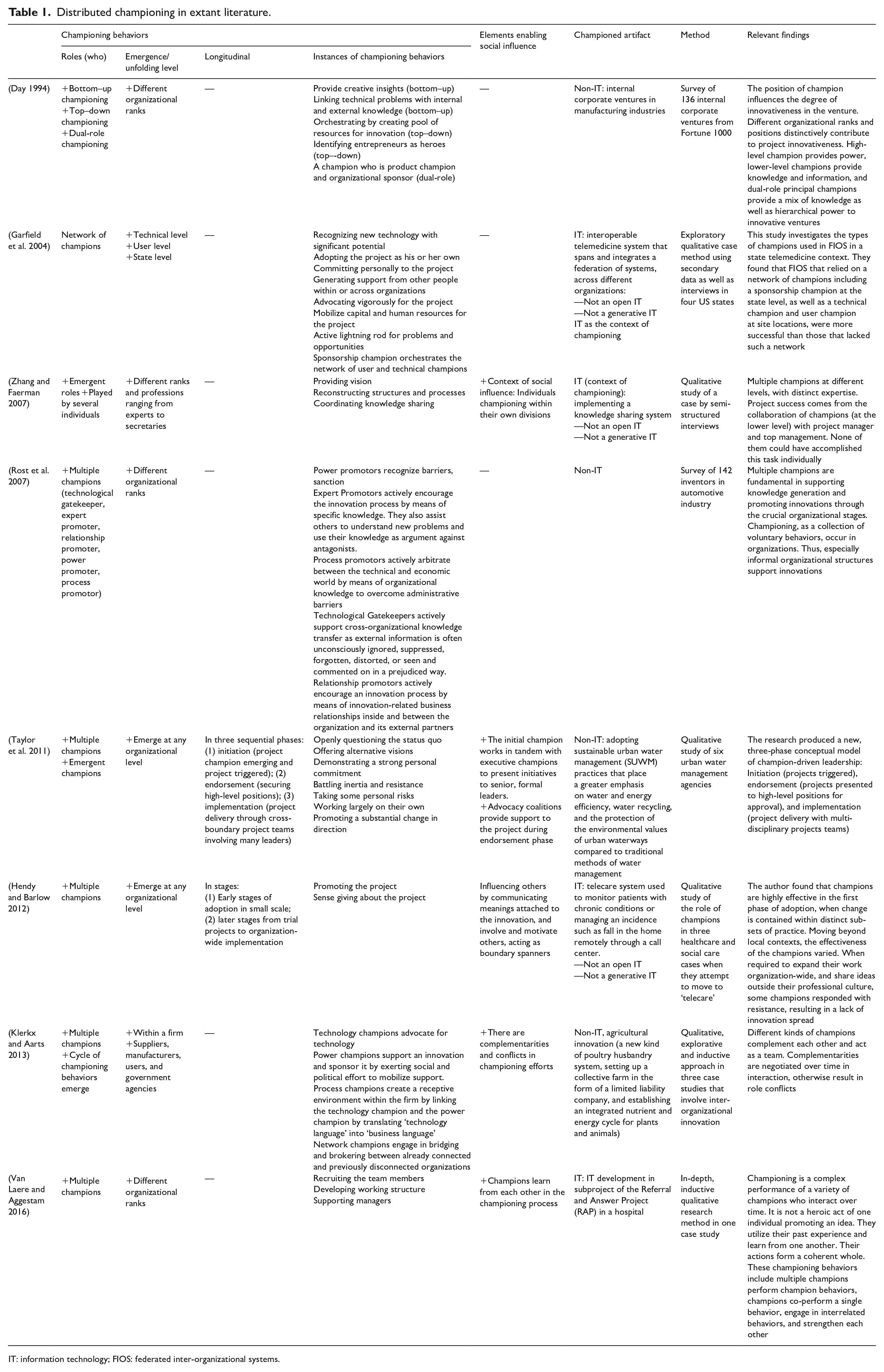
More recent championing research, however, has moved beyond looking at “the champion” and her behaviors to exploring distributed championing that adopts a more holistic view by acknowledging the role of multiple champions and their constellation of behaviors (Klerkx and Aarts, 2013; Zhang and Faerman, 2007). Table 1 summarizes the key studies of this research stream, with their synthesis leading to a number of conclusions.
Distributed championing in extant literature.
IT: information technology; FIOS: federated inter-organizational systems.
First, these studies suggest that successful IT implementation may not be achieved by the mere reliance on the champion. Regardless of position, an IT champion cannot individually overcome a variety of technical, political, and administrative barriers to an IT implementation (Garfield et al., 2004; Rost et al., 2007). In such circumstances, champions often stem from different organizational ranks within (Van Laere and Aggestam, 2016) or across an intra-organizational network (Klerkx and Aarts, 2013). Whether at technical, user, or executive level, there may be one or a few initial champions in an IT implementation (Taylor et al., 2011). Research shows that new champions emerge over time exhibiting diverse championing behaviors (openly questioning the status quo, offering alternative visions, demonstrating a strong personal commitment, battling inertia and resistance, promoting a substantial change in direction) over the course of an IT implementation (Hendy and Barlow, 2012). For instance, in a survey of 136 internal corporate ventures from Fortune 1000, Day (1994) recognized three championing paths involving multiple individuals: bottom–up (low-level informal power, influence, and relationships to obtain knowledge resources and build coalition), top–down (direct, early management sponsorship), and dual-role process, which incorporates the champion acting from the bottom and the sponsoring individual, from the top, mixing knowledge, information, and hierarchical power). The multiplicity of champions, their expertise, and organizational rank contributes to overcoming a range of technical, political, and administrative barriers to a successful IT implementation.
Second, to overcome barriers, champions need to engage in social influencing of other individuals to secure knowledge or power resources that are possessed by or are under the control of other people or units (Day, 1994). IT implementations need a variety of “advocacy coalitions” that support the project (Taylor et al., 2011) through their technical, power, process, or relationship contributions (Rost et al., 2007). To form advocacy coalitions and secure their commitment, champions engage in influencing others by acting as boundary spanners who communicate meanings attached to an innovation (Hendy and Barlow, 2012), facilitate learning from each other’s experiences (Van Laere and Aggestam, 2016), and motivate the sharing of scarce resources (Howell et al., 2005) within the context of an IT implementation. If successful, champions can expand the reach of championing behaviors across departments (Zhang and Faerman, 2007) and organizations (Klerkx and Aarts, 2013). While the process of social influencing aims to find new champions to complement existing championing behaviors necessary for project success, it is also associated with tensions among champions, which makes the process of social influencing far from straight-forward (Klerkx and Aarts, 2013). Distributing championing to multiple champions requires a significant shift for the passionate, initial champions to share the control of project championing with others. Otherwise, research shows that tight control of championing leads to resistance and would subsequently diminish the ability of initial champions to evangelize new champions to share their tangible and intangible resources in support of the project (Hendy and Barlow, 2012). Therefore, champions proactively expand their reach by socially influencing and recruiting new champions (Van Laere and Aggestam, 2016) from a diversity of disciplines (Taylor et al., 2011).
Overall, the review of the distributed championing literature shows that championing has been recognized as a distributed phenomenon involving multiple actors, with various expertise, ranks, and motivations, who collectively engage in championing activities. Distributed championing involves multiple champions influencing one another when they collaboratively leverage their different expertise, rank, and past experience to promote an IT implementation (Van Laere and Aggestam, 2016). Champions’ efforts could also extend to involve suppliers, manufacturers/users, and government agencies with champions not necessarily acting as one in promoting an innovation, but rather different kinds of champions representing different sets of functional competencies complementing each other (Klerkx and Aarts, 2013). This magnifies the role of initial champions in communicating the meaning of a new initiative and sense giving to socially influence others and turn a variety of individuals into champions of their project.
However, the process of exerting social influence through which “different champion(s . . .) influence each other [. . .] and execute their collaborative performance” (Van Laere and Aggestam, 2016: 48; emphasis added) may not always be successful and can fail for three reasons. First, social influence requires sharing ownership of a project with others who may champion it in ways that are not in line with the initial champion’s vision. Therefore, some initial champions may not open their projects to other potential champions for various contextual or personal reasons (Hendy and Barlow, 2012). Second, assuming that the initial champion does influence others to begin exhibiting their own championing behaviors either because these individuals identified with the champion or her message (Kelman, 1958), collectively championing large-scope projects with a diversity of stakeholders is challenging (Klerkx and Aarts, 2013), an endeavor often faced with group-level antagonism (Markham, 2000; Markham et al., 1991) as evidenced, for instance, in IT implementations in healthcare (Lapointe and Rivard, 2005). Third, as a project progresses and its needs evolve, other individuals may need to exhibit championing behaviors as a result of their identification with incumbent champions or their “sense giving” messaging. Here again, social influence can be unsuccessful should incumbent champions be unable to relay accurately and meaningfully an innovation’s meaning across domains, whether to another department or to an external stakeholder, such as a supplier or government body. Today’s heterogeneous work environments make it difficult to transcend across domains and translate what an innovation means for others. These three challenges make championing and the exertion of social influence through which it is performed, an unpredictable, fuzzy, iterative process of contextually dependent collective social interaction, rather than a sequential, stage-based path of initiation, endorsement, and implementation, as previously detailed by Taylor et al. (2011).
While existing models show that champions influence each other in a distributed championing process, there is a need for additional precision as to how they do so initially and then subsequently, over time. Recent championing studies call for studying “how the relations between different champions and their behaviors develop across innovations and over time, in order to develop a richer understanding of championing” (Van Laere and Aggestam, 2016: 1). Existing, sequential models of championing (Taylor et al., 2011) do not fully capture the complexity, fuzziness, and unpredictability of the process of distributed championing (Hendy and Barlow, 2012). Understanding the inner workings of social influence, which often enables the coordination of championing behaviors by multiple individuals (Van Laere and Aggestam, 2016) has managerial importance as research shows that champions fail quite often in their endeavors (Hendy and Barlow, 2012). Therefore, while the review of the literature shows that championing involves multiple champions (Zhang and Faerman, 2007) who learn from each other’s experiences and collectively promote an innovation in organizations (Van Laere and Aggestam, 2016), the process by which an initial champion reaches out to new entities (i.e. people, units, or organizations), socially influence them, and secure their championship remains unclear. This justifies adopting a social lens to explore the process by which champions successfully (or unsuccessfully) succeed in influencing others.
In addition, the review of the literature shows that the nature of the IT artifact has been less attended to when studying the championing process. While an IT artifact has been present in half of the studies exploring distributed championing (Garfield et al., 2004; Hendy and Barlow, 2012; Van Laere and Aggestam, 2016; Zhang and Faerman, 2007), not much is known about the impact of the nature of IT on the championing process. More specifically, existing distributed championing research has either explored non-IT championing projects (e.g. internal corporate ventures in manufacturing companies (Day, 1994), or sustainable urban water management processes (Taylor et al., 2011)) or have mainly treated IT as a context for studying championing without exploring the role of the IT characteristics, per se, on the championing process (e.g. championing in telecare system (Hendy and Barlow, 2012) or championing in an IT development project (Van Laere and Aggestam, 2016)). However, the nature of IT can have implications for the process by which distributed championing unfolds. As such, championing a proprietary technology, such as an Enterprise Resource Planning (ERP) system, can be different from an open technology, broadly based on “accessibility of knowledge, [. . .] transparency of action [. . .] and inclusiveness of participation” (Schlagwein et al., 2017: 297), in that the latter can engage a wider range of individuals in the distributed championing process.
This study focuses on these gaps by exploring the process by which champions engage in socially influencing others to be part of the distributed IT championing process. It also explores the impact of the nature of IT artifact in this process. The study extends past distributed championing research that develops a sequential process of distributed championing (as detailed by Taylor et al. (2011)), which may be less applicable in the context of a process of distributed championing characterized by complexity, fuzziness, and unpredictability. It also extends studies that mostly look at the outcomes of engaging others (e.g. learning from other champions, as shown in Van Laere and Aggestam (2016)), and less on the process of social influencing. It is to understand better the dynamics of social influencing and the interactional aspects of distributed championing that we draw on social capital theory.
Social capital
Drawing on earlier work (Bourdieu, 1986; Granovetter, 1985), social capital, as the quintessential social lens, is rooted in the interactions that take place between actors and, in itself, represents a type of resource that does not belong to any one individual but is embedded in the relationships shared by these actors (Coleman, 1988). Social capital is a multidimensional construct consisting of three dimensions, namely structural, cognitive, and relational (Nahapiet and Ghoshal, 1998).
First, structural patterns of relationships between individuals have been shown to influence the emergence of champions, as some individuals due to their very locations in these groups find themselves better suited than others to bridge conceptual, functional, and behavioral gaps between individuals and, in doing so, exhibit championing behaviors. Therefore, an examination of the network structure of multiple individuals can shed light on the structure and dynamics of distributed championing (Mehra et al., 2006).
Second, shared interpretations and meanings common among individuals are exemplars of the cognitive dimension of social capital. Given that exhibiting championing behavior “involves not just social intelligence (i.e. the accurate perception of social relationships in organizations) but also the management of others’ perceptions” (Balkundi and Kilduff, 2006: 425), research suggests that distributed championing may be facilitated when individuals show some degree of homogeneity across their shared narratives.
Third, the relational dimension of social capital reflects key elements of the relationship and the interdependence between individual actors. For example, trust is an intrinsically relational characteristic shared by two individuals in the sense that it is defined only in the context of the relationship between one actor and another. It is not a characteristic of individuals as independent, discrete entities. In the context of distributed championing, trust between the individuals exhibiting championing behaviors at different times over the course of an IT implementation is paramount given the need to influence others and often the lack of authority usually associated with more traditional, vertical forms of leadership (Uhl-Bien, 2006). Taken together, these three distinct dimensions of social capital are uniquely suited to shed light on distributed IT championing.
Method
Building upon the salient takeaways that emerged deductively (Webster and Watson, 2002) from the analysis of the extant literature but aiming at an inductive theory development, this study adopts an analytic induction strategy (Patton, 2002). In light of the available extant literature related to championing, in general, and distributed championing, in particular, this empirical approach was deemed to provide the best methodological fit for this study (Edmondson and McManus, 2007). As previous studies in information systems (Lapointe and Rivard, 2005; Rivard et al., 2011) have shown, analytic induction uses qualitative data from interviews to seek evidence that not only supports key insights from extant literature, but also allows for instances of so-called deviant cases that may come to contradict previous conceptualizations of the phenomenon of interest or yield novel, complementary insights (Patton, 2002). Qualitative data from semi-structured interviews were analyzed in an iterative manner by cross-checking, assessing, and interpreting theoretical constructs against the empirical data, while allowing for the empirical data to inform and shape the theoretical constructs. The different steps of the research process are summarized in Figure 1. The next sub-sections provide details on the context of the study, its data collection, and data analysis strategies.
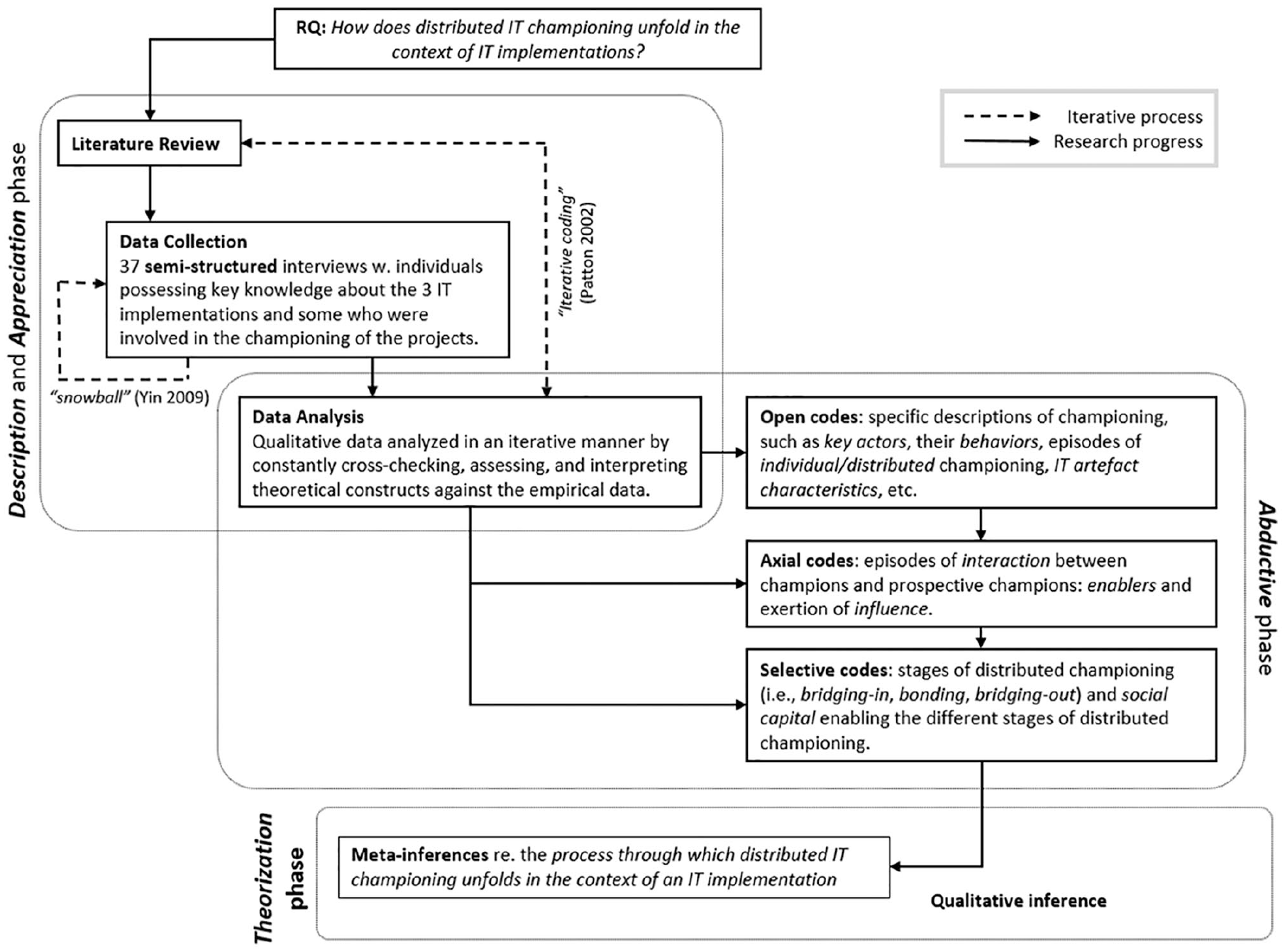
Summary of research process.
Context of the study
While extant research shows that IT is now considered one of the driving forces behind improvement in the delivery of healthcare (Bernstein et al., 2007; Yang et al., 2013), implementations of health information technologies are notoriously difficult (Kaplan and Harris-Salamone, 2009) with a high incidence of unsuccessful projects (McManus and Wood-Harper, 2007). To overcome the challenges imposed by such implementations, IT championing has been shown as vital to the success of new IT projects in hospitals (Bernstein et al., 2007). IT implementation success in a healthcare context relies, in part, on how a project is being facilitated to ensure a sense of urgency and purpose and to win the support and active engagement of stakeholders (Lapointe and Rivard, 2005). In addition, it appears important to inform and engage professional staff (Kohli and Kettinger, 2004) and ensure direct lines of communication between executive leaders and opinion leaders in the medical community. Given the crucial role of multiple instantiations of championing behaviors to the success of IT implementations in hospitals (Boonstra and Broekhuis, 2010; Gruber et al., 2009; Ludwick and Doucette, 2009), the health domain was deemed an appropriate and revealing context for this study (Chiasson and Davidson, 2005).
Data collection strategy
The case data were collected as part of studies of IT implementations of Electronic Medical Record (EMR) systems, in healthcare-related settings. The functionality of the EMR systems was similar across cases to include (1) the digital patient records, diagnosis, and notes, –that is, the digital equivalent of the paper chart and (2) the prescription records. Three research sites were selected based on theoretical sampling (Corbin and Strauss, 2008), while striving to ensure areas of similarity and discrepancy so as to allow for a compare-and-contrast data analysis approach (Eisenhardt, 1989). As far as similarities are concerned, the locations were healthcare settings—professional bureaucracies (Mintzberg, 1980)—where the same types of actors (i.e. practicing physicians, medical residents, nurses, administrative staff) participated in the IT implementation and where diverse championing behaviors could be observed. While the study explores the same phenomenon in all three cases (i.e. a successful—identified as such by a majority of respondents—EMR implementation), as shown in Table 2, the organizations varied by location, IT implementation scopes (e.g. hospital-wide implementation vs a hospital unit deployment), and IT artifact characteristics (e.g. commercial solutions limited to considerable customizability or open source solution with extensive customizability). The variations across the different settings provide opportunities to explore how the distributed IT championing may be shaped differently across cases.
Selected case details.
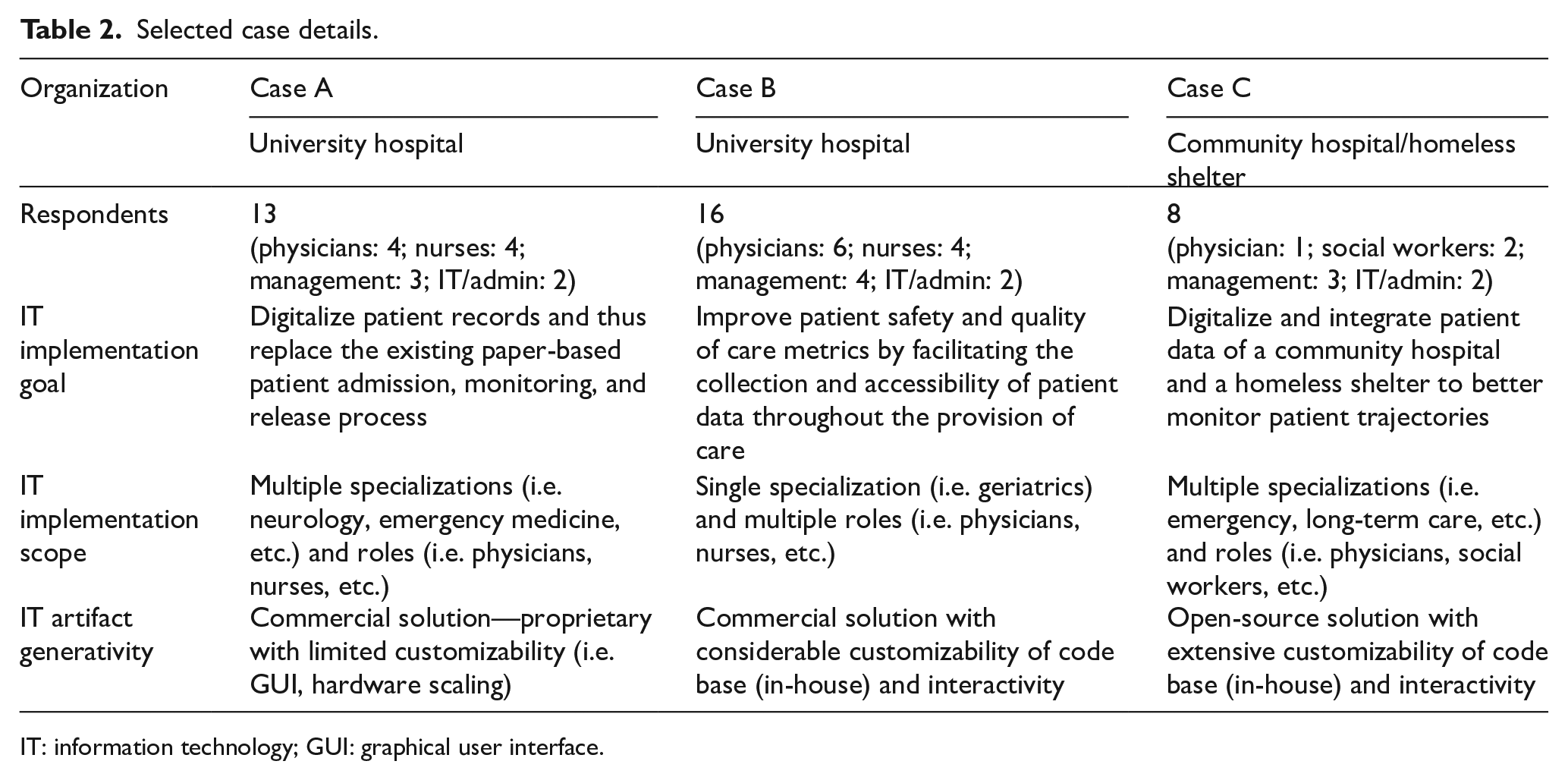
IT: information technology; GUI: graphical user interface.
Interview sessions began with key informants from the executive or management levels (e.g. healthcare facility directors, chief information officers (CIOs), project managers) to obtain a comprehensive and high-level perspective of the IT implementation and of its championing process. Using a snowball procedure (Yin, 2009), these key informants were then asked to identify additional respondents for subsequent interviews. Specifically, interviewees were asked to identify colleagues that, during the IT implementation, have exhibited championing behaviors, such as boundary spanning and knowledge brokering (Howell and Shea, 2001), building and sustaining momentum for the IT implementation (Howell et al., 2005; Neufeld et al., 2007), building networks (Howell and Boies, 2004), and exerting influence to secure financial, informational, and human resources (Akkermans and van Helden, 2002), among others. In line with the idea that champions go beyond the requirements of their job (Schon, 1963), it was important to the selection of additional respondents that their behaviors be in excess of their formal job requirements. The respondents included IT staff, management, as well as physicians and nursing staff. Multiple interviewees per location were selected for inclusion in the study in an effort to get a broad overview of the implementation process and to reduce possible response bias and inaccuracies due to poor recall (Yin, 2009). A total of 37 people were interviewed who were able to contribute critical information about championing behaviors during the IT implementation in their respective organizational contexts.
The face-to-face, semi-structured interviews were conducted on-site. The unit of analysis was the IT implementation project. The interviews began with generic questions, inviting respondents to share their personal and professional experience with the IT implementation, such as “When and how did you hear about the IT implementation?,” “What was your role in the IT implementation?,” “How did your contribution to the IT implementation evolve over time?” The interviews continued with specific questions related to the championing of the IT implementation, including “Thinking about your contribution to the IT implementation, was it part of your job responsibility?,” or “Who were the individuals that were critical in pushing the IT implementation forward?,” “What did they do?,” “How did they do it?,” “When, in the IT implementation, did they do it?” At this stage, the interviews focused on narratives of the respondents’ own or their colleagues’ behaviors that exceeded job-related expectations when overcoming barriers to the IT implementation. On average, each interview lasted one hour and elicited the respondents’ narratives. Data collection ended at the point of saturation (Corbin and Strauss, 2008), when no new information emerged during the interviews and when no new respondent was identified by her colleagues as a potentially valuable source of relevant information. The individual interviews were audio recorded in their entirety and transcribed verbatim.
Data analysis strategy
The qualitative data were coded using QSR NVivo11 (Jackson and Bazeley, 2019), in an iterative manner. During the first rounds of open coding (Corbin and Strauss, 2008), data elements from the transcripts containing specific descriptions of championing, such as key actors, their behaviors, episodes of individual/distributed championing, IT artifact characteristics, etc., were assigned to tentative labels or terms, as used by the informants. As the data analysis progressed, axial coding (Corbin and Strauss, 2008) was performed, whereby the labels were constantly compared to one another so that relationships between the labels identified during open coding could be established. For instance, episodes of interaction between champions and potential champions, the enablers of their interactions, and the exertion of influence. In the spirit of the analytic induction approach to theory building, the data analysis involved moving between open and axial coding and sometimes reverting between the raw data from the interviews and the literature (Patton, 2002). Specifically, in this case, to identify, read, and synthesize directly relevant extant literature that would help explain theoretically the empirical observations related to the interactions between champions and potential champions (i.e. the social capital lens and Kelman’s (1958) conceptualization of social influence). Finally, reflective of selective coding (Corbin and Strauss, 2008), labels could be collapsed when they differed but the empirical data reflected a shared theoretical basis. For instance, informants’ references to reporting structures, shared problem interpretations, and mutual trust, as enablers of their distributed championing, were associated with social capital, as they spoke to different dimensions of that concept of interest.
The reliability of the coding process was assessed by having the two researchers involved in the data coding process code 20 pages of transcripts (Von Eye and Mun, 2012). A comparison of coded excerpts showed a good level of agreement, with inter-rater reliability of 0.89 superior to the recommended level of 0.70 (Boudreau et al., 2001; Landis and Koch, 1977).
By alternating between data, emerging insights, and existing theory, the analysis unveiled areas of convergence of evidence across cases (Eisenhardt, 1989). Three main categories of insights emerged in relation with distributed IT championing in the context of an IT implementation: the role of IT artifact generativity in making it more conducive to distributed IT championing, the enabling role of social capital in distributed IT championing, and the stages of distributed IT championing. These insights were integrated into an overall process model that explains how distributed IT championing is enacted and evolves over the course of an IT implementation.
Findings
The data suggest that championing behaviors can be exhibited by anyone, at any organizational level, at any time during an IT implementation: from managers securing and providing resource allocation in excess of what is specified in the project plan of an IT implementation (in Case A), to physicians reaching out to pharmacists to share technical insights (in Case B), to software engineers going over and above their formal job requirements in training clients on newly delivered functionality (in Case C).
Although different in terms of organizational contexts represented and type of systems implemented, evidence indicates that, as an IT implementation unfolds, distributed IT championing evolves through an iterating sequence of stages (detailed and conceptually defined in Table 3). First, during bridging-in, an initial champion reaches out to others that have been identified as potential champions to overcome initial resistance to the IT implementation. Second, during bonding, having internalized the initial champion’s messaging, the previously identified potential champions become champions in actuality, coalescing around the IT implementation agenda and exhibiting their own championing behaviors aimed at securing socially held resources necessary for furthering the IT implementation. Third, during bridging-out, the champions act in concert to reach out to other potential champions to pursue and extend the reach of the IT implementation. Enabled by social capital and the nature of the IT artifact, the stages of bridging-in, bonding, and bridging-out iterate over time, in what could best be qualified as cycles of distributed IT championing (detailed in Figure 2).
The stages of distributed IT championing.
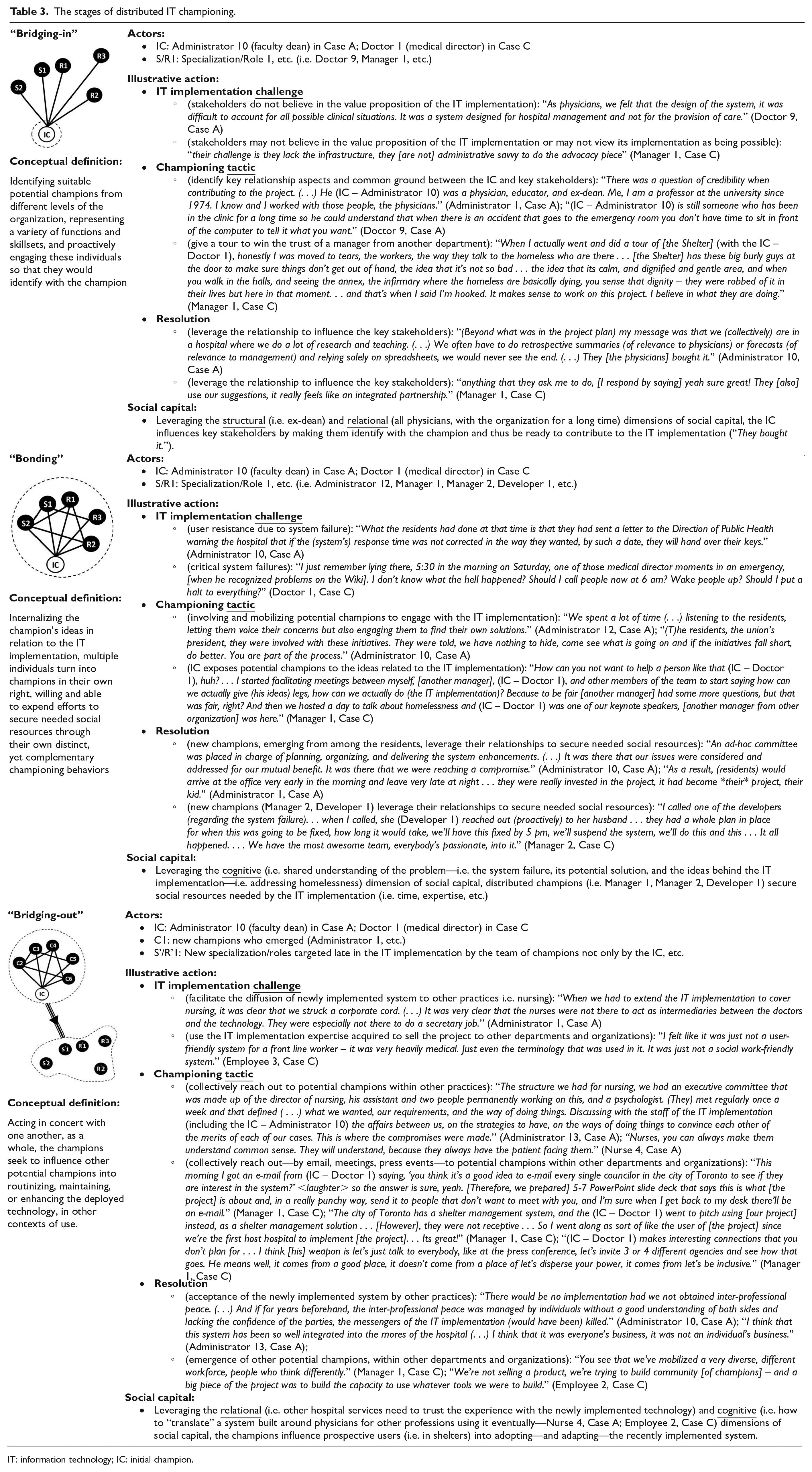
IT: information technology; IC: initial champion.
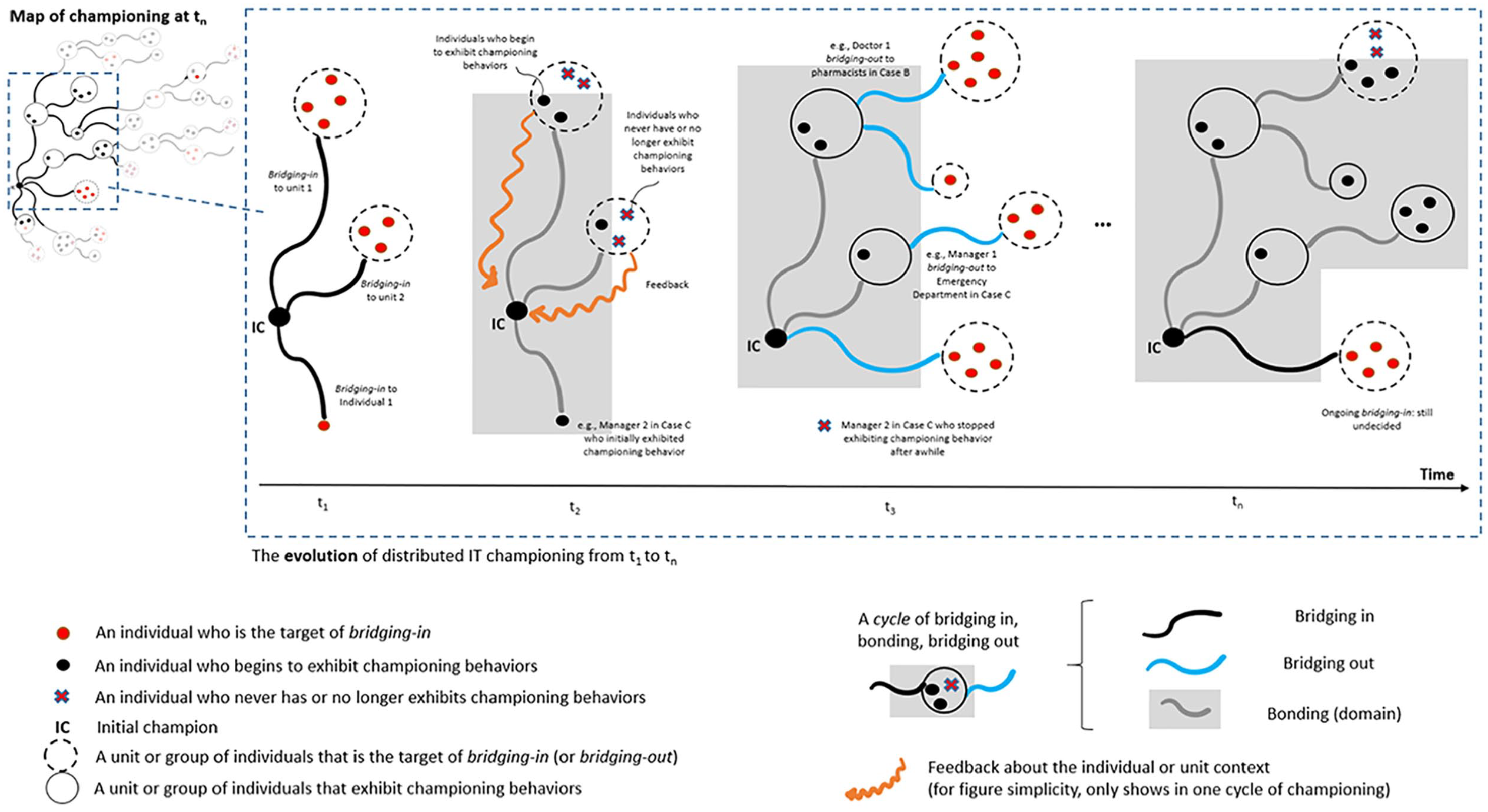
Process of distributed IT championing.
Stages of distributed IT championing and social capital
Overall, the results suggest that in IT implementations where champions lack power and direct-line authority, the enactment of distributed IT championing is enabled by the social capital, the goodwill, embedded in the relationships between actors (Adler and Kwon, 2002; Kwon and Adler, 2014). Illustrated in all cases is the idea that in order to influence others in distributed IT championing, the ability to leverage social capital is essential.
Given that championing rests on “the management of others’ perceptions” (Balkundi and Kilduff, 2006: 425), it follows that distributed IT championing is enabled when individuals are able to heedfully interrelate (Weick and Roberts, 1993) their narratives. These shared interpretations and meanings across individual members of an organization, the result of repeated socially embedded interactions among individuals (Faraj and Sproull, 2000) are examples of cognitive social capital. Describing how distributed IT championing was enabled in one of the cases, a respondent said: There was an intelligent approach. That is to say, that we appealed to the peoples’ intelligence, to their understanding of what the system can provide to them and how it can assist them in improving themselves the things that they do . . . a cerebral approach rather than an administrative one. If we had a more impersonal, more technical approach, I am certain we would have had much more difficulty. It was the human side that was much appreciated. (Administrator 1, Case A; respondent’s emphasis)
Leveraging a shared understanding, which in this case was non-administrative, non-technical in nature, by all parties (i.e. managers, physicians, and nurses) involved in championing the IT implementation, helped enable distributed IT championing. Because the potential champions individually and collectively understood “what the system can provide to them,” they were put in a position of “improving themselves the things that they do” (Administrator 1, Case A) through their own championing behaviors.
Transparency and openness, reflective of trust between individuals also make distributed IT championing possible. Trust, associated with relational social capital, is a relational element shared by two individuals and it is defined only in the context of their relationship. It is not a characteristic of the individuals as independent, discrete entities. In distributed IT championing, trust is essential given the lack of authority usually associated with the individual-centric view of championing (Uhl-Bien, 2006).
Also prompted by the absence of hierarchy and explicit power structures, the pattern of relationships, or structural social capital (Nahapiet and Ghoshal, 1998), dictates which individuals are in a position to engage in championing. Such individuals, for instance, are those in a position to bridge conceptual and functional gaps within the organization (Burt, 2004; Mehra et al., 2006). Speaking of one such instance when the relations between different professions have influenced their ability to leverage their specialized, differentiated, and complementary skills to facilitate the IT implementation, one of the respondents pointed out that There was this clash between the pharmacists and the physicians, because I think by definition, the physician will have trouble being scrutinized or second guessed on his prescription . . . by somebody that is not a colleague from the same profession. (Doctor 2, Case B)
Nonetheless, championing behaviors were enacted by one representative of a group of individuals (i.e. the pharmacists), that individual becoming one of the champions of the IT implementation by representing the bridge between the physicians and the pharmacists: It is the physician that has final responsibility with respect to the medical prescriptions and formalizing protocols. But in Geriatrics, given patients’ co-morbidities, the pharmacist is a key player when it comes to prescriptions. [. . .] she has background information, she knows things, (and) she was a leader in shaping the information system. [ . . .] in the end, the physicians shaped the module with the pharmacists’ direct input. (Doctor 1, Case B)
By taking note of the saliency shown in the dimensions of social capital, namely cognitive, relational, and structural, as reflected in the narrative accounts of the IT implementations provided by the respondents, the evidence suggests that distributed IT championing is constituted of iterative cycles of sequential stages of bridging-in, bonding, and bridging-out. Shown in Table 3, the stages are conceptually defined and are detailed in terms of their (1) key actors, (2) action sets, constituted of managerial challenge, championing intervention, and resolution episode, as suggested by Paré (2004), and (3) salient social capital dimensions. While each action set is illustrated with quotes from different cases, as particularly critical or revelatory cases (Patton, 2002; Yin, 2009), the evidence resonates across all cases.
In all three cases, during bridging-in, distributed IT championing is evidenced in a champion identifying suitable potential champions from different levels of the organization, representing a variety of functions and skill sets, and proactively engaging these individuals to identify with the persona of the initial champion. It is in this context that the initial champion mainly leveraged the structural and relational dimensions of social capital they had with potential champions to “sell” the project.
As the IT implementation progresses, the cognitive dimension of social capital becomes increasingly salient in enabling distributed IT championing. The ability to influence others is predicated on having a common understanding of the underlying issues associated with the IT implementation and on having a shared problem space and mental models to guide a commonly accepted path forward. Thus, the cognitive dimension of social capital appears as a key element that makes distributed IT championing work, for instance, between hospital administrators and physicians acting as champions, in Case A: [W]hen I approach one of my colleagues to contribute (to the IT implementation), I address him essentially from a medical perspective, using the spoken and unspoken medical jargon alike. [. . .] A physician is not to be managed in an authoritative fashion because they are not employees. They have a certain freedom of action. (Administrator 1, Case A)
During bonding, distributed IT championing sees multiple individuals begin to exhibit championing behaviors with the aim to facilitate the IT implementation. Their increased homophily, characterized by shared understanding and internalization of the champion’s ideas in relation to the IT implementation, sees multiple individuals turn into champions in their own right, willing and able to expend efforts to secure needed social resources. Distributed IT championing at the bonding stage rests on informally and collectively coordinating a multitude of distinct, yet complementary championing behaviors, by multiple champions.
As a coalition of champions emerges, acting in concert with one another, as a whole, the champions seek to influence prospective users into routinizing, maintaining, or enhancing the deployed technology. Enacting education and mentoring activities (“be careful, we propose a system but it is the geriatric system. It comes with certain functionality but it is necessary that it adapts to your practice.” (Doctor 1, Case B)), the relational and cognitive dimensions of social capital become paramount in enabling distributed IT championing during bridging-out. For prospective users reflecting new roles and specializations characteristic of new use contexts to identify with the coalition of champions, they need to trust the champions’ situated IT implementation experience (“(i)nitially they had no experience with this service . . . now they have experience, they came back to us (the coalition of champions)” (Doctor 1, Case B)) and be able to see the value proposition of the IT implementation for them, in particular.
All in all, the findings suggest that social capital shapes the stages of bridging-in, bonding, and bridging-out, as constituent elements of distributed IT championing. In addition, we observed that in the course of an IT implementation, the conclusion of a bridging-out stage essentially primes a subsequent bridging-in stage, which could best be described as the beginning of the next cycle of distributed IT championing.
Iterative cycles of distributed IT championing
Our findings show that the stages of bridging-in, bonding, and bridging-out occur in cycles of distributed IT championing, whereby multiple individuals enact (and may cease to enact) championing behaviors over time and throughout the course of the IT implementation. While the multi-staged nature of championing, including the formation of “advocacy coalitions,” has been reported in extant literature (Taylor et al., 2011), as detailed in Table 4, our findings detail how bridging-in, bonding, and bridging-out are not a one-time occurrence, but rather iterate over time. This helps explain how the distributed IT championing effort grows organically to encompass new individuals, as champions, as they are influenced and become evangelized by incumbent champion(s) over the course of an IT implementation.
Cycles of distributed IT championing evidenced in Case B.
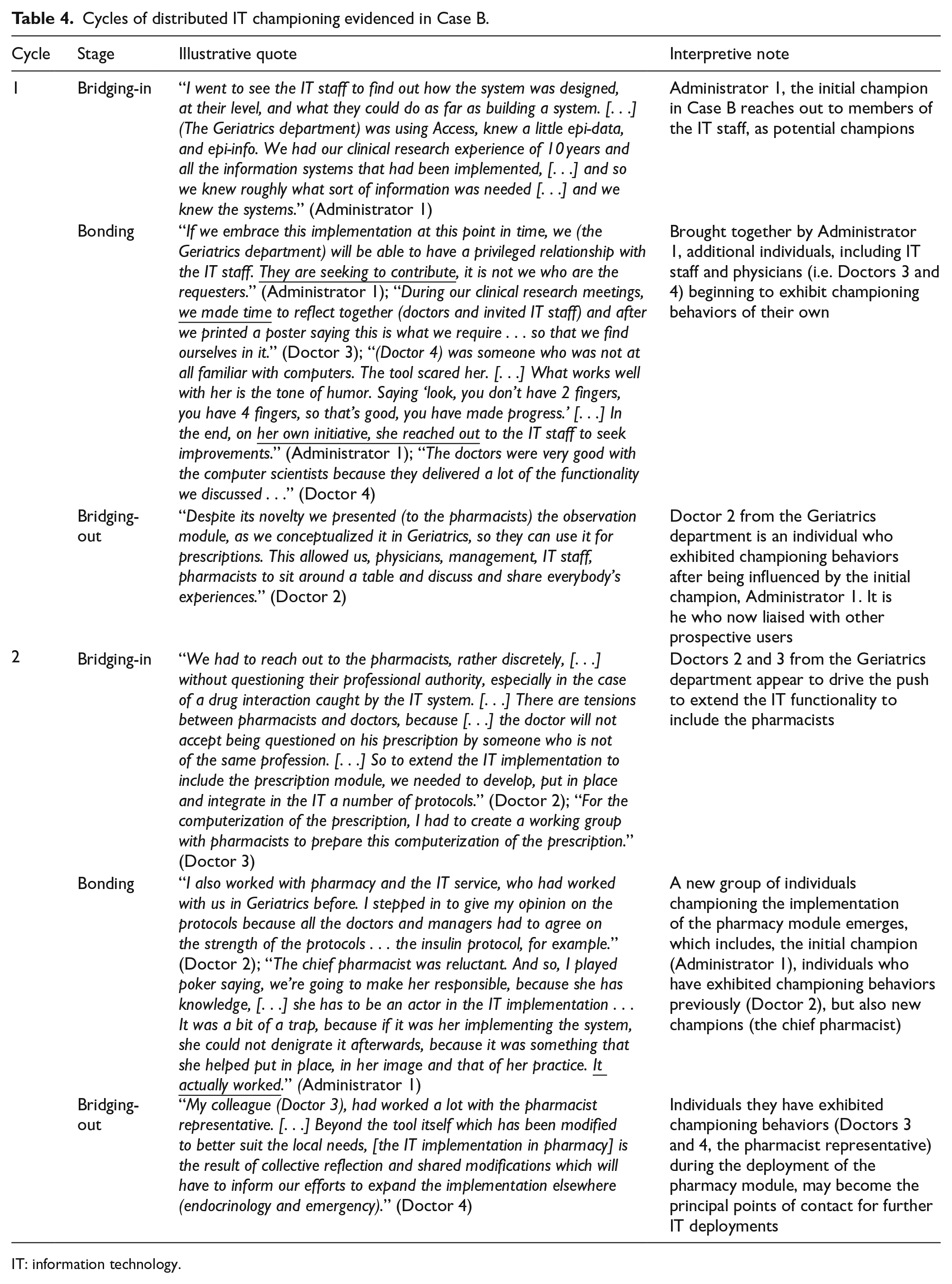
IT: information technology.
Of particular note in these data, in addition to the iterative cycles of distributed IT championing, with each cycle constituted of instances of bridging-in, bonding, and bridging-out, is that the role of the initial champion (Administrator 1, in Case B) appears to diminish as the IT implementation extends to other departments and hospital services. Instead, those that he influenced and evangelized earlier in the IT implementation (i.e. Doctors 2, 3, and 4 from the Geriatrics department, as well as certain pharmacists) take the mantle of supporting the IT implementation by exhibiting championing behaviors.
Iterating cycles of distributed IT championing have been noted in all cases, with Manager 1 from Case C (one of those individuals influenced by that case’s initial champion, Doctor 1) and who continues to promote the IT implementation. In bridging-in to a new organization (Emergency Department) potentially interested by the newly digitalized and integrated patient data, Manager 1 mentions, (w)ell it was a bit of both [push and pull with the Emergency Department’s (ED) director who was Manager 1’s peer in the administration], I was more of the facilitator. I set it up so [the director of ED] and ED physicians get together. (. . .T)hey’re all University of Toronto graduates too, so once they met, [. . .] they were understanding each other. I brought (the ED staff) together and was called upon to coordinate the training and then over to you Angela (ED staff). [. . .] [finally] the ED director sat right in front at this presentation, totally engaged, and makes a comment like ‘we’d love to implement this here’. [Then,] I started facilitating meetings between myself, the director of ED, and [the initial champion], and other members of the project to start saying how can we actually give this legs. (Manager 1, Case C)
Again, and especially during the bonding and bridging-out stages, the role of the initial champion diminishes with those that he influenced and evangelized earlier taking his place. The on-going interactions between Manager 1 and the initial champion (Doctor 1) became infrequent, mostly electronic communication: I deal him like electronically, but Angela was my contact on the actual implementation, and working with her on the board structure. [ . . .] (In addition), the director of ED now knows about [this project], we did a lot more education, we are applying for the ED support funds, we also host a community advisory committee so it’s like members of our stakeholder community and our staff. [The initial champion] is on that committee as well, and through that committee’s membership we educate the Community Care Access Centre, other smaller providers, other staff, so [the project] is a known entity here now. (Manager 1, Case C)
However, it should be noted that the cycles of bridging-in, bonding, and bridging-out can, at times, be interrupted, as evidenced by a manager who at the beginning of the IT implementation (in Case C) exhibited championing behaviors after being influenced by the initial champion (Doctor 1). As such, certain individuals who at one time exhibited championing behaviors, may, at a later time, stop championing an IT implementation: My role on [the project] has changed over time. [I initially helped] like a coordinator of integration, [such as] how do we connect the project to multiple agencies, multiple users, both locally and maybe even more provincially or even nationally. However, [over time] my relationship to the project has changed significantly . . . As far as contributions go, I had more to offer in those early days around development and strategic planning around this. I don’t think that’s been the case all the way through (when extending the IT implementation to the Emergency Department). I haven’t been completely
Process of distributed IT championing
Drawing on the cross-case analysis and observations related to the iterative cycles of bridging-in, bonding, and bridging-out stages, Figure 2 details how distributed IT championing unfolds in the context of an IT implementation.
In the main pane of Figure 2, encompassed by the interrupted line, we illustrate the unfolding of the championing process from t1 to tn. The path starts with the championing snapshot at t1, in which the initial champion reaches out to particular actors, either individuals or members of targeted units, to influence them and secure their support for the IT project. By t2, the initial champion may be able to secure some individuals’ support (e.g. Manager 2, in Case C; or Doctor 1, in Case B), yet others may fail to be influenced and do not begin to exhibit any championing behaviors. Both situations, when others begin exhibiting championing behaviors or when others do not, provide the initial champion with feedback about further potential champions depending on changing project needs. It is at this point that the championing becomes distributed as multiple individuals, having internalized the initial champion’s ideas in relation to the IT implementation, bond and complement their championing behaviors. By t3, acting in concert with one another, there is a collective championing effort aimed at bridging-out and influencing additional individuals and units to ensure on-going support for the IT project (e.g. Doctor 1 and colleagues, in Case B; or Manager 1 and colleagues, in Case C). By tn, as a result of the independent yet coordinated efforts of multiple champions of influencing other potential individuals into exhibiting their own championing behaviors, the distributed IT championing process may expand to encompass a greater number of individuals; however, that is not a guarantee. As distributed IT championing unfolds across multiple cycles of bonding-in, bonding, and bridging-out stages, there may well be individuals that have exhibited championing behaviors at some earlier point in the IT implementation that stop doing so later on (e.g. Manager 5, in Case C). This may indeed lead to the interruption of certain stages and cycles of distributed IT championing.
With regards to who contributes to the process of distributed IT championing, three generalizations can be made. First, the types of actors that enact championing behaviors change as distributed IT championing unfolds. For instance, in Case C, early in the IT implementation, city officials and medical professionals were championing the IT implementation by proactively reaching out to potential champions, as individuals that would be able to assist the technology deployment. As the IT implementation progressed, different actors (e.g. managers of other departments, social workers) became involved and exhibited their own championing behaviors. This inflow and outflow of individuals contributing to distributed IT championing through their behaviors can also be observed in Case A (early in the IT implementation: hospital administrators, physicians, and faculty management vs during the IT implementation: all actors, including residents and IT staff) and Case B (early in the IT implementation: hospital administrators, physicians, and IT staff vs during the IT implementation: physicians and IT staff). Notably, it is not only a single individual whose championing behavior appears particularly prominent at any one point in the IT implementation.
Second, while the data reveal a dynamic and continuous flux in the individuals enacting championing behaviors, the cross-case analysis shows some individuals consistently playing a role in distributed IT championing. For instance, in Case A and Case B, despite the high turnover of individuals that enact championing behaviors at different points in the IT implementation (from management to residents, to nursing, to IT staff), physicians represent a category of actors that exhibited championing behaviors throughout the IT implementation: We, as physicians, should not relay a negative message regarding the IT implementation to the management and nursing staff. If we start to complain about drawbacks and malfunctions, about the difficulties, everyone will begin to focus on shortcomings, everyone will start expressing concerns. And so, throughout the IT implementation, we were precisely there to try to have a positive discourse. (Doctor 3, Case B)
Probably due to the particular role they play in a professional bureaucracy (Mintzberg, 1980) afforded to them by their power and expertise, physicians recognize and appreciate their responsibility in setting the tone and staying involved in the IT implementation. This is not surprising since power stemming from affiliation with a professional practice has been shown to impact the trajectory of an IT implementation, either by promoting it or resisting it (Lapointe and Rivard, 2005; Rivard and Lapointe, 2012). Thus, while distributed IT championing is fundamentally different from the traditional approach to championing by having an inflow and outflow of actors co-enacting distinct, yet complementary championing behaviors, with the aim to facilitate the IT implementation, they are similar in that some individuals consistently play key roles in informally overseeing the process, while mindfully planning and reacting to emerging issues.
Third, in addition to social capital playing an important role in enabling distributed championing of an IT implementation, emerging inductively from the data, evidence suggests that the presence of a generative IT artifact opens up championing opportunities to a wider range of individuals. Generativity, as a property of the IT artifact, is the capacity of a technology or a system to be malleable by diverse groups of actors in unanticipated ways (Eck et al., 2015). Evidence suggests that generative IT enables different individuals with heterogeneous visions, goals, and needs to champion the IT implementation in line with their own interests. When the initial champion or other individuals that exhibit championing behaviors bridge-in to potential champions, these latter individuals are likely to discover and use key characteristics of the IT artifact, such as its interactivity or openness. They constantly find themselves interacting with and also influencing others in the organization with respect to the direction of the technology deployment. This collective shaping of the IT championing, as a result of using the system, is often done not in a predetermined or planned manner but in a rather organic nature, emerging from the interactions between the championing behaviors exhibited by multiple individuals. For instance, the openness of the IT artifact, which allows for its customization to better suit local contexts of use, fosters a broader distributed IT championing as more target individuals may resonate with its potential and may engage with one another to facilitate the IT championing and shape the IT project. Pointing to this relationship between the openness of the IT artifact and distributed IT championing involving IT staff and physicians, one of the respondents revealed that “we went to see this system and what its capability was. And then and there, in that meeting, we all understood that the potential was enormous in terms of development” (Doctor 1, Case B). It was the IT staff and physicians’ shared understanding of the system’s capability that acted as a catalyst and enabled individuals from both categories of actors to enact championing behaviors. As another example in Case C, Doctor 1 emphasized that “this whole open development idea get[s] the users to be developers,” which led users to co-develop the system in interaction with their colleagues and based on their preferences and the specifics of their work practices. As a more open technology, Doctor 1 in Case C credits the interactivity of the wiki (i.e. a website that allows collaborative editing of its content and structure by its users) for creating an organic and emergent environment that involves different individuals in the IT championing process: “[it has] instant documentation; it’s organized, it’s tracked, it’s iteratively built, by all.” The openness of the system is conducive to decentralizing the power and the responsibility in IT championing. Individuals who are bridged-in by others’ championing behavior may own new responsibilities and show new championing behaviors by negotiating, often emergent boundaries, with other actors in the IT championing process: (W)e saw the first time the computer scientists, who first built the functionality on paper, who reflected, and formalized each step of the module. After we went to see [the physician representative] and we understood what she was able to do, she understood what we knew. [. . .] The module is always changing as more functionality is added. It is a continuous exchange, with the physicians and the IT staff. The competence of evolving the system is now a collective characteristic.” (Doctor 1, Case B)
In addition to shaping distributed IT championing directly, the nature of the IT artifact may also indirectly influence distributed IT championing by enhancing the scope of the IT implementation. This is particularly apparent in Cases B and C, where the IT artifacts are open to modification. For instance, in Case C, the IT championing started with a limited scope, targeting certain individuals in a hospital and a shelter, and involving a multidisciplinary group that focused on making the initial prototype of the technology available to key stakeholders during initial IS use. Due to the immature and underdeveloped nature of the initial technology, the project had no potential to be showcased to a broader audience (i.e. limited IT implementation scope). However, as the working, open source prototype emerged, the actors championing the IT implementation were able to exploit the technology’s openness and interactivity, to showcase the work or bridging-in to other units and organizations, thus going deeper and broader in scope. As one of the respondents put it, pointing out how generativity may favor a diversity of individual champions and championing behaviors, “[an open source technology] immediately means it’s open to the public, anyone can inspect it, [. . .] it’s democratic because everybody can work on it.” (Doctor 1, Case C) The openness and interactivity of the technology, coupled with the showcase of its first prototype, helped convince a larger audience of the relevance and applicability of the technology to their particular needs and thus expand the IT implementation scope. This added scope, in turn, made the IT championing particularly relevant to other health partners and shelters, which prompted these individuals to champion the project. In the words of a social worker in a mental health unit, part of Case C, when [I] saw the technology (post modification), I decided to actively take part, learn, and also teach it others in their departments. I just thought, if we’re going to be using this, I want to be on top of it. [. . .] I took that on.
In contrast, in Case A with a closed, proprietary, commercially available solution, and thus a less generative technology, the breadth of IT championing was predetermined, to some extent, by a multidisciplinary group based on the available functionalities at the beginning of the IT implementation. Thus, a less generative IT artifact will not be able to foster distributed IT championing to the same extent as a more generative IT artifact since any additional potential champions will find it difficult to shape the scope of the IT implementation beyond what is already determined during the planning stages of an IT implementation.
Discussion and conclusion
Given the complexity of today’s IT implementations, characterized by increased scope and particularly generative technologies, the nature of championing an IT implementation has changed. What used to be viewed as the domain of a passionate champion, an often charismatic, subject-matter expert, who was with the project throughout its lifecycle (Beath, 1991; Chatterjee et al., 2002; Markham, 2000) is now a distributed endeavor bringing together a variety of actors at different stages of the IT implementation (Van Laere and Aggestam, 2016). As a result, solely taking into account the personal characteristics of select individuals, such as their levels of achievement, risk-taking, or innovativeness (Howell and Higgins, 1990), visioning (Chatterjee et al., 2002), and enthusiasm (Howell and Boies, 2004) provides only a partial view of what is a distributed, social process of facilitating an IT implementation in an organizational context.
This study’s objective was to explore IT championing and to examine how it unfolds across three IT implementations. The case studies showed that given an IT implementation of a considerable scope and the presence of a particularly generative artifact, a range of actors enact championing behaviors over time by leveraging different elements of social capital. As the IT implementation progresses, the process of distributed IT championing unfolds through iterative three-staged cycles that reflect the building of a coalition (during bridging-in), a collective effort to develop a shared understanding of the project benefits and coordinate complementary championing behaviors (during bonding), and the enactment of education and mentoring activities of other individuals likely to exhibit championing behaviors (during bridging-out). The analysis showed that the individuals’ social capital—specifically its cognitive, structural, and relational dimensions—plays a pivotal role in enabling this process.
The findings resonate, to some extent, with the concept of translation from the actor-network theory (Introna, 1997; Latour, 2005), in particular, the so-called “moments” of translation (e.g. problematization, interessement, enrollment, and mobilization), which allow a network to be represented as a single entity. As such, they reflect the efforts of an actor to “inscribe” others into roles proposed for them to address a particular problem, consolidate alliances through formalization of ties, and define the legitimacy of a spokesperson.
While extant literature has found evidence of the need to bridge and bond with professional groups to exert informal influence over their resources (Day, 1994; Kohli and Kettinger, 2004) or to build and leverage a clan in the context of the analysis and design of an enterprise system (Chua et al., 2012), the iterative three-staged cycles of distributed IT championing identified in this study represent a novel perspective. The evidence suggests that early in a cycle of distributed IT championing, during the bridging-in stage, behaviors aimed at coalition building enabled by the position in a network and shared trust are particularly important. However, the relative importance of the champion’s position in the network diminishes with time. After a while, the ability of various individuals to enact championing behaviors based on a shared problem space and mental model, which is reflective of the cognitive dimension of social capital, appears salient during the bonding stage. Finally, during the bridging-out stage, multiple individuals exhibiting championing behaviors acting in concert with one another, as a whole, leverage their cognitive and relational social capital to reach out to individuals in other contexts of use and influence them to support an IT implementation, before the cycle repeats. These findings with regards to the importance of the individual’s structural, cognitive, and relational dimensions of social capital between actors suggest that, when no formal authority is present, engagement in distributed IT championing rests on being well connected, having a shared understanding of the issues at hand, and being trusted by peers. These findings complement the extant literature on social capital, and particularly the study by Adler and Kwon (2002), by building an argument for the existence of subtle variations in the form of social capital (not all of them appear central all the time) and how certain of its dimensions become salient in enabling distributed IT championing at different times in the course of an IT implementation.
Furthermore, the evidence suggests that the scope of the IT implementation has a material influence on opening the IT championing to a diversity of actors, rather than the appointment of select individuals (Parr and Shanks, 2000). Nonetheless, the provision and co-enactment of championing behaviors in distributed IT championing is not a free-for-all, chaotic process. Despite the inflow and outflow of actors championing the IT implementation for a limited time, some individuals or professions remain at the heart of distributed IT championing. The constraint on who enacts championing behaviors, for instance, individual physicians, could be an artifact of the organizational types studied in these cases, namely professional bureaucracies (Mintzberg, 1980). This adds a new perspective to the emerging body of work on pluralistic championing of IT projects, which has predominantly considered actors to be either champions or not (Rost et al., 2007; Van Laere and Aggestam, 2016), in an almost binary way. However, our findings show that the multiple actors involved in distributed IT championing through their championing behaviors may have to be situated on a continuum, with some exhibiting championing behaviors that are sustained throughout the IT implementation while others do so only for a limited period of time.
Our results have broader implications for championing in extant literature. It contributes to the extant literature that has previously begun to recognize that the two existing approaches to championing (heroic and collective) can be combined and studied in conjunction (Rost et al., 2007; Van Laere and Aggestam, 2016). Initially, studies of championing focused on the individual aspects of the champion and suggested that the success of IT implementations cannot be achieved without the heroic acts of a visionary champion who passionately takes risks for the promise of a technology and performs the crucial functions of promoting the technology beyond his or her job requirements. However, this approach failed to explain the process by which the champion was able to secure a variety of crucial resources, which were controlled by others. More recently, others adopted a promotor approach (Rost et al., 2007) to study the role of several individuals in overcoming barriers to an IT implementation. This approach views championing as a distributed undertaking that is social in nature (Van Laere and Aggestam, 2016). However, the promotor perspective downplays the role of a hero individual and does not clearly differentiate the role of multiple individuals in the championing process. This study’s results provide an opportunity to reconcile the two approaches by showing that an initial, passionate champion may remain continuously active in the distributed IT championing process. By portraying IT championing not only as a process orchestrated by an initial champion but also evolving to encompass additional championing behaviors by multiple individuals, the study underlines the crucial role of the initial individual that shows championing behaviors in starting off what is essentially an evangelization process. However, it suggests that a single champion cannot secure the required resources unless the control of the championing process is released to other champions who can leverage different dimensions of social capital to influence others and turn them into champions. Mostly orchestrated by the initial champion, distributed champions can only collectively and collaboratively overcome different technical, organizational, political, and administrative barriers to an IT implementation.
Nature of the IT artifact and distributed IT championing
Our results suggest that the nature of IT artifact may render an IT implementation more conducive to distributed IT championing. This is a point of departure from previous arguments that personal characteristics drive active participation in technology initiatives (Chatterjee et al., 2002), employment of influence tactics (Howell and Higgins, 1990), or the building of positive momentum for change (Neufeld et al., 2007; Zhang and Faerman, 2007). In effect, the nature of IT artifact not only matters, but also shapes the process of distributed IT championing emergence and evolution. More precisely, generative IT appears to further distribute the sources of championing behaviors to include other individuals within and across units and specializations.
On one hand, in less generative technologies that are particularly closed and low in interactivity, the IT artifact’s impact on the process of distributed IT championing—to a variety of people with different specializations and at different levels or functional units—becomes limited. The rigid nature of an IT characterized by a tighter coupling between the content, service, network, and device layers (Yoo et al., 2010) narrows the pool of potential candidates for distributed IT championing to the ones who are either appointed or are among the few users who see a high degree of fit between specific IT functionality and their work. In these technologies, management predetermines the scope of the IT implementation and users from each unit are the recipients of the technology that has been adopted based on the “common” organizational needs that management foresees. On the other hand, however, open and interactive technologies provide a more fertile environment for distributed IT championing to involve a wider and more diverse range of organizational actors, thus reducing the initial champion’s control over IT implementation. The openness of the IT artifact provides further “interpretive flexibility” (Bijker et al., 2012) to users. This provides opportunities for users to take control and to extend the use of IT beyond a generic, common use. At the same time, the potential to expand the interaction between users and the open IT facilitates the creation of a collective effort aimed at customizing the IT based on the specific needs of certain units or professional groups. Thus, the IT artifact’s generativity, particularly its openness and interactivity, provides a fertile environment for collaboration of a wide and diverse range of users, who can proactively adopt and adapt the technology to their specific needs. Subsequently, the scope of the IT implementation will no longer be pre-determined (as it was the case with a less generative IT artifact) and, depending on the pattern of involved users in IT championing process, evolves over time to include new people in new departments with diverse specializations.
Contributions to research and practice
This study extends the literature on IT championing first, by extending the knowledge of the dynamics and nature of IT championing as a distributed process; and second, by explaining distributed IT championing’s social nature, rather than as an individual behavior shaped by personal characteristics. In doing so, the study extends the understanding of how IT championing facilitates IT implementations within an organizational context by actors who enact different championing behaviors as the IT implementation unfolds. It finds evidence that the scope of the IT implementation and the generativity of the IT artifact foster distributed IT championing by exposing the IT implementation to a larger pool of potential stakeholders and making it relatively easy for these individuals to champion the technology. Finally, the role of social capital in enabling distributed IT championing complements earlier conceptualizations of social capital (Adler and Kwon, 2002; Wasko and Faraj, 2005) by providing a longitudinal perspective on the evolution and saliency of particular dimensions of social capital as the IT implementation unfolds.
For managers, and those leading IT implementations in particular, the study reveals the importance of being aware and fostering the emergence of an organic, informal, less-controlled process of distributed IT championing. Distributed IT championing is more of a stewarding process rather than a management one (Rahrovani, 2020), in which a manager plays a formal gate-keeping role at specific moments in the course of the project. Since distributed IT championing is a social process, it is important for managers to appreciate the appropriate dimensions of social capital so that they can be leveraged by multiple champions when repeatedly engaging with bridging-in, bonding, bridging-out practices.
Limitations and future research
As with any study, its value ultimately depends on whether it proves generative in paving the way for future work. While a number of limitations need to be acknowledged, further research may go beyond the boundaries of this study. A few such opportunities arise.
One limitation of this study is that it has been based on the analysis of qualitative data from three cases in the healthcare domain. In light of research suggesting that managing in the context of professional bureaucracies is of a particular nature (Lapointe and Rivard, 2005; Mintzberg, 1980), researchers could explore and compare this study’s insights with those emerging from studies of distributed IT championing of IT implementations in other organizational types. Moreover, additional empirical scrutiny of distributed IT championing using a mixed-methods research methodology could be worthwhile. For instance, operationalizing and empirically testing the concepts behind this study should only strengthen the external validity of the findings.
Second, the findings of this work have been informed by the analysis of three successful IT implementations. Future work may be well justified to consider the specific context of unsuccessful IT implementations. Should such research uncover evidence of particularly large numbers of interrupted cycles of distributed IT championing or the lack of certain stages, whether bridging-in, bonding, or bridging-out, within such interrupted cycles, this would enhance the understanding of championing behaviors in IT implementations, namely who enacts them, when, and how. Furthermore, informed by the concept of requisite variety (Ashby, 1956), which states that the resolution of a complex problem partially rests in ensuring the right variety of responses to deal with the variety of the underlying issue, one can study the bridging-in stage, for instance, whether too much (or too little) diversity in championing behaviors decrease the chances of IT implementation success.
Third, future research could focus on the network structure and dynamics of distributed IT championing in the context of an IT implementation. As distributed IT championing and the social capital that facilitates it are fundamentally a question of network, this study opens the door to additional enquiries into detailing further the bridging-in, bonding, and bridging-out stages of distributed IT championing, from an actor-network theory (Introna, 1997; Latour, 2005) perspective. Of particular interest are questions related to who and when do they enact or stop enacting championing behaviors, as well as who ends up constituting the category of actors that sustains their championing behaviors throughout the IT implementation. While power, or perceptions of adding value through relevant expertise, may indicate who enacts championing behaviors (Van Laere and Aggestam, 2016), influencing others to contribute the resources and support needed to overcome barriers to an IT implementation, could also be a process driven by passion. As such, the difficulty of sustaining the passion for the IT implementation for the long term could be one of the factors that explains the fluidity observed in distributed IT championing.
All in all, above and beyond the immediate contributions to research and practice brought forth by this study, it is sincerely hoped that this work will prove generative in stimulating additional research on the topic of championing IT implementations.
Footnotes
Acknowledgements
The authors wish to thank the senior editor, Professor Blaize Horner Reich, and the reviewers for a developmental review process.
Declaration of conflicting interests
The author(s) declared no potential conflicts of interest with respect to the research, authorship, and/or publication of this article.
Funding
The author(s) disclosed receipt of the following financial support for the research, authorship, and/or publication of this article: The authors acknowledge the research support provided by the Fonds de recherche du Québec - Société et culture (FRQSC) and the Social Sciences and Humanities Research Council (SSHRC) of Canada.

Notes
Appendix
Championing by the heroic champion.
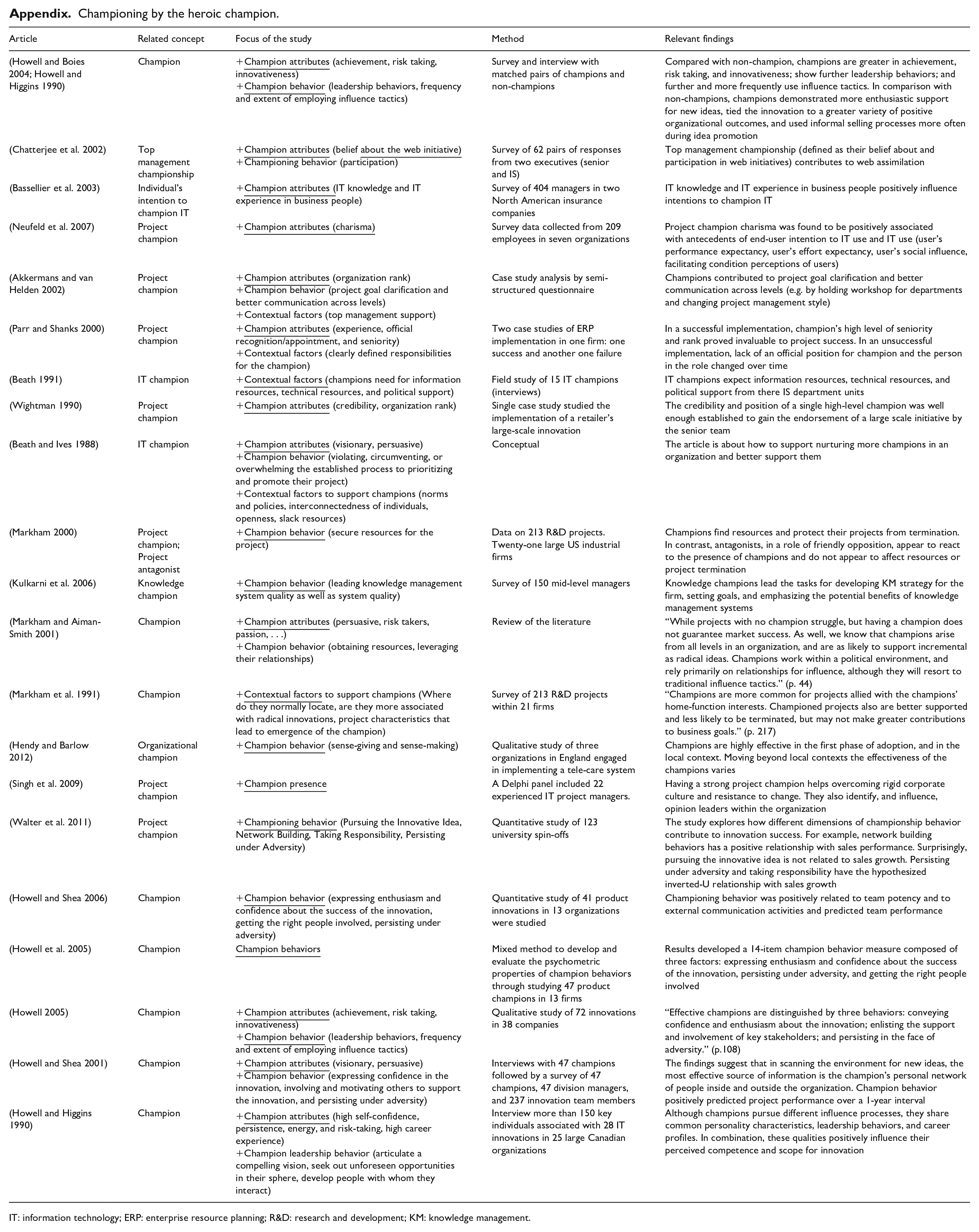
| Article | Related concept | Focus of the study | Method | Relevant findings |
|---|---|---|---|---|
| (Howell and Boies 2004; Howell and Higgins 1990) | Champion | + + |
Survey and interview with matched pairs of champions and non-champions | Compared with non-champion, champions are greater in achievement, risk taking, and innovativeness; show further leadership behaviors; and further and more frequently use influence tactics. In comparison with non-champions, champions demonstrated more enthusiastic support for new ideas, tied the innovation to a greater variety of positive organizational outcomes, and used informal selling processes more often during idea promotion |
| (Chatterjee et al. 2002) | Top management championship | + +Championing behavior (participation) |
Survey of 62 pairs of responses from two executives (senior and IS) | Top management championship (defined as their belief about and participation in web initiatives) contributes to web assimilation |
| (Bassellier et al. 2003) | Individual’s intention to champion IT | + |
Survey of 404 managers in two North American insurance companies | IT knowledge and IT experience in business people positively influence intentions to champion IT |
| (Neufeld et al. 2007) | Project champion |
|
Survey data collected from 209 employees in seven organizations | Project champion charisma was found to be positively associated with antecedents of end-user intention to IT use and IT use (user’s performance expectancy, user’s effort expectancy, user’s social influence, facilitating condition perceptions of users) |
| (Akkermans and van Helden 2002) | Project champion | +Champion behavior (project goal clarification and better communication across levels) +Contextual factors (top management support) |
Case study analysis by semi-structured questionnaire | Champions contributed to project goal clarification and better communication across levels (e.g. by holding workshop for departments and changing project management style) |
| (Parr and Shanks 2000) | Project champion | +Contextual factors (clearly defined responsibilities for the champion) |
Two case studies of ERP implementation in one firm: one success and another one failure | In a successful implementation, champion’s high level of seniority and rank proved invaluable to project success. In an unsuccessful implementation, lack of an official position for champion and the person in the role changed over time |
| (Beath 1991) | IT champion | Field study of 15 IT champions (interviews) | IT champions expect information resources, technical resources, and political support from there IS department units | |
| (Wightman 1990) | Project champion | Single case study studied the implementation of a retailer’s large-scale innovation | The credibility and position of a single high-level champion was well enough established to gain the endorsement of a large scale initiative by the senior team | |
| (Beath and Ives 1988) | IT champion | +Champion behavior (violating, circumventing, or overwhelming the established process to prioritizing and promote their project) +Contextual factors to support champions (norms and policies, interconnectedness of individuals, openness, slack resources) |
Conceptual | The article is about how to support nurturing more champions in an organization and better support them |
| (Markham 2000) | Project champion; Project antagonist | Data on 213 R&D projects. Twenty-one large US industrial firms | Champions find resources and protect their projects from termination. In contrast, antagonists, in a role of friendly opposition, appear to react to the presence of champions and do not appear to affect resources or project termination | |
| (Kulkarni et al. 2006) | Knowledge champion | Survey of 150 mid-level managers | Knowledge champions lead the tasks for developing KM strategy for the firm, setting goals, and emphasizing the potential benefits of knowledge management systems | |
| (Markham and Aiman-Smith 2001) | Champion | +Champion behavior (obtaining resources, leveraging their relationships) |
Review of the literature | “While projects with no champion struggle, but having a champion does not guarantee market success. As well, we know that champions arise from all levels in an organization, and are as likely to support incremental as radical ideas. Champions work within a political environment, and rely primarily on relationships for influence, although they will resort to traditional influence tactics.” (p. 44) |
| (Markham et al. 1991) | Champion | Survey of 213 R&D projects within 21 firms | “Champions are more common for projects allied with the champions’ home-function interests. Championed projects also are better supported and less likely to be terminated, but may not make greater contributions to business goals.” (p. 217) | |
| (Hendy and Barlow 2012) | Organizational champion | Qualitative study of three organizations in England engaged in implementing a tele-care system | Champions are highly effective in the first phase of adoption, and in the local context. Moving beyond local contexts the effectiveness of the champions varies | |
| (Singh et al. 2009) | Project champion |
|
A Delphi panel included 22 experienced IT project managers. | Having a strong project champion helps overcoming rigid corporate culture and resistance to change. They also identify, and influence, opinion leaders within the organization |
| (Walter et al. 2011) | Project champion | Quantitative study of 123 university spin-offs | The study explores how different dimensions of championship behavior contribute to innovation success. For example, network building behaviors has a positive relationship with sales performance. Surprisingly, pursuing the innovative idea is not related to sales growth. Persisting under adversity and taking responsibility have the hypothesized inverted-U relationship with sales growth | |
| (Howell and Shea 2006) | Champion | Quantitative study of 41 product innovations in 13 organizations were studied | Championing behavior was positively related to team potency and to external communication activities and predicted team performance | |
| (Howell et al. 2005) | Champion |
|
Mixed method to develop and evaluate the psychometric properties of champion behaviors through studying 47 product champions in 13 firms | Results developed a 14-item champion behavior measure composed of three factors: expressing enthusiasm and confidence about the success of the innovation, persisting under adversity, and getting the right people involved |
| (Howell 2005) | Champion | + + |
Qualitative study of 72 innovations in 38 companies | “Effective champions are distinguished by three behaviors: conveying confidence and enthusiasm about the innovation; enlisting the support and involvement of key stakeholders; and persisting in the face of adversity.” (p.108) |
| (Howell and Shea 2001) | Champion | +Champion behavior (expressing confidence in the innovation, involving and motivating others to support the innovation, and persisting under adversity) |
Interviews with 47 champions followed by a survey of 47 champions, 47 division managers, and 237 innovation team members | The findings suggest that in scanning the environment for new ideas, the most effective source of information is the champion’s personal network of people inside and outside the organization. Champion behavior positively predicted project performance over a 1-year interval |
| (Howell and Higgins 1990) | Champion | +Champion leadership behavior (articulate a compelling vision, seek out unforeseen opportunities in their sphere, develop people with whom they interact) |
Interview more than 150 key individuals associated with 28 IT innovations in 25 large Canadian organizations | Although champions pursue different influence processes, they share common personality characteristics, leadership behaviors, and career profiles. In combination, these qualities positively influence their perceived competence and scope for innovation |
IT: information technology; ERP: enterprise resource planning; R&D: research and development; KM: knowledge management.