




Abstract
Technology is often used by senior management as an instrument to deliver strategy by influencing day-to-day activities within organisations. We study how local teams appropriate strategy through the use of technology, specifically in instances where it is rigid and single purposed. We show that technology has the potential to act as a carrier of strategic intent. We theorise local practices of appropriation of strategic intent by conceptualising the role of technology in ‘instantiation’, a notion adopted within the strategy-as-practice literature to explain how localised micro events directly constitute higher-level business outcomes such as those that arise from strategy. Through an in-depth case study following the use of passenger self-service kiosks in a UK airport over a period of 20 months, we review the strategic drivers at the top of the organisation and the central role of technology as the delivery mechanism of strategy. We focus on emergent strategising activity by local teams on the ground. Our main theoretical contributions are thus to extend the concept of instantiation to Information Systems studies and to conceptualise technology as a carrier of strategy, particularly in explaining how technology can embed strategic intent (structural strategising) and then influence the emergence of local practices consistent with these objectives (emergent strategising). We find and conceptualise how local practices instantiate strategic intent by decoupling, reframing and then recoupling new logics of work to achieve the aims set out in the organisation’s strategy.
Keywords
Introduction
Bonchek (2017) argues that ‘Execution is where good strategies go to die’ in referring to the often underestimated distance between strategic intent from the top of organisations and the actual, realised strategy in practice. This analytical separation between planning and execution of strategy has dominated academic research but recently a more integrated ‘adaptive turn’ has been called upon (Weiser et al., 2020). Within the strategic Information Systems (IS) field, research initially emphasised the role of good central strategic planning (e.g. Earl, 1993; Lederer and Gardiner, 1992), but more recent research has given much more attention to the execution and practices that deliver strategic intent on the ground (e.g. Peppard et al., 2014). For example, Arvidsson et al. (2014: 46) make this point clearly when they say that ‘strategy is dependent upon the way it is enacted’ while also highlighting the importance of creating tight links between an organisation’s strategic intent, the ensuing IS implementation and the de-facto realised strategy. Despite the significant and growing effort in the IS field to study links and alignment between technology and business strategy (Benbya et al., 2019), we still have a deficient view of how strategy travels to, and is constituted, at ground level in organisations. Karpovsky and Galliers (2015) argue that ‘we still know little about what it is that organizational actors actually do, on a day-to-day basis, to align information systems and related concerns with business imperatives’ (p. 1). Indeed, a major missing component in contemporary IS research is to reconceptualise the role of technology in organisational strategising by focusing on how local use of that technology may enact strategic intent (Arvidsson et al., 2014; Arvidsson and Holmstrom, 2018; Peppard et al., 2014; Whittington, 2014). Our concern is therefore to reconceptualise the role and significance of technology-led initiatives in strategic organisational change by going beyond first-order effects of digital transformation in organisations (Baptista et al., 2020). We depart from superficial views of this as an implementation problem or as tactical local response to new mandated technology (Mackay and Zundel, 2017). We aim instead to capture the strategic significance of technology as a carrier of strategy and its ability to instantiate – to make real – strategy at the ground level of organisations.
The role of technology in strategy and organisational change has been viewed from a number of different perspectives in the IS literature over the years, from Barley’s (1986) view of technology as an ‘occasion’ for organisational change to Markus’s (2004) notion of technochange, for example. This literature typically places emphasis on either the technology or the organisation as the driver of strategic change but often takes for granted a degree of interpretive flexibility in the technology (Orlikowski, 1992), thereby accepting that technology evolves to ‘accommodate’ change (Markus and Robey, 1988) by ‘inscribing’ and ‘translating’ technology in organisational activity (Beynon-Davies, 2011; Beynon-Davies et al., 2009; Latour, 1991). In these studies, the mutual changes and interplay between the organisation and technology (Baptista, 2009) underpin processes of local adjustment and change in relation to intended strategic aims. Berente and Yoo (2012) conceptualise the trigger for this process as the loose coupling of routines when the logics embedded in the new technology clash with the logics used by people to work on the ground. The sociomaterial entanglement of technologies and work routines (Hultin and Mähring, 2014) ultimately leads to the technology gaining meaning at the local level and in turn adjusting local practices to reflect intended strategic aims from the top of organisations. It is this ongoing process of ‘aligning’ at the local level (Karpovsky and Galliers, 2015) that has the potential to link technology use with intended strategic aims.
In this study, we go deeper in exploring how strategic intent can be directly observed in the use of technology and operational practices on the ground, rather than as a process that unfolds over time. We contribute to recent research that breaks down the artificial separation between practices and praxis suggesting that strategy is fluid and runs seamlessly from ideation to implementation/enactment (Leonardi, 2015). This is consistent with the shift in strategy research too, which has seen the emergence of what Weiser et al. (2020) call the ‘adaptive turn’, removing the analytical separation between the creation and the implementation of strategy and to paying more attention to dynamic processes of enactment of strategy. These ideas can be traced to earlier work by Walsham and Han (1993) when he talks of the formation – rather than the formulation – of strategy, and earlier still, of Mintzberg’s discussion of emergent strategies (e.g. Mintzberg and Waters, 1985).
To fully capture the effects of technology on the process of enacting a business-level strategy, we focus on a case where technology is extremely rigid (Desouza, 2006; Galliers, 2006). Rigid technologies have less capacity for interpretive flexibility (Doherty et al., 2006) when implemented as they have predefined characteristics and functions and leave little opportunity for users and local teams to adapt and customise them to their needs. Furthermore, rigid technologies have deeply embedded business logics, and therefore react or contrast more sharply with established local logics of work and social values (Friedland and Alford, 1991; Thornton et al., 2012), especially in periods of strategic change in organisations (Berente and Yoo, 2012).
We study rigid technologies because they allow us to remove possible adjustments in the technology and focus instead on the practices as they emerge, consistent with the strategic structures embedded in the technology. Unlike studies of workarounds where local users find alternative ways to perform their work (Alter, 2014; Ioannis and Nandhakumar, 2009; Rossi et al., 2020), our study is centred on a large ‘mandated’ technology programme where senior management specify and impose the technology without room for alternative arrangements, as in the study by Carugati et al. (2018). The blunt and single-purposed nature of the technology removes the capacity for adaptation to local needs, allowing us to focus on their role as carriers of strategic intent and to capture emergent everyday practices of users. Our aim is not to conceptualise the process of implementation of the technology (as a process with discrete stages). Instead, our aim is to observe and capture the strategic value of everyday activity and practices on the ground, as they emerge shaped by the use of new technology . We develop this distinction between process and practice in our conceptual background section.
Another important implication of the rigid nature of the technology is its potential to amplify the effects of loose coupling (Berente and Yoo, 2012) between strategic intent and actual practices on the ground, and potentially lead to clashes that can more easily be captured. This means that local teams have to reconstruct new logics of work and meaning around the new technology, based on emergent new localised practices (Bechky, 2011). We use the term ‘logics’ loosely here to describe widely accepted shared values and references driving local behaviour in organisations, in line with Berente and Yoo (2012).
Few studies in the IS field have captured the strategic significance of technology in carrying strategic intent and shaping local action. Some authors have shifted our attention from static views of strategy towards a view of strategy as an activity (Jarzabkowski, 2003) or strategising (Galliers, 2004, 2011), while others focus on everyday practices from a Strategy-as-Practice perspective (Arvidsson et al., 2014; Henfridsson and Lind, 2014; Huang et al., 2014; Leonard and Higson, 2014; Peppard et al., 2014; Whittington, 2014). However, more research is still needed to understand the doing (activities, strategising, practice) that constitute how doing (activities, strategising, practice) constitutes strategy-as-realised in an organisation. The detailed analysis of mundane, everyday events may at first seem far removed from strategy, but these have the potential to represent the genesis of actualised strategy (Kouamé and Langley, 2018), particularly if they are influenced and shaped by embedded logics within technology-in-use.
If a realised strategy is constituted through the doing of strategy (practices) and the embedded logics within technology-in-use, some interesting questions arise. These include: Can the technology act as a carrier of strategic business objectives to teams on the ground? and How do teams on the ground reconfigure their work practices around the strategic demands imposed by the new technology? A supplementary question arises from the latter, which is, Do these new local technology-based practices constitute strategy? It is interesting to ask whether local technology-based practices change in response to a new and rigid technology and do they indeed constitute strategy or have any strategic significance. Thus, and more precisely, the key research question we ask is, What is the role of technology in realising strategy on the ground?
To examine the link between local activity and strategic intent as articulated by managers in the higher echelons of organisations, we study the case of a large, rigid, and single-purposed technology. Our study captures how this technology shaped the practices of local teams on the ground to reflect specific strategic objectives set by senior executives. We capture the effort by local teams to reconfigure their work around the requirements arising from the demands of a new strategy and its accompanying new technology. The case follows the implementation 1 of self-service check-in kiosks in a regional airport in the United Kingdom and its business-level strategy, which aims to increase the scale of operations by serving more passengers without expanding the size of its terminal buildings.
The paper is structured as follows. In this section, we motivate the study by identifying the need for more IS research that is focused on local-level activity with strategic significance. The next section grounds the study in the strategy-as-practice literature and draws specifically on the concept of strategy instantiation (Kouamé and Langley (2018) in order to establish the theoretical background of the study. We then outline and justify the methods used in this single in-depth case study research design. The findings section then traces strategic activity at the top of the organisation, to show how the technology was tightly coupled with organisational strategy and then shows evidence of emergent strategising practices at the local level of the organisation. This is followed by a conceptualisation of the role of technology as a carrier and sense-giver of intended strategy from the top of the organisation to local teams. We conceive three elements of instantiation based on our analysis: decoupling, reframing, and recoupling. These concepts explain the process by which operational teams develop or learn practices consistent with strategic intent embedded in the technology – we show that this enables the instantiation of strategy through the technology deployed. We conclude by highlighting the theoretical contributions and practical implications of this study.
Conceptual background
The focus of our research is to establish a link between local-level technology use and business-level strategy (Chia and Holt, 2006; Chia and Rasche, 2015). Technology has the potential to shape and stimulate local reflective action consistent with strategic intent and, therefore, to act as a sense-giver of strategy on the ground (Rouleau, 2005). To advance this conceptualisation of the performative nature of strategy through technology-in-use, we draw on the concept of ‘instantiation’ (Kouamé and Langley, 2018). Instantiation provides a lens that views technology as inherently embedding strategic intent, and therefore with the potential to shape in-use practices and so perform a similar role to middle managers in carrying strategy across organisations (Rouleau, 2005; Rouleau and Balogun, 2011).
In order to trace macro-level concepts such as ‘business strategy’ within individual actions and thinking (practices at local level) that unfold through technology use, we take a ‘mixed-level theory’ conceptual position (Markus and Robey, 1988). Our emphasis on practices as the locus of strategy (cf., Bourdieu, 1990) reflects a distinct research perspective that acknowledges microprocesses (what people do) as constitutive of macro outcomes (realised strategy) in organisations (Jarzabkowski, 2004; Jarzabkowski et al., 2007; Jarzabkowski and Wilson, 2006; Whittington et al., 2006). By taking this perspective, we view practices on the ground as constitutive of, and continually re-making, broader social and organisational structures with strategic significance (Kouamé and Langley, 2018; Schatzki et al., 2001). Strategy, therefore, cannot be reduced, or abstracted, merely to the organisational plan. Rather, strategy is performative because it is defined by, and shapes, the subjects and objects involved in its making (Kornberger and Clegg, 2011) – a perspective that is consistent and underpins the large body of research in strategy-as-practice (Whittington, 2006; Whittington et al., 2011).
However, within this larger body of strategy research, there are three distinct approaches that link local practices with macro structures in organisations (Kouamé and Langley, 2018). The first sees the link as variance, the second as progression, and the third as instantiation as viable ways to link microprocesses and macro outcomes. The distinct characteristics of these three types of strategy research are summarised in Table 1, based on the work by Kouamé and Langley (2018), to which we have added a row (shaded) illustrating how the role of technology is viewed within each type of research on strategy-as-practice.
Views on the role of technology (shaded) in the three types of micro-macro links in strategy research (based on Kouamé and Langley, 2018).
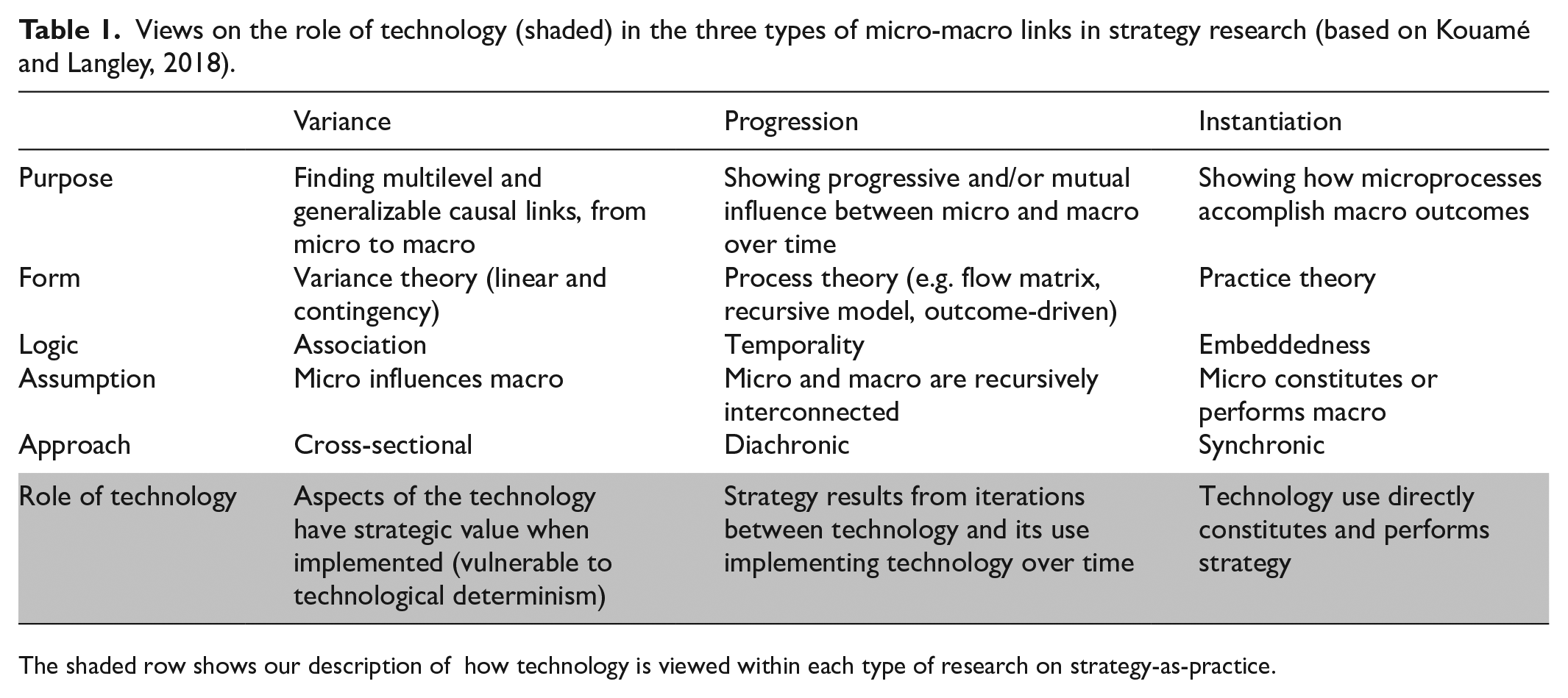
The shaded row shows our description of how technology is viewed within each type of research on strategy-as-practice.
The differences between the three types of strategy research have implications when studying the role of technology in strategising. For example, there are differences in the purpose and form of research when conceptualising how strategy takes place in an organisation. Variance-type research seeks to find and test generalisable and causal relationships between micro-level processes and macro-level outcomes. For example, much of the literature on microfoundations (Teece, 2017) can be categorised as variance research. In contrast, progression studies reject the claim that microprocesses cause strategic outcomes, arguing instead that microprocesses and macro phenomena interact recursively over time to produce in time a state of strategy. In contrast, instantiation studies show how macro outcomes are accomplished through microprocesses, specifically practices accomplish (rather than cause) macro outcomes.
The underpinning logic for each of the three types of strategy research is also distinct. While variance studies associate microprocesses (i.e. positive or negative association) with a strategic outcome, studies anchored in progression draw on recursive interactions between the micro and the macro through time to influence strategic outcomes – an approach typical of process studies (Johnson, 1992; Pettigrew, 1990). However, instantiation is based on a logic of embeddedness to explain ‘how microprocesses accomplish macro outcomes’ (Kouamé and Langley, 2018: 7). From this perspective, micro-activity does not evolve or emerge, it inherently and ‘directly instantiate[s] or constitute[s] the macro-processes through which the organisation exists’ (Kouamé and Langley, 2018: 14). This means that local, mundane activities have the potential to ‘instantiate’ high-level strategy, or in other words, the micro constitutes or performs the macro. Thus, microprocesses (events and practices at ground level of organisations performed by individuals and groups) are constitutive of macro outcomes including formal and informal structures within organisations, including policies and other goal-oriented features responsible for significant shifts in the direction of an organisation.
This has important implications for the role of technology in shaping strategic outcomes, which we capture in the last row of Table 1. Much IS research follows variance (See Moeini et al., 2020) or progression perspectives. The former examines correlations or contingency between variables to explain an influence of the micro on the macro; the latter takes a process view of strategy in organisations (Johnson, 1992; Pettigrew, 1990). Process research takes a longitudinal view to explain the link between the micro and macro levels, but distinctively, it means that they see technology as a driver of strategy while not always recognising everyday practices and microprocesses as inherently strategic in nature. In this study, we follow the instantiation perspective to provide a fresh view as to the strategic significance of technology in-use to create, rather than influence, strategy.
Although the IS field is already taking an interest in ‘the work, workers and tools of strategy’ (Knight et al., 2018; Peppard et al., 2014: 1), calling for a research partnership between the fields of Strategy and IS (Whittington, 2014), there are still only a few studies that capture the role of technology in the creation of strategy at the local level (Marabelli and Galliers, 2017); the role that IT tools have in strategy practice (Kaplan, 2011; Knight et al., 2018), and on their impact on practices following system implementation (Aversa et al., 2018; Barrett et al., 2016).
This theoretical position provides a basis to study the capacity of technology to carry strategic intent and regulate and frame local action consistent with strategic imperatives. From this perspective, we argue that it is the use of technology at the local level that instantiates business-level strategy, addressing directly the linking of microprocesses and macro outcomes. We now describe the methodological approach used in the empirical work undertaken in our study.
Research design and methods
Research design and data collection
Our research questions set out to address how technology acts as a carrier of strategy and whether associated practices constitute that strategy. Hence, the research was designed to capture strategy on the ground or ‘reality in flight’ (Pettigrew and Whipp, 1993) as organisational actors sought to work through the implementation of a new strategic technology initiative. This required an exploratory and broadly inductive research approach to allow us to conceptualise the role of technology as a possible carrier of strategy by analysing the links between local practices with intended higher-level strategy (Gioia and Chittipeddi, 1991; Gioia and Thomas, 1996). A single, in-depth qualitative case study research strategy (Myers, 1997) was used to examine the emerging organisational practices by key stakeholders. The case follows in real-time how the strategy was communicated, and the technology adopted. Data collection spans the period immediately prior to, and in parallel with, implementation of the new technology in order to capture both the conditions of intended use (the strategic plan) and the actual issues and practices inherent in the use of the technology.
Our effort was to closely follow the adoption of automated self-service check-in kiosks, introduced as a strategic IT-driven project within a regional UK airport. We chose this as a case of an extremely rigid technology, which was implemented top-down by senior managers at the corporate-level of the organisation. The technology served a single purpose to process passenger check-ins in airports and provided very limited malleability and flexibility for adaptation locally. This newly adopted technology offered the opportunity to capture and analyse how technology can act as a carrier of strategic intent, given that strategic intent is preserved in the technology by its rigid nature. We captured local reaction to the technology to analyse how local teams appropriated the strategy carried within it.
We studied the practices of the managers and employees on the ground as part of a project where 10 new self-service check-in kiosks were adopted in a large regional airport. This was part of a group of airports to introduce 90 kiosks at three airport sites. Data collection involved a combination of in-depth semi-structured interviews, non-participant observation, informal discussions, and review of documentary data to produce a single in-depth case study covering the introduction and implementation of Common-Use Self-Service (CUSS) check-in kiosks in the airport over 20 months. The core of our analysis draws on direct observations and immersion of the researcher into the organisation. We observed and interviewed the main project stakeholders, including the managers at the airport and the management team at the corporate level who commissioned the project. We also captured the activities of terminal managers and the IT function and, more crucially, the customer services manager and their team of customer service assistants (CSAs) who were responsible for launching the new technology with passengers in the airport. Data collection also involved a total of 18 in-depth interviews lasting between 1 and 3 h, comprising eight interviews with members of the kiosks project team and 10 interviews with IT suppliers, handling agents, airline management and managers at other UK airports, each of whom worked on the project. Accompanying the interviews, 40 h of non-participant observation were conducted on-site to examine technology in-use. Appendix A provides a detailed interview schedule and the observations conducted.
We conducted detailed observations over a sustained period of 6 months to ensure that we observed, and captured, what people ‘actually’ did while performing their everyday working activities, which is different from ‘what they say they do’ and ‘what they ought to be doing’ (Feldman and Orlikowski, 2011: 1241). This period of observation captured the implementation of the CUSS technology, involving the researcher spending 4–5 h on each visit alongside the customer services team and managers overseeing the project. Observations focused on the check-in of passengers to observe how between 6 and 15 flights would use both the new self-service kiosks and the existing, desk-based, check-in process. Observations began to follow a routine with the researcher arriving before and remaining until after each check-in period. This enabled observation of the staff and passengers and their use of the new technology. It also allowed observation and discussion with staff who would congregate to discuss, criticise and reflect on issues relating to the technology before and after they had performed the passenger check-in process. These periods of observation complemented the interviews and provided a valuable opportunity to question and clarify specific events or issues with the kiosk project team throughout data collection. Specifically, we examined instances where members of the project team changed or improvised new routines when they experienced tensions between the intended functioning of the CUSS system and operational demands (Kamoche et al., 2003; Pina e Cunha et al., 1999). This helped us to unpack the emergence of local practices in response to the technology that was designed to achieve very specific business imperatives.
Data analysis
Data from interviews, discussions, documentary sources and non-participant observation were treated as texts which provide ‘a window into human experience’ (Ryan and Bernard, 2000: 769). These were transcribed and imported into the NVIVO qualitative analysis software. Data were thematically coded (Ayres, 2008), initially using open coding (Urquhart et al., 2010) to identify pertinent and enduring themes. The coding process began in parallel with data collection so that clarification could be sought from informants to ensure greater consistency within and between data sources.
We used theory to guide our analysis as a sensitising device while allowing new concepts to emerge as new theoretical explanations (Gioia et al., 2012). Our effort was to theorise from the data collected how individuals make sense of their normal daily work (Bechky, 2011). This allowed us to theorise but stay close to the way individuals made sense of their practices at local level in relation to the introduction of new technology in line with Gioia et al’.s (2012: 16) advice to ‘capture concepts relevant to the human organisational experience in terms that are adequate at the level of meaning of the people living that experience and adequate at the level of scientific theorizing about that experience’ and also Lee’s (2010) call for the starting point of IS research to be the ‘natives’ themselves (professionals, managers and executives) and to capture ‘theory-in-use’, rather than ‘espoused theories’.
Our research approach was inspired by previous studies in the field of IS that have focused on practice to study technology in-use in organisations (Orlikowski, 2002). We used, in particular, the account by Schultze (2000) of an ethnographer researching the work practices of individuals in their natural organisational settings as guidance and a sound research model to follow. In our case, we captured practices and processes of individuals during implementation while the technology was being adopted by local teams. We paid particular attention to how these teams reconciled strategic aims articulated by managers and the characteristics of the technology with their emerging activities on the ground. Our aim was as to develop a rich and thick description of a unique case (Lee and Baskerville, 2003).
Consistent with our interpretive approach, we gradually became aware of regularities in our observations. This enabled ongoing reflections of events and observations following the principles of the hermeneutic circle (Boland, 1991; Lee, 1994) working in iterative stages between data gathering and conceptualisation. By going forward and back between our data and our theoretical framing, we identified decoupling, reframing, and recoupling as elements of instantiation. Appendix B provides an overview of data analysis, including a table showing the analytical process with first- and second-level coding, following Gioia et al’.s (2012) guidelines.
Findings: strategy instantiation at the NMA
The study was undertaken at the North Midlands Airport (NMA) in the United Kingdom. This international airport was privatised in 1993 and sold in 2001 to the current owner, the Northern Airport Group (NAG). NAG owned four UK airports and was one of three airport groups serving 94% of UK airline passengers. The UK airport sector served 236 million passengers per year and 2.3 million aircraft movements around the time of the study (Civil Aviation Authority, 2009). NMA handled close to 5 million passengers. Our study focuses on NMA’s CUSS project which involved the implementation of 10 self-service kiosks, which was part of a larger roll out of 90 kiosks by NAG at the time. We focus on NMA as the CUSS project was implemented in its entirety internally, providing a clear line of sight from strategic intent to strategy implementation.
Our findings are presented in two parts to capture strategic activity at both the top of the organisation (intended strategy or structural strategising) and at the local level (enacted strategy or emergent strategising). We distinguish between structural and emergent strategising to show activity with strategic significance both at the top of the organisation and by local teams on the ground. We pay particular attention to the role of technology in carrying strategic intent from top managers to local teams.
In the first part of this section, we review the strategic drivers that focused the attention of senior management and NMA on technology (such as self-service kiosks) as their response to increasing competitive pressures in the airport sector. We then explain how the CUSS project became integral to the strategic objectives set by senior managers. We characterise this process as structural strategising to represent the tight coupling between the new strategy of NMA and the kiosk technology used in CUSS. In the second part of this section, we deepen our analysis to show activity by teams on the ground as they rethink their roles and processes to accommodate the new mandated self-service kiosks at the airport. The introduction of the kiosks dislodged established practices and routines of these local teams. This meant that the teams had to redefine the passenger check-in process by allowing new meaning structures to emerge consistent with the capabilities of the kiosk technology. We characterise this as emergent strategising to represent the decoupling from extant local practices which clashed with logics embedded in the new technology.
Structural strategising: tight coupling of intended strategy with the technology
NMA faced significant business pressures that prompted managers’ intervention to adopt automated check-in. Heightened cost competition between NMA and other nearby airports meant that managers were seeking new ways to introduce cost savings to attract new airlines to NMA as well as retain existing customers. In addition, the sharp rise in low-cost airlines and increasing passenger demand had increased pressure on the airport for more flights and additional floor space in terminal buildings to handle greater volumes of passengers. Compounding these pressures were tight regulatory restrictions on expanding terminal buildings. Senior managers determined that the only option available to them was to improve passenger-handling capacity using technology to better utilise floor space in airport terminals.
These business pressures dominated the strategic development of NMA. In response, the executive team at NAG, the parent company of the NMA, created specific strategic objectives for their four airports. These objectives focused on optimising terminal building floor space and maximising passenger throughput while maintaining, or improving, customer satisfaction. A further strategic priority was to create cost savings which could be passed on to attract the new group of customers to the airport: low-fare airlines. NMA’s strategic objectives were often referred to by managers as the ‘golden principles’ for strategic success. The principles were:
Increase passenger-handling capacity without need to extend terminal buildings.
Reduce transaction cost per passenger check-in.
Improve NAG’s capability to manage terminal floor space.
Add capability to generate revenue stream from airlines.
Bridge traditional check-in and emerging technologies (mobile/Internet).
Improved customer service through fast check-in times and increased convenience.
These strategic objectives were formalised and were regularly invoked by managers as the guiding priorities for the future of NAG’s airports. To deliver these strategic objectives, senior managers placed great emphasis on technology. Indeed, technology was seen as the only viable alternative to adding more terminal buildings in order to regain control of floor space in terminal buildings from airlines who were already in the process of installing their own kiosks and so jeopardising efforts for space optimisation. The new strategy was based on the premise that the company needed to ‘stay one step ahead with technology’, to ultimately improve passenger throughput and satisfaction. It is against this backdrop that CUSS kiosks emerged as a strategic IT project at NAG. CUSS emerged as a vehicle to achieve the ‘golden principles’ as illustrated by this statement by the General Manager of Development at NAG (C): 2
We thought that [CUSS] was a key investment because you could see the benefits of the self–service kiosk with airlines and passengers – it means that, if there are half a dozen machines, you can go to the one with the shortest queue. You don’t have to queue up at the one that is just for your airline.
Technology became known as ‘the way forward’ and focused the attention of the organisation on CUSS to deliver the formalised golden principles. As such, CUSS kiosks were implemented and would initially operate alongside the incumbent check-in desks, but with the aim to replace desks entirely. To monitor and assess the effectiveness of the technology, NAG managers set a performance target for CUSS in the NMA. The target set for NMA was for at least 20% of passenger check-in transactions to be performed using CUSS. That is, a minimum of one fifth of passenger check-in transactions should move from conventional check-in desks to automated kiosks at the airport.
The strategic intent was to exploit the kiosk technology to deliver passenger check-in at a lower cost, to more passengers, at faster pace, and with a higher level of passenger service. CUSS technology had the potential for significant cost savings, which could be passed on to customers (i.e. airlines and their passengers) because kiosks add capacity without having to extend or add new buildings. Airport management could also optimise terminal space by circumventing a parallel move by airlines to instal their own proprietary check-in kiosks. Common-use kiosk infrastructure can be ‘used by any airline and at any time’, hence reducing the spread of many airline-owned kiosks. The threat of airline-owned kiosks pushed airports to create common-use kiosk infrastructures which could then be sold as a service across customer airlines, as explained by the Terminal Services Development Manager (C): It all started when airlines were going to self-service and more airlines were going individually to self-service, so airports started to say ‘there’s going to be a proliferation of these machines, do we start charging for floor space or create our own network?’
Senior management at the NMA designed CUSS to be used across airlines and be faster at processing passenger check-in compared to using check-in desks. The kiosks would address the challenge of increasing volume of passengers while also providing excellent passenger experience due to speeding-up the check-in process. To deliver the ‘golden principles’ outlined by managers, the kiosks had specific design features. For example, to ensure a high-speed check-in transaction, the machines used a simplified version of the check-in desk software (to allow passengers to check-in for the correct flight, answer security questions, register the number of bags for the hold of the aircraft, and provide a boarding card). The kiosks were also designed to provide excellent customer satisfaction and good passenger experience using a fast and simple interface but also by interacting meaningfully with each individual passenger by asking relevant questions related to their individual booking. However, this then meant that the functioning of the kiosk was mostly designed to be used for standard individual passengers, for which the information and interaction could be more easily anticipated and processed. These features were meant to provide a fully automated check-in facility 24 h a day and 7 days a week and reduce the number of support staff needed for different airlines while improving passenger experience.
Emergent strategising: decoupling of embedded logics
This section captures the use of the self-service kiosks and the adaptation by teams on the ground shaped by the way the kiosks functioned. We found that the rigid nature of the kiosks clashed with, and dislodged, established ways of functioning. This stimulated the decoupling between action on the ground and the embedded logics in CUSS, and the emergence of new practices, which eventually gained strategic significance. Below, we capture how these emergent new practices reflected strategic aims.
The self-service kiosks were originally seen as a replacement for the existing desk-based check-in and designed to replicate the function of the desks. A touch screen prompts passengers to input required information themselves, saving the need for both a check-in desk and a member of staff to operate that desk. Initially, managers envisioned that this would entail the simple automation and self-service of a well-defined process. However, the deployment of the kiosks quickly showed that this assumption was far from reality. It emerged that the kiosks brought with them specific and unique rigid structures that required reconfiguring operations on the ground. Our observations of the CSA teams revealed that the ‘kiosks are not like the desk check-ins’ (CSA team member [P]) as they required frequent intervention and adaptation by team members on the ground to make them work. This stimulated a sense-making process for customer service teams to find distinct approaches to the passenger check-in process which required their intervention to make the kiosks ‘work’. Eventually, we captured the Manager of Operations (C) reflecting on this, who said ‘kiosks don’t replace desk check-ins, they enhance and support the check-in process’. We see this as an early indication of managers rethinking their role and local practices in context of the golden principles embedded in the technology.
This unexpected realisation that the kiosks brought with them unique demands that shaped local operations came to light over the period of observation. This was seen initially through clashes between the strict way the kiosks worked and established processes on the ground. Our data include multiple examples of the kiosks creating tensions that led to new processes and procedures to emerge. Each tension required the attention of CSAs in order to get the technology ‘to work’. We present three specific examples of these issues. Each represents a typical example of where the new logics embedded in the technology clashed with established practices on the ground, stimulating local teams to be reflexive and reinterpret their activities to reflect the way the new technology actually worked. Therefore, these emergent practices directly reflect intended strategy, but in a way that is more meaningful to the teams on the ground. It is this process of meaning making on the ground that we characterise as having strategic significance and call this process: emergent strategising. The three tensions described below illustrate specific features of the technology that clashed with established practices and served as prompts for decoupling.
Shared surnames limitation to increase passenger throughput
For the kiosks to process passengers as fast as possible they provided limited features and functionality, and therefore were designed to serve standard cases. For example, the kiosks were designed to process individual passengers one at a time and this meant that they would not cope well with multiple passengers who shared the same initial and surname. This happened to be a fairly common characteristic among family groups as the likelihood of sharing a first initial and surname was significant. This limitation of the kiosk’s software meant that such passengers using the kiosk could not be reconciled with the booking details stored on an airline’s reservation system, and so the check-in transaction could not be completed at the kiosk. These passengers would then require help from airport staff to restart the check-in process at the desks. Pre-empting and screening cases that could be handled by the kiosks was however not always straightforward.
In response to this limitation of the kiosks, local teams created new routines whereby they would verbally ask passengers if they shared the same surname and first initial. At the busiest times, the CSAs tended to direct family groups away from the kiosks and invite solo or business travellers to use the new technology. This enabled them to screen and select individuals who could use the new kiosks and reroute families towards the desk check-ins. The process was eventually faster for the ‘right’ passengers, but this required rethinking local operations significantly. This is indicative of a typical process of interpreting the unique demands of the technology at the local level. The intended aim of the kiosks to speed passenger check-in process required local teams to screen and fast track solo passengers which stimulated the creation of new structures that could not be anticipated by senior management but still reflected their intended interests and objectives on the ground.
Large groups limitation to focus attention on individuals and customer service
Despite the strategic objective to increase volume, the kiosks were designed for an individual person to interact with the screen as a conversation, so answering a sequence of questions about their booking, passport and the usual security checks, which mirrored desk passenger customer service. The intention was not to dilute passenger service, but instead to make it even more convenient and friendly. This meant that the kiosks were not designed to process large groups of five or more passengers on a single booking (e.g. families or corporate bookings). Nevertheless, the design of the kiosks was centred on the customer or passenger, which meant that the screen journey was designed to provide high-quality individual interaction. Therefore, the group bookings could not be retrieved from an airline’s reservation system and thus, ‘large booking parties’ of passengers could not use the kiosks to check-in and would instead have to use the conventional check-in desks.
This limitation of the kiosks prompted local teams to rethink the operations on the ground to place greater emphasis on individual passenger service by framing the use of the kiosk as an ‘express’ service for passengers. This showed the teams that although volume of service was important, their ultimate goal was to provide a much faster passenger service, which would also encourage the kiosks’ future use. This example exemplifies situations where teams on the ground ‘strategised’ the actual functioning of the technology through their own local knowledge and processes. The specific design choices of the technology to make it passenger-centric reacted against established practices, creating tensions which then pushed local teams to reinterpret their practices.
Limited bag drops to reduce costs
A key strategic objective for the kiosks was also to reduce costs, by serving multiple airlines and potentially giving the incentive for airlines to run more flights from NMA, increasing revenue for the airport. As part of their operation, the kiosks used dedicated bag-drop desks shared between multiple airlines which would serve passengers checking in using the kiosks. Local teams had to try to balance the number of bag-drop desks to the number of kiosks and the number of passengers using the automated service versus the number of passengers using the conventional desk-based check-in process. However, balancing the number of bag drops was difficult to anticipate as it depended largely on the type of passengers per flight for each airline, so initially large queues would often form at the bag-drop stage, limiting the number of passengers who could use the kiosks. The following quote from the Product Research and Development Specialist (P) highlights this problem: . . . we had 42% [passenger throughput] on the previous day which is pretty good, and we can’t get the passengers through the bag-drop fast enough.
Interestingly, the apparent slow-down of passenger processing because of longer queues on bag drops was perceived by senior airport management to be evidence of the technology performing ‘too well’. Local teams were aware that bag drops still required staff to weigh and tag baggage and thus incurred cost for every bag-drop opened. This stimulated discussions regarding who should pick-up this cost, and some suggested asking retail shops to contribute, the following quote from one of the team managers (P) indicates this: I can’t get more bag-drops until someone agrees to pay for it. The airlines won’t want to pay for it. There is going to be a real need to incentivize having extra bag drops. I don’t know where it’s going to come from, whether it’s going to be via retail –maybe by giving people more time to spend in the shops before departure?
This process of dealing with the passenger demand using kiosks, and bag drops illustrates strategic activity on the ground, reflecting the intended strategy of reducing costs. The new technology displaced established structures and shaped new meaning making around cost savings, therefore decoupling practices (emergent strategising) from structural strategy.
These three selected examples highlight empirically two important findings, and important aspects, of our study. First that the rigid design of the kiosks dislodged established practices, and second that this stimulated local teams to reformulate their practices shaped by the demands from the new technology designed to deliver intended strategy. Figure 1 illustrates these ideas as structural and emergent strategising.
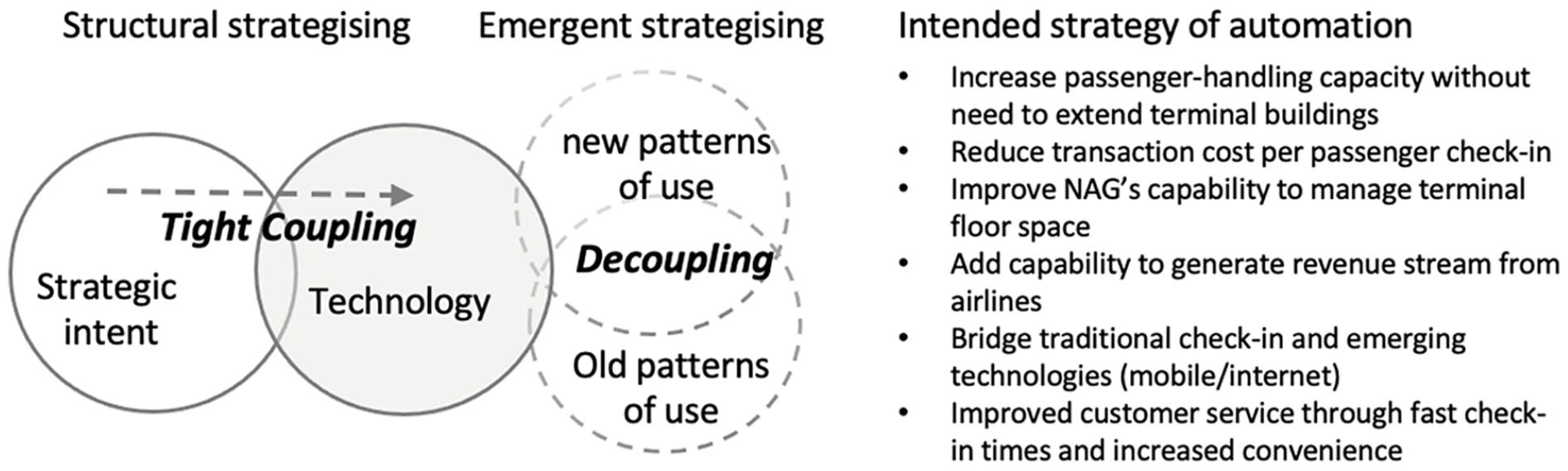
Strategising activity when technology acts as a carrier of strategy.
Figure 1 illustrates the tight coupling between strategic intent of automation as expressed in the ‘golden rules’ and the kiosk technology (structural strategising) and then decoupling effect when the technology is in use on the ground and clashes with extant practices. This creates conditions for the emergence of local microprocesses of meaning-making which are shaped by the strategic objectives embedded in the technology (emergent strategising).
In the next section, we draw on the concept of instantiation to analyse the above empirical material tracing and interpreting both structural and emergent strategic activity at the NMA.
Analysis and discussion
This section addresses the main research question: What is the role of technology realising strategy on the ground? We do this by conceptualising the influential effects of the self-service kiosk technology on the emergence of new practices on the ground consistent with intended strategy at the NMA. Our analysis draws on the concept of instantiation of strategy (Kouamé and Langley, 2018) to examine the capacity of the kiosk technology to instantiate the business strategy for the airport. Technology serves as a carrier of strategic intent from the top of the organisation to the operational teams on the ground, and instantiation explains the emergence of strategy from the praxis and practices that flow from its use.
Instantiation recognises the potential for local-level activity (‘microprocesses’ in Kouamé and Langley’s terms) to directly instantiate strategy. To capture this, we focus on the structuring effects of the kiosks on the emergence of new practices (emergent strategising) for managing the check-in process and passengers. The empirical material reviewed on structural strategising is relevant to describe the tight coupling of strategic intent in the technology, we also describe decoupling as the clash when the new technology is deployed in practice on the ground. These two aspects of tight coupling and decoupling are already well covered and conceptualised in the literature going back to the seminal work of Barley (1986) showing how the introduction of a seemingly standard technology decouples teams from their established ways of working, functioning as an occasion for (re)structuring work practices and roles in the organisation. We saw that decoupling initiates instantiation, so our analytical work therefore starts post-decoupling, and we exclude it from our conceptual development. We conceptualise the effects that emerge once old ways of working have been decoupled, and more specifically analyse how practices instantiate a renewed strategy. We suggest that the new practices have strategic significance through technology use and analyse two effects of this as reframing and recoupling, each with distinct but complementary characteristics in explaining the role of technology in instantiating strategy on the ground. Figure 2 is a conceptualisation of technology as a carrier of strategy and in the instantiation of strategy in practice on the ground.
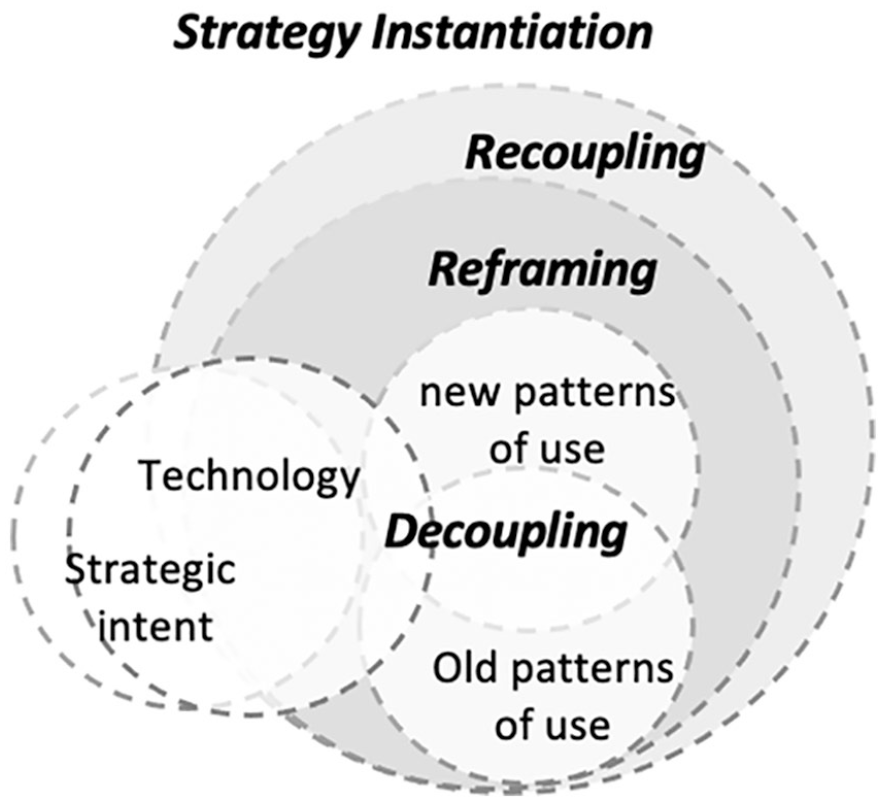
Conceptualisation of instantiation and the role of technology as a carrier of strategy.
Figure 2, shows instantiation as the combination of reframing and recoupling. Together, they explain how strategy (structural strategising) is instantiated on the ground through technology in use to produce emergent strategic outcomes (emergent strategising).
Decoupling
Instantiation is initiated by the dislodging of established practices, or decoupling. We observed decoupling when the strict design of the kiosks disrupted the flow and processing of passengers at the airport. Design limitations of the kiosks to process multiple passengers with the same surname and large groups shaped action on the ground by focusing teams on meeting targets set by managers to speed up and reduce operational costs. As seen in the findings section, these features of the technology reflected strategic objectives based on a new logic of work focused on volume, service and cost. The embedded nature of these objectives in the technology influenced the emergence of new practices and activities at the local level. We suggest that the kiosks effectively carried these new logics and reshaped operations on the ground. We refer to the term reframing as the emergence of new understandings that shaped new practices in managing passenger check-in process through the actual use of the technology. We use the term recoupling to refer to the eventual congruence and integration between technology and emergent practices by management. We now analyse data that explains decoupling as a precedent for instantiation and then conceptualise the two core effects of instantiation: reframing and recoupling.
The limited features of the kiosks facilitated the delivery of the strategic aims of the NMA focused on volume, speed, cost and customer service by, for example, only processing certain types of passengers and operations. The limitations of the rigid technology required severe changes to the check-in process and the way teams organised their activities on the ground. Although the expectation was that the kiosks would be ‘just like desk check-in’, the teams quickly realised the need to abandon established routines and adopt new logics of speed and efficiency embedded in the kiosk technology.
We refer to this initial effect of technology-in-use as decoupling. It captures the incongruence between established logics of work and emergent practices consistent with the logics embedded in the new technology. Decoupling therefore represents a discrepancy or detachment from rational extant formal arrangements and emergent organisational practices by local actors (Carruthers, 1995), which in our case were influenced by the rigid nature of the kiosk technology. Berente and Yoo (2012: 376) suggest a similar, more moderate, effect of decoupling whereby actors felt their actions could satisfy competing demands associated with multiple institutional logics: [an] enterprise system is introduced in accordance with the logic of managerial rationalism, but some of the institutional logics that organisational actors draw upon and reproduce contradict this logic (. . .) In these situations, organisational actors loosely couple elements of their practices from the practices implied by the enterprise system, thus satisfying the demands associated with both institutional fields.
In the case of Berente and Yoo (2012), local actors eventually accept and learn to operate across both logics. However, in our case, we observe a more extreme case of loose coupling. The mandated and rigid nature of the technology imposes its logic without allowing space for any alternatives, leaving little room for across-logic consistency. We suggest that full decoupling, rather than the loose coupling (as seen in Berente and Yoo), was in our case considered to be a more sustainable coping mechanism for the teams using the technology. This is because, it was easier for the teams to appropriate and accept the logics embedded in the new technology rather than trying to make compromises that allowed them to operate across the two separate institutional fields (Noir and Walsham, 2007). Therefore, decoupling represents the separation between extant formalised structure and ceremonial conformity from emerging practices shaped by the use of the new kiosk technology. Decoupling allows for a shift of focus towards new practices which become moderated by the design of the new technology, an effect which we conceptualise next as reframing.
Reframing
The use of the kiosks therefore required accommodating and appropriating these design choices, centred particularly on logics of speed, volume, service and cost. These strategic aims were vital for the NMA, but only realisable by the reflexive activities of CSAs and managers on the ground to achieve an effective integration of the kiosks with the desk-based check-in process. Reframing represents this adjustment of operations on the ground around these strategic aims carried by the technology.
Reframing refers to the adoption of these new ‘schemata of interpretation’ (Snow et al., 1986) for decoupled local activities. It represents the spread and acceptance of new logics consistent with the features of the kiosks and emerging local practices. This process of frame realigning (reframing) as described by Snow et al. (1986) involves transforming or replacing ‘old understandings and meanings’ with new ones. The rigid nature of the kiosk technology brought with them new frames of reference which influenced emerging coping behaviours and practices, leaving no room for ‘old meaning structures’. That is, the logics embedded in the new technology reshaped situated local practices, and stimulated the development of new understandings and stock of knowledge (Berger and Luckmann, 1967; Schutz, 1962) relevant to the new reality of working with the kiosk technology. Kouamé and Langley (2018) argue that it is through the day-to-day activities and the learning and reflexivity that they entail that strategy is made real and performed in practice. It is this change in local practices juxtaposed with the strategic aims embedded in the new technology we characterise as reframing. Reframing is the collective legitimation of new acceptable explanations of emergent practices and behaviours, for example, the improvised practices for screening large groups of passengers and moving them away from the kiosk preserved the overall strategy as ‘working’. This shift in thinking for managing check-in operations on the ground represent the emergence of these new frames of reference (Goffman, 1974). Reframing (or the production of a frame) is what allows people to understand what has changed and what has become accepted as normal in new day-to-day practices. Goffman (1974) suggests that these new schemas of interpretation give individuals a revised sense of purpose and meaning to new reality that they face on the ground.
In our case, the ‘new acceptable explanations’ became the enabling technology to address volume of passengers, service improvement and cost reduction, which encapsulated the golden principles of NAG and NMA strategy. These three ‘explanations’ for the new ways to manage passenger check-in process settled initial incongruences between the logics embedded in the technology and previous ways of working, when the kiosks were introduced, and became the accepted frames of reference used to drive emergent changes to the operations on the ground. Reframing is therefore a higher-level construct which operates at the level of sense-making (Galliers and Newell, 2003; Jensen et al., 2009; Weick, 1995) by creating acceptable ‘explanations’ that resolve inherent inconsistencies between technology in use and previous established norms and logics of work. This is evident in the many unintended effects of the kiosks. For example, the difficulties in managing bag-drop desks meant that the teams had to rethink and develop new practices to accommodate and support the faster pace of the kiosks, but the emergent solution to this was shaped by both the new technology and their understanding of local conditions.
While reframing represents the creation of newly accepted explanations on the ground which justify emergent activity, the recognition of the strategic significance of these emergent activities is still limited and not formalised. We conceptualise this effect as recoupling, as the point where instantiation of a strategy takes shape.
Recoupling
Recoupling is the attribution of strategic meaning to new emergent practices. It represents the reification of strategy as executed in practice. Recoupling is when planned strategy becomes tangible or explicit as a set of practices and behaviours and therefore can be visualised and measured. While reframing is the emergence of practices consistent with the new logics embedded in the technology, recoupling is the attribution of strategic meaning to these new practices.
Recoupling represents the forming of accepted formal links between emergent local frames of reference and pre-established strategic aims. Snow et al. (1986) indicate that the linking between local interpretive orientations with higher-levels structures happens when ‘individual interests, values and beliefs . . . goals and ideology are congruent and complementary’ (p. 464). This process of relating and relaying reframed local activities back to higher-level organisational structures is achieved through the assignment of meaning to new practices, such as when the bag-drop desks were failing to cope with demand; this was eventually seen as the kiosks ‘working too well’.
It is this attachment of emergent activity to strategic themes that recouples the effects of technology-in-use with strategic intent. Recoupling helps to produce a ‘working’ version of strategy by attributing strategic meaning to reframed activity on the ground. It is this effort to integrate and create congruence of framing across groups within organisations (Olesen, 2014) that links technology-in-use with higher-level strategic aims. This type of activity was salient in our analysis, particularly in the regular visits by senior management to discuss targets and strategic relevance of the kiosks to NMA, all of which reinforced the link between new processes, roles and reporting mechanisms to strategic aims captured in the ‘golden principles’.
Strategy instantiation
Instantiation is therefore the combination of both reframing and recoupling. Two important conclusions can be drawn from our case. First, through decoupling, reframing and recoupling – as seen in the practices by operational teams – strategy is realised in practice. That is, strategy is instantiated in the organisation through practice and not merely by planning or iterations of process improvement. Second, teams on the ground were crucial because their learning and reflexivity enabled a working strategy to emerge from a rigid technology that forced decoupling from established ways of working. Using the concept of instantiation, we were able to show that strategic intent can be carried by a technology which, in turn, prompts actors to reframe and recouple practices to technology and strategy.
The six ‘golden principles’ represented a planned strategy of automation, whereby the kiosks would deliver these aims eventually with no need for CSAs to help passengers. However, as the strategy is instantiated by teams on the ground, it became clear that CSAs were actually vital to the success of the strategy. The dialogue between managers and the project teams refocused on passenger throughput above all other aims. It was clear that customer service staff would be needed to ensure the kiosks continued to work and process enough passenger check-ins. The instantiated strategy thus became one of passenger throughput, abandoning full automation. The principle of using the kiosks as a temporary technology as Internet and smartphone check-in took far longer to implement than expected. Although, the airlines paid for the use of the kiosks, managers became far more focused on the number of check-ins performed, rather than the revenues the kiosks could generate. This was only rendered visible by studying the microprocesses of the actors involved. Figure 3 represents what happened to planned strategy by showing the elements of the Airport’s strategy that were instantiated in practice.
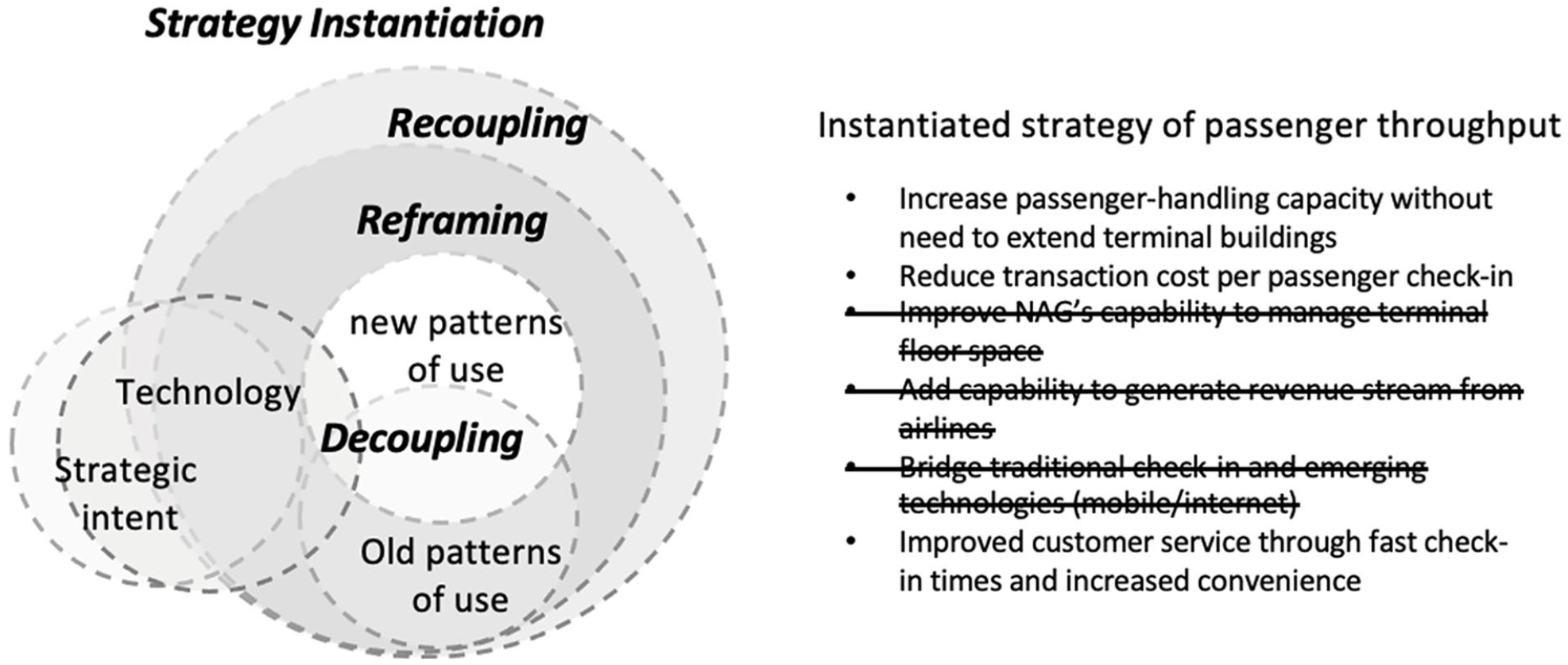
Instantiated strategy of passenger throughput.
This conceptualisation of instantiation as a combination of reframing and recoupling, takes this notion one step further from that which is presented by Kouamé and Langley (2018). We break down the notion of instantiation into two elements which, together, show how local action and technology use directly constitutes strategic intent in practice. We therefore contribute to the theoretical development of instantiation in this way and incorporate technology as a carrier of strategy in so doing. We capture the role that technology plays in instantiating strategy, by carrying strategic intent and reshaping emergent activity through reframing and recoupling operating logics on the ground.
Another important contribution is the realisation that strategy is also formulated at ground level and not only at the upper echelons of organisations. We highlight the range of significant strategic activity at the local level because it is at the local level that strategy gains practical meaning by ‘rendering events or occurrences meaningful’ (Snow et al., 1986: 464). It is the emergence of these new meaning structures shaped and framed by technology that ‘function to organize experience and guide action, whether individual or collective’ (Snow et al., 1986) towards intended aims and objectives. We explain this effect by showing how strategy carried by the technology shaped emergent practices through actual use of that technology.
It is therefore problematic to take a deterministic view that sees the deployment of technology as sufficient in executing and delivering strategic intent. Instead, our study places full emphasis on the practices of technology use as the locus of strategy instantiation. Although CUSS influenced emergent activity on the ground, it is the teams on the ground who rethink practices and actively make sense of the new technology. Kouamé and Langley (2018) refer to this as learning and reflexivity. It is the flow of practice and the learning and reflexivity of the local teams that instantiates strategy. In the next section, we discuss this further and provide an overview of the key contributions to theory and practice from this study.
Summary and conclusion
This study responds to growing calls to better capture and conceptualise the strategic significance of activity at the ground level of organisations, particularly in the context of large technology projects (Arvidsson et al., 2014; Arvidsson and Holmstrom, 2018; Carugati et al., 2018; Peppard et al., 2014). This emphasis on local-level activity is important because ‘people do not directly respond to social structures, but rather to the situations they face and their interpretations of them’ (Bechky, 2011: 1157). While other fields, such as Strategy and Organisation Studies, have engaged more productively with research at this level, much research in the IS field still takes a ‘helicopter view’ from the top of organisations and is belatedly striding in this direction (Whittington, 2014).
In response, we add to this programme of research by focusing on ‘the significance of micro-level interactions that are often understudied or forgotten, and the way in which they can be consequential’ (Kouamé and Langley, 2018: 15). In particular, we capture the capacity of technology to embed strategic intent and its role in moderating local-level activity to be consistent with that strategy.
To repeat, the research question driving this study was: What is the role of technology realising strategy on the ground? To amplify the desired effects of embedded strategic aims and associated local practices, we selected a case where the technology is mandated, rigid and single purposed. The case shows how senior management of a UK regional airport deployed 10 self-service check-in kiosks to meet fundamental strategic aims of the organisation. We conceptualised the role technology played in instantiating strategic intent by decoupling established practices and logics of work, and in influencing the framing of activities on the ground to reflect intended strategy.
The concept of strategy instantiation (Kouamé and Langley, 2018) was used to capture the link between strategy structures developed at the top of the organisation and the activity of teams on the ground. We show how these ‘microprocesses directly instantiate or constitute the macro-processes through which the organisation exists or is changing’ (Kouamé and Langley, 2018: 14). This is in contrast with processual views of strategy, which see strategy as an ongoing effort by the organisation to move towards a particular goal over time. In our case, we found that the structures embedded in technology stimulated emergent activity and processes of meaning making consistent with those structures. We analyse this by first showing how kiosk technology became central to the strategic objectives of an airport group in the United Kingdom.
We use structural strategising to capture the capacity of the kiosk technology to embed strategic aims. We then trace the activities of local teams at the airport during actual use of the kiosks. We use the term emergent strategising to capture the enactment of strategic intent by local teams by appropriation of the kiosk technology for passenger check-in operations.
We show that decoupling enables the instantiation of strategy through reframing and recoupling as teams and managers revise their practices. We describe decoupling to represent the detachment that happens when new technology brings distinct logics that force the dislodging of established practices and routines (Berente and Yoo, 2012). We then conceptualise reframing to represent the way restrictions in the technology shape and frame (Goffman, 1974) emergent practices consistent with intended aims embedded in the technology. Finally, we conceptualise recoupling as the affirmation that these new practices represent strategy and are congruent with the strategic intent set at the top of the organisation (Snow et al., 1986).
Our analysis provides a fresh perspective on the way we research and conceptualise the strategic role of technology and strategising activity within organisations. We argue that technology has the capacity to act as a carrier of strategy by decoupling, reframing and recoupling logics which shape practices at the local level that are consistent with strategic intent at a broader level – in essence, how technology plays a vital role in the instantiation of strategy. In our case, the intended strategy of full automation is instantiated as strategy of (maximising) passenger throughput. While it is no surprise that emergent strategies differ from those planned, our study shines new light on the vital role played by micro-level activity in forming the ‘working’ emergent strategy.
In sum, we propose that instantiation provides fruitful new ground to view technology not just as a strategic asset in itself, but actually as a vehicle of sense-giving across organisations (Rouleau, 2005). Our study shows how technology can be central to sense-giving in strategy (Rouleau, 2005), which is a novel view in IS Strategy literature. Despite the growing focus on ‘big data’ right now (e.g. Gunther et al., 2017; Jones, 2018), our study is an important reminder that the technology itself – even conventional and rigid technologies – play a central role in actualising strategy.
This resonates with, and extends, recent studies on strategic IS implementation and use (Arvidsson et al., 2014), the aligning in practice perspective of Karpovsky and Galliers (2015), and the strategising concept more generally (Galliers, 2004, 2011). This article goes further by conceptualising strategy as embedded in everyday practice in organisations, breaking therefore with the traditional view that strategy is formulated at the top and executed at ground level in organisations (King, 1978). We provide a nuanced view of strategy by connecting structural and emergent strategising in organisations through the concept of instantiation. Conceptually, we establish a more nuanced distinction between instantiation and implementation of strategy by showing how ground-level activity has strategic significance and value on its own. We develop this perspective and contribute to the IS field by conceptualising the link between micro-level activity, strategic intent and realised strategy with a fresh analysis of how strategies become ‘reality’ within an organisation as carried by technology.
The chosen case represents a technology that has been mandated by an organisation and is rigid in nature. This setting enabled us better to observe the capacity of technology to embed strategy and stimulate the emergence of practices consistent with the strategic imperatives embedded in it. Although these effects may manifest more strongly in this particular context, we believe that they are present in other less extreme contexts and technologies too, although we concede that more research is needed to study the strength of these effects in different contexts. For example, less rigid technologies with greater degree of interpretive flexibility may carry weaker framing structures and therefore require greater effort from management to achieve comparable effects of instantiation of strategy on the ground.
We seek to demonstrate that instantiation is a helpful and insightful step towards the ‘synergy’ between IS and strategy-as-practice research (Peppard et al., 2014) because it links the day-to-day micro strategising practices to higher-level strategic macro processes in organisations. We offer this perspective mindful of the limitations of micro or practice-level research that often lead to micro-isolationism, by artificially separating those practices and practitioners from important contextual components (their organisation, strategy, or the institutions they occupy), or by ‘parking’ such components as outside the realm of practice research (Seidl and Whittington, 2014). Of course, a single case cannot provide straightforward normative and generalisable implications because of the highly contextualised nature of our study (Kouamé and Langley, 2018). Instead, a goal of this kind of research is ‘transferability’ rather than ‘generalisability’ (Lee and Baskerville, 2003; Lincoln and Guba, 1985). Rather than generate normative or prescriptive directions for managers, the concepts of decoupling, reframing and recoupling provide the basis for managers to reflexively examine and learn from their organisational strategising.
This study also provides a distinctive multilevel perspective of strategic activity in organisations, responding to calls for more practice-based studies in IS research (Peppard et al., 2014), and to go beyond first and second order of effects of digital transformation in organisations (Baptista et al., 2020). By taking a practice-based view to examine the role of technology as a carrier of strategy, we also provide a novel contribution to the IS Strategy literature. In particular, bringing the concept of instantiation of strategy (Kouamé and Langley, 2018) from the strategy literature to explain the role of technology as a carrier of strategic intent in organisations. By so doing, we contribute to both fields with a novel view of technology in organisational strategising. Future research could start to look for integrative approaches (Weiser et al., 2020) or hybrid research designs (Kouamé and Langley, 2018), whereby established research approaches – for example, variance studies – are combined with process and instantiation (practice) research.
Footnotes
Appendix A
Data collection: detailed observation and interviews list.
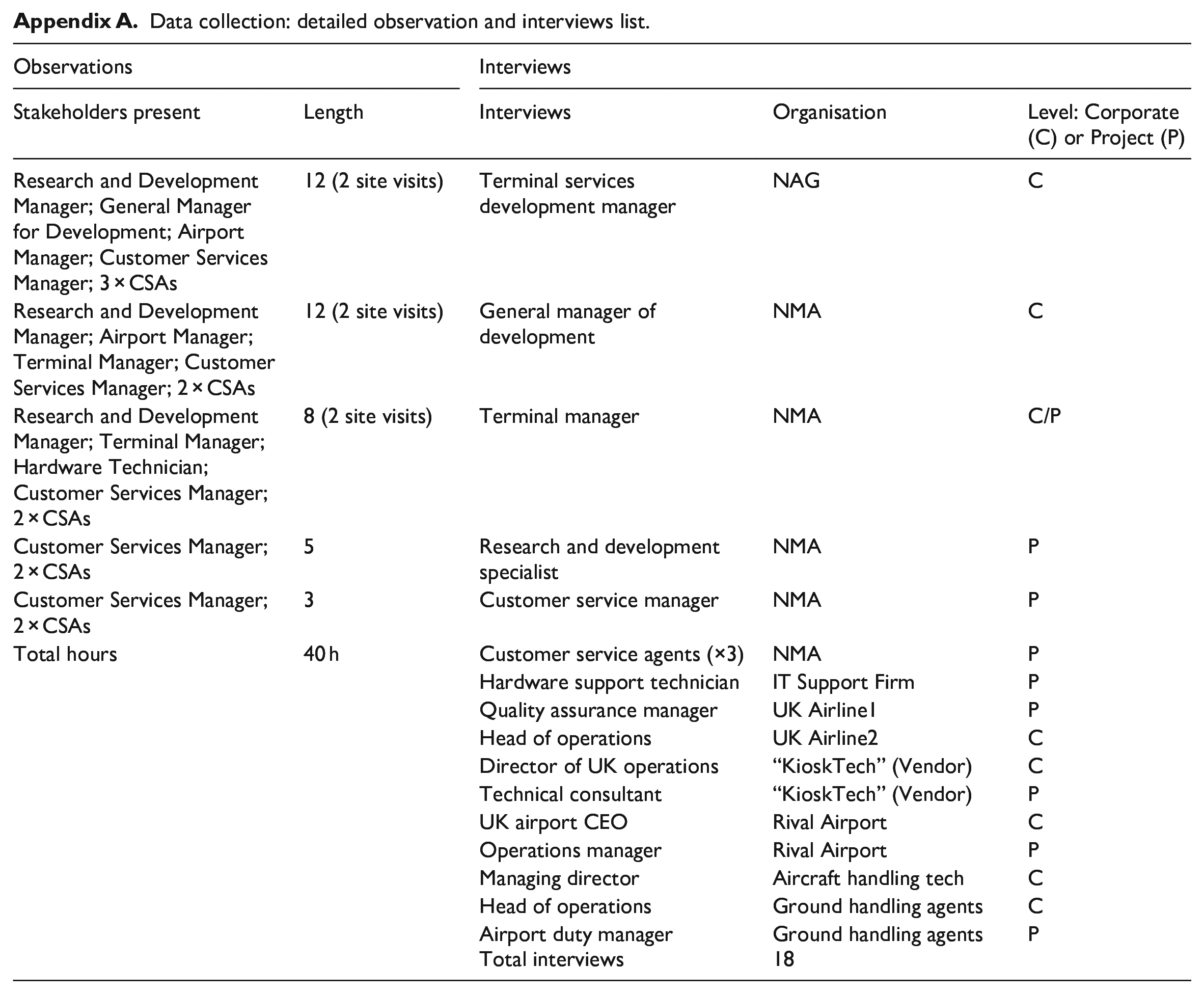
| Observations | Interviews | |||
|---|---|---|---|---|
| Stakeholders present | Length | Interviews | Organisation | Level: Corporate (C) or Project (P) |
| Research and Development Manager; General Manager for Development; Airport Manager; Customer Services Manager; 3 × CSAs | 12 (2 site visits) | Terminal services development manager | NAG | C |
| Research and Development Manager; Airport Manager; Terminal Manager; Customer Services Manager; 2 × CSAs | 12 (2 site visits) | General manager of development | NMA | C |
| Research and Development Manager; Terminal Manager; Hardware Technician; Customer Services Manager; 2 × CSAs | 8 (2 site visits) | Terminal manager | NMA | C/P |
| Customer Services Manager; 2 × CSAs | 5 | Research and development specialist | NMA | P |
| Customer Services Manager; 2 × CSAs | 3 | Customer service manager | NMA | P |
| Total hours | 40 h | Customer service agents (×3) | NMA | P |
| Hardware support technician | IT Support Firm | P | ||
| Quality assurance manager | UK Airline1 | P | ||
| Head of operations | UK Airline2 | C | ||
| Director of UK operations | “KioskTech” (Vendor) | C | ||
| Technical consultant | “KioskTech” (Vendor) | P | ||
| UK airport CEO | Rival Airport | C | ||
| Operations manager | Rival Airport | P | ||
| Managing director | Aircraft handling tech | C | ||
| Head of operations | Ground handling agents | C | ||
| Airport duty manager | Ground handling agents | P | ||
| Total interviews | 18 | |||
Appendix B: coding tables
In the methodology section, we explain our approach to data collection and analysis. The figure below is simplified version of our coding process as described by Gioia et al. (2012). It involved coding interview and observation material, generating over 100 open codes and 15 second-order codes. These mapped to the main concepts covered in the theory section, which emerged empirically and theoretically during the research.
Declaration of conflicting interests
The author(s) declared no potential conflicts of interest with respect to the research, authorship, and/or publication of this article.
Funding
The author(s) received no financial support for the research, authorship, and/or publication of this article.
