




Abstract
In recent times societal crises such as the coronavirus disease 2019 outbreak have given rise to a tension between formal ‘command and control’ and informal social media activated self-organising information and communication systems that are utilised for crisis management decision-making. Social media distrust affects the dissemination of disaster information as it entails shifts in media perception and participation but also changes in the way individuals and organisations make sense of information in critical situations. So far, a little considered notion in this domain is the concept of sense-giving. Originating from organisational theory, it is used to explain the mechanisms behind intentional information provision that fosters collective meaning creation. In our study, we seek to understand the potential impact of sense-giving from Twitter crisis communication generated during the Hurricane Harvey disaster event. Social network and content analyses performed with a dataset of 9,414,463 tweets yielded insights into how sense-giving occurs during a large-scale disaster event. Theoretically, we specified (1) perpetual sense-giving, which relies primarily on topical authority and frequency; as well as (2) intermittent sense-giving, which occurs from high value of message content and leverage of popularity, that is, retweets. Our findings emphasise the importance of information-rich actors in communication networks and the leverage of their influence in crises such as coronavirus disease 2019 to reduce social media distrust and facilitate sense-making.
Keywords
Introduction
Severe crises shatter societies and arouse trans-regional attention. These types of crises can range from shooting rampages and acts of terror, to natural disasters and epidemics. In such scenarios, social media provides a communication environment with an excess of conflicting and often inaccurate information which can be both unintentionally and intentionally propagated by individuals and groups. The World Health Organization (WHO) refers to this problem in the context of coronavirus disease 2019 (COVID-19) as a social media ‘infodemic’ that is, ‘an over-abundance of information – some accurate and some not – that makes it hard for people to find trustworthy sources and reliable guidance when they need it’, (WHO, 2020).
The COVID-19 outbreak, in particular, has highlighted the necessity for the development of a comprehensive social media communication strategy to enhance and support crisis response. Misinformation, scaremongering or trivialisation of a crisis event can all present challenges to government authorities as they develop their crisis communication strategy. Over recent years, a tension has been generated between formal ‘command and control’ and emergent informal self-organising information and communication systems for crisis management decision-making (Bunker et al., 2015). Up until the last decade, formally constructed and controlled information systems generated much of the information for critical decision-making during a crisis. These command and control systems continue to be used by crisis management agencies for critical decision-making, but we are now seeing a huge amount of information generated by social media platforms. This is fuelling an era of self-organising systems and collective informal decision-making within and between organisations, communities and individuals.
For example, when formal command and control information systems are pushed to failure during a crisis event like a virus epidemic, bushfire, flood or terrorist attack, social media–activated self-organising systems fill the information gap that is often created. Today, all crises are unexceptionally communicated about through social media, which are widely accepted platforms for public information exchange and crisis management communication (Oh et al., 2013; Reuter et al., 2019).
Social media limitations for crisis management decision-making
There are a number of factors, however, that contribute to social media system distrust (Bunker et al., 2019) which currently limit effectiveness and scope for use in informal collective decision-making in crises (see Figure 1). These include the following:
Lack of mass systematisation, that is, these platforms are structured for system personalisation (not mass systematisation) which limits their application for a systemic approach to decision-making;
Enablement of anti-social behaviours, that is, facilitating the propagation of rumours (including misrepresenting identity), false and manipulated information, images and sounds, cyber-bullying, coercion and harassment, privacy breaches etc.;
Haphazard facilitation of convergence behaviours, that is, unsystematically producing information generating communications which often produces ‘emergent, persistent, undesirable and unwanted behaviour and convergenc’, (p. 542) of individuals on crises.
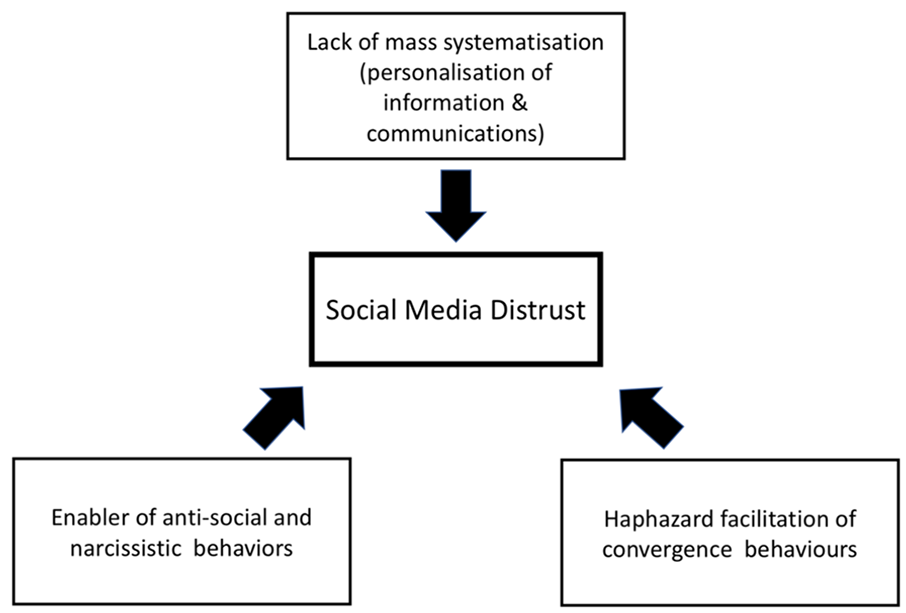
Factors contributing to social media distrust.
So how can we overcome these contributing factors to social media distrust and how might we make these platforms more effective for collective, informal decision-making in a crisis?
Sense-giving mechanisms in social media
The answer to this question implies not only shifts in media perception and participation but also changes in the way individuals, and organisations, such as emergency management agencies (EMAs), make sense of information in critical situations (Oh et al., 2012; Stieglitz et al., 2015; Vieweg et al., 2010). Social media platforms hold the possibility to augment emergency warnings, crisis response actions (Bunker et al., 2015), information seeking and broadcasting (Ross et al., 2018), collecting donations (Starbird and Palen, 2012) or hierarchy-free collaboration (Schlagwein and Hu, 2017). At the same time, social media communication might also produce an adverse impact on meaning creation and decision-making due to their personalisation of information; haphazard facilitation of convergence behaviour; and enablement of anti-social behaviour (Bunker et al., 2019). In the past, formal information systems relied on the concept of mass systematisation of information and messages for decision-making. Formal systems were built on mutually agreed system specifications including the definition of data and the processes applied to it. Social media platforms like Twitter, however, provide an infrastructure that can facilitate rumours and the spread of misinformation (Mirbabaie et al., 2016). Information on these platforms is first generated, represented, interpreted and acted upon at an individual level, without it necessarily being validated or its creator authenticated, while providing an organic network structure for the dissemination and spread of this (unverified) information (Kim and Dennis, 2019). Haphazard individual and group convergence on a disaster or crisis event is often the result as social media platforms lack the formal coordination mechanisms of formally constructed information systems.
Whether social media crisis communication enriches the available toolkit of response management or hinders concerned parties regarding sense-making depends on research being conducted which is required to define how we reconcile the dichotomy between the availability of a wealth of data and information overload (Dailey and Starbird, 2015).
The abstraction of information interdependencies almost inevitably leads to the application of a sense-making theory (Weick, 1988) to crisis communication. The theory incorporates information systems as a means for sense-making processes (Dervin, 1998; Dervin and Dewdney, 1986). Tying individual experiences to a collective understanding helps individuals to make sense of chaos (Dervin, 2003). Further investigation in this area helps to advance the understanding of how individuals and organisations create meaning from technologically supported crisis communication (Van de Walle et al., 2009). We must also consider the tension between the flow of information from its source to its recipients and the structural conditions of a collective decision about what messages and sources are being considered for sense-making through information systems. To this end, traditional emergency management approaches are being reconceptualised to work more effectively in a social media environment. For example, with the spread of COVID-19, health authorities such as the WHO are starting to use non-traditional approaches to leveraging social media ‘influencers’ to impact crisis response measures and communicate important information (Brown, 2020). Our study is specifically concerned with the characteristics and impact of these sense-giving efforts (Giuliani, 2016), which have not received any particular attention in crisis communication literature. This results in the following overarching research question:
This study proposes a data-driven approach to measure deliberate information distribution on Twitter and, therefore, attempts to identify decisive factors of influence, more specifically sense-giving, that affects sense-making during a crisis. We utilise the case of Hurricane Harvey in 2017 as a basis of this study, and we have divided our overarching research questions into two parts to guide this work:
We examine these questions from the analysis of crisis-related Twitter communication during Hurricane Harvey. This creates the opportunity to gain a holistic understanding of this communication within this medium and to what extent communication roles contributed to sense-giving during the crisis period. The study carries out a social network analysis (SNA) and a content analysis of tweets, retweets and replies of potentially influential users of the Twitter network during the Hurricane Harvey event. From the analysis of the Hurricane Harvey experience, we identify lessons learned that are highly relevant for the ongoing COVID-19 disaster response and other crises. Our results specifically aim to shed light on the social media sense-giving mechanisms of trusted authorities and agencies and how these can be leveraged for more effective communications outcomes in times of crisis.
Consequently, this study aims to contribute to the state of the art on meaningful social media use. The concept of sense-giving by means of information systems is not limited to crisis management but impacts a variety of societal and organisational use cases such as political communication, social movements, marketing or media literacy and education.
The study is structured as follows: section ‘Literature review’ provides an overview on the status quo of the literature on sense-making and social media crisis communication. A more detailed overview of the theoretical groundwork about sense-giving is outlined in section ‘Case description’, which is followed by a description of the research design in section ‘Research design – data collection and analysis’. Findings from section ‘Findings’ are then highlighted for discussion in section ‘Discussion’. The study concludes in section ‘Conclusion and further research’ with a summary of results, implications, limitations and further research suggestions.
Literature review
Sense-making and social media crisis communication
Sense-making is a process of individually constructed knowledge. It comes to pass when external cues impact an individual’s ability to progress the meaning of a certain situation (Dervin and Dewdney, 1986), or current activities (Weick, 1995). The process revolves around information seeking and information using (Dervin and Dewdney, 1986), generating a plausible meaning (Weick, 1995), and substantiating decisions and actions (Zhang and Gao, 2014). The concept of sense-making rests upon a general view of human communication and provides a useful framework for studying the mastery of meaning (Savolainen, 2006). Shared information can be tested in different contexts to support knowledge creation on a collective level (Dervin, 1999). With regard to increasing social media deployment, sense-making offers a unique perspective on interpreting the impact of social media as an unexpected, yet novel, toolkit for public crisis relations. Crisis events are characterised by low probability and, therefore, arouse a strong demand for sense-making (Weick, 1988). Social media may hold a transformational capacity in the way crisis response is being handled within society. This is mainly due to the fact that with social media, communicators may improve information dissemination (Soden and Palen, 2018) and data monitoring and analysis (Stieglitz et al., 2018); overcome the temporal and spatial separation (Van der Meulen et al., 2019); and, therefore, better coordinate their actions.
Past studies (Eismann et al., 2016; Reuter and Kaufhold, 2018) have investigated social media use in varying types of events under the scope of crisis management, which fall into the categories of either natural disasters or human-induced crises. Those incidents require local and global warning and response activities for which information systems are deployed (Bunker et al., 2015). Disaster management researchers have identified information uncertainty as one of the basic problems for emergency response operations, communication, collaboration, and decision-making (Oh et al., 2012). As a socio-technical phenomenon, it has become common practice that public incidents are initially reported by local eyewitnesses via mobile communication devices (Appleby-Arnold et al., 2019; Tanev and Zavarella, 2017). Publicly generated information is rapidly distributed through social media, followed by mainstream media coverage (Jin et al., 2014; Ross et al., 2018). Hence, existing systems used by EMAs during crises must deal with the fast spread of additional information stemming from organisations, groups and individuals on publicly available social media platforms (Mirbabaie et al., 2014; Sutton et al., 2012). These circumstances challenge the unique position of EMAs as the most credible source of information (Hughes et al., 2014). EMAs, governments and media organisations (MOs) frequently include social media in their communication strategy to engage with individuals at risk, to disseminate warning information and to provide informational updates over the course of a disaster event (de Graaf and Meijer, 2019; Palen et al., 2010). The use of social media by those entities, hence, presents two issues: on one hand, using social media as an additional channel to push messages; on the other hand, reaching out for valuable situational information from directly affected locals in the crisis area (Bruns and Burgess, 2014; Ehnis and Bunker, 2012). The latter has proven to oftentimes create a beneficial synergetic effect; local knowledge of first responders combined with the leverage of credible sources such as EMAs has the potential to result in a more effective emergency response (Oh et al., 2013). In most cases, however, social media has been adopted in an ad hoc fashion due to a lack of standardised frameworks (Ehnis and Bunker, 2019).
A key factor to successful crisis response is the establishment of effective information sharing and coordination among individuals and organisations, regardless of their location (Arvidsson and Holmström, 2013). Twitter appears to be a social media platform of great interest to research on crisis management and sense-making. Due to its speed (Oh et al., 2010), bottom-up design (Bruns et al., 2012) and public availability and use, it provides a blueprint for individual and collective (online) sense-making efforts. This requires us to consider individual members of society, as Twitter users, as ‘a powerful, self-organising, and collectively intelligent force’ (Palen et al., 2010: 1). Social media might serve not only as a backchannel to discuss crisis outcomes but also a means to share highly topical crisis information. Due to their wide-spread infrastructural components, social media platforms serve as vehicles and enablers for collective sense-making (Lee et al., 2017).
Interplay of sense-making and sense-giving
The success of a sense-making activity by a social media user depends on the ability of another user to provide useful information. Sense-making deals with ‘collecting, organising, and creating representations of complex information sets, all centred on the formation and support of mental models involved in understanding a problem that needs to be solved’ (Pirolli, 2009: 2). Additional terms have been introduced to the theoretical notion of sense-making such as sense-giving and sense-breaking. Sense-giving is defined as an attempt to influence someone’s sense-making by having a preferred definition of reality in mind. Sense-giving, therefore, limits the number of possible interpretations of information (Gioia and Chittipeddia, 1991; Voronov, 2008). Sense-breaking, on the contrary, describes the reorientation of individuals when contradictory cues break with the ongoing interpretation within the sense-making process. The three concepts are differentiated as follows: (1) sense-making deals with the identification of justifications of a specific phenomenon, (2) sense-giving supports the diffusion of a justification, while (3) sense-breaking is related to the refutation of an old justification and the adoption of a new one (Giuliani, 2016: 221). Figure 2 provides a graphical representation of the interplay between those concepts.
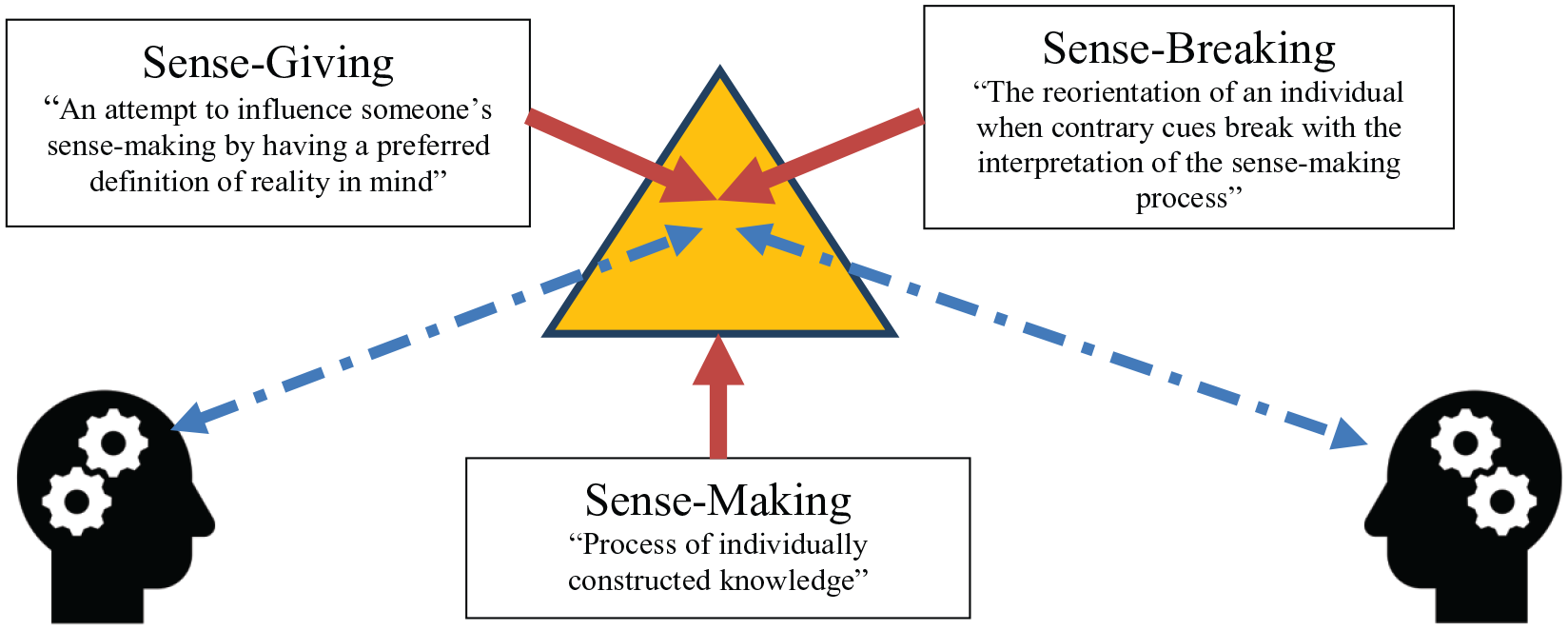
The interplay of sense-giving, sense-breaking and sense-making.
On Twitter, the identification of knowledge gaps might be fostered through adding targeted questions in postings which are then collectively retweeted (Zhang and Gao, 2014). Other than pulling information, novel information might also be pushed by certain types of users (Pervin et al., 2014). Studies on social media crisis communication describe sense-making as a collective process or even collective work (Starbird and Palen, 2012). However, the dimensions of individual users contributing to this process are not equally distributed. Whereas a ‘listening community’ of affected, indirectly affected or interested users seeks trustworthy information (Ehnis and Bunker, 2013), there is also the occurrence of influential users providing the information. Even though sense-making and sense-giving appear to be inherently different, both processes are ‘less distinct domains [. . .] than two sides of the same coin – one implies the other and cannot exist without it’ (Rouleau, 2005: 1415). Where sense-making deals with understanding, sense-giving is about influencing and persuading with the objective to shape the perception and interpretations of a situation (Dixon et al., 2017). The body of knowledge has yet to provide a clear understanding of sense-giving in the context of social media crisis communication, where a void of information leadership and influence is likely to occur.
We do know, however, that a number of factors can influence sense-giving. These can include an individual or organisation’s
Popularity – celebrities, government agencies and well-known organisations can have an influence on sense-giving by virtue of their popularity and likeability giving off and air of authenticity and believability (Skågeby, 2010);
Network-based content influence – being part of a network means you are hardwired into a group and being an accepted member of a network. Your contribution is considered in light of a ‘like-minded’ group (Lee et al., 2017);
Information – must be true or correct to be information; incorrect information is misinformation or disinformation. However, all those types affect sense-making (Mingers and Standing, 2018);
Authoritative behaviour – simply by behaving as if you have all the facts can also contribute to sense-making as you may have experienced a similar situation or you have experiential heuristics to rely upon when stating your opinions (Bakshy et al., 2011);
Ability to close knowledge gaps – news organisations are particularly good at this as they scan for information to ‘sell’ to their audience. Similarly, expert individuals who have cultivated a profile on a topic can also assist with closing gaps (Marx et al., 2018);
Ability to take preventive action – disaster management agencies and governments have the ability to influence policies and risk mitigation and, therefore, build their presence in a network prior to a disaster occurring. This means that they already have credibility and authenticity with network members, which adds to their sense-giving role (Oh et al., 2013);
Familiarity with the preferred ‘definition of reality’ – societal norms, values and beliefs all shape our ability to make sense of actions and situations. For instance, if rule of law is a core belief in a society, then organisations and individual who uphold these beliefs are an integral part of the sense-giving process (Giuliani, 2016);
Perceived trustworthiness – most of the previously outlined factors all contribute in a greater or lesser manner as to whether we trust an individual or organisation (Ehnis and Bunker, 2013).
Sense-giving also directly impacts and influences sense-making within hierarchical leadership structures like the command and control management structures of disasters or emergencies where citizens look to their EMAs or governments to help them understand the situation and survive it (Bunker et al., 2015). Official organisations can give sense to a situation by virtue of their legitimacy and collective control of the situation via a hierarchy of communication structures.
While sense-breaking efforts (Giuliani, 2016) such as rumours, misinformation and disinformation (Mirbabaie and Marx, 2019; Oh et al., 2013) are constraining factors, sense-givers take countermeasures to disseminate accurate and relevant information (Marx et al., 2018).
Factors of influence on Twitter
Twitter is designed to nurture the dissemination of information. Its architecture is based on the concept of users following the broadcasts of other users which builds an interconnected web of followers and followees (Bakshy et al., 2011). These dynamics challenge researchers to get to the bottom of how information is spreading through large (online) crowds and how it affects society in general (Kitsak et al., 2010). Influence detection might benefit political sciences, human mobility, rumour spreading, epidemiology and other areas of application (Riquelme and González-Cantergiani, 2016). Consequently, increased effort is being placed on systematically recognising and interpreting the identity of influential users in social media. However, influence is an ambiguously defined concept (Cha et al., 2010; Lee et al., 2014; Riquelme and González-Cantergiani, 2016).
No general consensus exists on what metrics specify influential users in social media. In general, influential users form ‘a minority of individuals who influence an exceptional number of their peer’ (Watts and Dodds, 2007: 441). Early studies suggest considering how many individuals were reached directly (Coleman et al., 1957). Since the creation and adoption of social media with high scalability, absolute numbers of individuals reached are mostly being neglected. Instead, the number of influential users is determined by tests that calculate a relative proportion of all users to be influential (Bakshy et al., 2011; Watts and Dodds, 2007). Other approaches characterise influential users with regard to their authority (Pal and Counts, 2011) or message content (Lee et al., 2017). Here, we should not confuse influential users with popular users. Whereas popularity in Twitter can be seen from the follower count, authoritative and influential users might appear and vanish with certain events or topics, for example, local EMAs. Such authorities are often less discoverable due to few followers and little to no previously produced content (Pal and Counts, 2011). The same number of followers, or popularity, does not equal the same kind of influence (Bakshy et al., 2011). It requires additional factors on a content and/or network level to become an authority of influence.
The retweet function is often seen as the most eligible metric to identify influential accounts within a Twitter network level (Kim and Kim, 2016; Lee et al., 2017; Mirbabaie et al., 2014; Riquelme and González-Cantergiani, 2016; Watts and Dodds, 2007). The overall influence of a tweet might have multiple dimensions. First, influence can be measured through the mere reach of a message: how many other users were exposed and effected by the tweet? Second, the impact of one’s cognitive and emotional perception might vary (McNeill and Briggs, 2014). Tweets could reach the same number of users but they may differ in their level of concern due to the type of content. Still, maintaining a high volume of original tweets does not imply influence as it does not entail attention or engagement (Mirbabaie et al., 2014).
The nature of influence in Twitter is based on an ambivalent paradigm. On one hand, influence arises from a minority of people who are either highly convincing or hold diverse connections throughout the network; on the other hand, influence constantly occurs accidently through unpredictable circumstances. Relatively fameless users unexpectedly become influential through a cascading effect of their content (Watts and Dodds, 2007). The latter scenario, to a large extent, is fostered by the Twitter architecture and its algorithm. This implies that, despite some seemingly random influential users, a number of decisive criteria can be determined (Quercia et al., 2011). Bakshy et al. (2011) take this concept even further and claim that information dissemination through ‘ordinary influencers’ is more cost-effective than utilising large-scale accounts.
With regard to sense-making, a role-based approach allows us to organise social media accounts who ‘negotiate between their own individual commitments and perceived social expectation’ (Cornelissen, 2012: 118). Consequently, a role-based approach serves as an alternative way of framing social media content. EMAs and other authorities face certain expectations within the Twitter community. Collective sense-making processes subsequently evaluate how those expectations are met and how performances fit the role (Shaw et al., 2013).
Influential role characteristics on Twitter
Social media crisis data spawn different communication roles and a different distribution of each of the role agent’s visibility and characteristics. The review of pre-existing studies tries to ascertain a common array of communication roles and characteristics during crisis events (see Table 1).
Influential role characteristics on Twitter.
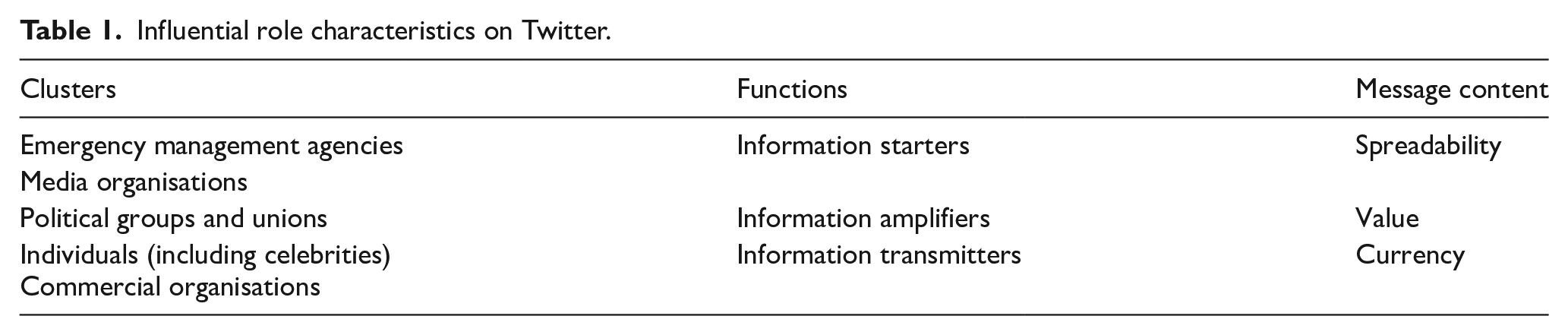
Mirbabaie et al. (2014) identified five role clusters: EMAs, MOs, political groups and unions, individuals and commercial organisations.
A different approach is to cluster users according to their function within the network, regardless of their inherent characteristics such as a private or professional background. Mirbabaie and Zapatka (2017) differentiated between three types of influential roles. Information starters are widely retweeted due to introducing novel information to the community. Users who resort on a large base of followers and consequently receive large numbers of retweets are considered amplifiers. A third role type, transmitters, actively disseminates opinions to help other users to establish or reconsider their own perspective during the process of sense-making. The classification by behavioural characteristics allows a more tangible way to connect observations in social media to the theoretical construct of sense-making.
Measurements of influence on a network level can be found in the activity graph of network participants. Lee et al. (2014) deliver a comprehensive approach on how to measure content influence; this basically rests upon the idea to what degree a tweet contains meaningful information for another user. The (1) spreadability of a piece of content relies on the size of the audience it is initially exposed to. The (2) value of content information can be measured through the number of times a piece of content is being shared. The (3) currency of information follows the assumption that newer content is of higher value to Twitter users than older postings. This is particularly important when analysing Twitter data as its algorithm values content primarily in a chronological order. Consequently, the frequency of posting original tweets might serve as an indicator for content influence. Authoritative users are typically assumed to be the central nodes of topical hubs (Räbiger and Spiliopoulou, 2015). Pal and Counts (2011) refer to the notion of authority to differentiate a user’s influence in terms of magnitude. To determine authority, it requires both graph characteristics and textual features. Therefore, they suggest a mixed approach to investigate influence metrics.
We therefore focus on how influential roles in Twitter differ during a crisis and how influence factors of communication roles impact sense-giving. To better understand these factors and roles, we look at Twitter use during Hurricane Harvey in 2017.
Case description
In early August of 2017, the tropical storm ‘Harvey’ developed to a Category 4 hurricane over the Atlantic Ocean. Harvey gained in intensity and was considered a tropical storm on 23 August. Several Texas counties issued mandatory evacuations of residents while weather predictions expected Harvey to strengthen to a major hurricane. On 26 August, Hurricane Harvey made landfall near Corpus Christi. The hurricane moved towards the City of Houston while causing severe floods throughout south-eastern Texas on Sunday, 27 August. Disastrous floods and heavy rain continued until Wednesday, 30 August. Hurricane Harvey was declared over on 31 August and was followed by recovery and reconstruction efforts throughout a large number of Texas and Louisiana counties (Sternitzky-DiNapoli, 2017). The portrayed events provide the opportunity to understand sense-giving in disaster situations as this case involves the entire social spectrum of involved communication roles, extensive Twitter activity and platform-savvy users.
Research design – data collection and analysis
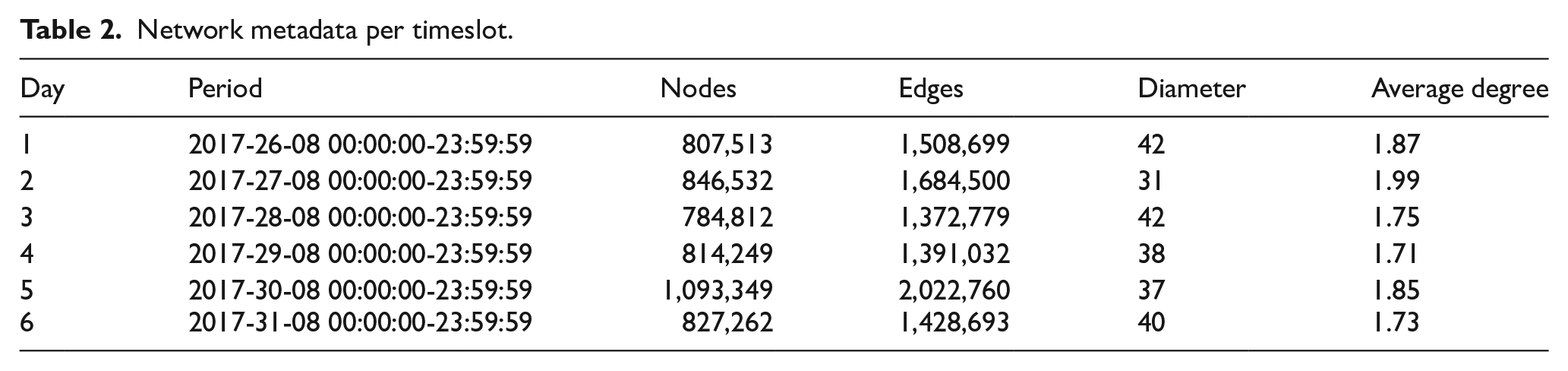
This case study builds upon a Twitter dataset concerning the events caused by Hurricane Harvey. The data were sourced through a self-developed crawler, which is based on the Social Media Analytics Framework (Stieglitz et al., 2018) and is using the open source library Twitter4J. A total of 6 days of Twitter communication from 26 August 2017 (0:00 UTC) to 31 August 2017 (23:59 UTC) was collected. To obtain only relevant data, postings containing the keywords ‘hurricaneharvey’, ‘harve’ and ‘hurrican’ were crawled by using the Twitter API search query. The selection of keywords was based on their usage frequency during the crisis as well as trending hashtags, which are included in the selected keywords. Only data provided with English language settings were collected. Data tracking of the keywords provided a total of 9,414,463 tweets. Our research design was constructed upon a combined set of metrics including original tweets, retweets, mentions as well as characteristics from graph theory (Pal and Counts, 2011) to determine user role influence on Twitter. To ensure manageability and to set the data in the sequential order, the dataset was divided into six parts, each covering a 24-h ‘slice’ of communication.
Our methodical approach was to perform a comprehensive SNA. To this end, the open source tool ‘Gephi’ was used. The dataset presents the Twitter communication flow as a directed retweet network. The nodes of the graph represent Twitter users, and the directed edges represent retweets. All relevant metric calculations were applied to the complete graph of each 24-h slot. Visualisations were performed on a subset of the graphs to ensure technical feasibility. For each of the six networks, the network diameter and specific centrality measures help to better characterise the norms and appearance of the graphs (Caldarelli and Catanzaro, 2012). A key measurement to determine highly visible users within a retweet network structure is the indegree. This represents the number of retweets a user received and serves as a strong indicator for the visibility and popularity of a message (Kwak et al., 2010). Power users are defined as the accounts receiving the highest number of retweets relating to all their original tweets (Oh et al., 2015). Determining the power users based on their indegree allows us to create a ranking of potentially influential users. To cover the entire spectrum of predefined communication roles, the accounts were ranked by indegree. Double entries for different 24 slots reduced the number of power users for some role types.
The SNA was complemented by a content analysis of influential users’ textual Twitter communication. To this end, the creation of a conclusive and manageable sample was necessary; the six underlying datasets for each day served as a foundation. In practice, the tweet collections were allocated to the role categories we derived from the literature: private persons, MOs, journalists, influencers/bloggers, celebrities, EMAs, and politicians (Mirbabaie et al., 2014; Mirbabaie and Zapatka, 2017). This step was performed manually by all authors in the descending order until each role type occurred at least five times among the most visible power users (top 100). Using the statistical metric of Krippendorff’s alpha, a score of 0.834 was calculated. Our coding can be rated as reliable as α ≥ 0.800 (Krippendorff, 2013). The final sample consisted of 1272 tweets, retweets and replies.
Findings
SNA
The Hurricane Harvey communication showed a consistent distribution of involved users and their contributions on Twitter across all days that the data were collected. There is a slight peak in communication on Day 5 with 1,093,349 unique users and 2,022,760 tweets. The diameter, which is the longest of all shortest paths of a network, represents the linear size of each network. Following this measurement, the networks of Days 1 and 3 are the largest, and Day 2 is the smallest network in terms of path lengths. The average degree, as displayed in Table 2, defines the medial tweet activity per unique user. According to the calculations, the users showed the highest engagement on Day 2 and the least activity on Day 4.
Network metadata per timeslot.
The calculation of the indegree value as an individual network metric allows the identification of power users as highlighted in Figure 3. Their affiliation to each role type is indicated by its colour.
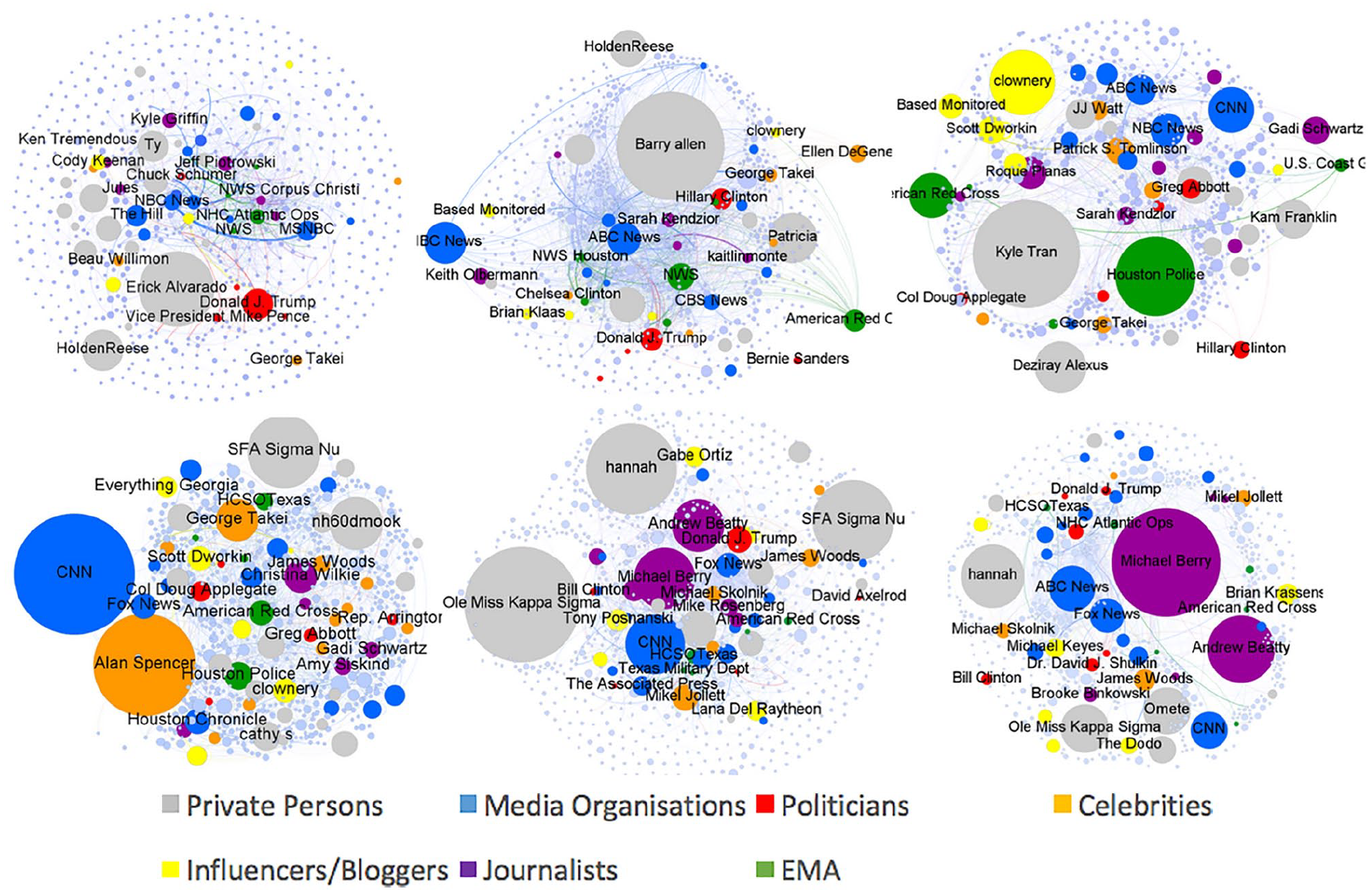
Hurricane Harvey communication network Day 1–6.
The size of each circle represents its indegree value, whereas each colour represents the according role type. The visualisations were exported from Gephi and rest upon the layout algorithm ‘Fruchterman Reingold’. This algorithm produces a force-directed graph layout, which exhibits symmetries, avoids crossings and tends to be visually appealing (Kobourov, 2012). At the same time, unconnected nodes as well as nodes with a lower indegree value (received retweets) than 250 were screened out. This step notably increases clarity and manageability of the graphs. It also leaves these subgraphs with a relatively low percentage of visible components. However, this filtering only applies to the visualisation – other conducted calculations were based on the complete graph.
The images illustrate a shift in predominant role types over the course of the crisis. On Days 1 and 2, private persons occupy large parts of influence exertion, whereas organisational roles gain relevance midway through the crisis as depicted in the networks of Days 3 and 4. The last 2 days of Hurricane Harvey communications are again dominated by individual role types such as private persons and journalists; however, the visualisations based on indegree values might not reflect a holistic view in terms of influence. Hence, further examination regarding additional metrics is required. As outlined in the research design, the sample for the content analysis is based on the top five ranking users in terms of indegree per communication role type. Figure 3 aggregates the indegree values of the power user lists of the entire 6-day period, in which a clear distribution of received retweets is evident. As shown in Figure 4, private persons hold the first position in this comparison. These numbers rest upon the data of only the top five power user ranking; therefore, all roles are represented by the same absolute number of users.
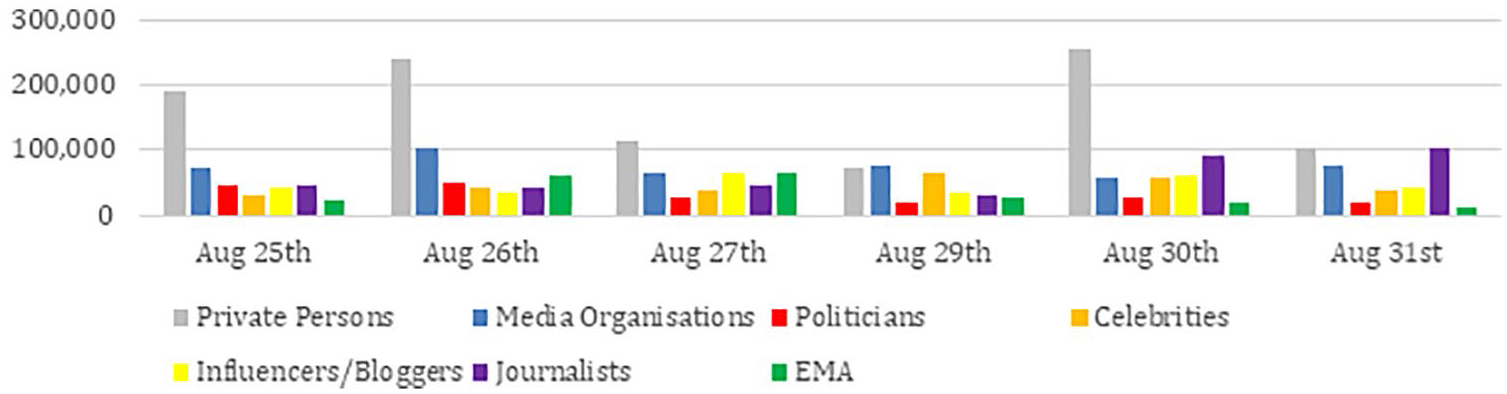
Top five power users (received retweets).
As the indegree value tends to be the most crucial metric in terms of influential content, its distribution over the course of the crisis is of interest. By arranging the volume of received retweets among all identified roles, their impact during distinct crisis phases becomes visible. Private persons received the highest number of retweets on 4 of the 6 days (Day 4: MOs, Day 6: journalists).
Content analysis
As a next step in our research design, that is, content analysis, a sample of representative tweets, retweets and replies was created. This allows a comprehensive analysis of potentially influential user’s activities. To supplement the sample with relevant content, the activities of all top five power users of each role per day were merged into a separate dataset, which was arranged according to role type. Considering duplicate accounts in the daily rankings, the sample contained 121 users. The most represented roles were private persons (20), journalists (20) and influencers/bloggers (20). The variety among celebrities (19) and politicians (18) almost equals this amount, whereas MOs (12) and EMAs (12) show a smaller number of unique accounts. These accounts produced a total output of 1272 tweets during the 6-day period: 753 original tweets, 490 retweets and 29 replies. Interestingly, 36 of the 121 accounts did not provide any content containing one of the keywords, including hashtags, for the recorded time span. The reason that these users show up in the daily top five rankings is the relevant content they produced before the first day of data tracking. Over the course of the 6-day period, those accounts still received enough retweets to keep their crisis-related content visible and appear in the power user rankings in the SNA. Celebrities (9), influencers/bloggers (8) and politicians (7) appeared to have the greatest occurrence of such ‘lingering’ accounts (Table 3). Those accounts have authored various other tweets prior to the tracking period but were still retweeted.
Communication role types included in sample.
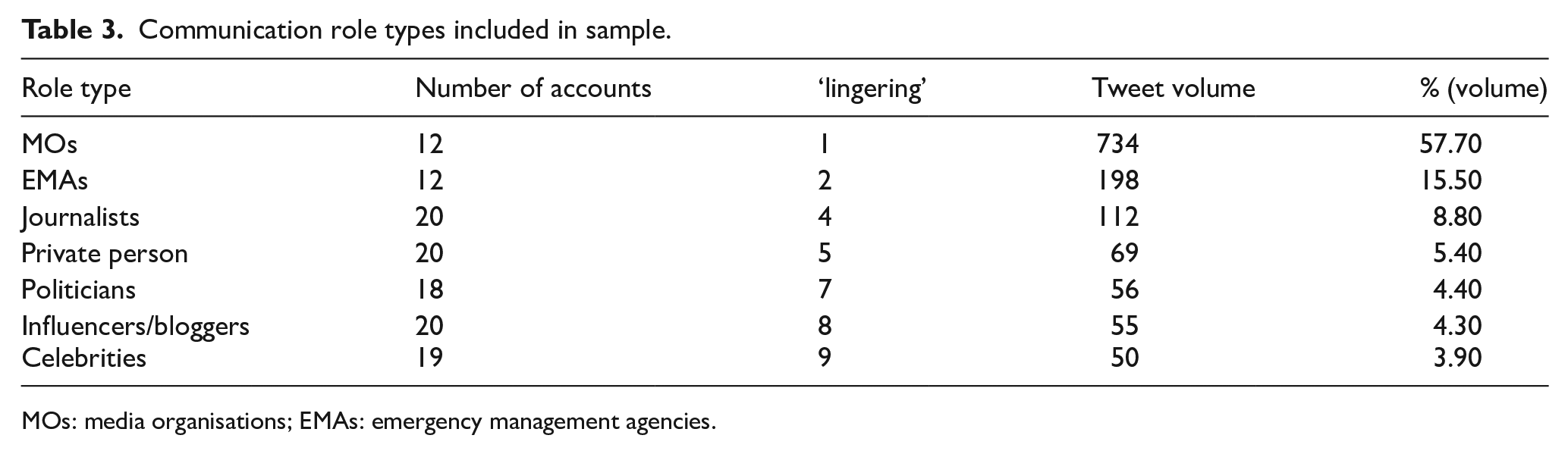
MOs: media organisations; EMAs: emergency management agencies.
MOs make up the most active role type, as 57.7% of the sample’s content stems from involved media outlets, followed by EMAs (15.5%). Celebrities showed the least activity in terms of quantity of tweets. Obviously, these figures relate only to tweet frequency, with no other metrics such as the indegree value involved. In a subsequent step, all tweets were classified according to their information types. Official statements had to be declared by official bodies such as governmental organisations or representatives. Table 4 also includes retweeting or replying as one of the information types, for example, a private person retweeting an official statement. News or crisis information includes current coverage of the crisis events. A personal opinion can primarily be expressed by individual roles rather than organisational roles. Personal experiences reflect actual eyewitness reports and usually provided additional audio-visual content. Forwarding messages stand for any types of tweets that are created to be shared. Those messages explicitly (or implicitly) contain a call to action. Most prominent messages of this category are charitable content and appeals for donations. Solicitousness expresses compassion with affected people. Humour includes parody, sarcasm and jokes.
Information type used by each role.
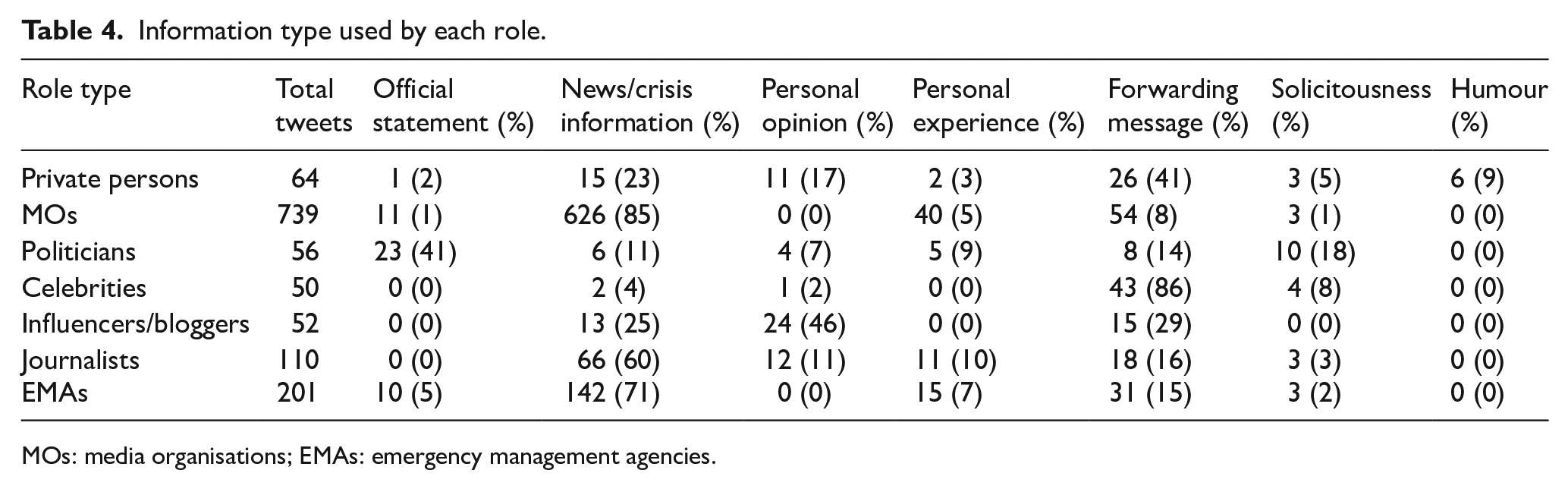
MOs: media organisations; EMAs: emergency management agencies.
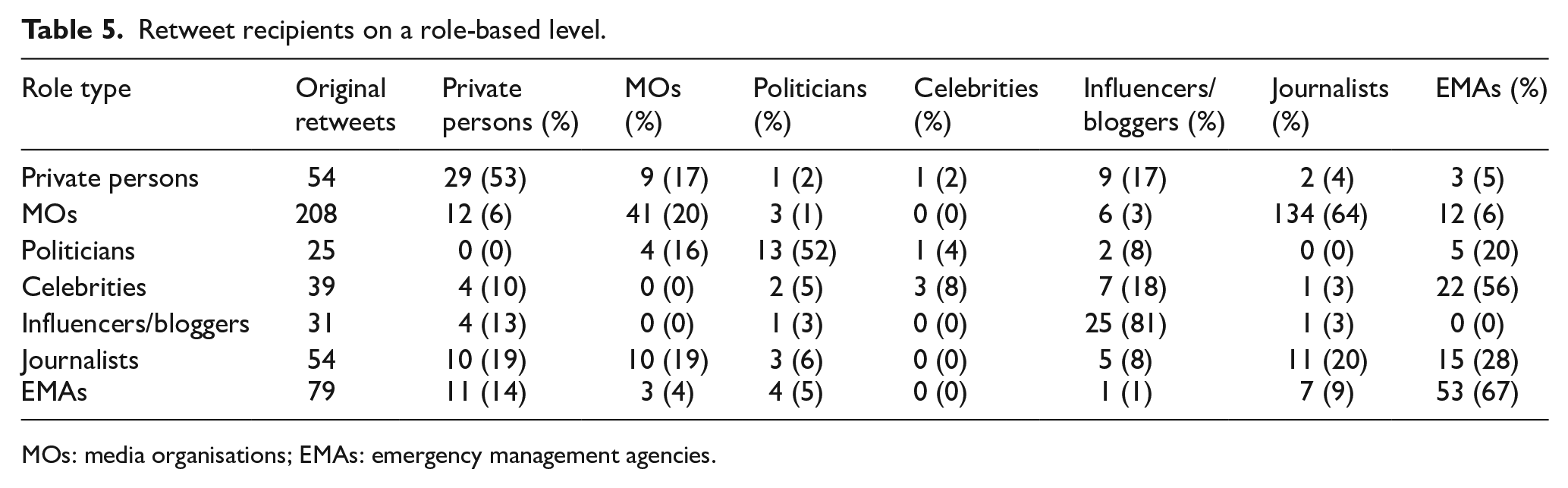
The sample coding revealed distinctive features of each role to distinguish them from another and, therefore, serves to answer the first research question of this study. The relative numbers (in parentheses) reference the total number of tweets (original tweets, retweets and replies) of each role, for example, 2% of private persons’ tweets contained official statements. Private persons (and politicians) distributed the most balanced mix of information types. In addition, humorous tweets could only be found among private persons. A seemingly low number of six humorous tweets made up for a significant number of retweets. Those tweets primarily featured additional content. The analysis also revealed that the majority of humorous tweets were authored before the onset of the crisis but experienced a somewhat viral effect through retweeting over the course of the unfolding crisis. MOs primarily focused on the distribution of crisis information and news. A total of 85% of MO content could be classified as such. The numbers of crisis information provided by MOs have the highest absolute score in the sample (626) and the second highest occurrence of one information type relative to the other messages distributed by this particular role (85%). Politicians take the leading role in declaring official statements (41%) and expressing solicitousness (18%). Celebrities seem to leverage their popularity by spreading forwarding messages such as appeals for donations and other charitable content. The influencers/bloggers category stands out by voicing personal opinions (46%), whereas journalists (66%) and EMAs (71%) focus on news and crisis information. The distinction of information types within the content of certain roles helps to characterise those roles of Twitter users in social media crisis communication; however, this analysis can be taken one step further by bringing into focus the retweets by each role type. The sampled accounts were selected based on the power user ranking (received retweets). To add another layer on the characterisation of such roles, one could ask the following: did the most retweeted users retweet themselves? To that end, all retweets (490) had to be separated from the rest of the sample. The retweet recipients were subjected to the same role categorisation as the accounts in the superordinate sample. Table 5 shows the distribution of retweet recipients in absolute numbers and relative to the overall retweet volume of each role type.
Retweet recipients on a role-based level.
MOs: media organisations; EMAs: emergency management agencies.
The accounts assigned to the private person category preferably retweeted content stemming from other private persons (53%). MOs forwarded a high number of tweets authored by journalists to their followers (64%). Politicians retweeted politicians (52%). Celebrities referred primarily to EMAs (56%), whereas influencers and bloggers retweeted related content from members of their own role type (81%). Journalists show the most balanced distribution in terms of retweeting to other roles, slightly preferring EMAs (28%), who themselves were concerned to share a high number of tweets of other EMAs (67%).
Discussion
Sense-giving in social media crisis communication
To reverse-engineer the factors of influence implicated in a collective sense-making process, this study identified popularity, network-based and content influence, as well as the authoritative behaviour of Twitter users. The most obvious conclusion about influential users is their ability to close knowledge gaps (Dervin, 1999) by providing information. During Hurricane Harvey, influential users did not open up new gaps by raising questions (Zhang and Gao, 2014) but rather aimed to reduce uncertainty through preventive action. Invoking influential users or popular users, who have been influential in the past (Kitsak et al., 2010), might advantage an individual’s sense-making process. This is due to a user’s familiarity with the preferred definition of reality (Gioia and Chittipeddia, 1991), and perceived trustworthiness. Existing literature discussed sense-giving as a constraining force of sense-making (Voronov, 2008). While this might be true in an organisational context with hierarchical leadership structures, public crisis communication might actually benefit from sense-giving efforts. While sense-breaking efforts (Giuliani, 2016) such as rumours, misinformation and disinformation (Oh et al., 2013) are constraining factors, sense-givers take countermeasures to disseminate accurate and relevant information. Retweets, along with other influence factors, serve as a legitimisation and collective control action to determine the extent to which a sense-giver is influential. Despite the fact that sense-making takes place on a collective level (Bruns et al., 2012; Dervin, 1999; Palen et al., 2010; Stieglitz et al., 2017), with social media as an amplifying system for democratising information, there is still a natural hierarchy in communication structures. Those structures might be redefined through leveraging the above factors of influence in each distinctive situation. However, the role-based approach of this study helps to understand underlying patterns of actors influencing sense-making processes. Our study exemplifies how individual and organisational role types influence collective knowledge creation (Dervin, 1999; Dervin and Dewdney, 1986). As sense-making involves the creation of meaning by an individual through the integration of external sources, influence should be regarded as a crucial factor when transmitting expertise between individuals. MOs especially were found to leverage their influence and, therefore, contribute to sense-making by providing crisis information. MOs tend to have high betweenness centrality values, which make them transmitters (Mirbabaie and Zapatka, 2017). This enables them to connect unrelated users throughout the network and utilise their weak ties. At the same time, MOs function as ‘information hubs’ (Hughes et al., 2014). MOs do not necessarily function as ‘information starters’ but join roles together. Whereas influential private persons, for instance, solely rely on their network authority by tweeting influential tweets sporadically, MOs further establish themselves as content authorities by providing information on a constant basis. Content authorities’ influence rests upon receiving retweets on a frequent basis, whereas users with time-limited network influence gain a majority of their retweets through large momentum, which goes back to a single tweet. Other role types contribute to collective sense-making by either leveraging their popularity (e.g. celebrities, politicians) or content influence (e.g. private persons). Those roles provide less crisis-related information but rather official statements, humour or solicitousness to drive emotional sense-making (Ehnis and Bunker, 2013). However, most users do not author consistently enough to be regarded as content authorities. The mere volume of tweeting does not necessarily translate to influence, but tweeting in a consecutive manner about a specific subject, among other factors, facilitates the process of becoming a content-related authority. We found a strong tendency of users to retweet others of the same role type. This observation reveals idle potential in how Twitter users might increase their amplifying and transmitting capabilities (Mirbabaie and Zapatka, 2017). Surprisingly, private persons could be found to reach the largest audience during the event, even in relative numbers. Compared to a crisis case such as the Brussels bombings of 2016, this makes a big difference (Mirbabaie and Zapatka, 2017; Stieglitz et al., 2017) in how crisis-related communication patterns emerge.
When investigating the terminology of influence relating to sense-making, theory provides the notion of sense-giving (Gioia and Chittipeddia, 1991; Giuliani, 2016). The concept of sense-giving is mainly understood in an organisational context, with leaders providing a view of reality to their network. This study proposes to transfer and apply the notion of sense-giving to the sphere of social media crisis communication. It represents a subfactor of sense-making that is driven by influence and deals with actively pushing information towards ‘collective knowledge creation’ (Dervin, 1999). Sense-giving is responsible for the input of knowledge (Giuliani, 2016), whereas the knowledge seeking and action taking produces the outcome of sense-making (Dervin, 1999). This study identified network and content authority to be essential factors of sense-giving. Predetermined or, more explicitly, input factors of Twitter communication rest upon network-related measurements and content-related factors of influence. Factors such as popularity, trustworthiness or perceived content value are secondary drivers on both layers.
Distinctive characteristics of influential communication roles
The volume of crisis-related communication on Twitter during Hurricane Harvey remained at a constant level with no significant peaks of information flow. The differing nature of Hurricane Harvey compared to highly unexpected events becomes evident when comparing the distribution of role activities over time. Whereas MOs or EMAs dominate early stages in highly unexpected crises (Stieglitz et al., 2017), the distribution of role activities during Hurricane Harvey remained constant over time. Apparently, there was less demand for ‘emotional sense-making’ (Ehnis and Bunker, 2013) during later stages of Hurricane Harvey, which is usually provided by private persons, celebrities or social influencers (Stieglitz et al., 2017). When considering the number of received retweets (indegree) as a network metric for influence as proposed by related work (Kim and Kim, 2016; Riquelme and González-Cantergiani, 2016), private persons as a role type record the highest values. This can primarily be explained by means of content nature. Private persons’ predominantly produced information types during Hurricane Harvey were forwarded messages or original messages of a humorous nature. Those information types hold a larger potential for viral spreading within social media.
Whereas MOs (12) and EMAs (12) accounted for the least number of unique accounts within our content sample, individuals such as private persons (20), journalists (20), influencers/bloggers (20), celebrities (19) and politicians (18) showed a larger variety of content. The results of our SNA point to less accounts of higher influence among organisational role types and a broader variety of users sharing influence within the range of individual role types. This might seem to be a limitation; however, the occurrences of ‘lingering’ accounts reveal insights into role characteristics and, therefore, serve to answer the first research question. The findings highlight that individual role types such as celebrities (9), influencers/bloggers (8), politicians (7) and private persons (5) show higher appearances of influential accounts with no postings during the tracking period. Organisational role types, however, did not contain as many infrequently authoring accounts: MOs (1), EMAs (2). This leads to the conclusion that individual role types tend to exert influence through fewer original tweets. Influential users with no profound popularity or following, for example, private persons, might even owe their influential force to one single tweet of exceeding virality.
This leads to the conclusion that within social media crisis communication, two types of sense-giving are predominant:
Perpetual sense-giving;
Intermittent sense-giving.
The former type relies primarily on authority and frequency, whereas the latter occurs due to a content value (Lee et al., 2014) and is largely supported by open network amplification, for example, retweet distribution. In terms of roles, the influence of organisational role types is rather pre-mediated and relies on a frequent publishing strategy. This aligns mainly with the currency of information, which assigns higher influential power to newer and highly topical content. The first influence factor, spreadability of information, applies to both individual and organisational role types. One exception might be the group of private persons as those accounts have no large pre-existing audience, which is exposed to their content. MOs and EMAs showed the highest tweet frequencies among all roles, whereas individual role types posted less frequently. Those role types tend to prefer authoring original tweets over retweeting other content. Individual role types, by contrast, show higher activity in terms of forwarding messages to their following.
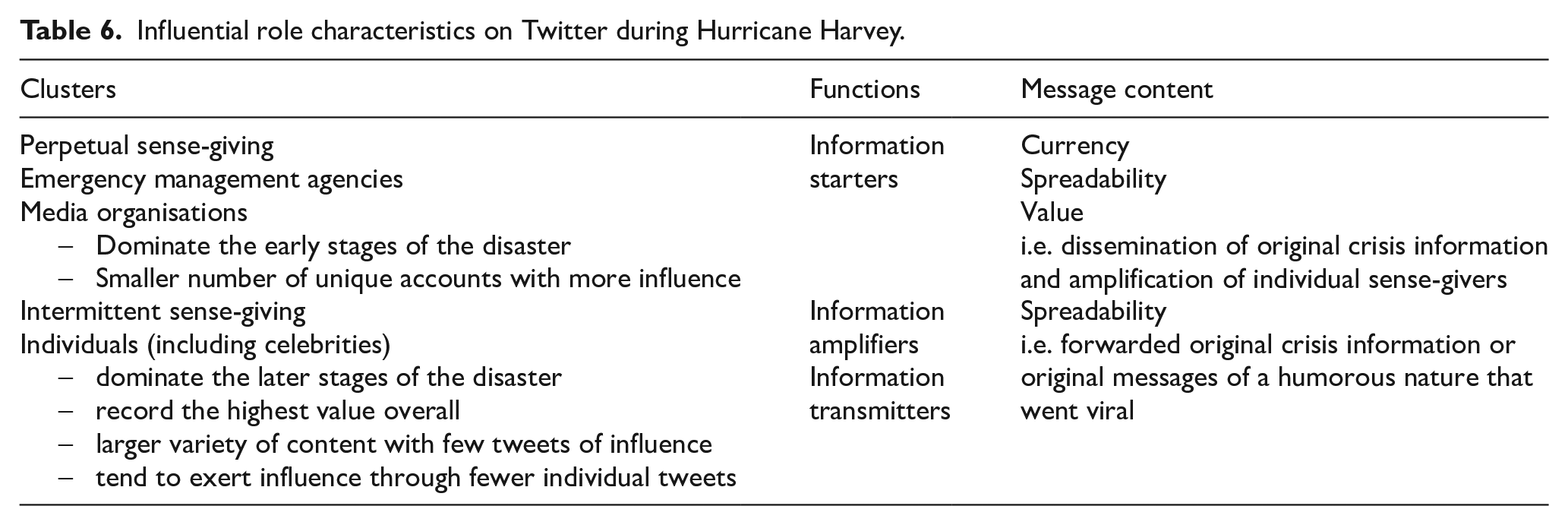
The content analysis revealed distinctive role types to be responsible for creating different kinds of content. Whereas MOs, EMAs, and journalists are mainly responsible for the dissemination of crisis information, remaining individual role types publish official statements (politicians), personal opinions (influencers/bloggers), solicitousness (politicians) or humour (private persons). These findings tend to be rather intuitive and further support Mirbabaie et al. (2014) and their role categorisation. Beyond that, however, our analysis revealed distinctive role characteristics and prerequisites, respectively, which are needed for effective sense-giving. Table 6 provides an overview of functions and content traits related to each of the two sense-giving clusters.
Influential role characteristics on Twitter during Hurricane Harvey.
Moreover, our analysis of Hurricane Harvey revealed novel realisations about how influential users actively engage with the Twitter community. The measurable level of influence mainly originates from received retweets as a reaction to authoring original tweets. Influential users might additionally retweet other users’ content themselves and therefore – to the extent of their popularity – leverage their reach. While this is a frequently observed phenomenon in social marketing, it has important implications for organisations willing to disseminate information in social media (Ross et al., 2018). While organisations can be assumed to be aiming to increase their influence on users and their economic, political or social behaviour, they certainly lack the ability of exerting sense-giving. Instead of acting as a conduit of supplementary information outside of their own personal experience, organisations might broadcast information already circulating within their inherent cluster. A wide range of authors criticised missing two-way communication and interaction on the part of organisations (Hughes et al., 2014). Analysing Hurricane Harvey revealed a reasonable amount of activity in terms of incorporating other sources by organisations, yet there is still room for improvement. In this context, MOs author a large number of unique contents, but also function as a bridge between users in other role categories. To be able to exert perpetual sense-giving and have an impact on a particular industry, single event or societal discourse, organisations benefit from deploying social media as a panel, frequented with original content. On the way, or in extreme situations, intermittent sense-giving provides organisations with the ability to bridge between other actors. This requires increased emphasis on inter-organisational relations and collaborative work with users already holding sense-giving capabilities.
Conclusion and further research
In this study, we have applied the concept of sense-giving to the realm of social media crisis communication through analysing the characteristics of the most influential roles which communicated during Hurricane Harvey on Twitter. Network and content authority were characteristics these influential roles have in common. Both, network and content authority, are essential factors for sense-giving. Our findings are highly relevant for a number of reasons in view of the current ongoing COVID-19 crisis.
Development of a communications strategy for epidemic crises
In July 2019, a 1-day workshop was held by the Australian members of our research team in Sydney with key practitioners and researchers in health and crisis communications to develop a strategic view of communications and development of situational awareness during epidemic crises. Attendees included a cross-section of health researchers, managers and workers (including an Aboriginal health worker/researcher); communication managers; disaster management practitioners and researchers; and IT and communication researchers.
Key findings included that information and communication systems should be developed and used to
Support relationship building in public health (1:1, 1:n, M:M);
Communicate information that reinforces trust and responsibility of all parties, that is, government, business, communities and individuals;
Target messages effectively to specific cultural subgroups;
Provide timely public access to health information that reinforces trust, privacy and ethics;
Develop practitioner clarity on ethics of health communications;
Consider the structure and impact of closed system health communications, that is, military, hospitals, nursing homes, schools etc.
So how does our study of Twitter communication during Hurricane Harvey help us to design a communications strategy for an epidemic like COVID-19 which considers the key findings of this workshop?
From our Hurricane Harvey study, we now better understand that authorities and organisations involved in the management of the current epidemic such as health, border control, transport, education, retail, media etc. have a communication advantage in early information provision to social networks.
For example, in the case of COVID-19 epidemic management, one of the key concepts critical to containment of the virus is that of ‘social distancing’. It is a social practice, however, that relies on the trust and responsibility of individuals taking action and the disruption of their day-to-day activities. It also relies on culturally appropriate messaging (including language translation) to ensure that everyone understands what social distancing entails. However, in Australia, for example, policy settings and official announcements regarding social distancing measures were delayed even though many health professionals were highlighting the probable need to adopt these measures from late February, 2020. For instance, the first case of COVID-19 was reported in Australia on 25 January 2020. The pandemic then took hold at 197 confirmed cases on 14 March 2020, when the Commonwealth Chief Medical Officer made an announcement on the need for social distancing. Official social distancing rules only went into effect on the 23 March 2020, however, and these rules then had to be enacted across 8 different State and Territory jurisdictions. As a result, the social distancing message was not as effective as it might have been, as illustrated by the large crowds that gathered on Bondi Beach (21 March 2020) shown in Figure 5. An early communication advantage was clearly lost in this instance, and once communication of the need for social distancing was established, the message was ineffective. This situation might have been avoided by implementing a communication strategy based on the early establishment of perpetual sense-giving, relying on topical authority and communication frequency, as well as through intermittent sense-giving, where early provision of high-value message content can be leveraged through the popularity of trusted individuals, that is to say, through retweets of high value information.
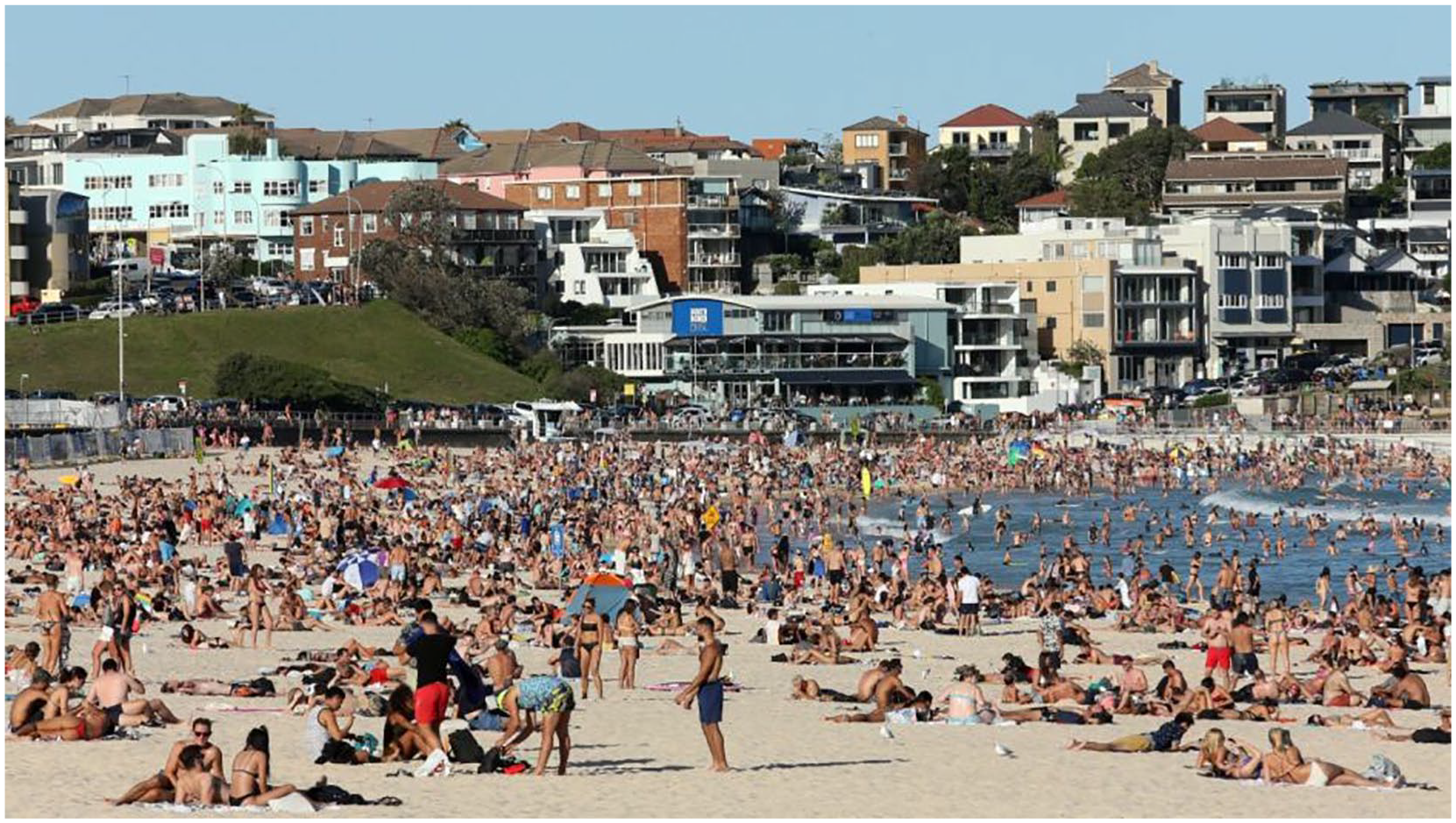
Images of massive crowds at Bondi went viral around the world. (Raper, A. (2020); AAP: John Fotiadis).
Contribution to theory and practice
Societal roles differ in the way they exert influence on a Twitter communication network. Influential and trusted users who classify as individual role types such as private persons, politicians or celebrities affect public discussion through low-frequency authoring and retweeting. Organisational role types tend to act more frequently and partially establish themselves as information hubs of authoritative character. Users attributed to organisational role types constitute a smaller part of involved Twitter users with consistent influence. MOs amplify the reach of individual role types such as journalists and private persons. Retweeting users of low popularity, who provide eyewitness reports and hence ‘hubbing’ information on a more popular account, generate enhanced visibility and more accessible knowledge to create meaning and facilitate action taking during crises. The coherence between influence and collective sense-making, we argue, should be redefined under the terminology of sense-giving as a subconcept of sense-making.
This notion, which has its origin in organisational theory, is highly relevant to both crisis communication and organisational social media use. Sense-giving represents the provision of knowledge through influence as an input for meaning creation. Influence, which is exerted differently by different roles, is reliant on factors such as popularity, trustworthiness and authority. The current literature provides a simplistic specification of influence on Twitter, namely through retweet numbers, but this study offers a basis for discussion on the wider notion of influence and sense-making in communication that is mediated by information systems. Sense-giving by organisations allows the spread of a biased view on unfolding events or provides background. We can, however, apply the positive aspects of sense-giving to the collective sense-making process, that is, official interpretations that have already been evaluated by other users. As a result, the cost of sense-making efforts for individual participants can be greatly reduced. The publicness of social media platforms provides a control mechanism of collectively pushing the messages of users being perceived as being trustworthy.
Social media crisis response during Hurricane Harvey underwent a relatively long preparation time (pre-crisis) and sense-making period (crisis and post-crisis). This led to an exalted but rather flat curve (no significant peaks) of social media crisis communication. To learn from this case study for other persistent crises such as the COVID-19 epidemic, our results emphasise the importance of considering the sequential exertion of sense-giving. Early phases require perpetual sense-giving as a means to position topical authorities who can provide the best information and guidance possible. Oftentimes, perpetual sense-giving is facilitated by exclusive knowledge or information. Over the course of the crisis, especially in peak times, it becomes imperative to amplify the spreadability of response measures through influential individuals, which might not be topical authorities but borrow their reach and trustworthiness (intermittent sense-giving).
Limitations and further research
Analysing the Hurricane Harvey case and considering our findings in relation to COVID-19 crisis response has led us to highlight a number of unresolved issues. Due to the characteristics of this scenario being a predicted crisis with a long warning lead time, this case study raises questions about the boundaries of crises and the point in time when collective sense-making begins. Perhaps people’s uncertainty was already reduced through information supplied through various communication channels before Hurricane Harvey hit the mainland of Texas. The progression of Twitter communication throughout the 6-day period with no significant peak indicates that uncertainty was not high. Researchers and practitioners face the task of determining the best time to encourage and analyse collaborative sense-making in preparation for a predicted crisis. Our study is limited to Twitter social media data, which, of course, do not represent all the crisis communication around this event. Our case analysis is focusing on influential Twitter users during Hurricane Harvey over a 6-day period. A considerable number of participants affected Twitter communication and collective sense-making around the disaster event with content that was published prior to the first day of data recording. Thus, a large part of the crisis communication that took place before the Hurricane hit the affected area is not represented in the data. In further research, a study comparing a similar predictive crisis with this one would shed more like on this topic. This would allow an improved understanding about how collective sense-making is being performed in the preparation phase of an anticipated crisis event. The capture of data around predicted crisis events in pre-crisis stages would assist us to better understand influence and sense-making before an event. On the other hand, an analysis of communication roles when a crisis occurs unexpectedly, and uncertainty is at a peak level, would also add to the body of knowledge on this topic. The current COVID-19 pandemic highlights that a lack of early trusted and factual information can result in the proliferation of rumours, false information and information overload to ‘fill the gap’ and drastically accelerate the effects of a crisis as it impacts social behaviour. When there is high information and knowledge uncertainty, people search for information online and particularly social media to fill their knowledge gap. While rumours and information overload are nothing new, how they play out on such a large scale is a novel phenomenon which is currently not fully understood or conceptually defined. Sense-making and sense-giving can help us to develop efficient social media frameworks, approaches and procedures to counter this situation to mitigate and minimise adverse consequences and ensure that trustworthy information reaches those who need it. Further research is required in model development, which includes all relevant factors of collective sense-making during crisis communication whether predicted or not. Our study provides an outline of which factors should be considered when creating a model for empirical testing. Trustworthiness and other related issues such as credibility and reputation are especially important and have yet to be applied to this context in a systematic manner.
Footnotes
Declaration of conflicting interests
The author(s) declared no potential conflicts of interest with respect to the research, authorship and/or publication of this article.
Funding
The author(s) disclosed receipt of the following financial support for the research, authorship, and/or publication of this article: This project has received funding from the European Union’s Horizon 2020 research and innovation programme under the Marie Skłodowska-Curie grant agreement No 823866.