




Abstract
The major venous societies in the United States share a common mission to improve the standards of medical practitioners, the educational goals for teaching and training programs in venous disease, and the quality of patient care related to the treatment of venous disorders. With these important goals in mind, a task force made up of experts from the specialties of dermatology, interventional radiology, phlebology, vascular medicine, and vascular surgery was formed to develop a consensus document describing the Core Content for venous and lymphatic medicine and to develop a core educational content outline for training. This outline describes the areas of knowledge considered essential for practice in the field, which encompasses the study, diagnosis, and treatment of patients with acute and chronic venous and lymphatic disorders. The American Venous Forum and the American College of Phlebology have endorsed the Core Content.
Keywords
The Core Content is composed of five major categories:
Basic sciences Diagnostic evaluation Treatment modalities in venous and lymphatic medicine Clinical sciences Other components and core competencies of the practice of venous and lymphatic medicine
Background
The Core Content for a specialty outlines the areas of knowledge considered essential to practice in the field, can serve as a template for the development of curricula for medical school, residency and fellowship education, and can provide a framework for training programs, accreditation standards, and board certification testing. Core Content is developed through detailed review of the medical literature combined with input from recognized experts in the specialty.
As awareness of venous disease and associated morbidities has increased, so have the volume of patients seeking treatment and the numbers and diversity of medical practitioners providing care to this population. Over the past two decades there have been improvements in the understanding of the pathophysiology of venous disease and venous anatomy. This knowledge, along with major technological advances has provided the diagnostic and therapeutic tools to more effectively identify and manage venous conditions.
The major venous societies in the United States share a common mission to improve the standards of medical practitioners, the educational content for teaching and training programs in venous disease, and the quality of patient care related to the treatment of venous disorders. With these goals in mind, a multi-specialty task force was convened with representatives from phlebology, dermatology, interventional radiology, vascular medicine, and vascular surgery, with the goal to develop a consensus document describing the Core Content for venous and lymphatic medicine and to develop a core educational content outline for training. The Core Content for Training in Venous and Lymphatic Medicine is the result of that process. The American Venous Forum and the American College of Phlebology have endorsed the Core Content.
Description of the field
Venous and lymphatic medicine is the discipline that involves the diagnosis and treatment of acute and chronic venous and lymphatic disorders, including varicose veins, venous edema, chronic venous insufficiency with skin changes, venous leg ulcers, deep venous disease, pelvic venous insufficiency syndromes, congenital venous anomalies, venous thromboembolism (VTE), lymphedema and other disorders of venous, lymphatic, and mixed origin.
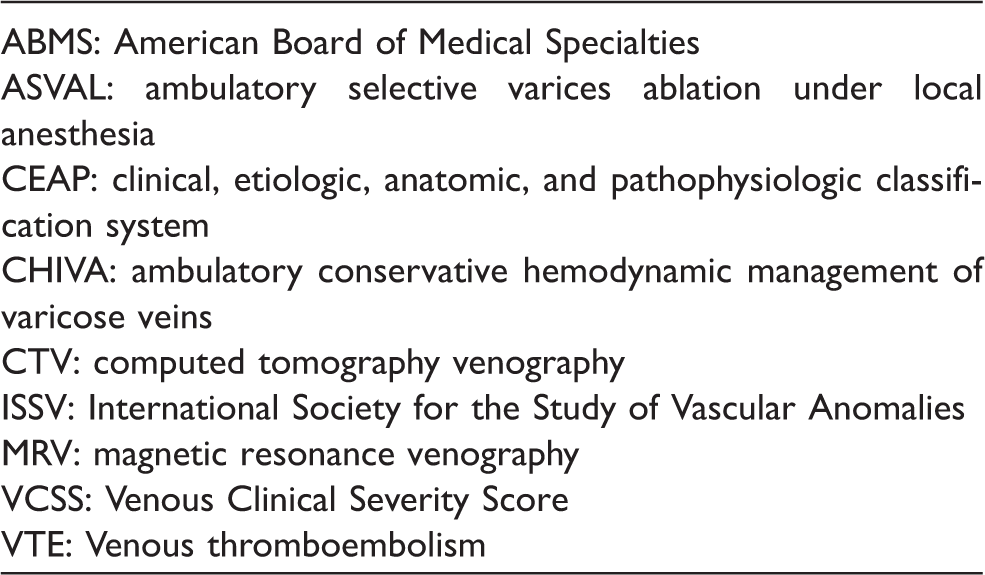
List and definitions of abbreviations.
The Core Content for Training in Venous and Lymphatic Medicine seeks to: (1) outline the knowledge necessary to identify and manage venous, lymphatic, arteriovenous, and venolymphatic conditions and their sequelae; (2) provide a Core Content outline for training across all the different specialties that treat venous and lymphatic disease; and (3) describe a fund of knowledge expected of practitioners of venous and lymphatic medicine and surgery.
This document reflects the current consensus of experts in phlebology, dermatology, interventional radiology, vascular medicine, and vascular surgery. We realize that the Core Content in Training in Venous and Lymphatic Medicine will evolve over time and periodic reevaluation of this document will be warranted as the field of venous and lymphatic medicine continues to advance.
The Core Content comprises five major categories.
Basic sciences
The first core content category is Basic Science. Knowledge of basic science provides an indispensable foundation for the understanding of health and disease. Such knowledge facilitates comprehension and incorporation of new discoveries and concepts. Basic science knowledge, integrated with clinical knowledge, underlies accurate diagnosis and good therapeutic decision-making.
The well-trained physician who treats venous and lymphatic conditions should have knowledge of the basic sciences and possess a common vocabulary pertinent to the field. This should include the anatomy of the venous, arterial and lymphatic systems, venous and lymphatic embryology, genetics, venous histology and histopathology, and venous and lymphatic physiology and pathophysiology. In addition, it is important to understand venous hemodynamics and the derangements associated with chronic venous insufficiency, coagulation and thrombosis, fibrinolysis and thrombolysis, thrombophilias, and obstruction as well as wound healing, compression and pharmacology relevant to venous medicine. Physics as it relates to ultrasound, laser, radiofrequency, foam sclerosants, compression, and hemodynamics should be understood.
Diagnostic evaluation
The second core content category comprises the knowledge and skill required to enable the clinician to perform and interpret a proper diagnostic evaluation. A thorough understanding of diagnostic evaluation is essential to providing appropriate, safe and effective management of venous and lymphatic conditions.
Elucidating the etiology of venous and lymphatic dysfunction requires mastery of a directed history and physical exam and utilization of appropriate laboratory testing. The clinician must understand the indications, contraindications, risks, benefits, and alternatives for each type of diagnostic evaluation. Clinicians must also have knowledge and familiarity with intravascular ultrasound, MRV, CTV, ascending and descending venography, and lymphatic imaging, as well as the ability to perform and interpret non-invasive evaluations of the venous system, including both Doppler flow analysis and direct imaging modalities such as Duplex ultrasound.
The venous and lymphatic specialist must be able to differentiate signs and symptoms of venous and/or lymphatic origin from other causes. This is particularly true for the differential diagnosis of leg ulcers, edema, skin changes of the legs, and leg symptoms such as pain. The practitioner must be able to recognize signs and symptoms of venous and lymphatic disorders that involve areas of the body other than the lower extremities, such as upper extremity and pelvic venous disorders.
Other important areas requiring mastery include the use of venous classification systems, including clinical, etiologic, anatomic, and pathophysiologic data (CEAP) and Venous Clinical Severity Score (VCSS), and VTE risk assessment and risk scoring, post-thrombotic assessment including evaluation and scoring (e.g. Villalta Score), and various diagnostic algorithms.
Overall, the ability to synthesize the findings from clinical evaluation, imaging studies, and physiological testing to correctly diagnose venous and lymphatic disorders and to distinguish them from other conditions with similar presenting symptoms or signs, is critically important.
Treatment modalities in venous and lymphatic medicine
Specialists in venous and lymphatic medicine are physicians who possess special knowledge, skills, and professional capability in the care of patients with venous and lymphatic disease. They must understand the full spectrum of this type of disease, including prevention, indications, and contraindications for each type of evaluation and each type of treatment, risks and benefits of treatment, follow-up treatment and alternatives for treatment, including management of venous insufficiency, pelvic venous disorders, VTE, venous and veno-lymphatic malformations, deep venous abnormalities, and lymphedema. They must also understand the prevention and management of chronic venous insufficiency and post-thrombotic syndrome, including pain, edema, skin changes, and ulceration.
Clinical sciences
The fourth core content category, clinical sciences, is a list of conditions that comprise the practice base of venous specialists. These conditions include superficial, perforator, deep and pelvic venous insufficiency, chronic venous insufficiency, venous ulceration, VTE (superficial and deep), thrombophilias, post-thrombotic syndrome, congenital arteriovenous, venous and veno-lymphatic malformations, venous obstruction and compression syndromes, and lymphedema, phlebolymphedema, lymphedema-like syndromes such as lipedema, and other lymphatic disorders.
Other components and core competencies of the practice of venous and lymphatic medicine
The fifth core content category is designed to foster achievement of the six core competencies as delineated by the American Board of Medical Specialties (ABMS) and the US-based Accreditation Council for Graduate Medical Education, including patient care, medical knowledge, practice-based learning and improvement, systems based practice, professionalism, and interpersonal skills and communication. The ABMS provides the following information about these competencies:
Patient care
Provide care that is compassionate, appropriate, and effective treatment for health problems and to promote health.
Medical knowledge
Demonstrate knowledge about established and evolving biomedical, clinical and cognate sciences and their application in patient care, and a commitment to lifelong learning.
Interpersonal and communication skills
Demonstrate skills that result in effective information exchange and teaming with patients, their families, and professional associates.
Professionalism
Demonstrate a commitment to carrying out professional responsibilities, adherence to ethical principles, and sensitivity to diverse patient populations.
Systems-based practice
Demonstrate awareness of and responsibility to larger context and systems of healthcare. Be able to call on system resources to provide optimal care.
Practice-based learning and improvement
Able to investigate and evaluate their patient care practices, appraise and assimilate scientific evidence, and improve their practice of medicine.
Core Content
1.1 Anatomy (Venous, Arterial and Lymphatic Systems) 1.1.1 Structure of venous wall 1.1.2 Venous valves 1.1.3 Anatomical nomenclature 1.1.4 Lower extremity 1.1.4.1 Superficial venous system 1.1.4.2 Perforating veins 1.1.4.3 Deep venous system 1.1.4.4 Microcirculation 1.1.4.5 Arterial system 1.1.4.6 Nerves of the lower limb 1.1.5 Pelvic venous anatomy 1.1.6 Abdominal venous anatomy 1.1.7 Thoracic venous anatomy 1.1.8 Upper extremity venous anatomy 1.1.8.1 Superficial system 1.1.8.2 Deep system 1.1.9 Cerebral and jugular venous anatomy 1.1.10 General arterial anatomy 1.1.11 General lymphatic anatomy 1.2 Embryology 1.2.1 Venous embryology 1.2.2 Lymphatic embryology 1.2.3 Congenital arteriovenous, venous and other vascular malformations 1.3 Genetics 1.3.1 Venous disease 1.3.1.1 Chronic venous disease 1.3.1.2 Inherited thrombophilias 1.3.1.3 Vascular anomalies 1.3.2 Lymphatic disease 1.4 Venous physiology & hemodynamics 1.4.1 Flow through collapsible tubes and the reservoir function of the venous system 1.4.2 Venous valves and their function 1.4.3 Venous pump function—Foot, calf, muscular and respiratory 1.4.4 Venous pressures—Normal and abnormal 1.5 Venous pathophysiology 1.5.1 Mechanisms of primary venous disease 1.5.1.1 Ascending disease 1.5.1.2 Descending disease 1.5.1.3 Disorders of the vein wall 1.5.1.4 Disorders of the valve 1.5.1.5 Concepts of venous hypertension 1.5.2 Chronic venous insufficiency 1.5.2.1 Historical theories (fibrin cuff and diffusion block, leukocyte trapping theories) 1.5.2.2 Primary, secondary, post-thrombotic 1.5.2.3 Subcutaneous tissues and skin involvement 1.5.2.4 Cutaneous microangiopathy 1.5.3 Mechanisms of venous ulceration—The role of matrix metalloproteinases and growth factors 1.5.3.1 Macromolecules and other mediators 1.5.3.2 Fibrinolytic abnormalities 1.5.3.3 Microcirculatory abnormalities 1.5.4 Venous obstruction 1.5.5 Edema 1.5.5.1 Venous 1.5.5.2 Lymphatic 1.5.5.3 Phlebolymphatic 1.5.5.4 Impairment of the venoarterial reflex 1.6 Venous histology and histopathology 1.7 Wounds and wound healing 1.7.1 Acute wounds 1.7.2 Chronic wounds 1.8 Coagulation and thrombosis 1.8.1 Coagulation system 1.8.2 Blood/vessel wall interactions 1.8.3 Hypercoagulable states 1.8.4 Inflammation and thrombosis 1.8.5 VTE and sequelae 1.9 Compression and bandaging systems 1.9.1 Stiffness, compliance, elasticity 1.9.2 Resting and working pressure 1.9.3 Interface pressure 1.9.4 Physiological effects 1.10 Lymphatic physiology and pathophysiology 1.11 Pharmacology 1.11.1 General pharmacological principles 1.11.2 Sclerosants 1.11.2.1 Detergents 1.11.2.2 Osmotic agents 1.11.2.3 Chemical irritants 1.11.3 Gases used for creation of sclerosant foam 1.11.3.1 Air 1.11.3.2 CO2 1.11.3.3 CO2/O2 1.11.4 Anticoagulant, antiplatelet, fibrinolytic, thrombolytic agents 1.11.5 Anesthetic agents 1.11.6 Embolic agents 1.11.7 Veno-active agents 1.11.8 Miscellaneous agents 1.12 Physics 1.12.1 Ultrasound 1.12.2 Laser and pulsed light 1.12.3 Radiofrequency 1.12.4 Compression
2.1 History 2.2 Physical examination 2.3 Doppler 2.3.1 Venous 2.3.1.1 Continuous 2.3.1.2 Pulsed 2.3.1.3 Color 2.3.1.4 Spectral analysis 2.3.2 Arterial 2.3.3 Ankle brachial index 2.4 Imaging 2.4.1 Venous ultrasound 2.4.1.1 Reflux diagnosis 2.4.1.1.1 Superficial 2.4.1.1.2 Perforator 2.4.1.1.3 Deep 2.4.1.2 Mapping 2.4.1.3 Diagnosis of deep vein thrombosis 2.4.1.4 Pelvic venous disease 2.4.1.5 Duplex ultrasound-assisted procedures 2.4.1.6 Duplex ultrasound use in follow-up care 2.4.2 Intravascular ultrasound 2.4.3 Magnetic resonance imaging and MRV 2.4.4 Computed tomography and CTV 2.4.5 Contrast venography 2.4.6 Lymphatic 2.4.6.1 Lymphangiography 2.4.6.2 Radionuclide lymphoscintigraphy 2.4.6.3 Indocyanine green lymphography 2.4.6.4 MR lymphography 2.4.7 Transillumination 2.4.8 Other 2.5 Dynamic venous function tests 2.5.1 Air plethysmography 2.5.2 Photoplethysmography 2.5.3 Strain gauge plethysmography 2.5.4 Phlebodynamometry 2.5.5 Other 2.6 Edema assessment 2.6.1 Leg circumference measurement 2.6.2 Volumetry 2.7 Laboratory tests 2.7.1 Hypercoagulability workup 2.7.1.1 Acquired (including malignancy screening) 2.7.1.2 Inherited 2.7.2 D-dimer, prothrombin fragments 1 + 2, tissue plasminogen activator antigen, inflammatory biomarkers and their clinical utility 2.7.3 Skin biopsy 2.7.4 Routine blood, urine, microbiology, basic clotting tests 2.8 VTE 2.8.1 Risk assessment 2.8.2 Diagnostic algorithms 2.8.3 Monitoring of anticoagulant therapy 2.9 Classification systems and assessment tools 2.9.1 CEAP 2.9.1.1 Basic 2.9.1.2 Advanced 2.9.2 Vascular anomalies 2.9.2.1 Modified hamburg 2.9.2.2 International Society for the Study of Vascular Anomalies (ISSVA 2014) 2.9.3 VCSS 2.9.4 Post-thrombotic syndrome 2.9.4.1 Villalta 2.9.4.2 Other 2.9.5 Quality of Life Assessment 2.9.6 Classification of wound severity
3.1 Conservative therapy 3.2 Compression therapy 3.2.1 Compression stockings 3.2.2 Short stretch bandages 3.2.3 Bandaging systems 3.2.4 Pumps and other compression devices 3.3 Pharmacological treatment for venous insufficiency 3.4 Wound care 3.5 Endovenous ablation 3.5.1 Chemical 3.5.2 Mechanical 3.5.3 Thermal 3.5.4 Other techniques 3.6 Surgery for venous incompetence 3.6.1 Ligation and division 3.6.2 Ligation and stripping 3.6.3 Surgical treatment of perforating veins 3.6.4 Deep venous surgery 3.6.5 Saphenous vein preservation 3.6.5.1 Ambulatory conservative hemodynamic management of varicose veins (CHIVA) 3.6.5.2 Ambulatory selective varices ablation under local anesthesia (ASVAL) 3.6.6 Ambulatory phlebectomy 3.7 Sclerotherapy 3.7.1 Liquid 3.7.2 Foam 3.7.3 Visual 3.7.4 Ultrasound-guided 3.8 Endovascular embolization 3.9 Treatment modalities for pelvic venous disorders 3.9.1 Pelvic venous incompetence 3.9.1.1 Embolization with coils and other materials 3.9.2 Genital varicosities associated with pelvic venous incompetence 3.9.2.1 Ambulatory phlebectomy and/or sclerotherapy after treatment of pelvic venous incompetence 3.9.3 Nutcracker syndrome 3.9.3.1 Venoplasty and stenting of the renal vein 3.9.3.2 Renal vein reimplantation onto the inferior vena cava 3.10 Treatment modalities for VTE 3.10.1 VTE prophylaxis 3.10.1.1 Pharmacologic 3.10.1.2 Non-pharmacologic 3.10.2 Anticoagulation 3.10.2.1 Initial treatment and duration of therapy 3.10.2.2 Management of recurrent VTE 3.10.2.3 Secondary prophylaxis 3.10.3 Superficial venous thrombosis 3.10.4 Thrombus removal strategies 3.10.4.1 Pharmacologic 3.10.4.2 Mechanical 3.10.4.3 Pharmacomechanical 3.10.4.4 Surgical thrombectomy 3.10.5 Vena cava filters 3.10.5.1 Removable 3.10.5.2 Permanent 3.10.6 Pulmonary embolus 3.10.6.1 Anticoagulants 3.10.6.2 Thrombolysis 3.10.6.3 Thrombectomy 3.11 Treatment modalities for deep venous obstruction 3.11.1 Endovenous angioplasty and/or stenting 3.11.2 Open surgical repair 3.11.2.1 Bypass 3.11.2.2 Patch angioplasty 3.11.3 Resection/repair for extrinsic compression 3.11.4 Endophlebectomy for restoration of venous inflow 3.12 Energy-based treatment for small veins 3.12.1 Laser 3.12.2 Pulsed light 3.12.3 Thermocoagulation and Ohmic thermolysis 3.13 Treatment modalities for lymphedema 3.13.1 Pharmacologic 3.13.2 Manual lymphatic drainage 3.13.3 Automated compression 3.13.4 Compressive garments/wraps 3.13.5 Complex decongestive therapy 3.13.6 Surgical reconstruction 3.13.7 Surgical ablation 3.14 Anesthesia 3.14.1 Preoperative sedation (anxiolysis vs. conscious sedation) 3.14.2 Topical 3.14.3 Local anesthesia 3.14.4 Tumescent anesthesia 3.15 Treatment of medical emergencies and complications 3.15.1 Principles of basic cardiac life support 3.15.2 Principles of advanced cardiac life support 3.15.3 Anaphylaxis 3.15.4 Neurological complications 3.15.5 Sclerotherapy complications 3.15.5.1 Liquid 3.15.5.2 Foam 3.15.6 Thermal ablation complications 3.15.7 Phlebectomy complications 3.15.8 Cutaneous laser complications 3.15.9 Thrombotic complications 3.15.10 Infectious complications 3.15.11 Complications of anticoagulation, including heparin-induced thrombocytopenia 3.15.12 Complications of thrombolytic therapy 3.15.13 Stent thrombosis and other complications 3.15.14 Recognition and management of anesthetic toxicity
4.1 Superficial venous incompetence 4.1.1 Telangiectasia 4.1.2 Reticular veins 4.1.3 Varicose veins 4.1.3.1 Primary 4.1.3.2 Secondary 4.1.4 Recurrent varices 4.1.5 Neovascularization 4.2 Perforator incompetence 4.3 Deep venous incompetence 4.4 Chronic venous insufficiency 4.4.1 Edema 4.4.2 Corona phlebectatica 4.4.3 Skin changes 4.4.3.1 Hyperpigmentation 4.4.3.2 Eczema 4.4.3.3 Lipodermatosclerosis 4.4.3.4 Atrophie blanche 4.4.4 Venous ulceration 4.4.5 Differential diagnosis 4.5 Pelvic venous insufficiency syndromes 4.5.1 Pelvic venous insufficiency 4.5.2 Varicocele 4.6 Venous thromboembolism 4.6.1 Superficial venous thrombosis 4.6.2 Deep vein thrombosis 4.6.2.1 Phlegmasia cerulea dolens 4.6.2.2 Phlegmasia alba dolens 4.6.3 Post-thrombotic syndrome 4.6.4 Pulmonary embolism 4.6.5 Paradoxical embolism 4.6.6 Chronic thromboembolic pulmonary hypertension 4.6.7 Upper extremity venous thrombosis 4.6.7.1 Primary 4.6.7.2 Secondary 4.7 Venous obstruction and compression syndromes 4.7.1 Popliteal vein 4.7.2 Iliac vein 4.7.3 Mesoaortic compression of the left renal vein (Nutcracker Syndrome) 4.7.4 Inferior vena cava 4.7.5 Superior vena cava 4.7.6 Axillo-subclavian 4.8 Vascular malformations 4.8.1 Capillary malformations 4.8.2 Venous malformations 4.8.3 Lymphatic malformations 4.8.4 Arteriovenous malformations 4.8.5 Complex malformations/syndromes 4.8.6 Venous aneurysms 4.9 Venous tumors 4.10 Recognition of life and limb threatening syndromes 4.10.1 Compartment syndromes 4.10.2 Acute limb ischemia 4.10.3 Gangrene 4.11 Lymphedema and other lymphatic and lymphatic-like disorders 4.12 Phlebolymphedema
5.1 Epidemiology & evidence-based medicine 5.1.1 Fundamentals of study design—randomized versus observational designs and the strengths and limitations of each approach 5.1.2 Outcome measures in venous disease 5.1.2.1 Technical outcome 5.1.2.2 Clinician-based 5.1.2.2.1 VCSS 5.1.2.2.2 Villalta 5.1.2.3 Patient reported outcomes 5.1.2.3.1 Generic quality of life 5.1.2.3.2 Venous disease specific 5.1.3 Samples and populations 5.1.4 Normal distribution, means and standard deviations, medians, interquartile ranges, incidence, prevalence 5.1.5 p-Values and confidence intervals 5.1.6 Kaplan-Meier curves 5.1.7 Sensitivity, specificity, negative predictive value, positive predictive value 5.1.8 Systematic reviews and meta-analyses 5.1.9 Practice guidelines and their interpretation 5.2 Communication skills 5.3 Patient care and safety 5.4 Medical informatics 5.5 Medicolegal issues 5.6 Medical ethics and professionalism 5.7 Healthcare systems 5.8 Quality assessment and improvement 5.9 Certification and facility accreditation
Footnotes
Acknowledgments
The Core Content for Training in Venous and Lymphatic Medicine was an initiative of the American Board of Venous and Lymphatic Medicine. The following physicians served on the Task Force: R Torrance Andrews, Teresa Carman, Anthony Comerota, Stephanie Dentoni, Steve Elias, Chieh-Min Fan, Craig Feied, Lawrence “Rusty” Hofmann, Michael R Jaff, Raghu Kolluri, Sanjoy Kundu, Fedor Lurie, BB Lee, Mark Meissner, Robert Min, Benson S Munger, PhD, Joseph Raffetto, Suman Rathbun, Melvin Rosenblatt, Neil Sadick, Julianne Stoughton, Thomas Wakefield, Steven E Zimmet (chair).
This document would not have been possible without the additional input of the following physicians who served as advisors: James Albert, Werner Blättler, Willy Chi, Stephen F Daugherty, Sandra Dickerson, Mark Forrestal, Wayne Gradman, Bruce Gray, Jean-Luc Gillet, Jean Jerome Guex, Phil Hertzman, Michael Junger, Lowell Kabnick, Julie Karen, Ted King, Mark Malouf, John Mauriello, Dan Monahan, Nick Morrison, Eric Mowatt-Larson, Ken Myers, Jerry Ninia, Tri Nguyen, Kurosh Parsi, Hugo Partsch, Lisa Pavone, C Duane Randleman, Armen Roupenian, Sirunya Silapunt, Kenneth Todd, Michael Vasquez, Richard Vazquez, and Suresh Vedantham.
The American Venous Forum and the American College of Phlebology have endorsed the Core Content.
Conflict of interest
None declared.
Funding
This research received no specific grant from any funding agency in the public, commercial, or not-for-profit sectors.