




Abstract
Rationale
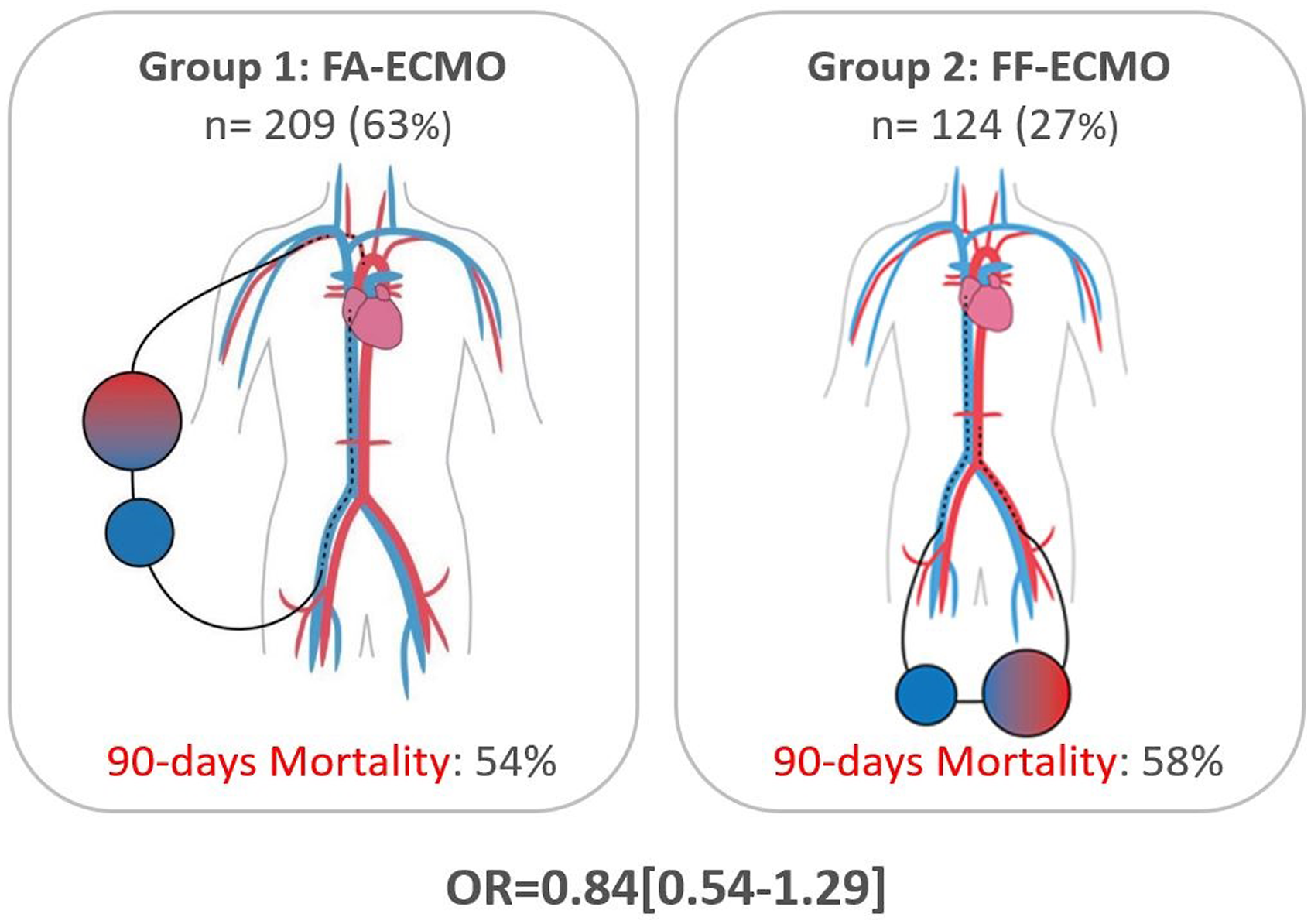
For veno-arterial extracorporeal membrane oxygenation (ECMO), the femoral artery is the preferred cannulation site (femoro-femoral: Vf-Af). This results in retrograde aortic flow, which increases the left ventricular afterload and can lead to severe pulmonary edema and thrombosis of the cardiac chambers. Right axillary artery cannulation (femoral-axillary: Vf-Aa) provides partial anterograde aortic flow, which may prevent some complications. This study aimed to compare the 90-day mortality and complication rates between VF-AA and VF-AF.
Methods
Consecutive adult patients with cardiogenic shock who received peripheral VA-ECMO between 2013 and 2019 at our institution were retrospectively included. The exclusion criteria were refractory cardiac arrest, multiple VA-ECMO implantations due to vascular access changes, weaning failure, or ICU readmission. A statistical approach using inverse probability of treatment weighting was used to estimate the effect of the cannulation site on the outcomes. The primary endpoint was the 90-day mortality. The secondary endpoints were vascular access complications, stroke, and other complications related to retrograde blood flow. Outcomes were estimated using logistic regression analysis.
Results
VA-ECMO was performed on 534 patients. Patients with refractory cardiac arrest (n = 77 (14%)) and those supported by multiple VA-ECMO (n = 92, (17%)) were excluded. Out of the 333 patients studied (n = 209 Vf-Aa; n = 124 VF-AF), the main indications for VA-ECMO implantation were post-cardiotomy (33%, n = 109), dilated cardiomyopathy (20%, n = 66), post-cardiac transplantation (15%, n = 50), acute myocardial infarction (14%, n = 46) and other etiologies (18%, n = 62). The median SOFA score was 9 [7-11], and the crude 90-day mortality rate was 53% (n = 175). After IPTW, the 90-day mortality was similar in the Vf-Aa and VF-AF groups (54% vs 58%, IPTW-OR = 0.84 [0.54-1.29]). Axillary artery cannulation was associated with significantly fewer local infections (OR = 0.21, 95% CI:0.09-0.51), limb ischemia (OR = 0.37, 95% CI:0.17-0.84), bowel ischemia (OR = 0.16, 95% CI:0.05-0.51) and pulmonary edema (OR = 0.52, 95% CI:0.29-0.92) episodes, but with a higher rate of stroke (OR = 2.87, 95% CI:1.08-7.62) than femoral artery cannulation.
Conclusion
Compared to VF-AF, axillary cannulation was associated with similar 90-day mortality rates. The high rate of stroke associated with axillary artery cannulation requires further investigation.
Keywords
Get full access to this article
View all access options for this article.
References
Supplementary Material
Please find the following supplemental material available below.
For Open Access articles published under a Creative Commons License, all supplemental material carries the same license as the article it is associated with.
For non-Open Access articles published, all supplemental material carries a non-exclusive license, and permission requests for re-use of supplemental material or any part of supplemental material shall be sent directly to the copyright owner as specified in the copyright notice associated with the article.
