

Introduction: Obesity is associated with a worse prognosis in COVID-19 patients with acute respiratory distress syndrome (ARDS). Veno-venous (V-V) Extracorporeal Membrane Oxygenation (ECMO) can be a rescue option, however, the direct impact of morbid obesity in this select group of patients remains unclear.
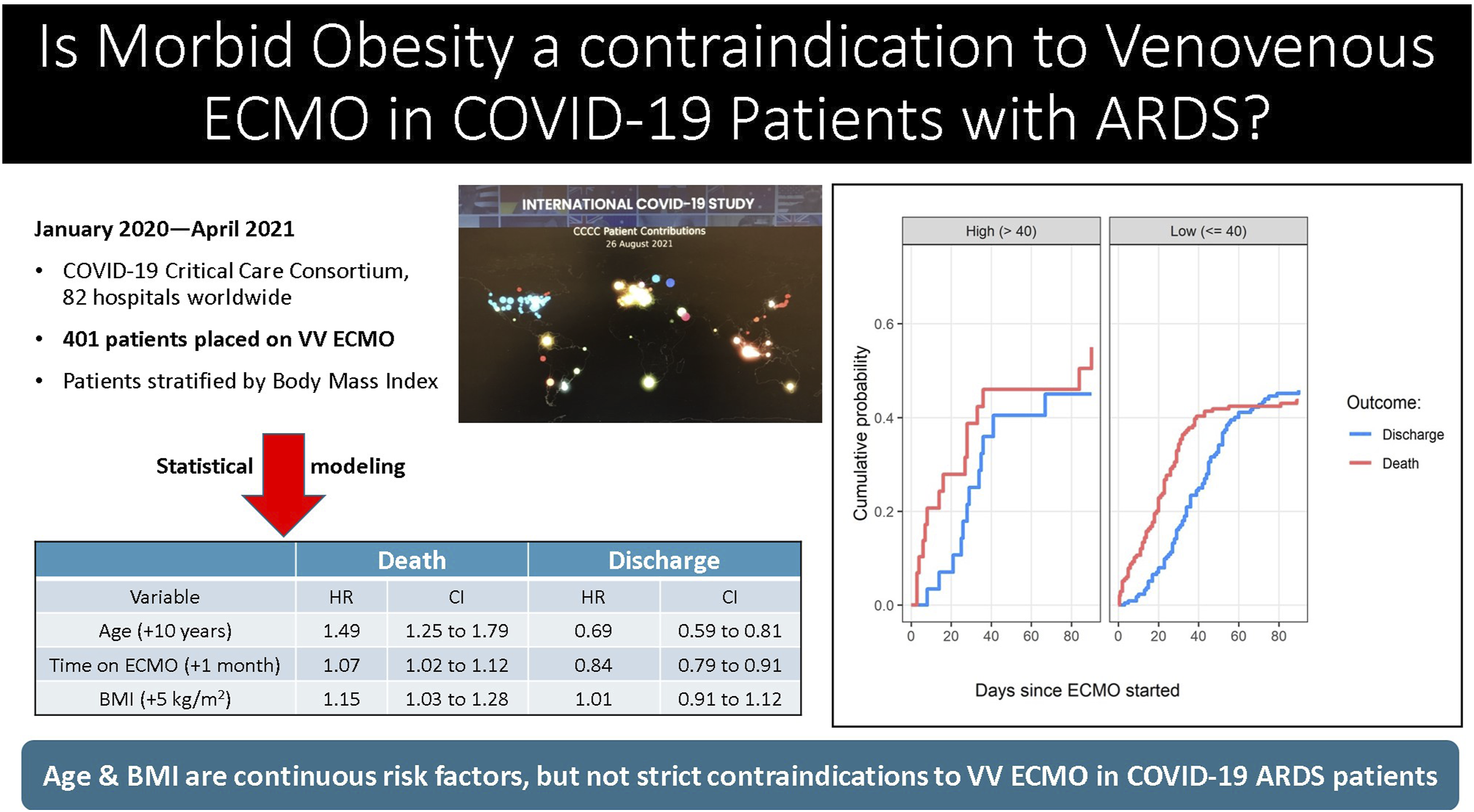
Methods: This is an observational study of critically ill adults with COVID-19 and ARDS supported by V-V ECMO. Data are from 82 institutions participating in the COVID-19 Critical Care Consortium international registry. Patients were admitted between 12 January 2020 to 27 April 2021. They were stratified based on Body Mass Index (BMI) at 40 kg/m2. The endpoint was survival to hospital discharge.
Results: Complete data available on 354 of 401 patients supported on V-V ECMO. The characteristics of the high BMI (>40 kg/m2) and lower BMI (≤40 kg/m2) groups were statistically similar. However, the ‘high BMI’ group were comparatively younger and had a lower APACHE II score. Using survival analysis, older age (Hazard Ratio, HR 1.49 per-10-years, CI 1.25–1.79) and higher BMI (HR 1.15 per-5 kg/m2 increase, CI 1.03–1.28) were associated with a decreased patient survival. A safe BMI threshold above which V-V ECMO would be prohibitive was not apparent and instead, the risk of an adverse outcome increased linearly with BMI.
Conclusion: In COVID-19 patients with severe ARDS who require V-V ECMO, there is an increased risk of death associated with age and BMI. The risk is linear and there is no BMI threshold beyond which the risk for death greatly increases.
CombesAHajageDCapellierG, et al.Extracorporeal membrane oxygenation for severe acute respiratory distress syndrome. N Engl J Med2018; 378: 1965–1975.
2.
PeekGJMugfordMTiruvoipatiR, et al.Efficacy and economic assessment of conventional ventilatory support versus extracorporeal membrane oxygenation for severe adult respiratory failure (CESAR): a multicentre randomised controlled trial. Lancet2009; 374: 1351–1363.
3.
DaviesAJonesDBaileyM, et al.Extracorporeal membrane oxygenation for 2009 Influenza A (H1N1) acute respiratory distress syndrome. JAMA2009; 302: 1888–1895.
4.
BarbaroRPMacLarenGBoonstraPS, et al.Extracorporeal membrane oxygenation support in COVID-19: an international cohort study of the extracorporeal life support organization registry. Lancet2020; 396: 1071–1078.
5.
MohammadSAzizRAl MahriS, et al.Obesity and Covid-19: what makes obese host so vulnerable?Immun Ageing. 2021; 18: 1.
6.
KassDA. COVID-19 and severe obesity: a big problem?Ann Intern Med2020; 173: 840–841.
7.
FordESGilesWHDietzWH. Prevalence of the metabolic syndrome among US adults: findings from the third national health and nutrition examination survey. JAMA2002; 287(3): 356–359.
8.
GrasselliGGrecoMZanellaA, et al.Risk factors associated with mortality among patients with COVID-19 in intensive care units in Lombardy, Italy. JAMA Intern Med2020; 180(10): 1345–1355.
9.
LighterJPhillipsMHochmanS, et al.Obesity in patients younger than 60 years is a risk factor for COVID-19 hospital admission. Clin Infect Dis2020; 71: 896–897.
10.
Lockhart SM, O’Rahilly S. When Two Pandemics Meet: Why Is Obesity Associated with Increased COVID-19 Mortality?Med (N Y)2020; 1(1): 33–42.
11.
JavidfarJZaaqoqAMYamashitaMH, et al.Venovenous extracorporeal membrane oxygenation in obese patients. JTCVS Tech2021; 10: 335–348.
12.
BartlettRHOginoMTBrodieD, et al.Initial ELSO guidance document: ECMO for COVID-19 patients with severe cardiopulmonary failure. ASAIO J2020; 66: 472–474.
HarrisPATaylorRThielkeR, et al.Research electronic data capture (REDCap)—A metadata-driven methodology and workflow process for providing translational research informatics support, J Biomed Inform2009; 42(2): 377–381.
15.
HarrisPATaylorRMinorBL, et al.The REDCap consortium: building an international community of software platform partners, J Biomed Inform2019; 95: 103208.
16.
ZaaqoqAMBarnettAGGriffeeMJ, et al.Beneficial effect of prone positioning during venovenous extracorporeal membrane oxygenation for coronavirus disease 2019. Crit Care Med2022; 50(2): 275–285.
17.
HazardDKaierKvon CubeM, et al.Joint analysis of duration of ventilation, length of intensive care, and mortality of COVID19 patients: a multistate approach. BMC Med Res Methodol2020; 20: 206.
18.
NoahMAPeekGJFinneySJ, et al.Referral to an extracorporeal membrane oxygenation center and mortality among patients with severe 2009 influenza A(H1N1). JAMA2011; 306: 1659–1668.
19.
LunnDJacksonCBestN, et al.The bugs book: a practical introduction to bayesian analysis. Chapman & Hall/Crc Texts in Statistical Science. New York: Taylor & Francis, 2012.
20.
WolkewitzMCooperBSBontenMJM, et al.Interpreting and comparing risks in the presence of competing events. BMJ2014; 349: g5060.
Al-SoufiSBuscherHNguyenND, et al.Lack of association between body weight and mortality in patients on veno-venous extracorporeal membrane oxygenation. Intensive Care Med2013; 39(11): 1995–2002.
25.
KonZNDahiSEvansCF, et al.Class III obesity is not a contraindication to venovenous extracorporeal membrane oxygenation support. Ann Thorac Surg2015; 100(5): 1855–1860.
26.
SwolJBuchwaldDDuddaM, et al.Veno-venous extracorporeal membrane oxygenation in obese surgical patients with hypercapinic lung failure. Acta Anaesthesiol Scand2014; 58(5): 534–538.
27.
SwolJBuchwaldDStrauchJT, et al.Effect of body mass index on outcome of surgical patients receiving extracorporeal devices (VV ECMO, pECLA) for respiratory failure. Int J Artif Organs2017; 40: 102–108.
28.
SchmidtMZogheibERozeH, et al.The PRESERVE mortality risk score and analysis of long-term outcomes after extracorporeal membrane oxygenation for severe acute respiratory distress syndrome. Intensive Care Med2013; 39(10): 1704–1713.
29.
UllCBuchwaldDStrauchJ, et al.Extremely obese patients treated with venovenous ECMO—an intensivist’s challenge. Am J Emerg Med2015; 33(11): 1720.e3–1720.e4.
Supplementary Material
Please find the following supplemental material available below.
For Open Access articles published under a Creative Commons License, all supplemental material carries the same license as the article it is associated with.
For non-Open Access articles published, all supplemental material carries a non-exclusive license, and permission requests for re-use of supplemental material or any part of supplemental material shall be sent directly to the copyright owner as specified in the copyright notice associated with the article.