




Abstract
Introduction:
This study aims to investigate the correlation between severe aortic stenosis (sAS) and impairment of left ventricular global longitudinal strain (LVGLS) in particular segments, using two-dimensional speckle tracking echocardiography in patients with sAS and normal ejection fraction of left ventricle (LVEF).
Methods:
The study included 53 consecutive patients with asymptomatic sAS and preserved LVEF. The regional longitudinal systolic LV wall strain was evaluated at the area opposite of the aorta as the median strain value of the basal, middle, and apical segments of the lateral and posterior walls and was compared to the average strain value of the interventricular septum (IVS) at the same views.
Results:
LVGLS was decreased and was not statistically different between three- and four-chamber views (−12.5 ± 3.6 vs −11.4 ± 5.5%, p = 0.2). The average strain values of the lateral and posterior walls were statistically reduced compared to the average value of the IVS (lateral vs IVS: −7.8 ± 3.7 vs −10 ± 5.3%, p = 0.005, posterior vs IVS: −7.7 ± 4.2 vs −10.3 ± 3.8%, p < 0.0001). There was no significant difference between lateral and posterior walls (−7.8 ± 3.7 vs −7.7 ± 4.2%, p = 0.9).
Conclusions:
The strain of lateral and posterior walls of left ventricle, which lay just opposite to the aortic valve seem to be more reduced compared to other walls in patients with sAS and preserved LVEF possibly due to their anatomical position. This impairment seems to be the reason of the overall LVGLS reduction. Regional strain could be used as an extra tool for the estimation of the severity of AS as well as for prognostic information in asymptomatic patients.
The potential ability to detect pre-clinical LV dysfunction-impaired strain diffused and not limited in the lateral or/and posterior wall- may provide the opportunity to identify patients at higher risk for a progressive decline concerning LV function, leading to worse postoperative survival, cardiac performance, and symptom status if valve replacement is delayed. Preservation of strain in the remaining LV walls (anterior, inferior, and IVS) at the time of AV surgery, might predict better post-operative evolution since the presence of an aortic prosthesis does not necessarily result in significant improvement of the opposite to the prosthetic valve wall strain.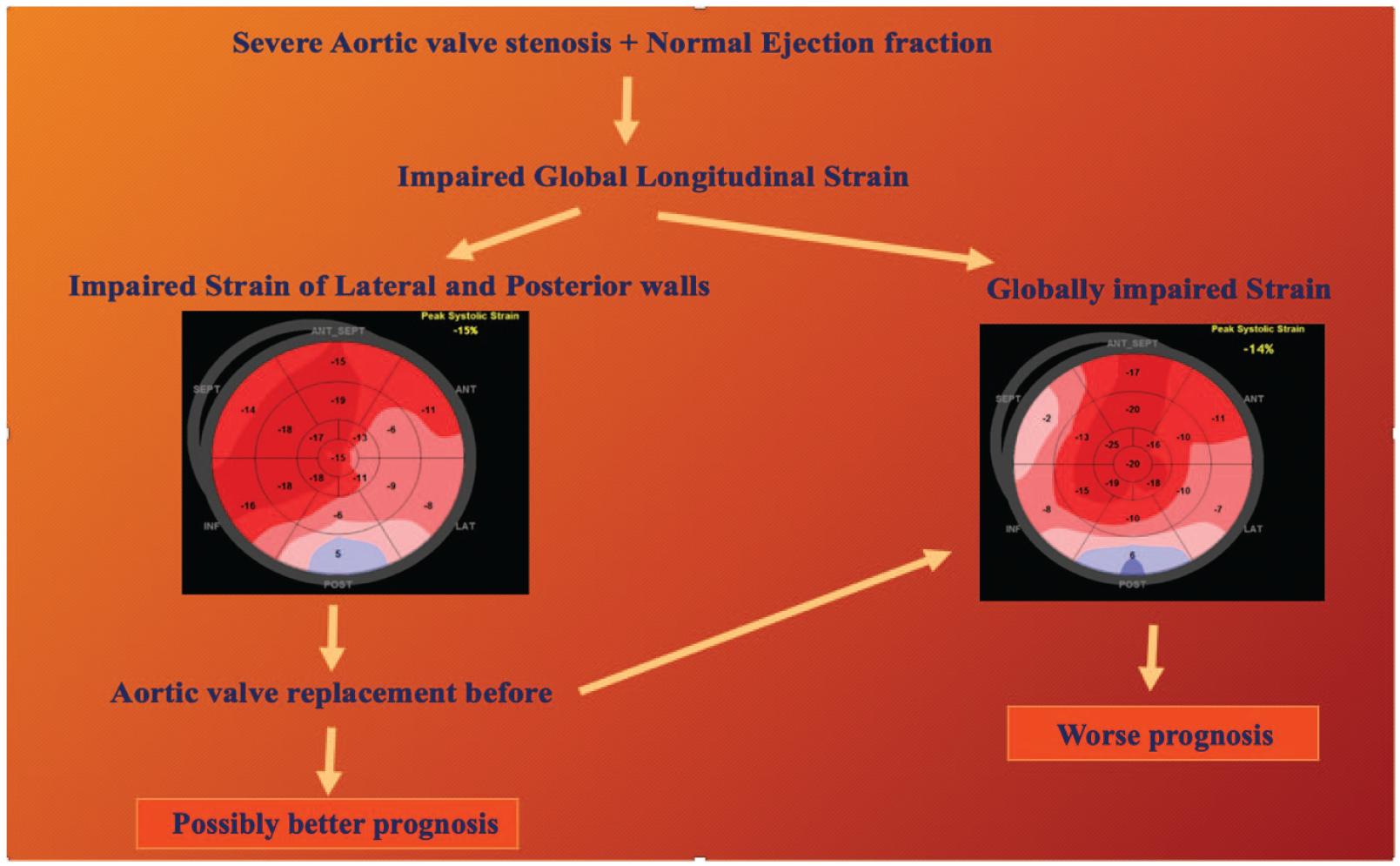
Keywords
Get full access to this article
View all access options for this article.