




Abstract
We here respond to a 2024 discussion and commentary article entitled Dangerous dichotomies and misunderstandings in second language research by Truscott and Sharwood Smith (T&SS), who argue that several dichotomies pervade the field of second language acquisition (SLA) that negatively impact progress in the field. T&SS focus on four dichotomies, all of which imply an opposition of generative and usage-based approaches: (i) Cognitive vs. Generative, (ii) Usage-based vs. Generative, (iii) Dynamic vs. Static/Fixed, and (iv) Innatist vs. What? We find T&SS’s specific approach problematic as corrections are overly skewed towards a single side; some imprecisions are simply swapped for others; and at times, crucial developments in both generative and usage-based approaches are ignored. Thus, we – two usage-based and one generative language researcher – combine forces here to offer our perspective. For the ‘dangers’ that T&SS list regarding each of the four dichotomies they discuss, we provide a synopsis of where we agree with T&SS and where we do not; and, based on where we see contemporary generative and usage-based approaches stand with regard to these four dichotomies, we offer an alternative set of statements that we consider more balanced and nuanced than the ‘corrective statements’ initially offered in T&SS (2024).
Keywords
I Introduction
In a recent discussion and commentary article entitled Dangerous dichotomies and misunderstandings in second language research, Truscott and Sharwood Smith (2024), henceforth T&SS, argue that several dichotomies pervade the field of second language acquisition (SLA) and suggest that these dichotomies play a clandestine role in fostering and sustaining, perhaps even advancing misunderstandings that negatively impact progress in the field. While acknowledging some functional utility for dichotomies as a shorthand to refer to bona fide points of distinction that are more complex than a given context would permit discussion of, T&SS warn of the dangers entailed with the inexactitude dichotomization confers, especially as time moves on and shorthand imprecisions become increasingly less understood. T&SS specifically focus on four claimed cases in point, all of which imply an opposition of generative and usage-based approaches: (i) Cognitive vs. Generative, (ii) Usage-based vs. Generative, (iii) Dynamic vs. Static/Fixed, and (iv) Innatist vs. What?
We share the view with T&SS that when simple dichotomies are misunderstood as faithful representations of absolute (and often exaggerated) differences, or when it seems that different theoretical approaches use overlapping nomenclature that in fact means different things, then scientists have a responsibility to expose those misunderstandings in the interest of overall progress. In fact, various publications in the past two decades have made similar points (e.g. De Bot, 2015; Rastelli, 2025; Rothman and Slabakova, 2018; Slabakova et al., 2014, 2015; Zyzik, 2009). However, we find T&SS’s specific approach problematic as corrections are overly skewed towards a single side; some imprecisions are simply swapped for others; and at times, it appears that T&SS have missed crucial developments in both generative and usage-based approaches in the last 20 plus years or so, some of which have created much larger common ground between them than T&SS seem to be aware of or choose to consider. After reading their piece and wanting for the overall message to have the best chance to realize its due impact, the authors of this article (henceforth SN&J) – two usage-based and one generative language researcher – felt it prudent to combine forces to offer a more balanced and nuanced approach. We do this in two ways. First, for the ‘dangers’ that T&SS list regarding each of the four dichotomies they discuss, we provide a synopsis of where we agree with T&SS and where we do not. Second, based on our discussion of where we see contemporary generative and usage-based approaches stand with regard to these four dichotomies, we offer an alternative set of statements that we consider more balanced and nuanced than the ‘corrective statements’ initially offered in T&SS (2024).
Before we turn to these two tasks, it is fitting to summarize the essential differences between generative and usage-based approaches as we understand them so that the reader may be able to follow the context of our reasoning. While there are many important distinctions in various regards (terminological, practical, theoretical, . . .) that we do not have room to outline here (for a comprehensive overview, see Christiansen and Chater, 2016), the most fundamental difference between these two sets of cognitive theories relates to how linguistic representations are formed and ultimately represented. Does the acquisition of language obtain at the crossroads of language exposure and domain-general cognition alone or is some, perhaps a good deal, of language domain-specific in nature? In other words, the question is not whether there is a reality to grammar, for example, whether there is a D(determiner) P(hrase) as a category that defines human language. Rather, the debate is how the DP develops and comes to be instantiated in the grammar of humans. Was it derived on the basis of available input, conditioned by cognitive needs associated with such a category’s formation alone, or is the DP a universal functional category that is part of a genetic linguistic endowment (Language Acquisition Device) that gets fine-tuned to the settings of a particular language grammar on the basis of available input? So while both approaches agree that there is a DP and that it is likely to work in a particular way at a mature state of representation given a particular language, usage-based approaches would contend that the DP is wholly derived (or, in usage-based parlance, emergent) while a generative perspective would say it is only partially so. To phrase it yet another way, while usage-based approaches assume that input and domain-general cognition are necessary and sufficient to arrive at the sophisticated grammars of humans, generative approaches question this sufficiency and postulate a gap filler in the form of domain-specific (language) cognition.
1 Cognitive vs. Generative
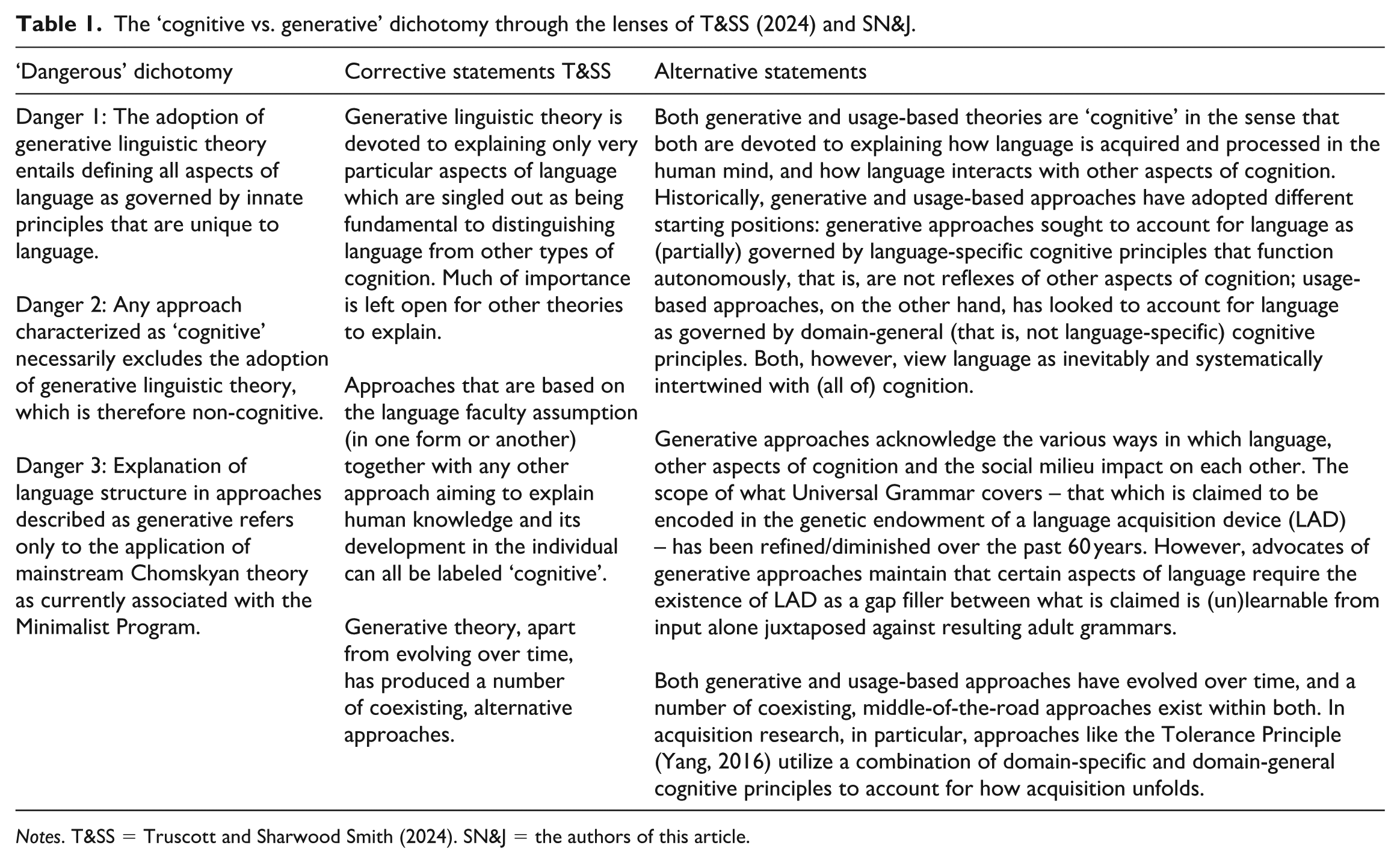
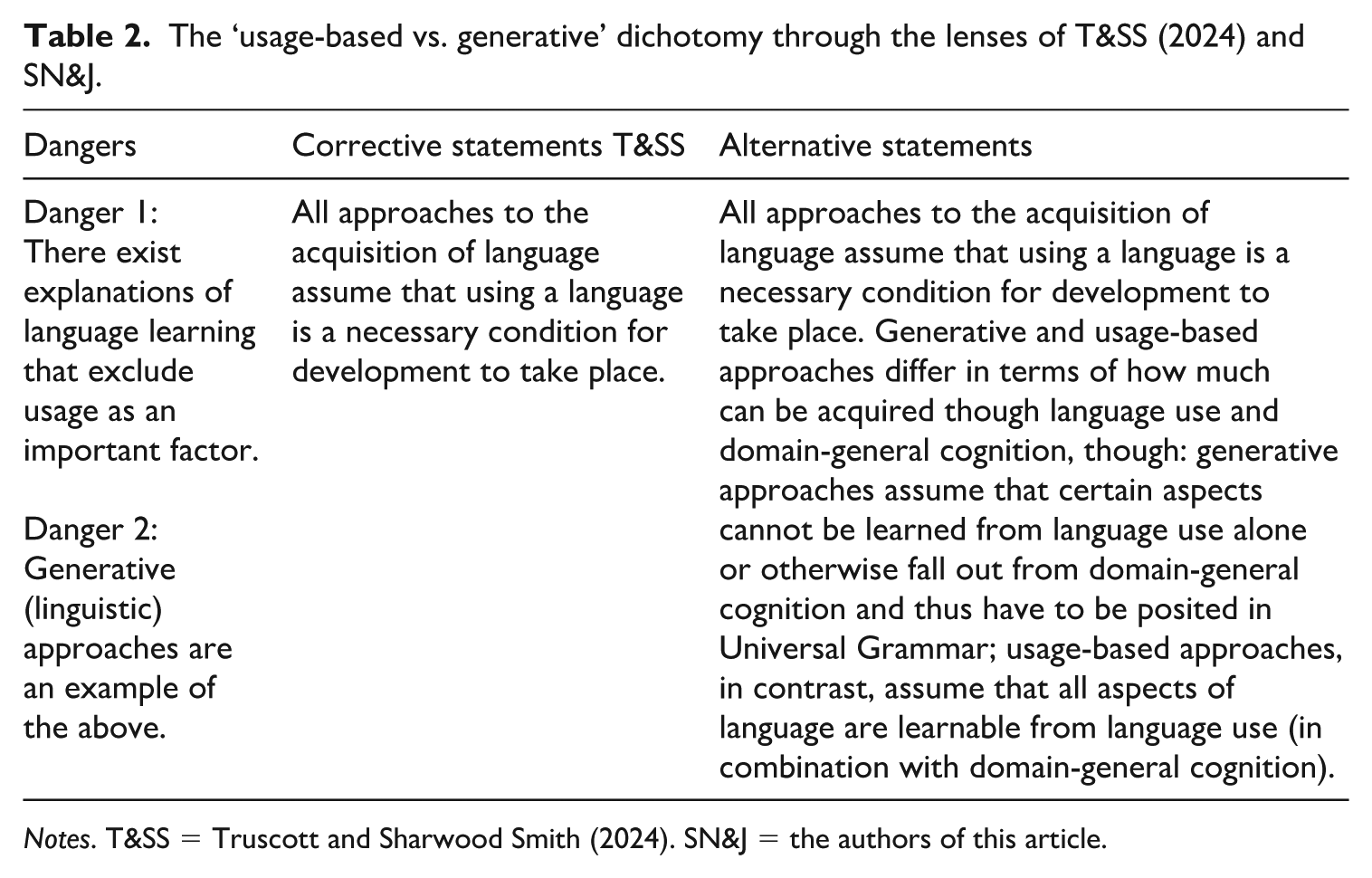
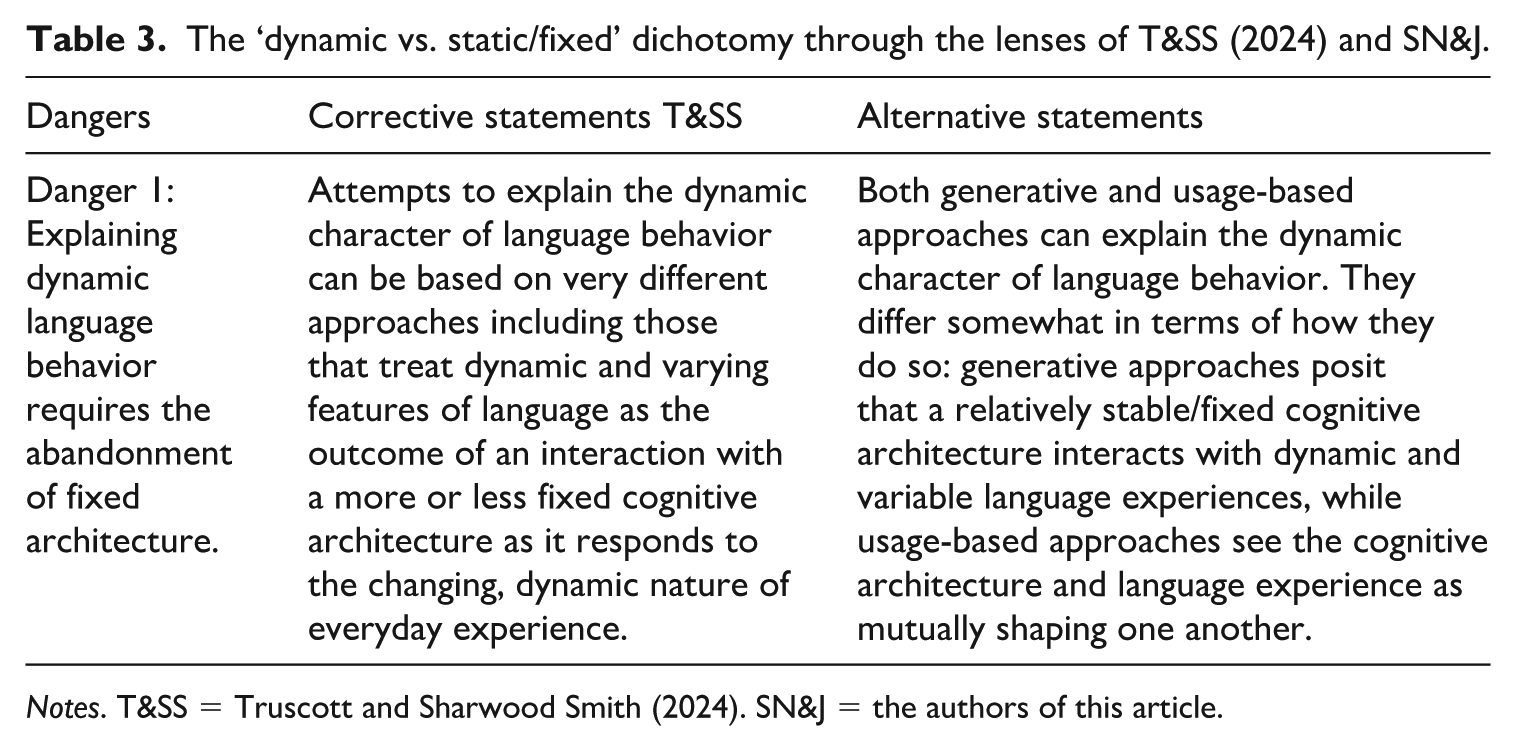
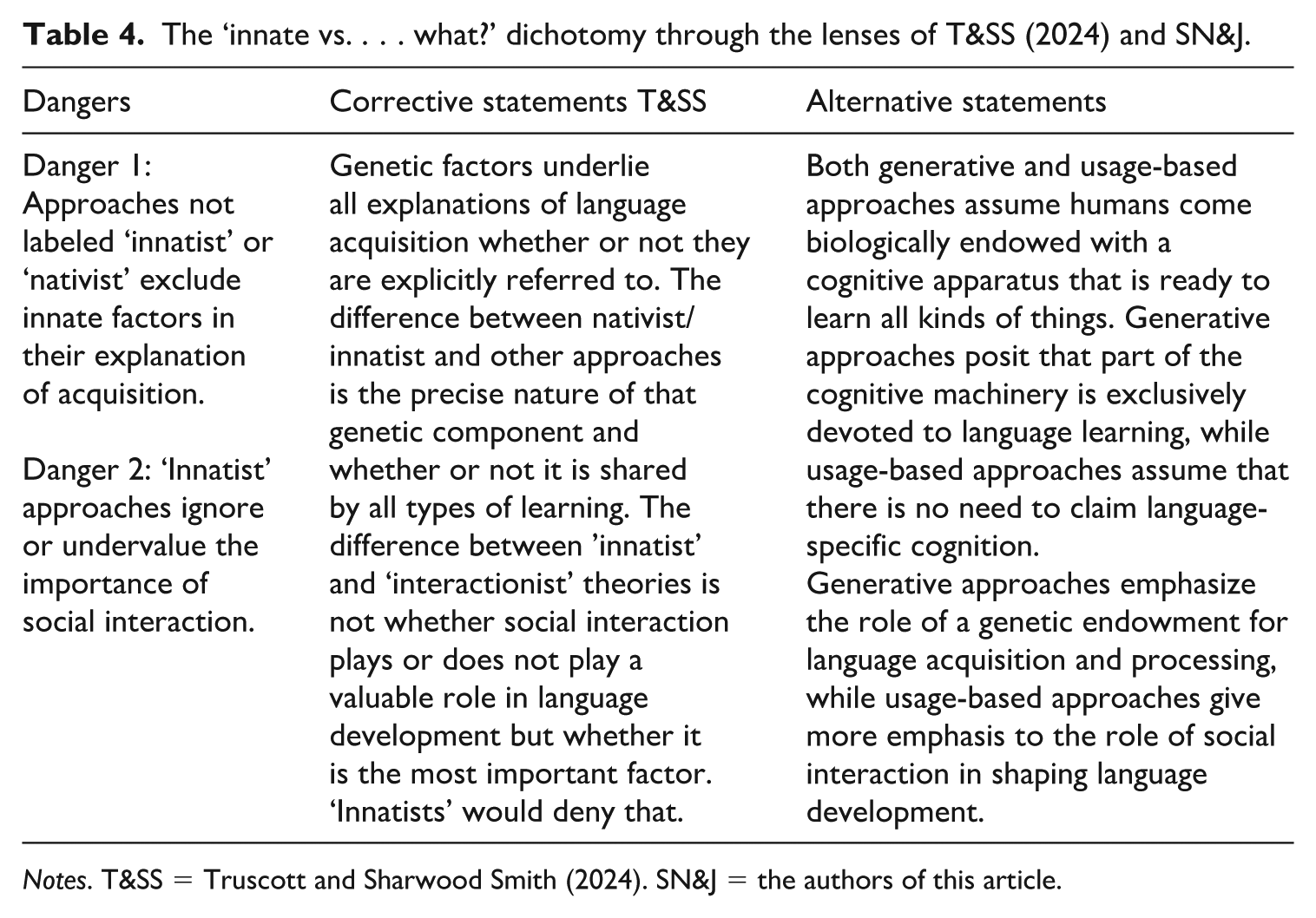
Tables 1 to 4 reproduce the exact wording of T&SS regarding the ‘dangers’ associated with each dichotomy and the ‘corrective statements’ they offer in the left and middle columns; in the right-hand columns, we submit our alternative statements describing each dichotomy not as a danger, but as a point of departure.
The ‘cognitive vs. generative’ dichotomy through the lenses of T&SS (2024) and SN&J.
Notes. T&SS = Truscott and Sharwood Smith (2024). SN&J = the authors of this article.
The ‘usage-based vs. generative’ dichotomy through the lenses of T&SS (2024) and SN&J.
Notes. T&SS = Truscott and Sharwood Smith (2024). SN&J = the authors of this article.
The ‘dynamic vs. static/fixed’ dichotomy through the lenses of T&SS (2024) and SN&J.
Notes. T&SS = Truscott and Sharwood Smith (2024). SN&J = the authors of this article.
The ‘innate vs. . . . what?’ dichotomy through the lenses of T&SS (2024) and SN&J.
Notes. T&SS = Truscott and Sharwood Smith (2024). SN&J = the authors of this article.
Regarding this dichotomy and the dangers that T&SS argue fall out from it, the three of us are not aware of anyone ever having claimed anything to that effect (at least not in peer-reviewed publications or other reputable outlets). Does anyone think that generative linguistic theory claims to account for all aspects of language as governed by innate principles; that ‘cognitive’ is solely owned by non-generative theories, or that people only think of the Minimalist Program when they consider generative approaches?!
As we see it, the more fruitful way to conceptualize the generative vs. usage-based dichotomy is to see them as approaching the same question – how do we acquire language? – from different points of departure: generative approaches, from their beginnings until today, assume some degree of (linguistic) modularity, while usage-based approaches adopt a non-modular perspective. In the early days of SLA research, we think it is true that much of the research that was published from both points of departure made a rather conscious effort to see how far the envelope could be pushed: much of generative research presented empirical data that supported the idea that certain aspects of language could not have been acquired through exposure to input alone, while usage-based research presented empirical data showcasing just how much more than previously assumed could be argued to be acquirable from the input, provided access to domain-general cognition. For example, for studies that focused on second-language poverty-of-the-stimulus in the late 1990s and early 2000s, see Pérez-Leroux and Glass (1999), Dekydtspotter et al. (2000), and Rothman and Iverson (2008) adopting a generative perspective; usage-based alternatives accounts are offered for example in Stefanowitsch (2008), Goldberg (2019), and Blything et al. (2025).
T&SS would like to ‘correct the record’ for generative approaches as offering more than the Minimalist Program – ironically, this still implies an unbridgeable divide, a Venn diagram with no overlapping area between generative and usage-based approaches. But in fact, and for a while now, a variety of approaches have co-existed: some that subscribe to (i) modularity of different kinds and/or (ii) modularity to different extents, in the sense that they have shifted from an all-or-nothing type of reasoning to one that allows for a more nuanced model in which some aspects of language remain in Universal Grammar, while others are explicitly driven by domain-general cognition; and some are (iii) neutral to the modularity debate altogether, in the sense that the question of modularity is not in focus at all. Regarding (i) and (ii), to give but a few examples, we think of the Processability Theory (Pienemann and Lenzing, 2020), which is a modular theory of language in the sense that the posited default processing mechanisms are argued to be a part of Universal Grammar, while at the same time being a non-modular theory in the narrower sense of syntax not being autonomous from other linguistic domains, since semantics is seen to drive acquisition, and acquisition of syntax specifically. Or we can think of Yang’s (2016) Tolerance Principle as an example of a model that adopts a more contemporary perspective: emphasis is placed on stochastic, algorithmic mechanisms of learning while at the same time, productivity is developed and constrained by the properties of Universal Grammar in first language acquisition (and in principle all instances of bilingualism, including later acquired additional languages, see Yang, 2018; Yang and Montrul, 2017). Regarding (iii), we point as one example to the Typological Primacy Model (TPM) (Rothman, 2011, 2015), which posits that transfer in the initial stages of third language (L3) acquisition will come from the most structurally similar background language, regardless of the order and context of previous language acquisition. While it is certainly compatible with generative approaches, it could just as well be applied in the larger context of usage-based approaches.
2 Usage-based vs. Generative
We again feel that the dangers T&SS posit here exist primarily in their minds. While it is possible that their mindset is shared by others, in our view, it does not represent what the majority of researchers in the field know to be true. Of course, usage matters for all theories! Simply stating that misses the point though: as specified above, what really delineates usage-based from generative approaches is the relative determinism usage must have and the role that domain-general cognition plays in explaining the whole of language acquisition development and outcomes. Usage-based approaches take the position that there are hard constraints from domain general cognition that drive acquisition of language and other skills, while to generativists, some of these constraints look to be specific to language. This furthermore implies that in usage-based approaches, language and cognition are bidirectionally intertwined: both shape the other (Douglas Fir Group, 2016; Ellis, 2019); generative approaches, in contrast, adopt what can be viewed as a more unidirectional view whereby cognition shapes language, but not the (necessarily or so clearly) the other way around. That gives what is meant by ‘usage-based’ a flavor in usage-based approaches that simply does not exist in generative approaches.
3 Dynamic vs. static/fixed
We largely refer to the previous section on this and wish T&SS had given a little more detail as to what they mean by a ‘more or less fixed cognitive architecture’. Assuming that they are referring to linguistic representations, the three of us share the view that language acquisition is a process of representation building of an interlanguage (Selinker, 1972) and again acknowledge the different views on the extent to which we assume the language-cognition connections to be more or less mono- or bi-directional.
4 Innatist vs. What?
We disagree with T&SS’s characterization that ‘[t]he difference between “innatist” and “interactionist” theories is not whether social interaction plays or does not play a valuable role in language development but whether it is the most important factor.’ The main issue is not – and never has been – what the most important factor is. There has been wide agreement that both genetic and social factors are important, indeed necessary conditions for acquisition; the question is whether social factors, paired with general cognition, are sufficient conditions to account for acquisition, or whether (innate) language-specific cognition triggered by social factors needs to be recruited for a sufficient model of language acquisition. To that point specifically, we again believe it is useful and expository to point out that much generative research on heritage bilingualism, especially in recent years, has convincingly shown the need for and explanatory value of attributing significantly more weight to the impact of social factors in language acquisition (e.g. Hao and Chondrogianni, 2023; Kubota et al., 2025; Kupisch and Rothman, 2018; Rodina et al., 2020). Further, we encourage readers to explore recent progress in conceptualizing, measuring, and testing such factors by recruiting insights and techniques from complex systems and network science, which, in our view, are perfectly compatible with both generative and usage-based approaches (e.g. Iniesta et al., 2025; Navarro and Rossi, 2024; Titone and Tiv, 2023).
II Dichotomies as points of departure
We hope that our discussion of the dichotomies makes it quite clear that they are far from ‘dangerous’. Rather, they can be points for productive exchange and collaboration that not only build growing consensus but also give finesse to points of disagreement – which plays a crucial role in scientific progress, in (second) language acquisition as in any other scientific field. Dichotomization ultimately reflects a human problem-solving strategy: we approach complex things, events, and ideas by partitioning them into pairs. Ellis and Larsen-Freeman (2006), in their Applied Linguistics edited special issue on the emergence of language, provide an extended list of the dualisms pervasive in language research; see Figure 1.
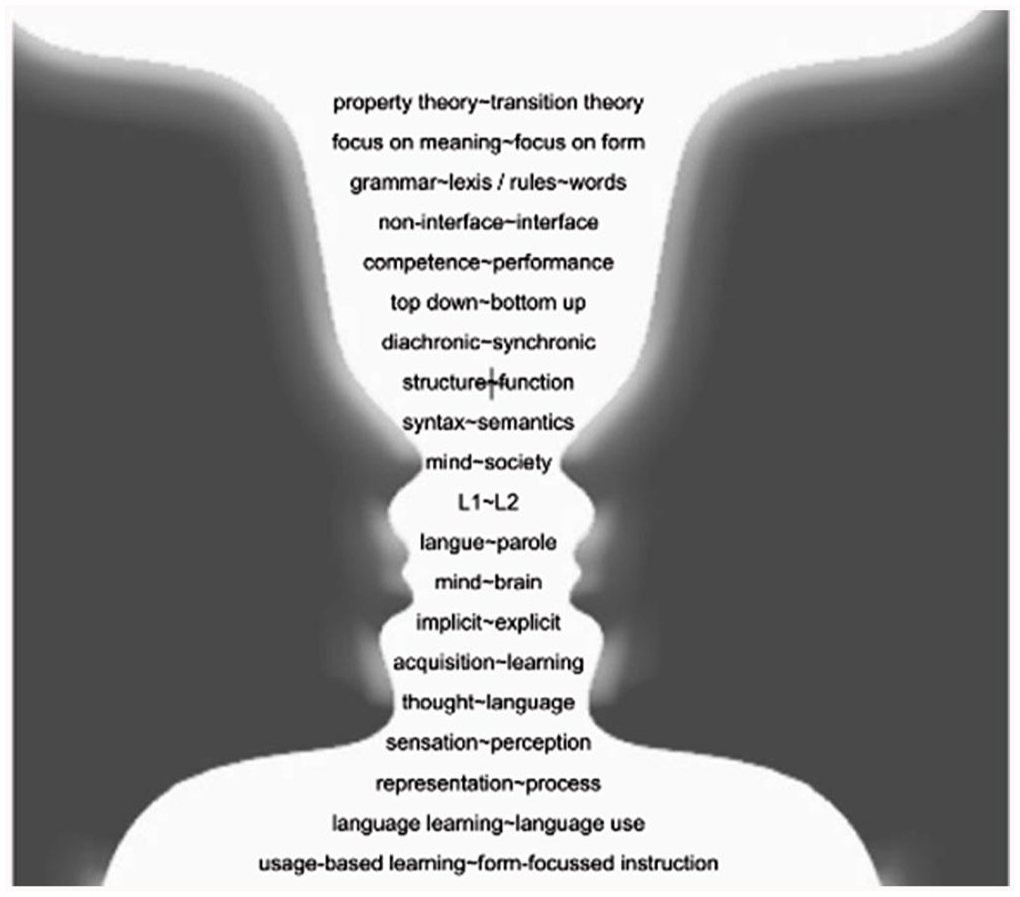
Complementary pairs in language research.
But these pairs are emergent, and they are complementary, more mutually dependent than mutually exclusive. They drive change, with the action taking place in between in complex coordination dynamics. Throughout history, many have recognized that truth may well lie in between such opposites: Failure to accept this perspective leads to researchers picking sides in debates such as whether it is genes or the environment which can be used to explain development . . . genes and environment are locked in a complex chain of steps over time and that they cannot be conceived of as variables that make mutually independent contributions to development (Ellis and Larsen-Freeman, 2006: 581).
We are thus in full agreement with T&SS when they conclude by admonishing language acquisition researchers against extreme academic modularity and advise us that the days of compartmentalized research passed long ago in the hard sciences. It is exactly in that spirit that the three of us put forth our response here.
Footnotes
Declaration of conflicting interests
The authors declared no potential conflicts of interest with respect to the research, authorship, and/or publication of this article.
Funding
The authors received no financial support for the research, authorship, and/or publication of this article.
