




Abstract
In this article we investigate transfer in the ab-initio acquisition of grammatical gender in two groups of multilingual learners. The first group knows two gender languages (German and French), which can potentially act as transfer sources; the second group knows three (German, French and Italian). Both groups had to assign gender to nouns in Franco-Provençal, a Romance language which is new to the learners, and which shares similarities with both French and Italian. Based on our data, we address the question whether there is a unique transfer source and what the respective roles of sub-lexical structural similarity, proficiency, and recency of use of the background languages are. The findings of this study reveal that learners of the first group use both French and German as transfer sources, whereas learners in the second group additionally transfer from Italian. We show that the amount of transfer increases with higher proficiency, more recent use of the source language(s), and increasing structural similarity between the source and target language. Finally, not only is the gender feature transferred but also orthographical cues.
I Introduction
Research on third language (L3) acquisition has focused on situations where three languages are in contact. Although participants in the relevant studies might have been proficient in additional languages, only few studies mention these explicitly, and even fewer discuss their potential roles. Thus, fourth language (L4) or Ln acquisition has so far not been systematically investigated even though it is common for multilinguals to know more than three languages. In 2014, the Guardian reported that 10% of all Europeans can hold a conversation in three additional languages beyond their native language. 1 The study presented in this article was carried out in Germany, where reportedly about 11.8% of the population speaks three additional languages beyond their native language (Adler and Silveira, 2022). However, many surveys estimating the average number of languages known ask about ‘foreign’ languages, while not taking into account that some respondents might already be multilingual when starting to acquire their first foreign language due to a migration background or bilectalism. We thus suspect that the number of L3+ cases, and, by implication, the relevance of this topic has been underestimated.
Herein, we present a study in which learners are exposed to nouns in Franco-Provençal: a language that is new to these learners but may look familiar given previously acquired languages. The overall goal is to investigate transfer strategies when multilinguals acquire additional languages. We compare two groups of learners: The first group knows two gender languages (German and French) and Franco-Provençal will be their third gender language. The second group already knows three gender languages (German, French and Italian) and Franco-Provençal will be their fourth gender language. 2 The study we present bears some similarities with an artificial language learning design, as the participants have never seen Franco-Provençal before, while having the advantage that the stimuli are taken from a natural language (see also Pereira Soares et al., 2022). Given the learners’ knowledge of French (and Italian), Franco-Provençal looks familiar to them, and they can infer the lexical meaning of the words they encounter. This study focuses on the potential transfer of the gender feature of the noun, e.g. the feature [+feminine] of the French noun assietteF ‘plate’ to the Franco-Provençal equivalent piatM, which happens to be masculine. We will refer to this type of transfer as ‘direct’ gender transfer.
Before we proceed, a note on Ln terminology is in order. Hammarberg (2001: 97) defined L3 as ‘a non-native language which is currently being used or acquired in a situation where the person already has knowledge of one or more L2s [second languages] in addition to one or more L1s [first languages]’. Accordingly, it is not crucial whether a language is an L3, L4 or L5 as long as it is not the first foreign language acquired. By contrast, Rothman et al. (2019: 157) suggest different scenarios for L3 and L4 acquisition. While arguing for full transfer from a single language in L3 acquisition, they speculate that things might play out differently in post-L3 acquisition because learners have already experienced that the full transfer of an entire grammatical system can have negative effects and may consider other strategies. Herein, we explore whether the number of potentially relevant transfer sources makes a difference, distinguishing between Franco-Provençal as an L3 and an L4 based on whether the participants already know two or three gender languages.
Third language acquisition research has focused on determining the driving forces for transfer and crosslinguistic influence. 3 Herein, we focus on the role of sub-lexical structural similarity as well as recency and proficiency as co-variants, as proposed by the Parasitic Model of L2 and L3 vocabulary acquisition (Hall and Ecke, 2003; Ecke, 2015). In our study, ‘structure’ refers to orthographical structure, as the participants were presented the stimuli in written form (see Sections IV.2 and IV.3). Structural similarity thus corresponds to orthographical resemblance.
II Background
1 Lexical transfer in L3/Ln acquisition, proficiency and recency
The Parasitic Model (PM) presumes that each lexical item consists of a triad of interconnected levels of representation: (1) the lexical form (phonological and orthographic representation), (2) the syntactic frame (e.g. word class, subcategorization frame, grammatical gender), and (3) the concept or meaning of the item (Hall and Ecke, 2003). When encountering a new word form, L3 learners must construct an appropriate triad of form, frame and meaning, and the PM assumes that they apply a ‘parasitic’ strategy to do that. This strategy consists of the integration of the novel word into the already present network of lexical representations and access routes via the connection to a pre-existing representation serving as a ‘host’. The host can be an L1, L2 or L3 form, and the association between target and host word is driven by similarity or overlap between them with regards to one or several of the following factors: phonological or orthographical features, grammatical (syntactic) attributes, semantic characteristics. The integration of a new word into the existing network includes the activation of the L3 form’s closest L1, L2 or L3 matches (if they exist) based on salient formal properties and its connection to the host, which is the most highly activated of these forms satisfying a threshold level of similarity. As soon as the connection to the host is established, the new L3 form adopts the host’s frame, which also links it to the corresponding conceptual representation. 4 An example of lexical triads and possible parasitic connections is shown in Figure 1 for L1 Spanish L2 English L3 German.
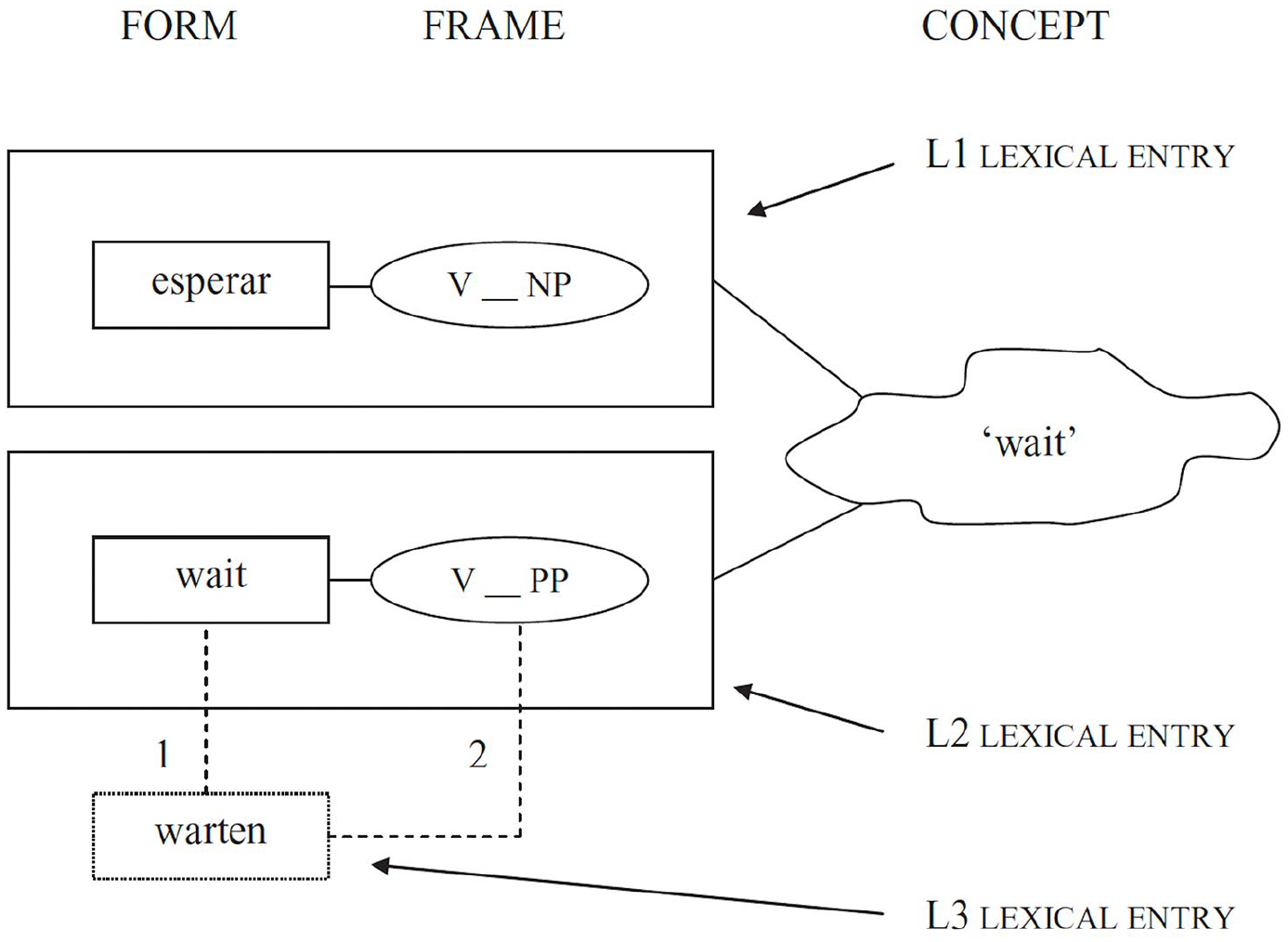
Example of lexical triads and hypothetical parasitic connections (1) between L3 form and L2 form and (2) between L3 form and L2 frame.
The L3 form can also be associated with the frame of the nearest conceptual (translation) equivalent when the activation of none of the matching forms is sufficient. Generally, learners can identify translation equivalents through overt translation, contextual cues or a picture, which is what the participants in our study will be provided with. Since the PM assumes fast integration of new words into the existing lexical network, non-target representations and access routes are frequent in initial stages of acquisition and often surface in transfer. The PM accommodates the fact that transfer can be co-determined by other factors: the parasitic connections are modulated by an array of lexicon-external factors, which affect the degree of activation of representations and connections in the lexical network. These include psychotypology, L2 status, task mode, proficiency and recency of use (Hall and Ecke, 2003). The PM makes assumptions on individual lexical items, not the lexicon as a whole.
The central assumption of the PM that learners make use of similarities between new and already existing information is shared by other L3 transfer models, including the Linguistic Proximity Model (LPM) (Westergaard et al., 2017), the Cumulative Enhancement Model (CEM) (Flynn et al., 2004) and the Scalpel Model (SM) (Slabakova, 2017). While the PM is specifically concerned with the lexical level, the other models make no explicit reference to the lexicon, although they could potentially be extended to lexical properties. The PM further aligns with LPM, CEM 5 and SM in that transfer happens incrementally or property-by-property based on similarities of individual structures, which means that all background languages can act as transfer sources.
As mentioned above, the PM can accommodate extra-linguistic factors, such as proficiency and recency. Controlling for proficiency has become a standard in multilingual acquisition research, but there is no conclusive data on its role. While Williams and Hammarberg (1998) and Ben Abbes (2020) found that proficiency in the background language(s) is decisive (see also Lindqvist and Bardel, 2014), Möhle (1989) concluded the opposite. The picture is clearer for the role of proficiency in the target language: Lower proficiency in the target language leads to more activation of potential transfer sources (Hall and Reyes Durán, 2009; Lindqvist, 2009; Möhle, 1989; Williams and Hammarberg, 1998). Unlike proficiency, recency is rarely ever quantified systematically. Recency has been defined in terms of the amount of contact with the background languages that is recent (Falk and Bardel, 2011: 63), the idea being that background languages can be activated more easily as transfer sources if their use has been recent (Hammarberg, 2001). However, there have been few studies on recency, and these have led to contradictory results, some suggesting that recency is not crucial (De Angelis and Selinker, 2001; Möhle, 1989), others proposing that it matters, at least in combination with other factors (Hall and Ecke, 2003; Lindqvist, 2010; Williams and Hammarberg, 1998). Intuitively, the role of recency might become more important with an increasing number of background languages, which underlines its relevance for our study. Herein, we take both recency and proficiency in the background languages into account. Proficiency in the target language will not be relevant, because the target language is unknown to the participants.
2 Gender
Grammatical gender is a feature of nouns that is reflected on elements that agree with them (Hockett, 1958: 231). Gender assignment refers to the way in which speakers allot nouns to gender classes (Corbett, 1991: 3). Gender may or may not be overtly marked on the noun itself, which implies that languages can be more or less transparent in terms of how gender is assigned to nouns. In transparent assignment systems, the noun ending may give away the gender. Regarding the representation of grammatical gender there are opposing views in the literature. It is either viewed as a lemma feature (e.g. Levelt et al., 1999) or as a syntactic feature (e.g. Caramazza, 1997). We adopt the first approach, which is in line with the Parasitic Model, where gender is represented in the frame of a lexical item, corresponding to the lemma in Levelt’s speech production model (Hall and Ecke, 2003; Levelt et al., 1999).
3 Gender assignment in German, French, Italian and Franco-Provençal
German has three genders: feminine, masculine and neuter. Amongst the languages relevant here it has the least transparent gender assignment system. Indeed, Köpcke et al. (Köpcke, 1982; Köpcke and Zubin, 1983), while stressing the systematicity of gender assignment in German, point out that it is more appropriate to speak of assignment ‘regularities’ rather than ‘rules’. German is similar to French in that nouns have many different endings, of which some provide reliable cues to gender. For example, nouns ending in /ə/ (e.g. PfanneF ‘pan’, SonneF ‘sun’) tend to be feminine and nouns ending in /ɛt/ (e.g. BettN ‘bed’, BrettN ‘board’) are neuter, and these rules hold for more than 90% of the nouns having these endings.
French is more transparent than German. It has two genders – masculine and feminine – and nouns can have 30 different endings, both vocalic and consonantal, which differ in how reliably they predict gender (Lyster, 2006: 75). The predictive value of phonological endings ranges between 99% for /ɑ̃/ to only 53% for /e/. Six final phonemes predict gender correctly for more than 90% of all nouns: /ɑ̃/, /ɛ̃/, /o/, and /ε/ reliably predict masculine, while /z/ and /ʃ/ reliably predict feminine. Based on a corpus of 9,961 nouns, Lyster (2006) demonstrated that 81% of all feminine nouns and 80% of all masculine nouns are rule governed, having endings that systematically predict their gender. Predictability even increases if orthography is taken into account. Although there is some disagreement on native speakers’ ability to assign French gender on the basis of noun endings, and whether they do so on a phonological, morphological or orthographic basis, most researchers agree that L2 learners of French are sensitive to word-internal properties that affect grammatical gender (e.g. Carroll, 1989; Tucker et al., 1977), which will be relevant for our findings.
Italian has the most transparent assignment system of the languages in our study. It has the same binary gender system as French and about two thirds of all nouns end in /o/ or /a/ in the singular and can be classified as masculine or feminine, respectively, e.g. gattoM ‘cat’, casaF ‘house’. About 20% of nouns end in /e/ in the singular. These can be either masculine or feminine, but sometimes /e/ is part of a suffix, which is unambiguously associated with one gender, e.g. -ione in rivoluzioneF ‘revolution’ with feminine gender and -ore as in scrittoreM ‘writer’ with masculine gender (Chini, 1995).
Franco-Provençal is another independent Gallo-Romance language spoken in France, Switzerland, and Italy (Kristol, 2016; Stich, 1998). It is severely endangered, shows extreme dialectal variation and has never been standardized. Franco-Provençal bears similarities with both French and Italian, which also becomes evident when looking at nominal gender. It has the same two genders, and nouns may look similar to either their French or Italian equivalent, or to both, and their genders may be consistent with either or both languages. Given dialectal differences, there are nouns whose gender varies, e.g. leM/laF mensongeM/F ‘the lie’.
4 Gender transfer in foreign language acquisition
There have been numerous studies on grammatical gender and its transfer in early bilingual language acquisition and adult second language acquisition (for a recent overview of Romance languages, see Kupisch et al., forthcoming) but only a handful of studies on L3/L4 acquisition (Ben Abbes, 2020; Brown, 2020; Długosz, 2021; Ozernyi, 2021). Two things need to be pointed out.
First, it is debatable whether in research on L3/L4 acquisition all languages should be ‘counted in’. For example, for gender assignment and agreement in determiner–noun sequences, English cannot be a transfer source because it only marks semantic gender on pronouns. This would turn Ben Abbes (2020) (L1 Spanish/Turkish L2 English L3 French) and Brown (2020) (L1 Spanish L2 English L3 German) into L2 studies and Ozernyi (2021) (L1 Russian L2 Ukrainian L3 English L4 Polish) and Długosz (2021) (L1 Polish L2 English L3 Norwegian L4 Swedish) into L3 studies.
Second, not all studies on grammatical gender have looked at the same construct when investigating gender transfer. Broadly speaking, studies have looked at the discovery of the abstract gender feature in child language acquisition, transfer of agreement rules, transfer of gender features and transfer of gender cues. The latter two are relevant to our study. Transfer of the gender features from a previously acquired language to the new language has also been referred to as ‘surface transfer’. For example, when Germans speak French, they might assign feminine gender to masculine nouns, such as soleil ‘sun’ or chat ‘cat’, because the equivalent nouns are feminine in German. Evidence for this type of transfer was found in several studies, including Sabourin et al. (2006), White et al. (2004), Bianchi (2013) and Ben Abbes (2020). Other studies have taken morpho-phonological cues to gender as a starting point, asking whether there is transfer of cues to gender assignment (Kupisch et al., 2022). For example, in Italian and Russian word final /a/ is a marker of feminine gender (Chini, 1995; Corbett, 1982), but in French word final /a/ is associated with masculine gender 85% of the time (Lyster, 2006: 75). If L1 Italian/Russian learners of L2 French over-assign feminine gender to nouns, such as boisM /bwa/ ‘wood’, platM /pla/ ‘dish’, this might indicate transfer of the gender cue ‘/a/’ for feminine to French. Our study will investigate both transfer of the gender features of the noun (henceforth ‘direct gender transfer’) as well as that of orthographical gender cues (henceforth ‘cue transfer’).
III Research questions
As shown in the previous section, hardly any studies have systematically investigated gender transfer in settings with more than one possible transfer source. Herein, we investigate potential gender transfer in ab-initio acquisition by learners with more than one previously acquired gender system. The target language is Franco-Provençal, a Romance language that is typologically close to French and Italian and entirely unknown to the learners. We conducted two experiments: Experiment 1 tested L1 German speakers with L2 French, for whom Franco-Provençal was the third gender language (L3). Experiment 2 focused on L1 German speakers with L2/3 French and L2/3 Italian, for whom Franco-Provençal was the fourth gender language (L4). Our study thus addresses what happens in cases with multiple background languages, especially if two of these are typologically similar to the target language, as in experiment 2.
According to the PM, direct gender transfer would be the result of the adoption of the syntactic frame of the new noun’s host, which includes a gender feature, such as e.g. [±masculine]. Remember that the selection of the host and thus the adoption of the host’s frame is assumed to be driven by formal similarity between the new and existing word. Evidence for transfer of syntactic frames in the verbal domain comes from a study by Hall and Reyes Durán (2009), where participants transferred the preposition heading the verbal complement, amongst other aspects. We expect that, due to the typological similarity of the involved languages in our study, the associations between new and existing nouns are mostly driven by the formal (in our case, orthographic) similarity between them. However, translation equivalents can also be activated through the images that are provided. Cases where the background languages share the same gender will likely result in the adoption of a joint frame, potentially even overriding gender cues in the new L3 form (Hall and Ecke, 2003: 79). Our research questions and predictions are the following:
Research question 1: Is there one unique transfer source or is there transfer from several background languages?
The two previous studies on the L3 acquisition of gender with several possible transfer sources (Długosz, 2021; Ozernyi, 2021) led to conflicting results: The latter, a single case study, found negative transfer from the L3 (Norwegian) into the L4 (Swedish); the former found combined L1 + L2 (Russian + Ukrainian) transfer into the L4 (Polish). Since the PM predicts word-by-word transfer based on similarity, transfer from different background languages is possible or even predicted because nouns in Franco-Provençal differ in terms of whether their internal structure looks more similar to French or to Italian. Because of the overall absence of similarity between German and Franco-Provençal (with very few exceptions) transfer from German is unexpected. Evidence for transfer from several sources comes especially from learners with a low proficiency in the target language (Lindqvist, 2009), which is the case in our study, where participants have no experience whatsoever with Franco-Provençal.
Research question 2: What is the role of structural similarity, proficiency and recency of the background languages in transfer source selection?
According to the PM, structural similarity at the sub-lexical level is predicted to be the driving force of transfer. Thus, we expect transfer from French if the Franco-Provençal noun has (more) similarity with its French equivalent, and transfer from Italian if the Franco-Provençal noun has (more) similarity with its Italian equivalent. As to the role of proficiency and recency, the results of previous studies are inconclusive. Based on the PM, we expect that languages spoken at higher proficiency levels and used more recently are more likely to act as transfer sources because they have a higher level of activation, thus being more likely to provide host representations for the new Franco-Provençal words. We further suspect that the two factors – proficiency and recency – might interact with structural similarity in that higher proficiency and recency increase the probability of participants detecting structural similarities between two languages so that the necessary threshold level for the parasitic strategy is met. 6 In summary, our precise hypotheses are:
Hypothesis 1: Greater structural similarity between French/(Italian) and the target language Franco-Provençal leads to more transfer from French/(Italian).
Hypothesis 2: Higher French/(Italian) proficiency and recency of use lead to more transfer from French/(Italian) and they might interact with structural similarity.
IV Method
Experiment 1 tested whether L1 German L2 French participants transfer from German or French when assigning gender to new nouns in Franco-Provençal. Experiment 2 took Italian as an additional language into account and tested whether participants would transfer from French or Italian. Note that the purpose of the study is to investigate if and how similarity, recency and proficiency, which are all treated as continuous variables, modulate transfer; it is not about whether potential transfer has a facilitative or detrimental effect.
1 Participants
Thirty-five participants aged 19–53 years (M = 23.7, SD = 5.8) were recruited for experiment 1. All grew up monolingually with German as their L1 and had learned French as a foreign language. Table 1 provides detailed information on proficiency and recency of French. Thirty-one participants aged 19–71 years (M = 28, SD = 12.76) participated in experiment 2. Twenty-nine of them grew up monolingually with German as their L1, and two were German–Polish 7 early bilinguals. All had acquired French and Italian as foreign languages (for details, see Table 1). Participants in both experiments had intermediate to advanced proficiency in English. 8 The proficiency reported here and used in the analysis (in both experiment 1 and 2) was self-assessed on a scale from 1 (beginner) to 6 (native-like). The distribution of proficiency scores is illustrated in Appendix B. 9 The recency scores were obtained from specific questions in the background questionnaire (Appendix A). The response options were assigned points according to the degree of recency they represent, with higher scores indicating more recency. To obtain a recency score between 0 and 1 for each participant the points were added up and divided by the maximum possible number of points.
French (and Italian) knowledge of participants.

Note. AoO = age of onset. Proficiency scores ranged from 1 (beginner) to 6 (native-like).
2 Stimuli
The same stimuli were used in both experiments. They consisted of 72 Franco-Provençal nouns, taken from the Patois VdA Le site du Francoprovençal en Vallée d’Aoste online dictionary, 10 which provides translations from different localities in the Aosta valley. We selected the items in such a way that congruency between the background languages and the target items was controlled for systematically. Since French, Italian and Franco-Provençal are part of the Romance language family, almost all nouns are cognates. Resemblance is nevertheless a matter of degree. For example, the Franco-Provençal noun mèzanoit ‘midnight’ bears more similarity with Italian mezzanotte than with French minuit. Therefore, to capture the role of similarity at the sub-lexical level in our study we operationalize it by means of Levenshtein distance, a measure indicating how similar two strings are (Kirby et al., 2008). Note that in previous studies the role of lexical similarity was often tested by means of comparing cognates with non-cognates. However, investigating cognate facilitation effects was not the aim of our study. Moreover, as mentioned above, in a language constellation where several Romance languages are present, cognate status is not a reasonable measure for lexical transfer because most words are cognates. The difference is rather to what extent they are recognizable and similar. Levenshtein distance therefore gives us a more fine-grained, continuous measure.
As to similarity of the noun items in our task, we piloted them by asking speakers of French and Italian to indicate for each noun whether it is more likely to be a French or an Italian noun. The piloting indicated that most words have a stronger resemblance to French, in line with the classification of Franco-Provençal, which is generally grouped with Gallo-Romance rather than Italo-Romance (Kristol, 2016). The Levenshtein distance between French and Franco-Provençal ranged between 0 and 0.94 (M = 0.53, SD = 0.23); and the distance between Italian and Franco-Provençal ranged between 0 and 0.90 (M = 0.47, SD = 0.24). A Kruskal–Wallis test was run to compare the overall Levenshtein distance for the relation between the French and Franco-Provençal vs. the Italian and Franco-Provençal nouns, yielding no significant difference between the two (χ2(1) = 0.259, p = .610). This simultaneous similarity with two background languages might be an effect of the chosen variety (spoken in Italy) and it reflects the situation of natural language input in a new language (L3), where there can be similarities with several background languages at the same time, especially if these are typologically similar. 11
We chose to present the stimuli in written and not auditory form for two reasons. First, it is the easiest way for participants to process an unknown language for which they have no representation. Second, using script allows us to investigate the effect of gradually increasing structural similarity to French or Italian, whereas the use of either French or Italian phonology in an aural mode would probably override the potential effect of these fine-grained differences because the phonologies of the two languages are radically different. Whether this is really the case needs to be tested in future studies. Moreover, we do not deny that the visual presentation mode nevertheless activates a phonological representation. However, by presenting the nouns orthographically, we leave it open which of several phonological representations is activated.
The noun items fall into five sets based on their gender in the four languages (no German neuter nouns were used). Table 2 provides two examples for each set. In sets 1 and 2, the nouns are gender matched between German and Italian (and not French) and serve to detect transfer from French. The nouns in German and Italian are masculine in set 1 and feminine in set 2. In sets 3 and 4, the nouns are gender matched between German and French (and not Italian) and serve to detect transfer from Italian. The nouns in German and French are feminine in set 3 and masculine in set 4. Set 5, in which the nouns have the same gender in all four languages, serve as control items, testing whether transfer is a strategy that is used in the first place. 12 The Franco-Provençal nouns were also systematically balanced for gender. This was solely done for reasons of ecological validity, not for the investigation of accuracy, which is not the purpose of this study. For the investigation of potential transfer from the background languages the actual gender of the target nouns is not relevant.
Item sets and number of items in each set.
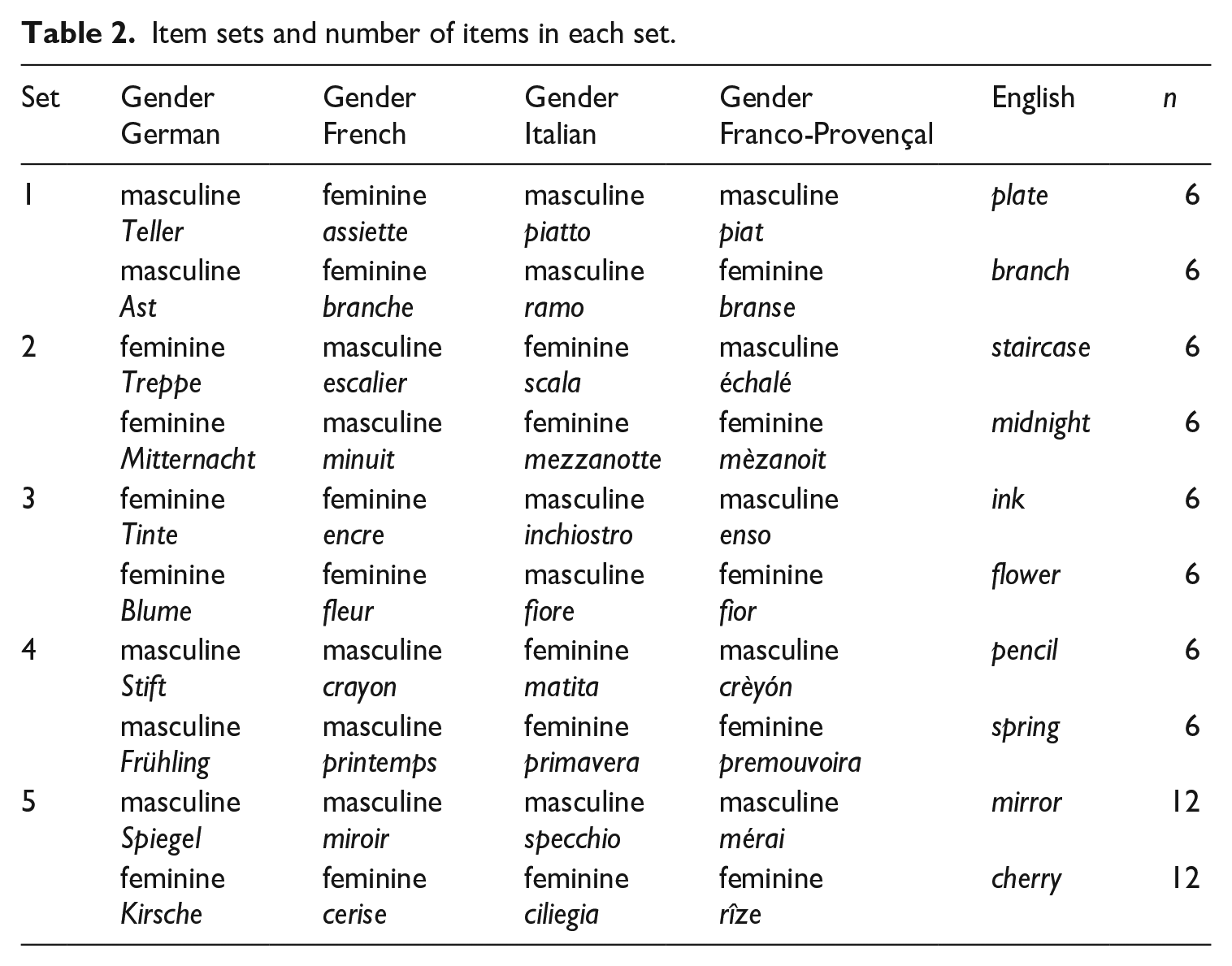
Only nouns with depictable meanings were used to ensure that participants understood the meaning (Section IV.3). Thus, abstract nouns were avoided. In many cases, comprehension was additionally facilitated by formal similarity between the target Franco-Provençal nouns and their translation equivalents in French (and Italian). Moreover, the selected nouns are typically learnt at an intermediate proficiency level.
3 Procedure
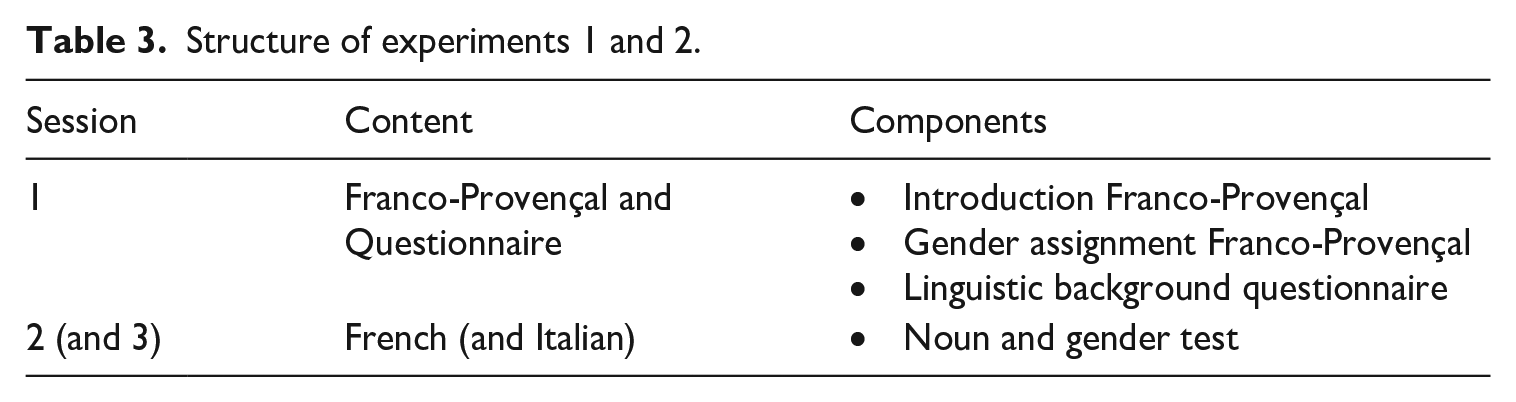
Both experiments were conducted online using SoSci Survey (Leiner, 2022). The experimental tasks were split into two sessions in experiment 1 and three in experiment 2 (Table 3). Twenty-hour hours after the completion of the first (and second) session the participants received the link for the following session. The first experiment lasted 30–60 minutes and the second 60–90 minutes. Participants received an Amazon voucher as compensation.
Structure of experiments 1 and 2.
a Introduction to Franco-Provençal
The introduction to Franco-Provençal familiarized the participants with the new language and allowed for the detection of similarities with the background languages. Nouns were shown individually together with an image depicting the concept as unambiguously as possible (Figure 1). The order in which the nouns were presented was determined by Levenshtein distance: Franco-Provençal nouns displaying the greatest similarity to their French equivalents were presented first to make similarities with French more prominent. Nouns displaying greater similarity to Italian than to French were interspersed every three to four words. The participants were not told that the language they were confronted with was Franco-Provençal to avoid potential biases and activation of metalinguistic knowledge.
b Gender assignment in Franco-Provençal
Each noun was presented once more individually together with an image, and the participants had to decide whether the noun had masculine or feminine gender (Figure 2). At the end of the task the participants were invited to explain what factors had influenced their decisions.
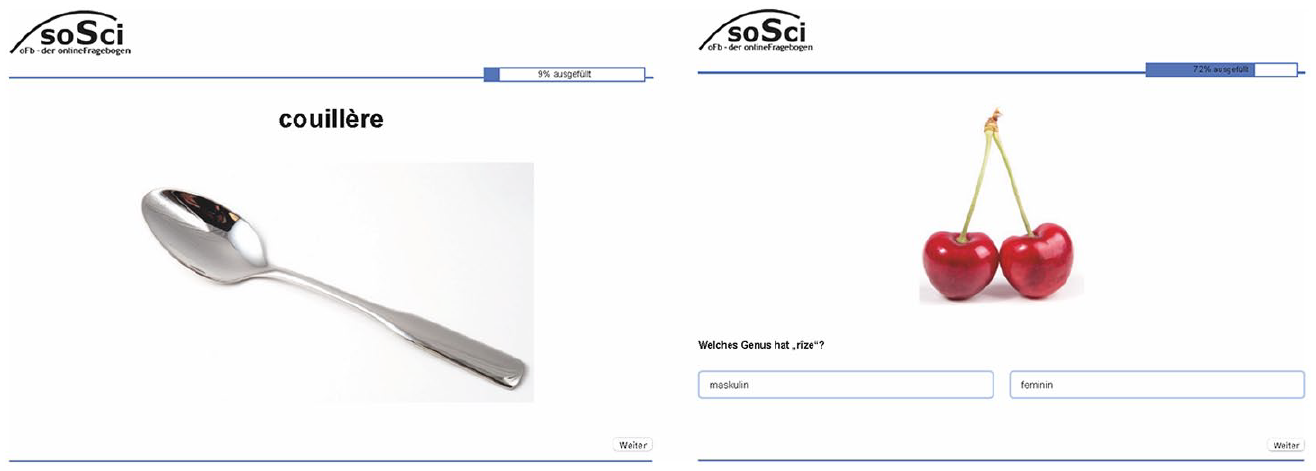
Stimuli from the introductory part and the gender assignment task.
c Linguistic background questionnaire
The questionnaire asked about linguistic background and it contained seven questions on the recency of French (and Italian) use. The final question was whether the new language was similar to French or not (experiment 1) and whether one of the two languages, French or Italian, was more similar to the new language than the other and, if yes, which one (experiment 2). In experiment 1, all participants but one perceived the new language, Franco-Provençal, as being similar to French. In experiment 2, 17 participants perceived more similarity with French, and the other 14 perceived equal similarity to French and Italian.
d Noun and gender task in French (and Italian)
In the second session participants were presented with the French translation equivalents of the Franco-Provençal nouns from session 1. Each French noun was presented individually, and the participants had to indicate whether they know the noun and its meaning (yes) or not (no). If they chose ‘yes’, they were asked whether the noun was feminine or masculine. Nouns whose gender was unknown in the background language were discarded from the analysis of transfer. The rationale was that only linguistic knowledge that has been acquired is available for transfer into another language (Rothman, 2015: 188). The third session (only experiment 2) tested the participants’ knowledge of the Italian translation equivalents of the Franco-Provençal nouns. The reason for conducting the Franco-Provençal task before the French (and Italian) task was to avoid a bias towards one of the two languages.
V Results
1 Experiments 1 and 2: Congruency of gender assignments with background languages
For the identification of direct gender transfer, we first excluded all observations in which participants did not know the French (and/or Italian) translation of the Franco-Provençal target, because if the gender is unknown, it cannot be transferred. In what follows, the gender of the Franco-Provençal noun will be referred to as ‘target gender’. Although the control items from set 5, i.e. those with the same genders in all languages, were not included in the analysis of transfer sources, it is interesting to see how often participants assigned the target gender with these items: 82.6% (set 5) compared to 66.4% (other sets) in experiment 1, and 86.2% compared to 64.9% in experiment 2. This indicates that transfer is being used as a strategy.
For the analysis of transfer sources, we considered whether Franco-Provençal (FRP) nouns were assigned the gender of the translation equivalents in one of the background languages. For example, if the FRP noun crèyón ‘pencil’ was assigned masculine, thus matching the gender of its French equivalent crayon, we considered the assigned feature a transfer from French. Our analysis is restricted to the items which discriminate between German (GE) and French (FR) as transfer sources in experiment 1 (sets 1–2) and between French and Italian (IT) in experiment 2 (sets 1–4). That is, for experiment 1 only the items in which French and German had different genders were included; for experiment 2 only those in which French and Italian had different genders.
Figure 3 shows the amount of transfer from the different background languages for both experiments. As can be seen by the percentages, there is transfer from all available background languages: In experiment 1 from both French and German and in experiment 2 from French, Italian and possibly German. Since the gender of the German nouns always concords with either French or Italian, transfer could come from either language or from both cumulatively. Note that the result of the groups also reflects the behaviour of the individual participants: No participant except for one in experiment 2 transferred from one background language exclusively (Appendix B). The inferential data analysis focuses on the role of structural similarity, (self-assessed) proficiency and recency for transfer into the new language. Remember that all three factors constitute continuous variables.
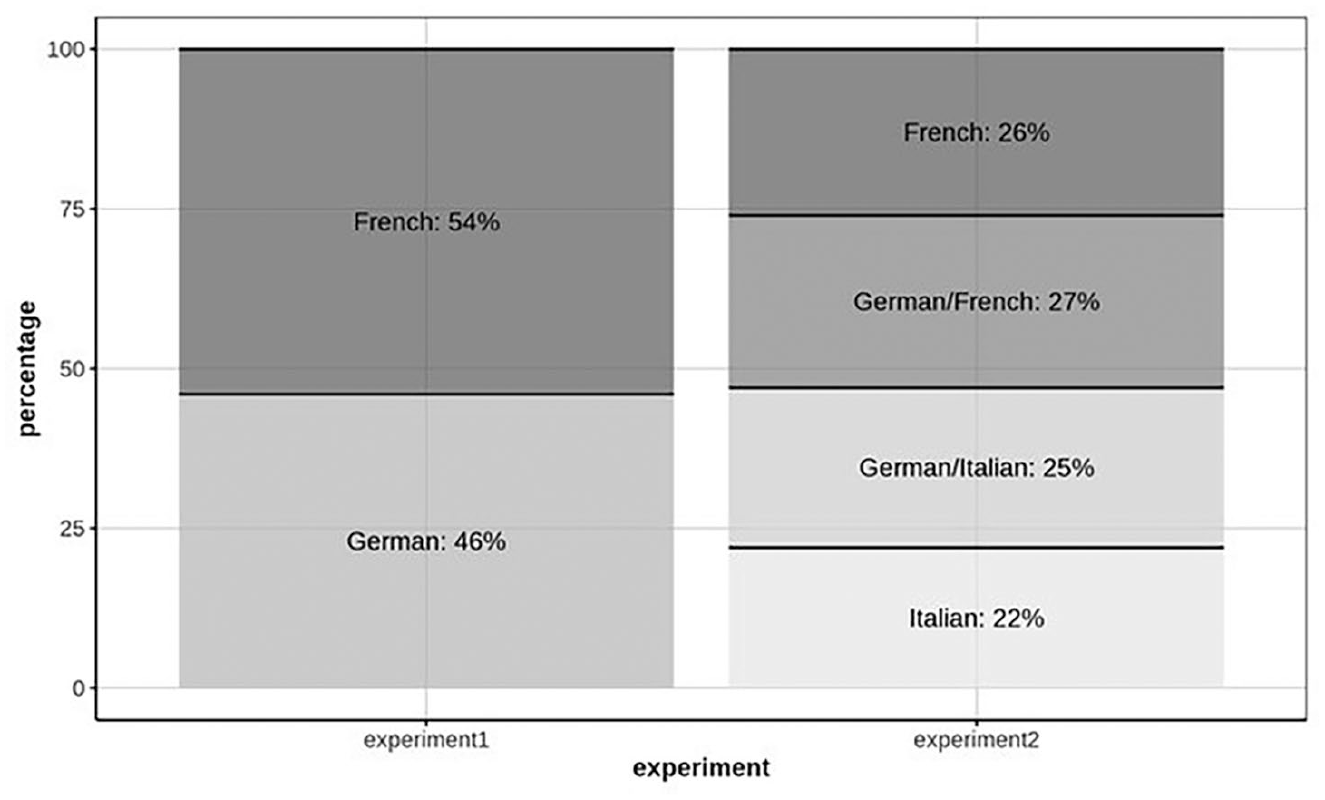
Congruency of gender assignments in Franco-Provençal with the gender of the nouns in the background languages.
2 Experiment 1: Transfer into L3 Franco-Provençal (L1 German L2 French)
We ran generalized linear mixed effects models (implemented using the glmer function from the lme4 R package; Bates et al., 2015) to investigate the effects of Structural Similarity as measured by Levenshtein Distance (LD), French Proficiency, and Recency of use on the transfer of the gender feature from two gendered background languages (GE and FR) to FRP. The response variable, (Gender) Transfer, was coded as binary (i.e. 1 for transfer from French when the gender assigned to the FRP noun corresponded to that of the French equivalent; 0 for transfer from German when the assigned gender corresponded to that of the German equivalent). Since French Proficiency and Recency of use were only moderately correlated (r = 0.396, p < .001), both measures were included in the model. The model formula was the following: Transfer ~ LD × Proficiency + LD × Recency + (1 + LD | Item) + (1 | Participant), assuming a binomial distribution. Given that the model allowing the random slope for LD on items failed to converge, we tested an intercept-only model. We used the drop1 and the anova functions to drop predictors that were not significantly improving the fit of the model. The best-fit model included a two-way interaction between Proficiency and LD and Recency as a fixed effect. All continuous predictors were scaled and centred. Within this model, we found a significant positive effect of LD (χ2 = 9.90, df = 1, p = .002) and FR recency of use (χ2 = 4.34, df = 1, p = .037), as illustrated in Figure 4 (right panel). FR proficiency alone was not significant (χ2 = 1.80, df = 1, p = .180). The two-way interaction between FR proficiency and LD was significant and positive (χ2 = 4.95, df = 1, p = .026). We used the emtrends function from the emmeans package (Lenth, 2023) to further test the interaction term. Specifically, we explored whether the effect of structural similarity was stronger at higher levels of proficiency (+1.5 SD) as compared to lower FR proficiency levels (−1.5 SD). Note that FR proficiency was scaled and centred around 0. The post-hoc analysis revealed that while structural similarity did not significantly influence transfer at the lowest level of FR proficiency (β = 0.34, SE = 0.30, z = 1.14, p = .253), its effect was significant for high-proficiency FR learners (β = 1.20, SE = 0.32, z = 3.70, p < .001), as shown in Figure 4 (left panel).
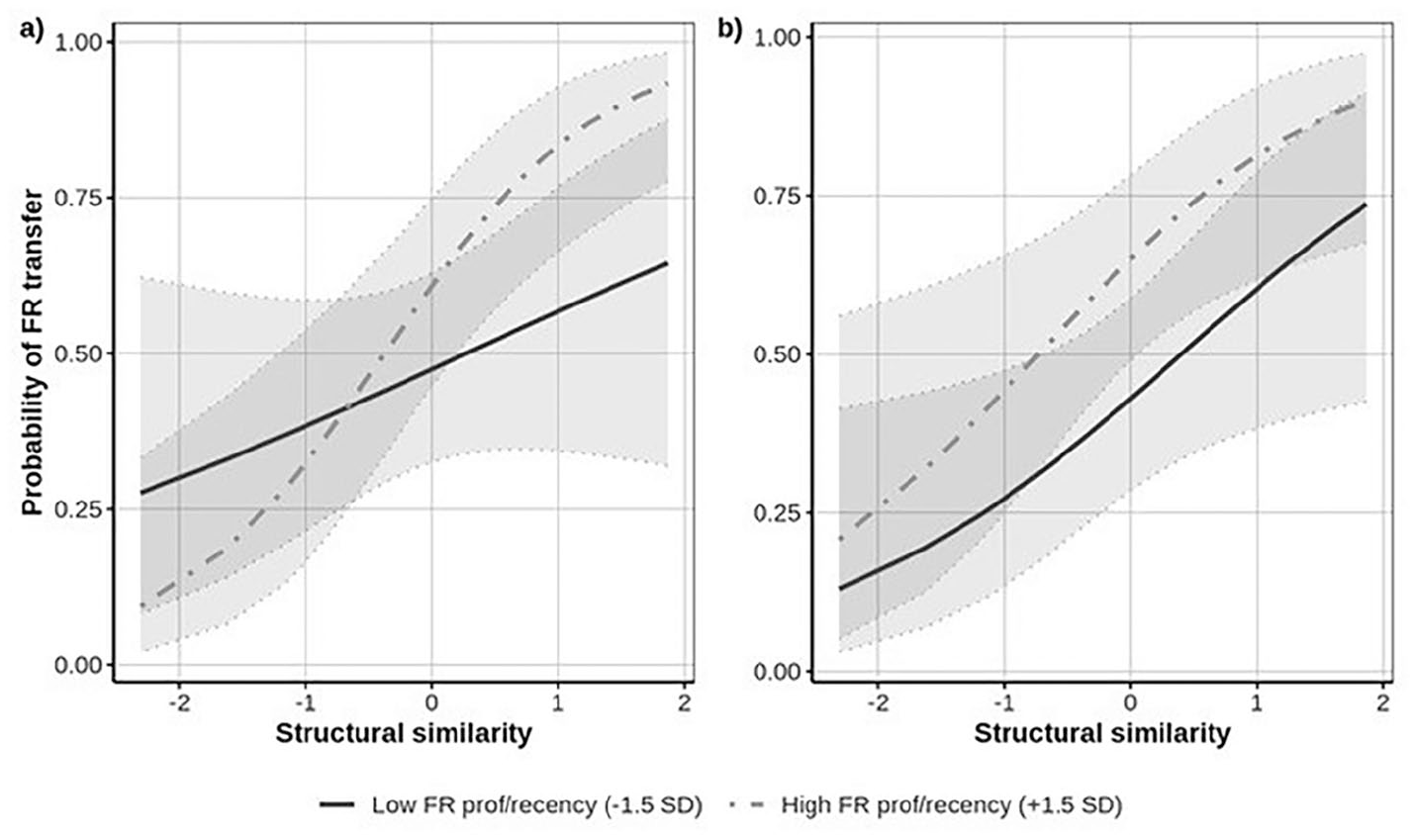
Model output: Transfer ~ LD × Proficiency + Recency + (1|Item) + (1|Participant). Plot (a) illustrates the interaction between Structural Similarity (LD) and FR Proficiency. Plot (b) illustrates the effect of Structural Similarity (LD) and FR Recency.
3 Experiment 2: Transfer into L4 Franco-Provençal (L1 German L2/L3 French/Italian)
In experiment 2, more than two transfer sources were available for the assignment of gender to Franco-Provençal nouns. For the inferential analysis we replicated the methodology of experiment 1 and examined the effects of Structural Similarity (LD), Proficiency and Recency of French use (analysis 1) and Italian use (analysis 2) on Gender Transfer. We created two separate datasets for the French and Italian transfer analyses. In the French analysis, the response variable was binary coded as follows: Transfer was coded as 1 if participants assigned French gender to FRP nouns (including cases where German gender was also congruent). For the Italian analysis, the opposite was done, with Transfer being coded as 1 if participants assigned Italian gender to FRP nouns (including cases where German gender was also congruent).
A correlation analysis using the Spearman’s rank correlation coefficient revealed a high correlation between Recency and Proficiency in both French (r = 0.696, p < .001) and Italian (r = 0.727, p < .001). Therefore, we performed separate analyses for each factor. Again, all continuous predictors were scaled and centred. We tested the models shown in Table 4, always assuming a binomial distribution.
Experiment 2: Inferential analysis.
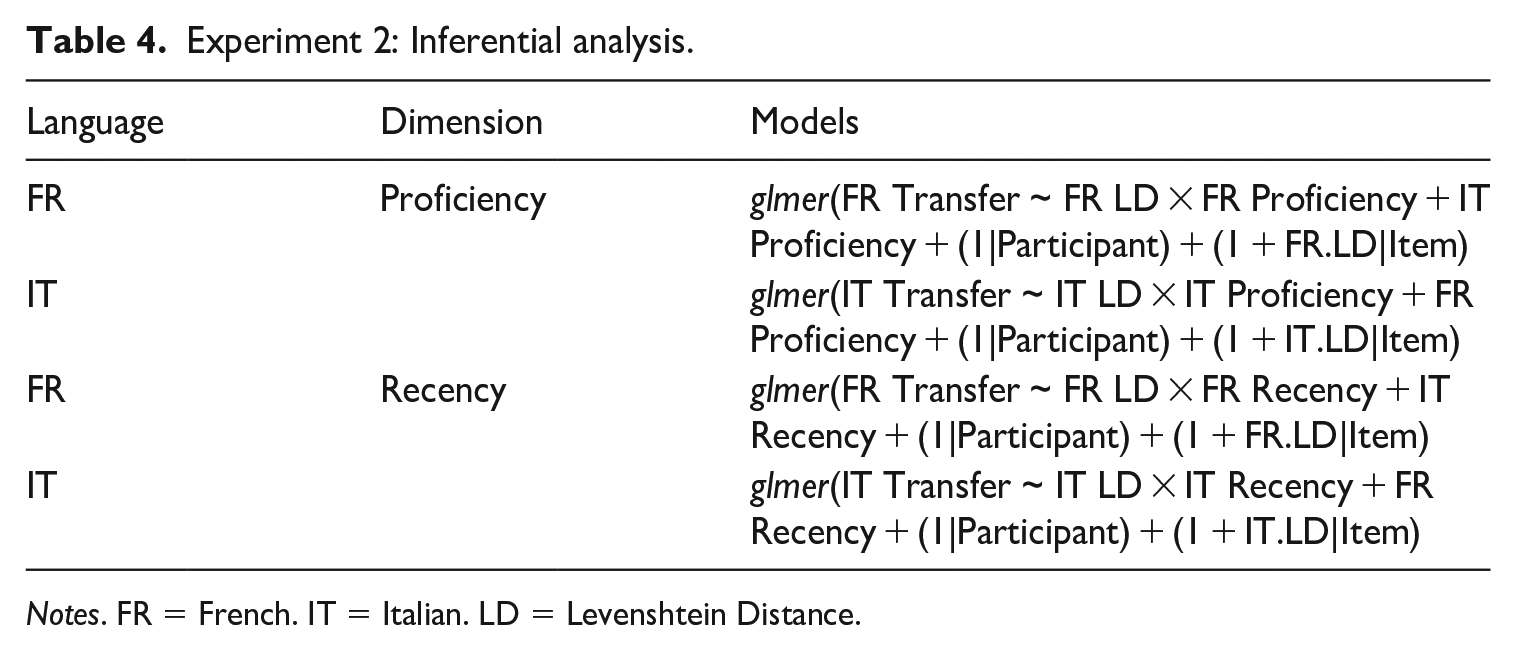
Notes. FR = French. IT = Italian. LD = Levenshtein Distance.
a Proficiency
French transfer and proficiency
With the first model, we predicted the log-odd probabilities of FR Transfer as a function of a two-way interaction between FR Proficiency and Structural Similarity between FRP and FR (FR LD), while accounting for IT Proficiency (Figure 5). Since the model including the slope for LD on item did not converge, we tested an intercept-only model. Within this model, we found a significant negative effect of IT Proficiency (χ2 = 5.02, df = 1, p = .025), but no effect of FR Proficiency (χ2 = 0.06, df = 1, p = .812). The effect of FR LD was significant and positive (χ2 = 12.02, df = 1, p = .001), while the interaction term was not significant (χ2 = 0.59, df = 1, p = .443).
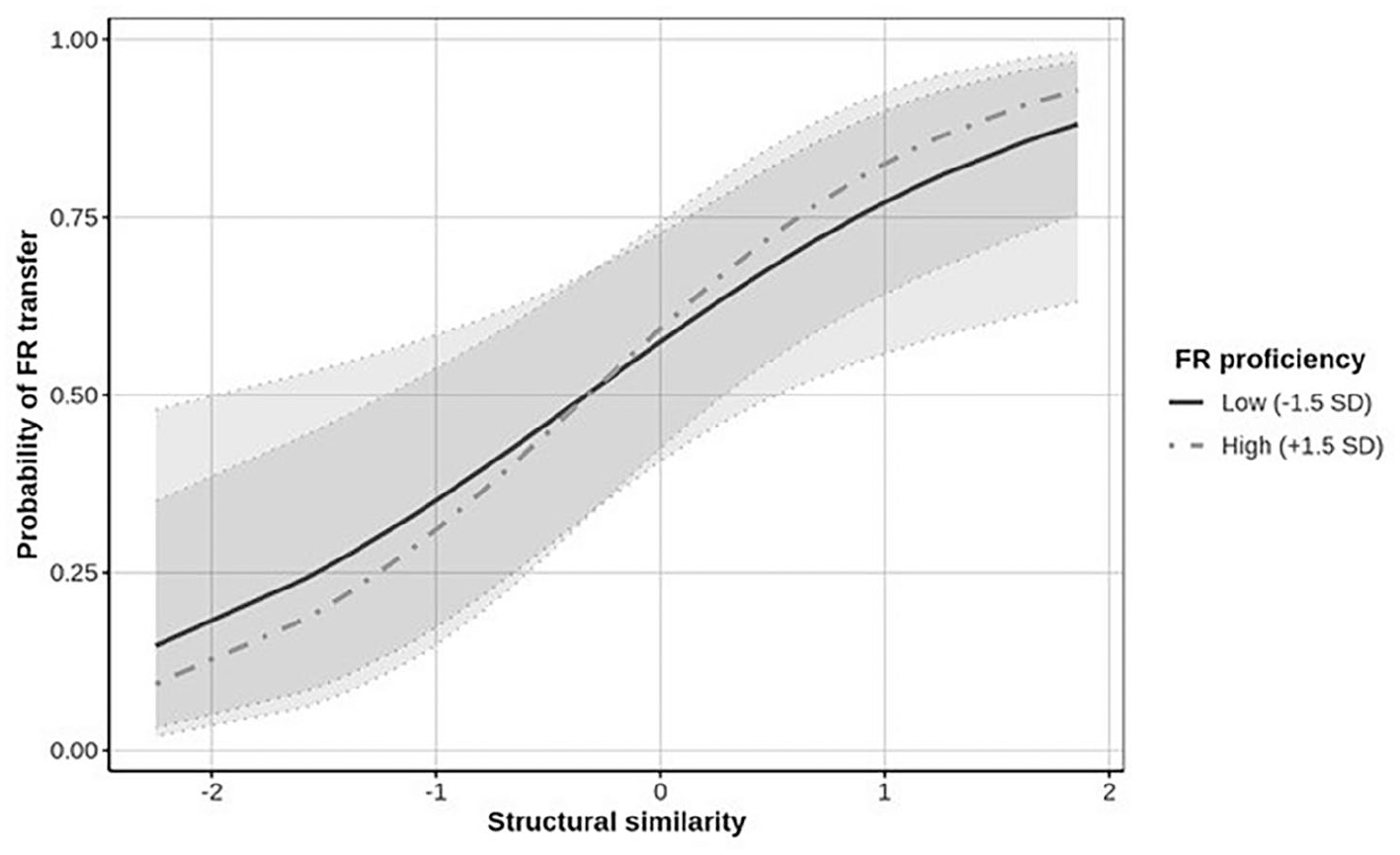
Model output: French Transfer ~ LD (FR) × Proficiency (FR) + Proficiency (IT) + (1|Item) + (1|Participant).
Italian transfer and proficiency
The best-fit model predicting IT Transfer as a function of IT Proficiency and Structural Similarity to IT (IT LD) included a two-way interaction between the two terms, as well as FR Proficiency as a covariate (Figure 6). No slope was added to the random effect because of convergence issues. Within this model, we found a positive, significant effect of IT Proficiency (χ2 = 4.78, df = 1, p = .029). FR Proficiency was not significant (χ2 = 0.01, df = 1, p = .928). The effect of IT LD was also significant and positive (χ2 = 15.79, df = 1, p < .001). The interaction between IT Proficiency and IT LD was not significant (χ2 = 0.92, df = 1, p = .336).

Model output: Italian Transfer ~ LD (IT) × Proficiency (IT) + Proficiency (FR) + (1 |Item) + (1|Participant).
b Recency
French transfer and recency
In the following, we examine the extent to which FR Recency of use modulates transfer from FR. Again, the model allowing the random slope for FR LD on item failed to converge. The model yielded a significant positive effect of FR LD (χ2 = 11.99, df = 1, p = .001), and a significant negative effect of IT Recency (χ2 = 6.81, df = 1, p = .009). The two-way interaction between FR Recency and FR LD was also significant (χ2 = 8.74, df = 1, p = .003). FR Recency alone, however, was not significant (χ2 = 1.14, df = 1, p = .286). The post-hoc analysis (emtrends function; Lenth, 2023) showed that higher structural similarity (i.e. higher FR LD values) does not significantly modulate transfer in participants with low recency scores, i.e. –1.5 SD from the mean (β = 0.56, SE = 0.35, z = 1.63, p = .102), while the effect is significant for participants with high recency scores (β = 1.56, SE = 0.36, z = 4.39, p < .001), as shown in Figure 7.
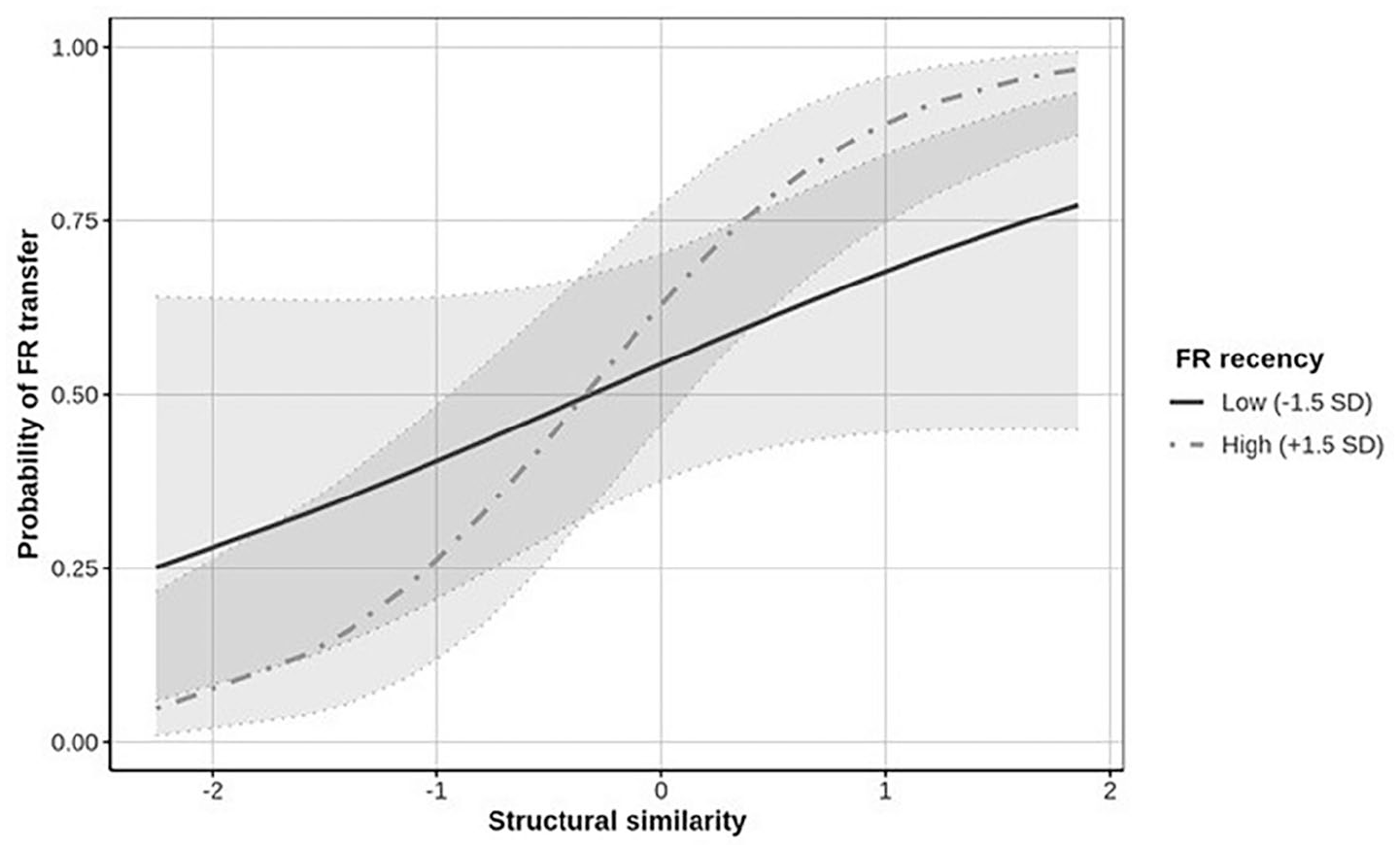
Model output: French Transfer ~ LD (FR) × Recency (FR) + Recency (IT) + (1|Item) + (1|Participant).
Italian transfer and recency
The (intercept-only) model testing IT Transfer as a function of a two-way interaction between IT Recency and IT LD, and FR Recency as covariate yielded a significant positive effect of IT Recency (χ2 = 6.27, df = 1, p = .012), while the effect of FR Recency was not significant (χ2 = 1.20, df = 1, p = .273). IT LD was significant and positive (χ2 = 15.35, df = 1, p < .001), while the two-way interaction term was not significant (χ2 = 0.49, df = 1, p = .482) (Figure 8).
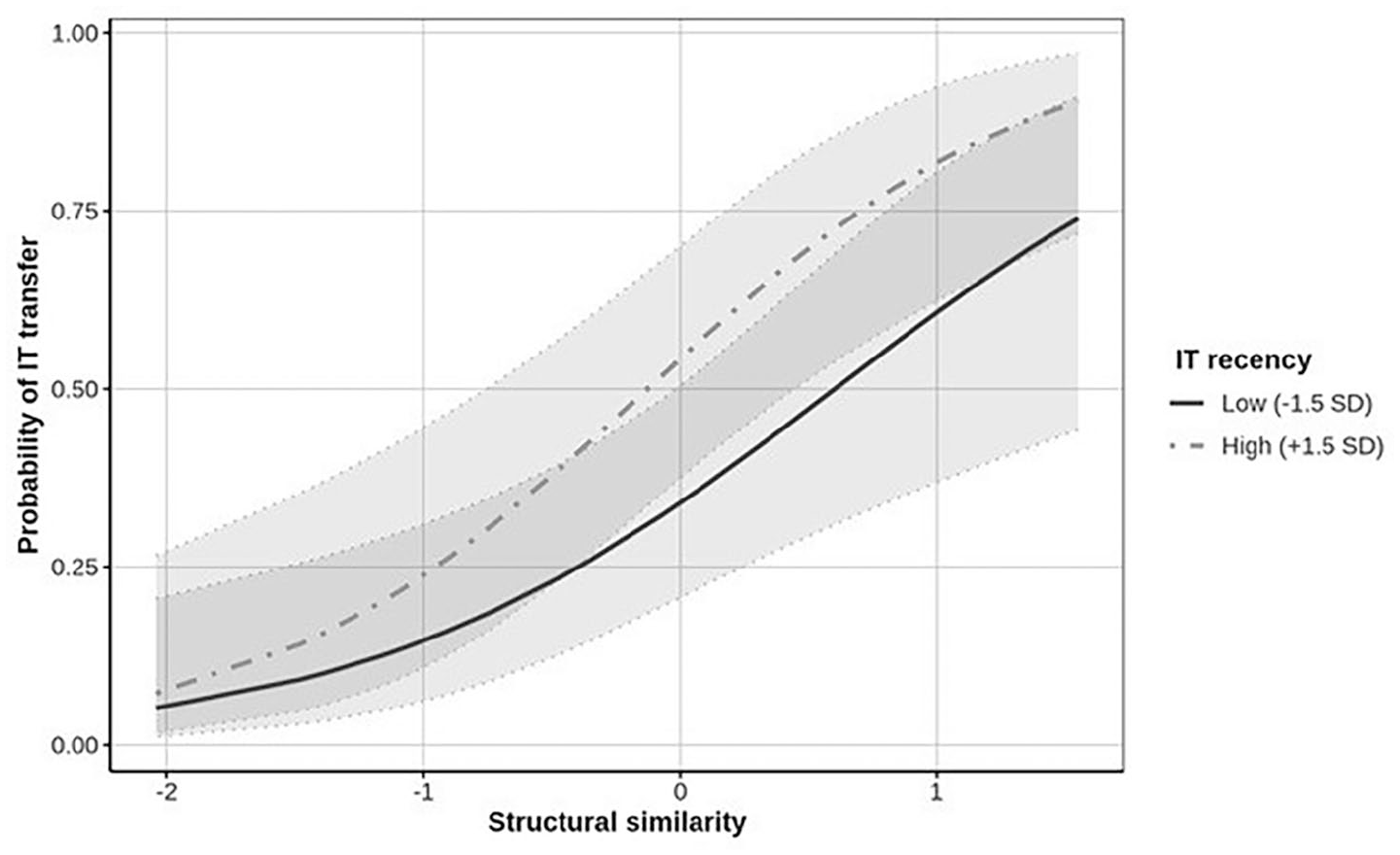
Model output: Italian transfer ~ LD (IT) × Recency (IT) + Recency (FR) + (1 |Item) + (1|Participant).
4 Experiments 1 and 2: Metalinguistic comments
The metalinguistic comments at the end of the assignment task revealed that most participants used various strategies when deciding which gender to assign to the FRP nouns (Figure 9). Participants mostly commented on structural cues, such as noun endings (e.g. -a/-ée/-ion = feminine; -o/-age/-eil = masculine), noun length (e.g. short = masculine) and assumed pronunciation (e.g. soft = feminine). Importantly, even though the items were presented orthographically, we do not assume that comments like these necessarily refer to orthography. As mentioned previously, even with an orthographic presentation, speakers might activate phonological or morphological structures. Moreover, it is not always clear, neither within linguistic theory nor for non-linguist test-takers, whether ‘endings’ constitute phonological cues or morphological cues (e.g. the Italian ending -a), which is why we refrain from classification. Besides structural cues, direct gender transfer from French translation equivalents was also frequently commented on. Transfer from German and Italian translation equivalents was mentioned equally often, although Italian was relevant only in experiment 2. Semantic cues evoked by the images or activated concepts (e.g. lips and flowers = feminine) played a minor role.
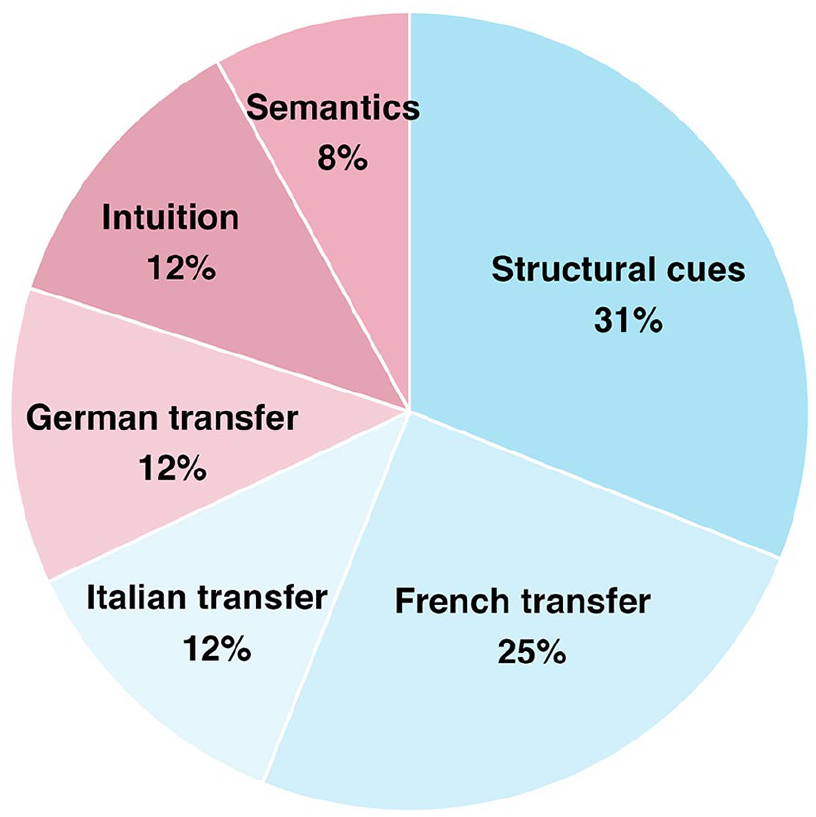
Summary of the metalinguistic comments in experiments 1 and 2.
VI Discussion
Research question 1 was whether there is gender transfer from only one or several background languages. Moreover, we were interested in how (sub-lexical) structural similarity, proficiency and recency influenced the transfer source. Our hypotheses were that greater structural similarity to the target language, higher proficiency and recency of the background languages would catalyse transfer from that language. We further hypothesized that structural similarity would interact with proficiency and recency such that participants with higher proficiency and/or recency were more likely to detect structural similarities to a background language and consequently transfer from it.
1 One or several transfer sources?
There is no evidence for a unique transfer source in our data, like in Ozernyi’s (2021) L3 study. As shown in Figure 3, neither in experiment 1 nor 2 is gender in Franco-Provençal assigned congruently with one single background language. This is not only true for the cross-participant analysis but also for the individual participants (Appendix B). As proposed by Lindqvist (2009), we can see that learners at low proficiency levels draw on more background languages. As the learners seem to have transferred from several sources, the data support our prediction based on the PM. This was especially evident in experiment 2, where learners who knew both French and Italian could exploit structural similarities with both languages.
As mentioned above, other L3 transfer models have not been formulated with the lexical level in mind, but nothing would speak against it. Under the assumption that they can capture the lexical level, the results are also in line with the predictions of the LPM, the SM and, to a lesser degree, the CEM because they all allow for transfer from several sources. The CEM’s assumptions are not completely borne out since not all gender assignments were target-like despite high accuracy rates in both experiments.
2 Structural similarity and type of transfer
We hypothesized that increasing similarity between the target and a background language would facilitate transfer. This assumption also corresponds with the metalinguistic comments (Figure 9). Transfer from French increased significantly with more similarity between the French and Franco-Provençal nouns in both experiments, and transfer from Italian increased significantly with more similarity between the Italian and Franco-Provençal nouns in experiment 2. For our study, this means that multilingual speakers can rely on fine-grained word-internal structural properties when acquiring a new language. The results are in line with the assumption of the PM that learners exploit structural similarities between words by connecting the new form to the most similar translation equivalent in one of the available background languages and thereby adopting its gender feature.
The meaning of the nouns, by contrast, seems to have had little impact on the choice of grammatical gender (Figure 9), although we had provoked semantic strategies by the use of images. Under the assumptions of the PM, this is not surprising, since the connection of a new to an existing word via the concept level is only predicted to happen in the case of insufficient activation of a matching form, i.e. when no/not enough structural similarity is detected. Due to the high similarity between Franco-Provençal and French and Italian, these cases seem to have been rare for our participants, so that semantic strategies were hardly used, and possibly only as a ‘last resort’. This might also be an explanation for transfer from German, which is unexpected given the few similarities between the two languages. The higher amount of German transfer in experiment 1 could be explained by the more limited multilingual experience of these learners. They had fewer resources to draw on and could not exploit structural similarities to the same degree as the learners in experiment 2.
Interestingly, the strategies mentioned in the participants’ comments suggest that not all gender assignments in Franco-Provençal were the result of direct transfer of the gender feature and, hence, the parasitic strategy. In fact, the most widely used strategy in both experiments were structural cues, specifically noun endings (Figure 9). Most endings the participants mentioned were reliable predictors for masculine or feminine gender in French or Italian, which suggests that the cues were transferred from these two languages. The predominant cues were -a for feminine gender, and -o for masculine gender. Given their knowledge of Italian, it is not surprising that these cues were mostly mentioned by participants in experiment 2. In experiment 1, those participants who mentioned these cues had some knowledge of Spanish and/or Latin, where these endings are also predictors for the respective gender. Besides the two characteristic Italian endings, typical French noun endings were also used as cues, e.g. -ée, -elle, -tte, -ion, -eille, -ère for feminine; -on, -ou, -eil, -i(s), -age for masculine. These structural cues represent a mix between phonological endings and suffixes, suggesting that orthography can potentially activate both.
Thus, two types of transfer strategies were used in our study: direct transfer of the gender feature, possibly evoked by the parasitic strategy, and transfer of salient linguistic cues. The fact that structural cues were named more often than direct gender transfer (Figure 9) even suggests that the latter was more prominent than the former. We acknowledge, however, that it is hard to tease apart direct transfer and cue transfer, because direct gender transfer is guided by structural similarity, and the recognition of cues might trigger the detection of structural similarity.
Overall, the participants’ strategies when assigning gender to nouns in an unknown language indicate that they resorted to everything they had at hand, including language-specific structural cues and the combined knowledge of several background languages. This shows that our multilingual ab-initio learners of an unknown L3/L4 were well prepared when being confronted with the new language. It is even possible that previous knowledge has led to cumulative effects, along the lines of the CEM.
To conclude the discussion on the role of structural similarity, a note on phonological activation is in place. Based on the metalinguistic comments, the assumed phonological form of the new words was a determining factor for the gender assignment for at least some participants. Moreover, previous work has shown that phonological representations of both languages are activated when bilinguals read in their L2 (e.g. Haigh and Jared, 2007; Jared and Szucs, 2002). We therefore assume that the transfer patterns found in this study might have been influenced by the phonological activation of the background languages. However, since the stimuli were presented orthographically only, it is impossible to draw informed conclusions about the extend and exact effect this potential influence might have had in individual participants or the two learner groups as a whole. A possibility to systematically investigate the modulating effect of phonological activation on gender transfer would be to recreate this study and present the stimuli in an auditory mode in addition to or instead of the orthographical mode. In that case, Levenshtein distance could be calculated on the phonological word forms in the target and background languages.
3 Recency and proficiency
We expected that higher recency and proficiency in a background language would facilitate transfer from that source, but we found different results for the two factors and the two experiments. There was no significant effect of French proficiency on its own in either experiment. Increasing Italian proficiency, on the other hand, led to significantly less transfer from French and significantly more transfer from Italian in experiment 2. For recency, our expectations were mostly borne out. Higher French recency led to significantly more transfer from French in experiment 1 and higher Italian recency led to significantly less transfer from French and significantly more transfer from Italian in experiment 2. Only French recency in experiment 2 was not significant on its own. Overall, this seems to confirm Hammarberg’s (2001) idea that background languages that have been used more recently may be activated for transfer more easily. We suspect that the absence of recency effects in some previous studies might be due to the way recency has been operationalized, namely in a binary fashion, classifying the background languages as ‘recent’ and ‘not recent’, instead of treating recency as a continuous variable based on a cumulative score, which allows for a more fine-grained analysis.
We further hypothesized that recency and proficiency would interact with structural similarity, which was partly confirmed. No significant interactions were found for French proficiency and Italian proficiency and recency in experiment 2. In experiment 1, by contrast, French proficiency and Levenshtein distance interacted: While proficiency on its own did not have a significant effect, it determined the impact of structural similarity, as structural similarity affected high proficiency learners but not low proficiency learners. A similar effect was found in experiment 2 for French recency. In both cases, lower proficiency/recency led to more transfer from French at low levels of similarity between French and Franco-Provençal, while with higher similarity higher proficiency/recency led to more French transfer. The latter suggests that, starting from an intermediate level of similarity between French and Franco-Provençal, the participants with higher proficiency in French and who had used it more recently were more likely to exploit this similarity, probably because the French forms were more activated and thus more likely to act as hosts for the new forms. This is in line with our hypothesis. It is less clear, however, why a lower proficiency/recency led to more transfer from French than a higher proficiency/recency paired with little structural similarity. One reason could be that participants with a proficient and freshly activated French were reluctant to transfer the French gender when they could detect no similarities. Generally, this result shows that structural properties and extra-linguistic factors, such as proficiency and recency, may in principle interact, although these interactions are not prevalent in our study. The partial absence of interactions implies that participants rely on structural similarity regardless of how well they know a background language or how present it is for them. It is possible that this finding is particularly characteristic of grammatical gender, which is more easily acquired in morphologically transparent languages like the Romance ones. In summary, both proficiency and recency of use, whether on their own or jointly with structural similarity, can influence the transfer source.
VII Conclusions
This study investigated gender transfer in an L3+ setting, including cases with three potential transfer sources, two of which were typologically close. First, we found that participants did not only make use of several transfer sources, but they also made use of several transfer strategies, in particular cue transfer and direct gender transfer. This was clearly revealed in the statistical analysis but backed up by the participants’ metalinguistic strategy comments. The latter type of transfer can be accounted for by the assumptions of the Parasitic Model. Second, the metalinguistic comments indicated that transfer strategies might be hierarchical and dependent on the combination of background languages: Only when no prominent structural cues were available did participants resort to direct transfer. The use of semantic cues, a rarely used strategy, might have been some kind of last resort. The relative importance of strategies further seems to depend on the combination of background languages. In experiment 2, where two Romance languages were available, structural cues became more important and direct transfer from German was rarely mentioned. Despite the different strategies, the participants in both experiments were successful at determining the target gender in Franco-Provençal, which emphasizes multilingual speakers’ ability to draw on their sources and choose the ones that are useful. Finally, we found some effects of proficiency and recency, which we have treated as a continuous variable. Given the prominence of orthographical cues in this study, it would also be interesting for future research to explore measures of morphological awareness in the background languages as proficiency measures.
Supplemental Material
sj-docx-1-slr-10.1177_02676583241237763 – Supplemental material for When multilingualism is more than three: On the nature of gender transfer in L3+ acquisition
Supplemental material, sj-docx-1-slr-10.1177_02676583241237763 for When multilingualism is more than three: On the nature of gender transfer in L3+ acquisition by Charlotte Englert, Ilaria Venagli and Tanja Kupisch in Second Language Research
Footnotes
Acknowledgements
We would like to thank the anonymous reviewers and the editor for their helpful comments on earlier versions of this manuscript. We would also like to thank Laura Hund for her valuable feedback on the stimuli, all colleagues who distributed and promoted the experiment, and Maria Polinsky for sharing her expertise on gender with us. Further, we wish to thank the audiences of the Multigender Retreat (2022) in Engø Gård and the L3 workshop 2022 in London for valuable feedback. All remaining errors are our own.
Declaration of Conflicting Interests
The author(s) declared no potential conflicts of interest with respect to the research, authorship, and/or publication of this article.
Funding
The author(s) received no financial support for the research, authorship, and/or publication of this article.

Supplemental material
Supplemental material for this article is available online.
Notes
References
Supplementary Material
Please find the following supplemental material available below.
For Open Access articles published under a Creative Commons License, all supplemental material carries the same license as the article it is associated with.
For non-Open Access articles published, all supplemental material carries a non-exclusive license, and permission requests for re-use of supplemental material or any part of supplemental material shall be sent directly to the copyright owner as specified in the copyright notice associated with the article.
