




Abstract
Many studies have explored the second language (L2) acquisition of relative clauses (RCs) and whether L2 speakers transfer a resumptive strategy from first language (L1) to L2. While evidence seems to suggest that there are significant L1–L2 differences in the processing of RCs, relatively little is known about the source of non-target-like L2 behaviour. The present study investigates the grammatical acceptability of different RC types in L2 English and whether reliance on a resumptive strategy is a syntactic or processing issue. The participants included 71 L1-Persian L2-English, 52 L1-French L2-English, and 44 native English speakers, who completed a proficiency c-test, a grammaticality judgment task, and a reading span working memory (WM) task. Unlike French, which is similar to English in the syntactic derivation of RCs, Persian is a structurally wh-in-situ language that syntactically allows resumption in direct object and object-of-preposition RCs. The results showed that unlike L1-French speakers, L1-Persian speakers were more likely to accept resumptive pronouns in L2-English RCs; however, both L1 and L2 groups overwhelmingly preferred a gap over a resumptive strategy. The results suggest that given sufficiently high proficiency and long immersion experience, L2 speakers can match native speakers in terms of RC syntactic representations, suggesting that the issue faced by learners is a processing issue rather a representational one as suggested by the Interpretability Hypothesis.
Keywords
I Introduction
Many studies have explored the second language (L2) acquisition of relative clauses (RCs) and the way L2 grammars potentially differ from native grammars. Where differences are observed between first language (L1) and L2 performance, theories divide as to the potential source of non-target-like behaviour. On the one hand, representational deficit accounts such as the Interpretability Hypothesis view a subset of morphosyntactic features, namely uninterpretable features, as being impossible to acquire in an L2 and posing learnability issues even at a highly advanced proficiency state (Tsimpli and Dimitrakopoulou, 2007). By contrast, Full Access accounts argue that adult L2 acquisition is essentially similar to L1 acquisition, in that they both fully draw on the same inventory of morphosyntactic features embedded in the language faculty (Lardiere, 2008; Schwartz and Sprouse, 2017). According to this line of theorizing, non-target-like L2 behaviour at an advanced proficiency state reflects processing issues and, given sufficient L2 proficiency, linguistic exposure, and individual working memory (WM), L2 grammars can match native grammars in terms of the complexity of the underlying linguistic system (Hopp, 2006). The present study aims to contribute to the debate by investigating the L2 acquisition of English RCs by L1-Persian and L1-French speakers. By appealing to a generative syntactic framework (Chomsky, 2000; Hornstein et al., 2005), this study specifies the learning task for the L1-Persian speakers as requiring both the pre-emption of L1-based and acquisition of L2-specific uninterpretable features. By contrast, the L1-French speakers do not need to acquire new uninterpretable morphosyntactic features and only need to modify the features that already apply in their L1.
II A minimalist view of relativization in English, French, and Persian
According to the Minimalist Program (MP), the language faculty is composed of grammatical modules such as Lexicon (LEX), Morphology, and Syntax, which are connected by the so-called interfaces to other cognitive components responsible for language processing (Chomsky, 2000). The LEX is connected to a computational system (CHL) with a set of syntactic devices such as Merge, Move, and Agree that combine lexical items into linguistic expressions, interpret these expressions semantically, and assign them a phonological spell-out (Hawkins, 2005: 124). The CHL connects the lexicon to the conceptual-intentional system via the Logical Form (LF) interface and the articulatory-perceptual system via the Phonetic Form (PF) interface, respectively. The lexicon itself is composed of well-defined matrices of phonological (e.g. [–back]), semantic (e.g. [+animacy]) and morphosyntactic (e.g. [–past]) features that amount to units of grammar. Chomsky (1995) divides morphosyntactic features into interpretable and uninterpretable features. Interpretable features are those that make an essential contribution to the meaning (e.g. [tense]), whereas uninterpretable features have a purely syntactic role (e.g. [agreement]). Of the two featural types, only uninterpretable morphosyntactic features are accessible to CHL. That is, syntactic computations such as movement operations are motivated by the need to eliminate those features that are uninterpretable at the interfaces (for an example, see below).
1 RC formation in English and French
English and French RCs are subject to locality conditions and are assumed to be formed by means of wh-movement (Sportiche, 1981). It is assumed within Minimalism that each morpheme heads its own syntactic category containing a subset of morphosyntactic features. The Complementizer (C) node in English and French contains the uninterpretable Extended Projection Principle (EPP) and (wh) features that drive wh-operator movement operations to a position higher in the corresponding syntactic tree: the specifier position of the complementizer phrase or spec (CP). The [EPP] feature mandates that the specifier position be filled with a syntactic constituent in the embedded Tense Phrase (TP), and the [wh] feature regulates the precise morpheme that undergoes movement (Hawkins, 2005; Radford, 2009). If the C contains a [+wh] feature, as in (1a), an overt wh-word such as who with an interpretable [+wh] feature moves to spec (CP), whereas in the case of a C [–wh], as in (1b), the element undergoing movement is a silent morpheme with a null [0wh] feature (Hermas, 2014).
(1) a. The man whoi [wh] [C [+wh] ] [TP I was talking to <whoi>]] b. The man [CP Opi [0wh] [C [–wh] that] TP I was talking to <Opi>]]
Null features are assumed to be interpretable at LF but uninterpretable at PF (Chomsky, 2000); thus, despite the apparent syntactic differences between the two, (1a) and (1b) have the same LF representation. Importantly, the precise form of English relativizers does not seem to depend on the syntactic position of the relativized element within TP. That is, English allows both wh-words such as who and the invariant complementizer that to function for human referents as potential relativizers in different RC types, such as subject (SU), direct object (DO), and object-of-preposition (OP) RCs (Keenan and Comrie, 1977). This is illustrated in (2) (Dickens, 2018: 14–18): (2) a. The boy who/that <Op> saw you SU b. The boy who/that you saw <Op> DO c. The boy who(m)/that you gave the key to <Opi>]] OP
Furthermore, English OP RCs allow preposition stranding with relativizers, where a wh-morpheme moves to the spec (CP) alone and leaves its DP complement stranded at its base position, as in (2b).
Similarly to English, French involves wh-movement operations in different RC structures, i.e. wh-words such as lequel (‘which’) and its allomorphs and qui are displaced from the positions where they are interpreted as in (3). In addition to the possibility of gender and number inflection for lequel, there is an added level of complexity in selecting the correct RC pronoun in French RCs, namely the fusion between the prepositions and the wh-operator lequel. In French, since the prepositions à and de typically contract with the determiners le and les, they do so in lequel RCs, leading to forms such as auquel (à + lequel) and duquel (de + lequel) (Rowlett, 2007: 190). Unlike in English, no PP stranding is allowed in French and the only grammatical option to form OP RCs is through a pied-piping strategy, whereby the entire PP moves to spec (CP) (Dickens, 2018: 33).
(3) a. la femmei [CP avec laquellei [wh] [C [+wh] ] [TP Jean veut se marier <avec laquellei>]] the woman with whom Jean wants to self marry <with whom> b. la femmei [CP avec quii [wh] [C [+wh] ] [TP Jean veut se marier <avec quii>]] the woman with whom Jean wants to self marry <with whom> ‘the woman Jean wants to marry’
Despite the similarity in wh-movement operations between English and French RCs, the distribution of relativizers in French RCs is different from that in English and is tied to the syntactic function of the relativized element (Dickens, 2018; Hawkins, 1989; Rowlett, 2007). Object-of-preposition RCs in French are obligatorily relativized by relative pronouns such as lequel and qui as in (3) above, but whereas qui can only appear in RCs with a [+Human] feature, lequel can potentially refer to both [+/–Human] antecedents (Dickens, 2018: 20). By contrast, DO and SU RCs take the overt complementizers que and qui as in (4) and (5) below, regardless of animacy (for evidence why qui in SU RCs is not considered a wh-word, see Rowlett, 2007: 192).
(4) la fillei [CP Opi [0wh] que [–wh] [TP j’aime <Opi>]] DO RC the girl that I love (5) la fillei [CP Opi [0wh] qui [–wh] [TP <Opi> court ]] SU RC the girl that runs
Finally, standard English and French RCs do not syntactically allow a resumptive strategy (Dickens, 2018; Hawkins, 1989). A resumptive pronoun is a pronoun variable appearing in a position where movement has occurred (Pérez-Leroux, 1995). Resumptive RCs in English and French are not syntactically allowed and are typically judged ungrammatical by native speakers of these languages (Keffala and Goodall, 2011). The example below illustrates the ungrammaticality of resumption in French and English RCs.
(6) * la boîte que je ‘* the box that I have found
In summary, English and French RCs are formed by wh-movement and allow the use of either an invariant complementizer [0wh] or a wh-pronoun [+wh]. French differs from English in that it involves finer-grained syntactic restrictions on the distribution of relativizers. As for resumption, neither English nor French allows resumptive RCs. This is quite different in Persian RCs, a topic which is explored in the next section.
2 RC formation in Persian
In contrast to English and French, Persian is a pro-drop, SOV, and scrambling language, which does not respect island conditions of movement (Raghibdoust, 1993: 55–68), and is therefore considered to be a wh-in-situ language (Karimi, 2005). Unlike English and French, Persian RCs are not formed by means of wh-movement operations (Karimi, 2005; Karimi and Taleghani, 2007). Following Karimi and Taleghani (2007), it is assumed in this study that Persian RCs contain a base-generated null wh-operator [0wh] at spec (CP) that agrees with a C head containing a [–wh] feature. Furthermore, unlike English and similarly to French, Persian does not allow PP stranding and all OP RCs involve pied-piping PPs. An example of OP RC in Persian is provided below
1
: (7) mærd-ii [CP Op [0wh] [C[–wh] ke ] [TP beh ( man-RES that to ‘the man that I gave money to’
As evident in the above example, Persian RCs may contain syntactically allowed resumptive pronouns that reflect the relativized head within the embedded clause. The resumptive pronouns in Persian RCs can be realized by either an overt and independent pronoun such as u (‘him/her’) or a verbal clitic such as -eʃ (‘him/her’), coindexed with the relativized head (Taghvaipour, 2005). According to Taghvaipour (2005), no resumption is allowed in Persian SU RCs (for counterexamples, see Abdollahnejad and Marefat, 2017: 144), whereas inserting a resumptive pronoun is optional in DO and obligatory in OP RCs, respectively. It is assumed in this study that resumption in Persian RCs resembles (uninterpretable) verbal agreement features typically expressed by subject and object clitics. Persian has obligatory subject and optional object verbal clitics.
In fact, where TP agreement features are overtly attached to the verb, resumption is redundant in Persian RCs and, where verbal clitics are missing, resumption is obligatory. As far as SU RCs are concerned, the agreement features of the subject are already obligatorily indicated on the verb, and inserting an overt resumptive is syntactically redundant. This is consistent with the observation that resumptive pronouns in SU RCs are ungrammatical (Taghvaipour, 2005) unless with an increased focus interpretation (Abdollahnejad and Marefat, 2017). In addition, using object clitics is optional and is typically associated with informal Persian, as is the use of resumption in DO RCs (Abdollahnejad and Marefat, 2017). Furthermore, using both an overt resumptive pronoun and verbal object clitic does not seem to be grammatical in Persian, as illustrated below, where a gap (8a) or resumption (8b) is grammatical, but using both a resumptive pronoun besides a verbal object clitic is questionable at best (8c). And finally, resumptive pronouns are obligatory in OP RCs and this can be linked to the lack of verbal clitics in the oblique case (the case assigned to the DP complements of prepositions). Following Adger (2003), it is assumed in this study that resumption is specifically a PF phenomenon, i.e. the uninterpretable agreement features of the verb are converted to overt phonetic realizations as resumptives in Persian RCs, doubling the features of the extracted morpheme.
(8) a. mærd-i ke mæn did-æm. man-RES that I saw-[NOM1SG] ‘the man that I saw’ b. mærd-i ke mæn man-RES that I ‘the man that I saw’ c. mærd-i ke mæn man-RES that I ‘the man that I saw’
It is important to acknowledge that the assumption of the lack of movement following Agree between the operator at spec (CP) and C can be debated. In fact, McCloskey (2002) argues that in Irish the form of relativizer at C registers an application of wh-movement into its specifier position: where resumption is observed, a merge operation is assumed without movement but, with a gapped RC, a movement operation is suggested to take place following the merge between an uninterpretable operator feature on C and the relativized element. However, we argue that such an analysis fails to successfully account for the range of wh-phrases in Persian, and the operator at spec (CP) in Persian RCs does not result from movement of an element at spec (TP) but is base-generated. This is supported by the observation that the wh-operator in Persian interrogatives may surface overtly at spec (CP) as a scope marker, as in (9) (Karimi and Taleghani, 2007: 178), where the overt wh-phrase chi (‘what’) in the matrix clause marks the scope of the wh-phrase in the embedded clause: (9) chi fekr mi-kon-i [ u ki-râ did]? what thought DUR-do-[NOM22SG] she who-[ACC] saw Who do you think she saw? Literally: What do you think who she saw?
Additionally, unlike the case of Irish, in which the relativizer form is sensitive to the type of syntactic operation between the operator at spec (CP) and the head C, the only relativizer form allowed in Persian RCs is an invariant complementizer ke (‘that’). That the form of complementizer ke which initiates RCs (Aghaei, 2006) is always the same regardless of the animacy, gender, grammatical function, or number feature of the head (Rahmany et al., 2014) suggests the need for a uniform account of RC derivation in Persian. Given that, unlike English and French, Persian does not respect island constraints (Raghibdoust, 1993), following Karimi and Taleghani (2007) it is assumed in this article that Persian RCs are not formed by wh-movement.
Table 1 provides a summary of the syntactic properties of SU, DO, and OP RCs in English, French, and Persian. Wh-movement in English and French to spec (CP) is triggered by the presence of an [EPP] feature at C, whereas there is no wh-movement in Persian RCs, hence the lack of an [EPP] feature. In addition, the relativizing word involves an agreement relationship between an uninterpretable [wh] feature on C and an interpretable one in English, French, and Persian, but the specific values are different in the three languages in SU, DO, and OP RCs. Finally, TP agreement features remain covert in English and French and no resumption is allowed, whereas agreement might be overtly realized as resumptive pronouns in Persian.
Summary of syntactic properties of English, French, and Persian relative clauses (RCs).
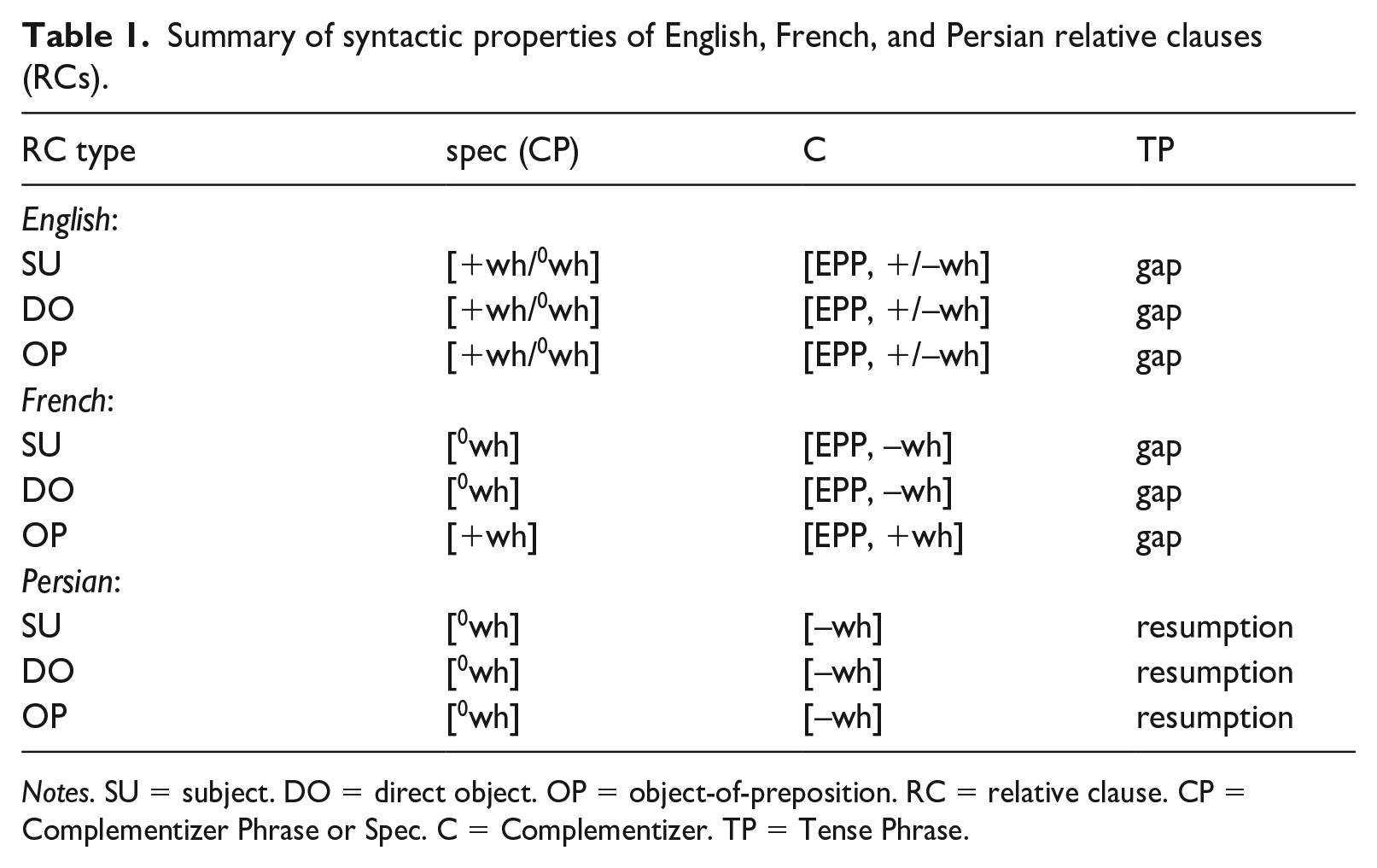
Notes. SU = subject. DO = direct object. OP = object-of-preposition. RC = relative clause. CP = Complementizer Phrase or Spec. C = Complementizer. TP = Tense Phrase.
The learning task for L1-French speakers does not consist of learning new features but ascertaining how these features are expressed in English. As for L1-Persian speakers, however, the learning task involves the acquisition of uninterpretable features of [EPP] and [wh] on C that motivate wh-movement, in addition to the pre-emption of an L1-based resumptive strategy that overtly spells out the TP agreement features in Persian.
III Previous research on L2 resumption
Many studies have been carried out to investigate the L2 acquisition of wh-structures and whether L2 grammars allow resumptive pronouns in languages where the only syntactically licit option is a gap strategy (Belikova and White, 2009; Hawkins and Chan, 1997; Lardiere, 2008; Tsimpli and Dimitrakopoulou, 2007). The results have suggested significant differences between L1 and adult L2 speakers, leading some to the conclusion that the uninterpretable features of resumptive pronouns are no longer accessible in adult L2 acquisition and resist resetting to appropriate L2 values (Tsimpli and Dimitrakopoulou, 2007). For example, Tsimpli and Dimitrakopoulou, (2007) administered a grammaticality judgment task to explore the acceptability of resumptive pronouns in L2-English wh-interrogatives by L1-Greek speakers. Unlike English, resumption represents a cluster of uninterpretable verbal agreement features in Greek wh-interrogatives and is obligatory in subject and optional in object positions. The materials consisted of structures of the type below (Tsimpli and Dimitrakopoulou, 2007: 227): (10) a. Who do you think that Jane likes ___ / *him? Object-extraction b. Who have you suggested ___ / *he should not resign? Subject-extraction
The participants included a group of native English speaker controls and two groups of L1-Greek L2-English speakers divided by proficiency: intermediate and advanced. The results showed that despite a clear development in the rejection of resumptive pronouns in the two learner groups, the rates of resumption acceptability in both subject and object extraction structures were significantly higher for the L2 participants than for the native English speaker control group. In addition, whereas the advanced group judged resumptive subject extraction structures significantly more acceptable (32.6%) than resumptive object extraction structures (21.4%), the intermediate speakers judged resumption almost equally acceptable in subject (38.3%) and object extraction sites (40.5%). Tsimpli and Dimitrakopoulou argued that resumption as a cluster of uninterpretable features is likely to cause learnability problems for L2 learners at even an advanced proficiency level, and L2 speakers are likely to transfer the status of resumptive pronouns from their L1 to L2. Tsimpli and Dimitrakopoulou conclude that their findings support the Interpretability Hypothesis, according to which the uninterpretable features of L1 resist resetting to L2 appropriate values due to critical period effects, and L2 speakers operate based on the uninterpretable features of their L1.
However, these results should be interpreted with caution. That the L2 speakers’ rate of resumption acceptability in Tsimpli and Dimitrakopoulou (2007) was higher than the native English speakers’ does not warrant the conclusion that the underlying grammatical representations are necessarily different. All of the materials by Tsimpli and Dimitrakopoulou (2007) involved double-embedded CPs, which are associated with an additional level of processing difficulty (Traxler et al., 2002). Therefore, it is possible that the observed reliance on resumption acceptability was motivated by processing limitations, and the L2 participants were not sufficiently advanced to behave like native speakers in terms of acceptability of resumptive RCs. Previous research suggests that given sufficient working memory capacity (WMC; Hopp, 2014), proficiency (Hopp, 2006), and linguistic exposure (Pliatsikas and Marinis, 2013), L2 speakers are likely to display native-like processing behaviour. In fact, in a replication of Tsimpli and Dimitrakopoulou (2007), Leal-Méndez and Slabakova (2014) showed that only those L2 speakers who were not sufficiently advanced in L2 English and who frequently accepted a resumptive pronoun in their L1 were likely to transfer an L1-based resumption strategy to L2 English. By contrast, those L2 speakers who enjoyed more than 6 years of immersion experience in an English-speaking country and who did not typically accept a resumptive over a gap strategy in their L1 were unlikely to accept a resumption strategy in L2 English.
In a similar vein as Tsimpli and Dimitrakopoulou (2007), Marefat, and Abdollahnejad (2014) investigated the status of resumptive pronouns in English L2 RCs by 4 different proficiency groups of L1-Persian speakers: elementary, low-intermediate, high-intermediate, and advanced. They administered a grammaticality judgment task on SU, DO, and OP RCs in English. As discussed in Section II, resumptives are ungrammatical in Persian SU, optional in DO, and obligatory in OP RCs. The results indicated a clear development by proficiency in rejecting resumptive RCs: Acceptability rates of resumptive pronouns were significantly lower among the advanced group (SU: 18%, DO: 28%, OP: 24%) than among the elementary group (SU: 65%, DO: 75%, OP: 64%). Additionally, the authors reported no statistically significant difference in SU RC resumption acceptability between the advanced group and the native speakers, whereas a significant difference was observed in the resumption acceptability of DO and OP RCs between the native and the advanced L2 speakers. Marefat and Abdollahnejad argued that their findings were compatible with the Interpretability Hypothesis, since they found no difference in resumption acceptability in SU RCs between advanced and native speakers, but the advanced speakers were more likely than native English speakers to accept resumptive pronouns in DO and OP RCs, mirroring the status of resumptives in L1 Persian.
However, these results should also be interpreted with caution. Marefat and Abdollahnejad reported an advantage for a gap over resumption for both the advanced L2 and the native English speakers. Both groups significantly preferred gapped over resumptive RCs, suggesting that the L2 participants’ occasional reliance on a resumptive strategy does not necessarily indicate syntactic deficits. The mere observation of L1–L2 performance differences does not necessarily justify the conclusion that the underlying grammars are fundamentally different (Dekydtspotter et al., 2006). L2 speakers might resort to a resumptive strategy to facilitate WM constraints (Hawkins, 2009), since inserting a resumptive pronoun in place of the relativized element enhances the availability of the extracted morpheme in WM by highlighting its morphosyntactic features (Lewis et al., 2006), and even native speakers of [–resumptive] languages sometimes use a resumptive strategy to lighten the processing burden on the underlying parsing system (Tezel, 1999). Early research on L2 acquisition of English RCs has shown that even L2-English speakers of [–resumption] L1 backgrounds might resort to a resumptive strategy to facilitate processing limitations (Gass, 1979; Tezel, 1999), and this is more likely to be observed in relatively complex syntactic environments such as OP and DO RCs than in SU RCs (Gibson, 1998). Thus, the relatively higher acceptability of resumption in DO and OP RCs is not necessarily informative as to the (in)accessibility of uninterpretable features in L2 acquisition. Given the hypothesis that L2 speakers are more susceptible to cognitive resource limitations than monolingual speakers (Hopp, 2014), L2 speakers are equally (if not more) likely to adopt a resumption strategy to reduce processing burden on the underlying parsing mechanism. This is especially true for those L2 speakers whose L1 allows resumption (Gass, 1979), suggesting that inserting a resumptive pronoun in RCs potentially reflects an L2 developmental stage in the acquisition of RCs regardless of L1, which may persist longer in L2ers whose L1 grammaticalizes resumption (Hitz, 2012).
Overall, the research motivating the Interpretability Hypothesis to date has focused on resumption acceptability, disregarding individual differences and confounding potential syntactic deficits and processing limitations. A more fruitful investigation of accessibility to uninterpretable features in L2-English RCs should involve an investigation of the potential role of individual differences in WM, proficiency, and immersion experience and concentrate not only on resumption but also on other morphosyntactic phenomena that are motivated by uninterpretable features (e.g. preference for different relativizer forms). In addition to resumptive pronouns, the distribution of relativizers (that, wh-pronouns) is motivated by uninterpretable features [EPP, wh] at C. An investigation of preference for the potential form of relativizer alongside resumption acceptability can help illuminate the degree to which uninterpretable features are accessible in L2 acquisition of English RCs.
IV The present study
The present study aims to bridge this gap by investigating the way speakers of L1-French and L1-Persian syntactically represent and process RCs in L2 English, specifically seeking answers to the following questions:
• Research question 1: Is there a difference between L1-French and L1-Persian speakers in terms of acceptability of resumptive pronouns in L2-English RCs?
• Research question 2: If there is evidence for an L1-based transfer of resumption to L2-English RCs, is this motivated by syntactic deficits or by processing limitations? To investigate this question, the following sub-questions were formed:
a. Is there a difference between L1-English, L1-French, and L1-Persian speakers in terms of acceptability of RCs with different relativizer forms (e.g. who relatives vs. that relatives) that are motivated by a [wh] feature?
b. Do L1-French and L1-Persian speakers show evidence of the acquisition of wh-movement operations in L2-English OP RCs motivated by an [EPP] feature?
c. Do individual differences in L2 proficiency, immersion experience, and WMC impact L2 speakers’ judgment of English RCs?
Research question 1 investigates whether L2 speakers of [+resumption] (e.g. Persian) L1s transfer a resumptive strategy from their L1 to L2, whereas the following questions help examine the potential source of such transfer. According to the Interpretability Hypothesis, unlike L1-French speakers, L1-Persian speakers should not only display relatively high acceptability of resumptive RCs in L2 English, but they should also be equally likely to display non-target-like behaviour with respect to different relativizer forms. Specifically, since Persian does not allow wh-pronouns as relativizers, L1-Persian speakers should favour that-relatives to wh-relatives, and resumption acceptability should be higher in that-relatives than in who-relatives. Similarly, previous studies have shown that the acquisition of wh-movement in English OP RCs is preceded by the base-generation stage of relativizer, where no movement is assumed to take place and L2 readers resist the presence of a stranded preposition at the end of OP RCs (the guy who I was talking to; Klein, 2001). As such, it was expected under the Interpretability Hypothesis that the rates of rejecting OP RCs based on the presence of an overt preposition would be higher for the L1-Persian than for the L1-French and L1-English groups (Lardiere, 2008). Lastly, according to the Interpretability Hypothesis, the source of non-target-like acceptability of ungrammatical RCs in L2 English is inaccessibility of uninterpretable features, and high proficiency, immersion experience and WMC do not compensate for syntactic deficits. However, if L2 and L1 resumption are similar phenomena that are motivated by processing limitations rather than syntactic deficits, highly advanced L2 speakers with long immersion experience and high WMC should display less non-target-like acceptability behaviour.
1 Method
a Participants
All the data for this study were collected online (for details, see below) from two groups of L2 learners of English: 52 French-speaking learners (mean age = 30 years, range = 19–42 years) and 71 Persian-speaking learners (mean age = 34 years, range = 18–59 years). In addition, 44 native English speakers (mean age = 34 years, range = 20–51 years) served as the control group. All the L1-French, L1-English, and 11 L1-Persian participants were recruited through Prolific (www.prolific.co). The remaining L1-Persian speakers were recruited through advertisements on social media. All of the participants were paid for their participation, reported having normal or corrected-to-normal vision, were residing in an English-speaking country at the time of the experiment, and were naive with respect to the purpose of the experiment. Table 2 provides a summary of the participants’ biographical information collected through a language history questionnaire, as well as the scores from individual differences tasks hypothesized to modulate the processing of resumptive RCs (for details, see the next section).
Participants’ biographical information and individual differences scores.
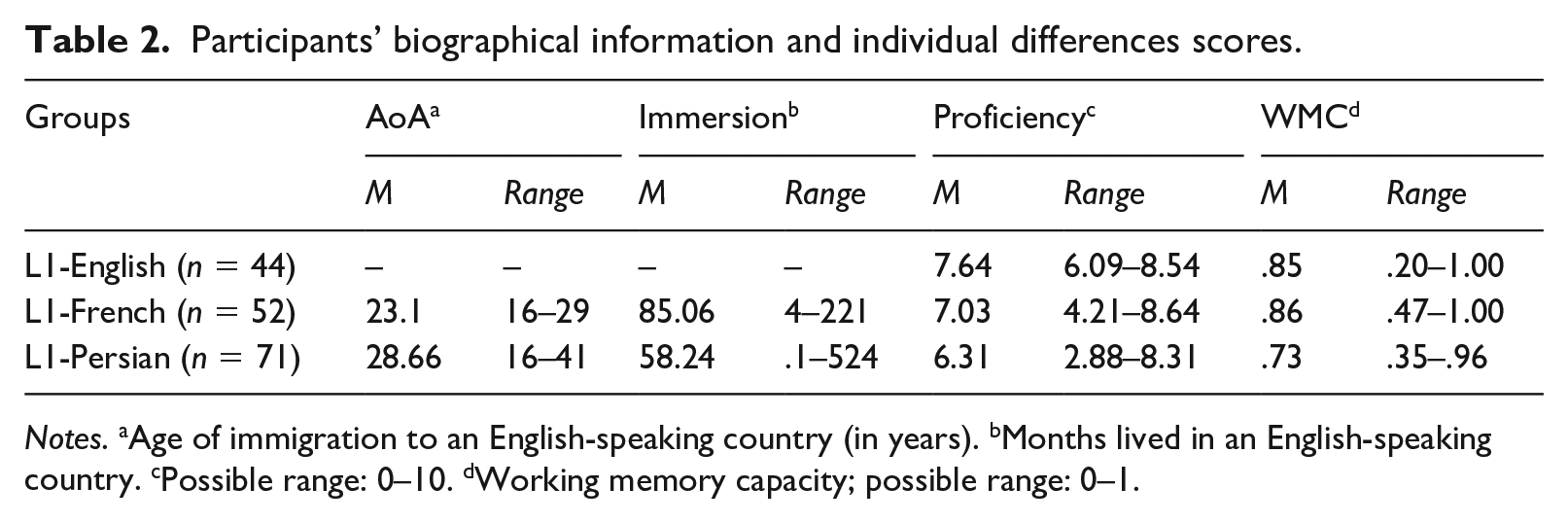
Notes. aAge of immigration to an English-speaking country (in years). bMonths lived in an English-speaking country. cPossible range: 0–10. dWorking memory capacity; possible range: 0–1.
b Pre-test: Proficiency: C-test
To determine the participants’ general proficiency level in English, all completed a c-test (Keijzer, 2007), where they were required to complete 5 mutilated passages (Cronbach’s alpha: .95). There was a reliable difference in proficiency among the three groups (F(2, 164) = 23.93, p < .001), and the L1-English group scored higher than the L1-French (β = .61, t(164) = 2.90, p = .01, d = .53) and the L1-Persian (β= 1.35, t(164) = 6.80, p < .001, d = 1.16) groups. Furthermore, the L1-French group was more advanced and had higher immersion experience than the L1-Persian speakers (proficiency: β = .73, t(164) = 3.89, p < .001, d = .71; immersion: β = 26. 29, t(121) = 2.03, p = .04, d = .37).
c Pre-test: Working memory: Reading span task
Following the procedure described in Conway et al. (2005), the participants were also required to complete a reading span task (Daneman and Carpenter, 1980) to yield a measure of their WMC. All the L1-French and L1-English participants attempted the reading span task. By contrast, only 23 L1-Persian readers completed this task, even though all completed the other tasks in this study. Overall, the Cronbach’s alpha for the reading span task was .90. There was a reliable difference in WMC among the three groups (F(2, 74) = 3.38, p = .04), and whereas the L1-English and the L1-French groups performed equivalently (t (74) = .25, p = .81), the L1-Persian speakers had (marginally) lower WMC than the L1-English (β = .12, t(74) = 2.28, p = .07, d = .73) and L1-French (β = .12, t(74) = 2.48, p = .04, d = .79) speakers.
2 Resumption acceptability: Grammaticality judgment
The main task involved a grammaticality judgment task (GJT) where the participants were required to provide judgments on gapped and resumptive RCs. The materials for this task comprised 42 experimental and 14 filler sentences. The RC structures always had [+human] heads relativized from the subject (14 RCs), direct object (14 RCs), and object-of-preposition positions (14 RCs). According to Gibson (1998), the number of discourse referents that intervene between the surface position of an extracted morpheme and its canonical position determines processing difficulty. Given that the relativized element must be carried unattached longer in OP and DO RCs compared to SU RCs, we therefore expected more processing difficulty in these constructions (Traxler et al., 2002).
Out of the 14 items per each RC type, 4 involved that and 10 who as the relativizer. Half of the experimental sentences were grammatical, and the other half were ungrammatical due to the presence of a resumptive pronoun. Ten lists were randomly constructed to reduce potential ordering effects, and participants were randomly assigned to one of the lists. The participants were required to judge the grammaticality of each sentence (grammatical, ungrammatical) and make the necessary corrections if they judged a sentence to be ungrammatical. The participants were required to judge the grammaticality of each sentence (grammatical, ungrammatical) and make the necessary corrections if they judged a sentence to be ungrammatical (for a full list of the sentences, see supplemental materials). The GJT used in this study was untimed, following current theory, which suggests non-target-like L2 performance on timed GJTs can be attributed to either inaccessibility of (uninterpretable) functional features or to processing constraints associated with the online parsing of timed GJT stimuli (McDonald, 2006). 2
The scores assigned to grammatical and ungrammatical judgments were coded as 1, .5, or 0. Regardless of grammaticality, all the items that were judged to be grammatical were coded as 1, indicating that the participants accepted the relativization strategy used. By contrast, items judged to be ungrammatical were coded as either 0 or .5. Those items that were rejected based on reasons unrelated to the experimental manipulations were coded as .5, since it is possible that the participants rejected the RCs due to an implicit recognition of the non-target-like relativization strategy used. By contrast, those items that were judged to be ungrammatical due to resumption or the form of relativizer were coded as 0, since the participants explicitly indicated that they did not accept the relativization strategy used. Items left blank were excluded from further analysis. A higher score on each item indicated relatively higher acceptability of the RCs (minimum: 0, maximum: 1).
3 Procedure
The data were collected online using the Qualtrics software, version (2020), and Ibex Farm (Zehr and Schwarz, 2018). The study was administered in two separate sessions, with approximately 5 days in between. Initially, all the participants were required to complete a language history questionnaire on Qualtrics, the proficiency c-test on Ibex Farm, and the GJT on Qualtrics. Subsequently, the highly advanced L2 speakers were invited to complete the reading span task (Daneman and Carpenter, 1980) on Ibex Farm to yield a measure of their WMC.
V Results
The data were analysed for the grammatical acceptability of each RC type, including the relativization strategy (gap, resumption), syntactic position of the relativized element (SU, DO, OP), and the preferred form of the relativizer used (that, who) as the within-groups factors and native language (L1-English, L1-French, L1-Persian) as the between-groups factor. Nested linear mixed effects models were constructed using the lmerTest package in R (Bates et al., 2015; Kunzetsova et al., 2017; R Core Team, 2020). The models were evaluated with the same random-effects structure and included by-subject and by-item adjustments to the intercept. No random slopes were included to avoid singularity issues (Vasishth et al., 2020). The analyses were constructed hierarchically, and the statistical models were compared using likelihood ratio tests to determine whether additional parameters significantly improved model fit. Treatment contrasts were set to allow comparisons across different levels of the categorical variables, with gap, SU RC, the invariant complementizer that, and L1-English as the reference levels for the relativization strategy, RC type, relativizer form, and native language, respectively. The c-test proficiency scores, reading span scores, and responses on immersion experience were standardized, and effect size estimates of Cohen’s d were calculated using R’s effectsize package (Ben-Shachar et al., 2020). The raw acceptability scores per each condition are shown in Table 3, with the possible range of 0 (completely unacceptable) to 1 (completely acceptable).
Acceptability per relativization strategy (gap, resumption), RC type (SU, DO, OP) and relativizer (that, who).
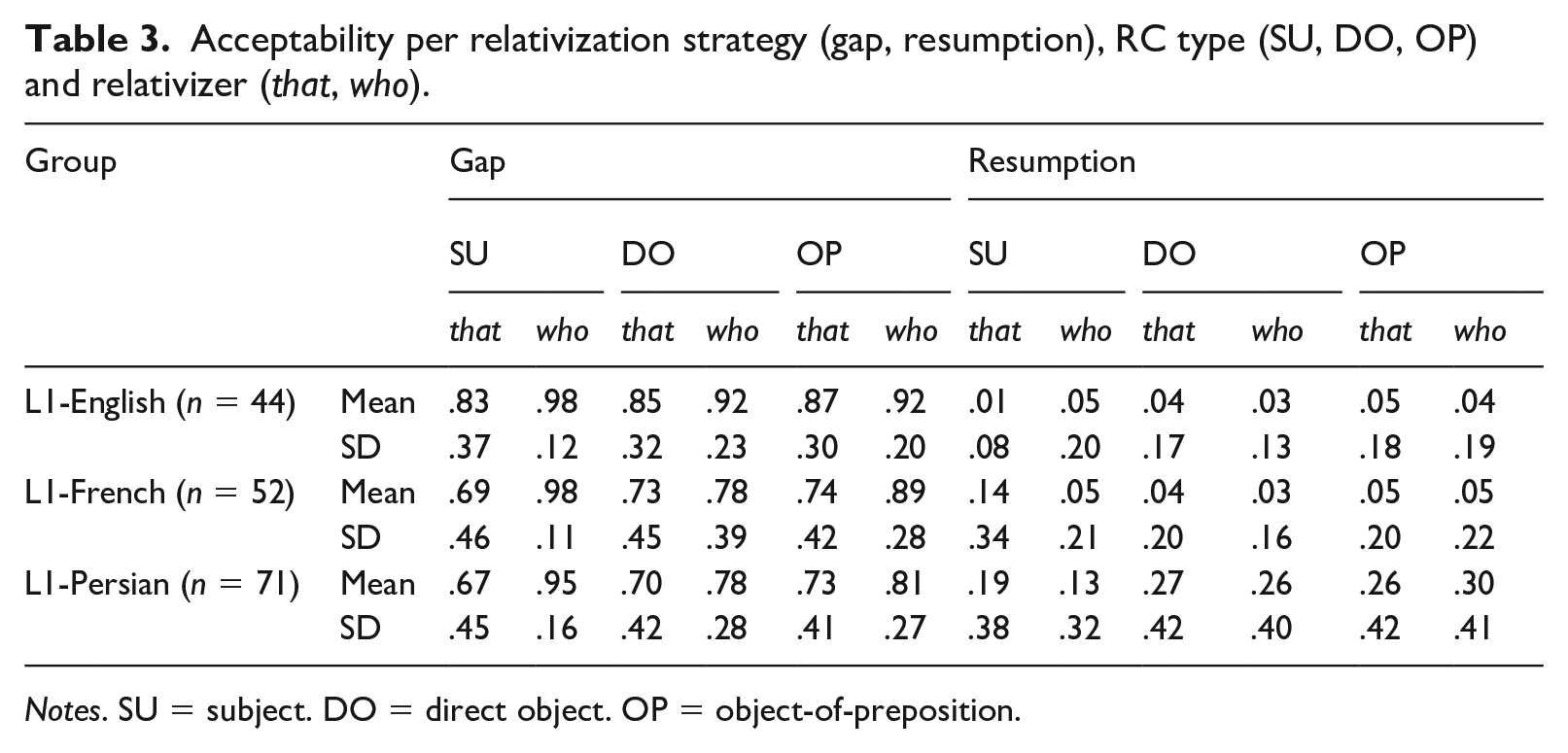
Notes. SU = subject. DO = direct object. OP = object-of-preposition.
Initially, between-groups comparisons were constructed to examine whether there was a reliable difference among the 3 groups in resumption acceptability (Section V.1). This was followed by within-groups comparisons to assess each group’s data more closely and explore potential interactions among resumption acceptability, RC types, and relativizer choice (Section V.2). Next, we examined the way the participants corrected resumptive OP RCs in those structures that were judged ungrammatical in order to assess potential evidence for the base-generation of the wh-morpheme (Section V.3). Finally, we sought to assess the hypothesis that resumption acceptability is moderated by individual differences in proficiency, immersion, and WMC (Section V.4; for full analysis and R code, see supplemental materials).
1 Between-groups comparisons
To address the hypothesis that the three L1 groups use different relativization strategy, two models were constructed: one with only the relativization strategy (gap, resumption) as the fixed factor and another with the relativization strategy and its interaction with native language. There was a main effect of relativization strategy (χ2(1) = 1159.8, p < .001) as well as an interaction between relativization strategy and native language (χ2(4) = 362.95, p < .001). Whereas no reliable difference in resumption acceptability was observed between L1-English and L1-French speakers (t (215) = .67., p = .98), L1-Persian speakers were more likely to accept resumptive RCs than L1-English (β = .19, t(215) = 8.28, p < .001, d = .68) and L1-French speakers (β = .17, t(215) = 7.94, p < .001, d = .62).
2 Within-groups comparisons
To further explore the potential factors that might impact resumption acceptability, a sequence of separate within-groups analyses was constructed on each group’s data to assess the potential interaction between resumption, RC type (SU, DO, OP) and relativizer form (that, who). All groups preferred gapped over resumptive RCs (L1-English: β = .87, χ2(1) = 1165.3, d = 1.80; L1-French: β = .78, χ2(1) = 846.79, d = 1.60; L1-Persian: β = .57, χ2(1) = 675.83, d = 1.25; all ps < .001). In addition, all groups showed a reliable interaction between the relativization strategy and the form of relativizer (L1-English: β2(2) = 27.01; L1-French: χ2(2) = 67.35; L1-Persian: χ2(2) = 59.95; all ps < .001), and found gapped RCs to be more acceptable with who than with that (L1-English: β = .09, t(392) = 5.26, d = .44; L1-French: β = .17, t(392) = 8.34, d = .33; L1-Persian: β = .15, t(392) = 7.91, d = .47; all ps < .001).
Furthermore, a significant interaction was observed between the relativization strategy and RC type both for the L1-French and L1-Persian groups (L1-French: χ2(4) = 34.5, p < .001; L1-Persian: χ2(4) = 64.97, p < .001). Specifically, the L1-French data showed little difference in acceptability between different resumptive RCs (all ts < 1.5), but gapped SU RCs were judged by the L1-French speakers to be more acceptable than gapped DO RCs (β = .14, t(393) = 5.73, p < .001, d = .51). In addition, gapped OP RCs were judged to be more acceptable than gapped DO RCs by the L1-French speakers (β = .08, t(395) = 3.42, p < .001, d = .31). As for the L1-Persian group, resumption was judged to be more acceptable in DO and OP than in SU RCs (DO: β = .11, t(407) = 4.95, p < .001, d = .11; OP: β = .14, t(414) = 6.07, p < .001, d = .65). In addition, gapped SU RCs were judged to be more acceptable than gapped DO (β = .12, t(425) = 5.23, p < .001, d = .12) and gapped OP RCs (β = .07, t(438) = 3.05, p = .03, d = .07). There were no other reliable effects (all ps > .32).
To summarize, the results showed that L1-Persian speakers were more likely than L1-French and English controls to accept resumptives in English RCs. However, other evidence seems to point to some striking commonalities among the different L1 groups: all three groups overwhelmingly preferred gaps over resumptives and displayed an identical pattern with respect to the interaction between the relativization strategy and the potential form of relativizer. Even though the only form of relativizer in Persian is an invariant complementizer, resumption acceptability in L1-Persian L2-English did not seem to be influenced by the potential form of the relativizer used. This is illustrated in Figure 1: whereas all three groups preferred the wh-operator who over the invariant complementizer that in grammatical RCs, there is not a reliable difference in acceptability between resumptive who and resumptive that RCs.
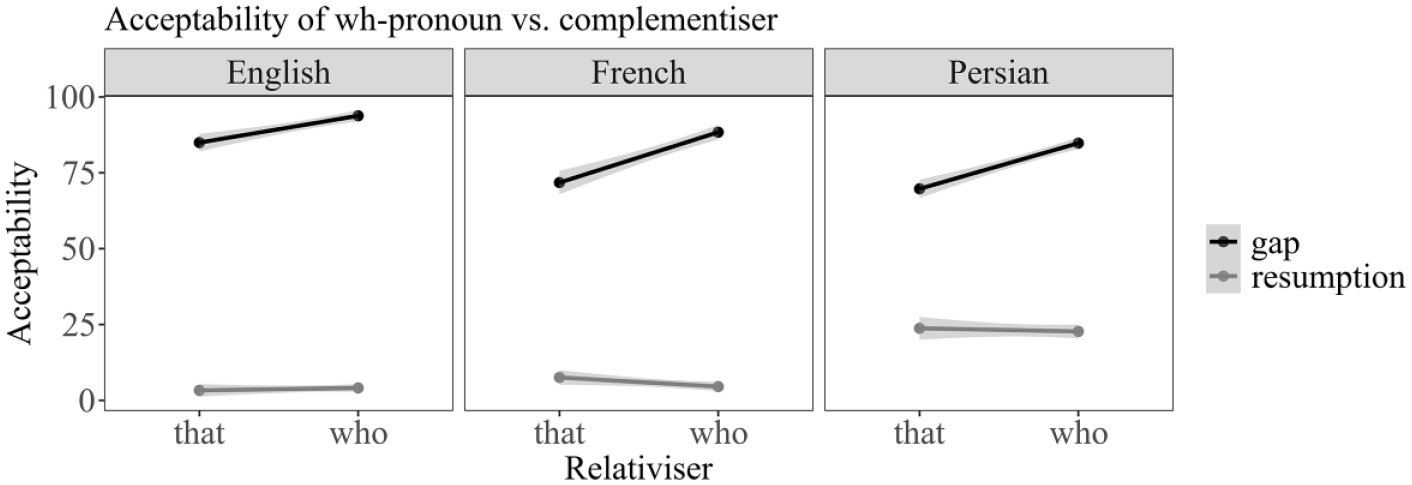
Relative clause (RC) acceptability in different groups.
3 Correction data on OP RCs: Evidence for wh-movement?
The above results suggest that both the L1-French and L1-Persian speakers did not reject who RCs and, similarly to native speakers, showed a reliable preference for gapped who over gapped that RCs. It remains unclear, however, if the above acceptability of who RCs reflects underlying wh-movement operations or signals the base-generation of the wh-morpheme who. Recall that while French is a wh-movement language that allows both wh-pronouns (in OP RCs) and invariant complementizers (in SU and DO RCs) to function as potential relativizers, Persian is a wh-in-situ language and does not allow RCs with wh-pronouns. An argument can be made that the above pattern does not necessarily indicate wh-movement, and the relativizer who is base-generated in the L2 grammar of the L1-Persian group in this study. That is, the L1-Persian speakers might have reset the null [wh0] of L1-Persian C to the [+wh] of L2-English without having to acquire the C [EPP] feature that motivated the movement of a wh-morpheme. In order to explore this possibility, we focused exclusively on OP RCs and the way different L1 groups attempted to correct those structures that were judged ungrammatical.
Given the assumption that preposition-stranding is not allowed in French and Persian OP RCs (Poletto and Sanfelici, 2017), we expected that L2 speakers who have not yet acquired wh-movement would face additional difficulty in correcting RCs with stranded prepositions. Previous evidence suggests that L2 speakers have a tendency to drop obligatory prepositions before acquiring wh-movement in L2-English RCs (Klein, 2001), and the observation of correction attempts to delete the stranded preposition is a sign for the base-generation of wh-operators (Lardiere, 2008). However, our data showed less than 3% of OP RCs were rejected based on the presence of the preposition (Persian: 2.82%, French: 1.61%, English: .03%). There was no significant interaction between the number of preposition deletion attempts and the native language of the participants (χ2(2) = 2.71, p = .26), supporting the conclusion that the reason for rejecting ungrammatical OP RCs was not the stranded preposition, despite the fact that both L1-French and L1-Persian disallow preposition stranding in OP RCs. Thus, little evidence was found that the wh-morpheme was base-generated.
4 Individual differences
Finally, focusing on individual differences in proficiency, WM, and immersion experience, the L2 data showed a significant interaction between proficiency and relativization strategy (L1-French: χ2(2) = 11.89, p < .005; L1-Persian: χ2 (2) = 102.24, p < .001), such that the more proficient L2 speakers were less likely to accept a resumptive strategy (L1-French: β = .03, t(1821) = 2.56, p = .01, d = .06; L1-Persian: β = .10, t(2819) = 9.93, p < .001, d = .26). As for WMC, the L1-English speakers showed a reliable interaction between WMC and resumption acceptability (χ2(2) = 7.02, p = .03), and higher WMC was associated with a significant reduction in acceptability of resumptive RCs for the L1-English speakers (β = .20, t(1252) = 2.65, p < .05, d = .06). However, the L2 speakers did not show a similar interaction (L1-French: χ2(2) = 1.52, p = .47; L1-Persian: χ2(2) = 2.72, p = .26). Furthermore, there was a marginal interaction between immersion and resumption acceptability both for L1-French and L1-Persian speakers (L1-French: χ2(2) = 4.61; L1-Persian: 4.60; both ps < .10). Those L2 speakers who had more immersion experience were less likely to accept resumptives in L2-English RCs (L1-French: t(2032) = 4.38, p = 06, d = .05; L1-Persian: t(2851) = 2.99, p = .04, d = .05). The correlation coefficient was weak between immersion and proficiency (r = .08, t(1885) = 3.40, p < .05) and moderate between WMC and proficiency (r = .28, t(3186) = 16.15, p < .001)
In summary, evidence suggests that higher proficiency and longer immersion experience helps L2ers of both L1-French and L1-Persian speakers approximate native English speakers in rejecting resumptive RCs. However, there was little evidence that L2 resumption acceptability interacted with WMC, even though the L1-English data suggested that high WMC is associated with low rates of acceptability of resumptive RCs.
VI Discussion
The purpose of the current study was to investigate whether native English speakers and L1-French and L1-Persian L2 learners of English accept syntactically ungrammatical resumptive pronouns in SU, DO, and OP RCs, and to examine if such potential non-target-like acceptability can be attributed to inaccessibility of uninterpretable features. The main results of the experiment can be summarized as follows:
Both the native and L2 speakers showed overwhelmingly higher acceptability of grammatical RCs with a gap than ungrammatical RCs with a resumptive pronoun.
Between-group comparisons showed little difference in resumption acceptability between L1-English and L1-French speakers, whereas L1-Persian speakers were more likely than the other groups to accept resumptive pronouns in English DO and OP RCs.
The pattern of acceptability rates for the preferred form of relativizer (that, who) was similar among the three groups: all preferred who over that in grammatical RCs, with little difference in acceptability observed between that and who in resumptive RCs.
L2 resumption acceptability was negatively correlated with L2 proficiency and immersion, with little effect of WMC.
Several studies on the processing of resumptive RCs have shown that L2 speakers are more likely than native speakers to accept resumption in English RCs. However, as resumption acceptability is closely related to cognitive resource limitations, results from these studies do not provide unequivocal evidence as to the difficulty in acquisition of the underlying uninterpretable morphosyntactic features. To eliminate this potential confounding factor, we explored the learnability of two sets of uninterpretable features, namely those that drive resumption (TP agreement features) and those that lead to wh-operator movement (EPP and wh). According to the Interpretability Hypothesis, both the pre-emption of an L1-based resumptive strategy and the acquisition of wh-movement in L2 English pose learnability issues to L2-English speakers (Tsimpli and Dimitrakopoulou, 2007) who do not have the same morphosyntactic phenomena in their L1. Therefore, under the Interpretability Hypothesis, the Persian readers should have different acceptability patterns compared to the native English and French groups, such that the Persian speakers should not only be more tolerant of resumptive RCs but also show non-target-like behaviour with respect to the choice of relativizer.
Comparing different groups’ acceptability rates on resumptive RCs and the preferred form of the relativizer, we found that L1-Persian speakers were more likely than L1-French and L1-English speakers to adopt a resumption strategy in English RCs, potentially reflecting the morphosyntactic properties of their native language. This was the pattern observed for DO and OP RCs, which (may) syntactically require a resumptive pronoun in the equivalent Persian structures. Thus, one hypothesis might be that L1-Persian speakers transfer their L1-based resumption strategy along with the corresponding uninterpretable features into L2-English RCs. However, other evidence collected in this study does not support this conclusion. DO and OP RCs are more complex than SU RCs (Keenan and Comrie, 1977) and, while it might seem plausible to assume an L1-based transfer account, it is equally likely that the L1-Persian speakers in this study resorted to a resumptive strategy to counter processing limitations in DO and OP RCs. The L1-Persian speakers in this study had lower proficiency scores than the L1-French and L1-English speakers and, as such, it is not all that surprising that the rate of resumption acceptability was higher among L1-Persians. This is compatible with previous studies suggesting the reduction of processing burden at an advanced proficiency level when reading complex syntactic structures such as relative clauses (Frenck-Mestre, 2002; Tezel, 1999). Similar explanations have been proposed with respect to the acceptability of resumptive pronouns in L1-English grammars (Hofmeister and Norcliffe, 2013) and, given the hypothesis that L2 speakers are more susceptible to cognitive resource limitations than monolingual speakers (Hopp, 2014), L2 speakers should be more likely to adopt a resumption strategy in DO and OP RCs. In fact, resumption acceptability in this study was negatively correlated with WMC for the L1-English speakers, thus supporting the hypothesis that resumption helps facilitate processing limitations. This argument is bolstered by the observation that the acceptability of resumption RCs in L2 English was negatively associated with proficiency and immersion experience, and those L2-English speakers that were highly proficient and lived for relatively long periods in an L2 environment were less likely to accept resumptives in L2-English RCs.
However, unlike the L1-English speakers, the L2 speakers in this study did not display a relationship between WMC and resumption acceptability. This might seem surprising under the hypothesis that L2 speakers are more susceptible to cognitive resource limitations than monolingual speakers (Hopp, 2014). We argue that a closer look at the L2 data might help explain the results. In this study, only the highly advanced L2 speakers were required to complete the reading span task, and thus the lack of a statistically significant interaction between resumption acceptability and WMC cannot be generalized to all L2 speakers and should be interpreted with caution. In fact, after trimming the WMC data to exclude participants with response accuracy below 70% (Conway et al., 2005), there remained only 14 L1-Persian speakers, in contrast to 32 L1-French and 31 L1-English speakers. While the analysis of the L1-Persian data still showed a (non-significant) negative relationship between resumption acceptability and WMC (□ = .12, t(506) = 1.04, p = .26), the high WMC individuals were less likely to accept resumptive RCs in L2 English. It might well be the case that the sample size was too small to reach statistical significance. In addition, since the reading span task used to assess WMC in this study was administered online, there was little control over the task procedure to stop the rehearsal of the to-be-remembered information. In fact, 38% of the native English readers, 39% of the L1-French readers, and 28% of the L1-Persian readers scored above 90% accuracy in retaining the to-be-remembered information, suggesting possible ceiling effects. It might well be the case that the WMC measure obtained from the reading span task in this study was not powerful enough to show a reliable contingency with resumptive acceptability. It should also be pointed out that the GJT in this study was untimed and allowed the L2 speakers sufficient time to make their grammaticality judgments. This might have helped the L2 speakers overcome real-time processing limitations, given that WM effects are more likely to appear under time constraints that require increased cognitive control (Hopp, 2014). Clearly, more research is required to investigate the relationship between WMC and resumption in L2 speakers.
The results of this study are not compatible with the Interpretability Hypothesis that questions L2 speakers’ ability to successfully acquire movement operations, since the L2 speakers showed a similar pattern of results with respect to the acceptability of different relativizer forms. Under the Interpretability Hypothesis, uninterpretable morphosyntactic features remain inaccessible and pose learnability issues in L2 acquisition, thus the impossibility of target-like performance in both resumption (motivated by agreement features) and preference for the relativizer form (motivated by EPP and wh features). Given that little difference was observed among the three groups in acceptability between that and who RCs, it seems reasonable to argue that the L2 speakers of both L1-French and L1-Persian backgrounds have access to uninterpretable features in the L2 acquisition of English RCs and were capable of successfully acquiring the respective morphosyntactic phenomena.
It is noteworthy, however, that an argument can be made that the Persian readers might have transferred wh-operators from wh-questions in Persian, as in example (9), when interpreting RCs with wh-pronouns in L2 English. Thus, the acceptability of who-relatives in the GJT might not necessarily suggest the same morphosyntactic representation in L1 and L2. However, we argue that this explanation does not successfully account for the pattern of acceptability observed for different relativizer types, that and who. Not only did the Persian readers accept wh-pronouns in English RCs, which is ungrammatical in Persian, but they also displayed the same differential acceptability pattern as the native English controls and L1-French readers: all groups preferred who in gapped RCs, yet no acceptability difference was observed between that and who in resumptive RCs.
Similarly, it might be argued that all the GJT materials in this study involved RCs with human referents, which might confound the interpretation of the observed native-like acceptability rates for the L2 speakers. In fact, in Tsimpli and Dimitrakopoulou’s (2007) study, animacy of pronoun had a significant effect. Advanced learners behaved native-like by rejecting resumptive [+animate] pronouns but were more tolerant in the case of [–animate] it, showing a strategy of conforming with the target language input in the case of semantically ‘heavy’ material which they rejected and allowing the less specified pronoun to appear in dependencies. It could be argued that the L1-Persian speakers have received positive evidence in the L2 environment that who-relatives are more frequent and semantically heavier for human referents than that-relatives, and managed to achieve native-likeness by resorting to the interpretable feature of [±human], not necessarily acquiring the uninterpretable [EPP, wh] features. We suggest that while this proposal can successfully explain the higher acceptability rates of who than that in grammatical gapped RCs, it falls short of adequately explaining the pattern of results observed in ungrammatical resumptive RCs. Resumption in Persian always appears with an invariant complementizer, and if L1-Persian speakers were operating based on their L1 uninterpretable features then that resumption RCs should have been favoured compared to who resumption RCs. However, similar to English and French speakers, L1-Persian speakers did not display a preference for either that or who in resumptive RCs, which remains unexplained under the Interpretability Hypothesis.
In addition, given that resumption is optional in Persian DO RCs, it is possible that the Persian readers may have perceived the empty element at the foot of the dependency as a null resumptives rather than a variable. However, this explanation falls short of accounting for the target-like acceptability pattern observed in OP RCs which, unlike DO RCs, require a resumptive pronoun to be grammatical in Persian. In our data, acceptability rates of resumptive RCs were very similar in both resumptive DO (Mean = .26; SD = .40) and OP RCs (Mean = .28; SD = .40). Nevertheless, future work should include other structures such as those violating islands to provide more direct evidence on whether the Persian learners have acquired movement (see, for example, Hawkins and Chan, 1997).
Overall, the results suggest that the L1-French speakers in this study have successfully acquired the wh-movement and the [–resumption] property of L2-English RCs. The L1-French speakers seemed to face little difficulty pre-empting the increased syntactic complexity of French RCs which restricts the distribution of relativizers. They seem to have acquired the [+wh] feature in SU and DO RCs, which allows English SU and DO RCs to begin with an overt wh-operator, unlike the case of relativizers in L1-French which allows only an invariant complementizer in SU and DO RCs. As for Persian speakers, the data seem to suggest that they do not face considerable difficulty with an overt wh-pronoun as the relativizer, and this is unlikely to be base generated. Thus, it seems reasonable to argue that the Persian readers have acquired both the wh-operator movement and the syntactic ban on resumptive pronouns in L2-English RCs, although this should be interpreted with caution. If it were the case that they were operating on L1-Persian uninterpretable features, they should have displayed higher acceptability rates for that RCs than for who RCs, since Persian does not allow wh-morphemes to function as relativizers. However, the results showed that not only did the L1-Persian speakers predominantly favour a gap over a resumptive strategy, they also showed a differential pattern of preference in grammatical RCs for the form of relativizer, displaying significantly higher acceptability rates for who . . . gap RCs than that . . . gap RCs, similar to native speakers. L1-Persian L2-English speakers’ occasional reliance on a resumptive strategy does not seem to be a syntactic issue but is potentially motivated by processing limitations, as per the observation that resumption acceptability interacted with proficiency and immersion experience. As L2 speakers become more proficient in the L2, they forgo resumption and approximate native-like grammars.
VII Conclusions
The results of this study lend support to the Full Access Hypothesis, according to which, L2 grammars have unconditioned access to the full inventory of the morphosyntactic features of the language faculty but may occasionally display L1-based residual effects in syntactically complex environments. Both the L1-French and L1-Persian speakers in this study behaved similar to the native English speakers by overwhelmingly preferring gaps to resumptives in English RCs and showing little evidence for an L1-based transfer of the distribution of relativizers. However, whereas it was only sufficient for the L1-French speakers to transfer their L1-based ban on resumptive RCs to L2 English, the residual impact of the [+resumption] property of L1-Persian led to higher acceptability of similar structures in L2-English RCs. This is not necessarily an indication of potential syntactic deficits but rather is observed in DO and OP RCs which are more syntactically complex than SU RCs. While more research is required to investigate the potential interrelationship in L2 acquisition between L1 transfer and universal cognitive resource limitations, the results of this study seem to suggest little evidence that L2 grammars are necessarily defective and thus do not support the Interpretability Hypothesis. Rather, we find that given sufficiently high proficiency levels and linguistic exposure, L2 grammars can potentially match L1 grammars in terms of the complexity of the underlying linguistic system. We argue that L1–L2 performance differences can be countered by increased proficiency and linguistic experience.
Supplemental Material
sj-docx-1-slr-10.1177_02676583231162783 – Supplemental material for Testing the Interpretability Hypothesis: Evidence from acceptability judgments of relative clauses by Persian and French learners of L2 English
Supplemental material, sj-docx-1-slr-10.1177_02676583231162783 for Testing the Interpretability Hypothesis: Evidence from acceptability judgments of relative clauses by Persian and French learners of L2 English by Ehsan Solaimani, Florence Myles and Laurel Lawyer in Second Language Research
Footnotes
Acknowledgements
The authors would like to thank the participants who took part in this study.
Declaration of Conflicting Interests
The authors declared no potential conflicts of interest with respect to the research, authorship, and/or publication of this article.
Funding
The authors disclosed receipt of the following financial support for the research, authorship, and/or publication of this article: The authors would like to express their gratitude to the University of Essex, Faculty of Social Sciences, and the Department of Language and Linguistics for their generous support in funding this project.

Supplemental material
Supplemental material for this article is available online.
Notes
References
Supplementary Material
Please find the following supplemental material available below.
For Open Access articles published under a Creative Commons License, all supplemental material carries the same license as the article it is associated with.
For non-Open Access articles published, all supplemental material carries a non-exclusive license, and permission requests for re-use of supplemental material or any part of supplemental material shall be sent directly to the copyright owner as specified in the copyright notice associated with the article.
