




Abstract
The construct of awareness plays a pivotal role in several big debates in the field of second language acquisition. It lies at the heart of discussions about the (im)possibility of learning without awareness, or conversely, whether some degree of awareness is a requirement for learning to take place. In this study, I propose a research agenda to further the interface issue, which addresses how awareness, or knowledge of which you are aware, may impact on second language (L2) learning. I argue progress can be made by assessing the development of learning over time and establishing when awareness emerges, and by making a clear distinction between uninstructed and instructed learning. The present study was designed to investigate if awareness would autonomously emerge in uninstructed learning and whether this was contingent on prior implicit learning. Visual world eye tracking was used to monitor learners on the fly as they were exposed to a fully unknown miniature language with a determiner system marking for distance and animacy. Twenty-six out of 39 participants remained fully unaware of the determiner system and showed no signs of learning throughout the exposure. The remaining 13 participants, however, showed clear signs of changed eye movement behavior prior to and post awareness. Thus, in as far as learning was observed, it coincided with the emergence of awareness.
I Introduction
The decision to learn a second language (L2) is arguably mostly a conscious decision. However, this does not necessarily mean that all pieces of knowledge of the L2 are also consciously and deliberately used. For example, learners may demonstrate knowledge of how adjectives are typically ordered in English in their use of the language (an expensive, silver ring), without knowing that adjectives of opinion generally come before adjectives of material or color. It would seem possible that such knowledge was never consciously learned, even though it is part of a learner’s knowledge of the L2, and instances such as these might lead one to conclude that learners are able to incorporate forms into their language system without being aware of them. In fact, the default position in both UG-based and usage-based approaches to (second) language acquisition is to see language acquisition as a process of implicit deduction or induction (Ortega, 2007; Schmidt, 2010).
Within the field of second language acquisition (SLA), the role of awareness has been debated and questioned as part of the interface issue, the issue of how awareness, or (explicit) knowledge of which you are aware, impacts on the process of becoming a proficient user of the L2 (Andringa and Rebuschat, 2015; NC Ellis, 2005, 2015; R Ellis, 2009; Hulstijn and Ellis, 2005; Hulstijn, 2015; Rebuschat, 2015; Williams, 2016). There is no question (in SLA at least) that learners may be aware of linguistic form, but positions have ranged from viewing such awareness as entirely inconsequential for L2 acquisition (e.g. Krashen, 1982, 1994) to viewing awareness of form as a necessary step in L2 learning (e.g. Bialystok, 1994; DeKeyser, 1998, 2007; Schmidt, 1990, 2001). Intermediate positions have also been proposed, which effectively hold that awareness may facilitate the learning process for certain aspects of the L2 (NC Ellis, 2005, 2015; R Ellis, 1994, 2005). There have been surprisingly few studies designed specifically to address the interface issue (Williams, 2016). In essence, the interface issue is about the power of implicit learning: Could L2 learning be fully implicit, and is proficiency in the L2 fully resided in implicitly acquired knowledge? Or does awareness, or knowledge of which you are aware, somehow impact on the SLA process? In the remainder of this introduction, I will appraise interface proposals in the light of recent cognitive psychological theories of awareness and propose a research agenda for moving the interface issue forward.
1 Awareness in cognitive psychology
Implicit learning concerns the establishment of representations that may affect behavior and decision making without the presence of awareness. The very existence of implicit learning has been debated quite extensively in SLA (e.g. Hama and Leow, 2010; Leow, 2000; Leung and Williams, 2011; Williams, 2005). Many cognitive psychologists would argue that knowledge can be unconsciously acquired and that unconscious learning and decision making can be quite powerful (Cleeremans, 2011; Dehaene et al., 2017). Dehaene, for example, claims we tend to underestimate the power of implicit processes in human cognition precisely because we are not aware of them; human behavior is continuously shaped by parallel running, unconscious and automatic processes of visual recognition, speech recognition and processing, inhibitory processes, etc. Awareness is what provides control over behavior, and generally several dimensions of awareness are distinguished. Researchers have made a distinction between what has been called ‘phenomenal awareness’ and ‘access awareness’ (Cleeremans, 2007). Access awareness refers to a state of awareness that is required for channeling the streams of unconsciously processed information; it is needed to overcome the temporal constraints imposed on implicit representations by globally sharing the information, and is seen as necessary for selecting information for further processing and guiding behavior that requires more controlled and adaptive behavior (Cleeremans, 2011; Dehaene et al., 2017). Phenomenal awareness is roughly equivalent to subjective experience. This is short-lived and does not necessarily involve metacognition (Lamme, 2003). Metacognition is yet another dimension of awareness and refers to our capacity to monitor our own behavior and reflect on it and on its consequences (Dehaene et al., 2017).
Awareness is often viewed as arising from implicitly acquired knowledge (Cleeremans, 2007, 2011; Dienes and Perner, 1999; Haider and Frensch, 2005). Cleeremans (2007), for example, sees awareness as essentially the product of the brain learning about its own unconsciously accrued representations, which is a result of information processing and implicit knowledge acquisition. For information to become accessible to awareness, it needs to have been acquired to a certain level of stability and quality, and Cleeremans emphasizes the time-consuming nature of this process. Awareness offers higher levels of control over behavior and its occurrence is typically triggered by a need for more control. However, the need for the involvement of awareness in information processing reduces as representations gain further strength and processing becomes more automatic (Cleeremans, 2007). Thus, the involvement for awareness arises as learners need more control over behavior, and reduces when this behavior becomes more automatic.
Important lessons to be learned from cognitive psychology thus seem to be that we shouldn’t underestimate the potency of implicit learning processes, that the involvement of awareness in behavior is variable, depending on the degree of control that is required, which in turn is related to the degree that behavior is automatized, and finally that awareness may be contingent upon a certain level of implicit learning. Many of these ideas are visible in the interface positions that have been proposed in the SLA literature.
2 The role of awareness in L2 development
The emphasis on the power of implicit processing is most visible in NC Ellis’s Associative-Cognitive CREED approach to the interface issue (e.g. 1994, 2005, 2015). Within the field of SLA, NC Ellis was among the first to define implicit learning as essentially a frequency-driven, statistical process of tallying the occurrence and co-occurrence of linguistic phenomena. Researchers have increasingly turned to statistical learning as the mechanism that constitutes implicit learning (e.g. Rebuschat and Williams, 2012; Rebuschat, 2015). NC Ellis himself has also been quite clear about the implicit nature of statistical learning: ‘We never consciously compute the relative frequencies of units of language’ (NC Ellis, 2015: 6). However, Ellis also imposed limits on the power of implicit learning and claimed that some degree of awareness may be required for committing certain forms that are difficult to detect in the input to memory. He argued that implicit learning processes may be hindered particularly by learned attention phenomena, which means that implicit learning of some linguistic structures may be blocked because they are overshadowed by other more salient cues or by first language processing routines transferred to the L2. In such cases, explicit information about how the L2 works may be indispensable to direct learners to cues in the input that might otherwise remain impervious to implicit learning processes (NC Ellis, 2015). In as far as interface phenomena have been researched in SLA, they have mostly been studied within the learned attention framework, and such studies have offered clear support for blocking effects and the effectiveness of explicit information to overcome them (e.g. Cintrón-Valentín and Ellis, 2015; Ellis and Sagarra, 2010; NC Ellis et al., 2014).
In NC Ellis’s interface account, implicit learning processes are strongly constrained by what the learner already knows from the first language (L1). Others have imposed greater limitations on the power of implicit learning. Schmidt proposed that L2 learning necessarily requires some degree of awareness; surface forms need to be consciously attended to for them to be learned (e.g. 1990, 2001, 2010). Higher levels of awareness, such as understanding or recognizing that the attended form is an instantiation of a particular pattern or rule, would not be necessary, even though it would probably be facilitative (2010). The notion that attention is required for learning has received wide recognition and empirical support (e.g. Godfroid et al., 2013; Godfroid and Schmidtke, 2013; Smith, 2012), and the noticing hypothesis has been referenced widely in support of more explicit focus on the formal features of the L2 (e.g. Leow, 2007). DeKeyser has also attributed an important role to awareness in learning (DeKeyser, 1998, 2007). His skill acquisition approach emphasizes automatization and proposes that linguistic knowledge initially typically takes a declarative form. Declarative knowledge is factual information about how something is done and is thus similar to explicit knowledge. According to DeKeyser (2007), such knowledge is often instantiated through teaching, although he acknowledged it may emerge upon a learner’s interaction with L2 input. Declarative knowledge needs to be converted into a procedural routine by acting on the knowledge or by applying it in controlled situations of use, which can occur quickly and easily. Procedural knowledge then needs to be automatized through practice, which is a gradual and time-consuming process of learning to use the language accurately and effortlessly. There has not been systematic effort in L2 research to falsify the claims of skill acquisition (e.g. DeKeyser, 1997; Robinson, 1997), although the effects of L2 practice have been studied and demonstrated quite extensively (e.g. Sato and McDonough, 2019)
Cognitive psychologists argue that awareness may arise from implicitly accrued knowledge. This idea has not been entertained very explicitly in the SLA (but see Hamrick, 2013). It’s probably most visible in Bialystok’s (1994, 2011) interface ideas. In a nutshell, she argued that learners tend to begin with unanalysed knowledge. In her view, language learning requires learners to develop awareness of the structure of language through analysis that leads them to develop grammatical sensitivity: ‘Indeed, increasing explicitness can almost serve as a definition for what we mean by “learning” ’ (1994: p. 567). There are indications that awareness could indeed be the product of implicit learning. The most important indication is probably that implicit learning effects are generally small (Leow, 2015). Kerz et al. (2017) and Williams (2005), for example, report approximately 60% accuracy rates by unaware participants against 50% chance. Accuracy rates were much higher (approximately 90%) for those learners who became aware. This is rather typical of implicit learning studies: they do not provide evidence that implicit learning leads to fully developed knowledge. Other indications are studies that suggest a strong link between learning and awareness (Curcic et al., 2019) or the absence of transfer of implicit learning effects into oral production (Godfroid, 2016). Such findings suggest that implicit learning exists, but may not suffice for at least some aspects of the L2 to be learned fully. However, they do not offer conclusive evidence on whether awareness follows from implicitly acquired knowledge; this would require research designs that chart the role of awareness in learning over time.
If awareness follows from implicit learning, then it would seem important to understand whether awareness is necessary for each and every aspect of the L2 to be learned. NC Ellis linked awareness to previous experience (2015). However, other factors might play a role as well. Williams (2016) provides an in depth treatment of the power of implicit learning and concludes that there is indeed evidence for a wide array of linguistic phenomena that can be learned via contingency learning. However, there are also seem to be limitations: Williams points out that it appears more difficult to learn long distance dependencies and more abstract grammatical categories, and suggests that some degree of attention may be necessary for such aspects to be acquired (Williams, 2016). It is important to note, though, that this conclusion does not have to disagree with NC Ellis’s account (2015), as it is not clear how the target structures in the studies reviewed by Williams relate to previous experience of the participants in those studies.
Cognitive psychology emphasizes that involvement of awareness is variable in the course of the learning process and suggests this depends on a sufficient level of stability and on the need to gain and exercise control over behavior. Behavior would be based on implicit processes in early stages of acquisition, but also in late stages when it has become automatized. DeKeyser’s (2007) skill acquisition approach and its emphasis on automatization via controlled practice probably reflects these ideas most closely. In recent studies, DeKeyser and colleagues have provided evidence for the changing nature of L2 knowledge and built a case for the existence of automated explicit knowledge as a stage existing prior to fully automatized implicit knowledge (Suzuki, 2017; Suzuki and DeKeyser, 2015). In a different way, R Ellis has also addressed this concern. He suggested that awareness is variably involved in different linguistic tasks, and he has devoted much energy to the operationalization of measures of explicit and implicit knowledge as a necessary first step to be taken for studying interface phenomena (2004, 2005). Through a range of studies, R Ellis and others identified a number of features, most notably time-pressure, grammaticality, focus of attention, and the degree to which tasks require verbalization of knowledge: that determine the extent to which tasks draw on implicit or explicit knowledge (e.g. R Ellis, 2005; Godfroid et al., 2015).
When considering the interface issue in the light of cognitive psychological theories, it is important to keep in mind that the latter do not consider instruction, while interface proposals in SLA have often been motivated to understand how instruction might affect learning processes. Indeed, the often reported finding that explicit instruction generally leads to larger learning effects (e.g. Goo et al., 2015; Spada and Tomita, 2010) has often been construed as support for theories that argue that making learners aware of form positively affects language development. However, as Andringa et al. (2011) point out, form-focused instruction studies were mostly not designed to address the interface issue, and don’t exercise the kind of control that is required for this. A problem in form-focused instruction studies, for example, is the use of measures that are biased against implicit knowledge (Norris and Ortega, 2000). However, using such measures will not necessarily lead to answers if they are used to measure the product of learning only. Leow et al. (2011) have usefully distinguished between the construction and the reconstruction phase, where the former refers to moments of knowledge encoding, while the latter refers to moments of retrieving stored knowledge. Their point was that establishing absence of awareness at reconstruction does not imply absence of awareness at construction. Thus, classical pretest-treatment-posttest designs may not be sufficient to further the interface issue, because they don’t chart the relationship between learning and awareness over time.
From this discussion, a research agenda emerges for moving the interface issue in SLA forward. A better understanding is needed of awareness throughout the L2 learning process and there should be a distinction between uninstructed and instructed learning. In uninstructed learning, investigations should focus on the extent to which awareness and declarative knowledge may be contingent on prior implicit learning and to what extent such awareness is a necessity for learners to advance to higher levels of proficiency (Cleeremans, 2007, 2011; Dienes and Perner, 1999; Haider and Frensch, 2005; Hamrick, 2013). Such studies should also investigate why and when awareness emerges: it should look at which features of the input are conducive to awareness and learning. In instructed learning, instruction may make learners aware of the forms of the L2 without prior implicit learning having taken place. Whether and when this is effective, is an empirical question of its own right (Leow et al., 2011). An important goal should be to investigate if explicit information may effectively bypass the implicit acquisition processes that would normally lead to representations that learners can autonomously become aware of, as is implied by DeKeyser’s (2007) skill acquisition theory. It would need to address timing of instruction in relation to implicit learning processes. In addition, the message to be taken from NC Ellis (2015) and Williams (2016) is that such research should be done in relation to the nature of the structure that is learned and how that structure relates to the L1.
II The current study
Advancing the research agenda sketched above would require charting the learning process, identifying moments of awareness in that process, and establishing if and how learning is affected by the occurrence of awareness. This requires monitoring learning using procedures that do not trigger awareness. While several new methods have been proposed for establishing the implicit nature of acquired knowledge (e.g. Andringa and Curcic, 2015; Godfroid, 2016; Suzuki and DeKeyser, 2015), none of these have yet been used to gauge the learning process, and it is unclear to what extent they can be. This was attempted in the present study. One group of learners was exposed to a miniature language based on Esperanto that included the determiner system that was used in Williams (2005). Visual world eye tracking was used because it offered the possibility of assessing the learning process as it happens; it does not rely on ungrammatical items to assess what learners know, which would negatively affect learning and might trigger awareness. For the same reasons, retrospective verbal report – rather than concurrent methods (see Rebuschat, 2013) – was used to determine whether learners became aware of the target structure and when they became aware. The following research questions were explored:
Do learners autonomously develop awareness for the target structure?
To what extent is learning associated with awareness? and
Is there evidence that awareness is contingent upon implicit learning prior to the point at which it occurs?
And, finally, an important goal was to investigate the viability of the proposed method for researching issues about the role of awareness in SLA.
III Method
1 Participants
In total, 39 students were recruited to participate, all native speakers of Dutch. Six participants identified as male; thirty-two identified as female, and one as neither. Their ages ranged from 18 to 28, and their mean age was 23. They were recruited through flyers and posters posted at several university buildings, and they were enrolled in diverse educational programmes, such as economics, medicine, biology, and psychology. Nine participants were enrolled in the first or the second year of one of the university’s language programmes, such English or Dutch. Three participants identified as bilingual. The study procedures, information leaflets and consent forms were approved by the research ethics committee, and all participants consented to participation and received ten euros in reward.
2 The target structure and the target language
The miniature language participants had to learn was based on Esperanto. It included the target structure adopted by Williams (2005). Following this structure, nouns were marked for distance and animacy, depending on whether the object is near or far and animate or inanimate. The determiners ‘gitene’ and ‘ultene’ marked near and far animate objects, respectively, while ‘rotene’ and ‘netene’ marked near and far inanimate objects. The ‘-tene’ morpheme was added to Williams’ (2005) system to lengthen the determiner, thus allowing more time for determiner-cued eye movements. While being exposed to the target language auditorily, eye-tracking was used to monitor whether learners would become sensitive to this system, as shown in their anticipatory eye movements (see below). The language consisted of 18 Esperanto-based nouns that were very easy to learn for Dutch speakers, to minimize the possibility that target structure learning would be hindered by noun learning difficulties. Eight nouns were cognates in that they were phonologically very similar to their Dutch translations. Five nouns were similar to English or French nouns, languages that most participants speak. Three nouns were related to Greek or Italian, languages that our participants mostly didn’t speak. Two nouns were unrelated to any language participants might know. Finally, the language had a carrier phrase that was identical in all trials: ‘tio estas’, meaning something like ‘this is’. Thus, participants would continuously hear sentences like: ‘tio estas gitene cato’, meaning ‘this is the cat’. All nouns and the images to represent them can be found in the supplementary file (Andringa, 2020).
3 Experimental task, experimental conditions and target language exposure
Participants were asked to learn the target structure in a picture matching task, during which their eye movement behavior was recorded. In every trial, participants would first see two objects in a visual scene. Then they heard a sentence as described above. Participants simply had to click on the corresponding object by pressing ‘z’ or ‘m’ on a keyboard, corresponding to the object on the left or right side of the screen. There was always a correct answer and there were no ungrammatical sentences. Therefore, every item was informative about a participant’s knowledge of the target language. This enabled us to chart learning during the exposure. Participants were told they were participating in a study about automatization of linguistic knowledge. They were instructed to try to learn the language as well as they could and to try to respond as fast as they could. After each block, they received feedback on how accurately (percentage correct) and how quickly (response time in milliseconds) they had responded in the previous block and they were invited to try to improve themselves in the next block. Participants were seated behind a computer screen at approximately 60 cm distance in a sound insulated booth.
A total of 288 trials was divided into seven blocks for the purpose of analysis (each block could be independently analysed) and to help identify moments of insight during the exposure (see debriefing). The first block consisted of 72 trials. The six remaining blocks consisted of 36 trials, which was considered the minimum number of trials needed to determine whether participants were able to use determiners predictively within that block. The materials were constructed according to the experimental conditions listed in Table 1. There were four experimental trials for animacy (one for each determiner), four experimental trials for distance, and four control trials. Thus, the first block consisted of 24 trials of each type, while the next blocks consisted of twelve trials of each type.
The experimental conditions.
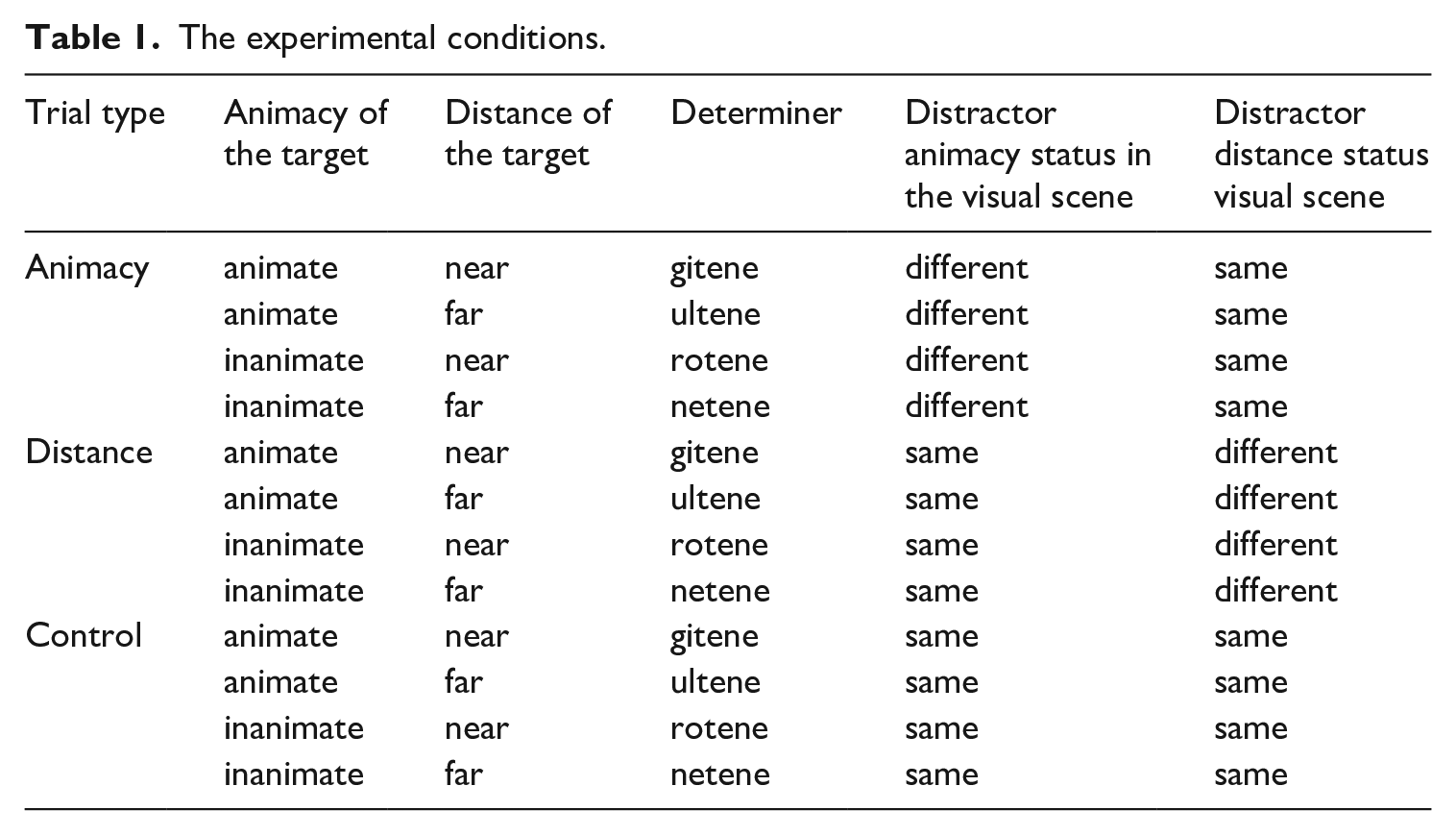
For the experimental animacy and distance trials, participants would be able to predict which object would be referred to in the sentence based on the animacy or distance contrast of the objects in the visual scene. In animacy trials participants always saw an animate and an inanimate object together, both near or far. Thus, if they saw a cat and a bicycle in the scene and heard: ‘tio estas gitene cato’, they might look at the cat upon hearing ‘gitene’ if they had become sensitive to the target structure. In distance trials, the animacy status would always be the same, but the distance would be contrasted. In control trials, prediction was impossible because neither animacy nor distance were contrasted. Evidence of learning would be provided by contrasting experimental and control items. If participants looked at the correct image earlier on experimental trials in comparison to control trials, this would mean they had incorporated knowledge of the animacy or distance contrast.
Each of the 18 objects appeared as target object 16 times over the entire experiment; four times in the first block, and twice in all subsequent blocks. In each block, every object appeared equally often with each (animate or inanimate) determiner. The images representing these objects were created for the purpose of this experiment. All objects were colorless and were presented within a landscape to create the illusion of distance (see Figure 1). To further strengthen the sense of distance, far objects were presented approximately two times smaller than near objects; this varied slightly per object. Far objects were also positioned just before the horizon towards the top of the screen, while near objects were presented near the bottom to suggest close proximity. Objects were presented on the left or right and were oriented towards the center of the screen. Four broad (invisible) areas of interest of equal size were defined to compensate for the varying sizes and dimensions of the objects presented.
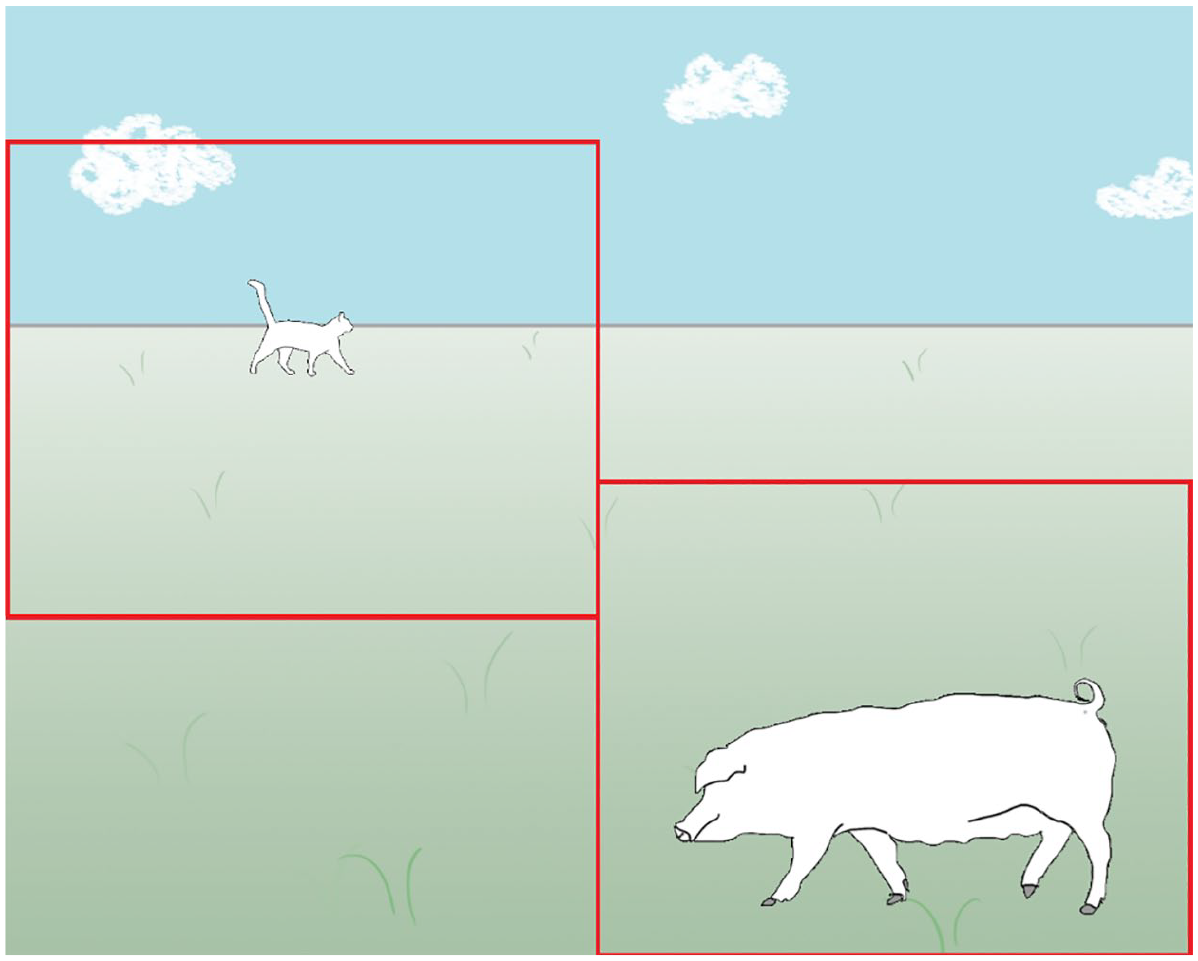
Screenshot of the visual scene with areas of interest superimposed.
A fixed, semi-randomized order of trial presentation was used. In the first block, the presentation order was manipulated to make learning the nouns easier. In particular, the first 20 trials were limited to ten different nouns, six of which were cognate nouns. In the following 52 trials, all nouns were randomly presented, but all new nouns were first presented with one of the ten initial nouns as distractor. In the subsequent blocks, trials were randomized within each block. Throughout the experiment, the same noun was always presented with at least three other trials in between. In the first block, 97% of the trials were already correctly responded to, which confirms participants had no problems learning the words. The target image was presented left and right equally often. For each trial, however, the presentation side was assigned randomly; as a result, some nouns were unevenly presented on the left or right side. In the most extreme case, one noun was presented 11 times on the left and 5 times on the right. Left and right presentation was also not balanced within blocks; in the most extreme case the target was presented left 14 times and right 22 times.
There was a break between every block. In the six breaks, participants were given tasks that were intended to serve as mnemonic aids, to help learners to remember and verbalize if and when awareness occurred during the retrospective debriefing, that took place after the experiment. The following break activities were used, in this order: (1) watch a video clip; (2) draw a mandala; (3) play a videogame; (4) watch another video clip; (5) make a connect-the-dots drawing; (6) play another video game. Two different video clips and video games were used. Each activity took about five minutes. The camera was recalibrated after every break.
All sentences were compiled from a set of recorded carrier phrases, determiners, and nouns. Several instances were recorded of the carrier phrase, each determiner and each noun. For the determiners, the four or five longest instances of each were selected. In the final selection, determiners varied between 780 and 830 milliseconds in length. These were then randomly combined with the selected carrier phrases (six versions) and the selected nouns (four to five for each), which were both allowed to vary in length. Thus, while there were no more than 36 different sentences (18 nouns combined with two different articles), each sentence was unique. This was done to give the language a more natural feel. The materials were recorded by a female native speaker of Serbian to make the language sound foreign to Dutch native speakers. To obtain fairly natural intonation contours, all materials were recorded within the context of a full sentence. The speaker was asked to pause briefly before and after the article, to be able to cut out the required elements.
4 Debriefing
Participants were debriefed once, after the experiment. This was done according to a fixed protocol, by which participants were gradually probed about the language they learned and the things they noticed about that language. Participants were asked (1) if they felt the task was difficult, (2) if they knew all of the words, (3) if they felt they knew everything about the language; (4) if they waited till the end of the sentence to make their choice; (5) if they tried to predict the choice and if so, on what basis. Then they were presented with example trials, first grammatical trials, then ungrammatical trials. We read a sentence and asked them to choose the correct image, and to tell us why they chose that image. If they would still not mention animacy or distance, we would explicitly ask if they had noticed anything about animacy or distance. If participants still said no, they would be classified as unaware. If participants did mention animacy and/or distance, they would be probed separately for animacy and distance. They were asked (1) what they knew about distance; (2) whether they noticed whether the determiner expressed animacy or distance, (3) when they noticed this; and (4) and whether they used this knowledge in making a choice.
On the basis of this protocol, all experimental trials were coded for participants’ awareness status. Four levels were distinguished, indicating whether they were unaware of the target structure, close to becoming aware, becoming aware, or aware. Awareness status was coded as ‘emerging awareness’ for all trials within the block in which participants reportedly became aware. All trials following this block were coded as ‘aware’. The trials in the block immediately prior to the block in which awareness emerged were coded as ‘immediately prior’. All other trials prior to the emerging awareness block were coded as ‘unaware’. The immediately prior category was included as this might be were signs of implicit learning might become manifest. For some analyses, ‘immediately prior’ and ‘unaware’ were taken together.
5 Analysis procedures
Participants’ eye movements were recorded with a Tobii TX120 eye tracker while they were learning the miniature language. It sampled participants’ eye position every 8.3 milliseconds. The time frame capturing the onset of the determiner from the offset of the noun (roughly, as nouns were unequal in duration) was selected for analysis. Determiner onset corresponds to zero and there was no correction for the time it generally takes to launch saccadic eye movements. Depending on where participants were looking, each sampling frame was coded as ‘correct’ for looks on the target image, ‘incorrect’ for looks on the distractor image, ‘irrelevant’ when neither was looked at, or ‘missing’ in case of track loss (for example, due to blinking or looks outside the screen). Missing and irrelevant sampling frames were excluded from the analyses. Also, trials that suffered more than 50% track loss were excluded from the analysis. This lead to the exclusion of 14% of the trials. After these trials were excluded, mean track loss within trials was 10.5% (SD = 6.5%).
Cluster-based permutation analysis (Maris and Oostenveld, 2007) was used to identify time clusters in which participants were significantly more likely to look at either same or different object trials (recall that only different object trials allow for prediction). I tested the expectation that learners would become sensitive to the predictive value of the determiners over time, which should be visible in differentiated behavior in same and different object trials. Cluster-based permutation analysis involves two steps. In the first step, t-tests on separate time bins are run to identify differences between same and different object trials in the proportion of looks towards the target image. For the analyses below, I opted for 50-ms time bins (equaling 6 sampling frames). The first step leads to the identification of time bins or clusters of time bins in which eye movement behavior on same and different trials is suspected to be different. Because this procedure is sensitive to false alarms (Maris and Oostenveld, 2007), this procedure is repeated many times in the second step on randomly shuffled data (probabilities were based on 2,500 reiterations) to calculate the probability that the observed clusters are chance occurrences. Clusters with probabilities larger than .05 are considered chance occurrences. Between and within group differences eye movement behavior on same and different object trials and awareness were investigated by first calculated the average difference between same and different trials per time bin for unaware and aware participants, or pre and post awareness. A difference score close to zero expresses that participants are equally likely to look at same and different picture trials, while a positive value would be indicative of determiner-based prediction. Cluster-based permutation analysis can subsequently be used to identify time clusters in which the difference scores diverge. All analyses were performed with R, version 3.5.1 (R Development Core Team, 2018) and the EyetrackingR package (Dink and Ferguson, 2015).
IV Results
1 The occurrence of awareness for the target structure
As a first step, I analysed the debriefing data to identify emergence of awareness per block. Table 2 shows the number of participants that were aware in any given block, split for animacy and distance, as participants sometimes reported to have noticed the animacy contrast, but not the distance contrast and vice versa. For some participants, awareness already emerged in block 2. However, by block 7, no more than 13 and 12 participants had become aware of the animacy and distance contrast, respectively. Apparently, the target structure was difficult to discover.
Cumulative awareness per block.

Next, I investigated associations between learning and awareness. Investigating this relationship can in principle be done by making between-participant comparisons for aware and unaware participants, and by comparing pre-awareness and post-awareness blocks within aware participants. Both approaches are presented, but these must be treated as exploratory given that statistical power (with only 13 and 12 aware learners) is low.
2 Comparing aware and unaware participants
A comparison of eye movement behavior between aware and unaware participants per block gives insight into learning over time and provides indications about the extent to which determined-based processing might be associated with awareness. Figures 2 and 3 exemplify such a comparison for animacy and distance in block 5 (Figures for other blocks and associated analyses can be found in the supplementary file: Andringa, 2020). A comparison of the top (unaware, n = 11) and bottom (aware n = 28) panels suggest that unaware learners did not show clear signs of predictive eye movements: for both animacy and distance throughout the blocks, proportions of looks towards the target structure hoovered between 0.40 and 0.50 throughout the blocks and there were few signs of clear divergence between same and different object trials. The aware participants, however, did show behavior that might be indicative of determiner-driven eye movements. The figures shows that proportions of looks on target in different object trials reached 0.60, and this occurred well before noun onset. Cluster-based permutation analyses were performed on the average difference score between same and different trials per time bin for unaware and aware participants separately. No clusters were found that were associated with probabilities below five percent (all details are in the supplementary file: Andringa, 2020). Thus, any differences visible in the figures must be treated as chance occurrences.
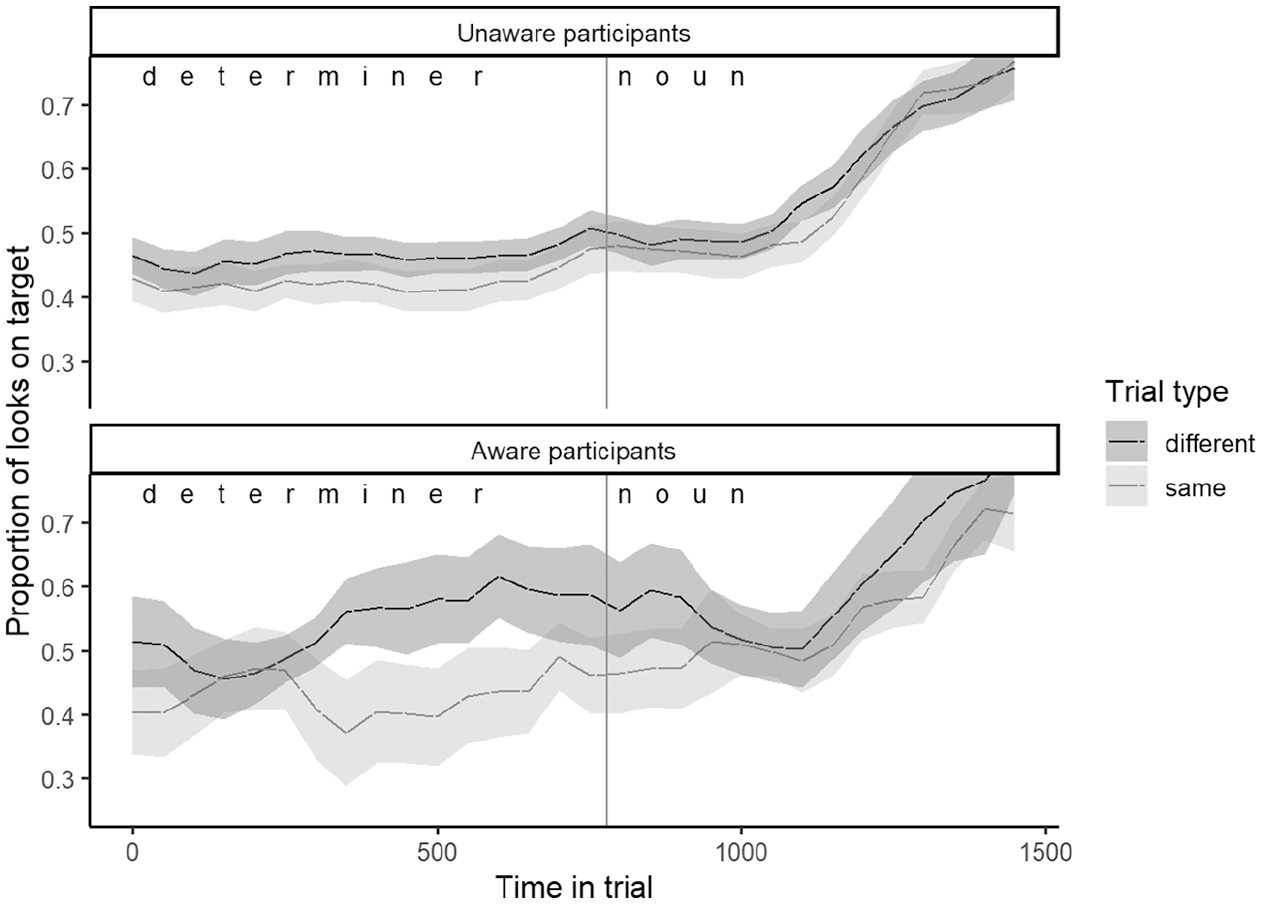
Proportion of looks on target as the determiner–noun sequence unfolds over time for same and different for animacy in block 5.
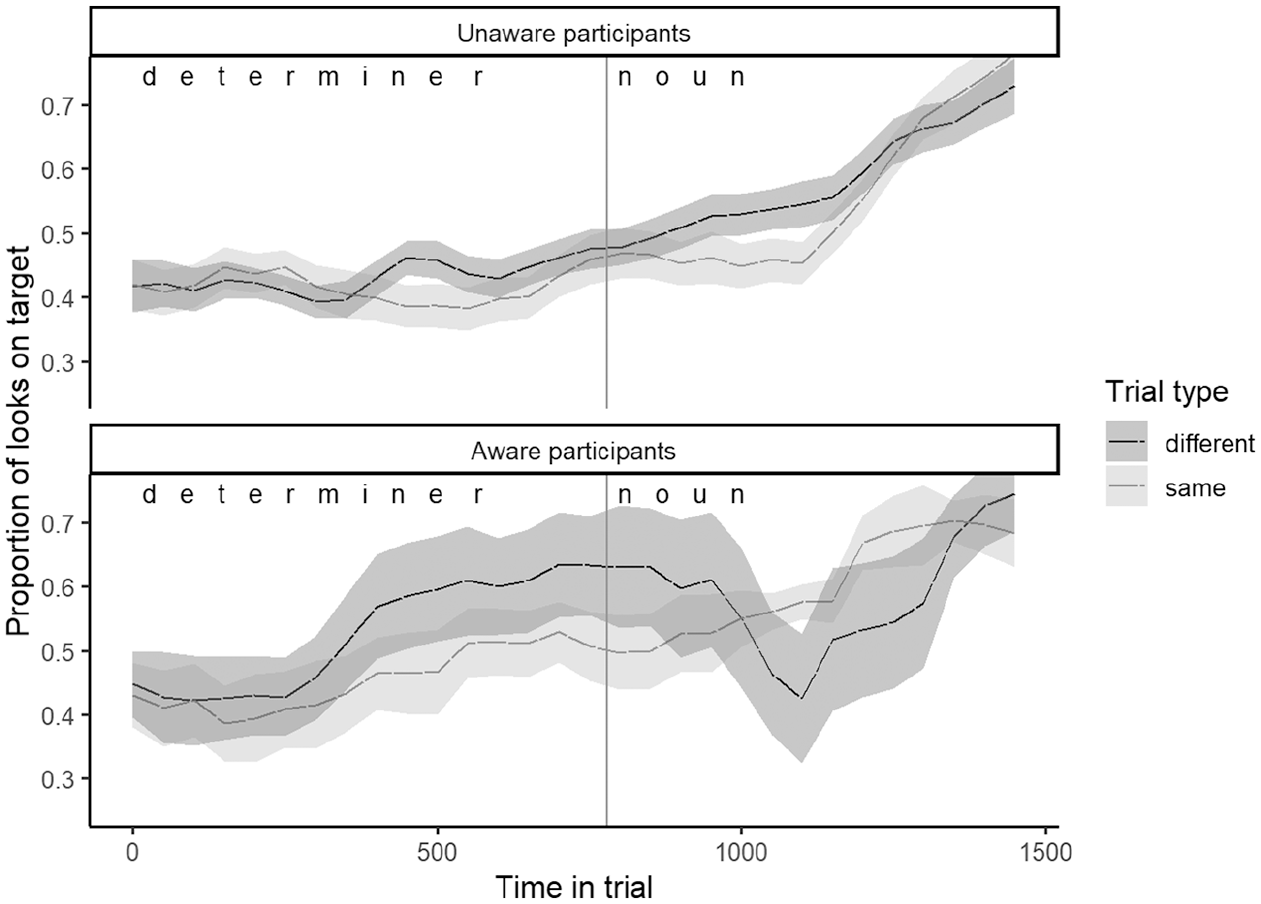
Proportion of looks on target as the determiner–noun sequence unfolds over time for same and different for distance in block 5.
3 Comparing prior and post awareness blocks
Next, I investigated whether the occurrence of awareness was associated with changed eye movement behavior within those participants who became aware. This analysis is based on only 12 participants for both animacy and distance (participants who became aware in the final block cannot supply post-awareness data and were dropped; block 1 data were included in order not to lose participants who became aware in block 2). First, I investigated eye movement behavior according to awareness status, so for each awareness phase separately. These analyses are presented in the supplementary file only (Andringa, 2020) and quite clearly suggest that eye movement behavior changed in the course of experiment, upon the emergence of awareness. They provide no evidence of determiner-based processing prior to awareness, however.
To test whether there was a meaningful change in behavior, a within participant analysis was conducted comparing pre and post-awareness behavior. For this, all blocks prior to awareness were taken together and compared to all post awareness blocks; the blocks in which awareness emerged were excluded. Cluster-based permutation analysis was then used to identify time clusters in which eye movement behavior was different in prior and post awareness blocks. This analysis was based on the average difference per time bin between same and different object trials, calculated for prior and post awareness blocks separately. Figures 4 and 5 plot these difference scores. In these plots, zero means there is no difference in proportion of looks to same and different object trials. The results are very similar for animacy and distance. The figures show that the difference in proportion of looks between same and different trials is close to zero throughout the entire trial in the pre awareness blocks. However, in the post awareness blocks, clear differences emerge between the same and different object trials, that peak around 0.2 points at approximately 500 milliseconds after determiner onset. The shaded areas indicate the time clusters where prior and post awareness behavior differ significantly. The results of the analyses are presented in Table 3.
Results of the cluster-based permutation analysis comparing eye movement behavior prior and post awareness.
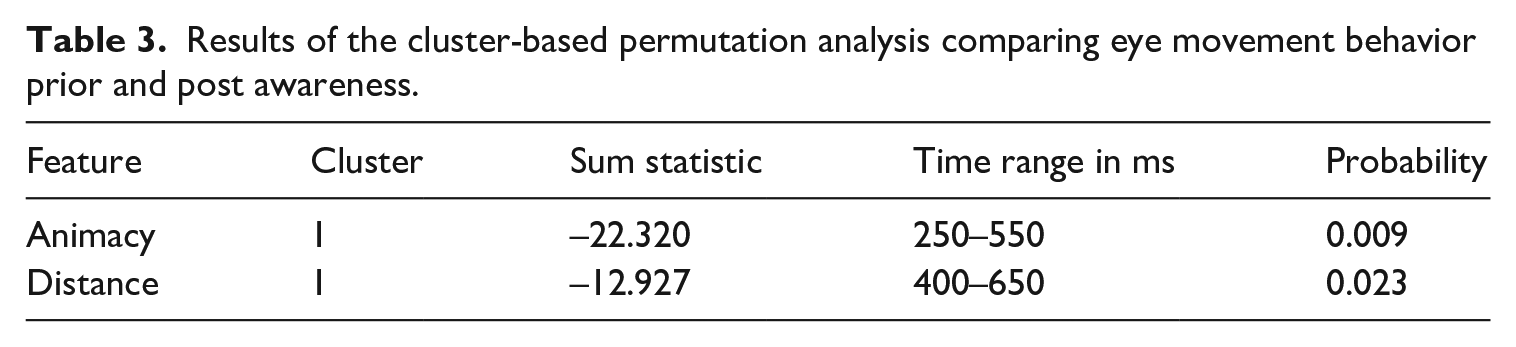
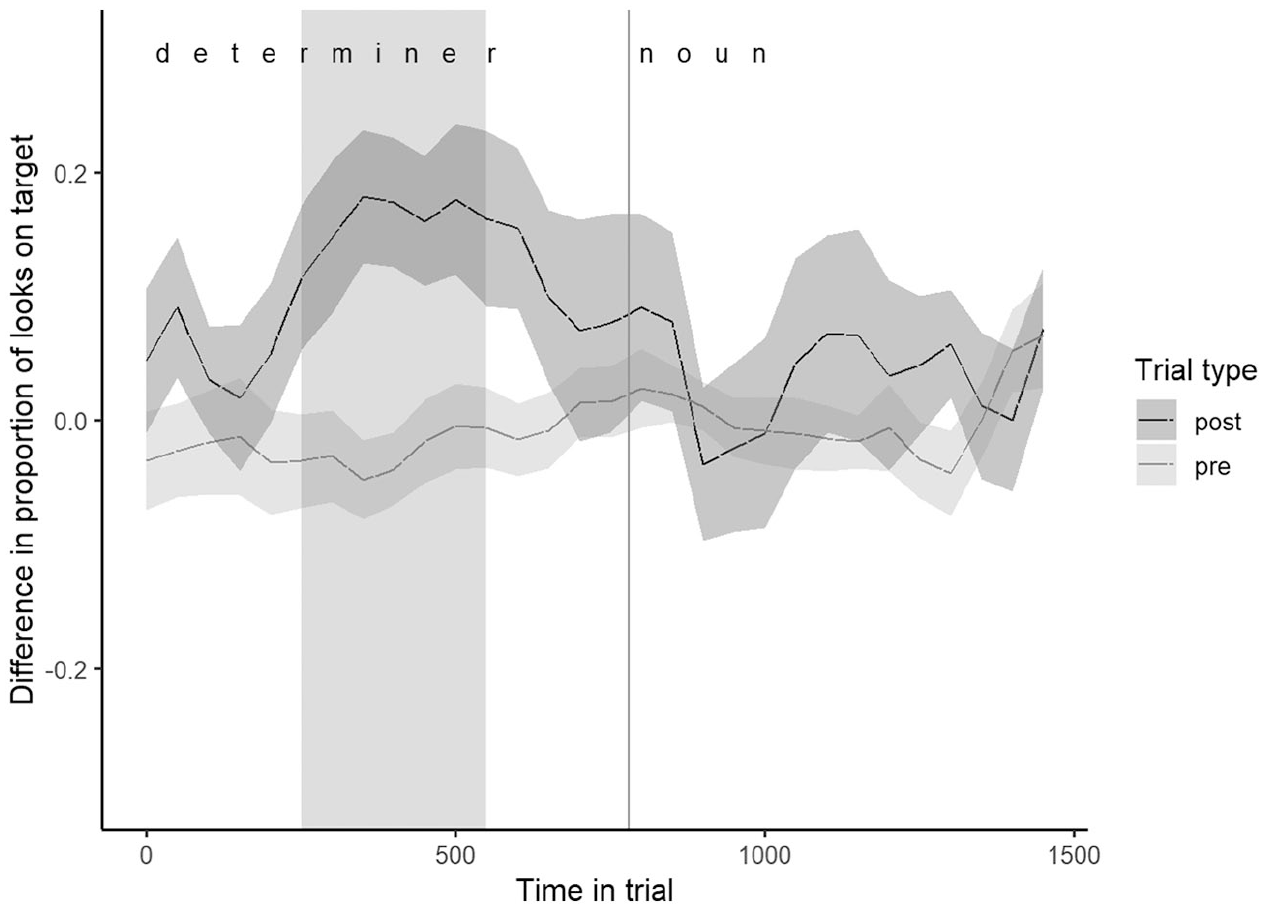
A comparison of the average difference in proportion of looks on target between same and different object trials, prior and post awareness for animacy.
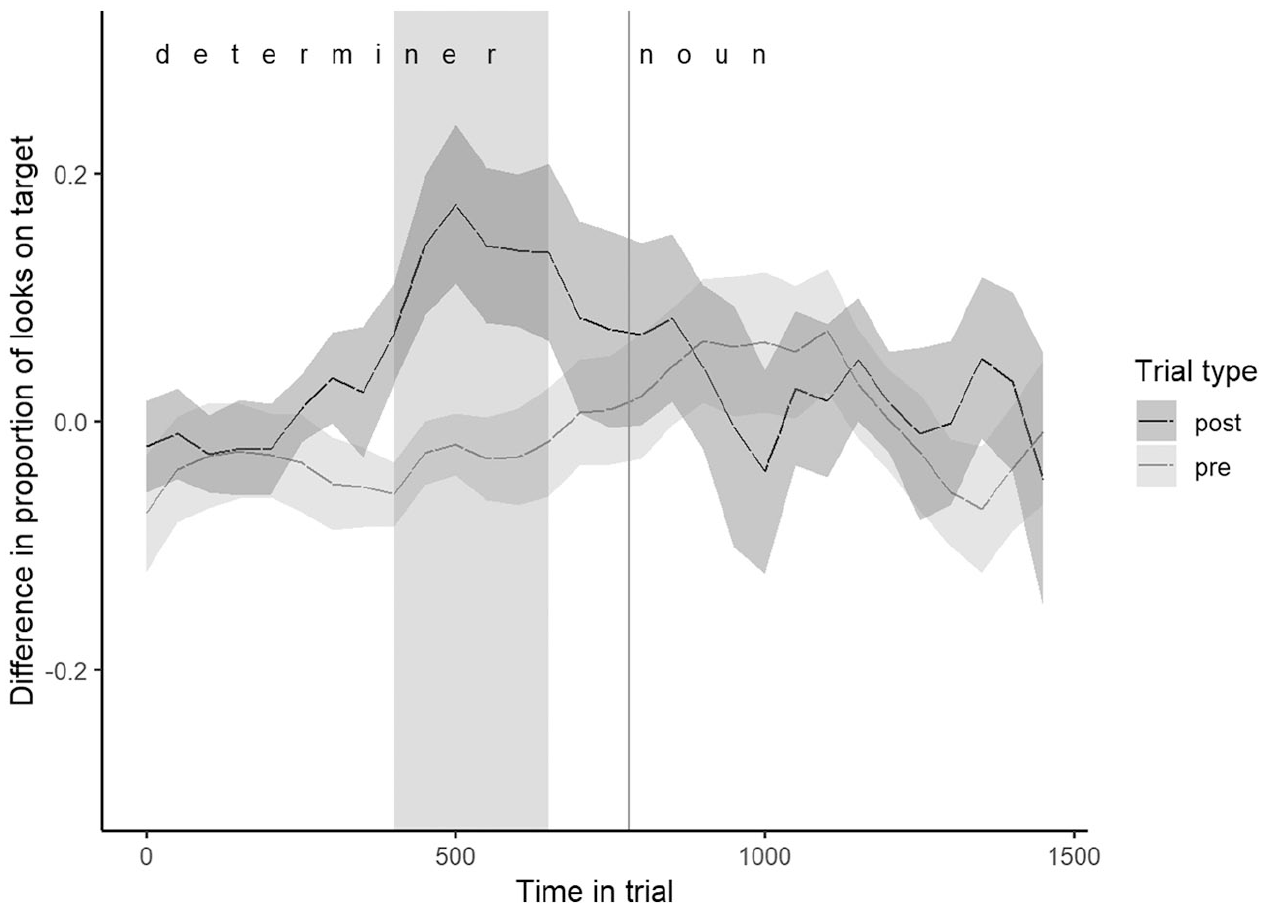
A comparison of the average difference in proportion of looks on target between same and different object trials, prior and post awareness for distance.
4 Did unaware participants learn?
The previous analyses did not yield clear signs of learning prior to awareness. As a final step, I sought to determine whether there were any signs of learning in the 26 participants who showed no signs of awareness for the target structure. In order the increase the power of this analysis, blocks two and three, four and five, and six and seven were taken together. Cluster-based permutation analysis was used to look for signs of differentiated behavior between same and different object trials. To cut a long story short: there were no such signs (details can be found in the supplementary file: Andringa, 2020).
V Discussion
1 The role of awareness in learning
The present study aimed to investigate the role of awareness in uninstructed learning. The goal was to see if awareness would spontaneously emerge and to find out to what extent learning was associated with the emergence of awareness. While a respectable number of participants were tested (n = 39), only 13 (or 33%) of them noticed the target structure in the input. The results of this study suggest that the ability to use determiners predictively was fully contingent on the emergence of awareness that determiners express animacy and/or distance. One could construe these results as in support of Schmidt’s noticing hypothesis (1990, 2010), which holds that some degree of conscious registration is required for learning, as well as Bialystok’s notion of learning as a process of analysis (Bialystok, 1994, 2011), that should lead to awareness of structure. In both theories, awareness is a necessary step in learning. The results are arguably not in disagreement with the idea that declarative knowledge is important in initial stages of L2 learning, as hypothesized by DeKeyser (2007). It is important to recognize, however, that learners in the present study became aware autonomously. It is an empirical question whether instruction could effectively bypass implicit statistical learning (see Andringa and Curcic, 2015 for an attempt). The outcomes of this study agrees with NC Ellis’ (2005, 2015) views in that he argued that awareness may be required for committing a pattern to memory, but it might be more difficult to align with the notion that awareness may be needed especially for those features that are blocked due to learned attention, although this study was not a test of that hypothesis. Dutch is similar to English in encoding distance in determiners, which means this aspect should not necessarily have been problematic to pick up. Animacy, however, is not grammaticalized in Dutch, and the present determiner system encoded both simultaneously.
While several studies have provided evidence for implicit learning (e.g. Godfroid, 2016; Kerz et al., 2017; Williams, 2005), this study found no evidence of learning in the larger sized group of participants who remained fully unaware. This might mean that some degree of awareness is required, at least for learning this particular structure. However, as is always the case with null effects, alternative explanations for the absence of implicit learning effects are possible. The exposure may not have been sufficiently lengthy, for example. Many have pointed to the idea that implicit learning may require much more time than typically given in experiments such as these (Hulstijn, 2015).
Another explanation for the absence of signs of implicit learning in unaware participants could be that the eye tracking procedure may be insufficiently sensitive to implicit learning effects. It could be that knowledge of a particular structure comes in degrees: the ability to use determiners predictively may involve a deeper level of understanding than recognizing when determiners are accurately used, which is typically how implicit learning is demonstrated. Prediction may require higher levels of control, and may hence be contingent on awareness. This might seem in conflict with the claim that prediction can be indicative of implicit knowledge (Suzuki and DeKeyser, 2015; Suzuki, 2017), but this is not necessarily so. It is important to keep in mind that this study looked at awareness at the knowledge construction phase (Leow et al., 2011), while Suzuki and DeKeyser (2015) and Suzuki (2017) studied looked at reconstruction in highly proficient learners, for whom one would expect that higher levels of control and the involvement of awareness are no longer required.
It has been hypothesized that conscious awareness arises from implicitly acquired knowledge (Cleeremans, 2007; Dienes and Perner, 1999; Haider and Frensch, 2005). There were no clear signs of learning prior to awareness, however. This could mean either that implicit learning effects were not detectable in the present design, as discussed above, or that awareness does not follow from implicit learning. The first interpretation is perhaps more plausible than the second, simply because it is difficult to think of alternative explanations for self-generated awareness. How could one work out that a particular determiner may cue inanimate objects without internalizing first that there were also animate objects appearing with different determiners? Also, there were some signs in the data that learning preceded awareness. For distance-based prediction, a late effect prior to awareness was observed, although it was not significant. But perhaps more importantly, two learners reported feeling they became faster in making decisions and were triggered by this to reflect on the input.
2 Methodological considerations
What are the virtues and pitfalls of the method used? The most innovative feature of the design employed was the use of a procedure that allowed for the assessment of learning and awareness over time, which is essential for moving the interface issue forward. Effects of exposure or instruction are generally measured by means of post-test designs, capturing the product of learning. The present procedure potentially allowed for following the learning process as it developed, although this was constrained to blocks of thirty-six items, the minimum number of items deemed necessary for analyses per block. In order to capture the learning process, one needs procedures that do not rely on ungrammatical items for assessing what learners know, as these could negatively affect learning. Visual world eye tracking allows for this. An additional advantage of avoiding ungrammaticality is that ungrammaticality is thought to trigger awareness (R Ellis, 2009). There are also disadvantages to the technique, the most important being that only a limited number of target structures lend themselves for the procedure (only those that cue upcoming information).
The riskiest aspect of the current method was its reliance on retrospective verbal reports. This involved asking participants not only to report what they noticed, but also to indicate when they noticed. Verbal reports have received a fair amount of criticism for being potentially unreliable (R Ellis, 2015; Rebuschat, 2013). One may fail to classify learners as aware, because they forgot or failed to report their insights. They are, however, the only technique available that allows researchers to potentially pinpoint the moment of awareness, because learners can be asked when awareness emerged. Subjective ratings and concurrent think alouds could also be used during the exposure, but there is every chance that the procedure itself triggers reflection and awareness that would otherwise not have occurred (Rebuschat et al., 2015). There are reasons for optimism though, as all learners who noticed the target structure were also able to indicate when they noticed: there were none missing in this respect. In addition, there is clear evidence of changed eye movement behavior in relation to awareness. The results are sufficiently encouraging to continue experimenting with this method. However, the debriefing procedure could be improved in one important way. In this the debriefings were not recorded. This would have allowed for them to be judged by another rater, as was done in Curcic et al. (2019), to ensure that awareness was consistently measured.
In this study, participants received no instruction beyond ‘learn the language and try to become fast in responding’. This was different from Williams (2005), where participants were taught that the meaning of the determiners corresponded to near and far, and they were instructed to provide near-far judgments. One may wonder how the nature of the instruction affected learners’ propensity to actively search for regular patterns and how this affected learning outcomes. Learning must have been intentional for all participants in the present study in that they tried to grasp the language they were asked to learn. It is possible that the learners who became aware in this study were those that actively searched for rules. Implicit learning processes might be disturbed somehow if learners are actively searching for patterns, which could explain why we did not find evidence of implicit learning prior to awareness. Ultimately, though, no one knew what they would be searching for and as in Williams (2005), the vast majority did not develop awareness of the target structure.
Some further methodological changes should also be considered. Learning rates in the present study were low. There were no signs of implicit learning and few participants managed to become aware of the target structure; it would be interesting to consider how learning can be stimulated. There would be several ways of doing this within the current design. The first would simply be to elongate the exposure; this should allow for more learning and perhaps also give more opportunity to implicit learning effects. Another adaptation could be to allow nouns to be immediately repeated; in the present study, presentation order was manipulated so that the same noun was always presented with at least three other trials in between. Allowing for repetition could perhaps stimulate the establishment of associations between particular nouns and the determiners they can occur with; repetitions could also be a trigger of awareness. It would therefore be interesting to manipulate the occurrence of repetitions experimentally and gauge how this affects learning and awareness rates.
VI Conclusions
Understanding how awareness affects the L2 acquisition process is a crucial issue in SLA. This study was a first attempt to investigate the emergence of awareness in uninstructed learning through a method designed to follow the development of learning. While replication and further experimentation is required, this study suggests that learning a particular L2 structure coincides with the emergence of awareness of that structure. This could mean that learning an L2 is effectively an autonomous and explicit induction process, at least for some structures, not unlike Bialystok’s (1994, 2011) proposals. However, even ignoring the fact that the statistical power was too low to make any definitive claims, this study cannot be construed as evidence against implicit learning for the reasons outlined above. This study should also not be construed as evidence in favor of explicit approaches to teaching, simply because this study was not a study of instructed learning. There is no telling how instruction would affect autonomous inductive learning: as suggested by NC Ellis (2015), it might be a help or a hindrance depending on the nature of the structure taught and how that structure related to the first language. In addition, it would probably depend on the timing of the instruction. A method that can capture the learning process, as was presented here, would be well-suited to address such questions.
One of the more intriguing questions raised by the present findings is: What triggers awareness? If it is true that learning proceeds through some degree of awareness of the target structure, as suggested by the present data, then it becomes vitally important to understand what might trigger awareness in uninstructed learning. Is some degree of implicit learning required? Or should we think along the lines of the unexpected event hypothesis, as proposed by Haider and Frensch (2005), or a combination of both? It is interesting to note that even amongst the small number of aware participants, there were large differences in how long it took them to become aware, ranging from block two to seven. Could this be a reflection of individual differences in implicit learning, or are particular cognitive abilities conducive to awareness? There are questions to be addressed in future research.
Footnotes
Acknowledgements
I would first and foremost like to thank John Williams for the wisdom shared when designing and writing up this study. I would also like to thank Iris Broedelet, Leonie Cloos, Joris Wolterbeek, Maja Curcic and Maria Vasiliadis for their help in various stages of the project, and Dirk Jan Vet for his crucial assistance in setting up the eye-tracking procedures and processing the raw data. Finally, I owe a debt of gratitude to Aline Godfroid, Kathy Conklin and Paula Winke for their patience, their encouragement, and their excellent advice on early drafts of this text.
Declaration of conflicting interests
The author(s) declared no potential conflicts of interest with respect to the research, authorship, and/or publication of this article.
Funding
The author(s) received no financial support for the research, authorship, and/or publication of this article.
