



Abstract
The diversity of social media platforms has expanded the possibilities for citizens to encounter political content and express political opinions. However, the patterns of users’ contact with political information and political expression across different platforms are largely unclear. Based on survey data from Germany (n = 1054), this study investigates social media use, exposure to political content, and political expression across nine platforms and presents a typology of political social media users. A cluster analysis identified five user types: Unpolitical Sporadics, Casual Mainstreamers, Twitter-focused Mainstreamers, Expressive Contributors, and Political Activists. Multinomial logistic regressions reveal that these types are associated with different socio-demographic characteristics, political attitudes, and media usage habits. In particular, a small group of users with right-leaning attitudes is very active on all platforms. These Political Activists could potentially contribute to the much-discussed dominance of the political right on social media.
Introduction
The establishment of social media platforms is one of the most significant phenomena of the transition from low- to high-choice media environments, resulting in more opportunities for citizens to encounter political content and to express themselves politically. This development has always been and continues to be associated with hopes and concerns (Van Aelst et al., 2017). On the one hand, people gain freedom and autonomy in their choice of information sources and ways of expression. On the other hand, high-choice media environments are considered to pose democratic challenges, such as increasing fragmentation, polarization, and inequalities in terms of political information and participation (see, e.g., Klinger et al., 2023; Van Aelst et al., 2017; Vowe and Henn, 2016).
To evaluate these hopes and concerns, it is crucial to examine the patterns of political social media use. Thereby, it must be considered that the political usage of social media platforms can be diverse, ranging from passive contact with politics to active political expression. Hence, the first aim of this study is to identify political social media user types according to this multifaceted nature of political social media use based on survey data from Germany. Furthermore, it is essential to investigate the potentially different socio-demographic characteristics, political attitudes, and media usage habits of these user types. Identifying these differences can help to understand a) which segments of the population are reached by political content on the various platforms and b) which political views users have who regularly express their opinions on social media. Accordingly, our second research objective is to investigate whether socio-demographic characteristics, political attitudes, and media usage habits determine which type of political social media user an individual belongs to.
Hence, this study provides valuable insights into how often people encounter political information and express themselves politically on social media platforms. Instead of focusing on just one or a few, we consider nine different platforms, recognizing that social media platforms have different affordances and appeal to different user groups (Vaccari and Valeriani, 2021). Moreover, this research considers different facets of political social media use and helps to identify characteristics and attitudes associated with different user types. This allows for a more differentiated understanding of political social media communication than examining specific predictors of single variables of social media use or activity.
Facets of political social media use
Social media platforms are popular around the world (e.g., Newman et al., 2023; Vaccari and Valeriani, 2021), including European countries like Germany. Half of the German population over the age of 14 use social media at least once a week; among 14- to 29-year-olds, the figure is as high as 91% (Koch, 2023). Although social media is more often used for other purposes, people also go there to find news and political information (Behre et al., 2023). This applies to a comparable extent to other European countries (Newman et al., 2023). The fact that people use social media for this purpose seems plausible, given that media organizations and journalists (Degen and Olgemöller, 2021), parties and politicians (Haßler et al., 2023; Kelm et al., 2019), as well as other political organizations and activists (Poell and Van Dijck, 2015; van der Graaf et al., 2016) use social media platforms to distribute political content. However, users can also come across political content on social media without deliberately seeking it out. Survey data from various European countries (including Germany), Australia, and the US show that users are incidentally exposed to news or political information on social media regularly (Fletcher and Nielsen, 2018; Valeriani and Vaccari, 2016).
Besides encountering political information, users can express themselves politically on social media platforms. Both internationally and especially in Germany, only a minority of users regularly make use of the possibility to, for example, like, share, or comment on news (Behre et al., 2023; Newman et al., 2023) or post political messages (Vaccari and Valeriani, 2021). This minority, however, which has been referred to as hyperactive users, is responsible for a disproportionately high number of likes and comments, for instance, on the Facebook pages of German parties (Papakyriakopoulos et al., 2020).
To account for the different facets of political social media use, the present study considers the general usage of social media platforms, the overall contact with political content there, and users’ political expressions to identify and describe patterns of political social media use.
Platform differences matter
Political social media use, however, not only encompasses different facets but also takes place across many different platforms offering different affordances (Bucher and Helmond, 2017). Consequently, specific usage habits have emerged on different platforms. For example, due to their features, Twitter 1 tends to be used more for following and sharing news, while platforms like Snapchat are more about sharing images with friends (Phua et al., 2017). Studies show that platform affordances also play an essential role in why people with different personal characteristics prefer different platforms (Shane-Simpson et al., 2018). Accordingly, people's motives to use platforms with different affordances also vary (Alhabash and Ma, 2017). Communication that takes place on social media platforms is likewise influenced by their affordances. Research demonstrates that platforms’ digital architecture influences political actors’ social media communication and points, for example, to Instagram and Snapchat being less important for election campaigns than Facebook and Twitter because of the platforms’ affordances (Bossetta, 2018; Kreiss et al., 2017). Moreover, the use of social media by journalists (Neuberger et al., 2019) and the quality of users’ political discussions (Esau et al., 2017; Rowe, 2015) vary between platforms. Beyond this, findings based on survey data from the US, France, and the UK indicate that users’ political behaviors on Facebook and Twitter are distinct from one another (Theocharis et al., 2023). Thus, the platforms’ different characteristics can influence not only who uses them and for what reasons but also what and how is communicated there (e.g., amount, nature, and quality of political content).
As these platform differences are rarely considered, research regarding social media participation needs to recognize the differences between platforms and their affordances (Ruess et al., 2023). Differentiating between nine different platforms allows us to explore which user types are more affordance-sensitive and which users tend to use platforms of different affordances to a comparable extent.
Typologies of social media users
Political social media use across various platforms is a multifaceted construct. To capture its multifaceted nature and, at the same time, bring order to the multitude of relevant variables, explorative analytical procedures such as cluster analyses and latent class analyses can help to typologize different patterns of political social media use.
Research has already provided some typologies of media users in high-choice media environments, which, however, neither specifically focus on the political usage of social media nor consider the variety of different platforms. Nevertheless, these typologies offer insights into different patterns of social media use. For example, Castro et al. (2022) distinguish different types of news consumers based on a cross-national survey about news consumption habits on legacy and social media in 17 European nations. More than one-fifth of the respondents were labeled as social media news users. These users tend to be young, less educated, less politically interested and show low levels of media trust. Brandtzaeg and Heim (2011) present a typology based on survey data representative of Norwegian internet users, focusing on social media users’ general (not explicitly political) activities. They identify five user types: sporadics, lurkers, socializers, debaters, and actives. While the first two types tend to use social media rather passively, the latter three types are characterized to varying degrees by activities on social media. However, neither of these two approaches explicitly reflects political social media use.
Other existing typologies do address the political dimension of social media use. For instance, Datts et al. (2021) rely on survey data from Germany collected in 2013 to typologize young adults (18–33 years old) based on the entire spectrum of their political information, communication, and participation behavior. They find that the usage of social media platforms is significantly greater in two groups than in the others: news junkies and organized extroverts, that is, people who passively (news junkies) or actively (organized extroverts) participate rather intensively in political communication. Still, this typology only refers to a particular age group and also incorporates aspects far beyond political social media use (e.g., face-to-face communication and voting). The study most similar to our approach was conducted by Acharoui et al. (2020). They focus specifically on political behavior on social media and identify three types of users with different levels of political activities based on survey data from Morocco: activists, agitators, and outsiders. While activists show high levels of political engagement on social media, agitators limit their activities to motivating other users. Outsiders, on the other hand, are hardly active. But due to the data basis, it is questionable whether these results can be transferred to European countries.
A common finding among the latter three studies (Acharoui et al., 2020; Brandtzaeg and Heim, 2011; Datts et al., 2021) is that large groups of users rarely or never participate on social media, while user types that make up a minority participate intensively. However, none of the abovementioned typologies differentiate between people's activities on social media platforms that offer different affordances.
So, as yet, there is no typology of political social media users that takes the multifaceted nature of political social media use and the diversity of platforms into account. This study aims to close this gap by addressing the first research question (RQ1): Which political social media user types can be identified in Germany when considering social media use, exposure to politics, and political expression across various platforms?
Characteristics of different user types
Among other factors political social media user types may differ in their socio-demographic characteristics, political attitudes, and habits of media usage. Uncovering these differences can be vital to understand the implications of the identified user types. If, for example, user groups that express their views more often than others on social media also remarkably often represent certain opinions, these political opinions are likely to be more present on social media.
Indeed, several studies indicate that different socio-demographic characteristics, political interests, and political orientations are related to the use of different platforms (Feng et al., 2019; Koch, 2023) and engagement on social media (Bode, 2017; Kalogeropoulos et al., 2017; Lane et al., 2023). Moreover, some studies illustrate correlations between political participation and social media use (Boulianne and Theocharis, 2020; Boulianne, 2015; 2020; Gil de Zúñiga et al., 2012; Vaccari et al., 2015; Vaccari and Valeriani, 2021).
Potential differences between political social media user types are especially relevant in light of debates regarding which political actors benefit from social media. For example, Jungherr et al. (2019) argue that social media platforms offer particularly political outsiders, such as the German right-wing populist party AfD, the opportunity to “coordinate supporters, to create alternative information spaces and route around established media to get their messages heard, and to make their support visible to gain and sustain legitimacy” (Jungherr et al., 2019: 4). In line with this, right-wing networks are believed to exist on Telegram (Urman and Katz, 2022). In addition, the supposedly extensive audience reach of the AfD on TikTok remains an issue of concern in Germany (Hillje as cited in Metzger, 2024; Mienert, 2024), and the strategies behind its success on TikTok have become a subject of research (Bösch, 2023). To determine whether and how this presumed dominance of the political right on social media could potentially be reinforced by user activities, it is necessary to clarify the political attitudes of user types who frequently express their views. Therefore, the second research question (RQ2) is: Which socio-demographic characteristics, political variables, and media usage habits influence who belongs to which political social media user type?
Method
Data and sample
The data was collected in a standardized survey of individuals living in Germany with internet access aged 16 and above. The German research company bilendi executed the fieldwork during August and September 2022. Quotas were applied to ensure representation across gender, age, education, and place of residence for the German population with internet access.
A total of 1343 individuals completed the questionnaire, of whom 289 were excluded due to incorrect, missing information, a failed quality check (“please check the box with number 6”) or inconsistent response behavior 2 , resulting in a final sample of n = 1054. In this final sample, 49.7% of the respondents identify as female and 50.3% as male. The age range spans from 16 to 87 years (M = 49.5, SD = 16.8). Regarding education, 32.4% reported a low education (up to Hauptschulabschluss), 32.5% medium education (up to Mittlere Reife), and 35.0% high education (at least Hochschulreife). The sample differs only slightly from the data of the Federal Statistical Office of Germany (2022) regarding gender (50.7% women), age (44.6 years), and education distribution (low education: 29.1%; medium education: 33.6%; high education: 37.3%).
Variable description and analytical strategy
To identify different political social media user types, we employed a cluster analysis, described as “the methodological instrument for breaking down heterogeneous survey results into homogenous groups” (Backhaus et al., 2023: 454). Unlike latent class analysis, which assumes the existence of latent classes, the primary assumption of cluster analysis is that cases with similar patterns belong to the same cluster (Weller et al., 2020).
The clustering variables encompass participants’ (a) general social media usage, (b) exposure to political content on social media, and (c) political expressions on social media, each across nine different platforms (see measurement below): Facebook, Instagram, Twitter, YouTube, WhatsApp, Snapchat, Telegram, TikTok, and Reddit. Thus, we focus on social networks, micro-blogging services, messengers, and video platforms, as all of these have elements of social media platforms (Kümpel, 2022). Therefore, the cluster analysis is based on 27 variables.
All analyses were performed in R Studio 4.2.2. The distances between these variables were determined by the Euclidian distance. Ward's method served as the hierarchical cluster method. The optimal number of clusters was identified using the NbClust package (Charrad et al., 2014). A two-cluster solution receives the most support. However, this solution only divides respondents into non-political and political social media users. Solutions with three, four, and five clusters are all supported to a comparable extent. As the three- and four-cluster solutions hide a distinctive user type in their largest cluster, we opted for the five-cluster solution to describe political social media user types with adequate differentiation. The results of the two, three, and four clusters solution can be found in the supplemental material file.
To explain the differences between the clusters, we performed a multinomial logistic regression with the cluster number as dependent variable and socio-demographic characteristics, political interest, political orientation, political efficacy, political participation, and media use as independent variables (see measurement below).
Cluster variables
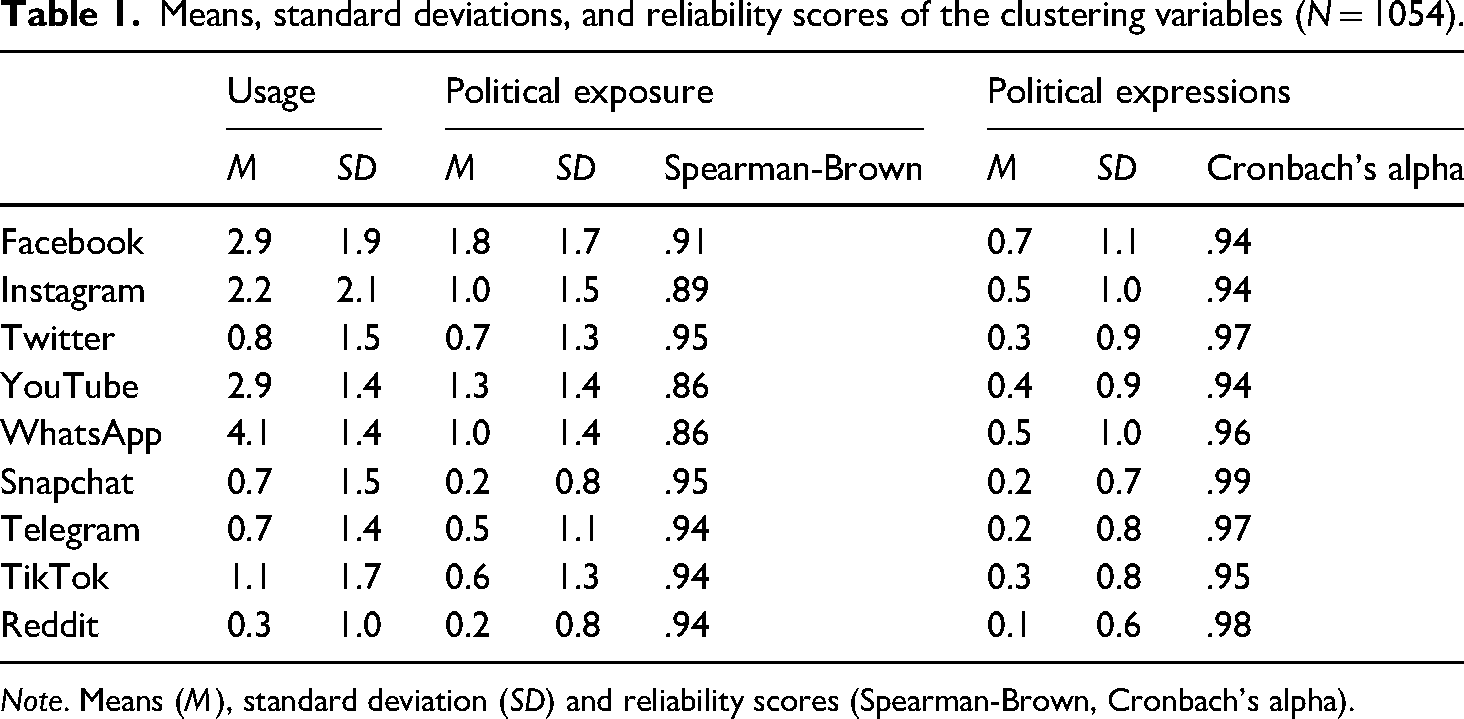
To measure the general social media usage, the respondents indicated how often they use the different platforms at the beginning of the survey. The items of these and the following variables were assessed using a six-point scale (0 = never, 1 = less than once a month, 2 = at least once a month, 3 = at least once a week, 4 = daily, 5 = several times a day). After that, the respondents were asked whether and how often they encounter (a) political information and (b) political discussions on the platforms they use. Respondents were told that we define political information as political content or contributions published or disseminated by media organizations, politicians, parties, other organizations, or users and political discussions as opinion expressions towards political content by users. The variables were averaged for each platform to measure the exposure to political content on social media. Next, the respondents were asked whether and how often they (a) publish a political post, (b) share a political post, (c) comment on a political post, (d) react to a political post (e.g., with a like) on the platforms they use. The variables were averaged for each platform to measure political expressions on social media. Detailed information on means, standard deviations, and reliability scores for the cluster variables can be found in Table 1.
Means, standard deviations, and reliability scores of the clustering variables (N = 1054).
Note. Means (M), standard deviation (SD) and reliability scores (Spearman-Brown, Cronbach's alpha).
Independent variables
Respondents provided information regarding their gender (male, female), age in years, and education level (from 1 = no school leaving certificate to 6 = university graduation). Education levels were recoded into a categorial variable: low, medium, and high education.
Political interest was assessed on a scale from 1 (not at all) to 10 (very strong; M = 6.6, SD = 2.4). Political orientation was measured with a left-right scale from 1 (left) to 10 (right; M = 5.2, SD = 1.7). Internal (M = 4.5, SD = 1.5; Spearman-Brown = .82) and external political efficacy (M = 2.6, SD = 1.4; Spearman-Brown = .86) were measured on a seven-point scale, utilizing two items each from the Political Efficacy Short Scale (Groskurth et al., 2021).
Political participation was measured by asking the respondents whether they had participated in various political activities in the past 12 months: (a) voting in a political election, (b) singing a petition, (c) participating in a political demonstration, (d) boycotting or buying a product for political, ethical, or environmental reasons, (e) donating money to a political organization (0 = no, 1 = yes). The responses were aggregated (M = 1.4, SD = 1.2).
Legacy media usage frequency was measured by asking how often respondents use various media outlets for information about politics and society: (a) local or regional newspapers, (b) nationwide newspapers, (c) tabloid newspapers, (d) internet providers, (e) public-service broadcasters, and (f) private broadcasters. The same six-point scale used to assess social media usage frequency was applied, and the responses were averaged (M = 1.9, SD = 1.1, Cronbach's alpha = .76). The frequency of alternative media usage was assessed by asking the respondents how often they use so-called alternative news websites to inform themselves about politics and society (M = 1.9, SD = 1.4).
Results
To answer RQ1, we conducted a cluster analysis aimed at identifying distinct political social media user types. The analysis was grounded in participants’ general social media usage, contact with political content on social media, and their political expressions on social media. The resulting five clusters were labeled based on respondents’ social media usage patterns.
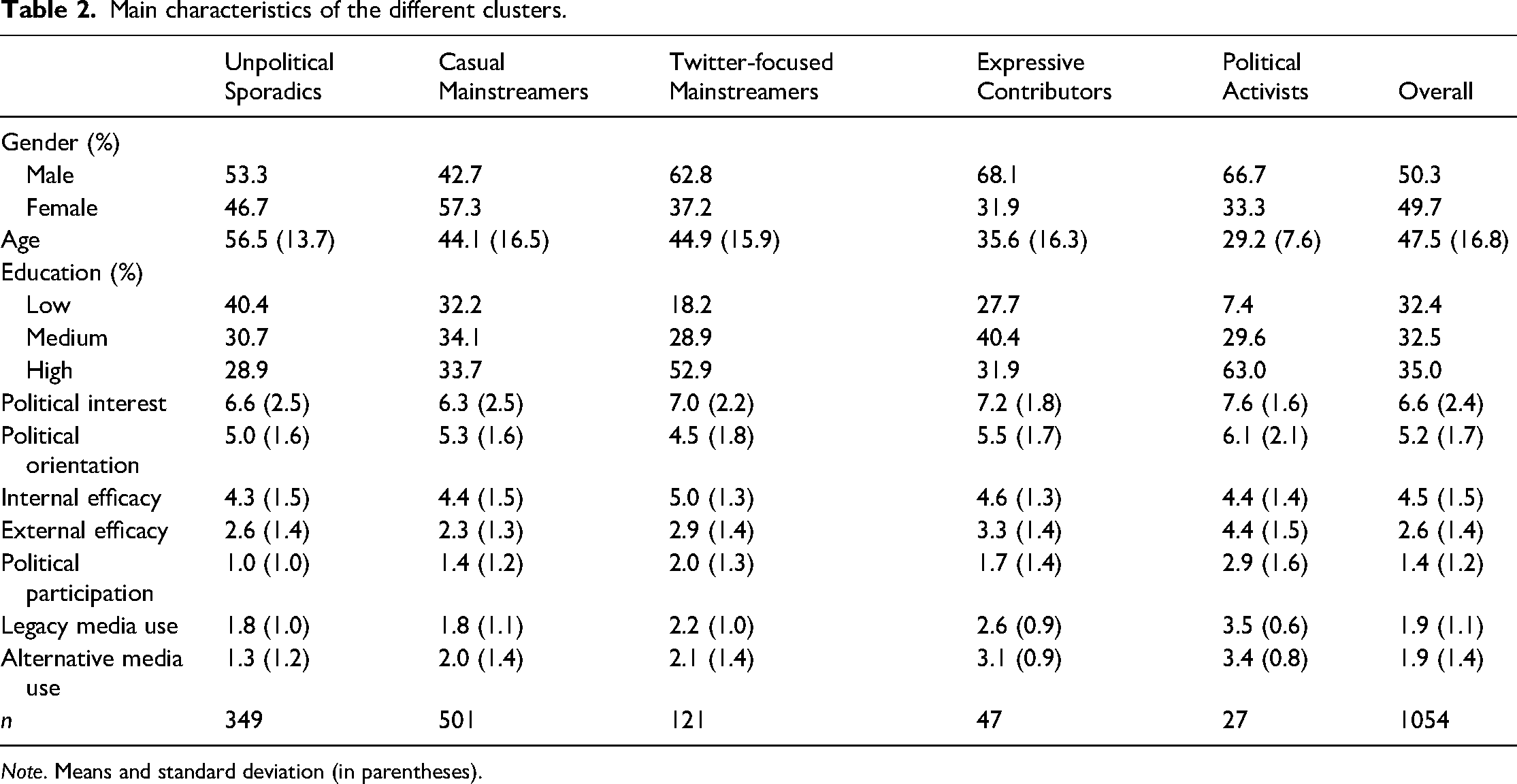
A third of respondents were characterized as “Unpolitical Sporadics” (n = 349, 33.1%). Almost half of the sample (n = 501, 47.5%) fell into the largest cluster, called “Casual Mainstreamers”, while 11.5% of participants, mostly resembling the largest cluster in terms of their political social media use but using Twitter more intensively, were identified as “Twitter-focused Mainstreamers” (n = 121). A smaller number of respondents were assigned to the categories of “Expressive Contributors” (n = 47, 4.5%) and “Political Activists” (n = 27, 2.6%). Figure 1 visualizes the differences between the clusters in their social media usage frequency, exposure to political content, and political expressions on different social media platforms. The main characteristics of the individuals in the different groups are presented in Table 2.
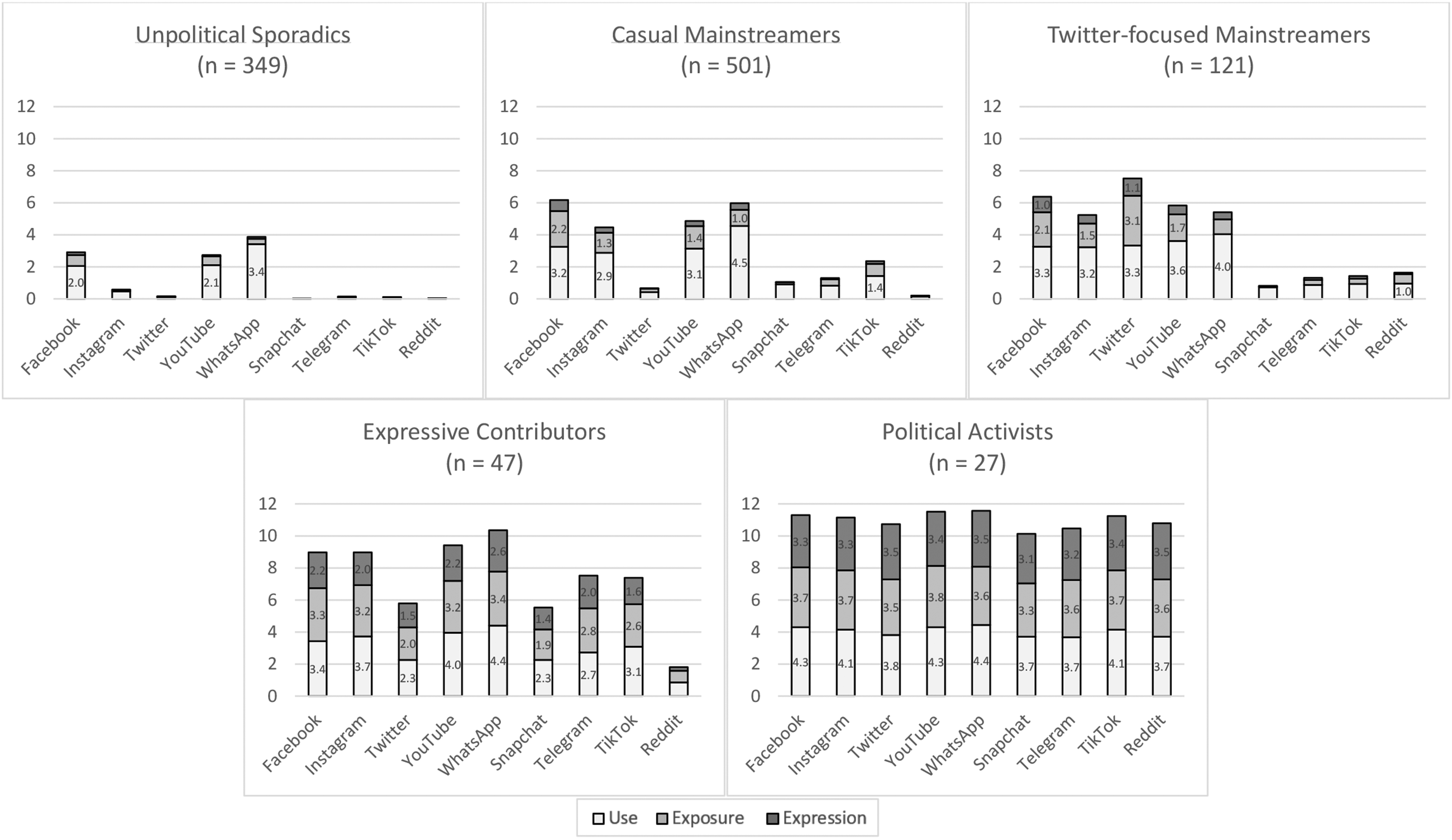
Differences between the clusters in their frequencies of social media usage, exposure to political content, and political expressions on nine social media platforms (0 = never, 1 = less than once a month, 2 = at least once a month, 3 = at least once a week, 4 = daily, 5 = several times a day).
Main characteristics of the different clusters.
Note. Means and standard deviation (in parentheses).
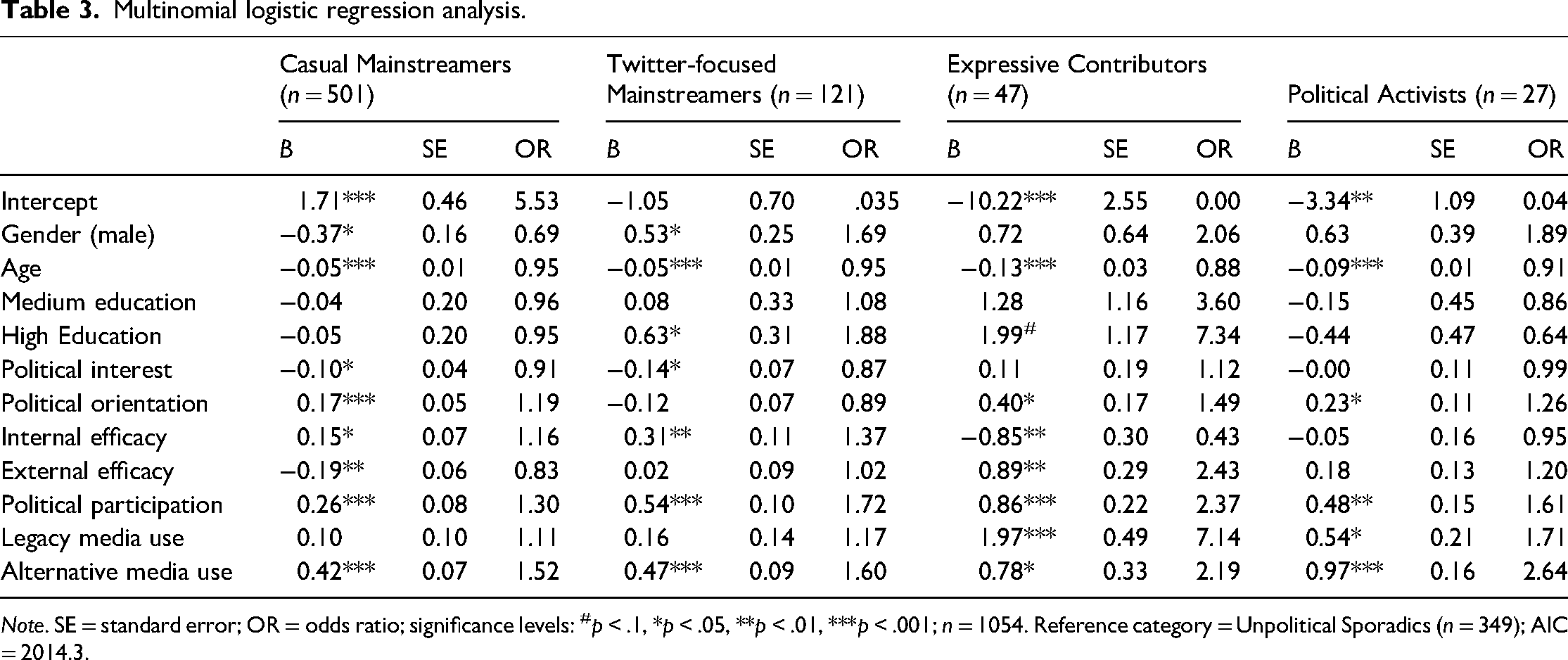
To answer RQ 2, we conducted a multinomial logistic regression analysis, utilizing “Unpolitical Sporadics” as the reference category (Table 3).
Multinomial logistic regression analysis.
Note. SE = standard error; OR = odds ratio; significance levels: #p < .1, *p < .05, **p < .01, ***p < .001; n = 1054. Reference category = Unpolitical Sporadics (n = 349); AIC = 2014.3.
In the following, we describe the different user types and their differences based on the descriptive results and the results of the regression analysis.
Unpolitical Sporadics
On average, Unpolitical Sporadics (33.1% of the respondents) use WhatsApp several times a week, YouTube, and Facebook at least once a month, but no other platforms with noteworthy frequency. They rarely encounter political content and virtually never express themselves politically on social media. Among Unpolitical Sporadics, 53.3% are male, and a significant portion possesses only a low level of education (40.4%). The findings of the multinomial logistic regression highlight that all other user types are significantly younger than Unpolitical Sporadics (M = 56.5, SD = 13.7). Moreover, users of this type participate less often politically (M = 1.0, SD = 1.0) and use alternative media outlets less often (M = 1.3, SD = 1.2) than all other user types. Regarding all other characteristics, Unpolitical Sporadics closely resemble the overall average.
Casual Mainstreamers
Casual Mainstreamers (47.5% of the respondents) tend to use only the platforms regularly that are the most popular overall. On average, they use WhatsApp on a daily basis and Facebook, YouTube, and Instagram at least once a week. They encounter political content on Facebook at least once a month, less often on YouTube, Instagram, and WhatsApp, and they almost never express themselves politically on social media. In addition, they are the least politically interested users (M = 6.3, SD = 2.5). Compared to Unpolitical Sporadics, Casual Mainstreamers are more likely to be female (57.3%, OR = 0.69, p < .05) and politically slightly more orientated towards the right (M = 5.3, SD = 1.6, OR = 1.19, p < .001). Moreover, compared to the reference category, a high internal (M = 4.4, SD = 1.5, OR = 1.16, p < .05) and low external efficacy (M = 2.3, SD = 1.3, OR = 0.83, p < .01) increases the likelihood of being a Casual Mainstreamer.
Twitter-focused Mainstreamers
Twitter-focused Mainstreamers (11.5% of the respondents) are largely similar to Casual Mainstreamers in terms of their political social media use. They also regularly use WhatsApp, Facebook, YouTube, and Instagram, occasionally coming across political content there but rarely sharing their political opinion on these platforms. However, Twitter-focused Mainstreamers deviate distinctively from Casual Mainstreamers in one aspect of their social media use, which earns them their label: Apart from Political Activists, they use Twitter most frequently of all user types. On Twitter, they are exposed to political content at least once a week and sporadically express themselves politically. On average, they are the most left-leaning users (M = 4.5, SD = 1.8). Compared to Unpolitical Sporadics, Twitter-focused Mainstreamers are, among other things, more likely to be male (62.8%, OR = 1.69, p < .05), highly educated (52.9%, OR = 1.88, p < .05), and have a high internal efficacy (M = 5.0, SD = 1.3, OR = 1.37, p < .01).
Expressive Contributors
On average, Expressive Contributors (4.5% of the respondents) use WhatsApp and YouTube daily, Instagram, Facebook, and TikTok at least once a week, and also Telegram several times a month. While they use Twitter and Snapchat at least monthly, they almost never use Reddit. They encounter political information on Twitter and Snapchat at least once a month, a little more often on Telegram and TikTok, and even on a weekly basis on WhatsApp, Facebook, Instagram, and YouTube. In contrast to the user types described so far, Expressive Contributors more regularly express their political views on the platforms they use. Most respondents belonging to this cluster are male (68.1%). Compared to Unpolitical Sporadics, multinomial logistic regression analysis shows that individuals with a more right-leaning political orientation (M = 5.5, SD = 1.7, OR = 1.49, p < .05) and high external efficacy (M = 3.3, SD = 1.4, OR = 2.43, p < .01) are more likely to be Expressive Contributors. Furthermore, those who regularly use both legacy (M = 2.6, SD = 0.9, OR = 7.14, p < .001) and alternative media outlets (M = 3.1, SD = 0.9, OR = 2.19, p < .05) are more likely to be in this group.
Political Activists
Political Activists (2.6% of the respondents) use all social media platforms daily or at least several times a week, and they encounter political content there with almost the same frequency. Across all platforms, these users express themselves politically far more often than all other user types, including Expressive Contributors. In contrast to the latter, of whom only 31.9% possess a high education, the majority of Political Activists are highly educated (63.0%). They are also often male (66.7%) and are the most politically interested (M = 7.6, SD = 1.6). Compared to Unpolitical Sporadics, Political Activists have a right-leaning political orientation (M = 6.1, SD = 2.1, OR = 1.26, p < .05) and frequently use legacy (M = 3.5, SD = 0.6, OR = 1.71, p < .05) as well as alternative media (M = 3.4, SD = 0.8, OR = 2.64, p < .001).
Conclusions and discussion
In the course of the growing importance of social media in political communication, a recurrent question is whether this manifestation of high-choice media environments reinforces inequalities of political information and participation. To get closer to a differentiated answer, it is important a) to identify different political social media user types, and b) to investigate how these user types differ in their socio-demographic characteristics, political attitudes, and media usage habits.
Based on survey data of individuals living in Germany, we conducted a cluster analysis and identified five political social media user types: Unpolitical Sporadics, Casual Mainstreamers, Twitter-focused Mainstreamers, Expressive Contributors, and Political Activists. These show several similarities to existing typologies based on general (Brandtzaeg and Heim, 2011) and political social media use (Acharoui et al., 2020) or political communication behavior in the broader sense (Datts et al., 2021). On the one hand, in line with previous research consistently indicating that user types which numerically represent the majority rarely or never participate on social media, Unpolitical Sporadics and Casual Mainstreamers are the largest clusters and together make up 80.6% of our sample. On the other hand, we find numerically relatively small user groups who at least occasionally express their political opinion on many different social media platforms (Expressive Contributors) or even frequently across all of them (Political Activists). In other studies, user types comparable to the latter were also referred to as actives (Brandtzaeg and Heim, 2011) or activists (Acharoui et al., 2020).
In contrast to previous studies, the distinction between nine different platforms in our clustering approach additionally reveals user types’ preferences for certain platforms. For example, Casual Mainstreamers tend to stick to the platforms that are most popular overall: WhatsApp, Facebook, YouTube, and Instagram. However, a distinct user group, Twitter-focused Mainstreamers, who are on average the most left-leaning, more often male, and highly educated, additionally have a strong affinity for Twitter and come into contact with politics here regularly. This corresponds to the observation that Twitter, as a text-based platform, is often used to communicate about publicly relevant topics beyond users’ personal sphere (Phua et al., 2017). Such a way of using Twitter, shaped by the platform's affordances, seems particularly appealing to users with the aforementioned characteristics. In addition, the three largest clusters, Unpolitical Sporadics, Casual Mainstreamers and Twitter-focused Mainstreamers, and thus over 90% of respondents very rarely encounter political content and hardly ever express themselves politically on the picture- and video-based platforms they use regularly, Instagram and YouTube. Accordingly, platforms with such features seem to be less suited for political information and participation for most users. One reason for this could also be decisions by platform operators, such as the one by the company Meta, to algorithmically reduce the visibility of political content on Instagram (Riga, 2024). These potential links between algorithmic governance (Katzenbach and Ulbricht, 2019), platform affordances, and political social media use should be examined more closely in future research.
A striking socio-demographic pattern is a gender gap when it comes to political expressions on social media. More than 65% of the two categories of users who politically express themselves most frequently, Expressive Contributors and Political Activists, are male. This result supports existing findings from Germany, showing that the individuals most actively involved in political communication in general are also predominantly male (Datts et al., 2021). Thus, in Germany, gender inequality regarding participation in political communication appears to exist not only in general but also on social media.
Furthermore, Expressive Contributors, who are relatively active on many platforms, and particularly Political Activists, who express their views most frequently on all platforms, have a rather right-leaning political orientation. Notably, the latter user type's extraordinary frequency of political social media activities validates recent survey results from Canada, France, the USA, and the UK, showing that right-wing users post more political content across all platforms (Boulianne et al., 2024). Since the vast majority of users rarely or never express themselves politically, the frequent political expressions of the right-leaning Political Activists could potentially contribute to the presumed dominance of right-wing political outsiders on social media (Jungherr et al., 2019). In contrast to all other clusters, Expressive Contributors and especially Political Activists also use Telegram for political information and expression to a relevant degree. This finding may be seen as at least an indirect indication for the assumption of right-wing networks on this platform (Urman and Katz, 2022). Additionally, out of all clusters, these two user types most often use alternative media outlets for political information, corresponding to results from other survey data collected in Germany showing that frequent exposure to alternative media is related to both using social media for political information and voting for the right-wing AfD (Müller and Schulz, 2021). A question that can addressed in future studies is what kind of content Political Activists share on social media, as well as whether and how often they spread misinformation (Valenzuela et al., 2019). With regard to debates about the success of right-wing populist parties on TikTok (Bösch, 2023; Hillje as cited in Metzger, 2024; Mienert, 2024), our findings are relevant as they indicate that the groups of users who encounter political content on this platform tend to be numerically small and at least somewhat right-leaning. According to our data, a politicization of large groups of previously not right-leaning users through right-wing content on TikTok seems unlikely.
To summarize, our findings show that there is not just one pattern of political social media use. Instead, user groups need to be differentiated based on how often they use which platforms and how often they encounter political content and express themselves politically on the various platforms. The overall importance of social media as a source of political information seems relatively low, as the majority of respondents rarely encounter political content here. Regarding political expressions on social media, there are not only platform differences and a gender gap but also an inequality between different political orientations. In particular, right-leaning users regularly express their political views, which could contribute to a shift in perceived public opinion from which right-wing political actors could benefit. Therefore, concerns about fragmentation, polarization, and inequalities in and by political communication on social media seem somewhat justified. However, research regarding these democratic challenges should build on a differentiated typology of political social media users to account for the different, multifaceted patterns of political social media use instead of lumping all users together.
A limitation of our study is that we rely on self-reported data, as some key variables, such as the frequency of exposure to political content on certain social media platforms, can hardly be measured otherwise. However, self-reported data on media use does not always accurately match logged measurements (Parry et al., 2021). Additionally, the data were collected in 2022, and since then, Twitter (now known as X) has undergone significant changes, prompting many users to leave the platform and migrate to alternatives like Bluesky (Boyd, 2024). This raises uncertainty about whether the left-leaning Twitter-focused Mainstreamers identified in our study still use Twitter (X) as intensively as before or have switched to other platforms. Moreover, participants’ political orientation was solely measured with a left-right scale and not additionally assessed, for example, by surveying the respondents’ party preferences. This must be considered when evaluating the conclusions related to the political orientation of certain user types.
Due to the data basis, our findings are limited to individuals living in Germany and should be contrasted with studies regarding political social media user types in other parts of the world. In addition, future research should focus on the questions outlined above (links between algorithmic governance, platform affordances, and political social media use; nature of content/views shared by different user types) and the consequences of different patterns of political social media use.
Supplemental Material
sj-pdf-1-ejc-10.1177_02673231251327860 - Supplemental material for From Unpolitical Sporadics to Political Activists: Identifying political social media user types
Supplemental material, sj-pdf-1-ejc-10.1177_02673231251327860 for From Unpolitical Sporadics to Political Activists: Identifying political social media user types by Gerrit Philipps, Ole Kelm, Dennis Friess and Marc Ziegele in European Journal of Communication
Footnotes
Data availability
The data are available on request.
Ethical approval and informed consent statements
An ethical approval was not required.
Funding
The authors received no financial support for the research, authorship, and/or publication of this article.

Supplemental material
Supplemental material for this article is available online.
Notes
References
Supplementary Material
Please find the following supplemental material available below.
For Open Access articles published under a Creative Commons License, all supplemental material carries the same license as the article it is associated with.
For non-Open Access articles published, all supplemental material carries a non-exclusive license, and permission requests for re-use of supplemental material or any part of supplemental material shall be sent directly to the copyright owner as specified in the copyright notice associated with the article.
