




Abstract
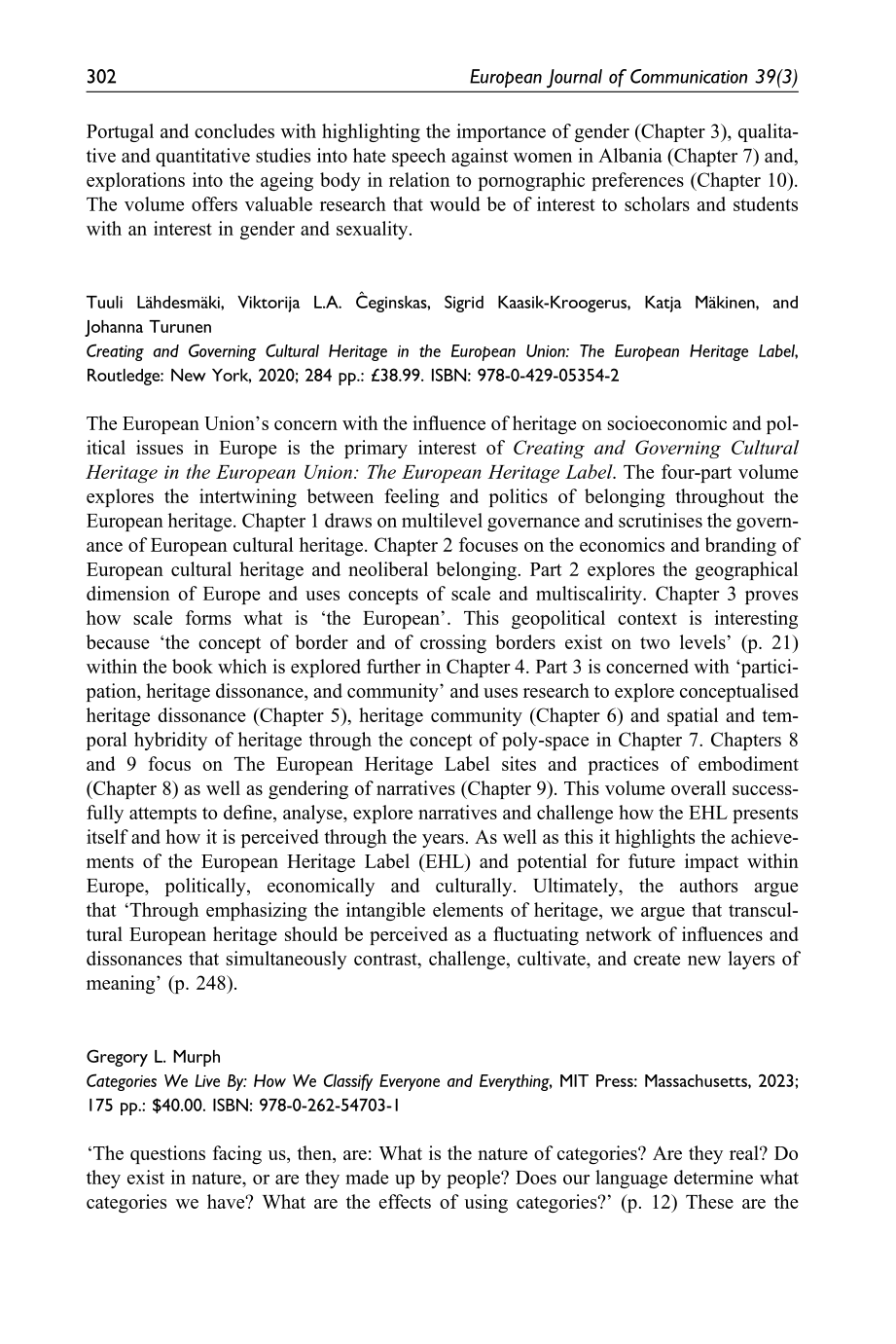
The European Union’s concern with the influence of heritage on socioeconomic and political issues in Europe is the primary interest of Creating and Governing Cultural Heritage in the European Union: The European Heritage Label. The four-part volume explores the intertwining between feeling and politics of belonging throughout the European heritage. Chapter 1 draws on multilevel governance and scrutinises the governance of European cultural heritage. Chapter 2 focuses on the economics and branding of European cultural heritage and neoliberal belonging. Part 2 explores the geographical dimension of Europe and uses concepts of scale and multiscalirity. Chapter 3 proves how scale forms what is ‘the European’. This geopolitical context is interesting because ‘the concept of border and of crossing borders exist on two levels’ (p. 21) within the book which is explored further in Chapter 4. Part 3 is concerned with ‘participation, heritage dissonance, and community’ and uses research to explore conceptualised heritage dissonance (Chapter 5), heritage community (Chapter 6) and spatial and temporal hybridity of heritage through the concept of poly-space in Chapter 7. Chapters 8 and 9 focus on The European Heritage Label sites and practices of embodiment (Chapter 8) as well as gendering of narratives (Chapter 9). This volume overall successfully attempts to define, analyse, explore narratives and challenge how the EHL presents itself and how it is perceived through the years. As well as this it highlights the achievements of the European Heritage Label (EHL) and potential for future impact within Europe, politically, economically and culturally. Ultimately, the authors argue that ‘Through emphasizing the intangible elements of heritage, we argue that transcultural European heritage should be perceived as a fluctuating network of influences and dissonances that simultaneously contrast, challenge, cultivate, and create new layers of meaning’ (p. 248).