




Abstract
Platformization has been used to describe how platforms such as Facebook, Google, Twitter, WhatsApp and TikTok have become increasingly important for how people communicate and access information, including news. But to what extent have news media systems in different countries become platformized? Using online survey data from 46 countries, we show that: (a) although over 90% of internet users use at least one social platform, there are large country differences in the proportion that use them to access news; and (b) large country difference in the proportion that still go directly to news websites and apps. Furthermore, we find (c) that country differences at least partly reflect path dependency, more specifically the historic strength of the newspaper market leading to lower levels of news platformization and continued high levels of direct access. These findings show how platformization varies in different parts of the world, provide a framework for capturing how it changes over time, and highlight the potential benefits of bringing together platform studies and comparative media systems research.
The rise and global expansion of a few big platform companies (e.g. Google, Meta), a number of medium-size and smaller platform companies (e.g. Reddit, Snapchat, Twitter) and, more recently, rapidly growing entrants (e.g. TikTok) and the central role they play in how people access and use information has been described as a process of ‘platformization’. Defined by José van Dijck and her collaborators in their influential work, platformization represents the gradual and variable penetration of economic and infrastructural extensions of online platforms into different economic sectors and spheres of life, as well as the reorganization of cultural practices and imaginations around these platforms, affecting the distribution, circulation, and production of cultural content and forms of expression (van Dijck et al. 2018).
But how pronounced is this penetration, both overall in terms of media use and for specific areas of activity such as news, entertainment, or sport? This is an empirical question. Like ‘globalization’ and other concepts that point to large-scale processes of structural change, the term ‘platformization’ raises questions that require evidence-based answers.
In this article, we present a cross-country analysis comparing the relative degree of platformization of news media systems (treating news as a sub-set of wider media systems) across a diverse sample of 46 different countries to advance our empirical understanding of how platformization is playing out in different societies across the world. We do this to complement a growing body of comparative empirical work examining the role of platforms across different sectors (e.g. Poell et al. 2022a) or inside specific sectors (e.g. Nielsen and Ganter 2022) with cross-national comparative work, and more broadly to contribute to research comparing media systems, which even in recent work (e.g. Brüggemann et al. 2014; Humprecht et al. 2022) has paid no attention to the role of platforms.
Using survey data from the 2022 Reuters Institute Digital News Report and secondary sources for historical data on media use, we develop a preliminary framework for empirically comparing the relative degree of platformization of news media systems structured around three research questions. First, what is the relation between overall use of social media for any purpose and use for news specifically? (To be able to examine the relationship between the overall role of platforms and the penetration into news as a specific form of cultural content.) Second, what is the relation between overall use of social media for any purpose and going direct to news online? (To be able to examine the degree to which overall platformization and the relative weakening of a specific sectors’ owned-and-operated distribution channels are in a zero-sum relationship.) Third, how path dependent is the relative platformization of news media systems? (To begin to understand what causal factors help account for the observed cross-country variation.)
We find that while over 90% of internet users in most of the countries studied use one or more social media platforms regularly—documenting the important role platforms play in all of them—there is wide variation in the proportion that use these platforms for news specifically, and in the proportion that still go directly to news websites and apps. This shows that platform use can be near-universal at the population level even as the relative degree of platformization of a specific cultural sector—in the present analysis, news—varies greatly. In addition to being important in itself to understand how different news media systems are evolving, this also has wider implications as research suggests that while people learn from following the news, including online (e.g. Altay et al. 2023), there are not necessarily any similar benefits from following the news via social media (e.g. van Erkel and van Aelst 2020).
As we will show using historical data on newspaper markets, path dependency provides a starting point for understanding this variation across news media systems, as the historic strength of the printed newspaper industry is highly correlated with the extent to which people today tend to rely on direct access to news websites and apps rather than accessing news via social media platforms. Theoretically, our analysis helps operationalize the concept of platformization for comparative and longitudinal research, and empirically, our findings represent an important contribution to our understanding of platformization, how it varies across the world, and why it varies across countries. We suggest that future work will benefit from bringing together platform studies and comparative media systems analysis, as we do here.
In the first part of the article, we explain how our work builds on a growing body of work on the role of platform companies and connects the study of platformization to long-running work on comparing media systems, thus leading to our three research questions. In the second part, we describe the data our analysis is based on. In the third part, we present our results. In the final, concluding part of the article we discuss the implications of our findings, the limitations of the approach developed, and make suggestions for future research to advance our understanding of how various forms of platformization are playing out across different countries and over time.
Platform studies and comparative media system analysis
Google Search, YouTube (also owned by Google's parent company Alphabet), Facebook, Instagram, and WhatsApp (all three owned by Meta), LinkedIn and Bing (both owned by Microsoft) as well as medium-size and smaller competitors including Reddit, Snapchat, Twitter, and the rapidly growing TikTok, are all examples of platforms that have become very important for how people access and use information and media content including news, and by extension important for the business of news and the wider media system (Bucher 2018; van Dijck 2013; van Dijck et al. 2018; Poell et al. 2022a; Smyrnaios and Rebillard 2019). All of these platforms are examples of products and services owned and operated by for-profit companies with international operations that: (a) enable interaction between at least two different kinds of actors; (b) in the process come to host public information, organize access to it, create new formats for it, and control data about it; and (c) thereby influence incentive structures around investment in public communication (including news production) (Nielsen and Ganter 2022).
Platform studies is the rich inter-disciplinary field of research analysing the role of such platforms, and the companies that run them, in the distribution, circulation, and production of cultural content (Burgess 2021). Starting with game studies and cultural studies (e.g. Bogost and Montfort 2007), followed by broader work into digital media (e.g. Caplan and Boyd 2018; Helmond et al. 2019; Petre et al. 2019; Plantin et al. 2016), scholars have highlighted how the popular and commercial success of platform companies means they have begun to play an infrastructural role in our media systems, carrying with them a range of cultural, economic, and technological logics including programmability, popularity, connectivity, and datafication (van Dijck et al. 2018). More recently, journalism studies scholars have also begun to study the role platforms play in news including in the business (Hindman 2018; Meese and Hurcombe 2020), distribution (Bailo et al. 2021; Nielsen and Fletcher 2022), and production (Dick 2011; McGregor 2019) of news, as well as across the news media as an institution (Nielsen and Ganter 2018; Poell et al. 2022b).
A generative term in the field of platform studies is the notion of ‘platformization’, which—like earlier terms such as ‘televisualization’ associated with the rise of television as a cultural form, mass medium, and media institution—anchors a wide range of issues associated with the rise of platform companies. It includes how the growing popularity of various platforms and their consequent centrality to the distribution of cultural content and communications has implications for how cultural practices are organized, imagined, commercialized, governed, measured and more (van Dijck et al. 2018; Nieborg and Helmond 2019, see also Helmond 2015).
A simple but absolutely central aspect of platformization is the one we focus on here, use. One of the factors that drive and define different degrees of platformization is how widely platforms are used, and an examination of differences between overall use and use for specific purposes (in our analysis, news) across different countries provides a way to empirically base our understanding of the relative degree of platformization of different news media systems.
In doing so, we connect platform studies with the long-running tradition of comparative media system research. Building off early work by Blumler and Gurevitch (1995), and Norris (2000), the nearly two decades since the publication of Daniel C. Hallin and Paolo Mancini's Comparing Media Systems in 2004 has seen a significant evolution of comparative, system-oriented research where the object of analysis is the aggregate total of media in a given country, conceptualized as a system, and compared with other such national systems along one or more key dimensions.
Building off Hallin and Mancini's theoretical and synthetic work focused on comparing media systems across four dimensions (the development of the mass market for news, the degree of political parallelism, the development of journalistic professionalism, and the level of state intervention), more recent empirical work has moved on to compare media systems based on a growing number of indices. In a major step, Brüggemann et al. (2014) operationalized and validated Hallin and Mancini's four dimensions into a wider range of quantitative variables. But even this far more extensive and up-to-date work did not consider digital media, let alone platforms specifically. The first large-scale empirical study to identify, operationalize, and measure indicators of media systems in the digital age is, to our knowledge, Humprecht et al. (2022). But even in this extensive and detailed recent empirical analysis—published almost twenty years after Facebook (2004), YouTube (2005), and Twitter (2006) were launched—only a single general measure of online news reach is integrated into their work, and no variables look at social media or other platforms.
Thus, despite the growing popularity of platforms, and their increasing centrality to many aspects of contemporary media, comparative media system research has so far paid little attention to the role of platforms. (Understandably, perhaps, as with a few exceptions like television blackouts caused by disputes over retransmission fees, the occasional strike disrupting physical production and circulation, and incumbent newspaper publishers’ success in some countries in constraining the distribution and production of freesheet competitors, journalism studies have had few reminders of why infrastructures matter.) To begin the work of addressing this omission, we start here from a key dimension that Blumler and Gurevitch (1995) in their early conceptual work insisted was central to comparing media systems, namely audience behaviour (also central to Pippa Norris’ (2000) categorization of media systems into TV-centric and newspaper-centric). Platform use is an important dimension of media systems both in terms of understanding how the public engages with and uses media in different countries, but also as a key part of the ‘institutionally effective audiences’ that are part of the basis of media institutions both as businesses and, in some countries, as public service or non-profit organizations (Napoli 2011). Platform use, as other forms of media use, also provides an important opportunity to consider the theoretical hypothesis that media systems converge over time as a result of economic and technological forces (as suggested by Hallin and Mancini 2004, though see Nielsen 2013 for empirical data challenging the convergence hypothesis).
To empirically compare the relative degree of platformization of different national news media systems, we take as our starting point social media platforms for two reasons. First, social media platforms represent one of the most important and widely used kinds of platforms (see, e.g. van Dijck et al. 2018, others include computing, ecommerce, gaming, mobile ecosystems, and search). Second, social media are one of the most important platforms for how people find, access, and use online news (Newman et al. 2022).
To develop a cross-national analysis of the relative degree of platformization of news media systems, we examine three research questions.
Our first research question probes the relationship between the overall role of platforms (at the level of the entire media system) and the penetration into a specific form of cultural content (at the level of news specifically)—key questions raised by the notion of ‘platformization’ both generally and for news media specifically (van Dijck et al. 2018; Poell et al. 2022a). It draws attention to the possibility that platforms can play a very prominent role in a media system overall without necessarily being equally important in every sector of the media.
This subsequent research question focuses on the degree to which overall platformization is consistently associated with the relative weakening of a specific sectors’ owned-and-operated channels, and whether platform and publisher distribution are in a zero-sum relationship (as captured in concerns over possible ‘platform capture’, see Nechushtai 2018). It considers whether, empirically, overall platformization is generally associated with a high degree of platformization in a specific sector, here news.
This third and final research question begins the work of identifying factors that might help account for observed cross-country variation. Just as the notion of ‘globalization’ does not automatically mean every country is equally or identically globalized, and ‘televisualization’ does not mean that television was equally dominant or similarly institutionalized in every market, ‘platformization’ is open to empirical variation across both sectors and countries. We focus here on the possible role of historical path-dependency over time on the basis of previous work in comparative media systems research highlighting its importance (Hallin and Mancini 2004; Humphreys 2012; Voltmer 2013), and more broadly, because historical institutionalist approaches from across the social sciences see contemporary systems as the legacy of concrete historical processes where institutions emerge from and are embedded in temporal processes.
Data
To address our research questions, we primarily use data from the 2022 Reuters Institute Digital News Report (Newman et al., 2022)—a large cross-sectional online survey (N ≈ 2000 in 46 countries). The data were gathered by YouGov in January/February 2022, and the same (translated) questions were asked in all countries. Samples were drawn from online panels and were based on nationally representative target quotas for age, gender, education and region—and in a limited number of countries, past vote (see Newman et al., 2022). 1 Just over half (24) of the countries included are from Europe, with 11 from Asia-Pacific, eight from the Americas, and three from Africa. The sample is not random, and the media use measures, which we will introduce below, are all based on self-reports. It is also important to note that this is an online survey and the ability to achieve a representative sample will be influenced by levels of internet penetration, which varies across the sample of countries included (see Table 1). Despite these limitations, the data are still suitable to investigate our research questions.
Countries included in the analysis.
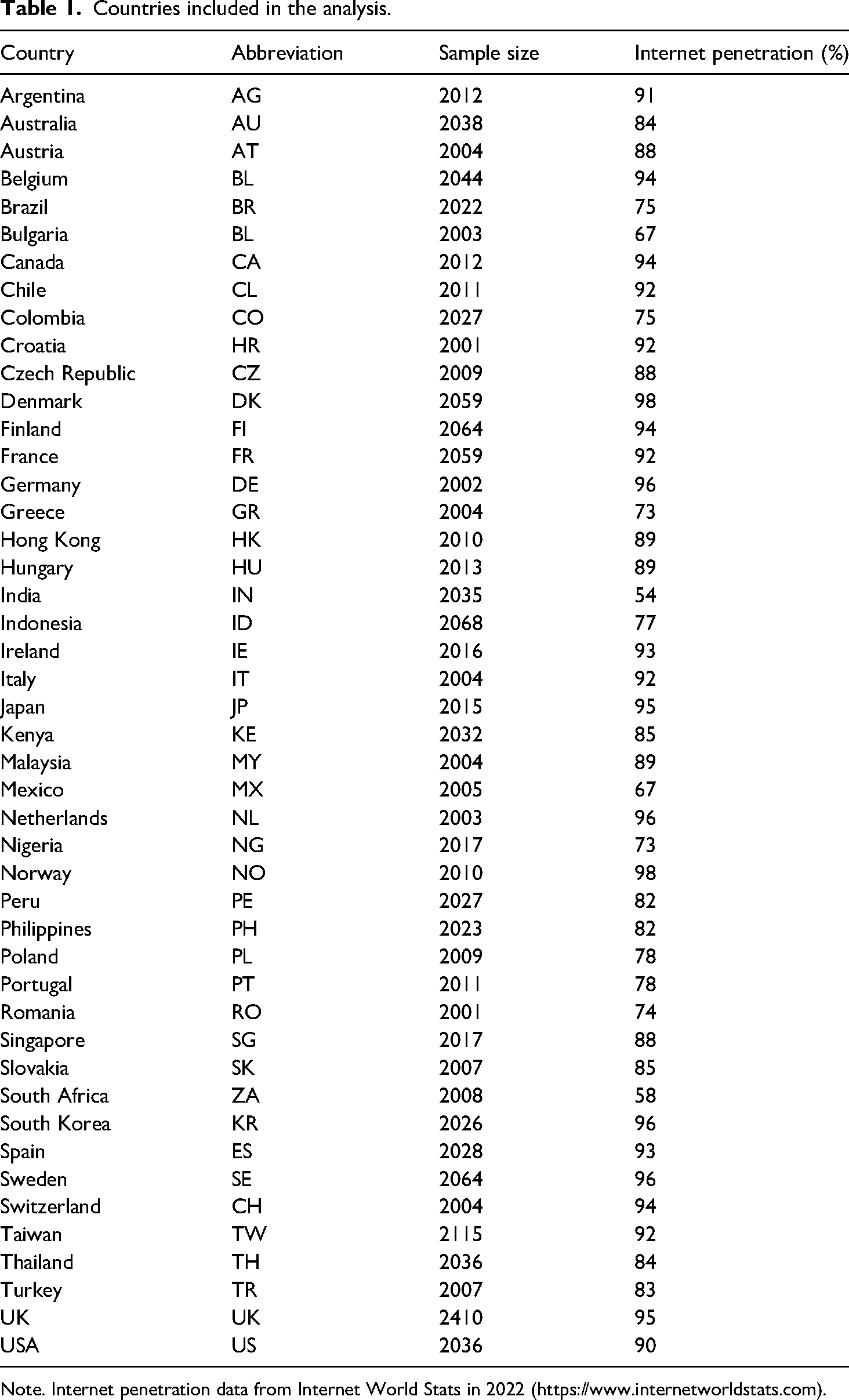
Note. Internet penetration data from Internet World Stats in 2022 (https://www.internetworldstats.com).
The main questions from the survey we will focus on concern social media use (including the use of social media for news) and direct access to online news via news websites and news apps.
The measures of social media use are Q12a: ‘Which, if any, of the following have you used for any purpose in the last week? Please select all that apply’ with respondents provided with a checklist of around 15 social media platforms, broadly defined to include social networks (e.g. Facebook), video hosting (e.g. YouTube) and messaging services (e.g. WhatsApp). Lists were made up of the same core global platforms, with country-specific platforms included where relevant. This was followed by Q12b: ‘Which, if any, of the following have you used for finding, reading, watching, sharing or discussing news in the last week? Please select all that apply’, with all social media selected previously at Q12a listed. These two questions provide data on, first, overall use of social platforms and, secondly, which are used for news specifically.
The measure for direct access to online news via news websites or apps is Q10: ‘Thinking about how you got news online (via computer, mobile or any device) in the last week, which were the ways in which you came across news stories? Please select all that apply’, with respondents provided with a list of options that included using a search engine, a news aggregator, social media, email newsletters, mobile alerts, and going direct to a news website or app (the last of which we use here). This question provides data on, in media systems undergoing different degrees of platformization, the direct connection between news media and the public.
To be able to assess whether platformization in 2022 is path dependent upon the historic popularity and reach of legacy news media, we examine the relation between the above measures and the average circulation of national paid-for daily newspapers before the advent of social media. We focus on newspapers for two reasons. First, newspapers are particularly important parts of news media systems, accounting for the majority of investment in original reporting, and often setting the agenda for broadcasters and other media. Second, previous comparative work has documented greater variation in newspaper circulation than television viewing, and established the historical evolution of newspaper circulation as a defining feature of how news media systems develop over time (Hallin and Mancini 2004). For circulation data, we use the WAN-IFRA World Press Trends database, compiled by the global newspaper industry association from its members (WAN-IFRA 2018). WAN-IFRA provide data on the average circulation of paid-for daily newspapers in 45 of 46 countries covered in the Digital News Report. We use data from 2002, 20 years before the data on online news access form the Digital News Report. In the nine countries where no data is available for 2002, we use the next available year (see Table S1 in Supplementary Materials). To compute per-capita measures, we combine with 2002 population data from the United Nations (2022).
We analyse all 46 markets covered in the 2022 Digital News Report rather than a smaller subsample to avoid the risk of unwarranted generalizations from a few, in a global perspective highly unusual, countries, and to provide scholars interested in any country or region represented among these markets an opportunity to see how particular news media systems compare to others. The quantitative measures we rely on here are not a substitute for, but a supplement to, qualitative research on specific countries and cases, and we believe that such quantitative and qualitative approaches can complement one another in the same way that social science research on, for example, globalization has involved both very specific and nuanced but necessarily circumscribed deep-dives and much more general cross-national comparative analysis of a few key indicators such as international trade and capital flows.
Results
We answer our first research question by plotting the overall use of social media in each country against the use of social media for news specifically. The scatterplot is shown in Figure 1. It shows that—even though almost everyone in every country covered uses social media—the proportion that uses social media for news varies a lot. On average across all 46 countries, 96% of internet users say they use at least one social media or messaging platform. The lowest figure is in Japan (81%), which is something of an outlier, given that the next lowest value is 90% in the US. However, the proportion that say they get news from at least one social platform ranges from 47% in the UK to 99% in Kenya—with an average of 78%. Japan, the US, and countries in Northern and Western Europe typically have the lowest levels of social media news use (between 50 and 75%), whereas in countries in Asia-Pacific, Latin America, and Africa, almost everyone who has access to the internet uses social media for news. However, it should be recognised that these countries also typically have lower levels of internet penetration, with internet access associated with sociodemographic variables that are also positively associated with news use. In other words, while nearly all current respondents in countries with lower internet penetration say they use social media for news, that will not necessarily be the case in the future as internet use grows and becomes more inclusive. In response to our first research question, we find that near-universal widespread use of social media in general does not necessarily go hand-in-hand with high use of social media for news. The ratio of social media users (Q12a) to social media news users (Q12b) ranges from a low of 2:1 in the UK to very near 1:1 in Kenya and the Philippines.
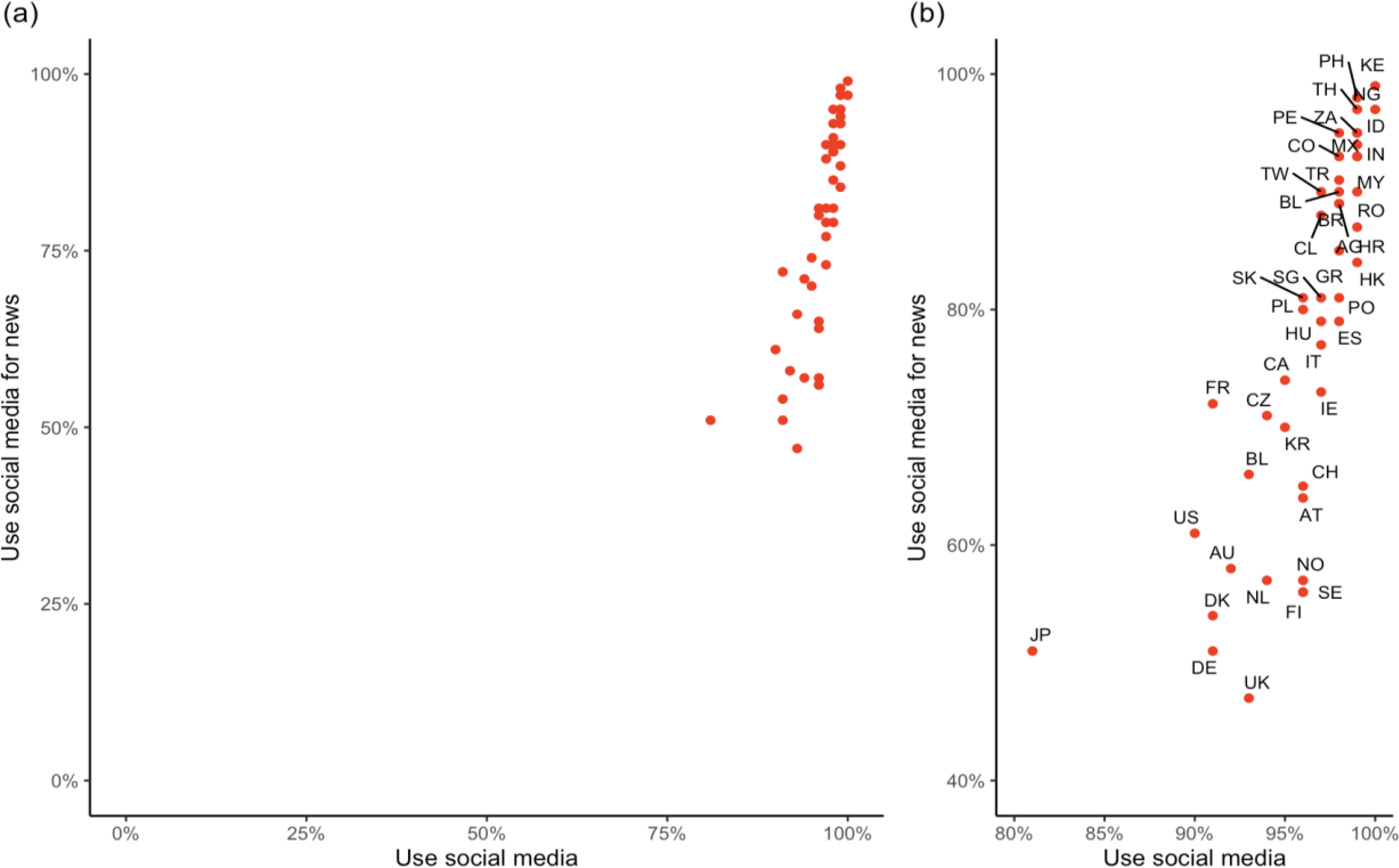
(a) Proportion that use social media plotted against the proportion that use social media for news and (b) zoomed in to show country labels.
Our second research question asked about the relation between overall use of social media and going directly to online news websites and apps. The proportion in each country that do each of these is shown in Figure 2. As in Figure 1, we can see that almost everyone in every country uses social media. However, the proportion that say they access news by going directly to a news website or app varies by country. Finland (71%) has the highest levels of online direct access, ahead of Norway (63%), Denmark (55%), Sweden (53%) and the Netherlands (47%)—followed by other countries in Northern and Western Europe. The lowest levels of online direct access can be found in South Korea (14%) and Japan (17%)—which are home to very popular online news aggregators—and Brazil (19%) and the Philippines (17%)—where news access via social media is widespread. The average figure across countries is 34%. In response to our second research question, we find that near-universal use of social media in general does not necessarily go hand-in-hand with limited numbers of people going directly to news sites or apps for news. The ratio of social media users (Q12a) to news website/app users (Q10) ranges from a low of around 7:1 in South Korea to a high of around 4:3 in Finland.
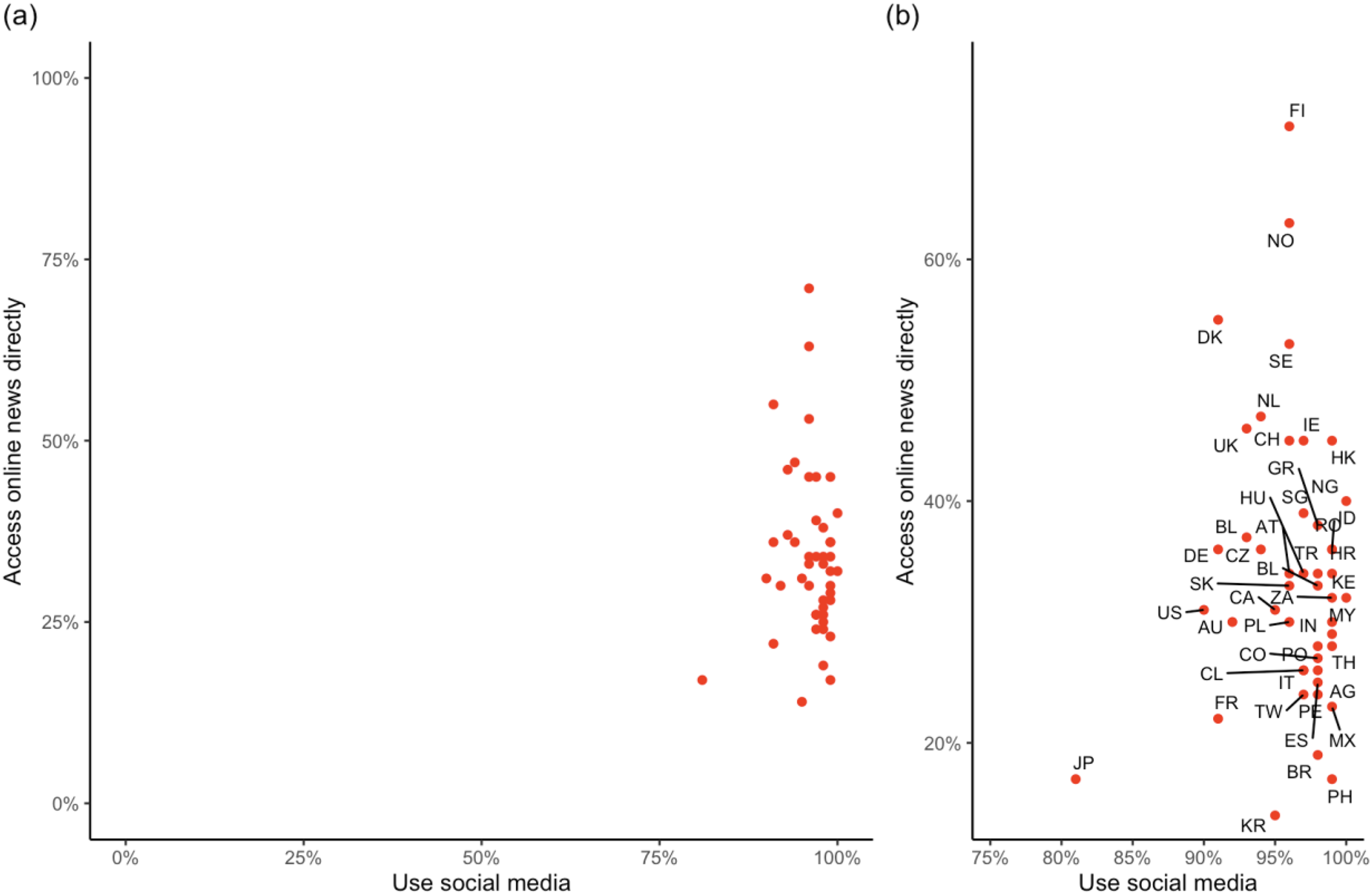
(a) Proportion that use social media plotted against the proportion that access news directly and (b) zoomed in to show country labels.
The results thus far suggest that platformization, which is clearly very pronounced at a general level, has affected news use to different extents in different countries. For our third research question, we now consider factors that might begin to explain this variation. As the platform companies, including their commercial motives and the technological affordances they offer, are largely the same across all the countries covered, we examine the possible role of path dependency, specifically the historic strength of the national newspaper market, measured using the average circulation of national paid-for daily newspapers per 1000 people in 2002. As mentioned above, this is inspired by previous comparative media systems research highlighting the role of path dependency and the particular importance of the newspaper industry. Our sample includes countries which historically had among the highest levels of newspaper circulation in the world (e.g. Norway, Finland, Japan, Sweden, Switzerland) and countries with much lower levels (e.g. Kenya, India, South Africa, Argentina, Romania)—though our sample does not include countries with the lowest levels globally.
We plot historical per-capita newspaper circulation taken from WAN-IFRA World Press Trends against the proportion in 2022 that say they access online news directly in Figure 3(a), and against the proportion that use social media for news in Figure 3(b). These scatterplots support the idea that the level of platformization in each country is shaped by path dependency. At least in our sample of countries, there is a strong positive Pearson's Product-Moment correlation between historic per-capita newspaper circulation and the proportion that currently go direct to online news (r(43) = .62, p < .001) and a strong negative correlation between historic per-capita newspaper circulation and the proportion that use social media for news (r(43) = -.79, p < .001). In other words, countries with higher levels of newspaper circulation historically now have significantly higher levels of direct news access online, and significantly lower levels of social media news use. 2 Thus, in response to our third research question, we find that the relative platformization of news media systems specifically seems partly path dependent on the historic strength and popularity of the newspaper industry—while social media use is widespread in all the countries covered in our analysis, their relative importance for news specifically, as well as how many people go direct to websites or apps for news, vary in ways that correlate with the historic strength of newspapers.
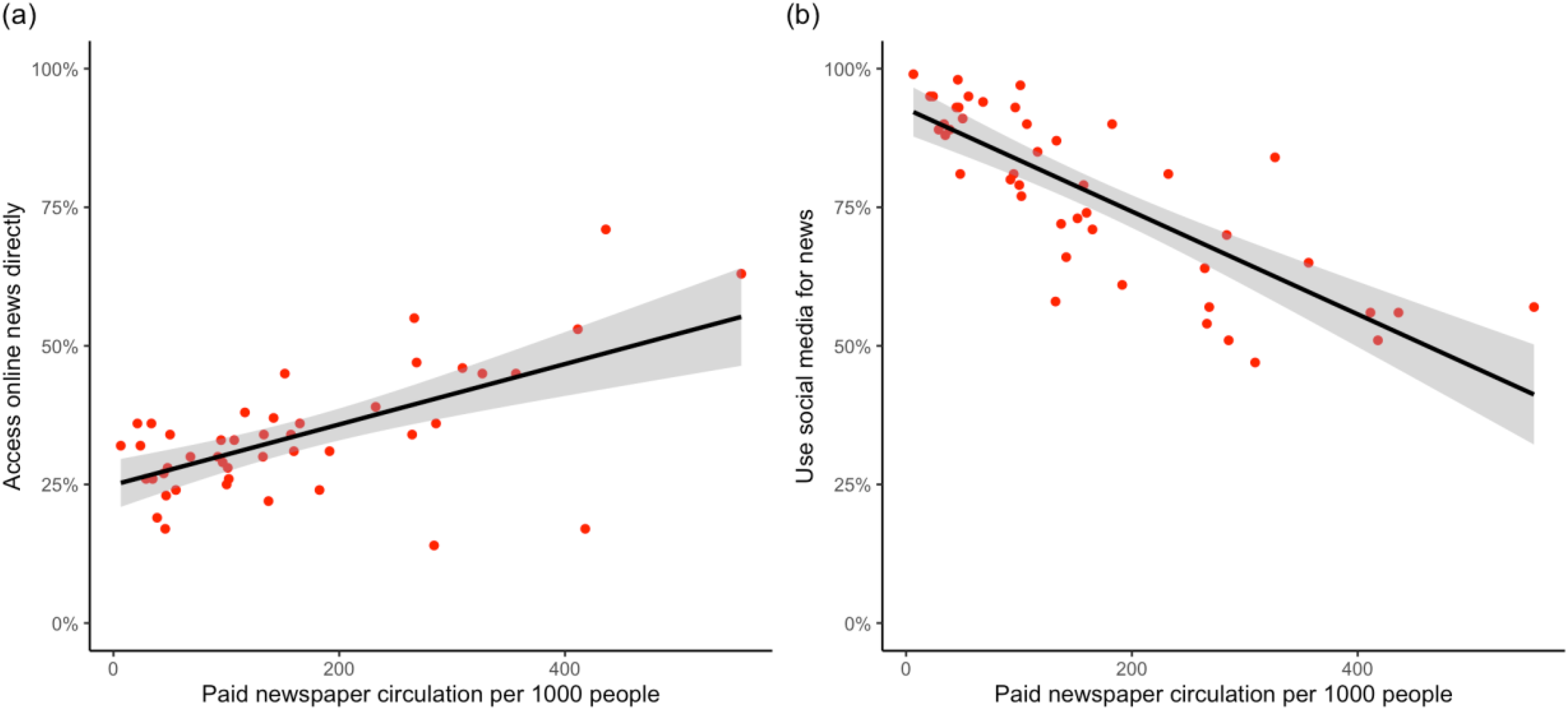
Paid newspaper circulation per 1000 people plotted against (a) the proportion that access online news directly and (b) the proportion that use social media for news.
Concluding discussion
In this article, we have drawn on generative terms from platform studies and taken inspiration from comparative media systems research to conduct an empirical cross-country analysis of the relative degree of platformization of news media systems in 46 different countries across the world. Focusing on social media use, social media use for news, and direct access to news websites and apps we have shown that while: (a) social media use in general is very widespread, (b) there is marked variation in how many use social media for news specifically; and (c) marked variation in how many people go direct to news sites and apps—documenting important empirical variation in how the growth of social media platforms has played out very differently for news media specifically. At least when it comes to distribution—which in turn has consequences for advertising, consumer revenue, data collection, and more—countries with broadly similar levels of overall social media use are platformized to very different degrees when it comes to news.
Our analysis has important theoretical implications for how we think scholars should use the term ‘platformization’—as a generative one, a way to ask questions that require empirical answers. Like other concepts such as globalization or televisualization, platformization at its best is what Herbert Blumer (1954, p. 7) called a ‘sensitizing concept’ which ‘gives the user a general sense of reference and guidance in approaching empirical instances’. If used instead as what Blumer called a ‘definitive concept’ that purports to ‘[refer] precisely to what is common to a class of objects, by the aid of a clear definition in terms of attributes’, it, like other macro concepts, risks leaving scholars insufficiently sensitive to pronounced empirical and contextual variation. Definitive concepts, when not based on comprehensive and exhaustive evidence backed by clearly identified causal mechanisms, foreclose inquiry and risk unwarranted generalizations, whereas sensitizing concepts enable inquiry and call for scholars to continually consider variation and change over time.
Furthermore, our analysis strengthens the argument that how we describe social media (or other platforms) in one place, or a region with commonalities that set it apart from most of the world (like the Nordic countries, or even Western Europe more broadly) should not be understood as a general description of social media universally, but as a case study (Miller et al. 2016). It also helps avoid the assumption that there are ‘models’ that correspond to geographic designations—in our analysis, for example, many countries in much of Europe have more in common with markets on other continents than with the Nordics. It underlines the importance of seeing theoretical concepts as tools for empirical analysis attuned to differences, not as foregone conclusions. Used this way, we believe it can also help enrich comparative media systems research which so far has paid no real attention to platforms.
As José van Dijck and her collaborators have stressed from the outset in their work, platformization is likely to be gradual and variable, vary across sector, and for an overall understanding requires the analysis of production (and its associated political economy), circulation (including content analysis and the like) as well as the distribution that we focus on here. Until proven otherwise, our results here further underline that we should assume platformization will differ across sectors, as well as potentially by level (e.g. local vs. national), and that it will continue to evolve over time. Our analysis also highlights how platform studies can draw theoretical inspiration from comparative media systems research and integrate additional attention to how historical differences and other contextual variation can shape economic and technological forces that are sometimes assumed to drive processes of global media system convergence (Hallin and Mancini 2004).
As noted from the outset, what we have presented is only a preliminary framework for comparing the role of platforms in different media systems, and how that role evolves over time. We hope future cross-national comparative work will benefit from the analysis presented here, and that research examining news specifically will consider a number of additional questions, including how platformization varies across different news media brands (beyond the dominant platform companies, are the ‘winners’ in evolving media systems the same ones who dominated in the past?), how it evolves over time, might be influenced by other forms of path dependency (e.g. the strength of public service media, or degree and kind of state intervention in media markets (including around issues of free expression)) and compares with different kinds of platforms (not just social but also, search engines, news aggregators, etc.). While there are few signs of this happening currently, it also opens up the possibility of future empirical analysis identifying trends towards de-platformization (the same way that, in some cases, scholars have seen waves of globalization followed by de-globalization, and that the rise of linear scheduled television has been followed by its decline).
The present analysis is just one first step towards expanding our cross-country empirical understanding of how the penetration of economic and infrastructural extensions of online platforms into the web affects cultural content. We hope many more will follow.
Supplemental Material
sj-docx-1-ejc-10.1177_02673231231189043 - Supplemental material for Comparing the platformization of news media systems: A cross-country analysis
Supplemental material, sj-docx-1-ejc-10.1177_02673231231189043 for Comparing the platformization of news media systems: A cross-country analysis by Rasmus Kleis Nielsen and Richard Fletcher in European Journal of Communication
Footnotes
Declaration of conflicting interests
The author(s) declared no potential conflicts of interest with respect to the research, authorship, and/or publication of this article.
Funding
The author(s) disclosed receipt of the following financial support for the research, authorship and/or publication of this article: This research was supported by Google UK as part of the Google News Initiative.

Supplemental material
Supplemental material for this article is available online.
Notes
References
Supplementary Material
Please find the following supplemental material available below.
For Open Access articles published under a Creative Commons License, all supplemental material carries the same license as the article it is associated with.
For non-Open Access articles published, all supplemental material carries a non-exclusive license, and permission requests for re-use of supplemental material or any part of supplemental material shall be sent directly to the copyright owner as specified in the copyright notice associated with the article.
