



Abstract
The article discusses the negotiations surrounding the treatment of journalistic content in relation to content regulation in the context of the European Union's Digital Services Act. News media organisations lobbied for a privileged treatment of editorial content from platforms’ content moderation systems during the Digital Services Act's negotiations in the European Parliament, which came to be known as ‘non-interference principle’. Although the principle did not make it to the final version of the Digital Services Act, a provision related to the respect of media pluralism and media freedom by platforms was added. This article draws data from in-depth interviews with stakeholders, as well as from an analysis of legal and communication documents. It aspires to shed light on the political-economic tensions that shaped the final version of Digital Services Act and how the European Union attempted to integrate the asymmetric relationship between news media and platforms in its regulatory agenda.
Keywords
Introduction
Amongst the many debates concerning how online platforms’ content should be governed, one is particularly telling of the political stakes at play: how editorial content should be treated by platforms’ content moderation systems, especially related to editorial independence (van Drunen and Fechner, 2022). This article focuses on recent regulatory developments in the European Union (EU), namely its holistic proposal to regulate online platforms’ content governance procedures with the Digital Services Act (DSA; EP and EUCO, 2022). Specifically, this article aims to untangle the debate concerning a now-rejected proposal (Bertuzzi, 2021) put forth, principally, by the news media industry to include a ‘media exemption’ or a ‘non-interference principle’ 1 in the DSA, which would provide privileged treatment to editorial content from platforms’ content moderation practices.
The key components of the proposed principle were articulated by proponents as follows: (a) restriction of platforms to meddle with editorial content; (b) establishment of dedicated communication channels between platforms and news organisations to rectify wrongful content restrictions and be informed a priori of any changes in their algorithm; and (c) integration of the respect for media freedom and pluralism in platforms’ terms and conditions. This article draws, primarily, upon interview data with insiders and stakeholders, who participated in the negotiations either formally (e.g. through the European Commission's consultations) or informally (e.g. through lobbying). In addition, it also draws upon a document analysis of several legal (i.e. the DSA and other regulatory or legal texts) and communication material (i.e. policy proposals of lobbyists or blog posts of involved parties).
The driving research question for this publication is: how has the EU attempted to integrate the relationship between platforms and publishers in its strategy to regulate online content governance? The case study presented here serves as an illuminating example regarding, on the one hand, the political tensions that shaped the final version of the DSA, along with the prominent role that lobbying centres play in the European policymaking process. On the other hand, it shows how European policymakers attempted to alleviate some of the risks elicited by the power asymmetry found in the relationship between news media organisations and platforms (Nielsen and Ganter, 2022). While the now-rejected proposal was far from perfect, changing over time depending on the negotiations’ fluctuations, it erred in the right direction insofar as it attempted to address an important aspect of platforms’ power over opinion shaping processes (Helberger, 2020).
Finally, the article's findings demonstrate how the platformisation of journalism and the increasing pressure put on news media organisations by online platforms (Papaevangelou, 2023) have given a new dynamic to the age-old question of what constitutes a media (Deuze, 2005). EU legislators mainly base the foundation of their regulatory interventions on a broad definition of media as publishers of information who have the editorial control over that process. Though, the identity of news media and journalism is in constant negotiation with other institutional actors and objects, as well as the technological advancements (Lewis, 2015). Thus, the discussion around a media privilege related to platforms’ content moderation also speaks to the existential process of journalism's identity.
The relationship between news media organisations and platforms
A plethora of scholarly work has, in recent years, engaged with the increasingly complex relationship between journalists and platforms. Some researchers have tackled the issue from the perspective of editorial autonomy in light of online platforms’ algorithmic and automated content curation (Simon, 2022), others from the perspective of integrating platforms’ services in their editorial processes (Nielsen and Ganter, 2018) and what implications this holds for journalists’ dependency on platforms (Nechushtai, 2018; Nielsen and Ganter, 2022; Schiffrin, 2021), while some have studied how journalists have been negotiating their (in)dependence from platforms’ tools and infrastructures (Chua and Westlund, 2022).
This article is specifically focused on digital communication platforms with distinct characteristics of social networking sites, namely platforms that are important for cultural production and the dissemination of information, including news (Nielsen and Ganter, 2022: 13), like Alphabet (Google and YouTube) and Meta (Facebook, Instagram and WhatsApp). Digital platforms are digital intermediaries in multisided markets that have, in recent years, transformed into infrastructures for many an industry (Plantin and Punathambekar, 2019). An online platform is defined ‘as a programmable digital architecture designed to organise interactions between users - not just end users but also corporate entities and public bodies’ (van Dijck et al., 2018: 4). Additionally, Poell and others have framed the notion of platforms as ‘data infrastructures that facilitate, aggregate, monetise, and govern interactions between end-users and content and service providers’ (2022: 6).
The relationship between news media organisations and platforms has been characterised as a conflicting one, yet with mutual benefits, with some calling it as one consisting of ‘frenemies’ (Radsch, 2022). For instance, in interviewing relevant stakeholders, Nielsen and Ganter collected accounts of journalists and news industry executives, who – early in the previous decade – felt that they were benefitting from sharing their content through social media and search engines (2022: 6); idem for platforms’ executives, who have ‘insisted on mutual benefits’, albeit in the form of ‘mutual self-interest’ (2022: 126). As they note, ‘when platforms successfully enable potentially mutually beneficial interactions between large numbers of different individual users and various third parties, they create markets that can realise such gains from trade’ (Nielsen and Ganter, 2022: 106).
Content moderation and journalism
The point concerning platforms’ content moderation is of particular importance to this article. Indeed, as Gillespie writes, ‘platforms must, in some form or another, moderate’ (Gillespie, 2018: 13) and, the larger the platform, the larger the difficulty of moderating at scale (Gillespie, 2020); hence they rely on automated solutions with tangible risks for fundamental rights (Suzor, 2020). As Zuckerman and York have written, content moderation has proven to be an ‘existential threat’ for ‘both platforms and the networked public sphere’ (2019: 137). This much became evident during the early phase of the COVID-19 pandemic, where platforms’ employees, as well as their content moderation contractors, who are often employed in precarious conditions in developing countries (Roberts, 2019), were working from home, which caused turbulence in platforms’ scaled content moderation (Magalhães and Katzenbach, 2020).
Two examples from relevant scholarship help us to understand the existing risks of platforms’ content moderation related to editorial content. First, Gillespie has written of a Norwegian journalist, who got his Facebook account restricted for having shared an article containing the iconic ‘Napalm Girl’ photograph of Nick Ut because Facebook's content moderation team had identified it as a violation of its community guidelines (2018: 8–9). Secondly, Papaevangelou and Smyrnaios have detailed a ‘content moderation debacle’ that unfolded in 2021 in Greece, where a dozen of Greek journalists, who were covering a politically charged and controversial topic, had their Facebook accounts arbitrarily restricted (2022a).
Subsequently, the dependency of news media organisations on online intermediaries for many of their editorial processes (Sebbah et al., 2020) has had implications on how their content is governed beyond the remits of their offline or online news stores. This type of dependency has induced, as critical media scholars Caplan and boyd note, an ‘isomorphism’, whereby news media organisations become dependent on dominant platforms and, thus, more vulnerable to changes elicited by the latter without the former's control (2018: 5). Therefore, there exists a critical influence exerted by sociotechnical intermediaries on our capacity to deliberate online, which is primarily expressed through platforms’ content governance processes. This becomes even more apparent when this influence is exerted on journalists, who have traditionally acted as informational gatekeepers in democratic societies (Nielsen and Ganter, 2022: 37).
Consequently, this article aspires to contribute to an undertheorised facet of platform governance, namely how power and dependencies are negotiated among stakeholders, who partake in deliberations that shape how our digital public spheres are governed (Napoli, 2019; Seeliger and Sevignani, 2022). It does so by focusing on a particular moment of friction, where these relations emerge clearly, to explore how these stakeholders antagonise one another to secure their way of governing, interests and power.
Methodology
This article draws upon 23 semi-constructed interviews conducted with expert stakeholders (Table A1) and an analysis of relevant communication and policy documents. 2 Specifically, interviews helped me gather insightful data about the scope, objectives and nuances of the DSA. Though, as the story was developing while I was conducting my interviews, which can be a limitation in and of itself, I had to constantly adjust my questions. To this end, I also conducted follow-up interviews with news industry stakeholders who had intimate knowledge of the story. The interview data were, then, thematically analysed to generate themes and codes (Braun and Clarke, 2021). This approach requires not only descriptive but interpretative work, ‘evaluating the ‘underlying ideas, assumptions, and conceptualizations’ (Braun and Clarke, 2006: 84).
For instance, interviewees from the news industry were favourably biased regarding the proposed amendments, which must be accounted for in the analysis. To ensure a balanced representation of all sides in my analysis, I examined policy and documentation material published by or in collaboration with relevant stakeholders (e.g. civil society organisations or industry lobby groups). This allowed me to contextualise developments in platform regulation in their legal and political context, to understand the discourse used by involved stakeholders and to fill in the gaps created by the relatively limited number of data gathered through interviews that specifically spoke to this case study due to a relative lack of coverage and constant changes. Finally, I created an indicative table categorising the involved parties’ opinion about the non-interference principle (i.e. positive, negative or sympathetic) based on an interpretive analysis of the data collected (Table A2).
The non-interference principle and a European tug-of-war
The DSA is a proposed EU legislation that aims to regulate the European Digital Single Market, including online platforms and services (Buri and van Hoboken, 2021: 7). It was proposed alongside the Digital Markets Act in December 2020 as a way to overhaul the EU's online content governance and regulation (Heldt, 2022: 70). The DSA is practically the successor of the 2001 e-Commerce Directive, which protected intermediaries from liability for illegal activities on their services (EP and EUCO, 2001: arts. 14, 15). In addition, it aims to address legal fragmentation and regulatory gaps caused by unilateral measures adopted by EU Member-states (Buri and van Hoboken, 2021: 7).
In short, the DSA establishes a horizontal framework for all intermediaries, with more obligations for Very Large Online Platforms (VLOPs) and Very Large Online Search Engines (VLOSEs). It includes, among others, provisions on moderating illegal content, transparency obligations, opportunities for researchers to access platform data, and the creation of new authorities to implement and enforce the DSA's obligations, and introduces regulatory backstops for self-regulatory frameworks (Buri and van Hoboken, 2021; Heldt, 2022).
The DSA's final version was published in the Official Journal of the EU on 19 October 2022 3 and entered into force on 16 November 2022, just two years after it was proposed by the Commission 4 . This, in and of itself, demonstrates the EU's willingness to act fast despite common criticism regarding its authorities’ reaction speed. This new regulation does not specifically address journalism or news media, as the Commission's strategy is to draft ad hoc regulations to tackle sectorial issues.
Furthermore, the DSA is a regulation aimed at introducing due diligence obligations for online intermediaries regarding how they tackle illegal online content and some forms of content that are characterised as ‘systemic risks’, like ‘disinformation or manipulative and abusive activities’ (EP and EUCO, 2022: rec. 104), which ought to be tackled with respect to fundamental rights. It must be noted that the final text, among others, adds media freedom and pluralism to the fundamental rights that digital platforms must respect, which was missing in the initial version proposed by the Commission. As a result, the DSA will likely, even if indirectly, affect news media organisations as well, namely vis-a-vis platforms’ content moderation policies. For instance, the new obligation for VLOPs and VLOSEs to carry out risk assessments might prevent platforms from imposing unilateral and abrupt changes to their recommendation or personalisation algorithms, as happened with the infamous ‘Facebook Live Saga’ (Nielsen and Ganter, 2022: 141).
It would be beneficial, at this point, to introduce the debate around the non-interference principle, which saw European policymakers and lobbyists engage in a tug-of-war over it (Figure 1).
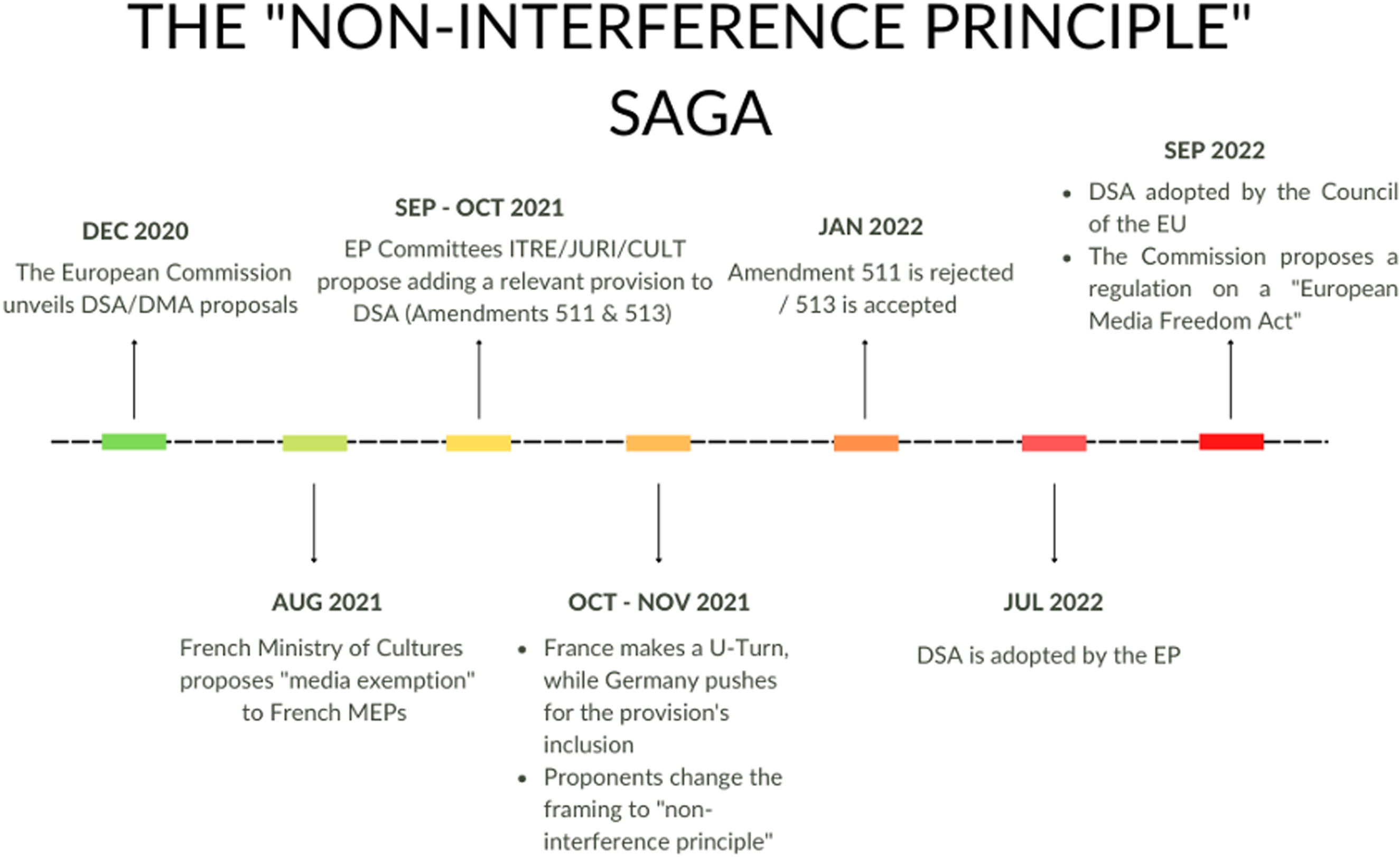
The timeline of the ‘Non-Interference Principle’ Saga (credits: author).
First, the debate concerned Article 12 – currently Article 15 5 – of the DSA, which in its original version introduced responsibilities as to how online intermediaries compose and enforce their terms and conditions. Initially, the principle itself was, reportedly, proposed by the French Ministry of Culture through French Members of the European Parliament (MEPs) and the DSA's own Rapporteur, MEP of the Social Democrats party, Christel Schaldemose, who was also in favour of the proposed amendment (Bertuzzi, 2021; Interview #14). While Germany backed it as well, reports also claim that French officials quickly changed their minds out of ‘fear that the proposal would open the door to foreign interference [and] growing resistance from the ministries of foreign affairs and defence’, and joined other stakeholders in opposing the suggested principle (Bertuzzi, 2021).
In September 2021, the Committee on Industry, Research and Energy of the European Parliament (EP), along with MEP of the European People's Party (EPP)
6
Henna Virkkunen as its opinion's Rapporteur, proposed the following amendment to Article 12 of the DSA: platforms shall not remove, disable access to, suspend or otherwise interfere with [content of press publications] or the related service or suspend or terminate the related account based on the alleged incompatibility of such content with [their] terms and conditions. (Art. 12b)
7
This is what, effectively, came to be known as the non-interference principle, with the main argument being that editorial content should not be subject to double scrutiny as it is already bound by sectoral regulation, ethical standards and editorial processes.
Similarly, in September 2021, the Committee on Legal Affairs, with EPP MEP Geoffroy Didier as its opinion's Rapporteur, proposed that platforms refrain from fiddling with editorial content (Recital 106a). Following suit, in October 2021, the Committee on Culture and Education of the EP, along with EPP MEP Sabine Verheyen as its opinion's Rapporteur, proposed similar amendments and, in addition, introduced another suggestion to be implemented in the DSA, which would oblige platforms to notify news media organisations of any changes to their terms and conditions and algorithms, as was expressed in Articles 2(1) (q.a.) 8 , 7(a), 12(a) and Recital 38. Each opinion, thus, had a slightly different approach to the matter, which did not help consolidate a clear framing of the proposed principle.
At the same time, news industry lobbyists gradually changed their wording and opted for the use of the ‘non-interference principle’ over ‘media exemption’ to alleviate criticism, especially after convening with sceptics and opponents of the principle (Interview #19). As Ms. Raoux stressed: saying that the DSA would provide for a media exemption is a bit confusing; I'd rather talk about a non-interference principle […] because we think that the media companies abide like any other company to laws of all the member States […] but not the laws that the platforms will make for themselves. (Interview #14)
Ms. Schroeder, representing journalists rather than publishers, agreed with that position albeit with more reluctance, while reiterating ‘what we all agree on, is that we do not want to have any arbitrary takedowns’ (Interview #17). Ditto for Mr Petillault, representing the largest association of French publishers, who argued that ‘if we keep moderating content on the basis of terms and conditions, [with] no judge to intervene […] it's the Wild West’ (Interview #18).
So, we could summarise the principle in three key components: (i) restriction of platforms to meddle with editorial content; (ii) establishment of dedicated communication channel between platforms and news organisations to rectify wrongful content restrictions, as well as to inform a priori the latter of any changes that would affect the visibility and circulation of their content; and (iii) integration of respect for media freedom and pluralism in platforms’ terms and conditions.
In particular, the suggestions were solidified in the final proposed text of the DSA as Amendments 511 and 513 to Recital 38 and Article 12 of DSA, respectively 9 : the former, which was rejected, demanded platforms to ‘promptly’ inform media of any content moderation decision before its implementation and allow them to challenge it beforehand, while the latter, which was accepted, added a provision for online platforms to respect fundamental rights, including media freedom and pluralism, as enshrined in Article 11 of the Charter of Fundamental Rights of the EU 10 . Notably, the rejected Amendment 511 seems to have been a compromise that had been put forth by the German Permanent Representation to the EU in October 2021 (Bertuzzi, 2021).
The core of the opposition comprised experts, civil society organisations and fact-checking groups dealing with disinformation. The latter feared that creating carve-outs for editorial content could construct a loophole for bad actors to take advantage of the immunity and propagate deleterious content to European citizens. One of the central actors of this camp, EU Disinfolab, a non-governmental organisation tackling issues related to disinformation, organised a campaign to mobilise influential figures, like Facebook whistleblowers Frances Haugen, policymakers and others, to voice their opposition against the proposed amendments 11 (Interview #19). Alongside the disinformation experts, policymakers, civil society advocates and researchers also took a critical stance against the proposed principle. For instance, Věra Jourová, Vice President of the European Commission for Values and Transparency, placed the proposal ‘in the box of good intentions leading to hell’ 12 .
Despite not achieving explicit protection of editorial content from content moderation in the DSA, the news industry lobbyists saw positively the fact that they managed to have such a public debate for a provision that was missing from the Commission's initial proposal (Interviews #13, #14, #21 and #22). Also, the newly unveiled European Media Freedom Act (EMFA) stipulates in Article 17(2) that platforms should ex-ante inform media organisations about their decision to restrict or suspend content that they deem incompatible with their terms and conditions, which is closely related to the rejected DSA Amendment 511, albeit without the possibility of ex-ante challenge. Markedly, news media associations were also pushing for an amendment of Article 17 13 of the DSA regarding platforms’ internal complaint-handling mechanisms, so that journalists could have access to a fast-track appeal process; this did not come to pass (Interview #19).
The media definition conundrum
The problem, according to opponents of special treatment of news content was, primarily, the broad definition of media, which could offer protections to malicious actors, providing a ‘blanket exemption’ for editorial content, as was initially suggested by the EP's committees. Indeed, one of the recurring topics brought up in the interviews conducted was the problem of defining what constitutes a news media organisation. In recent years, the EU has provided high-level definitions of media to underpin EU-wide media-related regulation, because ‘media laws and cultural policies are still highly determined at national level’ (Interview #14). Specifically, the current legal framing of news media in the EU is largely based on a combination of three definitions:
‘Press publications’, which, according to Article 2(4) of the Directive 2019/790 on copyright and related rights in the Digital Single Market (EP and EUCO, 2019), are ‘journalistic publications, published in any media, including on paper, in the context of an economic activity that constitutes a provision of services under Union law’ ‘Media Service Provider’, which, according to Article 2(2) of the EMFA (EC, 2022), refers to ‘a natural or legal person whose professional activity is to provide a media service and who has editorial responsibility for the choice of the content of the media service and determines the manner in which it is organised’ ‘Audiovisual media services’, which, according to Article 1(a) of the Audiovisual Media Service Directive (EP and EUCO, 2018), are ‘devoted to providing programmes, under the editorial responsibility of a media service provider, to the general public, in order to inform, entertain or educate, by means of electronic communications networks’. the exercise of effective control both over the selection of the programmes or press publications and over their organisation, for the purposes of the provision of a media service, regardless of the existence of liability under national law for the service provided.
It seems, thus, that any service in any form that provides informative, entertaining or educative programmes and holds the editorial responsibility for that content is recognised as a media service provider under EU law. Additionally, editorial responsibility is also crucial to both the definition of news media and this paper: Article 2(9) of EMFA defines it as a self-regulatory process referring to:
Furthermore, interviewees from the news industry expressed concerns about having one narrow, legally binding definition, but acknowledged the need to reconsider this in view of upcoming media-policy regulation. For instance, Renate Schroeder said that the European Federation of Journalists does not wish for a definition of journalism because it is a ‘free trade’. However, she added, ‘with EMFA […] it may be very important to have this exercise of what is media’ (Interview #19).
Nonetheless, stakeholders agreed that a legal definition of media, with the prospect of offering them protections vis-a-vis state or platform power, ought to be as broad as possible to cover the most vulnerable professionals, like freelancers. Thus, the conundrum with legally defining media is that, on the one hand, this should be broadly encompassing to protect as many professionals as possible and, on the other hand, this same framework might create loopholes for bad actors to exploit, something that was used as the predominant argument of those who opposed the non-interference principle. In the next section, we introduce the debate around the principle, discuss how this played out and delineate the two opposing stakeholder camps.
Moreover, the most common actors named by opponents of the principle were Russian media (RT, Sputnik and Tass) and France Soir (Interviews #14 and #19). To that end, proponents decided to change the framing of their proposal, as mentioned earlier. But it was probably too little too late, as the other camp had already solidified the term ‘media exemption’ in the public discourse, which resonated more strongly with policymakers who, even before the illegal invasion of Ukraine by Russia, did not want to risk the creation of legal loopholes. Additionally, opponents argued that such amendments would create further ‘bureaucratic’ burdens for platforms, who would have to comply with a series of steps before dealing with problematic content (e.g. disinformation around COVID-19) and would, thus, breach other DSA's obligations to weed out the said content and, at the same time, cause them to hesitate to remove content that could turn out dangerous 14 .
Notably, the initial version of the DSA already included three provisions (Articles 15, 17 and 18 15 ), which required platforms to: (i) inform users that their content has been affected by a content moderation decision along with its rationale; (ii) provide users with the possibility of appealing a decision; and (iii) provide users with the necessary information to settle out-of-court a challenge concerning that decision. What is more, in the final version of the DSA, these provisions were expanded to include all nuances of content moderation actions, like restricting the visibility of content.
Other counterarguments presented by proponents were that content that was deemed illegal would not be covered by the principle. But some proponents proposed demonetising that content, in line with the revamped Code of Practice on Disinformation (EC, 2021: para. 4.1; Interview #14). They also argued that policymakers should turn their attention to how the organisations spreading such information were accredited to operate in the EU 16 in the first place and, thus, that it was up to Member-states to reconsider the legal framework, instead of leaving platforms to decide the legality and validity of editorial content (Interview #14).
However, as ‘disinformation is just much trickier [than illegal content]’ (Interview #23), policymakers were not convinced that such an amendment should be included in the DSA because it was beyond the remit of the proposed regulation, which envisioned to, primarily, set procedural obligations for platforms’ content moderation mechanisms (Interviews #5 and #11). To that end, the Commission left more sectorial issues, like the one discussed here, to be regulated either through co-regulatory codes of conduct (i.e. the new Code on Disinformation) or other regulations (i.e. EMFA; Interviews #8 and #21).
Consequently, one principal reason for the exclusion of a provision that would fiddle with the governance of editorial content on online platforms was the agenda of the Commission and the EU, specifically regarding the scope and goals of the DSA. Put simply, the Commission did not wish to expand it in a way that would give off the wrong message and instead of making the DSA a ‘one solution fits all’ framework, wanted to have distinct regulatory frameworks for specific content.
As a Commission staffer told me: in the [DSA] it is pretty clear that the removal of content focuses on illegal content, whereas for any other types of harm, we are departing from the content-specific point […] but we are looking at how systems […] are propagating societal harms. (Interview #14)
As such, it made sense for policymakers to avoid inscribing specific rules for editorial content into the DSA, as was suggested in the rejected Amendment 511 and, conversely, implement Amendment 513, which focused more on platforms’ systemic behaviour related to governance (i.e. their Terms and Conditions). It could be, then, that the proponents of the ‘non-interference principle’ knew that it was a long shot to have such a provision adopted but wished to make it part of the public debate to legitimise their push for a sector-specific regulation vis-a-vis the treatment of editorial content in online content governance, as it happened with the EMFA.
The case concluded with a compromise: proponents succeeded in adding respect for media freedom and pluralism in platforms’ terms and conditions, while opponents succeeded in fending off more specific protection of editorial content. Nevertheless, the fact that special treatment of editorial content returned in EMFA indicates that proponents might have scored another point in that tug-of-war, as well as that the Commission did not wish to overextend the DSA's scope beyond illegal content and certain types of systemic risks.
Concluding remarks
Many scholars have theorised about a new structural transformation of the public sphere in the age of platformisation and how this has impacted the role of established news media or, more broadly, journalism (Habermas, 2022; Seeliger and Sevignani, 2022; Staab and Thiel, 2022). Yet, the same attention has not been paid to the negotiation of power between platforms and journalists, in particular, concerning the governance of the latter's content. Seeliger and Sevignani noted how professional journalists are nowadays ‘increasingly bypassed as gatekeepers’ (2022: 10). Indeed, the domination of platforms that rely on user-generated content has led to a ‘[pluralisation] of public spheres’ where the ‘number of concerns fed into the public discussion process’ is increased, contrary to when traditional media were more easily able to set the agenda (Seeliger and Sevignani, 2022: 10–11).
This much is partially echoed by Habermas, who posited that ‘a democratic system is damaged’ when the ‘infrastructure of the public sphere can no longer direct the citizens’ attention to the relevant issues that need to be decided’ (2022: 167). Though, Habermas seems to ‘[reproduce] the criticism of the development of filter bubbles and echo chambers as an effect of algorithmic dispersion’ (Staab and Thiel, 2022: 133), he does point out the importance of editorial processes in distributing information that is valuable for democratic deliberation, especially compared to how platforms curate and serve content (Habermas, 2022: 159).
So, then the question quickly arises: what happens when these editorial processes are undermined by platforms’ automated way of curating content (Seeliger and Sevignani, 2022: 11)? As noted in the introduction, this has also revived existential questions about the identity of media or journalism. Despite this being a constantly negotiated process, legislators are called to act fast to deal with current challenges, like the increased dependencies and power asymmetries that exist in the relationship between platforms and news media, which impact the governance of our digital public sphere.
As a result, proposals like the non-interference principle are far from perfect but they are erring towards the right direction. Certainly, a blanket exemption could prove disastrous but stronger regulation, like the one envisioned in EMFA; concerning how platforms moderate content, especially the kind that is vital for democratic deliberation like news, is timely considering the ongoing structural transformation of the public sphere. Who gets to partake in its governance is crucial to the public interest.
Consequently, this case study's findings suggest that another chapter in the ever-evolving relationship between news media organisations and online platforms is unfolding before us. As such, leaving it up to opaque models of governance is not only problematic but can also be dangerous (Zuckerman and York, 2019: 155). Hence, it is through contestations like the one presented here that we can achieve more robust regulatory frameworks, as well as a deeper understanding of the political-economic interests at play. The main limitations of this work stem from the difficulty of studying a phenomenon in flux and the lack of access to more people who were directly involved in the negotiations.
Future research should look at how EMFA and other recent regulations have attempted to reframe the issue of editorial content's privileged treatment, as well as the broader stakes of the relationship between platforms and news media regarding platform governance and our digital public spheres. One other important theoretical aspect to investigate would be the impact of this evolving relationship on the negotiation of journalism's identity, in the context of multiple regulatory interventions across the world.
Footnotes
Acknowledgements
I would like to express my gratitude to the editors of the European Journal of Communication and the guest editors of this Special Issue, Nikos Smyrnaios and Olivier Baisnée, for organising an exceptional symposium in Toulouse and for providing me with valuable feedback. Additionally, I would like to thank the peers who attended the symposium and shared their thoughts with me, further contributing to the improvement of this article. Finally, I would like to thank the people who agreed to be interviewed as part of this study.
Author's note
Charis Papaevangelou is also affiliated at the Institute for Information Law, University of Amsterdam, The Netherlands.
Declaration of conflicting interests
The author(s) declared no potential conflicts of interest with respect to the research, authorship, and/or publication of this article.
Funding
The author disclosed receipt of the following financial support for the research, authorship, and/or publication of this article: This work was supported by the H2020 Marie Skłodowska-Curie Actions (grant number 76514).

Notes
Appendix
List of proponents and opponents of a non-interference principle.
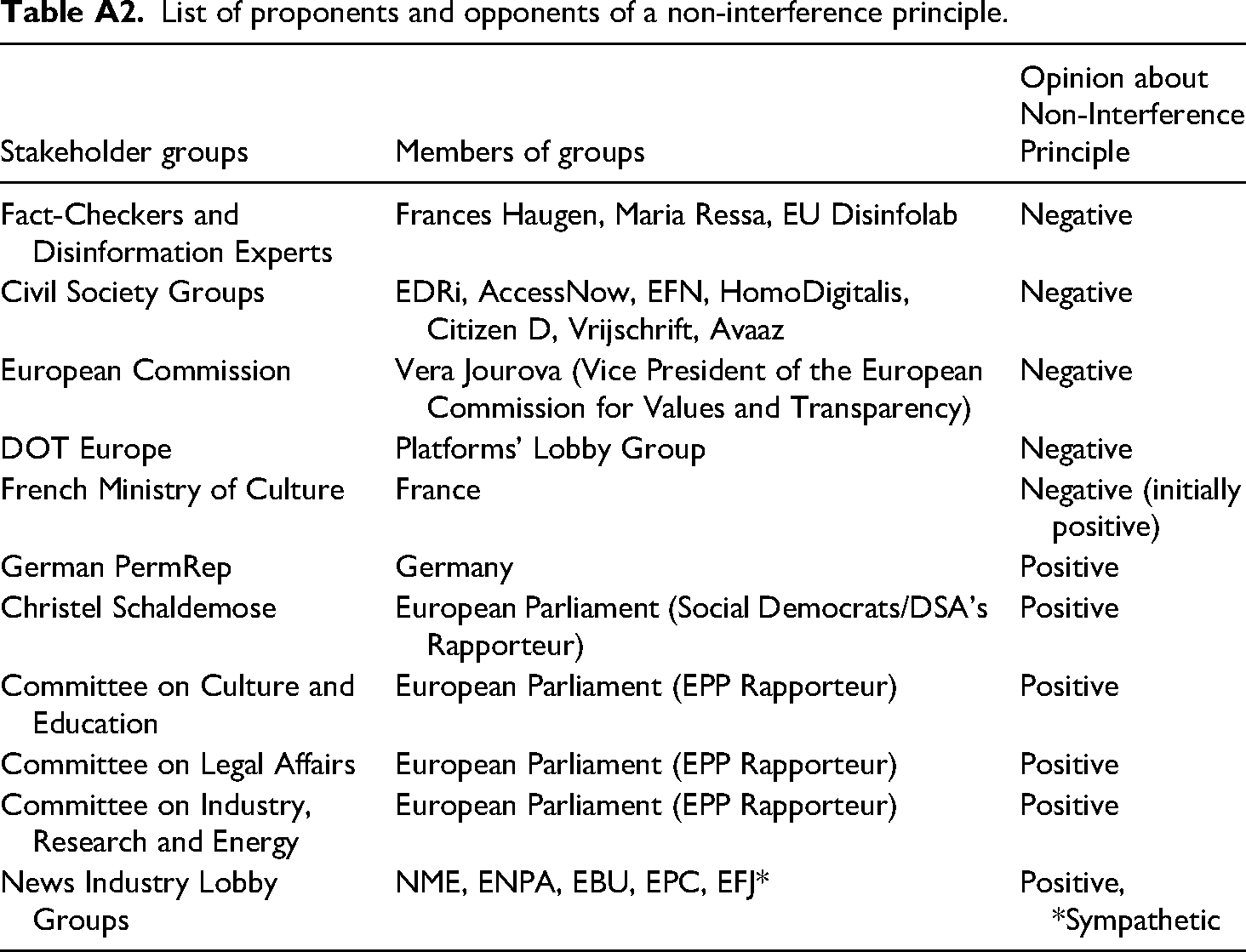
| Stakeholder groups | Members of groups | Opinion about Non-Interference Principle |
|---|---|---|
| Fact-Checkers and Disinformation Experts | Frances Haugen, Maria Ressa, EU Disinfolab | Negative |
| Civil Society Groups | EDRi, AccessNow, EFN, HomoDigitalis, Citizen D, Vrijschrift, Avaaz | Negative |
| European Commission | Vera Jourova (Vice President of the European Commission for Values and Transparency) | Negative |
| DOT Europe | Platforms’ Lobby Group | Negative |
| French Ministry of Culture | France | Negative (initially positive) |
| German PermRep | Germany | Positive |
| Christel Schaldemose | European Parliament (Social Democrats/DSA's Rapporteur) | Positive |
| Committee on Culture and Education | European Parliament (EPP Rapporteur) | Positive |
| Committee on Legal Affairs | European Parliament (EPP Rapporteur) | Positive |
| Committee on Industry, Research and Energy | European Parliament (EPP Rapporteur) | Positive |
| News Industry Lobby Groups | NME, ENPA, EBU, EPC, EFJ* | Positive, *Sympathetic |