



Abstract
This article investigates to what extent technological affordances are associated with people's preference for video streaming platforms over traditional television services. Such affordances refer to properties of these platforms (including personalized recommendations and easy-to-navigate interfaces) that provoke certain uses of the technology and satisfy social and psychological needs. Based on a quantitative study of 25–50-year-olds in Belgium (N = 596) and a hierarchical regression analysis, the study builds further on the conceptualization of technological affordances as presented in the MAIN model, which suggests that four affordances (Modality, Agency, Interactivity and Navigability) are central to digital media technology. As such, the study presents an affordance-based measure of video streaming platforms, and helps to understand how video streaming technology shapes new patterns of audiovisual consumption and enhances the viewing experience beyond that of traditional television. Whereas most research attention has focused on user-oriented gratifications of video streaming platforms, this study addresses a gap in the literature by dealing with platform-oriented gratifications of video streaming platforms.
Introduction
Despite the looming threat of subscription fatigue, analyst PwC (2021) forecasted that by 2025 the number of video streaming subscribers will have grown beyond 1.5 billion and hit a market penetration of 18.2%. This popularity of video streaming platforms such as Netflix and Disney + marks the breakthrough of connected viewing, which challenges our conventional understanding of how screen media is created, circulated and consumed (Holt and Sanson, 2014). Besides transforming the economic structures of the television broadcasting industry, this era of connected viewing brings about a massive shift in media consumption patterns, leading to a viewer experience that is fundamentally different from viewing practices developed for traditional forms of television distribution. Evens et al. (2021) pointed to the structuring role of video streaming platforms in audiovisual consumption and claimed that for a growing proportion of the viewing population, these platforms start to act as the primary entry point. Not only does the supply of exclusive, high-quality series act as a magnet to attract subscribers, but these platforms would also offer more convenient navigability, interactivity and recommendation engines than traditional television services.
According to Lotz (2017), the technological affordances of video streaming platforms encourage an enhanced viewing experience that is quite different from previous forms of television distribution. Such affordances refer to properties of video streaming platforms that provoke certain uses of the technology to satisfy emerging social and psychological needs. Internet-distributed television facilitates a shift away from collective and linear viewing to more individualized viewing practices and the self-scheduling of audiovisual programming. In contrast to linear scheduling strategies, streaming technology would offer mass customization and deliver tailored content recommendations to viewers (Evens and Donders, 2018; Jenner, 2018). Hence, the viewing experience of streaming becomes more personalized, and highly driven by algorithmic software and easy-to-navigate interfaces. Though streaming platforms’ enormous investments in original content suggest quality content is central to the business model of streaming platforms, pay-television services also provide exclusive and premium content, including the latest movies, series and, especially, live sports. According to Johnson (2019), however, technological affordances that enable personalization, flexibility and control for viewers genuinely differentiate streaming video platforms from traditional television services.
Based on a quantitative study of 25–50-year-olds in Belgium (N = 596) and a hierarchical regression analysis, this study reveals to what extent these assumed technological affordances lead consumers to replace traditional television services with streaming platforms. The study builds further on the conceptualization of technological affordances as presented in the MAIN model, which suggests that four affordances (Modality, Agency, Interactivity and Navigability) are central to digital media technology (Sundar, 2008). By adjusting and applying the framework to the specific context of video streaming platforms, the study provides an affordance-based approach to video streaming uses and gratifications, and helps to understand how video streaming technology shapes new patterns of audiovisual consumption and enhances the viewing experience beyond that of traditional television.
To date, a profound understanding of technological affordances has not been adequately integrated into the large body of literature covering the uses and gratifications of video streaming platforms. Whereas most attention has focussed on user-oriented gratifications (i.e. social and psychological motivations such as information-seeking, relaxation or habitual viewing) that are fulfilled by consuming video streaming platforms (e.g. Camilleri and Falzon, 2020; Hou et al., 2020; Hsu et al., 2020; Steiner and Xu, 2020; Tefertiller and Sheehan, 2019), platform-oriented gratifications have hardly been dealt with in the video streaming literature, or at least only partially (Lüders and Sundet, 2021; Tefertiller and Sheehan, 2020). Sundar and Limperos (2013) made a convincing plea to put more focus on the technology of the medium and the gratifications that arise from it. By focusing on the platform-oriented gratifications of video streaming technology, enhanced by algorithms, easy-to-navigate interfaces and curated libraries, this article expands the current theoretical framework of uses and gratifications.
Technological affordances of video streaming platforms
The uses and gratifications approach is typically concerned with the social and psychological origins of needs that are satisfied by media consumption (Katz et al., 1974). Since the early 1970s, uses and gratifications have been a salient theory to examine motivations for television viewing, leading to different gratifications linked with television viewing (Greenberg, 1974; Katz et al., 1973; McQuail et al., 1972, Rubin, 1983). Although more sophisticated video technology expanded the number of channels and media choices over time, the bulk of uses and gratifications research continued to build further on a similar set of rather broadly defined social and psychological needs that were equally applied to, among others, cable television (Donohew et al., 1987; Williams et al., 1985) and video streaming (Pittman and Sheehan, 2015; Sung et al., 2018; Tefertiller and Sheehan, 2019).
Sundar and Limperos (2013) showed there is considerable overlap between the gratifications for traditional and newer media, which is largely the result of the audience-centric nature of uses and gratifications research. All too often, uses and gratifications research has put emphasis on individual differences and active audiences to explain media consumption rather than specific technological features of media that trigger people's media behavior. Hence, there is a need to broaden the focus of uses and gratifications research beyond the social and psychological origins of needs (user-oriented gratifications) and consider technological features of media as a source of gratifications (platform-oriented gratifications). Similarly, Ruggerio (2000) suggested to expand current theoretical models of uses and gratifications research and to examine properties of new media technology, such as interactivity, demassification and asynchronity that would transform media consumption, social habits and roles. Video streaming technology may lead to a more enhanced viewing experience, which raises the question of to what extent and which of these affordances influence our preference for video streaming platforms.
These properties of video streaming technology refer to technological affordances, a concept that originates from perceptual psychology and is based on the idea that the design of artefacts and their interface features suggest relevant and desirable actions for their users (Gaver, 1991; Gibson, 1977). The concept of affordances has become increasingly influential in media and communications research, especially related to social media (e.g. Bucher and Helmond, 2018; Circucci, 2017; Ronzhyn et al., 2022). Affordances enabled by internet-distributed television allow people to experience audiovisual programming in more interactive and personalized ways. In this context, algorithmic platforms through their recommendation systems shape which content consumers discover, select, share and watch (McDonald and Smith-Rowsey, 2016). In general, Sundar (2008) identified four classes of technological affordances – Modality, Agency, Interactivity and Navigability – in digital media that together form the MAIN model and lead to a number of platform-oriented gratifications. Hereunder, each of these affordances is discussed and applied to the context of video streaming platforms (see Table 1).
Technological affordances.

Modality
Streaming video platforms offer a number of modalities that are distinct from those offered by traditional television. Modalities refer to methods of presenting and organizing content (e.g. text, videos, pictures). Although Amazon provides linear channels, content is generally not presented in schedules, but as part of a curated library classified under different themes or genres. In an almost saturated market, consumers may be looking for something spectacular, unique or at least distinctive. This way, streaming's offering is rather distinct from traditional television, for example, by the release of entire seasons of series to promote binge-watching or the absence of interrupting advertising breaks (Jenner, 2017). This brings us to the first technological affordance: distinctiveness.
Moreover, the (partially debunked) myth that the commissioning of series like House of Cards were the product of algorithmic decision-making was instrumental in building the image that Netflix was innovative and revolutionary (Havens, 2014). In this context, streaming platforms that are stylish, hip and cool may attract a lot of consumer interest Now-defunct Quibi entered the streaming market with its mobile video platform and Turnstyle feature that let consumers easily switch between portrait and landscape viewing modes. Future novel features using voice recognition, gesture interfaces or 8 K resolution video quality may also drive people to video streaming platforms. Hence, novelty is, therefore, identified as a second technological affordance.
Agency
In contrast to traditional television which leaves viewers with the limited agency, video streaming platforms offer numerous ways to customize the viewing experience (Lotz, 2017). Personalized services are largely automated with data-driven algorithms recommending movies or series according to users’ preferences and tastes. Streaming platforms do so by collecting a vast amount of data about viewing patterns, location, search history or ratings that generate unique insights about viewing behaviour and the customer value. Offering such a level of customization would lead to a higher level of agency and engagement, and increases subscriber retention, just because viewers enjoy an experience that reflects their needs (Kübler et al., 2021). As discussed later, this notion of enhanced agency is contested by, among others, Cox (2018), who claims streaming platforms exploit an illusion of agency and steer viewing behaviour rigidly. Nevertheless, customization is selected as a third technological affordance.
Moreover, streaming services enable community building and social bonding. Johnson (2019) pointed out that framing internet-distributed television as a cause of fragmented and individualized viewing is too simplistic: togetherness continues to stay an important factor in the streaming era. While video streaming may have a stronger component of individualized viewing, it remains a collective activity in many ways (Lüders and Sundet, 2021). People consider talking about television programmes as a way of social bonding and building social capital. Some fear streaming destroys the ‘water-cooler’ effect of traditional television, which is based on people talking about the same shows they have seen at the same time. But audiovisual consumption via internet-distributed television remains a social activity and appears to be a common topic in daily conversations. Spurred by second-screen viewing and social media, online conversations enrich the experience of streaming in ways that are analogous to the appointment television era (Samuel, 2019). Streaming platforms are aware of this social dimension and developed functionalities such as Teleparty or Watch with Friends so that people can watch series virtually together and start online conversations about the shows they are watching. Community building is, therefore, identified as a fourth technological affordance.
Interactivity
Video streaming platforms are said to provide a more interactive viewing experience, in which consumers have more control over which content they want to see when (time-shifting) and where (place-shifting). Audiovisual consumption is no longer bound by fixed schedules provided by television broadcasters but has become much more flexible as technology has progressed. Interactivity is reinforced by platform properties that are said to provide consumers with a sense of control over their own decisions and actions, which enhances the usefulness and likeability of the platform (Kirk et al., 2015). Netflix promotes itself as the future of television and as a service in tune with consumer needs by using terms such as ‘user freedom’ and ‘active audiences’ (Burroughs, 2019). Viewers can, among others, select content from different categories, add favourite shows to their personalized watchlist (My List) to view them later, and skip the intro or the cap of previous episodes. Control is then seen as a fifth technological affordance.
Although these practices of platform mobility and individualized media consumption may mark the ‘on-demand culture’ of audiovisual consumption (Tryon, 2013), social live streaming platforms such as YouTube or Twitch allow nearly professional, full-time streamers to broadcast shows (or gameplays) in real time to their fans and provide interactive affordances including chat features and co-action to get in touch with the streamer. These functionalities create communal experiences and incentivize participation and engagement (Spilker et al., 2018). According to Ko et al. (2005), a high level of interaction with a platform produces positive associations with that platform and increases the continuation of platform usage. For this reason, interaction is identified as a sixth technological affordance.
Navigability
Whereas traditional television involves a zapping experience largely determined by the schedules set by broadcasters, this linear flow is generally replaced by a circular flow, in which the viewer becomes the centre of the system (Marinelli and Andò, 2017). Viewers are given the possibility to browse massive libraries of content and discover new series and movies. The feeling of almost infinite scrolling, adopted by Netflix, creates the impression of an endless content offer and is said to create a superior user experience (Wang et al., 2016). Additionally, algorithmic interfaces and menus create streaming flows and guide viewers through the massive amount of content available. Certain shows and genres enjoy higher visibility in the menu, usually promoting the original series commissioned and owned by the platform, and are recommended to the viewers. Browsing is, therefore, selected as a seventh technological affordance.
Some of these platforms also offer auto-play functionalities, which automatically shows the next episode of a series once the previous one is finished. Others experiment with shuffled playlists and randomly starts a series or a movie the personalization algorithm thinks their viewers will love. These functionalities help to create a frictionless and joyful experience. Superior navigability affordances may lead to play gratification, arising from the fun element and ease of use. Escapism and immersion induced by the affective state of play result from streaming interfaces that afford a continuous sense of content exploration and smooth transitions. This brings us to the eighth, and final, technological affordance: play.
Method
Sampling
Data were obtained through a quantitative survey study targeting 25–50-year-olds. Respondents were recruited through a panel from market research company Bilendi. When recruiting respondents, the survey study was framed as research about traditional television and streaming platforms. Responses were processed anonymously and confidentially, and respondents were assured that they could end their participation at any given time. No personal details (name or e-mail address) were collected.
Quota sampling was used to retrieve a total sample representative of the population. Of this total sample of 1206 respondents, only those with a subscription to a streaming platform were retained for this study (subsample of N = 596). To assess any bias in our sub-sample regarding age, gender and education, the subsample was compared with the remaining respondents without a streaming platform subscription (N = 610). No significant differences were found with regard to age (t = −0.36; p = .72) and education (p = .24). In contrast, our subsample contained significantly more women than men
Measures
The measurement instrument consisted of a structured questionnaire. The first part included socio-demographic questions (e.g. age, gender, education marital and domestic situation). The second part contained questions about viewing behaviour, more specifically how often they watch content on traditional television or streaming platforms. Furthermore, respondents were asked about the number of subscriptions, and recent purchases, renewals or cancellations of these subscriptions. The third part consisted of questions addressing the different technological affordances of video streaming platforms, which are discussed below.
The dependent variable of this study is one's preference for streaming platforms over traditional television, which we refer to as preference. The intention for the displacement of traditional television by streaming platforms was measured using three items from Tefertiller (2018). A five-point Likert scale ranging from strongly disagree to strongly agree was utilized to test respondents’ agreement with each statement. The measure was highly reliable (α = .87, M = 2.43, SD = 0.94).
The study's main independent variables, technological affordances of streaming platforms, were measured on a five-point Likert scale, ranging from strongly disagree to strongly agree. The measures were adapted from the original items suggested by Sundar and Limperos (2013) and put into the specific context of video streaming platforms. As shown in Table 2, most constructs have satisfactory Cronbach alpha values except for distinctiveness (α = 0.65), play (α = 0.67) and control (α = 0.59), falling slightly below the customary .70 threshold. However, distinctiveness and play were retained as they meet the .60 threshold that is found acceptable for exploratory research (see Hair et al., 2010). Below we discuss our measures in more detail.
Measures.
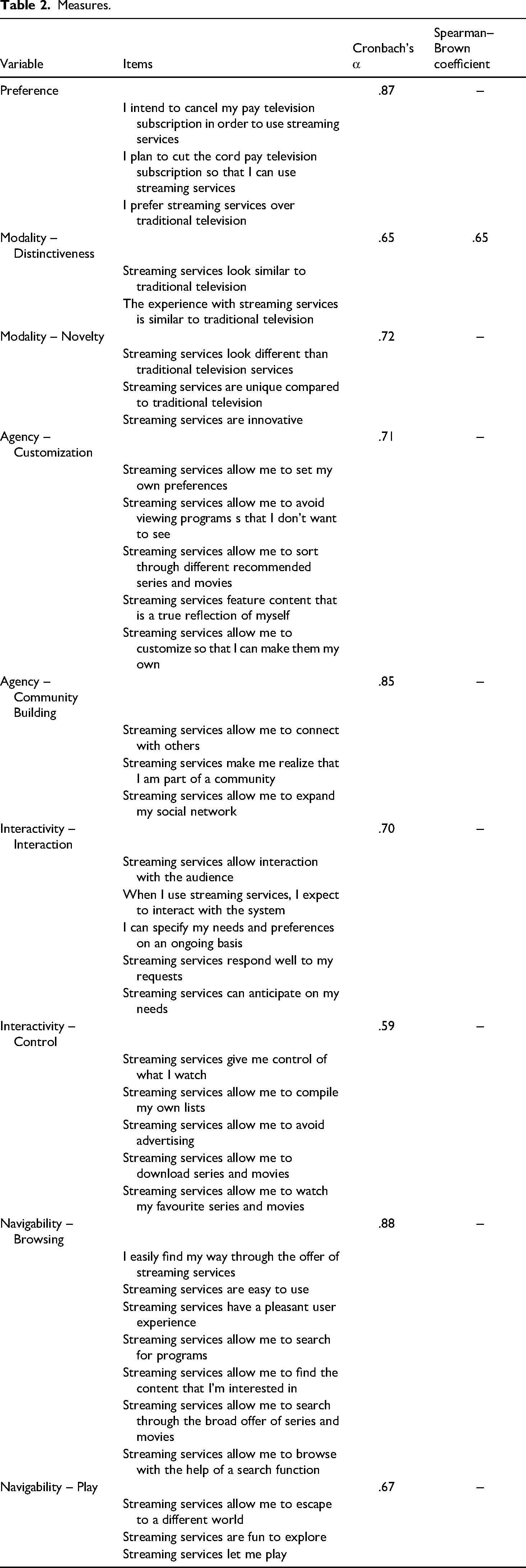
Distinctiveness relates to the fact that video streaming services provide a different viewing experience than traditional television services. The construct was measured by two items adapted from Flavián and Gurrea (2007). Given that we are using only two items for this measure, we performed an additional reliability assessment using the Spearman-Brown coefficient, as recommended by Eisinga et al. (2013). The measure was reliable (α = .65, Spearman–Brown coefficient = .65, M = 3.20, SD = 0.91). Novelty refers to the innovative and stylish features of video streaming services and was measured using three items from Sundar and Limperos (2013). The measure was reliable (α = .72, M = 3.67, SD = 0.72). Customization relates to the personalization possibilities of video streaming services and was measured using five items from Sundar and Limperos (2013). The measure was reliable (α = 0.71, M = 3.75, SD = 0.57). Community building relates to the social character of video streaming services and was measured by three items adapted from Sundar and Limperos (2013). The measure was highly reliable (α = 0.85, M = 2.28, SD = 0.92). Interactivity relates to the possibilities for viewers to interact with and through the platform and was measured by five items (Sundar and Limperos, 2013). The measure was reliable (α = 0.70, M = 3.20, SD = 0.57). Control was measured by five items, but the construct failed to reach an acceptable level of reliability (α = 0.59). Because of its low consistency, control was left out of the further analysis. Browsing enables users to move through the streaming platform and was measured by seven items. The measure was highly reliable (α = 0.88, M = 3.98, SD = 0.57). Play refers to the fun aspect of the user experience and was assessed using three from Sundar and Limperos (2013). The measure was reliable (α = 0.67, M = 3.58, SD = 0.73).
Data analysis
The data were analysed using SPSS and R. Multiple linear regressions were used to assess the association between technological affordances as the independent variables and preference for video streaming services as the dependent variable. We controlled for gender, age, and level of education. The level of statistical significance was set at p = .05. Prior to reporting the results of the multiple regression analysis, multicollinearity among independent variables was evaluated.
Results
Descriptive statistics
A detailed overview of the sample can be found in Table 3. The mean age of respondents is 36.01 (SD = 7.89). Women account for 53.0% of the respondents, and 69.8% of the respondents have a degree of higher education (bachelor’s or master’s). All age categories are substantially represented, but the 25–30 and 36–40 are least represented. Overall preference for streaming platforms over traditional television is 2.33 (measured on a five-point scale) and thus relatively moderate. 88% of the respondents have access to basic pay-television services, 11% subscribe to premium movie channels and 10% to premium sports channels. Netflix is the most popular streaming service (58%), and Disney + and local service Streamz have a penetration rate of 20% and 10%, respectively.
Descriptives.
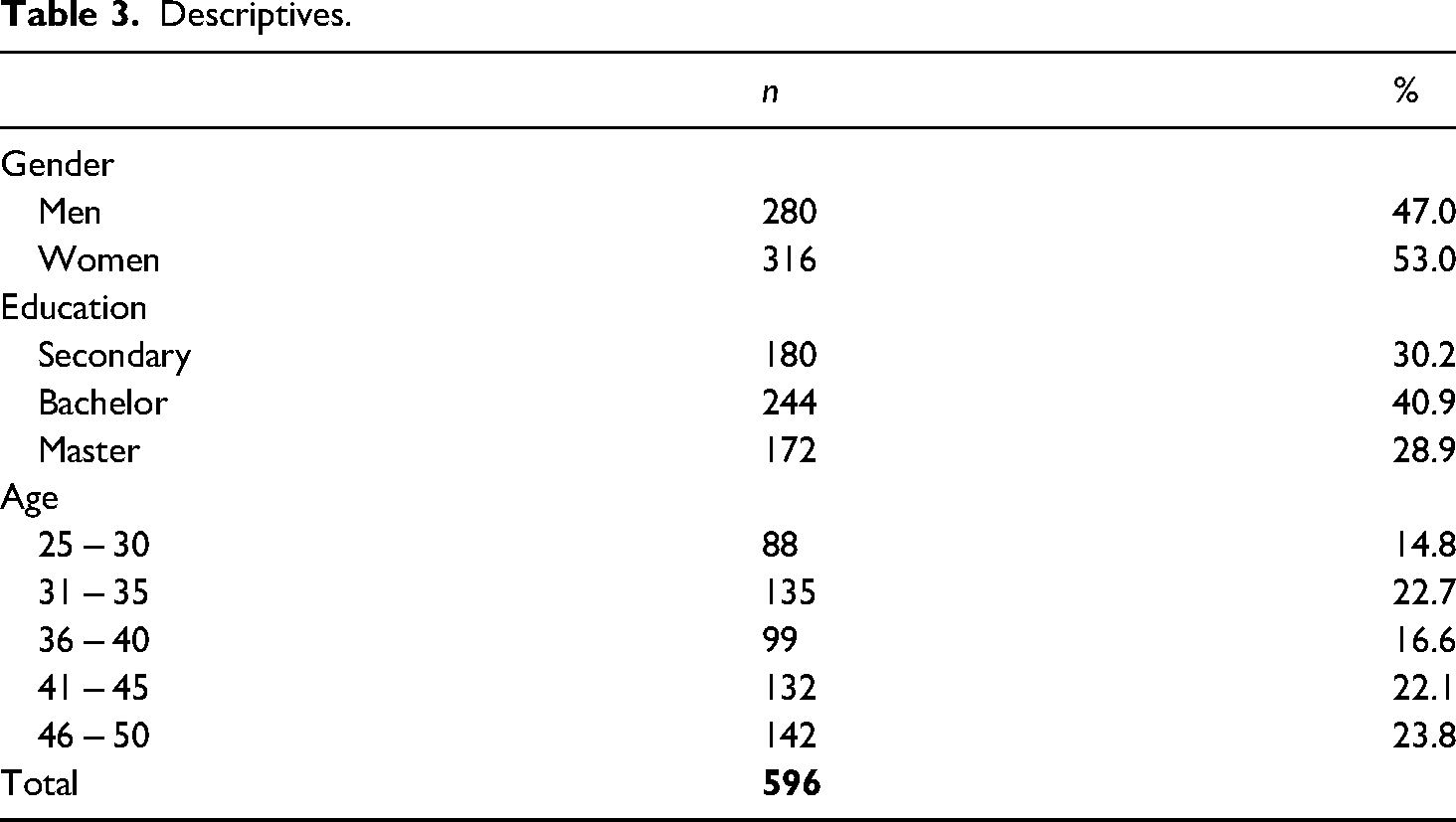
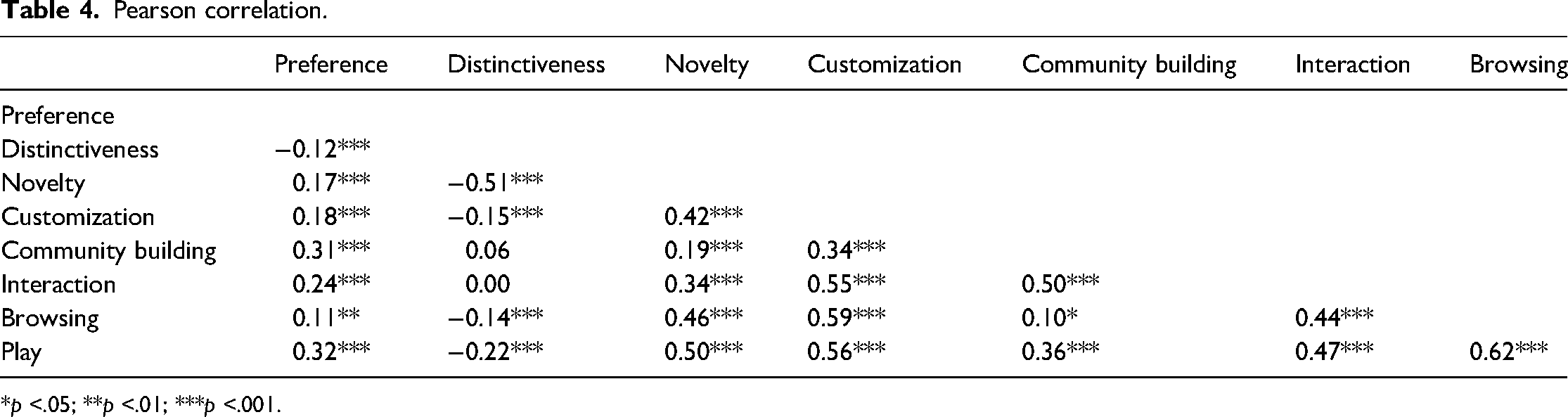
Gender has no statistically significant impact on preference (Welch t-test, t = 1.66, p = .1). Similarly, no effect on level of education (one-way ANOVA, F = 0.32; p = .32) was found. In contrast, age is negatively associated with preference (Pearson correlation, r = −0.13, p = <.001) meaning that younger consumers have a higher preference for streaming platforms and are more eager to replace traditional television services with streaming. Table 4 presents the Pearson correlation indices, showing statistically significant relationships between all affordances and preferences. Among these, distinctiveness is the only affordance that is negatively associated with preference (r = −0.12). This suggests that people who believe that streaming platforms are different than traditional television have a stronger preference for streaming platforms.
Pearson correlation.
*p <.05; **p <.01; ***p <.001.
Multiple regression
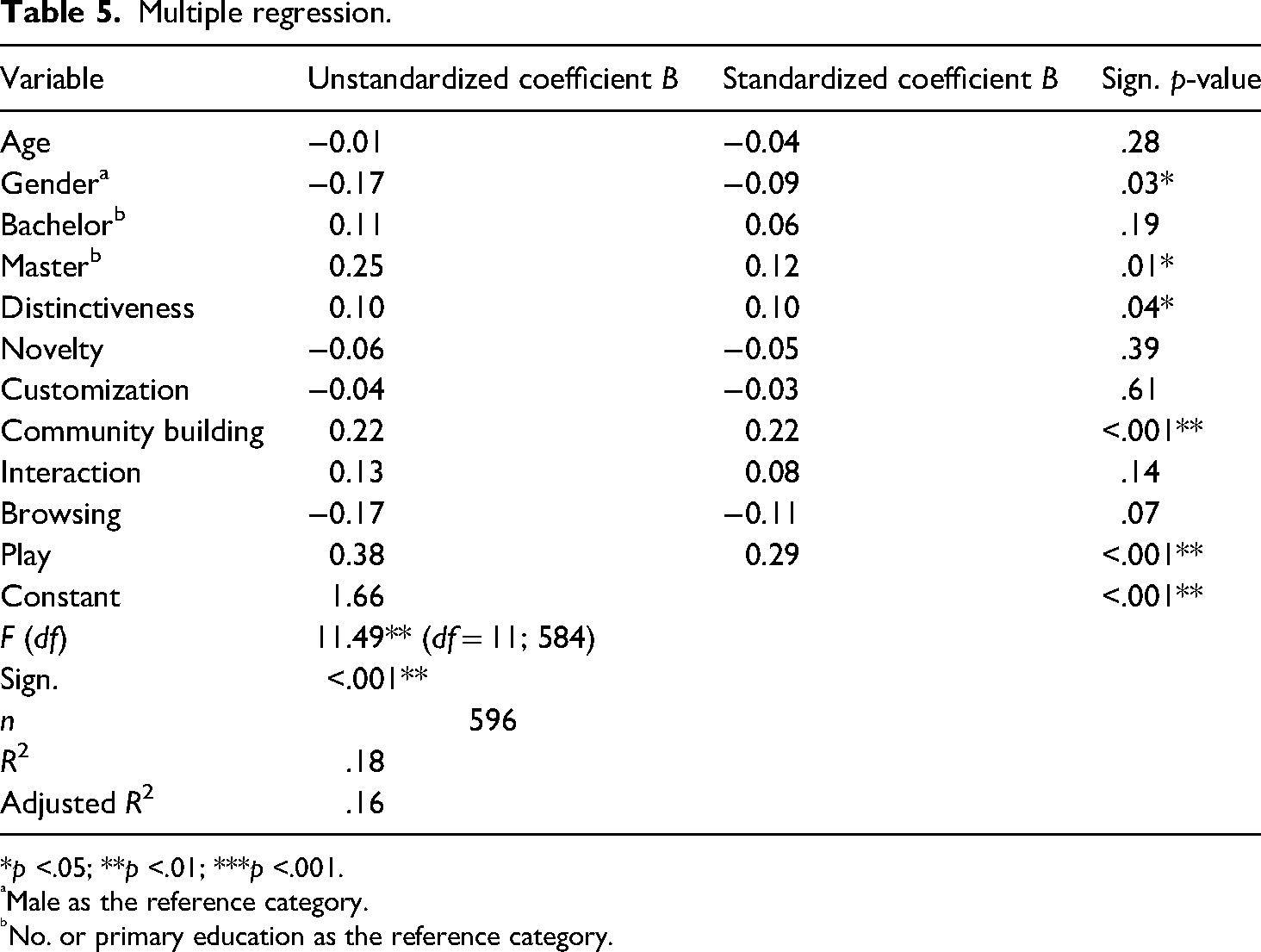
Table 5 presents the results of the hierarchical regression analysis. It reports the level of statistical significance between the variables in our model and the outcome variable (i.e. preference). The results indicate that distinctiveness, community building and play are technological affordances that have a significant impact on our preference for video streaming services. Distinctiveness is significantly negatively associated with preference (B = −0.10, p = .04): subscribers acknowledging the different experience streaming platforms provide are thus more likely to replace traditional television services with video streaming services. Moreover, the results provide strong evidence for a significant impact of community building on preference for video streaming services (B = 0.22, p < .001). Finally, the play has the strongest significant impact on preference (B = 0.29, p < .001). All other technological affordances failed to reach statistical significance. In addition to technological affordances, some socio-demographics do have a significant impact. Unlike age (B = −0.04, p = .28), gender has a significant impact, suggesting women's lower preference for streaming platforms (B = −0.09, p = .03) compared to traditional television services. Finally, respondents with a master's degree show a significantly higher appetite for streaming platforms when compared to our reference category of respondents with secondary education (B = 0.12, p = .01). Respondents with a bachelor's degree, on the contrary, have an equal level of preference (B = 0.06, p = .19). Overall, the model was statistically significant in predicting preference for video streaming services (p < .001) and explained 16% of the variance in preference. Technological affordances thus partly explain why consumers prefer video streaming platforms over traditional television services.
Multiple regression.
*p <.05; **p <.01; ***p <.001.
Male as the reference category.
No. or primary education as the reference category.
Discussion
This article investigated to what extent technological affordances play a decisive role in why people prefer streaming platforms over traditional television services. Based on a quantitative study of 25–50-year-olds in Belgium and a hierarchical regression analysis, the research revealed the impact of platform-oriented gratifications on preference for subscription-based video streaming platforms. Building further on the conceptualization of technological affordances as presented in the MAIN model (Modality, Agency, Interactivity and Navigability), the article put forward a tailored approach to platform-oriented gratifications of video streaming platforms. Whereas Sundar and Limperos (2013) provided a rather general operationalization of gratifications typical for digital media, this framework was adjusted and applied to video streaming platforms. Although far from being consistent (cf. supra), the measurement model adopted in this study forms a first, modest attempt to obtain a better understanding of how video streaming technology shapes audiovisual consumption.
The adjusted MAIN model suggests that distinctiveness, community building and play are significant predictors of preference for video streaming platforms. First, distinctiveness refers to different modes of presentation between video streaming platforms and traditional television services. The fact that consumers indicate a difference between both types of audiovisual services does, however, not imply that consumers will automatically abandon their pay-television subscription. After all, a considerable group of viewers combines video streaming platforms with basic or premium pay television (the so-called cord couplers) (see Evens and Donders, 2018). This confirms earlier research on media displacement theory: Cha and Chan-Olmsted (2012), among others, concluded that both types of services satisfy different needs, deliver different gratifications and are, therefore, complementary. In this regard, Tefertiller (2018) argued that the ability of a medium to provide advantages and cause substitution is much more important than a medium's ability to offer the same experience. Despite watching video streaming platforms often being considered a highly individualized activity, community building was also found statistically significant. The feeling of connection and belonging to a social group seems to be an important gratification for streaming services. This supports earlier research done by Lüders and Sundet (2021), who emphasizes that the social and ritual role of watching television remains crucial and extends beyond watching together in the same physical space. In the streaming era, popular series such as Squid Game or Stranger Things continue to act as the ‘talk of the town’ either in real life or online. Third, the play gratification is the strongest predictor of preference for video streaming platforms. It seems that streaming technology provides a more enjoyable user experience and is more fun to navigate through than the ‘zapping’ experience of traditional television services (see Lüders, 2022).
Customization is, surprisingly perhaps, negatively associated with preference for video streaming platforms. Online-distributed television is seen as a transformation whereby the viewer has more freedom, becomes more active, and gets an almost personalized experience (Burroughs, 2019). Video streaming platforms such as Netflix promote themselves as the future of television putting the viewer's needs and demands first According to Johnson (2019), however, this viewer agency is more illusion than reality because platform interfaces and recommendation algorithms are central. Algorithms decide which series are granted higher prominence in the content libraries and which series are put forward based on interest and/or previous viewing behaviour. As mentioned by Cox (2018), series are not always recommended based on viewer preferences, but often on commercial logics pursued by the platforms themselves (e.g. guiding viewers towards platform-powered originals). Traditional television services generally provide a scheduling-flow experience, but also allow for interactivity and on-demand viewing (Bruun, 2020). In contrast, streaming platforms may enhance user control at first sight but are being driven by industrial control simultaneously (Cox, 2018). As a consequence, Williams's flow concept remains very much accurate to date since the viewer is left with the relatively limited agency on streaming platforms (Williams, 2003). This possibly also explains why interactivity gratification was not a significant predictor of preference for video streaming platforms. This may suggest that viewers value the level of interactivity for traditional television services and video streaming platforms almost equally. Moreover, browsing gratification was negatively associated with a preference for streaming platforms. Although many of these platforms focus on the findability and discoverability of programming, viewers may have difficulties to see ‘the forest to through the trees’ and get lost in the massive content libraries. This aligns with Lüders and Sundet (2021) stating that viewers often find it challenging to browse through the library and pick their favourite series. Van Esler (2020) warned about how content is organized in libraries and how interfaces steer viewers towards a certain action of content. Viewers may get irritated by such a push strategy and may watch more of similar programming instead of discovering new shows or series. Similar to television prime time, video streaming platforms offer prime shelves featuring the most popular content whereas viewers may be interested in discovering other programs in the catalogue (Evens and Donders, 2018). Although platforms such as Netflix and Disney + have a fancier and often more tech-savvy image than traditional television services, the novelty was not a significant predictor of preference for such streaming platforms. Video streaming platforms emphasize how innovative and novel they are, in most cases to stress the difference with pay-television services. However, the latter are going through a process of digital transformation and are increasingly betting on innovative features such as voice control to command the set-top box (see Hesmondhalgh and Lobato et al., 2019).
Because of its ambiguity of use and meaning, the affordance concept is highly contested in the literature (see Ronzhyn et al., 2022 for a systematic review of affordances in social media). Building further on the MAIN model, this study has conceptualized affordances as properties of streaming technology that give rise to platform-oriented gratifications. To be clear, affordances are not just material artefacts of video platforms, but suggest a series of actions that may fulfil gratifications with the viewers. Through the interaction of viewers with the technology, affordances shape, enhance or constrain audiovisual consumption. If technological affordances would be reduced to properties of streaming platforms, there would be a danger of technological determinism. However, affordances cannot be equated to these properties because they also relate to the contextual and individual use of the technology (Bucher and Helmond, 2018). In the case of the MAIN model, the majority of affordances relate to properties that provide the potential for particular action. For example, easy-to-navigate interfaces enable endless browsing, creating a feeling of almost infinite choice among viewers. On the contrary, algorithmic platforms may direct viewers towards popular series based on their viewing behaviour, almost reducing that choice. This might not be the case for the affordances categorized under the ‘Modality’ umbrella, which rather seem to describe the technology. Admittedly, because distinctiveness and novelty do not refer to properties of the technology that enable further action, their conceptualization of ‘technological affordance could be questioned. This conceptual blurriness may also be linked to a key limitation of the MAIN framework.
Limitations and future research
A key limitation of this study is undoubtedly the vague character of the MAIN model as our theoretical framework. The original operationalization of platform-oriented gratifications by Sundar and Limperos (2013) may provide a good starting point, but remains too broad and generic for most digital media technologies. Hence, the original items were targeted towards video streaming platforms. Qualitative research prior to the construction of the questionnaire could have led to a more convincing operationalization of the items, and even to the discovery of new platform-oriented gratifications. However, extending the model was not the goal of this study, which simply sought to apply the model to the context of video streaming. Despite the framework being successfully validated in previous studies (e.g. Rathnayake and Winter, 2018; Wang et al., 2016), its internal consistency and explanatory power was found low, if not disappointing, in our study. While the set of technological affordances seems intuitive and makes sense for video streaming platforms, the adjusted MAIN model largely fails to pass the test Nevertheless, this study is the first of its kind to come up with a context-specific measurement of platform-oriented gratifications and forms a basis for further iterations and explorations of technological affordances of video streaming platforms that may result in improved measurement. Such future instruments may also be applied to similar service models in media branches such as music, podcasting, gaming or journalism, where algorithmic platforms flourish.
Moreover, in this study, subscription-based video streaming platforms were considered one broad category, but in reality, each platform has distinctive features and evidentially offers distinctive affordances that can lead to distinctive gratifications. In this context, it may be relevant to also look at the underlying business model of these platforms and take these different platform logics into account (see Klatt, 2022). Whereas Netflix is, for the most part, driven by subscriptions, Apple TV + and Amazon are built around a different business model logic aiming to lock in viewers in their respective massive ecosystems of services. Similarly, competing platforms such as YouTube or TikTok but also many of the services operated by traditional television broadcasters provide ‘free’ access to content and gain revenues from advertising. Hence, it may be valuable to comprise the entire video streaming ecosystem and map the cannibalizing effect of advertising-based platforms on subscription-based platforms, and the relation of both with more traditional pay-television services. Not only would this advance our understanding of platform-oriented gratifications of digital media technology, but such results would also be highly relevant for practitioners, designers and digital strategists.
