




Abstract
Transnational political communication today is being reconfigured by digital technologies and global power transition. Authoritarian state actors such as China are increasingly active on global social media platforms such as Twitter to directly advance their preferred frames with foreign publics in Western democracies, most notably in what could be called Chinese Twiplomacy contesting narrative globally over contentious issues. This paper problematises such Twiplomacy from authoritarians to Western democracies as ‘networked transnational frame contestation’, arguing that the political and cultural distance between the sending and target countries, the networked affordance of social media, and the national prism of the target countries, all contribute importantly to the complexity of such frame contestation. Through a case study on China's Twiplomacy in contesting coronavirus narrative in the UK, this paper further provides empirical evidence on how ‘networked transnational frame contestation’ works between politically and culturally distant countries. Using a mixed-method approach combining social network analysis and discourse analysis, this study finds that China's emotion-evoking discursive strategy draws traction but the authoritarian nature of the highly centralised networkedness and that of its discursive strategy, together with the strong cultural discordance with British publics, lead to networked recontextualisation of its intended frames in Britain. British publics, heavily relying on British political elites and press for foreign affairs, invoke shared cultural reference to recontextualise Chinese frames into culturally resonant counterframes. This study proposes a paradigm of ‘networkedness within cascades’ to understand frame contestation between politically and culturally distant countries.
Keywords
As we are entering what Blumler (2016) calls ‘the fourth age’ of political communication, globalisation and digital technology are further networking different political systems, actors, citizens and publics together, fundamentally changing the dynamics and structure of political communication landscape, not only within the domestic domain but also beyond national borders (see also in Bennett and Pfetsch, 2018; Dahlgren, 2005; Davis, 2019). On contentious issues, state narrative is not anymore the only dominant frame in public space, prompting scholars to call for a paradigm shift from hierarchical to networked frame contestation (Knüpfer and Entman, 2018; Meraz and Papacharissi, 2013). But as Castells (2015: 8) notes, ‘the network of power constructed around the state and the political system’ still plays a fundamental role in the overall networking of power. In transnational political communication, how different actors, both state and non-state, are networked in digital spaces contesting narrative and how such networkedness configures what scholars (see, e.g. Lee, 2010; Mowlana,1997) call a new global information flow on the front of international politics remains an under-explored terrain. As the global geopolitical power shifts and tensions grow especially between the US-led Western liberal order and non-Western illiberal powers represented by China and Russia, state actors with competing national interests are scaling up their ammunition contesting narrative over contentious issues globally. Bypassing traditional gatekeepers and national regulators in the target foreign countries, state actors are populating major social media platforms with their preferred narrative to influence foreign publics in these open and borderless digital spaces. These new practices of transnational frame contestation in digital spaces pose new challenges to the field of transnational political communication.
Most studies on transnational frame contestation to date have focused on how state actors use diplomatic communication or manage journalistic discourse to gain favourable public opinion) among Western democracies, where similar political communication systems and culture congruence diluted the complexity of the challenge. The increasing enormity of authoritarian or semi-authoritarian state actors contesting narrative on social media targeting foreign publics across different political communication systems has not drawn enough scholarly attention yet. Researchers have noted that the publics’ interest and knowledge of foreign affairs are largely cultivated by their own media system (Curran et al., 2009), and that cultural resonance is an important determinant for contesting frame transnationally (Gamson, 1992). Authoritarian state actors embodying drastically different political and media system pushing their narrative directly to Western publics are therefore not only contesting with the media or political establishment's narrative of the target countries; they are also contesting with the hybrid networks of the target publics, who recontextualise or even dissolve the original frame in cascading networks structured around their home media system and political culture strongly discordant with the ones of the authoritarian narrators. This paper proposes a new model of networked transnational frame contestation to problematise the emergence of frame contestation from authoritarian states to democracies on social media. I argue that for transnational frame contestation, the political and cultural distance between the sending and target countries, the networked affordance of social media, and the national prism of the target countries, all contribute importantly to the nuanced dynamics of such frame contestation, which can be seen as ‘networkedness within cascades’; for politically and culturally distant countries, the contesting frame is often discordant with target publics, who turn to their own political elites and media (with cascading effect) and their own collective cultural stocks of frames to recontextualise the contesting frame in networked discourse negotiation. What Entman (2004) calls the hierarchical cascade framing model remains prominent, but enmeshed with the networked affordance of social media.
Amidst the intensified geopolitical rift between China and the West, China has notably stepped up its global narrative contestation apparatus, including what is known as its ‘wolf warrior’ Twiplomacy, deploying state envoys on Twitter to militantly contest the global narrative around issues such as the most recent coronavirus pandemic and China’s controversial role in the original outbreak. This offers an invaluable opportunity to examine the nuanced dynamics of networked transnational frame contestation from authoritarians to Western democracy. Taking notes of the above-mentioned lacunae in political communication research, this study seeks to answer: (1) how China's diplomatic apparatus is using Twitter to contest the coronavirus narrative in one Western democracy, namely the UK and (2) how such efforts are recontextualised by both British publics and British media. I argue that the multi-directional and multimodal networks in transnational frame contestation complicates the debate around social media in political communication studies and leads to mixed results: via resorting to polarisation discursive strategy, Chinese Twiplomacy to a certain extent manages to circumvent traditional gatekeepers to directly communicate to foreign publics, especially when evoking negative emotions (as seen in ‘wolf warrior’ style messaging); but its ‘wolf warrior’ style emotional Twiplomacy, culturally discordant with target publics, is recontextualised by both the media and publics in target countries, thus is left to fail or even backfire.
Emotional Twiplomacy, discursive power and China's ‘wolf warrior’: China's rising voice in cyberspace
The rising prominence of Twitter in transnational political communication has led to a plethora of studies on ‘Twiplomacy’ or ‘Twitter diplomacy’, referring to the practices of state actors engaging public-facing communication on Twitter to cultivate favourable foreign public opinions (Cassidy and Manor, 2016; Heine, 2013; Manor, 2019; Slaughter, 2009; Strauß et al., 2015). From Western democracies; to Latin America (Waisbord and Amado, 2017) to Middle East (Manor and Crilley, 2018; Salimi and Vahabpour, 2018), cyberspace is increasingly weaponised by MFAs and diplomats so much so that The Economist wrote in 2012 that diplomacy going digital is a double-edged sword and could be misused with some e-diplomatic incidents: ‘wait for Twitter to start a war’, the article warns.
The ‘war’ metaphor is perhaps more than metaphoric. Researchers have noted the rise of combative and undiplomatic communication style of Twiplomacy – adopting more brazen and confrontational rhetoric – from countries including Russia and Israel (Manor, 2019). Such tactics are to evoke negative sentiment (anger or anxiety) so to create viral content, as messages that evoke emotions (both positive and negative) are found to be able to trigger higher levels of attention and participation (Manor, 2019; Ott, 2017; Stieglitz and Dang-Xuan, 2013). Hall (2015) uses ‘emotional diplomacy’ to refer to state actors employing the discursive use of expression and provocation of emotion – be it anger, sympathy or guilt—to achieve political goals in transnational frame contestation. Such emotional registers are especially widespread on Twitter, as social media is found to be favouring sensationalist content, thus playing an important role in escalating or de-escalating conflicts (Duncombe, 2019).
Emotional Twiplomacy, essentially, is power struggles between nation-states over discourse. Power relations are increasingly shaped and decided in the communication field (Castells, 2007), so is in international relations and transnational political communication. The world order can be conceived as ‘the outcome of a struggle for discursive hegemony’ (Wojczewski, 2018: 36). In Western political discourse, China is usually a sinister threat to democracy; such imagination has been solidified in Western hegemonic discursive power (Gao, 2016). But as China has risen as a new global power with coveted economic clout and geopolitical influence, in what Wojczewski (2018: 49) calls ‘a shift of representational power dislocating and contesting the Western discursive hegemony’, China has been noticeably growing assertive and combative in transnational political communication, keenly emphasising the importance of ‘discursive power’ (huayuquan) over the last two decades. Vowing to counter the Western hegemonic discursive power and to legitimise the Party rule, Chinese President Xi Jinping calls for the country's massive propaganda apparatus to ‘tell China's story well’ to the world (Lams, 2018). With digital spaces becoming a key discursive battlefield with strategic significance, Chinese state media are expanding their presence on global platforms such as Facebook and Twitter, with click-bait content and target advertising; state-sponsored social media influencers and troll operations are also recruited into the discursive battle (Molter and DiResta, 2020; Ohlberg, 2018). These global platforms, to a certain extent, are becoming ‘high-speed propaganda pipelines’ for China (Kao et al., 2021).
China has only started to embrace Twitter to directly mold foreign public opinions since recent years, having witnessed the virality of @DonaldTrump and China's own diplomat Zhao Lijian's 1 shared unbridled style on Twitter. Especially, the fame Zhao has garnered on Twitter during his stint in Pakistan where he initiated the combative style of aggressive polarisation strategy, mostly targeting the US, has encouraged Chinese policy makers to promote the pugnacious style amongst diplomatic corps and state media on Twitter. As the New York Times observes, China has ‘discovered its voice—one that sounds a lot like Zhao Lijian’ (Palmer, 2021). Instructed to ‘dare to fight’, Chinese diplomats, although new to Twitter, feature an unprecedentedly proactive and aggressive style, hurling salvos at any criticism, hence dubbed ‘wolf warrior’ (Martin, 2021). At the time of data collection for this study (September 2020), there are more than 40 Chinese diplomats on Twitter, excluding Chinese embassies and other Chinese diplomatic organisations’ Twitter accounts; three quarters of these accounts only joined Twitter since late 2019. For China, where media discourse has long been strictly sanctioned, a national political truth of China being the victim of aggression and exploitation by Western colonial and capitalist powers has been perpetuated to consolidate the political legitimation (Renwick and Cao, 2003). Especially against the backdrop of the grand ‘national rejuvenation’ narrative promoted by President Xi, the ‘wolf warrior’ style, albeit controversial, is warmly welcomed by a wide swathe of Chinese publics especially domestic nationalists (Dai and Lvqiu, 2021). But overseas, the rhetoric that works well in Chinese political discourse is often found struggling to engage foreign publics, especially in countries where media and political elites have long framed China along with the Western liberal discourse: an authoritarian power poised to defy the rule-based system and dominate the world with its own rules. So much so that a Times editorial claims that ‘the democratic world has finally united over China’ (The Times, 2021).
Networked transnational frame contestation: Discursive strategy, cultural resonance and recontextualisation
Twiplomacy can be problematised as networked transnational frame contestation, where state actors pursue certain discursive strategy to diffuse their favoured frames amongst foreign publics. Yet the common ideological polarisation strategy of binary propositions of ‘positive self-presentation’ and ‘negative other-presentation’ in political discourse, as identified by van Dijk (2006) and seen in Donald Trump and many other politicians’ discursive strategy on social media, gets murkier in transnational frame contestation. Between vastly different and tensely contesting political systems such as the ones of authoritarian China and Western democracy, emotional Twiplomacy might backfire, due to the strong cultural discordance of the messaging with the target publics and the networked recontextualisation by the target publics.
In transnational frame contestation, cultural resonance is an important determinant in predicting the success of a contesting frame in target countries, along with the media systems of the target countries (Entman, 2004; Gamson, 1992). Other researchers have similarly noted the cultural and political distance between countries as a defining factor in the competition for foreign media (Chang et al., 1987). Between countries with significant cultural and political distance, frames that do not resonate with the political culture of the target country are more likely to elicit contestation from the political elites, journalists, and the publics of the target country.
The significance of cultural resonance is particularly prominent in times of crisis, when the national identity of the target country plays a more salient role in determining which political messages will be culturally resonant (Rowling et al., 2011). Hence, the polarisation discursive strategy from a distant foreign land could even produce stronger discordance amongst target publics during national crisis such as coronavirus pandemic. Western democracies’ political culture is undoubtedly very much incongruent with pro-China framings; the liberal pluralist media system of Western democracies, in sharp contrast to China's own centrally controlled party media system, poses further complications to propagate pro-China framings even via social media where individual nodes are not just networked as resources but also as counterforces with the agency to recontextualise or even dissolve the intended frames. Recontextualisation is a discursive and social process of establishing a certain hierarchy of discourses (Bernstein, 1990). It is about the dominance and power of discursive frames: ‘certain discourses lose their primary function and become secondary or appropriating tools of other discourse’ (Krzyżanowski, 2016: 309). When authoritarian state actors use emotion-evoking messaging to appeal to foreign publics, the target publics could invoke their pre-existing and shared cultural schemas to substantially recontextualise the intended frames. The networkedness of discourse negotiation on social media, referring to the networks individual users belong to and tactics including hashtags, facilitates hijacking the intended frame (Jackson and Welles, 2015), constituting what I call networked recontextualisation.
Below I use a case study of Chinese Twiplomacy in the UK to empirically validate the model of networked transnational frame contestation in the multi-directional and multi-modal digital environments.
Case study: China's ideological frame contestation on coronavirus in the UK
This case study focuses on China's Twiplomacy efforts during the coronavirus crisis in the UK, through exploring the following two research questions:
RQ1. What are the networking and discursive strategy of Chinese Twiplomacy in the UK?
RQ2. How is such discourse recontextualised by the media and the publics in the UK?
The narrative over coronavirus has become an intensely contested battlefield, especially between China and the West, with the latter pressing China to be more transparent with the virus’s origin investigation whilst China dismissing international scrutiny and denying any wrongdoing. The dynamics between the UK and China are particularly interesting to observe. A Western liberal democracy with close economic ties with China and freshly divorced with the EU, the UK is in the course of seeking to recalibrate its relationship with China (Brown, 2019; Summers, 2021). The two countries had a warm but fleeting ‘golden era’ during Cameron's Conservative administration; it did not take long for the ‘golden era’ to fall to the ‘deep freeze’, amidst the growing tensions over the situations in Hong Kong, Xinjiang, and most notably, over coronavirus and national security concerns (Wang, 2022). The pandemic, concerning every member of British public, has particularly contributed to a sharp growth in critical public views towards China as well as a more critical tone in British parliamentary debates on China (Summers et al., 2022).
The UK has always been a key battlefield for China's overseas propaganda operation. London has been the European headquarter of China's state broadcaster CGTN only until 2020 when its license was revoked by the British regulator Ofcom for breaching impartiality rule. Chinese diplomats in the country, led by the then Ambassador Liu Xiaoming, have been drawing much attention with prolific tweets and active presence in British media to fend off any criticism of China. Warmly echoing the ‘fighting spirit’ Chinese President Xi Jinping demands of his envoys, Liu, who would later publish a book ‘Tell China’s Story’ about his proud stint in the UK after leaving the role in January 2021, becomes ‘a leading voice amongst China's “wolf warrior” diplomats’ (Ramzy, 2020) and is praised by Chinese state media as ‘setting fine example to confront West's bias head-on’ (Zhang, 2021). Yet reception in the host country of Britain might not be as flattering. British media have already given the verdict: ‘for all the bombastic talk by Liu Xiaoming … of a new ‘wolf warrior’ diplomacy, efforts to shape public opinion via Western social media are failing’ (The Spectator, 2021).
My analysis is thus based on three sets of data: Then Chinese Ambassador Liu Xiaoming's Twitter account @AmbLiuXiaoMing, British press's coverage on coronavirus and China's Twiplomacy, and the UK-based Twitter users’ conversation around coronavirus and China. Timeframe for all three datasets is set from 11 March 2020 to 12 June 2020. The World Health Organisation officially designated coronavirus as a global pandemic on 11 March and the British government subsequently ordered a national lockdown on 23 March. During the first three months since 11 March, the frame contestation between the UK and China was the most intense, as after July more focus of China's persuasion work is shifted to justifying the new National Security Law imposed in Hong Kong.
For RQ1, social network analysis and discourse analysis are used to map the strategy and practice of Chinese Twiplomacy in the UK. I examine both the network and discursive strategy of the Twitter account of the Ambassador @AmbLiuXiaoMing, leaving out other diplomatic accounts operating in the UK (such as the official account of Chinese Embassy in the UK), because the official account of Chinese embassy in the UK @ChineseEmbinUK is considerably less active, with just over 1000 tweets in total, and just over 17,000 followers. 2
To answer RQ2, I use discourse analysis to examine the replies under @AmbLiuXiaoMing's most engaging ‘wolf warrior’ styled tweets, alongside with a social network analysis of UK-based Twitter users’ discussion on China and coronavirus over the same period of time. The discourse of British press's coverage of coronavirus and Chinese Twiplomacy is also analysed to better understand how institutional media are recontextualising the narrative and shaping public discussion. I choose three mainstream broadsheets: the Daily Telegraph, The Times, and the Guardian, covering the British political spectrum from the right to the left. Articles on China’s diplomatic messaging on coronavirus was retrieved from LexisNexis, using keywords: China, wolf warrior/Chinese ambassador/Chinese embassy, coronavirus/COVID-19. Articles focusing on other issues such as trade war, Hong Kong, mentioning coronavirus and China’s diplomatic messaging by passing, are excluded.
All tweets are collected using Twitter API through Python package tweepy. Social network analysis is conducted using NodeXL. The graphs plotting Twitter users as nodes were directed and laid out using the Fruchterman-Reingo layout algorithm.
Results
Chinese Twiplomacy in the UK: A not so networked social network
A close look at the network relationship of @AmbLiuXiaoMing shows an apparent effort of networking with traditional elite actors such as politicians, state media and business bodies, but the account rarely uses these interactive functionalities for conversation. There is no ‘replying to a tweet’ during the period of the study. With 90,000 followers, @AmbLiuXiaoMing only follows 12 accounts, six of which are Chinese state media. As the then most senior Chinese diplomat to the UK, at the time of this study, @AmbLiuXiaoMing only follows two British accounts: the royal family @RoyalFamily and the UK Prime Minister's official account @10DowningStreet.
A social network analysis of @AmbLiuXiaoMing shows that this network consists of only 49 individual accounts (nodes) and 414 edges, of which 16 are self-loops and the rest 398 are retweets or mention interactions. As Figure 1 shows, the nodes closer to @AmbLiuXiaoMing are those with which the Ambassador has established the most edges (strongest ties, via either mentions or retweets); the nodes further away in the map are those with very scarce and weak ties.
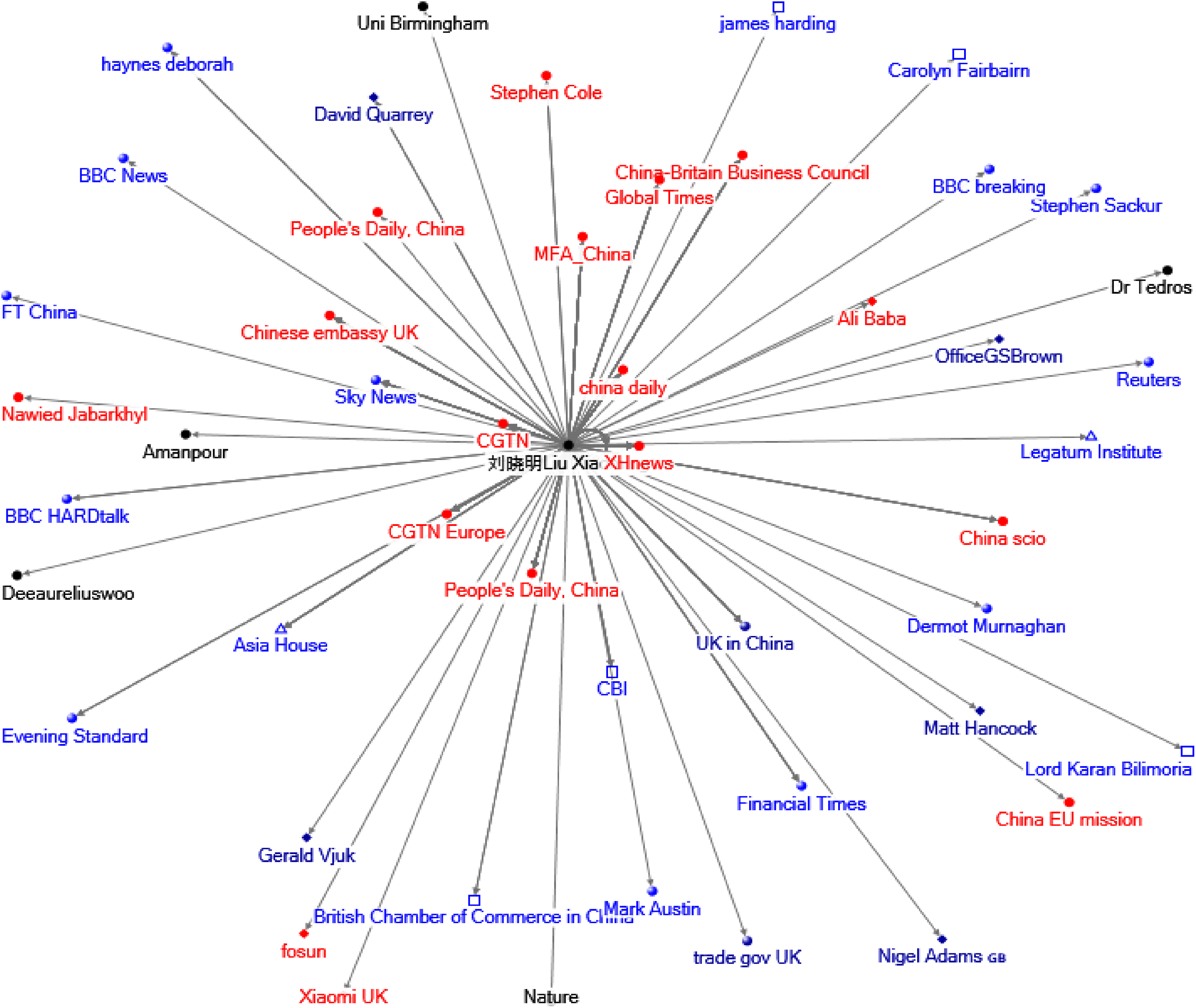
Social network of @AmbLiuXiaoMing’s tweets/retweets.
As Figure 1 shows, @AmbLiuXiaoMing predominantly networks with Chinese official sources, establishing strong ties exclusively with Chinese state media (Global Times, China Daily, XHNews, CGTN, People's Daily) and Chinese MFAs (MFA_China, Chinese embassy UK). All Chinese official sources, including state media and governmental bodies, account for 88.6% of all edges in this network. Interactions with British sources (including British officials, media and business) only account for 7.4% (N = 31) in total – more than half of which are promoting the Ambassador's own media appearance, and the rest are either diplomatic reciprocity in response to the tweets promoting China–UK relations from the official account of the UK embassy in China or promoting business events.
The network of Chinese Twiplomacy, at least in the case of the UK, is predominantly unidirectional monologue of Chinese official voice. @AmbLiuXiaoMing is unambiguously propagating Chinese narrative without any signs of engaging in meaningful conversation. Besides, the account exclusively mentions or retweets from elite sources only. Ordinary users, either Chinese or not, are still left outside of the network.
Discursive strategy: Don't make yourself an enemy of us; we are the global benefactor
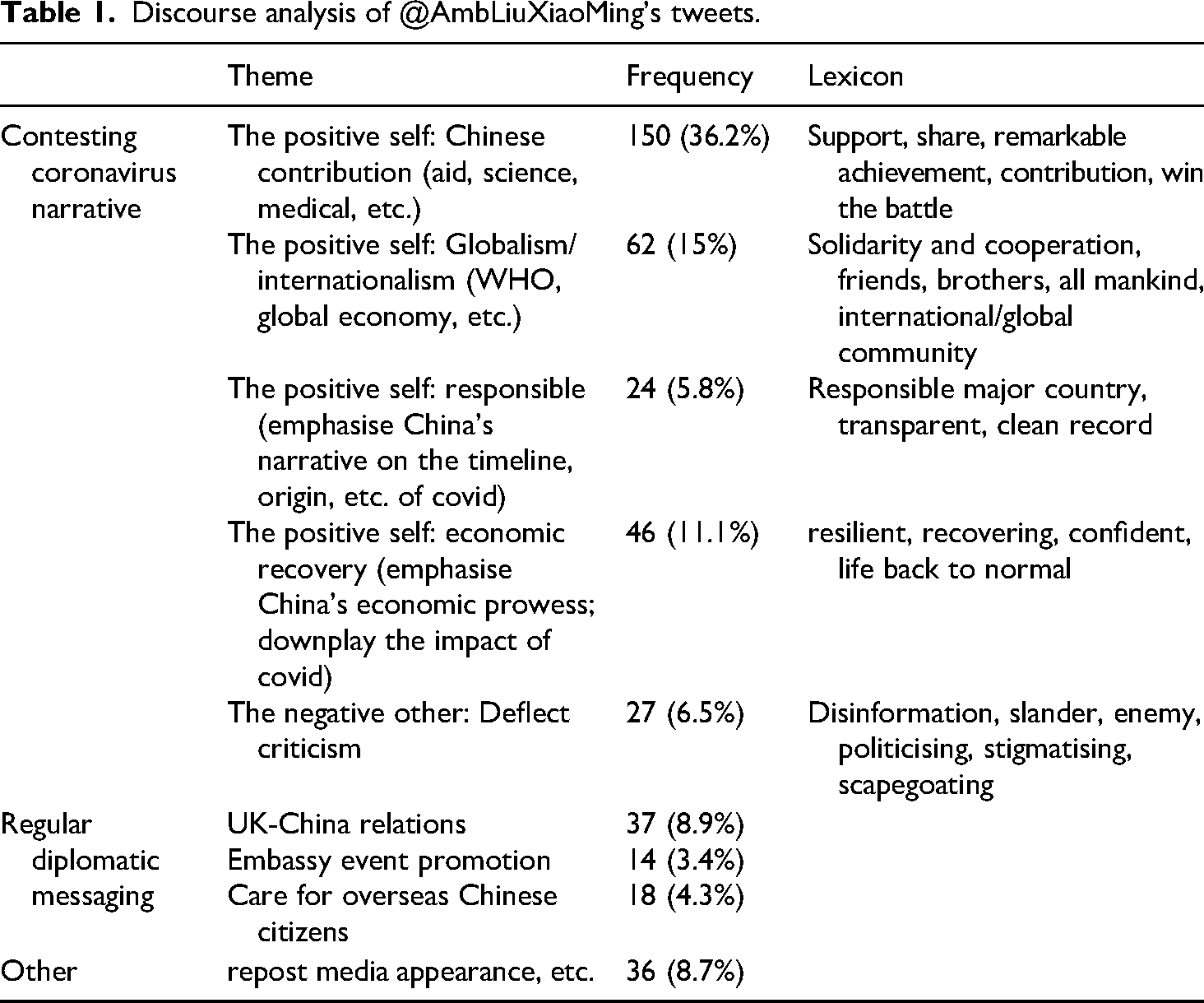
I further conducted a discourse analysis of @AmbLiuXiaoMing ‘s tweets, following van Dijk (2006)'s ideological discourse analytical framework, with emphasis on sematic macrostructure (topics/themes), lexicon and polarisation strategy (positive self-presentation and negative other presentation). As summarised in Table 1, only 16.6% of the Ambassador's 414 tweets are regular diplomatic messaging promoting embassy events or addressing China–UK relations. Three-quarters of the tweets employ the polarisation strategy to contest the framing of coronavirus, emphasising China's positive role in helping other countries and the international community in ‘winning the battle’ against the virus, in an apparent effort to frame coronavirus as a ‘global challenge’ that needs ‘global response’. This echoes the ‘globalism’ Chinese President Xi has been promoting to poise as the global leader in the absence of the US under Trump (Zhao, 2021) and tries to convince British publics that China is not ‘other’, but one of ‘us’. In the meantime, any criticism of China's coverup and ill response at the early stage of the outbreak is framed as the negative other who are hostile enemies ‘spreading disinformation and slander’ and ‘scapegoating China’.
Discourse analysis of @AmbLiuXiaoMing’s tweets.
This overall polarisation discursive strategy boasting China as the global benefactor and de-emphasising accountability and blame is well illustrated in the below example where the Ambassador retweets a Chinese Embassy's ballistic tweet calling the British paper The Times ‘deplorable’ for publishing an article penned by the US Ambassador to the UK blaming China for the pandemic. In this ideologically polarising tweet or a typical ‘wolf warrior’ tweet in its combative tone, the Ambassador wrote: My advice to those Western politicians who are busy with game of blame and scapegoating: Stop playing games, concentrate on setting your own house in order and address the concerns of your own people.
A clear demarcation between ‘us’ and ‘Western politicians’ is thus being drawn up, with pronounces such as ‘your’/‘your own’ as a distancing device for negative other-presentation (Masroor et al., 2019). However, how well does this ‘us versus Western politicians’ polarisation strategy resonate with Western publics? Below I discuss the actual engagement of China's Twiplomacy with British publics on Twitter.
Public engagement and recontextualisation of Chinese Twiplomacy: China the liar
Likes and retweets are usually used as indicators of engagement on Twitter. In this case, considering the inflated retweets and replies by an inauthentic coordinated network of fake users (Schliebs et al., 2021), only replies are used to measure real engagement. Although extensively using topical hashtags #coronavirus or #covid-19 to expand the reach of Chinese narrative in the Twittersphere, the Ambassador's tweets are not very engaging. Out of the total 414 tweets (63% of which used #coronavirus or #covid-19), only eight tweets received more than 100 replies. All eight tweets fall into the category of employing ideological polarisation discursive strategy, either hailing China as a ‘responsible global benefactor’ or castigating others (the US or any other critics) for ‘playing games’ and ‘scapegoating China’. This pattern echoes previous findings on the virality of emotion-driven content on Twitter, as discussed earlier.
The combative tweet shown above is one of the most engaging of all tweets studied, having received 144 replies. A further discourse analysis of these 144 replies reveals how such combative tweet, though highly engaging, is recontextualised via networked discourse negotiation among the target publics on Twitter. An emerging discursive theme of these replies is hijacking the Ambassador's original frame accusing the UK of ‘playing blame game’ to reframe it into ‘China the liar’, via the use of hashtag #ChinaLiedPeopleDied, or presenting richer context such as alluding to the authoritarian nature of China. An example of the latter is a reply from Twitter user @LocoFocoParty : My advice to you, sir, is to stop spreading propaganda. You live in the West and are not hidden by the Great Firewall of China.
Another strategy of recontextualisation, commonly used by animal rights groups on Twitter, is to reference the meat consumption culture in certain parts of China, alluding to the zoonotic origin of coronavirus. An example is a reply from NoToDogMeat Campaign group @notodogmeat, which has more than 10,000 followers: Our advice to China is close all dog and cat meat markets forever!
These collective cultural stocks of frames are shaped in the target publics’ home political and cultural system, where political elites and news media play an essential role. To better understand this layer of cascading networks, I further examine the social network of the coronavirus conversation in British Twittersphere to determine how closely British publics on Twitter network with their own political elites and news media as opposed to Chinese Twiplomacy.
A social network analysis of UK-based users’ tweets that contain China/Chinese and coronavirus/covid19 during the same period shows an embarrassing reality for Chinese Twiplomacy. The network has in total 3524 edges (tweets) and 2673 nodes (users). UK's then Prime Minister Boris Johnson @borisjohnson has the highest betweenness centrality (91295.036), indicating the most influential node in the network, followed by then Foreign Secretary Matt Hancock @matthancock (82703.761), British tabloid Daily Mail @mailonline (75994.586), British political commentator Piers Morgan @piersmogan (53656.359), the World Health Organisation @who (50188.396) and the BBC @bbcnews (42738.509). In contrast, the Chinese Ambassador @AmbLiuxiaoming only has a betweenness centrality of 4, indicating only four edges. Figure 2 shows the highly insignificant position of @AmbLiuxiaoming in this network.
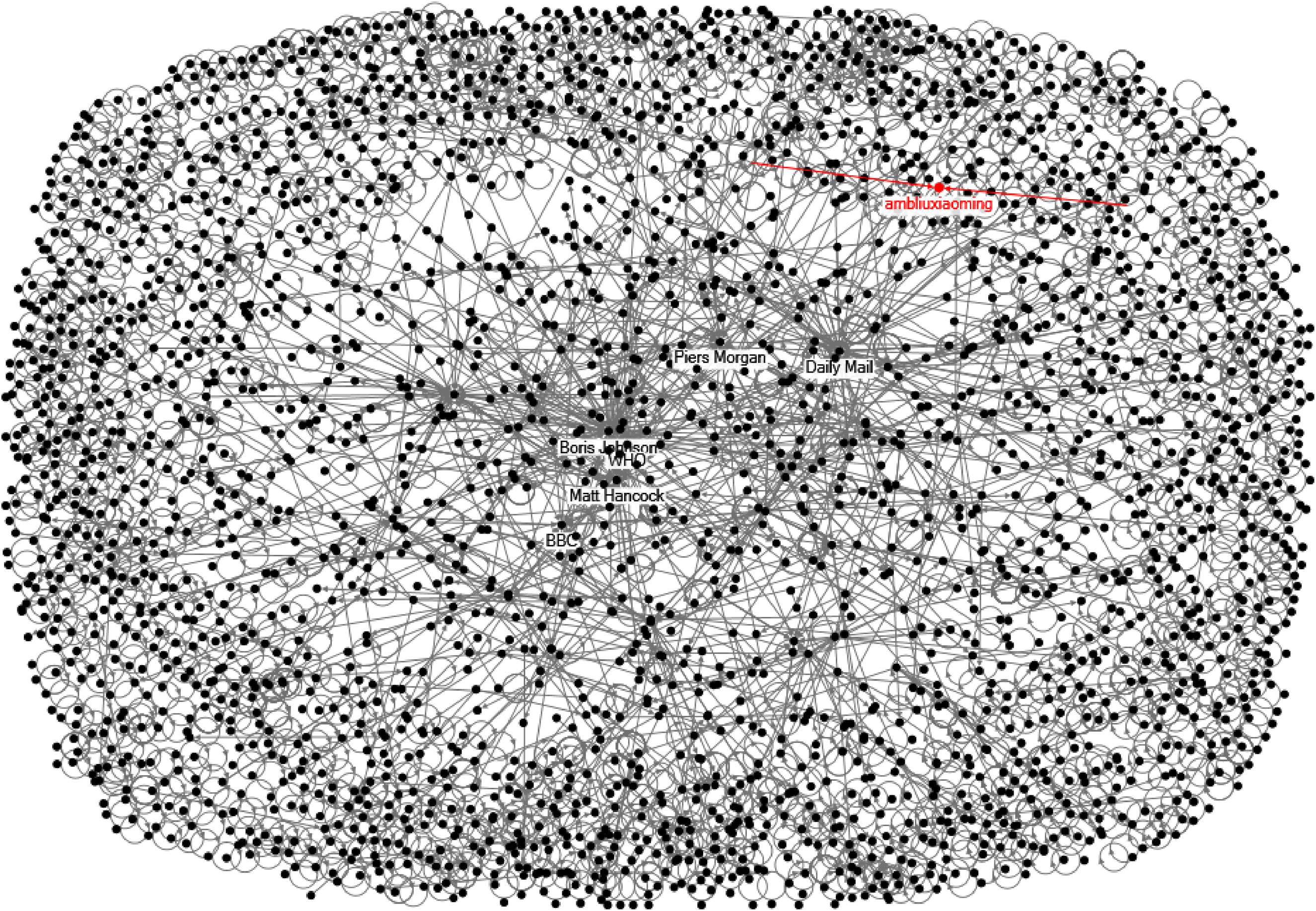
Social network analysis of UK-based tweets containing ‘China’ and ‘coronavirus/covid19’.
As to the discourse of British Twittersphere on China and coronavirus, below is a word cloud for a visual representation of topics frequently discussed 3 in British Twittersphere.
As both Figures 2 and 3 show, British publics on Twitter mostly tweet from their national prism: their top concern is how Britain is coping with the deadly virus. For China-focused messages, they are retweeting from British media and British politicians, or international bodies such as the World Health Organisation. The main theme is anxiety and scepticism, with keywords such as ‘death’, ‘truth/true’ and ‘lied’ indicating a shared anxiety about the gravity of the pandemic and strong doubt over China's response to the original outbreak.
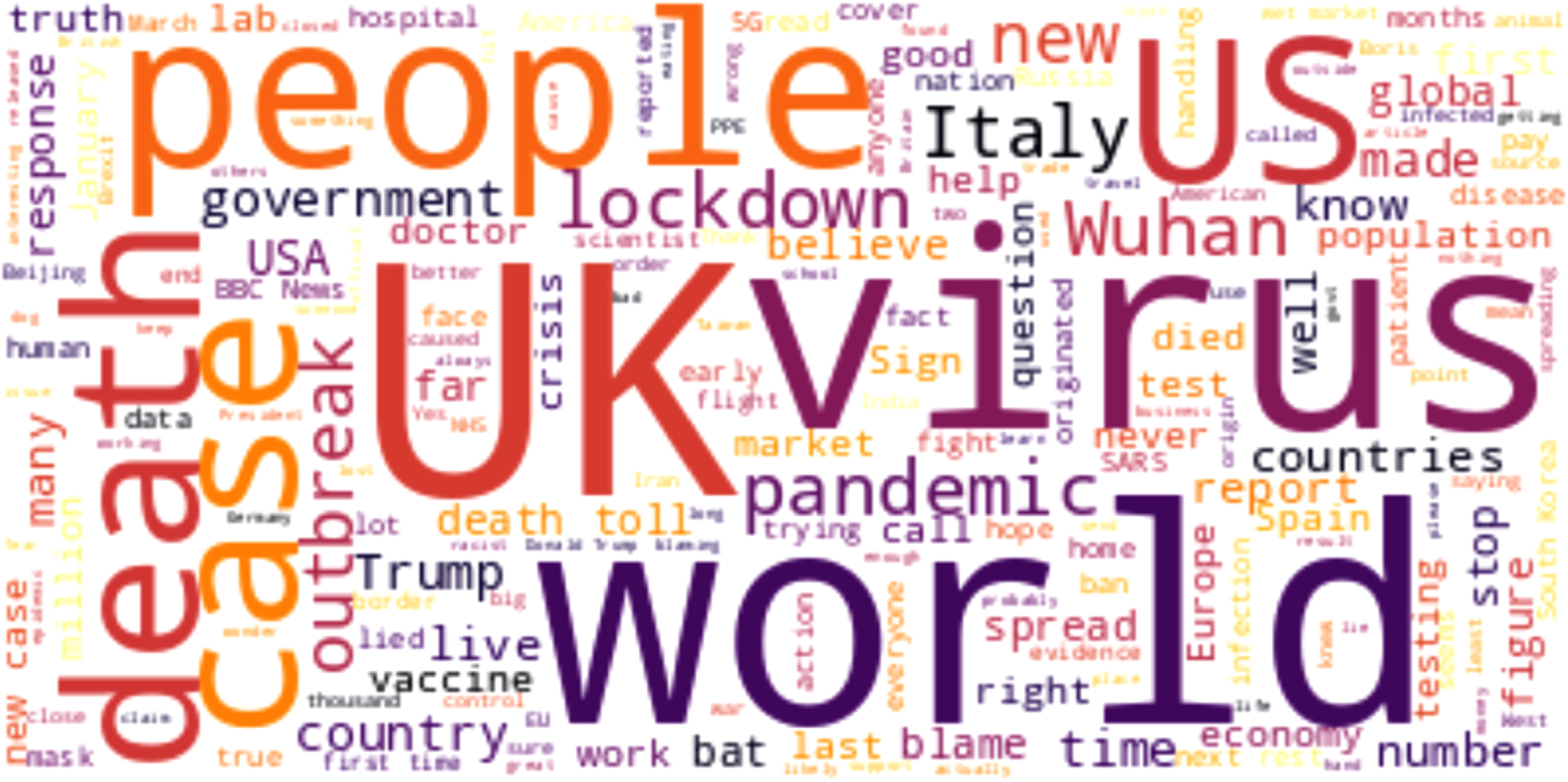
Word cloud of UK-based Twitter discourse on coronavirus and China.
British media's recontextualisation of Chinese Twiplomacy: China the bully
The above discussion shows that British publics directly recontextualise Chinese frames into more culturally resonant counterframes and are heavily reliant on their own elites and media to frame the discussion on coronavirus. To understand how British mainstream media recontextualise Chinese Twiplomacy on coronavirus narrative and if it is consistent with the patterns of British publics's recontextualisation on Twitter, I analyse the discourse of three British broadsheets the Daily Telegraph, The Times, and the Guardian.
The three papers in total published 21 articles that contain ‘coronavirus/covid-19’, ‘Liu Xiaoming’ or ‘wolf warrior’. 12 of them either frame China's assertiveness as a threat to global order or a bully ‘breaching treaties and threatening countries around the world with rhetorical echoes of the Thirties’ (Evans-Pritchard, 2020). The word ‘bully’ is consistently appearing together with ‘China’ in British press in context such as ‘Beijing's crude bully-boy tactics’ (Coughlin, 2020), ‘a hysterical hooligan-style diplomacy’ (Lucas, 2020 ) and ‘envoys who snarl at their host countries’ (Boyes, 2020). The reference to shared cultural stock of frames such as comparing today's China to Nazi Germany in the Thirties further evidences the strong cultural discordance of Chinese Twiplomacy for British publics.
Only one article from the Times quoted cordial remarks from the Ambassador: ‘The coronavirus pandemic has brought Britain and China closer together, Beijing's UK ambassador has claimed’, but only to recontextualise it into a contentious frame: ‘His comments came amidst warnings that Britain should rethink the relationship in the light of issues raised by the pandemic, in particular the reliance on Chinese technology’.
When mentioning Chinese aid, all articles chose to focus on either the future of the EU, China-US rivalry, or China and Russia’s insidious overseas influence operatives, rather than Chinese aid per se. In stark contrast to China's Twiplomacy agenda which strives to present itself as an altruistic benefactor for universal good, British press recontextualise Chinese aid as ‘politicising its aid’, ‘rank hypocrisy’ when the country has so many questions unanswered in regard to the origin of the virus (Lucas, 2020), ‘seeking to exploit the gap in global leadership left by the Trump administration’ (Philip, 2020). British publics are constantly reminded that Chinese aid to European and African countries is ‘overshadowed by questions about its handling of the original outbreak’ (Philip, 2020). ‘Yet, rather than accept responsibility for causing the crisis, Beijing is seeking to rewrite history by silencing its critics, while positioning itself as the lead aid donor for other countries afflicted by the virus’ (Coughlin, 2020). As a Guardian article points out unapologetically, China is changing the narrative to present the country as the solution to coronavirus, not its cause.
British press's framing of Chinese Twiplomacy and China's role in the pandemic is therefore highly consistent with British Twittersphere in recontextualising Chinese official narrative into culturally resonant counterframes: the act of ‘a global benefactor’ as painted by Chinese Twiplomacy is merely China's efforts to divert attention away from questions over the origin of the virus; rather than fighting Western bias and setting the record straight about coronavirus, China is a bully ‘snarling at its host countries’. By invoking collective cultural references such as Nazi Germany in the 1930s, British press have reversed Chinese Twiplomacy's polarisation strategy, which tries to paint China as the positive ‘us’ and brand any criticism as the ‘hostile other’, into something completely different: China in British press becomes the ‘bullying and lying other’ for Britain.
Conclusion and discussion: Emotional Twiplomacy and networked frame contestation
This study examines China's Twiplomacy effort in contesting coronavirus narrative in the UK and proposes a new model of networked transnational frame contestation between politically and culturally distant countries. By conceptualising the model to incorporate networked recontextualisation through the national prism of the target countries, the study contributes to scholarship on how social media and the subsequent emergence of global and transnational information networks have fundamentally reconfigured transnational political communication.
Coveting the unscalable disruptions @realDonaldTrump and the like have brought to the political communication order in Western democracies, Chinese state actors are taking notes and embracing the global platforms too open to be allowed access in China. But as this study shows, Chinese Twiplomacy in the UK exclusively networks with Chinese elite sources, unambiguously propagating Chinese official voices, with little engagement with British publics or non-elite Chinese actors, demonstrating a highly centralised ‘networkedness’, and remains very peripheral in the network of British public discourse on Twitter.
The shift from diplomatic messaging to ‘wolf warrior’ style suggests China is embracing ‘emotional Twiplomacy’ to encourage engagement on social media. The ideological polarisation of Chinese Twiplomacy's discursive strategy does bring virality to Chinese messaging but remains authoritarian in nature, reminiscing what Lams (2014, 2018) identifies as ‘hegemonic articulation’ which excludes dissonant voices and tries to build up another discursive hegemony by claiming to contest with existing Western hegemony. This authoritarian nature of communication drives home as jarring for the target publics in a Western democracy, who in cascading networks recontextualise Chinese narrative into counterframes in line with home media and political discourse, thus further complicating the networked frame contestation in these digital open spaces.
The study thus suggests a paradigm of ‘networkedness within cascades’ to understand frame contestation on social media between politically and culturally distant countries. China's 'wolf warrior' diplomacy is partly in response to the rise of anti-establishment populism in Western countries. But for transnational frame contestation in times of crisis, especially between drastically different, if not antagonistic, political systems, tapping on populism sentiment is not only overridden by the cascading effect in the target country but also dissolved in the publics’s networked recontextualisation on social media. China's ‘wolf warrior’ Twiplomacy might not pan out as China intends for now, but as authoritarian actors are updating their media repertoires to take advantage of the open access and wide reach of digital platforms to advance their frames 4 , it is hardly alarmist to underscore that if the democratic institutions in established democracies continue to dissolve and lose public trust to ideological rogue actors, with updated playbook the authoritarian regimes would in no time gleefully advance in fracturing democratic institutions and values. Admittedly, this study only examined one single Ambassador’s tweeting pattern, which by no means represent the whole picture. However, by focusing on one case study, I hope this paper provides timely intervention on problematising the emerging issue of transnational frame contestation from authoritarians to Western democracies on social media, thus opening up more promising lines of inquiry for future research.
