




Abstract
Over the past decade, the rights of people whose sexual orientation does not conform to prevailing norms have become a divisive issue in many countries. Despite a long tradition of research on media and sexual minorities, the role of the media in these recent backlashes remains poorly understood. We argue that this is partly because work in this area is often underpinned by a simple, linear narrative that unambiguously links visibility to empowerment. We highlight the ambivalent impact of mediated visibility and argue that in the context of elite-driven polarization, illiberalism and low levels of media freedom, visibility can become a vehicle of control. To explore this proposition, we examine the link between media and public attitudes to same-sex relationships in four east European countries, combining a population survey with semi-structured interviews. The results confirm the need to consider the conditions of mediated visibility in particular socio-political contexts, showing that where control over the conditions of visibility remains in the hands of homophobic elites, specific types of media, which are controlled by ruling elites, including Public Service Media, can contribute to negative attitudes, while digital media play a more ambiguous role.
After decades of progressive changes in the realm of recognition and inclusion of people with diverse sexual orientations, the past decade witnessed several notable backlashes. From the temporary reversal of provisions preventing the discrimination of lesbian, gay, bisexual, trans and queer minorities in healthcare in Trump's United States to the ban on ‘non-traditional sexual relations’ in Putin's Russia and the so-called ‘anti-LGBT’ referendum in Orbán's Hungary, right-wing populist leaders are increasingly using sexual minority rights as a platform for mobilizing public support. As evident from these examples, these recent backlashes are not necessarily focused only on sexual minorities, but often go hand in hand with the proliferation of ‘gender critical’ discourses and attacks on ‘gender ideology’, directed specifically at trans and non-binary communities (e.g. Borba, 2022). This, however, is not the only novelty. As Graff and Korolczuk (2021: 5) argue, contemporary homophobic and ‘anti-gender’ campaigns are distinct due to their close relationship with right-wing populism and extremism, and form part of ‘a coordinated transnational effort to undermine liberal values by democratic means’ and end the dominance of liberalism in the West. This effort is advanced by populist leaders and parties that claim to be giving a voice back to ‘the people’, and juxtapose innocent, conservative-minded people with corrupt and immoral elites (Graff and Korolczuk, 2021: 5). As such, recent campaigns form part of a broader array of issues – from immigration and abortion to climate change – that constitute focal points of contemporary ‘culture wars’ worldwide.
Existing research provides ample evidence of the media's ability to inform social norms on sexuality (e.g. Chen and Pain, 2018; Schiappa et al., 2006; Sink and Mastro, 2018). However, this work is primarily concerned with the role of the media in fostering positive attitudes to non-normative sexualities, rather than examining their potential to amplify hostility and prejudice (for rare exceptions see Fijavž, 2020; Kuhar and Paternotte, 2017; Persson, 2015). There are multiple reasons for the lack of research in this area. First, with very few exceptions (e.g. Filipović, 2019; Persson, 2015) existing research is dominated by an optimistic narrative centred on public visibility as a key prerequisite for the advancement of equality. In this narrative, the media feature as an important instrument of visibility, leading to growing public acceptance of sexual minority rights (e.g. Ayoub and Garretson 2017; Jacobs and Meeusen, 2021). Second, and relatedly, existing research is largely focused on the West, and/or on countries marked by relatively tolerant attitudes to sexual minorities and by high levels of media freedom.
Yet, as Ayoub (2016: 45–46) reminds us, we should be wary of assuming that greater visibility inevitably translates into greater public acceptance. Several researchers, especially those focusing on experiences beyond the West (e.g. Çağatay et al., 2022; Edenborg, 2020; Stella, 2021), as well as those conducting in-depth historical research on the issue (e.g. Kerrigan, 2022; Kerrigan and Vanlee, 2022; Kohnen, 2015), have questioned the empowering potential of visibility, arguing instead that visibility can also lead to increased violence and control. In this article, we build on these arguments and use them to rethink the role of the media in shaping public attitudes, focusing on sexual minorities and specifically attitudes to same-sex relationships. We then use a mixed methods approach to examine the impact of public service media (PSM) and digital news (including the consumption of news on the Internet and via social media) on attitudes to same-sex relationships in four east European countries with different levels of homophobia and different experiences of mobilization against gay and lesbian rights: the Czech Republic, Hungary, Poland and Serbia. The results point to the need for a more context-sensitive understanding of visibility and help clarify the conditions under which visibility can pay a positive role.
A note on language and focus is in order before proceeding. Our empirical investigation is limited to same-sex relationships; however, we also draw on research related to a wider range of sexual and gender minority issues. When doing so, the LGBTQ+ acronym is used for consistency, except when quoting from interview data, where we retain acronyms used by participants (e.g. LGBT).
Media and same-sex relationships
Research on media and same-sex relationships is well established, with a particularly long tradition of studies examining media representations and visibility of homosexuality across different media genres and different media types (e.g. Gross, 2002; Jacobs and Meeusen, 2021). Cinema played a particularly prominent role in early lesbian and gay rights activism, partly because of its separation from the home and partly because it was less closely regulated than television at the time (Dyer, 2017). Television eventually became more open to moving beyond heteronormative representations as well (Kohnen, 2015), with Public Service Broadcasting centrally involved in the introduction of gay and lesbian visibility in several Western European countries (Kerrigan and Vanlee, 2022; Vanlee, 2019). A similar growth in visibility, accompanied by a shift to more positive coverage, has also been recorded in news (Barnhurst, 2003; Jacobs and Meeusen, 2021; Moscowitz, 2010). Most recently, the role of digital media in enabling greater visibility has attracted attention as well (e.g. Dhoest et al., 2017). Finally, it is also important to acknowledge a gradual shift from an exclusive focus on the mediated visibility of gays and lesbians to research on diverse LGBTQ+ minorities (e.g. Dhoest et al., 2017; Jacobs and Meeusen, 2021).
If the initial wave of research on same-sex relationships and media often focused on media representations, the last two decades have seen a decisive shift towards audience research and public attitudes. Two main directions of research can be discerned. First, a significant body of research is focusing on the role of the media among sexual minorities themselves, including in relation to identification, coming out and activism (e.g. Dhoest et al., 2017; Driver, 2007; Szulc and Dhoest, 2013). Second, the effects of media representations on the general population have also started attracting more attention. Here, research showed that shifts in public attitudes were in part driven by the growing visibility and positive representations in the media over time (e.g. Chen and Pain, 2018; Garretson, 2015). Studies have shown correlations between positive attitudes to same-sex marriage and watching political talk shows, reading blogs and considering television as a primary source of entertainment (Lee and Hicks, 2011), and demonstrated that media exposure can draw groups with disparate views towards greater acceptance (Calzo and Ward, 2009). Several studies have also shown a reduction in negative attitudes after exposure to television programmes featuring LGBTQ+ characters (e.g. Gillig et al., 2018; Madžarević and Soto-Sanfiel, 2019; Schiappa et al., 2006; Sink and Mastro, 2018). The impact of news was investigated as well, with longitudinal studies showing correlations between shifts in public attitudes and changes in media framing of same-sex relationships (Chen and Pain, 2018; Johnson, 2012).
Studies covering other parts of the world have brought compatible results. A comparative study covering 70 countries showed that greater availability of electronic media is a significant predictor of positive attitudes to same-sex relationships among younger people, over and above other systemic factors such as economic development, political history and levels of democratization, the existence of supportive legislation and levels of religiosity (Ayoub and Garretson, 2017). However, the effect of electronic media was moderated by levels of press freedom, suggesting that greater press freedom is conducive to higher visibility of gay people, while greater availability of electronic media leads to greater exposure, resulting in more positive attitudes.
The ambiguities of visibility
As evident from this brief overview, existing research on media and same-sex relationships is largely centred on visibility, from the growing visibility of sexual minorities in media content to its impact on public attitudes. While this focus is well-justified it is also important to acknowledge that visibility is often discussed in relatively one-dimensional terms, and largely assumed to be a positive thing. This is reflected in the fact that visibility is often associated with positive images and/or positive impact on public attitudes – as evident, for instance, in research investigating the impact of television programmes featuring LGBTQ+ characters on public attitudes (e.g. Gillig et al., 2018; Madžarević and Soto-Sanfiel, 2019; Sink and Mastro, 2018). In a related manner, research tracing the parallels between growing visibility of same-sex relationships in the media and their growing public acceptance (e.g. Chen and Pain, 2018; Garretson, 2015) is arguably conducive to a simple narrative of progress, whereby visibility unproblematically leads to more positive attitudes.
Yet, recent research on the politics of LGBTQ+ visibility (Edenborg, 2020) and general debates about the social implications of visibility (Brighenti, 2007) have drawn attention to its ambivalent nature. As Brighenti (2007: 335) points out, visibility is ‘a double-edged sword’, and can be both empowering and disempowering, with its effects heavily dependent on context, on who is visible to whom and under what conditions. While greater visibility is often associated with recognition and empowerment, being visible can also imply been seen and watched, and thereby subject to surveillance and control (Brighenti, 2007: 336). These ambiguities are increasingly acknowledged in recent research. As Villarejo (2007) points out, work on queer visibility often tacitly assumes the prevalence of positive representations and fails to acknowledge that representations of difference are routinely commodified. In a similar vein, Brewer et al. (2016) caution against assuming a direct link between visibility and tolerance, showing that some forms of visibility can lead to more negative attitudes.
The increasing acknowledgment of the ambiguities of visibility is particularly common among scholars investigating same-sex relationships and LGBTQ+ issues more generally beyond the West (e.g. Çağatay et al., 2022; Edenborg, 2020; Stella, 2021). In the context of an oppressive political environment and illiberal public attitudes, queer visibility may be undesirable and even dangerous (Stella, 2012), and strategic invisibility can provide an important form of resistance (Çağatay et al., 2022). The ambiguities of visibility are also increasingly highlighted in historical research. As Kerrigan's (2022) study of the history of queer visibility in Ireland shows, visibility was a strategic tool used not only by LGBTQ+ communities but also by media and other institutions, which pursued a variety of goals from minority empowerment to boosting audience ratings. This shifting ‘tug-of-war’ power dynamic affected the nature and implications of visibility and complicates a simple, linear narrative of progress. A similar conclusion is reached by Kohnen (2015) whose research of the history of queer visibility in US film and television likewise challenges accounts that present the increase in visibility over time as a seamless, largely progressive development, and instead shows that the process resulted in a rather restricted set of mainstream representations in which white LGBTQ+ individuals in stable relationships came to serve as the model of progressive queer representation.
Acknowledging the ambivalence of visibility requires us to pay closer attention to the conditions of mediated visibility. This entails considering who has control over communication channels, and what social norms regarding gender and sexuality they support. As Ayoub (2016) points out, visibility can have a different valence depending on the relative strength of competing norms (heteronormative vs. LGBTQ+ rights) in specific contexts. The impact of the 2013 ‘gay propaganda’ law in Russia offers a good example of visibility with a negative valence; local elites managed to exploit heightened visibility to promote heteronormative ideals, using their control over the legislative system and the media. Competing norms were framed through a nationalist prism (Persson, 2015), paving the way for international norm polarization, with Russia positioning itself as a defender of traditional social norms vis-à-vis ‘the West’ or ‘Europe’ as champions of liberalism and LGBTQ+ rights (Ayoub, 2016: 48; Symons and Altman, 2015). Such norm polarization can also occur at a national level, for instance, if political actors mobilize competing for normative approaches to LGBTQ+ issues as part of their political agenda – a situation found in two of the countries we investigate, Hungary and Poland.
In the context of norm polarization, it becomes important to consider the extent to which competing political elites and social groups can mobilize specific communication channels, as the relationship between media and attitudes may differ depending on which media people consume. Existing research offers limited insights into these issues, and typically considers the differential impact of specific media types (e.g. television vs. newspapers vs. digital) without regard for how they relate to political control. Among rare exceptions are Ayoub and Garretson's (2017) study, which found evidence of a positive correlation between greater levels of internet penetration and more tolerant attitudes, and Winkler's (2019) investigation of media influence on attitudes to LGBTQ+ minorities in Africa, which found that the consumption of internet and social media leads to more positive attitudes, in contrast to the consumption of radio and television that had either no significant effect or a negative effect. Winkler interprets these results in light of different levels of censorship, pointing out that government censorship of LGBTQ+ minorities is more often directed at broadcasting rather than the internet (Winkler, 2019). These arguments are consistent with research on anti-gender campaigns, which highlights the role of government-controlled broadcast media (Kuhar and Patternotte, 2017), and with work that notes the importance of the internet for LGBTQ+ minorities (Dhoest et al., 2017). That said, it is possible that the relative impact of broadcasting versus digital media may be different in contexts where LGBTQ+ issues become a subject of political contestation. For instance, a study of LGBTQ+-related social media posts in Croatia suggests that digital media may become a channel of hostile attitudes when LGBTQ+ visibility increases (Fijavž, 2020).
Building on these arguments we first ask: (RQ1) How are patterns of news consumption linked with attitudes to same-sex relationships and how do these patterns vary across countries?
We focus on digital news and public service media (PSM) consumption, taking PSM as the part of the media system most exposed to government control. Building on existing research we expect:
Finally, to understand the ambiguous consequences of mediated visibility, we also consider audience reception and ask (R2): Which aspects of media coverage of same-sex relationships leave the greatest impression on audiences?
Country selection and regional context
While the four countries covered here – the Czech Republic, Hungary, Poland and Serbia – all underwent a process of transformation from communism to democracy, the trajectories of this transformation were rather different. As a result, they also vary on three key dimensions that shape the relationship between media and public attitudes to same-sex relationships, namely the level of media freedom and especially government control over PSM, societal attitudes to same-sex relationships and extent of elite mobilization of homophobic attitudes (summary in Table 1). All three dimensions form part of a wider trend of rising illiberalism, understood here – following Laruelle (2022: 309) – as a new ideological universe that represents a backlash against contemporary liberalism, emphasizes majoritarian solutions and favours traditional hierarchies and cultural homogeneity.
Factors expected to affect the relationships between media and public attitudes to same-sex relationships.
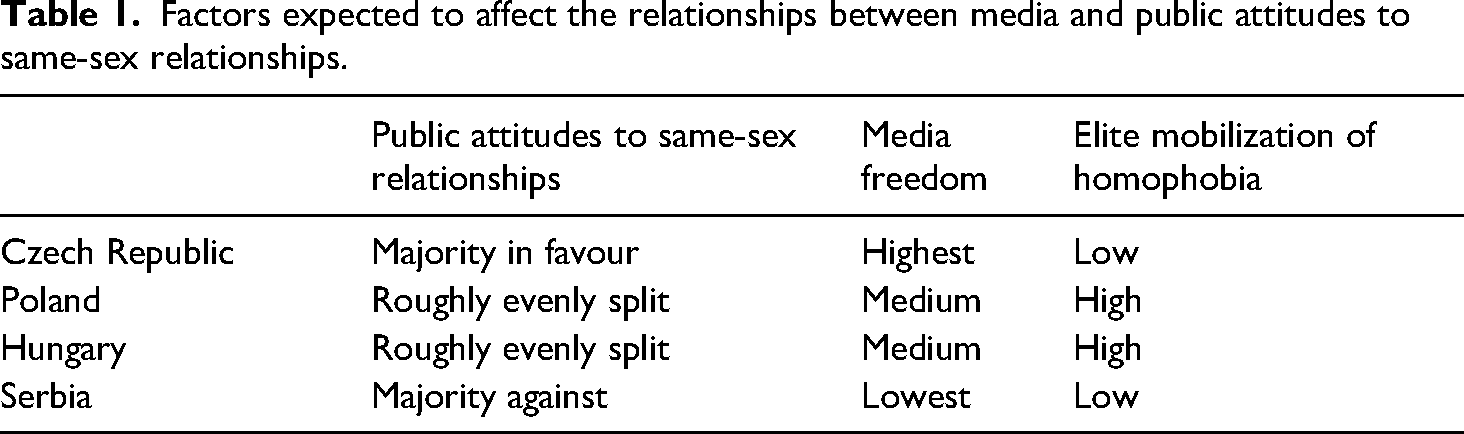
The Czech Republic displays the healthiest state on all three dimensions. Although it has been affected by rising illiberalism and democratic backsliding, manifested also in increasing risks to media freedom, exacerbated by the pandemic (Štětka and Hájek, 2021), its PSM are still relatively independent, provide high-quality news and enjoy high levels of trust (Newman et al., 2021). Public attitudes are significantly more positive than in the remaining countries, with 56% of the population supportive of LGBTQ+ rights (Globsec, 2020: 58).
In contrast, Serbia's transition path was the most complicated and least successful, leaving the country lagging in democratic standards and lowest of the four countries in media freedom rankings (RSF, 2021). The country also has the lowest levels of public acceptance of LGBTQ+ rights, with only 32% of the population in favour (Globsec, 2020: 58). The visibility of same-sex relationships is highly contentious, with pride parades regularly met with violence and hostility, and occasionally banned due to high risk of violence (Bilić, 2016). At the same time, Serbia currently has an openly lesbian Prime Minister, and the country's ruling, conservative populist elite has also sought to instrumentalize pride parades as a means of demonstrating its readiness to join the EU (Filipović, 2019: 1699). Serbia is thus marked by a rather incongruous combination of public hostility and elite instrumentalization of the pro-gay and lesbian agenda.
Hungary and Poland initially managed to consolidate the key democratic institutions, including a pluralistic media system, but the situation started deteriorating during the 2010s. Both countries experienced a rise in right-wing nationalist populism and a subsequent erosion of democracy, as their governments actively sought to undermine the rule of law, the rights of minorities and the system of democratic checks and balances, including the media (Vachudova, 2020). This trend has been reflected in the sharp fall in global rankings measuring the quality of democracy and media freedom (Csaky, 2021: 2; RSF, 2021). These developments have also affected the PSM, which have been transformed into instruments of government propaganda (Surowiec et al., 2020). Unlike the Czech Republic and Serbia, Poland and Hungary are also characterized by high levels of political contestation over LGBTQ rights, with ruling parties mobilizing public support by countering LGBTQ+ rights and ‘gender ideology’ (Csaky, 2021: 4). Both countries are also roughly evenly split with regards to public attitudes to LGBTQ+ rights, with 49% in favour in Hungary and 46% in Poland (Globsec, 2020: 58).
Methodology
This study combined a representative population survey and semi-structured interviews. The population survey (18+, N=4092) was carried out using an online questionnaire and telephone interviews in December 2019 and January 2020.
1
To measure attitudes towards same-sex relationships we used three variables: (a) attitudes to same-sex marriage, (b) attitudes to same-sex adoption and (c) attitudes to lesbian and gay people as neighbours, using the following questions, all of which were adopted from existing surveys and hence pretested:
‘Some countries have adopted laws that make it possible for same-sex couples to get married. Do you think same-sex couples should have a right to get married in [YOUR COUNTRY] too?’; ‘In some countries, same-sex couples have a right to adopt children. Do you think this should be possible in for same-sex couples in [YOUR COUNTRY] too?’ and ‘Would you mind having any of the following groups of people as your neighbours?’ [Option: Gays or lesbians].
Questions (a) and (b) used a 7-point scale of 1 to 7, where 1 indicated full agreement and 7 full disagreement. For question (c), the answers on the 7-point scale were 1 – ‘I would not mind at all’, 7 – ‘I would mind a lot’.
To answer RQ1 and test hypotheses concerning the link between attitudes and exposure to news, we used two variables: (a) frequency of PSM news consumption and (b) frequency of digital news use consumption. The first variable was measured by asking people how often they use public service TV and radio ‘for accessing news in the last month’, on a 6-point scale (1 – several times a day; 6 – never). Questions referred to specific national PSM channels in each of the countries. The final score was constructed as an average of individual scores. The second variable was measured as an average of the scores given in response to questions on how often people (a) ‘read political news on the Internet’ and (b) ‘read political information shared on social media (e.g. Facebook, Twitter, WhatsApp)’, on a 6-point scale (1 – more than once a day; 6 – never).
The survey included selected socio-demographic variables that are known to influence attitudes to same-sex relationships, namely age, gender, education, domicile size and religiosity (e.g. Adamczyk and Liao, 2019; Becker and Scheufele, 2011; Takács et al., 2016). These were used as controls in the OLS regression analysis, which was applied to explore the effect of exposure on attitudes.
Qualitative analysis, used to answer RQ2 and to provide in-depth insights in response to RQ1, is based on semi-structured interviews with 30 participants per country, conducted in February and March 2020. Participants were recruited from the surveys and from personal connections. The sample was limited to participants who consume news and who follow politics on a regular basis (minimum weekly). Quota sampling was used to ensure the purposive sample was sufficiently diverse on key demographic dimensions known to shape media use and political behaviour, namely age, gender and domicile size; political preference was also taken into consideration. In accordance with the Loughborough University Guidance on Investigations Involving Human Participants, all participants were asked to provide informed consent. The research was approved by the Ethics Approvals (Human Participants) Sub-Committee (dated 20 March 2019).
The interviews lasted an hour on average, and covered attitudes to several potentially polarizing issues, political engagement and news consumption routines and preferences. Of particular importance for this article, participants were asked about the reasoning behind their answers to survey questions mentioned above, and to provide examples of encounters with news on sexual minorities. All interviews were transcribed from local languages to English and analysed using thematic analysis (Braun and Clarke, 2006) in NVivo. The coding tree was formulated through a combination of deductive and inductive coding. Data collection and initial coding were conducted by four researchers fluent in local languages. As part of initial coding, all four researchers identified excerpts in which sexual minorities were discussed. To ensure comparability, and resolve translation and coding problems, researchers used the same interview protocol, attended a joint workshop prior to fieldwork and regular meetings during fieldwork and coding. In the second step, a single researcher examined all excerpts in which sexual minorities were mentioned, from all countries. The researcher also consulted the principal investigator, who read through a selection of interview material.
Government-controlled PSM as amplifiers of illiberalism in polarized societies
Our data reflects significant cross-country variation in the levels of prejudice towards same-sex relationships, consistent with prior research (Globsec 2020). When asked whether same-sex couples should have the right to marry and the right to adopt, Czech participants had the most positive attitudes, followed by Hungarian and Polish participants, while Serbian participants had the most negative attitudes (Figures 1 and 2). Similar cross-country differences are reflected in attitudes to gay and lesbian neighbours, although acceptance is generally higher on this dimension (Figure 3).
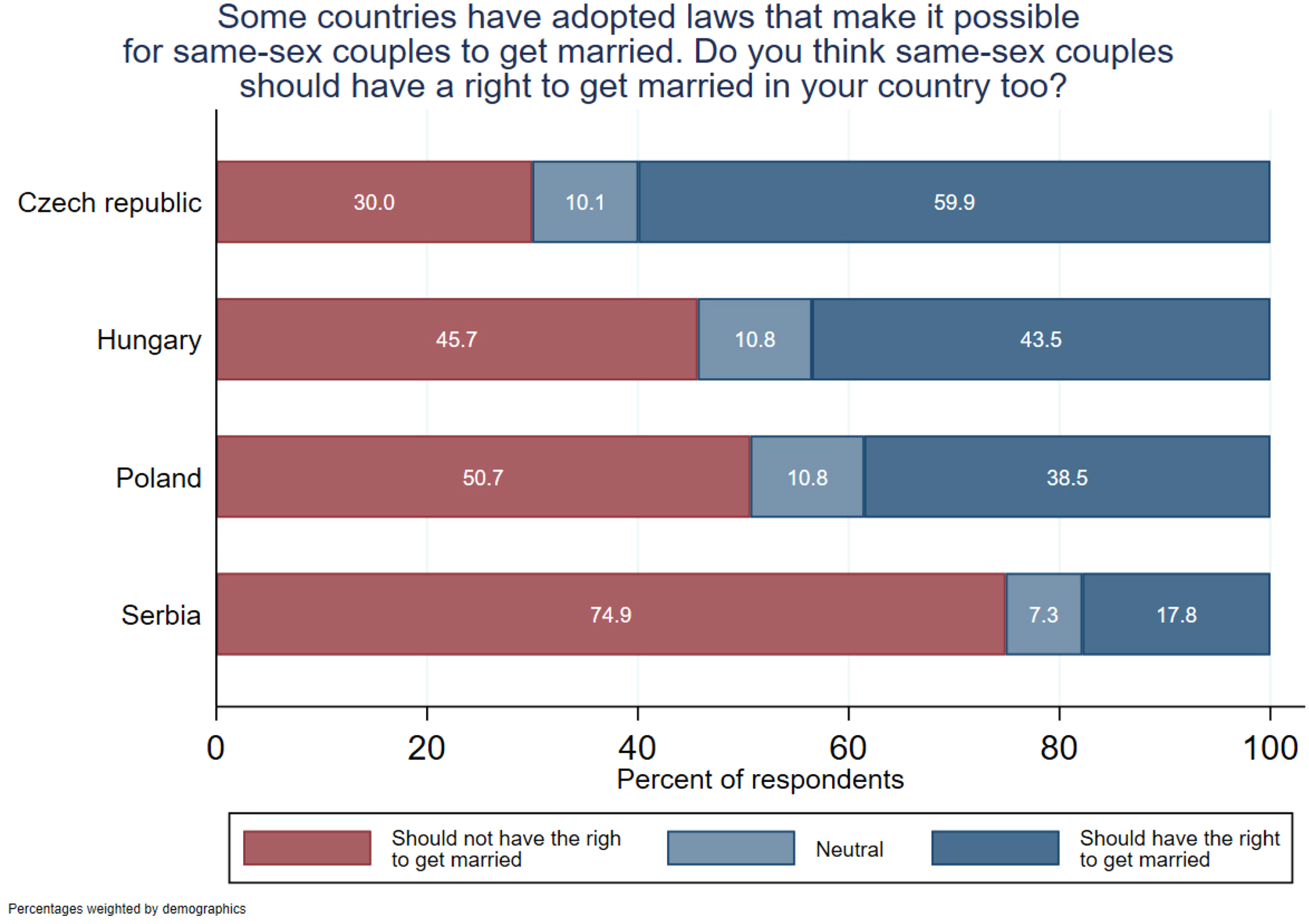
Attitudes to same-sex marriage, compared across four countries.
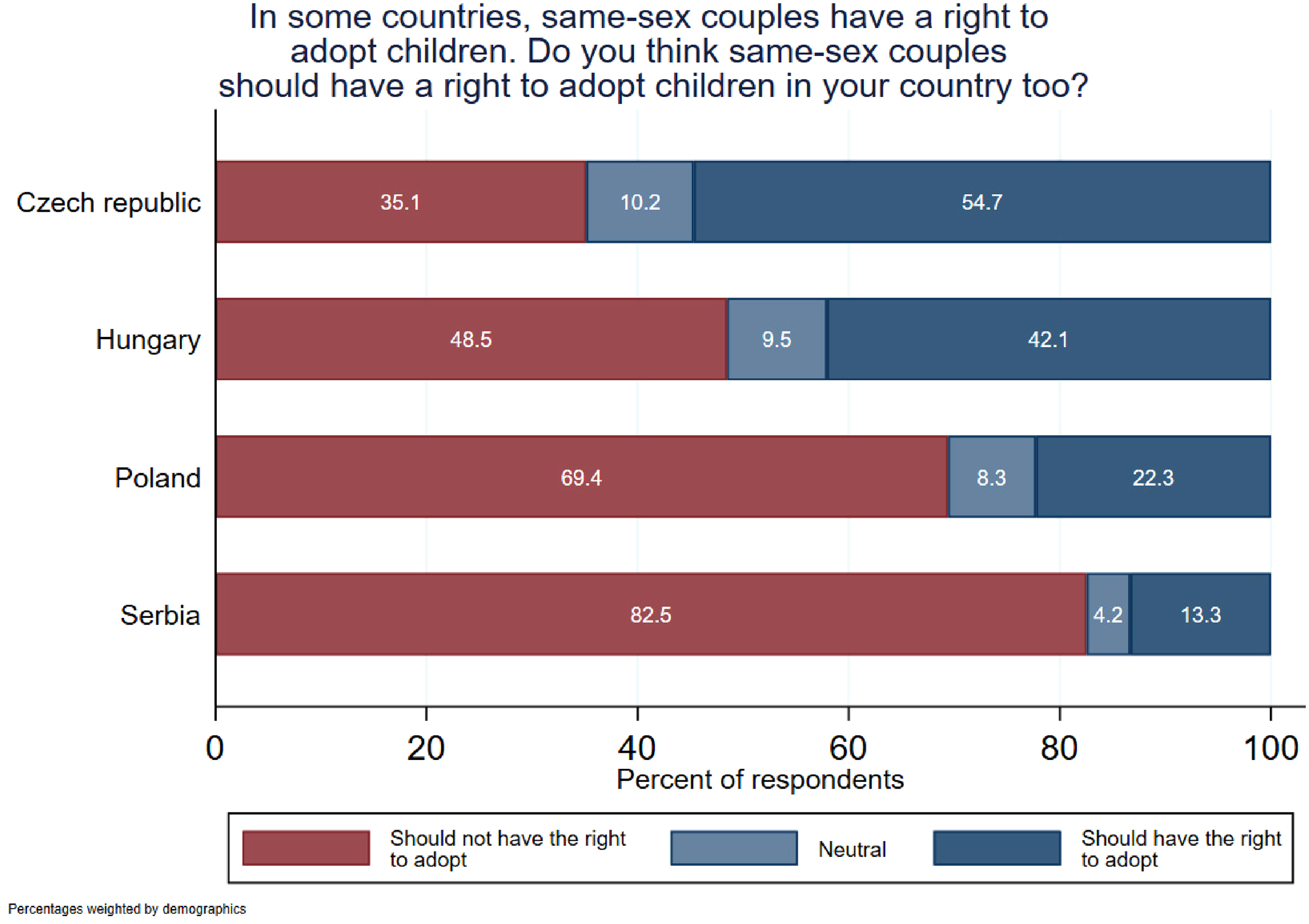
Attitudes to same sex adoption, compared across four countries.
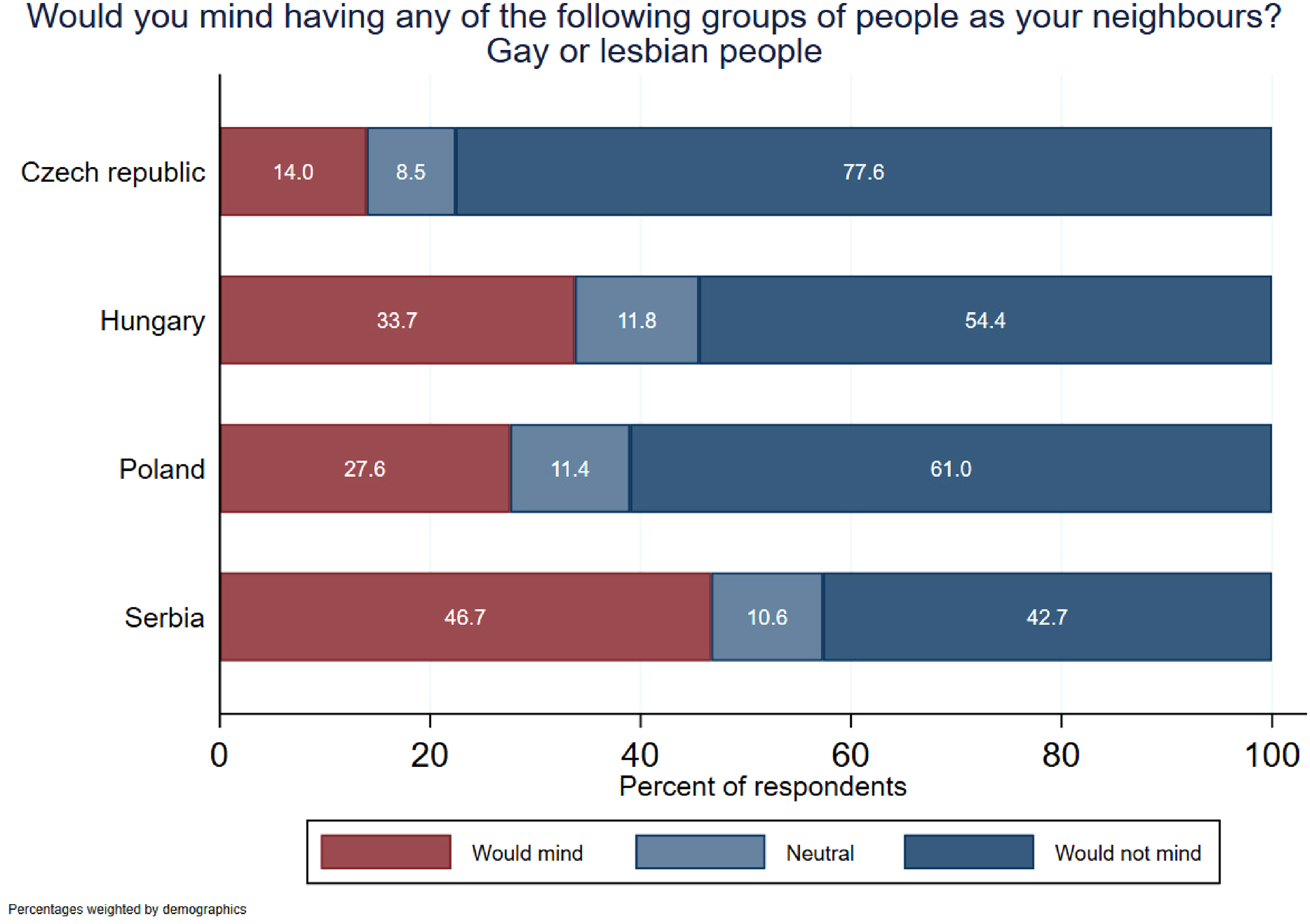
Attitudes to gay and lesbian neighbours, compared across four countries.
Turning to the link between attitudes and PSM use, our data again show significant cross-country variation (Figure 4). After controlling for relevant demographic variables, the results show a significant relationship between PSM use and negative attitudes in Hungary and Poland, with no significant relationship in either Czech Republic or Serbia.
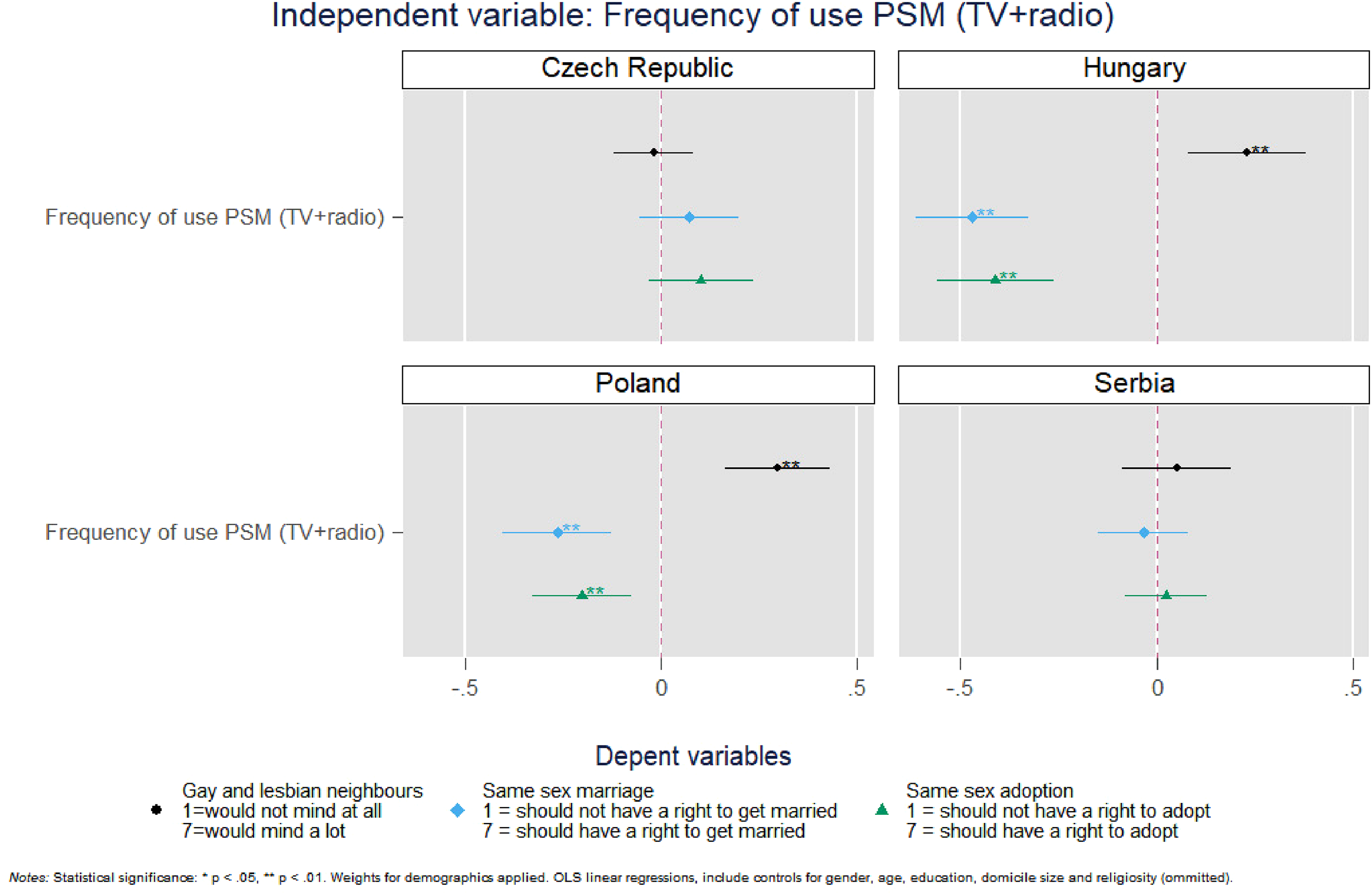
Effect of PSM news consumption on attitudes to same-sex relationships, compared across four countries.
The absence of a significant relationship in Czech Republic is consistent with H1, as Czech Republic has the highest levels of media freedom. The absence of a significant relationship in Serbia, however, means that H1 is rejected. These results suggest that the impact of PSM varies not only with levels of media freedom, but also depending on elite mobilization of homophobia, and attitudes to same-sex relationships. Poland and Hungary are the two countries where gay and lesbian rights have become a key axis of political contestation, and where the population is roughly evenly split on the issue. In contrast, there is elite consensus on the topic in Serbia and the Czech Republic, and public attitudes are also more homogeneous, with Serbia overwhelmingly against, and Czech Republic overwhelmingly in favour. In such a context, news coverage of same-sex relationships is likely less polarized, meaning that the choice of news sources is unlikely to be aligned with attitudes to same-sex relationships.
These arguments are consistent with findings derived from qualitative data. When asked where they encountered news about sexual minorities, several Polish and Hungarian participants mentioned PSM, and noted the negative tone. For instance, Polish participant Pol-13 (female, 38) explained that Polish PSM do cover same-sex relationships, ‘but they present them in a bad light, showing that same-sex couples go against ethics, go against religion, more importantly’. Other pro-government channels were also mentioned as sources of negative framing of same-sex relationships. For instance, a Hungarian participant mentioned seeing news about same-sex adoption on the pro-government, right-wing commercial TV channel HírTV, and on the website of the ultraconservative, transnational campaign platform CitizenGo: Since I watch a lot of programmes on HírTV and in CitizenGo… they talk about this, or on their website. And I think it was there that I read that there were studies in the US about children adopted by same-sex couples and it had negative results. (Hun-14, female, 56)
In Poland, several participants also mentioned the polarized coverage of same-sex relationships, and the stark contrast between reporting provided by PSM and commercial channels. For participant Pol-17 (female, 24), this contrast was a taken-for-granted feature of the Polish media landscape; comparing the coverage on the commercial TV channel TVN with the coverage provided by the public service channel TVP, she said that ‘of course, TVN will be more in favour of these people, while TVP will be more against them’. For another Polish participant, who is opposed to same-sex marriage and adoption, this polarization was also a reason for avoiding channels such as TVN, because ‘they promote LGBT and other things that I don't approve of’ (Pol-08, female, 36).
It is telling to compare these responses to those seen among Czech and Serbian participants. In the Czech Republic, only one participant explicitly mentioned seeing coverage of same-sex relationships in mainstream news, and even in this case, she felt that this is not a particularly prominent issue: ‘I do not think this is a topic being spoken about now […] maybe when it was discussed here before from the legal point of view, then there were some articles, coverage […] There are always some activists who bring it to the table, but it is not a big issue’ (Cze-22, female, 32). The near absence of recollections of news coverage of same-sex relationships in the Czech Republic confirms that this is not a prominent issue, which is consistent with more accepting public attitudes and absence of political polarization on the topic.
In Serbia, on the other hand, several participants mentioned media coverage of same-sex relationships, but – unlike Hungarian and Polish participants – did not single out PSM channels as particularly negative. Rather, negative coverage was associated primarily with tabloids and social media. For instance, participant Srb-09 (male, 48) mentioned coming across negative news in the tabloid Informer, where news items about LGBTQ people reportedly appeared together with sensationalist titles referring to rape and harassment, indicating that same-sex relationships were framed as part of crime and deviance: ‘Usually, on a certain page, not sure which, it's reserved for “Girls touched”, “Boys raped”, “People asking for abortion are worse than paedophiles”. It's like that page is reserved for it – it's full of that news’. Another Serbian participant (Srb-30, male, 26) likewise recalled reading news about gays and lesbians in the tabloid Informer but noted that the tone of coverage was less negative. However, the participant suggested that this was because the coverage referred to the Serbian Prime Minister, who is openly lesbian and has an adopted child; in this context, negative reporting would go against the pro-government bias characteristic of the tabloid: My friend sent me an issue of Informer on Facebook once, and the whole issue was dedicated to gays in Serbia, and what they plan to do in our country. But that issue didn't really show that they were in favour of LGBTQ population. Their reporting on them was reserved. They weren't reporting in their favour, and they were not against them, either. They would’ve been against them if they hadn't been reporting in favour of those in power. (Srb-30, male, 26)
Digital media between amplifiers of illiberalism and channels of resistance
Existing research suggests that in countries marked by low levels of media freedom, online channels may provide an important outlet for more liberal views on homosexuality (Ayoub and Garretson, 2017) and LGBTQ (Winkler, 2019). We, therefore, expected (H2) that the link between digital news consumption and positive attitudes to same-sex relationships will be stronger in countries with lower media freedom. However, our analysis (Figure 5) shows a more complicated picture. In Serbia – the country with the lowest levels of media freedom at the time of data collection – regression analysis showed no significant correlations. In contrast, the correlations were strongest in Hungary, where media freedom was higher than in Serbia but lower than in the remaining two countries: all three variables measuring attitudes to same-sex relationships showed a significant relationship with digital news, with people who consume more digital news displaying more positive attitudes to same-sex relationships. This was followed by Poland, where two of the three indicators (attitudes to same-sex marriage and same-sex adoption) were significantly and positively correlated with digital news use. In the Czech Republic, where media freedom is highest, a significant positive relationship was found only in relation to gay and lesbian people as neighbours.
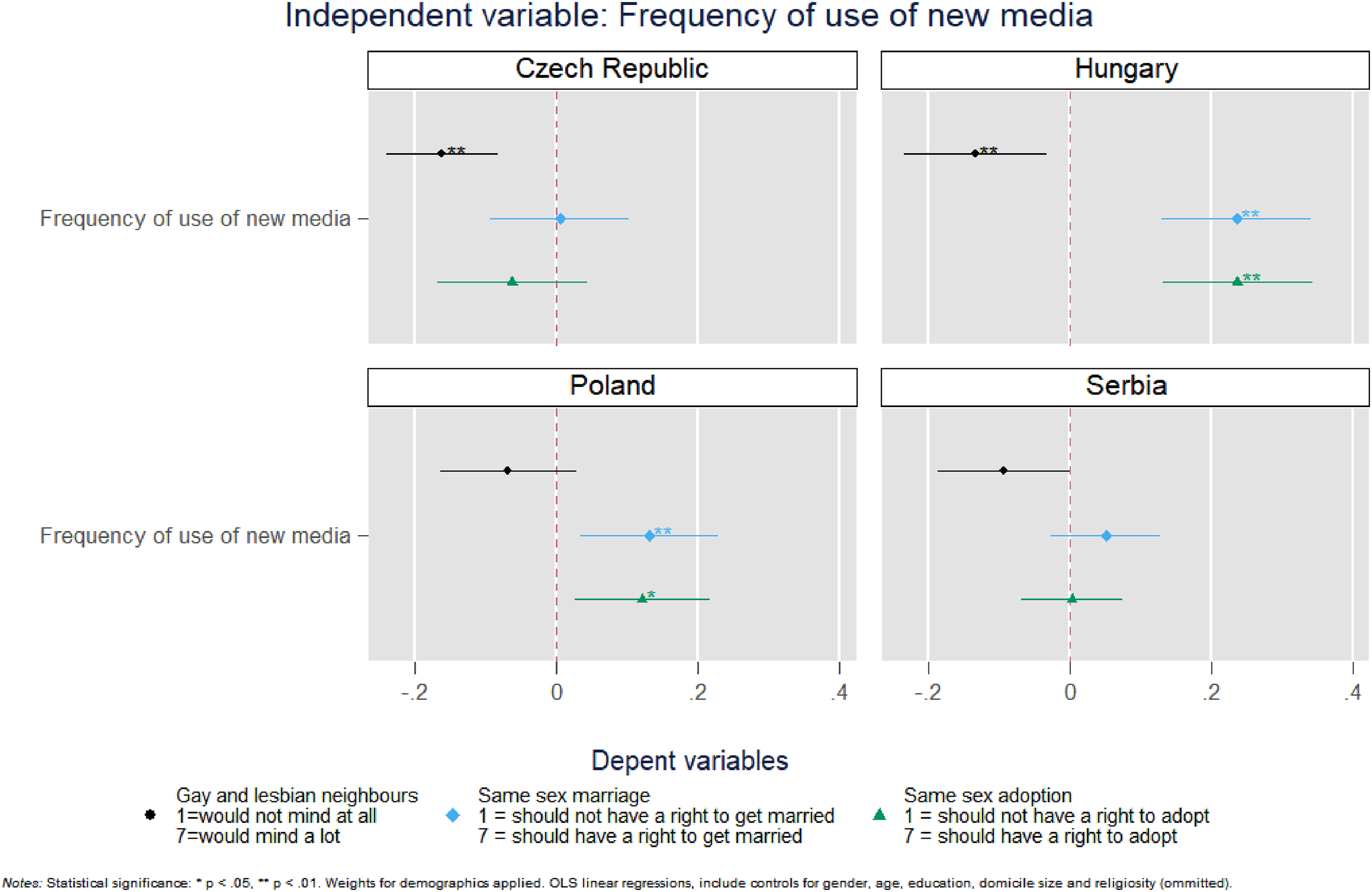
Effect of digital news consumption on attitudes to same-sex relationships, compared across four countries.
These results also lead us to reject H3, showing that elite-driven mobilization does not necessarily diminish the potential of online channels to have a positive effect on the attitudes towards same-sex relationships. Rather, in such a context, which is characteristic of Hungary and Poland, digital platforms can still act as channels of liberal views, enabling a more positive visibility of same-sex relationships, in contrast to the negative sentiments promoted through government-controlled PSM channels.
Qualitative data offers further insights into the relationship between attitudes and exposure to depictions of same-sex issues on social media. The results remind us that visibility can cut both ways, and can reinforce either positive or negative attitudes, depending on context. Several participants from Poland, Serbia and Hungary (but only very few from the Czech Republic) mentioned finding news on same-sex issues online, particularly on social networking platforms. Most often, participants remembered encounters with negative rather than positive depictions online, which confirms that digital media are an important channel of exposure to negative attitudes. Given that our survey results suggest a correlation between greater digital news consumption and more positive attitudes, this may seem counterintuitive. However, what also emerged from our interview data was a sense that the reception of depictions of same-sex relationships – whether positive or negative – was shaped by pre-existing attitudes.
For participants holding negative attitudes, such negative representations seemed to confirm their views. For instance, Polish participant Pol-29 (female, 47), noted that gay and lesbian people are associated with paedophiles, mentioning social media as a source. Some of our participants also used social media to express their opposition to marriage and adoption rights for same-sex couples. Serbian participant Srb-23 came across a newspaper report about the introduction of same-sex relationships to preschool children, and shared it on social media to mobilize her friends against it: ‘I took a picture of that excerpt from Politika and posted it on Facebook, asking people to rise against it' (Srb-23, female, 60+).
In contrast, participants with more positive views were not persuaded by negative depictions and were also more inclined to mention positive coverage online or describe heated arguments over same-sex relationships on social media. For instance, a Serbian participant (Srb-19, female, 62) mentioned coming across uplifting coverage on social media: ‘I saw something on Twitter, about a girl whose father has finally accepted her for who she is, and when you see that immense joy, you realise how little we need to be happy’. Another Serbian participant (Srb-21, female, 21) noted that positive coverage found online attracted negative comments: ‘There are foreign pages that I follow on Facebook, and sometimes they post something on the LGBTQ population, and then I read comments and see that people are against them’. On the other hand, Polish participant Pol-15 (male, 38, rural) mentioned discussions about same-sex relationships on their Facebook newsfeed, and noted that in these discussions, LGBTQ people were ‘strongly criticised’, but then also added that in the comments section, he came across ‘a lot of comments [that] say that gay people are good and so on’.
These examples confirm that even in cases where political elites successfully appropriate public service media as means of spreading illiberal attitudes, social media can retain capacity to sustain a more diverse set of discourses. This does not mean that digital media do not act as channels of negative attitudes – they do – but rather that the actual impact of visibility is not uniform and is often shaped by pre-existing convictions.
Audience reactions to the coverage of pride parades
Data presented in the previous two sections already provides insights into the ambiguous impact of same-sex visibility, demonstrating the ability of government-controlled PSM to act as amplifiers of illiberalism, while pointing to a more ambiguous role played by digital visibility. In this section, we add to this discussion by examining audience reactions to the coverage of pride parades.
When participants discussed seeing same-sex topics in the media, the examples they mentioned most often revolved around pride parades, confirming that pride parades are an effective means of increased visibility. As one Hungarian participant (Hun-04, male, 72) explained, sexual minorities are found in the news, ‘but mainly when there are marches about this and there are conflicts…Not only here but in other countries…’. Similarly, Polish participant Pol-28 (female, 49) said: ‘When there are marches, then they talk a lot’. Serbian participants also agreed that there is news about sexual minorities only around the time of the Pride Parade. Participant Srb-18 (male, 42), for example, explained that ‘as the date of the pride parade approaches, the number of news dealing with whether they should get these or those rights become more prominent’.
However, our participants’ reactions also showed that such increased visibility during pride parades was not unambiguously linked with positive attitudes. For instance, one of our Serbian participants (Srb-24, female, 26) argued that people are now getting used to the coverage of Pride, but the tone of her comment, along with negative attitudes to same-sex relationships expressed elsewhere in the interview, suggest that she does not welcome this change: ‘In the beginning, it was something shocking, people were fighting in the streets, but now our nation has become immune to that, we let all of it keep happening, as well as everything else [laughs]’. Similar negative reactions are found among several other Serbian, Polish and Hungarian participants, which indicate that the mediated visibility generated by pride parades had the effect of fuelling negative sentiments, rather than aiding the diffusion of more tolerant attitudes. Views on pride parades were largely negative, with participants often repelled by the public visibility of gays and lesbians. For instance, Polish participant Pol-05 (male, 51) noted his personal contacts with ‘gays’ but objected to the public display of their ‘otherness’: ‘I don't want them to show off their otherness. We do have gays around us, and they seem pretty decent people. But thankfully, they feel ashamed to do what them other gays do when they go out on the streets’. Participant Pol-20 (male, 57) shared similar views, arguing that everyone was born with sexual identity, ‘but it's not a reason to show it off and consider it an asset’.
Some participants also expressed more extreme views, using pride parades as a pretext for suggesting that same-sex relationships should be criminalized. For instance, participant Pol-19 (female, 26) explained: ‘My attitude results from the fact that these groups, or those who say they represent gay people and lesbians, have the nerve to do things I consider to be against the law’. In a similar manner, participant Srb-11 (female, 46) recalled seeing coverage of attacks on people in the parade, which she found inappropriate, but then went on to argue that the best alternative is imprisonment: ‘… you shouldn't attack them, but lock them up. That's the way to do it’.
Conclusions
The results presented here bring several contributions to ongoing debates about the ambivalences of visibility. First, our findings confirm the need to consider the conditions of mediated visibility in particular socio-political contexts. At the same time, they challenge assumptions about a linear relationship between media freedom and the impact of media on public attitudes to same-sex relationships (Ayoub and Garretson, 2017; Winkler, 2019), and instead suggest the need to consider the interaction with factors such as elite-led mobilization of homophobia and levels of homophobic attitudes, and also acknowledge that these factors can play out differently depending on the type of medium considered. More specifically, we have shown how heightened visibility of same-sex relationships, in a context where control over the conditions of visibility remain in the hands of homophobic elites, or where public opinion is largely hostile, can end up reinforcing prejudice. Second, the results add further nuance to existing research on the role of PSM in LGBTQ+ visibility (Kerrigan and Vanlee, 2022; Vanlee, 2019) showing that government-controlled PSM can contribute to the reproduction of negative public attitudes, while digital media play a more ambiguous role.
On a more general level, these results confirm the need to move beyond frameworks that assume mediated visibility to be an unproblematic route towards recognition and align with the conclusions of recent historical studies of LGBTQ+ visibility (Kerrigan, 2022; Kohnen, 2015) and work that focuses on cases beyond the West (e.g. Çağatay et al., 2022; Edenborg, 2020; Stella, 2012). Materials presented here confirm the ambivalent impact of mediated visibility in the context of elite-driven polarization and rising illiberalism, and suggest that in such a context, visibility can turn from a vehicle of recognition into a vehicle of control. To better understand the changing conditions of mediated gay and lesbian visibility – but also, potentially, LGBTQ+ visibility more generally – future research needs to pay closer attention to the role of different media in shaping public attitudes, particularly in contexts where their rights become politically contested.
In this article, we have only scratched the surface of what is a very rich field of inquiry, and we should note some limitations. First, we did not analyse media coverage, which would have further enhanced the understanding of the differential impact of specific media. Second, our questionnaire focused on three issues only (same-sex marriage, adoption and gay and lesbian people as neighbours) rather than the full range of topics associated with LGBTQ+. And third, while the mixed methods approach added depth and contextual interpretation, it also meant that the number of countries included was limited, which restricted our ability to draw generalizations about the impact of systemic factors. Further research could therefore test our conclusions about the differential impact of PSM and digital media by including media coverage analysis; cover a wider range of attitudes to LGBTQ+ issues and explore our propositions about the relative impact of systemic factors (elite-driven contestation, levels of anti-LGBTQ+ attitudes, media freedom) by examining a wider range of countries.
Footnotes
Acknowledgements
We would like to thank Ana Stojiljković, Damian Guzek, and Marketa Doležalova for their help with data collection and preliminary analysis. We are also grateful to the two anonymous reviewers and to Marco Pino for their comments on an earlier version of this paper. The remaining mistakes are of course ours.
Declaration of conflicting interests
The author(s) declared no potential conflicts of interest with respect to the research, authorship, and/or publication of this article.
Funding
The author(s) disclosed receipt of the following financial support for the research, authorship, and/ or publication of this article: This research was supported by the Economic and Social Research Council [ES/S01019X/1].

Notes
Correction (September 2023):
This article has been updated with textual changes on pages 583-586 since its original submission.