



Abstract
Televised election debates are considered as the most important single campaign event. While a large body of research has analyzed their content, processing, impact, and media coverage, it has not yet been examined under which conditions candidates agree to debate. This is remarkable, as debates are a matter of course in only a few countries, and candidates are always renegotiating their participation with the television networks. Using a dataset covering all German federal and state elections between 1994 and 2022 (N = 108), we demonstrate that the broadcasting of televised debates is more likely if (1) there was a debate in the last election, (2) the fragmentation of the party system is low, and (3) the race is close. Furthermore, the likelihood for debates increases over time; also, the introduction of debates on the national level has stimulated the broadcast of debates in state elections.
Introduction
Televised debates are considered as the most important single campaign event (Maier and Faas 2011: 76). With respect to audience ratings, media coverage, and probably also the great care and conscientiousness with which candidates prepare for this event, no other political program can compare with debates. Moreover, probably no other single campaign format is considered to have the potential to be as effective as televised debates. For instance, before a debate, the media regularly claim that it is “the last chance” for candidates lagging in the polls to get back into the electoral race. 1 Regardless of whether this is really the case (for a summary of the effects of televised debates on voting behavior see, e.g. Benoit 2016; Kraus 2000; McKinney and Carlin 2004; Maier and Faas 2019), the candidates’ hope of substantial persuasive effects probably explains their willingness to participate in such a “high-risk TV” (Schroeder 2000) format.
While a large body of research has analysed the content, the processing, the impact, and the coverage of televised debates in traditional and social media, the question under which conditions candidates agree to debate each other has, to the best of our knowledge, not yet been addressed. This is quite astonishing, because unlike in the United States, where the organisation and conduction of (presidential) televised debates are currently quasi-institutionally regulated by the Commission on Presidential Debates and actually leaves the candidates no decision power about whether to participate, 2 the situation in the vast majority of other countries is completely different: Whether debates take place is solely a matter of negotiation between candidates and television networks. 3 In fact, there are several countries—including the United States (1964, 1968, 1972)—where these negotiations have apparently failed, although there have been televised debates in the past (e.g. Bulgaria, see Raycheva and Dimitrova 2008; Canada, see LeDuc 1990; France, see Requate 2018; Ireland, see Rafter 2011; Poland, see Dobek-Ostrowska and Lodzki 2008; Romania, see Patrut and Cmeciu 2012). This raises the question of what factors influence whether or not debates are aired on TV in the run-up to elections. Unfortunately, we know next to nothing about these negotiations and the reasons why televised debates sometimes occur and why they sometimes do not (for some anecdotal information, see Kraus 2000; Seltz and Yoakam 1962, 1979).
This article innovates in providing the first empirical evidence on the drivers of broadcasting US style televised debates, contributing to research on “which channel” (Lasswell 1948) is used to communicate political content. Based on a dataset of all German federal and state elections since 1994, we demonstrate that the broadcasting of televised debates is more likely if (1) there was a debate in the last election, (2) the fragmentation of the party system is low, and (3) the race is close. Furthermore, the likelihood for debates increases over time and the introduction of debates on the national level has stimulated the broadcast of debates in state elections.
Factors influencing the broadcasting of a televised debate
Televised debates—defined as a meeting, usually broadcasted live throughout the entire electoral territory, between the (usually two) candidates who have the best chance of being elected head of government (see Maier and Faas 2019: 2)—are a great resource to inform voters and get them involved in the campaign. 4 Numerous studies have shown that watching a debate fosters knowledge about the candidates and the issues and increases political interest and turnout (see, e.g. Benoit et al. 2003; Cho and Choy 2011; Maier and Faas 2011). However, when candidates decide whether they want to participate in a debate, their primary goal is probably not to educate the electorate. It is much more likely that, first and foremost, they are interested in persuading the electorate to vote for them. Since candidates are assessed by the public and the media as to whether they are the “winner” or “loser” of a debate (e.g. Kraus 2000), the outcome of the debate for the candidates is not predictable. Therefore, it can be assumed that candidates carefully consider potential benefits and risks of participating—at least when they have a choice to reject such an invitation.
The ultimate benefit of a successful debate is for a candidate to convince a large number of voters to cast their vote for them rather than for the political opponent. However, the effect of debates on voting intention is contested (e.g. McKinney and Carlin 2004; Maier and Faas 2019: 121–124); unquestionably, debates only rarely decide elections (e.g. Jamieson 2015). A more realistic goal, therefore, is to improve voters’ attitudes toward them as a person and their policy plans and to gain some momentum for the rest of the campaign. Many studies indicate that this is indeed feasible (see, e.g. Benoit et al. 2003; McKinney and Warner 2013), particularly if a candidate is seen as the “winner” of a debate (e.g. Pattie and Johnston 2011; Yawn and Beatty 2000).
The risky side of televised debates is that the questions of the moderator(s) and the opponent's behavior are difficult to predict and impossible to control. Therefore, one's own pre-formulated statements may have to be spontaneously adapted to the situation—which can quickly lead to inaccuracies, inconsistencies, or omissions in the argumentation, also due to limited speaking time. In addition to the pitfalls of rhetoric, nonverbal communication, which is often even more difficult to control, is a factor that harbors risks. In particular, the visual presentation of candidates in televised debates, such as the trend of showing all candidates virtually permanently via split screen (see, for instance, the 2020 US presidential debates), ensures that no facial expression or gesture remains undetected. In addition to the fact that all verbal and visual impressions can have immediate effects on viewers, statements and appearances of the candidates are closely followed not only by the classic media (e.g. Kendall 1997; Reinemann 2007), but also in the social media (e.g. Chadwick et al. 2017; McKinney et al. 2013), and—as soon as anything unusual occurs—are immediately picked up. “Debating the debate” (Tsfati 2003) allows this format to have an impact even on those who did not watch it.
Thus, because the potentially great benefits of televised debates are offset by significant risks, participation in such broadcasts is not a matter of course. This is especially true for the incumbent, who generally has little incentive to agree to participate in televised debates; they know that a debate with the opponent means sharing media attention with them in any case and—in terms of debate effects—tends to benefit the challenger (Maier and Faas 2019: 106). For instance, in 1969 the German Chancellor Kurt Georg Kiesinger refused to participate in any competitive televised discussion. He argued that “it is not proper for a Chancellor of the Federal Republic of Germany to sit on a little chair and wait to be given the floor” (Klein 1990: 12; translation by the author). Chancellor Helmut Kohl, who felt “insecure on television anyway” also refused to debate his challengers, apparently because he considered the risks greater than the opportunity for positive self-promotion (Rosumek 2007: 176; translation by the author). And in 2002, French president Jacque Chirac refused to debate the far-right leader Jean-Marie Le Pen to avoid giving him a platform for his political ideas. 5 In contrast, challengers should always choose to debate the incumbent if given that opportunity. What could be better than meeting the incumbent at eye level in front of a large audience and thus demonstrating to the viewers how important one is?
We argue that four types of reasons influence the decision to have a televised debate: (1) political competition, (2) the incumbent's need for visibility and delimitation, (3) the structure of the party system, (4) traditions.
Political competition
Since the potentially large benefits of televised debates are accompanied by substantial risks, we assume that incumbents are willing to participate only if the benefits outweigh the risks or if the strategic situation in the campaign is so bad that high risks must be accepted regardless of the potential returns. We believe there are three situations in which the likelihood increases that an incumbent will decide to debate their challenger. First, if the polls indicate that the incumbent will lose votes. Loosing votes increases the risk that they will lose office. Even if this is not the case and the incumbent can continue to govern, losing too many votes can lead to having to give up office due to internal party pressure.
6
Therefore, we expect:
H1: The likelihood of a televised debate increases when the incumbent (or their party) loses votes.
Second, in multiparty systems, governments usually consist of a coalition of at least two parties. Therefore, the decision of whether an incumbent can continue to govern depends not only on how their own party performs. This is because the party's own losses can be offset by the gains of its coalition partner. It is therefore also important to consider whether the governing coalition loses votes. If the coalition as a whole loses votes, the risk for the incumbent to lose office or that he or she is only able to continue to govern with a new—but maybe also more complicated—alliance increases. We therefore expect:
H2: The likelihood of a televised debate increases when the governing parties lose votes overall.
Third, in multiparty systems, the strongest party is usually charged with forming the government (e.g. Warwick 1996). Hence, being the strongest party is important to keep control of the government building process. However, also in terms of the perceived legitimacy of the government, it is of great importance to be ahead of the game. If parties that are weaker than another party join forces to take over the government, this is formally completely unobjectionable. However, this could lead to the impression that quite a large share of voters is not represented in the government, which might reduce the perceived legitimacy of the governing coalition and its decisions. Hence, we expect:
H3: The likelihood of a televised debate increases when the race between the two strongest parties is close.
The incumbent's need for visibility and delimitation
A second set of factors that might influence incumbents’ decision to participate in a televised debate is that they believe that not all voters know them very well, either as a person or in terms of their policy positions. Both constellations increase the likelihood to debate the challenger. In multiparty systems, there are at least two situations where this can happen. First, incumbents can govern even though they have not been elected. It is not uncommon for politicians to take over as head of government because the actual elected incumbent leaves office due to resignation, running for an office at another level of the political system, or illness. In this situation, voters may not be very well informed about the new incumbent. As a result, the incumbent does not have the advantage over the typically rather unknown challenger. To compensate for this, an incumbent who has come into office as “successor” should show a greater willingness to participate in a televised debate, while incumbents who have come into office “regularly” should not. Therefore, we expect:
H4: Incumbents regularly elected in the last election show a lower likelihood to participate in a debate than incumbents who came into office during a current election term as “successor” of the previous incumbent.
Second, because of the increasing fragmentation of party systems (e.g. Best 2013) and the recent electoral successes of both radical left- and right-wing parties (e.g. March and Rommerskirchen 2015; Stockemer 2017), a coalition of the two strongest parties is sometimes the only way to form a stable government. This constellation is often called a “grand coalition.” However, from a strategical point of view, grand coalitions have an important disadvantage: Unlike in “normal” constellations, in which one major party takes over the government while the other major party fills the opposition role, voters find it much more difficult to identify policy differences between the two parties working together in a grand coalition (Dorn et al. 2017), although analyses of party manifestos show that there are clear differences (e.g. Wagschal and König 2014). Since voting is a “comparative act” and political actors therefore “must appear different from one another” (Benoit 2007: 34), parties linked in a grand coalition must explain to voters what these differences are. As a result, we expect:
H5: If parties work together in a so-called “grand coalition”, their top candidates are more likely to participate in a televised debate.
The structure of the party system
However, the decision whether or not to debate is not always in the hands of the candidates but is also influenced by external factors. One of these factors is the structure of the party system. Whereas presidential systems are designed to focus on two or only a few candidates, the situation is completely different in multiparty systems where smaller parties also play an important role. Since a discussion only between the political leaders of the parties that will most likely provide the next head of government excludes smaller parties, televised debates face much criticism in multiparty systems. For instance, it has been argued that such programs foster the presidentialization of political competition and is therefore incompatible with the nature of political decision-making processes in multiparty systems (e.g. Anstead 2016; Donsbach 2002). We therefore expect that as the party system becomes more fragmented, public criticism of televised debates will increase, to the point where it will become very difficult to legitimize the conduction of such a format. Hence, we formulate:
H6: The higher the fragmentation of the party system, the less likely are televised debates.
Traditions
Repeatedly airing televised debates can lead to a situation where candidates have no choice about whether to debate. If so, televised debates become a standard event in election campaigns and are considered “institutionalized.” They are perceived as a “good habit” of political discourse, a key element of informing voters serving as “a point of reference on the candidates’ messages” (Benoit 2014: 4) in an increasingly cacophonous communication environment. Behind this rather normative position that voters should be well informed and televised debates can help in this respect, there is also an economic interest on the part of the media. Debates come with large audiences (for an overview, see the country chapters in Juárez-Gámiz et al. 2020), offer the opportunity of several days of pre- and post-debate coverage (e.g. Coleman et al. 2011; Kendall 1997), and are fit perfectly in the media's “horse-race” journalism (e.g. Reinemann and Wilke 2007). Hence, once established it should be extremely difficult for candidates to refuse to participate in televised debates—not least because they depend on the attention and positive coverage of the media, that is, the actor with an extremely high interest in such a format. Therefore, we expect:
H7: The likelihood of airing a televised debate increases if there was a debate in the previous election.
Research design
To analyse our hypotheses, we use a dataset including information for all German federal and state elections between 1994 and 2022 (N = 108). We chose to use this starting point as the first televised debate was aired in the run-up to the 1997 Hamburg state election and we want to include all elections that took place from this election onward as well as the preceding one. We therefore consider the 1994 federal election to be a suitable starting point for our data collection. See Table A1 in the Appendix for a list of the elections analyzed.
The broadcasting of televised debates in Germany seems strange at first glance, given the parliamentary system in which the head of government—the chancellor at the federal level or the minister president at the state level—is elected by parliament rather than directly by the people. Indeed, the adoption of the US format in favor of the “elephant round” that had prevailed until then was sometimes sharply criticised (e.g. Donsbach 2002; for a summary, see Maier and Faas 2019: 9–10). It was argued that US style televised debates were generally unsuitable for a parliamentary system because they were incompatible with multiparty systems in which smaller parties also play an important role (e.g. Anstead 2016); consequently, the introduction of American-style televised debates to such political systems was seen as indicative of the Americanization of politics (e.g. McKinney and Carlin 2004: 227). In this context, fears were expressed that such broadcasts would increase the focus on the top candidates of the two largest parties at the expense of parliament and the political parties. Furthermore, it was also expected that US style televised debates would fuel the personalisation of politics, with far-reaching consequences for candidate selection and voting behavior.
The introduction of televised debates in Germany is seen as a response to several trends in the electorate (Maier and Faas 2019: 5). Above all, the declining influence of social factors on voting behavior and the process of dealignment—the dissolution of long-term stable affective ties to political parties—are seen as causal factors for the decline in turnout, the increase in floating voters, and the rise in late deciders (Schmitt-Beck et al. 2022). In this “new era of instability” (Schmitt-Beck et al. 2022: 3), televised debates have created a communication opportunity that is generally considered as a “‘win-win-win’ situation” (Maier and Faas 2011: 76; see also, e.g. Wagner and Werner 2017). For candidates, such broadcasts offer the opportunity to reach a large proportion of the electorate, bypassing journalistic selection criteria to a large extent. In particular, candidates can address those voters that are difficult to reach with standard campaign tools but are very open to persuasive messages. For the media, televised debates fit their “logic” perfectly, guarantee high ratings, and lend themselves to extensive coverage. For voters, debates provide orientation in a complex political world. This is particularly true for those voters who lack traditional heuristics such as identification with a party. The amount of time voters have to invest in the debate is manageable; and at best, the broadcast is even entertaining.
Dependent variable
Our dependent variable is whether or not there was a US style televised debate in the run-up to the elections covered in our data set (binary variable with 0 for “no” and 1 for “yes”). Information is based on the inventory provided by Maier and Faas (2019: 170–176). In addition, we have updated the information for all elections held after June 2019. For descriptive statistics of the dependent variable, see Table A2 in the Appendix.
Independent variables
To measure the changes in vote shares for the incumbent's party (H1) and the government as a whole (H2), we rely on elections results collected in www.wahlrecht.de. The measure we use here is the difference in votes between the election in focus and the previous election. Information on the party affiliation of the candidates and the composition of the government was collected via Wikipedia. Although not ideal, Wikipedia has been shown to provide quality factual information when it comes to electoral results and party competition (Brown 2011). Based on the election results from www.wahlrecht.de, we measure the closeness of an election by simply calculating the absolute difference in vote shares between the strongest and the second-strongest party. This allows us to test H3. Information to analyse H4 (incumbent was elected in last election) and H5 (governing parties work together in a so-called grand coalition) is also based on Wikipedia data. Both variables are binary (0 for “no”, and 1 for “yes”). The fragmentation of the party system (H6) is measured by the formula for the effective number of parties suggested by Laakso and Taagepera (1979). The index is calculated as the strength of the parties represented in the parliament for the election in focus; the higher the score, the higher the level of fragmentation. Finally, whether there was a televised debate in the last election is also measured using a binary variable (0 for “no,” 1 for “yes”). This allows us to test H7. For descriptive statistics of the independent variables, see Table A2 in the Appendix.
Controls
We include three control variables in our analyses. First, the year of the election. This control is necessary to account for the generally increasing attractiveness of televised debates in Germany (see Figure 1). Second, for all states and the national level respectively, we capture whether the election was the election following the 1997 Hamburg state election. Technically, we generate a dichotomous variable indicating whether the respective election was in the wake of this election (0 for “no” and 1 for “yes”). The logic behind this variable is that the Hamburg election may have provided an immediate impetus for other elections to also televise debates, trying out a new element in election campaigns. Third, the same logic applies to the first televised debates at the national level, which were aired in 2002. Therefore, we also generate a dichotomous variable indicating whether the respective election was in the wake of this election (0 for “no” and 1 for “yes”). For descriptive statistics of the control variables, see Table A2 in the Appendix.
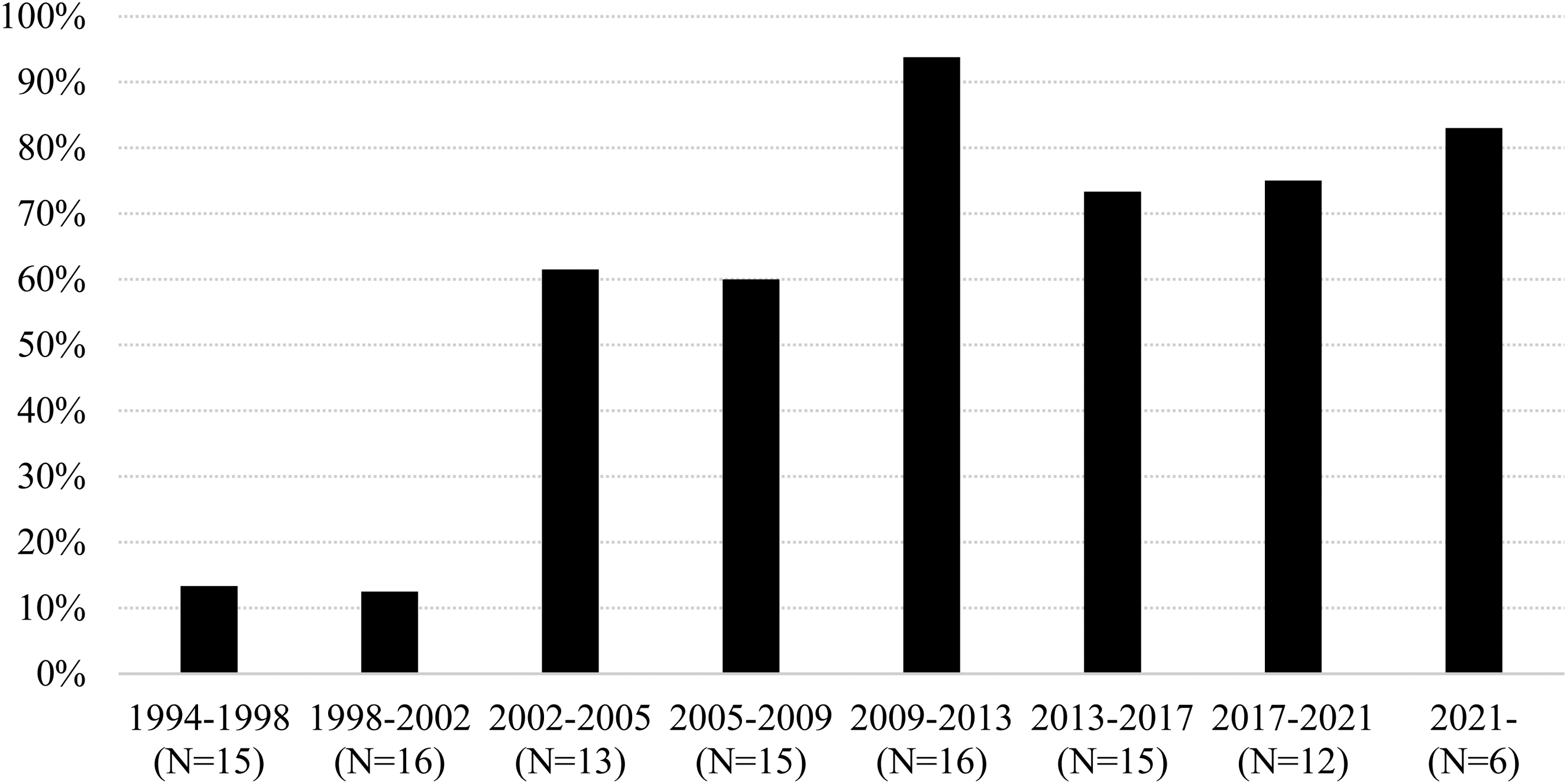
Proportion of elections in which a televised debate was broadcasted of all elections held during a legislative period of the Bundestag.
Results
We test our hypotheses by regressing our dependent variable—whether or not voters had the opportunity to watch a US style televised debate—on the competitive situation, the incumbents’ need for visibility and delimitation, the structure of the party system, and the tradition of having televised debates. To test our hypotheses, we estimate a logistic regression. Due to the lack of independence among observations—debates are clustered within states or at the federal level—we estimate the impact of region on the decision to air a televised debate with robust clustered standard errors. Table 1 presents the result of this model. There is no evidence that multicollinearity among the independent variables is a serious problem in our regression model (see Table A3 in the Appendix).
Explaining the broadcast of televised debates.
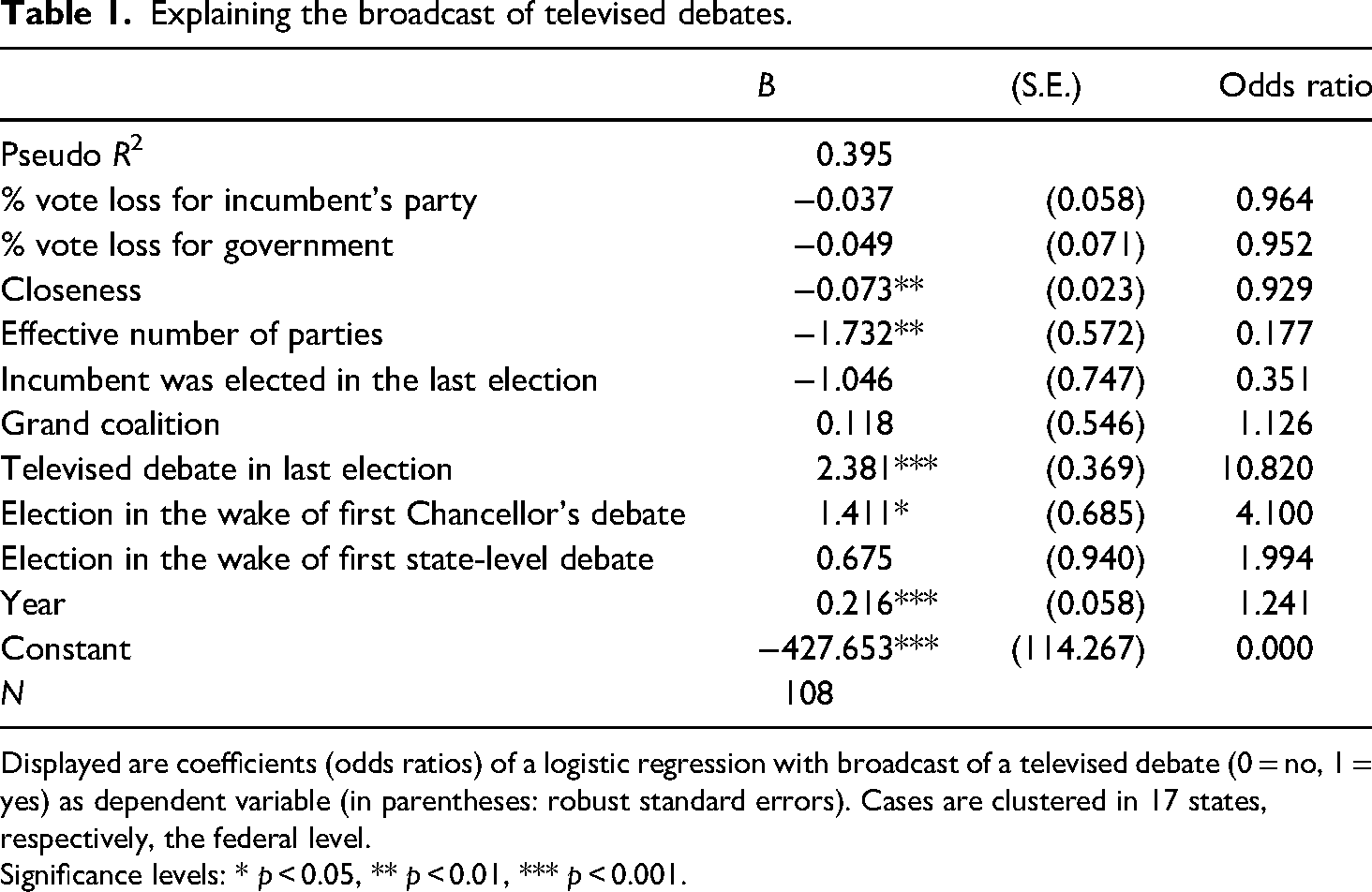
Displayed are coefficients (odds ratios) of a logistic regression with broadcast of a televised debate (0 = no, 1 = yes) as dependent variable (in parentheses: robust standard errors). Cases are clustered in 17 states, respectively, the federal level.
Significance levels: * p < 0.05, ** p < 0.01, *** p < 0.001.
With respect to political competition, our results indicate that neither a loss in votes for the incumbent nor for the government as a whole affects the decision to debate. We therefore have to reject H1 and H2.
In contrast, the closer the election results are between the strongest and the second-strongest parties, the higher the likelihood that top candidates of these parties debate each other. A one-unit increase in closeness (i.e. the difference in vote shares between the two strongest parties decreases by one percentage point) increases the likelihood of a debate by about 7%. Hence, H3 is supported.
There is no evidence that incumbents who are under pressure to make themselves and their policy positions more visible or to distinguish themselves from their competitors are more likely to participate in a debate. Furthermore, the fact that the incumbent is head of a so-called grand coalition does not influence the decision to debate his rival. We therefore reject H4 and H5.
Furthermore, the structure of the party system has a significant effect on the likelihood that voters can watch a televised debate. As expected, a high fragmentation of the party system decreases the chances that top candidates debate each other. An increase of the effective number of parties by 1 decreases the likelihood of broadcasting a televised debate by about 82%. Therefore, H6 is supported.
In addition, we also find that the decision to debate strongly depends on whether there was a televised debate in the last election. In such a case, the likelihood that the top candidates debate each other is more than ten times as high than if there was no debate in the last election. Hence, H7 is supported.
Finally, our results demonstrate that some of the control variables have a significant effect on the decision for televised debates. First, we see that the likelihood of airing debates increases over time. Second, there is evidence for a spill-over effect of televised debates to other elections. In particular, the introduction of televised debates for federal elections had a strong effect on the next state elections.
Discussion
Why is there a televised debate in one election campaign, but not in others? In sharp contrast to the large body of research on the content, the processing, the impact, and the coverage of debates, to the best of our knowledge the literature provides no empirical evidence on this aspect. One possible explanation for this research lacuna is that research on televised debate focuses heavily on the United States, where debates are virtually mandatory for presidential candidates. In contrast, in most other countries the situation is very different; whether there will be a debate is a matter of negotiation between candidates and television networks.
Based on a dataset of all German federal and state elections between 1994 and 2022 (N = 108), we demonstrate that the broadcasting of televised debates depends on several factors, sometimes pulling in different directions. First and foremost, the decision for televised debates depends on traditions (i.e. if there was a debate in the last election), but also on the structure of the party system (i.e. its level of fragmentation), and on electoral competition (i.e. if the race is close in terms of which party will be the strongest after the election). Moreover, we find that the likelihood to hold televised debates is significantly increasing over time. Furthermore, our results demonstrate that the introduction of televised debates on the national level significantly increases the chances of televised debates on other levels of the political system. In contrast, the incumbent's need for delimitation (because he or she is head of a so-called grand coalition) and the incumbent's or his government's loss of votes have no effect. The same holds for the incumbent's need for visibility (because he or she came into office after the last election) and delimitation (because he or she governs in a so-called grand coalition).
Our results indicate that the decision to debate is often, but not always, in the hand of the candidates (which in effect means in the hand of the incumbent, as challengers are always interested in participating in such a format). Candidates are particularly keen to debate each other when the race is close, that is, when it is not clear which party will turn out to be the winner. This makes sense in multiparty systems, since the strongest party takes the initiative in forming the government, usually bringing several parties into a coalition. Being the strongest party is important for dominating the political process; being the voters’ first preference also gives the party an additional legitimacy that makes it very difficult to form a government without it. Therefore, it seems reasonable to accept the risks of televised debates to secure this advantageous position.
The situation is different when there is a tradition of televised debates or when televised debates are held in other elections, particularly on the national level. The decision not to debate each other in these cases is likely to have negative effects on the image of the candidates, especially for the incumbent, since public pressure is probably very high. In other words, candidates who cancel their participation in a televised debate under such conditions must be able to afford to do so. If this is not the case, the decision to debate is no longer in their hands, but they are more or less forced to do so. This is, of course, a crucial point—after all, televised election debates have a very high-reach and thus potentially are very persuasive formats. This can become a problem for candidates who would rather forego a debate—either for strategic reasons or because they feel uncomfortable with live appearances on TV. The tradition of debates in previous elections proved to be the strongest factor in our model; it explains, for example, why Chancellor Helmut Kohl could decline an invitation to debate his challengers (Holtz-Bacha 2020), while Angela Merkel—who was also reluctant to meet her opponents in the 2005 (Holtz-Bacha 2020), 2013 (Faas et al. 2017), and 2017 campaign 7 —could not (however, she was able to reduce the number of debates to one).
This development is counterbalanced by changes in the party system. Our data show that televised debates tend to become less likely as the fragmentation of the party system increases. This finding makes sense, since such televised debates usually focusing on only two candidates are heavily criticized in multiparty systems in which smaller parties also play an important role in the political process. After a certain point, such formats are hardly justifiable. At the moment, despite increasing fragmentation of the party system (e.g. Anstead 2016), it looks like the TV networks will continue to broadcast televised debates, adding more candidates when necessary. For example, the Chancellor debates in the run-up to the German federal elections have recently become a contest between three candidates instead of two. Given the different developments, it is very exciting to observe how televised debates will change in the future with regard to the likelihood that they will be held, but also with regard to their format.
Last but not least, it is worthwhile to also take a look at factors not associated with the broadcasting of televised debates. It is remarkable that vote losses—either for the incumbent's party or the government as a whole—do not provide any incentives to participate in televised debates. This finding suggests that the perceived risks of televised debates appear to be very high as incumbents try to avoid such programs even in such threatening situations. The same holds for situations in which incumbents came into office because the candidate elected in the last election resigned during the term. The advantages of an incumbent presenting himself not only as a person but also as the head of government, setting out his policy record, and outlining what policies voters can expect if they elect him are apparently not worth taking the risk of a televised debate. The same conclusion holds for incumbents who are governing in a so-called grand coalition. The benefits of delimiting themselves from their coalition partner are obviously considered smaller than the potential risks of this format.
From a more general perspective, our findings help us understand when such a key electoral event is (un)likely to occur. Our results also provide insights for voters, candidates, and the media. For voters, our study shows under which conditions they can hope to be concisely informed not only about the most important issues and political ideas, but also about the personalities of the main contenders in the context of televised debates. This is especially important for political systems in which televised debates are not a quasi-mandatory part of election campaigns (e.g. in the United States, at least before the withdrawal of the Republicans from the commission responsible for the organization of presidential debates, a decision that could mean “the end of presidential debates”) 8 or even required by law (like in the Ukraine) 9 . In elections where it is unlikely that televised debates will be broadcast, voters need to be aware that they will have to seek information through other communication channels. For candidates and the media, our study offers evidence on when it is promising to invite the opponent, respectively the main contenders, to participate in a televised debate. For candidates, this information can help them plan their own campaigns, instead of waiting for something unrealistic to happen or being surprised when their opponent agrees to participate.
Our study comes with limitations. First, we have data only for Germany. In order to arrive at generalizable statements that go beyond the German context, studies from other countries are necessary in which TV debates are not regularly broadcasted. Second, we have assumed that candidates decide “rationally” whether or not to participate in a debate. Although it is a common assumption in research on candidate behavior that candidates act this way (see, for instance, the entire literature on the use of negative campaigning; for an overview see, e.g. Nai and Walter, 2015), we have no empirical evidence that this is actually the case. Candidate surveys would be an excellent option to learn more about when and why candidates decide to debate each other. Third, candidates decide during the campaign whether they will participate in televised debates. Our data does not capture the campaign dynamics, for instance, the standing of the parties in the polls and the underlying trends. For the sake of simplification and also because polling data were not available for all elections near election day, we used the final election result as an indicator of the competitive situation in the campaign. However, even if polling data were available, we usually do not know at what point the decision to broadcast a debate was made. Fourth, more research is also indicated for the impact of so-called open seat contests—a situation that occurs regularly in the United States but rarely in parliamentary systems like Germany. In fact, our data set includes only two elections in which no incumbent was running (2021 federal elections, 2021 Berlin state elections); hence, we are unable to test the effect of this factor. Our article hopefully sets the stage for such research to learn more about the factors influencing the broadcasting of televised debates.
Supplemental Material
sj-docx-1-ejc-10.1177_02673231221123201 - Supplemental material for What factors explain the broadcasting of televised election debates? Empirical evidence from Germany
Supplemental material, sj-docx-1-ejc-10.1177_02673231221123201 for What factors explain the broadcasting of televised election debates? Empirical evidence from Germany by Jürgen Maier in European Journal of Communication
Footnotes
Funding
The authors disclosed receipt of the following financial support for the research, authorship, and/or publication of this article: This work was supported by the Research network “Communication, Media, and Politics” at the University of Koblenz-Landau.

Supplemental material
Supplemental material for this article is available online.
Notes
References
Supplementary Material
Please find the following supplemental material available below.
For Open Access articles published under a Creative Commons License, all supplemental material carries the same license as the article it is associated with.
For non-Open Access articles published, all supplemental material carries a non-exclusive license, and permission requests for re-use of supplemental material or any part of supplemental material shall be sent directly to the copyright owner as specified in the copyright notice associated with the article.
