



Abstract
As the first country in the world, Sweden introduced its Feminist Foreign Policy (FFP) in 2014. The article investigates how Sweden's FFP is communicated in quality newspapers in 11 EU Member States (2014–2020). It focuses on whether the coverage of FFP signals the adoption of media logic or political logic, and whether the newspapers’ images of FFP serve to strengthen or counteract the existing tendencies on gender equality in the different Member States. The findings demonstrate that reports on FFP are heavily influenced by media logic. They give priority to political conflicts and focus on short-term events and persons rather than long-term consequences and content of the policy. FFP is least reported and explained in Member States with lower levels of gender equality, which can serve to strengthen existing views. In more gender-equal Member States, the reports on FFP are more frequent and elaborate, especially in the left-leaning newspapers.
Introduction
As the first country in the world, Sweden launched its Feminist Foreign Policy (FFP) in 2014, with the then-new Social Democratic-Green government at the helm. This policy is based on existing norms on gender equality and women's rights found in international conventions. What is new is that FFP applies a “systematic gender equality perspective throughout foreign policy” (Ministry for Foreign Affairs, 2019: 9). The introduction of Sweden's FFP takes place in a context of opposing trends. Over the last years, a strong mobilisation for women's rights has taken place around the world. At the same time, the rise of populist and far-right parties and politics has led to the advocation of “traditional” gender roles and viewing “gender ideology” as a threat (Agius et al., 2020; Kantola and Lombardo, 2021).
These opposing trends are also evident in the EU. France, Spain and Germany have followed Sweden in initiating feminist foreign policies (Federal Foreign Office, 2022; Government of France, 2018; Government of Spain, 2020), and the European Parliament has called for all Member States to adopt a Feminist Foreign Policy (European Parliament, 2020). However, a study on EU Member States’ views of Sweden's FFP demonstrate that especially among Eastern-Central and Southern Member States the concept of feminism is perceived as controversial and prone to negative reactions, both among the elite and large segments of the population (Rosén Sundström and Elgström, 2020). It is not only the concept of feminism that evokes reactions: Hungary and Poland strongly object to the term “gender equality” in EU documents, instead promoting “equality between men and women” (Zalan, 2020).
Considering these opposing trends in regard to gender equality and women's rights in the EU, an intriguing aspect is how Sweden's FFP is communicated to other EU Member States. The media is an important component when communicating foreign policy news and events: “People rely on the news media for information, particularly information on a foreign country, and it is the news media that construct the world for people, both for public and elites” (Zhang, 2010: 235). However, just as political actors – in this case, the Swedish government – have their own agendas and operate according to their own logic, so does the media. This is known in communication research as political logic and media logic, respectively (e.g. Strömbäck, 2008; Strömbäck and Esser, 2014). If political logic prevails, focus is on policy rather than, for example, political events. Political logic also tends to focus on processes and long-term consequences. If media logic, on the other hand, prevails, persons and events are at the forefront. Reports also tend to focus on the short-term and be more prone to negativity (Haßler et al., 2014). Thus, the logic(s) at work will affect how and what foreign publics learn about Sweden's FFP.
Studying major national quality newspapers, the following two research questions are posed: 1) Does the newspapers’ coverage of FFP signal the adoption of media logic or political logic?; and 2) Are the newspapers’ images of FFP strengthening or counteracting the existing tendencies on gender equality and views of FFP in different EU Member States?
These research questions will be approached by using descriptive quantitative analysis as well as qualitative content analysis. The 11 EU Member States included in the study are Denmark, Estonia, France, Germany, Hungary, Ireland, Italy, Malta, Poland, Spain and the UK. 1 The selection is mainly based on different levels of gender equality in relation to the EU average and is further elaborated in the methodology section.
The findings demonstrate that reports about FFP are heavily influenced by media logic. The reports give priority to politics rather than policy (FFP) and focus on short-term events and persons rather than the long-term consequences and content of the policy. Furthermore, there is an emphasis on conflicts with other states. There are, however, tangible differences between newspapers in the different EU Member States. In the Member States with lower levels of gender equality, there are very few articles about FFP and it is not explained what the policy consists of. This lack of information about FFP might serve to strengthen the existing views on gender equality, since the readers will not be introduced to views that could challenge them. Newspapers in the like-minded countries tend to explain the policy and its effects. However, the left-leaning newspapers have more articles and are more positive towards FFP than the right-leaning ones. Hence, the images of FFP are likely to strengthen existing views on gender equality and the policy itself also in these Member States, depending on the political affiliation of the newspapers.
Previous research efforts have noted several challenges relating to how FFP is communicated. This article first introduces these challenges, and how the core concepts of media logic and political logic are used and linked. The article then proceeds to methodology and thereafter briefly describes how the Swedish government has communicated its FFP. Findings and analysis linked to media logic and political logic are followed by some final reflections about FFP images in the different EU Member States.
Challenges of communicating FFP
Previous research has identified different challenges in communicating FFP. These challenges might impact the reports on FFP and are therefore of relevance to a study analysing media logic and political logic in relation to FFP. Rosén Sundström et al. (2021) raise three challenges in their study of FFP in newspapers in regional and world powers. The first is the fact that there is no universal definition of FFP (cf. Thompson and Clement, 2019) and that it could be, especially in the early days, a rather abstract topic. For example, is FFP “only” about women and gender equality, or does it also include other, marginalised groups? The lack of a clear definition might render it difficult to report.
A second challenge consists of the inherent tension between feminist ideals and “traditional” national interests, such as security and commercial interest. One such example is when Sweden's promotion of women's rights is contrasted with its export of weapons to states disregarding these rights. The third challenge is that in many countries there is an uneasy relationship between the concept of feminism (the “f-word”) and the media (Rosén Sundström et al., 2021). At the same time as “feminism” might be regarded as provocative or radical, however, it also comes with the benefit of sticking out and attracting interest
Previous research has demonstrated a relatively modest coverage of FFP. In a study of how 20 conflict-affected states, prioritized by Sweden during its period in the UN Security Council (2017–2018), reported about Sweden's FFP in national newspapers, Zhukova finds that half of the selected states do not have any coverage at all (2021). The study by Rosén Sundström et al. (2021) also shows an overall modest coverage, but with Western states reporting considerably more about FFP than non-Western.
Other studies have focused on the Swedish government's communication of FFP on social media. Aggestam et al. find that Sweden has been active in communicating FFP through digital diplomacy and to project a “Feminist Power Sweden” narrative (2021: 7). However, studying Sweden's digital diplomacy on Twitter in Poland and Hungary, two of the most “gender sceptic” EU Member States, Jezierska demonstrates how posts on gender equality have actually decreased since the introduction of FFP. She suggests that it might be a result of pragmatism, prioritizing “smooth relations” with other states instead of “promoting feminism in an adverse context” (2022: 19). Previous studies of FFP communication hence indicate that this innovative new policy approach faced serious communicative obstacles.
Newspapers, media logic and political logic
The present study investigates the coverage of Sweden's FFP in quality newspapers in a selection of EU Member States. The media has a central role in diffusing ideas from state actors to the national public and elites in other states, as argued by Joshi and O’Dell (2017: 346). In the rich literature on external perceptions of the EU, it is common to study “EU meanings produced by reputable press”, which is “hypothesised to possess a heightened ability to influence images of and attitudes to the EU among the general public, as well impact other media and foreign policy making” (Elgström and Chaban, 2015: 28). This is the reason for the choice to analyse quality newspapers in the present study.
The media's framing of an issue or policy will influence both what is reported and how (Entman, 2004). The media, and in this case more specifically newspapers, have their own agendas and operate according to their own logic. The two concepts of media logic and political logic relate to “two different institutional systems that serve different purposes and […] each has its own set of actors, organizations and institutions, rules and procedures, and needs and interests”, which together form “a certain ‘logic of appropriateness’ within each sphere” (Strömbäck and Esser, 2014: 248).
In a study of how the United Nations Climate Change Conferences are reported in German mass media and direct communication channels, Haßler and colleagues investigate the use of media logic and political logic (2014). Haßler et al. divide media logic into five aspects, or dimensions, which they argue separates it from political logic. These dimensions are useful for teasing out the differences between media logic and political logic also in this study and will therefore be applied, with the exception of their last dimension as explained below. The first dimension is the absence of policy issues, which means a focus on polity and politics, where the former refers to the overarching system of rules regulating politics or the institutional structure of a nation-state – or with regard to foreign policy, the global order – and the latter to the power struggles within it (Strömbäck and Esser, 2014: 249). Politicians, on the other hand, tend to focus on policy, which is about individual issues or problem areas (Haßler et al., 2014; Vowe, 2008).
The second dimension is personalisation, where coverage is focused on “individual actors rather than abstract topics” (Haßler et al., 2014: 328). The third dimension is negativity, which refers to the assumption “that media tend to select rather negative than positive events and present events in a rather negative than a positive way” (ibid., p. 329). The fourth dimension of media logic is topicality, referring to the assumption that “the media's attention to certain topics does not last for long. With regard to media logic, it has been assumed that the media focus on short-term events instead of long-term procedures and decisions” (ibid.). This implies that there might be a focus on short-term events rather than on the FFP as such or its consequences.
The final dimension of media logic, according to Haßler et al., is the absence of ambiguity (2014: 330). This implies that clear statements should be more readily picked up by the media, while politicians sometimes have a strategic interest in communicating in vague terms. However, while politicians might maximize support by being vague in an election campaign (ibid.), a government launching a new foreign policy could be expected to gain less by presenting its policy in vague terms. Therefore, both the media and the Swedish government could be expected to want to avoid ambiguity. At the same time, while the media prefers clear statements, it is probably not prone to publish advanced or complex explanations of a policy. Rather, it is likely to look for simplifications (Cf. Bednarek and Caple, 2017: 32). This will thus constitute the final dimension of this article. The five dimensions of media logic, as opposed to political logic, are further elaborated in connection to the analysis.
Methodology
The selection of EU Member States includes both some that are considered to be like-minded countries to Sweden when it comes to gender equality and women's rights (Cf. Elgström, 2017) and some that are known for conservative views on the same issues. In order to include states with different levels of gender equality, the Gender Equality Index was consulted (European Institute for Gender Equality, 2020) (Supplemental Appendix 1), selecting five states below and six states above the EU-27 average. The selection also represents EU Member States of different geographic location and size.
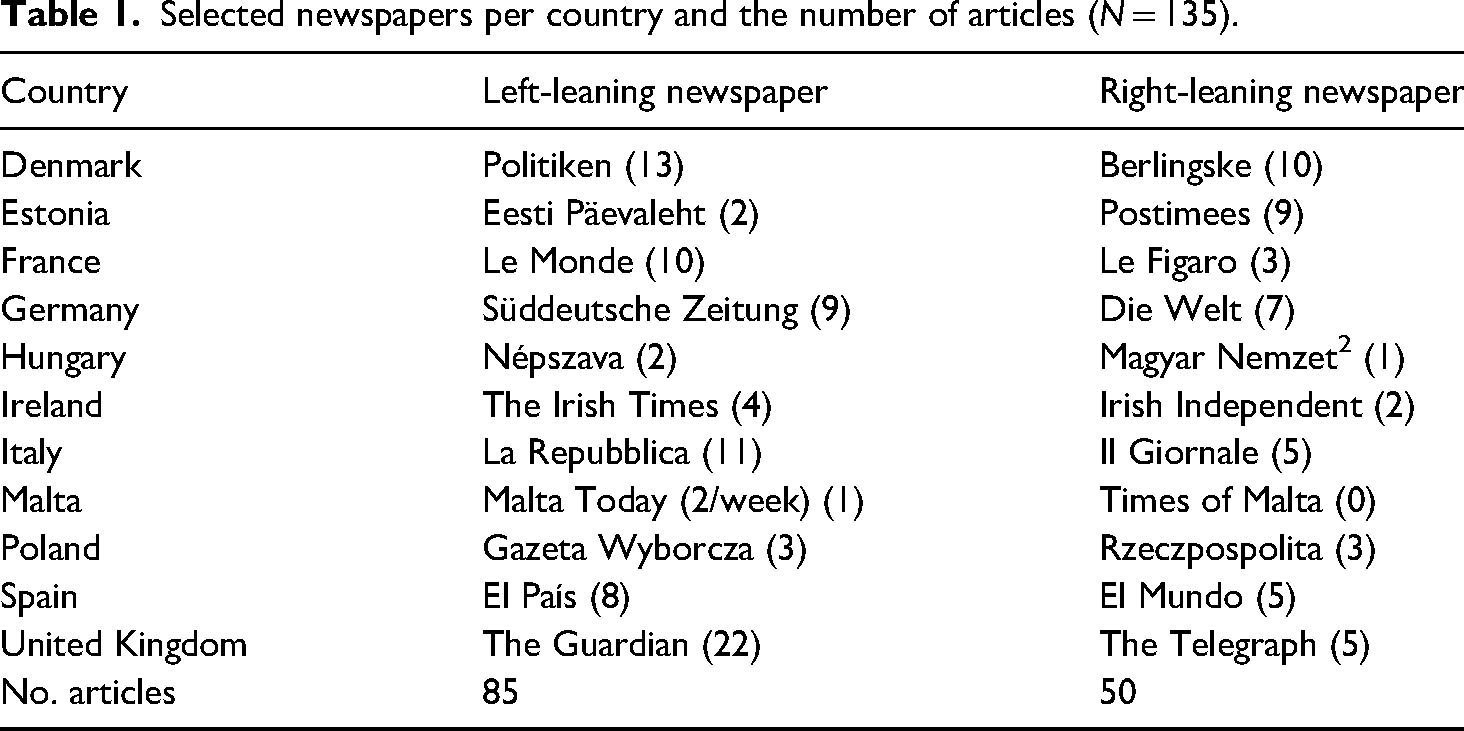
For each state, two major national quality newspapers are selected, taking into account their political affiliations: one representing a centre-left or liberal stance and one representing a centre-right or conservative stance, henceforth referred to as “left-leaning” and “right-leaning”, respectively. The newspapers had to be available in Global Newsstream or through online editions, which means that it is not always the biggest two newspapers in a state that are included. Table 1 shows the selected newspapers per country and the number of articles in each. 63% of the material is published in the left-leaning newspapers.
Selected newspapers per country and the number of articles (N = 135).
The newspaper articles are analysed based on both descriptive quantitative analysis and qualitative content analysis (Krippendorff, 2018; Riffe et al., 2019). The five dimensions of the two logics were analysed by first developing codes deductively, based on the operationalisations of each dimension. These were tested on a small sample of the material, and in a few cases somewhat modified. During the analytical process, potentially interesting findings not fitting any code were noted separately. Two rounds of coding were conducted, with only minor adjustments in the second round. Coding was conducted by the author and one other coder, from the same research project. All articles were translated into English.
The time period covered in the newspapers starts in September 2014, when FFP was declared and ends on 31 December 2020. The search words used are: “feminist foreign policy”, “feminist diplomacy”, “feminist government”, “Margot Wallstrom” (Minister for Foreign Affairs, 2014–2019), “Ann Linde” (Minister for EU Affairs and Trade, 2016–2019; Minister for Foreign Affairs since September 2019), “Asa Regner” (Minister for Gender Equality, 2014–2018) and “Isabella Lovin” (Minister for International Development Cooperation and Climate, 2016–2019, Deputy Prime Minister, 2016–2021).
FFP communicated by the Swedish government
Before turning to the analysis, a brief description of Sweden's FFP and how it is communicated by the government is in place, since this likely serves as a foundation for what the media reports about FFP. Swedish government representatives, not least Margot Wallström, often describe FFP as based on three R’s – rights, representation and resources. A fourth R is sometimes added, reality, which “is about getting the facts right from the outset” (Ministry of Foreign Affairs, 2015: 13, section 4). There is also an emphasis on the systematic aspect of FFP: “Throughout our foreign policy, including in peace and security efforts, we will apply a systematic gender perspective” (2015: 3, emphasis added) and on challenging historical power relations: “It is my ambition to actively address the structural and historical inequalities in power relations from a rights perspective” (Ministry for Foreign Affairs, 2014).
FFP is furthermore described as consisting of six objectives and focus areas: (1) Full enjoyment of human rights; (2) Freedom from physical, psychological and sexual violence; (3) Participation in preventing and resolving conflicts, and post-conflict peacebuilding; (4) Political participation and influence in all areas of society; (5) Economic rights and empowerment; and (6) Sexual and reproductive health and rights (SRHR) (Ministry for Foreign Affairs, 2015: 4). Hence, rights is both one of the R’s and a focus area in its own right.
In addition to the policy itself, the Swedish government often stresses the fact that it is the first government in the world to introduce a feminist foreign policy. It is also often emphasised that FFP is “part of a bigger feminist structure”, with a feminist government and with gender equality work at its core and with “[g]ender budgeting […] carried out within all governmental policy areas, including foreign policy” (Ministry for Foreign Affairs, 2019: 36–37). The bigger feminist structure is most thoroughly developed in the comprehensive Handbook – Sweden's Feminist Foreign Policy, which was launched for the first time in 2018. 3
Findings and analysis: Media logic or political logic?
In this section, each sub-section starts with the operationalisation of the dimension in question, followed by the findings and analysis.
Polity, politics or policy
Polity refers to politically organized societies, such as the nation-state, but also to the political order (Vowe, 2008), which in relation to foreign policy is the existing global order. Polity is therefore operationalised when the main topic of an article is about the global order, for example by linking FFP to global gender issues (e.g. the argument that by involving women in peace processes, we get a more lasting peace and a hence a more peaceful world). Politics is about “power struggles between actors inside the polity” (ibid.), which in the global order include for example states, non-governmental and intergovernmental organisations and multinational corporations. If the main focus in an article is on any of these actors and their relations to one another, it is considered to be about politics. However, despite the emphasis on “power struggles” in the quote above, cooperative or friendly relations are included as well. Politics can also refer to relations between actors within Sweden, in regard to FFP. Policy refers to individual issues or problem areas, and in our case the policy under investigation is Sweden's FFP.
Politics is the main topic in 91.8% of the articles (124 articles). Policy is the main topic in 8.1% of the articles (11). Only two articles have polity as the main topic (1.5%). 4 Most of the articles on politics are about Sweden's relations with other states, of which Sweden's diplomatic conflict with Saudi Arabia in 2015 is most frequently reported. Margot Wallström was invited as a speaker to a meeting of the Arab League, but the invitation was withdrawn at the request of Saudi Arabia. The reason was that Wallström had called a sentence of a blogger to prison and 1000 whiplashes “a medieval punishment” and criticized the status of human rights in the country. In the cancelled speech, which was published on the website of the Swedish Ministry for Foreign Affairs, Wallström had intended to talk about human rights and women's rights. Around the same time, a weapons export agreement with Saudi Arabia was up for renewal in Sweden, an agreement that had already come under criticism. Sweden ultimately decided not to renew it, which led to the Saudi Ambassador in Sweden being recalled (he was later sent back). Saudi Arabia also threatened not to issue visas to Swedish business representatives.
Another frequently occurring example of politics is Climate Minister Isabella Lövin signing a new climate law in February 2017, surrounded by female colleagues only. The photo, which was first posted on social media, has a clear resemblance to a photo of Donald Trump – surrounded by seven men – signing the so-called Mexico City policy or “gag rule”, which blocks federal funding for non-governmental organisations that provide information about or access to abortion in foreign aid (e.g. The Telegraph, 3 February 2017). Sweden, along with a number of other states, also initiated a donor conference, She Decides, with the aim to counteract the US decision in terms of financial support (e.g. Le Monde, 9 February 2017).
One of the two articles with polity as the main topic is about the role of values in foreign policy, more specifically, the importance of human rights and women's rights, written by a Danish Social Democratic MP, in an op-ed (Berlingske, 31 March 2015). The other polity article is an interview with actress Emma Thompson in Le Monde about the need for a more feminist world (19 August 2019). Both articles present Sweden and Wallström as forerunners and role models.
The 11 articles which have policy as the main topic are of diverse kinds. The two French newspapers have one article each about FFP, based on the launch of the Handbook (Le Figaro and Le Monde, both 23 August 2018). Le Monde has also an article about Swedish foreign policy in general, of which FFP is described as an important part (27 March 2015). Only two right-leaning newspapers, Berlingske and Le Figaro, have articles in which FFP is the main topic (27 February 2015 and 23 August 2018, respectively). Considering that articles in left-leaning newspapers constitute 63% of the material that is perhaps not surprising.
Level of personalisation
If media logic prevails, the focus is on “individual actors rather than abstract topics” (Haßler et al., 2014: 328). Personalisation is operationalised as whether an article is about or brings up a Swedish government representative as a person (instead of referring to “Sweden's government” as a collective).
Following van Aelst et al. (2012), personalisation can be divided into two forms: the first is individualization, which is about the politician's “ideas, capacities and policies” (2012: 204). As argued by van Aelst et al., “[t]his type of personalisation is not necessarily in contrast to substantive political news content, but it does imply a shift in media visibility […] from government to individual cabinet members” (2012: 204–205). The second form is privatization, “a shift in media focus from the politician as occupier of a public role to the politician as a private individual”, which encompasses personal characteristics and personal life. However, personal characteristics can be categorised as an expression of individualization, if they are related to the politician's “professional competence and performance” (ibid., p. 208). The Foreign Minister could be expected to be the most frequently occurring person in the articles, but all government representatives are taken into account.
The findings demonstrate a very high level of personalisation: it occurs in 80.7% of the articles. Almost all of these are individualization, which is present in 78.5% of the articles, while privatization only occurs in 9%. 5 By far, most cases of personalisation relate to Margot Wallström (56.3%), which is not surprising considering that she was the initiator of FFP, and the two are often mentioned together. Only five articles are published after Wallström's retirement, which further underlines the linkage between her persona and FFP.
There are several accounts of Wallström's personal characteristics and how they influence her foreign policy actions. She is often described as a person who will not back down when principles are at stake. Many of these descriptions relate to her resolute actions when she was stopped from giving the speech at the meeting of the Arab League: “Margot Wallström does not back down from her words that such a system is medieval – an expression that is very annoying to Saudis” (Eesti Päehvaleht, 19 March 2015). A headline in Süddeutsche Zeitung states: “Sweden's Foreign Minister Wallström: The woman who challenges Saudi Arabia” (13 March 2015). In most articles, it is Wallström, and not Sweden, who is described as being in conflict with Saudi Arabia.
Furthermore, Wallström is depicted as brave and outspoken and an editorial in The Guardian calls her “a splendidly undiplomatic diplomat” (29 March 2015). Despite the conflicts, Wallström is described as sticking to her principles and showing no regrets: “Margot Wallström has no regrets. She's not the type. She means what she says and says what she means. Dot. A coveted trait as a business leader, especially of the male sex. Less popular if you are a female foreign minister from a social-democratic Sweden who would like to see itself as a moral superpower in the Nordic countries” (Politiken, 15 January 2016).
A common topic in the instances of privatization is how Wallström is dressed, which is in line with other studies that have found the media to comment far more often on the appearances of female politicians (e.g. Ross, 2017). The following example also comments on her dialect: “Wearing a turquoise jacket and with her characteristic Norrland dialect, she told Dagens Nyheter's TV reporter about her plans for Swedish foreign policy during the walk” (Politiken, 27 February 2015). One article in La Repubblica describes Wallström as “very elegant in a black trouser suit and a white blouse” (19 October 2015) – which is somewhat of a contrast to another account by the same journalist, describing her as the “strong man” of the government (2 March 2017). Stories about her personal life are rare. The closest to this is “the apartment scandal”, when it turned out that Wallström had jumped a queue when renting her apartment in Stockholm from a trade union. The trade union, it turned out, had assured her that she had not by-passed any queue when she was offered the contract (Le Figaro, 15 January 2016).
Far behind Wallström, three other women account for most of the remaining articles with personalisation: Isabella Lövin in 25 articles (18.5%), Ann Linde in 11 articles (8.1%) and Åsa Regnér in 8 articles (6%). Lövin's all-female photo is described as a clever counter-move to Trump's signing of the gag rule and put her, as well as Sweden's stance on SRHR, in the spotlight (e.g. El País, 3 February 2017). It is worth noticing that most of the articles with personalisation in regard to Ann Linde are from her time as Trade Minister and only three of them are published when she was announced as the new Foreign Minister in September 2019 or later. The event most associated with her is when a Swedish trade delegation visited Iran in February 2017. A big part of the delegation consisted of women, which were all dressed in hijab, as required by Iranian law. Linde is by critics depicted as not standing up for the feminist government and foreign policy she represents (e.g. Politiken, 19 February 2017), while others describe how she – and the other women – did not really have a choice (e.g. El País, 30 April 2017).
Negative, positive or neutral
The third dimension is whether FFP is framed in a negative, positive or neutral way. This is operationalised as: 1) The writer's position in regard to FFP, as negative, positive or neutral, which can apply to the whole article or to parts of the article (occasional sentences or paragraphs); and 2) If focus is on a conflict/division with others (negative “event”) or support from or cooperation with others (positive “event”), both externally and internally.
For the majority of articles, the writer's position is neutral. A likely explanation is that most of the articles are news articles (75.6%). Articles that are positive throughout the text constitute 6.7% of the material and articles that are positive in part of the text 8.1%. Articles that are negative throughout constitute 7.4% and articles that are negative in part 9.1% of the material. Hence, the numbers of positive and negative views on FFP as expressed by the writer are almost the same. In all the selected Member States, the left-leaning newspaper has at least one article with a positive view throughout, while the right-leaning newspaper has none, with the exception of Malta, Hungary and Poland whose left-leaning newspapers do not have any positive articles. One example of praise for Sweden's FFP is found in Irish Times (12 December 2017): [T]he more we learn about the dynamics of global development and conflict, the more obvious it becomes that applying a feminist lens to a state's external dealings is not only a vital goal in itself but a precondition for progress in achieving peace, making the world more secure and lifting people out of poverty. The standard-setter is Sweden, whose Social Democrat-led government in 2015 proclaimed it would pursue a feminist foreign policy…
Articles that express critique throughout the text are found in the right-leaning newspapers Il Giornale, Berlingske and Le Figaro, but also in left-leaning Politiken. Several of the most critical articles concern the visit to Iran and the fact that the women in the delegation wore hijab. With regard to positive and negative in parts of the text, there are no patterns discernible based on the newspapers’ political leaning.
Moving on to the second operationalisation, whether the focus is on conflict or support, we find that an overwhelming majority of the articles are about conflict, or negative “events”: 70.4% of the articles bring up at least one external conflict. External support is found in 15.6% of the articles. Internal conflict is present in 24.4% and internal support in 11.1% of the articles. 6 External conflicts are almost exclusively with other states or their representatives, that is, diplomatic conflicts.
The most frequently reported conflict is the one with Saudi Arabia, which is present in 35.6% of the material. The Saudi conflict also led to internal conflicts, both within the government and with Swedish business. The second most frequently reported conflict is President Trump's reintroduction of the gag rule, which was followed by counter actions by Sweden and some other states, as described above. This conflict is present in 20.7% of all articles, which include the articles about Lövin's all-female photo.
As stated above, there are less articles reporting about support than conflict. Support expressed by interview persons or in other ways made visible without being the opinion of the writer (which is categorised as writer's position) concerns many different aspects. Süddeutsche Zeitung, for example, has a number of articles concerning sexual and gender-based violence in conflict, an area in which Sweden is portrayed as a leader (e.g. 5 August 2019). Several articles profess support for Sweden in standing up against Saudi Arabia for human rights: “Abroad, many voices praised Sweden's firm attitude toward Saudi Arabia” (Le Monde, 27 March 2015).
Short-term events or long-term processes
Following Haßler et al., a “possible indicator of topicality is the share of articles dealing with long-term issues instead of short-term events” (2014: 329). Short-term events are operationalised as being about a single event in relation to FFP, while long term is about processes or consequences of FFP. An article about how Sweden acted during a meeting in the UN Security Council, relating to FFP, would hence be a short-term event, while a report about how Sweden worked to integrate a Women, Peace and Security-perspective on all resolutions taken is an example of a long-term process. If an article contains a short-term event as well as processes over time, or consequences, it is categorised as “both”.
Reports about short-term events make up 60% of the articles, while only 8.1% are about long-term. Articles with both aspects account for 31.9%. The short-term events consist of “dramatic” events, such as the diplomatic conflict with Saudi Arabia. However, there are also several articles about the consequences of FFP or the deteriorating relations between the two states, in addition to the description of the latest turns in the conflict, which means they cover both short term and long term.
Articles about the long term relate to FFP as a policy as well as to how Wallström is conducting it. An example of the latter is found in Berlingske, in an op-ed by a Social Democratic MP: “She has been called ‘naïve’ and ‘foolhardy’. But she insists that foreign policy should not be considered in a single election year. It must be long-term enough to plant a real seed of democracy” (31 March 2015). Some newspapers have a long-term focus in their reports on Sweden's achievements in the UN (e.g. El País, 30 April 2018).
Simplification
The last dimension focuses on if and how FFP is defined or explained in the articles. It is assumed that media outlets look for ways to inform its audience what FFP is in relatively simple terms. Here, one could argue that the Swedish government's presentation of FFP as consisting of three R’s (rights, representation and resources) would come in handy. As described earlier, the Swedish government also presents FFP as a systematic gender perspective on foreign policy and as consisting of six focus areas, which could also be used by the media. These might, however, be considered somewhat more complex.
Only 31.9% of the articles have some kind of definition or explanation of FFP, ranging from very brief to more elaborate. The three R’s are described in 12 articles (8.9%). Five of these are in The Guardian. It is interesting to note that all but one of the articles with the three R’s are published in left-leaning newspapers. The only exception is an opinion piece written by a Social Democrat in Die Welt (6 December 2018). In an article mainly focused on the French Feminist Diplomacy, which is described as somewhat vague, it is stated that: “Sweden has made a conceptual effort, by linking this feminist diplomacy to three criteria: the rights to be promoted, the question of the representation of women, and finally the resources mobilized” (Le Monde, 17 November 2020).
In four articles, the systemic aspect of FFP is described, such as it “opposes the systemic and global subordination of women” (Le Monde, 19 August 2019) or that it is a “response to systemic discrimination and subordination of women” (Süddeutsche Zeitung, 10 September 2019). There are five additional articles that refer to FFP in a broad, but systemic way, for example by describing it as “taking women's interest into account in foreign policy” (El País, 12 July 2018).
Women's rights as human rights is the most frequently occurring focus area, which is present in 20 articles (14.8%). This is not surprising, considering that it is at the very core of FFP, in addition to being a focus area in its own right. Articles on women's rights are relatively evenly spread in both types of newspapers. FFP as including women in peace processes is present in eight articles (5.9%) and FFP as including women in decision-making in five articles (3.7%). The remaining focus areas are mentioned twice, with the exception of SRHR, which is only used once to explain FFP.
Out of the 43 articles with some kind of definition or explanation of FFP, only 10 are published in right-leaning newspapers. This is not surprising, considering that all existing FFPs (Canada, France, Mexico, Spain and Germany) have been introduced by left-of-centre governments. It could hence be seen as more interesting by left-leaning newspapers.
The findings demonstrate that in some of the investigated EU Member States there is a complete lack of definitions of FFP in the newspapers. This is the case in Hungary, Malta and Poland. There is one brief presentation of FFP in the Estonian newspapers, in an op-ed by Wallström (Postimees, 22 August 2019). Thus, the four states ending up last in the Gender Equality Index share a lack of precision when presenting Sweden's FFP.
Concluding discussion
The articles on FFP are clearly dominated by media logic. First, politics – rather than polity or policy – is the main topic in more than 90% of the articles. Second, there is a high level of personalisation. Third, short-term events only are reported in a majority of the articles. Fourth, there are considerably more articles on conflicts with other states than support from them, giving an overall more negative framing of FFP. Fifth and finally, a majority of the articles do not give any indication of what FFP really is. With one single exception, FFP is not explained in the newspapers in the EU Member States which hold the four last places in the Gender Equality Index among the states selected in this study (Estonia, Hungary, Malta and Poland). Hence, in the states with the lowest levels of gender equality, the chances of citizens receiving information about Sweden's FFP through the selected newspapers is also least likely. This could serve to strengthen existing views on gender equality, if readers are not presented with alternative views. Considering the overall negative views towards the concept of “feminism” in some Eastern-Central and Southern Member States, a policy including this word is likely to evoke negative or sceptical reactions, especially if it is not explained. The domination of media logic means that also in the like-minded Member States, where we find a higher number of articles on FFP, readers will learn more about political conflict than what FFP is and its long-term consequences.
The high degree of personalisation, with the prominence of Margot Wallström in relation to FFP, is worth special mention. It could be viewed as a double-edged sword: on the one hand, it probably contributed to the increased visibility of FFP. Many articles portray Wallström in a positive way, which gives a positive “glow” also to FFP – despite the relatively large focus on conflicts. On the other hand, after Wallström's retirement, only a few articles are published about FFP. When she left the stage, the interest in FFP seems to have almost disappeared.
Although the present study confirms findings in previous research with regard to obstacles in communicating FFP to foreign publics through the media – in this case, due to the application of media logic – there are also reasons for positive evaluations. In the like-minded countries, not least the UK and Denmark, the opportunities for the readers to encounter FFP are relatively good. This is the case especially in the left-leaning newspapers, which more often also provide explanations of what FFP is all about, making it possible for the readers to evaluate and take a stand on Sweden's FFP.
Supplemental Material
sj-docx-1-ejc-10.1177_02673231221115861 - Supplemental material for Sweden's feminist foreign policy in national newspapers in EU member states (2014–2020): Media logic or political logic?
Supplemental material, sj-docx-1-ejc-10.1177_02673231221115861 for Sweden's feminist foreign policy in national newspapers in EU member states (2014–2020): Media logic or political logic? by Malena Rosén Sundström in European Journal of Communication
Footnotes
Funding
The author(s) disclosed receipt of the following financial support for the research, authorship, and/or publication of this article: This work was supported by Riksbankens Jubileumsfond, (grant number P-19-0712:1).

Supplemental material
Supplemental material for this article is available online.
Notes
References
Supplementary Material
Please find the following supplemental material available below.
For Open Access articles published under a Creative Commons License, all supplemental material carries the same license as the article it is associated with.
For non-Open Access articles published, all supplemental material carries a non-exclusive license, and permission requests for re-use of supplemental material or any part of supplemental material shall be sent directly to the copyright owner as specified in the copyright notice associated with the article.
