




Abstract
Populist politicians’ social media activity has often been associated with their electoral success. Yet, research on the driving forces of engagement on social media is scarce. Are populist politicians triggering more interaction than mainstream politicians, or is it rather the populist ideology they convey? To disentangle these different factors, we conducted a comparative content analysis of Twitter and Facebook communication of 13 leading candidates in Austria and the Netherlands during an election campaign. Findings show that it is rather styles conductive to populism (i.e. emotionality, first-person references) than the actual content of populist communication that trigger online behaviour. Importantly, irrespective of the content they convey, right-wing populist politicians are more successful in spreading their message via social media than mainstream politicians. These findings have important implications for our understanding of the role of online communication for populist politicians’ success in spreading their viewpoints across networked societies.
Keywords
The media, and social networking sites (SNSs) in particular, may have played a central role in fostering populism’s popularity. Social media enable politicians to interact with the ordinary people and to foster a direct bond with their followers (e.g. Engesser et al., 2017; Ernst et al., 2018). Although a growing body of research has investigated the central content features of (online) populist communication and its effects on the electorate, we know too little about what elements of online populism trigger engagement among the public and whether populist actors are indeed more successful in mobilizing their followers than their mainstream counterparts.
This study aims to provide a better understanding of how populist communication may drive online user engagement by exploring the role of (1) message elements that convey the thin ideology of populism, (2) stylistic elements that have been associated with populism and (3) populist versus mainstream actors. As sharing, liking and commenting on populist messages may substantially contribute to the spread of populist ideology across today’s networked societies, it is important to assess what elements of populism spark user engagement – and thus help populists to gain an advantage via their online communication.
Here, we need to stress that we look at engagement among people who actually expose themselves to the online communication of mainstream and populist politicians. Even if we cannot rule out incidental exposure, it can be argued that most people who approach the online communication of populists already agree with the core message that these actors convey (Hameleers et al., 2018; Müller et al., 2017) – indicating that this study does not necessarily look at the general audience, but focuses on citizens who expose themselves to the content we investigated. Yet, there can be various motivations driving selective exposure, as selection is not always informed by a confirmation bias: People may come across populist content to look across the border (cross-cutting exposure) or aim to strengthen their opposition to such populist rhetoric. Although we cannot empirically establish the different motivations guiding selection, we can assume that people are not exposed to populist communication randomly, but as an outcome of selection decisions.
This study relies on a comparative quantitative content analysis of Facebook and Twitter posts of 13 leading politicians in Austria and the Netherlands to assess which actors, messages and styles are most successful in triggering engagement on the demand-side of the electorate. These countries represent ‘most similar’ cases – they are both Western democracies with a strong presence of right-wing populism (Aalberg et al., 2017). Taken together, this article aims to comprehensively map what elements of populist communication contribute most to engagement on social media – which may offer a partial explanation of the omnipresence of populist ideology in public opinion. Although engagement may not directly predict voting, populist message elements in politicians’ direct communication may contribute to the spread of populist worldviews across society and strengthen polarized divides by fostering congruent views among issue publics and disagreement among non-populist citizens.
How populist ideas, styles and actors trigger user engagement on SNSs
Populist message elements and engagement on SNSs
Essentially, populist messages emphasize a binary divide in society by pitting ‘the pure people’ against ‘the corrupt elites’ who are accused of failing to represent the people (e.g. Mudde, 2004; Taggart, 2000). Populism discursively constructs an imagined community of ‘ordinary people’ and frames this in-group against an outsider accused of causing the people’s problems (the constructed out-group). This boundary between ‘us’ and ‘them’ is not existing naturally, but constructed through communication (Aslanidis, 2016). The key populist message elements identified in this article can conceptually be linked to social identity framing and collective action theory (Gamson, 1992; Polletta and Jasper, 2001; Van Zomeren et al., 2008). The social identity model of collective action (SIMCA) postulates that messages that construct a deprived in-group identity while identifying credible scapegoats mobilizes the in-group to engage politically (Van Zomeren et al., 2008). By emphasizing that the ordinary people are deprived on political, cultural and material levels (Albertazzi and McDonnell, 2008), populist messages correspond to similar identity frames.
The discursive construction of an in-group threat should motivate members of the in-groups to engage in collective action in order to restore the status of their in-group (e.g. Polletta and Jasper, 2001). Extrapolating the premises of the SIMCA to the persuasiveness of populist message elements, it can be expected that populist communication results in engagement because it (1) cultivates a collective threat to the in-group and (2) assigns blame for the deprivation of the people to the elites. Taken together, populism’s emphasis on threat and the cultivated experience of disadvantage to their own constructed in-group, the imagined community of ordinary people, increases the likelihood that people engage in collective action on behalf of their in-group (Simon and Klandermans, 2001).
Yet, this expectation needs to be weighed with insights from selective exposure literature (e.g. Stroud, 2008), especially in the light of exposure to populist messages that address a specific identity discourse (e.g. Hameleers et al., 2018; Müller et al., 2017). Hence, the premises of the SIMCA predicting engagement with populist content may apply most to people who feel part of the ordinary people addressed in populism and people who selectively expose themselves to populist arguments on SNSs.
In this article, we conceptualize political engagement as behavioural responses to politicians’ direct communication on SNSs by relying on the modes of engagement afforded by the platform. On SNSs, such as Facebook or Twitter, there are different levels of engagement or interaction. People can, for example, like, share or post comments to a message (Heiss et al., 2018). We follow the conceptualization of Xenos et al. (2017) by measuring the responses of citizens who are related to the communication of politicians. As such forms of engagement are relatively easy, low-effort forms of collective action, we expect that populist messages that cultivate in-group deprivation and a credible scapegoat foster citizens’ responses to direct communication. Therefore, we hypothesize that populist communication leads to more user engagement among people exposed to populist content than non-populist communication (H1).
Triggering user engagement through styles conductive of populism
Stylistic elements related to populist communication are not populist by themselves but may provide a context for the expression of populist sentiments (also see Ernst et al., 2018). These styles may be used to ‘package’ the populist divide between the people and the elite in a more credible and engaging manner. An emotional style may be used to frame the divide between the people and the culpable elites. Hence, the divide between ‘us and them’ central in populism can be strengthened and presented in a more engaging manner when positive emotions towards ‘us’ and negative emotions towards ‘them’ are expressed.
The tonality of populism has frequently been regarded as overtly negative, stressing failures and crisis sentiments rather than positive evaluations (e.g. Krämer, 2014; Mazzoleni et al., 2003). In their messages, populists frequently emphasize threats to people’s well-being and the elite’s responsibility for negative developments and outcomes (e.g. Mudde, 2004; Taggart, 2000). Overall, populists mostly express negative attitudes towards people who do not belong to their social in-group. Therefore, these groups are often portrayed as ‘dangerous others’ (Albertazzi and McDonnell, 2008). Importantly, a negative tone is inherent to the emphasis of the deprivation of the in-group and the severity of their crisis caused by the corrupt elites. Reasoned from the SIMCA, negativity biases may thus motivate ‘the people’ to engage with direct communication of politicians that cultivates threats. Against this backdrop, we hypothesize that negativity in politicians’ direct communication evokes engagement with political communication (H2).
Above and beyond stressing negativity, populism inherently relies on emotional language (e.g. Wirz, 2018). Discrete negative emotions express feelings towards situations, which can be more or less detached from the overall evaluation of the message or situation. A negative tone refers to the evaluation of situations or the overall tone in a message – for example, the emphasis on politicians’ failures. Negative emotions and a negative tone can co-occur, but this is not necessarily the case. Hence, we conceptualize negative emotions as direct references to specific discrete emotional states.
Anger and fear have been regarded as the most important discrete negative emotions related to populist communication (e.g. Hameleers et al., 2017; Wirz, 2018). Negative emotions are known to be mobilizing (Valentino et al., 2011). Anger has been associated with the attribution of blame – which is central to populist communication (e.g. Hameleers et al., 2017). In the setting of populism, emotional appeals have been found to augment the persuasiveness of populism (Hameleers et al., 2017; Wirz, 2018). Negative emotions further stress a sense of urgency, as they signal a pervasive threat in people’s environment. Applied to the SIMCA, it can be expected that the reliance on negative emotions signals an in-group threat that warrants the in-group’s attention and therefore mobilizes the people to engage with the message. We therefore hypothesize that messages that rely on negative emotions are more likely to trigger user interaction than messages without such emotions (H3).
Populism may also be connected to positive emotions. The positive emotion hope, for example, expresses closeness to the in-group of ordinary people discursively constructed by populists (Aalberg et al., 2017; Wirz, 2018). Hope can, for instance, be elicited by an emphasis on future expectations, goal congruence or as a reaction to appraisals of importance (Chadwick, 2015). Thereby, when populist actors emphasize closeness to the ‘virtuous’ people, they present themselves as the voice of the people, fighting for a better situation of the people’s heartland. When these emotional states corresponding to core relational themes are made salient, they may trigger behavioural responses among receivers. In line with this, Heiss et al. (2018) showed that positive emotional expressions can have a stronger effect on user engagement than negative emotions. We expect that negative emotions resonate most with the threat emphasized in populist communication, but that positive emotions correspond to the evaluation of the virtuous in-group (the imagined community of the ordinary people) or the celebration of the heartland. Emphasizing these emotions may trigger the response of sharing hope for the people’s in-group with like-minded community members. Focusing on populist communication via SNSs, we can raise the following hypothesis: messages with a positive emotional tone are more likely to engage user interaction with direct communication on SNSs than messages without such an emotional tone (H4).
A final stylistic element to consider is the use of the first-person references when speaking about the in-group. Different from the core populist message element of people centrism, references to the in-group are conceptualized as directly addressing ‘us’ or ‘we’ instead of more distant third-person references (i.e. the native population). References to the first person should trigger engagement on the demand-side as politicians express a direct bond to the electorate when they appeal to their followers. When politicians directly refer to ‘us’, they cultivate a sense of community, which may be related to the populist heartland (Taggart, 2000). The experience of community, in turn, may correspond to political engagement (Gamson, 1992). We therefore expect that direct communication containing references to the first person (us, we) results in more user engagement than messages without such first-person references (H5).
Direct communication by mainstream versus populist actors
It has been argued that populist actors are more media-savvy than mainstream political actors (e.g. Aalberg et al., 2017; Engesser et al., 2017; Mazzoleni et al., 2003). Populist actors are newsworthy, and their conflictive behaviour and the violation of norms they engage in via social media are attention-grabbing (Mazzoleni et al., 2003). Moreover, populist actors are rated as more authentic than mainstream politicians, which may contribute to their success on social media (Enli and Rosenberg, 2018). Hence, they speak the same language as their followers, and the message they communicate is newsworthy and provocative, which should trigger engagement on the demand-side of the electorate.
As populist actors typically attack the mainstream from an underdog position, their antagonistic and conflict-seeking message may yield more engagement than mainstream politicians who confirm the status quo. Yet, differences in engagement may not only be interpreted as leader-effects: people who respond to populist leaders may share their populist worldview and also experience the need to engage with messages. Hence, they experience a collective sense of deprivation and an urgent threat that needs to be alleviated – which should correspond to higher levels of engagement. Against this backdrop, we hypothesize that direct communication by populist politicians triggers more user engagement among followers than the direct communication of mainstream politicians (H6).
In this article, we employ a most-similar system design. More specifically, we expect that Austria and the Netherlands represent relatively similar cases regarding the (electoral) success and visibility of right-wing populism (Aalberg et al., 2017). Moreover, both countries are relatively similar when it comes to the distribution of other country-level factors, such as average income level and the political system (a multi-party system with a collation consisting of different parties). Therefore, we do not expect a priori differences between the two countries. We include the country-comparison as a robustness check and aim to explore the extent to which the relationships between populist content features and engagement are similar in two national settings. Hence, as (right-wing) populist leaders are unique and not easy to compare, it is relevant to assess whether the hypothesized patterns are also case-specific. In this setting, we raise the following exploratory research question (RQ) on country-level differences: If, and, if so how do, the relationships between (1) populist styles, (2) populist message elements and (3) populist actor with engagement behaviour differ between the two countries? (RQ).
Method
This study was part of a larger quantitative content analysis during the national parliamentary election campaigns in 2017 conducted in Austria and the Netherlands (Schmuck & Hameleers, 2020). Our analysis focused on the official profiles on Twitter and Facebook of the 13 leading candidates running for the parliamentary elections. We coded engagement by assessing each post’s reactions, shares, and comments. We included Facebook and Twitter because these are the most intensively used SNSs for political purposes in Europe (e.g. Ernst et al., 2018) and can be connected to different affordances and types of engagement (see Valenzuela et al., 2018).
Sample
We included the six leading politicians in the Austrian parliamentary election in 2017 and the seven leading politicians in the Dutch general election in 2017. Our sample consisted of the Facebook and Twitter posts issued by these politicians 6 weeks before the elections and 4 weeks after the elections. Since general elections were held in the Netherlands on 15 March 2017, the coding period covered the 10 weeks from 1 February to 13 April. The Austrian elections were held later in that year on 15 October. Therefore, the coding period ranged from 4 September to 12 November.
We constructed artificial weeks with 4 days each week before and 6 days each week after the elections to ensure that each weekday was represented in the sample. The approach of artificial weeks was chosen to make sure that our sample reflected an equal variety of weekdays, hereby overcoming biases of certain more eventful or busy days. On the selected days, we randomly drew one post and one tweet for each candidate. If no post was available on that day, a post on the following day was chosen. This procedure resulted in a maximum of 96 posts for each candidate (see Supplemental Appendix B). In total, we coded 1010 items: 242 Facebook posts and 255 tweets from Austria and 264 Facebook posts and 249 tweets from the Netherlands.
Coding procedure
Four independent coders (i.e. two in each country) analysed the data. All coders were fluent in English and native speakers in their respective language. We coded only the textual content of a tweet or a Facebook post. After intensive coder training, we conducted several rounds of intercoder reliability tests for each variable to assess within- and between-country intercoder reliability. For within-country intercoder reliability tests, the coders analysed a random sample of posts and tweets of each political candidate in their respective country. For the between-country reliability tests, the coders analysed English-language Facebook posts and tweets. After each round of testing, inconsistencies were discussed with the coders and tests were repeated with different subsamples. The total sample for the intercoder reliability tests included 220 Facebook posts and tweets (21.8% of the total sample). For each variable, the four coders achieved acceptable levels of reliability (Brennan and Prediger’s kappa, .71–.98, see Supplemental Appendix A).
Independent variables: Populist styles, messages and actors
Based on previous research, we used different keywords to identify positive (e.g. hope, joy and love) and negative emotions (e.g. anger and fear), which have been connected to populist communication (e.g. Aalberg et al., 2017; Hameleers et al., 2017). The positive tone of the message was coded by looking for indicators of success, ability to solve problems, achievements and situations of improvement. Negative tonality was, for example, indicated by stressing a political failure, fiasco, disaster and crisis situations. References to the people, also regarded as a ‘thin’ or ‘empty’ signifier of populism (e.g. Jagers and Walgrave, 2007), were indicated as present whenever the political candidate referred to the common people in the first person (i.e. not to politicians or other representatives).
Populist message elements were conceptualized based on refined existing indicators of populist ideas in the media (Ernst et al., 2017). As populist communication can be regarded as a rare event in media coverage, the nine separate indicators were merged into an index of the expression of populist ideas. In line with Ernst et al.’s (2017) approach, the presence of populist message elements was coded when an indicator of populism was present together with the corresponding target connected to that populist attribute (see Supplemental Appendix C for an overview).
The identification of actors as populist or mainstream is based on existing reviews made by country experts and empirical research on populist communicators (e.g. Aalberg et al., 2017; Rooduijn, 2014). In line with existing classifications, the Austrian politician H.C. Strache (FPÖ) and the Dutch Freedom Party’s leader Geert Wilders (PVV) were identified as right-wing populist actors. In addition, in line with the literature, the Austrian politician Peter Pilz (Liste Pilz) was coded as left-wing populist actor, as was the Dutch party leader Emile Roemer (Socialist Party (SP).
Dependent variable: User engagement
Similar to the study of Heiss et al. (2018), we measured different levels of user engagement on the social media channels Facebook and Twitter, namely, the number of reactions, shares (retweets for Twitter) and the number of comments a post received. The number of reactions was measured by the number of reaction-emojis on Facebook (i.e. heart, smiling face, angry face, sad face) a post gained. Reactions ranged from 1 like to 76,000 likes per post with a median of 299 likes. Shares ranged from no share up to 9024 with a median of 43 shares. Comments ranged from no comment up to 5500 comments per post with a median of 42 comments.
Data analysis
We ran multilevel negative binomial regression analyses because the observed variance in our dependent variables was considerably larger than the mean for likes (M = 970.18, SD = 3019.941), shares (M = 157.78, SD = 519.924) and comments (M = 138.99, SD = 344.749) (Heiss et al., 2018; Hilbe, 2011). We grouped characteristics of the posts in lower level units in the analyses, whereas we entered the 13 candidates as higher level units. To account for differences between the candidates, we allowed intercepts to vary randomly across the candidates’ user profiles. We used the Automatic Differentiation Model Builder (ADMB) in R (Fournier et al., 2012) to implement our analysis (see also Heiss et al., 2018). As covariates, we included one dummy variable each for country (Austria vs the Netherlands), type of SNS (Facebook vs Twitter) and time period (pre- vs post-election period). To test for country differences, we estimated separate models including the interaction terms between (1) populist styles and the country dummy variable, (2) populist message elements and the country dummy variable and (3) populist actor with the country dummy variable.
Results
Populist message elements and user engagement
In a first step, we investigated whether direct communication that relies on the ‘thin’ ideology of populism triggers more engagement among users and people that selectively expose themselves to the analysed content than non-populist messages (H1). For every level of engagement, a different model was estimated (see Table 1, Models 1–3). The results indicate that populist message elements referring to populist ideology do not trigger more engagement among people who select these messages than messages without such content. This pattern is similar for reactions (b = −0.01, SE = 0.10, p = .913), sharing (b = 0.12, SE = 0.10, p = .214), and commenting (b = −0.07, SE = 0.10, p = .504). Thus, the framing of direct communication using references to the ‘thin’ populist ideology does not trigger user engagement among the audience that selects such messages in online settings, which contradicts H1.
Negative binomial regression with random intercepts predicting user engagement.
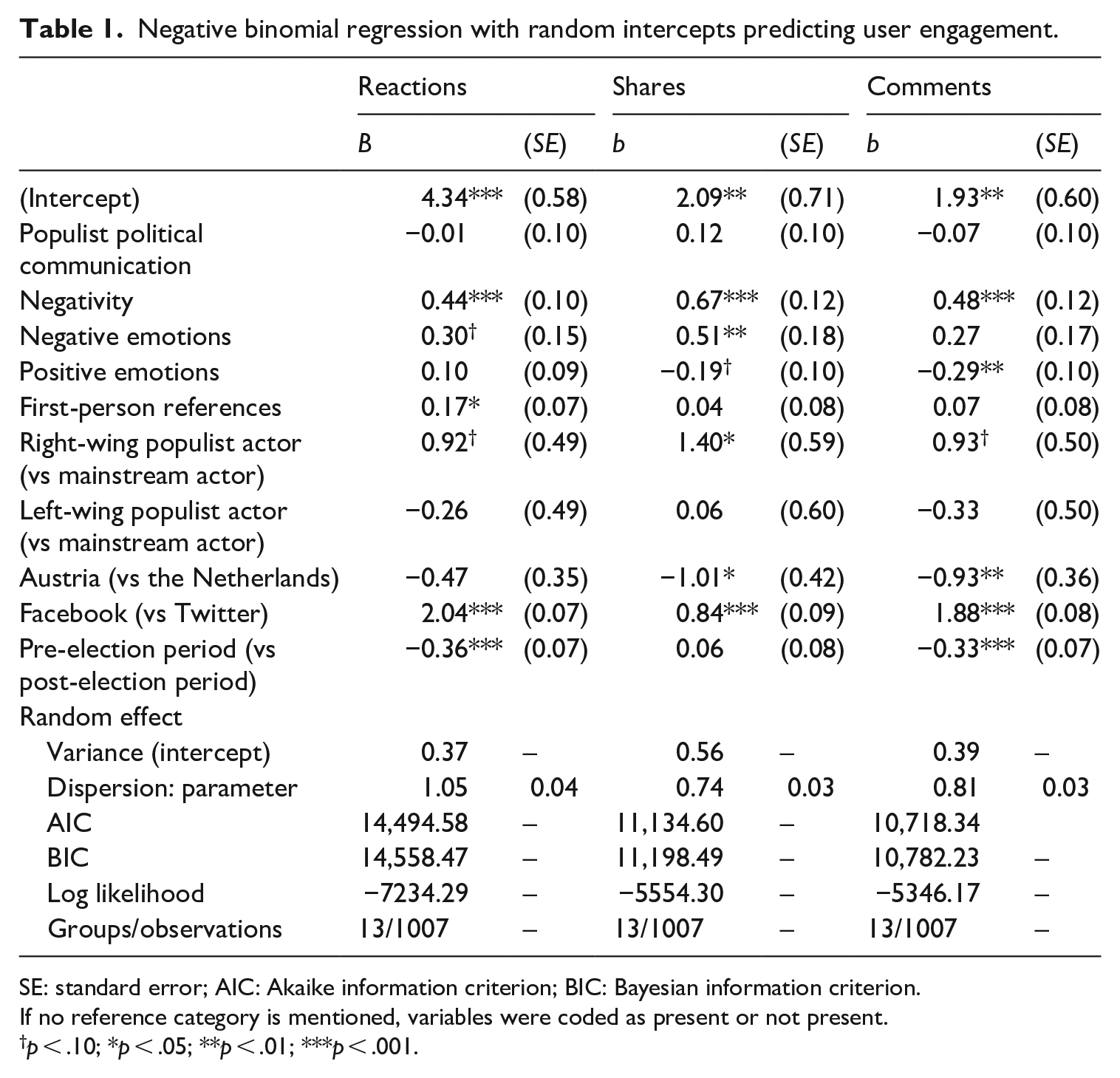
SE: standard error; AIC: Akaike information criterion; BIC: Bayesian information criterion.
If no reference category is mentioned, variables were coded as present or not present.
p < .10; *p < .05; **p < .01; ***p < .001.
Populist styles and engagement
In support of H2, our findings indicate that a negative tone predicts more reactions (b = 0.44, SE = 0.10, p < .001), shares (b = 0.48, SE = 0.12, p < .001) and comments (b = 0.67, SE = 0.12, p < .001) among people who select these messages. Hence, negative posts receive more attention and are more likely to trigger users of social media to engage with the content compared to messages without references to negativity.
Regarding the emotionality of the message, the results indicate that negative emotionality predicts more shares (b = 0.51, SE = 0.18, p = .006), whereas the use of a positive emotional tone predicts significantly less comments (b = −0.29, SE = 0.10, p < .004). The effect of positive emotions on sharing is marginally significant (b = −0.19, SE = 0.10, p = .076), and the effect of negative emotions on reactions (b = 0.30, SE = 0.15, p = .054) also approaches statistical significance. Based on these findings, it can be concluded that negative emotions trigger more shares, whereas positive emotions can even reduce commenting, a form of user engagement that requires more effort than liking or sharing. These findings provide partial support for H3, but contradict H4: although the use of negative emotions in politicians’ direct communication can enhance some forms of engagement, a positive emotional tone reduces the number of user comments among audiences who select these messages.
Finally, references to the first person lead to more reactions (b = 0.17, SE = 0.07, p = .013). This means that when politicians present themselves as closer to the people, their direct communication triggers more reactions compared to when such references to the people are absent (H5). As sharing (b = 0.04, SE = 0.08, p = .604) and commenting (b = 0.07, SE = 0.08, p = .391) behaviour is not triggered by people references, the results provide only partial support for H5.
Are populist actors more successful in triggering engagement than mainstream actors?
Overall, our results show that this seems to be the case for right-wing, but not left-wing populist politicians (Models 1–3). However, it needs to be noted that right-wing populist politicians are much more established than their left-wing counterparts in both countries. For instance, the Austrian right-wing populist candidate had over 720,000 followers on Facebook in 2017, whereas the left-wing populist candidate only had 34,500 followers. The same was found in the Dutch case: the right-wing populist candidate had more than 813,000 followers on Twitter, whereas the left-wing candidate had less than 200,000 followers. In addition, we had a lower number of posts for the left-wing populist candidates (see Supplemental Appendix B), as these candidates were less active on Twitter and Facebook. The effects of the presence of a right-wing populist actor on reactions (b = 0.92, SE = 0.49, p = .057) and comments (b = 0.93, SE = 0.50, p = .063) are marginally significant (Models 1 and 3), and the effect on sharing behaviour is significant (b = 1.40, SE = 0.59, p = .018, Model 2). As sharing can be identified as an important form of engagement that spreads the message via weak and strong ties in people’s network, it can be argued that right-wing populist actors are indeed more successful in spreading their message and gaining attention via social network sites than mainstream politicians. These findings offer support for H6.
Country differences
Finally, we investigated our RQ, which asked if, and if so how, the relationships between (1) populist styles, (2) populist message elements and (3) populist actor with engagement behaviour differed between Austria and the Netherlands. First, we investigated descriptive differences between the countries for populist styles, populist message elements and populist actors. We found that a negative style, χ2(1) = 16.91, p < .001, and negative emotions, χ2 (1) = 49.27, p < .001, were more prevalent in the Netherlands than in Austria, while populist message elements, χ2(1) = 45.56, p < .001, were more prevalent in Austria than in the Netherlands. No other significant descriptive country differences emerged.
Second, we tested our RQ by including interaction terms in our multilevel models. Regarding populist styles, we found a positive significant interaction effect between negativity and country on reactions (b = 0.66, SE = 0.19, p < .001), shares (b = 0.89, SE = .23, p < .001) and comments (b = 0.95, SE = 0.22, p < .001), indicating that negativity stimulates more user engagement in the Netherlands than in Austria. In addition, we found that references to the people were more successful in triggering comments (b = 0.40, SE = 0.16, p = .010) in the Netherlands than in Austria. We found no other significant interaction effects of style elements with country.
Regarding populist message elements, we found a significant negative interaction effect of populist message elements and country on reactions (b = −0.49, SE = 0.17, p = .004) and shares (b = −0.54, SE = 0.20, p = .008), but not on comments (b = 0.00, SE = 0.20, p = .988). This indicates that populist message elements triggered significantly more reactions and shares in Austria than in the Netherlands. Finally, with regard to populist actor, we found no significant interaction effects with country. However, these findings need to be interpreted with caution, as the number of posts was very small for some combinations of predictors (see Supplemental Appendix B).
Discussion
This study aimed to explore which features of online populism trigger engagement among social media users: Are (right-wing) populist source cues the driving force of the people’s engagement with populism, or is it rather the ideology or styles they convey? We find that message elements conveying the thin ideology of populism by framing the discursive divide between the ‘good’ people and the ‘corrupt’ elites do not trigger more user engagement. This finding does not support our theoretical framework of the SIMCA (Van Zomeren et al., 2008).
Our findings indicate that the general audience may not feel personally addressed by populism’s Manichean outlook, and therefore may not be motivated to engage with populist content. We expect that the hypothesized social identification mechanisms were not confirmed as the general audience do not universally feel addressed by the populist appeal – they may even expose themselves to it for different reasons. If we aim to counter populist communication tactics and its influence on society, we need to have a better understanding of which segments of the audience are appealed to what elements of populist messages – and how engagement corresponds to different political consequences (i.e. voting or counter-arguing the message). Considering evidence on the polarizing impact of populist communication (Müller et al. 2017), it is relevant to assess how engagement can strengthen the existing populist beliefs of some citizens and foster opposition to populist worldviews among others.
The finding that style mattered more than content could also be the result of selective exposure mechanisms. People with congruent prior attitudes and aligning ideologies may be most likely to follow populist rhetoric online, which may indicate that they not consistently engage with content that is similar to their priors. Hence, they may be triggered by the stylistic and emotional elements added to the message – as these are more engaging elements than the rhetoric they already agree with. Yet, we should also take into account that people may be drawn to populist rhetoric for other reasons than a confirmation bias, such as cross-cutting exposure or a reinforcement of political beliefs based on exposure to incongruent views.
We found that more peripherally populist cues in direct communication trigger engagement. More specifically, stylistic elements that are often used by populists such as emotionality, negativity and references to the first person significantly predict user engagement. Negativity corresponds to all forms of user engagement, indicating that negativity can be an effective strategy for politicians to foster engagement with the public. However, contradicting previous findings (Heiss et al., 2018), we found that references to positive emotions reduce user comments on direct communication by politicians. This finding can be explained theoretically. Messages including positive emotions such as hope, love or enthusiasm are less likely to be controversial, threatening and mobilizing, and therefore spur the debate less than negative emotions do (Valentino et al., 2011). Positive emotions may trigger less engagement as they confirm the status quo, and do not motivate behaviours to change this emotional state. Negative emotions that signal a threat, such as anger, are more mobilizing and resonate stronger with an overall populist worldview that shifts blame to the elites for causing the people’s problems (Hameleers et al., 2017).
An important finding of this research is that the direct communication of right-wing populist communicators is shared more than mainstream politicians’ messages, even when controlling for the popularity of the leader measured by the number of followers. In line with extant literature that has defined populist actors as media-savvy communicators who are able to establish a bond with their followers (e.g. Mazzoleni et al., 2003), we see that direct communication via Twitter or Facebook helps populist communicators to disseminate their message to the electorate. Based on our results, it seems that left-wing populist leaders might not have a similar advantage in reaching the electorate – their messages are shared at a similar rate as other political actors. However, when interpreting this finding, it needs to be kept in mind that right-wing populist parties in both countries are larger in size and more established. Therefore, future research is warranted that investigates more established left-wing populist candidates and takes into account a larger amount of posts.
We found that, on all three levels, Facebook yielded more user engagement than Twitter. Facebook is more aligned with the voice of the ordinary people – cultivating a stronger sense of community than Twitter, which may be regarded as a platform to learn about novel information, rather than to demand engagement (Valenzuela et al., 2018). These findings imply that (populist) politicians may use different platforms for different reasons. If they aim to spread novel information on their issue positions, Twitter may have a wider reach among new segments of the audience. However, if they intend to mobilize the audience by creating engagement with their messages, Facebook may be a better option.
Populist styles stimulated more user engagement in the Netherlands, while message elements triggered more user engagement in Austria. These differences may be explained by the prevalence of these communicative elements in the politicians’ communication. Our descriptive analyses revealed that negativity and negative emotions were much more likely in the social media communication of Dutch politicians, while Austrian politicians relied more heavily on populist message elements such as appealing to the people and denouncing the elites. Although it reaches beyond the scope of this article to explain these differences, these differences may be partially due to the longer history of successful right-wing populism in the Netherlands (Aalberg et al., 2017).
Overall, our findings have important theoretical and practical implications. For instance, Krämer (2017) argues that interactions with populist actors on social media often remain asymmetrical and populist politicians do not engage in discussions with their followers or their critics, although the technologies would allow reciprocity in communication. Therefore, theoretical models should take into account reciprocal interactions between followers and politicians. In terms of practical implications, the higher engagement of posts by right-wing populist actors may offer a partial explanation for their electoral success across the globe. However, it remains unclear whether engagement with posts by populist actors on social media in fact translates into voting behaviour. Future research should therefore more closely address the link between online engagement and populist voting behaviour. Finally, with regard to democratic processes, our findings suggest that posts by right-wing populist actors do lead to more engagement with online political content. The underlying motive of this engagement might be either critical or supportive. In future research it is important to consider the quality of engagement – that is, whether engagement with posts by populist actors are just a form of so-called slacktivism or whether they stimulate critical, in-depth political discussions, which are ultimately beneficial for democratic processes.
That being said, this study has a number of limitations. Our dependent variable of user engagement does not distinguish between positive and negative interaction with politicians’ direct communication. Although one could argue that a like or retweet on Twitter does not contain valence, comments can either be reinforcing or challenging politicians’ messages. However, we focus on the overall level of engagement – and for politicians, any type of interaction may be regarded as an indicator of attention. In addition, social media profiles of politicians are typically selected by followers of these actors, and negative comments may be found structurally across different posts by mainstream and populist politician – cancelling each other out on the aggregate level.
Another limitation concerns the focus on just two countries, which are known to provide favourable opportunity structures for populist actors and their communication (e.g. Aalberg et al., 2017). It would be interesting to see how actors in other countries – with different contextual level factors – get their (populist) message across. Related to this limitation, we only focused on the lead candidate of each party, which allowed us to analyse multiple different posts of each candidate. However, the type of communication may be specific for this leading candidate, which is why the generalization of our findings to other political candidates may be limited.
Furthermore, we coded the use of emotions using various keywords (see also, for example, Heiss et al., 2018). Yet, emotions can also be expressed in more subtle ways than by explicitly using emotional keywords, which could be in the focus of future in-depth qualitative content analyses. In addition, we suggest future research to devote more attention to multimodal populist communication: populists frequently use visuals, memes and audiovisual materials to illustrate their issue positions. Yet, we lack systematic insights on its occurrence and effects. Finally, future research should more explicitly take into account the characteristics of the audience who follows and engage with populist content online. In this study, we were not able to describe the profile of people who engage with populist content, but it can be expected that these citizens are already aligned with populism’s thin ideology. Yet, future research indicates that confirmation-biased exposure is not as prominent as oftentimes assumed (Garrett, 2009). Ideally, future research should take into account social media users’ political ideology when investigating their engagement to determine why people engage with a post or which groups are particularly likely to be active on social media (see, for example, Groshek and Koc-Michalska, 2017).
Supplemental Material
sj-pdf-1-ejc-10.1177_0267323120978723 – Supplemental material for Interacting with the ordinary people: How populist messages and styles communicated by politicians trigger users’ behaviour on social media in a comparative context
Supplemental material, sj-pdf-1-ejc-10.1177_0267323120978723 for Interacting with the ordinary people: How populist messages and styles communicated by politicians trigger users’ behaviour on social media in a comparative context by Michael Hameleers, Desirée Schmuck, Lieke Bos and Sarah Ecklebe in European Journal of Communication
Footnotes
Authors’ notes
Desirée Schmuck is now affiliated with Leuven School of Mass Communication Research, KU Leuvenm.
All authors have agreed to the submission, and the article is currently not being considered for publication by any other print or electronic journal.
Funding
The author(s) received no financial support for the research, authorship and/or publication of this article.

Supplemental material
Supplemental material for this article is available online.
References
Supplementary Material
Please find the following supplemental material available below.
For Open Access articles published under a Creative Commons License, all supplemental material carries the same license as the article it is associated with.
For non-Open Access articles published, all supplemental material carries a non-exclusive license, and permission requests for re-use of supplemental material or any part of supplemental material shall be sent directly to the copyright owner as specified in the copyright notice associated with the article.
