




Abstract
The Great Get Together was first held in the United Kingdom in June 2017, to commemorate the death of Labour Party MP, Jo Cox, murdered by a far-right extremist a year earlier, and to celebrate diversity in local communities. I argue that the Great Get Together offers an illuminating experiment in convivial politics; a concept discussed and developed further in the article. Drawing upon scholarship about events and media events, the article traces the mediated formations and flows of the Great Get Together as it is promoted by mainstream media and by citizens sharing affinities and experiences on social media. By examining the aesthetics and styling of convivial politics promoted by those involved in the tapestry of Great Get Together events, drawing upon Robin Wagner-Pacifici's framework of ‘political semiosis’, I critically assess its capacity for building solidarity across political divides, alongside the limitations.
Introduction
The question of what can be done to address the divisive and uncivil character of political discourse has become urgent in various democratic countries over recent years. The recognition of a growing divide between politicians and citizens has been exploited by populists who are keen to offer simplistic solutions to complex problems, and to blame both elites and immigrants for current woes. A number of academics, politicians and journalists have written books attempting to describe and explain this age of anger and political breakdown (Mishra, 2017; Runciman, 2018), while others have presented possible answers for how we might mend a broken politics through either radical action or a re-embrace of liberalism (Mason, 2019; Monbiot, 2017). The world has become an uncertain and insecure place, where dominant media conglomerates and political leaders are not trusted to work together efficaciously for the public good, or indeed the good of the planet.
The idea that there is a simple, one-size-fits-all answer to such democratic failures would be a crass suggestion. But there remains a question of how scholars of mediated politics might intervene in such debates and theorise a way of doing politics differently, whether at local, national or global levels. Politics is mediated through various mainstream, alternative and social media channels and any consideration of a mutating political culture needs to take the hybrid media environment seriously (Chadwick, 2013). The objectives of this article are therefore to propose a preliminary conceptual development of convivial politics and to demonstrate the importance of examining the symbols, gestures and performances in the mediated forms of such happenings; what might be called their political semiotics. As part of this endeavour, I discuss an initiative stimulated by an act of political violence during the UK European Union (EU) Referendum in June 2016, but which takes love and compassion as its central political tenets. The Great Get Together was first held in the United Kingdom in June 2017, to commemorate the death of Labour Party MP, Jo Cox, murdered by a far-right extremist a year earlier during the EU Referendum campaign. The primary objective of the initiative was not to memorialise Cox, but to celebrate diversity in local communities by bringing people together to share food and meet neighbours in a series of events held across the nation.
I argue that the Great Get Together offers an illuminating experiment in convivial politics; a concept developed further in this article, drawing upon diverse approaches to conviviality. In sum, convivial politics refers to organised encounters designed to foster a shared sense of commitment to civic togetherness, where multivocality and multiculture are embraced and celebrated both in the moments of bodily co-presence and in mediated forms. The aesthetics and styling of convivial politics are an essential aspect in understanding the meaning-making potentials of such initiatives across the hybrid media environment. I apply Robin Wagner-Pacifici's (2017) framework of ‘political semiosis’ to examine how the Great Get Together was promoted by mainstream media and by citizens sharing affinities and experiences on social media. In doing so, this study assesses the campaign's capacity for building solidarity across political divides, but also notes the limitations, including how some of the promotional material relied on a problematically nostalgic national imaginary. In the concluding section, I develop a framework for convivial politics, deliberately suggestive and inviting further dialogue to test whether it could have useful applications beyond this case study.
My normative position towards convivial politics is as a critical friend, that is, critical in the sense of being curious and probing, and a friend in that my aim is to be part of an effort to nurture a shift away from the more toxic and intolerant political discourse. In critiques of the artistic initiatives or politically motivated local projects devised to emphasise commonalities over differences, there is often an underlying disdain towards their ‘soft’ politics, idealism and triviality. While remaining alert to limitations, my critical approach includes being open to what others deem ‘not serious’ and moving beyond the disdain which can be directed at the forms of civic work often initiated by women and found in the everyday labour of crafting, cooking and organising social activities.
Projects with consensus, cohesion and commonality at their core undoubtedly raise alarm bells about the stifling of debate. Exploring the potential of convivial politics is not about quietening dissent, but looking for ways to respond to a polarising discourse that stokes hatred towards others. My perspective also is informed by the scholarship that takes seriously the affective and aesthetic dimensions of politics (Papacharissi, 2016; Wahl-Jorgensen, 2019). This is about examining the spaces in which political identities are negotiated, and how the characteristics of conviviality strengthen or constrain exchanges that foster meaningful social and political action. I conclude that convivial politics has clear limitations in terms of addressing entrenched structural inequalities, but it also holds potential in engendering a shift in political mood or feelings, which, as Ben Highmore (2017) has argued, is an urgent task for progressive cultural politics.
Conviviality and politics
While conviviality is not a concept regularly found in tandem with politics in the political communication literature, it is a familiar notion to those writing about multiculturalism, cosmopolitanism and artistic practice from a sociological, cultural geography or urban planning perspective (Amin, 2008; Georgiou, 2017; Gilroy, 2004; Nowicka and Vertovec, 2014; Ong and Rovisco, 2019). A special issue of the European Journal of Cultural Studies, guest edited by Magdalena Nowicka and Steven Vertovec (2014), provides an excellent overview of the key ideas and meanings of conviviality. The issue contains articles drawing on research from urban localities as diverse as London, Antwerp, 19th century Berlin, Johannesburg and the cities of the Ottoman Empire. In such studies, practices of conviviality tend to be socially located in urban environments, examining where and how mutual respect across ethnicities and generations can be engendered through everyday organisation (Nowicka and Vertovec, 2014). However, a rare earlier study by Neal and Walters (2008) considered community feeling in local rural environments, casting conviviality as the missing link between ‘yearning for human togetherness’ and ‘tensions and conflict’.
It could be argued that there is a broader genealogy of convivial politics, even if the term itself is not directly used. In the United Kingdom alone, we can point to the role of figures such as William Morris in writing about the joy and liveliness of the budding socialist movement in the 1880s and 1890s, emphasising the creative and aesthetic side to work and life. In his exploration of socialism of this time as a ‘religion’, Stephen Yeo (1977) concedes that Morris' writing might not have been helpful in ‘specific organisational or programmatic ways’ for the socialist revolution, but there was an emotional intensity to this ‘joyful struggle’ captured in Morris' and others' imaginative and inspiring writing (pp. 48, 10). How the ‘good life’ is nurtured, alongside the entwined notions of morality, social justice and human dignity, remain philosophical considerations too extensive to consider in this short article, but which could feed into a further conceptualisation of convivial politics.
Another strand of literature that features conviviality is that focused on living in harmony within oneself and with one's social, cultural and natural environments (Bassey, 2012), often influenced by Ivan Illich's (1973) essay on ‘Tools for Conviviality’. This ecological perspective is concerned with how humans devise policies able to contend with urgent threats to the natural world. For geographers Steve Hinchliffe and Sarah Whatmore (2006), accommodating difference in their concept of ‘politics of conviviality’ is not about multi-ethnic communities living side by side, but rather a ‘posthuman’ political project, ‘better attuned to the comings and goings of the multiplicity of more-than-human inhabitants that make themselves at home in the city’ (p. 215). The authors examine how urban green spaces, conservation areas, and wildlife-friendly derelict land are constituted as a public good or ‘urban commons’ in urban policy. One example they consider is the way in which peregrine falcons have started to settle in cities, and even become a significant part of the civic attachments that make our cities liveable. While this strand of literature is perhaps less directly relevant to the current project, the authors develop a style of research they refer to as a ‘politics of conviviality’, to which I will return in the concluding section.
A major influence is Paul Gilroy's notion of ‘convivial culture’ stemming from cultural studies and, more specifically, critical race studies. In stressing its spontaneous and unruly nature, Gilroy (2004) refers to the ‘processes of cohabitation and interaction that have made multiculture an ordinary feature of social life in Britain's urban areas and in postcolonial cities elsewhere' (p. xi). Gilroy (2004) does not suggest that this describes an absence of racism or conflict in British urban society, but looks to those who exemplify ‘the ordinary multiculturalism that distinguishes us and orients our hopes for a better country’. Gilroy acknowledges an ‘unabashed humanism’ in his conceptual choices but stresses that it is one in opposition to the exclusionary humanisms ‘that characterize most human-rights talk’ (p. xii). As Sivamohan Valluvan (2016) has noted, there is a specific emphasis in Gilroy's concept ‘on how everyday multicultural practices rest on a radical and complex ability to be at ease in the presence of diversity but without restaging communitarian conceptions of the self-same ethnic and racial difference’ (p. 205, emphasis in original). As Gilroy (2004) suggests, it is the ‘radical openness’ of conviviality that gives it some distance from the reified notion of ‘identity’ (p. xi), in which ‘subversive ordinariness’ can be cultivated in ways of living with difference which also recognises the colonial past (p. 166).
Starting from Gilroy's work mentioned above, Myria Georgiou (2017) refers to conviviality ‘as the close urban co-presence of difference that feeds into individual and collective identities’ constitution, sometimes in dialogue and sometimes in opposition to other identities' (p. 264). Georgiou (2017) argues that a communication perspective can enrich understanding of urban politics in multicultural cities, demonstrating how forms of media and communication practices intervene in affective connections and disconnections in cities of difference. Citing Doreen Massey's (2005) notion of ‘throwntogetherness’, Georgiou interrogates how people deal with the inescapable close proximity of urban life and how such encounters are experientially and affectively managed, finding a spectrum of conviviality and civility, with varying levels of commitment, care and cooperation at different moments. She proposes ‘convivial separation’ as the frame for analysis, as it allows for withdrawal or inattention to others within this spectrum, rather than insisting on an enforced togetherness that suppresses difference (p. 277). Conviviality might not be ‘enough’ for Georgiou, according to her article title, but the ‘collective imaginings of a community’ (p. 274) that she finds suggest potential for further political or social commitment.
The final arena for recent conviviality research concerns projects with refugees and asylum seekers. Jonathan Corpus Ong and Maria Rovisco (2019) take up conviviality ‘as a conceptual tool to understand artistic interventions to the forced migration and asylum issues that variably aim for healing, empathy, and reflexivity’ (p. 140). For the authors conviviality is a ‘mode of sociality that invites togetherness-in-difference’ through both everyday encounters and exceptional events (p. 144). In their discussion of three artistic interventions into forced migration and asylum, Ong and Rovisco note the dangers of a Western middle-class narcissism or voyeurism which can mire such productions, but they also suggest that the registers of convivial culture can open up avenues for political and social change.
Similar to Georgiou's forms of civility with varied levels of commitment, Ong and Rovisco's analysis of artistic performances suggests different levels of political commitment: the comedy Borderline is understood as ‘conviviality as healing’ because it cultivates moments of healing but has limited potential to bring about social and political change. Lalya Gaye's art installation is illustrative of ‘conviviality as empathy’ due to its participatory nature while remaining an individualised and situated experience. Finally, the performance art of Jose Torres Tama enacts ‘reflexive conviviality’ by provoking self-reflection about the limitations and possible hidden injuries ‘inflicted by relationship of togetherness-in-difference especially when they are emptied out of any political commitment’ (p. 150). Torres Tama's work includes the critique within it, pointing out the contradictions of the togetherness rhetoric in an anti-immigrant political context but with the aim of activating activist sensibilities.
Each convivial intervention has its limitations, but Ong and Rovisco recognise them ‘as acts of everyday refusal of despair and apathy’ (p. 152) with the possibility of providing the hope required to shape lasting change. Having discussed some of the ways in which conviviality is defined and used as a conceptual tool, I now turn to the framework of political semiosis which facilitates the identification of signifying capacities across media forms and genres as they constitute meaningful ‘events’.
Events and political semiosis
In her study on the social, political, and cultural forces that establish occurrences as ‘events’, Robin Wagner-Pacifici (2017) recognises the role of the news media in domesticating moments of potential rupture, and the necessarily repetitious work of representation which gives shape to and makes sense of the unexpected. But Wagner-Pacific does not ‘start’ with the media, looking more broadly at how events are experienced in time and space: how they take shape and gain momentum. She also ‘seeks to challenge the epistemological primacy of language as the mode of experiencing, knowing, and constituting events’ (Wagner-Pacifici, 2017: 160). Particularly striking is the way Wagner-Pacifici uses paintings and poems to examine how it might feel to be part of an event-in-the-making and how identities are represented in such forms. For Wagner-Pacifici, this requires a ‘sustained focus on a range of aesthetic and communicative genres, images, symbols, gestures, and postures’ (p. 160). The author stresses that it is critical to understand the ‘signifying capacities and operating modes of individual forms’ (p. 13), whatever their genre, as pictures or documents. In this endeavour, she proposes an analytical apparatus of ‘political semiosis’ for tracking the shape and flows of event forms. The three processes or features of political semiosis are performatives, demonstratives, and representations. These features interact in varied manners, and so are not offered as necessarily distinct from each other but offer different ‘operational logics’ that ‘operate conjointly to produce events’ (p. 31).
It is worth briefly outlining Wagner-Pacifici's three features of political semiosis as this guides my own analysis. Drawing upon the work of JL Austin, performatives are (speech) acts which call something into existence through their utterance, and bring identities into being. Demonstratives designate proximities and distances, and how subjects are positioned in relation to each other – what is ahead, close by, what is central and marginal. Semiotic mechanisms designate ‘the near and the far, the now and the then, the sooner and the later, the us and the them, and the inside and the outside’ (Wagner-Pacifici, 2017: 25). Finally, every event involves representational features, and representations transform events in their treatment or codification. Genre is an important aspect of the representational form, as are the selected technologies of circulation. As Wagner-Pacifici states, the signification of any event remains ‘contingent upon its uptake’ (p. 31), and this open-endedness provides opportunities for new ideas, identities, or turning points. However, the analytical framework still allows for the investigation of the semiotic projects initiated by political forces, to examine how they hope to shape the course of events in their selected symbols and professed values.
Hybrid media events and the limits of togetherness
The literature on media events is relevant here because of its focus on the media's role in creating a collective ‘we’ and calling citizens together (often as a nation) through ritual and symbolism (Couldry et al., 2010; Dayan and Katz, 1992). As recent reappraisals of media events have highlighted, audiences no longer gather together in front of the television at the same time to experience ceremonial or exceptional events, but instead respond to the circulation of messages and images across diverse media platforms and technologies (Ryabovolova and Hemment, 2020; Sumiala et al., 2016). The hybridity of more recent events problematises the centering influence of the news media, and introduces a broader intermingling of media genres and platforms which shape our mediated encounters with ‘events’. Specifically it is the role of social media in reconfiguring what is deemed to be significant through offering more varied narrative possibilities, the real-time intensity of communicative activity that comes with the ease of sharing posts, and the construction of communities of belonging through shared emotions, which has changed the grammar, rhythm and scripts of media events (Sumiala et al., 2016; Vaccari et al., 2015).
A number of studies have focused on the role of social media in building solidarity and a sense of political belonging, especially through sharing images and other symbolic communication during moments of crisis, terror and commemoration (Berkowitz, 2017; Bruns and Hanusch, 2017; Merrill, 2019). Samuel Merrill (2019), for example, examined the #WalkTogether initiative which commemorated the 10th anniversary of the 7 July 2005 London bombings, in which Londoners walked to and from work together. The togetherness here was both physical and imagined, a ‘hybrid genre of commemoration’ (Merrill, 2019: 7) which relied on the walking procession, posting on social media, and remediation by news outlets. But Merrill notes that this ‘cosmopolitan understanding of togetherness’ (p. 9) may actually have created a ‘commemorative silo’ (p. 13) that rarely featured oppositional viewpoints, and which points to the limits of the togetherness it engendered.
Jo Cox's violent death in June 2016 could be viewed as a micro-event within the context of the EU Referendum, which served as a pivotal moment in UK political history; and arguably European Union history, if to a lesser extent in political culture terms. This ‘event’ is still ongoing as the ramifications of the ‘Leave’ vote continue to play out in the years since. The murder itself is not the subject for this article, but the Great Get Together can be seen as a planned effort to make sense of and to co-create affinities out of a tragic earlier event, to steer the political mood of the nation.
In sum, convivial politics is characterised by a ‘throwntogetherness’ or ‘togetherness-in-difference’ which can manifest in one-off events or in the everyday activities within a situated political culture. Such encounters are designed to variously foster healing, empathy, solidarity, festiveness, ‘communitas’, hope and unruliness (Ong and Rovisco, 2019). In order to better understand such interventions, to see how they cohere, gain momentum and transform in mediated genres, Wagner-Pacifici's (2017) political semiosis gives us the tools to recognise the signifying capacities of the varied forms of convivial politics in text, image and gesture. Social media platforms offer one space through which to trace how the proffered significations are taken up by ‘affective publics’ (Papacharissi, 2016) and the articulations of political belonging that emerge across the digital hybrid media environment. Paying attention to the apparently mundane politics of this kind stresses the importance of feelings as ‘political and cultural forms that orchestrate our encounters with the world’ (Highmore, 2017: n.p.), and resists the urge to disdain forms of apparently ‘low threshold’ or symbolic political participation across the board. I now turn to the case study of the Great Get Together, drawing upon Wagner-Pacifici's political semiosis approach, alongside insights gained from literature on hybrid media events and the constitution of social media publics.
The Great Get Together as a case study in convivial politics
The Great Get Together was a series of events first held across the weekend of 16–18 June 2017 with the aim ‘to bring our communities together and celebrate all that unites us’. Inspired by Jo Cox MP, who was murdered by a white supremacist during the Brexit campaign on 16 June 2016, the movement focuses on engendering community togetherness in spite of political differences. The #MoreInCommon hashtag originates from Jo Cox's maiden speech in Parliament (‘we are far more united and have far more in common than that which divides us’), and along with the Jo Cox Foundation, provided the initial rallying point for those who were keen to promote the causes she was committed to, most specifically the plight of Syrian refugees and the despair caused by loneliness and social isolation in the United Kingdom. The events held under the banner of the Great Get Together presented an opportunity to bring people together in local communities where social ties did not already exist.
Methods
This section reports on a mapping exercise across mainstream and social media which traces the development of the campaign and how its purpose is articulated in both visual and textual form in the hybrid media environment (Chadwick, 2013). In addition to collecting television broadcasts and campaign material, I focus particularly on the most shared image-tweets and the semiotically rich reorientation away from violent extremism, and towards celebrating a particular form of ‘Britishness’ (which raises its own questions). Drawing on semiotic and thematic analysis of Twitter data extracted using the Mecodify data analytics tool (Al Saqaf, 2016), I use Twitter as a ‘gateway’ digital platform to other relevant media and to public sharing of performances of solidarity and commonality. Similar to other recent media-anthropological approaches, this method traces the ‘relevant media content co-created by different actors and travelling across different platforms’ (Ryabovolova and Hemment, 2020: 7; Sumiala et al., 2016); in this case to explore how conviviality is manifested in the hybrid mediations and symbolism of the Great Get Together. Key moments of the campaign and the associated media coverage are presented first, and then analysed in relation to Wagner-Pacifici's (2017) overlapping features of the demonstrative, performative and representational.
Findings
In February 2017 the Great Get Together was launched by celebrity chef Jamie Oliver and the Duchess of Cornwall on behalf of the Jo Cox Foundation, as a series of street parties, bake-offs and picnics to pay tribute to Cox. As Rhiannon Lucy Cosslett (2017) commented in the Guardian at the time, there is something of the imagery of street parties that conjures up patriotism, royals, British bulldogs, union jack bunting and cupcakes, filled with ‘imperialist nostalgia’, ‘along with the kind of austerity glorification’ encapsulated in the ‘Keep Calm and Carry On’ poster, itself a once-forgotten remnant of the Second World War. However, Cosslett's point was that this was finally a street party she could attend, one celebrating multicultural Britain especially in the context of a post-Brexit rise in hate crime and intolerance (Merrick and Gye, 2019). In the end, the street parties might not have been adorned with Union Jacks, but they were ‘branded’ with a red and white gingham pattern, available in starter packs with tips and resources for organisers. As seen in Figure 1, street party tablecloth aesthetic and ‘do-it-yourself’ craftiness combined to project a traditional and provincial picnic styling.
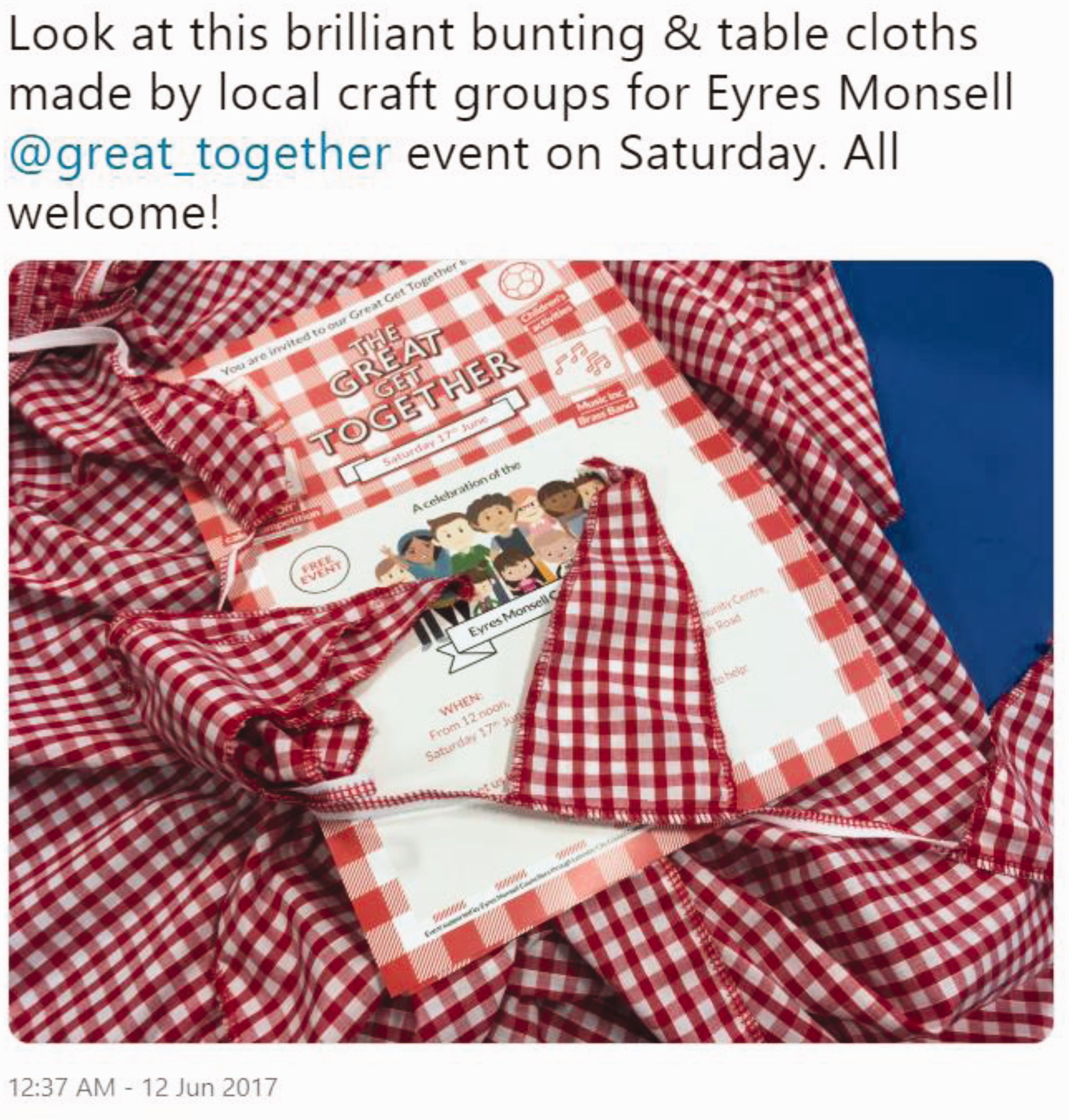
Image-tweet shared on 12 June 2017, in the week running up to the Great Get Together which highlights the resources and red and white gingham pattern identified with the campaign. Personal information removed from tweets unless a public organisation.
Focusing on the week running up to the Great Get Together weekend, there was a cross-media surge in related material: a documentary following the murder investigation and trial, ‘Jo Cox: death of an MP’, was broadcast on BBC2 on 13 June, the same day that widower Brendan Cox (2017) launched his book Jo Cox: More in Common. Both generated further coverage and reviews, adding to the momentum of the Great Get Together on the anniversary of Cox's death. Twitter analysis reveals tweeters promoting their own preparations for events; baking scones, reproducing posters and invitations for picnics, fun runs, face painting, school assemblies, and so on. With trademark ‘Let's get together' boards, the images echo familiar ‘selfie citizen’ campaign photographs, where handwritten banners are shared on social media in actions of protest, charity campaigning or social mobilisation (Kuntsman, 2017). In some cases, these were videos; such as that inspired by the Love Actually (2003) film, with Imam Qari Asim MBE and Rabbi Esther Hugenholtz holding up cue cards to reveal how much they have in common (Figure 2).
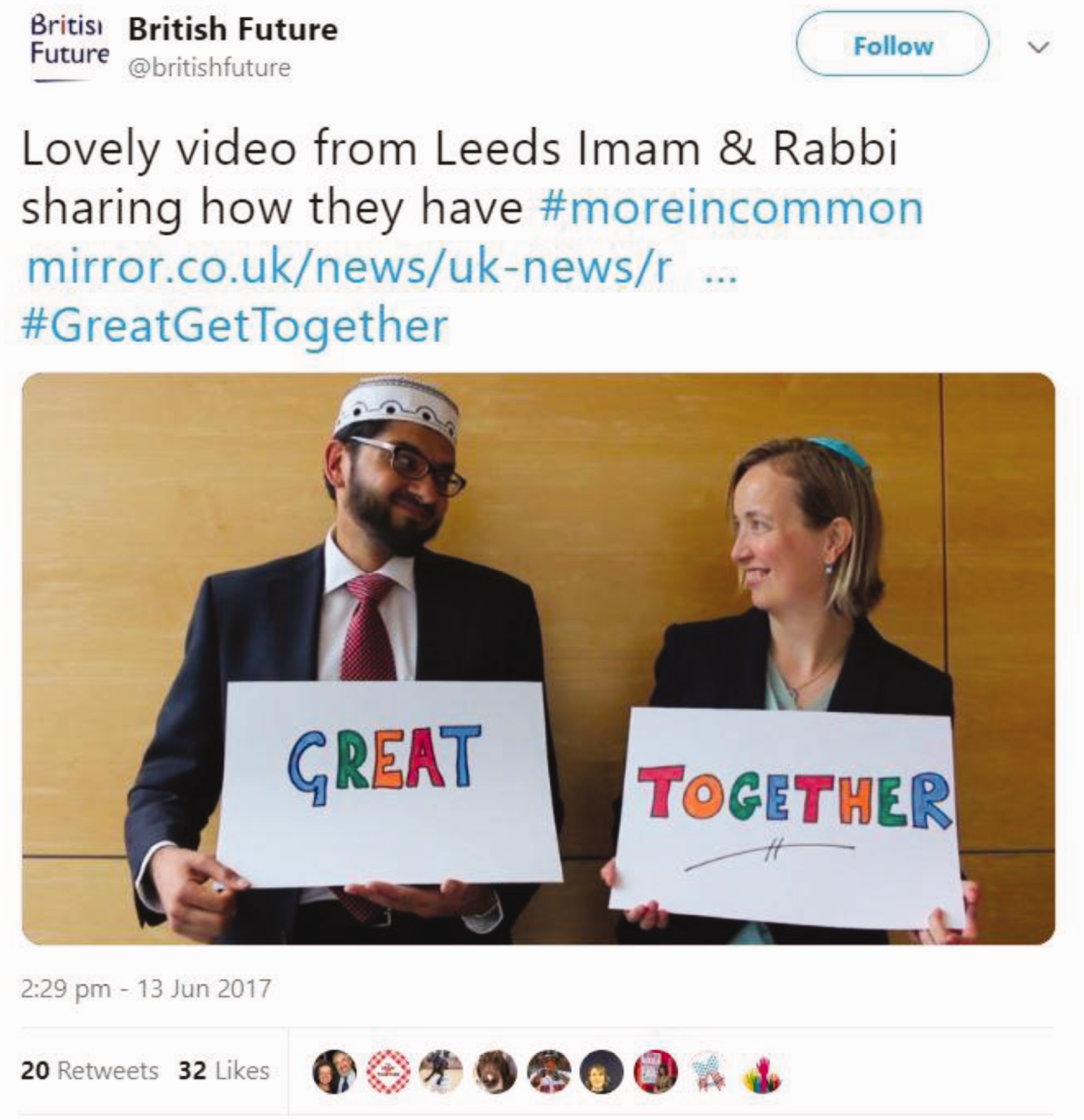
Video from the Great Get Together campaign, shared here via a link to the Mirror newspaper website (https://www.mirror.co.uk/news/uk-news/rabbi-imam-together-share-love-10617555#ICID = sharebar_twitter). https://twitter.com/britishfuture/status/874740516239400960
Much of the pictured planning activities centred on food, but there was also a focus on bringing together rivals or enemies. Considering the role of UK tabloid newspapers in promoting divisive political discourse, one of the most striking examples of this was the Sun and the Mirror publishing the same editorial for the first time in their history, an extraordinary moment also re-mediated via Twitter (Figure 3).
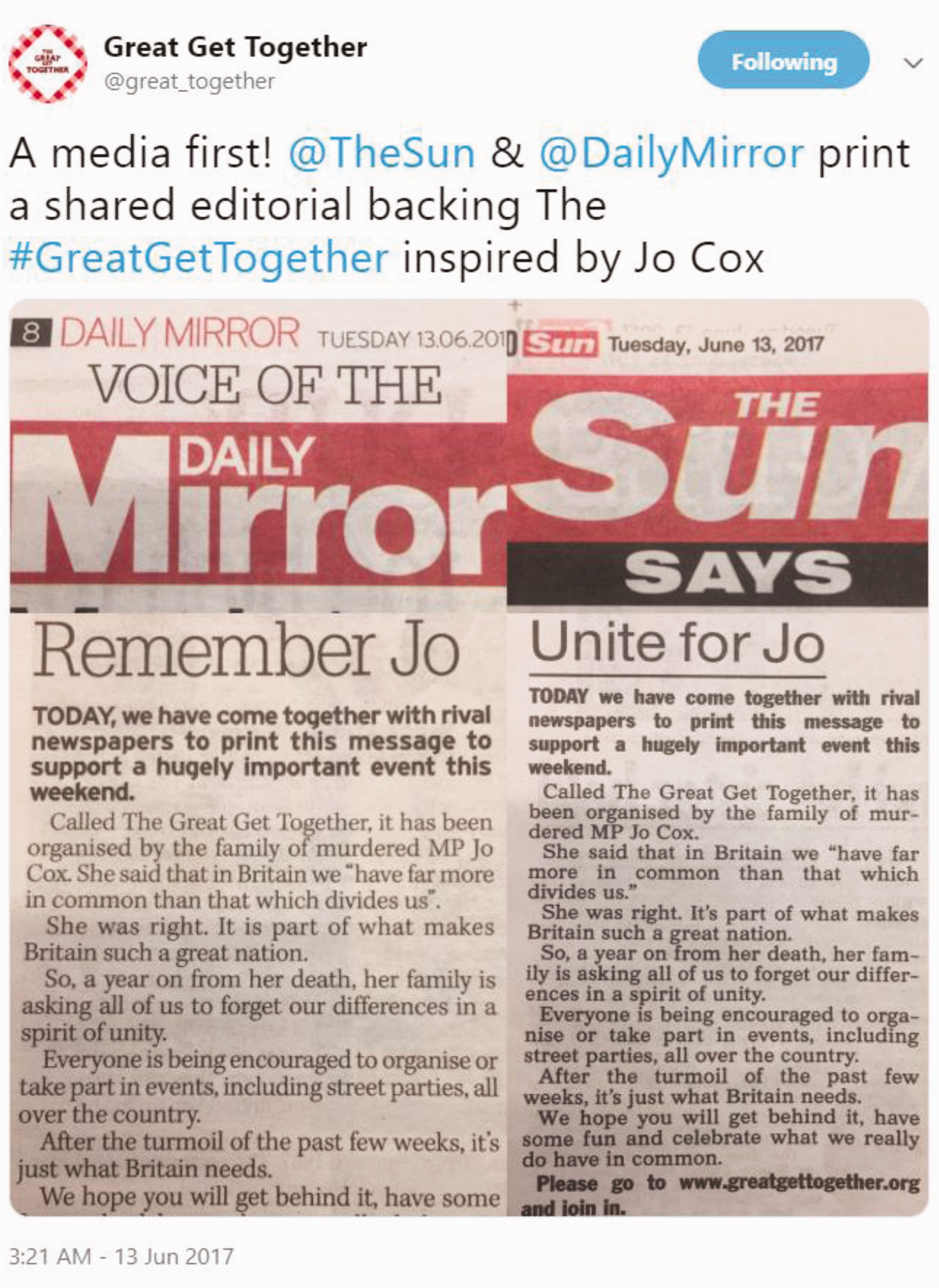
The Great Get Together twitter account promotes the shared editorial from the Mirror and Sun newspapers.
The theme of ‘burying the hatchet’ was also a defining feature of a special extended 2-hour episode of The Last Leg, broadcast on Friday 16 June 2017. The Last Leg is a Channel 4 Friday night comedy show originally commissioned to run alongside the 2012 Summer Paralympics, hosted by comedians Adam Hills, Josh Widdicombe and Alex Brooker. Hills has jokingly described the show as ‘Three guys with four legs talking about the week’, as both he and Brooker have no right feet, and the theme of disability remains a strong focus in its weekly incarnation. The comedy talk show offers a rare space for irreverent humour towards disability, but the show also wears its progressive politics on its sleeve. The Last Leg: Re-United Kingdom special was dedicated to Jo Cox, and invited various politicians and celebrities to resolve their differences in the ‘Lift of Reconciliation’. Four former prime ministers appeared on the show (Tony Blair, Gordon Brown, David Cameron and John Major), with current rivals Nicola Sturgeon (Scottish National Party leader) and Ruth Davidson (Scottish Conservative leader) appearing in the ‘Lift of Reconciliation’. While the politicians tended to feature in pre-recorded segments, the programme followed its usual talk show format, broadcasting live and encouraging audience participation through Twitter and other social media.
This programme generated a huge spike in Twitter engagement when it comes to ‘Jo Cox’ related tweets (almost 119,000 tweets and retweets at its peak), with Hills asking viewers to adopt a profile image to demonstrate solidarity, or to tweet using the #MakeItOk hashtag.
The role of The Last Leg as a prominent coordinating force speaks to the ‘interdependencies between newer and older media logics’ that Vaccari et al. (2015) observe in ‘dual screening’ of political media events (p. 1044). Television's affordances encourage communal spectatorship while the smartphone and the Twitter hashtag allow individuals to connect with others, even if fleetingly. During the live broadcast, Hills recounts how he was sent a design during the week that incorporated the bees of Manchester, the London tube sign and ‘a whole lot of heart’, which he tinkered with to create the avatar unveiled on the show (Figure 4). He encouraged people to download the image and adopt it as their Twitter profile over the weekend so that audience members would ‘at least have this in common’. This symbol of collective identification or ‘memetic signifier’ (Gerbaudo, 2015) was the most shared image on Twitter during the sample period, and is worth discussing due to its dense symbolism.
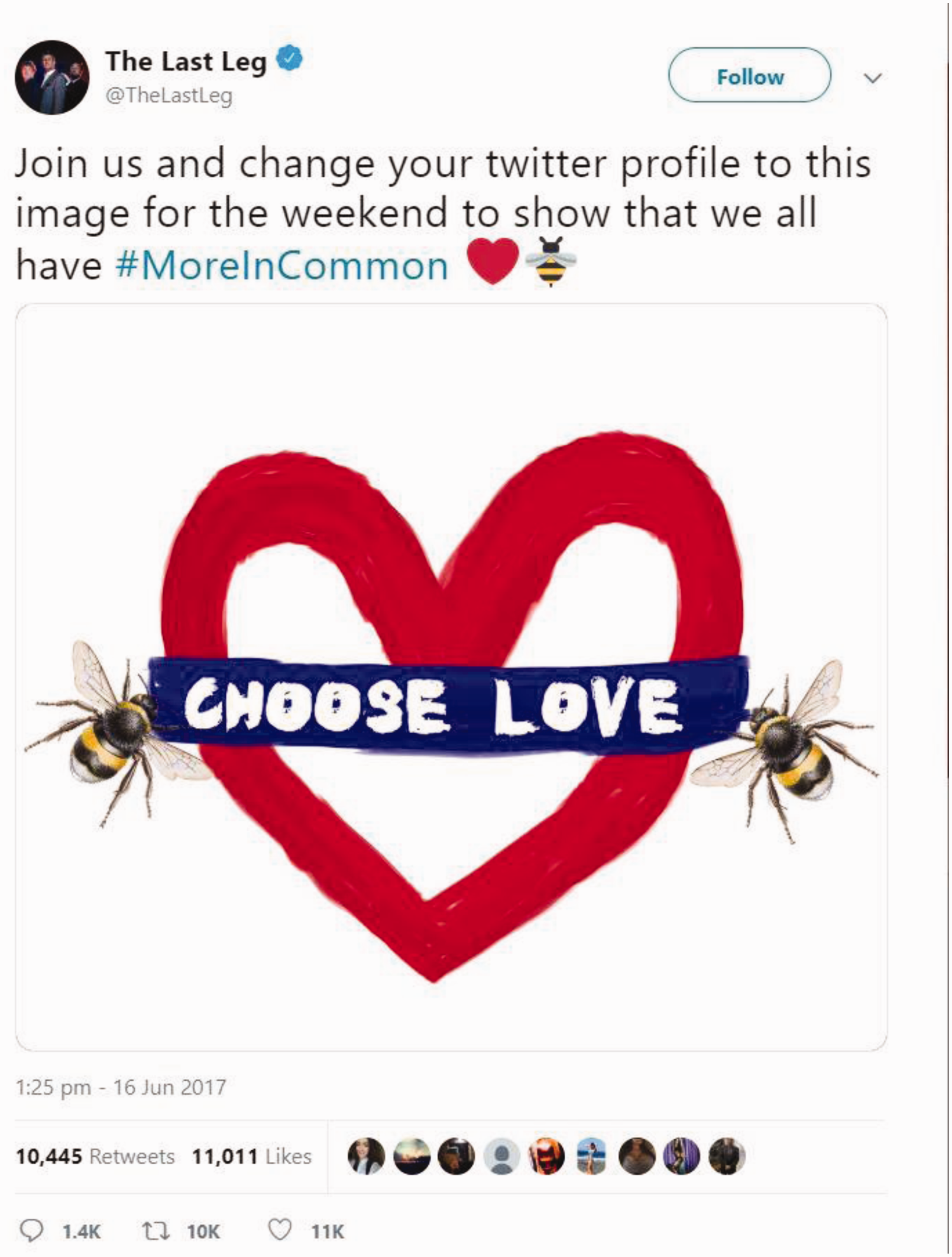
‘Choose love’ avatar shared by The Last Leg on Twitter: https://twitter.com/TheLastLeg/status/875811713567920128/photo/1
The ‘choose love’ imperative gained particular prominence following the homophobic terror attack on the Pulse nightclub in Orlando, USA, in which 49 people were killed, on 11 June 2016; this was in the week before Jo Cox's murder. The heart is presented in the colours of the London tube service, referencing both the London Bridge terror attacks on 3 June 2017, and the Grenfell Tower fire disaster on 14 June 2017, in which 72 people died. The bees represent Manchester, where on 22 May 2017 a suicide bomber had killed 22 people, many of them children, at Manchester Arena. The worker bee has a long history as the symbol for Manchester, representing its industrial past. But since the bombing it has become a symbol of unity and defiance, with many car stickers, badges and tattoos evident in the Greater Manchester area and beyond. At a vigil outside Manchester town hall on 23 May 2017, the poet Tony Walsh had also ended his poem ‘This is the Place’ with the words ‘Choose Love, Manchester’. This short summary cannot do justice to all the interconnections made here, but hopefully it conveys how the ‘choose love’ avatar was intended to combat the sense of despair following the multiple terror attacks, and the sense of injustice for the families of Grenfell. The avatar visually embraces the other events, drawing on them as a power source to build solidarity between those affected by the attacks and Grenfell Tower disaster. Solidarity-building works here by reaching across to others in pain, but through an expression of love and good humour.
The Grenfell Tower fire in North Kensington, which started just 2 days before the Great Get Together weekend, was an event which could not be ignored by many of those organising Great Get Together gatherings. But while this human tragedy became a symbol of government and corporate complacency and neglect, the immediate responses from members of the public and volunteers, and the fight for justice from survivors since then, have also shown a commitment to make something good come out of something terrible. Long delays in the inquiry process and government inaction are testing that commitment to a peaceful and constructive approach (Booth, 2019).
The Last Leg provided a televisual focus for the Great Get Together on the Friday evening but really it was the tapestry of local events held over the weekend that embodied the ‘togetherness-in-difference’ ethos. Social media helped to publicise the events, with many tweets re-mediating posters, local media reports and flyers distributed in communities, while broadcast news coverage was patchy, partly due to the dominance of the Grenfell Tower fire in news bulletins. In Yorkshire, local news bulletins BBC's Look North and ITV's Calendar presented a joint broadcast from Birstall in Jo Cox's constituency. The Great Get Together had partnered with ‘The Big Lunch’, a pre-existing initiative from the Eden Project to bring neighbours together, but with the event taking place during Ramadan, other towns and cities held ‘Big Iftars’, joining with Muslims to break their fast with a meal at sunset (Figure 5).
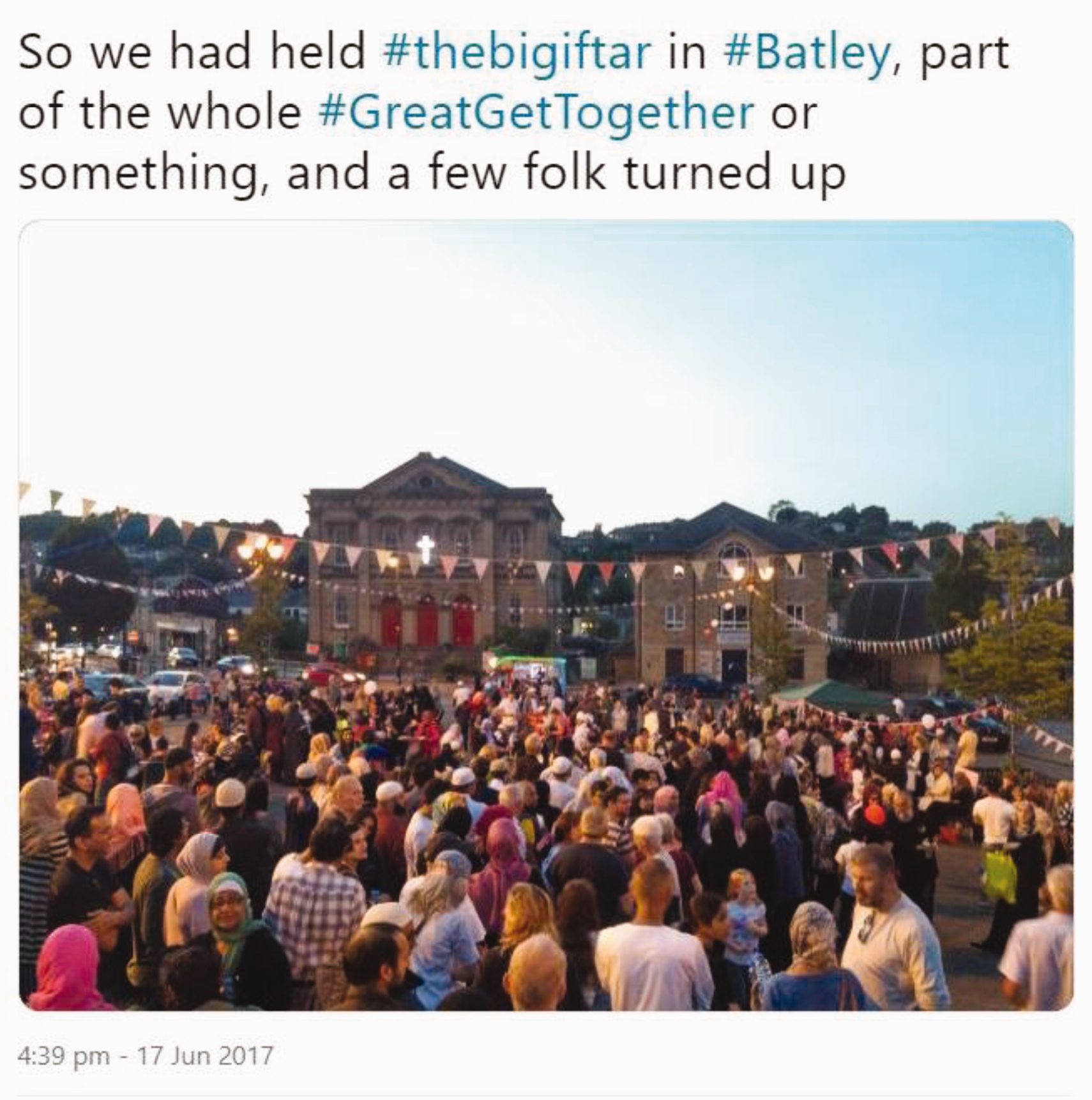
The Big Iftar in Jo Cox's constituency of Batley and Spen, Yorkshire.
The tweets show that Iftars and lunches were held all over the United Kingdom. Refugees Welcome even posted a ‘how to host an interfaith Iftar’ guide for those keen to be inclusive and welcoming. Despite the often twee aesthetics of the Great Get Together identity, the events apparently attracted 9.3 million people to take part, ‘one of the biggest community celebrations to ever happen in Britain’ (Eden Project, 2017). Jo Cox was largely unknown until her violent death, but her image (as witnessed smiling in photographs across the media) and her imagined political vision provided the impetus for people to come together and to feel more hopeful (Parry, 2019). The subsequent Great Get Together events in 2018 and 2019 may have attracted fewer people overall, but the interactive map (https://www.greatgettogether.org/find/) offers a heartening array of hundreds of tea parties, lunches and walks still being organised with the aim of continuing Cox's legacy. Such events do not make high demands on people, but they do promote empathy and an awareness of the dangers of social isolation.
I now return to Wagner-Pacifici's model of political semiosis to summarise the characteristics of convivial politics as constructed in the hybrid mediations of the Great Get Together.
Performative
Performative acts call identities into action or existence, including notions of citizenship and nationhood. A certain vision of the nation is called into existence in the posting of selfies and flyers which publicise specific contributions to the Great Get Together. This could be an individual contribution of baking scones or running a race, but it is also as part of a collective imagination of the nation. Through acts of coming together, the performance of civic association and connection also intends to set in motion, or bring into being, a new way of doing politics as a nation.
In their work on ‘everyday nationalism’, Marco Antonsich and Michael Skey (2017) point to a growing literature on the affective dimensions of nations, with a stress on the intermittent, emergent and relational character of the nation. Nations therefore emerge ‘out of the interactions between people, material objects and the environment’ (p. 843). They argue that work on affective nationalism needs to foreground questions of power and difference, mapping who participates in affective practices and to what end. Those memorialising Jo Cox and promoting her as a symbol of tolerance and diversity might hope to embrace a broad public, but it would be remiss not to point to that they are also often addressing people from a particular position of power; as members of the political elite and non-governmental organisations. Their cosmopolitan vision of the nation might actually work to exclude those they would most like to reach. As Wagner-Pacifici (2017) writes, performative interactions involve ‘constant chances for misfires, mismatches, or disjunctures’ (p. 21) and while there was clearly success in bringing political subjects into being who felt some level of commitment to civic togetherness, however temporarily, these dynamics are fragile and will undoubtedly prompt multiple reactions, not all positive.
Demonstrative
The purpose of the Great Get Together was to bring people together at local events at the same time across the country. Unlike media events, there was no principal live broadcast acting as a centring diversion, but social media was used to publicise events, share ideas and generate further media coverage. This demonstrates ‘affective publics’ (Papacharissi, 2016) are not only being created in localities but in the amplification of civic associations through the media. The functionalities of social media point to the ‘here and now’ of participation, but also concurrent events ‘over there’, demonstrative of a shared commitment to reach out beyond established social ties. The recognition of kinship is explicitly extended to recent victims of terror attacks and the Grenfell fire disaster through the ‘choose love’ avatar promoted by The Last Leg: Re-united Kingdom and shared on social media. Foregrounding love and compassion as political feelings designates everyone as welcome; it accentuates cultural proximities through the #MoreInCommon hashtag and impels people to physically come together and eat together: closeness in communities is pictured again and again. Feelings of belonging and solidarity are articulated through adopting the avatar and demonstrating the decision to ‘choose love’.
Representational
The representational features have already been hinted at above, with the ‘circulatory power of the copy’ (Wagner-Pacifici, 2017: 26) exemplified in the social media sharing of photographs of Jo Cox herself, the ‘choose love’ avatar, and the red and white gingham patterned material found across posters and self-representations. The semiotic stability provided by organisers' resources crystallises the picnic theme and festive tone, with the many repetitions across the media environment building recognition. The representational capacities of various media forms and genres are utilised by the Great Get Together to cultivate an orientation towards a hopeful and open-minded civic interaction with others. The genre of comedy is significant here, enabling a sometimes awkward transition from grief and dismay to solidarity-building through good humour.
Conclusion: What might convivial politics look like?
In the United Kingdom, in the time since the Great Get Together, politicians and political activists are looking for ways to engender a political imaginary built on compassion and conviviality. In October 2018, Labour peer Lord Dubs, himself a one-time refugee who arrived on the Kindertransport during the Second World War, launched a cross-party initiative for Compassion in Politics, focusing on refugees and asylum seekers, equality and climate change (Walker, 2018), and motivated by the need to challenge an oppressive political narrative by working together with compassion and respect. In the activist realm, the Extinction Rebellion protests in April 2019 across London embraced conviviality in their forms of non-violent civil disobedience, with music, ritual, performances, and gardens on Waterloo Bridge (Taylor and Gayle, 2019). Interestingly the activists were at times ridiculed for a ‘middle class’ style of activism, but others see their embrace of the spectacle and of ritual experience as proposing a new kind of spiritual response to the existential threat of climate catastrophe (Seth-Smith, 2019). The movement certainly offers a potential further study in conviviality in activist politics.
Given the existing literature on conviviality, I think any conceptual work needs to start from a position where a commitment to being ‘at ease’ with others is highlighted but without a reification of identity (Gilroy, 2004); where racial and ethnic difference is made ‘commonplace’ (Valluvan, 2016). Conflict lives alongside conviviality, and plurality is also vital, but without this minimal starting point, the paths towards creating a convivial political imaginary are closed off. This ‘civic culture of ease’ (Amin, 2008: 11) is likely to be multi-ethnic and multi-faith, but also focused on healing generational, social class and gender divides. While not intending to appropriate conviviality from its traditions in critical race studies, my intention is to broaden its remit beyond the multiculture of (capital) cities, and into other localities, where the spaces or semi-public spaces for everyday sociality offer very different forms of ‘throwntogetherness’ (Massey, 2005) to those of urban environments. In this way, I would like to move beyond the oftentimes London-centric focus of much of the literature in this area, and call for further studies that examine spaces for conviviality in cities other than London, and in town and village settings. Indeed, this conceptual work is certainly not limited to the UK context, and concerns about political violence, hostility and hate crimes are both affecting the political cultures of many other nations, and prompting manifestoes for healing such divisions (Lerner, 2019).
As Hinchliffe and Whatmore (2006) suggest, the capacity for a politics of conviviality requires a multiplicity of political perspectives, or ‘political agonism’ to move forward: ‘a capacity that is not produced or determined by any one social identity or political alignment but in the multiplicity of relations through which civic associations and attachments are woven’ (p. 135). The authors balance agonism with Rosalyn Diprose's (2002) notion of ‘corporeal generosity’, where capacities and powers are enhanced by the ‘practical intercorporeality of civic association’, and where the political is placed in the realm of the affective and bodily rather than in the realm of conscious judgement (Hinchliffe and Whatmore, 2006: 136). This balancing of unity with diversity, and of bodily experienced politics speaks to the importance of moments of physical co-presence with those not politically aligned.
Georgiou (2017) has already pointed out how a communication perspective can enrich our understanding of how conviviality is enabled or prevented in a multicultural city, and how local media play a part in supporting affective connections and disconnections. Looking beyond the city, I argue the ‘range of aesthetic and communicative genres, images, symbols, gestures, and postures’ (Wagner-Pacifici, 2017: 160) shared and re-articulated across the hybrid media environment are significant cultural artefacts for understanding the contours of togetherness and separation, of belonging and solidarity, in ongoing and dynamic manifestations for convivial politics beyond the city.
Therefore, again with a minimally prescriptive notion in mind, we can summarise some core attributes that would undergird a convivial politics:
It relies on moments of bodily co-presence where a commitment to being ‘at ease’ in civically minded gatherings is cultivated, but also recognises that ‘convivial separation’ (Georgiou, 2017) is important at other times; coming together convivially cannot work without appreciation of the time and space required for separation or withdrawal. Hinchliffe and Whatmore write of ‘political agonism’ in their framework of a politics of conviviality (see above). To think further about the practices required to work through differences, I follow Stephen Coleman's (2018) formulation that democratic politics ‘depends upon the communicability of intersubjective perspectives’, especially in times of post-truth populism (p. 158). This places the emphasis on the practices of how to communicate political viewpoints and the ‘work of connecting and integrating subjectivities’ (p. 162). While politics emerges in the irreconcilability of conflicting perspectives and values, collective citizenship ‘depends upon a shared sense of what social togetherness means and entails’ (p. 162). Coleman's three principles for improving intersubjective political judgement: of social curiosity; of collective interpretation; and of working through disagreement, offer a model of political communication which identifies the messiness of multivocality but proposes an intersubjective sensibility that potentially aligns well with conviviality. In addition to organising events where people come together in local community initiatives, convivial politics takes seriously the role of the symbolic, aesthetic and emotional in political culture. Enabling co-presence across social differences is crucial, but a commitment to convivial politics correspondingly recognises that representational forms and genres are performative; that mediations and symbolic gestures are forms of action that shape political cultures, and have the potential to marginalise some groups of people if not well-thought-out. This is undoubtedly about a cultural or imaginative shift, rather than a proposal that directly addresses structural inequalities. Everyday creativity, crafting, cooking, eating together do, however, build convivial capabilities that can open up possibilities for participation in other civic activities, and restore a sense of human dignity for those feeling isolated. An example of this is the growing number of charities using cooking together to help refugees improve their English, gain confidence and build local networks. As Jess Thompson from social enterprise Migrateful comments in a recent Observer article: ‘We also train them to share their stories, which gives them a sense of worth and healing’ (cited in Wazir, 2019).
The infrastructures and architectures to enable empathetic gatherings (such as how seats are arranged in a physical space) are important to consider. But the ways in which digital technologies impact democratic or civic processes cannot be ignored. Virtual spaces can also be engineered, redesigned or modified to shift the quality of online discourse. One example is ‘Change A View’ which started life as a subreddit discussion group on Reddit, set up by 17-year-old Kal Turnbull, structured to try to provoke thoughtful, well-reasoned conversation and using the affordances of the platform to reward civility (Wending, 2019). As Alan Finlayson (2019) has recently concluded, digital technologies have changed the means of communication and the social relations between people: ‘In altering the stages, scripts and dramas with which we perform our politics for each other, it is also altering what people know (or think they know) about politics, and how they feel about it’ (p. 88). But the question remains of how far the realisation of a convivial politics committed to social justice is constrained by a market-based media system (Moss, 2018). Can the scripts for convivial politics be cultivated using the digital media platforms currently available?
How might this work in practice beyond the Great Get Together as a momentary example? In a sense there are already activities that could be gathered under this umbrella of convivial politics as very broadly defined here. For example, the recent surge in interest in citizen assemblies speaks to similar principles of consensus-building and citizen-led politics (BBC, 2019; Elgot, 2019). Likewise, community arts projects with inclusive social action in mind have a long history. But we can heed a warning from one of the experts in community arts: Owen Kelly (2016) has written about how community artists have failed to document their history, and have therefore struggled to construct a sustainable political programme, where success and failure can be measured and lessons learned. This only gives us more reason to start to pull together these disparate initiatives in multiculture, communitas and compassion in politics, to gain a better understanding of the promises and limitations of the varied initiatives designed to fix a broken and divisive political culture. Could evaluating disparate grassroots, creative and official political initiatives through the lens of convivial politics aid us in finding an effective way to enhance democratic politics and re-orientate the political mood towards ‘working through’ (Coleman, 2018) difference and disagreement? This article is an attempt to promote such a project and contribute towards a documenting of convivial politics.
Footnotes
Acknowledgements
I am very grateful to Stephen Coleman and Beth Johnson for their guidance during the development of this article. I would also like to thank the anonymous reviewers for their constructive comments during the review process.
Funding
The author(s) received no financial support for the research, authorship, and/or publication of this article.
