




Abstract
Faced with fundamental societal changes such as partisan dealignment and mediatisation, political parties in Germany as well as in other Western democracies professionalise their communication. Drawing on the concept of professionalisation of political communication, the present study investigates changes of campaign posters for German Bundestag elections from 1949 until 2017 with regard to personalisation, de-ideologisation and negative campaigning. By using a quantitative content analysis of visual and textual elements of campaign posters (N = 1,857) and logistic regression analyses, we found an increase in visual personalisation and in visual ideologisation. However, no upwards trend was detected regarding negative campaigning across the four phases of political campaigning. Moreover, we found no empirical evidence for an increasing textual personalisation or textual de-ideologisation. All in all, the findings of this longitudinal analysis indicate an increasing visualisation of political communication.
Political parties are forced to adapt to an emerging electoral market as well as to the pivotal role of media logic in light of the fundamental societal changes of partisan dealignment (Dalton, 2014) and mediatisation (Strömbäck and Esser, 2017). This transformation, occurring since the 1960s, affects both political parties’ organisational structure and their communication strategies and can best be described as professionalisation (Gibson and Römmele, 2001; Negrine and Lilleker, 2002; Negrine et al., 2007). The professionalisation of political communication becomes especially apparent during election campaigns in parties’ own communication channels such as campaign posters. Several researchers have identified personalisation, de-ideologisation and negative campaigning as strategies of professionalised political communication (Holtz-Bacha, 2002; Schweitzer, 2008; Vliegenthart, 2012). With regard to election campaigns, the professionalisation of political communication has been systemised by several phase models (Blumler and Kavanagh, 1999; Gibson and Römmele, 2001). While the assumption of a time-bound use of different campaigning tools has been contested (Magin et al., 2017), phase models still might be helpful to characterise the evolution of a certain campaigning tool used continuously over time.
Despite the emergence of newer campaigning tools, German election campaigns are characterised by a vivid poster culture. Due to regulations on televised advertising in Germany as well as in other European countries (Holtz-Bacha, 2017), campaign posters have remained an important visual campaigning tool for German election advertising (Holtz-Bacha and Lessinger, 2017). During the 2017 Bundestag election campaign, political parties distributed up to 371,000 campaign posters and spent up to 39% of their campaign budgets on this tool. 1 Spread in public spaces, campaign posters can hardly be avoided and reach almost the whole German electorate. For instance, 94% of the voters have seen campaign posters during the 2017 Bundestag election campaign (Roßteutscher et al., 2018). Given their wide reach, campaign posters are meant to inform the electorate about the parties’ programme and candidates, signal strength, mobilise adherents and convince undecided voters (Dumitrescu, 2012).
In spite of the importance of campaign posters for German election campaigns, until now far too little attention has been paid to this means of communication with regard to political parties’ use of professionalised strategies. Instead, several studies have investigated campaign posters in terms of their anatomy (Dumitrescu, 2010), their functions in practitioners’ views (Dumitrescu, 2012), their perception (Geise, 2011) or their effects (Matthes and Schmuck, 2017). Longitudinal studies on campaign posters revealed an increasing personalisation in Austrian election campaigns (Hayek, 2016) and an increasing use of images of political leaders as well as a decrease in the use of ideological symbols in Dutch election campaigns (Vliegenthart, 2012). Regarding negative campaigning, these analyses are in line with a recent study by Johansson (2014), which showed relatively low levels of negativity for Swedish campaign posters. However, there is still need for empirical studies that consider all strategies of professionalised political communication in a long-term perspective systemised by the phases of political campaigning.
Against this background, this study aims at analysing changes in political campaigning with regard to personalisation, de-ideologisation and negative campaigning by focusing on campaign posters for German Bundestag elections in the period from 1949 to 2017. Empirically, the study relies on a quantitative content analysis of visual and textual elements of campaign posters.
The present study adds to the existing literature in two ways. On the one hand, based on a suitably large dataset, it provides new empirical evidence for the professionalisation of political campaigning in general. On the other hand, to the best of our knowledge, it is the first longitudinal study that includes all four phases of political campaigning and, therefore, contributes to the theoretical discussion on different phase models of political campaigning.
The article is structured as follows. We begin by examining the concept of professionalisation of political communication. Next, we review our methodology and present the results of the quantitative content analysis focusing on personalisation, de-ideologisation and negative campaigning. Finally, the findings are discussed.
The professionalisation of political communication
As a major visual means of communication, campaign posters are integrated in wider campaigns. Over the past decades, the circumstances for election campaigns as for political communication, in general, have changed fundamentally. The concept of professionalisation provides a useful theoretical framework to examine the development of political communication in Western democracies since the end of World War II. The shift to professionalised campaigning in view of these political and media changes has been systemised in several phase models. Recently, researchers have distinguished four phases of political campaigning (Enli, 2017; Magin et al., 2017; Vergeer et al., 2013), reconsidering established models of three phases (Blumler and Kavanagh, 1999; Gibson and Römmele, 2001; Norris, 2000). Partly, they refer to similar developments, but draw on concepts such as modernisation (Strömbäck and Kiousis, 2014). In line with Holtz-Bacha (2002), we regard modernisation as superordinate to the professionalisation of political communication. Modernisation comprises the mutually dependent societal trends of partisan dealignment and mediatisation. Professionalisation addresses political parties’ adaption to partisan dealignment and mediatisation with respect to their organisational structures such as the growing influence of consultants, spin-doctors and advertising agencies as well as their communication strategies (Tenscher, 2013). It basically describes a process leading to a high focus on political leaders, less focus on ideology and high levels of negativity (Vliegenthart, 2012). Consequently, personalisation, de-ideologisation and negative campaigning can be assumed as strategies of professionalised political communication (Holtz-Bacha, 2002; Schweitzer, 2008).
Generally, political personalisation describes ‘a process in which the political weight of the individual actor in the political process increases in the course of time, while the centrality of the political group (i.e. political party) declines’ (Rahat and Sheafer, 2007: 65). In the literature, three different lines of research can be identified: (a) personalisation of the electoral system (institutional personalisation), (b) personalisation of the paid and unpaid media (media personalisation) and (c) personalisation of politicians’ and voters’ behaviour (behavioural personalisation). Although the German political system shows fewer tendencies of institutional personalisation compared to other countries (e.g. Israel or the United States) (Rahat and Sheafer, 2007), the differentiation between media personalisation (e.g. Reinemann and Wilke, 2007) and behavioural personalisation (e.g. Gschwend and Zittel, 2015) fits for the German case. Furthermore, centralised personalisation of single leaders and decentralised personalisation of individual politicians who are no party leaders can be distinguished. This study concentrates on centralised personalisation in a paid medium, defined as an increasing focus on political leaders (political parties’ heads or executive leaders) in parties’ own communication channels such as campaign posters (Balmas et al., 2014).
The increase of political personalisation is accompanied by de-ideologisation (Garzia, 2011). Kirchheimer (1966) describes de-ideologisation in Germany as well as in other Western European post-war societies: ‘De-ideologization in the political field involves the transfer of ideology from partnership in a clearly visible political goal structure into one of many sufficient but by no means necessary motivational forces operative in the voters’ choice’ (p. 187). It has been suggested that the hiring of external experts contributes to rather sales-oriented election campaigns instead of clear-cut ideological political communication (Holtz-Bacha, 2002). Accordingly, we assume that political parties refer to a lesser extent to the political ideologies of liberalism, conservatism, socialism, communism, nationalism, fascism, ecologism, feminism and religion (Heywood, 2017) and their respective symbols (Mazzoleni and Schulz, 1999) in the course of time.
Nevertheless, political parties aim at mobilising own partisans (Lau et al., 2007) and at demobilising adherents of the opponent (Krupnikov, 2011) with negative campaigning. Therefore, political parties try to show that their opponents are not eligible to lead the country (Ceron and d’Adda, 2016). In general, directional and evaluative definitions of negative campaigning can be distinguished. In line with the directional definition of Lau and Pomper (2002), we perceive negative campaigning as ‘talking about the opponent – his or her programmes, accomplishments, qualifications, associates, and so on – with the focus, usually, on the defects of these attributes’ (p. 48). Hence, all references to the political opponent are considered negative campaigning. Lau and Pomper (2002) described negative campaigning for the two-party system in the United States. Nevertheless, this definition considers all references to the political opponent as negative campaigning and is, therefore, also suitable for multiparty systems such as Germany.
In the following, the professionalisation of political campaigning and the emergence of the strategies linked to this development are examined more closely. In the first phase of political campaigning (until 1960), the electorate is characterised by a strong party identification and low volatility. Therefore, political parties can easily refer to ideologies because political institutions and beliefs are strong (Blumler and Kavanagh, 1999). By using campaigning tools such as campaign posters, partisan press, and face-to-face-communication (e.g. canvassing), political parties aim at reaching and mobilising voters (Gibson and Römmele, 2001; Norris, 2000). Moreover, during the first legislative periods from 1949 to 1957, different radical left-wing and right-wing splinter parties such as the German Communist Party (KPD) and the nationalist German Party (DP) gained seats in the parliament. Consequently, besides high levels of ideologisation, low levels of personalisation can be expected for Bundestag elections in this early phase.
The second phase of political campaigning (1960–1990) differs from the first phase especially in terms of the electorate and the growing importance of the media logic. Regarding voters, partisan dealignment and an increasing electoral volatility are characteristic during this phase (Dalton, 2014). Confronted with declining party identification, political parties need to convince the electorate and address masses instead of only mobilising their own partisans. Political parties such as the Christian Democratic Union/Christian Social Union (CDU/CSU) or the Social Democratic Party (SPD) therefore transform into catch-all parties trying to avoid ideological battles in order to appeal to a variety of voters (Kirchheimer, 1966). Despite first attempts of the CDU/CSU in the 1950s, both major parties establish the outsourcing of their campaign organisation and the hiring of external experts in the 1961 election campaign. CDU/CSU and SPD hire opinion researchers, PR-consultants and advertising agents. For the first time, professional advertising agencies are responsible to design and distribute campaign posters (Krewel, 2017). The liberal Free Democratic Party (FDP) is at first the only minor party represented continuously in the German Bundestag until The Greens (later Alliance 90/The Greens) enter the parliament in 1983. Furthermore, this phase is characterised by a shift from direct communication between political parties and the electorate to mass media communication (Gibson and Römmele, 2001). This development is accompanied by the rise of television, introduced in Germany during the 1950s and established until 1980, leading to a more personalised political communication (Blumler and Kavanagh, 1999). Especially the introduction of commercial television in the 1980s reinforced German political parties’ adaption to media logic (Schulz and Zeh, 2005).
In the third phase of political campaigning (1990–2008), political consultants play a more crucial role in the political process (Blumler and Kavanagh, 1999; Gibson and Römmele, 2001; Norris, 2000). During this phase, the ties between voters and political parties become even weaker. Consequently, the level of electoral volatility as well as the number of swing voters and late deciders in Germany increases (Dalton, 2014). With the reunification of the two German states, the Party of Democratic Socialism (PDS, later The Left) enters the German Bundestag for the first time in 1990. Since 2002, German TV broadcasts debates between the chancellor candidates. To address voters as consumers, political parties adopt new marketing techniques and use targeted campaigns (Gibson and Römmele, 2001). Hence, this phase describe professional campaigns. The focus of political campaigns moves from ideological conflicts to leaders. Besides this personalisation, negative campaigning is established as a further strategy of political campaigning (Geer, 2012; Norris, 2000). In Germany, especially the SPD’s 1998 campaign led by Gerhard Schröder ‘seemed to mark the new era of professionalized campaigning’ (Gibson and Römmele, 2001: 35).
Finally, the increasing relevance of social media in political campaigning leads to the emergence of newer forms of political communication, a trend current research has characterised as the ‘fourth age of political campaigning’ (Magin et al., 2017). The developments of ongoing dealignment and mediatisation identified for previous phases even intensify with the rise of the Web 2.0. Political parties worldwide hire social media experts and integrate digital tools into larger campaigns (Bruns et al., 2015; Lilleker et al., 2015), leading to a reinforced professionalisation in view of the new digital environment (Enli, 2017). Social media platforms further contribute to the personalisation of politics, as candidates spread personal messages via social networks like Facebook or Twitter (Enli, 2017; Vergeer et al., 2013). However, it has to be investigated whether an increase in the usage of such strategies can also be observed for established tools such as campaign posters. With regard to negative campaigning, previous research has indicated an extensive use in both online and offline contexts over the last years (Druckman et al., 2010). Benefitting from the European refugee crisis and the rise of nationalism, the right-wing Alternative for Germany (AfD) complements the party system in 2017.
It has to be taken into account that the adoption of professionalised structures and strategies varies across countries and that newer tools complement instead of replace older tools (Tenscher and Mykkänen, 2014). However, phase models are a useful heuristic to identify long-term trends of political campaigning (Klinger and Russmann, 2017). Although professionalised political communication may be characterised by a mixture of campaign styles, phase models allow describing predominant patterns of political campaigning in the course of time.
Following this line of argument, one could expect several changes of campaign posters’ characteristics during the period of the study. Considering the specifics of the respective phases, an increasing focus on political leaders, less ideological references as well as a high level of negativity are expected for recent campaigns in contrast to German Bundestag elections in earlier phases. Based on these theoretical considerations, we formulate the following six hypotheses:
H1. The (a) use of images and (b) mentioning of political leaders on campaign posters increases in the course of time.
H2. The (a) use of ideological symbols and (b) mentioning of political ideologies on campaign posters decreases in the course of time.
H3. The (a) use of visual references to and (b) mentioning of political opponents on campaign posters increases in the course of time.
Methods
To test our hypotheses, we carried out a quantitative content analysis of both visual and textual elements of campaign posters for German Bundestag elections in the period between 1949 and 2017. The distinction between visual and textual elements for the investigation of campaign posters is in line with a recent study that demonstrates discrepancies between visual and textual parts of posters (Vliegenthart, 2012). To collect the sample, we used the archives of the German political party foundations (Konrad Adenauer Foundation, Hanns Seidel Foundation, Friedrich Ebert Foundation, Friedrich Naumann Foundation, Heinrich Böll Foundation, Rosa Luxemburg Foundation), the German Federal Archives and the political parties’ official websites. The campaign posters were selected by the following criteria: posters had to be (a) distributed nationwide, (b) by political parties represented in the Bundestag following the respective election (CDU/CSU, SPD, FDP, Alliance 90/The Greens, The Left, AfD, and Others) and (c) promoted the parties, their programmes or their leaders. These criteria excluded posters showing politicians who were neither the political parties’ heads nor executive leaders (e.g. constituency candidates), wall newspapers as well as campaign posters published by the political parties’ youth wings or other supporting organisations (e.g. citizens’ initiatives or unions). Finally, a total of 1,857 campaign posters for 19 Bundestag elections were collected and analysed using a quantitative content analysis.
The campaign posters were coded by six native speaking and trained coders. To assess intercoder reliability, a randomly selected subsample of 186 campaign posters was coded. By using Krippendorff’s alpha for calculating intercoder reliability (Krippendorff, 2013), we found satisfactory reliability scores (reported below).
To measure the strategies of professionalised political communication, we used a set of binary variables (0 = absent, 1 = present), which served as dependent variables in the following analyses. In line with the definition of centralised personalisation mentioned above, the first variable Visual Personalisation indicated whether the campaign posters contained an image of a political leader (Krippendorff’s α = .95). Similarly, the second variable Textual Personalisation measured whether the text on the campaign poster referred to a leader (Krippendorff’s α = .87). The third variable Visual De-ideologisation indicated whether campaign posters showed symbols representing political ideologies, such as hammer and sickle, red star, or red flag (socialism or communism); the national flag or the federal eagle (nationalism); swastika or runic insignia of the Schutzstaffel (fascism); Venus symbol (feminism) and crucifix, crescent, or the Star of David (religion) (Krippendorff’s α = .97). The fourth variable Textual De-ideologisation measured whether the text on the campaign posters named the political ideologies of liberalism, conservatism, socialism, communism, nationalism, fascism, ecologism, feminism, or religion (Krippendorff’s α = .79). The fifth variable Visual Negative Campaigning was constructed based on Lau and Pomper’s (2002) directional definition of negative campaigning and indicated whether the image on the campaign posters referred to other political parties or candidates (Krippendorff’s α = .82). Finally, the variable Textual Negative Campaigning measured whether the text on the campaign posters referred to the political opponent (Krippendorff’s α = .84). Coding illustrations of the strategies of professionalised political communication are given in the Appendix 1.
Due to the binary coding of the dependent variables, logistic regressions were used to test the hypotheses. In the logistic regression analyses reported below, the election years served as the independent variable. In line with our theoretical approach, we classified the election years into categories representing the four phases of political campaigning. The first phase covered the post-war period including the Bundestag elections from 1949 to 1957, followed by the second phase ranging from 1961 to 1987, which was characterised by the division of Germany. The third phase included the period after Germany’s reunification from 1990 to 2005, while the fourth phase included the latest German Bundestag elections from 2009 to 2017. The first phase was chosen as reference category. In addition, we included the political parties as a control variable in our logistic regression models to assess whether differences between the political parties occur. Due to its permanent presence in the Bundestag, we chose the SPD as reference category.
Results
The first set of hypotheses assesses the personalisation of politics on campaign posters in the course of time. We assume that both the use of the images of political leaders (H1a) and the mentioning of the leaders’ name (H1b) have increased. Figure 1 presents the levels of visual and textual personalisation per election year. It becomes apparent that images of political leaders were present in all phases of political campaigning. However, differences across phases can be identified: During the first phase, political leaders were less present on images compared to later phases of political campaigning. Especially in recent years, including the latest Bundestag elections from 2009 to 2017, the use of images of political leaders has increased. As is shown in Table 1, the results of the logistic regression analysis confirm the increasing visual personalisation on campaign posters in the course of time. The odds of using images of political leaders was 3.635 times higher for the second phase of political campaigning than for the first phase. For the third phase, the odds of using images of political leaders was 3.750 times higher compared to the first phase. Finally, for the fourth phase, the odds of using images of political leaders was 8.802 times higher than for the first phase. Therefore, Hypothesis 1a is supported. In addition, significant differences across political parties occurred. As compared to the SPD, Alliance 90/The Greens had 66.9% lower odds of using images of political leaders. Likewise, The Left had 52.9% lower odds of visualising the leaders on campaign posters compared to the SPD.
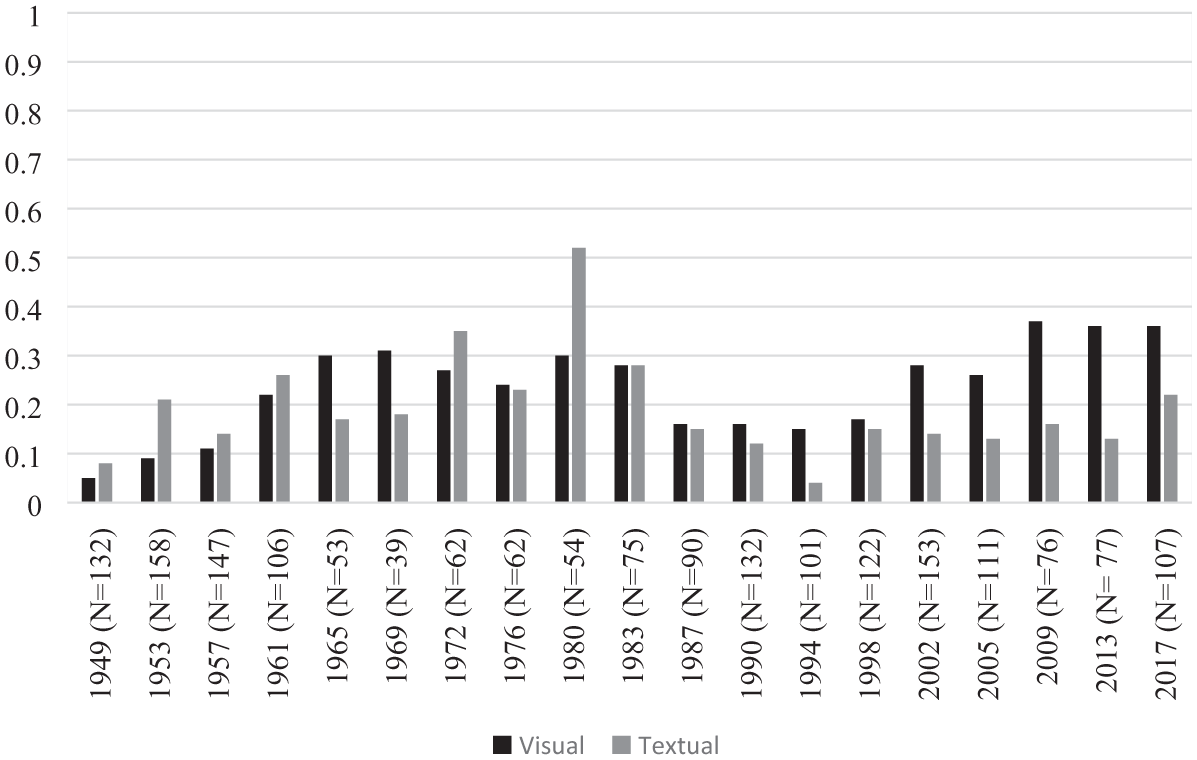
Levels of personalisation in the course of time.
Predicting strategies of professionalised political communication.
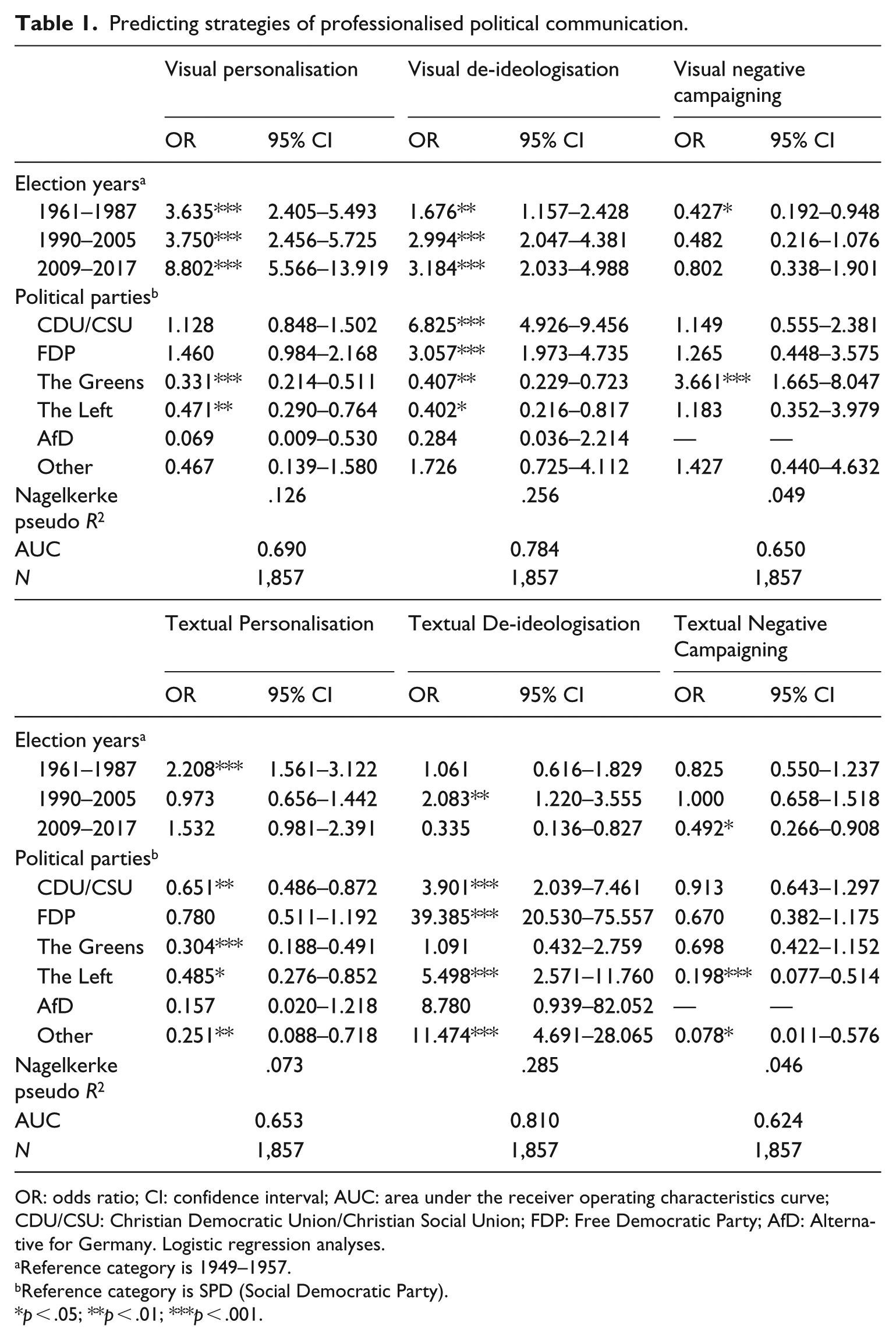
OR: odds ratio; CI: confidence interval; AUC: area under the receiver operating characteristics curve; CDU/CSU: Christian Democratic Union/Christian Social Union; FDP: Free Democratic Party; AfD: Alternative for Germany. Logistic regression analyses.
Reference category is 1949–1957.
Reference category is SPD (Social Democratic Party).
p < .05; **p < .01; ***p < .001.
Hypothesis 1b deals with the increasing textual personalisation in the course of time. As shown in Figure 1, the mentioning of the leaders’ names was especially present in the second phase of political campaigning. This can be explained by the fact that especially the election campaign in 1980 was characterised by a strong focus on the two chancellor candidates. On one hand, the popularity of the incumbent Helmut Schmidt (SPD) by far exceeded the popularity of his party. On the other hand, his challenger Franz Josef Strauß (CDU/CSU) was seen as a very controversial and divisive candidate. This led to a highly polarised election campaign between the two candidates. However, textual personalisation did not seem to increase in the later phases compared with the first phase. This observation is further supported by the results of the logistic regression analysis. Although the odds of mentioning the leaders’ name on campaign posters is 2.208 times higher for the second phase of political campaigning than for the first phase, the mentioning of the leaders’ name did not increase significantly in the third and the fourth phase.
Consequently, the results do not support Hypothesis 1b. Furthermore, the regression analysis also shows systematic variations across parties: compared to the SPD, the CDU/CSU had 34.9% lower odds of mentioning the name of political leaders. In addition, we found that The Left had 51.5% lower odds of mentioning their leaders’ names and Others had 74.9% lower odds than the SPD. The logistic regression model also indicates that Alliance 90/The Greens had 69.6% lower odds of mentioning the name of political leaders compared to the SPD. The latter is likely to be related to the approach of grassroots democracy in the party’s early days.
Overall, our findings suggest an increase in the visual personalisation, while the level of textual personalisation remains low. This indicates that political parties assume their leaders to be widely known among the electorate so an image is sufficient to recognise them.
Our second set of hypotheses proposes a decreasing visual ideologisation (H2a) as well as textual ideologisation (H2b) on campaign posters in the course of time. As demonstrated by Figure 2, ideological symbols were widely used throughout all phases of political campaigning. During the first phase, symbols such as hammer and sickle or red stars were used occasionally, whereas a high level of visual ideologisation occurred in the second phase. This can be traced back to the tremendous use of the German national flag, not only by the conservative CDU/CSU but also by the Social Democrats, especially during the Bundestag election campaigns in 1976 and 1980. Since 2002, the campaign posters of several political parties have shown an extensive use of the national flag again. This surprising observation is supported by Table 1: the odds of using ideological symbols on Bundestag election campaign posters was 1.676 times higher for the second phase of political campaigning compared to the first phase. In the third phase, the odds of using ideological symbols was 2.994 times higher than for the first phase. Finally, the odds of using ideological symbols was 3.184 times higher in the fourth phase compared to the first phase of political campaigning. Overall, we did not detect a decreasing ideologisation and thus, Hypothesis 2a was not supported. Moreover, we also found systematic differences across parties: the odds of using ideological symbols was 6.825 times higher for the CDU/CSU than for the SPD. This is due to the fact that the CDU/CSU often used national symbols as well as negatively connoted communist symbols. The FDP had 3.057 times higher odds of using ideological symbols compared to the SPD. As compared to the SPD, Alliance 90/The Greens had 59.3% lower odds of using ideological symbols, and The Left had 59.8% lower odds of using ideological symbols.
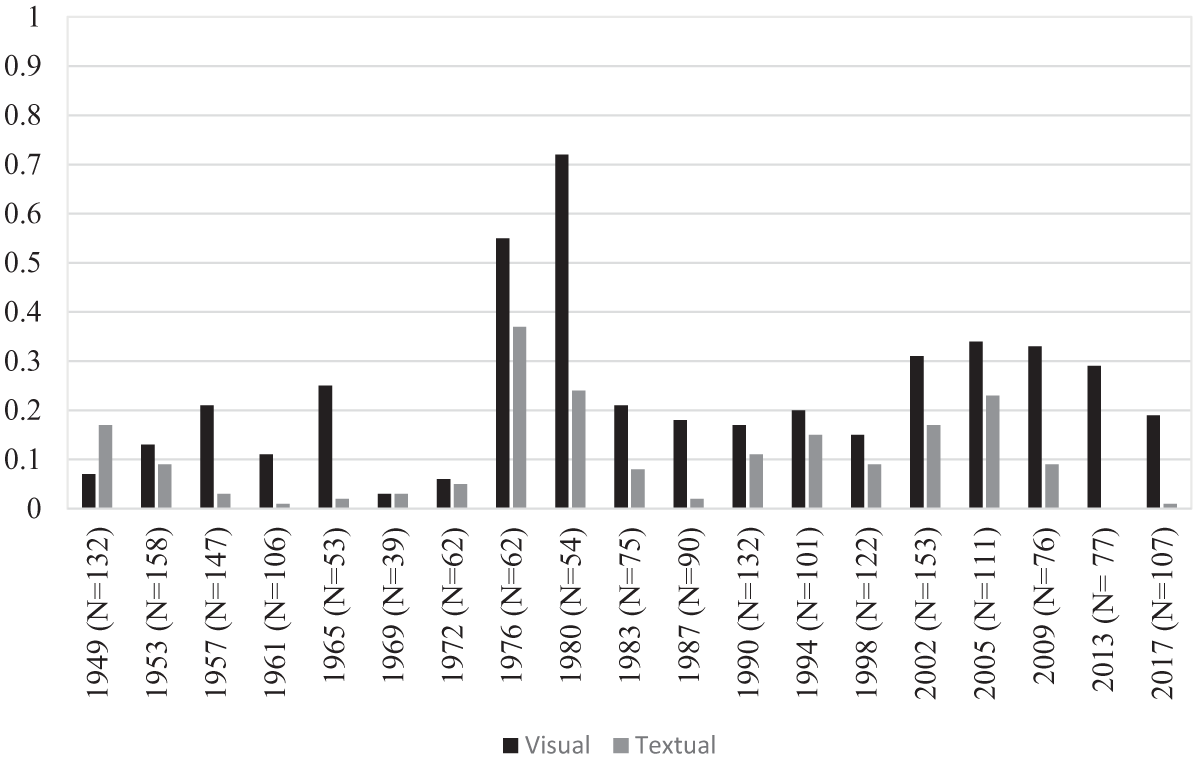
Levels of ideologisation in the course of time.
Similar to the visual level, campaign posters for the Bundestag elections in 1976 and 1980 displayed an outstanding ideologisation on the textual level (Figure 2). This result may be explained by the fact that in the second phase, especially the CDU/CSU used several slogans with explicit ideological references such as Freiheit oder Sozialismus (Freedom or Socialism) or Sozialismus stoppen (Stop Socialism) to stoke fears of an allegedly socialist menace by the SPD. As seen in Table 1, we found no empirical evidence of a decrease in textual ideologisation. Interestingly, the odds of mentioning political ideologies on campaign posters was in fact 2.083 times higher for the third phase than for the first phase. Thus, Hypothesis 2b was not supported. The logistic regression analysis also indicated systematic variations across parties. The most striking finding was that the FDP had a 39.385 times higher odds of mentioning political ideologies compared to the SPD. This can be explained by the enormous use of the label Die Liberalen (The Liberals) on the FDP’s campaign posters (see coding illustrations). The CDU/CSU had a 3.901 times higher odds of mentioning political ideologies than the SPD, while The Left had a 5.498 times higher odds of mentioning political ideologies compared to the SPD. Finally, other parties mentioned political ideologies significantly more than the SPD did. This result may be explained by the fact that with the Godesberger Programm (Godesberg Programme) in 1959 the SPD dissociated from Marxism and transformed into a catch-all party. Consequently, the party tried to avoid ideological references.
Our final set of hypotheses posits an increase of visual negative campaigning (H3a) and textual negative campaigning (H3b) on campaign posters in the course of time. According to Figure 3, visual negative campaigning only played a minor role on campaign posters across the different phases. Obviously, the use of this strategy varied with regard to the respective election. The Bundestag election campaign in 2013, for example, was characterised by several attacks on Chancellor Angela Merkel by the opposition parties SPD and Alliance 90/The Greens. During the latest election campaign in 2017, no visual attacks were used at all, while textual ones were used only scarcely. It is rather unexpected that the AfD did not directly attack the established parties. However, the right-wing party primarily concentrated on attacks against minorities such as Muslims or refugees.
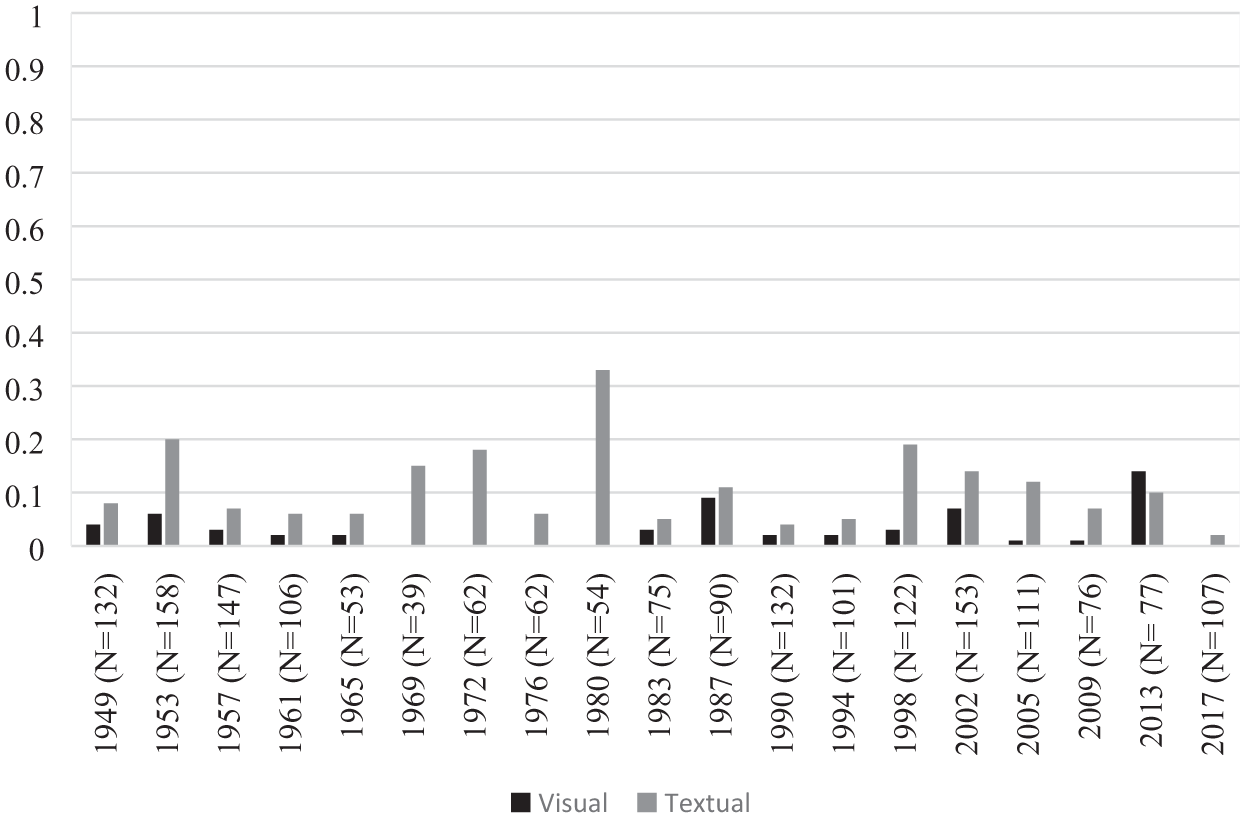
Levels of negative campaigning in the course of time.
In the same vein, the results of the logistic regression show no clear trend of an increasing visual negative campaigning on Bundestag campaign posters (Table 1). Therefore, Hypothesis 3a is not supported. Compared to the SPD, only Alliance 90/The Greens attacked their political opponents significantly more often on a visual level.
As stated with regard to the visual level, textual negative campaigning played a minor role in Bundestag election campaigns as well. No long-term trends could be detected but differences regarding the respective election year. In contrast to the other elections, campaign posters for the Bundestag election in 1980 showed a relatively high level of textual negative campaigning due to the various attacks on CDU/CSU’s candidate Franz Josef Strauß by the SPD as well as by the FDP. The logistic regression model in Table 1 also indicates that a significant increase of textual negative campaigning on posters in the course of time could not be found. Thus, Hypothesis 3b is not supported. For political parties, however, we found systematic differences: The Left and also Others had a lower odds of mentioning political opponents on campaign posters than the SPD.
Discussion
The purpose of the present study was to investigate the over-time development of personalisation, de-ideologisation and negative campaigning by analysing campaign posters for German Bundestag election campaigns from 1949 to 2017. The findings show an increasing visual personalisation as well as an increasing visual ideologisation across the phases of political campaigning, but the level of negativity varies from one election to the other without any clear trend. Furthermore, we found no evidence for an increasing textual personalisation and textual de-ideologisation. Taken together, these results strengthen the idea to distinguish between visual and textual elements of campaign posters (Vliegenthart, 2012).
In terms of personalisation, our findings are in line with previous research that states an increasing visual personalisation in parties’ own communication channels such as campaign posters (Vliegenthart, 2012), newspaper advertisements (Balmas et al., 2014) and social media (Filimonov et al., 2016). This result suggests that German political parties extensively use this strategy of professionalised political communication on campaign posters, although only a minority of the electorate can vote for political leaders as their local candidates. Despite the wide use of visual personalisation on campaign posters, one should consider that the levels of personalisation might differ across parties’ own communication channels and also tend to be even higher in newspaper articles and television coverage (Holtz-Bacha et al., 2014; Reinemann and Wilke, 2007; Schulz and Zeh, 2005).
The most striking result of our study is the high level of visual ideologisation. Our finding is contrary to previous studies that have suggested a decreasing ideologisation on campaign posters (Vliegenthart, 2012). Although the levels of visual ideologisation slightly decreased in 2017, it remains an important strategy of German Bundestag election campaigns. Hence, future research has to examine whether the ongoing rise of right-wing populism with a re-nationalisation of politics might cause an even stronger ideologisation. Obviously, the decreasing relevance of ideological cleavages and the growing influence of external consultants do not inevitably lead to de-ideologised political communication. In contrast to the established theoretical assumptions, campaign specialists use ideological references as a strategy of professionalised political communication.
Furthermore, the longitudinal analysis shows neither a clear upwards nor downwards trend regarding negative campaigning but overall low levels of negativity on campaign posters. This finding supports previous research on European election campaigns revealing low or decreasing levels of negativity (Hayek, 2016; Johansson, 2014; Vliegenthart, 2012). This may be explained by the fact that these countries have multiparty systems in contrast to the United States’s two-party system. Political parties are forced to form coalition governments and are thus less likely to attack potential coalition partners. In addition, differences within parties’ own communication channels and across controlled tools and media coverage have to be considered (Elmelund-Præstekær and Mølgaard-Svensson, 2014; Walter and Vliegenthart, 2010). Similar to personalisation in Germany, the level of negativity tends to be higher in newspaper campaign coverage (Reinemann and Wilke, 2007) compared to campaign posters.
All in all, political campaigns in Germany can be seen as professionalised, especially in terms of high levels of personalisation, although negative campaigning is used to a much lesser extent than in U.S. campaigns. The theoretical assumptions regarding de-ideologisation as a strategy of professionalised political communication have to be reconsidered. Based on our findings for political campaigning in a multiparty democracy, more longitudinal analyses in a comparative perspective are needed to systematically assess whether the German case is outstanding or typical. The first attempts of comparisons presented above indicate differences both across communication channels and countries. Due to the fact that our study is limited to a single country and a single medium, these differences have to be addressed by further analyses considering multiple communication channels and different media and political environments. Moreover, the integration of qualitative techniques offers further valuable insights into political parties’ use of strategies of professionalised political communication. Qualitative analyses might identify more implicit uses of negative campaigning such as humour and satire. While right-wing populist parties make use of stereotypes of ethnic or religious minorities, these attacks can be hardly identified by a quantitative analysis of negative campaigning and ideologisation. Qualitative techniques, for instance, allow to distinguish between positive representations of the multicultural society referred to as La deutsche Vita (The German Lifestyle) by Alliance 90/The Greens in 2002 and threatening images of refugees on the AfD’s campaign posters for the 2017 Bundestag election.
The findings demonstrate that phase models are helpful to identify predominant patterns and systemise differences over time. Nevertheless, these developments are mostly not linear. Therefore, this study provides empirical evidence for the assumption that phase models describe different campaign types that are not necessarily limited to specific time periods. Time periods have to acknowledge the country-specific context, political events, and the circumstances of the respective elections. Various aspects have to be considered: the parties’ role (government vs. opposition and major vs. minor), the candidates’ characteristics (incumbent vs. challenger as well as popularity and prominence) and the closeness of the elections’ outcome.
More generally, our results indicate a visualisation of political communication. The discrepancies between the visual and the textual level this study and previous research have revealed for single media (Boomgaarden et al., 2016) indicate that the much needed comparisons of different communication channels have to take this differentiation into account as well. We assume that the visualisation will even intensify with the rise of social media campaigning. Furthermore, the growing relevance of social media in political campaigning leads to the emergence of newer forms of political communication such as online political posters (Lee and Campbell, 2016). Hence, future research has to consider both traditional and online campaigning tools. Especially, traditional campaign posters as well as online campaign posters have to be examined from a comparative perspective with respect to the strategies of professionalised political communication on a visual and textual level.
Footnotes
Appendix
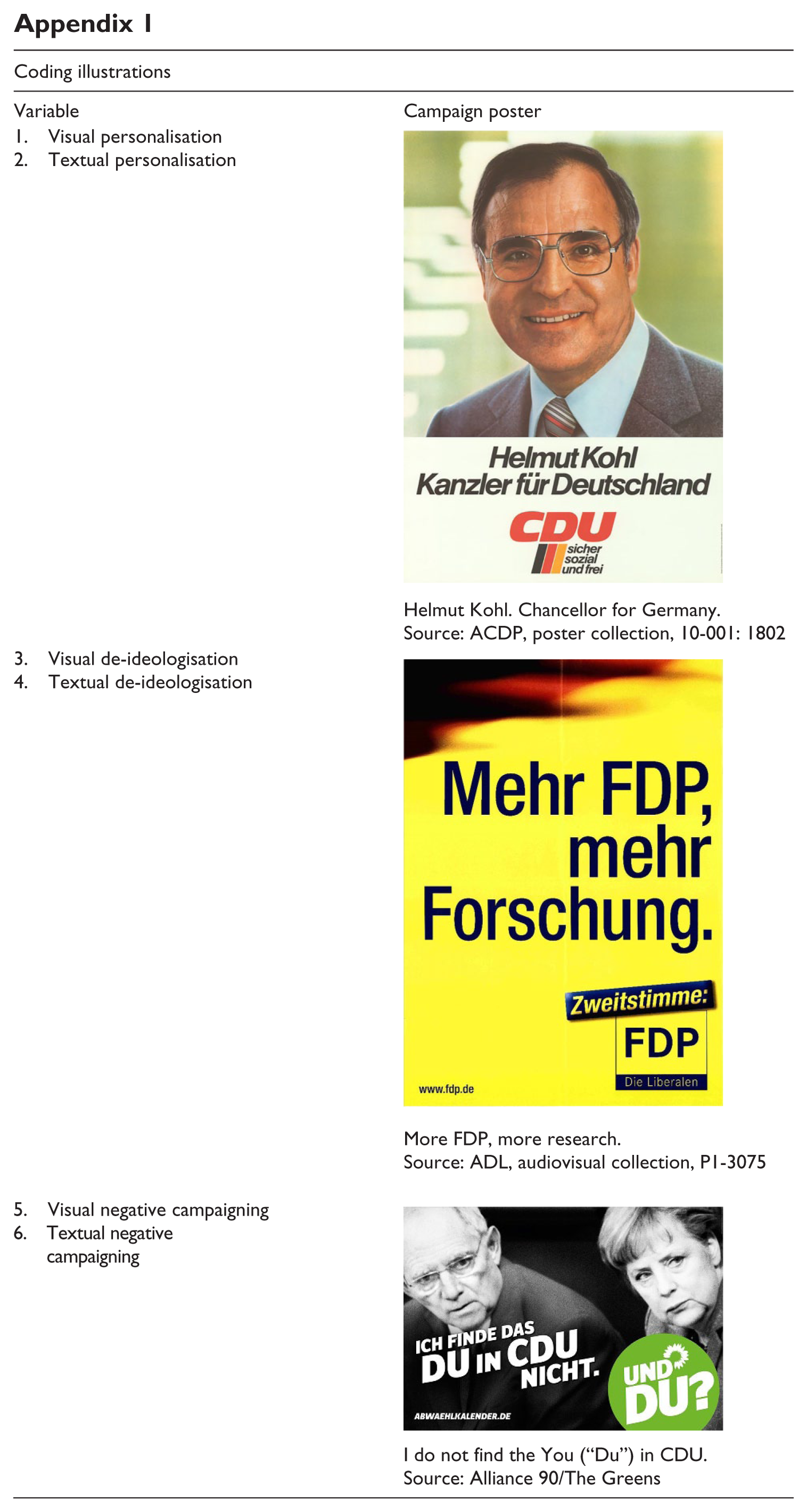
| Coding illustrations | |
|---|---|
| Variable | Campaign poster |
| 1. Visual personalisation 2. Textual personalisation |
Helmut Kohl. Chancellor for Germany. Source: ACDP, poster collection, 10-001: 1802 |
| 3. Visual de-ideologisation 4. Textual de-ideologisation |
More FDP, more research. Source: ADL, audiovisual collection, P1-3075 |
| 5. Visual negative campaigning 6. Textual negative campaigning |
I do not find the You (“Du”) in CDU. Source: Alliance 90/The Greens |
Declaration of Conflicting Interests
The author(s) declared no potential conflicts of interest with respect to the research, authorship, and/or publication of this article.
Funding
The author(s) received no financial support for the research, authorship, and/or publication of this article.