



Abstract
Timely evaluation of services is a missing link in many Zimbabwean public sector organisations, resulting in poor quality service provision. Guided by the gap analysis model theoretical framework, this study reviewed the quality of services provided by National Archives of Zimbabwe (NAZ) using the SERVQUAL instrument, with a view to making recommendations for enhancing continuous quality improvement. NAZ was confronted with challenges characterised by poor service quality, underutilisation of archival holdings, and a low socio-economic impact on Zimbabwean communities. The study adopted a mixed methods research approach to address the research problem. Data were collected through a SERVQUAL-type questionnaire, semi-structured interviews, and document analysis. Quantitative data were analysed using Microsoft Excel 2016 and descriptive statistics, while qualitative data were thematically analysed using Atlas.ti 24. The study's findings revealed that the overall quality of NAZ's services fell into the poor category, indicated by a negative service quality gap score of minus one (−1). NAZ's efforts to deliver quality services were undermined by shortcomings in tangibles, responsiveness, assurance, and empathy service quality dimensions, a weak policy and standards framework, inadequate budget allocation, demotivated staff, and insufficient technical skills among personnel. Therefore, there is a need for NAZ to be fully equipped to regularly review and improve the quality of its services to remain relevant and to foster increased utilisation of its holdings.
Keywords
Introduction
The idiom “the proof of the pudding is in the eating” implies that the real value of something can be judged only after being evaluated or tested. This is applicable to archival services which require to be assessed based on the stakeholder's perception and satisfaction. Measuring service quality contributes significantly to improved organisational performance (Manani et al., 2013). Given its centrality to the survival of institutions, the evaluation of service quality needs to be robust and thorough. Consequently, this study reviewed the quality of all services offered by the National Archives of Zimbabwe (NAZ), in a holistic manner. The approach incorporated service quality assessments from both the service provider and clients, with the aim of establishing whether NAZ is fit for purpose. Archivists must now justify their existence by expanding their user base through offering quality services, as it is no longer sufficient to draw value solely from the safekeeping of old documents, photographs, and genealogical records (Mason, 2016). Meehan (2024) argues that archival institutions should move away from relying solely on statistical data such as the number of requests to prove their value to authorities but should demonstrate their societal impact through the delivery of quality services. Providing high-quality services offers a promising avenue to challenge the negative perceptions often associated with archival institutions, address their low public profile, and promote the utilisation of archival holdings.
The exponential growth of technology and the ongoing economic crisis have shaped a new generation of service users who are well-informed, educated, and equipped with greater choice, constantly evolving behaviours, complex needs, and high expectations (Gathoni and van der Walt, 2019). As Aletaiby (2018) argues, in today's business environment, neglecting service quality results in increased costs, client attrition, and organisational failure. Thus, delivering excellent service quality that fosters customer satisfaction has emerged as a critical driver of business success, performance, sustainability, competitiveness, differentiation, and survival in a globalised and increasingly sophisticated world (Ganiyu, 2016).
In archival institutions, the need to measure, manage, and deliver quality service is even more pressing, considering the growing competition from the Information Technology (IT) sector, which risks side-lining the archival role (Garaba, 2015). Sturzlinger (2013) notes that the role of archival institutions is shifting from that of mere record administrators to service providers. This evolution underscores the necessity of gathering and analysing user feedback, understanding client expectations, and delivering quality services. Evaluating service quality enables archival institutions to strike a balance between preserving material holdings and serving the users who access them (Chaterera, 2015). As Saurombe (2016) highlights, it is essential that users encounter both the service and the archival materials at a standard that reflects institutional pride and professionalism. Accordingly, studies such as this one reviewing the quality of services at NAZ are not only worthwhile but critical. They hold the potential to improve service delivery, increase visibility and recognition, and enhance the relevance of archival institutions in the public domain.
Background to the study
The establishment of colonial rule in Zimbabwe in 1890 by the British South Africa Company, set the stage for the transformation of record-keeping practices from primarily oral traditions to document forms (Matangira, 2016). NAZ is the sole public institution mandated by the National Archives Act Chapter 25:06 of 1986 to acquire, preserve, and provide access to Zimbabwean documentation in any format, in an efficient and cost-effective manner. The mandate and core services of NAZ are delivered through four major sections: records management, public archives and research, library, and technical services.
According to Sections 6 and 7 of the National Archives Act Chapter 25:06, the NAZ records management section is responsible for monitoring and advising public institutions on the professional creation of records, filing, utilisation, storage, preservation, and disposal of records. The public archives and research section is in charge of acquiring and preserving central government records of historical significance older than 25 years, as well as local government archives, which include historical manuscripts (NAZ, 2016). On the other hand, the library section is in charge of acquiring and processing all published materials, including government publications, statutory instruments, parliamentary debates, and newspapers, as well as making them available to researchers (NAZ, 2016). Furthermore, the section is in charge of issuing International Standard Book Numbers (ISBNs), compiling the Zimbabwe National Bibliography (ZNB), and preserving and providing access to the photographic collection.
The technical services are another important aspect of NAZ's services. These include the reprographic, conservation, oral history, audio-visual, and information communication technology (ICT) units. The reprographic unit handles photographic enlargement prints, photocopying and scanning, negative processing, and microfilming. The conservation unit aids preservation efforts by restoring physically and chemically damaged archival materials to usable condition. The oral history unit's responsibility is to collect and preserve oral interviews from a diverse range of people. The audio-visual unit manages and provides access to films, videos, audio cassettes, compact diskettes, gramophone records, and slides about Zimbabwe. The ICT unit is responsible for creating an automated work environment for NAZ, as well as providing user support to help NAZ fulfil its mandate (NAZ, 2016).
In this study, the term services refer to the activities of the archival institution in ensuring the proper management of public records, archives, and library materials, promoting the preservation and accessibility of archival heritage, and overseeing the national archival system (Akotia, 2003). Quality service in archives involves delivering archival services that are effective, dependable, and focused on user needs, consistently meeting or surpassing user expectations (Chepukaka and Kirugi, 2019). It includes key aspects such as security, integrity, usability, reliability, responsiveness, assurance, empathy, and the physical accessibility and presentation of archival resources and services. (Chepukaka and Kirugi, 2019). However, the study of service quality in public sector organisations has received relatively little attention in comparison to the amount of work done in the private sector (Benjamin, 2012). It should be noted that service quality in most public sector organisations is, to say the least, subpar (Benjamin, 2012). This is supported by Aletaiby (2018), who observes that there is extensive evidence of total quality management (TQM) implementation in developed countries, but limited adoption in developing countries. There is also a scarcity of research on service quality in archival institutions in developing countries and the East and Southern Africa Regional Branch of the International Council on Archives (ESARBICA) (Sibanda, 2011). Mushunje (2020), as well as Nengomasha and Nyanga (2015), observe that there is a growing concern about the underutilisation of archival services in Sub-Saharan Africa and the ESARBICA region.
As of 2024, NAZ has two archival centres in Bulawayo and Harare, as well as six records centres in Harare, Bulawayo, Gweru, Masvingo, Mutare, and Chinhoyi. Despite these developments, Mutsagondo (2021) observes a decline in the key service deliverables of NAZ in post-colonial Zimbabwe. According to Bhebhe et al. (2013), the records centres in Masvingo, Chinhoyi, Gweru, and Mutare lack purpose-built structures, shelving equipment, and preservation facilities. Harare and Bulawayo archival centres also have malfunctioning air conditioning systems and dust suckers, which turn repositories into ovens (Murambiwa and Ngulube, 2011). Zimbabwe's ICT-based records management projects are carried out in a piecemeal, interim, and hit-and-miss manner (Chikomba, 2018; Mutsagondo, 2017; Tsvuura and Ngulube, 2020). Scholars such as Chaterera (2016) and Chikomba et al. (2020) concur that managing digital records in Zimbabwe presents significant challenges.
NAZ also lacks a sound legal framework, policies, guidelines, and standards, as well as the necessary infrastructure, financial resources, and technically competent personnel to support the delivery of quality services (Masuku and Ngulube, 2019). Mutsagondo (2021, p. 15) puts it more bluntly: “The NAZ Act is rather too archaic to deal with records in electronic form, including email”. Chikomba (2018) also claims that NAZ has never had a records management policy since its inception in 1935, which has hampered records management in public sector institutions over time. This leaves NAZ heavily reliant on the NAZ Act Chapter 25:06 of 1986 and the Printed Publications Act 25:14 of 1975 to carry out its functions (Mutsagondo, 2021). Mutsagondo and Tsvuura (2017) described the NAZ Act as in shambles in terms of digital record management. As a result, NAZ is not visible enough when it comes to providing digital records management services (Bhebhe, 2015).
NAZ also faces the challenge of having a skilled workforce as well as adequate resources and infrastructure to provide quality services. According to Bishi and Rodrigues (2021), the current crop of archivists at NAZ struggles to effectively use available resources to improve service delivery due to insufficient training. This is due to the institution's significant staff turnover caused by poor staff retention strategies (Bishi and Muchefa, 2022). Bishi and Muchefa (2022) add that NAZ's efforts to provide quality services are hampered by insufficient funding and the deterioration of purpose-built infrastructure. The situation supports the findings of Venson et al. (2014) and Mukwevho (2017), who state that public archival institutions in the ESARBICA region have failed to persuade the public of the value of their services.
While it is well known that archives are preserved in order to be accessible, NAZ is also struggling to provide ‘quality’ access to its collection. Bishi and Rodrigues (2021) note that the finding aids at NAZ were still manual and not automated. These scholars add that the database link on the institution's website only provides an overview of the collection via the KOHA software. This is supported by Ngulube et al. (2013) who argue that the finding aids on the NAZ website only direct users to a list of services that are not linked to any database. NAZ, like most African archival repositories, is plagued by perennial backlog issues that prevent users from accessing materials that have passed their closure dates (Moyo, 2012; Muchefa and Chigodora, 2016). NAZ is also closed on weekends, preventing many working-class people from accessing its archival holdings.
Problem statement
Quality service delivery in Zimbabwe's government is marked by challenges and problems. More specifically, Mushunje (2020) observes that timely evaluation of services is a missing link in many Zimbabwean public sector organisations, including NAZ, resulting in poor quality service provision. As a result, despite the significance of NAZ's services to central government ministries, departments, local governments, statutory bodies, the public, researchers, journalists, publishers, and genealogists, among others, the institution's services are underutilised (Murambiwa and Ngulube, 2011). NAZ is failing to make a visible socioeconomic impact in society, despite its status as the sole custodian of the nation's official documentary heritage (Bishi and Muchefa, 2022). It is clear that the quality of NAZ services requires a thorough examination. While NAZ may have some internal perspectives for quality service delivery in place, it appears that the quality of its services is hampered by a lack of attention to the user's perspective (Chaterera, 2017). This violates the principles of providing quality services. According to Ncwane (2016), service quality is determined by what customers expect and how well the institution performs in providing that service. Murambiwa and Ngulube (2011) observe that NAZ lacks a tool to assist archivists in collecting meaningful and usable data on how far they have come in bringing archives to the people. According to Gebremichael and Singh (2019), service quality issues are more likely to occur in organisations that do not focus on identifying and responding to customer needs and expectations. As a result, NAZ's chances of retaining its existing clients are threatened, and its position as an information resource centre is compromised.
Purpose and objectives of the study
The general purpose of this study was to review the quality of the services of NAZ with a view to make recommendations for sustainable and continuous improvement of the quality of services rendered. The specific research objectives were to:
Review the quality of the services offered by NAZ. Proffer recommendations to enhance quality service delivery.
Theoretical framework
This study adopted the gap analysis model with all its aspects (five gaps) as its theoretical framework. This model was propounded by the North American school of thought led by Parasuraman, Zeithaml, and Berry in 1985 (Wafula, 2019). According to this model, gap one / knowledge gap: is the difference between what management thinks the client wants and what the client actually wants. Gap two / policy gap: occurs when the service provider fails to set the expected customer service standards and policies due to lack of understanding of the customer needs. Gap three / delivery gap: is the difference between the service rendered and the requirements set in the organisation's service standards, policies, and procedures. Gap four / communication gap: is the difference between the organisation's stated service standard and the firm's external communication. Gap five / service gap: is also known as the customer gap, which shows the discrepancy between customer expectations and perceived services. It is from gap five that the SERVQUAL service evaluation instrument was developed (Virima et al., 2019). Gap five depends on the size and direction of the first four gaps associated with service providers during service quality delivery. When gap five arises, management should address the first four gaps to eliminate and avoid gap five (Ekinci, 2004). The SERVQUAL instrument uses the formula SQ = P-E, where SQ stands for service quality, P stands for perception of the actual service rendered, and E represents customer expectations to determine the service quality score. Zekele (2012) adds that, if service P is better than E, positive disconfirmation associated with quality service and customer satisfaction is realised, but if performance is below standard or expectation, negative disconfirmation associated with customer dissatisfaction happens. Gaps one to four represent the organisation's internal systems and processes. If there are more faults and weaknesses in internal systems and processes, the institution cannot deliver quality services or close gap five. Scholars like Khattab (2019), criticised this model for being generic and lacking consideration of the dynamic nature of the impacts of expectations, which continuously progress and change over time. There is also scepticism about the application of the model in the archival field. In response to the weaknesses, this research modified the SERVQUAL instrument by adding information security and information usability technical dimensions, to make it suitable for use in the archival field. Consequently, the SERVQUAL instrument used in this study has seven service quality dimensions and 28 service quality measuring questions or items.
Methodology
This study employed the mixed methods research methodology (MMR). This study's philosophical paradigm was pragmatism. This study used the convergent parallel design. Questionnaires, interviews, and document analysis were used as data collection tools to increase the reliability of the findings. The collected quantitative and qualitative data were given equal weight. The researcher analysed the two data sets separately and independently using standard quantitative procedures, such as Microsoft Excel 2016, as well as qualitative thematic analytic procedures with Atlas.ti 24. The data sets were combined during presentation and interpretation to improve understanding in response to the study's overall purpose. The study's population was used to generate a sample size of 103 units of analysis. These included one participant from the NAZ directorate (D1), four chief archivists (CA1-CA4), four archivists at Head Office (AHO1-AHO4), five archivists stationed at provincial centres (PA1-PA5), 23 Records Management Supervisors in central government ministries, a decision maker from a central government ministry (D2), a journalist (J1), a publisher (PUB1), 50 researchers, ten documents, and three NAZ online platforms chosen through purposeful sampling. J1 and PUB1 were included as a special category of respondents to give the study insights from NAZ's institutional clients who regularly use the audio-visual and library services respectively. Out of 90 invitations to participants and respondents, 67 responses were received. The researcher gained access to all ten documents targeted for analysis, as well as three online platforms. This resulted in an overall response rate for this study of 77.7%.
Results
This section presents the findings of the study. The presentation is in line with the objectives of this study.
Review of the quality of the services offered by NAZ
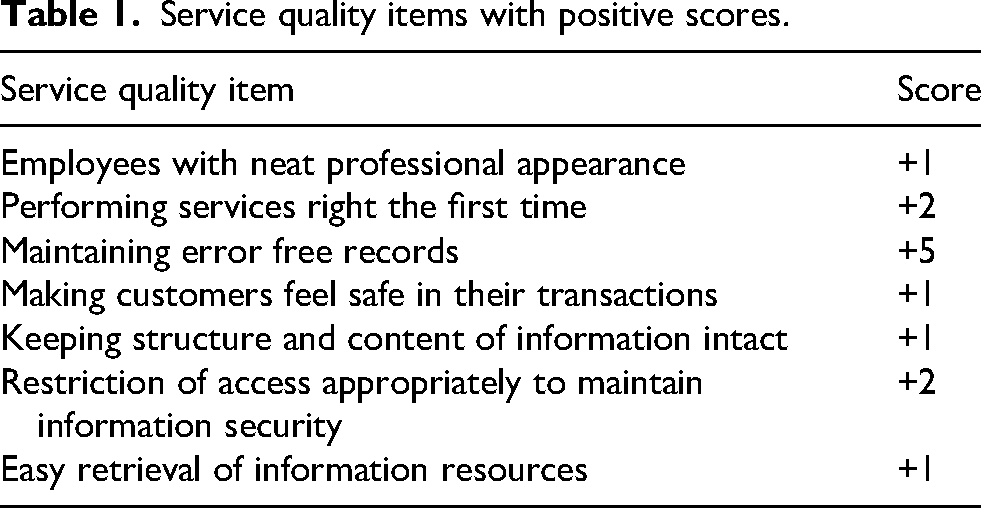
The quality of NAZ services was reviewed along the seven quality dimensions and 28 service quality items from the SERVQUAL instrument used in this study, as well as through interviews. The service quality gap scores for NAZ services were calculated using the formula SQ = P-E, where SQ stands for service quality, P stands for perception of the actual service rendered, and E represents customer expectations. The obtained results revealed that out of the 28 service quality items, seven (7) had positive service quality gap scores or positive disconfirmation scores. The areas where NAZ received positive disconfirmation scores are presented in Table 1.
Service quality items with positive scores.
This study also found that NAZ received a service quality score of zero (0) on eight (8) of the 28 service quality items. This means that NAZ's service performance is satisfactory across these eight quality criteria. The eight service quality items for which NAZ received a satisfactory zero service quality score were:
Dependability in handling customers’ service problems Provision of prompt services to clients Instilling confidence in customers Consistently courteous Dealing with customers in a caring manner Offering complete and unaltered information Freedom from danger, risk or doubt during a service performance Provision of information that is easy to interpret
However, NAZ received negative service quality or disconfirmation scores on 13 of the 28 service quality items. The areas where NAZ got negative quality service scores are presented in Table 2.
Service quality items with negative scores.
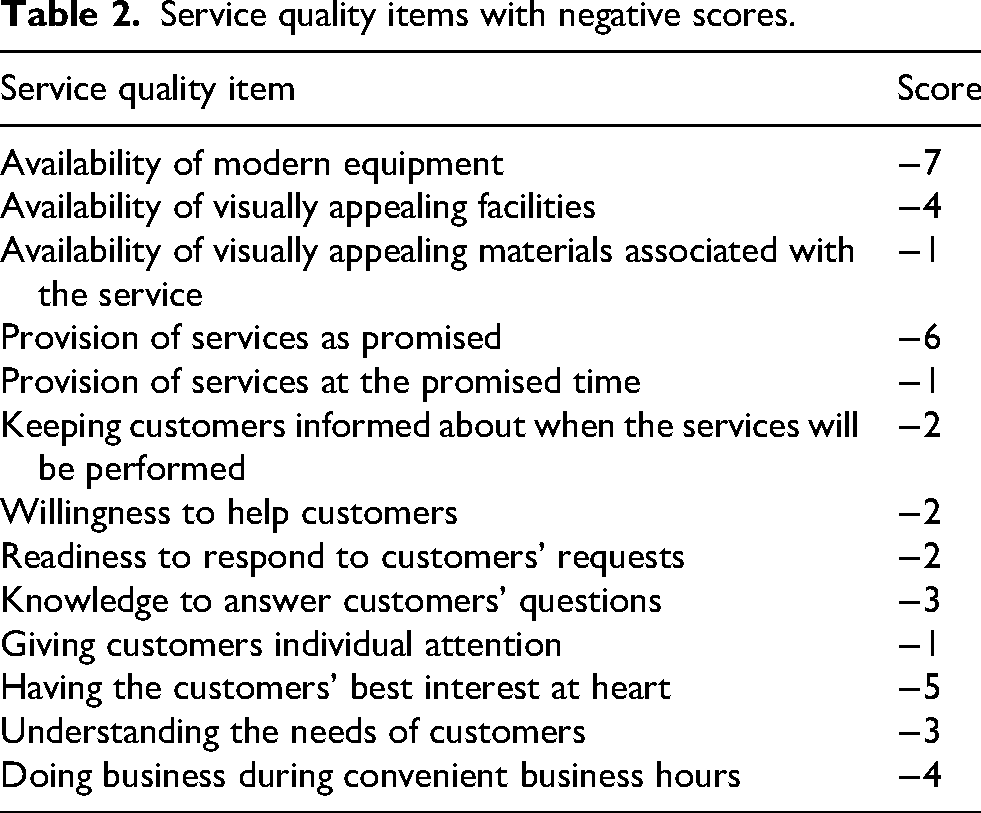
The service quality items with negative scores caused NAZ to obtain a negative one (−1) overall service quality score, indicating poor service quality. This overall result was obtained by calculating the mean of the scores of the 28 service quality items.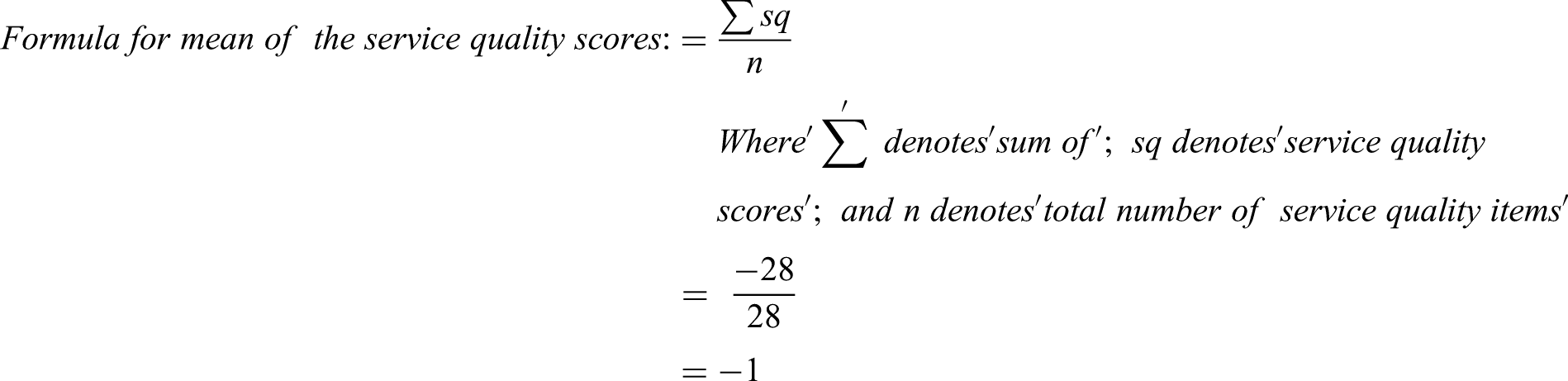
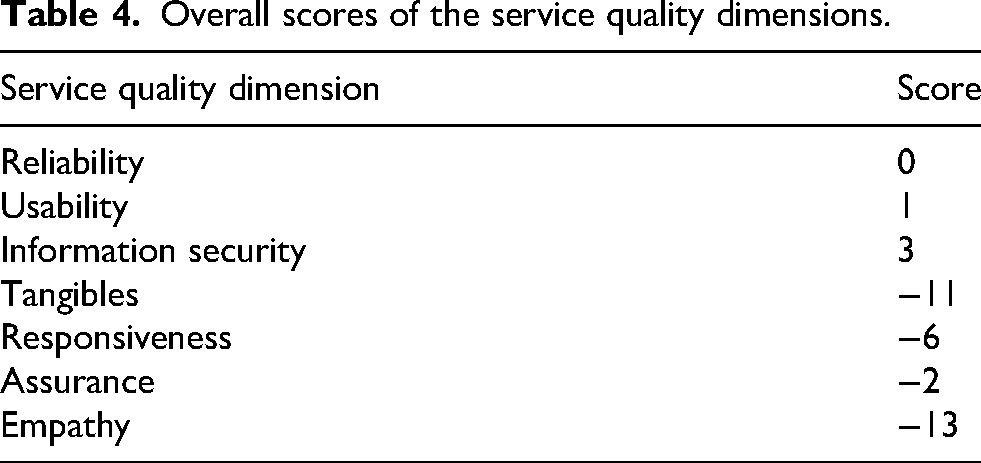
This result is confirmed when the overall score for each service quality dimension is considered. Three service quality dimensions obtained good quality scores and the other four received huge negative disconfirmation scores as illustrated in Table 3.
NAZ negative service quality gap scores.
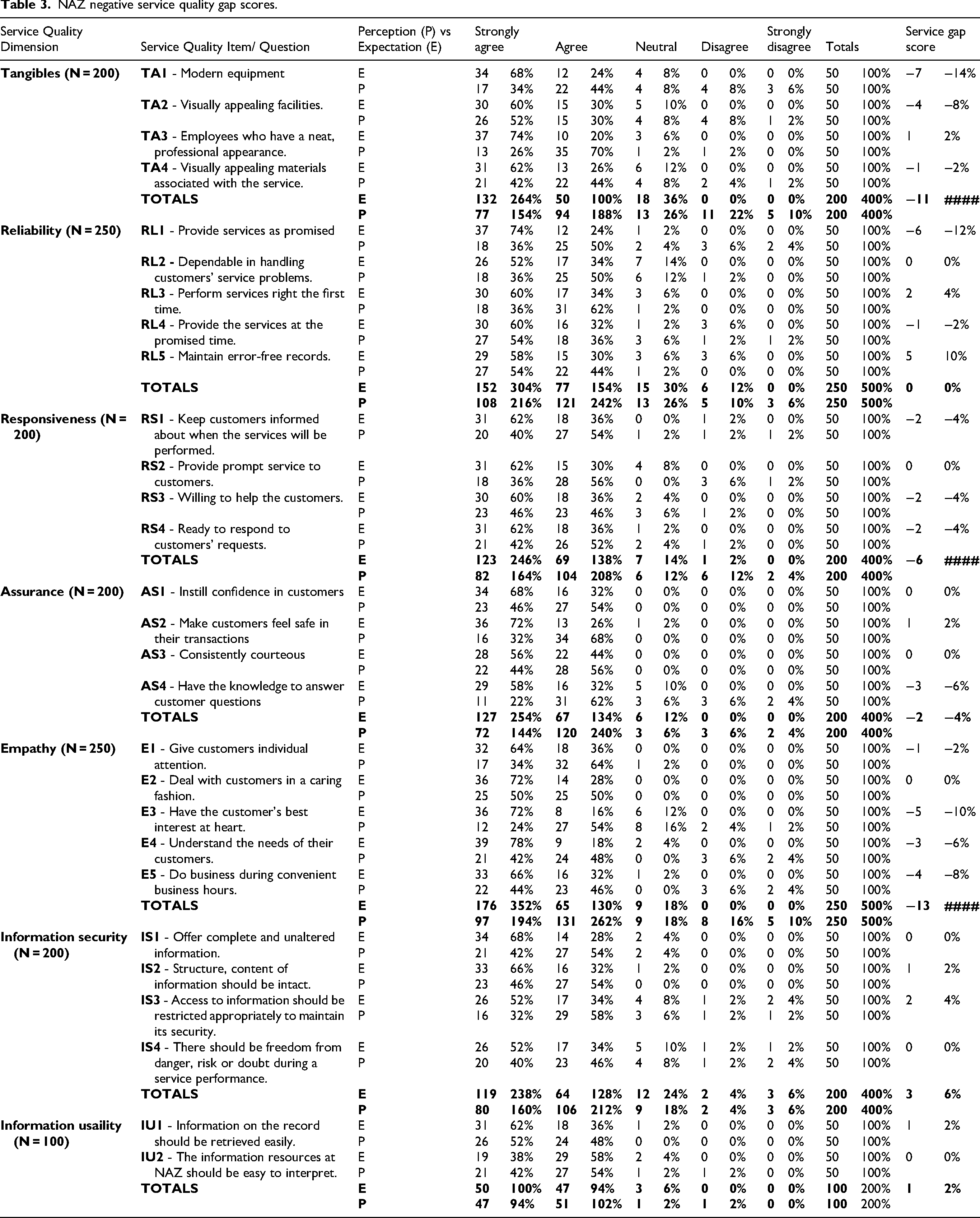
Table 4 illustrates how computation was done to produce the NAZ service quality gap scores.
Overall scores of the service quality dimensions.
The quantitative results were in agreement with the qualitative ones. Participants J1, PUB1, and PA5 confirmed service quality challenges, particularly in terms of tangibles. This finding was corroborated by responses from participants AHO1, AHO3, PA1, PA5, and D1, who agreed that the budget obtained by the head office is insufficient to cover the entire institution, including the provincial centres. The negative service quality scores may also be caused by ineffective communication channels and disengaged employees. This study found through document analysis that between November and December 2023, the number of followers on NAZ online platforms remained low, and their X platform was rarely updated with new postings. Respondents, particularly D1 and PA4, identified acute challenges such as power outages, insufficient technological resources, limited mobility resources to reach clients in remote areas, and manual finding aids as challenges that NAZ frontline staff faced in providing quality services.
The negative service quality gap scores under the responsiveness service quality dimension may also be due to frustration and demotivation of NAZ frontline staff. Elements of frustration and demotivation can be deduced from a response from participant PA5 who said, “Although the NAZ client service charter can help with some timelines and benchmarks for offering quality services, lack of adequate resources and demotivation of staff is making it difficult to adhere to the service quality parameters.
The results obtained, in which NAZ received negative disconfirmation scores for having customers’ best interests at heart and giving customers individual attention, indicate that there are issues with how NAZ reviews the quality of its services and the quality dimensions or benchmarks they use to make quality reviews. Participant CA1 explained that the institution receives few comments from clients, and some of them are simple one-word responses such as fair or good service. It is difficult to use such feedback to improve the services. CA1 also stated that there were few comments on NAZ's online platforms because the majority of NAZ's potential clients may not have access to them. Despite their small number, CA1 claimed that the majority of comments on online platforms were made by NAZ employees. In addition, qualitative responses from archivists stationed at provincial centres and at head office revealed a lack of uniformity in the way NAZ operates. PA2 said, “Most of the instruments, such as the comments book and specific online platforms dedicated to provincial centres, did not exist at the provincial stations.”
Despite the fact that all archivist participants agreed that NAZ uses its client service charter as a benchmark or standard for quality service delivery, as well as criteria to distinguish between good and poor services, NAZ received a poor service quality score of −13 in empathy. The archivists agreed that the strategy was far from holistic. This was summarised in the responses of PA4, who stated, There are no proper benchmarks or service quality dimensions used to evaluate the quality of services offered by NAZ. Tangibles aspects such as the appearance of the physical facilities, cleanliness, comfort of amenities, conditions of machinery and equipment are not factored in the benchmark parameters of the current client service charter. As an institution, NAZ has never used known service quality evaluation instruments like SERVQUAL, LIBQUAL, and SERVPERF to review the quality of its services. We do not open during weekends and public holidays, and I am sure there is a group of potential clients who are disadvantaged by that arrangement. Also, during the weekdays, we open to clients between 0800 h and 1600 h, and I also think there are some working-class clients likely to be disadvantaged.
Discussion
The obtaining of seven positive gap scores indicated that NAZ was providing good service quality in those areas. This is consistent with the gap analysis model theoretical framework used in this study, which states that a positive score is obtained when service performance exceeds clients’ expectations (P > E). This scenario is associated with high quality services and customer satisfaction (Chepukaka and Kirugi, 2019). Even though NAZ provides high-quality services and products, it should never fold hands. According to Mufudza (2018) and Seyoum (2017), customers’ expectations are dynamic as a result of rapidly changing industry conditions driven by ICTs, and thus they must be constantly monitored. Missing customer expectations wastes resources on things that are irrelevant to the clients, resulting in client loss to competitors (Zeithaml and Bitner, 2003). In the spirit of continuous improvement, NAZ should continue to review the quality of these seven high-quality performing items on a regular basis to ensure that they do not degrade into poor quality services.
On the eight service quality items where NAZ obtained a zero-gap score means that NAZ was providing satisfactory service quality across these items. According to Ekinci (1999), when performance equals expectation, resulting in a zero score, it indicates confirmation, which is associated with quality service and customer satisfaction. According to the researcher's interpretation, these are areas that should be marked for improvement in the short-term strategy. A small improvement in these areas can easily result in positive disconfirmation scores associated with high service quality and customer satisfaction.
According to strategic planning principles, the 13 service quality items with negative service quality gap scores are areas which NAZ should prioritise and direct its available resources and effort in order to save its threatened image and existence (Shaikh and Khan, 2011). The gap analysis model theoretical framework indicates a negative disconfirmation score when performance is less than expectation (P < E). This result indicates that NAZ provided poor quality services on these 13 service quality items. Parasuraman et al. (1994) state that if performance falls short of expectations, it results in negative disconfirmation and customer dissatisfaction.
NAZ shortcomings on tangibles confirm Bhebhe et al. (2013)'s observation that leakages, cracks, poor drainage system, difficulties with accessibility, and distance characterise NAZ buildings in smaller provinces. The finding is also consistent with Matangira's (2016) observation that the air conditioning system at the NAZ headquarters had been inoperable for more than 25 years. Furthermore, inadequate tangibles confirm Sibanda et al.'s (2021) observation that NAZ lacks ICT infrastructure to ingest digital records. NAZ's failure to have modern equipment and visually appealing facilities indicates that the organisation is not receiving adequate financial resources. This interpretation is consistent with Sigauke and Wutete (2022) who observe that adequate financial resources and infrastructure are necessary for providing quality and satisfactory archival services. According to Hoffman and Bateson (2016), the suitability of the physical environment for producing services and equipment that improves service performance is dependent on the availability of financial resources.
While inadequate funding is a convincing explanation for the lack of modern equipment and the availability of visually appealing materials associated with the service, NAZ should not intentionally turn a blind eye to the possibility of poor prioritisation and planning in terms of using the limited financial resources available to improve service quality. Mutsagondo (2022) supports this interpretation, stating that the government finds it difficult to provide adequate financial resources to archival institutions due to a lack of terms of reference.
Negative disconfirmation scores under the reliability service quality dimension can be explained in part by Saurombe (2016)'s observation of a lack of appropriate instruments to assess service delivery efficiency in the ESARBICA region, of which Zimbabwe is an active member. Twinomurwizi et al. (2012) argue that proper review or measurement of service quality is critical for business survival and improved overall service performance. These findings also confirm Mushunje's (2020) observations that timely evaluation of service quality is a missing link in many Zimbabwean organisations, affecting quality service provision. Murambiwa and Ngulube (2011) also point out that NAZ lacks a tool to help archivists collect meaningful and usable data on how far they have come in bringing archives to people. This scenario begets poor quality services. As put across by Lovelock (1996), what cannot be measured cannot be managed.
In terms of the gap analysis model theoretical framework, failure to review and deliver the promised services on time opens gap four, making it difficult for NAZ to achieve a positive confirmation score on gap five. According to the gap analysis model, this could mean that NAZ was communicating inflated service standards that it cannot meet. This frustrates and disappoints clients, who will perceive the overall quality of the organisation's services as poor. According to Nyundo (2013), client frustration is linked to the spread of negative word of mouth, institutions’ failure to broaden their clientele base by attracting new clients while retaining existing ones, and overall underutilisation of archival services.
Since service quality dimensions such as responsiveness, assurance, and empathy are human centered, failing to provide staff with adequate skills and motivation results in significant service quality gaps, as evidenced by negative disconfirmation scores that represent poor service quality (Mufudza, 2018). The existence of negative disconfirmation scores on responsiveness, assurance, and empathy as a possible explanation for frustration and demotivation is further supported by Ngoepe and Keakopa (2011), who argue that knowledgeable, high-performing, and well-motivated staff with clear opportunities for advancement are a pillar that can enable national archival institutions to deliver their mandate efficiently and effectively.
The lack of consistency in how an institution conducts business creates service gaps, particularly in the empathy service quality dimension, resulting in the delivery of poor services. As stated by Costa et al. (2004), empathy is a key source of exciting moments and interfaces between employees of an organisation and customers, resulting in increased total service quality perceptions. NAZ received a negative disconfirmation score of −13 under the empathy service quality dimension, implying that it is currently impossible for NAZ to satisfy its clients with high quality services. If user studies are conducted properly archival institutions will be able to develop service packages and flexible business working hours that are convenient for all segments of clients, thereby increasing the use of archival services (Chaterera, 2017). The findings of this study are in agreement with Murambiwa and Ngulube (2011), who note that NAZ was closing on weekends, thus excluding many working-class people from accessing its archival holdings.
Unless these service gaps are closed, especially on tangibles, responsiveness, assurance, and empathy service quality dimensions, NAZ will never be able to provide quality services that meet or exceed their customers’ needs and expectations. Although an overall negative one (−1) service quality score is undesirable because it indicates poor quality services, this researcher believes that the situation NAZ is in is redeemable. According to the researchers, the mathematical gap between negative (−1) and zero (0) is not very large, and a focused concerted effort on major service quality items with high negative disconfirmation scores can easily result in NAZ receiving a zero score, indicating satisfactory services. Another concerted effort on such quality items with negative scores may eventually allow NAZ to achieve a positive disconfirmation score, indicating good to excellent quality services.
Recommendations to enhance quality service delivery
Data analysis using the Artificial Intelligence Summaries (A1) functionality of Atlas.ti 24 picked several recommendations that were proffered by the participants in this study. The recommendations are visually illustrated in an ad-hoc Atlas.ti 24 generated network on Figure 1.
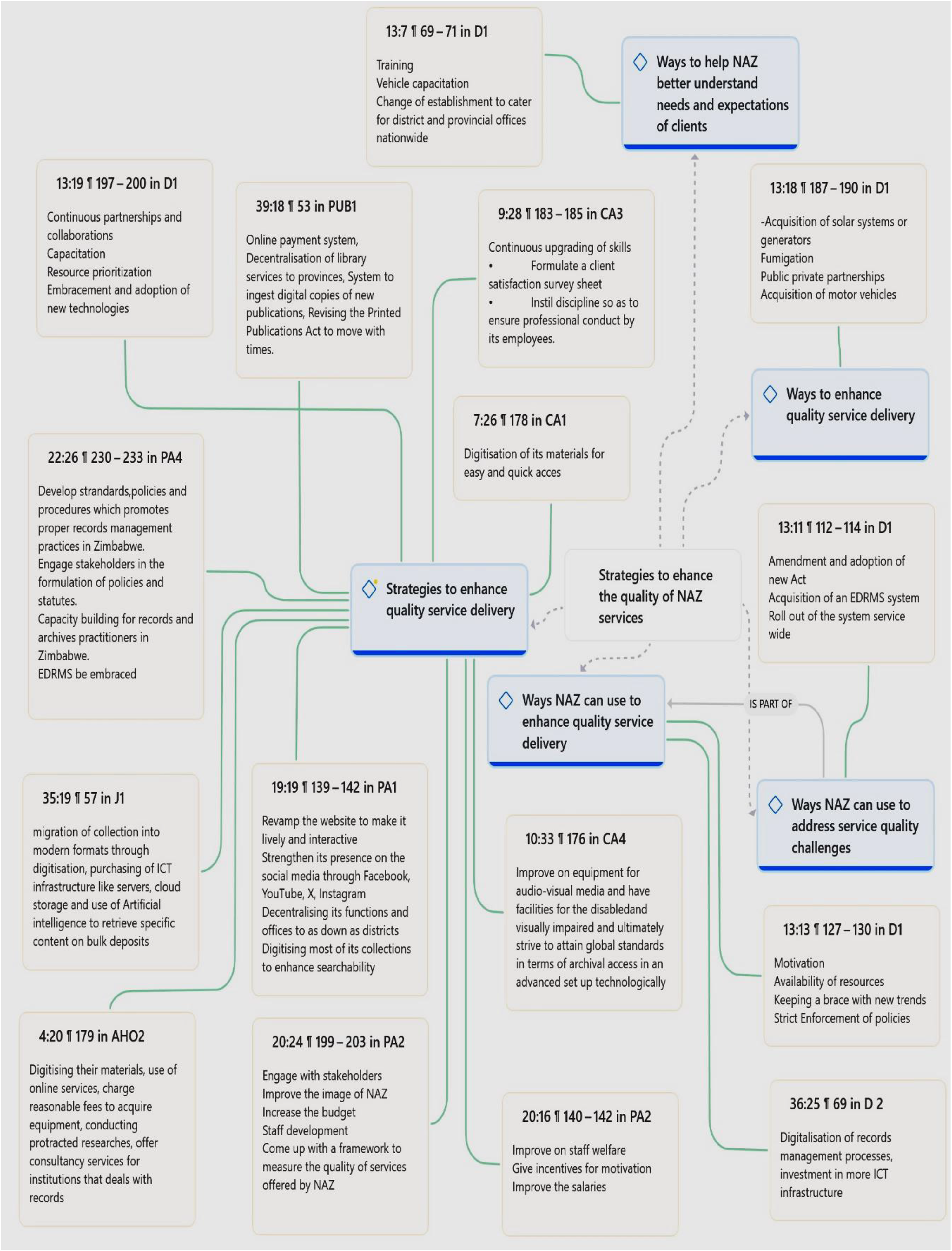
Recommendations to enhance the quality of NAZ services [source: field data 2023].
To improve the delivery of quality services, this study as informed by the findings made the following recommendations:
Regular evaluation of service quality - Evaluating service quality reveals gaps that assist managers in developing effective strategies to boost service quality by closing such gaps. It is also invaluable to guide strategic planning and the allocation of resources. Understanding clients’ needs and expectations - Delivery of quality services begins with an understanding of what the client or customer needs and expects. Missing customer expectations can lead to wasting time and resources on things that do not matter to the clients and losing clients to competitors. Coming up with sound legal, policy, standards, and procedures framework – Updated policies, standards, and procedures are required to achieve efficient and effective archival service delivery. NAZ should consider coming up with procedures for all its sections and revise the NAZ Act and Printed Publications Act to meet the requirements for managing, preservation, and provision of access to its holdings in a networked digital environment. Improving on tangibles – NAZ should address the funding gap it is experiencing through Public Private Partnerships (PPPs) and collaborations to be able to acquire modern equipment, which improves efficiency in delivering quality services and maintaining the overall ambience of the service delivery environment. NAZ should prioritise the construction of purpose buildings to enhance the preservation of its holdings. Careful selection and use of relevant technology can assist in closing all the service quality gaps. Continuous staff training and motivation - Employees have become a crucial component in the matrix for providing quality services. The delivery of quality services directly depends on skilled and motivated employees. Provision of services as promised – NAZ should step up the decentralisation and devolution of its full services to all the provincial centres for ease of access. Linking expectations and reality is critical in closing the communication gap to yield quality and satisfactory services. Effective communication - uncoordinated service marketing communications, over-promising, and poor administration of customer expectations, can cause a communication gap and subsequent negative service quality perceptions.
Conclusions
Overall, the services provided by NAZ were of poor quality. This was scientifically supported by negative one (−1) service quality score on the SERVIQUAL scale. Although NAZ had 15 service quality items with positive disconfirmation and confirmation status, the 13 service quality items with negative disconfirmation scores had a greater impact on overall service quality. This result shows that quality is interpreted from the obtained scores rather than the number of service quality items used to measure it. Furthermore, service quality is determined by examining the entire spectrum of service quality items, as well as how they are perceived by both clients and service providers. The other emerging conclusion is that performing well in the majority of service quality items does not guarantee a positive score. Few service quality items with very high negative service quality scores can overshadow good performances resulting in poor overall service score as was the case with NAZ. This also leads to the conclusion that no service quality problem should be overlooked in terms of rectification because the impact could be negative for the organisation's overall service quality image. The other conclusion is that NAZ's efforts to provide high-quality services were hampered by negative disconfirmation scores on tangibles, responsiveness, assurance, and empathy dimensions. Unless NAZ works extremely hard to close service quality gaps in these dimensions, the institution will never be able to deliver quality services that meet and exceed customer expectations.
Footnotes

Funding
The author(s) received no financial support for the research, authorship, and/or publication of this article.
Declaration of conflicting interests
The author(s) declared no potential conflicts of interest with respect to the research, authorship, and/or publication of this article.