



Abstract
This study explores the integration of information overload (IO) management and serendipitous information encounters among Nigerian digital entrepreneurs, offering novel insights into balancing efficiency and opportunity in digital ecosystems. Through a critical realism (CR) and grounded theory (GT) framework, the research analyses 26 semi-structured interviews with Nigerian business founders across sectors. Findings reveal three core strategies for mitigating IO: information immersion (deep engagement with curated data streams), limited engagement (strategic disconnection from overwhelming inputs), and detachment (selective avoidance or deferral of non-critical information). These strategies intersect with purposive and non-purposive information-seeking behaviours, demonstrating how entrepreneurs navigate information abundance while fostering serendipity. Theoretically, the research extends IO literature by integrating serendipity as a complementary—rather than conflicting—element of information management, while contributing to entrepreneurship studies through a developing country perspective. This study underscores the importance of contextualized, holistic approaches to information behaviour in fostering entrepreneurial resilience in information seeking and business idea generation.
Keywords
Introduction
The volume of information available to digital entrepreneurs creates an unwelcome impact, given that the constant influx of information combined with the need to stay updated creates information overload (Orrensalo et al., 2022; Orrensalo and Nikou, 2021). This information overload (IO) poses a significant challenge, hindering entrepreneurs from effectively navigating the digital space and making informed choices (Ibrahim et al., 2022). This can be attributed to the ubiquity of information and communication technology devices that continuously generate, store and distribute information on an ever larger scale (Goulding, 2001). Although scholarship has identified a number of coping strategies (Bhambri, 2021; Goulding, 2001; Karia et al., 2020), these mitigation strategies are not without counter effects. These mitigation efforts hamper valuable information seeking, limiting the chances of accidental information discovery, or serendipity (Foster and Ford, 2003). Studies have acknowledged the role of serendipity in entrepreneurship (Martello, 1992, 1994; Merrilees et al., 1998), and even more importantly in opportunity recognition (Mirvahedi and Morrish, 2017). There exists therefore an implicit tension between measures to cope with floods of information and the benefits than accrue from the accidental discovery of valuable knowledge. Opportunity recognition, the process of identifying and evaluating potential business, is a critical component of the entrepreneurial journey and serves as the catalyst for entrepreneurial activity (Rongji et al., 2021). The way opportunities are identified in digital enterprises differs from the traditional methods used in classical entrepreneurial ventures hence the need to reevaluate the information activities that underpin it (Kreuzer et al., 2022).
The integration of IO management and serendipitous encounters provides a holistic approach to finding balance in digital entrepreneurship. Striking this balance, digital entrepreneurs can enhance their decision-making processes, optimize their use of information resources, and increase their chances of entrepreneurial success. To accomplish this synthesis between the two concepts, the current research draws on the work by Foster and Ford (2003) who explore the concept of serendipity within the context of information science, proposing a conceptual framework for understanding serendipity in information retrieval, which includes three interrelated elements: the serendipity process, the role of the searcher, and the role of the system. Serendipity is not solely a random event but can be facilitated by certain conditions, such as the searcher's expertise, curiosity, and flexibility, as well as system design factors like algorithmic suggestions and browsing interfaces. This research also builds on and expands work by Savolainen (2007) and Narayan et al. (2011) in order to provide practical guidance and insights for digital entrepreneurs on how to effectively manage IO and leverage serendipitous encounters as valuable resources. These studies collectively improve our understanding of IO as well proposing measures to mitigate them.
Nigeria has witnessed a digital transformation across various sectors, including e-commerce, financial technology, logistics, and more (Ufua et al., 2021). This transformation has led to a proliferation of digital platforms, tools, and channels that entrepreneurs can leverage for their businesses. Additionally, Nigeria has experienced significant growth in digital entrepreneurship, with a thriving technological ecosystem and an increasing number of startups. This development provides a rationale for examining serendipity within Nigeria's digital domain.
Research aim
The aim of this study is to examine how digital entrepreneurs can integrate information overload management and serendipitous encounters, thereby enhancing their decision-making processes and entrepreneurial success.
Research objectives
To examine the current challenges faced by digital entrepreneurs in managing information overload.
To explore the strategies employed by digital entrepreneurs in effectively managing information overload.
To investigate the role and significance of serendipitous encounters in the information acquisition process of digital entrepreneurs.
To understand the potential synergies and interplay between information overload management and serendipitous encounters in the digital entrepreneurial context.
Theoretical framework
Information overload
Information access and consumption has changed over the past few decades, particularly for digital entrepreneurs (Orrensalo et al., 2022). Where once a scarcity of information was a major barrier to entrepreneurial success, now an overabundance of information can create new significant challenges (Bhambri, 2021; Orrensalo et al., 2024). This shift has had a profound impact on the way entrepreneurs operate and make decisions. In the past, access to information was limited, and entrepreneurs often struggled to find the information they needed to start and grow their businesses (Gebremichael and Jackson, 2006; Lougui and Nyström, 2014). The limited information available was often out-of-date or unreliable, making it difficult for entrepreneurs to make informed decisions (Kaluza and Ginter, 2013; Strother and Ulijn, 2012). However, with the advent of the internet and the proliferation of digital technology, entrepreneurs now have access to an overwhelming amount of information (Nambisan, 2017). They can easily find data and insights into their competitors, customers, and market trends, as well as access tools and resources which can help their businesses (Nambisan et al., 2018). This abundance of information has created a new challenge for entrepreneurs: how to effectively navigate and make sense of the overwhelming amounts of data (Bhambri, 2021; Hallowell, 2005; Ibrahim et al., 2022).
Edmunds and Morris (2000) argue that the problem of IO in business can be attributed to the overwhelming abundance of information channels, which often leads individuals to feeling that they are being inundated with excessive information. They asserted that this state of IO could lead to adverse effects, including reduced productivity, increased stress levels, and burnout. Other cognitive effects of IO have ben dicussesed by Jacoby (1984) who argues that information overload can cause negative effects including decreased recall, and poorer decision-making due to the limited capacity of the human brain to process information. Similarly, Bawden and Robinson (2009) believe that even though information has the potential to empower people, it can also lead to anxiety, confusion, and even decision paralysis.
He (2020) reports how IO negatively impacts information processing and the work satisfaction of Chinese entrepreneurs. The study argues that IO is not solely caused by the volume of information, but also by excessive interactions. Karia et al. (2020) explored the relationship between information overload and entrepreneurial behaviour, concluding that information overload can negatively impact an entrepreneur's behaviour. They argue that the impact can be mitigated by the mediating role of entrepreneurial self-efficacy, which is the entrepreneur's belief in their own abilities to start and run a successful business. However, entrepreneurs who have high levels of self-efficacy are less likely to be affected by IO and are more likely to exhibit successful entrepreneurial behaviour. A similar finding was obseved by Tunney et al. (2021) who explore the importance of self-efficacy in managing news consumption and information overload. However, this does not imply necessarily that these self-assured entrepreneurs are effectively managing the information; rather, it merely indicates that they are not experiencing overwhelming anxiety.
Entrepreneurial tasks and the selection of information sources can also exacerbate the IO syndrome.The nature of the task at hand determines the type of information channel or source needed (Otuza, 2021). Selecting the appropriate information source is itself a significant informational burden (Orrensalo, 2020), necessitating information literacy to effectively mitigate this challenge (Bello et al., 2016; Fantin, 2010). Studies have shown that information and digital literacy are essential competencies for entrepreneurs (Carroll et al., 2019; Keshavarz, 2021; Steyn, 2018). Strother and Ulijn (2012) note the importance of developing the skills and strategies to manage information overload by information users if they must participate in information-based environments like the digital entrepreneurship space.
On apraoches to mitigating staregies to IO, Savolainen (2007) explores the coping strategies individuals use to manage information overload in their everyday lives. The author identified two main strategies for coping with information overload: filtering and withdrawing. Filtering refers to the process of selectively choosing which information to engage with and which to ignore. Withdrawing, on the other hand, involves actively disconnecting from information sources to reduce the amount of information received. Examples of withdrawing strategies include avoiding certain types of information or media, not using technology in certain situations, and delegating information management to others. Savolainen also found that individuals may switch between filtering and withdrawing strategies depending on the situation and their personal preferences. He highlights the importance of considering individual differences in coping with information overload, such as personality traits, cognitive abilities, and past experiences.
Narayan et al. (2011) explored the role of information avoidance in everyday information behaviours. They argued that information avoidance is an important part of information behaviour and can be a useful coping mechanism for dealing with information overload. Narayan and colleagues identified different types of information avoidance behaviours, including procrastination, selective exposure, and selective attention; showing that information avoidance behaviours are not always negative, as they can serve a protective function by allowing individuals to maintain their psychological well-being. However, Ibrahim et al. (2022) argue that excessive information avoidance can lead to negative consequences, such as missing important information or making poorly informed decisions.
Another important consideration is that withdrawing from or avoiding information can be an effective strategy for managing information overload when done intentionally and with clear objectives. Purposeful disengagement allows individuals to regain cognitive control, prioritize essential information, and maintain focus. However, in many cases, people engage in avoidance behaviors subconsciously, a behaviour also characterized as cognitive dissonance (Annu, 2020) and without a clear rationale, is often an automatic response to overwhelming stimuli rather than a deliberate strategy. This unintentional disengagement may lead to fragmented information acquisition and subsequently missed opportunities.
Serendipity in entreprenuship
While anxiety is a well-documented negative consequence of information overload, a potentially beneficial outcome is serendipitous discovery, where individuals unintentionally encounter valuable and unforeseen information. Serendipity, often defined as the unexpected discovery of valuable or meaningful things while searching for something else, has long been considred as a catalyst for innovation, creativity, and opportunity (Busch and Grimes, 2023; Cunha, 2005; Martello, 1994; Mirvahedi and Morrish, 2017). The role of serendipity in the digital landscape is evolving and becoming increasingly important for individuals, particularly entrepreneurs (Busch and Grimes, 2023; Merrilees et al., 1998). Reynolds (2005) explores the concept of serendipity and its role in understanding business creation. Reynolds provides an overview and analysis of two decades of research on business creation, with a specific focus on the role of serendipity in entrepreneurial processes. Reynolds begins by highlighting the significance of serendipity as a factor in business creation, challenging the prevailing emphasis on deliberate planning and rational decision-making. He argues that serendipitous events, chance occurrences, and fortuitous encounters play a substantial role in entrepreneurial processes and can significantly influence the success or failure of new ventures. Further work by Dew (2009) also notes how serendipity plays a crucial role in entrepreneurial processes. Dew presents a framework that outlines how serendipity manifests itself in entrepreneurship. He highlights three key components: (1) the prepared mind, (2) the bridge, and (3) the treasure. The prepared mind refers to the entrepreneur's receptiveness to unexpected events and their ability to recognize the potential value in those events. The bridge represents the cognitive and social mechanisms that enable entrepreneurs to connect the unexpected event to a particular business opportunity. The treasure signifies the value that can be extracted from the serendipitous event through entrepreneurial action.
Recent studies highlight the continuing role of seredipty in management and entrepreneurhip, with. For example, Balzano (2022) calling for increased emprical research in this area. Busch (2024: 1130) proposes a multi-level framework for cultivating serendipity within organizations, integrating these ideas into a comprehensive model. Busch empahises the importance of “paying attention to weak signals and noticing and bracketing cues” in cultivating srendipity. In the context of serendipity, a weak cue or signal refers to subtle, often overlooked, indicators or pieces of information that, when noticed and interpreted correctly, can lead to unexpected and valuable discoveries or insights (Busch and Barkema, 2022). These weak cues are not immediately obvious or prominent but can provide significant opportunities if recognized and acted upon. Serendipity plays a crucial role in entrepreneurship, as highlighted by Busch and Grimes (2023), who emphasize its importance in helping entrepreneurs continuously refine their problem definitions amid uncertainty. They contnue to argue that companies and individuals that cultivate serendipity as a capability—through open-mindedness, collaboration, and systematic exploration—are more likely to discover novel opportunities. This also aligns with individual business ideation give that both are creative cogntive processes.
In another study, Busch and Barkema (2022) focus on the role of incubators in facilitating serendipity for nascent entrepreneurs. They argue that incubators can enhance network embeddedness, leading to increased serendipitous encounters and opportunities for entrepreneurs. Martello (1992) and Martello Martello (1994) explore the role of serendipity as an entrepreneurial tool and its potential in developing creative business insights.
Carayannis et al. (2011) investigate the effects of knowledge arbitrage, serendipity, and acquisition formality on sustainable entrepreneurial activity. They emphasizes the importance of serendipity in regional entrepreneurship and its potential for driving innovation. Garud et al. (2018) examine “serendipity arrangements” for adapting science-based innovations, highlighting the importance of creating conditions that enable serendipitous connections and knowledge spillovers to facilitate innovation processes. Merrilees et al. (1998) discuss how serendipitous events can be leveraged to enhance the international expansion of entrepreneurial ventures. Napier and Hoang Vuong (2013) propose that serendipity can be strategically advantageous, noting that organizations can actively cultivate conditions for serendipity to occur and leverage unexpected events for competitive advantage.
Information overload can obscure weak signals, making it difficult for individuals to notice and interpret subtle yet potentially valuable information. And yet, it is the increased velocity and volume of information that actually enhances the chances of serendipity (Bawden and Robinson, 2009; Mirvahedi and Morrish, 2017). With more information flowing rapidly and abundantly, the opportunities for encountering unexpected and valuable insights multiply. The vast and fast-paced nature of modern information ecosystems means that there are more chances for weak signals—subtle, often overlooked indicators or pieces of information—to be noticed and interpreted correctly. Therefore, effective information management not only reduces the detrimental effects of information overload but also creates an environment where the potential for serendipitous discoveries is maximized. This dual benefit underscores the importance of strategic and intentional information practices in fostering idea generation and maintaining a competitive edge in the information-rich digital age. In light of these gaps, the current research has been conceived to address the practical needs of digital entrepreneurs and provide new conceptualization of information overload management and serendipitous encounter with information.
Methodology
The paper's findings emerged from a doctoral research project that utilized two methodological frameworks, critical realism (CR) and grounded theory (GT), which examined the information behaviour of Nigerian digital entrepreneurs during the process of generating ideas for start-up businesses. The project involved conducting twenty-six semi-structured interviews with business founders operating in various sectors of the digital technology landscape. The research also resulted in several related articles currently in submission which stemmed from the doctoral study. Given the adoption of critical realism (CR) in the current research, two data analysis modes, abduction and retroduction, are used. Abduction was undertaken after coding the research's main empirical findings (demi-regularities). This process is known as theoretical redescription – in which empirical data are redescribed using theoretical concepts. The second data technique is retroduction, which focuses on causal mechanisms and conditions. Retroduction is another form of inference that aims to identify the necessary contextual conditions for a particular causal mechanism to take effect and result in the observed empirical trends (Fletcher, 2017; Sayer, 2000). These two methodological frameworks are used to balance the subjectivity and objectivity given that CR acknowledges objective realities (e.g., information overload as a global phenomenon) while recognizing subjective interpretations (e.g., entrepreneurs’ perceived risks of information avoidance). Additionally, GT's iterative process aligns with the research aim to develop a new conceptual framework integrating information overload management and serendipity (Glaser and Anselm, 1967).
The authors have adopted one of the interviewing formats developed by Turner and Hagstrom-Schmidt (2022: 755), which allowed the participants to express themselves freely and flexibly; however, it also allows pre-determined questions so as “… to ensure that the same general areas of information are collected from each interviewee”. The research participants were recruited using the convenience and snowball sampling technique and were identified with help from a government agency, the Nigerian office for ICT, Innovation and Entrepreneurship. The interviews were conducted online (via Teams and Zoom), and over the telephone. The interviews were subsequently translated (where necessary) and transcribed. As most of interviews were conducted in the native language, Hausa, translation was required. Due diligence was observed to ensure that meaning from the source language was carefully converted to the target language (English), using the method and procedure outlined by Ordudari (2007) and Erkut (2010). This caution was necessary given the fact that culture-specific concepts such as idioms, proverbs and allusions are involved, and it helps to minimize the dangers of automated translation.
Analysis of findings
Information overload strategies
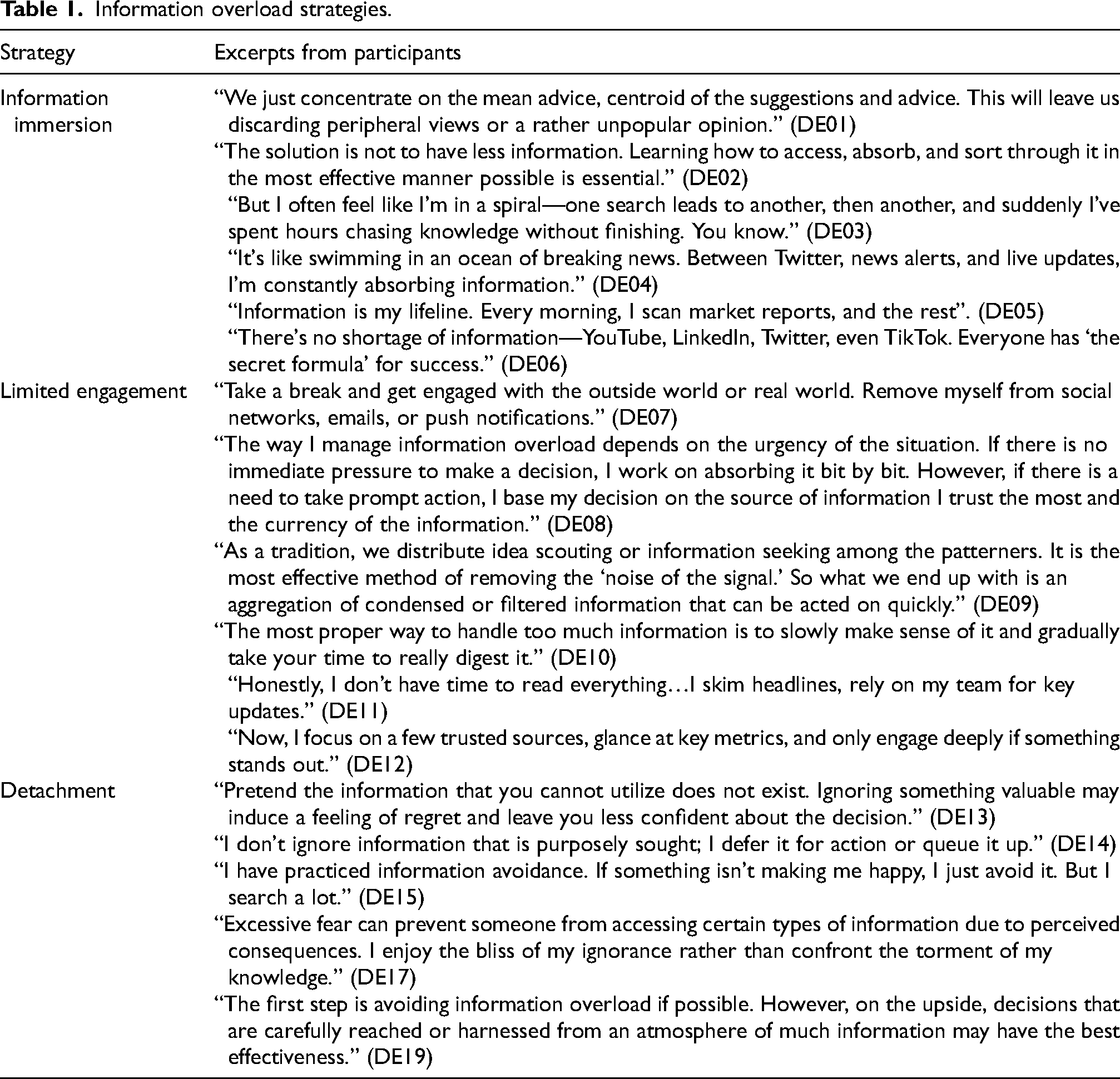
The study uncovered three strategies employed by digital entrepreneurs to effectively mitigate and manage information overload. These strategies, namely information immersion, limited engagement, and detachment, as presented in Table 1, were found to be instrumental in their ability to address the overwhelming influx of information and make informed decisions. Looking at each strategy, Information Immersion is about deep engagement and filtering. Limited Engagement involves setting boundaries and time management. Detachment is about avoiding non-critical information. It is noteworthy that those who mentioned consciously using information detachment strategies were emotionally affected by doing so in a variety of ways whether positively or negatively.
Information overload strategies.
Information seeking patterns
The study categorizes the information seeking pattern of the participants into purposive and non-purposive information seeking as indicated in Table 2. This is not surprising given that “serendipity, unintentional information encounter and non-purposive information encounter are all very closely related phenomena” (Marcella-Hood and Marcella, 2023: 635). The research findings show how the information overload strategies intersect the information seeking by digital entrepreneurs.
Serendipity and non-serendipitous information seeking.
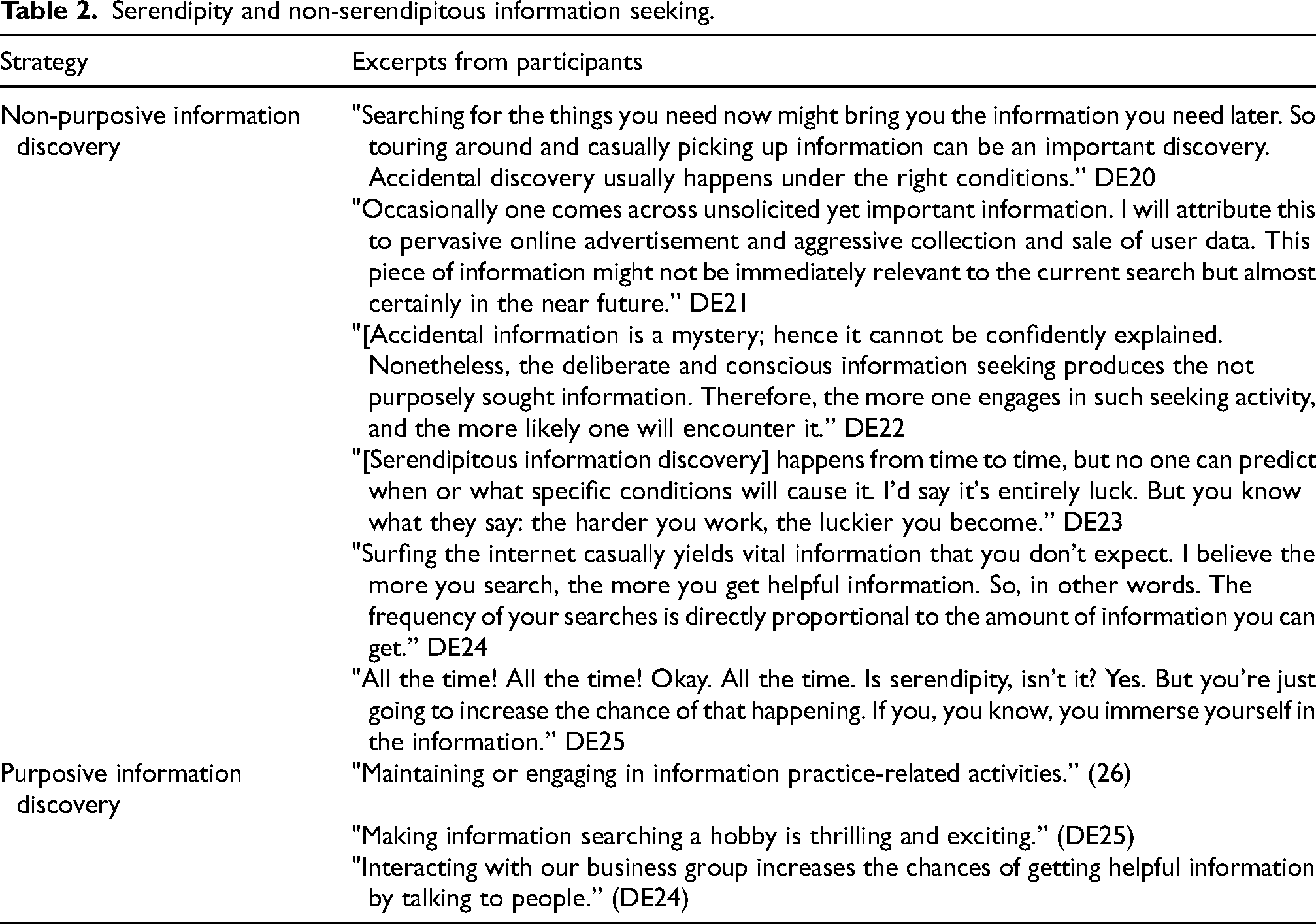
Information seeking occurs through non-purposive discovery, where individuals encounter information accidentally via casual browsing, online advertisements, and serendipitous exposure, with engagement increasing the likelihood of useful insights. In contrast, purposive discovery involves intentional searching, where consistent engagement, treating information-seeking as a hobby, and networking with business groups enhance access to relevant knowledge. However, it is the current authors’ view that intentional browsing where the information seeker actively seeks out serendipitous discovery can be carried out in a systematic manner.
Discussion
The participants’ accounts highlight the significance of non-purposive information discovery and the role of active engagement and immersion in the information environment. While maintaining a passive focus and engaging in information practice-related activities can lead to accidental discoveries Busch and Barkema (2022), actively seeking information, increasing search frequency, and immersing oneself in the information environment can enhance the chances of stumbling upon valuable information (Foster and Ford, 2003). These findings align with the notion that non-purposive encounters can be facilitated by both online platforms and individual search behaviours (Marcella-Hood and Marcella, 2023). Accidental information discovery is often seen as a fortuitous outcome resulting from unplanned encounters and unexpected connections. While it is challenging to control or predict such serendipitous events, there are certain strategies that can enhance the likelihood of accidental information discovery. Evidence from the findings show accidental information discovery and information overload are two interconnected concepts that influence how individuals navigate the vast amount of information available to them particularly within the Information Immersion strategy of information overload. Immersion as an IO mitigation technique also increases the chances of unplanned informational encounters. Analytically, information immersion strategy shapes serendipitous information discovery. Information immersion (also described active engagement) helps individuals prioritize their information needs and engage with sources that align with their specific goals or interests (Pirolli and Card, 1999), thereby minimizing the negative effects of information overload. Additionally, persistently seeking information, individuals can gradually refine their ability to locate relevant and valuable content (Taylor, 1962, 1968). Persistence is also particularly relevant as a condition in purposeful information seeking and information immersion if it is to be effective in locating reliable and useful information (Marcella, 2002). Serendipitous encounters can help individuals discover valuable information that they may have otherwise missed (Shah, 2014; Shah and González-Ibáñez, 2010). Through these techniques, individuals can effectively address information overload and improve their chances of unplanned discovery.
The process of immersion seeking serendipitous encounters is one that was long embraced by libraries and the notion of subject classification enabling users to browse collections to uncover related material in the connecting areas. This concept has been embraced by retailers for decades now. Browsing as a tool is controlled by the platforms we use. The notion of browsing is one that would merit further exploration by information behaviour researchers. Those studies that currently exist are fairly sparse and reveal that the process of browsing is undertaken, for example by Duarte Torres et al. (2014). often results in ‘an increased level of confusion and unsuccessful search sessions among children’.
The above components that enhance accidental information discovery align with Foster and Ford's (2003) conceptual framework for understanding serendipity in information retrieval. The Foster and Ford framework discusses aspects related to the serendipity process, the role of the searcher, and the role of the system, highlighting strategies for enhancing accidental information discovery and emphasizing the importance of active engagement and persistence.
Findings from the current research highlight that accidental information discovery is often found to be a fortunate outcome resulting from unplanned encounters and unexpected connections. This aligns with the concept of serendipity described by Foster and Ford, where serendipitous events involve unexpected and valuable discoveries during the search process. The findings also emphasize that while it is challenging to control or predict such serendipitous events, there are strategies that can enhance the likelihood of accidental information discovery. The participants discussed several aspects that align with the role of the searcher in Foster and Ford's framework. They emphasizes active engagement as a strategy for enhancing accidental information discovery, highlighting the intentional and proactive exploration of various information sources and environments. This aligns with the searcher's role in Foster and Ford's framework, which emphasizes the searcher's expertise, curiosity, and flexibility in fostering serendipity. The framework also mentions persistence as a crucial factor, where consistent and dedicated efforts to search for, gather, and process information increase the chances of encountering unexpected and valuable information.
A key element underpinning serendipity, often overlooked in the existing literature, is the intentional effort to achieve it. Information users must actively reposition their awareness by cultivating a mindset that anticipates and embraces unplanned information discovery. This intentionality enhances cognitive flexibility, allowing individuals to recognize and utilize unexpected information. Conversely, failing to acknowledge or prepare for serendipity may result in missed opportunities, underutilized information, and a rigid, less adaptive approach to information seeking.
Further, the findings touch on the role of the system in facilitating accidental information discovery. Participants mention immersion in information, which aligns with the system's role in Foster and Ford's framework. Immersion involves deeply engaging with a specific domain or topic of interest, exploring various facets, and actively participating in discussions and knowledge-sharing activities. The system can facilitate immersion by providing access to diverse information sources, platforms for exploration, and opportunities for participation and collaboration.
The strategies for enhancing accidental information discovery can also be seen as potential solutions or approaches to address information overload. Adopting these strategies, individuals can better manage the overwhelming amount of information available and extract meaningful insights from the vast information.
In comparison to Savolainen (2007) and Narayan et al. (2011), the three approaches (information immersion, limited engagement and detachment) reflect a broader understanding of coping with information overload among entrepreneurs. Savolainen's work emphasizes filtering and withdrawing as strategies, while Narayan et al. explore information avoidance behaviours. The approaches of Information Immersion, Limited Engagement, and Detachment encompass and expand upon these concepts, offering entrepreneurs a range of strategies to manage information overload based on their individual preferences and contextual demands. In terms of robustness and efficacy, each approach has its strengths and limitations. Information Immersion can be robust in enhancing information processing capabilities but may be less efficient in situations of information overload. Detachment strategies offer quick relief and reduced cognitive load, but excessive detachment may lead to missing important information. Therefore, the choice of approach depends on the specific context, individual preferences, and the trade-off between thoroughness and efficiency in information handling. Between the two extreme strategies (information immersion and detachment), lies the Limited Engagement, which perhaps provides the most utility in managing IO and as well as enhancing serendipity. This is possible given that it deliberately restricts exposure to excessive inputs, allowing individuals to maintain focus and enhance productivity. This involves strategic disconnection, where individuals selectively disengage from non-essential information sources to prevent cognitive fatigue. Additionally, setting boundaries on information consumption—such as designating specific times for checking emails or social media—helps create a structured workflow. Using time management techniques like scheduled information intake or time-blocking ensures controlled and purposeful information processing. This appears as a sustainable approach with a focus on well-being but may have limitations when real-time information is crucial. These three strategies for managing information overload are diagrammatically illustrated in Figure 1 below.
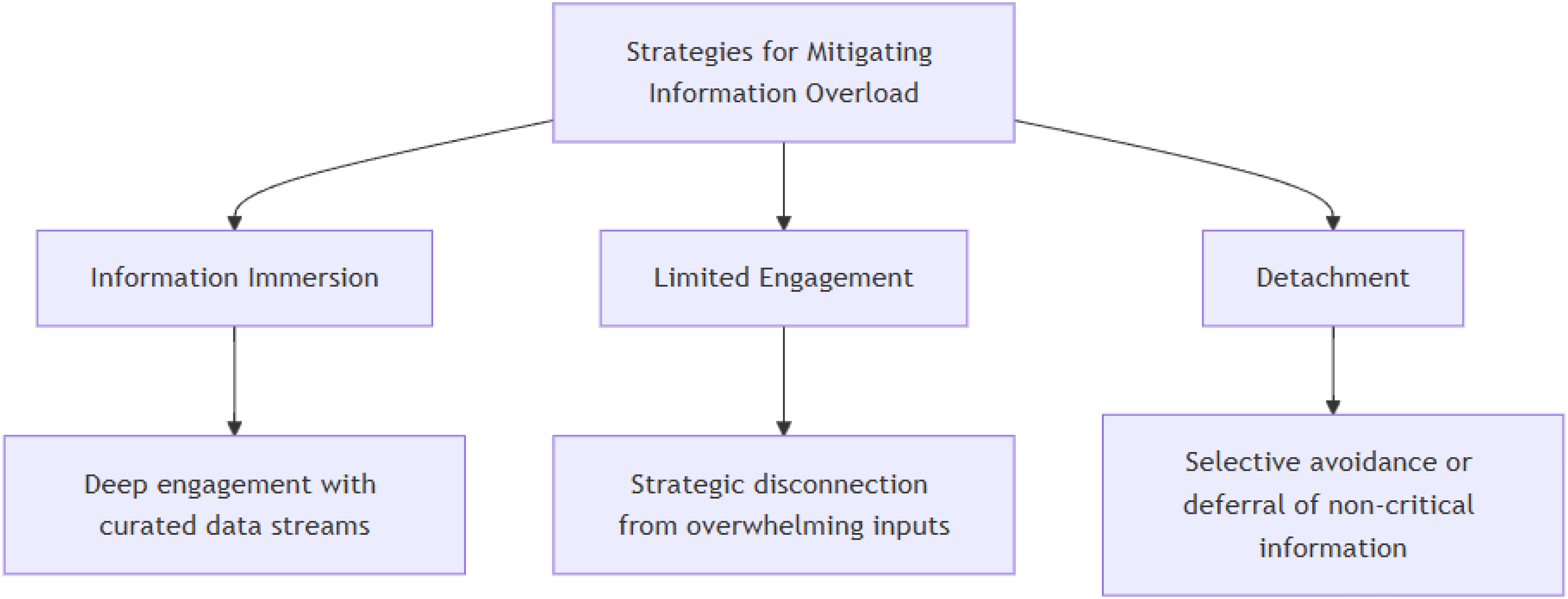
Framework for information overload management to enhance serendipity.
Conclusion
The findings of this study underscore the interplay between information immersion, accidental information discovery, and strategies for managing information overload. The research highlights that information immersion and active engagement significantly enhance the likelihood of such serendipitous events. This aligns with Foster and Ford’s (2003) conceptual framework. From a theoretical standpoint, information immersion not only serves as a mechanism for mitigating information overload but also incorporates elements that facilitate unplanned information discovery. Immersion enables individuals to prioritize relevant information and engage deeply with information sources, thus minimizing cognitive overload while maximizing the potential for valuable insights. The study further extends existing literature on entrepreneurial information management, offering a broader perspective on coping strategies beyond the filtering and avoidance mechanisms proposed by Savolainen (2007) and Narayan et al. (2011). The three identified approaches—Information Immersion, Limited Engagement, and Detachment—provide a nuanced understanding of how entrepreneurs balance information processing efficiency with cognitive sustainability. While each approach presents distinct advantages and trade-offs, their effectiveness depends on contextual demands, individual preferences, and the need to balance depth with efficiency in decision-making. Through these integrating active engagement, selective exposure, and structured detachment, individuals can not only manage information overload more effectively but also leverage serendipitous discoveries.
This study acknowledges methodological constraints that may affect the validity and scope of its findings. A critical limitation arises from the over-reduction of the original doctoral dataset, which included extensive qualitative interviews and contextual observations. While necessary to streamline the analysis for publication, this reduction involved the loss of nuanced insights, contextual depth, and potentially impacting the robustness of the findings. Additionally, as with other qualitative research, the findings of this study cannot be directly generalized to broader populations. However, the emergent universal themes hold strong theoretical significance
Future research by the authors will examine in more detail the three coping mechanisms to deal with IO, which have been uncovered in the present research, in order to discover the ways in which these techniques can be employed to greater effect by information seekers, whether in business or beyond. The practice of browsing will also be further investigated, where browsing is purposeful searching carried out in an unplanned manner. This behaviour is more frequently characterized as scrolling in today's largely electronic world in the search for information.
Footnotes
Declaration of conflicting interests
The author(s) declared no potential conflicts of interest with respect to the research, authorship, and/or publication of this article.
Funding
The author(s) received no financial support for the research, authorship, and/or publication of this article
