



Abstract
The main purpose of this article is to bring to the fore the nexus between what borderlands theory stands for and the mushrooming of community archives in these areas as a form of counter-archiving and documenting the ‘other’. Zimbabwe's borderlands are uniquely inhabited by the marginalised ethnic indigenous groups of people. This prevalent borderland phenomenon has seen the growth of community archives which border on archival activism. Therefore, this article, through literature review interrogates further this borderland phenomenon by giving an overview picture of the nexus between community archives and Zimbabwe's borderlands. One of the findings reveals that these community archives which come in different formats such as archives, museums, trusts, oral history groups and language associations seem to be a counter move by the marginalised to tell their stories which are side-lined by those in power. It is now almost axiomatic to conclude that the stories of those in borderlands are scarcely documented in the mainstream heritage institutions in Zimbabwe. Also, one of the leitmotifs which runs through the article is how the concepts of Information and Communications Technology for Development (ICT4D) are used by community archives in borderlands to further their objectives.
Keywords
Introduction and background to the study
In Zimbabwe most of the borderlands are inhabited by the linguistic indigenous groups who are perceived as a ‘minority’. This can be seen in Figure 1 which is an Ethno-Linguistic Map of Zimbabwe. (In this article the phrase ‘minority ethnic groups’ is replaced with ‘indigenous ethnic groups’ except in direct citations).
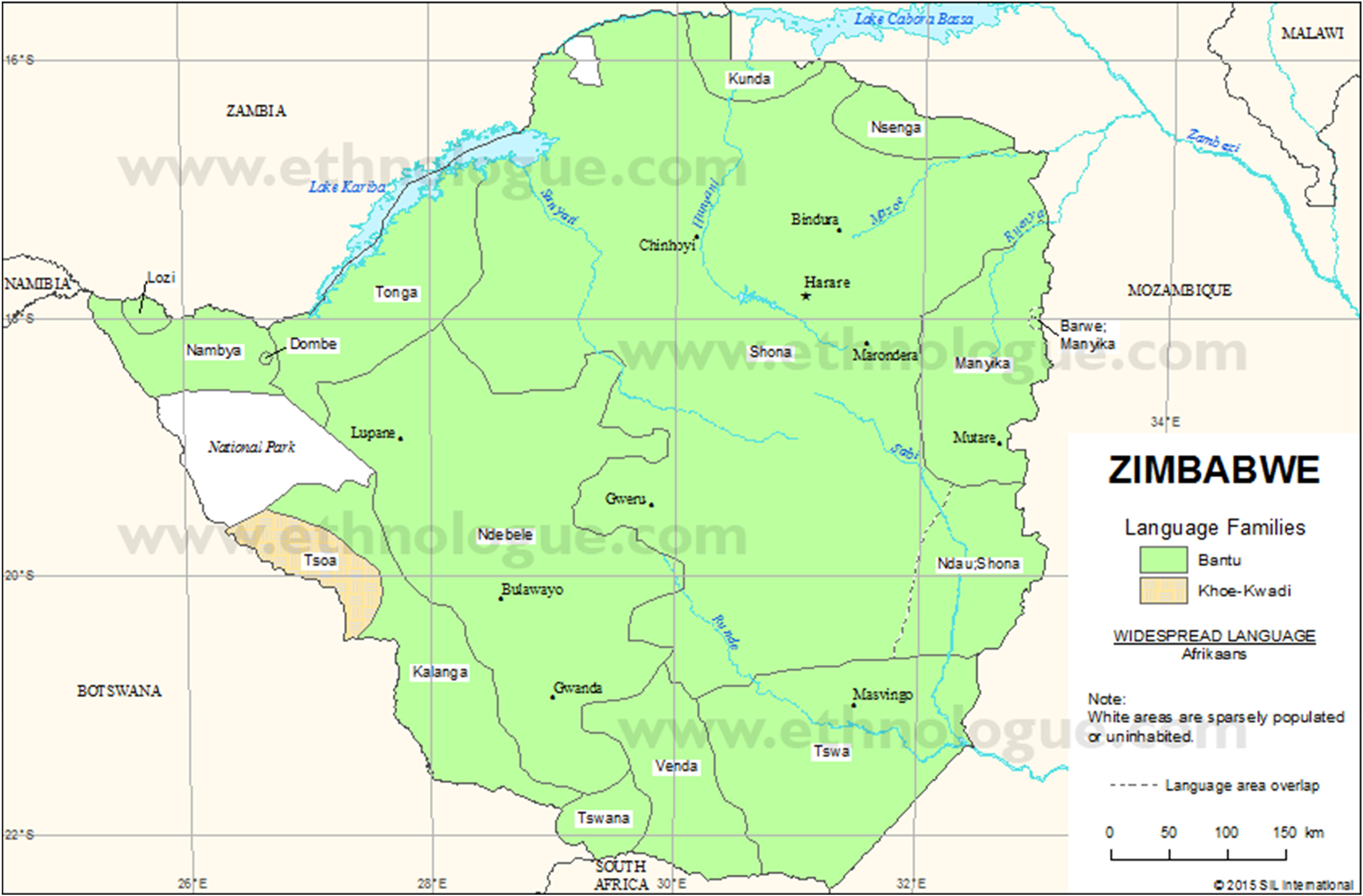
Ethno-Linguistic Map of Zimbabwe. Source: Ethnologue: Languages of the World (2021).
The Figure 1 Map clearly shows that the linguistic indigenous groups in Zimbabwe are mostly found on the borderlands. These indigenous groups are Tonga, the Dombe, the Nambya, the Lozi, the Khoisan, the Kalanga, the Tswana, the Venda, the Tswa, the Ndau, the Barwe, the Manyika, the Nsenga and the Kunda among others. These indigenous ethnic groups of people are clearly affected by the borderlands discourse which is described by the World Bank Group (2020:3) as politically and economically important and “usually inhabited by groups that lack representation in central power structures and are viewed by others as offering limited economic potential”. Goodhand (2014) states that borderlands seem to be immune to the development and successes celebrated at national and international level”. Same sentiments are mentioned by Orozco-Mendoza (2008:5) who argues that “borderlands can materialize and produce racism, discrimination, economic exploitation, exclusion, and the like”. Alemu (2019:30) adds that “the borderlands are sources of tension, belligerence and insecurity…” Epistemologically, borderlands are viewed as ‘border gnosis’ or ‘border thinking’ which is “a powerful and emergent form of comprehension or episteme that absorbs hegemonic forms of knowledge from the perspective of the subaltern” (Vargas-Monroy, 2011:264). Therefore, the mushrooming of community archives at borderlands comes as no surprise as it is more of subaltern archiving.
The borderland's theory can be traced back to the way that “Europeans employed to perpetuate and to reinforce difference. These sites were meant to mark a distinct division between those who could have access to the rights and benefits of the state and those who could not” (Orozco-Mendoza, 2008:11). Thus, who was to be included or excluded was to be determined by people's emplacement on one or the other side of the border (Orozco-Mendoza, 2008:11). Colonial nuances of borderlands are noted by Moyo and Nshimbi (2019:1) who argue that “the mere fact that such borders are a product of colonial gerrymandering means that these divisions are arbitrary in as much as they disregarded socioeconomic conditions and existing naturally occurring sociocultural and political delineations of the continent's inhabitants”. Moyo and Nshimbi (2019:1) further aver that “the frequent interaction of people across African borders seems to suggest that the borders crossed them, rather than the people crossing the borders”. However, post-colonial governments still subscribe to this divisive borderland approach which was emblazoned upon the same racist values employed by the imperialists and colonialists.
“Borderlands is also a fundamental term in the conceptualization of marginalized identities and of agency in today's transnational feminism” (Equality Archive, 2014:1). “This ‘borderlands’ is the symbolic and social location of the marginalized, the abject, the undesirable, the residual, of, in Anzaldúa's words, “los atravesados […] the squint-eyed, the perverse, the half-breed, the half dead” live” (Equality Archive, 2014:1). Englebert (2005:30) adds that these borderlands groups of people “have not reaped significant benefits from their integration into the state, and they have sometimes been persecuted at its hand”. This is how borderlands theory is sometimes conceptualised by speakers in the sense that it speaks of the marginalisation of those on the boundaries.
In fact, the ‘other’ is created within the borderlands. This is so in the sense that “all non-dominant groups must know where the border is because moving into the territory of the dominant group defines them as other and subjects them to the likelihood of cultural erasure at best, disrespect or violence at worst” (Fried, 1995:84). However, for the majority and dominant ethnic groups they can “remain oblivious to borders because their version of reality, value and truth dominates wherever they are. They represent the hegemonic belief system” (Fried, 1995:84) which manifests itself through the domination of major sources of ideological indoctrination such as national archives and media among others. Through these nationally controlled culturally institutions the dominant majorities can validate their perspective and ignore or devalue others (Giroux, 1981). This is the stance that was taken in this article. That is the marginalisation of the indigenous ethno-linguistic communities found on the borders of Zimbabwe and how this has affected their cultural identities, histories and the documentation of their oral testimonies, oral history and Indigenous Knowledge Systems (IKS). In short, the article looks at how their archives have been affected by the virtue of being residing on borderlands.
Community archives are defined by Flinn et al. (2009:73) as “collections of material gathered primarily by members of a given community and over whose use community members exercise some level of control”. Flinn et al. (2009:73) further state that “the defining characteristic of community archives is the active participation of a community in documenting and making accessible the history of their particular group and/or locality on their own terms”. Community archiving has mostly developed as a countering measure to the exclusion of the ‘other’ from the mainstream archives and this phenomenon is becoming more common in Southern Africa (Bhebhe and Ngoepe, 2021b). In other words, community archiving can be described as “a transformative praxis that liberates rather than oppresses” (Caswell, 2021) unlike what national mainstream archiving is perceived to be doing. McKemmish, Faulkhead and Russell cited in Van der Merwe (2019:239–240) speaks to this assertion by revealing that the current western archival epistemology privileges the colonist voices and narratives over indigenous ones, of written over oral records. Ozban (2014:16) takes note that “…ranging from women to African Americans or from minority groups to LGBTQI groups, who could not find a place in history to be archived and historicised, have constructed new forms of archival sites and practices from “the below”.
In the context of this article the ‘other’ are the indigenous linguistic ethnic groups found on the borderlands of Zimbabwe who have been earlier defined in ‘derogatory’ terms of being ‘minorities’. Through working with some of these indigenous ethnic groups it was discovered that they are mostly telling the same story, the story that their culture, language and history are being undermined by the state as it is left undocumented by the government departments which are supposed to do that. Muchefa (2012:129) concurs with this argument by clarifying that “in post-independent Zimbabwe, there are instances of certain sections of ethnic or tribal populations who feel enough is not done in documenting their past or that the truth is not said about their past”.
Bhebhe (2019:226) found out that ethnicity is playing a major role in motivating and stimulating oral history programmes or community archiving in Zimbabwe where community archives/museums have been established by the BaTonga (BaTonga Museum), the Nambya (Nambya museum), the Kalanga (Kalanga Language and Cultural Development Association), the San (Tso-ro-tso San Development Trust and the Tsonga (Gaza Trust). “Their formation is a result of a perceived threat to their identity. In Zimbabwe most of these ethnic groups feel marginalised, their languages are not given enough space in the education sector, and they are far away from the national lingua franca” (Bhebhe, 2019:226). Most of the participants in these indigenous ethnic groups said their associations or trusts were formed mainly to assert their identity, for example, one participant said that the BaTonga Museum became a rallying point for self-assertion and highlighting of their self-esteem (Bhebhe and Ngoepe 2021a:12). Same sentiments are echoed by Saidi (2019:325) who avers that the creation of the BaTonga Museum ‘may be seen as a direct protest to subjugation. In other words, this is a non-militant call for the inclusion in nation building’.
In the context of this article the interest is mainly on the physical and geographical location of these community archives especially their clustering around the borderlands. It should be noted that the term community archives in this article is used broadly as defined by Flinn (2007:150) that community histories or community archives are the grassroots activities of documenting, recording and exploring community heritage in which community participation, control and ownership of the project is essential. This activity might or might not happen in association with formal heritage organisations, but the impetus and direction should come from within the community itself. Flinn (2007:152–153) also mentioned that other comparable, if not exactly synonymous terms which are also regularly used, include local history group, oral history project, community history project and community memory project. Also, terms such as trusts, and language associations are added to the definition of community archives.
Zavala et al. (2017:202) argue that “community archives have compelled shifts in dominant archival management practices to reflect community agency and values”. Zavala et al. (2017:203) continue to aver that the “selective nature of collecting [by mainstream national archives] leads to marginalisation of voices in archives, as funds and space restrictions continuously frame collection decisions. These power dynamics necessitate the creation of community archives to give space to marginalised communities”. This article takes the view that the concept of borderlands or the theory behind the term is also influencing the establishment of community archives at the frontiers.
It is not only the indigenous ethnic socio-linguistic aspect that the author of this article believes is behind the formation of community archives on the frontiers but there are other factors such as economic exclusion and violation of communal land property rights by the state among others. In Zimbabwe these indigenous ethnic socio-linguistic groups have been displaced in their ancestral lands in the name of development projects. These displacements date back to the colonial era, for example the San people were displaced from what is now the Hwange National Park. These exclusionary tendencies by the central government are influenced by the promotion of ‘minoritization’ policies.
Minoritization can simply defined as the marginalisation of the minorities by the dominant majorities. It should be noted that ‘minoritization’ of identities “has always been intrinsically linked to struggles over socio-political power, cultural domination and control. ‘Minoritorization’ has no necessary factual basis in demography. It is an instrument constructed for use in pursuit of exclusionary political agendas” (Musekiwa, n.d:18). It has been “observed in most of the post-colonial societies that there are citizens and denizens, the latter being the lower strata of the society, in terms of class, ethnicity, those who are being minoritorized by the prominent, the majority- the nation” (Moshsin, 2010:3). Therefore, in this article the indigenous ethnic groups in Zimbabwe are the denizens whereas the majority are the citizens. This divide is a potent source of discontent and violence. This discontent is clearly manifested in borderlands where the margined minoritized see it fit to document their stories which are neglected by the centred majority.
The creation of colonial boundaries in some parts if not all of Africa has divided communities who once lived together in the pre-colonial past. Some of these same socio-linguistic communities are the majority on the other side of the border and vice-versa on the opposite. For example, along the mighty Zambezi River bordering Zimbabwe and Zambia one finds the Tonga and Lozi people who are a ‘minority’ on the Zimbabwean side but a majority on the Zambian side. Therefore, this borderlands concept does not only smack of colonial nuances, but it is also a fierce battleground of oppression, marginalisation, criminality, economic exclusion, cultural and linguistic genocide. Englebert (2005:55) gives an example of borderlands ethnic groups of the Barotseland and Casamance in how they have struggled to be part of the whole in terms of their cultural specificities and grievances because “they are at the margin of the prebendal system of power and, hence, are first to suffer from the fiscal contraction and failure of the central state apparatus”.
Hogan (2014:907) also writing about the borderland Barotse ethnic group of the Lozi avers that the “persistence of Lozi secessionism over the twentieth century, and into the twenty-first, does not reflect a primordial attachment to ethnicity and polity. It is instead a movement fed by a particularism bred of resentment and poverty”. Such conditionalities have triggered a defence approach in which the communities of these indigenous ethnic groups have coalesced and came up with community archives to ascertain their identities and fight for their human rights. For example, despite the Zambian's central government ‘hostility’ towards the Lozi, they have managed to continue practising and preserving their 200-year Kuomboka ceremony which has been an annual event on the ancestral landscape. The term, Kuomboka, means ‘emerging out of the waters’. When the plains are fully flooded every rainy season, the Litunga (King) and all plain dwellers sail in a colourful ceremony accompanied by an orchestra of traditional music and dance all the way to the highlands in Limulunga, where a similar capital to the traditional Lealui in the plain stands established (UNESCO, 2022).
Statement of the problem
The archival landscape in Zimbabwe presents a picture where national archival institutions are dotted in major cities or metropoles whereas indigenous ethnic community archives are clustered around the borderlands. This pattern clearly shows how post-colonial governments tended to centralise power within metropoles at the expense of remote borderlands areas. Muchefa (2012:129) describing the national archival landscape in Zimbabwe noted “the fact that National Archives of Zimbabwe (NAZ) has two archives’ offices in Harare and Bulawayo says a lot in starving some people to critical information. This brings in the issue of decentralization of archives…” Therefore, borderlands areas of Zimbabwe which are mainly occupied by indigenous ethnic groups are the victims of national archival services lacunae. Thus, it is the purpose of this article to show how the marginalisation of the indigenous ethnic groups in borderlands has manifested itself in the proliferation of community archiving in the frontiers.
Research objectives
The major objectives of this article were to:
Show the linkage between borderlands and community archiving among the indigenous socio-linguistic groups in Zimbabwe. Further deliberate on the linkage between borderlands and community archiving among the indigenous linguistic groups by using a specific case of the Tonga and Ndau people.
Research methodology
This article's research methodology employs qualitative approach and is based on integrative literature review of the indigenous linguistic ethnic groups located on the borderlands of Zimbabwe mainly the BaTonga in Binga and the Ndau in Manicaland. Literature on community archiving and its linkage with the theory of borderlands was reviewed. Not only journal articles and book chapters were reviewed but also newspaper articles that speak to the subject matter of the research. Annual reports of community archives in Zimbabwe found on their websites were also reviewed. However, this was neither systematic nor semi-systematic literature review but an integrative one as already mentioned.
Integrative review is defined by Snyder as (2019:336) “to overview the knowledge base, to critically review and potentially re-conceptualize, and to expand on the theoretical foundation of the specific topic as it develops”. Integrative literature review in this article started with the formulation of the problem, which is elucidated in section 3, that is statement of the problem. This also led to the identification of the borderland's theory as relevant to the research question of the article. The researcher borrowed the political science theory of borderlands after noticing that it can be used in understanding why there is a noticeable manifestation of community archives at the frontiers. Secondly, data collection or literature search was done thematically under the following themes: borderland's theory, community archives and ethnicity in Zimbabwe. This data was evaluated, analysed, interpreted, discussed and presented narratively and thematically.
Data presentation and discussion
This section presents and discusses the data collected from literature review.
The Ndau borderland's community archiving
Equitable distribution of natural resources especially the land has been a bone of contention on borderlands which are mostly habited by the indigenous ethnic groups. The Ndau people who reside mainly in Manicaland specifically in Chipinge and Chimanimani and share the border with Mozambique have been caught on land ownership disputes. The importance of land ownership in these communal areas habited by the Ndau is explained by Musanga (2022:2) who argues that “the control and ownership of land, which is a form of symbolic cultural capital, to borrow from Bourdieu, can be heavily politicised and can result not only in enhancing one's economic capital but in the material and symbolic exclusion or inclusion of certain ‘selves’ and ‘others’”.
Musanga (2022:2) states that the Ndau community felt dissatisfied by the land programme that took place in 2000 as it benefited the outsiders who got land in their areas whilst themselves the locals did not get much. Even before the land reform in 2000, Dzingirayi (1996:19) citing Herbst (1990:70) distinguish that “it is frequently the case that post-independent leadership instigates, for political reasons, the movement or migration of thousands of rural people from the dominant ethnic groups at the centre of the state into the formerly marginal frontier zones”. Unfortunately, Dzingirayi (1996:19) detects that mostly these people are resettled “into the Zambezi Valley, Gokwe and Binga, which previously were sparsely populated. These areas were previously settled by a variety of small ethnic groups, mostly the Shangwe and Tonga people, who have failed to secure political representation since independence”. This has created conflict with the borderland ethnic groups as Musanga (2022, Mwinde, 2016 and Dzingirayi, 1996) notes. “The Ndau read this as political and therefore deliberate and calculated to keep and maintain them as an inferior ethnic group in Zimbabwe” (Musanga, 2022:2). Therefore, their history becomes of persecution and marginalisation to the extent that their identity is being questioned. However, this treatment has given such borderlands communities such as the Ndau to establish community archives and ascertain their identity and challenge some of these decisions made on their behalf by the central government.
Musanga (2022:6) states that “the majority of the Ndau largely see themselves as second-class citizens in Zimbabwe. The general stereotype of the Ndau as ‘witches’, ‘wizards’ and ‘herbalists’ reinforces this perception of marginality. Some Ndau read the land reform programme as a strategy to maintain the Ndau in a permanent state of inferiorisation”. It then comes as no surprise that such borderland indigenous ethnic groups are aggrieved to the extent that they establish community archives to prove to the world that they are not inferior. For example, they formed the Ndau Festival of the Arts (NdaFa) which is an annual event that has demonstrated their willingness to preserve and showcase their vibrant culture, as well as being a celebration of the need to preserve nature for human sustenance (Muyambo, 2018:223). This cultural board preserves indigenous trees with medicinal properties and teaches community members how to go about it.
The importance of preservation in community archives by the communities themselves is very important as emphasised by Mhlongo (2020:291). The importance of in-situ in contrast to ex-situ preservation is also recommended by Zimu-Biyela (2016) when researching on the IKS preservation strategies at Dlangubo village in KwaZulu-Natal. Therefore, despite their oppression and being called ‘inferior’ such borderlands ethnic ‘minority’ groups are using the concepts of community archiving to dispel derogatory labelling directed to them. Muyambo (2018:225) mentions that “bodies such as the NdaFA were also found to be instrumental in ensuring that the Ndau IKS which included the Ndau language were promoted and preserved for future generations”. In addition to such bodies like the NdaFA, the Ndau people has also established their presence online by creating community archives such as Rekete ChiNdau—Leave a Legacy Facebook page. Sithole (2020:9) pronounces that Rekete ChiNdau-Leave a Legacy was formed to fulfil an ethnolinguistic identity maintenance function because Ndau is allegedly endangered.
Secondly, Sithole (2020:10) articulates that the online group was formed “to push a socio-cultural identity maintenance agenda. A claim underpinning this argument is that Ndau is assimilating to Shona”. The mien of socio-cultural identity maintenance is shown by social media users who “appear convinced that their culture is under threat, as expressed in the declaration that ‘A CULTURE MUST LIVE ON’ on the group's Wall description” (Sithole, 2020:10). Mpofu and Salawu (2018) speak widely how the ‘minority’ groups have invaded the online space to resist machinations of language ethnocide from the state and ethnic ‘majorities’. Sithole (2020:11) reciprocates that the Ndau and other indigenous ethnic groups which are mainly found on the borderlands as a measure of resistance have appropriated “Facebook to assert a separate sociocultural identity and create visibility around them”.
Sithole (2020:11) further elaborates that the Rekete ChiNdau-Leave a Legacy platform preserves visuals of “cultural events such as chinyambera and muchhongoyo (traditional dances), and traditional dress like zvichhakati (ragged skirts), mihizo (wrap-overs), mazambiya (wrappers), madhuku (doeks) and zvigolanagolana (earrings) and ngoma (drums) that shape a Ndau identity in Zimbabwe”. It is very interesting that the Ndau ethnic group is utilising Information Communication Technologies for Development (ICT4D) of their peoples. This can be seen by using social media platforms in speaking to the challenges faced by their communities. Chibanga (2020:236) notes that ICTs can give voice to the marginalised and that “digital revolution is transforming how humanity lives, works and relates with one another”. In other words, these community archives by the subaltern indigenous communities are not only used as archive centres but also for other developmental issues. For example, Chibanga (2020:234–267) shows how the marginalised indigenous voices in Congo can be amplified by just a basic ICT such as a cellphone.
The Ndau language in Zimbabwe was classified under Shona before the promulgation of the Constitution of 2013. However, Sithole (2018:412) spots that some “historians, linguists and politicians consistently describe Ndau people as a Shona sub-group. Ironically, mother tongue lobby and advocacy groups are relentlessly vociferous in asserting a separate cultural, political and linguistic identity from Shona”. Sithole (2018) singles both the colonial and post-colonial governments as having a hand in undermining the independence of the Ndau identity. Sithole (2018:426) further protests that: Cultural policies sought to create a ‘Zimbabwean national culture’ which aimed to promote the dominance of Shona and Ndebele. The idea was to integrate different cultures along Shona and Ndebele to promote cultural homogeneity…Convinced that they are being suppressed and/or excluded in the mainstream Zimbabwean national culture, minority ethnic groups such as the Ndau and other marginalized groups such as Kalanga, Sotho, Nambya, Tonga, Venda and Shangaan find a strong justification to create, maintain and assert separate senses of cultural identity. Competition among several ethnic groups and the subsequent suppression thereof of minorities often give rise to combative identities based on geography, tradition, language, culture and ethnicity…
The Avuxeni Community Museum which is described by Pikela et al. (2022) as: a community-initiated museum project of the Tsonga people that is located deep in the rural settings of the Chiredzi South District. Tsonga people, as a minority ethnic group, have endured stigmatisation and marginalisation by other dominant cultural groups in the country. The museum challenges the historic and contemporary exclusions of Tsonga people in the national narratives. Activities at the community museum also strengthen cultural ties between Tsonga people who were separated by colonially invented national boundaries. The museum allows the Tsonga people to collect, document, and exhibit their artefacts as well as to author and censor their narratives.
The BaTonga borderland's community archiving
The BaTonga have several cultural organisations that are meant to promote their culture and ascertain their language. For example, there is the Basilizwi Trust, Binga Rural District Council, the BaTonga Museum, the Zimbabwe Indigenous Languages Promotion Association (ZILPA), the Tonga Language and Culture Committee (TOLACCO), the Zambia Education Publishing House and the University of Zimbabwe especially the African Languages and Research Institute (Mwinde, 2016; Mumpande, 2020). In the past they used to have organisations like Venda-Tonga-Kalanga Languages and Cultures Promotion Society (VETOKA), Catholic Commission for Justice and Peace in Zimbabwe (CCJP(Z)), Lusumpuko plan of 1981, Binga Development Association (BIDA) 1989–1996, Kunzwana Trust, Zubo and Ntengwe for community development (Mwinde, 2016; Manyena, 2013). Nyika (2008:460–1) highlights that “some language groups such as the Tonga increasingly became vociferous in their demands for the teaching of their languages and threatened taking their case to the Supreme Court or withdraw their children from school if they continued to be taught Ndebele and not Tonga”. Nyika's (2008) example mentioned above clearly alludes to the effectiveness of the BaTonga cultural community groups in fighting for their indigenous ethnic identity.
Mudimba (2015:12) avers that “in the poverty reduction discourse in Zimbabwe, poverty has notoriously become the badge of the Tonga. The poverty of the Tonga tends to be synonymous with demeaning, stereotypical descriptions, such as ‘marginalised’, ‘isolated’, ‘poor’, ‘backward’, ‘minority’, ‘primitive’,‘dangerous’, ‘degraded’ and ‘two-toed people’” as she cites Manyena (2013:25). Mudimba (2015:12–13) notes that development-induced displacement (DID) as one of the causes of chronic poverty in Binga among the Tonga people. DID has been one of the methods that has been used by state-centric governments to displace the indigenous linguistic groups found on the borderlands.
Besides Binga, another interesting current example is that of the Shangaan/Tsonga people in south-western Zimbabwe in the Chilonga village who are being displaced so that a proposed investor can grow lucerne grass. Masvingo Centre for Advocacy and Development (2021:2) laments that “in the Zimbabwean population, minority groups comprising of Shangaan, Tonga, Nambya and Kalanga are less than 10% of the total Zimbabwean population. The numerical inferiority makes them more vulnerable to government-initiated evictions and land dispossession”. Therefore, the chronic poverty in Binga for the Tonga people is attributed to DID in which they were relocated in 1950s to pave way for the construction of the Kariba Dam. Tremmel (1994) argues that their life has been characterised by the following pain and suffering: the separation of families, the flooding of farms and ancestral burial grounds and the removal of people in truckloads without compensation, to infertile land with little water, where they struggle to live today. Even though not limited to borderlands, there seems to be a persistent and consistent pattern in which these DID are more prevalent to the frontiers which are occupied by the indigenous ethnic linguistic groups. Recently this year in 2022 the villagers in Muchesu, Binga were given a three months’ notice to vacate their ancestral land to pave way for a Chinese coal mining project (Mpofu, 2022). Hence, the thesis of this article is that these indigenous ethnic groups perceive themselves as under threat to the extent that they have to regroup under the banner of community archives and speak with one voice in fighting for their rights, ascertaining their identity which is under threat and therefore also preserving their culture.
Mumpande and Barnes (2019:50) explains the human needs theory in relation to the Tonga people on revitalisation of their language. This explanation can also be used as a reason of community archiving manifestation on borderlands. Referencing Burton (1997:32), Mumpande and Barnes (2019: 50) avers that: human beings need to belong to a clearly identifiable and distinguishable group that they can associate with (identity); they need to confidently feel that their language and culture are safe from other cultures and groups around them (security); they need to participate in decision making processes on issues that directly affect their lives (participation); they need to be free from any form of oppression, domination and discrimination (freedom) and they need to be respected and affirmed (recognition).
TOLACCO was formed in 1976 to fight for the recognition of their language rights which were under siege from the then colonial government and is a community-based organisation that works closely with the Tonga chiefs (Ngandini, 2016:210). It was the engine that powered the whole Tonga language revitalisation programme (Mumpande, 2020:110). Ngandini (2016:198) further argues that “TOLACO as a civic organisation was instrumental in leading lobbying and advocacy activities with their chiefs so that their language rights are recognised, respected and protected by the government of Zimbabwe”. TOLACCO has also managed to spearhead the formation of Zimbabwe Indigenous Languages Promotion Association (ZILPA) by bringing on board other indigenous language groups in Zimbabwe to fight the government as a united front for the recognition of their languages. The other groups which were taken on board are the Kalanga, the Nambya, the Venda, the Sotho and the Shangaan (Ngandini, 2016:198). ZILPA then became the mouthpiece of indigenous ethnic groups in Zimbabwe hence a national structure to which all marginalised language committees are affiliated (Mumpande, 2020:91).
Mumpande (2020:108) outlines that “TOLACCO members realised the need to establish their own community-based organisation, called Basilwizi Trust in 2002, that would stir local development by the people, for the people, with the people and to fund the language revitalisation activities”. Basilwizi (2015:6) elucidates that under the education and culture program, Basilwizi key deliverables are “the promotion of the Tonga and Korekore cultures, educational support for the poor and vulnerable children from the valley, fostering community expression through various new media, documentation and indigenous knowledge sharing and preservation”. For example, Basilwizi (2015:6) highlights that in 2015 “Basilwizi supported and documented Tonga traditional food fair in Simatelele, reaching out to over 500 participants with the activity witnessed a huge support from the local business community. The objective remains as that of preserving and promoting Tonga culture and all its facets”. Traditional dances are also supported by the Basilwizi and TOLACCO, for example, ngoma buntibe dance was encouraged everywhere because it is the most unique Tonga cultural dance that identifies and distinguishes the Tonga from any other ethnic group in Zimbabwe… Apart from inculcating cultural values in the younger generation, ngoma buntibe events played another pivotal role of providing platforms for TOLACCO's information dissemination not only to educate communities about the importance of languages and culture but also to update them on progress made in revitalising the Tonga language (Mumpande, 2020:154).
Basilwizi (2022) list that one of their goals is to “promote culture and the teaching of indigenous language in the Zambezi valley”. Basilwizi (2022) adds that some of their achievements are the following:
Awareness raising in order to generate widespread support for the promotion of indigenous languages and culture. Policy dialogue meetings with ministry of education officials – aggressive engagement of policy implementers in the valley to enforce teaching of the language. Lobby and advocacy training workshops for TOLACCO members to empower them to lobby for the exclusive teaching of the Tonga language in the Zambezi valley alongside English. Cultural support through restoration of the norms, beliefs and values using cultural festivals that brings participants from across the lake. Networking and information sharing between the Zambia and Zimbabwe Tonga for cultural exchanges and to share teaching resources.
Mumpande (2020:100) further states that “Silveira House and Basilwizi Trust have moved with technology. In addition to hardcopies documentary material they have also developed e-archives. They are running parallel systems, physical and electronic archives, as a backup measure”. The Basilwizi Trust incentivised the competitions in which community members participated in reviving dormant cultural practices by forming cultural groups which competed within the district (Mumpande, 2020:137). Mumpande (2020:141) adds that the “Basilwizi Trust took over most of the roles that were done by the NGOs after being formed in 2002 such as conscientizing communities, training of writers, funding TOLACCO's local and nation advocacy activities with government and tertiary institutions, and funding ZILPA's national advocacy meetings”. The argument brought by Mumpande (2020:147) that “it is advisable for the endangered community to establish its own organisation to finance the language revitalisation activities in a sustainable manner just as TOLACCO did by establishing Basilwizi Trust” is a very important concept in the corpus of community archiving.
Basilwizi (2015:24) argues that some of their challenges have been “bureaucratic procedures in government departments [which] led to postponement of some activities while vague requirements from the ZRP [Zimbabwe Republic Police] led to barring of activities in Binga, for instance the capacity building of the Binga Residents Association was cancelled on the last minute with facilitators already in Binga having travelled from Harare”. Mumpande (2020:132) echoes with similar challenges faced by TOLACCO and Basilwizi by averring that: the politicians who were opposed to the language revitalisation belonged to the ruling political party… that they accused TOLACCO of being a political party hiding behind language activities. In this case they disrupted TOLACCO activities in the communities or influenced the police to stop the activities since they were labelled as opposition political party gatherings requiring police clearance.
Mumpande (2020:99) reminiscences that the The Catholic Commission for Justice and Peace Binga branch which was also involved in the promotion of self-identity advocacy for the Tonga people was closed sometime in mid-2000 due to political pressure from government. Conyers and Cumanzala (2004:395) observed that “on one occasion, President Mugabe, in a national speech, mentioned the organization by name, accusing it of meddling in politics”. Conyers and Cumanzala (2004:396) further laments that “the people of Binga have thus been deprived of an organization that was beginning to have a tangible impact on their well-being. Moreover, they are now subject to constant political persecution and harassment”. However, it should be noted that such experiences of state intimidation are not unique to TOLACCO but to almost all the borderlands indigenous ethnic groups as Bhebhe (2019:228) observes. Bhebhe and Ngoepe (2021a:13) further cites Hameso (1996:14) who deliberates that such state fear are elitist alarms and tactics meant ‘to force people to shy away from ideas of political autonomy and self-determination’. This argument is augmented by Manyena (2013:43) who also laments that some “associations such as the Tonga Language Committee and VETOKA were viewed with suspicion by the government, no matter how genuine their demands might have been”. This is not surprising because the borderlands communities which are home to the minorities are victims of “linguistic terrorism” as put by Anzaldua (1998:1026). However, Vail (2004) argues that ethnic-community archiving or activism should not be condemned as reactionary or divisive, but it is now high time that indigenous linguistic groups need to be totally embraced by the state because they cannot just be wished away like that.
Taking note of all VETOKA languages, one can discern that pattern of linguistic ethnocide. VETOKA being the acronym for the Venda, Tonga and Kalanga Association and when it incorporated Sotho language it became known as VETOKASO. It should be noted that all these languages incorporated in VETOKASO are of indigenous linguistic groups mainly found on the frontiers of Zimbabwe. These areas are mostly neglected by the Zimbabwe state-centric government which is shying away from devolutionary governance that may help these regions in the frontiers to develop on their own hence the manifestation of community archives on these borderlands. Ethnicity can also be at play in the neglection of borderlands as explained by Chibangu (2015:51) citing Cornell and Hartman “that race and ethnicity continue to serve as vehicles of political assertion, tools for exclusion and exploitation, sources of unity, and reservoirs of destructive power”
As a result of neglect from the central government, VETOKA even advocated for the renaming of the Matabeleland Province because they argued the name does not take into cognisance their ethnic groups (NAZ BOH/70). Same sentiments are clearly captured by Ndlovu (2013:521) referenced by Mumpande (2020:177) who points out that the Tonga traditional leadership wanted their geographical space to be named Zambezi Valley Province or the Gwembe Province not Matabeleland North Province as it currently stands. In voicing their anger against the ruling government, the Tonga have always voted the opposition as noted by Mwinde (Mwinde, 2016:41). Therefore, these victimhood sentiments expressed by the marginalised ethnic groups on borderlands has led them to form their own community archives that would speak direct to their grievances.
The Tonga have systematically and legitimately taken this struggle for inclusion through electoral process. In all plebiscites, the Tonga have been consistently voting for the opposition to register their anger. Same can also be said of the Ndau people in Chipinge who have continued to vote “for ZANU Ndonga and Ndabaningi Sithole against ZANU PF and Robert Mugabe. This they did for all the elections held before Sithole ‘s death. Even when Sithole died, the Ndau people continued to cast a protest vote against Robert Mugabe and ZANU PF” (Mangiza and Mazambani, 2021:49) by voting for the opposition party, the Movement for Democratic Change. In other words, these indigenous borderland ethnic groups not only are they asserting their self-identity through community archiving but also at the same time seeking political divorce with their ‘oppressors’ by voting them out of their frontiers.
Every community or an ethnic group tends to have its heroes, in addition to that some of these heroes are elevated to a ‘national’ status. In other words, these heroes are no longer memorialised only in their communities but nationally. Nevertheless, some ethnic groups feel their heroes have been demonised as the case with Ndabaningi Sithole, a liberation nationalist who was later to be denied the national heroes’ status by the Zimbabwe African National Union Patriotic Front (ZANU PF) government led by the late President Robert Gabriel Mugabe. Mangiza and Mazambani (2021:46) postulates that Ndabaningi Sithole's “deliberate omission from Zimbabwe's national history is an indication of the strong ethnicisation, not only of ZANU, but also of ZANU PF. The other political leaders’ view of Ndabaningi Sithole and his small Ndau tribe is that of a people whose contribution to national history is negligible”. Mangiza and Mazambani (2021:49) proffer the idea that the denial of a national heroe's status for Ndabaningi Sithole was mainly due to the fact that he “was neither a Karanga nor a Zezuru, the two politically dominant tribal groups. This was also worsened by the fact that Sithole came from a very small Ndau tribe and from a remote area of Chipinge, which made him not qualify to lead, as perceived by other ZANU leaders”. This deliberate omission and erasure from public memory of the indigenous linguistic groups hailing from borderlands is a common phenomenon in Zimbabwe as also noted by Mwinde (2016) in Binga. Mwinde (2016:41) when he exemplified that: Despite to have contributed to the cause and execution of the liberation struggle Sikajaya Muntanga, Francis Munkombwe, Cephas Siangoma, Samuel Mugande and Paul Siachimbo never rose to national positions even at national level after independence. Such marginal ethno-power relations keep the Tonga at peripheral position in terms of resource distribution.
Conclusion
Mainstream archival institutions or any other conventional heritage centres are encouraged to embrace multi-identities in their repositories a point well put by Flinn (2008:55) when he suggested that “the archival profession must embrace diversity in all its aspects in support of the production of a more representative national heritage which in turn might engender a greater sense of shared, multicultural identities”. Decentralisation of national archival services to the periphery can be an answer. This will lead to the indigenous ethnic communities in borderlands to feel accommodated in the making of the nationhood that promotes plurality instead of singularity. This is so in the sense that the manifestation of community archives in the frontiers, borderlands or remote regions from the centres of power is the vindication of neglection, omission, misrepresentation, silencing and erasure of voices by mainstream heritage institutions. The application of this political science theory in this article clearly shows that the manifestation of community archives at borderlands is not only due to political neglect by the central government of Zimbabwe but a phenomenon that cuts through the whole world in general.

