



Abstract
This article analyzes the perspective of journalists on the media coverage of climate change crisis in Pakistan. For this purpose, 26 journalists who were responsible for climate related events were interviewed. Overall, the study found that professional and economic factors were responsible for the lack of media interest in this important topic. Professionally, journalists said they were required to report on newsworthy events. Since apart from the occasional climate related destructive events, most of the climate news lacked drama, sensationalism and political consequences—thus not fulfilling the news selection criteria and hence were ignored. Likewise, media in Pakistan is facing financial crunch. Climate news needed dedicated reporters and lot of resources. Comparatively, political news was easy to get and attract larger audiences. As a solution, the journalists called for changes in the existing political discourse on the issue and emphasized that media should play a more socially responsible role to highlight the enormity of situation in Pakistan.
Introduction
Pakistan being a developing country is contributing less than 1% of greenhouse gases but it is in the list of top 10 most vulnerable countries of the world (Sathar and Khan, 2019). The Work Bank declared Pakistan at a high risk of catastrophic climate events in the shape of floods, storms, melting glaciers, landslides, rising sea level, droughts and food shortages (World Bank Report, 2021). The report states the country's north with mountainous terrain faces climate change induced land sliding and glacier melting issues and the lower riparian is exposed to flash floods besides rising sea level and sandstorms (World Bank Report, 2021). Similarly, Sathar and Khan (2019) recorded that heatwave per year increased by 31 days in the period from 1980 to 2017 in the country. According to the Climate Change Profile of Pakistan prepared by the Asian Development Bank (2017), the country's projected temperature increase is expected to be higher than the global average. The report projects a significant decrease in the wheat and rice crops due to water scarcity which could lead to serious food shortage. Already, in 2010 and 2011, the country saw unexpected torrential rains and floods that displaced millions of people and inflicted huge losses on the economy.
To avoid these imminent disasters, climate change advocates have stressed on the utilization of media for mass awareness both at the policy and general levels. Unfortunately, coverage in the Pakistani media on the crisis is almost negligible even when compared to the neighboring South Asian countries (Ali, 2010; Boykoff, 2011; Sharif and Medvecky, 2018). Boykoff (2011), for example analyzed press in Pakistan for climate change crisis and found the coverage to be limited and inadequate. Ali (2010) found the press gave least coverage to the issue as compared to other issues. These findings are supported by a report of the National Council of Environment Journalists (TNN, 2014) that concluded that issues relating to climate crisis got least coverage in the Pakistani media. The lack of debate and planning for this looming catastrophe in Pakistan both at the political and popular levels also partly stems from lack of media interest (Ejaz et al., 2021).
It is therefore important to investigate why journalists are ignoring this problem, what are the main hurdles in climate crisis reporting and what strategies can be devised for its constructive reporting. In an important study, Sharif and Medvecky (2018) found that a range of political, economic, organizational and professional factors hindered the reporting of climate change crisis in Pakistan. In a recent study Ejaz et al. (2021) found climate change reporting in Pakistan was influenced by lack of journalistic expertize and commercial interests of media. Both these studies are inspired by the hierarchy of influences model that examines the boarder factors that shape media content. Despite the important contribution of this model in journalistic research, it is criticized for being too generic and fail to identify the specific influencing factors and lacking the agenda for solving the problems (Hackett, 2017; Hussain, 2017). Comparatively, the peace journalism approach is better placed to diagnose the problem by focusing on the identification of issues/causes and offering practicable solution (Lynch and McGoldrick, 2005). Following Hackett (2017), we apply the peace journalism approach to identify the specific challenges that journalists face at agential and structural levels and highlight the corrective strategies for more constructive reporting of the crisis in Pakistan.
Literature review: news media and climate change crisis
News stories about deaths, injuries and damages to infrastructure from floods, tornados, earthquakes etc. have always found coverage in news media. In fact, there is nothing new in the involvement of media in disasters and crises. According to Cottle (2014) the nexus between news and disasters is centuries old. He adds that all the major calamitous events in the past three centuries have been communicated by news media due to their newsworthiness.
However, the phenomenon of climate change crisis has lately been recognized and accepted into the media agenda in the western world (Bolsen and Shapiro, 2018). Scholars (Carvalho, 2007; Osaka et al., 2020) have identified various issues for this change in the media agenda like the increased international advocacy for creating awareness among the people, role of the UN, efforts of celebrities like Greta Thunberg and the increased academic interest in the field. Though news media in certain non-Western countries like China, Brazil, Malaysia have also started treating the climate change crisis as important issue, news media in most of the countries in the Asian and African continents have yet to realize the enormity of the problem (Bolsen and Shapiro, 2018).
Researchers have discussed an array of factors that determine media reporting of climate change issues including the newsgathering techniques, institutional ethos, audiences’ expectations, ideological environment of a country, economic structures and industrial interests (Boykoff and Boykoff, 2007; Boykoff and Osnes, 2019; Carvalho, 2007; Gibson et al., 2016; Schmidt et al., 2013). Scholars (like Calvalho and Burgess, 2005; Gibson et al., 2016; Hassol et al., 2016; Schmidt et al., 2013), for example found that since different countries were impacted differently by the crisis, so they argued that the context is an important determinant of how climate change is treated as a news story. Others have found that the different media systems are the key determinant of media coverage in different parts of the world. Boykoff and Boykoff (2007) found that the US media due to their reliance on national politics and strong tradition of objectivity focused more on the two-sided arguments while reporting on the climate issues. On the other hand, the French media focused more on the political perspective as compared to the scientific reasoning. Similarly, in Germany researchers found that the news media highlighted the crisis in terms of alarmist frames due to its penchant for more drama and sensationalism (Peters and Heinrichs, 2016). In a more recent study, however, Comfort et al. (2020) found that media systems were not the significant determinant of media coverage of climate change crisis. These scholars examined climate change news attention and sourcing patterns in news publications in China, India, Singapore, and Thailand. Using content analysis from 1995 to 2017, the study reveals striking similarities in the countries despite their differing media systems. In an important contribution to the scholarship, Volkmer and Sharif (2018) conducted interviews with Pakistani journalists by using the methodological interdependence approach to examine how they construct climate change and situate themselves in the globalized risk discourses. The study found that journalists constructed the globalized dimension of climate change through their specific engagement in individually constructed discursive scales. Volkmer and Sharif (2018) concluded that Pakistani journalists did not construct climate change in the local or global sphere but rather in the dynamic transactional sphere of continuous interconnectivity with highly diverse climate actors.
Carvalho (2007) found that the ideological orientation of the news media was the key determinant of framing of climate change in the UK. While the conservative newspapers like The Sun or Telegraph positively framed the viewpoints of skeptics, the more liberal and progressive newspapers like The Independent or The Guardian sided with the proponents of climate change and called for strict action to stem emissions (Carvalho, 2007). Additionally, scholars (Calvalho and Burgess, 2005; Cottle and Nolan, 2007)) found that politicians are the major influencers on the issue. They observed that initially journalists depended more on scientists to share news stories about the environmental crises but with the passage of time, the politicians became more vocal and visible actors in the media debates (Calvalho and Burgess, 2005). The negative side of this tendency has been the salience of political rhetoric over reason. Privileging politicians over other actors like scientists in media have given them significant discursive control on climate change debates. In modern times, common people look more towards the politicians to save the mother planet than the specialists having more accurate and scientific knowledge (Cottle, 2009). According to Cottle and Nolan (2007), this formulation is positive because with the politicization of important debates like the climate change issue, politicians are now under pressure to take remedial steps or otherwise lose the support of the people. On the other hand, critics like Olausson (2010) believe the consequence of this tendency is that despite a huge amount of scientific evidence about the climate change phenomenon, naysayers and skeptics are still able to find audiences and even effective in persuading some sections of society (Olausson, 2010).
Scholars have also discussed how the various existing journalistic practices and the societal factors hindering the constructive reporting of climate change issue. Cottle (2009) discussed a number of reasons for the mismatch between the news media traditions and constructive climate change coverage. First, he maintains that climate change is an imminent danger while news media is interested in the present. To be covered, issues relating to climate change have to be made visible and manifest for journalists (Cottle, 2009). Second, news media usually focus on the cause-effect issue. However, due to its scientific nature, it is not easy to decipher the causes-effect debate on the climate change crisis. Third, news media is mainly concerned with the fast events of the world while on the other hand; the climate change process is complex and time-based. An event would qualify to be treated as news worthy news story if it is attributed to officials, contextualized and easily comprehended by journalists (Cottle, 2009).
Last but not the least, a number of researchers have suggested better practices for climate change reporting including making the information easier for journalists and audiences to comprehend, availability of dedicated journalists and emphasizing on the local nature of the crisis (Bolsen and Shapiro, 2018; Brüggemann, 2017; Hassol et al., 2016; Stott and Walton, 2013). Stott and Walton (2013) for example observed that the key challenge for journalists is to present information in an understandable way. Most of the information about the climate crisis is presented in a technical way that confuse common people. Then, there is a need to clearly state the link between an event and the crisis to stop rumors and build trust of people on the scientific findings and predictions (Hassol et al., 2016). Scholars have found that journalists usually do not report on the conditional terms that the scientific community too often use like it is likely, possibly etc. and that such statements can hinder public understanding of the issue (Osaka et al., 2020). Brüggemann (2017) argued that specialized journalistic beat is essential for quality reporting of climate change because it was a recurring process and needed to be presented in its complete details with proper context. A sole reliance on scientific reports is not enough as these are usually prepared once a disruptive event has occurred.
Theoretical framework: peace journalism approach
Though the peace journalism approach mainly deals with constructive reporting of conflicts, scholars have extended it to non-violent scenarios as well (Gouse et al., 2019; Hussain, 2017). Hackett (2017) argues that peace journalism could inspire crisis-oriented climate journalism that can better explain its “ethical moorings, audience orientation, journalism practices, self-reflexivity and skepticism of the practices of objectivity” (p:1). He maintains that peace journalism theory addresses major issues in the climate coverage including over-reliance on official sources, focus on events rather than processes, focus on the problem than on the solution. While borrowing from Lynch and McGoldrick (2005), Hackett invested journalists with an agency who were making choices—of what stories to report and about how to report them—that create opportunities for society at large to consider and value non-violent responses to conflict (Hackett, 2017).
Hackett (2017) and Hussain (2017) believe that climate journalism can borrow the nice balance of professionalism and advocacy from the peace journalism scholarship. Environmental journalism scholars Boykoff and Boykoff (2007) argue that inappropriate “balance” between science and opinion confused American public opinion for years. As a remedy to this, peace journalists are self-reflexive who can predict that powerful stakeholders will get media coverage and hence they need to include alternative perspectives for a broader representation of the issue. In this respect, peace journalism advocates (Lynch and McGoldrick, 2005) argue that though societal institutions are major influencers on journalists, but at the same time, they can exert agency to produce constructive coverage. For instance, they can broaden the range of sources and voices in the news beyond the officials to grassroots activists, solution-builders, and the victims—a democratized pattern of access that resonates with climate justice (Hussain, 2017). Peace journalists have found ways to expand the news agenda beyond today's events by including engaging narratives about the contexts and backgrounds. McGoldrick and Lynch (2016), for example, in their experimental studies found that audiences were better informed and showed more interest in news stories that included background information as compared to those that excluded it. Similarly, audiences favored news stories that included perspectives of all relevant stakeholders as compared to stories that focused on just two parties in a conflict (McGoldrick and Lynch, 2016). Similarly, Hackett (2017) maintains that crisis-oriented climate journalism would extend the news agenda beyond protests and disasters like oil spills to explore the systemic causes of the global warming. Last but not the least, Hackett (2017) adds that peace journalism scholars have skillfully dealt with some of the traditional journalism ethos like objectivity and impartiality. While these values are central to journalism, the flip side is, working journalists rely more on elites as compared to experts, rely more on events as compared to the process and rely more on a dichotomous approach as compared to a multi-perspectival approach (Hackett, 2017; Hussain, 2020; Lynch and McGoldrick, 2005). As a solution, these scholars believe crisis-oriented climate journalism should aim for more complete, informative and truthful journalism by discussing context, causes and solutions to the problems.
Both peace journalism and climate journalism face common problems including media ownership, traditional media penchant for drama and sensationalism, the endogenous nature of media culture, and structural ties to consumerism and capitalism (Hackett, 2017; Hussain, 2020). Studies show peace journalism has succeeded in certain contexts to highlight compelling narratives of peace. For example, in Pakistan, sectarian conflict is mainly reported through peace journalism approach by proactively engaging leaders of opposite sects to stop hate speeches and inciting followers to violence (Hussain, 2020). In a nutshell, the peace journalism approach calls for a thorough understanding of the problem at hand and suggests ways and means to better strategies for its practice. While diagnostic principle calls for investigating the attitudes of journalists about the crisis and the challenges that they face while preforming their professional tasks, the prognostic principle calls for innovative ways to find solution to the crisis. Based on the two principles, the following research questions are formulated.
RQ1. How journalists see the climate change crisis in Pakistan?
RQ2. What factors hinder constructive reporting of this crisis in Pakistan?
RQ3: What are the best strategies to promote constructive coverage of climate change crisis in Pakistan?
Method
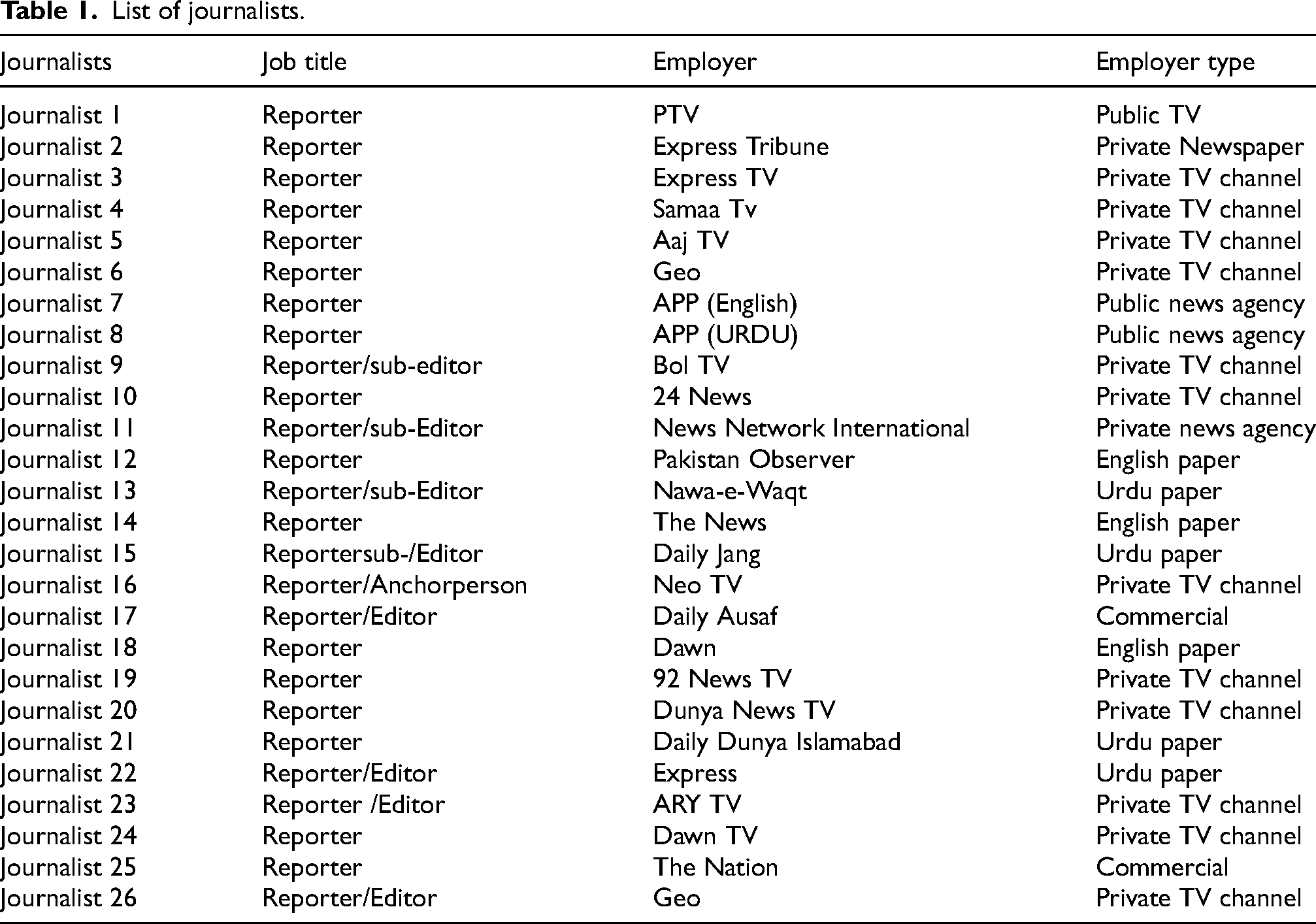
Since the Pakistani media organizations do not employ special reporters for environment related issues, the researcher identified those journalists who were responsible for covering climate change issues. In this regard, 26 journalists belonging to leading media outlets in the country were selected. This study followed the sampling procedure adopted by Aharoni and Tenenboim-Weinblatt (2019) to ensure including journalists from all the major news organizations as well as the keeping in mind the theoretical needs. The interviewing process was stopped at the point when data saturation was achieved because adding more interviewees did not add in any significant way more useful information rather it was repetitive in nature.
These interviews were conducted in face-to-face interaction in different locations press club, tea chops and media houses. These took place between January 15 to March 10, 2021. These were semi-structured interviews. The questionnaire was produced keeping in view the research questions in mind. The questionnaire was sent in advance to the Interviewees. They were informed to call us for clarification in case of confusion. However, none of them complained in this regard. So, the initial draft was considered as the final draft. The interviews were conducted in Urdu language—the national language of Pakistan and lasted between 30 to 50 min. Supplementary questions were asked to make the arguments clear. The interviews \were recorded and later transcribed into English.
Thematic analysis was used to analyze the data. We followed the procedure adopted by Mulherin and Isakhan (2019) to analyze the translated material. In the first phase, the three authors carefully read the English translations of the interviews and identified the core themes. To highlight a particular theme, it has to be both substantial and representative (Mulherin and Isakhan, 2019). In the second phase, the three authors compared these themes and refined them. The final list of themes was prepared through consensus among the authors (Table 1).
List of journalists.
Findings
RQ1. How the Pakistani journalists see the climate change crisis in the country?
Respondents of various media houses both from the state run and commercial or private sectors a number of perspectives while answering this question. These perspectives broadly pertained to (1) vulnerability of the country (2) political apathy and (3) a cautious optimism.
Vulnerability of Pakistan
Almost all the journalists knew that Pakistan was among the most vulnerable countries in the world due to its location and poor economic conditions. They expressed fears in the wake of melting of Himalaya glaciers in the north of the country as floods can wreak havoc to the agriculture sector—the backbone of economy. They were of the view that Pakistan was more vulnerable because in case of any event, it did not had the resources to save its people and important infrastructure. A journalist (13) said, “The threat is looming large. Variations in weather patterns can disrupt the whole ecology. We need to take immediate action”. Another reporter (20) said, “We are living in dangerous times. While things are fine now, we may be running into a disaster if serious efforts are not taken. Unfortunately, the government machinery is still on this impending crisis. A number of journalists pointed to the political ramifications of the issues. For instance, journalist (5) said, “we need to engage experts to shape public opinion and inform the masses. The issue can contribute to inter-provincial and local conflicts in the future”. He feared things could get out of control if remedial steps were not undertaken at this stage.
Political apathy
Majority of the journalists were critical of the role of politicians. They believed the government as well as the opposition political parties were not serious in addressing this situation. They argued that political leaders were in better position to create awareness on the issue because of their contacts with the masses. They expressed hope if political parties included climate change as a priority in their political manifestos, things will improve to a great deal. A journalist (12) said, “The issue is directly linked to our economy, politics, foreign policy, judicial system, civil society, media and institutional mechanisms and therefore requires more deliberate, planned and comprehensive response from the political parties”. A number of journalists lamented that political narrative in the country revolved around point scoring and were responsible for creating misperceptions about the crisis. Journalist (26) proposed to initiate a national dialog on the issue. He said, “An all parties conferences can be convened on the climate change to undertake a concerted effort in this direction. Another journalist 24 said, “Climate change should be considered as a threat to national security”. He maintained that such a declaration would pressurize government to take corrective measures in the direct direction.
Most of the journalists appreciated the government policy to launch The Billion Tree Project. However, they feared the project was politicized and the real benefit not occuring. For example, journalist (5) said, “The Billion Tree Project should involve politicians across the board. If it is pursued as a government project, the opposition would soon start talking about it in terms of corruption and it may jeopardize its completion”. They believed political polarization would affect the goals of the project and success of this project heavily rely on the ownership from the politicians across the board. The journalists from the two government owned media organizations opined such projects should be used to start a debate on the enormity of situation in the country. They agreed they were under pressure to highlight the steps of the government instead of creating awareness about process on how this project would be executed.
A cautious optimism
Though the journalists were not happy with the lackluster role of media in creating awareness about this issue, however, they agreed as compared to past, climate change topic was reported with interest. They agreed more events about the awareness on the crisis were happening and these were reported in the mainstream media. Majority of the journalists were of the view that both politicians and media should take lead to create awareness about this looming catastrophe. For example, journalist (21) suggested that media should pressurize government to “declare climate emergency at the national level”. Another journalist (22) said, “the threats from climate change are becoming visible. People are now talking about it. The occasional media debate on the issue are driven by the public awareness”.
RQ2. What are the key factors that hinder constructive reporting of this crisis in Pakistan?
Journalists in this study identified a number of factors that hindered the news coverage of climate change. These can be broadly arranged as (1) professional needs of journalism (2) need for dedicated climate reporters and (3) lack of resources.
Professional needs of journalism
Almost all the journalists agreed that they reported stories that fulfilled the professional criteria of news. In this regard, they said an event should be newsworthy to be selected for reporting. A journalist (20) explained the criteria for news selection in this way: “To be reported as news, an event should be about some conflict, relevant to the debates in society and most importantly should engage audiences”. A number of journalists revealed they ignored a number of stories in the recent past relating to climate crisis because they believed these were not relevant. For instance, journalist (11) said, “we select only those news stories that result in some damages to human lives or bring significant disruption to the daily lives. News selection is a competitive process and events that involve deaths and injuries are easily included in the schedule”.
Apart from the deadly nature of events, journalists agreed it becomes easy to publish reports on climate change when politicians speak on the issue. They said it happened media in Pakistan gave preference to politics over other issues. A journalist (17) said, “When a top politician talks about climate, it is reported on the front page. If the same information is given by a climate expert or advocates, it is usually ignored”. When they were asked about the harms of political rhetoric, most of them disagreed. They were of the opinion that political perspectives on the issue would bring this issue to the limelight which can facilitate initiating some corrective measures. However, three journalists agreed that political rhetoric would damage the cause. They argued it was an expert level issue and the people with specialized knowledge should talk about it as compared to politicians who they feared would reduce it to points scoring.
Need for dedicated journalists
All the journalists agreed that reporting on climate and environment was a specialized field and should have dedicated beat reporters. However, they opined in the presence of financial crunch in the industry, the media owners would hesitate to do that. In the absence of climate reporters, important events were either missed out or improperly reported. The journalists confessed they were not trained in the field and hence could not report on it professionally. For instance, journalist (21) said, “Most of the times, I do not understand the story I publish. I simply rely on the readymade information provided by some relevant organizations”.
Journalist working for the Urdu media pointed to another important area that necessitates the need for dedicated reporters. They said they faced problems in translating the stories into Urdu language because the organizations working on climate change send press releases in English. Journalist (15) said, “When I report on the issue, I find it difficult to use easy language for the understanding of common people. Many of the jargons and terminologies do not have substitutes in Urdu that makes it harder for common people to understand the reports”. Another journalist (17) said, “Most of the times, the news disk would tell us to reduce the size of the story. Since we do not have proper knowledge of the field, we trim stories arbitrarily that I believe result in excluding important information”. Similarly, the journalists working for TV channels said they were unable to telecast events relating to climate due to unavailability of relevant visuals. A journalist (12) said, “TV is a visual media. You need need supplementary visuals with text. At times we receive good stories on climate but with no visuals. In this scenario, editors usually refuse to telecast stories shared by the climate organizations due to absence of visuals”.
Lack of resources and expertize
Journalists also opined that climate was an under-reported because it required a different mechanism. Both the government and media organizations required resources and expertize to generate credible information and then disseminate it accordingly. Journalist (22) said, “Though we receive some information from the international bodies on the state of global climate crisis but we do not find relevant information to Pakistan. When we approach to our experts, they usually give us old data that we cannot use for publication”.
Journalists complained about the media management skills of organizations that hold events on climate. They argued these organizations were not able to produce a comprehensive press release aided by photos and visuals. Journalist (8) said, “We have to cover a range of assignments on daily basis. The seminars and conferences arranged by climate organizations are longwinded and we cannot afford to sit there the whole day. So we need readymade information in the form of press releases but unfortunately these are poorly written, loaded with data and scientific information. How can I publish a piece of information that I know one body would understand it”.
Due to the market competition and shrinking budgets, journalists working for the private media suggested that the public sector media was better placed in this regard. However, the journalists working with the public sector media pointed to a number of factors that hampered their work. For example, journalist (1) said, “While working in government-controlled media, we cannot report accurately on the seriousness of crisis. We have to defend government stance and cannot criticize it for its handling of climate issue. So, I think the private media should take the responsibility for producing critical coverage”.
RQ3: What are the best strategies to promote constructive coverage of climate change crisis in Pakistan?
Journalists suggested a number of steps to better report on the crisis. Broadly, these can be organized as (1) accurate information about the impending crisis in Pakistan (2) joint efforts by the stakeholders and (3) engaging local and social media. Below follows an analysis of each of these arguments.
Accurate information about the impending crisis in Pakistan
All the journalists stressed for latest and detailed information about the climate crisis that the different parts of the country were facing. They argued that though information about Pakistan was published by international agencies but it was just one-time story. To bring it to the public agenda, they believed information should be provided on frequent basis. Journalist (4) complained, “Most of the information that we receive is too general in nature. For example, we are told Pakistan is the most vulnerable country. We need more specific information on how different parts of the country are affected by specific types of crisis”. He added, for example that people can be persuaded better if we tell them specifically with scientific evidence that how the glaciers in the northern areas were melting or the drought and rain-scarcity affected the southern parts. Likewise, journalist (8) said, “Pakistan is a diverse country. The information about regions should be clear and related to educate the people living in that particular region to adopt environment-friendly practices”. Other argued that with specific and relevant information, editors and gatekeepers could be easily convinced about the importance of information.
Joint efforts by the stakeholders
Journalists called for joint efforts among the climate change experts, politicians and media to holistically deal with the crisis. At the moment, they argued there was no substantive coordination among these bodies to educate the people. For instance, journalist (2) said, “The work and research of experts is not utilized but the politicians have some other priorities and the media is uninvolved. We need greater synergies among these groups”. Journalist (12) suggested if these bodies coordinated better, their interests can be better served. “Experts can get funds and resources if politicians are convinced about the enormity of the crisis. Politicians can get popular support if they honestly work for the cause. Media can play its true role if they highlight the right actions in this direction. All the three will be the winners”.
However, a number of journalists revealed that such a partnership was not easy to achieve. They were skeptical about the expertize of scientists in Pakistan to produce credible research on the magnitude of the crisis. Similarly, the country was in a political crisis and the politicians did not have the awareness or willingness to give serious attention to the climate. Similarly, media in Pakistan with its limited resources was struggling to survive and that it could not afford resources for the purpose.
Despite these challenges, majority of the journalists believed it was the solution. They were hopeful that there was realization in the society about the risk and that more and more voices were raised on it. Journalist 10 said. “As compared to the past, in the recent years and months, more climate change events are held and duly reported in media. I think there is realization in our society about this issue and it will find momentum in the times to come”.
Engaging local and social media
Journalists favored the idea that local and regional media along with the social media platforms should be utilized for highlighting the seriousness of crisis. They believed the climate change crisis had local repercussions and the local media could be constructively engaged in this regard. Though the mainstream media had correspondents all the around the country but apart from major events, most of the local happenings were either ignored or reported in negligible spaces. Journalist (5) said, “Floods or melting glaciers effect the local communities the most. The mainstream media would report on these events once but the effects on local populations remain for longer. Here the local media can play its role by updating the people about the events”. Another journalist (10) agreed that local media would give detailed and continued coverage to climate change events as compared to the mainstream media. “Only the local journalists having the knowledge of local conditions can educate people about the variations in the ecological conditions. Through local explanations and contexts, people can be easily persuaded to adopt the required practices”.
Alongside the local media, the journalists emphasized that social media can be optimally used for this purpose. A journalist (5) said, “The mainstream media is occupied with disruptive political events due to commercial needs. It is difficult to persuade the media owners to dedicate more time and space to the climate crisis. On the other hand, I think the social media platforms can be easily applied by the climate research organizations and individual experts to communicate directly to the people”. Another journalist (10) said, “Pakistan is rapidly connected through information technologies and hardly there are areas having no mobile connectivity. The advocates can use these platforms with least budgets and more efficiency”.
Discussion and conclusion
This study investigated the perspectives of journalists towards the climate change crisis in Pakistan. While applying the peace journalism perspective, the researchers analyzed the attitudes of journalists towards the crisis and the professional challenges that they faced and then identified strategies for more constructive debate. The peace journalism scholarship is useful approach to the analysis of climate journalism because it diagnoses the existing problems in the field by highlighting the deficiencies in the existing journalistic approaches and then suggest alternative vistas (Hackett, 2017). In this way, the contributions of this study are quite unique. We were able to identify the specific factors that influenced the existing journalistic practices and highlighted workable strategies for for constructive reporting of climate crisis as compared to the two important studies on Pakistan by Ejaz et al. (2021) and Sharif and Medvecky (2018) that presented rather generic findings.
While applying the diagnostic/prognostic principles of peace journalism, the agency of journalists occupies special importance (Hackett, 2011). The exponents agree that structures are determining factors of media content but journalists can skillfully utilize their profession to provide opportunities to audiences to better see the social world (Lynch and McGoldrick, 2005). In this study, we found that journalists in Pakistan were concerned about the vulnerability of the country to the climate crisis. They were prepared to play their role in highlighting the issue to press politicians for corrective measures. This awareness helped them to better identify the larger professional and organizational factors that affected quality reporting of existing journalistic practices. Such an awareness also helps journalists to pragmatically play their role in ameliorating situations (Hussain and Lynch, 2019). In a related study, Berglez (2011) found that journalists in Sweden negotiated their professional positions to bring the climate crisis agenda into public arena. In this regard, the journalists applied conflicting creativities to bring the climate issue into media logic, stretching to the maximum of professional boundaries by relying on scientific evidence and at times assuming normative roles to find solution to the climate issue (Berglez, 2011).
Apart from journalistic perceptions, the diagnostic/prognostic principles of peace journalism share with the scholarship on climate crisis that traditional media do not responsibly report on crisis due to the professional and commercial interests of media. In this study we found that journalists were concerned about the newsworthiness of events. As identified in a seminal study on news values by Galtung and Ruge (1965) and supported by Harcup and O’neill (2017), events having conflict and involving important people like politicians are usually selected as news. In our study, we found that journalists considered climate events resulting in deaths and disruptions as more important as compared to the scientific evidence that signaled towards the slow process of rising temperatures. Peace journalism approach maintains that journalists prefer events over process due to the demands of objectivity (Hackett, 2011; Lynch and McGoldrick, 2005). As a solution, the advocates argue journalists should expand the range of news sources as they can get newsworthy information from common people, civil society and scientific community (Hackett, 2017). Likewise, journalists usually depend on politicians for news. While the findings of the scholarship on political rhetoric are mixed, peace journalism scholars believe journalists can use these as opportunities for crisis solution by asking critical questions. In our study, the journalists were optimistic that climate crisis was slowly getting into the political agenda and journalists considered it a positive development. Once politicians make it a policy agenda, they can be held accountable for their actions. Moreover, as suggested by a number of journalists in our study, this would also encourage media outlets to give due importance to climate crisis. Researchers believe when climate crisis would acquire a more compelling public discourse, news media would to invest in the sector for comprehensive reporting (Gibson et al., 2016; Schäfer and Schlichting, 2014; Schmidt et al., 2013).
Apart from the above, this study also offers some practicable solution for constructive reporting of climate crisis in Pakistan. To encourage journalists of mainstream media to include climate news, they should be provided relevant and accurate information. This should establish the cause and effect relation (Brüggemann, 2017; Osaka et al., 2020; Tandoc and Takahashi, 2014)). This is possible when the important stakeholders like scientific community, government officials and media play their due role. Studies show media can play help reunite important actors when a society faces crisis (Hussain, 2020; Lynch and Galtung, 2010). The impending climate crisis threatens everyone and media should create consensus on it. In this regard, peace journalism approach is better suited that calls for highlighting the causes, consequences, history and background information about an issue (Lynch and McGoldrick, 2005). Such an approach would create critical awareness among the audiences and help garner their support for corrective measures.
Studies have documented the limitations of traditional media in performing their normative roles due to commercial interests. On the other hand, the social media due to absence of elitist controls and economic considerations are well poised to highlight development agenda like climate crisis. Peace journalism have long argued that social media can be utilized to promote peace during confict times (Hackett, 2011; Lynch and Galtung, 2010). During the attack on a mosque in New Zealand, a global anger was expressed against the rising Islamophobia. The climate activits can learn from such experiences and lauch global online campaigns to press governments for corrective policies. In our study, journalists were aware of the power of social media and suggested to experts and members of local communities to use these platforms to promote the casuse of climate activism in Pakistan.
This study is not without limitations. First, we only interviewed journalists. Politicians, climate experts can be included for devising a more holistic debate on the issue. Secondly, social media are emerging as very popular platforms in Pakistan. Future studies should look into the potential of these avenues. Last but not the least, large surveys can be administered to include opinions of the local journalists. Despite and other limitations, we believe our study highlights important points that would help academia and media practitioners to better understand the problem at hand and strategize for constructive reporting of the crisis.
Footnotes
Declaration of conflicting interests
The author(s) declared no potential conflicts of interest with respect to the research, authorship, and/or publication of this article.
Funding
The author(s) received no financial support for the research, authorship, and/or publication of this article.

About the authors
Appendix
Questionnaire
Different research organizations have reported that Pakistan is highly vulnerable to climate crisis. What is your personal opinion on it. In your opinon, what are the causes of climate crisis in Pakistan? Do you believe there are some improvements in terms of increased poltical, media and public attention to the topic in the recent times? Studies show Pakistani media gave least coverage to the climate crisis. What are the reasons behind that? In our opinion, what the strategies that could be adopted to bring this issue in the media agenda. What could be the best journalistic practices to report on climate crisis—practies that are workable and easily practiced in the special context of Pakistani media environment. Any other thing that you would like to highlight in relation to media reporting of climate crisis in Pakistan.