



Abstract
In this paper, the impact of Information and Communication Technologies (ICTs) on economic growth in South Asian countries is investigated during 1990–2014. For this purpose, the newly developed panel data estimation method Dynamic Seemingly Unrelated Regression (DSUR) is applied. According to the results, the impact of ICTs on economic growth remains positive in South Asian economies. In addition, education stimulates economic growth; however, foreign direct investment does not contribute to economic growth. The newly acquired result would guide policymakers and government officials to focus on the advancement of ICT for maintaining the sustainable economic growth. The findings imply that South Asian countries should raise the ICT level with proper technology education level to achieve the desired economic growth.
Introduction
Recently, many countries have adopted the concept of “mainstreaming” ICT in sustainable economic development. For any country, sustainable economic growth is crucial for the sound and balanced development of the entire country. One of the important factors supporting sustainable economic growth is telecommunications technology and innovation, given its role and functions as an indispensable infrastructure of modern times. It provides economic development opportunities compatible with environmental protection (Maneejuk and Yamaka, 2020). More recently, ICT adoption has been widely accepted as a determinant of economic growth, human and sustainable development ((Appiah-Otoo and Song, 2021; Gómez-Barroso and Marbán-Flores, 2020). ICT and its applications remove the trade and investment barriers globally by providing a close linkage between customers, suppliers and firms (Pradhan et al., 2015). Furthermore, the ICT creates new opportunities in education and health, which accelerates the diffusion of information all over the world. In fact, the significance of ICT shows that the technologies are rationale (Fernback, 2018).
During the last few decades, ICT has changed societies dramatically and now these societies are more closely connected than past (García-Muñiz and Vicente, 2014). Finding the new sources of access and use of ICT make it more appropriate for the development of the other service sectors (Leidig et al., 2016). Access to ICT digital applications like smart phones and internet has significantly influenced social life of human beings and experts considered these applications as effective tools for economic development of a country (Houston et al., 2015; Qureshi, 2013). There are many time series and panel data studies about the nexus between ICT and growth which are available in existing literature. For instance, (Salahuddin and Gow, 2016) conduct study for South Africa; (Njoh, 2018) in Africa; (Pradhan et al., 2016) and (Pradhan et al., 2015) Asian economies; (Mohammed et al., 2017) for African countries; (Chakraborty and Nandi, 2011) in developing countries and (Liu et al., 2020)(Latif et al., 2018) for BRICS countries.
Education increases labor productivity and economic growth by increasing the human capital of the workforce (Benos and Zotou, 2014). Education may be one reason why most developing countries do not enjoy the full benefits of technological progress. For example, paying invoices online requires not only that the buyer has computer and internet knowledge, but also that the supplier develops and maintains this invoicing technology. The number of households using computers and the Internet has increased significantly. In the long run, education is an important force for technological innovation and economic growth in society. Therefore, in recent years, many countries are keen to build world-class universities to support their technological advancement and innovation-based development (Habibi and Zabardast, 2020). In the beginning of 20th century, the world observed enormous foreign investment invested by multinational companies in the South Asian region. The main reason behind these investments was most likely to be the huge population, weak economy and dependence on foreign investment. In this regard, the work is done by examiningthe role of ICT in achieving the foreign investment. The results of these studies depict that with the increase in ICT investment results in higher level of foreign investment in some of South Asian countries.
South Asian economies have shown remarkable growth in penetration of ICT and became the fastest growing countries in the region (Hussain et al., 2021; Liu et al., 2021a). South Asian countries are densely populated having almost similar economic and social conditions. Among these countries India, Pakistan, Bangladesh and Sri Lanka privatized their ICT sector to attract investment and expand trade activities to ensure economic growth. Indian government recently decided to develop more than 100 cities into smart cities to strengthen the economy of the country (Chattopadhyay, 2017). Similarly, Pakistan, Sri Lanka and Bangladesh are also digitalizing their cities, which lead towards the enhancment of economic growth through information technology (Gries et al., 2009). Therefore, the situation is attracting to conduct a separate study whether develpoment in ICT contributes to economic growth for the South Asia region or not.
In the aforementioned studies we have found several deficiencies. First, from the literature, the previous studies mainly discuss the impact of ICT on economic growth in different region of the world. However, for South Asian region, this growth and ICT relationship is studied by Hussain et al., (2021) and (Usman et al., 2021) for Asian countries, however they ignored the potential factor. Meanwhile, (Donou-Adonsou, 2019) and (Habibi and Zabardast, 2020) investigated the role of education in the relationship between information technology and economic growth for Sub-Saharan African and Middle east and (Habibi and Zabardast, 2020) OECD countries only. So, the nexus between information technology, education and economic growth for Asian countries is not explored so far. Further, the existing literature mostly examined the ICT effect on economic growth in various dimension; such as several studies consider mobile phone and internet as an indicator for ICT sector. On the other hand, some studies investigate various indictors for ICT sector, such as landline, fixed broadband, internet and mobile usages. However, none of the studies has examined that how ICT sector contribute to economic growth with the passage of time and change with technology.
This study contributes in the following ways; it investigates the effect of ICT on economic growth considering the potential role of education in South Asian countries. We use two additional variables education and foreign direct investment (FDI) in the nexus of ICT and economic growth those have been ignored in the literature for South Asia. The sample data over a long period has been taken for analysis i.e. (1990–2014). Finally, the study employs recently developed panel integration and long-run panel estimation tests to obtain most significant results. Moreover, most of the panel studies do not take cross sectional dependence in their econometric analysis, ignoring the issue may produce biased and inconsistent results. It will further eliminate the issue of cross-sectional dependence during the analysis, because ignoring it would give unreliable and inconsistent estimates.
Related studies
Relationship between ICT and economic growth
Baliamoune-lutz, (2003) found positive relationship between ICT and growth incorporating trade, education, financial development and freedom indicators employing panel of 46 developing countries with the help of Gompertz model. The results show that the trade and income influences ICT with the passage of time. However, freedom indicators have a neutral effect on ICT. Furthermore, (Erumban and Kusum, 2016; Ishida, 2015; Shahiduzzaman and Alam, 2014) used panel data series and found a significant positive impact of ICT investment on economic growth. (Latif et al., 2018) also analyzed the nexus of ICT and economic growth by incorporating trade and globalization for BRICS countries by using Dynamic Ordinary Least Square techniques (DOSL). In present days, ICT become a core part of the economy, and all the business stakeholders comprising firms and customers use mobile phones and internet for trading activities like providing consumers’ different product varieties and improving quality of products. Resultantly, the influence of ICT in societies increased during the last few decades. Apart from this, nexus between information technology and economic growth is widely debated across region and for panel group of studies. Pradhan et al., (2021) for G-20 countries; Asongu and Odhiambo (2020) for Sub-Saharan African countries; Appiah-Otoo and Song, (2021) compared rich and poor countries; Maneejuk and Yamaka, (2020) for developed and developing countries. These studies have concluded that information technology induce overall positive net effects on all three economic growth dynamics.
ICT and education nexus
The existing literature gives a possible link between ICT and education (Berrío-Zapata and Rojas-Hernández, 2014; Turner-Cmuchal and Aitken, 2016). The authors concluded that with introduction of ICT and its application in education sector, a positive impact is observed on education. On the other hand, Bolton Palumbo, (2014) depicted an indirect effect of ICT utilization in education. He argued that the effective utilization of ICT tools by teachers can lead towards a better education system and reduce the flaws in conventional education system. Recently, Habibi and Zabardast, (2020) investigated linkage between digitalization, education and economics growth comparing Middle East and OECD countries. The empirical results suggested that both technology and education are positively associated with the economic growth. Further, (Donou-Adonsou, 2019) estimated whether technology promote economic growth in Sub-Saharan African countries with better education. The result showed that internet user with better education contribute to economic growth, whereas, mobile phone user does not seem to do so.
Model specification and data source
Model specification
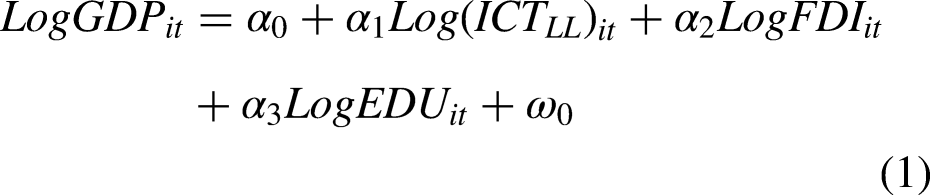
ICT sector is rapidly growing in both developing and developed countries during the last two decades. The term ICT has been used extensively adopted as a core variable in previous studies (Danish et al., 2018a; Latif et al., 2018). The rapid innovations in the ICT sector are considering a key tool in the economic development of a country. The change in technology means a various type of changes in ICT sector, i.e., landline telecom (LLT), fixed broadband (FBB), a number of internet users and a number of mobile users. The empirical estimation is based on the following model for each measure of ICT:



Data source and Variable description
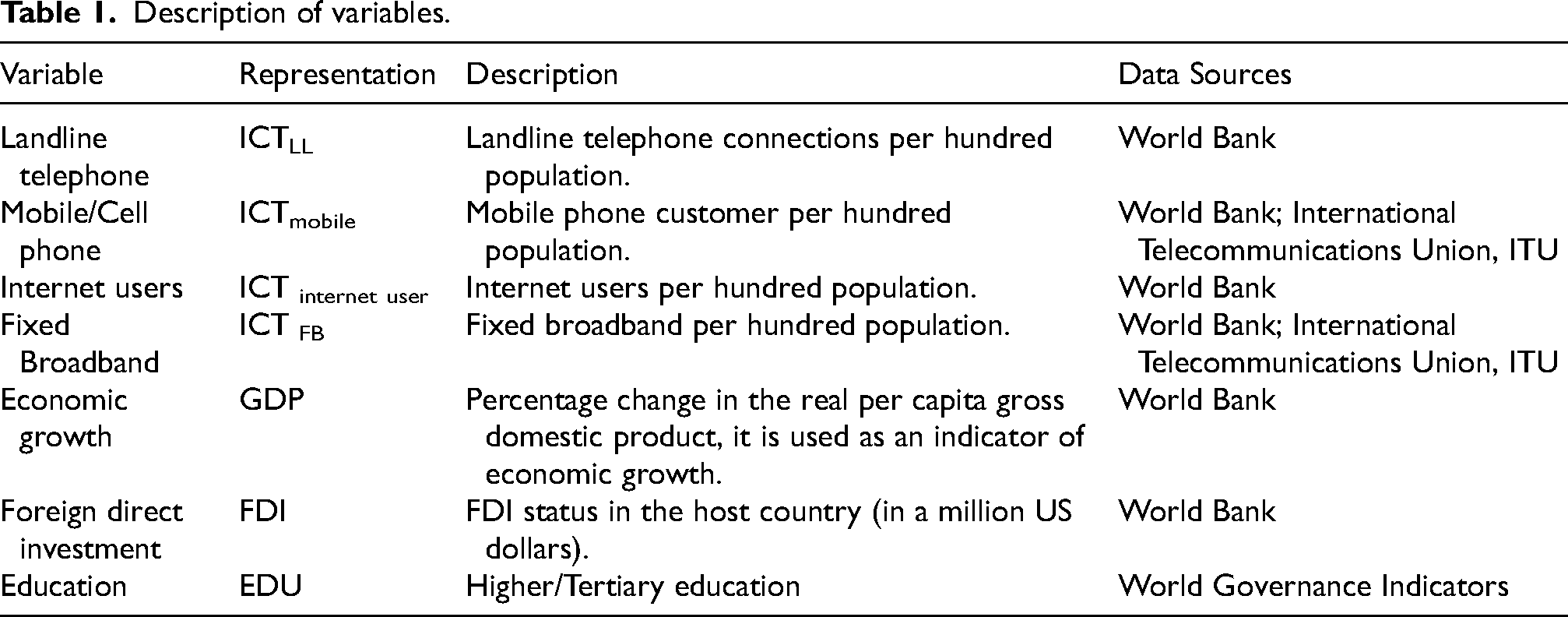
The secondary data spanning from 1990–2014 was collected for ICT variables for our econometric analysis. Data has been taken from the World Bank Indicator (WBI) for the time period of 1990–2014 1 and has been chosen on the availability of data. The change in ICT is measured through, internet penetration per 100 users, mobile use penetration per 100 users, number of the users of landline and fixed broadband. The measure is selected based in existing literature. Danish et al. (2018a) (Liu et al., 2021b) used internet and mobile phone penetration as a measure of ICT. The variables are converted into their natural log for further necessary analysis. The variable details are illustrated in Table 1.
Description of variables.
Econometric methodology
Cross-sectional dependence test
Generally empirical estimation starts with the investigation to find the cross-sectional dependence among the target countries. In our case, the selected Asian countries have different characteristics; there may be a possibility of the existence of cross-sectional dependence. In advance to analyzing stationary properties of economic growth (GDP), FDI, EDU, ICTLL, ICTFB, ICTinternet and ICTmobile, the paper first employs cross-sectional dependence suggested by (Pesaran H, 2004),because ignoring the cross-sectional dependence lead to misleading and unreliable results.
Panel unit root test
In second step of analysis, for finding the unit root, this study employs advanced CIPS and CADF unit root tests for panel data estimation. South Asian countries have different economic structure and varied level of ICT infrastructure. Hence, there may be a possibility of cross-sectional dependence, therefore we prefered to use second-generation CIPS and CADF test because it generates efficient estimates and overcome the possibility of cross-sectional dependence.
Panel cointegration tests
After unit root estimation, the next step is to confirm the level of relationship among underlying variables. The purpose of cointegration test helps to reach the long-run estimation of non-stationary variables. Therefore, in this study we prefered to use the Westerlund panel cointegration test by (Westerlund, 2007), which gives robust values in the presence of heterogeneity.
DSUR long run estimation method
Based on the evidence of cointegration, we pursued estimation of long-run dynamics. In the existing literature, most of the panel data studies did not address the issue of heterogeneity properly while using latest estimation methods. Due to which the results produced are biased and unreliable. The dynamic seemingly unrelated regression (DSUR) method by (Mark et al., 2005) is preferred to measure the long-run estimation among the underlying variables. DSUR is slightly different from the DOLS and FMOLS, as DSUR method correct the problem of endogeneity with the help of leas and lags of the first difference. In addition, DSUR is more efficient than DOLS because the estimators in DSUR are more consistent and produces fewer biases than OLS model estimation. Based on the above argument the selection DSUR method is the most appropriate one for the current study.
Empirical results and discussion
The descriptive statistics of underlying variables for South Asian countries are given in Table 3.
Results of cross sectional dependence test.

Note. a is the level of rejection at 1% level of significance.
Results of the descriptive statistic of variables.
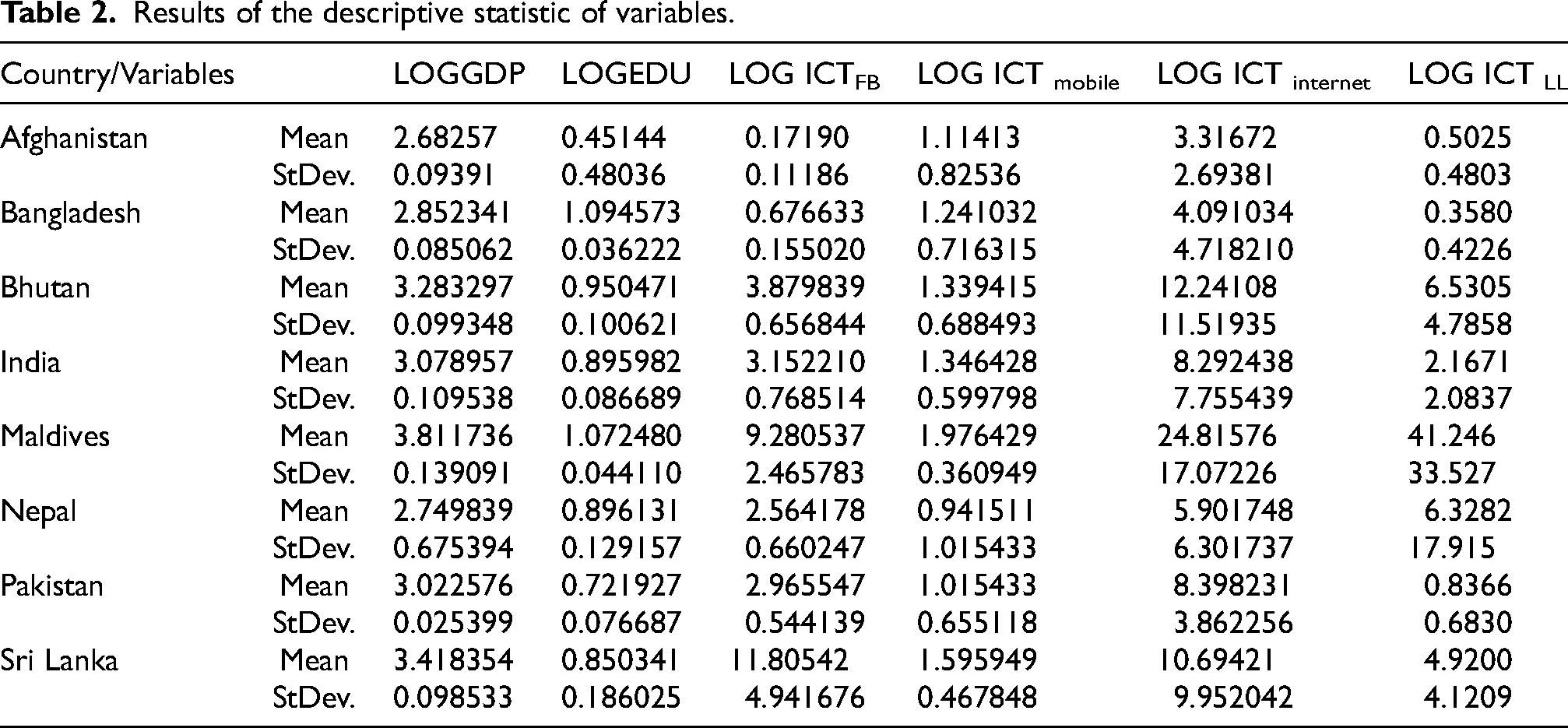
Table 3 contains the results derived from cross-sectional dependence test In Table 3, the probability value of the model depicts that all variables tend towards normality and thus we can pursue the regression test Further, the presence of cross-sectional dependence can be seen for underlying variables. Table 4 consists of the results derived from CIPS and CADF unit root tests. It depicts that we reject the null hypothesis of non-stationary at first difference and hence, the underlying variables are integrated at first difference I(1).
Results of CIPS and CADF panel unit root tests.
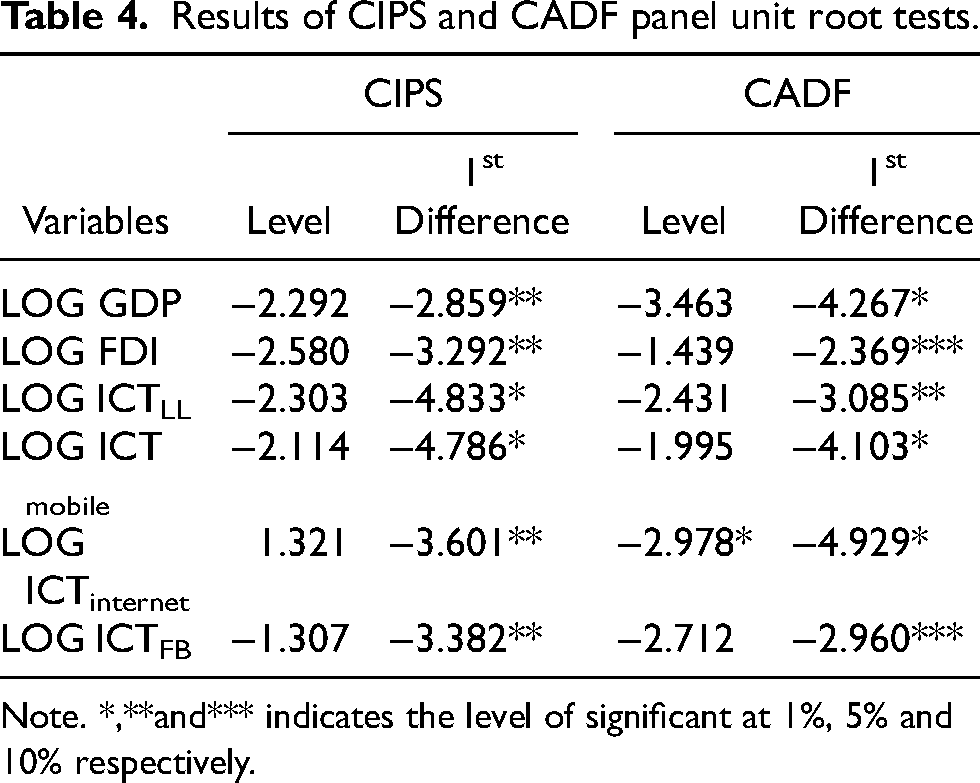
Note. *,**and*** indicates the level of significant at 1%, 5% and 10% respectively.
Panel cointegration
According to the values derived from Westerlund cointegration test given in Table 5, we reject the null hypothesis of no cointegration for all four models. Hence, it implies that the cointegration exists between the subject variables.
The result of westerlund panel cointegration test.
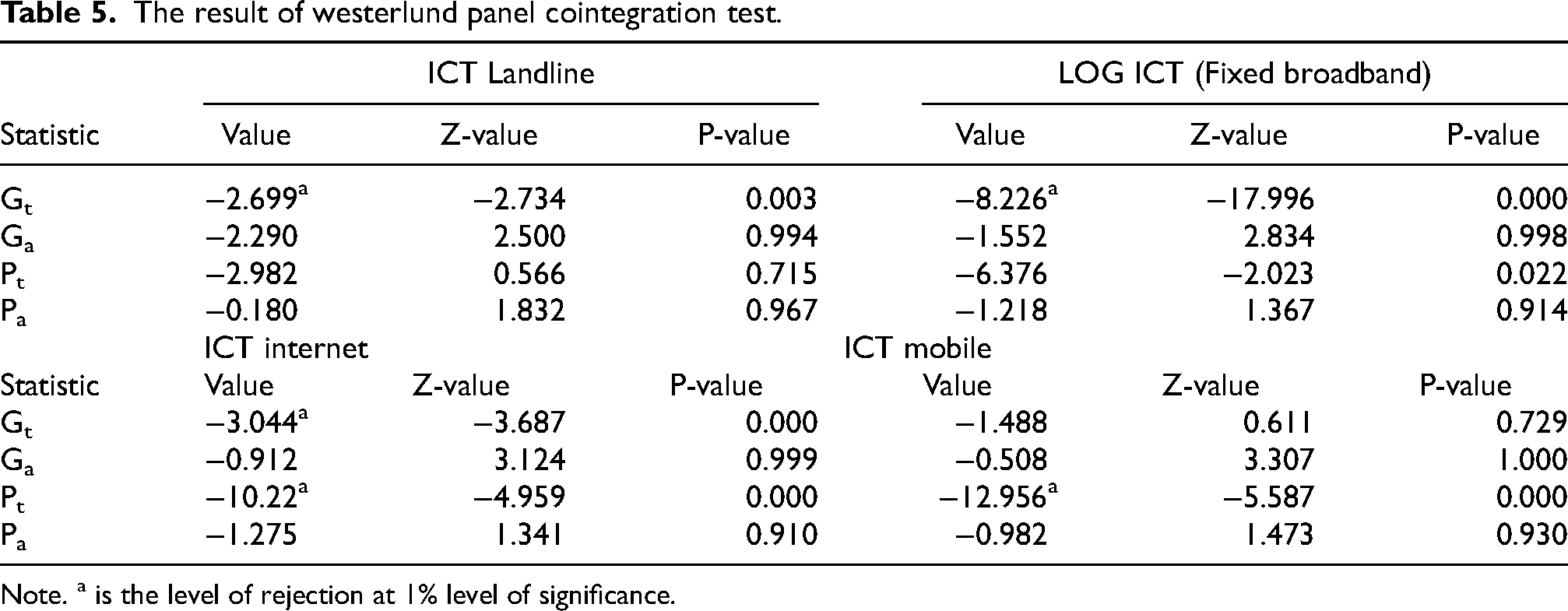
Note. a is the level of rejection at 1% level of significance.
After confirmation of cointegration now it turns to estimate the long run results, which is the key focus of the current study. The DSUR panel data estimation method is applied for long-run estimation and is given in Table 6. The change is ICT refers to various kind of technology with the passage of time, such as ICT Landline (Model 1), ICT fixed broadband (Model 2), ICTInternet sources (Model 3), ICT mobile (Model 4). The results depicted from DSUR method show a significat relationship between ICT and economic growth for each model, i.e. (Model 1, Model2, Model 3 and Model 4).
DSUR-Dynamic seemingly unrelated regression (panel estimation).
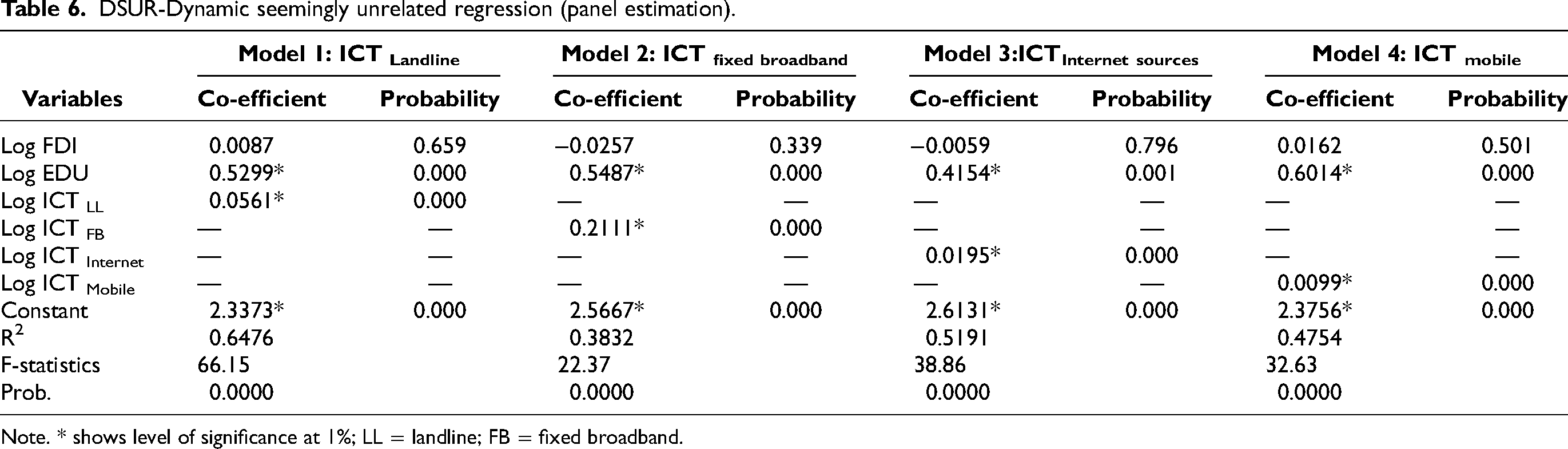
Note. * shows level of significance at 1%; LL = landline; FB = fixed broadband.
The finding indicates that a long-run relationship exists between ICT and growth, also the economic growth is elastic to ICT. In other words, with a change in technology, the effect on economic growth remains the same implying that change in ICT technology sustains the level of growth in South Asian region.
The landline telephone system is a core and earliest application of modern ICT technology. Generally, the ICT sector boost up with the advancement in landline telepone network during the last two decades. In South Asian coutries, India, Pakistan, Bangladesh and Sri Lanka liberilzed their telecom sector in the beginning of 21st century and received a huge amount in shape of foreign investment by providing voice communication all over the region. Similar results have also been derived by (Oseni and Pollitt, 2017). Moreover, the internet service providers (ISPs) can be also a possible reason in the penetration of internet users that attract enormous investment by providing ISPs lisences to different multinational vendors. These investments in the ICT sector in shape of various companies both in public and in private sectors reshaped infrastructure and created many job opportunities in the South Asian region. Furthermore, these advancements in ICT sector fasten the business dealings throughout the region. The previous studies conducted by (Asongu and Nwachukwu, 2016; Kodila-Tedika and Asongu, 2015) support the results depicted in our research study and added to the discussion that the de-regulation policies adopted by some of the South Asian countries results in a rapid increase in mobile phone users that further enhanced the country economic growth and created employment opportunities for the citizen of the region. Finally, from the results, it is very clear that for achieving the long-run sustainable economic growth, the ICT, and its applications need to be promoted in this region.
The findings also depict that FDI has an insignificant impact on economic growth. In another words, FDI does not contribute to the economic growth of South Asian countries. The reason could be that FDI outflow from south Asian countries towards developed countries is greater than FDI inflow, which gives more advantage to the developed countries instead of host countries.
Lastly, education positively affects the economic growth in the entire four models estimated in the study. Education can play an important role in the development of the living standards of the citizens in the South Asian region. By introducing internet and computer knowledge in colleges and universities of South Asian countries will lead towards the increase in knowledge and maturity of the citizens and they can actively participate in social development. The results of our study illustrate that with the introduction of the internet and smartphones in education system will lead to enhance the quality of education and produce a competent digital workforce that can contribute towards the development of a country. The results are consistent with the study of (Salam et al., 2018) in which authors highlighted that the ICT adoption has a significant positive impact on the education sector in the developing countries including digital workforce competency that further strengthen the economy.
Conclusions and recommendations
The purpose of this study is to investigate the impact of the change in ICT and economic growth controlling the model for FDI and education. To serve the purpose, the DSUR panel estimation method was used for South Asian economies from 1990 to 2014.
Main findings
The main findings of the study are:
ICT strengthens the economic growth, and the effect of a change in ICT on economic growth remains the same. The impact of FDI on economic growth is significant. Finally, education affects positively the economic growth in South Asian countries.
Policy recommendation
Most of the South Asian countries badly suffered due to poor law & order and terrorism issues. Particularly, Afghanistan and Pakistan during the last couple of decades underwent the worst chaotic situation. Also, a problem of weak political institutions and corruption affect almost all the South Asian region. Moreover, South Asian countries rely mainly on foreign investment for their economic development. ICT sector has a potential to attract enormous amount of foreign investments throughout the region, which will further lead towards the development of this most populated region of the world. Hence, ICT can be a game changer for the stainable development and growth.
In order to develop the ICT sector, South Asian countries must formulate their policies that can produce skilled ICT persons, up-to-date ICT applications and reduced the cost of latest ICT applications and equipment. Ensure and ease the complex rules and regulations in a legal environment and the respective governments in the region should provide easy access to ICT services to the people living in urban and rural areas.
Other than some interesting findings, the study has some limitations. Some more variables can be tested in future to analyze the influence on economic growth with change in ICT sector, such as population and inflation; imported technology (Danish et al., 2018b); financial development (Salahuddin and Gow, 2016; Xu et al., 2018) and corruption (Wang et al., 2018). The similar model can be used for another panel of countries and time series data to validate the study.
Footnotes
Declaration of Conflicting Interests
The author(s) declared no potential conflicts of interest with respect to the research, authorship, and/or publication of this article.
Funding
The author(s) disclosed receipt of the following financial support for the research, authorship, and/or publication of this article: This work was supported by the Natural Science Foundation of Zhejiang Province, (grant number LQ21G010007).
