



Abstract
Access to agricultural information has continued to be a key important issue in the fight for food security. This is as a result of the role played by information to farmers in improving food availability. This study presents the level of social skills possessed by smallholder farmers in South West Nigeria and how it affects access to agricultural information. Mix method approach involving structured interview and focus group discussion was adopted. Result of the structured interview showed that the highest rated mean among social skills is team work (3.27), followed by conflict management (3.16) and the least is oral communication in foreign language (2.70) while focus group discussion revealed that the highest skill is communication in local languages. A logistic regression analysis showed that oral communications in vernacular, entrepreneurial skills influence on others, team work and ability to form network are the five social skills that are significant in predicting access to agricultural information. An important implication is that information should be packaged in local languages and the skills on foreign language among smallholder farmers should be improved upon to enhance access to agricultural information. It is recommended that more conscious effort should be made to improve the level of social skills among smallholder farmers.
Introduction
Information is the most important and common entity in the world. It is a vital input for decision making. Nkiko and Iroaganachi (2015) stated that information is always available on virtually every issue in life. However, it is the flow of information that keeps human society alive, progressing and moving. According to Ranganathan (1973), information communication is essential for living. The author noted that there is no survival, in biological, social and spiritual planes. Gate and Hemingway (2000) have a strong belief that how one manages and uses information determines whether one will win or lose. The above suggests that availability or improved information alone is not sufficient for improved-decision making. Access to such information is one of the prevailing issues that need to be pursued since as revealed by Freeman and Qin (2020), access to information leads to information adoption.
Hence, access to information need to be pursued among the growing donors and developmental agencies as well as librarians and field agricultural extentionists helping to contribute to meaningful development of the smallholder farmers. Access to information has been problems to this group of people who are always found in rural setting such that possession of some social skills can enable them have access to agricultural information. Information asymmetrical is one of the threats to the rural poor which smallholder farmers represent. It is widely acknowledged that improved, timely and current information provides useful, logical and consistent decision making that helps to defend the interest, articulate need and increase bargaining power. Although access to information is widely recognized as basic and fundamental right of every citizen of any nation, it has consistently remained poor in the hands of rural dwellers. To ensure that the smallholder farmers have access to agricultural information, it is necessary that they possess enough social skills.
Social skills accounts for a pattern of behaviour that is relevant for accessing information. Smallholder farmers need to possess appropriate social skills; it is not adequate for them to possess only the functional skills but also to possess the real-world learning (social skill) experiences that will enable them to be adaptable and enterprising. So the standards-driven information access requires smallholder farmers to demonstrate their learning in various real life dimensions. That is to say that there are different types of learning outcome expected from smallholder farmers. Besides, according to UNESCO (2014), economic success also requires education and training systems that impart broad-based problem-solving skills as well as the social and interpersonal skills and attitudes required for effective teamwork. This is owing to the fact that human beings are inherently social. Competencies in managing social skills enhance a person's ability to succeed in many endeavours as well as positively influence mental health, success in work, and the ability to be a good entrepreneur. As stated by Rawles, (2016), social skills represent the individuals’ social and behavioural health success. According to Steedly et al. (2008), social skills are components of behaviours that enable people to comprehend and suitably adjust across different social environments. Fragoulis and Phillip (2011) has it that rapid economic, social and technological changes have turned social skills into an absolute necessity for human resources and the achievement of a successful career. Daraee, et al. (2016) noted that social skills are considered one of the important factors in the success or failure of every individual in a society. They are behaviours that enable individuals to interact influentially and to abstain from undesirable responses. Individual or organizations’ success to a large extent depends on the application of social skills.
According to Beheshtifar and Norozy (2013), organization's success is based on individual communications and their focus towards achieving required social skills. Chalkiadaki (2018) stated that the structural component of social skill include communication and collaboration, cultural awareness and global awareness and leadership. The author further broke the structural components of social skill to communication and collaboration to include skills such as skilled in oral and written communication in the mother tongue and foreign languages, team-working especially in heterogeneous environments, open-mindedness and conflict management. Cultural awareness and global awareness includes ability to appreciate the value of the varied cultures and to intentionally construct cross-cultural relationships and networks and cultural awareness and global awareness. Leadership involves self-motivation, initiative taking, entrepreneurship and leading by influence. It can be inferred from this that social skill can be defined as a set of competencies utilized by people to interact and communicate well with one another (Feitosa et al., 2012).
Contextually, social skills are skills necessary to work in social environment, comply with an instruction, participate in increasingly diverse society, ask questions or help in order to meet one's needs, get along with others, maintain positive relations and cope with rapidly changing workplaces. It involves behavioural components of a person. Literature have shown that people who possess social skills, can easily solve problems, undergo changes easily, and adapt to circumstances, Jurevičienė and Ruškus (2012) but due to insufficient social skills an individual becomes dependent on people surrounding him as is exemplified in (Gedvilienė and Baužienė, 2008). Social skills have some characteristics which include respect, responsibility, fairness, caring, learning among others.
According to Argyle, (1983); Dowling, (2001); Gresham and Elliott (1993); and Webster-Stratton, (2002), one of the basic characteristics of social skills is that they are acquired through learning. Leta, et al. (2018) stated that social learning is widely practiced by most farmers to cope with unequal distribution of extension related knowledge, technologies and agricultural inputs. Farmers learn everyday in an informal environment and according to Robinson-Pant (2016) “ethnographic research on everyday learning has shown that people can and do learn literacy and numeracy informally through vocational training and on-the-job experience, rather than only in the classrooms”. The author reaffirmed the consequences of Millennium Development Goals (MDGs) on universal primary education (UPE) which has “shaped the educational policy agenda to date, leading to the continued lack of prioritization of adult learning in national educational plans”.
Reflecting on this, UNESCO (2013) on post-2015 education proposed a strengthened and broadened Education for All (EFA) vision as an integral part of the broader international development framework, highlighting equitable access to lifelong learning opportunities to develop skills and competencies for life and work as a focus. Equitable access to information for lifelong learning as regard to smallholder farmers can be achieved by improving their social skill. Social skill is key in access to agricultural information especially in rural setting where the smallholder farmers reside. According to Gardner (1983, 1993 and 2006); Albrecht (2006); the domain of social intelligence is a critical component of descriptions of human ability and behaviour.
Besides, Beheshtifar and Norozy (2013) noted that if corporate strategy and technology is complex, a key success factor becomes the human factor. Improving smallholder farmers’ social skills will certainly strengthen their ingenuity to access general agricultural information as well as complex input information. It will equally increase their confidence and bargaining position and assist in gaining better agricultural production thereby reducing food insecurity. As stated by Shaijumon (2018), “achieving sustainable agricultural development is less based on material inputs (e.g. seeds and fertilizer) than on the people involved in their use”p.602. Better understanding of smallholder farmers’ information access and learning process is key in the move towards more food availability. A person with good social skill serves as good agricultural information disseminator. Possessing appropriate social skill direct individual on what to say, how to say it and when to say it. It also equip individuals on how to make good decisions, act in different settings, and are very important in relating with diverse people in farming community. Good social skills contributes to healthier interactions with smallholder farmer, hence they are an integral part of effective functioning of information dissemination.
Thomas, et al. (2020) cautioned against using past tendency of simplistic and often dualistic terms for different types of knowledge access. Reed et al. (2010) stated that this “does not sufficiently take into account the way individuals learn, make sense of the new information or the social contexts that influence how people understand issues” The findings of Mtega, et al. (2013) revealed that the knowledge sharing process among rural communities in Tanzania is mainly through discussions and conversations held on several occasions. The findings of Fidelugwuowo (2021) equally showed that the major source of agricultural information in South East Nigeria was through friends and co-workers. Sabo et al. (2020) revealed that rural farmers in Nigeria “were more exposed to the informal sources of agricultural information such as family members and fellow farmers compared to the formal and professional sources such as extension workers and the mass media”p1. By implication these farmers need to interact in order to access these agricultural information, to interact they need to socialize. Socialization needs social skill in order to be realized.
The outcome of the above works highlights the importance of social skill in accessing agricultural information especially among rural farmers. Nonetheless, none of them points to the skills that will enable the rural farmers improve their access to agricultural information. Although changes in organizational structures have heightened awareness of social skills in certain career outcomes, surprisingly no research to the best of my knowledge has considered the social skills for accessing agricultural information among smallholder farmers’. Therefore this study is set to fill this gap. The specific objectives of the study are to identify the major social skills possessed by smallholder farmers and determine their effect on access to agricultural information in South West Nigeria.
Literature review
An overview of importance of social skills in smallholder farming
According to Federal Office of Statistics (1999), smallholder farmers are farmers whose production capacity falls between 0.1 and 4.99 hectare holding. They are mainly resource poor farmers. These groups of farmers need many skills to access agricultural information and one of them is the social skills. The research into the area of social skills for accessing information is relatively a new phenomenon as is evidenced by the relative paucity of literature. However, this overview of its importance in smallholder farming is mostly on the component of social skill as structured by Chalkiadaki (2018).
The author foresaw that social skills increases network structure. Smallholder farmers leave in social setting where social practices are most of the time homogenous. As noted by Coleman (2000), social practices are directed to increase cohesion in communities and practices tend to be more homogenous. Tamako and Thamaga-Chitja (2017) found that farmers with more social capital are better at adopting adaptation strategies. The authors noted that this was possible because of the created networks and ties during the interaction of people. It was found that many farmers are using social capital as a platform to acquire agricultural resources, information, knowledge and credits. Membership of groups increases the likelihood that members will have access to agricultural inputs, technical advice and agricultural practice and management strategies which help them adapt to climate change. According to Ramirez and Hernández (2018), the problem of different local arrangements around construction of local networks and network governance led to diverse forms of inclusion. The author noted that they contrasted the outcomes for small-scale producers in terms of access to knowledge and new practices. This is as a result of dominant view amongst agricultural extension practitioners that small producer inclusion in agro-food markets primarily comes down to diffusion of information. As stated by Morris (1991), this lies on codification of top-down system of knowledge transfer and the propagation of “packages” of new practices and protocols by agricultural extension services to farmers.
Social skills promote bottom-up participation and democratization processes in information access especially as these are resource poor farmers. It helps to increase in building local social capital as a result of social network formation of the smallholder farmers. This was exemplified in Beddington (1997, 1998) where local organizations have, in some circumstances, been able to regenerate rural small farm production by managing, accessing and generating technologies and providing technical assistance to local producers. They also established hat strong external linkages include negotiating with the state, accessing markets and linking with financial services. According to Cagnin et al. (2012) and Carpenter et al. (2012), structures of social networks provide insights into the connectedness of actors and their social capital. They can also show the diversity of knowledge available to actors and the resources actors have at their disposal. On the other hand, Mansuri and Rao, (2013) was of the opinion that the governance of networks can explain how new technologies and practices are introduced by the agency of specific actor.
According to Shaijumon (2018) the major motive to join village resource centre (VRC) network is to obtain knowledge in their region, and recognize the significance of VRCs as a knowledge provider and innovation facilitator. It was also noted that around 11 per cent of VRC participants in one section of the study area carry the ideas introduced in VRC to farmers’ organizations. This establishes a bimodal network, other than merely strengthening the existing linkages between participants and non-participants. According to Aker and Mbiti (2010), the five potential mechanisms through which ICT can provide economic benefit include, facilitating communication within social networks in response to shock thereby, reducing businesses exposure to risks.
Entrepreneurial skill is another aspect of social skill. Its possession helps in surmounting many challenges. De lauwere et al. (2014) and Díaz-Pichardo et al. (2012) stated that climate change and inadequate government support among other things are such that smallholder farmers increasingly have to be entrepreneurial. They further emphasized on the need to develop new skills and capabilities to survive and remain competitive. Bruton et al. (2013), Díaz-Pichardo et al. (2012), McElwee and Bosworth (2010) equally emphasized on the importance of stimulating entrepreneurship in the smallholder farming sector for greater effectiveness in rural poverty and food insecurity reduction. As a key food security strategy, the South African government has prioritized entrepreneurship in the smallholder farming sector (Aliber and Hall 2012; National Planning Commission, (NPC) 2012). Hendriks (2014) noted that, the Integrated Food Security Strategy (IFSS), adopted in 2002 by the South African government was a means to eradicate hunger, food insecurity, and malnutrition. It was also aimed at increasing household food production and market participation levels. Hendriks (2014), National Department of Agriculture (NDA) (2002) noted that, among the expected outcomes of the IFSS is that the farming operations and rural enterprises owned or managed by the poor become more competitive and profitable.
NPC (2012) stated that the expectation is that agricultural entrepreneurship in rural areas would make farming a more attractive and profitable venture for the rural youths, making smallholder agriculture an important tool to reduce rural unemployment and thus control migration from rural to urban areas. According to Demyen and Iulia (2013) entrepreneurship in smallholder farming activities can help support industrial development in rural areas through its forward and backward linkages. Sinyolo and Mudhara (2017) found that entrepreneurship had a positive impact on food security. The author noted that the findings suggest that stimulating entrepreneurship through developing entrepreneurial competencies among the farming households is important for improved food security among rural households in South Africa.
According to Musa et al. (2018), among the divergent key factors inhibiting contract farming engagement were a lack in terms of quality seeds, trust, entrepreneurship and formal contract agreements. The World Bank Report (2013) was of the opinion that smallholder farming entrepreneurship is posited as the thrust of competitiveness and economic growth. Okpodu et al. (2020) found that in Akpabuyo Local Government Area of Cross Rivers State, small scale farmer do not possess entrepreneurial skill to recognize and realize business opportunities in their environment. The farmers claimed that they recognize opportunities only when there was an activity that is beneficial to their enterprise. Hanf and Muller (1997) suggest that in a dynamic environment with fast technical progress, an open-minded farmer with entrepreneurial skill recognizes more problems, as they are able to be solved in a rational way. The implication is that a farmer with entrepreneurship skill recognizes problems and work with them until decision-making is possible, create and maintain his personal cognitive requirements for problem solving and decision making and allocate limited time to management and operational tasks as well as to problems and decision-making.
The entrepreneurship nature of smallholder farming notwithstanding, every community is composed of people who interact on regular basis around a common set of issues, interests or needs as exemplified in the work of (Lesser, et al., 2012). According to Ranmuthugala et al. (2011), members of rural communities share knowledge to perform their day to day activities. The implication according to Bacsu and Smith (2011) is that for knowledge to be created and shared, communities must have opportunities for regular interaction and allowed to participate in discussions. The findings of Mtega et al. (2013) revealed that Knowledge was created through observations, personal experiences and social interactions and shared mainly through discussions and conversations held on several occasions. Lwoga (2009) found that rural people were members of formal and informal groups which held discussions on several occasions.
Communication is another important process of accessing information both linguistically and cognitively. It has become evident that there are communication problems and difficulties concerning accessing information in the rural area. This inevitably can cause problems among actors located at different levels of the communal networks responsible for the promotion of information access. It results in different worldviews and knowledge systems to collide. In this case, the bottom-up formula of participation will not easily marry the essentially top-down framework of development and modernization. This will lead to a confrontation of social actors with different epistemologies.
This was exemplified in Hagos (2017) where there were no explicitly designed rural food security communication strategies in Eastern Tigray but food security messages were communicated through frequent public meetings organized by the government representatives or development agents. Respondents indicated that public meetings were dominated by the views and interests of government officials and development agents that limited people's roles to participate in the strategic design and implementation of the food security programs. The author noted that according to the respondent despite frequent public meetings to communicate food security messages, meetings became unproductive to convey food security messages.
Firstly, public meetings employ predominantly a top-down communication approach, which limits people's participation in the decision-making processes. Secondly, food security messages through public meetings are not communicated in the languages of the people. The rural people, development agents and food security experts expressed their conviction about the appropriateness of folk media forms which were in their local language to have the potential to integrate them into food security communication strategies. The respondent noted that being credible sources of information with a potential to effectively address different needs of rural people, folk media continue to dominate the lives of people in their rural areas. The author concluded that harnessing these communication forms to food security communication strategies can help to raise the awareness of people about the nature, relevance and applicability of food security programs in Eastern Tigray of rural Ethiopia.
Chapman et al. (2011) equally found that vernacular radio programme can be used to improve the sharing of agricultural information by remote rural farming communities. The authors noted that participatory communication techniques can support agricultural extension efforts especially using local languages and rural radio to communicate directly with farmers and listeners’ groups. A format that combines a drama performed by local actors with corresponding thematic discussions was popular amongst farmers listening to agricultural extension radio programmes the authors maintained.
Another component of social skill is oral communication in foreign language. This skill appears to be very difficult in communicating information to certain group of people. For instance, Programme for International Student Assessment (PISA) (2006) reported that there have been poor English language levels among school-leavers such that mainstream media attention has been the general lack of ability to communicate in English.
Theoretical framework
This work is anchored on social learning theory. The theory was credited to Albert Bandura. According to Miller and Doddard (1941), social learning theory rests on the tenet that human behaviour is learned. In other words, it is acquired rather than inherent. Social learning theory shares the view that behaviour is learned and influenced by environmental factors and consequences. Cognitive processes are assumed to play a meditational role that is central to learning. Apparently, how a person cognitively process environmental information may be just as or even more important than the environment per se. As such, learning is viewed as a complex process involving interactions among cognitive, behavioural, and environmental variables. Social learning theory places a heavy emphasis on the social context. That is to say, that the social context both influences and is influenced by cognitions and behaviour. Human behaviour according to Maisto et al. (1999) was determined by an interaction of external stimulus events, internal processing systems and regulatory codes, and reinforcing response-feedback systems.
From a social learning theory perspective, social skills are learned behaviours. Social learning theory emphasize that the prevailing social skills conceptualizes from overt behaviour to the incorporation of a full range of cognitive, emotional, and behavioural skills and abilities, as well as motivational and expectancy sets. Learning opens the door to the application of conditioning and socialization perspectives. The learning process can be direct, involving actual exposure to the contingencies, or indirect, involving the observation of others. Indirect or vicarious learning can equally occur through more symbolic means, such as spoken or written language. These same learning processes are also presumed to be operating in the therapeutic context. As such, the social learning theory has given rise to a host of social skills intervention procedures, such as those that are direct (e.g. behavioural rehearsal, reinforcement, and feedback), vicarious (e.g. modeling), or based on symbolically represented experience (e.g. social problem-solving skills and self-instruction skills training) (Nangle, 2010).
Materials and methods
Area of study
The smallholder farmers of South West Nigeria which consists of Lagos, Ogun, Oyo, Osun, Ondo and Ekiti states were selected for the study. The area lies between longitude 2°311 and 6°001 East and Latitude 6°211 and 8° 371N (Agboola, 1979) with a total land area of 77,818 km2 and a projected population of 28, 767, 752 in 2002 (National Population Commission, 1991). The climate of South West Nigeria is tropical in nature and it is characterized by wet and dry seasons. The temperature ranged between 21°C and 34°C while the annual rainfall ranged between 150 and 3000 mm. According to Agboola (1979), the vegetation is made up of fresh water swamp and mangrove forest at the belt and the low land in the forest stretches inland to Ogun and part of Ondo State, while secondary forest is towards the northern boundary where the derived southern Savannah exists.
Research design
This study adopted a mix method approach involving structured interview and focus group discussion. Sümen and Çalişici (2017) used mixed method to examine the 21st Century Skills of Secondary School Students. Likewise Gregoriadis et al. (2017) investigated the parents’ perceptions concerning the impact of a physical education program named ESPEC (‘Early Steps’ Physical Education Curriculum) on their children's social skills. Structured interview was analyzed by assigning a numerical value to participants’ responses while focused group data was also coded according to the responses from participants.
Sampling and sample size
The multi-stage sampling procedure was used to randomly select three states namely Oyo, Osun and Ondo. The second stage of the sampling procedure consists of random selection of two zones of Agricultural Development Programme (ADP) per state. This represents about 60 percent of the zones in the states respectively. The zones are Saki and Ibadan/Ibarapa in Oyo State, Iwo and Ife/Ijesha in Osun state and Akure and Akoko in Ondo state. Stage three consists of random selection of two blocks from the lists of blocks per zone. The blocks selected were Saki, Igboho, Ido and Akinyele in Oyo State; Iwo, Ejigbo, Ijebu/jesha and Atakumosa in Osun State; Ishua, Ibule, Iwara Oka and Oke Oka in Ondo State. Stage four comprised of four cells selected randomly representing 50% of the selected blocks. Lastly, stage five was the random selection of seven farm households in each community making the population of the study to be three hundred and thirty six.
Instrument for data collection
Structured interview
The structured interview was prepared in English language and given to enumerators who were trained on how to conduct the exercise of data collection. In each state four enumerators were recruited on the basis of their experience in data collection, with focus on rural farmers and knowledge of the terrain. They were responsible for interpreting the questions to the respondents and completing the structured interview. The respondents were asked to rate the social skill they possess. The responses were rated Very High (VH) – 4, High (H) - 3, moderate (M) −2, Very Low (VL) −1 giving an overall average of 2.5. This was handled as an interview schedule or non-self-administered questionnaire in situations where the farmers could not read and write in English (Opara, 2008).
Focus group discussion
Qualitative research was used to broaden and deepen the understanding of the topic from the point of view of the population studied. It helped to explore the meanings and insights into the social skills used for accessing agricultural information among smallholder farmers in Southwest Nigeria. Its naturalistic approach to subject matter helped to discuss the findings effectively as it occurs in a natural setting and to develop a level of detail from high involvement and the actual experiences of the smallholder farmers.
I and the enumerators (Skilled moderators) worked in close consultation with community leaders to develop a plan to identify and recruit potential participants for each cluster. The recruitment strategies used was determined by the objective of the study and by the characteristics of the study population. We remained respectful and responsive to the guidance and advice of the community leaders because they have more opportunity to establish rapport with the local community. We developed guidelines for the introductory comments to each cluster in their community. These guidelines were sensitive to the social and cultural contexts from which each cluster were recruited. This reflect our awareness that willingness to participate in a focus group discussion depends on how well the participants understand what the study is all about, what is expected of them if they participate, and how their privacy will be respected. We tried to avoid saying anything that could be interpreted as coercive.
We used focus group discussion guide to collect further information on smallholder farmers’ stated preferences for accessing agricultural information. Ground rules such as confidentiality were laid. This was to enable the members of the focus group to speak openly knowing that they are comfortable that others present will treat their contributions confidential. As the facilitator of the focus groups, we allowed all participants to express themselves and equally tried to cope with the added problem of trying to prevent more than one person speaking at a time. Sampling structure of the focus group was determined prior to its execution, which is the criteria that were important to the study such as age, head of the household among others. Twenty five focus group discussions made up of between ten to fifteen farmers per session and lasting for about an hour was organized. Using a predetermined semi-structured interview we asked broad questions to elicit responses and generate discussion among the participants. Our goal was to generate the maximum amount of discussion and opinions within a given time frame.
Based on the objective of the study, the questions were made to be typically flexible and probing questions were asked to get more insight into the topic and at times to elaborate on an original response or to follow a line of inquiry introduced. In doing this I made the moderators to understand that they will remain neutral to ensure that everyone feels comfortable expressing his/her opinion and that their opinions were being heard. They were trained on how to elicit further information from shy participants, how to deal with dominant participants, how to paraphrase or summarize long or unclear comments by participants to shows them that the moderators were listening and how to probe deeper into new topics and ideas, as long as the information being gained is valuable.
We used video recorder and smart phone audio recorder to record the discussion. We equally made notes in the midst of the dialogue and after the episode with the participants. Then afterwards, reflective notes were made for robust qualitative data.
As soon as the data collection ended, I started transcribing so that the nuances of the dialogue were not lost in the annals of time. I did the transcription alone. I read through the transcript with care, because I had some themes in mind when I initiated the focus group discussion. But even as that, new themes emerged. I annotated the transcript as I went through it, separating it into sections with descriptive titles. This helped me to build a separate theme though I did not return to all of them, but when I read through from a thematic perspective, I had a clearer idea underlying the drift. Then i choose the most important themes with which to dissect the data.
I then organize the data by questions and themes. I used colour code responses, that is, I printed the transcript and used highlight pens. I interpreted the themes and ideas in the context. I began by identifying the main ideas that reoccurred across the focus group discussion guide. I tried as much as possible to avoid mis-transcription and omission of ideas.
The focus group discussion was credible because the participants were valuable sources of information on their social skills for accessing agricultural information. They were articulate enough to air their views, opinions, feelings and perceptions and the result of this focus group discussion were integrated into the discussion of quantitative findings of the study. This led to a complete understanding of the problem and a validation of the result obtained. The field work lasted for three weeks.
Data analysis
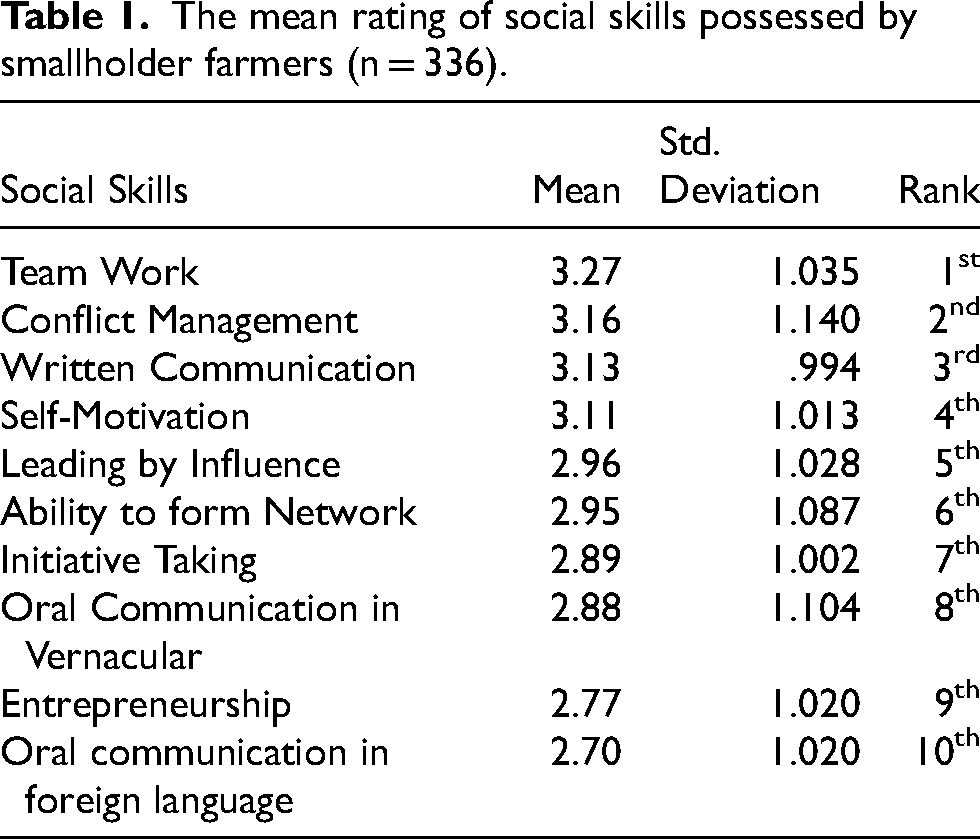
Descriptive statistics were used to analyze the responses on social skills possessed by the smallholder farmers. Data analysis was performed using Statistical Package for the Social Sciences (SPSS Inc, Chicago, USA Version 21). The mean responses were ranked in descending order of magnitude. In addition, logistic regression model was used to predict access to agricultural information. This is because of the dichotomous nature of the response or dependent variable. The independent variables considered in the model included all the social skills identified among the smallholder farmers in the study area as shown in table 1. The adopted design for the mix method approach used in this research is convergent design. This is shown in Figure 1: methodological framework.
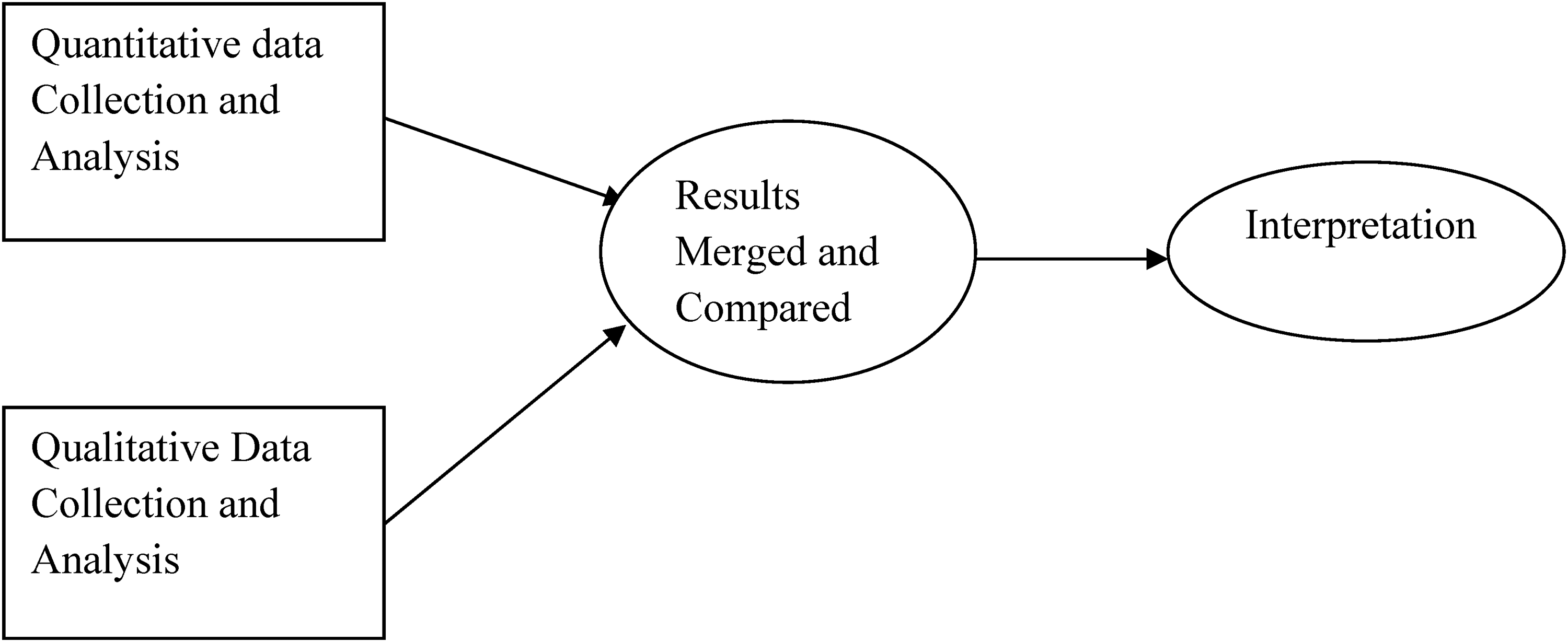
Schematic diagram of convergent design. Adapted from SAGE 2018.
The mean rating of social skills possessed by smallholder farmers (n = 336).
Assessment of social skills
The mean rating and standard deviation on all the social skills were calculated. The most highly rated social skill is team work with mean 3.27 and standard deviation 1.035. This is followed by conflict management with mean 3.16 and standard deviation 1.140, while the least rated is oral communication in foreign language with mean 2.70 and standard deviation 1.02, see table 1. The mean value of 3.27 for team work can be interpreted as a high average rating for this social skill. This implies that majority of the respondents rated team work high among all the social skills. The corresponding standard deviation of 1.035 can be interpreted as a low dispersion of the rating for team work as a social skill. This implies that the respondents rating of team work are close to each other.
Logistic regression analysis
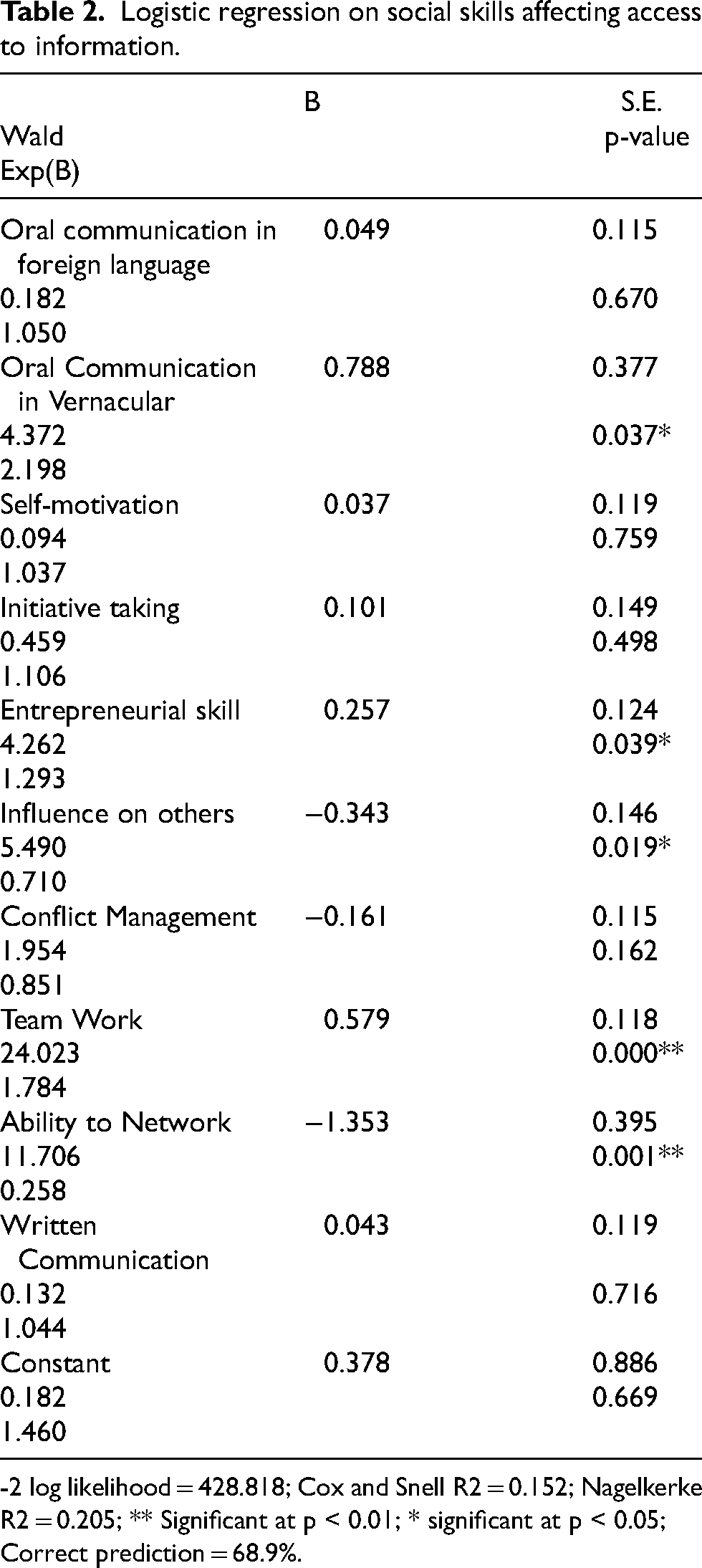
The result of the logistic regression model is shown in shown in Table 2. There are five significant predictor variables namely oral communications in vernacular, entrepreneurial skill, influence on others, team work and ability to form network. These variables shared the maximum contribution in the prediction of access to information according to Wald values (Table 2). Team work showed the greatest contribution in forecasting access to information according to Exp (B) (i.e. the exponentiation of the B coefficient) odds ratio values.
Logistic regression on social skills affecting access to information.
Logistic regression on social skills affecting access to information.
-2 log likelihood = 428.818; Cox and Snell R2 = 0.152; Nagelkerke R2 = 0.205; ** Significant at p < 0.01; * significant at p < 0.05; Correct prediction = 68.9%.
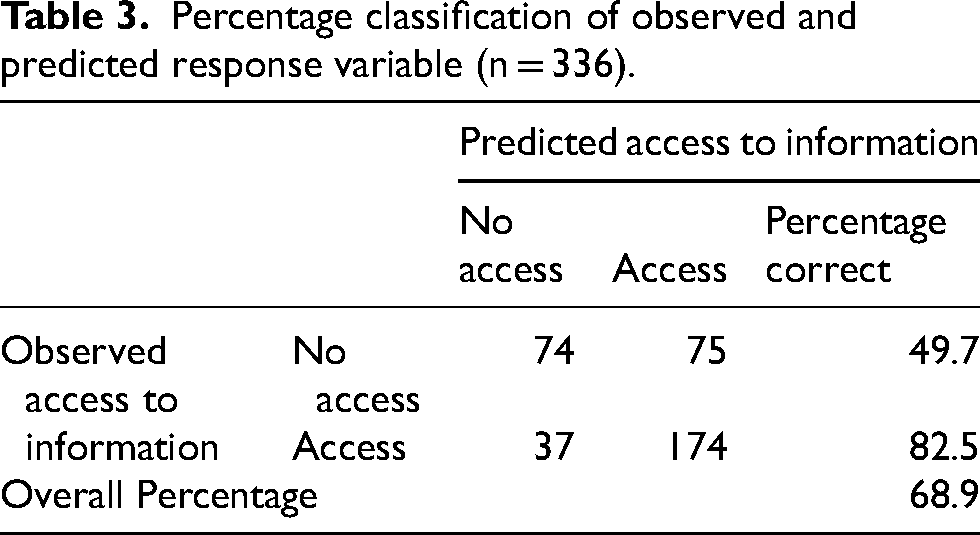
The logistic regression model showed high fit to the data with correct prediction of 68.9% (Table 3). This indicates the capability of the model to predict a high level of the amount of variance of the dependent variable and also a high predictability of access to information using the predictor variables.
Percentage classification of observed and predicted response variable (n = 336).
In this study, it was found from structured interview that oral communication in local language is highly associated with access to agricultural information (p < 0.05), showing that their mode of communication is more in their local language which is generally accepted as their means of communication. This shows the importance and usefulness of communication in local language to them. From this point of view, farmers’ access to information should be through these more interesting skills. The findings from focus group discussion revealed that the respondents were highly skilled in their local language and it is an appropriate measure for accessing agricultural information within the farming groups.
It has been established that oral communications in local language positively affect access to agricultural information among smallholder farmers. This was supported by Hagos (2017) who found that the rural people, development agents and food security experts in his study area expressed their conviction about the appropriateness of folk media forms which were in their local language to have the potential to integrate them into food security communication strategies. According to the author, folk media continue to dominate the lives of people in the rural areas. The implication is that harnessing agricultural information in local language forms can help the smallholder farmers to access it. Chapman et al. (2011) also supported the finding that vernacular radio programme can be used to improve the sharing of agricultural information by remote rural farming communities. Librarians, developmental agencies and field extensionists should help smallholder farmers to access information on the language their users will understand.
Although result from structured interview showed high skill on oral communication in foreign language, the result from focus group discussion showed that they have moderate skill in foreign languages. They revealed that oral communications in foreign language were difficult for them so also is written communication skill. Equally too, it was noted that many of the respondents were unable to read or write very well. This is in accordance with Programme for International Student Assessment (PISA) (2006) who reported that there has been poor English language levels among school-leavers such that mainstream media attention has been the general lack of ability to communicate in English.
The analysis of structured interview showed that skill on team work was positively associated with access to information (p < 0.01). It is also highly rated among other skills. The focus group discussion revealed that they are skilled in working as a team with fellow farmers in their community but has very poor team spirit when a person outside their community is with them.
The result from structured interview revealed that the farmers possess high social skill in conflict management but in focus group discussion it was noted that it usually depend on the type of conflict. According to the result, minor conflicts within their locality were easy to manage but major ones like crop farmer/herdsmen conflict requires government intervention.
The findings from structured interview revealed high ability to form networks. The result from focus group discussion revealed that networks outside their locality tend to show a core-periphery structure in which the processes and the dynamics of relationships are substantially different. It was further stated that because of lack of trust outside their locality especially outside Yoruba speaking nation, the respondents’ network formation were low. As noted by Mansuri and Rao (2013), the governance of networks can explain how new technologies and practices are introduced by the agency of specific actor. Core-periphery structure cannot facilitate strong network formation for access to agricultural information. This is because there won’t be trust Network formation will be encouraged by librarians so that the smallholder farmers obtain information as in Shaijumon (2018) and (Beddington, 1997, 1998).
The result obtained from the structured interview on self motivation was very high. Findings from focus group discussion showed that the rate at which the farmers are self-motivated to seek for information for sustainable intensification practices for instance is often low and this they stated is influenced by on-farm biophysical and socio-economic conditions. It was further stated that agricultural techniques and technologies that could foster sustainable intensification of farming should originate from external farm practices which they don’t have knowledge of. Further findings revealed that there is a narrow understanding of being social skilled in self motivations since they are rarely visited or invited by any information professional or obtain information from them; instead they attach themselves to the production resources and farming practices they were conversant with.
The result from both structured interview and focus group discussion showed high social skill on initiative taking. Further findings from the focus group discussion revealed that farming experience and general access to information negatively influence their decision to diversify into crop production for instance. It was reasoned that experience in farming alone cannot be a sufficient condition to diversify since there are other supporting factors such as the need to adapt to current conditions for instance climate change which is different from the past experience and availability of resources to support diversification. Secondly, it was noted that access to general information can be meaningless to their decisions making; instead there should be specific information on certain practices for a farmer to carefully consider adopting or not adopting a particular practice.
The finding from structured interview showed that entrepreneurial skills significantly (P < 0.05) contributed to access to agricultural information. Farming of all type stands as business outfit and as such it is an enterprise and people involved in it should be entrepreneurial. This was supported by Sinyolo and Mudhara (2017), Demyen and Iulia (2013) and National Planning Commission (2012). Bruton, et al. (2013), Díaz-Pichardo et al. (2012), McElwee and Bosworth (2010) who stated that it is importance to stimulate entrepreneurship in the smallholder farming sector for greater effectiveness in rural poverty and food insecurity reduction. The implication of this is that smallholder farmers should possess entrepreneurial skills. That entrepreneurial skill is positively associated with access to information have been emphasized by many authors. This include Hanf and Muller (1997) and De lauwere et al. (2014) and Díaz-Pichardo et al. (2012) who noted that recent developments and challenges such as climate change and inadequate government support are such that smallholder farmers increasingly have to be entrepreneurial, needing to develop new skills and capabilities to survive or remain competitive.
The findings from focus group discussion revealed that the mindset of smallholder farmers limits entrepreneurial activity. It was further noted that they lack credit facilities, access to markets, inadequate and inefficient government support systems; incentives to invest in farming production technology as a result of unfavourable input and output prices and poor infrastructure. To cap it all the smallholder farmers complained of inordinate risks and uncertainties that they face due to unpredictable climate, hostile corporate institutions and unreliable markets.
It should be recalled that according to World Bank Report, (2013) smallholder farming entrepreneurship is posited as the thrust of competitiveness and economic growth and Global Entrepreneurship Monitor (GEM) Report (2011) has it that technology based entrepreneurship is reliant on high levels of human and social capital. Nonetheless, smallholder farmers are not a uniform group with a single risk profile. However, individuals possessing high human and social capital are more likely to discover, identify and exploit opportunities for entrepreneurship. Beside, Schema theory explains how entrepreneurs identify opportunities. Schemas as defined by Ucbasaran et al. (2008) stated that knowledge or cognitive ability and structures representing content and organization of knowledge developed as a result of cumulative experience, learning and meanings that an individual encounters within a specific domain.
The findings revealed high level of leading by influence among the smallholder farmers both from the structured interview and focus group discussion. Further findings from focus group discussion showed that, village heads lead by influence and can gather information concerning their subjects. It was noted that they have the power to gather information and thus to influence the farmers with whom they are directly connected to.
Conclusions
This work identified some social skills possessed by smallholder farmers in South West Nigeria that contribute significantly to access to agricultural information. Based on the findings of this study, access to agricultural information can be enhanced through the promotion of acquisition of social skills among smallholder farmers of the region. This can be achieved through librarians, especially those working in public library. They should engage the stallholder farmers in their communities using their local languages. This is because communicating in local language encompasses ideologies, modes of perception, and implicit knowledge that are neglected in contemporary rural development projects. Furthermore, the librarians should try to discern whether their users understand the information communicated and also the preferred mode and language of communication. The implication of this study is that the low level skill in foreign language among smallholder farmers has affected their access to agricultural information since most information comes in foreign language.
Librarians should try to teach the smallholder farmers informally to influence their attitudes and overt behaviour towards acquiring written communication skill and also communicate in foreign languages. Librarians should teach smallholder farmers the essence of self-motivation for decision making on access to agricultural information. They should design programs to support motivations of farmers from divers social class for sustainable intensification related techniques and technologies. Supporting farmers’ autonomous choices can stimulate them in developing social skill for self-motivation in their profession.
Librarians should try to improve the level of social skills of smallholder farmers to enable them run their farms as entrepreneurial ventures. This is critical towards increasing their production and living standard. This study points to the facts that there is the need to improve social skills of smallholder farmers by information professionals (librarians), government agencies, and policy makers among others.
Implication of the study
Implication of the study for theory of social skills in agricultural sector
Access to agricultural information is mainly aimed at improving food production among smallholder farmers. Hence, the application of social skill is very essential for the success of agricultural sector. Fligstein (2001) noted that the idea of social skill originated in symbolic interaction. The implication of theory of social skills in agricultural sector is to provide a sociological, as opposed to a methodological top-down information access using institutional theories. Social life revolves around getting collective action of which smallholder farmers’ life revolves and this requires that information professional should pay more attention to. The core of the theory should be an attempt to develop a symbolic interaction view of action that is both strategic and based on providing smallholder farmers with collective identities a lee way to access agricultural information. The main aim of theory of social skills in information access is the improvement of material and social welfare of the people as well as improves their agricultural production.
The first step in the process of theory of social skills in agricultural sector is to abandon the view of top-down information access as essential static method. However the implication of theory of social skills in accessing agricultural information is not that of transforming a static method information access but of accelerating the rate of growth of access to information to improve agricultural production with the growth of other sectors of a modernizing economy. Therefore, any attempt to embrace a meaningful perspective on the process of information access must abandon the view of top-down traditional as essential static method. Hence, a theory of social skills in agricultural sector should provide insights into the dynamics method of information access.
Implication of the study for practice of social skills in agricultural sector
Recognizing the role of social skill in information access would increase the ground for steadfast transformation in agricultural sector. Similarly, aside from top-down method of information access, the application of social skill ensures improved access to agricultural information and promotes agricultural production, encourage self-motivated smallholder farmers and nurture active community co-operation. This can be envisaged as a good practical prospect for smallholder farmers in the future. Therefore, acknowledging and promoting the application of social skill can bear fruit for effective information access in agricultural sector. As such, social skill seems emulated from the traditional social setting of the smallholder farmers who are mainly rural dwellers. According to Leta et al. (2018), building new knowledge on previously existing one allows using synergies that enables faster transformation thereby grounding it well on experiences of the past
The current form information is accessed do not necessarily link smallholder farmer easily to agriculture information. As a result, smallholder farmers should resort to social skill as an alternative way to improve access to agricultural information. As stated by Leta et al. (2018), Leta, Kelboro, Stellmacher, and Hornidge (2017), the agricultural extension system as such is unable to bring a breakthrough for smallholder agricultural development and economic transformation in the country. As such, resource-poor farmers benefit from the knowledge that they acquire through the application of social skill in accessing agricultural information. In all, the application of social skill in accessing agricultural information regulates the increasing systemic inequalities and inadequate agricultural extension services in the developing countries.
Limitations of the study
This study is limited by gender, education and level of rural farmers’ livelihood. Some young women did not feel free to be identified as farmers due to their experiences regarding the farming community's expectations of gender roles. In the same vein, some young men also feel that farming is associated with poverty and tend to trivialize issues targeted at farmers. In the rural communities, some processes of informal as well as formal way of acquiring social skills were highly gendered, influencing both men's and women's aspirations and capacities. The level of education of the rural farmers was also very low and it made some enumerators to spend much time explaining the contents of the questionnaire which sometimes involved the use of vernacular. Finally the poor level of livelihood among the rural farmers resulted in persistent and persuasive moves to get the needed information.
Suggestion for future research
An extension of this study should be carried out in other agricultural regions. A further study to identify some latent factors affecting access to agricultural information can also be undertaken. A methodological approach in a study involving illiterate farmers can also be carried out. A study on the development of smallholder farmers’ soft skills for adaptation in this 21st century should be studied.
Footnotes
Declaration of Conflicting Interests
The author(s) declared no potential conflicts of interest with respect to the research, authorship, and/or publication of this article.
Funding
The author(s) received no financial support for the research, authorship, and/or publication of this article.
