



Abstract
Despite the growing amount of IT investment, IT governance decisions have ever more become complicated due to vague cost relationships, uncertain payoffs, rapid technological changes, and uncertain business environments. This study examines how IT governance mechanism and IT-enabled dynamic capabilities (ITDC) impact on firm performance in the turbulent environment. Drawing on the resource-based theory and dynamic capability theory this study conceptualizes that IT governance mechanism positively effect ITDC, that in turn positively impact on business process agility and firm innovative capability to achieve firm performance. Further, the moderating effect of turbulent environment is hypothesized between ITDC - business process agility and ITDC - firm innovative capability relationship. The finding from 188 senior IT and business manager's responses from Sri Lanka reveals the strong and positive relationship in the hypothesized relationship. In contrary to the expectation, the turbulent environment's both hypotheses (H6a and H6b) failed to show a significant moderating effect. This study proposes the theoretical and practical implications by empirically testing the proposed model in the Sri Lankan context. This study adds to the existing literature and extends the managerial practice by focusing on the key constructs such as IT governance mechanism, ITDC, Turbulent environment, and firm performance
Introduction
Businesses have invested a massive amount of money in IT; however, the payoff from IT is always a major concern for managers and executives. In spite of the growing amount of IT investment, IT governance decisions have ever more become complicated due to vague cost relationships, uncertain payoffs, rapid technological changes, and uncertain business environments. The traditional view of IT governance may not sufficiently address today's strategic, managerial, and technological complexity and it no longer resembles with what is trendy in the real world business phenomenon. Likewise, today's business environments have become ever more dynamic and competitive hence the dominance of IT-enabled dynamic capability (ITDC) in modern firms have deepened the significance of adopting IT governance mechanisms.
Though, the effect of IT governance on firm performance has been extensively studied still a gap exists to study how IT governance impact on firm performance (Wu et al., 2015). IT governance requires a set of IT governance mechanisms to implement more effectively as to inspire with the corporate mission, strategy, culture, value, norm, and business processes (Ali and Green, 2012; Dong 2012; Van Grembergen and De Haes, 2009; Wu et al., 2015). Today's business environments have become ever more dynamic and competitive hence the dominance of IT-enabled dynamic capability (ITDC) in modern firms have deepened the significance of adopting IT governance mechanisms. The past studies warrant further investigations on the IT governance and call for studies with either mediation or moderator model to explain whether IT creates business value directly or indirectly with firm factors.
Today, the business environments have become increasingly dynamic and competitive due to the turbulent environment (Ravichandran, 2018). Further, the increasing pervasiveness of IT-enabled dynamic capability in modern firms have deepened the importance of adopting IT governance mechanisms. Hence, firms are looking for ways to be more agile by reacting to market threats and opportunities to survive and succeed in the turbulent environment (Huang et al., 2012; Tallon and Pinsonneault, 2011). Alike, prior studies permit additional examinations on the effect of IT governance with other facets such as structures and process (Ali and Green, 2012), IT-enabled capabilities (Boh and Yellin, 2006), sustainable IT-related capabilities (Prasad et al., 2012), and multifaceted nature of environmental dynamics (Xue et al., 2011), including call for special issue in IS journal (Tiwana et al., 2013).
In this tenet, past studies warrant further examination on the importance of governing IT investment and call for studies with either mediation or moderator model to explain whether IT creates business value directly or indirectly with firm factors. Similarly, literature permits further studies on the effects of IT governance with other facets such as structures and process, IT-enabled capabilities, sustainable IT-related capabilities, and multifaceted nature of environmental dynamics. Managers and industry leaders who are struggling to manage and govern their IT investment in Sri Lanka. Thereby, the research setting is timely needed for Sri Lankan context, and we believe that the findings of these empirical studies would be able to offer insightful information for managers and practitioners that could enable them to make managerial decisions.
This study contributes in the following respects and brings the originality contributions. Firstly, this study contextualizes the concepts IT Governance Mechanism and IT-enabled Dynamic Capabilities in Sri Lankan business firm's context. It would explore many insights about the business firms in Sri Lanka. Secondly, this study also conceptualizes the business capabilities such as business process agility and innovative capability. Thus, it would help to understand the core intuition from these concepts that in turn brings firm performance. Thirdly, this study examines the turbulent environment as the moderator. The insights from the turbulent environment would also bring noteworthy contribution from this research context.
Background and literature review
In recent years, a large number of foreign investment and international businesses operations have increased in Sri Lanka, because of growing global competition, low labor costs and government incentives (Wickramasinghe and Wickramasinghe, 2012). The Sri Lankan government has recognized IT services as a way to attain competitive advantage, hence it moves towards operating in a global market offering a substantial and dynamic business environment (Wickramasinghe, 2009). The government initiatives have made Sri Lanka to become one of the South Asian countries where IT-enabled business process outsourcing firms have been located (Wickramasinghe and Kumara, 2009). In the past, a few empirical studies have been done and focused on business sector development (Wickramasinghe, 2009), IT contribution (Hosman, 2011; Wickramasinghe and Kumara, 2009), need for managerial competency (Wickramasinghe and Zoyza, 2009), addressed issues in enterprise resource planning implementation (Rajapakse and Seddon, 2005; Wickramasinghe and Gunawardena, 2010a; Wickramasinghe and Gunawardena, 2010b) in Sri Lankan context. Similarly, some prior studies have addressed on IT-enabled business process outsourcing issues (e.g. Wickramasinghe and Kumara 2009). However, the IT governance impact on firm performance studies are limited in Sri Lankan context. For example, the extend search of research articles that are included for IS related research in popular databases such as ABI/Inform, Emerald, Business Source Premier, Science Direct, and Wiley Blackwell has been unable to find any single studies conducted on managing IT / IT governance impact on firm performance in Sri Lankan context.
Resource-based view (RBV) and dynamic capability view (DCV)
To date, IS studies have greatly depended on the view of RBV highlighting the valuable, rare, inimitable and non-substitutable resources (VRIN) are the basis of firm competitive advantage (Barney, 1991; Lin and Wu 2014). The RBV supports firms to realize competitive advantage from resources, yet it does not adequately explain how firms realize competitive advantage in the fast-changing dynamic environments (Zhou and Li 2010). This is because of the reasons such as resources are situation based, their values rely on the characteristics of the certain environment; resources are also fairly stickier than their environment, resources variations and adaptations often lag behind environmental changes (Teece et al., 1997). Hence, the RBV offers a set of necessary conditions for the realization of competitive advantage, but it does not completely clear how competitive advantage is realized (Mikalef and Pateli, 2017). If resources are neither imitable or interchangeable, then competitive advantages created by these resources, have the potential to be long-lasting for firms (Bharadwaj, 2000). Lengthening the traditional view of firm capabilities to today's turbulent business environment, a firm's IT capability is the capacity to assemble and deploy IT-based resources in combination with other resources and capabilities (Bharadwaj, 2000). In the traditional RBV, the role of turbulent environment has been under-emphasized. Hence, dynamic capabilities view fills this limitation as a more meaningful way to respond environmental turbulence (Nevo and Wade, 2011; Teece et al., 1997). Hence, the dynamic capabilities theory has extended the RBV to integrate environmental and technological change and highlights the significance of tangible and intangible “specific asset positions” for competitiveness in quickly changing business environment (Teece et al., 1997).
IS scholars stated that dynamic capabilities view appeared from the RBV of the firm (Yeow et al., 2017) where RBV highlights resource selection (choosing resource combinations), whereas dynamic capabilities view highlight resource renewal (reconfiguring resources into new mixtures of operational capabilities) (Pavlou and El Sawy, 2011). The RBV includes the view of dynamic capabilities to explain how firms react to the swift changes in customer needs and business environments (Turel et al., 2017). Therefore, DCV has begun as one of the utmost prominent theoretical views in the study of strategic management and tries to elucidate the processes through which a firm advances for turbulent environments and sustains competitive advantage (Mikalef et al., 2016b). The dynamic capabilities are defined as “the firm's ability to integrate, build, and reconfigure internal and external competencies to address rapidly changing environments” (Teece et al., 1997, p. 516). Hence, it's a firm's ability to modify its resource base to sense and seize opportunities, and to cope with threats to increase its competitiveness (Zhang et al., 2016). Dynamic capabilities allow firms to integrate, build, and reconfigure resources and competencies with regard to changing conditions (Mikalef et al., 2016b). With regard to capabilities, scholars agree that firms need to be proactive to sense, shape and exploit on business opportunities (Teece, 2007).
The RBV is more effective to explain how resources and capabilities drive firm performance. Thus this theory yet has been criticized for weakening to detect how capabilities might realize in the turbulent environmental conditions (Tallon, 2008; Teece et al., 1997). In the turbulent environment, the mere presence of bundles of resources is insufficient to gain the sustainable competitive advantage (Helfat and Peteraf, 2003; Teece et al., 1997; Wu 2010). Hence, the question arises how to configure IT resources to fulfill customer demand, market changes, and respond to turbulence. The fundamental proposition of the RBV as being static and ignoring the influence of market turbulence, scholars proposed to adopt the dynamic view of resources that would be more appropriate (Helfat and Peteraf, 2003; Li and Liu, 2014; Wu 2010). As a result to meet the demands in practice and the limitations found in RBV, Teece et al. (1997) extended RBV and suggested that firms should frequently adapt, reconfigure and renovate their resources and capabilities to address dynamic environmental changes (Li and Liu, 2014). In this similar view, the evolutionary firm capabilities based recent research proposed the dynamic resource-based perspective (Helfat and Peteraf, 2003). In sum, dynamic capabilities are the only valuable competence in turbulent environments (Pavlou and El Sawy, 2011).
The IS scholars are extending RBV to DCV (Nevo and Wade, 2011; Wu 2010; Yeow et al., 2017); or vice versa (Helfat and Peteraf, 2003; Lin and Wu 2014), thus these have together become the de facto view for theoretical and empirical research (Lim et al., 2011). Moreover, for the hyper-competitive business conditions, dynamic capabilities are generally significant as resources that served as the basis of competitive advantage can rapidly end up outdated (Ravishankar and Pan, 2013; Teece et al., 1997). In response to these suddenly changing business environment, firms need to frequently generate the capabilities of acquiring and developing related resources. As a result, these capabilities may provide distinct sources of advantages (Barney, 1991; Ravishankar and Pan, 2013). Following the RBV and DCV, the firm performance can be achieved not only by the direct effects of resources but also from the indirect mediating effects from dynamic capabilities (Lin and Wu 2014). All in all, for the dynamic and ever more turbulent business environments, DCV better elucidates firm competitiveness and performance outcomes than RBV (Lin and Wu 2014; Pavlou and El Sawy, 2011; Teece et al., 1997; Wu 2010).
The role of IT in turbulent environment: theorizing from IT-enabled dynamic capabilities
Today the business environment is ever more becoming competitive and dynamic. Hence firms have to be agile and innovative to respond the challenges and turbulence they face. Firm face the turbulence and environmental uncertainty because of hyper-competition, time-to-market pressures, unstable customer demand, rapid product obsolescence, and technological advancements (Huang et al., 2012; Tallon and Pinsonneault, 2011) where firm agility and innovation are the sole retorts to its survival. With the present increase in environmental turbulence, firms are looking for ways to be more agile for identifying and reacting to market threats and opportunities readily to sustain and succeed (Huang et al., 2012; Tallon and Pinsonneault, 2011). Accordingly, modern firms are seeking to distinguish themselves by positioning IT to develop dynamic IT capabilities and respond to competitors’ actions to preserve these capabilities (Lim et al., 2011; Pavlou and El Sawy, 2010). Likewise, firms are ever more depend on IT to stay agile and innovative (Lowry and Wilson, 2016; Pavlou and El Sawy, 2010); and promptly react to external changes and competitive actions that are induced by IT (Pavlou and El Sawy, 2010). The recent industry cases, for example, Haier's IT leveraging competence was improved by information processing to achieve operational agility (Huang et al., 2012). In Boeing 787 the strategic IT architecture generated IT-enabled virtually integrated network for global design, manufacture, and operation of its commercial airplanes (Nolan, 2012). Dell developed a custom graphical user interface (GUI) for Ubuntu on Dell netbooks to sense and respond to IT-enabled external partnerships for innovation and competitive action (Roberts and Grover, 2012). The strategic sense making abilities of senior managers to evaluate the long-term business value is linked with modularity in the Asia-based call center case study (Ravishankar and Pan, 2013).
All of these industry cases signify that IT-enabled capabilities in the dynamic business environment certainly improve firm performance through agility and innovation. In this study the turbulent environment refers due to the uncertain conditions or changes in the market such as rapid advancements in technology, market pressure, speedy product oldness, increasing business competitive setting, frequent changes in customer demand…eth the business environment influence on the firm performance.
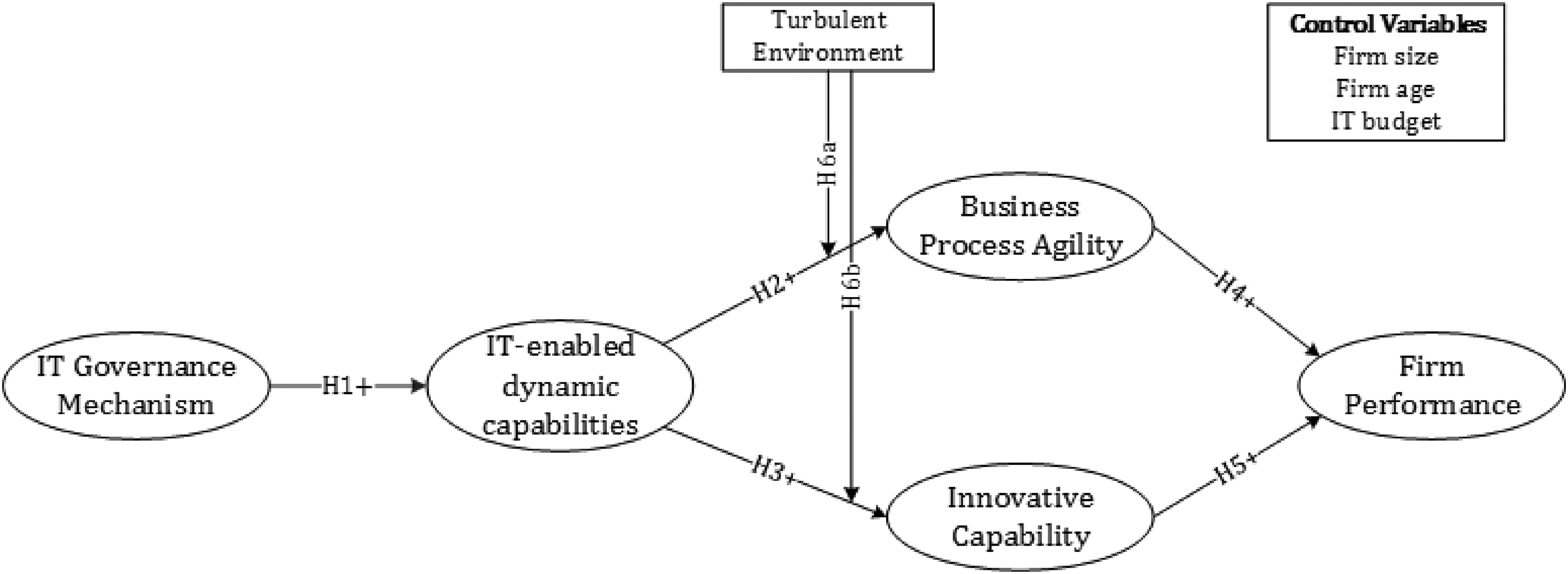
Research model.
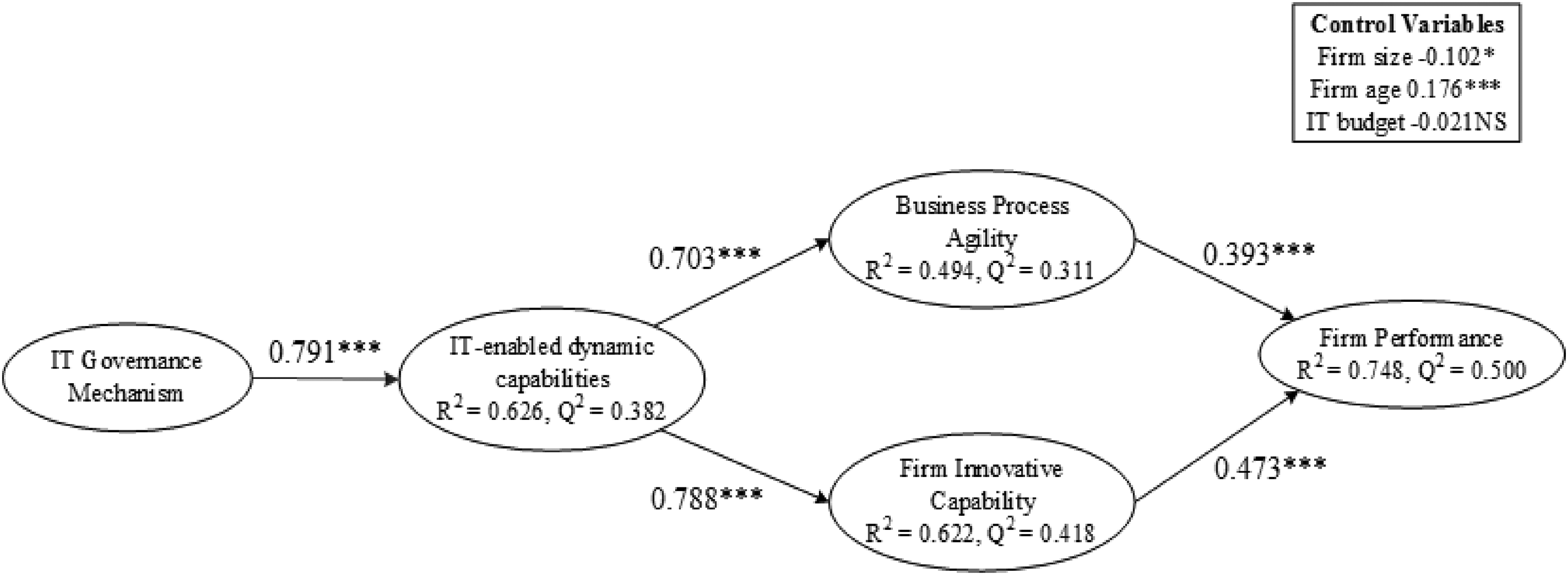
Base model path analysis results.
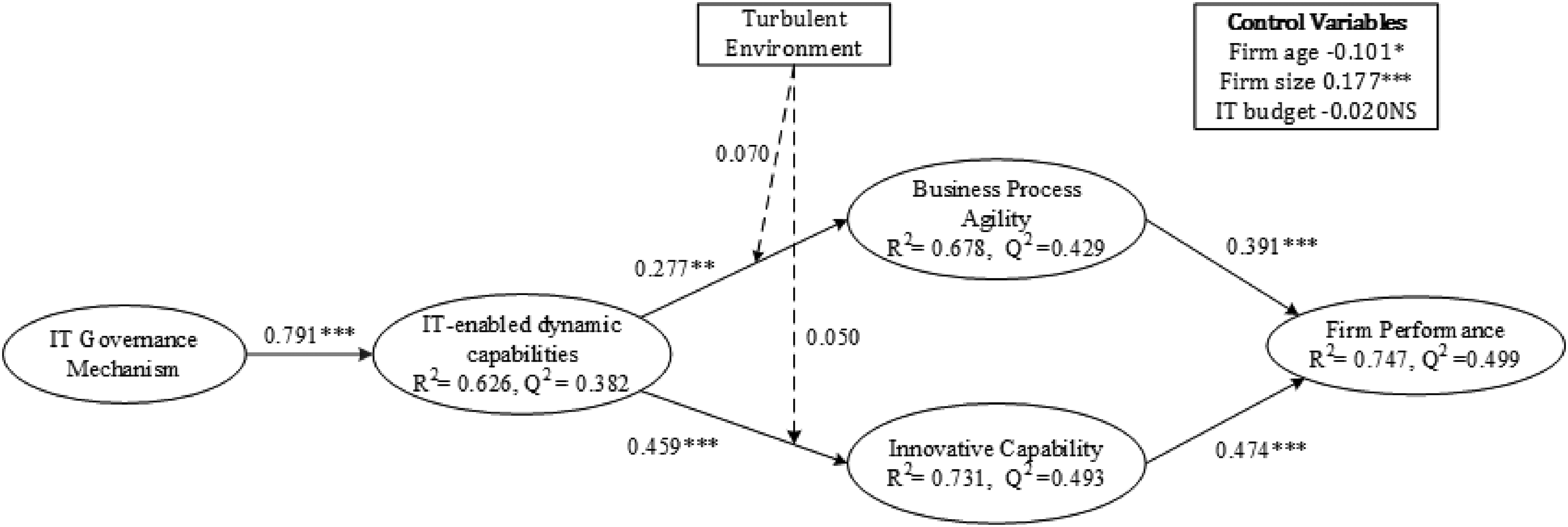
Moderation effect model.
Research model and hypothesis development
IT governance mechanism and IT-enabled dynamic capability
Organizations are using a mixture of different structures, processes, and relational mechanisms that outline a layered system in order to provide higher levels of capabilities (De Haes and Van Grembergen, 2013; Peterson, 2004). IT governance mechanisms facilitates to achieve intellectual IS strategic alignment which explain the roles and responsibilities of the stake holders, how the authority for IT is shared between business partners, IT management, and service providers (Wu et al., 2015). The more established IT governance mechanisms facilitate collaboration between IT and business people (Héroux and Fortin, 2018; Wu et al., 2015) which consecutively build synergy for business-IT alignment, causing in more capability. IT governance signifies the strategic importance of IT so the firm can enrich IT resources, sustain its operations, and extend its businesses thus improve its’ ability to leverage IT resources with other corporate resources (Zhang et al., 2016). To be an effective IT governance, it should focus on horizontal integration capabilities - the ability to coordinate and integrate formal and informal IT decision-making required for sustaining business value from IT in a complex and dynamic environment (Peterson, 2004). In the literature, past studies claimed that there is a positive link between IT governance and the possibility that the firm will nurture greater IT capability (Zhang et al., 2016). Hence, the first hypothesis is stated as follows (Figures 1):
IT-enabled dynamic capabilities and business process agility
In a turbulent environment, firms need to respond and fulfill customer requirement promptly hence it necessitates a greater level of agility and innovative capability to sustain in the complicated business environment. In the past, studies took much courtesy on how IT can shape by improving agility and dynamic capabilities (e.g. Pavlou and El Sawy 2010). IS scholars advocate that dynamic capabilities are the viable means for reacting to the turbulent environments by helping managers to extend, modify, and reconfigure present operational capabilities into new ones that better fit the environment (Pavlou and El Sawy, 2011). In this tenet, firms in the highly competitive and uncertain environments have to be more agile to adapt their strategies and actions to succeed (Ravichandran, 2018; Sambamurthy et al., 2003). According to Leidner et al. (2011), a constant pursuit of an innovative IS strategy enable the firm to improve dynamic capabilities, which is then used to grasp the changes, turn them into opportunities. The IT-leveraging capability has a direct positive effect on dynamic capabilities because it enhances the ability of new product development unit to sense the environment, enhance learning, integrate resources, and coordinate activities (Pavlou and El Sawy, 2010). In this study, we propose ITDC that permit a firm to sense from the business environment, coordinate firm's operational activities, learn from failures and success, integrate processes and routines, and reconfigure assets and resources. Thus, the first hypothesis is stated as follows.
IT-enabled dynamic capabilities and firm innovative capability
Firm invest in IT to pursue fast and innovative initiatives in response to a frequently changing market conditions. When customer demand changes, new market opportunities arise; thus firm's innovative capability lets to promptly detect and seize these opportunities, quickly configure the assets, resources to renew the value offer for their customers (Battistella et al., 2017). In a turbulent environment, technology updates are fast, product obsolescence, competitors’ moves, and customer preferences frequently change (Chen et al., 2014; Wang et al., 2012). Therefore, a firm's innovation capability provides the flexibility of responding to rapidly changing markets and customers’ expectations in realizing innovation-driven growth (Yang, 2012). Scholars highlighted that, firms with solid dynamic capabilities are strongly entrepreneurial by shaping through innovation and collaborating with other enterprises and entities (Teece, 2007). Further, the ability of dynamic capabilities such as sensing and responding to grasp opportunities for innovation and competitive action, hence the firm attain operational agility (Huang et al., 2012). The firm's sustainable competitive advantage depends on its dynamic capabilities to innovate, and the ability to adapt and reconfigure resources and capabilities (Camisón and Villar-López, 2014). According to Ravichandran (2018) study, a firm's innovation capacity to be a function of both its innovativeness and how IT-enabled new initiatives are combined with the rest of the firm. Hence, the hypothesis is stated as follows.
Firm business process agility and firm performance
Given the indispensable role of business process agility in the turbulence business environments, it is believed vital to the innovation and competitive performance and firms are ever more depend on IT, together with process, knowledge, and communication technologies to enrich their agility (Sambamurthy et al., 2003). Prior studies evidenced that agility is the insightful enabler through which IT-enabled capabilities to affect firm performance (Tan et al., 2017). Today's modern firms are heavily investing on IT resources and IT services (e.g. digital platform, web services, data warehousing, customer relationship management, supply chain management applications) with the confidence of growing business agility for competitive actions (Lowry and Wilson, 2016; Sambamurthy et al., 2003; Yang 2012). In the turbulent business environment, the ever-fluctuating customer demand, rapid product obsolescence, hyper-competition, and uncertain technological development (Huang et al., 2012; Tallon and Pinsonneault, 2011) in which agility is the sole mechanism for firm's survival. Hence, the firm agility is the ability to cope with rapidly fluctuating business contexts and succeed in a competitive environment by exploiting emerging business opportunities (Lu and Ramamurthy, 2011; Mikalef and Pateli, 2017).
Firm innovative capability and firm performance
A firm with a wide range of market-response options like flexible IT infrastructure, firm structure, or resources more likely to innovate and actively respond to new market prospects that in turn enjoy the future benefit in the form of profitability, cost reduction or market growth (Tallon and Pinsonneault, 2011). Hence, the speed of innovation has been found significant for the corporate growth opportunities in emerging industries. Even though innovative firms might have the incentives to configure firm resources to create new activity systems or business models; this process is easier when the resources are inherently flexible. As noted earlier, the inherent flexibility of firm resources are enhanced by digitization. Hence, a firm's innovation capacity gives the flexibility to configure resources, and these innovative firms are more likely to be agile when they have higher IT competence (Ravichandran, 2018). Hence the hypothesis is stated as follows.
The moderating effect of turbulent environment between ITDC - business process agility relationship
The dynamic capabilities can be a strategic options, which give a firm the choice to follow new directions when the opportunities arise (Pavlou and El Sawy, 2006). When the turbulence environmental is high, comparatively these options will become valuable (Sambamurthy et al., 2003), where as in less turbulent environments, less likely to make opportunities for reconfiguring existing capabilities (Pavlou and El Sawy, 2011). According to Pavlou and El Sawy (2006) turbulent environments increase the possibility that dynamic capabilities would reconfigure the new product development functional competencies. A firm with superior dynamic capabilities capable of rapidly respond to changes and succeed in turbulent environments, whereas a firm with less dynamic capabilities are less able to rapidly respond (Leidner et al., 2011). In this tenet, the higher turbulence environment would create greater the need and more pronounced IT leveraging competence (IT functionalities to support IT-related activities) to support knowledge flows (Pavlou and El Sawy, 2006). This study theorizes that the impact of ITDC in agility is positively moderated by environmental turbulence and it has been found in the past studies also. For instance, Tallon and Pinsonneault (2011) study shows the environmental volatility positively moderates the link between firm agility and its performance. Therefore, the following hypothesis is formulated.
The innovative firms are more likely to involve in learning, investigating, and able to cope with high uncertainty while these firms leverage digital platforms to respond to opportunities and threats (Ravichandran, 2018). Highly innovative firms are possibly to gather and integrate knowledge as to cope with high uncertainty and has the potential to stand high levels of firm innovative capability (Lin, 2007). The higher growth rate of market offers a firm range of opportunities to gain benefits from innovation, thus increases the effect of innovation on competitive performance (Xue et al., 2011). A firm should execute better by making changes to its product and service offerings and implement these changes more efficiently in the turbulent environment (Rai and Tang, 2010). Prior studies evidence that the link between dynamic capabilities and firm performance is insignificant in a stable environment but significant in a turbulent environment, signifying a moderating role (Li and Liu, 2014; Wu 2010). Pavlou and El Sawy (2011) viewed dynamic capabilities as options where the higher the degree of environmental turbulence, the more likely these options will become valuable markets as new opportunities are likely to arise. Similarly, during high technological turbulence, the relationship between resource orientation and innovation was reinforced (Paladino, 2008). Hence the hypotheses are formulated as follows.
Research design, methodology and data analysis
Research design, participants, sampling, and data collection procedure
The key informant approach used for the data collection, which is a common method in prior IS research (Ilmudeen et al., 2019; Ilmudeen and Bao, 2020; Ilmudeen and Yukun, 2018; Nevo and Wade, 2011; Wu et al., 2015). The data collection process started from mid of July to mid of September 2019. The self-administered questionnaires distributed in which the respondent read and answer the same set of questions in a fixed order (Saunders et al., 2009). The sampling frame for this study is currently working senior IT and business managers in Sri Lankan firms. The researcher used on-site and online methods to collect the data. For on-site data collection, the printed version of the questionnaire distributed among currently working professionals who are pursuing MBA, MSc and doctoral degree program from different universities and institutes in Sri Lanka. The research visited these universities and institutes in Sri Lanka with the prior approval for the data collection and used the convenient sampling method. The same questionnaire was converted into an electronic version (Google doc) and targeted professional working professionals (e.g. LinkedIn) and convenient and snowball sampling technique used to reach online respondents. For online questionnaire, the researcher set option that one respondent can answer only one questionnaire to avoid the multiple responses from a single respondent. The researcher posted the questionnaire link with the opening paragraph that describe the survey objectives, targeted respondent, and the role of expected respondents as the senior managers from IT and business position. In both the online and off-line the questionnaire was converted into the English language as it is the 2nd official language in Sri Lanka. The Table 1 shows the demographic profile of this study.
Demographic profile of the study 2 sample in Sri Lanka.
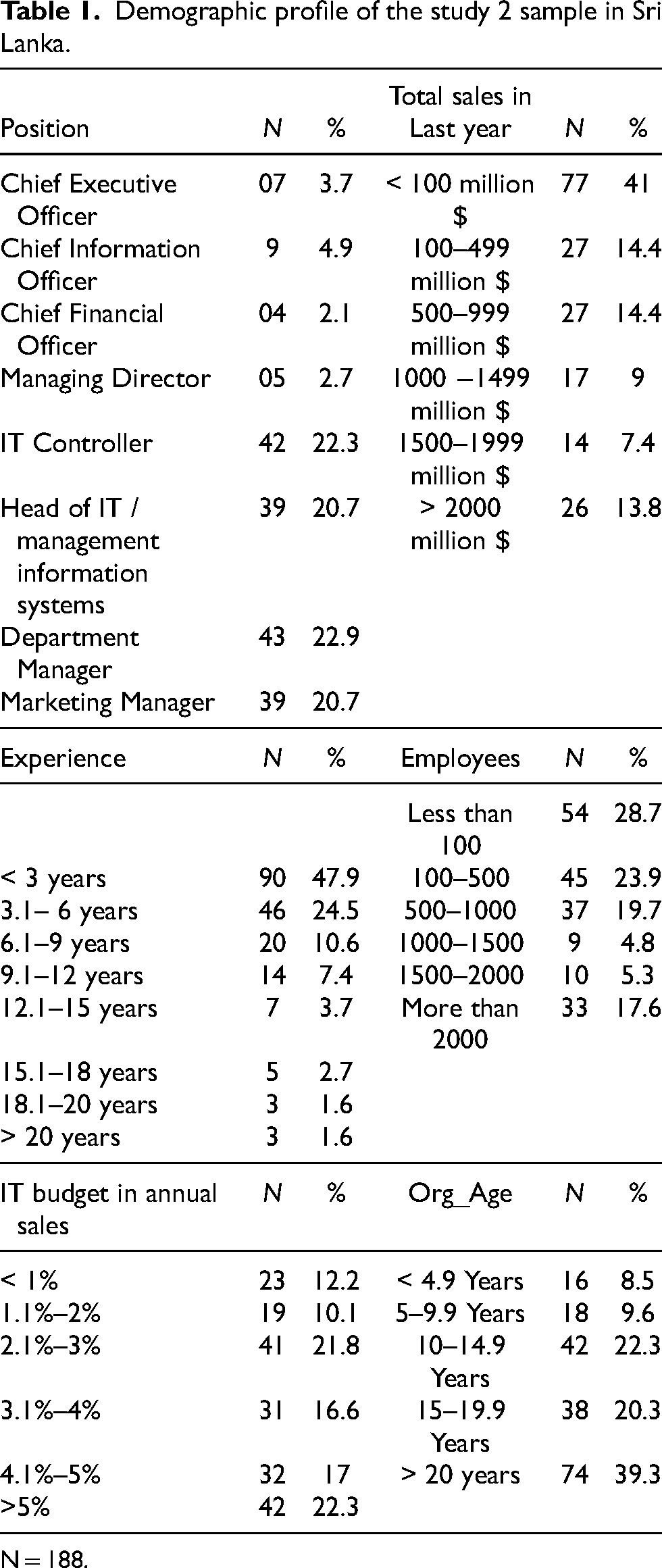
N = 188.
This study collected the data across different industry sectors such as IT and technology 35.6%, manufacturing 25.5%, trade and business 15.9%, banking, finance, and insurance 10.1%, transport and logistics 4.8%, communication services 4.3%, construction 2.7%, hotel and restaurants 1.1%.
Data analysis methods and procedures
The partial least squares (smart PLS 3.0) used because it efficiently analyzes the small dataset and has superior statistical power (Hair Jr et al., 2016). The data analysis consists of two steps. In the first step, the measurement model assessed for the proper psychometric properties. In the second step, the structural model measured. The reliability, convergent validity, and discriminant validity were measured to check for the quality of measurement (See table 2) item (Hair Jr et al., 2016); and then the hypotheses were tested using hierarchical regression analysis and path analysis. Appendix 1 presents the loadings between the item to construct.
Results and findings
Hypothesis testing
In model 1 Information technology governance mechanism (ITGM) has significant effect on ITDC (β = 0.810, p < 0.001) (See table 3) thereby H1 is supported. In model 2, ITDC has a significant impact on business process agility (β = 0.684, p < 0.001); hence the H2 is supported. The Model 3 demonstrates that the turbulent environment has a positive and significant relationship with business process agility (β = 0.597, p < 0.001). In contrary to the expectation, in Model 4 turbulent environment did not show significant moderating effect between ITDC – business process agility relationship. Hence, the higher the turbulent environment did not make stronger the relationship between IT-enabled dynamic capabilities and business process agility. Therefore, it did not decrease the impact of ITDC on business process agility; as a result, the H6a is not supported. In Model 1–4, none of the control variable has the significant relationship. In Model 5, ITDC has significant impact on firm innovative capability (β = 0.753, p < 0.001) hence the H3 is supported. Model 6 demonstrates that the turbulent environment has positive and significant relationship with firm innovative capability (β = 0.444, p < 0.001). In Model 7, turbulent environment moderating effect is not significant (β = 0.044). Hence, the higher the turbulent environment did not make stronger the relationship between IT-enabled dynamic capabilities and firm innovative capability. Hence, H6b is not statistically supported. In model 8, the impact of business process agility on firm performance is significant (β = 0.762, p < 0.001) hence the H4 is supported. In Model 9, the impact of firm innovative capability on firm performance is significant (β = 0.793, p < 0.001) thus, H5 is supported. In Model 10 the two independent variables such as business process agility (β = 0.396, p < 0.001) and firm innovative capability (β = 0.471, p < 0.001) have significant relationship and satisfactory explained variance on firm performance R2 = 0.571.
Discussion and implications
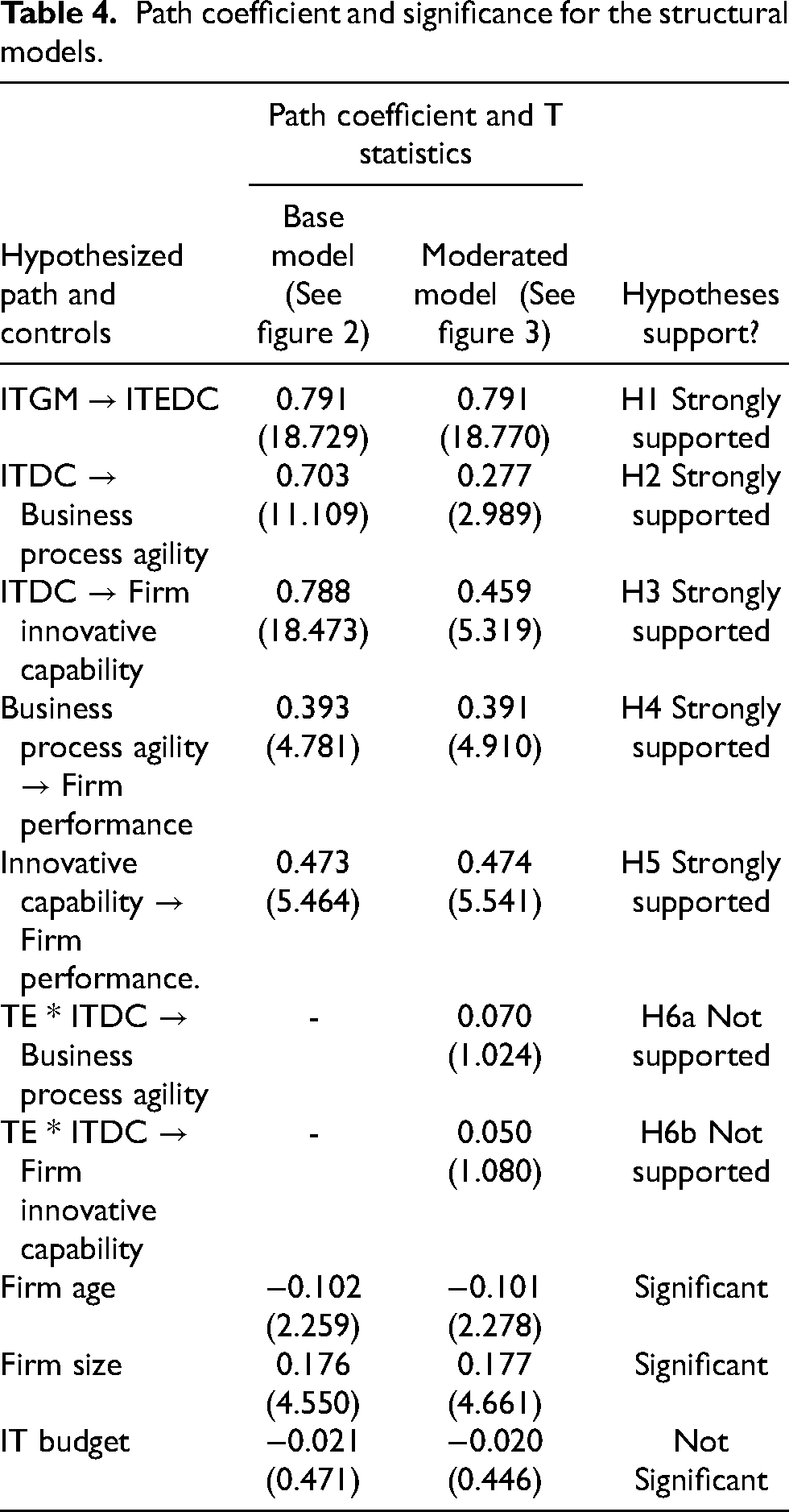
This study demonstrate significant and impactful relationships in the proposed model and hypotheses are supported except for the moderating impact of turbulent environment. The reason for the insignificant turbulent environment (See table 4) is the Sri Lankan business industry does not face huge turbulence as the economy is just booming after the 30 years of civil war, less number of business firms, average level of managing IT and IT governance implementation practices, growing nature of technology and business enterprises, lack of innovations, underdeveloped infrastructure and business sector, political instability and unstable economic growth. Moreover, Sri Lankan government and state authorities have taken number of initiatives to develop the business sector, attract foreign investments, government supports for new business start-up and massive infrastructural development. As it contextualized and revalidated in Sri Lankan context, these studies confirm the generalizability of Chinese study's findings, tested research models in Sri Lankan firm context, and comply with Chinese firm's findings as it offers significant implications and insights for the developing countries firm.
Descriptive statistics, correlations, and reliability.
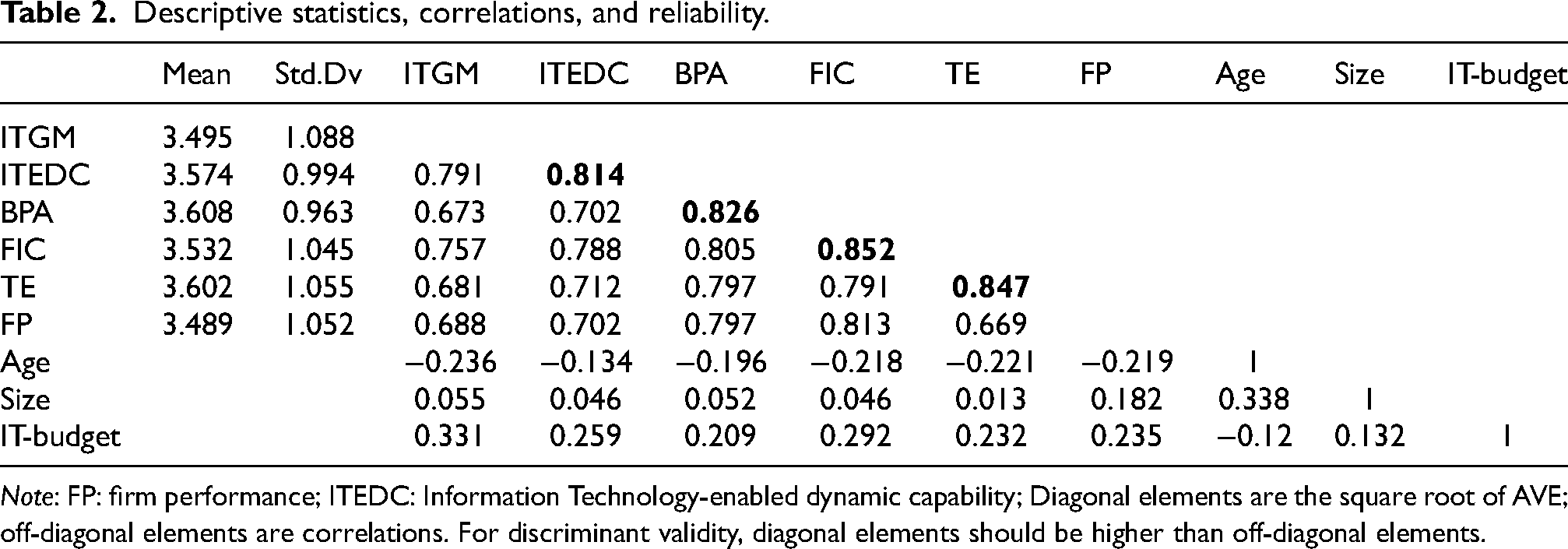
Note: FP: firm performance; ITEDC: Information Technology-enabled dynamic capability; Diagonal elements are the square root of AVE; off-diagonal elements are correlations. For discriminant validity, diagonal elements should be higher than off-diagonal elements.
Hierarchical regression results.
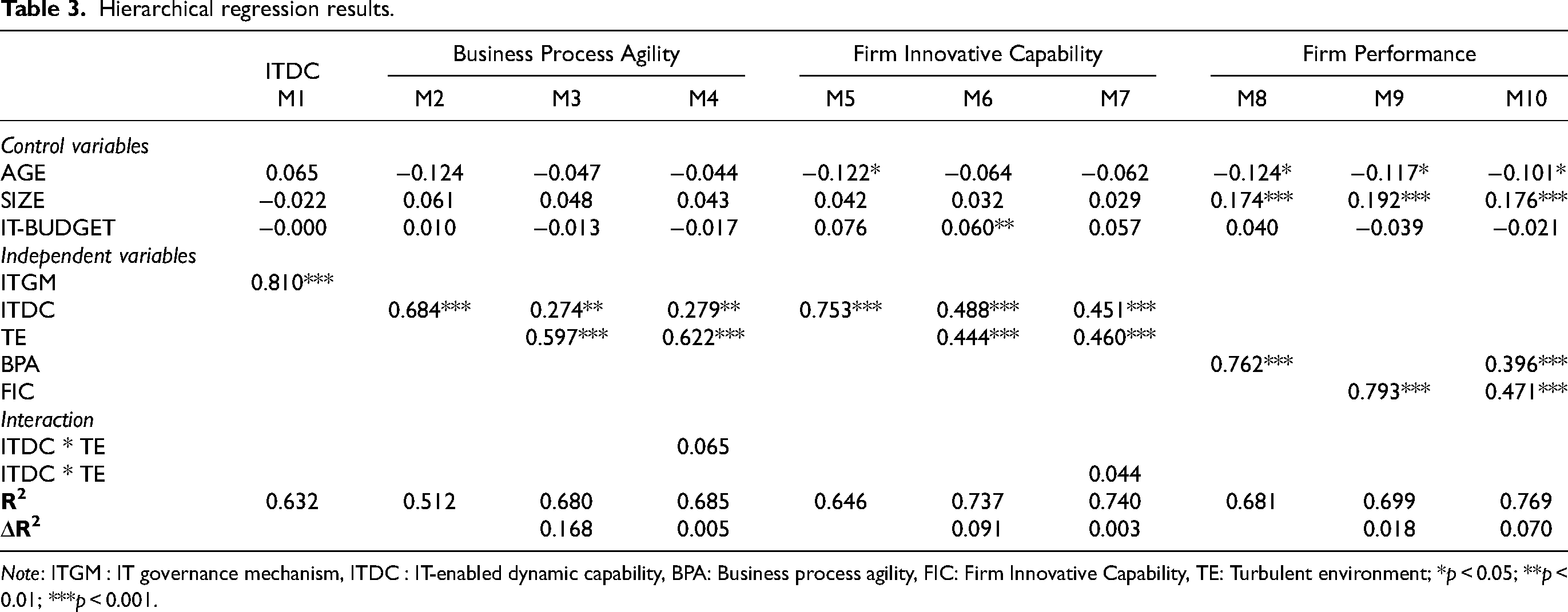
Note: ITGM : IT governance mechanism, ITDC : IT-enabled dynamic capability, BPA: Business process agility, FIC: Firm Innovative Capability, TE: Turbulent environment; *p < 0.05; **p < 0.01; ***p < 0.001.
Path coefficient and significance for the structural models.
Theoretical contributions
This study has several noteworthy contributions. First, the conceptualization and empirical validation of IT dynamic capability and the complementary nature between agility and innovative capability highlight the rareness, thus contributing to the growing body of knowledge in this significant research area. This study is one of the first to theorize thus it helps to shed light on their inner-working by detecting the underlying components of each capability to measure, conceptualize, benchmark, and operationalize ITDC. To the best of our knowledge, the ITDC constructs in this study having dynamic capabilities example sensing, coordinating, integrating, learning and reconfiguring have been analytically operationalized.
Second, the past studies have tested the exogenous factors’ impact on IT capability and firm performance relationship (e.g Chen et al., 2014). Yet turbulent environment has significant intuitions about endogenous factors impact and its moderating effect received very limited attention. With that this study integrates turbulent environment and suggesting that environmental turbulence has a multifaceted and nuanced impact. Therefore, the inclusion of environmental turbulence shows the firm's actual behavior where managers can determine significant implications and actionable decisions to readily act upon to manage resources in the turbulent environments.
Third, past studies warrant additional examination on the emergence and the consequences of IT governance and environmental dynamics (Tiwana et al., 2013). Likewise, a large number of practitioner and research articles highlighted the potential benefits of IT governance and IT capability in the turbulent environment context (Kude et al., 2017; Tallon, 2008; Turel et al., 2017). However, empirical studies confirming these claims is less in number in IS literature. Hence, this study addresses these gap by investigating how IT governance mechanism support to IT-enabled dynamic capabilities, and its subsequent effect to achieve firm performance in the context of the turbulent environment.
Practical and managerial contributions
The followings are the practical and managerial contribution from this study. First, Corporate leaders and practitioners recognize that IT investment decision should be headed not only to IT executives but also considering the multifaceted nature of the dynamic environment. As a result, executives should identify the ways to build a firm-wide dynamic IT capability and should do much more than merely investing in IT by systematically examining business goals and environmental conditions.
Second, the business leaders should not only look at IT capabilities but also be aware of the effect of ITDC under turbulent environment. This study delivers a diagnostic tool that managers can use to measure the strategic potential of a firm's ITDC for the environmental turbulence. What is serious for firms in the turbulent environment is, their ability to build and configure sophisticated ITDC to exploit on new market opportunities. Executives looking for achieving IT to gain superior performance outcome can consider to nature firm agility, and innovative capability thus adds to the growing call for firms to foster agility and innovation.
Third, the cooperate managers need to oversee auditing or streamlining processes for quickly detecting and separating IT applications that are no longer valuable as they once were. This could nurture valuable portfolio of IT infrastructure and IT capital that could be better positioned to develop strategic IT capability for future turbulent business conditions. Hence the finding suggests the actionable plans that how managers can sense and respond to environmental opportunities, coordinate tasks, process activities and resources, learn to renovate present capabilities, integrate the knowledge to reconfigure the capabilities towards business agility and innovation capability.
Conclusion
Although, since long the multifaceted effects IT governance has been taken into concern in both practice and theoretical debate, the mechanism through which IT governance drive firm performance yet unclear and limited. This study focuses how IT governance mechanism and IT-enabled dynamic capabilities drive firm performance in the turbulent environment. This study hypothesizes IT governance mechanism positively effect ITDC, that in turn positively impact on business process agility and firm innovative capability subsequently these positively impact on firm performance while the turbulent environment moderates. The collected 188 responses from senior IT and business managers from Sri Lanka proved the strong and positive relationship in the hypothesized relationship. In contrary to the expectation, the turbulent environment's both hypotheses (H6a and H6b) did not show the significant moderating effect.
Supplemental Material
sj-docx-1-idv-10.1177_02666669221074259 - Supplemental material for IT Governance mechanism and IT-enabled dynamic capabilities drives firm performance: An empirical study in Sri Lanka
Supplemental material, sj-docx-1-idv-10.1177_02666669221074259 for IT Governance mechanism and IT-enabled dynamic capabilities drives firm performance: An empirical study in Sri Lanka by Aboobucker Ilmudeen in Information Development
Footnotes
Declaration of Conflicting Interests
The author(s) declared no potential conflicts of interest with respect to the research, authorship, and/or publication of this article.
Funding
The author(s) received no financial support for the research, authorship and/or publication of this article.

Supplemental material
Supplemental material for this article is available online.
About the author
Appendix 1: Reflective constructs and measurement items
Construct and Items
Loading
T Statistics
0.945
101.334
0.888
47.156
0.913
57.909
0.948
112.126
0.893
47.141
0.905
57.733
0.902
60.657
0.894
45.617
0.927
83.101
0.941
92.465
0.923
62.346
0.881
31.961
0.894
47.955
0.903
53.521
0.903
53.245
0.887
41.791
0.879
41.601
0.912
60.753
0.901
57.9
0.894
55.796
0.776
20.991
0.765
18.285
0.832
23.301
0.823
25.761
0.837
26.482
0.858
41.044
0.865
40.126
0.85
34.313
0.817
26.369
0.851
34.979
0.845
34.791
0.828
27.896
0.846
39.629
0.88
51.108
0.883
52.927
0.823
27.979
0.855
41.191
0.848
30.57
0.869
45.866
0.837
29.472
0.882
41.504
0.854
28.382
0.851
38.569
0.822
22.696
Appendix 2: Formative construct items and measures
Constructs and measurement items
Weight
Loading
STDEV
T Statistics
0.247
0.869
0.084
2.947
0.492
0.931
0.086
5.706
0.386
0.847
0.07
5.526
0.431
0.939
0.091
4.723
0.283
0.921
0.101
2.807
0.354
0.943
0.103
3.435
0.337
0.881
0.077
4.388
0.411
0.912
0.072
5.718
0.359
0.915
0.091
3.955
0.435
0.956
0.104
4.184
0.377
0.947
0.085
4.419
0.252
0.901
0.094
2.677
0.546
0.951
0.097
5.622
0.297
0.854
0.069
4.288
0.256
0.891
0.08
3.202
0.449
0.946
0.102
4.41
0.296
0.938
0.111
2.658
0.321
0.929
0.096
3.344
References
Supplementary Material
Please find the following supplemental material available below.
For Open Access articles published under a Creative Commons License, all supplemental material carries the same license as the article it is associated with.
For non-Open Access articles published, all supplemental material carries a non-exclusive license, and permission requests for re-use of supplemental material or any part of supplemental material shall be sent directly to the copyright owner as specified in the copyright notice associated with the article.
