



Abstract
This study aimed to investigate Facebook users’ information sharing behavior during COVID-19 by merging the theory of planned behavior and uses and gratifications theory into one theoretical framework. Facebook has been playing a pivotal role in shaping how people across the globe are experiencing the coronavirus pandemic. Yet knowledge about motivational and behavioral factors influencing information sharing through Facebook remains limited in the context of COVID-19. We collected data from 540 Facebook users through Google Forms. Structural equation modeling was applied to test the hypotheses of the study. We noted that Facebook users shared COVID-19 information for entertainment, socializing, and status-seeking. The findings further identified that attitude toward behavior, subjective norms, and perceived behavioral control positively affect the behavioral intention and actual behavior of Facebook users to share COVID-19 information.
Keywords
Introduction
The magnitude of coronavirus disease 2019 (COVID-19) has quickly eclipsed other recent epidemics such as severe acute respiratory syndrome (SARS), Middle East respiratory syndrome (MERS), and the Zika virus (Baldwin, 2020). With detrimental consequences on the global economy, it has sparked fears of an economic crisis as serious as a world war (Burns, 2020). Labeled as a black swan event (Renjen, 2020), the outbreak has a rippling effect on social, cultural, and everyday life. As a contagious disease with a high rate of transmission pattern, it threatens our social existence. To combat its spread, the safety measure of physical distancing further refrained us from finding solace from others’ company, which is inherently human. The World Health Organization (WHO) declared the COVID-19 outbreak as a global emergency on 30 January 2020 (Sohrabi et al., 2020). In a response to “flattening the curve,” governments have enforced lockdowns to contain the spread of the virus (Nicola et al., 2020). During lockdown, social media emerged as a major source of connecting people; it was heavily used for sharing and disseminating information about the pandemic. Many individuals, while experiencing isolation during hospitalization or quarantining at home, turned to social media to be in touch with their family and friends and share their personal stories and experiences (Ahmad and Murad, 2020). Global Web Index reported that more than 40% of people have been spending more time using social media during the coronavirus pandemic. Overall, it plays a pivotal role in shaping how people across the globe are experiencing the pandemic.
Facebook is one of the most popular social networking platforms. Prior to COVID-19, Facebook had already been well-recognized for sharing all kinds of information including personal (Lin and Wang, 2020; Osatuyi, 2013), political (Hasell and Weeks, 2016), professional (Pi et al., 2013), health (Yan et al., 2016), and crisis-related information (Chen et al., 2018; Zhao et al., 2016). In extreme events (e.g. Japan tsunami, Katrina hurricane, terrorist attacks in Paris, and Arab Spring), Facebook and other social networking sites (SNSs) have shown great potential for improvising, transmitting, and disseminating information more easily, speedily, and broadly than mainstream media (Alexander, 2014; Chen et al., 2018). Although concerns about the quality of information have been raised and discussed in the literature (Lin et al., 2016; Osatuyi, 2013; Yalçınkaya et al., 2018), social media offer potential opportunities for rumor refuting, identifying misinformation, and spotting fake news (Alexander, 2014; Chen et al., 2018; Chung, 2011; Zhao et al., 2016). The COVID-19 health crisis highlights the particular strengths of this media as a powerful tool for social interaction, and for seeking and sharing accurate as well as fake information about the disease (i.e. symptoms, transmission patterns, and medical interventions). Despite the fact that it is heavily used for sharing information during the COVID-19 pandemic, there is little understanding of how and why people share information on Facebook during this crisis.
To know the factors influencing information sharing on Facebook, uses and gratification (UandG) theory is a promising one to explain the various psychological and social needs that influence users to choose particular media channels and contents (Lin, 2002). UandG assumes that people are goal-oriented and their media consumption habits are shaped by the needs they want to gratify (Katz et al., 1974). A review of research studies related to UandG and its application in the context of information sharing behavior demonstrates the appropriateness of this approach in the social media environment, and particularly Facebook.
Besides gratification factors, attitudes and social beliefs may significantly influence information sharing behavior (Lin and Wang, 2020). According to the theory of planned behavior (TPB), an individual is more likely to perform a behavior when he holds a favorable attitude toward behavior (ATB; Ajzen, 1991; Fishbein and Ajzen, 1975). Evidence from the previous studies suggests that TPB is suitable for explaining the impact of psychological and social factors on behavioral intentions (BIs; Kim et al., 2016; Mou and Lin, 2015; Taylor and Todd, 1995). By integrating UandG and TPB, the present study will offer a better opportunity to investigate the motivations and BIs of information sharing on Facebook. Moreover, we have been using information sharing as a broader term encompassing all types of informational content specifically related to COVID-19 symptoms, transmission, interventions, as well as professional knowledge, personal stories, news topics, etc. Previously, research has considered information sharing in general (Lee et al., 2010; Osatuyi, 2013) or news (Lee and Ma, 2012). The present study extends prior research by using UandG to explain Facebook user's motivations, as well as the TPB to understand information sharing intentions. In simple words, we aim to examine the following research question: What are the motivational (gratifications) and behavioral factors which influence Facebook users’ intentions to share information related to COVID-19?
Knowledge about factors influencing and impelling people to share information by combining TPB and UandG theory would help explain and understand the information sharing phenomenon during the COVID-19.
Literature review and theoretical framework
Information sharing on Facebook
Social media refers to a group of online services which facilitate social interaction and information dissemination by empowering individuals to be creators rather than just static receivers of information. Conceptually and technologically built upon Web 2.0, social media provide an interactive environment that allows individuals to create, share, and seek information directly through user-generated content (UGC). Large amounts of content in the form of text, images, audios, videos, etc., are created and shared by billions of users (Lin and Wang, 2020). It has influenced all spheres of the private and public lives of people. The sharing of information ranges from personal life events to commenting upon the biggest social, cultural, and political issues in the world. On the one hand, it serves as the new site of epistemic engagement and on the other hand, it tends to redefine the complex relationship between the dissemination of information and individual subjects. They report events instantaneously with photos and videos, particularly in the case of natural disasters such as hurricanes (King, 2018; Niles et al., 2019; Stewart and Wilson, 2016), earthquakes (Kim, 2014), and floods (Bird et al., 2012); epidemics such as Ebola and Zika virus (Guidry et al., 2017; Hagen et al., 2018); and social and political movements such as the UK riots and the Arab Spring (Dewey et al., 2012; Gascó et al., 2017). Individuals develop and maintain relationships with people of similar needs, interests, or circumstances by sharing their knowledge, opinions, insights, and other contents (Cho et al., 2010).
Taken together, social media empower individuals to communicate, interact, and collaborate through UGC. They can create, share, and post content independently and directly. These salient features have a great potential to improvise, and change the nature of information easily, rapidly, and broadly during crises. The COVID-19 pandemic has been accompanied by an “infodemic,” a term that refers to the rapid dissemination of fake news or misinformation through SNSs. The gravity of the matter can be measured by the WHO Director-General's statement, “We’re not just fighting an epidemic; we’re fighting an infodemic.” To investigate COVID-19 information sharing behavior, we conduct this study from the perspectives of TPB and UandG theory to explain users’ motivational factors and BIs.
Theory of planned behavior
TPB is a well-established theory that uses BIs to predict usage and in turn focuses on the identification of the determinants of intentions, such as attitude, social influences, and facilitating conditions (Ajzen, 1991; Fishbein and Ajzen, 1975; Taylor and Todd, 1995). The basic premise of TPB is that individuals are more likely to perform a particular behavior when they have a positive ATB, perceive that significant others think that they should do so (social influences), and have the ability to control the behavior (facilitating conditions). Putting succinctly, TPB elucidates the factors influencing an individual's particular behavior. TPB has been utilized, extended, and modified to explore behavior in various contexts. For example, it has been used in the context of internet behaviors (Baker and White, 2010; Cha, 2013); the acceptance of computers and information communication technologies (Jiang et al., 2016; Kim et al., 2016; Mou and Lin, 2015); online service applications (Cheng and Huang, 2013; Cheung and To, 2016); and in the context of social media such as information disclosure (Chang and Chen, 2014; Shibchurn and Yan, 2015), video watching (Cha, 2013), security and privacy protection (Taneja et al., 2014), combating rumor (Zhao et al., 2016), and information sharing behavior during crises (Chen et al., 2018).
Taking all this into consideration, our study proposes that the TPB can be applied to explore Facebook users’ information sharing behavior about COVID-19. ATB, subjective norms (SNs), perceived behavioral control (PBC), and BIs are the four variables that mainly explain the actual behavior (AB) in TPB (Ajzen, 1991). To better suit the context of our study, these variables are defined, modified, and explained in the following paragraph.
ATB refers to an individual's evaluation of a behavior and is considered as a significant predictor of both the intention to engage in a particular behavior and the AB of an individual (Ajzen, 2011; Fishbein and Ajzen, 1975). Prior research in the context of social media indicates that attitudes significantly impact users’ intention to perform specific behaviors, including service co-creation (Cheung and To, 2016), social crisis information sharing (Chen et al., 2018), and rumor combating (Zhao et al., 2016). Here ATB refers to Facebook users’ evaluation toward sharing information about COVID-19. Thus, we posit:
SN is another important factor influencing BIs. It refers to the perceived social pressure on an individual to engage in a behavior (Cheung and To, 2016). SN covers the influence of social bindings and ties on the formation of BIs. Put simply, individuals’ perceptions about a particular behavior are likely to be affected by their peers (i.e. family, friends, and colleagues). In the present study, SN refers to the degree to which Facebook users perceive sharing information as a norm among the people they know or who are important to them. Previously, studies demonstrated that SN could explain news sharing intentions (Karnowski et al., 2017). SN was a significant factor influencing social media users’ BI to share social crisis information (Chen et al., 2018) and to co-create services (Cheung and To, 2016). Accordingly, we postulate:
PBC affects BIs as well as AB directly. It refers to the perceived ability to engage in a particular behavior (Ajzen, 2011). The present study aims to examine how perceived ease or difficulty of sharing COVID-19 information affects Facebook users’ behavior. Chen et al. (2018) explain that PBC significantly affects the BIs and AB of WeChat users’ information sharing behavior, particularly during social crises. Thus, we postulate:
TPB asserts that AB is a joint function of BI and PBC (Ajzen, 2011). It indicates that PBC also impacts AB directly. Thus we further posit:
The individual's intention to perform a given behavior is the main factor in TPB. BIs are the direct antecedents of and mediate between AB and three independent determinants (ATB, SN, and PBC) of intention. BI indicates the degree of people's willingness to make an effort to perform a particular behavior. The strong intentions to perform a behavior will likely lead individuals to perform the behavior (Ajzen, 1991). Prior studies demonstrate that BI can predict actual usage of public transportation (Bamberg et al., 2007), microblogging (Jiang et al., 2016), news sharing (Karnowski et al., 2017), and social crisis information sharing (Chen et al., 2018). However, an intention-behavior gap is found in the studies such as rumor combating on social media (Zhao et al., 2016). Previously, studies indicated that the relationship between BI and AB could be different in different cases and situations. Our study aims to examine the relationship of Facebook users’ willingness to share COVID-19 information by postulating:
UandG theory
UandG theory offers a broad application to understand and predict media usage (Whiting and Williams, 2013) as well as its recurring use (Kaye and Johnson, 2002). Generally, UandG explains the psychological and social needs motivating people to select particular media and content choices (Lariscy et al., 2011; Lee and Ma, 2012; Rubin and Perse, 1987; Ruggiero, 2000; Whiting and Williams, 2013). Initially originated and deeply rooted in communication literature, UandG is relevant for research on social media that empower an individual to interact with billions of people across the globe (Williams et al., 2012). Individuals’ motivations have been examined in the context of different SNSs such as Twitter, Facebook, Snapchat, Instagram, and WeChat (Chen et al., 2018; Phua et al., 2017). Numerous studies adopted UandG theory for explaining the gratifications of specific activities on Facebook, including participation in groups (Karnik et al., 2013; Park et al., 2009), sharing links (Baek et al., 2011), knowledge (Pi et al., 2013), news (Lee and Ma, 2012), and photos (Malik et al., 2016). Collectively, prior studies on UandG suggest that information seeking, socializing, entertainment, and status-seeking are the common motivational factors for sharing information among Facebook users (Chen et al., 2018; Lee and Ma, 2012). However, how these motivational factors work during crises (i.e. COVID-19) needs further attention (Islam et al., 2020a). Against this backdrop, this study aims to see how these motivational factors work while sharing COVID-19 related information among Facebook users.
Social media can provide users with relevant and timely information (Ko et al., 2005). Therefore, individuals use social media to search for information and satisfy their goals (Papacharissi and Rubin, 2000; Whiting and Williams, 2013). The literature about the association between information seeking and information sharing attitudes is mixed. For example, Lee and Ma (2012) studied 203 students and noted information seeking as an insignificant motivator toward information sharing intention. Particular to COVID-19, Islam et al. (2020a) also identified an insignificant association between information seeking and WhatsApp users’ attitudes toward information sharing in Pakistan. On the other hand, Chen et al. (2018) noted that social media users (WeChat) behave with maturity during crises; therefore, they share their personal experiences to help the needy ones. Similarly, Zhao et al. (2016) also identified information seeking as a gratification during crises, motivating social media users to share information. As this study aims to examine information seeking as a motivator during COVID-19, therefore, we posit:
Entertainment connotes the way individuals spend their leisure hours for fun and pleasure. Researchers have interpreted entertainment as the ability of media to gratify individuals’ need for passing time, escapism, enjoyment, relaxation, emotional release, and anxiety relief (Lee and Ma, 2012; Palmgreen and Rayburn, 1979; Papacharissi and Rubin, 2000; Whiting and Williams, 2013). Sharing photos and contributing content on social media offer a good source of fun and entertainment (Malik et al., 2016). Korgaonkar and Wolin (1999) labeled these factors as escapism in the context of Internet use. Usually, when entertainment-oriented content is shared on social media, people get involved in discussing, gossiping, and making fun of persons and issues reported. These activities provide a kind of social catharsis and help individuals to fight against the ennui of daily existence.
Conversely, Chen et al. (2018) suggest that users share social crisis information, not for entertainment. Similarly, Lee and Ma (2012) reported that entertainment did not significantly predict news-sharing behavior on social media. This means that the relationship between entertainment and behavior varies in different cases and scenarios. So, we are interested to examine that COVID-19 information shared on Facebook is or not a source of entertainment among Facebook users. Here, we propose that:
UandG asserts that people communicate and interact with each other to attain a sense of belonging. Developing and maintaining social interaction is a key factor in using social media (Dunne et al., 2010). Other suggested terms used in the literature for socializing are social interaction (Ko et al., 2005), social motivation (Korgaonkar and Wolin, 1999), interpersonal utility (Papacharissi and Rubin, 2000), companionship, and sense of being a part of a community (Palmgreen and Rayburn, 1979). Park et al. (2009) noted socializing as one of the motivations among college students to participate in Facebook groups. Chen et al. (2018) found that socializing with others was a motivational factor to share information during a social crisis. Taken together, we posit:
Status-seeking refers to the way social media facilitate getting status among peers. Prior studies demonstrated that SNSs users shared knowledge to attain peer recognition (Kaiser and Müller-Seitz, 2008), to be a part of a peer group, or to follow a social trend (Papacharissi and Mendelson, 2010; Quan-Haase and Young, 2010). Status seeking has been reported as a strong motivation for college students to take part in Facebook groups and positively impacts social outcomes (Park et al., 2009). The sense of being valuable, respected, and appreciated among peers may motivate Facebook users to share content and exchange ideas (Rafaeli and Ariel, 2008). Hence, we posit:
Among the gratifications discussed above, both status-seeking and socializing deal with human interaction in society, while SNs also deal with social ties. Thus, the present study also intended to find out the relationship of both status-seeking and socializing with perceived SNs of Facebook users while sharing COVID-19 information. Thus, we further postulate the following two hypotheses:
Methods
Participants
The social media landscape is expanding in Pakistan with an annual growth rate of more than 7% until July 2020. According to the statistics given by Global Digital Report (2021), there are 46 million active users of social media in the country, and the majority of them (72%) are aged between 18 and 34 years (Bashir et al., 2021). More specifically, Facebook is the most famous social media platform in Pakistan with 40 million active users (Statista, 2021), and has been used heavily for sharing COVID-19 information. Facebook use increased by 6.94% during COVID-19 (Jahangir, 2020). These statistics urged the researchers to examine the factors that influence the information-sharing behavior of Facebook users during COVID-19 in Pakistan. We adapted scales from previous studies, as they have been validated, to conduct a pilot study on 30 Facebook users. In light of their feedback, the instrument was modified in terms of word accuracy and layout. The items used to measure each construct in the final survey are listed in Appendix A.
Sample and procedure
The data for the study was collected using Google Forms between 4 July and 12 August 2020. More specifically, we selected a sample of 540, following item-response theory with the criteria of 20 responses against each item of the questionnaire, that is, 27 × 20 (Ahmad and Islam, 2019; Islam et al., 2020b; Islam and Tariq, 2018). Facebook users from the capital cities (i.e. Lahore and Karachi) of the two most developed provinces of Pakistan (i.e. Punjab and Sindh) were approached on a convenience basis, because the exact list of Facebook users was not available in Pakistan. Google Forms were divided into three parts. First, the respondents were briefly explained about the purpose of this study and were assured about the confidentiality of their responses. In the second part, we collected information regarding their demographical aspects (e.g. age, gender, qualification, etc.). Finally, in the third part, they were asked regarding the observed variables of this study. Collecting data through Google Forms can raise the question of multiple responses from a single person; to tackle this issue we limited responses to not more than one response from a single internet protocol address.
Measures
By integrating the construct of TPB and UandG, a research model was developed (Figure 1) for empirical testing. Twenty-seven measurement items were developed using a 5-point Likert-type scale to measure nine constructs of the study. The items measuring motivations of information seeking, entertainment, socializing, and status-seeking for sharing COVID-19 information on Facebook were adapted from previous UandG studies. Particular help was taken from the studies by (Karnik et al., 2013; Lee et al., 2010: Lee and Ma, 2012; Malik et al., 2016; Park et al., 2009). Under TPB, items were taken from Chen et al. (2018), Cheung and To (2016), Pai and Tsai (2016), and Zhao et al. (2016).
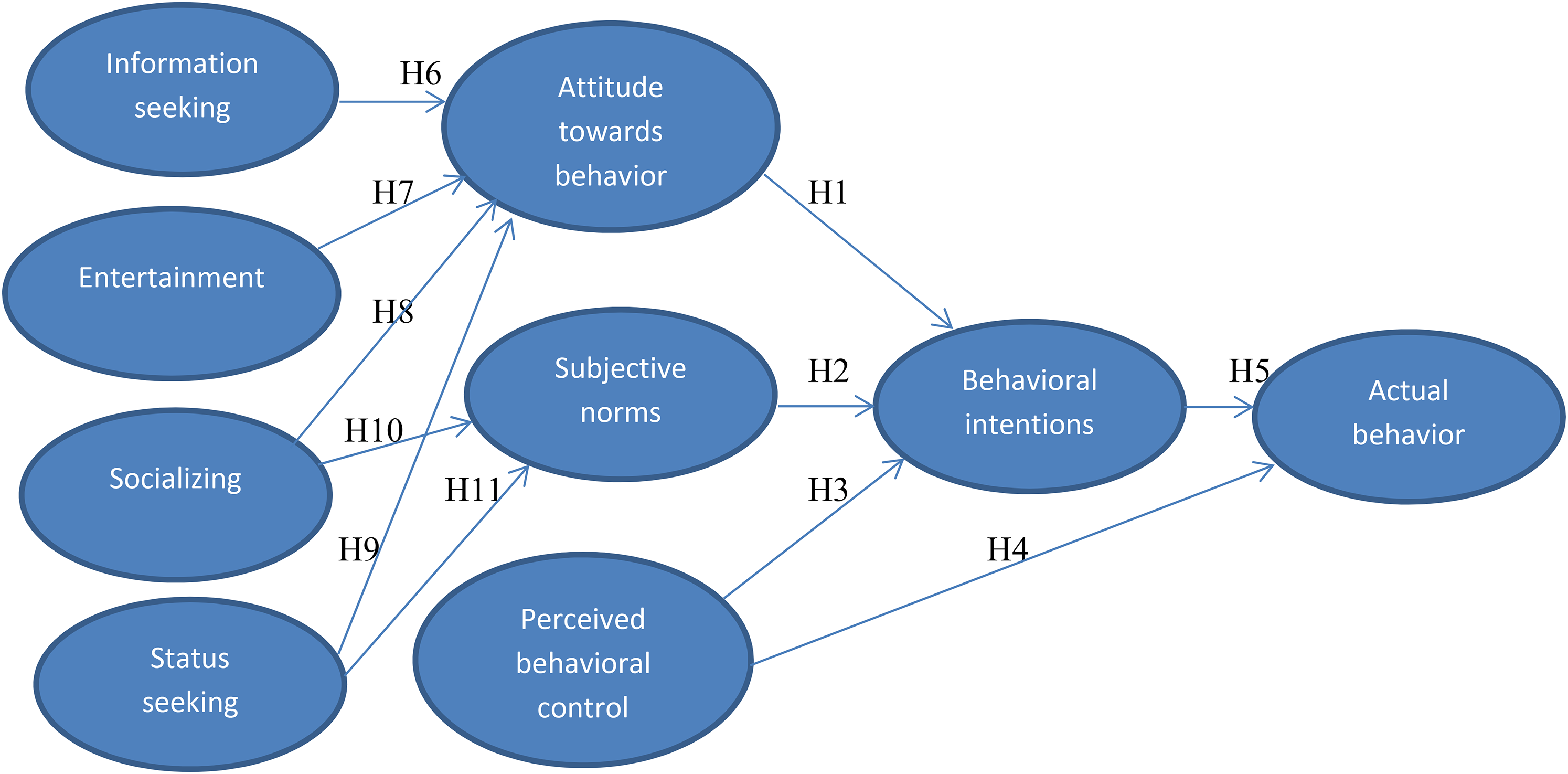
Conceptual model for the study.
Data analysis and results
In accordance with Anderson and Gerbing (1988), the two-step approach to structural equation modeling (SEM) was applied. First, confirmatory factor analysis (CFA) was performed to verify the measurement model. Then, SEM was applied to examine the relationships among the constructs. All analyses were conducted using AMOS version 24.
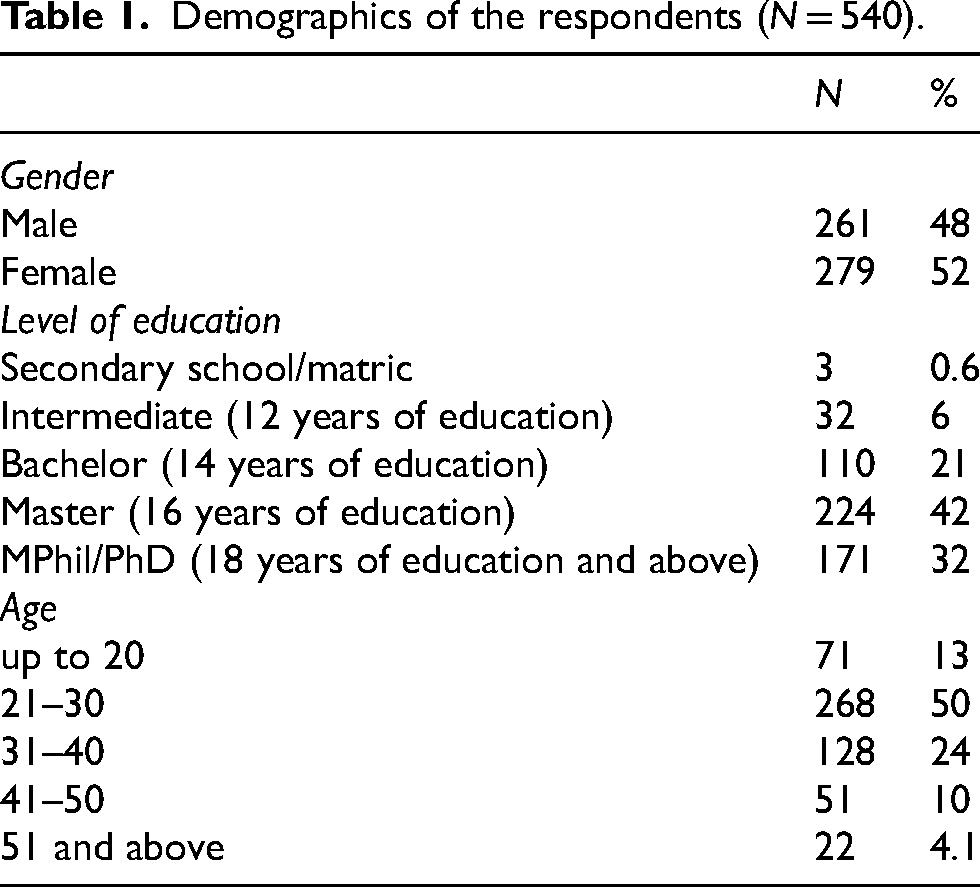
The findings revealed that more than half of the respondents were female (N = 279, 52%) and the majority were young, as 50% were aged between 21 and 30 years. These figures are aligned with the broader population statistics of Pakistan, where more than two-thirds of the population are below 35 years of age (Pakistan Demographic Profile, 2019). Most of the participants were master’s degree holders (N = 224). The demographic details of the respondents are presented in Table 1.
Demographics of the respondents (N = 540).
Prior to CFA, outlier, missing values, normality, and collinearity of data were examined to ensure their fitness for hypothesis testing. As the instrument was designed and administered through Google Form with an option of “required,” therefore, no missing values were found. Data outliers were examined using the stem-and-leaf method and found no outliers. The normality of data was examined on the basis of kurtosis and skewness values (i.e. ±3 and ±1, respectively) and was found to be in the range (Byrne, 2010). Finally, on the basis of bivariate correlations, collinearity was checked and none of the values were found to be >0.85 (Table 2), indicating multicollinearity would not be a severe concern and therefore, suitable for further analysis (Tabachnick and Fidell, 2019). Thus, all 540 responses were retained for analysis using SEM.
Correlational analysis.
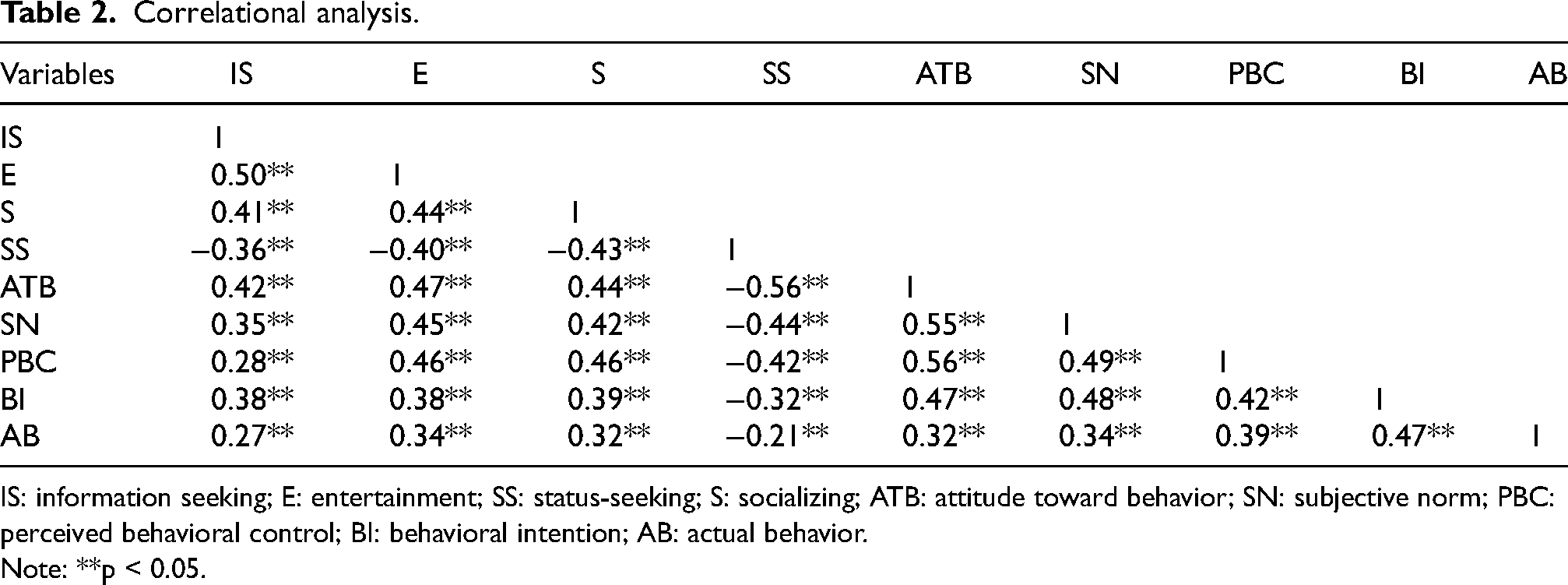
IS: information seeking; E: entertainment; SS: status-seeking; S: socializing; ATB: attitude toward behavior; SN: subjective norm; PBC: perceived behavioral control; BI: behavioral intention; AB: actual behavior. Note: **p < 0.05.
Finally, CFA was applied because the study measures were adapted from previous surveys. In CFA, the model fit indices were examined by considering the values of x2/df, comparative-fit-index (CFI), goodness-of-fit index (GFI), root mean residual (RMR), and root mean square error of approximation (RMSEA) (Bollen, 1989; Williams et al., 2009). As can be seen from Table 3, the results from CFA indicate acceptable model fit indices (x2 = 513.386, df = 288, x2/df = 1.78, GFI = 0.94, CFI = 0.95, RMR = 0.038, RMSEA = 0.038) with factor loadings for all items above 0.50 (Fornell and Larcker, 1981; Kline, 2010).
GFI indices.
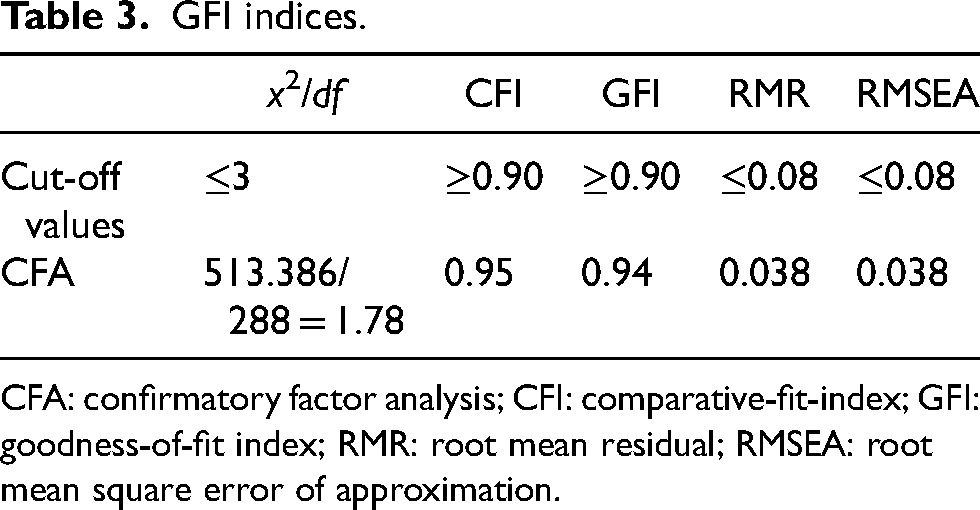
CFA: confirmatory factor analysis; CFI: comparative-fit-index; GFI: goodness-of-fit index; RMR: root mean residual; RMSEA: root mean square error of approximation.
The measurement model was assessed for construct reliability and validity. Cronbach's alpha was employed to test the measurement reliability. The results yielded acceptable values for all constructs of the given sample size (Appendix A). Moreover, composite reliability (CR) values were also well above its cut-off values of 0.60 in accordance with Byrne (2010).
Table 4 presents the results of our research hypothesis. The results showed that entertainment (β = 0.225, P < 0.05), status-seeking (β = 0.350, P < 0.01), and socialization (β = 0.283, P < 0.05) significantly influenced ATB, indicating support for hypotheses H7, H8 and H9. Similarly, ATB (β = 0.229, P < 0.01), SNs (β = 0.528, P < 0.01), and PBC (β = 0.153, P < 0.05) influenced BIs and thus indicating support for hypotheses H1, H2, and H3. Socialization (β = 0.789, P < 0.01) and status-seeking were positively associated with SNs (supporting H10 and H11). Similarly, PBC (β = 0.212, P < 0.01) and BIs (β = 0.527, P < 0.01) were positively associated with AB supporting hypotheses H4 and H5. We did not find support for hypothesis H6, indicating that information seeking (β = 0.020, P > 0.01) and ATB were not positively associated. In total, 10 of the 11 hypotheses were supported.
Hypothesis testing.
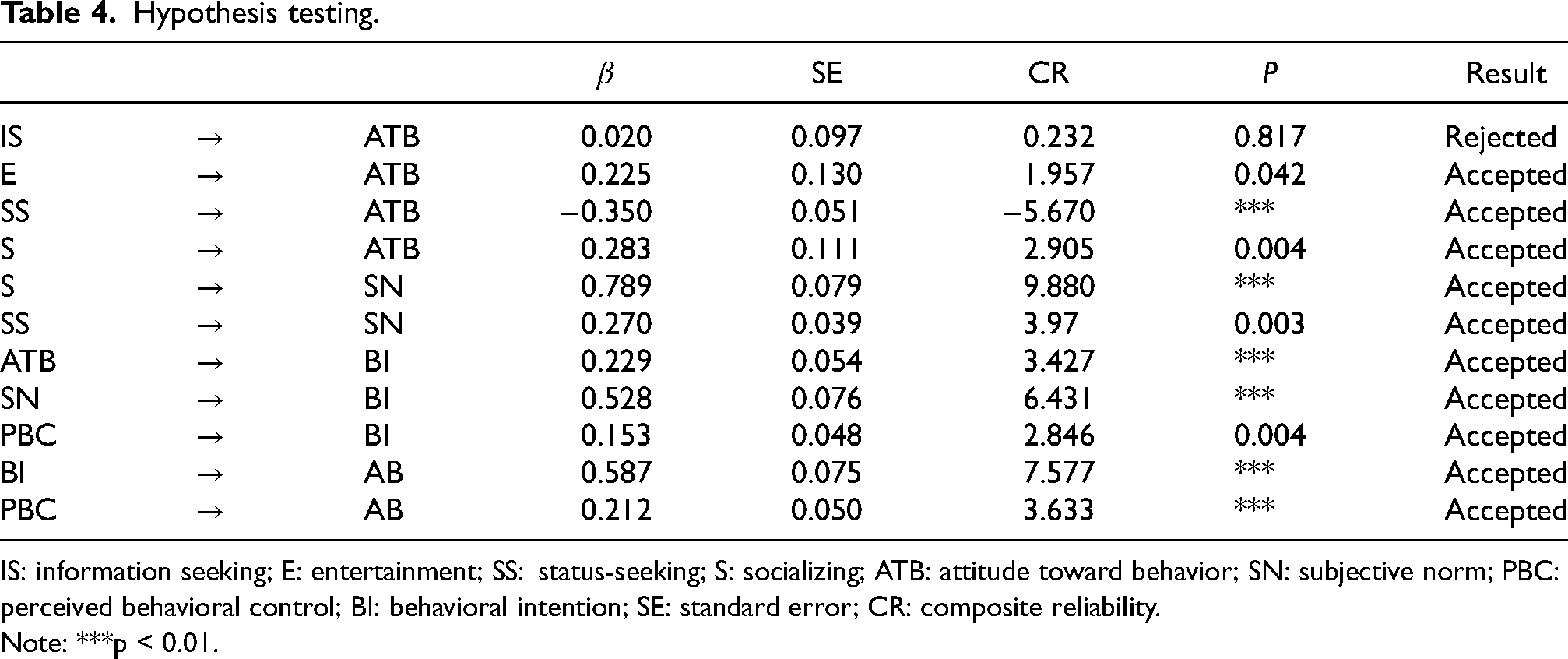
IS: information seeking; E: entertainment; SS: status-seeking; S: socializing; ATB: attitude toward behavior; SN: subjective norm; PBC: perceived behavioral control; BI: behavioral intention; SE: standard error; CR: composite reliability. Note: ***p < 0.01.
Discussion
The present study problematizes the role of motivating factors (based on UandG) that tended to help Facebook users to share COVID-19 related information (based on TPB). Therefore, the data from 540 Facebook users were collected from July to August 2020.
The study applied SEM and results revealed that entertainment, status-seeking, and socialization significantly, whereas information-seeking insignificantly affects Facebook users’ attitudes toward behavior (ATB) which reject H6 and accept H7, H8, and H9 of the study. The previous findings on the association between entertainment and ATB are of mixed results. Islam et al. (2020a) claimed that entertainment is a situation-specific motivator that may have varying effects on ATB on different social media. For example, Lee and Ma (2012) noted entertainment insignificantly affecting social media (mobile) users’ ATB whereas, Leggatt et al. (2011) noted entertainment significantly affecting ATB. Chen et al. (2018) noted entertainment negatively affecting WeChat users’ ATB in China during social crises, and Islam et al. (2020a) noted the same findings among WhatsApp users in Pakistan during COVID-19. Given that the findings of this study contradict past studies that even during crises (COVID-19) Facebook users use this platform as a source of entertainment. One of the reasons might be that Facebook is considered as a source of entertainment, rather than a platform to share serious information (Leggett et al., 2011). Past studies have also noted that Facebook is a platform where individuals share almost all (authentic as well as non-authentic) information including fake news, personal achievements, social movements, and political memes to kill time (Niles et al., 2019) as a source of entertainment. These results can be generalized to the whole nation as data were collected from the capital cities (i.e. Lahore and Karachi) of the two most developed provinces of Pakistan (i.e. Punjab and Sindh). These cities represent the entire culture and population of Pakistan. People from various towns, cities, and provinces came to Lahore and Karachi for seeking jobs, doing business, and getting an education. According to Sadiq (2020), Pakistan remained the most careless country during COVID-19, despite precautionary measures by the government, as people consider the pandemic fake unless it happens to their near ones. These arguments justify the odd behavior of Facebook users in Pakistan.
Regarding the significant effect of socialization and status-seeking and the insignificant effect of information seeking on ATB, the study opened new dimensions for future researchers and raise a question on Facebook users’ overall personalities. Chen et al. (2018) argued that information and status-seeking had no effect on WeChat users’ ATB during crises, however, socialization positively contributes toward WeChat users’ ATB during crises to get updates. Similarly, Islam et al. (2020a) also noted both information and status-seeking insignificantly associated, and socialization significantly associated with WhatsApp users’ ATB during crises. However, Fu et al.'s (2017) thought shows that culture, situation, and specific social media platforms do matter while identifying motivators to predict users’ ATB. Given that, Malik et al. (2016) suggested that Facebook is mostly used as a source of entertainment, therefore, most of the shared information is to seek status, rather than to socialize. More specifically, although Islam et al. (2020a) noted a negative association between entertainment and ATB among WhatsApp users in Pakistan during COVID-19, still they found an insignificant association between information-seeking and ATB. They argued that Pakistani people are less likely to use social media for information-seeking.
We further noted that socialization and status-seeking significantly predicting SNs (H10 and H11). These findings are in line with the past findings (Chen et al., 2018; Islam et al., 2020a; Zhao et al., 2016). According to Islam et al. (2020a), status-seeking and socialization are not considered good during crises, but still, social media users socialize and seek status to overcome their fear of being isolate. While doing so, Facebook users may indirectly know the updates about their near ones.
Finally, in line with past studies, we also identified ATB, SNs, and PBC positively affecting Facebook users’ BI and the AB of sharing information related to COVID-19 (H1, H2, H3, H4, and H5). These findings illustrate that those Facebook users who hold a positive attitude toward sharing feel obligated to share and consider themselves capable of sharing information are more likely to share information about COVID-19. These findings are in line with the prior studies (i.e. Chen et al., 2018; Islam et al., 2020a; Zhao et al., 2016) and can further be supported by TPB which states that “individuals ATB, subjective norms and perceived behavioral control impact their behavioral intention that predicts their actual behavior.” Succinctly, the findings of the present study suggest that UandG and TPB fit to understand the Facebook users’ behavior of information sharing during COVID-19.
Implications and limitations
The present study contributes to existing research in several theoretical and practical ways. First, most of the prior research has studied generic information sharing behavior in the social media context, while we studied it in COVID-19-specific context, with a prime focus on Facebook, and found conflicting results indicating the need to further investigate the information sharing behavior of social media users along with their motivations. Second, previous studies have been conducted in the western context primarily focusing on Facebook or Twitter, while this study is among a few attempts to understand Facebook users’ information sharing behavior in a non-western context. Third, by investigating the relationship between motivations and information-sharing behavior during COVID-19, this study may likely help researchers, academicians, and policymakers to understand the causal relationship between motivations and behavior. Finally, this study explains how various variables affect attitudes for specific social media behavior, thus extending the existing literature in the field of behavioral research.
Practically, the findings of our study suggest that Facebook is a platform usually used for entertainment rather than getting serious and authentic information about certain events (particularly in the Pakistani context). Therefore, sharing authentic information during crises may not be of much help for the policymakers. On the other hand, findings suggest that Facebook is a good platform to get updates about your near ones, to alleviate their anxiety, and to overcome their fear of being isolated by sharing information related to COVID-19 without much consideration for the quality of information. Credible information should be released through concerned official Facebook accounts to prevent people from spreading misleading or fake information (infodemic).
The study has some inherent limitations. First, the data for this study were collected from volunteers who use Facebook through a self-reporting online survey, which may raise a question of biased results. It is suggested that future studies may consider other data collection methods (i.e. interviews, observation, etc.) by employing qualitative and mixed methods research design. Second, the motivating factors included in the study are limited within the constructs of UandG and TPB. Future researchers may extend their studies by considering other potentially influencing factors such as information overload, trust in social media, habitual diversion, etc. Third, the study collected data without including past behaviors. UandG theory suggests considering past behaviors to get more accurate information about the current situation (Lee and Ma, 2012), therefore, future researchers are suggested to consider the past experience while predicting motivators of information sharing behavior. Finally, this article was focused on exploring information-sharing behavior instead of digging deep into the nature and types of information shared related to COVID-19 (such as personal stories, jokes, news, prevention measures, and symptoms of COVID-19). In terms of credibility and quality, Facebook users’ information-sharing behavior about COVID-19 may be different. Future research may contribute to this field by finding out how social media users deal or cope with various types of information during COVID-19.
Conclusion
The study examined a model (based on UandG and TPB) to understand the motivations which influence the Facebook users’ information-sharing behavior related to COVID-19. It is noted that Facebook users share COVID-19 information for entertainment, status-seeking, and socializing and not for information-seeking. They are less able to recognize their social and ethical responsibility to share authentic and credible information during crises. The study suggests that concerned stakeholders (health information professionals, the Ministry of Health) should take the lead to share relevant information on social media for further dissemination.
Footnotes
Declaration of conflicting interests
The authors declared no potential conflicts of interest with respect to the research, authorship, and/or publication of this article.
Ethics statement
The Facebook users participated voluntarily. In accordance with national legislation and institutional requirement, written informed consent for participation was not required.
Funding
The authors received no financial support for the research, authorship, and/or publication of this article.
