



Abstract
The United Nations Sustainable Development Goal SDG16.10 advocates for ensuring public access to information, yet knowledge access and sharing are some of the key challenges in many countries, especially in Africa. The African Union Agenda 2063 strongly recommends access to African indigenous, cultural information to promote sustainable development but how might this be achieved? This paper shares findings from a project - NetDiploma - that built an international multi-stakeholder network of experts, professionals and various user communities to mobilize and share knowledge to explore the requirements for promoting access to cultural heritage and government information held in memory institutions, such as archives, for everyone in Africa. It identifies the key enablers and challenges associated with the long-term goal of making African government, indigenous and cultural heritage information accessible online in the form of a Digital Public Library of Africa (DPLAf) and the research and development required to realise this vision.
Keywords
Introduction
The United Nations (UN) General Assembly, in its meeting on 25th September 2015, adopted Resolution A/RES/70/1 that proposed 17 sustainable development goals (SDGs) and 169 associated targets defined as “universal goals and targets which involve the entire world, developed and developing countries alike” (United Nations General Assembly, 2015a: 3). SDGs are successors of the UN Millennium Development Goals (MDG) adopted in 2000. Access to, and sharing of, information is paramount for sustainable development in all areas (Chowdhury and Koya, 2017). UN Sustainable Development Goal SDG16.10 specifically advocates for ensuring public access to information, yet knowledge access and sharing are some of the key challenges in many countries, especially in Africa. Aspiration 5 of the African Union (AU) Agenda 2063 (African Union, 2015) identifies African cultural identity, values and ethics as critical factors in Africa's re-emergence on the global stage. It sets the goal of ‘inculcating the spirit of Pan Africanism; tapping Africa's rich heritage and culture to ensure that the creative arts are major contributors to Africa's growth and transformation; and restoring and preserving Africa's cultural heritage, including its languages’ (African Union, n.d.). This is also echoed in the Priority Africa programme of UNESCO where Flagship Programme 3 (harnessing science, technology, innovation and knowledge for the sustainable socioeconomic development of Africa) includes in its main actions “improve universal access to information and knowledge as well as build capacity in the field of ICT [information and communications technology] use in Africa” and “develop African capacity in the preservation of documentary heritage” (UNESCO, 2013: 13).
Recent research in the context of access to information for sustainable development in Africa focuses on specific areas such as education, business, etc. For example, studies and reports from the Institute of Development Studies demonstrate how ICT and infrastructure can contribute to knowledge sharing opportunities in the context of higher education and research in Africa (Bimbe et al., 2015a; Bimbe et al., 2015b; Gregson et al., 2015). Krone et al. (2015) discuss how access to appropriate ICT can contribute to market access for smallholders in agriculture in Kenya and Tanzania. Ogutu et al. (2014) evaluate the impact of participation in ICT-based market information services on farm input use (e.g. fertilizer, pesticides) and land productivity in Kenya. Several studies have also indicated the key challenges facing memory institutions in Africa; for example:
common information delivery channels, viz. mass media information services (libraries), education and training programmes including conferences, workshops etc., benefit only a small section of society (educated and city/urban dwellers) while the majority of the population who live in rural areas cannot reach or use these information services (Uzuegbu, 2016) libraries in Africa suffer from a lack of funds to build an ICT infrastructure, to subscribe to online information resources, and to train personnel (Chisenga, 2015) management of digital content remains a huge challenge in the public sector as there is no technological infrastructure to manage and provide access to digital information properly (African Development Bank Group, 2017).
A review of research literature and informal professional communications with a number of leading African researchers and practitioners at various international digital library conferences over the past few years revealed that very little research has been undertaken to promote access to the wealth of cultural heritage and government/indigenous information held at various national archives and government institutions in Africa. Furthermore, it was revealed that millions of records and information objects have been digitised at various memory institutions, but these items largely remain inaccessible because of a lack of ICT infrastructure, financial and human resources and policies. Such inaccessibility to information assets has implications for education, healthcare, agriculture, industrial innovation and development, environmental sustainability and disaster response in Africa.
The ASKIA service (Access to Scientific and Socio-economic Information in Africa: ASKIA http://askia.uneca.org/), developed by the United Nations Economic Commission for Africa (UN ECA), provides access to scientific and socio-economic information for the African community, including scientists, researchers, academics, students, economists, and policy-makers, over an interactive online portal acting as a one-stop shop to such knowledge and associated information. The African Knowledge Base (AKB), a flagship project of the African Union, is a unique open online resource providing one-stop access to African premier academic, research, and government organisations’ current publications consisting full-text, abstract, and bibliographic information (http://akb.africa-union.org/auc/). Neither the ASKIA nor the AKB service specifically covers cultural heritage information or government information and records. However, the AU agenda 2063 action plan (Department of International Relations and Cooperation, 2015) proposes that ‘African development should be ‘strengthened by tapping into indigenous and inclusive knowledge systems’ (p. 18), and priorities should focus ‘on indigenous knowledge in education’ (p. 19).
Inspired by these observations and aspirations, coupled with the UN SDG17 (https://sdgs.un.org/goals/goal17) and the UN Addis Ababa Action Agenda (United Nations, 2015) for cooperation and capacity building, a project - called NetDiploma (Network for a Digital Public Library of Modern Africa) - was undertaken between 2017 and 2019 to explore the potential for making cultural heritage and government information and records held in memory institutions, such as archives, accessible online for everyone in Africa. It was funded by the Arts and Humanities Research Council in the UK under its GCRF (Global Challenges Research Fund) scheme (https://ahrc.ukri.org/funding/internationalfunding/the-global-challenges-research-fund/). This paper reports on the key findings of the project and provides a summary of key research and development requirements for a future Digital Public Library of Africa (DPLAf) that would provide online access to the information resources held in various national archives in Africa. It begins by presenting the research aim and questions before discussing the methods used to achieve the aim. This is followed by two sections on key findings – first those from the literature review and second those from the project's fieldwork activities, including a roadmap for developing a DPLAf and the impact on national development. The paper closes with brief conclusions and an indicative approach to implementing the roadmap for developing a DPLAf.
Research aim
The broad question driving this research was ‘what are the challenges to ensuring public access to information in Africa?’ Hence, the aim of the research was to understand the key enablers and challenges associated with the long-term goal of making cultural heritage and government information and records held in memory institutions, such as archives, accessible online for everyone in Africa. The specific research questions addressed were:
What are the key cultural, historical, political, linguistic and technology enablers and challenges to community access to information in Africa? How can modern ICT and mobile technologies be used to facilitate access to information required for education, health and wellbeing, cultural integration, agriculture, tourism etc? What policies and practices are required for developing and managing a free DPLAf? What further research is needed to enable the development of a DPLAf?
Methodology
A qualitative two-stage approach was adopted. The first stage was a review of relevant research literature and reports on the current state of information access and use in Africa, especially in the context of sustainable development initiatives, to understand the new and ongoing initiatives and activities for promoting access to digital information in Africa (push) as well as evidence of demand for access to information (pull), and also the key issues and challenges associated with community access to information in Africa. The second stage gathered new empirical data by engaging directly with people on the ground, using a ‘bottom-up’ participatory method, to understand the specific information access challenges they faced and the various research, development, engagement and advocacy activities required in order to develop a research roadmap for promoting digital access to cultural, indigenous and government information and records held in memory institutions in Africa. The latter was achieved by building an international multi-stakeholder network of experts, professionals and various user communities in three African countries, in order to get a reasonably rich picture of the key challenges and enablers to making indigenous information held in the national archives available online. These were: 1) Kenya, a pioneer in passing the Access to Information Act 2016 and in digitising millions of archived documents through the Kenya National Archives and Documentation Service (KNADS) that are not yet accessible online; 2) Ethiopia, where almost no archival content held at ENALA (Ethiopian National Archives and Library Authority) has been digitised, and yet a country that is the home of major organisations that have a key role in promoting access to African indigenous information for sustainable development (UN ECA, AU); and 3) Malawi where some of the content held at the National Archives has been digitised through external aid but is also not accessible online.
The NetDiploma network comprised a core of 42 project team, steering committee and other members including senior university researchers from information and computer science senior information professionals such as the former President of IFLA (the International Federation of Library Associations and Institutions), a senior Vice President of a large international publisher, head of the library service at the African Union, government and some NGO (non-governmental organisation) personnel, and representatives of UNESCO national offices in the partner countries. In total almost 100 researchers and professionals, interested in sustainable development and/or information systems and services, took part in the workshops and subsequent networking/collaborative activities.
The participatory approach involved a series of four 2-day workshops held in the UK and African countries between February 2018 and September 2019. The workshops focused on the cultural, behavioural and literacy issues of people as the key enablers in exploring how everyone, including the poorest and most vulnerable, can benefit from better access to and use of information. The first workshop (UK) established the appropriate design approach for a DPLAf together with the subject focus: (i) cultural heritage information to align with Agenda 2063 (African Union, n.d.) and promote both access to cultural heritage information and businesses such as heritage and creative industries; and (ii) government information, including government records, archives and legislative materials etc., to promote better governance and justice, better awareness and equality amongst the African population.
The second workshop (Malawi) focused on what needs to be done to make digital information accessible to three user groups for a DPLAf - school teachers and students, remote communities, and young people - in terms of ICT infrastructure and support, regulations and policies, and financial and human resources. The third workshop (Ethiopia) focused on issues facing content providers in Africa (i.e. national libraries, national archives, research institutions and universities) that need to be understood and addressed in order to fulfil the vision. In the final workshop (Kenya) participants shared their own experiences of access to cultural heritage and indigenous information in Africa in general, and Kenya in particular, exploring the key enablers, for example their Huduma Centres (https://www.hudumakenya.go.ke/), and challenges associated with access to government and cultural heritage information, specifically in relation to technology and infrastructure, policies and governance, and resources.
As a research method, workshops offer a number of advantages and opportunities. They can be a “constructively provocative and liberating” approach to gaining and sharing knowledge, where the group dynamics of facilitated discussions can “open up the issues” and enable “collaborative negotiation of meaning - not only between participants, but also between facilitators (the researchers) and participants, who both during and after the workshop adopt and adapt to what is being discussed, performed, and learned” (Ørngreen and Levinsen, 2017, 78). All of these were important in the context of the project's research questions and its long-term goal.
The workshops were designed to give agency to the participants and “integrate local knowledge and experience in to research planning” (Cornwall and Jewkes, 1995, 1669) in a collaborative way (the research team working with participants but retaining control of the research) rather than a collegial one (the participants having control over the research) (Biggs, 1987: Chapter 1, p. 3). Care was taken to balance the team's role as ‘clinician’ (focusing on the participants’ needs) and ‘ethnographer’ (focusing on the research) (Schein, 1987) to ensure the participants could influence the development of the workshops as they proceeded. The overall structure and aim of each workshop was planned but their content was not ‘fixed’ nor their timetable ‘strict’ to avoid fostering a top-down approach (Chambers, 2002: xiv) given the aim was to adopt a bottom-up approach. Participants were not required to prepare beforehand or follow-up afterwards but were encouraged to participate actively through pre-designed activities and other emergent ones. Ørngreen and Levinsen (2017, 76) note that “articulation of how to produce and analyse [workshop] data is practically absent” in the literature. We, therefore, adopted elements of their semi-anthropological approach using notes taken by both the research team and participants, and “in-the-background discussions” (Ørngreen and Levinsen, 2017, 77) during breaks and while participants were engaged in discussion, to recall the events and formally reflect on them at the end of each day.
See Chowdhury and McLeod (2019) for full details of the workshops and other activities.
SDGs and information access challenges in Africa
The project noted some research on building and managing institutional repositories in the three chosen African countries as well as some research on access to business information, health and agricultural information, and LIS education in Africa. Key findings of these studies are noted below.
Digital content
Several externally and internally funded initiatives have taken place for building institutional repositories of digital content and digitising content held in memory institutions such as national libraries and national archives in different African countries over the past few years. However, lack of the appropriate ICT infrastructure, metadata standards, policies, human resources, and user education make such content currently inaccessible to the public.
Similar challenges exist in the case of institutional repositories. Moseti and Mutula (2016) observe that inadequate institutional support for research and scholarly communication, including funding, material and physical infrastructure, mentorship, and ICT facilities, cause poor use of institutional repositories in Kenya. Similar situations prevail for access to institutional repositories in other countries such as Botswana (Oladokun, 2015), Ethiopia (Mammo and Ngulube, 2013), and Malawi (Chawinga and Zozie, 2106).
Regulations and policies
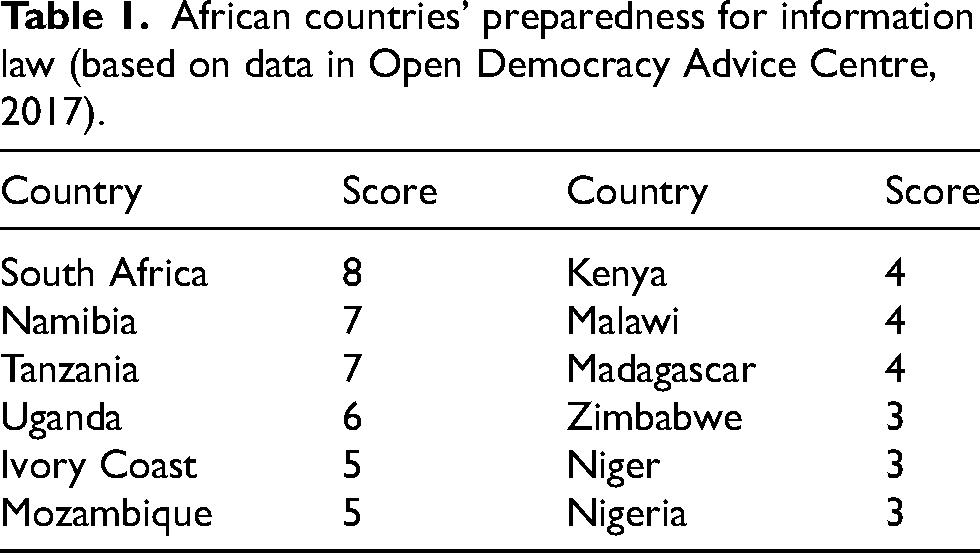
Growing adoption of the right to information in Africa should, in theory, improve access to government data, reduce corruption and expand the frontiers of democracy. A report supported by the African Platform on Access to Information (APAI) (Open Democracy Advice Centre, 2017) provides some country level case studies and comparisons of African countries’ preparedness for, and awareness of, access to information laws which are modelled on the AU model law. The AU Model Law aims to ensure that legislative drafters and policy-makers address all issues relevant to the African context in their adoption or review of access to information legislation. It also serves as a benchmark for measuring compliance with African and international legislation on access to information. The APAI supported report reveals the state of access to information in their countries in a scale of 1 (very weak) to 10 (very strong) (see Table 1).
African countries’ preparedness for information law (based on data in Open Democracy Advice Centre, 2017).
Many researchers have commented on access to information laws in Africa (see for example, Adu, 2018; Chisango and Lesame, 2017; Svärd, 2017). Some, for example Adu (2018), argue that the right to information has contributed little if anything to improving the fledgling democracy in Africa because of corruption, human rights abuses, restrictive media, absence of media pluralism, denial of access to information, and lack of transparency and accountability. It is argued that adequate political leadership, civil society involvement, and a balancing act would promote access to government information/records and the protection of individual privacy.
However, efforts are being made at the Pan-African level to formulate policies and guidelines for internet and broadband access. The UN ECA (2017) report aims to assist African countries in their efforts to formulate and implement policies. The report contains a number of recommendations for consideration and adoption by African Governments and their development partners. Reviewing the ICT policies developed for the Southern African Development Community (SADC) countries, Munyoka and Maharaj (2017) recommend that member states should update their national ICT policies in-line with the SADC digital regulatory framework and policies. Bunyasi et al. (2014) recommend that the government needs to develop a policy for capturing business information locally and internationally on small and medium enterprises to support sustainable development in small and medium-sized businesses in Africa.
Infrastructure for accessing digital information/content
Recent statistics show that access to mobile devices is rapidly increasing in some countries in Sub-Saharan Africa including Kenya, South Africa, and Nigeria and that benefits of mobile access have been widely recognised (see for example, Asongu et al., 2018; Cibangu et al., 2017; Traxler, 2018). However, there are several challenges surrounding mobile access, associated costs, electricity, social norms and customs, etc. Some researchers argue the supply and use of telecentres in Africa has remained very slow and there is a long way to go to fully benefit from internet services through telecentres due to: (a) weak infrastructure resulting from lack of computers and lack of, slow and/or unstable connections; (b) poor management caused by lack of marketing and lack of relevant information and services; and (c) human factors due to lack of awareness and knowledge among citizens (Furuholt and Sæbø, 2018).
There are other challenges too. For example, citing the 2016 ITU report, Kaba (2018) argues that only 15% of people in Africa have internet access. There is a huge gap between access to mobile phones and availability of electricity. Max and Berman (2018) argue that while about 83% of the Sub-Saharan population is covered by a mobile network and nearly 70% has a mobile subscription, only 33% can access electricity. As a result, access to the internet and facilities for charging of devices remains a key challenge, especially in rural and remote areas. High cost of internet access is often a major barrier, especially for rural and low income communities. However, there is evidence of success of community networks that can offer low cost internet access (Gwaka et al., 2018).
Social practices, customs and economic constraints
Some researchers point out that the principal barriers to technology adoption in Africa are neither macroeconomic ones nor aspects related to the telecommunications sector. Instead, they are related to consumer behaviour, in particular being able to access mobile top-ups in rural areas (Sawadogo and Ammi, 2018).
A study by Wyche and Olson (2018) shows that economic constraints leading to access only to old or used handsets, misinformation or restrictions surrounding social media, and gendered allocation of mobile time to family members often restrict women's access to mobile devices and services. In rural Africa women who use the internet are more likely to be better educated and have higher incomes (Edda and Wallace, 2019).
Information education and training facilities
Many countries in Africa do not have any university courses on library and/or records management. However, in countries where such university courses exist, the quality of education and research is not adequate to meet the demands of today's digital information world (see for example, Kacunguzi and Samuel, 2017; Katuli-Munyoro and Mutula, 2017).
Davis (2015) discusses the suitability of the Western world model and methods of teaching librarianship for Africa and suggests the need for an African-centred approach to librarianship training. More specialised training is required in some specific areas such as providing health information to users (see for example, Grace et al., 2017, Ajuwon et al., 2017).
User education
User literacy and education remain a key challenge in Africa. Reporting on a study of mobile device literacy in Senegal, Scharff et al. (2017) demonstrate the importance of a physical learning environment for users to improve their mobile device literacy skills and for developers to engage with users to produce better quality and appropriate apps. Studying the usage of telecentres in KwaZulu-Natal (South Africa), Mbatha (2016) comments that there is a need for adequate and coherent government policies regulating the training of local communities to effectively use ICTs and online services. In a similar study undertaken at a telecentre in Malawi, Kapondera and Hart (2016) observe that the key constraints facing users are the lack of online search skills, lack of local content, cost and electricity.
Deen-Swarray (2016) observes that the key issues contributing to poor adoption and the use of ICT and internet services in Africa are poor language and digital literacy skills. In a study involving 12 African countries, the author found that both adoption and range of ICT use correlated with increased basic literacy. It is a well-established fact that sharing and reuse of data can contribute to research, innovation, and sustainable development. However, user education and policies play an important role in data sharing. Jao et al. (2015) show how trust-building processes are central to perceptions of fairness in sharing data among researchers, and how user education and supporting policies for data sharing are crucial in this context.
Findings from the NetDiploma workshops
Engagement and networking activities with the relevant key partners and stakeholders in the three partner African countries suggest that a simple architecture, with flexibility for building specific applications, would be better suited to the vision of building a one-stop shop for accessing cultural, indigenous and government information and records held in memory institutions such as national archives in Africa. This could, in the future, lead to a DPLAf. The NetDiploma project also revealed some key enablers and challenges associated with the vision of a DPLAf.
Key enablers
Activities, largely funded by external agencies and in some cases government agencies, have resulted in the digitisation of some content. A catalogue of hard copies and of digitised content is available at the national libraries and national archives in the three partner countries in Africa, although often not with full and standardised metadata. However, theis digitised content is rarely accessible online due to the lack of common/shared infrastructure, standards, tools and policies which are the key requirements for a future DPLAf.
Key challenges
The key challenges to emerge from the workshops were:
content that has been digitised at the national archives in Kenya and Malawi, and at the Institute of Ethiopian Studies in Ethiopia, is not accessible online because of the lack of resources – ICT, financial and human – and access/use policies other valuable archival and cultural heritage content has yet to be digitised e.g. at the Ethiopian National Archives and Library Authority (ENALA) lack of any legal and ethical framework in relation to access and use of digitised content held at various institutions in the three partner African countries concern amongst national agencies and information professionals that if all the content is made freely available on the internet, it may disadvantage the content providers – i.e. national libraries, national archives, research institutions, etc.; the sentiment was that they might lose control of the content and this may have implications for their long-term existence and role in the management of indigenous content, records and archives ICT infrastructure and capacity – both at the supply (content providers) and demand (user) ends - vary significantly amongst African countries and specific institutions. Generally, the content providers lack the modern ICT infrastructure required for digitising content and making digitised content available online lack of resources is a key challenge for every content providing institution - government funding is often the only source, which is inadequate for running the current level of service let alone investing in digitisation and online services; most of the digitisation activities so far have been funded externally through grants and aid lack of human resources, and more so for professionally qualified staff and staff with adequate ICT skills, is common amongst content providing institutions in all the partner countries; for example, it was revealed that less than 5% of the staff at ENALA are professionally qualified in some countries, for example Malawi, until very recently there were no university courses that offer professional qualifications in archives and records management; and Ethiopia's librarianship, archives, records management courses were suspended a few years ago; and user skills required for accessing and using digitised content vary significantly in Africa, and amongst the cross sections of society and geographical regions – city vs. rural areas - with regard to literacy, ICT, and language skills.
A roadmap for an integrated system for online access to cultural, indigenous and government information and records held in memory institutions such as national archives in Africa
Detailed discussions with various stakeholders at the workshops, subsequent engagement activities in the participant countries, and consideration of the emergent key enablers and challenges resulted in the following roadmap:
The proposed networked DPLAf should focus on indigenous knowledge, cultural heritage and government information held in African memory institutions because this is one of the priority areas identified in the African Union Agenda 2063 (African Union, n.d.), and such information is not easily accessible at the moment. The vision of a DPLAf can be accomplished through a joined-up approach of various stakeholders, viz. content providers (national libraries, national archives, universities and research institutions), funding agencies (national, Pan-African and international), policy makers (government ministries/departments), professional associations, NGOs/charities, and user communities. The FAIR principles (Findable, Accessible, Interoperable and Reusable) principles for sharing and re-use of data (European Commission, 2018; Wilkinson et al., 2016) should form the foundation of the approaches to designing the DPLAf. The first step should be to make the catalogue/metadata of content available and searchable online so that people can discover what is available and where. Digitisation of content should continue with the long-term goal of making all the content of national libraries, national archives, and similar institutions accessible online. Additionally, catalogues/metadata of all kinds of content, in whichever format they are currently available, should be made available online by individual institutions. A searchable online catalogue – to be developed and managed by a Pan-African organisation – should link online catalogues/metadata of African archival documents, indigenous, government and cultural heritage content available in various African institutions and elsewhere in the world. This will ensure that users will be able to discover African indigenous content and government information irrespective of where those are available. A common and sustainable funding model should be developed through contributions from different African government agencies as part of their development agenda. Appropriate access and use policies, ethical guidelines and business models for digital content management and access, should be developed at national and institutional levels so that users can choose the most appropriate way to access and use African indigenous content and government information for a specific purpose. Content providers and other stakeholders should work together to build specific ‘use cases’ demonstrating the benefits of accessing and using indigenous knowledge and government information/content for better education, research and innovation, business, civil rights, and other global challenges. University courses and continuing professional development (CPD) programmes should be developed in each African country to meet the demands of professionally qualified human resources and ensure that each memory institution has appropriate staff with adequate information/records management and ICT skills. Appropriate information and digital literacy skills programmes need to be developed for users at all levels so that people in every sphere of education, business, government, etc., can access and use the DPLAf. Further research and innovation capacity should be developed to build and improve the design and management aspects of the DPLAf system and service. National and international networking activities should continue to promote the development and use of a DPLAf and its services to address various global challenges and sustainable development goals in Africa.
Impact of the NetDiploma network on national development
As stated earlier in the paper, a key objective of the NetDiploma network was to build awareness and encourage collaborations for promoting access to indigenous information as held in the archives in the partner African countries. The first workshop, in Lilongwe, Malawi, led to some follow up activities that resulted in some sustainable developments in the country for promoting access to archives and records. A significant outcome of that workshop is that it led to the implementation of the World Bank funded Electronic Document and Records Management System (EDRMS) project. One of the workshop participants came from the country's Department of E-Government, which is involved in the implementation of the Digital Malawi project (Public Private Partnership Commission, s.d). Following the workshop continued discussions between the National Archives and the Department of E-Government led to the inclusion of the National Archives in the Digital Malawi project. It was tasked with leading the EDRMS roll-out to the entire public service in Malawi. Eight pilot institutions have been identified to implement the system and have received a series of training sessions on the EDRMS which were conducted by a consultant from the UK specifically engaged for the task. An EDRMS Technical Advisor from Botswana has been recruited and a tender document for procurement of the system has been finalised and advertised. Had it not been for the NetDiploma workshop in Lilongwe, the National Archives would not have been championing implementation of the public sector-wide EDRMS through the Digital Malawi project.
Similar follow up discussions and activities have also taken place amongst various relevant stakeholders in the two other partner countries, Ethiopia and Kenya, which are expected to result in developments leading to better management of and access to indigenous information held in the form of government records and archival documents in the respective countries.
Conclusion
The NetDiploma project aligned with Agenda 2063 of the African Union, especially
The NetDiploma project aimed to address four key research questions, viz.
What are the key cultural, historical, political, linguistic and technology enablers and challenges to community access to information in Africa? How can modern ICT and mobile technologies be used to facilitate access to information required for education, health and wellbeing, cultural integration, agriculture, tourism etc? What policies and practices are required for developing and managing a free DPLAf? What further research is needed to enable the development of a DPLAf? the general disregard for the relevance of good records management practices and inadequate financial support for the archives, libraries, museums and indigenous knowledge centres responsible for documenting and preserving culture and heritage (Ashie-Nikoi, 2019); data integrity in terms of completeness, accuracy, credibility and relevance, as well as infrastructure and capacity, as some the key barriers to making African indigenous information accessible online (Lynch et al., 2020); and the lack of a standard policy guiding digitisation projects and a lack of knowledge or in-depth understanding of Web archiving and its prospect as a digital preservation measure (Balogun and Kalusopa, 2021).
Some of the findings of the project corroborate recent research published in this journal, such as:
In addition, the findings provide new or nuanced knowledge from the content provider perspective. In particular, content providers are concerned that free digital access to their indigenous content will result in a loss of control over who uses it and how. There was a strong sentiment that the national institutions might lose control of the content and this may have implications for their long-term existence and role in the management of indigenous content, records, and archives. They are also concerned about the financial implications. Not only do they have insufficient financial (and human) resources to digitise and prepare their content, they also fear they may lose income they have earned from access to the physical equivalents, albeit the income may be relatively small. The findings also revealed that user skills required for accessing and using digitised content vary significantly in Africa, and amongst the cross sections of society and geographical regions – city vs. rural areas - with regard to literacy, ICT, and language skills. There is also a lack of any legal and ethical framework in relation to access and use of digitised content held at various institutions in the three partner African countries. These are important in the context of the policies and practices required for developing and managing a free DPLAf, requiring the development of an appropriate legal and ethical framework for content access and use at the national level.
There was a general consensus among the participating institutions and stakeholders in the partner countries that the vision of a DPLAf can be accomplished through a joined-up approach with various stakeholders, viz. content providers (national libraries, national archives, universities and research institutions), funding agencies (national, Pan-African and international), policy makers (government ministries/departments), professional associations, NGOs/charities, and user communities working together to implement the roadmap above that emerged from the network. It was agreed that:
Appropriate access and use policies, ethical guidelines and business models for digital content management and access, should be developed at national and institutional levels so that users can choose the most appropriate way to access and use African indigenous content and government information for a specific purpose; and Content providers and other stakeholders should work together to build specific ‘use cases’ demonstrating the benefits of accessing and using indigenous knowledge and government information/content for better education, research and innovation, business, civil rights, and other global challenges.
Since various memory institutions that host indigenous knowledge, cultural heritage and government information are at different stages of the digital journey – some having a part of their collections accessible online with others not having a digital presence yet - a strategic approach with a phased development may be the most appropriate way forward. Such a phased approach should be based on the FAIR principles; for example, the first stage could be to focus on building a searchable catalogue of collections of resources on indigenous knowledge, cultural heritage and government information held in various African memory institutions. Such a searchable online catalogue would ensure findability of the resources. The next phase could be to make the content that is already digitised accessible online, alongside prioritised digitisation of content held at each memory institution. Both these phases of course have to be supported by financial resources and trained human resources vis-à-vis the appropriate ICT and policies that would make the technologies and tools interoperable to support access to and use/reuse of indigenous, cultural and government information and records held in various memory institutions across Africa.
Footnotes
Acknowledgements
The authors would like to acknowledge the UK Arts and Humanities Research Council for funding this project (Grant Ref: AH/R004277/1).
Declarations of interest
none
Declaration of Conflicting Interests
The author(s) declared no potential conflicts of interest with respect to the research, authorship, and/or publication of this article.
Funding
The author(s) disclosed receipt of the following financial support for the research, authorship, and/or publication of this article: This work was supported by the Arts and Humanities Research Council (grant number AH/R004277/1).
