



Abstract
This article sheds light on the collection and use of data by libraries in sixteen countries across Africa. It highlights the challenges that librarians and library organizations face in gathering, analyzing, and presenting data of various types for self-advocacy. In this study, qualitative data from a meeting of library representatives was analyzed to identify main challenges including: data integrity in terms of completeness, accuracy, credibility, and relevancy; infrastructure; capacity; local investment in libraries; time; and participation of data collectors and respondents. Implications for those collecting data on African libraries as well as those supporting the use of data in these contexts are discussed. The purpose of this paper is not to feed into representations of African libraries as chronically under-resourced and lacking in capacity, but rather, to constructively engage with first-hand accounts of how librarians are experiencing and navigating barriers in order to offer potential avenues forward for the field.
Introduction
“Libraries can make significant contribution to all levels of data collection. However, libraries are somewhat forgotten as active players.” (Group 2)
“The data we collect…it does not project the truth at times.” (Group 1)
“How then do we talk to governments when we don’t have anything here to support what we are talking about?” (Group 1)
Within the Library and Information Science (LIS) field across Africa, there is growing excitement about potential connections between public libraries and social and economic development. Both the 2018 IFLA General Conference and Assembly and the 2019 AfLIA Conference & African Library Summit, for example, were dominated by papers exploring the role of libraries in achieving African Union (AU) 2063 Development Aspirations and United Nations Sustainable Development Goals (SDGs). This excitement is perhaps natural – public libraries and development organizations do share many common goals that make them strong potential partners (Benson et al. 2016; Hart and Nassimbeni, 2015). Both groups seek to build strong community partnerships as they implement educational programs (Mahwasane, 2017), expand access to information and communication technologies (Ifijeh et al., 2016; Sears and Crandall, 2010), support improved community health practices (Emojorho and Ukpebor, 2013; Sow and Vienkar, 2012), and much more.
In spite of this potential, many public libraries struggle to have their work recognized by the broader development community (Fellows et al., 2012). As our opening quotes highlight, libraries are “forgotten as active players” in spite of the “significant contributions” that they can make to their countries. One key problem in this struggle for recognition and visibility is that libraries lack the data they need to demonstrate the development impact that they have on their local community (Lor, 2016). Unfortunately, as the quotes go on to demonstrate, these libraries often face challenges in collecting the authoritative data they need to advocate for themselves in front of government agencies and other development stakeholders.
These quotes were taken from a meeting of library representatives from 16 African countries held in Accra, Ghana in early 2018. The purpose of the meeting was to lay the groundwork for a larger project that seeks to build the capacity of public libraries to collect, analyze, and use data for self-advocacy. This included getting a better understanding of the current library context and data culture within the countries of participants in the meeting. Throughout the meeting, it was clear that there is an array of challenges surrounding the use of data in African library contexts, some of which are being addressed to varying degrees while others may not be as visible or fully understood by those supporting the use of data in these settings.
This paper explores participant feedback from that meeting, to highlight the barriers that participants perceive as preventing public libraries from using data to advocate for themselves as agents of development. The purpose of this paper is not to feed into representations of African libraries as chronically under-resourced and lacking in capacity, but rather, to constructively engage with first-hand accounts of how librarians are experiencing and actively navigating barriers in order to offer potential avenues forward for the field. As the analysis will show, the local, social context of knowledge production plays a large role in the capacity of libraries to enact evidence-based advocacy (Bundy, 2003; Sawaya et al., 2011), and this may be overlooked in capacity-building efforts. This understanding, then, exists at “the intersection of information science and social scientific thinking and practice” (Cronin, 2008: 465), and it is presented for those who collect data on African libraries as well as those who support the use of data in these settings to gain insight and spark reflection. We hope that the findings of this study will provide a baseline for thinking about how tools and trainings might be designed to support data culture across African libraries; how development organizations might support library data collection efforts; and how African libraries can better position themselves as development partners.
Data culture across African libraries
Current LIS literature shows that data collection is increasingly important for libraries across sub-Saharan Africa, but a broad array of factors are nonetheless hindering the development of a data culture. Bundy (2003) and others (e.g. Sawaya et al., 2011) have made it clear that data is an integral part of proving libraries’ value in a world of neoliberal accountability. Across Africa, the “decentralization policies of neoliberalism have shifted the power to local governments” (Stranger-Johannessen et al., 2014: 88), which frequently leads to an overall decrease in administrative and financial support as local governments are “often ill-equipped” to assume these burdens. For African libraries, Moahi (2019) found that lack of funding was the number one problem across all the literature reviewed. Part of the reason for this is that libraries tend not to play a central role within long term national development plans and are instead reliant on inconsistent and short-term funding (Benson et al., 2016; Kavalya, 2007). Libraries are frequently forced to advocate for themselves to be included in key development initiatives, sometimes successfully (see Namhila and Niskala (2012) for the case of Namibia) but not always.
Many studies tie this lack of funding to issues of perception – libraries are perceived as incapable of evolving beyond book lending services to meet 21st century needs (Moahi, 2019), are perceived as colonial institutions irrelevant to local communities (Kabamba, 2008; Moahi, 2019; Sturges and Neill, 1998), or are not perceived at all (Fellows et al., 2012). If they are not perceived as doing work that contributes to the national development of their country, then they will not receive funding from local and national stakeholders (Elbert, 2012) or international organizations (Fellows et al., 2012; Namhila and Niskala, 2012). These perceptions therefore have a direct impact on how successful libraries can be in achieving their goals. As Gould and Gomez (2010) point out, “Power and money matter: Government prioritization in the allocation of resources makes a difference in the success of libraries as public information venues in society” (169).
Many authors have suggested that African libraries should develop better evaluation programs to assess the social impacts that they are already having (see Moahi, 2019; Sawaya et al., 2010; Stranger-Johannessen et al., 2014). IFLA (2018), for example, has produced a Storytelling Manual that libraries can use to collect, frame, and tell stories about how they are making differences in the lives of their users. This can then be used as proof of how they are impacting development in their communities (Igbinovia, 2016; Kabamba, 2008).
Hart (2004), however, emphasizes that libraries should not stop at isolated stories, fearing that they may be too anecdotal to make a difference for libraries, particularly in the current neoliberal “climate of accountability and reduced public spending” (114). Instead, libraries need to adopt more rigorous forms of evidence-based advocacy. The Economic Commission for Africa (2003) echoes these same feelings: In spite of their enormous power to propel human progress, libraries are increasingly asked to justify the resources spent on them, to justify even their very existence. In this climate, libraries must be accountable, responsive, and effective in portraying the value of their services to funding authorities, be they public or private. These imperatives have led to a new emphasis on quantitative assessments to provide hard evidence about the extent of their value to the society or their sponsors. […] assuring the proper functioning of libraries depends on demonstrating their value in the widest sense and to their widest audiences. (1)
Unfortunately, there have been few empirical studies of the actual data collection practices and challenges within African libraries (German and LeMire, 2018). Researchers have described some of the general problems that libraries face, but often at theoretical level. For example, some authors blame the colonial history of many African library systems; libraries have never developed a culture of wanting to assess their local impact because they were not set up to have positive impacts on the local community (Moahi, 2019; Stranger-Johannessen et al., 2014). As Sturges and Neill (1998) point out, “Anyone involved with marketing could tell them that you do not just persist in pushing an unpopular product at the consumer, you find out what the consumer really wants and offer them that. This was not, however, a message that was heard very often.” (92) Even when libraries do attempt to collect data, authors posit that they face issues of capacity. In some cases, library systems lack the knowledge to formulate data collection strategies that capture the local impact they are having. As Moahi (2019) notes, “More often than not, apart from informing internal management about the number of library users and what resources they use, the data does not give an indication of the value of public libraries.” (252) In other cases, libraries are collecting useful data, but do not have the skills to use that data to produce a powerful story about their impact. Moahi (2019) argues that librarians are often not trained to analyze and “interpret data and integrate it with stories of impact” (242). This places the onus on the professional capacity of librarians, lacking the analytic skills needed to use data persuasively.
Even these few examples tend to be ‘desktop’-based reviews of existing literature on challenges of African libraries (e.g., Pingo, 2015; Jain, 2016) rather than empirically-grounded studies in specific contexts. Even less work constructively engages with these challenges to offer innovative data collection strategies that might support libraries given their current capacity. As German and LeMire (2018) contend, “Little has been written about strategies for assessing library outreach efforts,” (66) particularly at an international level. As a result, we know that there is some type of disconnect within the data cycle, which prevents libraries from persuasively demonstrating their local development value, but there is little definitive knowledge around what the actual issues are or how to overcome them. All of this feeds a vicious cycle: Public libraries are often perceived as colonial and elitist institutions that have little relevance, which leads the public to not make use of them and the government to not fund them. This, in turn, prevents libraries from effectively providing relevant services to the public and having evidence to prove their value. To interrupt this cycle, more research is needed to understand what prevents African libraries from telling data-driven stories, and what tools or strategies might help libraries to overcome these barriers.
Methodology
To overcome this research gap, the researchers carried out a series of focus groups to answer the following research questions: What are common experiences surrounding data collection and use in African libraries? What are challenges that libraries face in creating and telling data-driven stories about their impact? What strategies or tools can help to mitigate barriers to the development of a data culture amongst African public libraries?
Data were collected within a three-day workshop in Accra, Ghana in February 2018. The workshop was planned and organized by researchers from TASCHA (Technology and Social Change Group), a research group within Information School at The University of Washington, and AfLIA (African Library and Information Associations and Institutions), an international non-governmental organization that was established to support and promote libraries and information centers across Africa. A primary goal of the workshop was to seek buy-in and input from stakeholders for a broader applied research project that seeks to develop data collection methods for African public libraries. While the present study involved participants from sub-Saharan Africa only, it is the hope of the project to include North African libraries in the near future. The workshop was therefore a combination of presentations about the larger project, informal time to solicit feedback from stakeholders on the future direction of the project, and focus groups designed to solicit information to answer our research questions.
Population and Sampling
The population targeted here is librarians in sub-Saharan Africa. We used a purposive sampling technique to identify countries that were representative of Africa across variables including region (southern, eastern, western, and central Africa), major colonial languages (English, French, and Portuguese; we were unable to represent Arabic), and national library system types (centralized, decentralized, or mixed) across the continent. The goal was to include variety across these variables, and 16 countries were chosen according to these criteria. Within these countries, participants within the library field were selected using an expert sampling method based on the domain expertise of AfLIA. At this meeting, we asked for information pertaining to public libraries, but some participants were limited in this aspect of their experience. As a result, the individual responses likely reflect their expertise in the broader library field, though the next phase of research will explicitly focus on the unique barriers within public libraries. Where possible, the participants came either from the national library system or the national library association in their respective country. In cases where a participant from either of those entities could not be secured, other individuals were invited that have expert knowledge of the library context in their country.
Based on these criteria, the workshop included participants from the following countries: Angola (1), Benin (1), Botswana (1), Burundi (1), Cameroon (1), Côte D’Ivoire (1), Ghana (1), Guinea Bissau (1), Kenya (1), Namibia (1), Nigeria (1), Senegal (1), Seychelles (1), South Africa (5), Uganda (1), Zimbabwe (1). We also invited eight participants from five organizations identified by AfLIA as influential within the library sectors of countries in sub-Saharan Africa. In this report, the names of participants and their countries and/or institutions will be withheld to protect their privacy.
Data collection
To collect data to answer our research questions, we took a focus group approach. To form the focus groups, participants were divided into sets of four or five individuals, with the goal of including a mix of regional perspectives and a balance of genders within each group. The groups participated in various activities which were facilitated by researchers from AfLIA and TASCHA and allowed for various modes of engagement with the meeting content. The data considered in this report were from four different sources: written responses to questions posed during a group activity; written responses to worksheets that asked questions about participant experiences with data; transcripts of focus group discussions; and written observation notes taken by the research team during focus group discussions. These four data sources were selected to represent an array of time points from the 3-day meeting as well as different modes of expression, including individual/group and oral/written, to allow for an inclusive and comprehensive engagement with the issues. The data sources analyzed in this report are summarized in Table 1, followed by activity details:
Summary of data sources and activity details for the study.
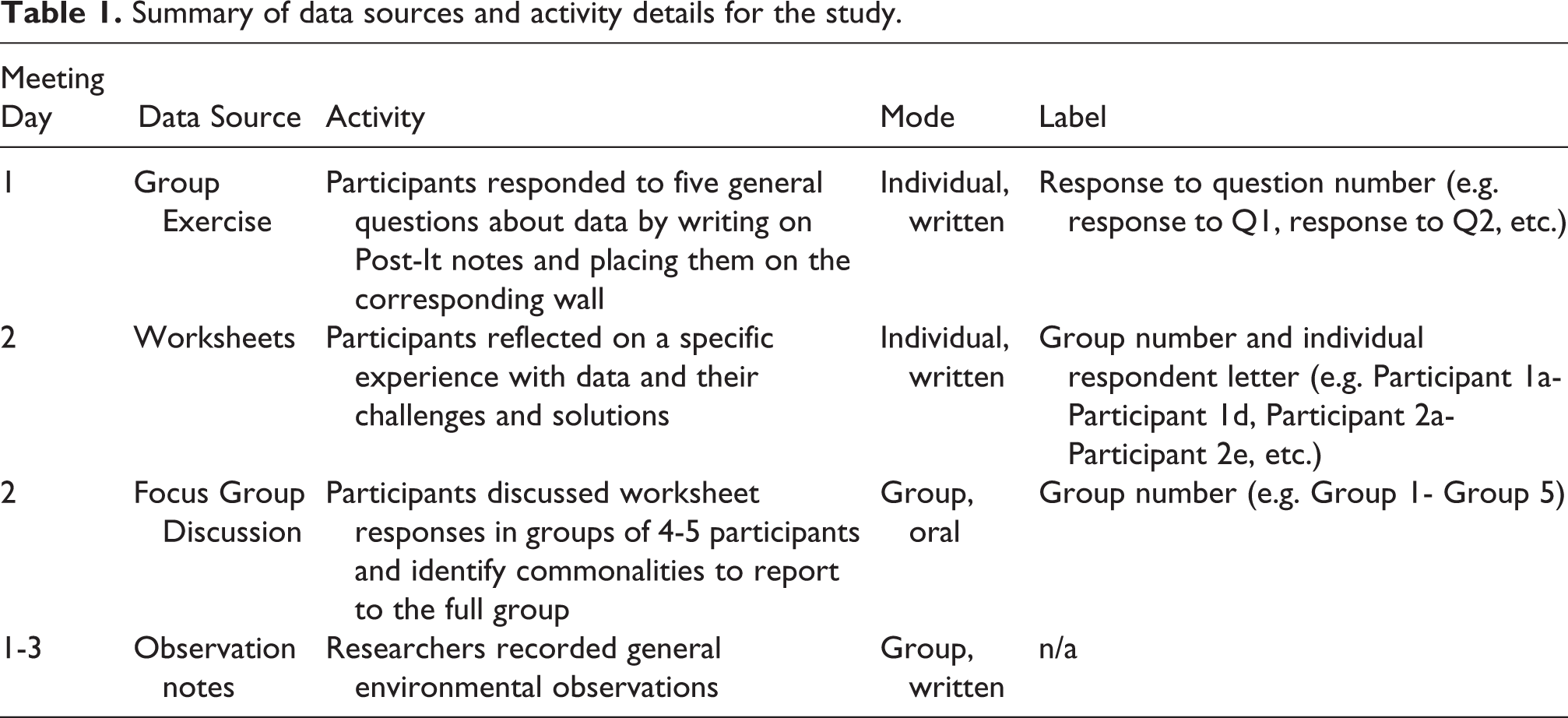
In the group exercise activity, the participants were asked to respond to five general questions about data including what kinds of data their organization collects, what types of data they wish they had, who their stakeholders are, what decisions they make using data, and if the data can speak to the national development agenda of their country. The next day, the worksheets asked participants to recount one specific example of data collection in their organization to share successes and perceived gaps in the process as well as insight into their local data culture. The worksheet responses were shared in the focus group discussions, allowing for additional reflection and responses from other members. The focus groups were then asked to identify three shared similarities and/or lessons to share with the group at large. Throughout, researchers were taking observational notes to record additional remarks and events in the surrounding meeting environment.
All sessions were conducted in English with interpreters present to translate between other languages (French and Portuguese) according to participant needs. Written responses were primarily in English, and those written in French or Portuguese were translated to English using Google Translate. Participants gave their consent to be included in the study when they agreed to attend the meeting. Participants also agreed to be audio-recorded.
Data analysis
Data were analyzed using a grounded theory approach and a coding scheme developed through an iterative process. Data were first analyzed in terms of broad content themes, from which the idea of challenges related to data emerged as prominent. Then, a system of codes to reflect the types of challenges related to data was created, applied, and revised to respond to emergent themes. In total, 11 codes across 6 themes were applied. Selected quotes are given below to illustrate both typical and outlying views.
Results: Data Challenges for Libraries
Regarding the research question “What are common experiences surrounding data collection and use in African libraries?” the responses across our sources showed that libraries engage with many different types of data, both qualitative and quantitative, and use varied methods such as surveys and focus group interviews, to collect data for a wide range of purposes. These purposes included needs assessment of library users and evaluation of current offerings, though the most commonly mentioned use of data was for funding and/or budgeting decisions.
It is clear that all participants are aware of and invested in the importance of data as a tool to guide and support the work of libraries in Africa. They see data as useful both internally and externally, as the following discussion comments illustrate: “Data helps us to remain focused – to have a direction. If we don’t collect data then you are hitting the wall, you don’t know the direction, but data collection helps you…to remain on the right path.” (Group 1) “If you can’t measure it, you may not be able to fund it…so in other words, statistics are really vital to our existence…they don’t fund anything emotional. You need evidence.” (Group 5)
Regarding the research question, “
1. Data integrity
This was the most commonly mentioned challenge for participants in working with data across the sources considered here with an overall focus on the social context in which “integrity” is constructed. In three of five focus groups, for example, group members identified issues related to data integrity as a common thread. However, “Integrity,” had many different meanings, generally implying soundness, wholeness, or truthfulness of the data. Given the potential vagueness of this term, as well as the overall prevalence of this challenge and its socially- constructed nature, data integrity is separated into four aspects: completeness, accuracy, credibility, and relevancy.
1a. Data Completeness
Participants discussed challenges with data perceived as incomplete. Worksheets revealed that the impediments to completeness were varied, including: limited coverage of data collection, small sample sizes, and items or sections of data instruments left unanswered by respondents. The idea of “omission” was mentioned by one respondent, as in “some relevant data may be omitted” and “staff omission of some facts,” (Participant 2b) suggesting the idea that some information was missing and therefore detrimental to data quality. In many cases, the ability to collect complete data was interrelated with other difficulties related to infrastructure (such as lack of Internet connectivity) and participation of respondents.
In some cases, participants expressed a desire for data that was not present or available to them: “The [data] doesn’t show/separate gender statistics. It’s hard to tell the number of female against male or children that accessed the library” (Participant 1c) “Very few libraries have and collect data about ICT. It is an obstacle to make strong case about library role in digital media” (response to Q1) “User profile and needs [are a data gap]…Because we serve the public…we haven’t really done the profiles as I think we want to do and their needs as well” (Group 5)
1b. Data Accuracy
There was also a sense that the data collected was not always representative. As stated by a group discussion participant, “The data we collect…it does not project the truth at times” (Group 1), or as written in a worksheet, “Not all time the data may reflect the actual situation” (Participant 2b). This was at times perceived as a consequence of the data collection process: A: “We took what people said but B: “Not ‘the functioning ones?’” (laughs) A: “Well, we didn’t say which ones are functioning (laughs) but from that, we also didn’t separate computers for staff and computers for users…we understood what we wanted, but
1c. Data Credibility
Some representatives also raised the issue of a lack of credibility because certain data did not come from a trustworthy source. Though similar to the issue of data accuracy, above, the source of the data played a large enough role to make this aspect distinct. This issue appeared in individual worksheet responses regarding perceived gaps in the data collection process such as “Credibility of the sources” (Participant 2e) and “Integrity of data as librarians were self-reporting (validation of data being received)” (Participant 5e). Interestingly, both of these comments co-occurred with references to “regular consultation meetings” (Participant 2e) and “librarians were given training and tablets to collect data,” (Participant 5e) suggesting that the existing supports were not sufficient or different support is needed, a common theme that will be discussed later. Alternatively, it suggests that there are other measures of credibility operating beyond the realm of training and resources that are impacting data quality, as perceived by participants.
These and other comments convey a lack of trust in librarians as valid sources, in the sense that information given by them needs additional validation or an alternate source with official status. When asked about lessons learned from the data collection process, two participants in the same group relayed, “Ensure the information provided is given by the official mandated to do so” (Participant 5b) and “Strengthen the integrity of data collected - who is giving info officially” (Participant 5c). Later, this group discussed a related anecdote: data had been provided to a participant by library staff, but later, the head of that library had called to complain that the data given was wrong. According to the participant, “Maybe the head of library was not too happy with…maybe if it was reported directly, he would have doctored it a little…massaged it, but the staff just put it out. I’m not sure what the issue was, but the lesson we learned was, you know,
The importance of hierarchy is echoed in different worksheet responses to the question “Who is responsible for data quality?” invoking other leaders, as in “The informants of the group and community leaders” (Participant 4a) and “The Council and Traditional rulers and librarians” (Participant 4d). This collective, social measure of credibility may be likewise linked to another worksheet response from a different group that “Collaboration with regional head librarians and training on data integrity strengthened quality of data collected,” (Participant 5e), further supporting the idea of hierarchical power as quality control for data to be seen as valid.
Looking to a higher power may be a practical solution to the issue of conflicting data from different sources. Another participant stated, “The gaps…is unreliability of the data and credibility of the sources…sometimes (laughs) we get conflicting information” (Group 2), reflecting the idea that contradictory information is therefore not credible, and perhaps appealing to an arbiter of higher authority may resolve the issue. Notably, the role of hierarchy in establishing data credibility was only discussed in a group with only Africans, in which no non-African facilitators were present, which may be a topic worth exploring further.
1d. Data Relevancy
In some cases, not all data collected was seen as useful for library purposes. For instance, a participant noted in the group activity that “Data is collected on circulation, however, not used to make decisions” while another expressed, “It would be better if data collected concerned more aspect of the library services” (both responses to Q1). This reflects a sense that some current data collection efforts may be perceived as superfluous, or that the data collected may be of a scope that is not useful to the libraries themselves, as illustrated in a group discussion: “The statistics we are collecting for government are very general; they are not really library-specific to assist us to improve what we do…we have 14 special projects that they fund but our impact information is not part of the quarterly reporting mechanism. We can use that for different reasons…we could use a more detailed look” (Group 5)
In the group exercise, however, there was an overwhelmingly positive response to the question “Can the data [that your organization collects] speak to the national development agenda of your country?” (Q4) – 17 out of 18 total responses answered positively, and 12 out of those 17 tied their data to specific aspects of national development plans and/or Sustainable Development Goals. This reinforces the idea that library representatives see data as useful in connecting their work to priorities of larger organizations, though not all data collected is seen as relevant to them, which may affect overall buy-in or motivation of staff collecting it.
2. Infrastructure
Infrastructure, in terms of material conditions and resources, also has a large impact on the ability of libraries to collect and analyze data. For example, one participant reported in the group exercise, “National library system doesn’t collect data since it has issues of connectivity,” (response to Q1) highlighting that a lack of reliable Internet connection can affect whether or not data is collected at all. Similarly, another participant stated, “We need a good software to analyze the information; we analyze with basic program,” (Participant 3e) suggesting that the present level of engagement with data is hampered by limited resources.
Connectivity was the most commonly mentioned infrastructural challenge, and access to technology more generally, as in lack of computers. These barriers are both economic and structural, as exemplified by an anecdote in observation notes: one participant recalled difficulties in conducting interviews by phone because phone calls are very expensive in their country, but alternatively, calls made via Skype may fail due to the unreliable Internet connection. Even when connectivity is present, it may be financially or mechanically inaccessible for libraries hoping to conduct research.
Representatives from certain countries reported more Internet connectivity than others, and this was acknowledged between participants. They highlighted that certain methodologies, such as engaging library users via social media, that may be possible in one country may not be replicable across the continent. They also noted disparities within the same country, wherein certain libraries may have computers while others do not, creating a challenge for consistent data collection and sharing within national library networks.
In the eyes of participants, these challenges fuel the vicious cycle mentioned previously: limited access to technology limits the available data, but without data, they have difficulties convincing funders of the need for technology. This in turn feeds the ambivalent local perceptions of and resulting lower investment in libraries. For example, according to observation notes, a representative spoke to the challenges of libraries in a post-conflict setting in which infrastructure had been damaged by years of war. Despite the desire and potential for expanded ICT access via libraries, the representative saw “no concrete examples” with which to persuade the post-conflict government to prioritize libraries due to the present state of infrastructure. This points to the negative effect of this type of challenge on not only data but also library advocacy and potentially longer-term consequences for library sustainability.
3. Capacity
Material resources notwithstanding, participants also reported challenges in the human resources or capacity of libraries to complete data collection as well as analysis. Some participants described capacity challenges as a lack of training, as seen in worksheet responses from individuals who reported “Lack of training of staff,” (Participant 2a) and “Lack of ICTs skills,” (Participant 2a) or “The way to collected [sic] it is not appropriate and we need people with skills in this area” (Participant 3e). Others relayed that some capacity support was present but not sufficient, as exemplified in the worksheet response: “Even though the team was able to rely on the study of the existing documentation the question, there are still things to improve on the analysis and collection of data” (Participant 3b). The idea of capacity challenges despite existing training or organizational support was a common thread, and this suggests that the present support could be adjusted or expanded to consider the social context of knowledge production, as addressed in the discussion section.
Another common thread within capacity was language skills. For example, according to observation notes, a representative from Francophone Africa voiced the need to improve their English language skills to engage with data more effectively. The participant observed that most resources for libraries, such as grant applications, are in English, which can make them difficult for French speakers to access. They then expressed a desire to be part of the “family” of library organizations gathered at the meeting, in order to benefit from the support that such networks can provide. This highlights that the present systems or support networks may not accommodate other languages as well as English, creating a barrier to access for other library staff and leadership.
4. Local investment and perceptions of libraries
Participants described a lack of buy-in on multiple levels. On the library level, for example, a worksheet respondent asserted, “When some, maybe the staff, will not see the process as important, there will be some omission” (Group 2). This comment remarks on the social context in which a low level of investment exists on the part of staff to collect accurate and complete data. A different focus group highlighted the role of hierarchy in staff buy-in, asserting, “Executive authority is really the owner of the entire thing, ultimately…government and other funders…because the push wasn’t for us to clearly know. I think that’s a difference” (Group 5). There is a suggested connection between data completeness, credibility, and local investment; if data is required from higher authority, combined with a lack of urgency on lower levels of data collection, the lack of motivation may result in unreliable data. This may signal a need to foster more ownership or investment on the part of those collecting the data, as will be discussed.
Participants also report low levels of investment on the part of government or communities as a barrier to data collection. As stated in a group discussion, “Libraries can make significant contribution to all levels of data collection however libraries are somewhat forgotten as active players” (Group 2). This summarizes the overarching issue, often due to local perceptions of libraries, termed “social representation” by one participant. It was observed that some representatives attribute this to a lack of awareness locally about the role of libraries in development, or a disconnect between libraries and the general public, in the sense that libraries can feel closed off, only for “Ivory Tower research.” Another participant recounted the challenge of knowing how to collaborate with the government ministry to advocate for funding and legislation, echoed by another who mentioned that “libraries are downplayed and not given much priority.” Soliciting government investment may be further exacerbated by politics, as another participant pointed out that libraries need to be “impartial,” unbiased toward a particular political group in order to secure support. Thus, local perception plays a large role in the ecosystem of knowledge influencing the extent to which library staff, local communities, and national governments invest in libraries. Relatedly, participants expressed a need for “success stories” or more stories in general about libraries to help shift local perceptions.
5. Time
Though mentioned less often than other factors, timing was also noted as a challenge. To illustrate, participants reported data gaps as, “Due to time constraints, the coverage was not as desired” (Participant 1b) and “Timing - conducted during busy farming season” (Participant 4a). Both of these comments mention time as a restraint which resulted in lower participation from respondents, perhaps resulting in less data and thus, limited analysis. Time also had a constraining effect on data collectors, as evidenced by the group comment, “The problem is that when we were collecting the information, we had a deadline to send information to [a partner] so till we reached the deadline, some colleagues didn’t send the information” (Group 1). It seems that the deadline resulted in an incomplete data set, according to this representative, suggesting that timing is yet another social and material factor to consider in data collection efforts.
6. Participation
Limited participation was mentioned as a challenge within libraries and their staff, evidenced by worksheet comments such as “The libraries don’t document what they should” (Participant 1a) and “Not all librarians are sending data on a monthly basis and makes it difficult to have a completed data” (Participant 3c). Comparatively more of the comments in this area cited respondents who were reluctant to participate for many reasons including: questions that were too personal (with marital status and age, cited as culturally sensitive in Group 5), lack of familiarization with procedures (“It’s not always easy to convince the users to write down their names, especially the new users,” Participant 3c), not understanding research items because of the content (such as finance and infrastructure, Participant 4d), or “Language issues,” (Participant 4c) when potential respondents do not speak the same language as the data collectors. While a common challenge in all data collection efforts, participation in collecting data on African libraries represents a formidable barrier intertwined with local investment in libraries and data efforts.
Regarding the research question, “
Discussion and recommendations: Data and social context
These data suggest that, despite their challenges, many African libraries are well-positioned to follow the recommendations of Sawaya et al. (2011) and others for evidence-based advocacy: many are aware of funders’ priorities (such as UN SDGs) and how their work contributes; they are collecting a variety of types of data, both quantitative and qualitative; and they are aware of the perceptions of key stakeholders and the impact those perceptions have on their success.
That said, given the variety and nature of the reported challenges, some key insights emerge, tied together by the recurring influence of the social context in which data is produced and constructed as knowledge. This seems to be a missing factor in current literature on data culture in African libraries and a likely point of disconnect within the data cycles discussed here. Though Cronin (2008) asserts that “the socio-cultural dimensions of knowledge and the socially embedded nature of information and communication technologies (ICTs) are, and to some extent always have been, integral to the theory base of information science” (466), this study suggests a renewed interest in the social context of knowledge production, local to the African libraries where the data is collected.
Overall, the experiences of participants illustrate the importance of engaging with local perceptions of data, social constructions of its legitimacy, and the lived realities of negotiating data for self-advocacy. This calls for greater attention to the “social dimensions and ramifications of informatization” (Cronin, 2008: 476) implicated in the collection and use of data in African libraries. To this end, the following are recommendations:
Shift perception of challenges from infrastructure to integrity
The real barriers for African libraries presented by infrastructure resonate with those cited in other sources, in terms of lack of computers, connectivity, consistent power supply and similar issues (Elbert, 2012; Moahi, 2019). However, it seems significant that this was not the main challenge cited by librarians overall; instead, issues with data integrity occupied a much larger presence in the comments of participants. This indicates the ever-present need to look past the stereotypical image of an under-resourced African library to engage more deeply with the data itself and how its integrity is established in context. Though weakened and unstable infrastructure undoubtedly affects these efforts, often functioning as a root cause of many other challenges, the fact that library representatives are looking beyond signals an opportunity to do the same. How can those undertaking and supporting current data efforts ensure that it meets quality standards, locally defined?
For example, challenges in achieving more complete data may be related to the interaction between methodology and cultural factors, as mentioned in challenges of data integrity, local investment, time, and participation. Their concerns are verified by Kabamba (2008:156) who advises: Socially excluded community members may not cooperate to answer questions or attend meetings as they have ‘more important issues to worry about’. For many such people every day that comes is totally committed to a perpetual vicious circle of struggle for survival. However, a sustained cordial relationship between the librarian and the community, based on respect and trust and the networks that evolve as a result, can help in facilitating conversations and bonding. (156)
Recognize the role of hierarchy and relationships
Representatives highlighted that the social position of a source impacts the integrity of the data from that source; participants cited the role of authority, in the form of a head librarian or traditional leader, in sanctioning the quality of data collected. This indicates that hierarchical relationships may be an important local determinant of data integrity.
This could create the potential for tension if, for example, a funding agency does not factor in hierarchical authority as a measure of data integrity. Consider the following: a funding agency asks librarians to count daily visitors and report directly via mobile app. This would overstep the library manager’s authority to approve the credibility of the numbers. The funding agency may notice reduced reporting by librarians and react with frustration, assuming the issue is with librarians’ technical skills, the app design, connectivity, or another factor when in fact, librarians are acting in accountability to a hierarchy that may not be visible to the funder. This tension may have a large impact on overall motivation to participate in the data project. Baada et al. (2020) highlight similar tensions in hierarchy among staff and management in public libraries in Ghana. They report that “self-initiative is not encouraged or supported,” specifically in staff who propose marketing ideas which are “rejected by management,” resulting in a “lack of motivation” (Baada et al., 2020: 16) to engage further. Thus, it is important to recognize the power that social hierarchy can have in many aspects of research, from judging data integrity to the participation of data collectors and respondents.
When working in her native South Africa, anthropologist Morreira (2017) suggests integrating an awareness of relationships to better understand the choices of individual research participants. She relates that if “personhood is relational rather than individual, then the…choices become clear…. as is the case across Southern Africa, to be a person is to be part of social relationships and to fulfill the requirements of those relationships” (298, citing Comaroff and Comaroff, 2001). Such perspective may be helpful in decoding why, for example, a library manager would denounce data that may reflect poorly on them, and why library representatives would then advise, “You need to be sure who you are dealing with, who is giving the information” (Group 5) rather than simply decry the inefficiencies of bureaucracy. If personhood is defined in the research context as more relational than individual, then relationships have a direct impact on the validation of data and production of knowledge. Specific to information science, Cronin (2008) echoes the need for attention to these more sociological aspects of knowledge: The cognitive viewpoint’s emphasis on the individual’s knowledge state can cause us to lose sight of the epistemological significance of social relations and social structures…Knowledge is created in the world, socially constructed to use an over-used phrase; it is not something that is only created and contained sub-cranially. (470)
At the same time, there is a need to legitimize librarian understandings of data. As mentioned above, hierarchical relations can also produce conflict if an authority is asking for data that do not seem useful or relevant to the local librarians, or if librarian reports are seen as untrustworthy on their own. This signals another tension for data collection efforts to negotiate in order to bridge gaps between authority and data relevancy. While, as Moahi (2019) suggests, some librarians may lack certain analytic skills, librarian knowledge of local context should not be overlooked or devalued in ways that replicate the colonial patterns highlighted by Amadi (1981). As the discussion around data relevancy suggests, more can be done to engage librarian voices around which data points are useful for proving library value, internationally as well as locally.
Shift the local narrative of libraries
Many of the challenges cited here are a product of lowered financial investment on the part of local governments, which leaves libraries at a loss and reinforces local perceptions of libraries as ill-equipped, irrelevant colonial institutions. The fact that participants highlighted local rather than international perceptions of libraries suggests that they present the foremost challenge. Likewise, Baada et al. (2020: 15) cite “lack of recognition of the importance of public libraries” as a significant barrier in accessing adequate resources for public libraries in Ghana, noting that local politicians may pay lip service to the value of libraries but nonetheless fail to act on supporting them. Data from Ethiopia, Ghana, Kenya, Tanzania, Uganda and Zimbabwe also support the fact that in-country stakeholders tend to see libraries as lenders of books and study space and restricted in terms of technology, not necessarily as “agents for development and innovation” (Elbert, 2012). Kabamba (2008) re-centers the influence of colonialism and class in local perceptions as well, asserting, “The concept of a public library is essentially Eurocentric and elitist…by and large public libraries are a luxury of the working class and the schooling society” (145). From this study, it is clear that library representatives are aware that such perceptions exist and have a real impact on their existence. However, their responses show that they are also attuned to the potential of data to help shift those perceptions. Participants’ call for more success stories signifies a need to be addressed. This may take the form, following Knuth (1994), of shifting library narratives from one of “lack” to “constructive goal-setting,” as well as building that capacity of library staff and local organizations to use data effectively.
Continue to build capacity
Participants noted that even when support for data collection and analysis was present, there were still related challenges, suggesting that more and/or different supports are needed. This phenomenon occurred in comments coded for challenges in data integrity (completeness and credibility) as well as capacity. For example, a worksheet cited “staff omission of some facts” as a gap in data collection despite there also being support, described as “formulation of a collection form” and “training of staff involved.” This invites research teams, especially those external to the context, to engage in deep assessment of the needs of data collectors to make sure that supports address the challenges at hand. In addition, more innovative support mechanisms could be explored to increase the efficacy of data collection and analysis. As one idea, one focus group (Group 1) asked each other to share their research tool, in this case a questionnaire, so that other group members could benefit from their tested success. Sharing successful tools and other instruments with fellow researchers who work in similar contexts to increase the likelihood of successful data collection.
Interrupt the cycle directly
A few participants also mentioned working more closely with specialists or “service providers” who performed data collection and analysis, which may be an additional support model to explore. This follows authors who argue for increased cooperation between librarians and development researchers (Igbinovia, 2016; Igbinovia and Osuchukwu, 2018). Though different development organizations may have different philosophies (for example, avoiding dependency by building capacity internally), Kabamba (2008) advocates for libraries soliciting the skills of research organizations to overcome capacity-specific challenges: Many public libraries do not have the capacity for conducting systematic needs assessment surveys. It is understandable that not all librarians will possess these skills. There are other people and organizations that can work with public libraries, to either develop skills or do the job on their behalf. Library schools, in particular, can provide support. Library associations and some development agencies can also be approached for professional guidance, material support or to commission studies. (156) …it is clear that from the discussions that we have information in bits and pieces – somebody has here and somebody has there – probably library associations or national libraries – I think it is our role to just bring all this information together, consolidate it and whether we put it on document or a government website or national library association, but we have to make it accessible. People need to know if I am in [location], this is what I have access to, if I am in [capital city], this is what I have access to. (Group 1)
Conclusion
African libraries are aware of the power of data to drive advocacy efforts but encounter challenges along the way, including barriers to data integrity in terms of completeness, accuracy, credibility, and relevancy; infrastructure; capacity; local investment in libraries; time; and participation of data collectors and respondents. These challenges arise from a variety of factors, and many of these point beyond the purely material. As Cronin (2008) reminds us, it is a “complex interplay of technical factors and social forces that together drive developments in ICTs” (467) as well as development, broadly conceived. In achieving greater visibility for African libraries as partners in development, this study suggests that a greater recognition of the “social forces” around data is needed, engaging with the local, social context of knowledge in which data is collected.
Similar thinking has framed next steps for TASCHA. As part of the ALVA (Advancing Library Visibility in Africa) project, geospatial data from libraries across Africa is being gathered and integrated into a map so that libraries may be more physically visible as resources for development projects. In designing the methodologies and tools, however, some of these known constraints have been taken into account. For example, the data gathering procedures bring relationship-based and technology-based methodology together; well-connected local champions coordinate between libraries on the ground and support their capacity to utilize a tailored technology platform. Throughout the process, TASCHA has worked closely with AfLIA to understand how to work effectively within the pre-existing hierarchies of the library sector and make use of established relationships. This social knowledge will be further enriched by interviews with staff of different levels at national libraries in six focal countries to map the flow of data collection and use to both sustain and potentially alter the data lifecycle. Ultimately, the hope is to produce accessible data of higher integrity for the benefit of libraries and development.
Footnotes
Acknowledgements
We would like to recognize the people that made this research possible, including participants Samuel Aggrey, Awa Cisse, Iaguba Djalo, Lantern Fusire, Marylyn Henrie, Lynn Jibril, Ugne Lipeikaite, Andrew Malotle, Purity Kavuri Mutuku, Dieudonne Ndayishimiye, Victoria Okojie, Kristine Paberza, Theopolina Shuumbili and eleven confidential participants. We would also like to thank Dr. Helena Asamoah-Hassan, Chris Coward, and Karen Hirst for their support and guidance. This project was funded by a gift from the Bill & Melinda Gates Foundation [Investment ID OPP1130103].
