



Abstract
Leadership style can encourage the behavior of employees in the organization. Several previous studies have shown the effect of leadership style on knowledge sharing. Nevertheless, more empirical proof is needed to show the various leadership style’ moderation effect. We conduct a literature review to analyze the determinants of knowledge sharing and empirical studies of the moderation effects of leadership styles on the determinants of knowledge sharing in government. The questionnaire survey collected 619 civil servants from a ministry in Indonesia. The test model uses the PLS-SEM method. The results showed that the factors that significantly influenced knowledge-sharing behavior were self-efficacy, horizontal trust, IT adoption, and organizational commitment. The results reveal that transformational leadership significantly moderates recognition reward and knowledge-sharing behavior. Furthermore, transactional leadership significantly moderates IT adoption and knowledge-sharing behavior. However, charismatic and servant leadership do not positively moderate these determinants of knowledge-sharing behavior. This research contributes to the literature on leadership styles and knowledge sharing. This research integrates several past research to confirm the factors influencing knowledge-sharing behavior among civil servants in developing countries. This research is expected to help governments and practitioners consider appropriate policies to encourage knowledge sharing within government organizations. This research filled a gap in the previous study by investigating the moderation effects of various leadership styles on the determinants of knowledge-sharing behavior among civil servants.
Introduction
Knowledge sharing (KS) is exchanging information, experiences, and skills (Nguyen, 2020). In the previous research, improved performance and productivity were the only two favorable organizational outcomes associated with KS (Nguyen, 2021). However, many employees hesitate to share their knowledge because they believe it will convert their valued personal resources into a public benefit (Gerpott et al., 2020). Most people hesitate to offer their expertise because they need more motivation (Ipe, 2003). For this reason, knowing what factors influence knowledge sharing is necessary.
The role of leadership is a determinant of organizational success (Văcar and Miricescu, 2013). Moreover, leadership can encourage employees’ behavior (Gerpott et al., 2020). Empowering leadership and sharing knowledge has a relationship with each other. Empowering leadership is a diverse concept of different leadership styles. The intention and behavior of employees to engage in knowledge-sharing practices within the organization are determined by a particular leadership style and organizational climate (Matić et al., 2017).
Several previous studies have examined the influence of leadership on knowledge-sharing behavior. Research conducted by Matić et al. (2017) shows that empowerment leadership influences subjective norms, attitudes toward knowledge-sharing, intentions, and knowledge-sharing behavior in the public and private sectors in the province of Vojvodina in Serbia. In line with this research, Kaffashan Kakhki et al. (2020) also prove that leadership empowerment significantly affects attitudes toward sharing knowledge, subjective norms, and intention to share knowledge among librarians in Iran. Besides, research by Tuan (2017) tested the indirect influence of servant leadership style on knowledge sharing mediated by organizational citizenship behavior in public institutions in Vietnam. The test results show that organizational citizenship behavior mediates between servant leadership and knowledge sharing.
One of the references in this study is research by Tseng (2017), which examines the moderation influences of leadership styles and organizational culture on the intention for IT adoption and knowledge sharing in Taiwanese corporations. Four leadership styles are tested: transactional leadership, transformational leadership, charismatic leadership, and servant leadership. The research proves that the intention for IT adoption significantly positively affects knowledge-sharing intention. Furthermore, servant leadership has the most significant moderating effect, followed by charismatic and transformational leadership. Meanwhile, transactional leadership has not significantly affected the association between the intention for IT adoption and knowledge sharing. Several studies also examine transactional leadership, such as research by Udin et al. (2022), which investigated the direct effect of transactional leadership on knowledge sharing among employees of a private company in Indonesia. The conclusion indicates that transactional leadership significantly positively affects knowledge sharing. Apart from that, Baskoro's (2022) research also shows the same results, where transactional leadership supports knowledge-sharing behavior in the construction sector in Indonesia. The previous study examines transformational leadership, such as Phung et al. (2019), who studied the moderation effect of transformational leadership on personal and environmental factors on knowledge sharing among academic staff at public universities in Vietnam.
Research also examines other leadership styles, such as Li et al. (2017), concerning the direct effect of authentic leadership on knowledge sharing among employees of state-owned enterprises in China. The conclusion indicates that authentic leadership significantly positively affects knowledge-sharing behavior. Measurements of authentic leadership, which include Internalization of Morality, Equalization Treatment, Relation Transparency, and Self-perception, have a positive effect on knowledge-sharing behavior. In addition, Wang et al. (2021) measure the indirect impact of coaching leadership on knowledge-sharing intention mediated by employee well-being among employees in the UK and US. The results of this study show that coaching leadership has a positive relationship with the intent to share knowledge, which is mediated by employee well-being.
Meanwhile, Nguyen et al. (2020) investigated the direct effect of humility leadership on the knowledge-sharing intention of professional employees in Australia. The research concludes that humility leadership significantly positively affects on intention to knowledge-sharing. Previous studies related to moderating effects, such as research by Al Hawamdeh and AL-edenat (2022), tested the moderation effect of humble leadership on extrinsic and intrinsic motivations with knowledge-sharing intentions in public organizations' employees in Jordan. The results of this study prove that humble leadership moderates intrinsic motivations, namely self-efficacy and enjoyment, with knowledge-sharing intentions. However, more empirical evidence is still needed to show the moderating effect of various leadership styles on the factors influencing knowledge sharing among government employees. This research filled a gap in the previous research by investigating whether leadership style moderates the determinants of knowledge sharing among civil servants.
Literature
Knowledge sharing
Knowledge is today the most significant strategic asset in organizations, and knowledge management is regarded as necessary for organizational success. Organizations must first comprehend how knowledge is generated, shared, and utilized inside the company to maximize their knowledge. Organizations have knowledge that is communicated at various levels. Knowledge-sharing is a social-cultural relation that exchanges knowledge, skills, and experience within an organization. (Lin, 2007). Knowledge sharing can occur through various techniques, including informal or formal information systems and gatherings (Bock et al., 2005). Knowledge sharing is a complicated process including many interconnected aspects that, when combined, produce an ideal atmosphere for knowledge exchange inside an organization (Ipe, 2003). In the age of knowledge workers, intra-organizational information exchange is critical for establishing and maintaining organizational success (Zenk et al., 2021). Knowledge sharing is a phase in knowledge management that allows employees of a firm or organization to expand their skills, thoughts, and experiences with others (Wahyudi et al., 2020). Knowledge sharing enables improving knowledge in an organization for long-term progress and service to society (Tuan, 2017). Furthermore, knowledge sharing is a component of knowledge-based reform attempts in public organizations, a subset of public sector reforms (Amber et al., 2019).
Self-efficacy
Self-efficacy is the urge to share knowledge when individuals believe their expertise will enhance the organization's efficiency and quality. Similar research has found an association between knowledge-sharing and self-efficacy (Li, 2013). Several previous studies have proven the effect of self-efficacy on knowledge sharing in the public sector in developing countries. Previous research conducted by Negara et al. (2021) demonstrated that self-efficacy significantly impacts knowledge-sharing. This research was also conducted in Indonesia with several employees as respondents in Central Kalimantan Province, Indonesia. In line with a study conducted by Wahyudi et al. (2020), the self-efficacy of auditors positively affects knowledge-sharing behavior in East Java Province, Indonesia. Research by Al Hawamdeh and AL-edenat (2022) also shows self-efficacy as a driver for sharing employee knowledge in public organizations in Jordan.
Horizontal trust
Horizontal trust is related to trust between individuals within the organization. The greater the trust between employees, the less risk and uncertainty in sharing knowledge (Roberts, 2000). Research by Kmieciak (2021) shows that horizontal trust significantly affects knowledge-sharing among employees in Poland's largest capital group. The study's results by Karagoz et al. (2020) illustrate that trust in the team's project becomes the Enabler of Knowledge Sharing in Australia Public Sector ICT Projects. Kipkosgei et al. (2020) also prove that co-worker trust positively affects knowledge sharing among public sector employees in Kenya. Similarly, research by Oliveira and Pinheiro (2021) tested mutual trust, which is part of individual characteristics and a factor driving tacit knowledge exchange.
IT adoption
IT adoption can help organizations organize and transfer internal knowledge (Pan and Leidner, 2003). IT adoption can be in the form of using applications such as WhatsApp, Skype, Viber, and Tango are also widely used by groups to share knowledge (Al-Aufi and Fulton, 2014). In addition, IT adoption by using social media can also promote successful knowledge and communication practices in individuals, communities, groups, and organizations. Social media promotes socialization in organizations and supports knowledge sharing (Naeem, 2019).
Research by Tseng (2017) shows that the intention to adopt IT employees has a significant positive effect on the intention of sharing the knowledge of Taiwan's company employees. The adoption of social media there is research by (Naeem and Khan, 2019) proves that social media networking apps significantly have a significant effect on encouraging knowledge-sharing among employees in Public and Private Universities in Pakistan. The results of this study show that social media networking applications such as Youtube, Facebook, Viber, WhatsApp, Research-Gate, and Skype support knowledge sharing in the university environment. Jarrahi (2018) shows that social media tools and company information systems have different characteristics in their use because they are considered more beneficial for individuals than organizations. In addition, understanding the reciprocal association between social media use and informal networks can help organizational policy-making to build informal knowledge sharing.
Organizational commitment
In organizational commitment theory, it is stated that to meet socio-emotional needs and assess the benefits of increased work effort, employees generally perceive the degree to which their contributions are valued by the business and care for their well-being. This organizational commitment will raise workers' sense of duty to assist the organization in achieving its objectives, emotional commitment to the organization, and the expectation that increased performance would be appropriately rewarded (Iebra Aizpurúa et al., 2011). Research from Wahyudi et al. (2020) proves that organizational commitment positively affects knowledge-sharing behavior in the East Java Province Auditors Province, Indonesia. The study of Rasdi and Tangaraja (2020) on the Malaysian public service administrator also shows that an affective organizational commitment was an intermediary factor that enables administrators with intrinsic motivation to engage in knowledge-sharing behavior.
Recognition and reward
To recognize workers to keep sharing their knowledge, organizations need to show them that they appreciate them. Similar to how formal education is valued, the transfer of tacit knowledge should be recognized and rewarded (Haldin-Herrgard, 2000). In research by Oliveira and Pinheiro (2021), recognition from co-workers is an aspect of the organizational culture that drives sharing of knowledge secretly with employees in the Portugal Public Sector. This research is supported by Al Hawamdeh and AL-edenat (2022), which proves that rewards significantly positively affect the intentions of knowledge sharing of Jordan public servants.
Leadership
Leadership is an individual's conduct while leading a group of others to accomplish a shared objective (Hemphill and Coons, 1957). Leadership is the practice and skill of controlling the actions of a managed party to enhance its performance and achieve its task, goal, or project (Rauch and Behling, 1984). According to Tseng (2017), there are four leadership styles: charismatic, transactional, transformational, and servant. Charismatic leadership is a leader who inspires good thoughts about the group's shared goals among their followers by making optimistic comments about the future and what must be accomplished (Bryman, 1993; Conger and Kanungo, 1987). Charismatic leadership consists of three elements, namely empowerment, empathy, and imagining (Choi, 2006; Takala, 2010). Transactional leadership entails rewarding and punishing employees depending on their productivity (Bass, 1985). Transactional leadership focuses on reciprocity between leaders and employees. Transactional leaders must be able to explain goals, how to achieve these goals, and encourage employee commitment to creating new ideas by giving awards or recognition (Baskoro, 2022). Transformational leaders develop organizational collectivity by knowing the needs of employees to achieve organizational objectives (Bass, 1985). Those who exhibit transformational behavior are enthusiastic about overcoming obstacles and sharing experiences with colleagues in the organization (Phung et al., 2019). Moreover, servant leadership is a leader who desires to assist others and fulfill their interests, needs, and wants (Spears, 1996). Servant leadership prioritizes followers' interests ahead of leaders' interests, focuses on developing followers' talents, and does not exaggerate admiration for the leaders (Hale and Fields, 2007). Servant leadership focuses on motivations for service among leaders and followers, prioritizing employees’ welfare. Servant leaders have the characteristics of providing direction, stewardship, interpersonal acceptance, authenticity, humility, and empowering the self-development of employees (Van Dierendonck, 2011).
Research conducted by Tseng (2017) proves that servant leadership is the most significant moderating effect between IT adoption and knowledge sharing, followed by charismatic and transformational leadership, and the least is transactional leadership. Research on transformational leadership, such as that by Nguyen (2022), proves that transformational leadership positively impacts technology-mediated knowledge sharing. Moreover, research by Phung et al. (2019) confirms that transformational leadership moderates the relationship between trust, self-efficacy, subjective norms, and knowledge-sharing behavior among academic staff in Vietnam. The research hypotheses are based on previous research described in the appendix.
Partial least squares structural equation modeling (PLS-SEM)
This work tested hypotheses using the SmartPLS program and the Partial Least Squares Structural Equation Modeling (PLS-SEM) method. SEM is widely used in research to analyze causal relationships between latent constructs. SEM consists of two types of processes, namely CB-SEM and PLS-SEM. The study uses the CB-SEM method to test the theory and confirm. In contrast, the PLS-SEM method is employed in research to predict and develop ideas. PLS-SEM is the same as using multiple regression analysis. PLS-SEM is a causal modeling technique that aims to enhance the variable reflected in the dependent variable and assess data quality based on the measurement model's characteristics (Hair et al., 2011).
Methodology
This study uses a quantitative approach with a questionnaire survey technique. Moreover, This research employs the purposive-random sampling method to determine the respondents. The purposive-random sampling method is selected based on specifications to obtain a sampling unit with the desired characteristics (Fitriani et al., 2019). This study applies the purposive-random sampling method to gather more respondents to boost the validity of the research empirically. The exact process is used in research by Oliveira and Pinheiro (2021), who researched knowledge sharing among Portuguese Fire Brigadier employees. And Khorakian et al. (2019) research on the Iranian Metropolitan Municipality government employees. This method was chosen to represent government employees with the case study of the Ministry of Law and Human Rights of the Republic of Indonesia employees. This organization is selected because the Ministry of Law and Human Rights is one of the ministries with many employees in Indonesia. With several employees, 65.699 people spread throughout the provinces in Indonesia, this is considered quite representative. Structural equation modeling was used to examine the data. In several studies, PLS-SEM has been used several times to help measurement models as in some research (Kaffashan Kakhki et al., 2020; Kunthi et al., 2018; Matić et al., 2017; Negara et al., 2021; Rasdi and Tangaraja, 2020).
Modeling
Based on the literature review results, the research objectives obtain the theory and model references. From these theories and models, an analysis was carried out to get the factors that influence knowledge sharing in government. These factors are then compiled into a conceptual model of this research.
Expert judgment
Experts then validate the conceptual model that has been built previously. The expert will assess whether the conceptual model is by the references obtained and follows the research objectives. The conceptual model can be seen in Figure 1. Determinants of knowledge-sharing from the literature include self-efficacy, horizontal trust, IT adoption, recognition and reward, and organizational commitment. Conceptual model.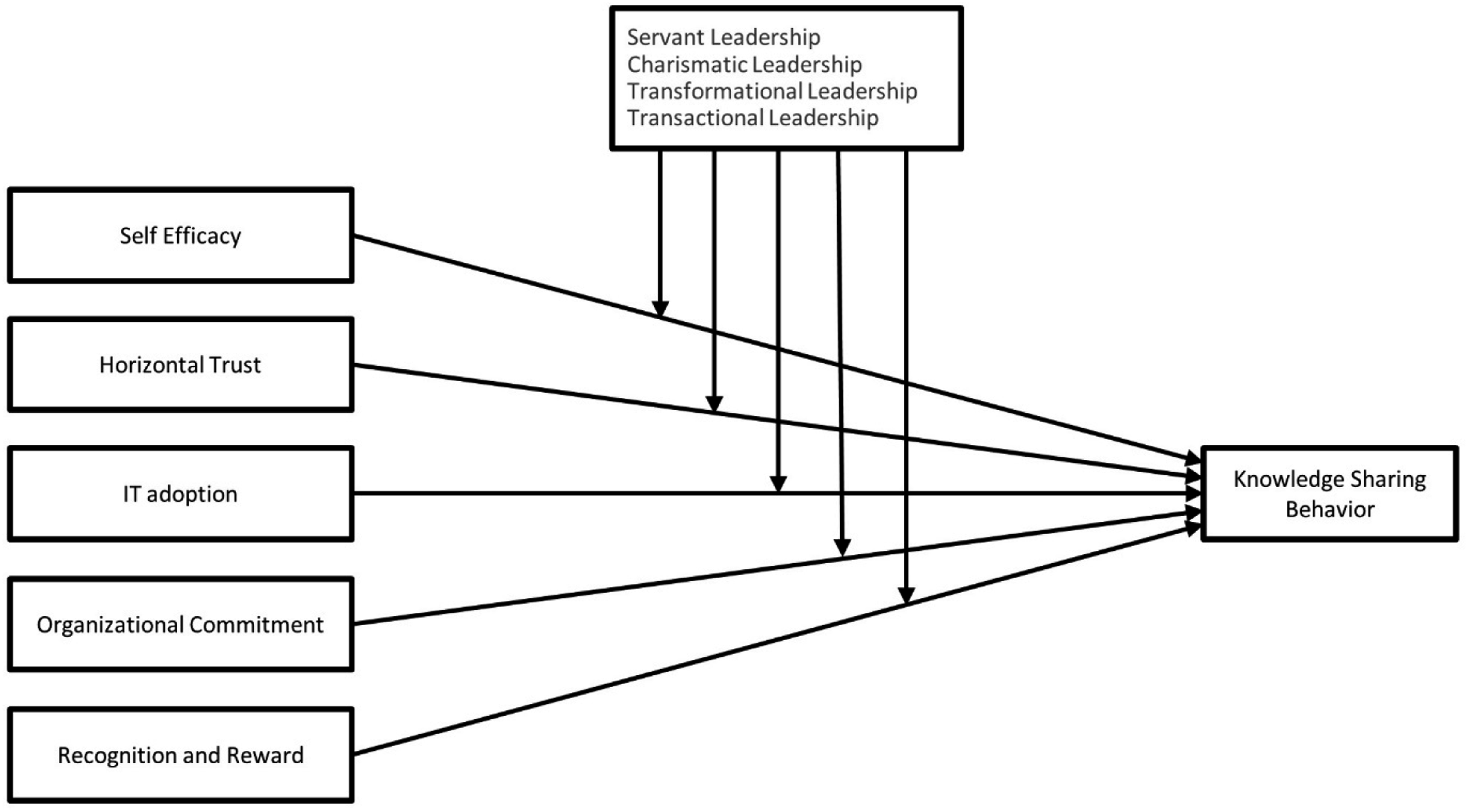
Instrument design
After the expert assessment process to validate the conceptual model, the next step is to develop a model instrument. The indicators of each factor were obtained from the appropriate references. This research instrument uses a 5-point Likert scale where one is the same as strongly disagree, and five is the same as strongly agree (Dawes, 2008). Measurement items in the instrument or questionnaire this research is adapted from several works of literature. Self-efficacy items are adapted from Al Hawamdeh and AL-edenat (2022), Jolaee et al. (2014), and Rasdi and Tangaraja (2020). Horizontal trust items are adapted from Kipkosgei et al. (2020) and Kmieciak (2021). Item IT adoption was adapted from Rasdi and Tangaraja (2020) and Tseng (2017). Whereas recognition and reward items were adapted from Rasdi and Tangaraja (2020) and Oliveira and Pinheiro (2021). The organizational commitment item was adapted from Rasdi and Tangaraja (2020) and Wahyudi et al. (2020). Moreover, the leadership style item was adapted from Tseng (2017). Until finally, 30 items were collected as instrument questions for this study.
Instrument readability test
Furthermore, at this stage, a readability test is carried out on the model instrument that has been compiled. The readability test was conducted through peer review from experts and peers, and feedback was provided for each question indicator. The feedback obtained is then analyzed to be used as instrument improvements.
Questionnaire distribution
The questionnaire instrument that passed the readability test is then created using Google Forms. The questionnaire is distributed through social networks between internal organizations. The questionnaire distribution starts from June 1 to June 8, 2022.
Data collection
The survey results were collected by downloading them from Google Forms. From this process obtained, 663 respondents spread across Indonesia, with 619 valid responses. Fourty-four responses were deleted because they did not meet the criteria and tended to be on one side (straight) on a 5-point Likert (Hair et al., 2019). The number of respondents is representative of the population of employees of the Ministry of Law and Human Rights of the Republic of Indonesia, which is 65.699. With a confidence level of 95% and a population proportion of 50%, the margin of error is 4%. After the data is collected, the model validation test uses the Structural Equation Modeling (SEM-PLS) method using the SmartPLS application. There are three stages in the SEM-PLS analysis, namely (1) preliminary considerations, (2) assessment of reflective and formative measurement models, and (3) assessment of structural models (Hair et al., 2019).
Data analysis
After the structural and measurement model, an assessment was performed. The next step is to interpret the results of the t test. At this stage, the hypothesis that meets the requirements is tested with a significance level of 95% and 90%. After that, the interpretation findings are compared to the result in the relevant past research. At this stage, the model has been validated to answer research questions.
Results
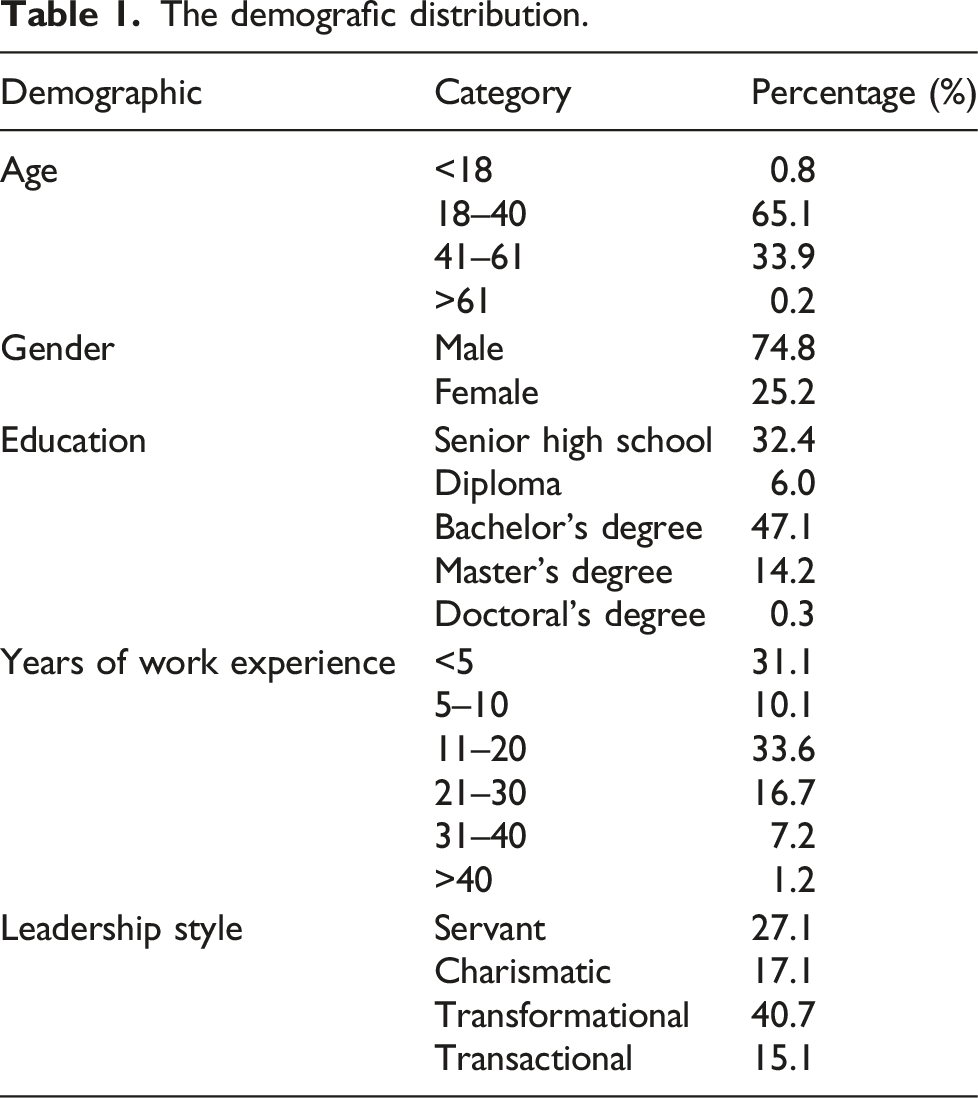
The demografic distribution.
Assessment of measurement model
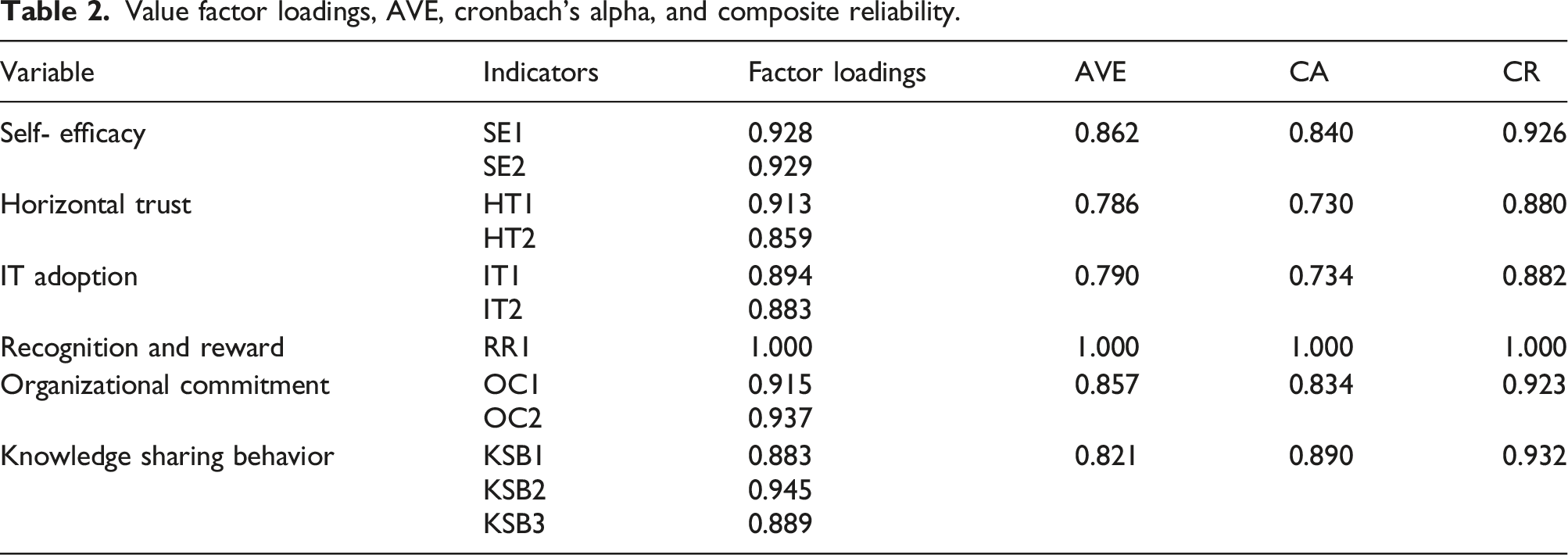
Assessment of the measurement model was carried out by conducting three tests, namely: (1) convergent validity test, (2) discriminant validity test, and (3) reliability test. The requirement for the loading factor value is >0.708 (Hair et al., 2019). Based on these results, if the loading factor value is less than 0.708, then the indicator is removed. Then the loadings factor was tested again, and all values met the requirements. Each latent variable must meet the criteria where the AVE value is >0.5 (Hair et al., 2019). The model passed the convergent validity test, according to the findings.
Then the discriminant validity test was carried out by measuring the value of the Heterotrait-Monotrait Ratio (HTMT), Cross Loadings for each variable, and the Fornell Larcker Criterion, namely the ratio of the square root of AVE to the correlation value among latent constructs. The general rule in HTMT is that the closer the HTMT value is to the value of one (1), this indicates less relative discriminant validity. The requirements for conceptually different constructs are HTMT values <0.85 (Hair et al., 2019).
Value factor loadings, AVE, cronbach's alpha, and composite reliability.
Assessment of structural model
The steps in testing the structural model include: measuring Collinearity Statistics, R-Square, effect size, Q Squared value, and T-value. The first stage is the measurement of Collinearity Statistics, where the requirement for the Collinearity (VIF) value is less than 5 (Hair et al., 2011). From the endogenous factor test, the Knowledge Sharing Behavior factor has an R-Square value of 0.531. This value indicates that the model obtained is moderate (Hair et al., 2011). Furthermore, the measurement of the Q-squared value is carried out through the Blindfolding process. The results of the Q-squared size show a value of 0.427. The model has predictive relevance because it meets the general rule that a Q-squared value >0 (Hair et al., 2019).
Hypothesis test
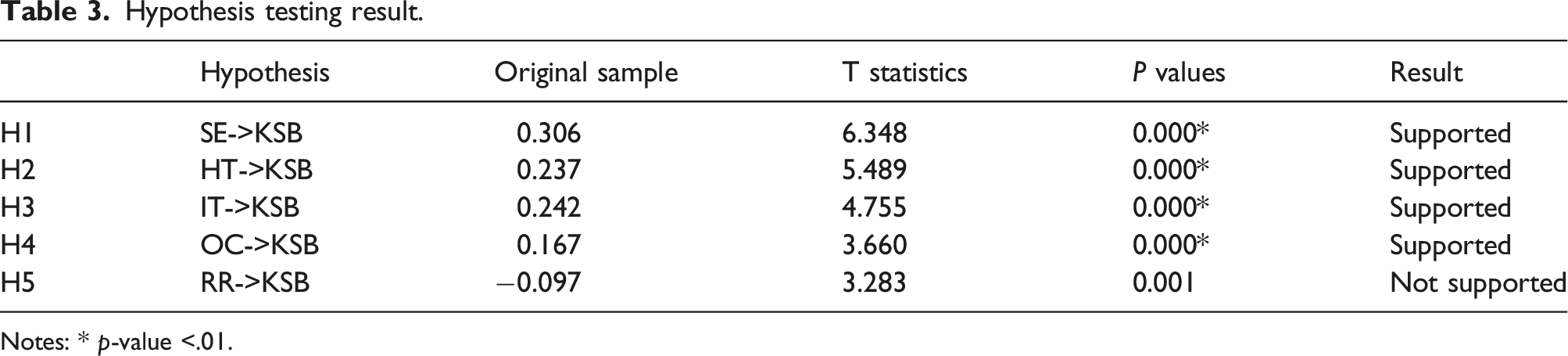
Hypothesis testing result.
Notes: * p-value <.01.
Hypothesis testing result moderator servant leadership.

Hypothesis Testing Result Moderator Charismatic Leadership.

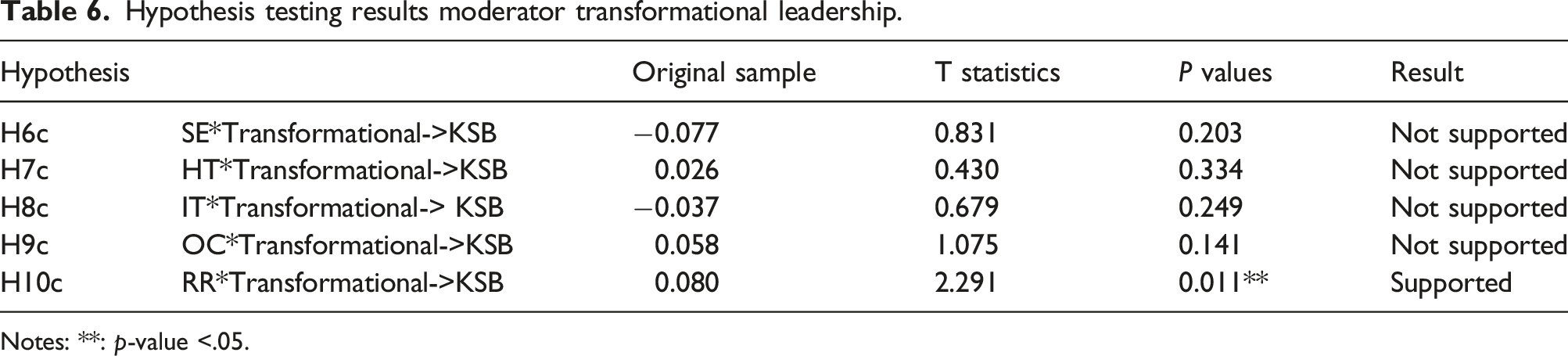
Hypothesis testing results moderator transformational leadership.
Notes: **: p-value <.05.
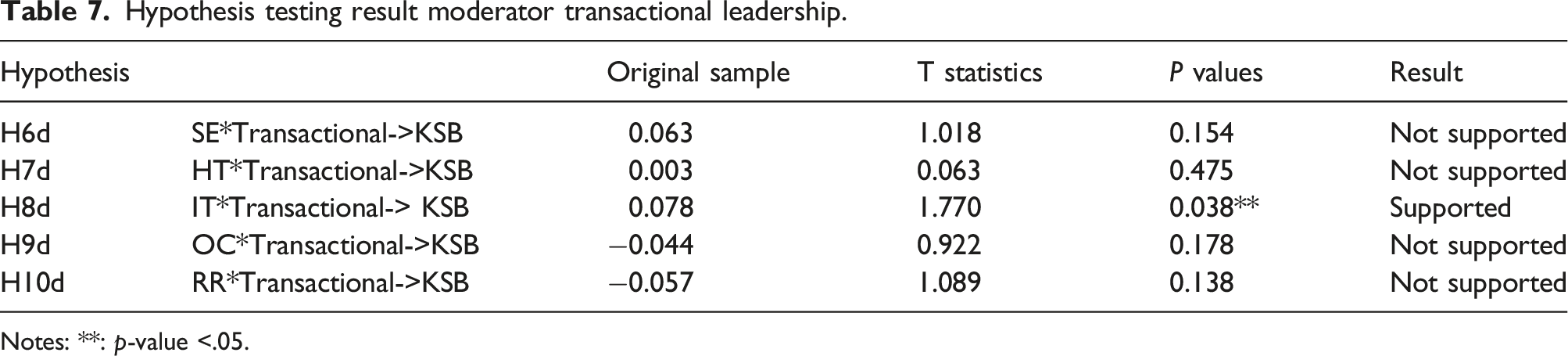
Hypothesis testing result moderator transactional leadership.
Notes: **: p-value <.05.
Discussion
This study examines the factors that influence knowledge-sharing in government. Hypothesis 1 (H1) testing results indicate that H1 is supported. Self-efficacy positively and significantly affects knowledge-sharing behavior. Employees who have the ability and feel their abilities can improve work quality and efficiency for organizations to share knowledge within their organizations. This hypothesis's acceptance is consistent with prior research findings (Al Hawamdeh and AL-edenat, 2022; Negara et al., 2021; Rasdi and Tangaraja, 2020; Wahyudi et al., 2020).
Hypothesis 2 (H2) testing results indicate that H2 is supported. Horizontal Trust positively and significantly affects knowledge-sharing behavior. Employees with confidence in their co-workers or teammates will be willing to share knowledge within their organization to achieve common goals. The acceptance of this hypothesis is in line with the results of previous research (Karagoz et al., 2020; Kipkosgei et al., 2020; Kmieciak, 2021; Oliveira and Pinheiro, 2021; Rasdi and Tangaraja, 2020).
Hypothesis 3 (H3) testing results indicate that H3 is supported. IT adoption positively and significantly affects knowledge-sharing behavior. Employees' use or adoption of information technology helps them share knowledge within their organization. Most respondents use Whatsapp groups, video conferencing such as Zoom, shared online storage such as Google Drive or Dropbox, and email to share knowledge with colleagues. 39.5% of respondents use social media such as Instagram, Facebook, and Twitter. The acceptance of this hypothesis is in line with the results of previous research (Jarrahi, 2018; Naeem and Khan, 2019; Tseng, 2017). IT adoption, especially social media, encourages socialization and knowledge sharing throughout the organization.
Hypothesis 4 (H4) testing results indicate that H4 is supported. Organizational commitment positively and significantly affects knowledge-sharing behavior. It can be concluded that the need for Organizational commitment to creating a knowledge-sharing culture. Organizational commitment felt by employees encourages them to be willing to share knowledge. The acceptance of this hypothesis is consistent with the results of past research (Rasdi and Tangaraja, 2020; Wahyudi et al., 2020). This result shows that the more elevated the organization's commitment, the more encouraging knowledge-sharing behavior (Wahyudi et al., 2020). The top leader usually initiates this organization's commitment in the organization. If the organization's top leader is concerned about his employees' competence, the leader will create a culture of sharing knowledge. Therefore the role of the top leader is critical to deciding the institution's priority and commitment.
The results of testing hypothesis 5 (H5) show that H5 is not supported. Recognition and rewards show a negative effect on knowledge-sharing behavior. Not supporting this hypothesis contradicts previous studies, where organizations must value their employees' willingness to share knowledge (Al Hawamdeh and AL-edenat, 2022; Oliveira and Pinheiro, 2021). However, this study's results align with research by Negara et al. (2021), proving that extrinsic awards do not significantly affect sharing knowledge. Tangible and Monetary Rewards do not contribute to the attitude of sharing knowledge in government because civil servants are usually allowed to increase skills and expertise with the costs of the government, so they do not need to receive rewards for the knowledge they have distributed. Intrinsic motivation is the biggest driver of the intention to share knowledge (Matić et al., 2017). Strong intrinsic motivation can be why recognition and rewards do not affect the behavior of civil servants. It can be included that employees do not expect recognition and reward when sharing knowledge within their organization. This phenomenon is good, where workers will share knowledge for the best of the organization even without recognition and reward. As civil servants, the government shows that they care about the common interest of developing together. The reward or not from the organization does not affect their attitude toward sharing employee knowledge with colleagues.
The following results from an investigation into the moderating effect of leadership style: servant leadership does not significantly moderate these determinants of knowledge-sharing behavior (see table 4). This result contradicts the research conducted by Tseng (2017), where servant leadership strongly moderates the adoption of IT and knowledge-sharing behavior. The study showed that the most considerable moderating effect is servant leadership, followed by charismatic and transformational leadership, and the least significant moderating effect is transactional leadership. Organizations must examine the leadership styles adopted, then propose practical and concrete methods to encourage employees to adopt IT and be willing to share knowledge actively. This practical encourages generating new knowledge and organizational learning (Tseng, 2017). In collaborative cultures, followers can feel uncomfortable with servant leadership that encourages individual creativity and initiative in followers since it is considered best done through collective dialogue and consensus (Hale and Fields, 2007).
Moreover, charismatic leadership does not positively moderate these determinants of knowledge-sharing behavior among civil servants (see Table 5). This means the hypothesis is not supported. Charismatic leadership impacts differently in every situation or organization. In some cases, charismatic leadership gains high acceptance, which may lead to concerns about its suitability given various contextual factors. Charismatic leadership can motivate organizational member behavior, job satisfaction, performance, self-leadership, group cohesiveness, and collective identity (Choi, 2006; Takala, 2010). On the other hand, charismatic leaders can persuade and mislead others (Takala, 2010). A charismatic leader who is inconsistent with integrity and accepted standards of character can cause distrust among team members or organizations because of the perception that leaders act for personal gain.
Besides, transformational leadership positively moderates the association between recognition and reward and knowledge-sharing behavior among civil servants (see Table 6). Transformational leaders try to meet the needs of employees to achieve what is expected. Therefore, it is common for transformational leaders to recognize and appreciate employees often. This culture is also seen in the application of knowledge sharing. Transformational influence encourages employees to share knowledge within their organizations because it fulfills their needs. The fulfillment of the need to make employees willingly share knowledge with co-workers to achieve organizational goals. The transformational leadership style can be applied to organizations that want to create a culture of sharing knowledge but need control so that employees are not reward-oriented.
Furthermore, transactional leadership positively moderates the association between the adoption of IT and knowledge-sharing behavior (see Table 7). It can be said that transactional leadership influences employees’ use of IT to share their knowledge. Charismatic, servant and transformational leadership styles do not moderate IT adoption and knowledge-sharing behaviors. Transactional leadership can encourage technology diffusion to facilitate knowledge sharing by making knowledge transfer more effortless wherever and whenever.
Implication
This study's findings expand on previous research by Tseng (2017), which only tested factors mediating leadership style in IT adoption by examining other factors such as self-efficacy, horizontal trust, recognition and reward, and organizational commitment. This research proves the impact of different leadership styles on the driving factors of knowledge sharing among civil servants. This study provides an overview of the theoretical integration perspective from several past research to confirm the factors influencing knowledge-sharing behavior among civil servants in developing countries. In addition, it expands on the research results by Rasdi and Tangaraja (2020), which find that commitment and intrinsic factors are the most influential in explaining knowledge sharing among public sector employees. The IT adoption factor also encourages knowledge sharing.
This study empirically proves that intrinsic, technological, and organizational factors significantly positively affect knowledge-sharing behavior among civil servants in developing countries such as Indonesia. The intrinsic factors that promote knowledge-sharing behavior are self-efficacy and horizontal trust. Related to technology, this study emphasized the adoption of IT to share knowledge. Moreover, related to organization focuses on organizational commitment. Therefore leaders in government organizations or agencies need to pay attention and consider these factors to support the attitude of sharing knowledge in government.
This research is expected to assist the government and practitioners in considering policies related to knowledge management within organizations. Programs or activities are needed to strengthen relationships between employees and teams and increase trust between internal organizations. Transformational leaders can encourage knowledge-sharing behavior by providing recognition and implementing policies to reward employees who have actively contributed to sharing knowledge within the organization. Meanwhile, transactional leaders should consider creating a knowledge-sharing system for the internal organization.
Conclusion
The factors influencing the knowledge-sharing behavior of civil servants are self-efficacy, horizontal trust, IT adoption, and organizational commitment. The moderator of leadership style affects the following factors: transformational leadership moderates recognition and reward, and transactional leadership moderates IT adoption. Charismatic and servant leadership do not positively moderate these determinants of knowledge-sharing behavior. The limitation of this research was conducted with one case study at a ministry in Indonesia, so the results cannot be generalized. Moreover, this research only uses quantitative methods. So that further research can be combined with qualitative methods to obtain a more in-depth analysis of the results of the hypothesis, qualitative research can explore why servant leadership does not moderate the knowledge-sharing factor. In addition, future research can be expanded to research in other organizations or institutions. This study contributes to understanding the factors that influence knowledge sharing and the moderating effect of leadership style. In addition, this research is expected to help governments and practitioners develop and implement knowledge sharing.
Footnotes
Acknowledgments
The author would like to thank Mr. F. Haru Tamtomo for his valuable suggestions and comments.
Declaration of conflicting interests
The author(s) declared no potential conflicts of interest with respect to the research, authorship, and/or publication of this article.
Funding
The author(s) received no financial support for the research, authorship, and/or publication of this article.

Appendix
The research hypotheses are as follows:
H1: Self-efficacy positively affects knowledge-sharing behavior among civil servants.
H2: Horizontal trust positively affects knowledge-sharing behavior among civil servants.
H3: IT adoption positively affects knowledge-sharing behavior among civil servants.
H4: Organizational commitment positively affects knowledge-sharing behavior among civil servants.
H5: Recognition and reward positively affect knowledge-sharing behavior among civil servants.
H6a: Servant leadership positively moderates the association between self-efficacy and knowledge-sharing behavior among civil servants.
H7a: Servant leadership positively moderates the association between horizontal trust and knowledge-sharing behavior among civil servants.
H8a: Servant leadership positively moderates the association between IT adoption and knowledge-sharing behavior among civil servants.
H9a: Servant leadership positively moderates the association between organizational commitment and knowledge-sharing behavior among civil servants.
H10a: Servant leadership positively moderates the association between recognition and reward and knowledge-sharing behavior among civil servants.
H6b: Charismatic leadership positively moderates the association between self-efficacy and knowledge-sharing behavior among civil servants.
H7b: Charismatic leadership positively moderates the association between horizontal trust and knowledge-sharing behavior among civil servants.
H8b: Charismatic leadership positively moderates the association between IT adoption and knowledge-sharing behavior among civil servants.
H9b: Charismatic leadership positively moderates the association between organizational commitment and knowledge-sharing behavior among civil servants.
H10b: Charismatic leadership positively moderates the association between recognition and reward and knowledge-sharing behavior among civil servants.
H6c: Transformational leadership positively moderates the association between self-efficacy and knowledge-sharing behavior among civil servants.
H7c: Transformational leadership positively moderates the association between horizontal trust and knowledge-sharing behavior among civil servants.
H8c: Transformational leadership positively moderates the association between IT adoption and knowledge-sharing behavior among civil servants.
H9c: Transformational leadership positively moderates the association between organizational commitment and knowledge-sharing behavior among civil servants.
H10c: Transformational leadership positively moderates the association between recognition and reward and knowledge-sharing behavior among civil servants.
H6d: Transactional leadership positively moderates the association between self-efficacy and knowledge-sharing behavior among civil servants.
H7d: Transactional leadership positively moderates the association between horizontal trust and knowledge-sharing behavior among civil servants.
H8d: Transactional leadership positively moderates the association between IT adoption and knowledge-sharing behavior among civil servants.
H9d: Transactional leadership positively moderates the association between organizational commitment and knowledge-sharing behavior among civil servants.
H10d: Transactional leadership positively moderates the association between recognition and reward and knowledge-sharing behavior among civil servants.