



Abstract
While entrepreneurial failure (EF) research has focused predominantly on entrepreneurs, the organisational-level responses of entrepreneurial support organisations (ESOs) remain underexplored, creating a critical gap in understanding how support structures adapt to EF. This gap may hinder the evolution of ESOs and limit the potential of university spin-off (USO) creation. Drawing on 52 semi-structured interviews with ESO key informants from nine European countries, this study examines how ESOs adapt to EF. We (1) identify four distinct perceptual ambiguities of EF in ESOs (i.e. typological, temporal, causational and effectual) and (2) document 16 organisational adaptation mechanisms that ESOs implement across six key organisational areas (i.e. offering, staffing, sourcing and selection, network, branding and funding). By showing how ESOs adapt their support practices to perceptual ambiguities of EF, this study deepens understanding of organisational‑level responses triggered by EF and advances organisational adaptation theory in university‑related, early-stage support contexts.
Keywords
Introduction
Universities are in a privileged position to foster innovation and entrepreneurship by creating startups due to their proximity to research results, new technologies, patents and talent. University spin-offs (USOs) ‘are companies created to commercialise knowledge or technology developed in academia’ (Corsi and Prencipe, 2016: 13) and are often associated with deep-tech activities (Bonardo et al., 2011; Capatina et al., 2024). Early-stage USOs, like many new ventures, face pronounced liabilities of newness and smallness. These reflect high levels of technological and market uncertainty (Baxter et al., 2023; Santisteban et al., 2023; Stinchcombe, 1965). European evidence suggests that approximately 75% of USOs cease operations within six years (Rodeiro-Pazos et al., 2021). This mirrors high discontinuity in research and development (R&D) contexts (Cantamessa et al., 2018; Corvello et al., 2024). These patterns emphasise profound uncertainty in early-stage venture creation, necessitating targeted support structures (Caputo et al., 2022; Negri et al., 2025; Szathmári et al., 2024).
Over the past five decades, entrepreneurial support organisations (ESOs), such as incubators, science and technology parks and accelerators, have been established to enable entrepreneurs in transforming ideas into viable ventures (Correia et al., 2024; Hruskova, 2024; Modina et al., 2024). Universities have increasingly entered this field, expanding their Third Mission beyond research and teaching to contribute to economic and societal development (Correia et al., 2024; Modina et al., 2024; van Rijnsoever, 2022). In Europe, substantial public investment supports university-related ESOs. These aim to reduce risks for early-stage ventures, increase success rates among participants and ultimately foster regional growth (Caputo et al., 2022; Lehmann et al., 2024; Serpente et al., 2025).
Entrepreneurial failure (EF) is an inherent aspect of ESO activities (McGrath, 1999; Shepherd, 2003). ESOs simultaneously strive to minimise EF among their tenants and to use EF as a learning opportunity and recurring element of the entrepreneurial process (Geulen et al., 2024; Koporcic et al., 2025). Positioned at the nexus of policy directives, university interests, technological developments and founder needs, ESOs provide critical infrastructures, resources, platforms and networks that help entrepreneurs navigate early-stage challenges (Correia et al., 2024; Hayter et al., 2020; Martín-Peña et al., 2024). Yet, they operate under multiple, sometimes conflicting objectives such as education (Davey et al., 2016; Pita et al., 2021), business creation (Caputo et al., 2022), branding (Youtie and Shapira, 2008) and financing (Pitsakis et al., 2015). They are commonly assessed through key performance indicators (KPIs) such as numbers of supported ventures, survival rates and high‑profile successes (Modina et al., 2024; Negri et al., 2025; Serpente et al., 2025), despite limited control over outcomes once ventures leave their programmes (Modina et al., 2024). How ESOs respond to EF is, therefore, central to both their effectiveness and their ability to fulfil their innovation and entrepreneurship mission (Braun and Suoranta, 2025; Van Rijnsoever, 2022).
While EF has been extensively studied at the individual level, for instance, in relation to entrepreneurial persistence (Coppens and Knockaert, 2022), learning (Cope, 2011) and cultural sensemaking (Cardon et al., 2011), much less is known about how organisations surrounding entrepreneurs adapt to EF. Research on university-related support structures has examined resilience (Korber and McNaughton, 2018), success factors (Alpenidze et al., 2019) and temporal evolution (Nicholls-Nixon et al., 2021), but has largely overlooked EF as an external trigger of organisational adaptation and a source of learning for ESOs themselves. This is a critical gap because ESOs are continually exposed to recurring EF of tenant startups, particularly in USO creation, yet the organisational response to these experiences remains under-specified. Drawing on organisational adaptation theory, which points out intentional decision-making by organisational members to bridge misalignments between the organisation and its environments (Sarta et al., 2021), we address the following research question: How do ESOs adapt to EF?
To address this question, we employ a qualitative, inductive research design based on 52 semi-structured expert interviews. Conducted between November 2024 and February 2025 with ESO professionals involved in USO activities across nine European countries, the study presents two key findings: First, it shows that ESOs perceive EF ambiguities (typological, temporal, causational and effectual) and second, it demonstrates that they implement organisational adaptation mechanisms across six key areas (offering, staffing, sourcing and selection, network, branding and funding) in response to these perceptual ambiguities. Together, these insights inform a grounded theory model of ESO adaptation to EF and advance understanding of organisational adaptation in university-related contexts.
Organisational adaptation and EF in ESOs
ESOs and USOs
Universities have increasingly expanded their knowledge-transfer activities and created entrepreneurial output through USOs (Correia et al., 2024; Hruskova, 2024; Modina et al., 2024). USOs are independent firms founded by university members or teams including them, which commercialise knowledge, technologies or research results originating from the parent university and maintain a formal link via technology-transfer-office involvement, verification of intellectual property origin or institutional spin-off procedures (Cantner et al., 2024; Park et al., 2024). Notably, they are widely recognised ‘as an important mechanism for science-based innovation’ (Fini et al., 2020; Park et al., 2024: 179). This importance is exemplified by cases like Consilient Technologies in Newfoundland, where spin-off failure recycled talent to seed a nascent ecosystem (Mason et al., 2025). In comparison with broader entrepreneurship, USOs are more R&D‑intensive (Park et al., 2024) and face greater technological and market uncertainty (Shahriar et al., 2025). Consequently, they rely more strongly on specialised early-stage support (Mian et al., 2016; Woolley and MacGregor, 2022).
Over recent decades, universities and public actors have developed ESOs, backed by policy initiatives and public funding at regional, national and European levels (Audretsch et al., 2020), including ‘Horizon Europe’ and ‘NextGenerationEU’ (European Commission, 2021). ESOs now provide tailored support across venture life-cycle stages, from sensitisation and ideation to incubation, acceleration and early growth (Bergman and McMullen, 2022; McAdam and McAdam, 2008; Mian et al., 2016). Simultaneously, they have evolved into nodes within broader entrepreneurial ecosystems, interacting with investors, experts and sponsors (Correia et al., 2024; Negri et al., 2025; Theodoraki et al., 2022). This ecosystem role becomes particularly visible in emerging contexts such as Uganda, where ESOs collaborate closely with other actors to work around persistent resource constraints (Negri et al., 2025). However, ESOs operate in a tension field between multiple, often competing goals, including education, business creation, technology transfer and regional development (Van Rijnsoever, 2022). Despite this extensive support, many early-stage ventures fail or struggle to develop sustainable business models (Van Weele et al., 2018), particularly in science-based and deep-tech segments (Jelfs and Smith, 2022; Park et al., 2024). Prior research has predominantly focused on success factors (Alpenidze et al., 2019; Audet and Couteret, 2012; Marullo et al., 2024), incubation models (Bruneel et al., 2012; Hackett and Dilts, 2008; Pauwels et al., 2016) and failure prevention (Nair and Blomquist, 2019). By contrast, limited attention has been paid to how ESOs respond organisationally to EF, such as through adaptive practices in nascent ecosystems like Uganda’s, where ESOs shift from stagnation to flourishing via collaboration (Negri et al., 2025). This positions them as a distinctive and theoretically relevant subject for examining organisational adaptation to EF.
Organisational adaptation to EF
Organisations adjust structures, strategies and behaviours to cope with changing environments and performance pressures (Brahm and Poblete, 2024; Greve, 2017), as Ghanaian AgriTech firms did by responding to technical misfits with cognitive learning from farmer feedback (Ayamga et al., 2024). Through strategic reconfiguration, learning and innovation, organisations seek to maintain or restore fit between internal arrangements and external demands (Hannan and Freeman, 1989; Lawrence and Lorsch, 1967; Weick, 1976), thereby enhancing long‑term viability (Aldrich and Ruef, 2006; Sutton, 2001; Volberda, 1996). Synthesising 443 adaptation studies via computational topic modelling and hand-coding, Sarta et al. (2021: 43) define organisational adaptation as ‘intentional decision making undertaken by organi[s]ational members, leading to observable actions that aim to reduce the distance between an organi[s]ation and its economic and institutional environments’. Their emphasis lies on purposeful decisions, observable changes and a clear orientation towards reducing perceived misfit. At the same time, they caution against a ‘functionalist adaptation fallacy’ (Sarta et al., 2021: 54), namely the tendency to treat any organisational change as inherently adaptive without evidence of purposeful environmental alignment (Dookie et al., 2024). Accordingly, adaptiveness depends on context-specific perceptions of such changes. Sarta et al. (2021) further organise the adaptation literature across themes that move from the intra- to the extra-organisational level. They distinguish intra-organisational themes centred on resources, search and behavioural change and on routines, capabilities and knowledge from extra-organisational themes centred on governance and stakeholder management and on competitive and institutional pressures.
In line with this perspective, our study distinguishes several core concepts relevant to ESOs. Change refers to any alteration in organisational structures, strategies or routines, whereas adaptation denotes intentionally chosen changes aimed at restoring or improving fit within the perceptual context (Aldrich and Ruef, 2006; Volberda, 1996). Triggers are events that motivate decision-makers to act (Brenk et al., 2019; Costa et al., 2024; Greve, 2017), while adaptation mechanisms are the concrete responses through which organisations attempt to restore fit (Ayamga et al., 2024; Cannon and Edmondson, 2005). Organisational learning plays a central role in this process, as by deliberately introducing or refining routines, organisations can steadily enhance their ability to adapt (Pedraja-Rejas et al., 2025).
EF represents such a salient trigger of organisational adaptation (Ayamga et al., 2024; Cannon and Edmondson, 2005). It has been conceptualised as a complex phenomenon with financial (Coad, 2014; Jenkins and McKelvie, 2016; Ucbasaran et al., 2013), psychological (Jenkins and Byrne, 2020; Klimas et al., 2021; Shepherd and Cardon, 2009), organisational or institutional (Lattacher and Wdowiak, 2020; Tipu, 2020) and societal (Cope, 2011; Damaraju et al., 2023) dimensions. Recent work distinguishes antecedents, the EF event itself and a variety of direct, indirect and long‑term effects (Czakon et al., 2024; Klimas et al., 2021). It shows that EF can lead to multilevel outcomes, ranging from grief and learning for entrepreneurs (Cope, 2011; Omorede, 2021; Shepherd and Cardon, 2009) through to financial losses and resource redeployment for organisations (Jeng and Hung, 2019) to market- and ecosystem-level renewal (D’Andrea et al., 2023). Evidence from Newfoundland, for instance, illustrates how Consilient’s closure contributed to ecosystem resilience through talent recycling (Mason et al., 2025). At the organisational level, EF is linked to rigid business models (Brenk et al., 2019), financial mismanagement (Cole and Sokolyk, 2018) and strategic inflexibility (Guckenbiehl and Corral de Zubielqui, 2022).
Yet, EF perception remains a conceptual black box, even though it forms the junction through which antecedents are translated into subsequent outcomes (Klimas et al., 2021). Recent studies emphasise that only when organisations accurately perceive environmental changes can targeted adaptive measures be derived from them (Dookie et al., 2024). Unclear or fragmented perceptions can hinder effective organisational adaptation because decision‑makers struggle to recognise, analyse and intentionally experiment with EF Scuotto et al., 2024). While Cannon and Edmondson (2005) specify six organisational levers that reduce technical and social barriers to these learning processes, the barriers limit the organisation’s potential to transform adverse experiences into structured learning (Brenk et al., 2019; Koporcic et al., 2025; Lattacher and Wdowiak, 2020). For ESOs, adjustments cannot therefore, be assumed to constitute effective adaptation unless they are grounded in a shared, analytically informed understanding of what is perceived as EF (Schwaeke et al., 2025).
In entrepreneurial settings, EF is an integral part of the innovation process (Braun and Suoranta, 2025; Lange et al., 2025) and, under certain conditions, can enhance subsequent success while threatening resource flows and legitimacy (Costa et al., 2023; Mueller and Shepherd, 2016). These tensions are especially pronounced in ESO‑supported USO creation, where high failure rates coexist with strong expectations of visible success and efficient use of public resources (Ayamga et al., 2024; Blank, 2021; Cotterill, 2012), akin to Ugandan ESOs balancing constraints via transformation practices (Negri et al., 2025).
Sarta et al. (2021) further emphasise micro-foundations, focusing on the roles, cognition and attention of organisational members, as well as the organisational processes that channel their decisions, thereby structuring adaptation across six theoretical streams (e.g. resource based, evolutionary, sociological perspectives) and three inquiry areas: ‘why organi[s]ations pursue adaptation, what internal factors preclude or enable adaptation [. . .] and what environmental factors urge adaptation’ (p. 45). EF perceptions form the first step towards ESO adaptation (Basu et al., 2022; Cannon and Edmondson, 2005), which, in turn, enables learning and response, whereas misrecognition or denial leads to rigidity rather than adaptation (Van der Byl and Vredenburg, 2023).
Most EF studies focus on the entrepreneur, with less attention paid to supporting organisational responses to EF events (Walsh and Cunningham, 2024). ESOs are a distinctive setting for adaptation studies because they encounter EF repeatedly throughout their portfolios and operate under institutional expectations. Thus, by conceptualising EF as an adaptation trigger, we apply organisational adaptation theory to analyse ESO perceptions, interpretations, responses and micro-founded adaptation mechanisms in key areas.
Methodology
For this study, we adopt an inductive, grounded theory research approach (Fisher and Aguinis, 2017; Strauss and Corbin, 1994), drawing on qualitative interview data collected between November 2024 and February 2025. It is consistent with established approaches in entrepreneurship and EF research (Avdiaj et al., 2024; Walsh and Cunningham, 2024). The data analysis followed a systematic and multi-stage process (Gioia et al., 2013) to explore ESO adaptation mechanisms in response to EF as a complex trigger (Czakon et al., 2024; Hlady-Rispal et al., 2021; Sarta et al., 2021). This methodological approach ensured close alignment between the research question and the empirical material, enabling the derivation of theoretical contributions.
Sampling strategy
A multi-step sampling targeted ESOs across Europe, including mature entrepreneurial ecosystems (e.g. Germany, Italy; Greco, 2025; Tsaplin and Pozdeeva, 2017) as well as emerging ones (e.g. Romania, Ukraine; Abetti and Rancourt, 2006; Budac and Ilie, 2024). First, following purposive selection (Guest et al., 2006), we began with a leading German university entrepreneurship database comprising 111 candidates. Specifically, this database drew on two networks: 51 ESOs identified via a university incubator programme and 60 via involvement in Europe’s largest competition for USOs. Second, we expanded through targeted outreach (an additional 40 candidates) and, third, via snowball sampling (an additional 43 candidates; Morse, 2015), yielding a total of 194 potential participants (Saunders et al., 2018). After excluding those not operating in ESOs, we sent 154 invitations. These resulted in 64 interviews (90 non-responses or refusals). Excluding 12 late-stage ESOs (identified as Accelerators), the final dataset comprised 52 interviews with early-stage, university-related ESOs (full or partially publicly funded) across nine European countries (Table 1). No secondary data were used. Finally, all the startups to which the interveiwees referred USOs, ensuring conceptual consistency across the dataset.
Participants descriptive information.

We conducted semi-structured interviews (>26 hours in total, ~31 minutes on average) via video conferencing, which were transcribed and, where necessary, translated with the support of automated software. Table 1 details participants by role and by ESO location to demonstrate the breadth of organisational perspectives and contexts informing our analysis. Participant-level descriptors are used for sample transparency rather than for country- or role-related theorising or comparison. Therefore, the uneven distribution of participants, including their concentration in Germany, is appropriate. The interview protocol covered four themes: first, the interviewee and ESO characteristics; second, respondent definitions and interpretations of EF, including its diverse nature and variations across startup stages; third, organisational-level effects of EF experiences in their startup portfolios; fourth, and finally, a reflective and a snowballing question.
Data analysis
We followed Gioia et al.’s (2013: 16) data analysis approach, designed to systematically generate meaningful concepts that ‘capture qualities describing or explaining a phenomenon of theoretical interest’ and serve as ‘precursors to constructs in making sense of organisational worlds’. This was supplemented by grounded theory techniques, including open, axial and selective coding (Langley, 1999; Strauss and Corbin, 1994), so that theoretical patterns inductively emerged from raw interview material rather than being imposed a priori (Abdalla et al., 2018).
We imported all transcripts into MAXQDA and coded them iteratively in four phases (Saldaña, 2013). First, open coding generated first‑order, informant‑centric concepts that captured participants’ interpretations of EF (Van Maanen, 1979). Second, axial coding refined emerging categories supported by ‘systematic comparison of small units of data’ and the construction of a ‘system of categories’ for ESOs’ adaptation mechanisms to EF (Langley, 1999: 699–700). Third, selective coding linked concepts into second-order themes (Langley, 1999; Strauss and Corbin, 1994). Fourth, theoretical memoing documented aggregate dimensions and refined conceptual linkages (Mohajan and Mohajan, 2022).
To enhance qualitative rigour, each researcher independently examined the transcribed data with intercoder reliability checks and consensus‑building discussions used to resolve discrepancies (Van Maanen, 1979). We applied theoretical sampling throughout the analysis to refine emerging categories and ensure conceptual saturation (Glaser and Strauss, 1967). As the data analysis progressed, new interviews were conducted and compared with existing coded material. Once no new second-order themes emerged in the last six interviews, saturation was considered to have been reached (Morse, 1995, 2015).
The final data structure (Appendices A and B) presents the resulting conceptual overview of ESO adaptation to EF beyond traditional success-failure dichotomies (Cardon et al., 2011; Jenkins and McKelvie, 2016). It contains first-order concepts, second-order themes and aggregate dimensions, grouped into (1) the perceptual ambiguity of EF (Appendix A) and (2) the adaptation mechanisms of ESOs in response to EF (Appendix B). In total, we identified 20 aggregate dimensions, which were further divided into four perceptual ambiguities of EF and 16 adaptation mechanisms, providing a structured lens on organisational adaptation to EF and contributing to ongoing theoretical debate (Ayamga et al., 2024). However, consistent with our organisational-level focus, our analysis neither compares countries nor draws country-level inferences. This integration of iterative coding, memoing techniques and theoretical sampling ensured a transparent, inductively structured category system and strengthened the credibility and reliability of our qualitative findings (Mohajan and Mohajan, 2022; Saldaña, 2013; Younger and Fisher, 2020).
Findings
Our data were synthesised into a grounded theory model of organisational adaptation, which focuses on how ESO professionals perceive EF as a complex event and implement micro‑founded mechanisms in response. The model identifies (1) four perceptual ambiguities in how ESO professionals recognise, interpret and label EF. These are areas where they hold multiple, partly overlapping understandings of what EF is, when it occurs, why it occurs and what it does. (2) They trigger 16 adaptation mechanisms across six organisational areas of offering, staffing, sourcing and selection, network, branding and funding in ESOs (Figure 1).
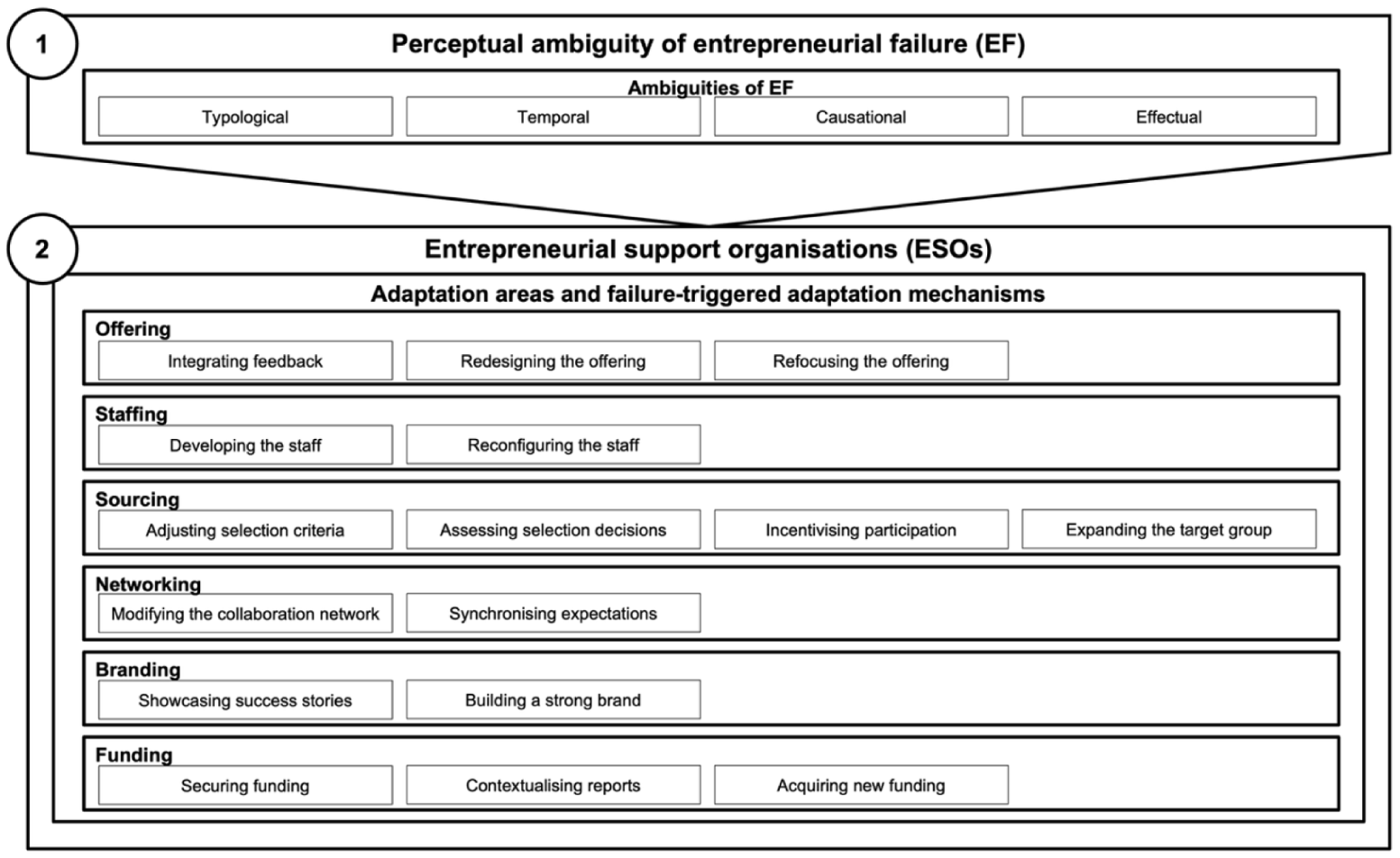
Entrepreneurial failure and ESO adaptation.
The perceptual ambiguity of EF
Results indicate that ESO professionals do not perceive EF as a single, stable category. Instead, they perceive it through four interrelated ambiguities (i.e. typological, temporal, causational and effectual). These jointly determine their adaptation. These ambiguities capture the coexistence of different ‘versions’ of EF in ESO professionals’ sensemaking and thus, form the basis for the adaptation mechanisms.
Typological ambiguity refers to uncertainty over whether a case primarily denotes financial, operational or behavioural and relational EF at the venture level. Financial EF centres on measurable ‘hard facts, [. . .] i.e. not being able to continue the business due to a lack of liquidity’ (Interviewee 36). This underscores how negative KPIs, cash-flow problems and funding shortages render ventures unsustainable amid adverse market conditions. Interviewee 15 summarised: Financial EF ‘occurs when [startups] have no more money [. . .] [and therefore] have to stop [. . .] [or] file for bankruptcy relatively quickly’. Operational EF highlights weaknesses in processes and business operations that hinder effective execution, such as ‘the team falls out again and the business model is simply not viable and not scalable’ (Interviewee 48). Cases with ‘no market need [. . .] simply the wrong time or the wrong direction’ leading to absent product-market fit (Interviewee 04) or where ‘the market just wasn’t big enough’ (Interviewee 13) often tie to resource constraints like regulatory hurdles (e.g. ‘a lack of easy bureaucracy to finance something like that’ – Interviewee 14). Behavioural and relational EF foregrounds individual‑ and team‑level soft factors, such as risk aversion, motivation, resilience and communication, that determine venture functioning. Evident in cases like ‘participants have not undergone any personal development over the programme’s duration’ (Interviewee 03), ‘the personality simply doesn’t fit the startup, something along the lines of personality traits’ (Interviewee 45) or ‘not having the right team’ (Interviewee 07). These ‘failed startups are characterised by the fact that they have not managed to overcome these internal frictions [. . .] discrepancies within the founder dynamic in terms of investment topics or mentality or willingness or somehow individual commitment’ (Interviewee 04).
Temporal ambiguity captures the blurriness within the recognition, interpretation and labelling of EF across venture support stages. ESOs navigate failures that emerge before formal founding, during business‑model development or at the stage of venture termination. Early failure, when potential entrepreneurs abandon their projects before formal launch, is perceived by ESO professionals as pre‑founding EF. As Interviewee 01 observed, ‘what I tend to see is that they don’t start at all’. During business model development, post-foundation struggles to gain market traction require pivots when the original model proves unsustainable. For Interviewee 02, ‘failure does not mean that the startup no longer exists . . . Of course, you can quickly say that a business model has failed, but if the startup then makes changes, then it is not failed as a startup’. Terminal failure, distinctly, is characterised by the incapability of recovery or reversal, hence resulting in insolvency or exit. Interviewee 06 describes it as ‘a hard failure’, where recovery within the current venture is no longer feasible and financial, emotional and reputational losses are fully realised or perceived.
Causational ambiguity denotes uncertainty about EF’s causes. Despite team constellations and contextual conditions, ESO professionals distinguish between internal and external drivers, but often perceive them as entangled rather than clearly distinct. Internally driven EF includes non‑complementary skills, fragile team cohesion, leadership deficits, emotional decision‑making and founder reluctance to learn or change course, pushing ventures towards failure even in favourable environments. Interviewee 04 noted: ‘You often feel like you’re just travelling with a 24/7 fire extinguisher, . . . And these things, if they’re not aligned with each other and don’t work, then it becomes difficult. And I think that’s also the reason for most of the internal failures’. Externally driven EF encompasses market demand shifts, regulatory hurdles (‘the project failed [. . .] because in the end they didn’t dare to bring the thing onto the market because they thought there would be legal consequences’ – Interviewee 13), customer inconsistency (‘People [. . .] give up because [. . .] customers keep dropping out or the order situation is just too inconsistent’ – Interviewee 35), funding rejection leading to resignation (‘A few have applied for additional funding and have been rejected. I get the impression that they are resigned and giving up’ – Interviewee 37) and competition exposing ecosystem weaknesses (‘startups fail quite often because they don’t have what the market wants’ – Interviewee 10).
Effectual ambiguity captures the variety in how the impact of EF is perceived, either as a setback or as an opportunity for learning. ESO professionals interpret and balance negative effects (e.g. financial loss, reputational damage, emotional strain) with potential positive effects (e.g. learning, resilience, improved practices) at multiple levels. Setback observations emphasise short‑term reputational impacts on ESO programmes, funding shortfalls and emotional strain among entrepreneurs and support staff, including disappointment, frustration, anxiety and burnout risk. It prevents the exploration of innovative ideas, particularly in stigmatised contexts where ‘people are so afraid to try things because they’re afraid of failing and of what others think’ (Interviewee 46). Learning, conversely, refers to the cognitive, professional and emotional development experienced by both entrepreneurs and ESOs in response to EF. It encompasses enhanced problem-solving, risk management and resilience that enable individuals and organisations to improve future success prospects by effectively confronting and processing EF. For these professionals, viewing EF as essential to economic growth and innovation fosters organisational adaptation, prompting a collaborative mindset where stakeholder cooperation becomes vital for addressing it and drawing ‘lessons from it, to perhaps do better next time’ (Interviewee 36).
Failure-triggered adaptation mechanisms in ESOs
The perceptual ambiguities of EF prompt 16 adaptation mechanisms across six organisational areas: offering, staffing, sourcing and selection, network, branding and funding (Table 2). Together, these mechanisms show how ESOs adapt to EF as an organisational adaptation trigger.
Overview of failure-triggered adaptation mechanisms of entrepreneurial support organisations.

Offering
Programme design, participant needs and overall outcomes were misaligned, as EF prompted ESOs to critically reassess the adequacy of their core offerings. ESOs view EF as feedback on their support logic rather than as an isolated venture-level event. This triggers more systematic approaches to integrating tenant feedback, including structured evaluations of participant experiences and EF reasons, as a basis for adapting their support at both programme and organisational levels. ESOs ‘analyse the feedback by clustering responses into themes and counting how often they occur. [. . .] Based on this, we determine what changes are necessary’ (Interviewee 03). This includes the analyses of tenants’ experiences and outcomes, specifically in the light of EF.
As Interviewee 29 reported, ESOs have ‘expanded from purely technology-based projects to impact-oriented projects’ or by offering programme models for specific groups through ‘chang[ing] the educational opportunities, thinking above all about workshops [. . .] that are aimed directly at future entrepreneurs’ (Interviewee 44). In the same fashion, Interviewee 40 revealed a thematical shift as they ‘now always offer workshops on teamwork: Who takes on which role in the team? [. . .] These were problems that occurred where we tried to mitigate or prevent.’ Additionally, this comprises addressing the needs of more stakeholders, to ensure fruitful collaboration among network partners on an organisational level. Interviewee 44 explained how they ‘have refined the ideation processes [. . .]. We have partners that we work with [. . .] and with whom we have practically developed the workshops further to support interested parties better’. Overall, refocusing manifests in shifts towards impact-oriented projects, tailored programme models for specific founder groups and the introduction of new content areas. Thereby, ESOs change what, who and how they support based on the outcomes of their offerings.
Staffing
EF prompts ESOs to reassess whether their internal staffing configurations are adequate to support tenant ventures. ESOs increasingly interpret EF as revealing a capability gap within their own support teams rather than attributing venture failure solely to shortcomings at the founder level. This shift in staffing is a central element of organisational adaptation. It is realised either by mechanisms such as developing staff competencies through skill-building or by more fundamental staffing revisions. On the one hand, staff members try ‘to improve [themselves] somehow and educate [themselves] further, to then introduce new methods’ (Interviewee 18). Interviewee 43 described this change with respect to the startup interaction: ‘Definitely, I adapt [the coaching] and these are also things that I pass on to the team. [. . .]. So, what problems and challenges teams have and that, of course, always flows into the coaching approach’. Additionally, on a team level, ESOs use this mechanism in which exchange of knowledge and intergroup training is undertaken, for instance: ‘My knowledge ends somewhere and then I also pass that on to the colleague who has somehow raised a Series A himself. And so, we divide it up internally’ (Interviewee 38) and with exchange through ‘meeting[s] once a week with all venture managers where we talk about all current cases, also problem cases where we ourselves don’t know exactly how to deal with them’ (Interviewee 50). From a management perspective, ‘train[ing] the people we get and guide them accordingly in the right direction instead of saying we only pick top people because we only get top applications’, highlights the staff development by Interviewee 20. Through these practices, ESOs aim to improve their collective ability to respond to diverse and evolving tenant needs without fundamentally altering their staffing structures.
On the other hand, ESOs adapt by reconfiguring staff resources more strategically. Instead of treating personnel as fixed assignments, managers begin to think of coaches as flexible resources to be redeployed according to venture performance and advancing organisational priorities. Reconfiguring staff strengthens the support through the reallocation of internal resources and new external hires. ‘I think that you can learn a lot from [failure]. So, what problems and challenges teams have and that, of course, always flows into the coaching approach’ (Interviewee 43). ESOs adapt their approach by (ex)changing staff. Interviewee 23 revealed this, ‘looking at the coaches as resources and consider[ing] whether they are better applied somewhere else’. Here, resource constraints and tensions in the mission of education and economic output strike as well, as Interviewee 26 pointed out that they are ‘recruit[ing] students and staff and everything based on the startup KPIs. But what we really are is an educational institution.’ Overall, these staffing mechanisms highlight how ESOs adapt their support teams and, thereby, balance tenant learning and progression with handling resource constraints in a challenging context. Rather than pursuing radical restructuring, ESOs combine incremental staff development with selective reconfiguration and use EF as a source of improvement.
Sourcing and selection
EF prompts ESOs to critically reflect on their sourcing and selection practices, revealing persistent misfits between venture characteristics, programme requirements and intended outcomes. ESOs increasingly interpret EF as evidence of selection uncertainty in the early-stage support context rather than framing admission decisions as neutral entry points. This reframing positions organisational adaptation in sourcing and selection as a key area for managing risk and preserving organisational relevance under resource constraints. For example, one core response to EF involves adjusting selection criteria as a mechanism for being more restrictive or more proactive, depending on application volume and KPI pressures. This ranges from ESOs ‘to be more rigid’ (Interviewee 38) over change from passive selection to active search: ‘We switch[ed] from teams coming to us, to us scouting teams’ (Interviewee 05). This reflects a change to ensure appropriate resource allocation and entrepreneurial output. Thereby, ESOs increase their relevance, address their mission and sustain their financial stability with ‘support[ing] young talent, young ideas, young startups [. . .] And the less success we have, the more difficult it is, of course, for us to continue acquiring financial resources [. . .] and it becomes less interesting to potential startups’ (Interviewee 21).
This highlights how crucial the sourcing and selection of tenants is, but also how uncertain and unpredictable the outcome of early-stage support can be. In this early stage, ESOs are already ‘trying to identify earlier the potential winners in a way’ (Interviewee 25). Adaptation in sourcing and selection is reflected, for instance, by ‘shifting selection from too little or too large founding teams [. . .], to no longer accept [. . .] applications from individual founders. We used to do that; don’t do that anymore. [. . .] Also, we don’t accept applications from a team of, say eight, which happens many times. We have become more restrictive on this’ (Interviewee 47). In line with the aforementioned resource constraints, these shifts are intended to search for efficiency and effectiveness in the process. ESOs modify selection criteria in response to output, highlighted through ‘phases [. . .] with relatively few applications [. . .] [where we had] to take more or less almost everyone. And so, we have taken countermeasures [. . .] to make the programme better known so that we also get highly motivated, innovative ideas in the programme’ (Interviewee 38). With these intentions, selection criteria also change focus, as reported by Interviewee 47, who is ‘looking much more at the teams [to see] whether they can find a company, [. . .] [It is] not so much about the idea behind [. . .]. We now assess whether the team can manage that, really build it.’ These shifts are also highlighted by Interviewee 25, reporting that ‘to evaluate, we are giving way more weight to the actual funding teams – more than project, market traction or anything else. Because we work so early-stage, we are focusing very much on the people we’re getting in’. This adaptation of criteria hence goes beyond the idea and team, setting a stronger focus on the individual founder personality: ‘If we know that the person we’re interviewing has gone through a study programme that has not been so intensive, their grades are not so strong, they have not done anything extra on the side [. . .] we know that this will might be very hard for the person’ (Interviewee 31). Thereby, adaptation to EF is observable in the selection process.
Beyond formal criteria, ESOs reorient the focus of evaluation. Selection increasingly emphasises team dynamics and individual founder capabilities, as opposed to prioritising ideas or early market signals. Assessing selection decisions serves as a mechanism to increase transparency by setting explicit standards and conducting evaluations, such as normalising coachability or uncovering long-term conflicts: ‘There was one case where one founder wanted to become agency head and keep growing and the co-founder wanted to go part-time, take care of family and travel. They didn’t manage to pull off both demands in one company and failed [. . .] the task for next time is: Talk openly and honestly about your long-term plans’ (Interviewee 22). Reflecting on prior EF shapes how ESOs evaluate subsequent applicants, with greater effort invested in triangulating assessments across multiple signals. This also involves interpreting data points in applicant assessment. Interviewee 25 revealed how ESOs invest additional effort in future assessment decisions, as ‘failures affected the selection that we then have done with the new startups’. This adaptation enables ESOs to identify failure risks earlier. They change decision-making to reflect on several data points and invest more effort by ‘asking people to record videos. [. . .] That’s something that we didn’t ask in the past [. . .]. That very quickly gives feedback on the people. Now we’re introducing personal interviews as well’ (Interviewee 25). This reflects acknowledgement that early-stage outcomes prove difficult to predict and that selection decisions inevitably involve judgment under uncertainty.
ESOs not only adapt to EF in the way they select but also in the way they source and scout. Rather than relying solely on passive application inflows, ESOs actively expand and diversify their target groups through scouting, cross-institutional collaborations and incentive structures. This includes offering academic credits or certificates to increase participation. In early-stage, university-related contexts, such incentives are crucial for motivating engagement and mitigating downstream failure risks. The following mechanism is complemented with another adaptation in sourcing, namely, incentivising participation. Here, ESOs enhance engagement through post-programme rewards and in-programme benefits. In the context of USOs, early incentivisation is crucial, as Interviewee 11 reported: ‘motivating founders, both male and female, via a certain currency or incentive that can be awarded to [them]’. Due to their proximity to universities, ESOs leverage this contextual advantage to grant credit points to students or certificates of participation and qualification.
Through expanding the target group, ESOs aim to reduce EF outcomes, for instance, by looking for ‘success factor[s]’ and tenants with high growth potential, such as ‘whether teams manage to attract external funding, like venture capital, [. . .] giving way more weight to the actual funding teams’ (Interviewee 03). They also scout suitable, complementary, ‘potential applicants. I am the first point of contact for applicants. I am the one who, to put it correctly, supports applicants’ (Interviewee 23). In this way, ESOs assemble cross-domain-specific teams. Expanding the target group widens programme outreach by including new team sources and diversifying participant profiles. Taken together, these adaptations illustrate how ESOs increasingly treat sourcing and selection not as administrative procedures but as anticipatory mechanisms to improve outcomes. By tightening criteria, refining evaluative processes and proactively shaping applicant pools, ESOs manage uncertainty, allocate scarce resources more effectively and reduce EF exposure while acknowledging the inherent unpredictability of early-stage venture development.
Network
In response to EF, ESOs modify the composition and interaction with their network. EF events prompt ESOs to adapt by modifying the collaboration network. Thereby, ESOs intensify and diversify partnerships by reassessing existing collaborations or considering new ones, which is crucial, especially for early-stage startups. Interviewee 24 described this adaptation as being ‘more focused on creating a good network compared to what we used to do before. We started to do that, looking at the difficulties of the startups that used to work with us’. This network is also used in the active support that ESOs provide. Here, after ‘generally advising them, [. . .] we try to pair them with people that really know the domain. [. . .] So, if they are into health tech, then we have someone in the health tech’ (Interviewee 05). EF also leads to an adaptation in the engagement of the network with the ESO. As reported by Interviewee 26, their ESO ‘had some people coming and investing in a few of the startups and then something happens. Some kind of failure, at least in their eyes, happens. And then they disappear again’. In response, new connections are required, and other connections are deepened, shaping a culture of support. For example, Interviewee 31 revealed how they ‘put them together and we also build this into the startup programme [. . .]. When they know that it’s a student from here, then it’s kind of someone on the inside. So, it’s some culture thing’.
Synchronising expectations aligns stakeholders through shared goals, mutual understanding and collaboration. Moreover, this mechanism allows ESOs to moderate tenant–network relationships. Thus, this adaptation helps, as ‘mentors not willing to work anymore because they had bad experiences [. . .] so it’s a compounding effect in both directions’ (Interviewee 25). Often, this is initiated by feedback from mentors, who ‘offered [the teams] something and there’s not really coming anything from the team’ (Interviewee 43). Interviewee 26 revealed, ESOs ‘have to answer the questions and [. . .] have to explain what [they]’re doing and why [they]’re doing it and what [they]’re not doing and why’. Overall, this mechanism helps ESOs to balance ‘a tricky situation’ in the interaction and relationship within the network of ‘the mentors, the experts and the teams’, noted by Interviewee 43. With this mechanism, ESOs communicate between stakeholders by serving ‘both the positive result and also the negative result’; otherwise, ‘mentor churn becomes very high’ (Interviewee 25). Taken together, these network adaptations illustrate how ESOs adapt to EF by actively governing their relational ecosystems.
Branding
EF affects how ESOs present themselves externally and how their activities are perceived by potential tenants and stakeholders. Because reputation plays a central role in attracting high-quality applicants, EF prompts ESOs to actively adapt their branding practices. Rather than passively accepting reputational spillovers from failed ventures, ESOs engage in deliberate framing strategies that emphasise success while contextualising EF. They employ showcasing success stories as a mechanism to highlight achievements while framing EF narratives, as ‘it gives [them] a certain standing if [they] manage to attract young talent and simply have the best ideas in [their] innovation programme’ (Interviewee 21). This selective visibility illustrates how ESOs manage the tension between entrepreneurial experimentation and reputational stability.
Building a strong brand contextualises ESOs’ reputation by using narratives that normalise failure while reinforcing entrepreneurship as an attractive domain for tenants. Here, Interviewee 29 noted: ‘If every team were to fail now, [entrepreneurship] would become an unattractive path. The role models that we have created motivate people to go down this path’. Hence, branding serves to sustain entrepreneurial aspiration despite uncertain outcomes. Interviewee 20 advanced the importance of this mechanism: ‘negative [effects of EF] were that every failed company [. . .] couldn’t be mentioned in our cosmos as kind of “flagship”, with which you could of course do marketing and public relations to continue to promote [the ESO]’. ESOs use different channels to build this brand and visibility, by using ‘social media and appropriate branding’ (Interviewee 21) or by integrating startup consultants as brandable assets, which they ‘incorporate [. . .] into [their] communication’ (Interviewee 38).
Funding
EF has direct implications for ESO’s resource flows and accountability. Because funding is often contingent on KPIs and external evaluations, EF prompts ESOs to adapt how they secure, justify and stabilise financial resources. In this domain, EF is interpreted less as an internal learning signal and more as a factor shaping funder expectations and ongoing viability. By adapting through securing funding, ESOs align with KPIs amid expectational conflicts regarding educational mission (Interviewee 12) or regulation (Interviewee 14). ESO funding is primarily secured by achieving goals (Interviewee 09), specifically by ‘coach[ing] and support[ing] flourishing and successful startups through our programmes’ (Interviewee 21). EF thus plays a crucial role in ESO survival, as ‘there could be some budget cuts on one side or it’s easier to get budget increase given the quality. So there may be a minimum budget. But then there is a variable portion that depends on quality’, highlighted by Interviewee 25. Specifically, relationships with public and private partners and sponsors are affected by this mechanism. ESOs must justify outcomes, as they have ‘been challenged on that [. . .] that they ask “Why don’t you have more startups relevant for us?”’ (Interviewee 26).
Contextualising reports puts past activities into perspective. ESOs increasingly engage in contextualising performance through reporting and justification practices. Rather than presenting outcomes in absolute success-failure terms, they frame EF as an inherent characteristic of early-stage entrepreneurship. Interviewee 30 explained that ‘a certain dropout rate is being priced in’. Such contextualisation becomes particularly important when partners and sponsors question relevance or impact. This helps ESOs moderate and secure relationships with their funding sources, as sometimes ‘[sponsors] don’t see the same kind of relevance anymore’ (Interviewee 26). Here, ESOs report and translate complex founder and venture trajectories into funder-relevant narratives, responding to demands to show projects unfold, as sponsors and funders remain ‘interest[ed] to learn for what they are giving in money in the system, what’s the output’ (Interviewee 44).
Acquiring new funding explores new sources and exploits follow-up opportunities. Beyond maintaining existing resources, EF shapes ESOs’ approaches to acquiring new funding. Experiences with EF inform how ESOs assess the feasibility of follow-up funding, diversify sources and pursue new partnerships. While not all failure experiences translate directly into funding losses, they influence how ESOs position themselves in subsequent funding applications, emphasising learning effects, selective successes and system-level value creation. In this sense, EF acts both as a constraint and a reference point in future funding strategies. Interviewee 25 described:‘Definitely, having many failures hinders our capacity [. . .] actually acquiring more resources and more funding for subsequent iterations. And that can also limit the improvements we can make to the programme based on budget availability’.
Each mechanism reflects intentional ESO adaptations addressing perceptual ambiguities of EF, bridging the gap between entrepreneurial expectations and realised outcomes at the organisational level.
Discussion and implications
Within this study, we examine EF perceptions in ESOs to shed light on failure-triggered adaptation mechanisms in early-stage, university-related contexts. In peripheral ecosystems, the closure of USOs has redirected talent and supported renewal (Mason et al., 2025). Similarly, our findings show that failure can open new developmental avenues. Building on these, we connect the results to literature on organisational adaptation and EF. We then outline three clear theoretical contributions and explore practical implications for ESOs.
Research on organisational adaptation synthesises intentional decision-making to address environmental misfit (Arunga, 2023; Sarta et al., 2021). Yet, its application to EF in ESOs remains under-explored. EF scholarship covers financial, psychological and organisational dimensions (Czakon et al., 2024; Jenkins and McKelvie, 2016; Klimas et al., 2021). However, it lacks integration, especially in how ESOs adapt to EF. Our findings improve the conceptual understanding and address the perceptual ambiguity of EF, as well as the resulting adaptation mechanisms in European ESOs. This bridges the two literatures using an ESO perspective. Dookie et al. (2024) demonstrate that perceptions of risk, preparedness and past disruptive events affect whether organisations take adaptation actions, even when mitigation measures are more frequently reported than adaptation-specific ones. This parallels our finding that ESO perceptions of EF shape whether their responses are genuine adaptation or merely reactive change. Pedraja-Rejas et al. (2025) note that culture, knowledge management, memory, feedback and dynamic capabilities support organisational learning, which enables deliberate adaptation, such as establishing new routines or revising existing ones. Our data confirm that ESOs that learn from EF events demonstrate greater improvements in adaptability than those that perceive failure as an isolated event.
Prior EF studies offer fragmented definitions (Avdiaj et al., 2024; Geulen et al., 2024), often treating perceptions as binary or isolated. This study responds by identifying four co-occurring ambiguities (i.e. typological, temporal, causational and effectual) that ESOs face simultaneously, extending emphasis on perceptual context (Cardon et al., 2011). Moreover, ESOs operate in uncertain, early-stage environments (Audretsch and Kariv, 2025) shaped by R&D innovation and, increasingly, student-driven entrepreneurship (Rasmussen et al., 2024). These contextual developments heighten the relevance and complexity of the perceptual ambiguities of EF as a trigger. Thus, ESOs often face multiple, interacting challenges when providing support. In this regard, we address Czakon et al. (2024: 974), who argued that ‘the definition of EF and its distinction from closely related phenomena must become more unambiguous because EF, . . . business exit, and individual exit can have both different causes and different effects’. We thus propose an integrative concept of ESO adaptation mechanisms that highlights the ambiguity of EF’s perception due to its contextual nature.
Classical adaptation theory posits that triggers motivate observable changes aimed at restoring fit (Greve, 2017; Hannan and Freeman, 1989). Our findings extend this by mapping 16 mechanisms across six areas (i.e. offering, staffing, sourcing and selection, network, branding and funding), contributing to the literature on how ESOs adapt to EF and evolve (Eggers and Park, 2018; Greve, 2017; Nicholls-Nixon et al., 2021), similar to support organisations in resource-constrained contexts that rely on networks to drive gradual yet meaningful change (Negri et al., 2025). These adaptation mechanisms take into account the specific characteristics of ESOs and expected outcomes within the ESO scope. Importantly, they accommodate the diversity of student-led ventures now entering entrepreneurial ecosystems (Rasmussen et al., 2024). Given that these ventures often display high levels of novelty (Baxter et al., 2023) and short development cycles, as well as heterogeneous motivations among early-stage innovation projects (Corvello et al., 2024), ESOs are required to respond flexibly and iteratively (Bruneel et al., 2026). These 16 mechanisms align with Sarta et al.’s (2021) three inquiry areas: triggers rooted in EF (why ESOs adapt), internal resource and capability constraints (what precludes or enables adaptation) and the contextual dynamics of university ecosystems (what environmental factors urge adaptation). Building on Sarta et al’s (2021) mapping of adaptation themes from the intra- to the extra-organisational level, our six areas span both levels. Offering, staffing and sourcing and selection capture intra-organisational adaptation through resource allocation, search and capability development that reshape support logics and selection decisions under uncertainty. Network, branding and funding capture extra-organisational adaptation through governance and stakeholder management under competitive and institutional pressures, as ESOs coordinate partners, manage legitimacy signals and stabilise resources in accountability-driven contexts. From a learning-from-failure perspective, Cannon and Edmondson (2005) argue that organisational learning depends on levers that enable information capture, disciplined analysis and experimentation, supported by social conditions for open dialogue. Our six areas specify where ESOs enact these levers through internal redesign of programmes, capabilities and selection practices and through boundary-facing work that shapes stakeholder expectations, legitimacy and resource stability.
As innovation and entrepreneurship are inherently dynamic domains, there is no single ‘right’ way to develop the ideal product or service (Jorzik et al., 2024). Instead, ESOs engage in continuous refinement as they accumulate experience with EF (Corvello et al., 2024). EF can occur involuntarily during the creation and education of startups. ESOs often respond by attempting to reduce their occurrence, for instance by adapting their offerings or startup selection criteria. However, there is no evidence that ESO professionals and ESOs respond uniformly. While some ambiguities lead to proactive mechanisms (e.g. network expansion), others yield defensive ones (e.g. stricter selection). Drawing on Sarta et al.’s (2021: 54) caution against the ‘functionalist adaptation fallacy’, we argue that the ESO’s ambiguous EF perceptions make this fallacy especially salient in university-related contexts. This perspective aligns with Dookie et al.’s (2024) finding that awareness, concern and experience with disruptive events, rather than uniform organisational protocols, drive adaptation actions. Ambiguous perceptions hinder clear adaptation and underscore the need for shared EF sensemaking in ESOs (Costa et al., 2023; Lattacher and Wdowiak, 2020), as seen when tech firms overcome adaptation barriers through field immersion and iterative learning (Ayamga et al., 2024). Building on the idea that organisational adaptation is realised through interpretive work by members (Sarta et al., 2021), our results suggest that ESO adaptations are perceived, interpreted and acted upon interpretations of EF by ESO professionals within their specific organisational processes.
In sum, our findings demonstrate (1) the perceptual ambiguity of EF and (2) failure-triggered organisational adaptation mechanisms within ESOs. Together, these elements indicate spotlight how ESOs perceive EF with different ambiguities and adapt through mechanisms that reflect intentional decision-making aimed at restoring fit, rather than incidental change (Sarta et al., 2021). These elements function as evolutionary guardrails (Eggers and Park, 2018; Nicholls-Nixon et al., 2021), guiding ESO’s adaptation while remaining sensitive to the growing role of USOs and student venturing within European ecosystems (Rasmussen et al., 2024). Such dynamics are illustrated by talent mobilisation, networked renewal and misfit rectification across varied contexts (Ayamga et al., 2024; Mason et al., 2025; Negri et al., 2025).
Implications for theory
Our findings advance organisational adaptation theory by highlighting ESO’s intentional adjustments amid high uncertainty in early-stage ventures.
First, this enhances conceptual understanding of EF as a phenomenon in which perception can be categorised into typological, temporal, causational and effectual ambiguities. We thus, integrate prior conceptual propositions. EF is not only multileveled, ranging from the individual to the organisation and the broader environment (Coppens and Knockaert, 2022; Czakon et al., 2024; Klimas et al., 2021), but also multifaceted. It actively affects its immediate organisational environment. The study extends this by showing how perceptual ambiguities of EF trigger adaptation, integrating multilevel and multifaceted EF effects (Czakon et al., 2024; Klimas et al., 2021).
Second, we contribute to organisational adaptation research (Brahm and Poblete, 2024; Greve, 2017; Sarta et al., 2021) by demonstrating how EF acts as a trigger for ESO mechanisms across six areas. This links EF perceptions to strategic reconfiguration, learning and innovation in high-risk settings, bridging gaps in ESO adaptation (Aldrich and Ruef, 2006; Audretsch and Fiedler, 2024).
Third, we advance entrepreneurial and innovation ecosystem research (Cavallo et al., 2019; Gomes et al., 2018) by adopting an ESO perspective on EF, detailing their adaptation mechanisms to the EF of startup participants. This illuminates incubation model evolution (Bruneel et al., 2012; Cohen et al., 2019), shaped by EF-triggered ESO adaptations in university-related European contexts.
Implications for practice
The findings from this study also provide ESO professionals with practical guidance for adapting to EF, fostering stronger ESOs and entrepreneurial ecosystems across Europe (Aguinis et al., 2025). Our evidence highlights two key themes: (1) perceptual ambiguities of EF and (2) organisational adaptation mechanisms. Practitioners gain an integrative overview to identify, reflect on and address EF and organisational development. EF is not a single, clear-cut event; it is complex and multifaceted, covering financial, operational, behavioural and relational aspects. Practitioners can use our typology of perceptual ambiguities to focus their analysis tools (e.g. KPI reporting, review processes, development stages) for evaluating their decision-making. The 16 adaptation mechanisms that we derived span key areas such as offering, staffing, sourcing and selection, network, branding and funding, indicating where ESOs can adapt.
For instance, managers might redesign programmes based on feedback from failed ventures, hire coaches with better EF-handling skills or synchronise expectations with network partners to avoid misfit between goals (Krome et al., 2025). Entrepreneurship practitioners and university administrators, in particular, gain insights for strengthening resilience and rethinking institutional setups in high-failure settings, such as early-stage university-related contexts and the nexus of education and transfer (Nicholls-Nixon et al., 2021; Tolstoy et al., 2023). Third, with this sharper view of the EF event as a trigger, our findings suggest ESOs embedding entrepreneurial risk and EF modules into employee training (Ravet-Brown et al., 2024). This facilitates their ability to sense and define variations of EF early, turning setbacks into learning and improved tenant development. Finally, our work points ESO staff towards ecosystem-wide steps: share EF lessons across networks, refine tenant selection to match programme realities and frame funding reports to balance risks with gains. In places like Germany or emerging ecosystems in Eastern Europe, this could normalise failure discussions and cut stigma (Audretsch and Kariv, 2025; Harima et al., 2024). Practitioners are thus enabled to manage the failure-triggered organisational adaptation to strengthen support structures for USOs through all venture stages.
Limitations
This study has several limitations. First, the dataset comprises of 52 interviews with ESO staff primarily from Germany within a nine-country European sample, limiting broad theoretical generalisation. Translation from German to English may have lost certain nuances or connotations. National policy differences could shape views on handling finances or the provision of incentives for aspiring entrepreneurs (e.g. scholarships, subsidies). The sampling strategy did not screen the entire organisational workforce. Thus, responses may reflect individual roles and EF experiences, leading to specific ESO adaptations rather than ecosystem-wide perspectives. As each ecosystem depicts its own complex system with specific dimensions (Stephens et al., 2022), the generalisability of this study is limited.
Second, although Gioia et al.’s (2013) methodology provides a well-established structure for qualitative data analysis, interpretive bias remains possible despite iterative coding, memoing and intercoder checks. Specific causal effects between perceptual ambiguities and adaptation mechanisms could not be measured. This leaves performance impacts unquantified.
Third, the study captures ESO staff perspectives at the organisational level, excluding supported startups or ecosystem perspectives and omitting individual-level consequences of EF.
Future research and conclusion
Future research should investigate ESO adaptation to EF in greater depth. First, longitudinal studies conducted across multiple levels would clarify long-term ESO responses: individual-level decision-making and sensemaking under repeated EF exposure (Brenk et al., 2019; Krome et al., 2025), organisational-level adaptation effectiveness (Brahm and Poblete, 2024; Theodoraki et al., 2022) and ecosystem-level effects on norms and collaboration (Hruskova, 2024; Stephens et al., 2022). Such studies could reveal structural and contextual constraints that limit entrepreneurial support. Second, extensive international comparisons through large-scale studies are required to examine whether perceptual ambiguities and adaptation mechanisms vary systematically with institutional or environmental contexts (Audretsch and Kariv, 2025; Czakon et al., 2024; Harima et al., 2024). These analyses would enable the development of more context-sensitive support logics (Brun, 2019; Jorzik et al., 2024; Thompson and Byrne, 2022). Third, in-depth analyses of the ‘accepting but undertaking no action’ phenomenon could illuminate defensive adaptation mechanisms, especially where ESOs face contextual paradoxes. Such paradoxes may stem from tensions between entrepreneurial education and transfer or from pressures to meet output- and sustainability-oriented KPIs while upholding mission-driven support principles. Analysing how these contextual tensions constrain or shape intentional, micro-founded adaptation would help specify the boundary conditions under which ESO responses qualify as organisational adaptation rather than mere change (Sarta et al., 2021). Finally, cross-organisational comparisons of ESOs with startups could reveal divergent responses to EF (Ayamga et al., 2024; Bruneel et al., 2026; Corvello et al., 2024).
In conclusion, by enriching the research on EF and organisational adaptation in ESOs, we enable a more nuanced understanding of EF as a trigger for adaptive ESO responses. Furthermore, organisational adaptation research is enriched by showing how the ESO’s adaptive capacity, understood as the intentional decision-making and observable actions through which they seek to reduce perceived misfit with their economic and institutional environments, is shaped, enabled and constrained by perceptual ambiguities of what constitutes EF (Greve, 2017; Sarta et al., 2021).
Overall, the findings serve as a puzzle piece for practitioners in ESOs to acknowledge, recognise and process the perceptual ambiguities of EF across key organisational areas (i.e. offering, staffing, sourcing and selection, network, branding and funding). By addressing these ambiguities (i.e. typological, temporal, causational and effectual), ESOs can foster organisational adaptation mechanisms, integrate perceptions of EF into staff training and funding narratives and transform such ambiguities into opportunities for iterative learning and ecosystem growth. This approach not only improved USO creation but also contributed to broader innovation. It contextualises EF as an inherent, yet complex, element of entrepreneurship.
Footnotes
Appendix A
Appendix B. Transcript analysis and data structure for failure-triggered adaptation mechanisms of entrepreneurial support organisations.
Appendix B
Adaptation area funding with its corresponding adaptation mechanisms.

| First-order concepts | Second-order themes | Aggregate dimensions |
|---|---|---|
| • Navigating conflicting performance expectations • Meeting stakeholder demands for measurable success |
Delivering on KPIs | Securing funding |
| • Aligning with implicit expectations • Managing investor reactions |
Empathising on investor needs | |
| • Assessing entrepreneurial sustainability • Framing past activities |
Examining past activities | Contextualising reports |
| • Anchoring the educational mission • Framing future activities |
Justifying future activities | |
| • Investigating alternative funding models • Attracting alternative investors |
Exploring new sources of funding | Acquiring new funding |
| • Leveraging existing relationships • Increasing access |
Exploiting follow-up sources of funding |
Funding
The authors received no financial support for the research, authorship, and/or publication of this article.
Ethical approval
We adhered to all ethical standards set by our university, including the guidelines for scientific work, honour code and faculty regulations, as well as data protection and proper referencing. Our university does not issue formal ethical approval numbers.

Data availability statement
The detailed interview guide can be made available upon request. Due to confidentiality reasons, the interview data cannot be shared.
Author biographies
Maurice M Steinhoff is an Assistant Professor for Entrepreneurial Management at the HHL Leipzig Graduate School of Management in Germany. He is the Co-Founder and Managing Director of HHL DIGITAL SPACE – The Entrepreneurship Hub focused on incubating digital business models. His research interest covers the fields of entrepreneurship, strategic management, and innovation.
Paulin L Ostrowski is a Research Associate and Doctoral Candidate at the Chair of Strategic Entrepreneurship at HHL Leipzig Graduate School of Management in Germany. Her ongoing research primarily centres on entrepreneurship, strategic management, and innovation management.
Oliver Vastag is a Doctoral Candidate at the Chair of Strategic Entrepreneurship at HHL Leipzig Graduate School of Management in Germany. His research interest covers the fields of strategic management, entrepreneurship and innovation management.
Dominik K Kanbach is a Full Professor and Chairholder of Strategic Entrepreneurship at HHL Leipzig Graduate School of Management in Germany. He leads the Strategic Entrepreneurship Research Group at HHL. Additionally, he is a Research Professor at the University of Warsaw, Faculty of Management in Poland. His research interest covers the fields of strategic management, entrepreneurship, and innovation management.
Sascha Kraus is a Full Professor and Chairholder in Management at the University of Siegen (Germany) and Distinguished Visiting Professor (SARChI Entrepreneurship Education) at the University of Johannesburg (South Africa). He holds a doctorate in Social and Economic Sciences from Klagenfurt University (Austria), a Ph.D. in Industrial Engineering and Management from Helsinki University of Technology, and a Habilitation (Venia Docendi) from Lappeenranta University of Technology (both in Finland). Previously, he held full professorships at Utrecht University (The Netherlands), the University of Liechtenstein, École Supérieure du Commerce Extérieur in Paris (France), Durham University (United Kingdom), and the Free University of Bozen-Bolzano (Italy).