



Abstract
This article examines how technological complexity and risk awareness amongst startups shapes entrepreneurial learning, operationalised as proactive information search, and investigates mentorship as a contingency that conditions this relationship. Using two-wave survey data from 75 startup teams in a leading accelerator, we find that both technological complexity and risk awareness increase entrepreneurial learning. However, these effects are contingent on mentorship engagement. Mentorship enhances learning when technological complexity and risk awareness are low to moderate, but its marginal contribution diminishes if either of these increases. This indicates a substitution effect in which external guidance replaces rather than reinforces internally driven learning stimuli. By adopting a contingency perspective, we challenge the assumption that mentorship uniformly benefits early-stage ventures and instead, positions it as a contextual resource whose value depends on its alignment with the founder’s cognitive conditions. Practically, the results highlight the value of adaptive mentorship frameworks that balance guidance with the independent exploration undertaken by entrepreneurs to improve learning and venture progress.
Keywords
Introduction
Startups operate in dynamic and uncertain environments shaped by rapid technological developments, market volatility, and severe resource constraints (Kai et al., 2024; Solodoha et al., 2026). To navigate such conditions, entrepreneurs must engage in continuous learning that enables them to interpret evolving circumstances, test assumptions, and adjust strategies in real time (Wang & Chugh, 2014). Drawing on contingency theory, which posits that the effectiveness of organisational mechanisms depends on their alignment with contextual conditions (Donaldson, 2001), we conceptualise entrepreneurial learning not as a uniform outcome but as a conditional process shaped by the interaction between internal learning drivers and external support mechanisms. In this study, entrepreneurial learning is operationalised as proactive and systematic information search, that is, deliberate efforts to identify, access, and acquire information to reduce uncertainty and inform strategic decision making (Becker et al., 2023; Nogueira, 2019). Although the importance of entrepreneurial learning is widely recognised, the conditions under which such learning is activated and sustained within accelerator programmes remain insufficiently understood (Marvel et al., 2022; Sullivan et al., 2021). Learning demands intensify as technological complexity increases. Complex technologies require entrepreneurs to integrate insights across diverse domains, interpret rapidly emerging knowledge and continuously adapt product and service development trajectories (Çelik & Gür, 2024; De Mol et al., 2020; Hou et al., 2023; Solodoha & Rosenzweig, 2025). Under such conditions, entrepreneurs often rely on systematic information search to reduce ambiguity and align technological opportunities with market needs (Brauer et al., 2021), thereby strengthening competitive positioning in volatile environments (Romme et al., 2023). Proactive information search is a core behavioural expression of entrepreneurial learning, and this study focuses on this dimension. Risk awareness also plays a vital role in shaping entrepreneurial learning behaviour. Defined as the cognitive ability to recognise, interpret and assess potential threats (Hou et al., 2023), risk awareness motivates targeted information gathering aimed at reducing uncertainty and improving strategic decision making. A substantial proportion of startups fail due to insufficient risk assessment or an inability to anticipate challenges (Frias et al., 2020; Halemski & Blank, 2024; Silva Júnior et al., 2022), highlighting the importance of understanding how risk awareness activates learning processes. As March and Shapira (1987) observed, entrepreneurial leaders often assess risk by asking, ‘If things go wrong, how much can we lose?’ Consistent with this view, we conceptualise risk awareness as a cognitive evaluation process that triggers systematic information search (Peace & David, 2023; Younger & Fisher, 2020), thereby enabling more adaptive responses to market volatility and uncertainty (Crammond, 2024).
Venture accelerator programmes provide a theoretically and empirically appropriate context for examining these learning dynamics. Accelerators are structured environments designed to facilitate entrepreneurial learning and support founders in the preliminary stages of defining and refining their startup ideas (Blank, 2021); they offer access to specialised expertise, professional networks and mentorship aimed at addressing knowledge gaps and sharpening strategic logic (Crișan et al., 2021; Shankar & Shepherd, 2019). In addition, mentors help founders cope with the psychological strain associated with high levels of uncertainty and risk (Frias et al., 2020). Because accelerator participants must simultaneously balance action orientation with systematic learning under time pressure, accelerators constitute an ideal setting for observing how internal drivers of learning interact with external support mechanisms. Despite the centrality of mentorship in accelerator programmes, existing research has yet to clarify whether and under what conditions mentorship complements or substitutes an entrepreneur’s internally driven learning efforts. Prior studies often treat mentorship as inherently beneficial, implicitly assuming uniform positive effects across contexts (Davidsson et al., 2021). Recent critiques also question whether accelerators consistently generate value across ecosystems, highlighting the role of institutional and contextual conditions in shaping outcomes (Tank et al., 2024). Although earlier work has examined technological complexity and risk awareness independently (Matthies & Coners, 2018), their combined influence on entrepreneurial learning, particularly within accelerator settings, remains insufficiently addressed (Newbert et al., 2022; St-Jean & Audet, 2012). As a result, we lack a nuanced understanding of how founders adjust their information search behaviours when facing both strong internal learning drivers and intensive external guidance. Given that proactive information search is an immediate and observable learning behaviour under accelerator time pressure, clarifying when mentorship complements versus substitutes this behaviour provides an empirically tractable entry point into broader entrepreneurial learning processes. Consistent with a contingency theory perspective (Donaldson, 2006; McAdam et al., 2019), recent research suggests that mentorship may play a more nuanced and context dependent role than previously assumed (Blank, 2021; Rechter & Avnimelech, 2024). Rather than functioning as a uniformly positive mechanism, mentorship may act as a contingency whose value varies with the degree of technological complexity and an entrepreneur’s level of risk awareness (Marvel et al., 2025). From this perspective, mentorship may stimulate learning when internal drivers are weak, while yielding diminishing returns, or even becoming substitutive, when internal drivers are sufficiently strong.
These considerations lead to the following overarching research question: Does mentorship function as a substitute for internal drivers of entrepreneurial learning such as technological complexity and risk awareness, so that its marginal utility declines when these internal drivers are strong? This question also speaks to an implicit resource-based assumption in accelerator research, namely that providing more support resources such as mentorship should uniformly strengthen early-stage ventures (Tank et al., 2024). By examining whether mentorship complements or substitutes internally triggered learning behaviour, we identify a boundary condition for the value of accelerator resources. By explicitly adopting a contingency theory perspective, we advance entrepreneurial learning research by identifying when and under what conditions mentorship in accelerator programmes enhances or replaces the founder’s independent information search. In doing so, it responds to calls for more refined theoretical accounts that integrate external support structures into models of entrepreneurial learning in complex and uncertain environments (Kuratko et al., 2021; Marvel et al., 2022; Sanchez-Burks et al., 2017).
Hypothesis development
Building on contingency theory, we examine how internal drivers of entrepreneurial learning, operationalised as proactive information search, specifically technological complexity and risk awareness, interact with external support mechanisms in the form of mentorship within accelerator programmes. Contingency theory posits that the effectiveness of organisational processes depends on the alignment between internal conditions and external contextual factors (Donaldson, 2001; 2006). In this study, we conceptualise mentorship as a contextual factor whose effect on entrepreneurial learning may vary depending on the intensity of technological complexity and the entrepreneur’s level of risk awareness.
Technological complexity and entrepreneurial learning
Startups operating in high-technology environments face substantial complexity arising from technological novelty, interdependence among components, and the rapid evolution of underlying systems (Çelik & Gür, 2024; Kai et al., 2024). Such complexity creates ambiguity, complicates decision making and increases the need for iterative learning processes (Gabay-Mariani et al., 2024). Entrepreneurs must engage in continuous information search, coordinate insights across technological domains and adapt their strategies over time (Brauer et al., 2021; Matthies & Coners, 2018). Prior research indicates that firms confronting high technological complexity often develop absorptive capacity and proactive information search behaviours that support learning and innovation (Feng et al., 2021; Hou et al., 2023). Therefore, technological complexity functions as an internal driver, motivating entrepreneurs to seek new information, test assumptions and refine product market alignment, all core components of entrepreneurial learning.
Risk awareness and entrepreneurial learning
Entrepreneurs must also continually evaluate potential threats in dynamic and uncertain environments. We define risk awareness as the cognitive ability to recognise, interpret and evaluate sources of uncertainty (Macko & Tyszka, 2009; Shepherd, 2003), distinguishing it from risk perception, which reflects the subjective evaluation of risk severity or controllability. Risk awareness activates proactive information search, enabling entrepreneurs to validate assumptions, adapt business models and reduce ambiguity (Peace & David, 2023; Zhao et al., 2021). Empirical studies show that risk-aware entrepreneurs engage in systematic learning behaviours that improve adaptability, resilience and strategic decision making (Hou et al., 2023; Santorsola et al., 2023).
Mentorship as a contingency moderator
Mentorship, a central feature of accelerator programmes, provides both instrumental guidance (technical expertise, strategic advice, access to knowledge networks) and psychosocial support (encouragement, psychological safety, confidence enhancement; Kram, 1983; Kubberød & Ladegård, 2021; St-Jean & Mathieu, 2015). By helping entrepreneurs manage cognitive overload, prioritise tasks and interpret complex technological and market information, mentorship can enhance the effectiveness of learning. Structured interactions and goal-aligned guidance within accelerators further amplify these benefits (Cohen et al., 2019; Robinson, 2022; Yitshaki & Drori, 2018). However, consistent with contingency theory, mentorship may also produce substitution effects, depending on the internal drivers present. When entrepreneurs rely heavily on mentor guidance, they may surrender cognitive authority so, reducing autonomous problem-solving and weakening entrepreneurial self-efficacy (Politis, 2005; St-Jean & Audet, 2012). Similarly, strong psychosocial support can create a psychological safety net, reducing the perceived urgency for independent information search and dampening the learning stimulus typically triggered by technological complexity or risk awareness. These mechanisms suggest that mentorship’s marginal utility diminishes when internal drivers are sufficiently strong.
Figure 1 presents the theoretical model and maps the proposed hypotheses (H1–H4). The model proposes that technological complexity (H1) and risk awareness (H2) positively influence entrepreneurial learning, while mentorship moderates these relationships (H3 & H4) such that the positive effects weaken at high levels of mentorship engagement.

Theoretical model.
Data and method
This study draws on data collected from Harvard’s Hi lab, part of the Innovation Labs established in 2011 to support student entrepreneurship. The Hi lab offers 30,000-square foot workspace used by approximately 100 early-stage ventures from diverse sectors. The facility provides continuous access to conference rooms, workshops and structured mentoring programmes designed to support entrepreneurial development. The primary programme for early-stage ventures is the twelve-week Venture Incubation Programme, which invites student teams to refine their venture ideas. Admission is based on demonstrated motivation and clarity of the problem addressed rather than commercial feasibility. For this research, surveys were administered directly to individual founders enrolled in the programme, with the Hi lab staff facilitating distribution. Within the programme, teams selected mentors aligned with their needs and venture domains. Startups were assigned to one of three sectors: consumer goods and services, healthcare and life sciences or social entrepreneurship. Each sector director maintained a list of volunteer mentors who possessed relevant expertise and met weekly or biweekly with participating founders. Mentors typically advised one to three teams and visited the Hi lab as needed to support decision making and project advancement. Because mentorship was voluntary and time limited, mentors tended to collaborate with teams they believed would benefit most from their guidance. Consistent with Hi lab procedures, founders received a list of potential mentors and met them at a structured networking event designed to support informed matching. Each team subsequently established a formal mentoring relationship and was expected to engage regularly with its assigned mentor. These interactions included discussions of progress, challenges and strategic decisions, allowing for observation of the personalised nature of mentorship within an accelerator context.
Sample and procedure
Data were collected in two waves using online surveys. In the first wave, distributed at the beginning of the programme, founders provided information about their venture idea, perceived business opportunity, and prior experience. The second wave was conducted at the end of the programme, approximately 12-week later, and focused on opportunity development and use of mentoring resources. Hi lab staff-maintained contact with participants throughout the programme, supporting continued engagement even when teams relocated. The first survey was sent to 351 founders, yielding 178 responses. The second was distributed to these 178 respondents, and 75 completed it. This two-wave design reduces the likelihood of common method bias by introducing temporal separation between survey waves and by combining procedural safeguards with diagnostic checks (Podsakoff et al., 2003; Fuller et al., 2016). The response rates of 51% in the first wave and 42% in the second wave align with typical founder survey rates in entrepreneurship research, which commonly range from 35% to 55% (Anseel et al., 2010; Baruch & Holtom, 2008; Hmieleski & Baron, 2009). A priori power analysis using G Power (Faul et al., 2009), following practices in prior entrepreneurship studies (Gunia et al., 2021; Jennings et al., 2023), indicated that a minimum of 74 teams was required to achieve statistical power of 0.95 with an alpha level of 0.05 and an effect size of 0.35. The final sample of 75 teams therefore met the threshold for adequate statistical power and is consistent with the sample sizes reported in accelerator-based studies (Cohen et al., 2019; Crișan et al., 2021).
Analyses were conducted using Hayes’ PROCESS macro (Model 1 1 ) to test whether mentorship engagement moderates the relationship between technological complexity and entrepreneurial learning and the relationship between risk awareness and entrepreneurial learning. PROCESS is a widely used tool for moderation and conditional process analysis and is appropriate for studies using observed variables and relatively small samples (Aiken et al., 1991; Hayes, 2012). Continuous variables were mean centred prior to estimating the interaction terms to reduce multicollinearity. Conditional effects were estimated at low, medium and high values of each moderator, allowing detailed examination of how mentorship interacts with technological complexity and risk awareness to shape learning.
Measures
Dependent variable
Entrepreneurial learning is operationalised as the extent to which teams engage in proactive information search. It was assessed using a single item asking founders to rate their agreement with the statement ‘We thoroughly search for new information that can help us in facing current challenges’, on a five-point Likert scale (Dutta & Crossan, 2005). This operationalisation aligns with prior entrepreneurship research that uses focused behavioural indicators to capture learning processes (Cope, 2005; Marvel et al., 2022; Sullivan et al., 2021). Single item measures are well suited for accelerator settings where founders experience significant time pressure and survey fatigue (Bergkvist & Rossiter, 2007; Fuchs & Diamantopoulos, 2009). Research demonstrates that single items can reliably measure concrete and unidimensional constructs (Diamantopoulos et al., 2012; Postmes et al., 2013; Sarstedt and Wilczynski, 2009), and they are frequently used for central constructs in entrepreneurship and organisational behaviour (Fisher et al., 2016; Wanous et al., 1997). For this study, entrepreneurial learning reflects proactive information search, a clearly defined behavioural process that is appropriate for single-item assessment. We treat this measure as a behavioural facet of entrepreneurial learning rather than a complete representation of learning processes such as reflection, sensemaking, and application. Although entrepreneurial learning is often conceptualised as a multi-stage process that includes sensemaking, reflection and behavioural adaptation (Cope, 2005; Crossan et al., 1999; Politis, 2005), proactive information search represents an empirically tractable and theoretically meaningful behavioural indicator of learning activity in early-stage accelerator contexts.
Independent variables
Technological complexity was measured using four items assessing the degree of integration of multiple technologies, the novelty of the technology, the diversity of required skills, and the pace of technological change. Each dimension was rated on a five-point Likert scale from one to five, with an option for ‘not applicable’ (Gatignon et al., 2002). The scale demonstrated acceptable reliability (Cronbach’s alpha = .703).
Mentorship engagement assessed the extent to which teams worked with mentors or coaches to advance venture development. Founders rated their agreement with the statement ‘We contacted a mentor or coach in the entrepreneurial field’, using a five-point Likert scale with an optional ‘not applicable’ response (Blank, 2021). Consistent with accelerator research, mentorship engagement was measured as frequency or intensity of contact (Crișan et al., 2021; Kuratko et al., 2021). This item captures mentorship engagement as contact with a mentor or coach and does not measure mentoring quality, depth, or content. Risk awareness captured the founder’s assessment of the team’s understanding of potential risks in developing their product or service. Founders evaluated their awareness of risk sources on a five-point scale, with a ‘not applicable’ option (Stroe et al., 2018). This approach is aligned with research that conceptualises risk perception and awareness using concise evaluative items in entrepreneurial settings (Macko & Tyszka, 2009; Zhao et al., 2021).
Control variables
Control variables were incorporated to reduce potential confounding influences on entrepreneurial learning and to ensure that the effects attributed to technological complexity, risk awareness, and mentorship were not spuriously driven by founder background characteristics or by differences in exposure to the accelerator environment. Prior research highlights that individual and team-level characteristics, such as prior experience, age, and tenure in entrepreneurial support programmes, can significantly shape learning behaviours, decision making, and opportunity development (Dimov, 2010; Unger et al., 2011). Including these variables, therefore, enhances the internal validity of the analyses and strengthens causal interpretation.
Time at the Hi lab was measured by tracking the number of renewal periods completed by each team. Because teams were required to apply for renewal each semester, this measure captured the duration of their engagement with incubator resources. Longer exposure to accelerator support structures may enhance learning by increasing access to feedback, networks and structured guidance (Cohen et al., 2019).
Gender was controlled as a binary variable. Founders additionally reported their age by selecting from predefined categories (Under 18, 18–24, 25–34, 35–44, 45–54, and 55+). The team’s average age was calculated, as age has been associated with differences in opportunity recognition, human capital accumulation and risk preferences (Kautonen et al., 2014).
General work experience was captured by years of full-time work experience reported by each founder, averaged at the team level. Prior research suggests that accumulated work experience shapes entrepreneurial cognition, opportunity evaluation and learning strategies (Beckman et al., 2007; Colombo & Delmastro, 2002).
Management experience measured the number of years founders had managed people or projects. Managerial experience reflects exposure to coordination, decision-making, and leadership contexts that may influence a team’s ability to process information and learn effectively under uncertainty (Hmieleski & Ensley, 2007).
The number of prior startups was measured as the count of ventures each founder had previously founded or co-founded. Entrepreneurial experience contributes to domain specific knowledge, pattern recognition, and adaptive learning processes, which may otherwise confound the relationships tested in this study (Harel et al., 2022; Marvel et al., 2016; Unger et al., 2011).
Results
The final sample consisted of 75 startup teams. Of these, 26.7% of founders identified as female and 73.3% as male. Most respondents were between ages 25 and 34 (62.7%), followed by ages 18 to 24 (25.3%) and ages 35 to 44 (12%). Regarding programme participation, 34% of the startups did not renew their involvement, while others renewed once (29%), twice (18%), three times (12%), or four times (7%). General work experience averaged 2.72 years (SD = 1.79), and management experience averaged 2.85 years (SD = 1.96). Entrepreneurial experience was limited, with an average of 0.47 prior ventures founded (SD = 0.84). The sample reflected the diversity of ventures across the three Hi lab sectors.
Table 1 presents descriptive statistics and correlations. Entrepreneurial learning was positively associated with technological complexity (r = 0.360, p < 0.01) and with mentorship (r = 0.325, p < 0.01). Technological complexity was also positively correlated with risk awareness (r = 0.401, p < 0.01). To assess multicollinearity, we examined VIF values across all models; all scores ranged between one and five, below accepted thresholds, indicating no concerns (Hair et al., 2009). Combined with the two-wave design described earlier, these diagnostics suggest that common method bias is unlikely to account for the findings.
Descriptive statistics and correlation matrix for study variables.

All VIF values are below accepted thresholds (Hair et al., 2009).
p < 0.001. *p < 0.05.
Table 2 summarises the regression models testing the hypothesised moderating effects. Supporting H1, technological complexity was positively associated with entrepreneurial learning, operationalised as proactive information search (B = 0.344, SE = 0.112, p = 0.003). Supporting H2, risk awareness was positively associated with entrepreneurial learning (B = 0.278, SE = 0.087, p = 0.002). Supporting H3, the interaction between technological complexity and mentorship was significant and negative (B = −0.327, SE = 0.080, p < 0.001), indicating that mentorship weakens the positive influence of technological complexity on learning at higher levels. The interaction between risk awareness and mentorship was significant and negative (B = −0.135, SE = 0.038, p = 0.001), supporting H4. Regarding the control variables, none reached conventional significance levels across models. This pattern is not uncommon in accelerator-based samples, where founders often share relatively homogeneous profiles due to selection processes and shared programme exposure, resulting in restricted variance in demographic and experience indicators. Importantly, the focal coefficients and interaction effects remained stable across model specifications, suggesting that the moderation patterns are not driven by background founder characteristics.
Results of linear regression analyses for hypothesis testing with entrepreneurial learning as the dependent variable.
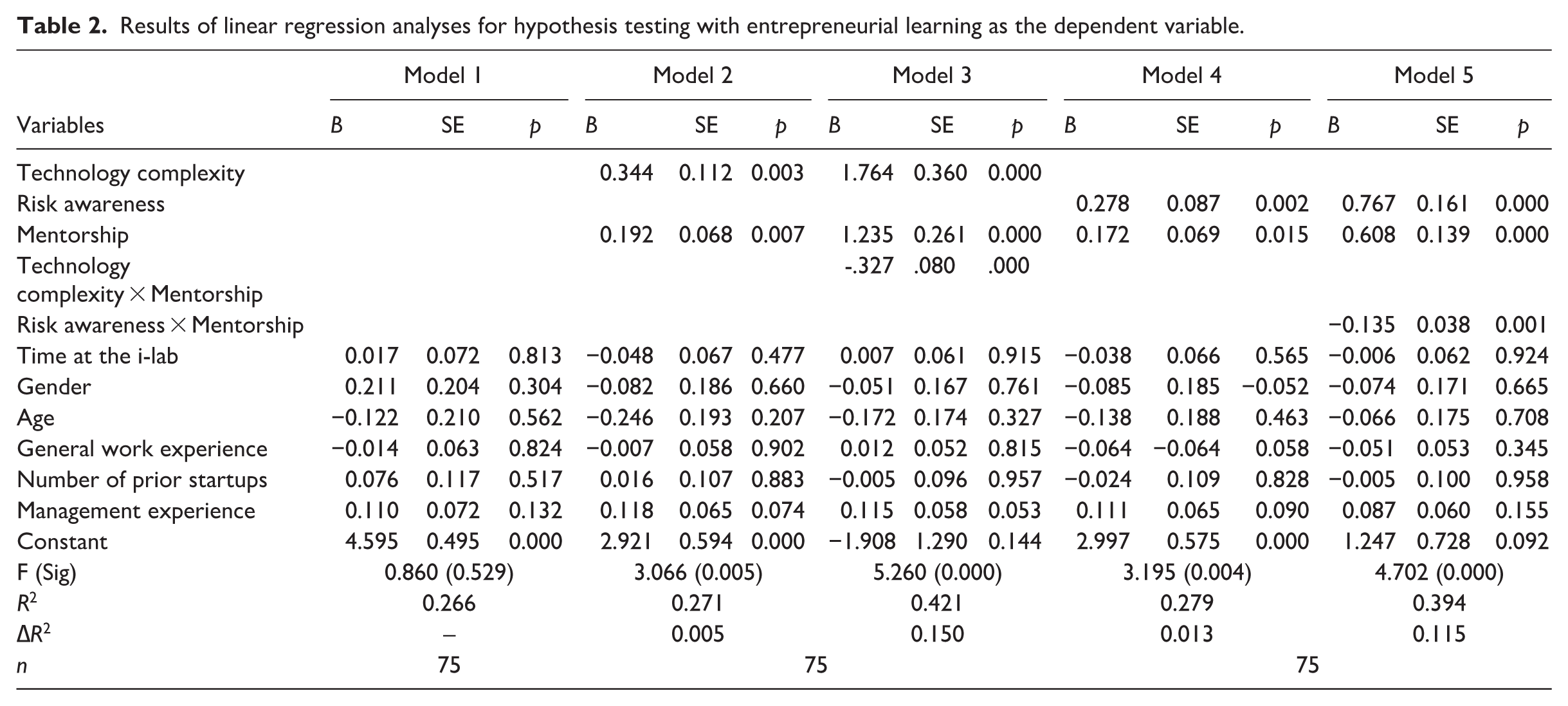
To complement these regression results, we calculated effect sizes (f²) for all main and interaction effects and report the significance of the corresponding changes in explained variance (ΔR²). The main effect of technological complexity yielded a very small effect size (f² = 0.007), reflecting the minimal increase in explained variance from Model 1 (R² = 0.266) to Model 2 (R² = 0.271); this ΔR² of 0.005 was statistically significant (p = 0.005). Similarly, the main effect of risk awareness produced a small effect size (f² = 0.018), corresponding to the increase in R² from Model 1 (R² = 0.266) to Model 4 (R² = 0.279), with a statistically significant ΔR² of 0.013 (p = 0.004). In contrast, the moderating effects demonstrated substantially larger magnitudes. The interaction between technological complexity and mentorship resulted in a medium effect size (f² = 0.259), based on the increase from Model 2 (R² = 0.271) to Model 3 (R² = 0.421); this ΔR² of 0.150 was statistically significant (p < 0.001). Likewise, the interaction between risk awareness and mentorship yielded a medium effect size (f² = 0.160), reflected in the increase from Model 4 (R² = 0.279) to Model 5 (R² = 0.394); this ΔR² of 0.115 was statistically significant (p < 0.001). Taken together, these results show that while technological complexity and risk awareness have modest direct effects, the moderating role of mentorship constitutes a substantially stronger influence on entrepreneurial learning, supporting the theorised contingency perspective. This pattern is consistent with contingency logic: the main effects reflect broad cognitive conditions whose influence may vary across ventures, whereas the interaction effects capture the extent to which mentorship shapes whether internal learning drivers translate into observable search behaviour. Thus, the medium f² values for the interactions indicate that mentorship is not merely an additive resource but a key boundary condition in accelerator learning dynamics.
To interpret these interactions, we followed Aiken et al. (1991) and examined conditional effects at low, moderate, and high levels of the moderators. For technological complexity, mentorship had a strong positive effect on entrepreneurial learning at a low level of complexity (Effect = 0.747, SE = 0.134, p < 0.001) and a smaller, though still significant, effect at moderate complexity (Effect = 0.361, SE = 0.093, p < 0.001). At a high level of complexity, the effect became nonsignificant (Effect = 0.135, SE = 0.103, p = 0.193). This pattern indicates that mentorship contributes to learning primarily when the level of technological complexity is low to moderate. At high complexity levels, mentorship no longer adds meaningful incremental benefit, consistent with a substitution effect. Figure 2 illustrates this interaction.

Interaction between mentorship and technology complexity on entrepreneurial learning.
A similar pattern emerged for risk awareness. Mentorship increased entrepreneurial learning at low levels of risk awareness (Effect = 0.349, SE = 0.074, p < 0.001) and at moderate levels (Effect = 0.177, SE = 0.073, p = 0.018). At high levels of risk awareness, however, the effect was nonsignificant (Effect = 0.076, SE = 0.083, p = 0.365). These findings indicate that mentorship supports learning when the risk level is low to moderate, but its contribution diminishes when the level of risk awareness is already high. Figure 3 presents this interaction.
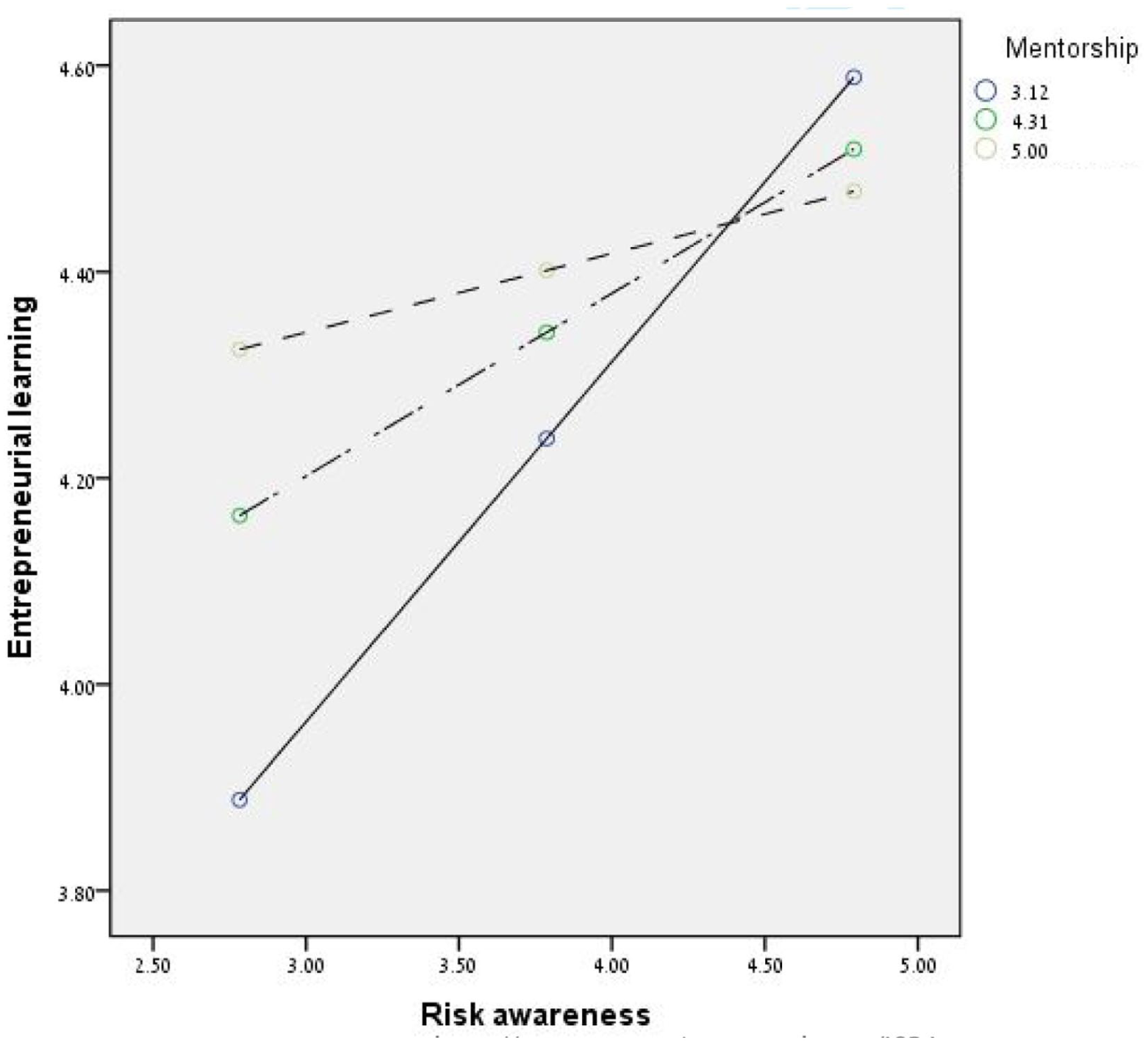
Interaction between mentorship engagement and risk awareness on entrepreneurial learning.
Discussion
We examined how technological complexity and risk awareness influence entrepreneurial learning, and whether mentorship shapes these relationships in accelerator settings. Consistent with our operationalisation, we discuss entrepreneurial learning as proactive information search and interpret the results at the level of this behavioural manifestation. Beyond contingency theory, the pattern also has implications for resource-based interpretations of accelerators. In this literature, mentorship is often treated as a valuable support resource expected to amplify venture progress (Blank, 2021; Cohen et al., 2019; Hallen et al., 2020). Our evidence instead indicates diminishing marginal returns, consistent with a substitution effect in which external guidance can replace rather than reinforce internally triggered learning behaviour under high complexity or high-risk awareness.
Across models, both technological complexity and risk awareness were positively associated with entrepreneurial learning; yet, mentorship moderated these relationships in a conditional rather than universal manner. These findings deepen current understanding of accelerator dynamics by demonstrating that mentorship functions not as an inherently beneficial mechanism, but as a context-dependent resource whose value varies according to the internal drivers entrepreneurs face. From a theoretical standpoint, this pattern aligns with the contingency perspective, which suggests that the effectiveness of external support mechanisms such as mentorship depends on the alignment between internal drivers of entrepreneurial learning and the contextual conditions of accelerator programmes (Donaldson, 2001, 2006). Notably, the modest main effects combined with the medium interaction effect sizes reinforce the central theoretical insight of the study: mentorship is most influential not as a direct additive driver of learning but as a contextual mechanism that conditions when internal cognitive stimuli translate into proactive information search.
Technological complexity emerged as a key driver of entrepreneurial learning, consistent with research showing that firms operating in complex technological environments must continuously acquire, and update knowledge and engage in targeted information search routines (Brauer et al., 2021; Matthies & Coners, 2018). Our findings reinforce this logic. When technologies are novel, interdisciplinary or rapidly evolving, entrepreneurs refine assumptions, experiment iteratively and mobilise diverse knowledge sources, behaviours aligned with absorptive capacity and dynamic learning mechanisms (Feng et al., 2021). However, heightened complexity also introduces cognitive burden, information overload and decision fatigue (Blank & Naveh, 2014; Hou et al., 2023), revealing the need for structured learning approaches such as disciplined search routines or targeted expert consultation (Santorsola et al., 2023). Future research may examine how entrepreneurs calibrate their exploration intensity relative to technological demands, and how they selectively engage external expertise to avoid inefficient overprocessing of information.
Similarly, the positive association between risk awareness and entrepreneurial learning aligns with studies showing that entrepreneurs who consciously evaluate uncertainty engage in deeper information search, validate assumptions, and systematically refine their strategic choices (Macko & Tyszka, 2009; Zhao et al., 2021). Risk awareness provides a cognitive stimulus for learning by increasing attentiveness to potential losses and motivating founders to anticipate challenges, consistent with theoretical work on uncertainty-driven learning behaviour (Shepherd, 2003). These results indicate that risk-aware founders engage more deliberately with external information and revise their strategies in response to perceived threats. Future work could explore how entrepreneurs calibrate their risk assessments across different stages of venture development, and how overly optimistic or pessimistic risk perceptions influence learning trajectories.
Our most distinctive contribution lies in demonstrating that mentorship’s value is highly contingent on context. Mentorship did not consistently enhance entrepreneurial learning; rather, its impact depended on the levels of technological complexity and risk awareness. When level of technological complexity was low to moderate, mentorship significantly increased entrepreneurial learning by providing entrepreneurs with clarity, heuristics and structured guidance to direct their search efforts. However, at high levels of complexity, mentorship no longer added incremental value. This pattern supports a substitution effect: when complexity inherently stimulates intensive learning, additional mentor guidance may lead entrepreneurs to over-rely on mentor expertise, potentially diminishing entrepreneurial self-efficacy and reducing independent exploration. This aligns with research showing that excessive mentor dependence can undermine self-directed learning and constrain problem-solving autonomy (Politis, 2005; St-Jean & Audet, 2012).
A similar contingency emerged with risk awareness. When entrepreneurs perceived high levels of risk, they engaged in intensive information search regardless of mentor involvement. Under these conditions, mentorship may act as a psychological safety net, reducing the urgency of independent exploration and attenuating the typical learning stimulus induced by risk (Funken et al., 2020). Conversely, when the level of risk awareness was low, mentorship substantially enhanced learning by compensating for the lack of perceived external threat and stimulating more focused information search. These dynamics collectively reinforce the idea of adaptive mentorship, where the optimal level and type of mentor involvement vary depending on the founder’s internal cognitive drivers (Kuratko et al., 2021; Marvel et al., 2025).
Consequently, we advance entrepreneurship theory by positioning mentorship as a context-dependent moderator within a contingency perspective. Rather than assuming that mentorship uniformly strengthens entrepreneurial behaviour, our findings show that its marginal utility depends on the strength of internal drivers such as technological complexity and risk awareness. We demonstrate that mentorship is most influential when entrepreneurs lack strong intrinsic stimuli for learning; when such stimuli are already high, mentorship may offer limited benefit or even substitute for independent exploration. This integrative view contributes to a more nuanced understanding of learning processes in accelerator programmes and highlights the importance of aligning mentor involvement with venture-specific challenges.
Theoretical contributions
Our evidence contributes to research on entrepreneurial learning within accelerator settings by demonstrating that mentorship operates as a context-dependent resource rather than a uniformly beneficial mechanism. Whereas prior work on accelerators has highlighted structural dimensions such as funding, resource access, and programme design, our findings emphasise the importance of mentor–team compatibility and contextual fit (Colombo et al., 2018; Crișan et al., 2021). By illustrating that mentorship effects vary according to technological complexity and risk awareness, the study advances a more refined theoretical understanding of how learning unfolds within structured support environments.
A central contribution of the study lies in challenging the common assumption that mentorship consistently enhances entrepreneurial learning. The results show that the influence of mentorship weakens when the level of technological complexity or risk awareness is high, suggesting that under demanding cognitive or uncertainty conditions, entrepreneurs already engage in intensive self-directed learning processes (Çelik & Gür, 2024; Romme et al., 2023). In such environments, additional mentor involvement offers limited incremental value and may substitute for independent information search. This insight positions mentorship as a contingent enabler whose effect depends on the internal demands imposed by technology and on an entrepreneur’s cognitive evaluation of risk. The findings further enrich theories of entrepreneurial learning (i.e., Cope, 2005; Politis, 2005) by showing how external support interacts dynamically with internal learning drivers. When technological complexity or risk awareness is low to moderate, mentorship provides cognitive scaffolding, direction, and focus that encourage proactive information search. When these internal drivers are strong, however, entrepreneurs rely predominantly on internally triggered stimuli for learning, and the incremental value of mentorship diminishes. This conditional logic clarifies how learning behaviour is shaped jointly by individual cognitive assessments and structured external support, thereby contributing to theoretical conversations on learning processes in high uncertainty environments (Zhao et al., 2021).
Traditionally, accelerator research implicitly aligns with resource-based reasoning by treating mentorship, networks, and expert access as valuable inputs that strengthen early-stage ventures through resource accumulation (Barney, 1991; Blank, 2021; Clayton, 2024). Our findings qualify this assumption by showing that mentorship does not uniformly amplify entrepreneurial learning. Instead, mentorship exhibits diminishing marginal utility and may become substitutive when internally triggered learning drivers are strong. This pattern suggests an important boundary condition for the value of accelerator resources: the effectiveness of mentorship depends less on its availability and more on its fit with venture demands and founder cognitive conditions. Conceptually, this implies a shift from a resource accumulation view toward a resource alignment perspective, in which accelerators create value by matching the most critical support resource to the venture’s dominant constraint rather than increasing support intensity indiscriminately (Cloitre et al., 2026; Kuratko et al., 2021; Tank et al., 2024). Additionally, the study advances the literature on accelerator ecosystems by identifying adaptive mentorship frameworks as essential for enhancing entrepreneurial learning. Drawing on the logic that effective entrepreneur-investor matching enhances guidance quality and decision support (Solodoha, 2023, 2026), a similar alignment principle applies to mentorship relationships in accelerators. Practices such as structured mentor matching, thoughtful assessment of mentor-entrepreneur fit and feedback systems that consider how perceptions of technological demands and risk evolve over time can improve alignment between mentoring practices and startup needs (Aljalahma & Slof, 2022; Yitshaki & Drori, 2018). These insights support a move beyond uniform mentoring models toward designs that account for heterogeneity in entrepreneurial challenges.
Finally, the findings highlight important boundary conditions for mentorship within accelerator contexts. Since mentorship appears most beneficial at low to moderate levels of complexity and risk, accelerators may need to incorporate complementary mechanisms, such as peer learning cohorts, structured experimentation routines, or domain-specific expert consultations, when startups operate under extreme technological demands or heightened uncertainty. Recognising these boundary conditions refines theoretical accounts of accelerator influence and provides a foundation for future scholarship on how different support structures interact to shape entrepreneurial learning trajectories.
Practical contributions
This research provides several practical insights for enhancing the effectiveness of mentorship within accelerator programmes. The results highlight the importance of tailoring mentorship approaches to the specific challenges posed by technological complexity and risk awareness, rather than assuming a uniform effect across all entrepreneurial contexts.
For entrepreneurs, the findings emphasise that mentorship should be regarded as a complementary resource rather than a primary source of guidance. Mentors can offer clarity and direction when technological complexity or perceived risk is low to moderate; yet, entrepreneurs must remain active in conducting independent information searches. In situations characterised by a high level of complexity or high-risk awareness, entrepreneurs appear capable of sustaining intensive learning processes on their own. Excessive reliance on mentorship in these settings may limit opportunities to consolidate insights from diverse sources and to strengthen autonomous decision-making capabilities.
The results also resonate with Jaafari’s (2001) view that risk management is a dynamic, real-time function that evolves with changing conditions. Evidence from extreme contexts further shows that heightened perceptions of risk stimulate more deliberate and adaptive entrepreneurial behaviour (Solodoha & Mosi, 2025). Applied to accelerator programmes, this perspective suggests that mentorship itself must be adaptive. Structured guidance is valuable for risk assessment and strategic evaluation, yet its influence becomes conditional as technological complexity or risk awareness intensifies. When these internal drivers are high, entrepreneurial learning remains elevated regardless of mentorship. This indicates that in such contexts, mentorship neither amplifies nor suppresses learning, and therefore should shift from directive guidance to mechanisms that encourage entrepreneurs to refine their own reasoning, challenge assumptions, and build cognitive resilience. Integrating real-time risk management principles into mentorship practices can help accelerators support entrepreneurs in responding proactively to uncertainty.
For mentors, the findings highlight the need to adjust their style and involvement based on the characteristics of the startup. Rather than emphasising prescriptive advice, mentors can focus on fostering critical thinking, helping entrepreneurs validate information from multiple sources and supporting the development of self-directed learning habits. Mentor training programmes can equip mentors with tools to balance guidance with autonomy, ensuring that support does not unintentionally inhibit independent exploration. For accelerator facilitators, the evidence illustrates the importance of implementing adaptive mentorship frameworks. Prior research shows that alignment between the mentor and the entrepreneur in expertise, communication style, and venture needs enhances the quality of the mentorship relationship (Kuratko et al., 2021; St-Jean & Audet, 2012; Yitshaki & Drori, 2018). Structured mentor matching based on these dimensions can improve learning outcomes. Facilitators should also incorporate periodic feedback loops to evaluate whether the mentor-entrepreneur pairing remains appropriate as venture conditions evolve. In contexts of high level of complexity or high-risk awareness, accelerators may also introduce complementary learning resources such as expert consultations, peer learning cohorts, or structured experimentation sessions to support entrepreneurs when mentorship alone provides limited incremental value. By aligning mentorship strategies with varying levels of technological complexity and risk awareness, accelerator programmes can enhance their overall effectiveness, improve the quality of entrepreneurial learning, and better support founders as they navigate uncertainty.
Overall, by identifying a substitution-based boundary condition for mentorship, the study connects contingency logic with a refined resource-based interpretation of accelerators, emphasising that support resources generate value through alignment rather than sheer intensity.
Limitations
Despite its contributions, this study has several limitations that should be acknowledged. First, our dependent variable captures entrepreneurial learning operationalised as proactive information search, which reflects a behavioural manifestation of learning rather than the full entrepreneurial learning cycle. Entrepreneurial learning also involves processes such as sensemaking, reflection, integration, and post-search application, which are not directly measured in this study. Future research should therefore employ multi-item and multidimensional learning measures and, where possible, combine behavioural indicators of search with cognitive measures of sensemaking and post-search application to capture the full entrepreneurial learning cycle. Relatedly, although we theorise that the substitution effect may reflect mechanisms such as cognitive authority surrender and a psychological safety net, our data do not allow direct testing of these processes. Specifically, high mentorship engagement may encourage cognitive authority surrender, whereby founders treat mentor expertise as a substitute for independent reasoning and exploratory effort, potentially weakening self-efficacy and autonomous problem solving. In parallel, mentorship may operate as a psychological safety net that reduces anxiety and perceived urgency, thereby lowering motivation for independent information search even when uncertainty cues are salient. Although conceptually distinct, these mechanisms may also interact, such that psychological comfort facilitates cognitive dependence. Future research should therefore unpack these pathways using multi-source and process designs, for example, combining behavioural traces of search, founder reports of anxiety and autonomy, and mentor interaction logs. Such designs would enable testing whether psychological comfort precedes or amplifies cognitive dependence and whether their joint operation accounts for reduced incremental learning under high mentorship engagement.
Second, the data were collected within a single accelerator programme, which may limit the generalisability of the findings to other entrepreneurial ecosystems. Accelerator programmes differ widely in their mentorship structures, resource configurations, programme philosophies, and cultural contexts. These variations may influence how mentorship interacts with technological complexity and risk awareness to shape entrepreneurial learning. For instance, differences in mentor quality, the frequency and depth of mentor-team interactions and programme expectations may produce alternative patterns of moderation. Future research should therefore examine multiple accelerator programmes across different regions, sectors and institutional environments to validate and extend the boundary conditions of the model. Such comparative designs may also clarify how institutional incentives and policy-driven support structures shape entrepreneurial decision-making and resource utilisation (Solodoha et al., 2023). We also considered conducting sector-based subgroup analyses (consumer goods and services, healthcare and life sciences and social entrepreneurship). However, given the modest sample size and uneven sector distribution, such subgroup interaction models would likely be underpowered and could produce unstable estimates. We, therefore, refrain from reporting subgroup analyses and instead, encourage future research using larger multi-accelerator samples to test whether the moderation patterns differ across venture sectors. Mentor scarcity may represent an especially important boundary condition. In resource-scarce ecosystems, such as emerging economies or peripheral regions with limited access to experienced mentors, mentorship may retain high marginal value even when technological complexity or risk awareness is high. Under such conditions, mentorship may function as a complement rather than a substitute, because founders may otherwise lack specialised expertise, networks and credible guidance. Future research should therefore test whether ecosystem-level institutional constraints systematically shift the mentorship-learning relationship.
Third, the study relies on self-reported data provided by entrepreneurs, which introduces the possibility of response biases such as social desirability and recall bias. Participants may have unintentionally under-estimated their mentorship engagement, perceived complexity, risk awareness, or learning behaviours. Moreover, self-reports capture perceptions rather than observable actions, and the two do not always align. To address this limitation, future studies could complement self-reported measures with objective indicators, such as behavioural tracking of mentor interactions, archival data, performance metrics or third-party assessments. Using multiple data sources would improve construct validity and allow for a more precise analysis of entrepreneurial learning processes.
Finally, although the study controlled several relevant founders and team characteristics, additional unobserved variables may have influenced the results. In particular, mentor-level factors such as mentor expertise, mentoring style, communication quality, perceived mentor authority, and mentor-venture fit were not directly measured. These attributes may shape not only the effectiveness of mentorship but also the extent to which founders engage with mentors, and thus could account for additional variance in entrepreneurial learning outcomes. Likewise, entrepreneurial characteristics, including resilience, cognitive style, openness to experience and tolerance for ambiguity, may shape how founders respond to mentorship and perceive complexity or risk. Future research should therefore, incorporate richer mentor and founder measures and adopt multi-source or multilevel research designs to better isolate mentorship mechanisms, reduce potential omitted variable bias and provide a more granular explanation of when and why mentorship substitutes for or complements entrepreneurial learning.
Conclusion
This study shows that technological complexity, risk awareness, and mentorship engagement interact in shaping entrepreneurial learning, operationalised as proactive information search, within accelerator environments. Mentorship is not an unqualified benefit; rather, its influence depends on the strength of internal learning drivers. When technological complexity or risk awareness is high, entrepreneurs already engage in intensive information search, which reduces the added value of mentorship. When these drivers are weaker, mentorship plays a more central role in guiding learning and supporting decision making. Practically, the findings highlight the importance of aligning mentorship with the specific needs of each venture. Entrepreneurs should treat mentorship as a complementary resource that supports but does not replace independent inquiry. Mentors are encouraged to foster critical thinking, autonomy and reflective learning. Accelerator facilitators should adopt adaptive mentorship structures that include careful mentor matching, ongoing assessment and targeted supplemental support. Future research should examine these conditional patterns across different accelerator models and explore complementary mechanisms such as peer learning groups, structured experimentation processes and expert consultations that may strengthen learning when mentorship alone is insufficient.
Footnotes
Author contributions
Tali Hadasa Blank and Eliran Solodoha contributed equally to the conception, research design, data analysis, and writing of this manuscript.
Funding
The authors received no financial support for the research, authorship, and/or publication of this article.
AI disclosure statement
The authors used OpenAI’s ChatGPT solely for language editing to improve clarity and readability. All theoretical arguments, empirical analyses, and interpretations were developed by the authors. All citations and claims were manually checked against the original sources.
Ethical statement
This study did not involve human subjects in a manner requiring institutional ethical approval. All interviews were conducted with informed consent and in accordance with ethical research standards.

Data availability statement
The data that support the findings of this study are available from the corresponding author upon reasonable request.