



Abstract
This article draws on theories of hybridity in social entrepreneurship, institutional logics, and technology-associated organisational change to develop a novel framework for analysing how digitalisation affects hybridity and internal tensions in social enterprises. Based on an action research study in a UK-based social enterprise, our findings reveal that digitalisation functions as a set of new strategic practices that disrupt existing institutional logics and trigger profound organisational changes. This form of institutional disruption destabilises established hybrid balances. These dynamics generate internal tensions – rooted in divergent digital literacies, competing mission recognition, and identity misalignments – which ultimately lead to resistance and the marginalisation of digitalisation. Our study advances understanding of digitalisation as a contested and complex socio-technical process in social enterprises and highlights its often-overlooked ‘dark side’.
Introduction
Social enterprises are broadly defined as self-sustaining and entrepreneurial organisations that pursue a primary social mission with market-based techniques (Chell, 2007; Luke and Chu, 2013). Accordingly, social enterprises are often hybrid organisations that combine multiple forms of organising (Battilana and Lee, 2014) to respond to competing social welfare and commercial institutional logics (Pache and Santos, 2013). Social entrepreneurship is also seen as a critical and effective tool to address complex social issues and crises (Sarma et al., 2022; Sutter et al., 2018; Waddock and Post, 1991; Weaver, 2023). Recent crises, such as the COVID-19 pandemic and rising living costs, have intensified these pressures, pushing social enterprises to rapidly adopt digital technologies. Similar to their commercial counterparts, social enterprises have to embrace digitalisation, incorporating online activities and new digital communication tools in their business models and processes (Meurer et al., 2021; Papadopoulos et al., 2020). Until recently, however, there have been limited scholarly attempts to elucidate this significant issue; these have primarily focused on the positive consequences of digitalisation in enhancing social enterprise resilience and creating social value (Nakpodia et al., 2024; Yáñez-Valdés et al., 2023).
In this article, we explore social enterprise hybridity and forms of hybrid tensions that emerge from these attempts at digitalisation – a socio-technical process of integrating and adopting digital technologies into an organisation’s infrastructure (Tilson et al., 2010) – at the times of crisis. Building on the work of Baiyere et al. (2020) and He et al. (2020), we suggest that digitalisation disrupts the conventional processes and logics of how social enterprises are managed. First, the need for digitalisation is likely to challenge the existing hybrid forms of organising in social enterprises (He et al., 2022), creating new tension between the need to digitalise and the need to address social and economic missions. Second, situated in a macro-level digital economy, digitalisation represents a new set of managerial norms, beliefs and practices that challenge the established logics in social enterprises (Bernardi and Exworthy, 2020; Schildt, 2022). Accordingly, these challenges demand a renewed understanding of hybridity and tensions in social entrepreneurship. We aim to contribute to such theoretical advancement through an empirical analysis of hybridity and tensions in social enterprise digitalisation. Specifically, we address the following research question: How does digitalisation challenge hybridity in social enterprises? To address this question, we draw upon existing theories of hybridity in social entrepreneurship (Battilana and Lee, 2014; Smith et al., 2013), institutional logic (Thornton et al., 2012) and technology-associated organisational change (Allen et al., 2013; Volkoff and Strong, 2013), to form a novel framework to analyse new forms of hybridity and tensions in social entrepreneurship during the digitalisation process. Our empirical analysis combines an action research approach with a single case study design, drawing upon a six-month virtual placement in a social enterprise in Hampshire, United Kingdom.
Our findings suggest that digitalisation is not merely the adoption of digital technologies but enables technology-driven organisational changes that reshape organisational structures, routines and internal dynamics. As digitalisation interacts with pre-existing social and commercial logics, it disrupts the established hybrid balance and generates new tensions within the organisation. These tensions – rooted in differences in digital literacy, professional identities, and perceptions of value – ultimately contribute to organisational resistance and the marginalisation of digitalisation. We extend existing theorisation of hybridity in social entrepreneurship, which has largely been viewed as a predetermined organisational feature (Battilana and Lee, 2014; Smith and Besharov, 2019), by illustrating how institutional complexity evolves through the emergence and contestation of new strategic practices. In so doing, we offer a more dynamic and multilevel understanding of hybrid organising, highlighting how individual agency, stakeholder alignment, and value recognition affect the evolution of institutional logics.
The remainder of this article is structured as follows. We first discuss the research background through a brief review of the literature on hybridity and tensions in social entrepreneurship. We then highlight the need for a microfoundations perspective when studying hybridity in the context of digitalisation, linking individual-, organisational-, and societal-level entities, tensions, and outcomes. This is followed by an outline of the single case, action research method employed in our empirical analysis. Next, we present our findings through three distinctive phases of digitalisation emerged from the empirical data. Finally, we discuss our theoretical contributions and research implications.
Theoretical background
Hybridity and institutional complexity in social entrepreneurship
Social enterprises operate in organisational environments characterised by institutional complexity, where the emergence of organisations and entrepreneurial practices is influenced by various institutional demands and pressures (Doherty et al., 2014; Greenwood et al., 2010). As such, social enterprises must develop varied activities, structures, processes, embodying a hybrid nature that exists at the intersection of financial sustainability and social impact (Battilana & Lee, 2014; Smith et al., 2013). This hybridity is thus often presented as a defining feature distinguishing social enterprises from purely commercial or non-profit organisations. Following Battilana and Lee (2014) and Thornton et al. (2012), we conceptualise hybridity in social entrepreneurship as the combination of multiple institutional logics, in which multiple organisational forms, values and identities are embedded. Institutional logics are historically contingent constellations of interconnected practices comprising of shared meanings, material elements and practitioner roles that both constrain and enable individuals and organisations to enact and drive change through situated action and meaning-making (Schildt and Kodeih, 2025). Individuals and organisations maintain partial autonomy in navigating institutional complexity by selectively enacting different logics, balancing organisational tensions while shaping institutional change (Friedland and Alford, 1991). This institutional logic perspective provides a useful framework to understand how these different elements of hybridity interact across different but interrelated levels of analysis.
At the macro-level, social enterprises must navigate competing institutional logics, particularly those of social welfare and market-based commercial logics (Battilana and Lee, 2014). These logics shape external expectations and influence how social enterprises position themselves within the broader institutional environment. To succeed, social enterprises must develop internal strategies to either align social welfare and commercial logics to achieve both social and business missions (Doherty et al., 2014; Pache and Santos, 2013) or prioritise some logics in organisational functioning through compromises that enable multiple logics to co-exist compatibly (Besharov and Smith, 2014). Societal-level institutional logics also shape the construction and reproduction of organisational forms within a given sector at the meso-level (Battilana and Lee, 2014). Here, hybridity materialises through the combination of organisational forms and governance structures, where social enterprises may incorporate features of both non-profit and for-profit forms typically associated with charities and commercial businesses (Bacq and Janssen, 2011; Mair et al., 2012). Once widely adopted, these organisational forms gain legitimacy and become institutionalised, providing cultural materials that members within the organisations assemble to construct their identity elements (Battilana and Lee, 2014), which in turn guide expectations of social practices at the micro-level (Wry and York, 2017). Hybridity is reflected in the multiple identities held by individuals, who draw upon institutionalised practices to negotiate their roles within the enterprise (Battilana et al., 2017; Wry and York, 2017). Accordingly, within organisations, various identities can coexist, some being central, peripheral, holographic, or widely shared across the organisation or among individuals (Battilana, 2018; Lumpkin et al., 2018).
The existing literature offers valuable insights for theorising hybridity in social entrepreneurship as the co-occurrence of multiple institutional logics, organisational forms, and identities at macro-, meso- and micro-levels. However, it often assumes hybridity as a given organisational feature (Smith and Besharov, 2019) and primarily emphasises the balance between social and commercial logics (Battilana and Lee, 2014; Battilana et al., 2015). What is less understood is how emerging strategic practices, such as digitalisation, create structural changes and environmental turbulence that disrupt the existing balance. Digitalisation introduces new organisational practices, decision-making frameworks, and sources of tension that extend beyond conventional hybridity challenges (Bandini et al., 2023; Fähndrich, 2023). In the following section, we explore how digitalisation introduces new layers of complexity and tensions that challenge hybridity in social enterprises.
Digitalisation and logic disruption
Digitalisation refers to a new set of interconnected socio-technical practices through which digital technologies become embedded in organisational activities, reshaping work structures and decision-making processes, and potentially influencing the evolution of institutional logics (Schildt, 2022; Tilson et al., 2010; Verhoef et al., 2021). It is distinct from digitisation, which mainly involves the conversion of internal and external documentation processes into digital forms, and from digital transformation, which entails a more fundamental strategic reconfiguration of new business models or industries driven by digitalisation (Verhoef et al., 2021). Key to this conceptualisation is that digitalisation is a process of technology-mediated organisational change, where digital technologies are not just a tool but a disruptive set of practices that challenge established institutional logics underlying organisational structures, roles, and institutional expectations (Allen et al., 2013; Schildt and Kodeih, 2025).
Thornton et al. (2012) suggest that institutional logics can emerge and evolve in response to external pressures, reshaping organisational decision-making and sensemaking frameworks within organisations. This has been evident in social entrepreneurship, where digitalisation has become a key focus of social enterprise operations in response to external shocks like COVID-19 (Bandini et al., 2023), and is also associated with opportunities to drive societal changes, including social inclusion and poverty alleviation (Faik et al., 2020). As a new set of practices, digitalisation introduces a complex organisational context that demands structural interruptions, adaptations and strategic reconfigurations at different levels (Appio et al., 2021). For example, digital technologies enable a reconfiguration of organisational routines, influencing employee cognition and strategic decision-making processes (Volberda et al., 2021). As new technologies are introduced, the decision-making authority may also shift towards those with digital expertise, often at the expense of individuals who uphold existing logics (Gawer and Phillips, 2013). Similarly, digitalisation can reshape decision-making structures and power dynamics, reinforcing efficiency-driven, data-centric norms that may not always align with relational, community-based approaches (Faik et al., 2020).
Accordingly, digitalisation is embedded in a dynamic ‘activity system’ of social and cultural structures (Allen et al., 2013), where organisation members interact, negotiate priorities and respond to changing decision-making structures and stakeholder expectations. For example, an organisation’s motivation to adopt a data storage system may originate from external social, structural or cultural logics that are inscribed within the material components of the system (e.g. a software platform for data management). Then, the implementation of such a system requires human agency, as individuals must adopt new workflows and adjust to evolving digital practices. Also, the software itself must be designed to centralise data and information for organisational management, reinforcing specific decision-making structures and strategic objectives (Mutch, 2010). These interrelated practices shape power dynamics and decision-making authority within the organisation, which in turn influence the broader outcomes of digitalisation. As Allen et al. (2013: 836) suggest, digitalisation within an organisation ‘provides reasons and resources to enable (and constrain) different stakeholders and participants to make changes, and it is through the interplay of action and context that one can understand why an Information System (IS) initiative succeeds, for whom, and in what context’. Thus, digitalisation, embedded in such a dynamic system of interactions, can be understood as a disruptive force that enables or constrains institutional work (Allen et al., 2013). Through its reconfiguration of decision-making structures, normative expectations and stakeholder relationships, it may contribute to the blurring, contestation or transformation of existing institutional logics (Schildt, 2022; Schildt and Kodeih, 2025). As such, digitalisation is not merely about the adoption of digital technologies; rather, it reshapes organisational dynamics in ways that can generate tensions between actors adhering to different institutional logics. In the next section, we examine these hybrid tensions in greater detail.
Hybrid tensions in social entrepreneurship
The institutional complexity inherent in social entrepreneurship arises from the coexistence of multiple institutional logics, organisation forms and identities that would not conventionally fit together (Battilana and Lee, 2014; Smith and Besharov, 2019). This hybridity requires social enterprises to navigate tensions between social welfare and commercial imperatives, balancing different organisational structures, governance models, and stakeholder expectations (Besharov and Smith, 2014; Pache and Santos, 2013). Tensions emerge when these competing logics, identities or practices co-exist within an organisation, forcing actors to make trade-offs, compromises or adaptations (Battilana and Lee, 2014; Smith and Besharov, 2019). For example, hybridity can complicate resource acquisition activities, as it creates new social and commercial resource demands that do not always correspond to existing investment categories (Battilana and Lee, 2014). In such cases, tensions derive from internal conflicts, clashes of individual identities, values and resource allocation, as well as external pressures related to economic and social legitimation from various stakeholders. These challenges have a significant impact on financial and human resource allocation (Battilana, 2018). If left unresolved, such tensions can create significant governance challenges, resulting in mission drift, internal fragmentation and organisational inefficiencies (Battilana et al., 2017; Ebrahim et al., 2014).
Smith et al. (2013) identify four types of tensions in social entrepreneurship: performing tensions, organising tensions, belonging tensions and learning tensions. Performing tensions emerge from conflicting goals and performance measures, which are particularly challenging in social enterprises where social and business missions have diverse stakeholder considerations and often involve non-quantifiable, non-standard performance measurement frameworks (Ebrahim et al., 2014). Organising tensions arise from internal conflicts over diverse organisational structures, processes and governance models, particularly as social enterprises balance diverse organisational cultures and human resource practices. These tensions manifest in challenges such as recruiting employees with varied skill sets to address hybrid missions, as well as in the dilemma of adopting a for-profit, not-for-profit or hybrid legal forms. Belonging tensions result from contested identities within a social enterprise and among stakeholders. Social entrepreneurs may struggle to articulate their multiple individual and collective identities due to diverse missions (Smith et al., 2013). Finally, learning tensions occur as social enterprises develop long-term strategies for growth, scalability and flexibility. While financial performance can be measured in the short term, social impact typically requires longer-term measurement, creating a temporal misalignment between social and economic goals. This difference in time horizon can lead to conflicting strategic priorities in long-term planning and growth, potentially leading to mission drift and weakened community ties (Smith et al., 2013). Following Dufays and Huybrechts (2016), we argue that tensions in social enterprises become particularly significant when team members face structural decisions that may disrupt existing hybrid processes. As digitalisation emerges as a new set of practices, it introduces profound changes to existing organisational routines and structures, while also encountering resistance from existing logics (Appio et al., 2021; Thornton et al., 2012). Digitalisation thus has the potential to further complicate existing tensions in social enterprises, making it critical to examine how digitalisation interacts with pre-existing hybrid tensions and creates new organisational complexities.
Methodology
Understanding the interplay between digitalisation and hybridity in social enterprises requires an approach that captures the evolving nature of organisational practices, decision-making processes and institutional complexity. Given that digitalisation is an emergent phenomenon, this study employs a qualitative action research design to explore how digitalisation unfolds in a social enterprise setting, shaping hybrid tensions and organisational responses over a 6-month period during COVID-19. This methodological approach allows us to investigate not only the direct effects of digitalisation but also the broader institutional dynamics and adaptations that emerge as organisations navigate institutional complexities.
Research design
This study adopts an action research approach within a single case study design. Following a critical realist ontology (Bhaskar, 1975; Hu et al., 2020), we assume that hybridity and hybrid tensions in social entrepreneurship are an emergent outcome of the dynamic interactions between institutional logics, organisational forms and identities at different levels. Institutional logics exist independently of individual perceptions and practices, yet both constrain and enable individual actions while simultaneously being shaped by them. Action research is a collaborative, iterative process that integrates applied behavioural science knowledge with practical organisational challenges (Craig, 2009). With its dual focus on organisational transformation and knowledge generation, action research promotes dialogue and collaboration with members in organisations (Shani and Coghlan, 2014; Zawadzki et al., 2020). This approach allows us to facilitate and observe real-time organisational changes in terms of values, mindsets, norms, restructuring perspectives on work, and the generation of new knowledge (Coghlan, 2019). It is thus particularly well-suited for studying digitalisation as a new set of dynamic socio-technical practices and its interaction with organisations over time.
A single case study design enables an in-depth, contextually rich examination of how digitalisation unfolds in a real-world setting, allowing for a detailed analysis of its emergence as a new logic, its interactions with other existing logics, and its organisational outcomes – insights that would be otherwise difficult to capture (Yin, 2019). Accordingly, combining action research with a single case study strengthens our ability to trace and understand the dynamic interplay between digitalisation and hybrid tensions, enhancing both observational depth and methodological trustworthiness through contextualised data collection (Bøllingtoft, 2007). However, we acknowledge challenges associated with this approach, particularly managerial influence on digitalisation decisions, organisational power dynamics and resistance from employees, which shaped the data collection process. These limitations are further discussed in the ‘Discussion’ section.
Case selection and data collection
The case we selected is a UK-based social enterprise, referred to as ‘South Hampshire Community Trust’ (SHCT, pseudonym). Founded in the late 1990s, the organisation was established to improve the well-being of local residents in an area historically characterised by high levels of deprivation, including unemployment, poor education, crime, and mental health issues. SHCT delivers local improvements, events, venues, and advisory services to support the community. It operates with a hybrid organisational form, combining a registered charity and a community interest company, with the latter offering commercial cleaning services to generate income for the former. Additionally, the social enterprise receives funding through a community levy, a charge collected by local authorities on new developments in the area. The selection of SHCT as the case study was based on its demonstrated ability to balance social missions and commercial sustainability over the past three decades, as well as its recent strategic shift towards digitalisation to enhance service delivery and community engagement. In particular, SHCT had been actively developing digitalisation initiatives before and during the COVID-19 crisis, including an online conference centre, a crowdfunding project, a community open Wi-Fi project, the recruitment of a digital marketer, and an increased social media presence. This case, therefore, provides a suitable context for examining the impact of digitalisation on well-established balance of hybrid logics.
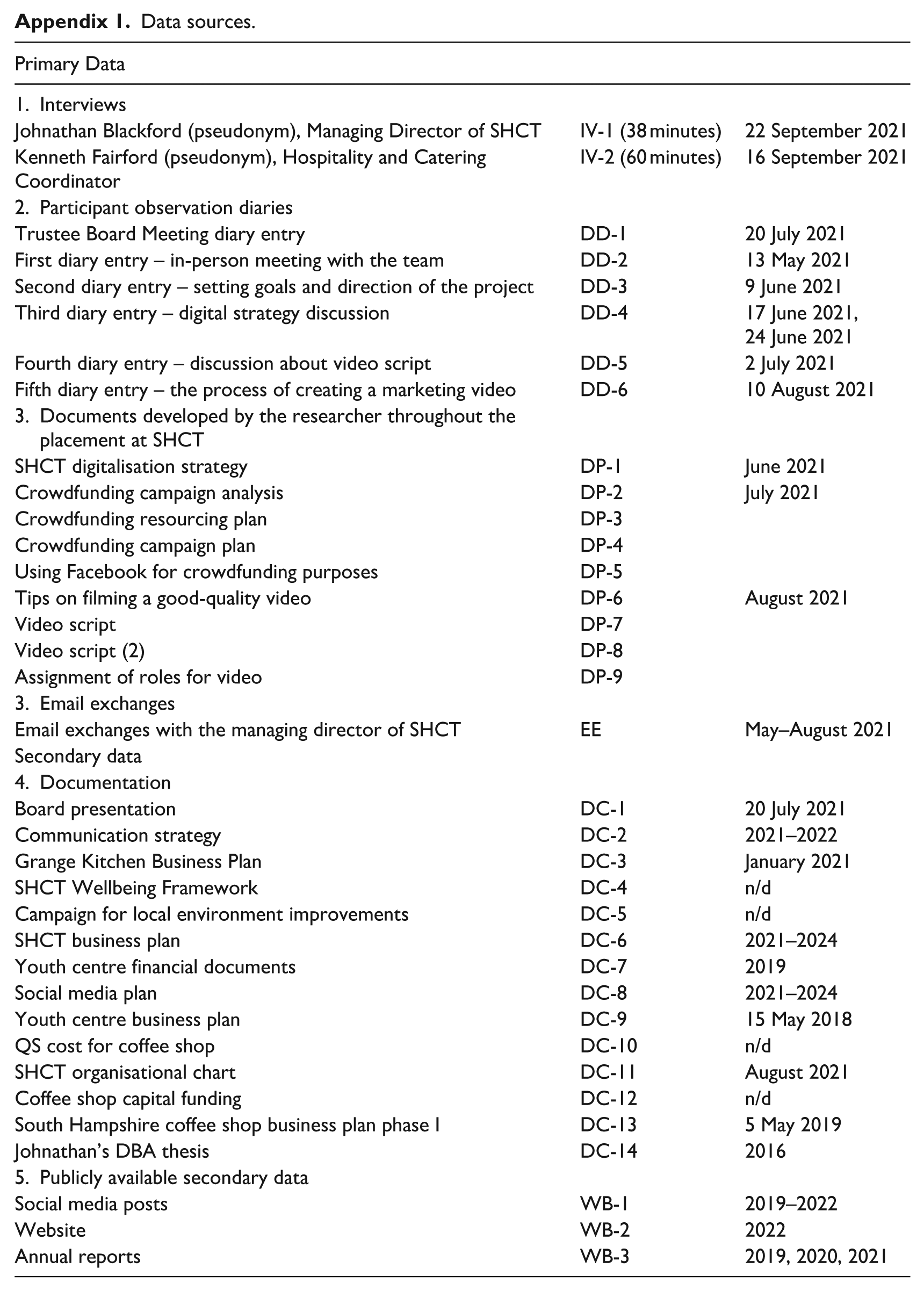
A member of the research team participated in a six-month virtual placement at SHCT, working as an external consultant to assist the CEO, Johnathan Blackford (pseudonym), in developing the organisation’s digital strategy. The placement was conducted remotely due to the pandemic lockdown restrictions in the United Kingdom at the time. During this period, the researcher worked from Monday to Wednesday each week, accumulating a total of 416 hours, and helped produce nine documents (28 pages in total, see Appendix 1) to support SHCT’s digitalisation initiatives. This placement provided an opportunity for first-hand observation and active engagement, offering valuable insights into how digitalisation interacts with SHCT’s hybrid organisational model.
Qualitative data were collected through multiple sources (Appendix 1) to provide a comprehensive understanding of the institutional context and organisational dynamics during digitalisation. Formal online interviews were conducted with Johnathan and a key operational manager, offering insights into leadership perspectives, strategic decisions and internal challenges surrounding digitalisation. Additionally, the researcher attended eight internal virtual meetings, where operational matters, digitalisation strategies, stakeholder concerns, and organisational challenges were widely discussed. Participant observations were recorded through six diary entries, capturing employee reactions, internal politics, tensions, and power dynamics within the organisation. A total of 65 email exchanges between the researcher and Johnathan provided further insights into the decision-making process and the evolving digital strategy. Given the virtual nature of the placement, the researcher did not have the opportunity to interact with other members and stakeholders in the organisation within the same physical spaces. This inevitably led to the dominance of managerial perspectives in formal interviews. To mitigate this limitation and enhance the trustworthiness of findings, secondary data were also reviewed, including internal reports, business plans, financial documents and publicly available materials such as social media posts, website updates and annual reports.
Data analysis
To guide our data analysis, we adopted a six-step thematic analysis framework proposed by Braun and Clarke (2006). This approach was chosen for its flexibility in identifying patterns across a variety of qualitative data sources, including interviews, meeting summaries, participant observations and secondary documents. It allowed us to uncover meaningful insights into how digitalisation interacts with SHCT’s hybrid nature, institutional logics, and emerging organisational tensions.
The first stage involved familiarisation with the data, during which the research team reviewed interview recordings and transcripts, meeting notes, diary entries, and relevant secondary documents. This provided a broad understanding of key issues and emerging patterns. Next, we conducted initial theoretical coding (Thornberg and Charmaz, 2014) following an inductive approach, while drawing on relevant theoretical concepts – particularly those related to hybridity, institutional logics, and digitalisation discussed earlier in this paper. Initial codes were generated based on participants’ everyday language and experiences, macro-level institutional influences, organisational processes, and individual identities, perceptions, and practices, as well as tensions observed across data sources. This step was further informed by the researcher’s first-hand engagement in SHCT’s digitalisation initiatives, which offered an insider’s perspective on internal power dynamics and interactional processes that would otherwise be difficult to capture through primary and secondary data collection alone. For instance, one emerging code was the employees’ perceived erosion of their community-oriented identity. As digitalisation expanded within SHCT, employees reported a growing disconnection from their work and concern over the loss of face-to-face engagement with community members. This concern was echoed in statements such as, ‘If you can’t actually see people, meet people, and the community you’re in is restricted, why would I want to do that job?’ Insights like this were later validated through participant observation, contributing to the development of the broader theme of belonging tensions as digitalisation became embedded in SHCT’s operational model.
We then searched for overarching themes by grouping conceptually related codes into second-order themes. A key focus of our analysis was to examine the impact of digitalisation on SHCT’s existing hybrid structures and possible tensions among organisational actors. We reviewed and refined these themes to ensure internal consistency and that they accurately represented patterns across the full dataset – including interviews, diary entries, observations and secondary documents. Themes were then aggregated into theoretical dimensions, systematically linked to build a coherent framework of how digitalisation interacts with hybridity and organisational change in SHCT. A data structure (Figure 1) was developed to illustrate this data analysis process, through which we organised findings as first-order concepts, second-order themes and aggregate dimensions (Gioia et al., 2013). This structure reflects an emerging institutional logic perspective, allowing us to explore how digitalisation was constructed, contested and ultimately marginalised within SHCT.
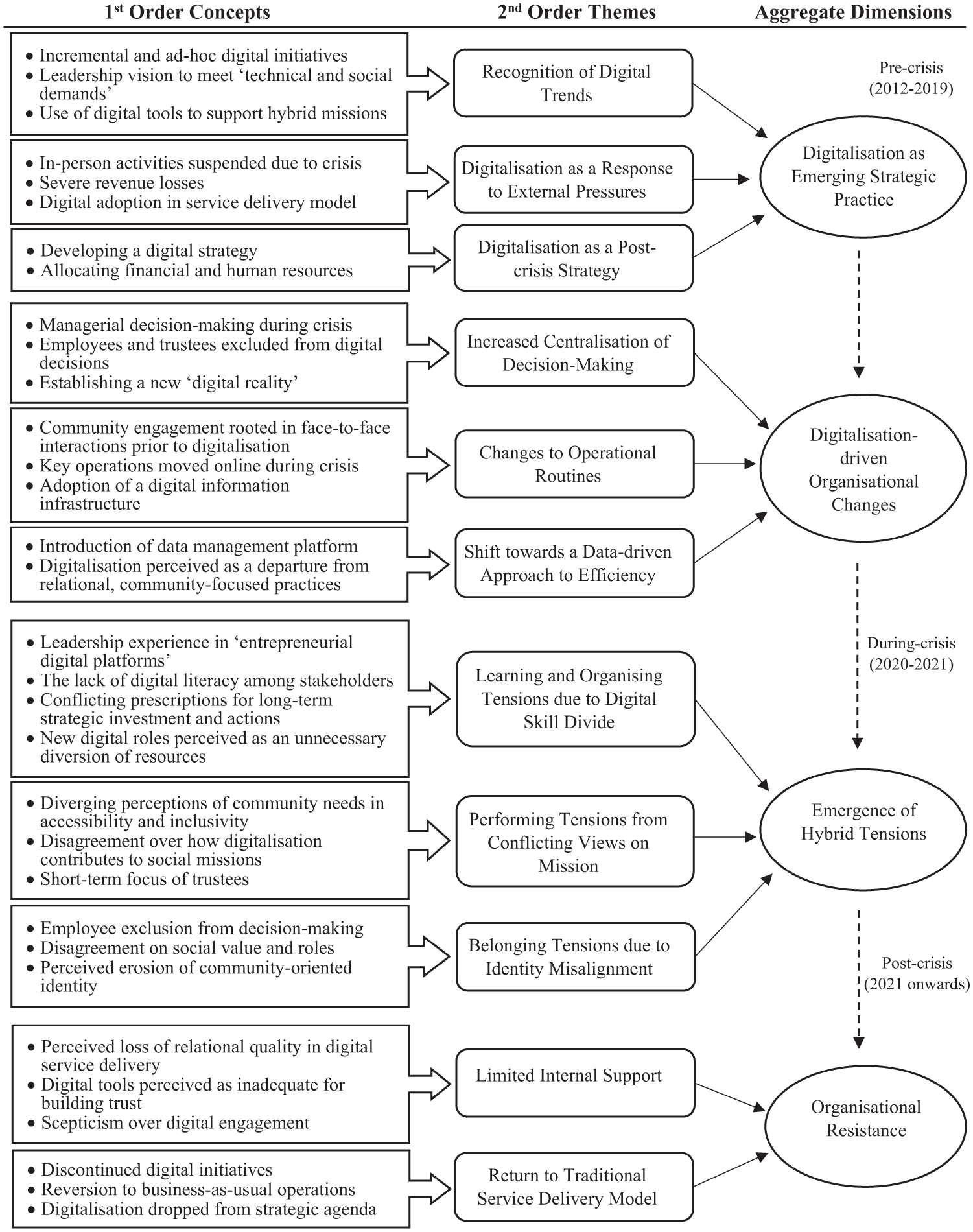
Data structure.
To ensure trustworthiness, we followed the criteria outlined by Lincoln and Guba (1985). Credibility was supported through data triangulation, integrating interviews, participant observations and secondary sources to validate findings. Transferability was achieved by providing detailed descriptions of the organisational context, dynamics and changes introduced through digitalisation. Dependability was reinforced by maintaining a logical and well-documented research process (Tobin and Begley, 2004). Confirmability was reinforced by clarifying how our interpretations were grounded in the data, with a clear rationale for our theoretical, methodological, and analytical choices (Koch, 1994). In addition, we maintained audit trails, including raw data, transcripts, observation notes and reflexive journal entries, to uphold research integrity.
Findings
This section provides the findings of our analysis, which shows not only how individuals perceive digitalisation in the context of crisis but also reveals how they start making the conscious choice to materialise these beliefs, as well as the impact that these choices and tensions have on the organisation. The findings of this study illustrate the complex and dynamic relationship between digitalisation and hybridity within SHCT over time. Drawing upon thematic analysis, we identify four key themes that capture how digitalisation emerged as a new set of strategic practices, driving organisational changes, generating hybrid tensions, and ultimately leading to organisational challenges. The analysis highlights the contested nature of digitalisation within SHCT, demonstrating how its integration was influenced by pre-existing social welfare and commercial logics, stakeholder dynamics and shifting organisational priorities. The data structure (see Figure 1) provides an overview of the first-order concepts, second-order themes and aggregate dimensions derived from the empirical analysis.
Digitalisation as emerging strategic practices
Digitalisation in SHCT emerged as a new set of strategic practices shaped by both external pressures and the strategic vision of the CEO, Johnathan Blackford (pseudonym). Historically, SHCT pursued a community-centred mission, aiming to enhance local well-being by fostering long-term contentment and instilling a sense of purpose among residents. Its activities predominantly relied on physical, face-to-face interactions, including litter-picking, fundraising events, career consultations, yoga, gardening, cooking classes and counselling (WB-1; WB-2; DC-3; DC-5; DC-6). Between 2012 and 2019, SHCT adopted an incremental and low-cost approach to digitalisation, where digital technologies were seen as an opportunity to enhance the organisation’s hybrid mission. During this period, Johnathan served as the primary driver of digitalisation initiatives. After earning his DBA (Doctor of Business Administration) degree from one of the UK’s leading business schools in 2016, he articulated in his thesis that a key competence of social entrepreneurs is the ability to ‘meet the technical and social demands of their jobs’ (DC-14), recognising digitalisation as a potential driver of funding diversification, outreach expansion, and operational modernisation in social enterprises (DD-4).
This belief reflected the wider recognition of the digital trends in creating entrepreneurial opportunities, driving innovation, and improving societal well-being (Torres and Augusto, 2020). Accordingly, Johnathan started to pursue several ad-hoc digitalisation initiatives aimed at restructuring the organisation’s service delivery model. These included installing high-speed internet, moving to cloud computing through the creation of an Oracle Database, and establishing the organisation’s social media presence on Facebook, Instagram, and Twitter. Additionally, a crowdfunding campaign was launched to complement SHCT’s traditional fundraising efforts, though it gained limited traction, generating only £20 over a year (DP-2; DP-3; DP-4). These incremental digital initiatives reflected a top-down approach to embed digitalisation into SHCT’s hybrid structure without major organisational disruption. Employees and trustees largely accepted these changes, as they did not challenge the established balance between SHCT’s social and commercial missions (DP-1). However, rather than being part of a systematic, long-term digitalisation strategy, these efforts were reactive and opportunistic.
The COVID-19 pandemic from 2020 marked a turning point, shifting digitalisation from an incremental enhancement to an urgent organisational necessity in SHCT. During this crisis period, the UK government implemented a set of lockdown measures, including social distancing, business closures, and restrictions on in-person gatherings. These measures severely impacted SHCT’s ability to deliver its community services. In-person activities such as community events, counselling and career services were largely suspended, forcing the organisation to reconsider its service delivery model. Financially, SHCT faced severe revenue losses, with a sudden loss of £150,000 in budgeted income due to the cancellation of room rentals and fundraising events. A review of SHCT’s annual reports (WB-3) illustrates the extent of this impact: trading income plummeted from £144,304 (year ending 31 March 2020) to £43,566 (year ending 2021). The combination of financial instability and increased community demand threatened the organisation’s hybrid mission, forcing SHCT to seek alternative models of engagement and income generation.
Faced with these operational and financial crises, Johnathan accelerated SHCT’s digitalisation efforts, now seeing digitalisation as a strategic survival mechanism rather than an optional enhancement (DD-2; EE; DC-6; DC-7; DC-9; DC-10). He proactively developed a digitalisation strategy, allocated financial and human resources, and restructured operations to move core services online. As part of this process, he recruited a digital marketing consultant (one of the researchers) on a voluntary basis to support strategy development. Following the evaluation of the digitalisation strategy, Johnathan reflected on the strategic shift within the organisation: ‘[The digitalisation strategy] is much clearer on certain aspects, which is very useful. It enabled us to be clearer about what we wanted from our marketing side in terms of an organisation. . . and will always be there to enhance key things that we’re trying to do in the community’ (IV-1).
This statement illustrates how digitalisation evolved from a temporary response into a strategic vision for modernising and future-proofing the organisation. During this period, several digital initiatives were coordinated, including online service delivery, creating digital marketing materials, social media campaigns and the introduction of a digital infrastructure. These strategic practices became increasingly embedded in SHCT’s operations, laying the foundation for the organisational adaptations and internal tensions described in the following sections.
Digitalisation-driven organisational changes
As digitalisation emerged as a strategic response at SHCT, it initiated profound changes to decision-making structures, organisational norms and routines, and the organisation’s strategic priorities. While Johnathan envisioned digitalisation as a means to enhance SHCT’s hybrid mission, its implementation significantly altered the established balance of logics within the organisation. One of the most notable organisational changes was the shift in decision-making power. Historically, SHCT had operated under a relatively democratic governance structure (DC-11), where board meetings served as a key decision-making mechanism involving trustees, employees, and senior management to develop organisational strategies (DC-11; DD-1). However, as digital initiatives accelerated under significant time pressure during the pandemic, decision-making power became increasingly concentrated in the hands of individuals with technical expertise, primarily Johnathan. He not only initiated digitalisation projects but also took direct control of their execution. Johnathan acknowledged that he often worked alone to implement several digitalisation initiatives during lockdown periods when ‘people weren’t here’. He justified this approach by arguing that digitalisation needed to be fully integrated into SHCT’s operations before employees and trustees returned to their usual routines, creating what he referred to as a new ‘digital reality’. This strategic shift resulted in a more hierarchical structure, where Johnathan and those proficient in digital tools gained more influence over strategic directions, while employees and trustees – many of whom lacked digital expertise – were largely excluded from decision-making processes.
The increasing reliance on digital technologies also led to significant changes in operational routines, particularly in how SHCT engaged with the local community. Prior to SHCT’s strategic move towards digitalisation, community engagement was deeply rooted in face-to-face interactions, reinforcing behavioural loyalty, emotional attachment, and a sense of community ownership. SHCT had long positioned itself as a physical space where local residents could access skills training classes (e.g. cooking classes), community events, creative pursuits (e.g. Christmas decorations workshop), and career development opportunities (e.g. interview skills workshop). These in-person interactions facilitated trust and developed a sense of belonging among community members, and reinforced identification with the organisation (DD-2; DD-3; IV-1; IV-2). However, the pandemic became an opportunity to transform SHCT’s organisational infrastructure. With Johnathan leading the digitalisation efforts, a digital information infrastructure was established through the implementation of a data management platform, while key operations such as cooking skills training and well-being classes were moved online. These strategic changes altered the organisation’s traditional modes of community engagement. Johnathan rationalised these changes as a natural progression of SHCT’s mission, particularly in response to pandemic-related restrictions: ‘When COVID hit there was community need and we needed to meet that or try to meet that community need and fill those gaps. . . it’s certainly going to be the fact that the technology and the approach that we take to digital inclusion, as well as our own digital strategy is much more accepted’ (IV-1).
For Johnathan, expanding digital services was a logical extension of his earlier digitalisation efforts, aligning with his vision of enhancing SHCT’s social mission. However, employees perceived these changes as a fundamental departure from SHCT’s traditional role, leading to a growing misalignment between managerial priorities and the expectations of employees and community stakeholders (DD-2; DD-3; DD-4).
Another major organisational adaptation was the shift towards a data-driven approach to efficiency and communication of social impact. Johnathan introduced a data management platform to track and optimise service delivery, aiming to enhance SHCT’s operational efficiency (DD-2; DP-1). While this change aligned with broader digital trends, it was perceived by other members in the organisation as a departure from a relational, community-focused approach, which had been central to SHCT’s social mission, to a strategic re-prioritisation on performance-driven metrics. For example, one employee commented that the shift towards digital communication and automated reporting overlooked the deeply relational nature of SHCT’s work: ‘If you can’t actually see people, meet people, and the community you’re in is restricted, why would I want to do that job?’ (IV-2). For them, digitalisation was not merely a technical upgrade but a cultural shift that risked changing SHCT’s core values. This growing divergence in perspectives between Johnathan, his employees and other stakeholders set the stage for heightened tensions within the organisation, as explored in the next section.
The emergence of hybrid tensions
SHCT’s strategic move towards digitalisation, while initially considered as a necessary adaptation to external crisis, generated new tensions that disrupted SHCT’s established balance between social welfare and commercial logics. Drawing upon Smith et al.’s (2013) typology of social-business tensions, namely, learning tensions, organising tensions, performing tensions and belonging tensions, we found that these hybrid tensions manifest at levels of individual digital literacy, short-term operational focus, sense of employee exclusion, accessibility and inclusivity, the social mission impact and value, as well as the perceived threat over the employees’ professional identity of employees.
One of the most immediate sources of tension was the different levels of digital literacy among members in SHCT, which created learning tensions (Smith et al., 2013). As one of the members commented, there was a clear digital divide within the organisation, particularly between Johnathan, who was ‘experienced in that world and the entrepreneurial digital platforms skill base that he has’ and those who ‘still don’t know how to check their email or the Google calendar’ (IV-2). This divide in digital literacy altered power dynamics in SHCT, leading to conflicting views on long-term strategic investment and actions. Trustees, in particular, struggled to understand the strategic relevance of digitalisation, viewing it as peripheral to SHCT’s core social mission rather than an enabler of long-term growth. As a result, they were hesitant to invest in digital initiatives (DD-1; DP-1; EE). Their concerns were further reinforced by their short-term operational focus, which prioritised on immediate, tangible community needs rather than long-term strategic transformation. This tension was particularly evident during a board meeting, in which Johnathan presented the digital strategy. Instead of engaging with the potential benefits of the strategy, the chair of the trustee board abruptly redirected the discussion, asking: ‘How is the employment skills hub going to be staffed?’ (DD-1). This dismissal of digitalisation as a strategic priority reflected the limited digital literacy and strong preference for direct, community-focused initiatives by trustees. Their scepticism extended to organising tensions (Smith et al., 2013), particularly around the creation of new digital roles, such as the digital marketing consultant (one of the researchers) and a proposed permanent digital marketing manager. Trustees questioned these roles as an unnecessary diversion of resources, insisting that anyone with administrative experience from the existing team could do the job, and the work of a digital marketing manager would not satisfy the immediate needs of local residents (DD-1). This reluctance to engage with discussions on digitalisation further reinforced learning tensions and limited constructive dialogue around strategic changes.
Beyond the Board of Trustees, the unequal distribution of digital expertise also contributed to employee disengagement and uncertainty. As decision-making power became increasingly concentrated, digitalisation led to a sense of exclusion among employees who lacked digital skills, exacerbating internal conflicts and raising concerns about the future trajectory of the organisation’s mission. This sense of exclusion was heightened when employees returned to work after pandemic lockdowns and were confronted with a new ‘digital reality’ that had not been effectively communicated in advance. The lack of transparency surrounding these changes undermined trust and deepened the divide between leadership and employees. One employee described their confusion upon returning to work: ‘Because it happened in isolation and you come back to the organisation that you worked for and everything’s changed and now, we’re pursuing a digital strategy, firstly, what on earth does that mean? What does that imply? Why is it different? I think if you said the words ‘digital strategy’ to most people who work here and then showed them what was sitting in that folder, they would be surprised.’ (IV-2)
This quote highlights the disconnect between managerial decision-making and employee involvement, reinforcing perceptions that digitalisation was being imposed from the top down, rather than co-developed through collaborative engagement and consultation. The result was a fragmented organisational response, where key stakeholders struggled to interpret, support or meaningfully contribute to SHCT’s digitalisation efforts. Accordingly, digitalisation disrupted the existing balance between its social welfare and commercial logics, creating performing tensions around SHCT’s missions (Smith et al., 2013). While Johnathan viewed digitalisation as a strategic opportunity to enhance SHCT’s service delivery, employees and trustees remained sceptical about its alignment with the organisation’s hybrid missions. These performing tensions thus emerged from diverging perceptions of community needs and disagreements over how digitalisation could contribute to SHCT’s social missions.
A central aspect of the performing tensions was the question of accessibility and inclusivity due to digitalisation. Employees questioned whether digital initiatives truly addressed the needs of the communities SHCT served, particularly given the socio-economic challenges faced by local residents. Many of SHCT’s beneficiaries had limited access to digital tools and the internet, raising concerns that the shift to digital engagement would exclude those most in need of SHCT’s services. One employee articulated this concern: ‘Whether the people that we are most needed by, whether that means anything to them and whether they have access to that digital world.’ (IV-2). This statement underscores a fundamental misalignment between digitalisation efforts and the perceived needs of SHCT’s target communities. While digitalisation was intended to expand outreach and improve operational efficiency, employees feared that it risked alienating vulnerable groups who relied on traditional, face-to-face service provision.
Trustees also did not see how digitalisation would directly benefit local residents and thus questioned the value it would add to their social missions, particularly in a local environment where ‘things have got worse in the past four years’ (DD-1). In response to deteriorating local socio-economic conditions, trustees tended to have a short-term focus on immediate community challenges rather than a long-term strategic vision. As a result, they were reluctant to allocate funding towards digital initiatives, instead prioritising more conventional service provision methods. The financial strain on SHCT further intensified these tensions, as Johnathan struggled to convince trustees to invest in his proposed digital strategy. Expressing his frustration, he recalled ‘spending hours trying to defend that investment’ (IV-1). During the board meeting, a lack of constructive debate was evident, and trustees used their position of power to deny Johnathan further resources. This financial constraint significantly limited the implementation of digitalisation, reinforcing tensions between Johnathan and the board.
Beyond disagreements over the value of digitalisation, performing tensions also surfaced regarding how SHCT’s social impact should be measured. Johnathan introduced a data management platform to track service delivery and quantify organisational performance (DP-1; DC-1; DC-6; DD-2). While this approach was aligned with broader digital trends, employees worried that it prioritised efficiency and quantifiable metrics over relational, community-based engagement. They expressed concerns that the organisation’s traditional emphasis on personal, trust-based interactions was being replaced by digital tools, which did not fully capture the social value of their work (DD-2; IV-2).
As digitalisation undermined the core values that had historically defined employee work, it also triggered belonging tensions around their professional identities and sense of belonging within SHCT. As discussed earlier, many digital initiatives took place without effective communication with employees and other stakeholders (DD-1; DD-2; IV-2). Consequently, employees experienced a growing sense of detachment from SHCT’s mission and their professional roles, as they felt that digitalisation was eroding the relational, trust-based aspects of social enterprise work that had given them purpose. One of the strongest manifestations of these tensions was their critique to the recruitment of a digital marketing manager on a permanent contract. Employees viewed this new role as misaligned with SHCT’s social mission, believing that it reflected a fundamental change that prioritised branding and outreach over direct community service. As one employee commented: ‘People are very defensive of that because people came into this kind of work to help people, and they won’t necessarily relate that to why we would need a marketing coordinator. You know, why would we take on a marketing coordinator instead of another community worker or another cleaner for the centre because, you know, if we want people to use the centre, we have to look after the centre, so how are we justifying that?’(IV-2)
This statement illutrated the employees struggle to align their professional identities with SHCT’s evolving priorities in digitalisation. They associated social impact with operational, hands-on community work, where they could ‘actually see people, meet people’ (IV-2), whereas Johnathan viewed digitalisation as a long-term strategy for organisational sustainability and outreach. The conflicting expectations regarding roles and organisational priorities reflected employees’ struggles with their professional identities, reinforcing their perception that digitalisation posed a threat to their place within SHCT. This sense of detachment led to further resistance, as employees denied Johnathan support for his actions and refused to embrace digitalisation as a meaningful part of SHCT’s future.
Organisational resistance
The hybrid tensions within SHCT led to a broader organisational resistance to embedding digitalisation as a post-crisis long-term strategy. Despite Johnathan’s propensity towards digitalisation during the pandemic, most of the actions implemented at the organisational level were ultimately suspended once pandemic-related restrictions were lifted after 2021. For example, plans for a new crowdfunding campaign and promotional videos were discontinued, while online cooking classes were moved back to in-person formats. Additionally, rather than expanding digital services, SHCT introduced new in-person activities, such as ‘Warm Hub’, which offered a space for local residents to meet over warm refreshments, as well as various fitness classes (e.g., Zumba, Karate) and ‘Slimming World’, which provided dietary consultations. These developments signified a strong reversion to traditional, ‘business-as-usual’ (WB-1; WB-2), service delivery models, whereas digitalisation had only been a temporary crisis response despite its profound impact on the organisation. When reflecting on why digitalisation was not sustained, neither trustees nor employees recognised it as a significant driver of value. A key reason for this resistance was the belief that digitalisation compromised the quality of service delivery within SHCT’s mission-driven activities. As one employee explained: ‘We are physical beings and there is something about being in the room with someone. . . you can laugh at a joke without a three-quarters of a second delay on Skype’ (IV-2). This view reflected the underlying scepticism over digital engagement. Employees felt that face-to-face interactions enabled a deeper level of community engagement, whereas virtual interactions were seen as unnatural, lacking nonverbal cues that are essential for building trust and social connection. Many employees and trustees believed that these limitations ultimately hindered SHCT’s ability to fulfil its social mission, reinforcing their preference for physical, relationship-driven interactions over digital tools.
Interestingly, Johnathan did not entirely dismiss these concerns but remained optimistic about the potential of digitalisation: ‘I think I’m not sure the digital strategies are going to be able to replace that – creating relationships and the passion in communities for change to happen – because it will be so locally-based’ (IV-1).
This statement suggests that even Johnathan acknowledged the limitations of digitalisation in fully replacing SHCT’s deeply embedded face-to-face engagement model. However, his vision of digitalisation as an enabler of organisational sustainability conflicted with the fundamental beliefs of employees and trustees that digital tools could never replace the relational, trust-based approach that had long defined SHCT’s mission. As a result, digitalisation was no longer listed as a priority in the organisation’s annual report, reinforcing the perception that SHCT’s digital transformation was a crisis-driven necessity rather than a permanent solution. Without sustained internal support, digitalisation as a long-term organisational strategy was effectively abandoned, marking the conclusion of SHCT’s digitalisation journey.
Discussion
Our findings demonstrate that digitalisation in social enterprises is not simply about integrating digital technologies into existing organisational activities but represents the emergence of a new set of strategic practices that disrupt organisational dynamics and drives profound change. In our case study, digitalisation triggered changes to decision-making structures, organisational routines and strategic priorities, which disrupted the existing hybrid balance between SHCT’s social and commercial logics. Internal tensions and resistance emerged due to disparities in digital literacy and different beliefs about the role of digitalisation, posing obstacles to its integration within the organisation. Ultimately, the digital strategy was abandoned, underscoring the fragility of digitalisation efforts when they are not aligned with the values and identities embedded in hybrid organisations. These findings extend current understanding of hybridity and tensions in social enterprises by illustrating how digitalisation can function as both an enabler and a disruptor of hybrid organising. We now elaborate on the contributions of our findings and highlight the implications for future research.
Digitalisation and practice-driven logic disruption
Our study contributes to social entrepreneurship research by offering a more nuanced, dynamic understanding of institutional complexity in hybrid organisations. While prior research often conceptualises institutional complexity in social entrepreneurship as an organisational feature arising from the co-occurrence of multiple institutional logics (Besharov and Smith, 2014; Doherty et al., 2014), our analysis demonstrates that it can also evolve as the balance of existing logics is disrupted by the emergence of new strategic practices. In our case, when digitalisation manifested as a strategic necessity in response to external institutional pressures during a period of crisis, it introduced new practices – such as digital marketing and crowdfunding – that altered organisational decision-making structures, routines and role expectations. These practices, however, lacked the widely shared narratives, meanings, and normative support needed to form a coherent new logic. Instead, they remained only loosely connected to the organisation’s established social and commercial logics, with limited alignment to prevailing understandings of mission, value, and professional identity. This weak integration created uncertainty over how the new practices should be interpreted, enacted, and prioritised, undermining the organisation’s ability to sustain a stable logic constellation. As different actors responded to digitalisation in conflicting ways, the result was not only ambiguity but also contestation and resistance. Such logic disruption reflects a process of blurring, in which the coherence of institutional logics is weakened by the introduction of loosely coupled practices that do not clearly belong to any one logic (Schildt and Kodeih, 2025). This mechanism of logic disruption – where new practices destabilise rather than replace or renew existing logics – offers a useful starting point for future research on how hybrid organisations absorb or resist emerging socio-technical practices over time.
This logic disruption, however, was shaped not only by changes to organisational-level practices but also by individual-level variation in how these practices were interpreted and enacted. Differences in digital literacy, prior experience and personal identification with the organisation’s mission influenced how members responded to digitalisation. For example, when confronted with the same external pressures, actors made sense of digitalisation through divergent frames. Compared to Johnathan, trustees and employees often lacked digital fluency and/or a long-term strategic orientation, which contributed to various forms of resistance. Trustees viewed digitalisation as misaligned with SHCT’s social mission, while employees perceived it as threatening to their professional identities and sense of purpose. These responses reflected not only differences in skill sets but also divergent understandings of value and appropriate practice – amplifying the ambiguity generated by weakly integrated digital practices.
The findings demonstrate that individuals do not simply adopt new strategic practices as part of an emerging institutional order; rather, they retain partial autonomy in how they engage with them (Friedland and Alford, 1991). While digitalisation as a new set of practices can enable organisational change, it is also constrained by the heterogeneity of human agency, as individuals may reinterpret, resist, or reject new practices when they fail to resonate with established logics. In this sense, institutional complexity is not only a structural feature but also a dynamic, contested process constituted through the interplay of evolving practices and individual sensemaking. This reinforces the view that institutional logics are not fixed belief systems but evolving constellations of interconnected practices (Schildt and Kodeih, 2025), and it calls for greater attention to the practice-driven evolution of logics as an ‘activity system’ (Allen et al., 2013), and to the multiplicity and heterogeneity of micro-level agency in hybrid organising (Thornton et al., 2012).
Digitalisation and its impact on hybrid organising
We contribute to a deeper understanding of hybrid tensions as a result of institutional logic disruption by highlighting the ‘dark side’ of digitalisation in social enterprises. Prior research has portrayed digitalisation as a positive catalyst for organisational change, sustainability and resilience (He et al., 2022; Nakpodia et al., 2024), as well as an opportunity for social enterprises to address inefficiencies and strengthen long-term social value creation (Austin et al., 2006; Yáñez-Valdés et al., 2023). However, our findings show that when digitalisation challenges deeply held organisational norms and identities, it can destabilise established hybrid arrangements, amplify internal tensions, and ultimately trigger organisational resistance and rejection.
In the case of SHCT, digitalisation was initially positioned as a strategic opportunity to enhance service delivery and community engagement. But as it became more embedded in the organisation’s operations and structures, it gave rise to tensions that exposed and strained the fragile alignment between SHCT’s social and commercial logics. Specifically, we observed how learning and organising tensions arose from internal divides in digital skills, experience, and knowledge. These tensions were compounded by performing tensions, as organisational actors disagreed on whether digitalisation aligned with SHCT’s mission and how social impact should be measured. Belonging tensions further emerged as employees struggled to reconcile their professional identities with new organisational priorities. These internal tensions increased fragmentation and ultimately led to the withdrawal of digitalisation as a key strategic element of organisational hybridity. These findings show that digitalisation can create new tensions within hybrid organisations and introduce new layers of complexity, rather than acting as a unifying force. When introduced without broad-based buy-in and without alignment with stakeholder values and identities, digitalisation can function as a destabilising force, eroding cohesion and undermining long-term value creation. Our findings, therefore, caution against embracing digital tools as neutral or inherently beneficial innovations. Instead, digitalisation should be treated as a value-laden organisational intervention with contested implications for organisational identity, stakeholder relationships and logic alignment.
These insights also offer important implications for advancing research on hybrid tensions in social entrepreneurship. While prior literature has predominantly conceptualised hybrid tensions as a structural outcome of institutional complexity (Besharov and Smith, 2014; Smith et al., 2013), our study demonstrates that such tensions can also be activated, intensified or reshaped by strategic practices such as digitalisation. Rather than being static or inherent, tensions are enacted and evolve through the interaction between institutional logics, organisational responses, and individual agency. In particular, digitalisation can surface tensions that may remain latent under stable conditions, challenging deeply held assumptions about what constitutes legitimate action within hybrid organisations. These assumptions include what skills and knowledge are considered valuable in strategy development (learning tensions), how social missions are defined and reshaped in response to changing institutional environments (performing tensions) and how individuals see themselves within the evolving organisational identity (belonging tensions). Future studies that explore these questions could extend prior theorisation by showing how tensions are not only embedded in hybridity, but also enacted, negotiated and reconfigured through efforts to adapt to institutional disruption and change.
Temporality and the dynamics of digitalisation
Our findings highlight the importance of adopting a more temporally sensitive perspective when studying digitalisation in hybrid organisations. While our study was not designed as a process study, the changes observed over time – particularly the rise and decline of digitalisation within SHCT during a period of crisis – suggest that the dynamics of digitalisation in social enterprises unfold in non-linear and often challenging ways. For example, different understandings of digitalisation in our case study varied not only between actors, but also within individual actors over time. Before the pandemic, Johnathan viewed digitalisation as an opportunity to enhance the organisation’s hybrid mission. With the onset of the pandemic, digitalisation became a strategic necessity for survival but was later regarded as dispensable to the social enterprise’s core mission. This shift in perspective – from opportunity to necessity, and eventually to a perceived threat – illustrates how changing structural conditions can influence individual belief systems (Hu et al., 2020; Saebi et al., 2019).
This pattern of initiation, struggle and reversal complicates the common assumption in social entrepreneurship research that digitalisation is a progressive, cumulative process leading to sustained organisational transformation (Yáñez-Valdés et al., 2023). It suggests the need for research that pays closer attention to the temporal dimensions of digitalisation, including how institutional logics and hybridity evolve over time and in response to shifting circumstances, and how actors’ interpretations, identities and strategic preferences change alongside, or in opposition to, technological changes. Future studies that adopt a longitudinal or process approach could shed light on the conditions under which digitalisation becomes institutionalised in hybrid organisations, as well as the factors that contribute to its discontinuation or marginalisation over time. Such perspectives would help uncover not just how digitalisation is adopted, but when, why, and with what long-term implications for hybridity, identity, and organisational sustainability.
Practical recommendations and limitations
The evidence within this study offers several practical implications for social enterprises navigating digitalisation in hybrid organisational contexts. Rather than viewing digitalisation as merely the adoption of new digital tools, social enterprises should approach it as a socio-technical transformation that can disrupt organisational logics, stakeholder roles, and professional identities. In practice, this means investing in digital literacy across all levels of the organisation. Building digital capabilities among trustees, employees, and other key stakeholders can help reduce learning tensions and support more inclusive participation in digital strategy development. Tailored training, workshops and peer learning initiatives may help bridge digital divides and create shared understandings of both the opportunities and risks associated with digitalisation.
Our findings also indicate that rapid or ad hoc digitalisation can lead to internal resistance and conflict when perceived as misaligned with the organisation’s core social mission. A more participatory and context-sensitive approach is therefore recommended. Fostering inclusive dialogue among trustees, employees, and other stakeholders – and soliciting their input through, for example, co-creation workshops – can help ease internal tensions between traditional, in-person community engagement and new digital initiatives. Additionally, maintaining iterative feedback loops is essential for harnessing the potential of digital technologies without compromising the trust and interpersonal connections fundamental to the social enterprise missions. Social entrepreneurs should remain attentive to how digitalisation affects identity and purpose within the workplace. Creating safe spaces for dialogue about shifting roles, expectations and concerns can help mitigate belonging tensions and support identity work during periods of strategic change.
Although rich in context and detail, this research has several limitations. By relying on a single case study through an action research approach, the study offers in-depth insights into digitalisation dynamics within a well-established hybrid organisation, but its findings may have limited transferability to other contexts or types of organisations. The COVID-19 pandemic also represents a highly dynamic and uncertain crisis context; future research might consider replicating this study in more stable environments. We also acknowledge challenges associated with our data collection. The virtual nature of the research, combined with managerial influence over digitalisation decisions, organisational power dynamics and employee resistance, constrained access and led to the dominance of managerial perspectives in formal interviews. The use of action research may have introduced potential bias due to the dual role of the second author as both participant and observer. Although reflexivity and triangulation were employed to mitigate these effects, they may have influenced the scope of insight. Finally, the relatively short observation period may not have captured the full trajectory of digitalisation or the longer-term consequences of its marginalisation. Future research could address these limitations by conducting longitudinal studies across multiple hybrid organisations, comparing different models of digital integration and examining how digital strategies evolve over time in response to internal dynamics and external pressures.
Conclusions
This article explores how digitalisation, as a new set of strategic practices, creates logic disruption that reshapes organisational hybridity and tensions in social enterprises. Drawing on an in-depth case study of a UK-based social enterprise, we analysed how digitalisation – initially introduced as a response to external pressures and leadership vision – transformed decision-making structures, organisational routines, and strategic priorities. We also examined how digitalisation disrupted the balance between existing social and commercial logics, leading to internal tensions and ultimately organisational resistance. These tensions emerged as members struggled to make sense of digitalisation in light of their values, capabilities and identities. Our findings contribute to research on hybridity and institutional complexity in social entrepreneurship by showing how new strategic practices disrupt existing institutional logics in dynamic ways. We demonstrate that institutional complexity is not static but evolves through the interplay of external pressures, organisational responses and individual agency. The study highlights the fragility of existing logics when they lack alignment with organisational identities and stakeholder beliefs. It also calls for greater attention to the temporal and micro-level dynamics of hybrid organising, offering a more processual view of how tensions are activated, negotiated and reconfigured during strategic change.
Footnotes
Appendix
Data sources.
| Primary Data | ||
|---|---|---|
| 1. Interviews | ||
| Johnathan Blackford (pseudonym), Managing Director of SHCT | IV-1 (38 minutes) | 22 September 2021 |
| Kenneth Fairford (pseudonym), Hospitality and Catering Coordinator | IV-2 (60 minutes) | 16 September 2021 |
| 2. Participant observation diaries | ||
| Trustee Board Meeting diary entry | DD-1 | 20 July 2021 |
| First diary entry – in-person meeting with the team | DD-2 | 13 May 2021 |
| Second diary entry – setting goals and direction of the project | DD-3 | 9 June 2021 |
| Third diary entry – digital strategy discussion | DD-4 | 17 June 2021, 24 June 2021 |
| Fourth diary entry – discussion about video script | DD-5 | 2 July 2021 |
| Fifth diary entry – the process of creating a marketing video | DD-6 | 10 August 2021 |
| 3. Documents developed by the researcher throughout the placement at SHCT | ||
| SHCT digitalisation strategy | DP-1 | June 2021 |
| Crowdfunding campaign analysis | DP-2 | July 2021 |
| Crowdfunding resourcing plan | DP-3 | |
| Crowdfunding campaign plan | DP-4 | |
| Using Facebook for crowdfunding purposes | DP-5 | |
| Tips on filming a good-quality video | DP-6 | August 2021 |
| Video script | DP-7 | |
| Video script (2) | DP-8 | |
| Assignment of roles for video | DP-9 | |
| 3. Email exchanges | ||
| Email exchanges with the managing director of SHCT | EE | May–August 2021 |
| Secondary data | ||
| 4. Documentation | ||
| Board presentation | DC-1 | 20 July 2021 |
| Communication strategy | DC-2 | 2021–2022 |
| Grange Kitchen Business Plan | DC-3 | January 2021 |
| SHCT Wellbeing Framework | DC-4 | n/d |
| Campaign for local environment improvements | DC-5 | n/d |
| SHCT business plan | DC-6 | 2021–2024 |
| Youth centre financial documents | DC-7 | 2019 |
| Social media plan | DC-8 | 2021–2024 |
| Youth centre business plan | DC-9 | 15 May 2018 |
| QS cost for coffee shop | DC-10 | n/d |
| SHCT organisational chart | DC-11 | August 2021 |
| Coffee shop capital funding | DC-12 | n/d |
| South Hampshire coffee shop business plan phase I | DC-13 | 5 May 2019 |
| Johnathan’s DBA thesis | DC-14 | 2016 |
| 5. Publicly available secondary data | ||
| Social media posts | WB-1 | 2019–2022 |
| Website | WB-2 | 2022 |
| Annual reports | WB-3 | 2019, 2020, 2021 |
Funding
The authors disclosed receipt of the following financial support for the research, authorship, and/or publication of this article: This work was supported by the ESRC National Productivity Investment Fund (NPIF) Accelerating Business Collaboration (ABC)
