



Abstract
It has been demonstrated that many small businesses have no desire for growth. In this article, we investigate whether a ‘no-growth’ strategy in microenterprises can still lead to performance enhancement. To explore this issue, we followed a panel of 13 microenterprises over 12 years with an ‘acted research’ protocol. This consisted of yearly intensive interactions between academics and panel participants including four group seminars, one interview with each owner-manager and firm observation. It resulted in a co-constructed model of ‘no-growth’ to which all study participants agreed. During the study, all 13 microenterprises reduced their employee count and pivoted their business models toward more exclusive offerings. Underpinned by the resource-based and dynamic capabilities theory, we demonstrate that a ‘no-growth’ strategy resulted in increase in margins, efficiency improvements and better work-life balance for the owner-managers and their collaborators. Theoretical, methodological and managerial implications are provided.
Keywords
Introduction
The question of performance in microenterprises 1 is worthy of further scrutiny. It is generally acknowledged that to reach a sustainable level of performance, firms need to grow; however, that is not the case for the majority of microenterprises (Davidsson, 1989). In France in 2021, these represented about 95.8% of all firms in the country or 4.1 million (INSEE, 2023). According to the public discourse, does this mean that most of the country’s economic infrastructure is doomed for failure? This may not be the case if we consider growth not as a limited number of metrics, namely size, but if we try to understand how firms grow, as suggested by Barbero et al. (2011). The objective of this article is, therefore, to explore how microenterprises achieve a sustainable no-growth strategy.
Fear of control loss and concern for employee well-being seem to be important deterrents to growth (Davidsson, 1989); in addition, ‘money is not a motivator powerful enough to bring about continued growth once a satisfactory standard of living is reached’. (Davidsson, 1989: 221). Davidsson et al. (2009) demonstrated that profitability is an antecedent to sustainable growth as it relies on ‘the identification and successful exploitation of the uniqueness of their resource bundles’ to create a competitive advantage (Davidsson et al., 2009: 399). Thus, some entrepreneurs deliberately try to limit the size of their firms and consider growth not in terms of head count or money, but wealth creation. It is then identified as no-growth development. Although this term may refer to stagnation in a firm’s trajectory, it may not be the case for all microenterprises and may vary by sector. For these firms, no-growth may be a chosen path rather than one the firms are subjected to, and the results of innovative decisions. Several owner-managers who are aware of the stimulating effect of growth are also cognisant of its impact on firm culture as well as on their own well-being. Thus, they choose to develop their firms by concentrating on their core business and limiting firm size. Rather than trying to increase the level of activity, they focus on optimising the margins and hence, their performance. For the purposes of this study, no-growth will be understood as development without change in size, stabilising the scope of the firm. This leads us to our research question: How do microenterprises achieve a sustainable no-growth strategy?
To explore this question, we drew on Resource-Based Theory (RBT) and dynamic capabilities theory. As such, we built on Barbero et al. (2011) by studying how microenterprises develop, and the subjectivity of resources whereby the entrepreneur is instrumental in designing a bundle of resources heterogeneity that leads to no-growth (Warnier et al., 2013). A qualitative longitudinal study spanning over 12 years with a panel of 13 microenterprises was undertaken. In situ observations, individual interviews with owner-managers of microenterprises and regular focus group discussions with the panel were undertaken. During this process, experiences and practices were shared, and co-constructed theorisation was monitored with the help of four academics. This research is named ‘acted research’ (Polge, 2009) as it is based on the daily experience of microenterprise owner-managers. The resulting analytical framework was co-constructed with the aim of providing practical pathways to other microenterprises that could adopt a no-growth strategy.
Our contribution is twofold, first with the topic itself. We looked at microenterprise growth, or more specifically development, through the lens of factors other than mere economic factors. We demonstrated that a no-growth strategy for microenterprises can be both sustainable and profitable and may reduce their vulnerability. By recentering the firms on their core competencies and integrating both networking based on interaction with stakeholders, and incremental development based on increasing knowledge and know-how, owner-managers achieved a fine balance between their professional and personal lives and that of employees. Second, we refined the concept of dynamic capabilities by showing that owner-managers of microenterprises used both managerial and entrepreneurial dynamic capabilities to push their firms toward increased excellence and innovation, differentiating them from the competition. Methodologically, we took a novel approach to data collection by fully involving the participants in the co-construction of the analytical framework.
The article is structured as follows: the theoretical underpinnings of RBT and dynamic capabilities are reviewed, followed by a detailed explanation of the ‘acted research’ methodology used. An exhaustive account of the results is illustrated by the analysis of the quotes collected during the group interactions, leading to discussion, implications and suggestions for further research.
The concept of no-growth in microenterprises
The issue of resource scarcity is more important when the size of the firm is limited; in the case of microenterprises, it is a major constraint in the search for value. In this context, does the theory of resources constitute a relevant theoretical choice for our purpose? To answer this question, we need to look at how the field of microenterprise is defined and what is its importance in the economy. While the literature on SMEs both in French and English is considerable, there is a more limited focus on microenterprises, particularly in relation to growth (Achtenhagen et al., 2017; Arlotto et al., 2011). It, therefore, seems necessary to justify our choice of this category of firm and to specify it.
Microenterprises: What are we talking about?
The very definition of a microenterprise is problematic: there is no consensus on the criteria used to define them (Contreras, 2022); the differentiation between microenterprises and small businesses is fuzzy (Anastasia, 2015; Carlson, 2023). The regulatory benchmarks themselves are open to discussion (Raczynska, 2019). Thus, we have adopted a three-dimensional approach to characterise this category of firm: statistical, economic and organisational.
The categories of firms determined by a European Union directive of October 2023 (Directive 2013/34/EU, amended in October 2023) are organised into four groups (micro, small, medium and large enterprises), defined by three criteria: balance sheet total, revenue and average number of employees during the financial year. The respective amounts for microenterprises are €450,000 for balance sheet total, €900,000 for revenue and a maximum of 10 employees. Since 2021, INSEE, the French National Institute for Statistics and Economic Studies, in line with European Union directives, has used the term ‘microenterprise’ to describe very small businesses. It should be noted that since 2009, there has been a category of firms in France whose owners benefit from a special, transitional tax regime: self-employed. This status is intended to make it easier to start a business, and it is possible to receive a salary or pension as well as revenue for self-employment. The self-employed are included in the group of microenterprises. Microenterprises, as defined by the European Union, cover a heterogeneous population. In 2021 (INSEE, 2023), France had 4.3 million microenterprises operating in the mainly non-agricultural and non-financial market sectors, with auto-entrepreneurs (self-employed) accounting for 1.2 million businesses. The importance of microenterprises in the French economic fabric deserves to be emphasised: they account for almost 96% of all businesses. For the economy as a whole, their share of salaried employees is higher than that of sales and added value (17.6%, 12.6% and 15.8%, respectively), their role is therefore significant in terms of jobs. Conversely, their proportion of export sales is insignificant (2.2%); the size of these firms means that they are only marginally positioned on international markets (INSEE, 2023). European comparisons confirm the high proportion of microenterprises in the French business fabric compared with its European neighbours (for example, 95.8% in France compared to 84.4% in Germany). Nevertheless, the large share of these businesses in national economies supports the interest of an analysis of the field of microenterprises.
Although the first two dimensions, statistical and economic, help to refine the field of research of microenterprises, we need to question the status of this category of firm as an object of research. The very definition of a small business is not fixed (De Sordi et al., 2024), even though many contributions use similar definitional indicators. More specifically, there is little scientific literature devoted to microenterprises (Arlotto et al., 2011; Jaouen, 2010; Jaouen and Torrès, 2008). Jaouen notes (2010: 133) that ‘the characteristics of the SME become more pronounced as the size of the firm decreases’. We will not return to these well-known characteristics: central role of the manager, low specialisation of tasks, little formalised strategy, etc. (Filion, 2007; Jaouen, 2010; Julien, 1997). In the search for clarification of what exactly is a microenterprise, the proximity effect appears to be important. For Torrès (2003), the specificity of SME management lies in the notion of proximity; he defines the management of this type of firm as a mix of proximities: proximity of the owner-manager to employees, proximity and interweaving of the firm’s functions, and temporal proximity, with a short-term strategic horizon. The smaller the firm, the more relevant the law of proximity; it plays a decisive role both from the point of view of the behaviour of the owner-manager and the internal and external management of the firm. The proximity dimension constitutes a notable element of the context in which microenterprises describe their development as no-growth (Figure 1). The statistical dimension, on the one hand, and the economic dimension on the other, make it possible to situate microenterprises as a field of research. These criteria determine the quantitative and qualitative weight of this category of firms in the economic fabric of a country.
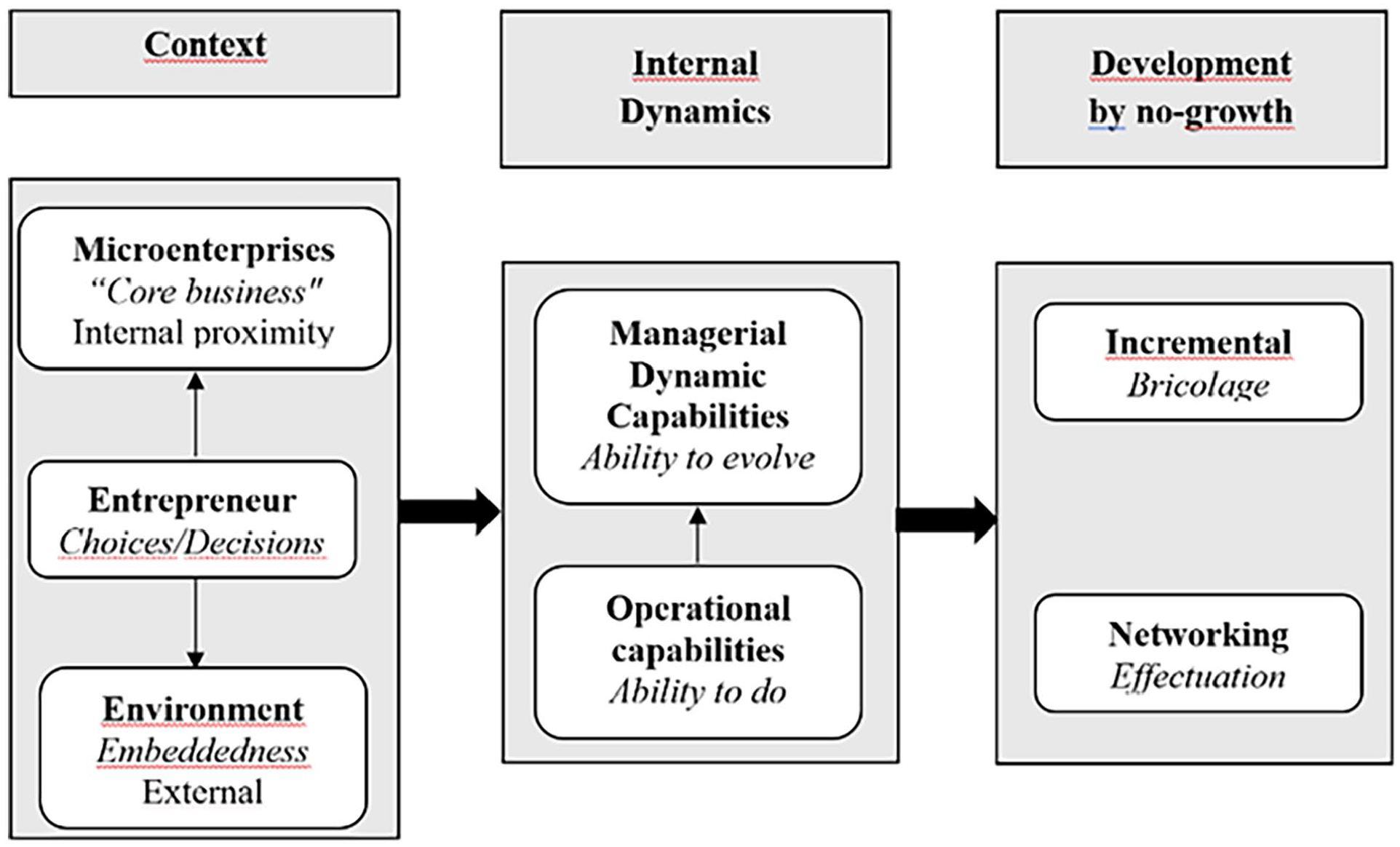
Process of no-growth in microenterprises.
The search for organisational characteristics specific to microenterprises led to an emphasis on the proximity effect. The behaviourist approach to proximity led to the concept of proxemia (Hall, 1971), referring to the limited physical distance between actors. Torrès (2003) used the concept to characterise the organisation of microenterprises, considering it to be a ‘proximity mix’. In addition, the concept of proximity underpinned the behaviour of owner-managers and determined their strategic approach. From this perspective, microenterprises are seen as a research object in their own right. It is, therefore, up to us to justify the choice of resource theory to support our exploration of the processes of no-growth development in the context of microenterprises as a research object.
The premises of resource theory
With reference to the concept of resource services defined by Penrose (1959), resource theory was developed in the 1980s and 1990s. Considered one of the founders of this approach, Wernerfelt (1984) suggested analysing firms from the point of view of resources, rather than products, proposes a definition of resources based on the distinction between tangible and intangible assets. According to Utami and Alamanos (2023), there is some confusion between the term RBT and RBV (Resource-Based View). From this perspective, the seminal work of Barney (1991) offered a vision of the firm as a bundle of resources which can achieve sustainable competitive advantage if able to mobilise and combine resources that qualify as strategic and have VRIN characteristics: Valued, Rare, Inimitable, Non-substitutable (Barney, 1991). The origin of these resources may be internal to the firm: specific material assets, human and organisational assets, and developed through new combinations (Sirmon and Hitt, 2003). Alternatively, resources can also be sought in the environment, in particular through interaction with other firms or actors (Bowman and Collier, 2006). The combined set of resources forms the basis of the firm’s specific value. For our purposes, we use the term RBT, as we consider the initial RBV approach constituted a stratum in the development of resource theory. This first level of approach to RBT theory gave rise to two critiques then followed by notable theoretical advances. The first concerned the essentialist conception of resources; the second questioned the objectivity of resources.
An essentialist conception of resources
The RBV approach was based solely on strategic resources, ignoring the existence of non-strategic resources. However, there are ‘ordinary resources’, which are a priori neutral in terms of the search for a competitive advantage, and even ‘junk’ resources, which are negative in terms of performance. Warnier et al. (2013) expressed three criticisms of this concept:
- The resource is treated as a ‘catchall’ concept (Priem and Butler, 2001): the resource itself is confused with the service it can provide,
- The attributes of resources and their uses are intrinsic and unique. The nature of the resource is unambiguous (Baker and Nelson, 2005),
- The role of the manager is not considered: a direct relationship is established between the possession of strategic resources and competitive advantage. The firm must acquire, accumulate and combine resources to create value, but the decisions taken by the manager in designing the value creation process are not taken into account (Sirmon et al., 2007).
An objectivist conception of limiting resources
No room is left for a subjective perception of the resource: ‘. . . to the subjectivity of knowledge and the entrepreneur’s interpretation of the environment’ (Weppe et al., 2013: 45). Foss and Ishikava (2007) pointed out that a subjective approach to resources involved considering the skills, knowledge and beliefs of managers. Overall, a general criticism of RBV, in the initial approach to RBT, lay in its tautological nature, that is an ‘elementary’ vision based on resources at the level of the firm alone (Priem and Butler, 2001), establishing a direct and systematic relationship between the type of resource and the existence of a competitive advantage. With a view to overcoming these limitations, an evolution in RBT could focus on the issue of the subjectivity of resources. The attributes of a resource are perceived through the prism of the entrepreneur, and furthermore, personally constructed (Warnier et al., 2013). They, thus, appear to be specific to each firm (Prévot et al., 2010).
Double subjectivity must, therefore, be considered:
- Subjectivity of space: that of the resource, which may be perceived as strategic, ordinary or even junk, depending on the way it is used and combined, and therefore, differing from one firm to another in a given sector,
- Subjectivity of time: that of the manager, who, depending on their knowledge, skills and beliefs, perceives and uses a given resource in different ways, attributing different values to a given resource depending on the period under consideration.
Considering the subjective dimensions of the resource is particularly relevant when evaluating the performance of microenterprises by emphasising the role of the owner-manager in the context of the process of development through no-growth. From this perspective, the Competence-Based View (Sanchez and Heene, 2004) analyses the decision-making processes relating to the choice of resources and their combination. The personal skills and knowledge of microenterprise owner-managers, and their relationships with the environment, lead to strategic decisions to refocus on the core business. Furthermore, the fact that these firms are embedded, or even anchored, in their local environment has an impact on the subjective perception of resources. The relationships and interrelationships maintained by entrepreneurs with the actors in their fields can determine intersubjectivity, defined as the sharing of perceptions regarding a given resource. Intersubjectivity refers to a set of individual subjective but coherent perceptions (Davidson, 2001). To go further in understanding no-growth strategies in microenterprises, we need to incorporate the contribution of dynamic capabilities – which proposes a dynamic approach to resources – taking into account their adaptation to the environment.
Advances in dynamic capabilities
The concept of dynamic capabilities emerged in the 1990s (Teece and Dosi, 1994). Two theoretical reasons and a pragmatic justification justify the choice of this concept for our purposes: first, the dynamic capabilities approach makes it possible to overcome the criticisms levelled at the RBV treatment of resources, namely, the essentiality and objectivity of the resource. Second, the approach integrates the impact of the environment on resources. The pragmatic justification lies in the relevance of the contributions of dynamic capabilities in understanding the behaviour and strategies of microenterprises that do not grow.
Dynamic organisational capabilities
A key definition of dynamic capabilities (Teece et al., 1997: 516) is: ‘We define dynamic capabilities as the firm’s ability to integrate, build and reconfigure internal and external competences to address rapidly changing environments’. Dynamic capabilities reflect the organisation’s ability to obtain new and innovative forms of competitive advantage. Eisenhart and Martin (2000) considered that it contributes to an improvement in RBV theory. They argued that dynamic capabilities could be used to reinforce existing resource configurations as part of a long-term strategy to maintain competitive advantage. Dynamic capabilities could also be used to build new configurations in pursuit of opportunities. Others argued that dynamic capabilities go well beyond a simple extension of the RBV approach (Teece et al., 1990; Zoot, 2003). In their view, the resource-competence approach concerned the operational capabilities that support technical skills – referred to as ordinary capabilities. Dynamic capabilities control the rate of change of ordinary capabilities (Collis, 1994; Winter, 2003); as such, they are a meta-competency, transcending operational competence (Teece, 1986, 2006). The firm not only invents but also innovates.
There are two criteria for distinguishing between operational and dynamic capabilities - the ability to do and the ability to evolve. This second issue is essential: dynamic capabilities imply going beyond a mere adaptation to the environment to achieve the ability to reconfigure assets and organisational structures (Teece, 2007). Reconfiguration is achieved through innovation, as well as through collaboration with other firms, institutions and stakeholders. Dynamic capabilities take into account the firm’s ability to configure the ecosystem in which it is embedded. It should be noted that Teece’s (2007) initial approach essentially concerns multinational firms operating in globalised markets, with a rapid level of technological change. Nevertheless, we will see that the concept of dynamic capabilities provides significant insights and contributions to the approach to microenterprise development strategies.
Dynamic managerial capabilities
From a conceptual stance, the contribution of dynamic capabilities significantly enriched RBT. However, the operationalisation of the concept is uncertain as the origin of dynamic capabilities was essentially sought in the organisational factors that enabled firms to adapt to change. A microenterprise’s embeddedness in its environment determined its organisational (Eisenhardt and Martin, 2000) and environmental (Helfat and Peteraf, 2003) capabilities. That said, the manner in which firms are managed has an impact on how they perceive and react to environmental change (Warnier, 2019). We, therefore, need to reintroduce the owner-manager into the analysis. In microenterprises, managerial capabilities refer to the owner-manager’s entrepreneurial capabilities; they concern their role as the driving force in the dynamic implementation of capabilities aimed at advancing firm strategy (Koryak et al., 2015). Overall, the owner-manager’s expertise guides the resource management process. Thus, we need to look at developments in RBT that consider the effect of owner-manager expertise on the resource management process.
The emergence of explanatory concepts
The cognitive approach to resources, and the methods chosen by the owner-managers to deploy them, inform conceptual explanations of their entrepreneurial behaviour. Two concepts illustrate how microentreprise owner-managers deploy resources creatively (Williams et al., 2021) in the process of growing their businesses: those of bricolage and effectuation. Bricolage is defined as ‘. . .making do by applying combinations of the resources at hand to new problems and opportunities’ (Baker and Nelson, 2005: 333). It involves using resources not normally valued, finding unexpected uses for one’s own resources and making creative re-combinations. The do-it-yourself aspect of bricolage behaviour involved original, even distorted, use of resources, which were not intrinsically given and defined. Effectuation is based on the identity of the entrepreneur (Servantie and Hlady-Rispal, 2019). ‘Effectuation processes take a set of means as given and focus on selecting between possible effects that can be created with that set of means’ (Sarasvathy, 2001: 245). This concept (Sarasvathy, 2009, 2024; Silberzahn, 2020) formed the basis of an actionable theory of entrepreneurial processes. The five principles of effectuation (Malsch et al., 2023; Sarasvathy, 2009; Silberzahn, 2020) emphasise the importance of the influence of the environment, both in terms of capturing unexpected resources and in terms of the possibility for the entrepreneur to cooperate with a wide range of players. Emphasis is placed on the ability of owner-managers to transform their environment through the actions they undertake.
The review of the literature on RBT enabled us to draw three conclusions on how to understand the behaviour of microenterprise owner-managers engaged in a process of development through no-growth: First, the resources and capabilities approach refers essentially to large firms operating in turbulent markets. Nevertheless, these analyses appear to be applicable to the field of small firms (Kevill et al., 2020; Teece, 2012; Zahra, 2021). Second, the subjective approach to resources focuses on the nature and management of resources and the usefulness of the resource, its use and the ways in which it is combined vary both spatially (depending on the firm) and temporally – the implementation of the resource is critical. The resource is valued and acted through the entrepreneur’s perception of it which is related to the owner-managers knowledge, skills and interpersonal relationships within the firm and with other actors in the environment. Third, the importance of the cognitive approach to resources. Research into the microfoundations of dynamic capacities on the one hand and the mobilisation of concepts to explain entrepreneurial behaviour on the other, converge to emphasise the major role played by the entrepreneurial rather than the managerial leader (Teece, 2012) in committing their firm to a process of development, and even the reconfiguration of the ecosystem in which the microenterprise is embedded.
These elements help to sketch out a process of development through no-growth in microenterprises.
A model of the process of no-growth in microenterprises
Context. Framing the context emphasises the central role of the manager. The entrepreneur makes decisions about the choice of resources: exploiting the firm’s internal resources; acquiring external assets; combining and assimilating the assets. The entrepreneur can decide alone, or with those around them (colleagues, family, trusted individuals). The owner-manager’s interpersonal relationships are a source of distinctive entrepreneurial resources that nurture entrepreneurial abilities. In addition, interpersonal relationships partly determine the extent to which a firm is rooted in its local environment. Geographical proximity, which facilitates access to the material and immaterial resources offered by the area, but also organised proximity, which opens the way to collaboration with nearby players (Jaouen, 2008) are important. The density of local relationships determines the extent to which the microentreprise is embedded in its environment. The entrepreneurial skills of the microenterprise owner-manager, reinforced by the interpersonal relationships within the firm, enable the firm’s key skills to be built up and, over time, to evolve and recompose (Sanchez and Heene, 2004). Core competencies (Coyne et al., 1997) combine complementary knowledge and skills. In microenterprises, this is where the firm’s project is built and where it stands out from the crowd (Marchesnay, 2020), depending on the choices made by the owner-manager and their vision. The core business of the microenterprise is a distinctive resource, a source of value creation.
Internal dynamics
The search for performance through the development of the firm constitutes an internal dynamic, supported by the combination of operational and dynamic capabilities. The interconnection between the three constituent elements of the context determines the firm’s commitment to a dynamic approach based on the interaction between the two levels of capabilities. Operational, or ‘ordinary’, capabilities support the ability to do this, aiming for excellence, by strengthening skills. Dynamic capabilities reflect the firm’s ability to evolve. Dynamic capabilities control the pace of change in operational capabilities (Collis, 1994; Winter, 2003). The firm is engaged in a constant process of dynamisation, driven by a renewed approach to the configuration and reconfiguration of resources.
No-growth forms of development
Dynamic capabilities, backed up by ‘ordinary’ capabilities, determine how microenterprises develop. The aim is not necessarily to grow in size but to create value and achieve performance through an innovative approach based on empowerment. The approach can be processual, resulting in the ongoing combination and deployment of resources in a creative way. Development takes an incremental form, as part of a process of bricolage (Baker and Nelson, 2005) insofar as all types of resources can be mobilised and reconfigured through the creative capacity of the firm’s actors. This process of development, by bricolage, is a creative mechanism internal to the organisation (Servantie and Hlady-Rispal, 2019): it reflects a logic of organisational entrepreneurial behaviour, involving a reinterpretation of resources (Fourcade and Polge, 2024).
The other form of no-growth development of the microenterprise is based on networking approaches, supported by methods of cooperation, pooling resources, co-development and co-construction of skills. This development process depends on the density and quality of the relationships developed by the managers in and with their environment. This process develops from a perspective of interaction, based on effectuation, through the co-construction of solutions with diverse partners from outside the firm (Servantie and Hlady-Rispal, 2019). Here, the logic of entrepreneurial behaviour is backed by the expertise of the manager, aimed at reinterpreting the environment (Fourcade and Polge, 2024). Our approach is intended to be positive, as opposed to the conception of ‘logics of reduction, resignation and professionalism characterising an attitude of non-growth’ (Grandclaude and Nobre, 2018). It is thus, our responsibility to demonstrate the reality and dynamics of microenterprise development through no-growth.
The ‘acted’ co-construction methodology
This research approach was part of a longitudinal protocol set up at national level by an association 2 consisting of various professional organisations in conjunction with the French Ministry of the Economy. The aim of the programme was to bring together the academic world and the socio-economic actors to jointly produce new knowledge for microenterprises. Organised into ‘panels’, the discussion forums were coordinated using a longitudinal co-construction process to design tools with a pragmatic approach. The ‘Acted Research’ research protocol is illustrated in Figure 2.
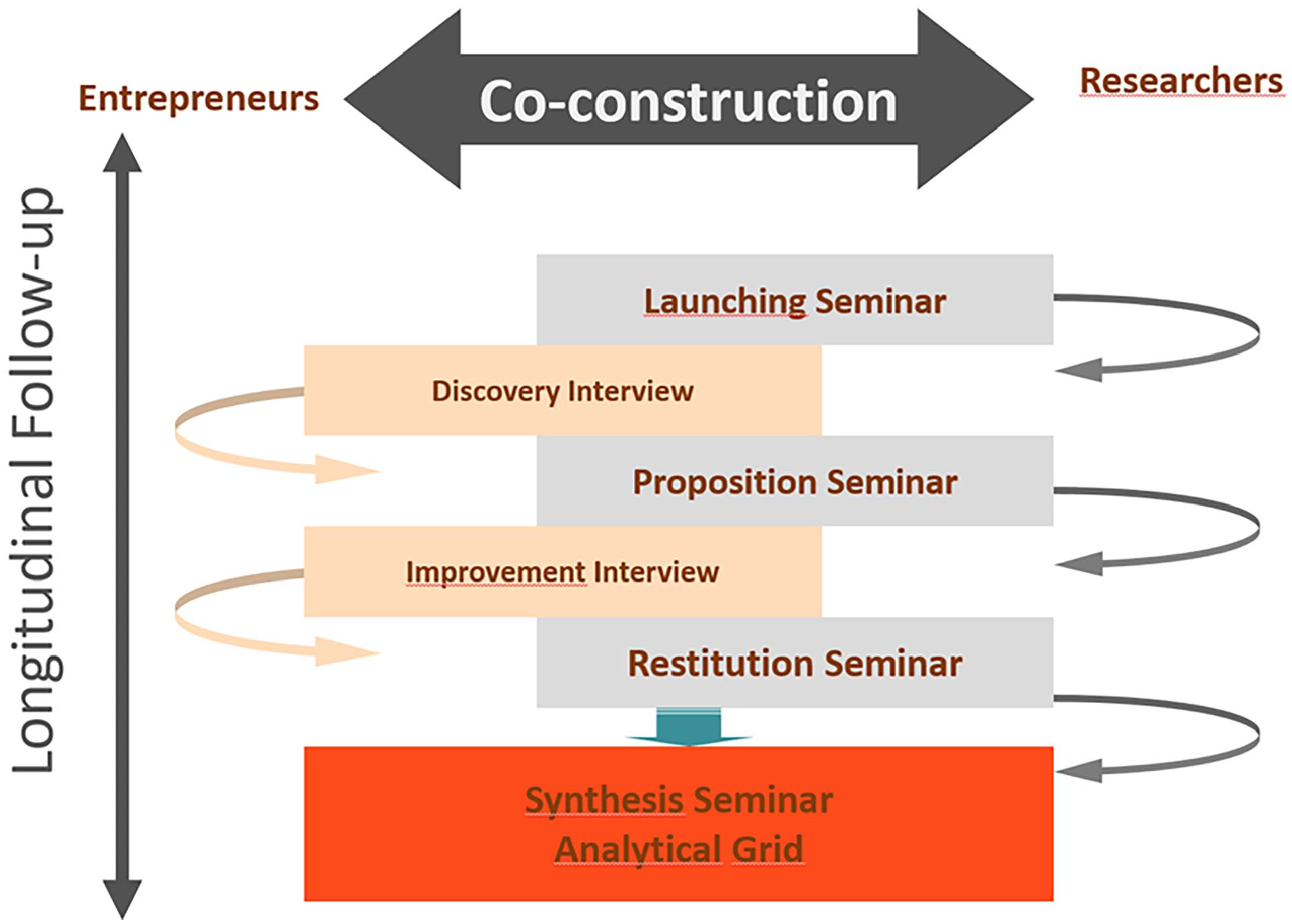
‘Acted Research’ protocol.
Longitudinal co-construction for ‘acted research’
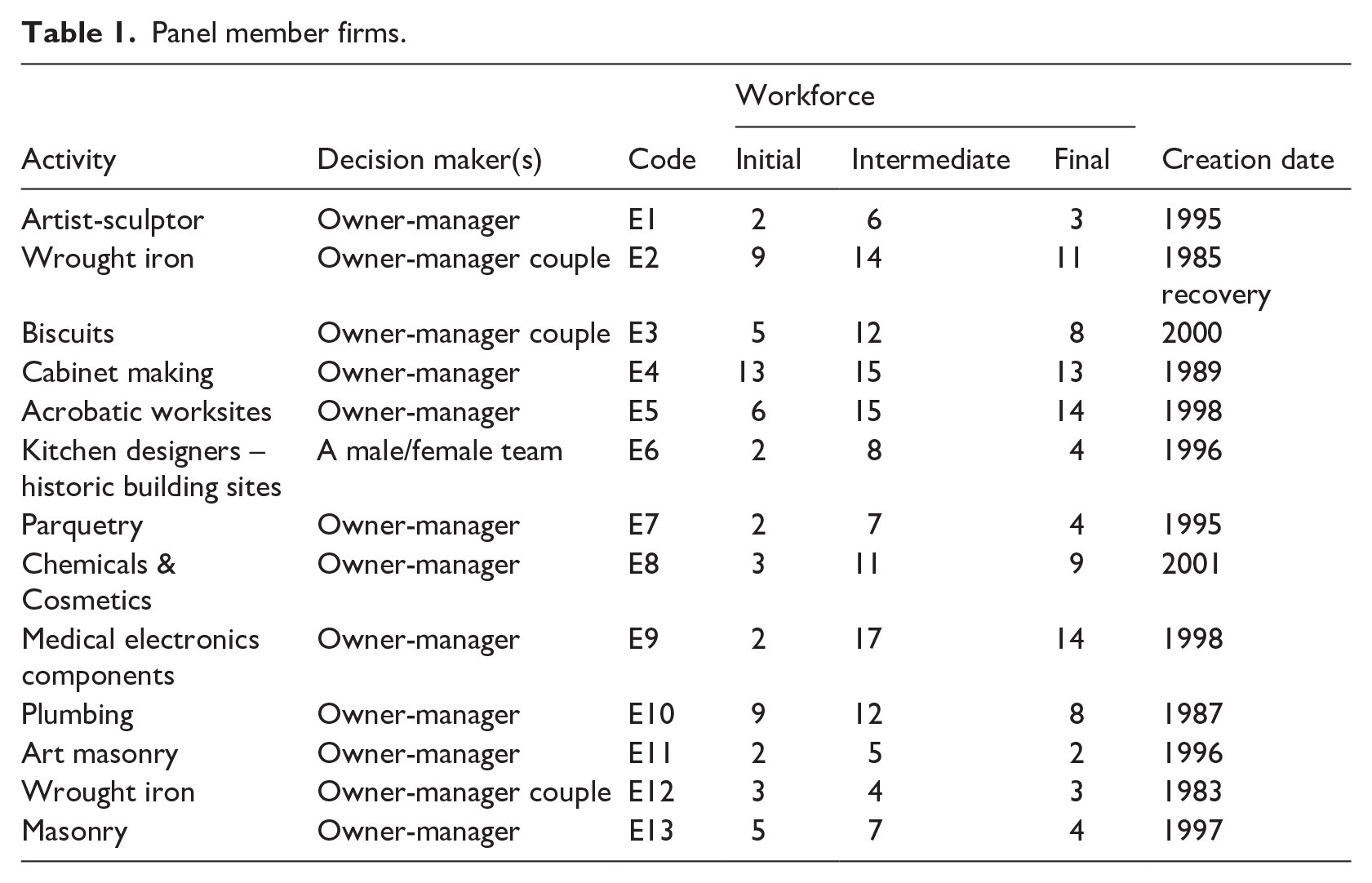
This panel studied the development and innovation of microenterprises for 12 years. Consisting of 13 managers and four academics, it met for four seminars each year. Individual interviews were used to complete, deepen and validate data. Table 1 shows the core group of participating firms. Some of these joined the group during the programme (E3, E8, E11) as we sought to consolidate a group of firms loyal to the programme. Five firms were not included as they attended only occasionally. Except for E2, which is a multi-generational family business, all others were created by their current owner-managers. The second column of the table shows the official management structure. A few firms are officially co-managed by a couple or partnership (E2, E3, E6, E12); others are informally co-managed, that is, the spouse does not appear in the firm organisational chart, but takes part in many decisions (E4, E8, E9). The next column shows the fluctuations in headcount over the course of the programme. All the firms in the panel increased and then reduced their workforce so were smaller by the end of the programme.
Panel member firms.
The discussion forums consisted of quarterly seminars, the themes of which were chosen in conjunction with the participants. The thematic life cycle was aligned with the academic year. Each seminar lasted one day, which left time to build links between participants. The group can thus, be considered as a community of intelligence (Cucchi, 1999) insofar as reference points, terms and cognitive processes shared by the members were established. That said, it was not a community of practice (Wenger, 1998, 2000), given the diversity of the profiles and backgrounds of the members, who met only in the specific context of the panel. They took part in this programme on the recommendation of the consular institutions, based on their level of performance, their achievements and the fact that they had been in existence for more than 5 years.
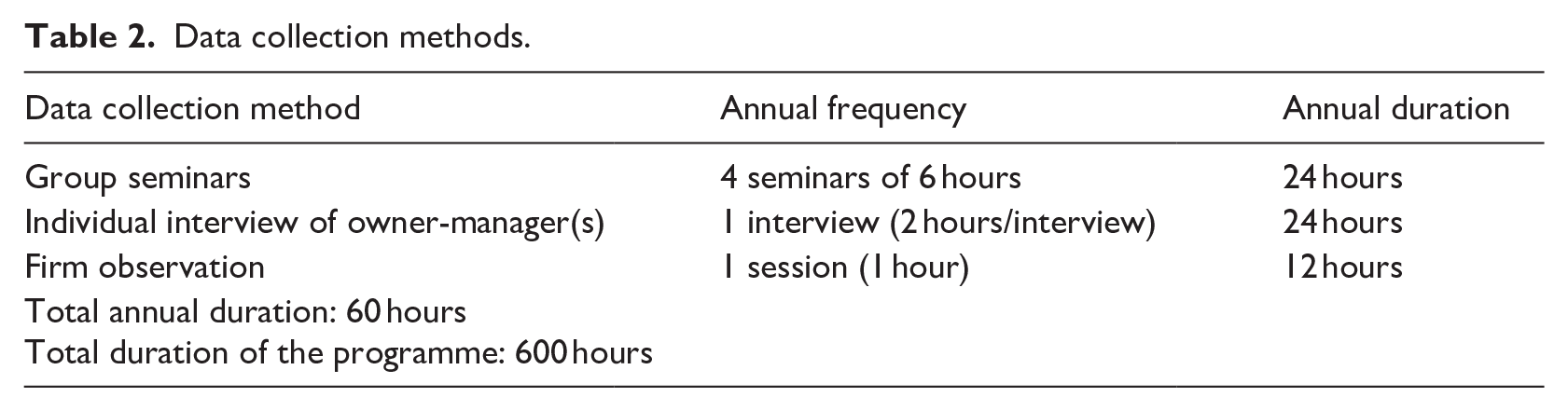
There were several spheres of knowledge creation due to multi-level data collection (seminars, interviews, discussions between owner-managers) and the coexistence of several cognitive systems as shown in Table 2. The diversity of data collection methods strengthened the quality of the research (Yin, 2014), by reducing the risk of bias. The use of a triangulation methodology using different types of material (in situ analysis, transcription of recordings, observation, note-taking) enriched the insights given to the analysis units. We were deliberately focused on the ‘interaction between the object and the subject’ as the basis for the ‘ways in which knowledge is developed’ (Charreire and Huault, 2002), as our aim was to be praxeological. Our iterative approach (Piaget, 1988) affected both the choice of problems and objectives, and the approach to each field of study. We could speak of action or participatory research (Allard-Poesi, 2003; Resweber, 1995) or intervention research (Koenig, 1997). But these methodologies aimed to respond to a request, a problem, from the subjects being observed. However, our objective was different - it aimed to generate knowledge from the best practices of the participants for the benefit of all microenterprise managers. In this way, the approach aimed to disseminate the knowledge developed through co-construction to managers other than the subjects observed, who provided us with data relating to their practices. For this reason, we speak of ‘acted research’.
Data collection methods.
A pragmatic approach for actionable tools
We were more interested in process than content. Our work was guided by the evolutionary path of one, or more variables, or events and the way in which they intertwined and combined (Van de Ven, 1992). We followed the logic of grounded theory (Labelle et al., 2012), which proposed systematically comparing verbal data and then gradually constructing a system of categories and sub-categories. This approach was established throughout the working sessions. More specifically, the process of longitudinal analysis of multiple cases that makes up one of the levels of analysis can be likened to the embedded case method proposed by Yin (2014). With a view to accurate data processing, this method recommended establishing several units of analysis for each case. Selecting and then exploring the issues opened the possibility of delving deeper into each analysis unit for each owner-manager. In addition, the intermittent seminars gave the opportunity to cross-reference each unit.
The seminars, in which the words circulated to gradually weave together knowledge, were part of the systemic paradigm of the Palo Alto school. The creation of knowledge did not reflect a certain image of the world but proposed an interpretation of reality. Discussions provided extremely rich data, expressed in modes and styles that were difficult to unify (Moscarola, 2018). It should be acknowledged that a level of uncertainty persisted at the end of the analysis work, with reference to the complexity paradigm (Morin, 1990). By progressively creating knowledge through interaction throughout the seminars, we were de facto analysing the data through a mirror effect within the panel. It was through this principle of interaction that we refined the co-construction process, coming as close as possible to the group’s expectations in terms of transferability to the corporate world. This approach, based on accounts of practices and their cross-comparison, was in line with the pragmatist tradition of management research (Lorino, 2018).
To comply with the pragmatist co-constructed knowledge creation protocol, the data were processed at two levels of analysis: At the first level, the data were analysed and then structured in the presence of the respondents during group discussions. The researchers used a circular approach involving all the managers in the discussion of keywords relating to the theme chosen collectively. The ideas were displayed to the whole group and the terms were defined in common so as to agree to a common semantic corpus and finally led to an organisation that was both thematic and semantic and that was agreed by all the participants. This technique ensured the reliability of the data. Nevertheless, its pragmatic strength suffered from theoretical limitations. The involvement of the respondents in the programme required an openness towards knowledge applied to concrete strategic issues in which academicism has no place. Consequently, a second level of analysis was necessary. It consisted of revisiting the quotes to preserve the raw data, then returning to the first analyses carried out in vivo and comparing them with the literature. This second stage of data analysis enabled us to compare the representation of microenterprise owner-managers with the literature on SMEs and, more generally, on strategic management. It is only at this second level that actionable tools were established. In this way, we described tools such as analytical grids, which can be used by advisors involved in support to establish support protocols or structure training courses for owner-managers. They were designed for easy use by advisers.
Results: Understanding no-growth in microenterprises by analysing collectively constructed data
To illustrate our results, we present a general analytical framework. It was constructed throughout the discussions with the owner-managers taking part in the panel. The chronological stages in which it emerged over the course of the focus group meetings will not be detailed here. We will, however, show how exchanges between owner-managers led to the gradual establishment of the extremities of the framework, as well as the interactions between these extremities.
The framework will be broken down in its different parts so that each structural element can be seen more clearly, followed by the dynamics of the whole. For each explanation, we will use a selection of quotes that we felt were particularly relevant to the exchanges. The analytical framework we are proposing is designed to be actionable. It is structured around two interconnected fundamental axes linked by the heart of the framework, the ‘core business’ (Figure 3). The clusters communicate on the same axis, then interact between the axes to create a path of no-growth dynamics.
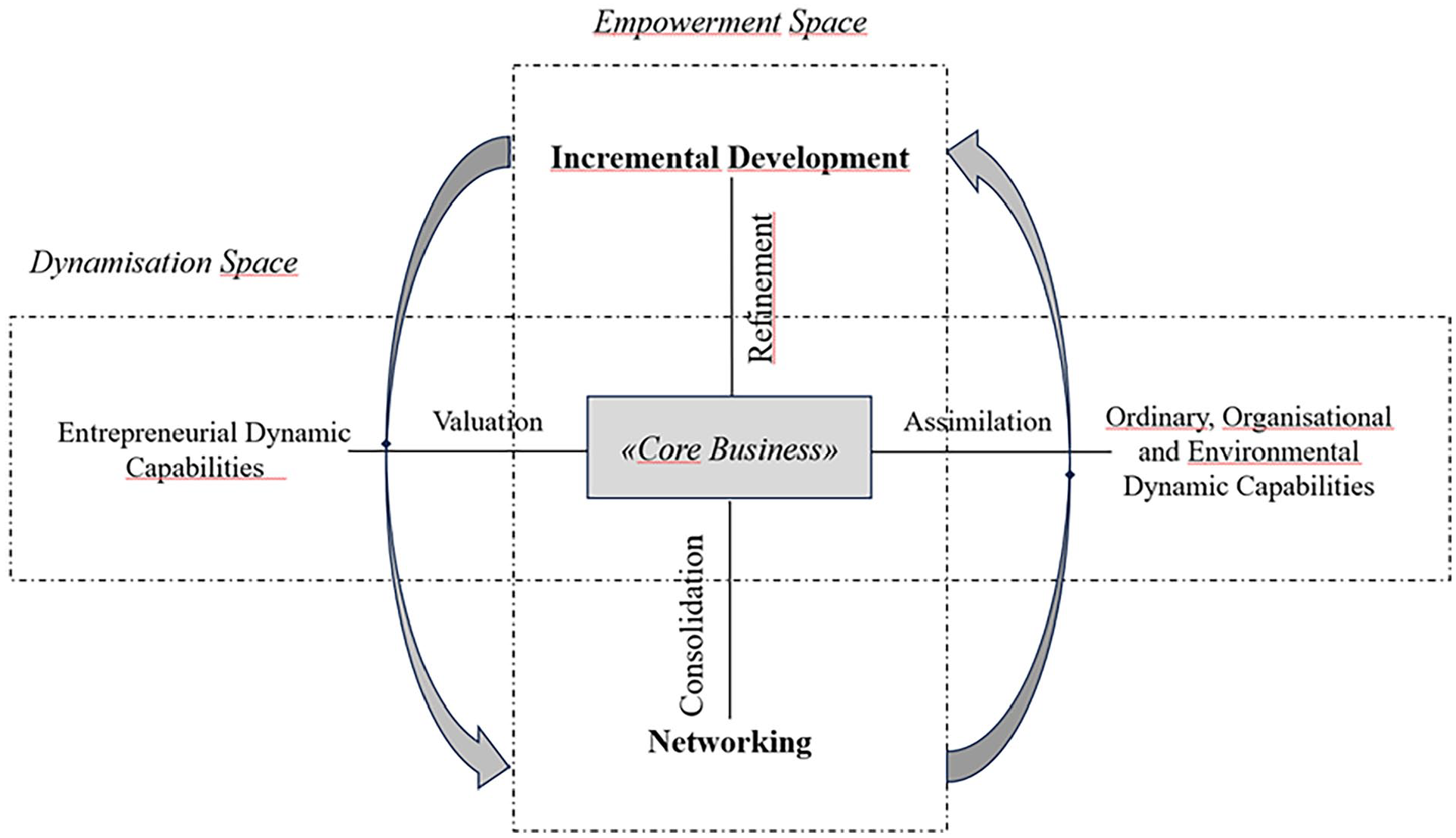
No-growth development analytical framework – Bi-axial architecture around the core business created by owner-managers.
Core business
Core competencies, as defined by Prahalad and Hamel (1990), are to be considered here from an organisational point of view: they formed the basis of the core business. It is at this level that the heterogeneity of the resources that each microenterprise owner-manager seeks to mobilise can be exploited (Alonso and Bressan, 2015), so that the process of dynamising the organisation, the source of capabilities, can begin. The core business is therefore, the foundation upon which capabilities are built (Sanchez and Heene, 2004): it gives them meaning, content and organic composition. At this level, the core business is defined subjectively by the way the owner-managers look at it, by what they expressed and put into practice, as a function of their own managerial (Kearney et al., 2014) and entrepreneurial (Teece, 2019) capabilities. The core business reflects the essence of the owner-manager’s strategic practices, the starting point and end point of what made sense for them in their firms. This result shows that in small firms, the leaders guide the core business through their perception. Microenterprises appear to be strongly marked by the perceptual, affective or intellectual impact of their decision-maker, as well as genuine managerial and technical capabilities (Ambrosini and Bowman, 2009; Teece, 2019). Table 3 presents some quotes from our discussions with owner-managers. We selected the most representative ones, even if they are particularly reductive in the richness of the overall discussions.
Quotes extracted from the discussions.
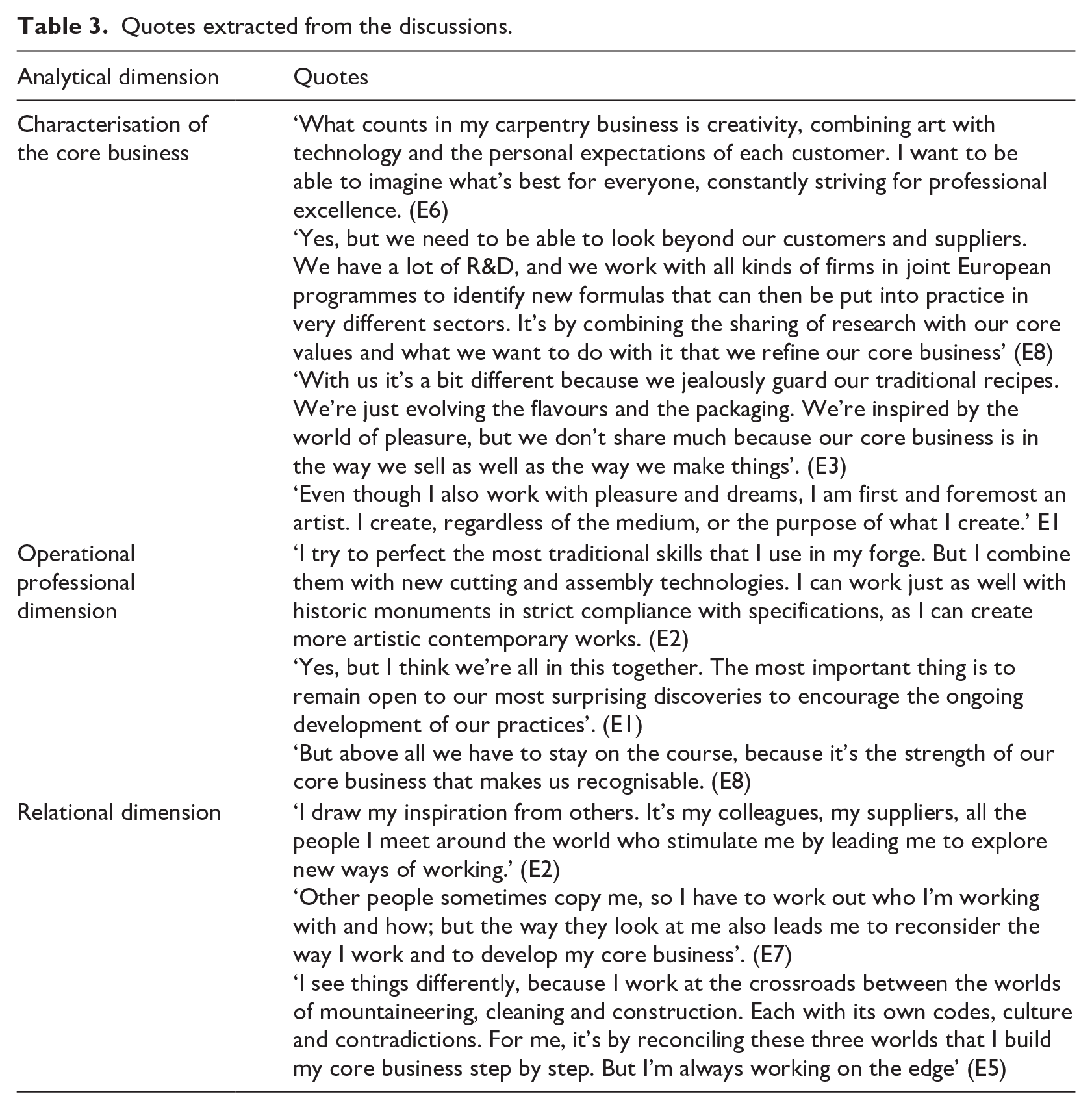
While the theoretical model seemed to place the core business as a contextual element that owner-managers chose in order to initiate the process of revitalising their firms, our research provided another interpretation: the core business serves as a pivot for the construction over time of dynamic entrepreneurial (and no longer managerial, as we were dealing with microenterprises), organisational and environmental capabilities (E3, E6, E8). It regulates the forms of dynamic capabilities that explain development choices. For the ‘pivot’ to be exercised around the core business, a link has to be made between the different forms of capability (E1, E8). Observation of firms led us to refining the definitions of operational and dynamic capabilities as proposed in the literature. A dual dimension determined the pivot effect: a professional dimension and a relational dimension. The first was expressed through the concrete practice of the activity, while the second manifested itself in the role of relationships in stimulating the first. These two dimensions were made up of dynamic and ordinary capabilities that combined to form the core business.
The characterisation of the ‘core business’ was ambiguous in microenterprises: it was not clearly distinguishable from the activity of the owner-managers. When entrepreneurs spoke about what explained the firm’s success, they referred to both operational know-how and technical excellence, as well as to the way in which they implemented and then promoted the latter. The small size of the workforce, which implied close proximity (even intimacy) with employees and partners, created a porous relationship between the owner-managers and the core business of the firm. Discussions showed that even among themselves, owner-managers sometimes had difficulty understanding each other’s activities and the reasons for each other’s success.
I do everything the client expects and I also help them with aesthetic integration. (E3) On the one hand, you are an installer for a large distributor, and on the other you are specialized in high-end rosettes. You may be looking at a global offering, but your business is working well because you have two very distinct markets. (E13) It’s true that my team’s mastery of traditional installation allows me to do something else with other types of clients. (E3)
It took several technical discussions between E3 and other owner-managers (E2, E4, E6 and E11) for him to become aware that while part of his business enabled him to make a living, it did not provide anything new or enriching and even risked increasing his dependence and vulnerability vis-à-vis the distributor who subcontracted him to lay the parquet. Through the discussions, he realised that creating marquetry rosettes (which had won several awards for excellence) was what would underpin his expertise and enable him to attract new partners. It was the combination of several forms of dynamic and ordinary capabilities that strengthened the core business.
Operational capabilities and professional dynamics: professionalism is characterised by the combination of several types of capabilities. Design, the mastery of old or more common traditional techniques, and the creation of contemporary artistic or utilitarian works expressed different aspects of the core business. The combination of these capabilities generated dynamic capabilities since it created a joint or successive evolution of one in relation to the other. The combination of traditional capabilities (ordinary capabilities) that evolved with modern technologies (abilities) revealed the ways in which owner-managers work through continuous dynamisation. The process of perfecting capabilities that were familiar and common to the trade reflected the way in which ordinary dynamic abilities could make it easier to do the job. From there, new capabilities were deployed, offering a renewed professional approach: dynamic capabilities could then be expressed through a complete renewal of excellence in terms of both creativity and their level of technicality.
When we decided to create a new state-of-the-art workshop, some of our customers were concerned that they would no longer be able to benefit from the excellence of our traditional production. On the contrary, thanks to these new tools, we have revisited our old forging techniques, and we have made even more progress (E2) I work B2B with my physiotherapist clients. Our innovations must be continuous and preserve the professional habits of our customers so that they can keep their bearings when using our rehabilitation equipment. (E9)
Operational capabilities and relational dynamics: these involved both routines and the dynamisation of relationships. While routines were associated with a generally organisational approach, in reference to the work of Nelson and Winter (1982), the framework for analysing capabilities in microenterprises invited a broader approach to the environment of the firms and their owner-managers. The porosity of the firms with their environment was accentuated in microenterprises. Similarly, the distinction between routine and dynamic became tighter because of the interpersonal links centred around the owner-manager; there can even be confusion with the environment:
Everyone knows that I am passionate about art history. My business is managed by and for the customer (E11) I created a cosmetic cream with the wine cooperatives, which gave us the idea of new formulas and then new products. But I did it because they were friends, and I like their wine! Because our project led me to share with them some of my manufacturing secrets. (E8)
The difficulty with the notion of relational capacity is its elasticity between professional and personal, objective and subjective dimensions. The aim here was not to attempt an exhaustive identification of each category of relationship, but rather to identify how the vectors that were the owner-managers, their entourage and the firms facilitated their integration into the process of building dynamic capabilities affecting the core business. In these processes, the decision-makers remained the central link who shaped the core business through their managerial capabilities (Helfat and Peteraf, 2015). Overall, the core business organised and led by the owner-managers guided the firm’s development system, based on the dynamism of the capabilities that served as leverage (horizontal axis). Based on academic literature showing that capabilities support competitive advantage, we looked at the implications of this advantage for the development of business. We described empowerment as the space that provided microenterprises with a more solid foundation, a singularity on the fringes of competition, to ensure that they become more sustainable and less vulnerable over the long term (vertical axis). The results highlighted the central role of the core business, but also its richness in explaining how no-growth microenterprises developed. Let’s now explore how they developed along the two axes of the framework.
Horizontal axis: Space for dynamism
The horizontal axis is made up of dynamic entrepreneurial capabilities at one end and organisational/environmental capabilities at the other. The first shows the driving role of owner-managers in the dynamic development of capabilities by driving strategy (Koryak et al., 2015). The latter emanates from the dominant academic current on dynamic capabilities, whose contribution focused essentially on the organisational dimensions (Eisenhardt and Martin, 2000) and on the relationship with the environment (Helfat and Peteraf, 2003). Our research enabled us to identify how entrepreneurial and organisational/environmental capabilities influenced the development of microenterprises. We identified that these two families of dynamic capabilities were revealed by the core business and then influenced its composition in return.
Table 4 shows a selection of the quotes that guided us in our analysis of the data from the space for dynamisation. To explain the dynamic entrepreneurial capabilities identified among panel members, we drew on the work of Adner and Helfat (2003) and Helfat and Martin (2015). According to these authors, managerial capabilities take three forms: cognition (beliefs and mental models), human capital (derived from past experience) and social capital (linked to social relationships). They explained why and how owner-managers are led to perform in a particular activity and consequently to develop their firms (E2, E4, E5). Beyond the purely technical approach, microenterprise owner-managers also decide with their feelings, their emotions (Huy and Zott, 2019) and their personal commitments to the project they are undertaking (Kokfai et al., 2015). For example, the discussion between E3 and E12 revealed the intensity of the family’s point of view, with a radically opposed feeling. The family played a part in the owner-manager’s psychological construction and had an impact on the whole trajectory. E5’s intervention was interesting at this point: he revealed: ‘I came to this region to escape a complicated family situation. However, the activity I decided to set up took me back to my native mountain region’. It’s worth noting that we did not in any way consider the family context as a subject to be explored. As the owner-managers took turns in expressing their views, we found that the focus on the family showed the link between their intimate personal life and the interpretation given to the entrepreneurial dynamic in all its dimensions.
Dynamisation space.
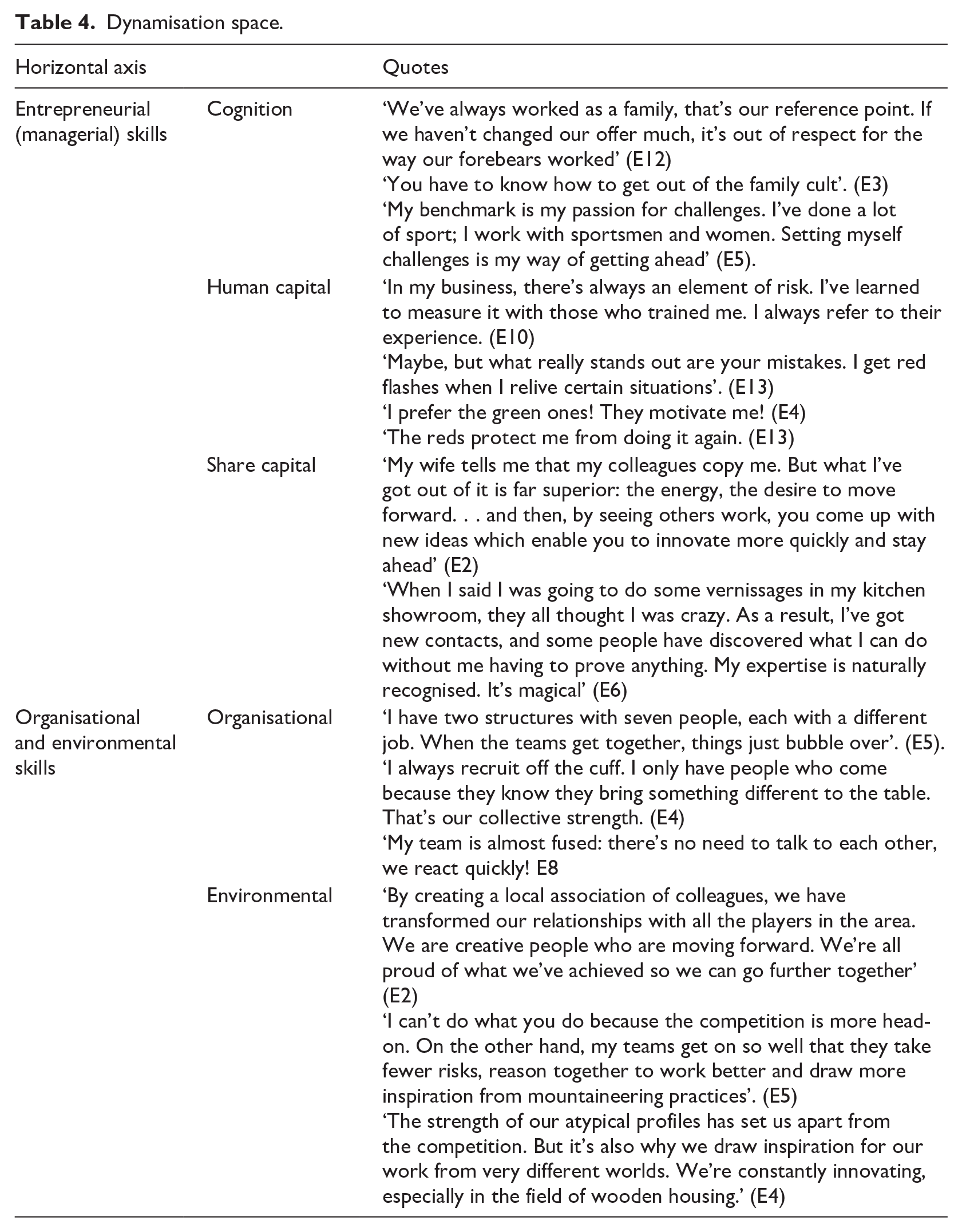
The dynamic entrepreneurial capabilities incited owner-mangers to develop and then structure the core business in accordance with their commitment to their projects (E2, E6, E10, E13). This was how owner-managers added value to the core business; they put in place continuous consolidation processes which led to organisational adaptation (dynamic organisational capabilities, as shown by E4 and E5). The evolution of the core business in this way led owner-managers to modify their practices and their representations in order to appreciate the new foundations of their firm’s success (E4, E13). The core business could in turn lead to better enhancement of entrepreneurial capabilities (E6). But symmetrically, the evolution of the core business led the owner-managers to modify their practices and representations in order to leverage the new bases of success of their firms (E4, E13). This evolution of the core business led in some instances to a better appreciation of entrepreneurial capabilities (E6). At the same time, these processes involved finding outlets and links with partners to support the growth of dynamic environmental capabilities corresponding to the firm’s level of quality, such as, in the cases of E2 and E5, competent co-contractors/sub-contractors, the raw materials and services offered by suppliers. Dynamic organisational capabilities (Eisenhardt and Martin, 2000) and those deployed to fit into the environment (Wang and Ahmed, 2007) echoed the core business through a process of assimilation. How did different dynamic capabilities relate to the core business?
Dynamic entrepreneurial capabilities involved a process of enhancing the core business. Initiatives that chart the firm’s trajectory highlighted the potential of the capabilities (dynamic and ordinary) that made up the essence of the business. Conversely, the core business supported by owner-managers stimulated their satisfaction, even their pleasure in developing the business, and thus motivated them to run it (E2, E5, E10, E13). In this way, value enhancement served a dual purpose: by linking entrepreneurial dynamic capabilities and core business, it densified the firm’s strategic trajectory. On the other side of the core business, on the same axis, the assimilation process took place. The skills and the resources that constituted the core business could be highlighted by the dynamic organisational capabilities that brought about the changes needed to implement them (E4, E5). They enabled the organisation to be transformed in terms of ‘how to do it’ (Dosi et al., 2008), so that the core business could be strengthened. Between the exploitation and exploration of new potential within the organisation, facilitating dynamics emerged so that the core business became more pronounced (March, 1991). But the core business was also nourished by the acquisition of new knowledge and skills that renewed dynamic capabilities (E2, E4, E10). Proximity with the local environment was influential in providing new informational resources and new capabilities shared with colleagues. Discussions between owner-managers E2, E4 and E6 showed that they were not aware that they were using the same mechanisms: the network, delayed recruitment, the means of forging links with the ecosystem, processes which provided firms with new resources and impelled them to progress but were not deliberate strategies. Some owner-managers were even amused by their gambling, by the provocation of ‘doing things differently’ to try something new (a vernissage, recruitment, professional association, etc.). If these owner-managers had not been left free to discuss these issues, they would not have opened up to us, admitting how much they enjoyed the challenge of transforming themselves.
On the horizontal axis, a development/assimilation dynamic was established around the core business where the owner-managers alternately mobilised processes of development and assimilation through entrepreneurial and organisational/environmental capabilities.
Vertical axis: Empowerment space
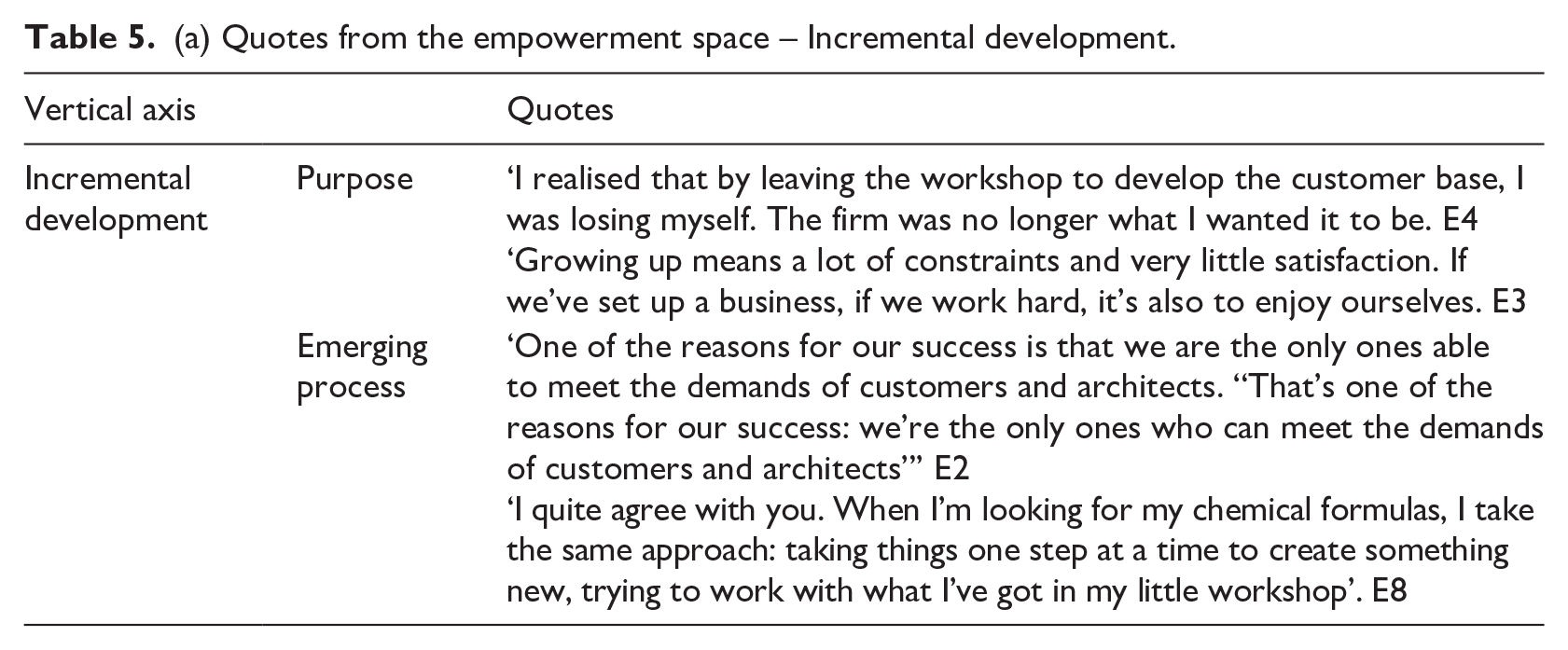
Empowerment was understood here as a space where the development of the business made sense because it was a response to the desires of the owner-manager (Ratten, 2020); the owner-managers took ownership of their projects, they aligned their entrepreneurial commitment with their concrete actions. In the sense of Amartya Sen (2001), 3 empowerment was understood as a learning process, enabling the development choices of the microenterprises to be made explicit. The members of the observed group of firms unanimously did not want to grow. More precisely, we found that they all grew only to return to their initial size, or even to a smaller size. For none of them, this was the result of a constraint or an accident. Quite the contrary: all of them accepted and even affirmed the choice to not grow to enable them to be more in line with their aspirations as a result of staying smaller. We were able to explain how no-growth development took shape through the alternative use of what we called incremental development and networking, both of which were driven by the core business. Table 5(a) and (b) shows the extracts from the quotes we used in our analysis.
(a) Quotes from the empowerment space – Incremental development.
(b) Quotes from the empowerment space – Networking.
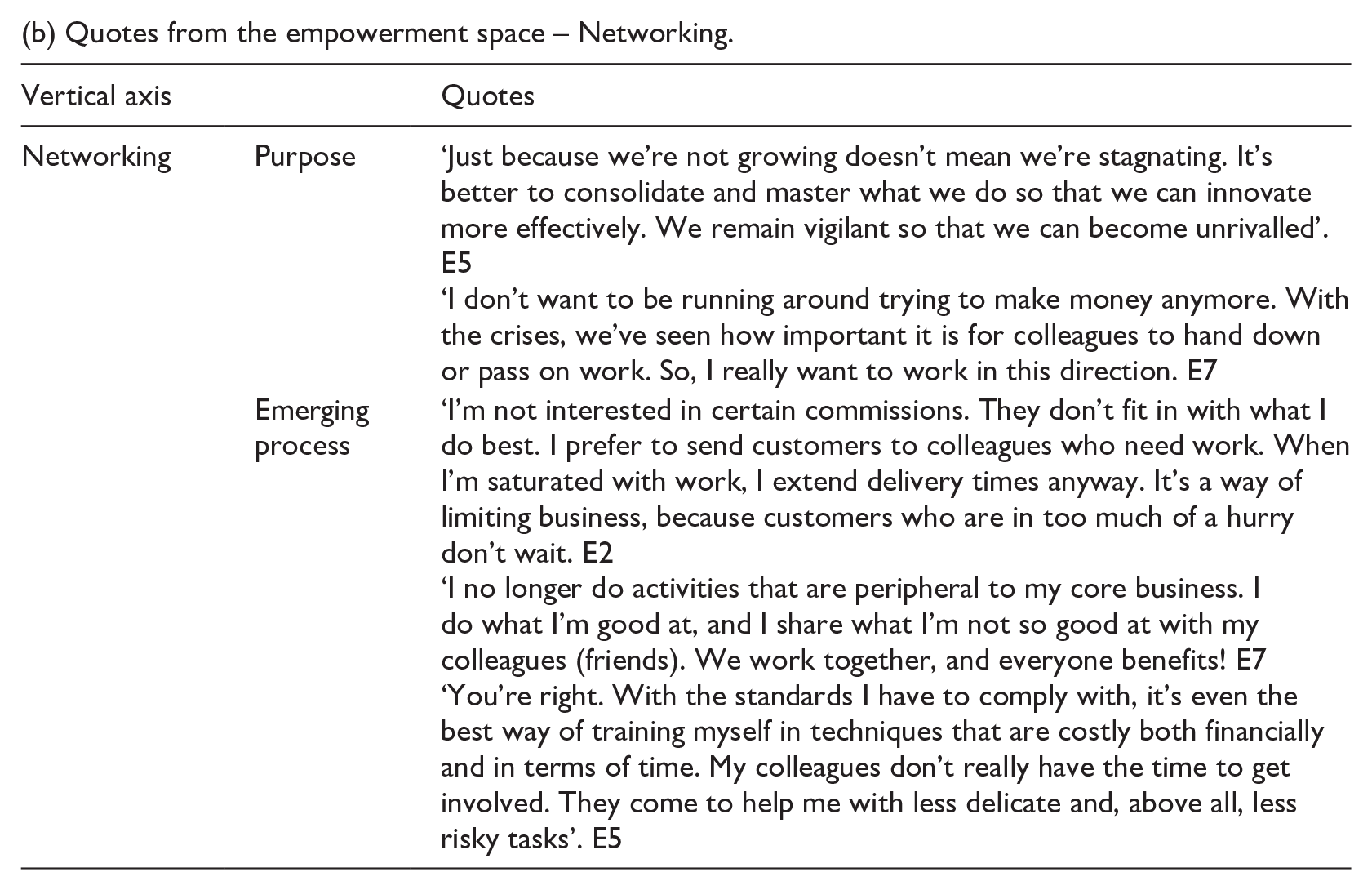
Incremental development (see Table 5a) involved gradual, small-scale innovation, starting an iterative innovation trajectory based on a process of refining capabilities (E2, E8). It was not a path to a predefined objective, nor to a desire to innovate. Owner-managers revised the nature of the business by adjusting processes, or by devising a new offering (new arrangement of the offering through the introduction of services, new commercial organisation, etc.). As E2 and E8 pointed out, these were cases of ‘do-it-yourself’ mechanisms (Baker and Nelson, 2005), where owner-managers did the best they could to exploit their resources and capabilities, by organising and reorganising as E4 explained:
By moving, expanding my workspace and transforming my management style (collaborative management) we took a step towards wooden frame houses. This challenge transformed the entire company. From now on, we refuse all projects that do not fit into our logic: innovation, green building, etc. Above all, we want to enjoy working together. (E4)
Table 5a shows other quotes that we tried to articulate in terms of aims and processes. We can see that the purpose of incremental development was more akin to the values that the owner-managers held as the basis for their choices. The processes in common put forward by E1, E2, E4 and E8 were enthusiasm and motivation for change and progress at a controlled pace.
With the hindsight provided by the longitudinal study, it appeared that the owner-managers were not influenced by development or by environmental opportunities. On the contrary, their values kept them alert to opportunities for innovation that would enable them to improve their capabilities. This was expressed by E1, who was not ready to embark on extra-cultural activity. He knew that by going abroad, he would have to rethink his business, while remaining aligned with his strategy. The subtle balance between opportunity captured and opportunity created supported the adjustment between incremental development and core business. The owner-managers were able to enrich their businesses with new practices that supported a trajectory of progression in expertise.
Capabilities (ordinary or dynamic) were part of the core business. They were distinct from key competencies in that they expressed an ability to combine resources and capabilities, whether strategic or not, to preserve the foundations of the core business. E4’s experience showed how ordinary capabilities (know-how in wood, use of ultra-light creative materials, organisation of the workspace, etc.) were combined with new dynamic capabilities (understanding new local cultures to come up with new designs, new market logics to create a new habitat). They explained the firm’s longevity through their contribution to entrepreneurial, organisational and environmental capabilities, which we were able to hear in various testimonials: ‘I’m going/ I’m not going’, ‘I don’t have the means/I’m creating new means’, ‘I understand the new expectations/I’m transforming myself to adhere to the new logic’. The combinations of capabilities established according to the values of the owner-managers were linked to the form of incremental development through a process of refinement. The incremental development chosen had an impact on the refinement of the core business. In this way, empowerment has been characterised by the freedom to choose the core business and incremental development.
Networking took place with network partners chosen by the owner-managers; as such, they could avoid increasing the volume of the firm’s activity by participating in networks to create forms of cooperation that supported co-development. In so doing, they avoided getting involved in a race for headcount. Owner-managers cited two types of negative experiences as reasons for rejecting growth: crises and managerial difficulties. The crises that led to sudden business turnarounds were experienced as professional and, above all, human traumas. ‘I had to part with some people I really liked. I knew I was putting them in a very difficult personal situation. I don’t want to go through that again’ (E10). Beyond proxemics (Hall, 1971) it was psychosociological, emotional and affective proximity that was put forward. What we found interesting here was the high degree of relational porosity in the microenterprise: owner-managers used the same terminology to describe the inter- and intra-organisational relationships: ‘I trust her completely’ E13, ‘he can do it better than me’ (E4), ‘we share so much together’ (E7), ‘without her, my business is not the same’ (E2).
Managerial difficulties can be seen both internally and externally: the owner-managers we observed expressed real difficulties in leading, controlling and, more generally, steering a team. The most difficult decision was that of delegating decisions, actions and control. Finally, letting go of the operational side of things was just as much a hindrance as the estimated risk: ‘Leaving my workshop thinking all day that they might do a bad job is eating away at me. There’s always something wrong’ (E6). One owner-manager spoke of a mourning effect to characterise his non-renunciation, whereas others emphasised the weariness of chasing after contracts to have to pay employees and doubting the team’s ability to meet production targets (E11, E12).
Alongside the obstacles to growth, most of the arguments related more to a genuine intention to do things better by sharing the business with selected, regular partners. The quotes presented in table 5b show how owner-managers used the extension of delivery times (E2) and the outsourcing of activities peripheral to their core business (E7) to regulate their volume of activity. Their goals included stabilising their activity to remain in line with their values (E5 and E7): empowerment was expressed by the desire not to get carried away by uncontrolled growth, while they wanted to stay on course by consolidating their core business. Networking was an indicator of what owner-managers wished to strengthen and what they hoped to entrust to other colleagues. This decision linked networking to incremental development, since capabilities evolved not only to strengthen themselves, but also to be better aligned with the colleagues who shared the offering.
Faced with an unpredictable future (Read and Dolmans, 2012), some people even evoked serendipity (Cunha et al., 2010) to explain the happenstance that led them to encounter a fortuitous opportunity to commit to innovation:
While attending a trade show where I was not supposed to go, I met representatives of a Japanese bank who discovered my sculptures of hanging rocks, which they considered a symbol of contradictory lightness. It was incredible! I signed a contract to equip all their agencies. It was the right time, in the right place . . . That’s serendipity for you. (E1)
While at first sight E1 appeared to be letting himself be carried along by chance, his arguments showed that it was apparently unrelated indicators that led him to launch successfully at a time appropriate for a form of creative innovation that would not lead to overheated growth. The notion of serendipity was revealed by the exchanges between owner-managers; it transformed our approach to the problem since it introduced the possibility of events occurring in an improbable way, without being really linked to chance, but rather to the unconscious vigilance of the owner-managers.
Refocusing on the capabilities that the owner-managers had mastered best goes hand in hand with an increase in excellence that facilitated creativity and innovation and therefore, incremental development, which in turn fed on an activity centred on a core of hyper-specialised capabilities that were given greater prominence in networking (E8). Alternatively, the owner-managers followed one or the other of these forms of development to preserve the meaning given to their projects: to develop by innovating, or by renewing their capabilities and resources, but not to grow.
Relying alternately on refining and consolidating the skills that were combined in the core business, the owner-managers followed a process that fed a path that was necessarily no-growth. By consolidating capabilities, the ‘volume effect’ was eliminated, leaving only the ‘value effect’. In a way, it was because firms were not growing that they were improving their economic performance (their profitability) and their competitive edge while satisfying the aspirations of the owner-managers and their pleasure in entrepreneurship. Refining the core business - the foundation of incremental development - involved purging their capabilities so that only those that were capable of driving innovation were valued.
Discussion
The theoretical underpinning of dynamic capabilities has, in the past, largely been aimed at large firms or start-ups (Teece, 2007, 2012). Although the specific context of our research was not predisposed to adopting this conceptual framework, the mobilisation of dynamic capabilities made it possible to explain how microenterprises can be successful while maintaining a limited size. Our work made it possible to place capabilities in a specific organisational framework (that of microenterprises) which was more stabilised than the one for which they were established (Eisenhardt and Matin, 2000). Moreover, capabilities explained firm growth through accumulation and innovation (Teece, 2019; Teece et al., 1990).
Our research, however, focused on no-growth. In their general sense, capabilities provide elements of understanding linked to the accumulation of resources or to growth sustained by the renewal of capabilities (Koryak et al., 2015). We showed that they could also describe a renewal dynamic that refocused the firms on certain capabilities and ordinary capacities at the heart of their success. The notion of core business identified the space in which the densification of capabilities and ordinary capacities explained success through no-growth. The quasi-organic aspect where the different forms of capability reached a level of fusional interweaving limited the possibilities of transposing the phenomenon from one firm to another, supporting non-reproducibility. Finally, capabilities generally allowed us to understand how firms coped with turbulent markets (Hervas-Oliver et al., 2016). However, the cases we studied were positioned traditional markets not obliged to apply innovative technologies. For example, a plumbing activity could be undertaken in a hypermodern context of installing photovoltaic panels, or in a more traditional context of laying pipes. Technology did not act as a barrier to entry into the sectors we studied. We observed that in these sectors, capabilities helped to explain the impetus given by managers to renew and energise their business without engaging in a frenetic race to hyper-competition.
To summarise, we propose the following definition of no-growth: No-growth is development without change in size, stabilising the firm’s scope. No-growth is not endured, but chosen, it is, therefore, a microenterprise strategy. It can take two forms: (1) internalised, by deploying innovations that refine the development trajectory; and (2) outsourced, based on networking strategies and practices that consolidate this trajectory. The two forms of no-growth complement each other and follow each other the development of microenterprises. Our theoretical contribution therefore, has a dual character, both contextual (through the nature of the firms observed) and purposeful, by adding a new perspective to the strategy of microenterprises. Going further, we proposed to mobilise two forms of capabilities that are generally approached separately: managerial capability and entrepreneurial capability.
Our results provided a new reading of the microenterprise owner-managers thanks to the joint mobilisation of managerial capabilities (Kevill et al., 2020) and entrepreneurial capabilities (Kokfai et al., 2015). Both were studied to explain the dynamics of managers and the innovative potential of teams in large firms. In our work, they succeeded in describing the practices of microenterprise owner-managers moving from the role of one-person band to that of orchestra conductor. In other words, when decontextualised, these capabilities can be revisited to address the complexity of the skills of microenterprise owner-managers. One of our major contributions is to characterise no-growth in several ways – it differs from decline or stagnation in that it consists of improving the business through excellence and innovation. It translates into higher margins, improved efficiency and a better quality of life for owner-managers and their staff. It does not reflect a minimalist approach to business. No-growth is the result of choices made by owner-managers, who decide according to their personal visions and aspirations; the decision not to grow the firm is based on professional and personal life choices, and on discussions with those in proximity. Decision-making is not based on rational economic reasoning – senses, emotions, feelings and life experiences all contribute to this choice (Huy and Zott, 2019).
This is why no-growth is part of a trajectory that follows the life trajectory of the owner-managers and their entrepreneurial journey. Sometimes they prefer to work as part of a team and share with their colleagues (networking), sometimes they refocus on their business (incremental development) and perfect their knowledge and know-how. They are only able to switch between the different development modes once they have identified the capabilities that make up their core business, which is the basis of their project. No-growth is thus, a combination of two forms of development, incremental and networking, that complement and follow each other over time. On another level, a deeper understanding of the concept of no-growth, and of the forms developed by firms, could be sought through the resourcefulness approach. Admittedly, it can be argued that this concept has not stabilised. It is related to and sometimes confused with other concepts, notably effectuation and bricolage, which we mobilised and attempted to advance.
The concept of effectuation, developed by Sarasvathy (2001), emphasised ‘entrepreneurial contingency’. It was of interest in understanding the no-growth approach. According to effectual logic, decision-making processes are carried out in the context of limited resources and a high level of uncertainty. The entrepreneurs pragmatically mobilised the resources available in their environments (which, incidentally, do not have the VRIN characteristics), demonstrating creativity to achieve performance. Effectuation helped us to describe networking because we found that the owner-managers relied on their networks to reduce environmental uncertainties and secure the activation of capabilities with trusted colleagues. The notion of bricolage implies necessity (Baker and Nelson, 2005); it is a matter of diverting a weakness and transforming it into a resource through an unexpected process (Feldman, 2004). Moreover, bricolage was not necessarily linked to scarcity but referred to the ability to transform an object into a resource, implying a significant level of creativity. It is from this perspective that we described the process of no-growth by incrementation as ‘bricolage’.
The resourcefulness approach made it possible to synthesise the contributions of these two concepts. In particular, the dimension of going beyond and even deliberately ignoring the limits of the organisation, and the search for original and unexpected sources of creativity, provided support for further reflection on the concept of no-growth applied to the analysis of microenterprise development strategies.
Limitations and future research
The longitudinal work we undertook enabled us to explore in depth a phenomenon that has, to our knowledge, rarely been analysed from the angle that we adopted. In this sense, the co-constructed ‘acted methodology’ was an undeniable asset. Confirmatory work based on a large-scale study could then be carried out. It would provide more precise information on the items used to identify the dynamic and ordinary capabilities that are conducive to development. The contributions of this article may seem to run counter to the dominant literature in entrepreneurship, which generally analyses and then supports firm growth. However, this work is merely the result of in-depth empirical studies that reflect a reality that we cannot ignore. While public policies actively support business creation and subsequent growth as a cornerstone of our economic systems, our findings show that this approach does not necessarily align with the aspirations of entrepreneurs. Although we did not explicitly address this issue in our fieldwork, the gap between our results and the prevailing support strategies raises important questions. It becomes reasonable to explore possible alternatives: How can the economic fabric be strengthened while businesses remain small? What policy recommendations can we, therefore, propose?
First, strengthening support for innovation appears to be the most direct recommendation, and one that has already been implemented by several support organisations. This is an entry point in our analytical framework capable of making the development system more dynamic. Nevertheless, the work we presented does not go into the analysis of innovation, which we will cover in other publications. Second, it would seem desirable to add a revisited approach to the principles of support from a global perspective, as opposed to a silo vision. Most assistance and diagnostics are often sequenced around a particular activity or problem: quality, decarbonisation, exports, building customer loyalty, etc. Our co-construction approach showed how the firm’s journey is gradually woven together. The interconnection of all the parameters forms the basis of the progression, determining an overall organic coherence. We chose not to present all the interconnections that make up the framework, they will be developed in a later article. Finally, one might ask what changes are desirable in the architecture of the support system. The intertwining of the development of microenterprises and their ecosystems raises the question of whether support should be split between internal (firm) and external (ecosystem) support. The need for joint support would also be a way of creating a collective force that is less vulnerable to environmental risks. This is where the risk associated with our research lies: the economic fabric made up of microenterprises is more fragile than that supported by SMEs or large firms. Through another form of support for the collective regional value chain, microenterprises could develop without growing, by reducing their risk of environmental vulnerability. This last point could be explored in the next stage, which would examine in greater detail how environmental and organisational capabilities can be linked to entrepreneurial capabilities. This is suggested by the outer circular arrows in Figure 2. By analysing the strategies implemented by owner-managers, we could then try to understand how to align the coherence of the forms of development. The links between the two axes of the analytical framework will help us to understand how each development strengthens the capabilities that will in turn support other forms of development.
Footnotes
Acknowledgements
This research was carried out within the framework of the Languedoc Roussillon Region’s Leaders’ Club. This club was part of the Artisanat-University® Network, initiated in 2002 by the Institut Supérieur des Métiers and the Union Professionnelle Artisanale. The Regional Chamber of Trades and Crafts and the General Directorate for Competitiveness, Industry and Services have given their support to the club in the Languedoc Roussillon region.
We thank the reviewers for their guidance and constructive comments..
Funding
The author(s) disclosed receipt of the following financial support for the research, authorship, and/or publication of this article: This research was funded by the Institut Supérieur des Métiers, which launched the Club des Dirigeants program.
Ethical approval and informed consent
The participants in the Leaders’ Club were chosen by the Chamber of Trades and Crafts of Languedoc Roussillon of which they are members. They have given their full consent to participate in the research and publication of the resulting academic contributions.
