



Abstract
This article leverages the Jo Rowlands’ typology of power and Crenshaw’s intersectionality to engage in interpretative phenomenological analysis of Ukrainian women refugee entrepreneurs. In this study, we ask: ‘How do Ukrainian women refugee entrepreneurs experience their identities as mothers, refugees, Ukrainians, and entrepreneurs in a context of displacement in the UK and Romania?’ Drawing on interviews and field notes, we expose the lived experiences of 13 women refugee entrepreneurs and reveal how they navigate their intersectional identities by enacting their agency through different forms of power. In doing so, our study aligns with this Special Issue call for understanding ‘everyday refugee entrepreneurship’ in under-researched constraint contexts thus, contributing to refugee entrepreneurship research and policy.
Introduction
For me, being free means being able to make my own decisions. It is a top priority in my life. (LavUK) I don’t want to be someone’s pet. (InaRo)
According to the United Nations High Commissioner for Refugees (UNHCR, 2024), conflict, violence and environmental disasters have recently displaced over 1% of the world’s population, an alarming milestone. In Europe, Russia’s war against Ukraine has caused refugee migration levels unmatched since Second World War, with over 160,000 Ukrainian refugees in Romania (UNHCR, 2024) and over 250,000 in the United Kingdom (Home Office, 2024). Refugees report leveraging entrepreneurship to overcome socio-economic constraints in host countries (Refai et al., 2024; Refai and McElwee, 2023). Following the World Bank (2023: 21), we characterise refugee entrepreneurs: ‘as all those who left their country of birth to escape persecution or conflict, are unable to go back, and have established a business, whether registered or not, in the country of refuge’. Indeed, over the past decade, entrepreneurship has emerged as a vehicle for social transformation and socio-economic recovery (Chitac, 2023; Harima, 2022); it has acquired agentic power as a proactive response to socio-economic power imbalances and the adversities faced by disadvantaged communities (Adeeko and Treanor, 2022). However, while research on entrepreneurship is growing (Desai et al., 2021; Heilbrunn and Iannone, 2020), most of the studies overlook the individual experience of refugees in a context of forced displacement and precarity (Abebe, 2023; Ram et al., 2022; Refai and McElwee, 2023), which includes war trauma, language barriers, loss of resources, skills and a sense of identity in host countries (Richey et al., 2022; Wauters and Lambrecht, 2006, 2008), instead, focusing on macro- (Harima, 2022; Heilbrunn, 2019) and meso-level challenges (Richey et al., 2022; Wauters and Lambrecht, 2006, 2008).
Evidence suggests that refugees exert their entrepreneurial agency to overcome contextual constraints (Christensen and Newman, 2024), reclaim autonomy, acquire competences, negotiate identity (Richey et al., 2022) and enhance their social status (Refai and McElwee, 2023). However, at the same time, refugee entrepreneurship might also be limited by contextual restrictions in host countries (Harima, 2022). While refugees probably face the greatest barriers to entrepreneurship compared to other immigrant groups, in some contexts, such as Adelaide, Australia for example, ‘they have the highest rates of entrepreneurship of any immigrant group’ (Collins et al., 2017: 33). Faced with this paradox of refugee entrepreneurship (Kohlenberger, 2023), refugees practice sub-entrepreneurship (Refai and McElwee, 2023) or bricolage (Kwong et al., 2019) at the margins of society, and do so with the resources at hand (Baker and Nelson, 2005) to overcome host market disadvantages. Similarly, they might blend power and constraints in the construction of their identity in the host country (Adeeko and Treanor, 2022). However, limited knowledge exists regarding refugee identities and how the experience of entrepreneurship may either limit or empower them (Adeeko and Treanor, 2022; Khademi et al., 2024). Given the increasing global political and war conflicts and the ever-increasing number of women refugees worldwide (OECD, 2023), the urgency of understanding how women refugees address contextual constraints while handling multiple identities can no longer be ignored (Al-Dajani, 2023; Khademi et al., 2024; Martinez Dy, 2020). Intersectionality gives people ‘some degree of agency that people can exert’ (Crenshaw, 1991: 1297) and provides a critical lens to help us understand how women refugees blend power and constraints in their identity construction and deconstruction (Adeeko and Treanor, 2022).
Our study leverages Rowlands’ (1997) typology of power to engage in interpretative phenomenological analysis (IPA) of Ukrainian women refugee entrepreneurs. Our research question asks: How do Ukrainian women refugee entrepreneurs handle their identities as mothers, refugees, Ukrainians, and entrepreneurs in the context of displacement in the UK and Romania? Drawing on interviews and field notes, we investigate the experiences of 13 women refugee entrepreneurs and reveal how they navigate their multiple identities by enacting different forms of power (power from within, power over, power to, and power with; cf. Rowlands, 1997). We acknowledge displacement (Wauters and Lambrecht, 2006, 2008) and its specific challenges, such as institutional dependency (Richey and Brooks, 2024), language barriers (Alkhaled and Sasaki, 2022), cultural and labour market exclusion (Ram et al., 2022) and a lack of recognition of prior educational attainment compared to other migrant communities (Abebe, 2023). However, we cautiously avoid the dominant focus on constraints experienced by refugees by investigating their intersecting identities as manifestations of both vulnerabilities and agentic power (Adeeko and Treanor, 2022; Khademi et al., 2024).
Given increased refugee numbers, political tensions and limited knowledge of refugee experiences, our contribution is timely and relevant to advance refugee entrepreneurship research and evidence-based policies. We bring two main theoretical contributions to this field: First, we respond to Refai et al.’s (2023) call for research on entrepreneurial agency in resource-constrained contexts by being one of very few studies (Klyver et al., 2022) to investigate Ukrainian refugees in the United Kingdom and Romania. Second, this study reveals that Ukrainian female refugee entrepreneurs are neither hopeless victims (Pesch and Ipek, 2024) nor invisible in the grand narrative of the masculinised nationhood (Peng et al., 2022). Rather, they overcome distinctive constraints and enact different forms of power, thereby bringing an overlooked, yet critical, dimension to understanding refugee entrepreneurship (Al-Dajani, 2023; Khademi et al., 2024) through a power and intersectional lens.
To explore our research question, we commence by providing an overview of the literature on multiple identities of women refugee entrepreneurs and emphasise Rowlands’ Lens of Power model (1997, 2019). Our methodological choices are presented next, followed by the research findings and contributions to refugee entrepreneurship research and evidence-based policies, along with limitations and future research suggestions.
Literature review
Contextualising women’s refugee entrepreneurship: intersectional vulnerabilities and agentic power
Women’s refugee entrepreneurship scholarship needs contextualisation (Al-Dajani, 2023) and an intersectional stance for a better understanding of its distinctive vulnerabilities and power (Adeeko and Treanor, 2022). To contextualise these entrepreneurial experiences, we embrace ‘everyday entrepreneurship’ (Baker and Welter, 2020) to examine women refugee entrepreneurs hidden potential to overcome displacement challenges and exercise agency in host countries through enacting intersectional identities (Adeeko and Treanor, 2022). While refugee entrepreneurship research has developed over the last few years (Abebe, 2023; Adeeko and Treanor, 2022; Khademi et al., 2024), many studies have borrowed concepts from migrant entrepreneurship research (Ram et al., 2022) and ignored the specificities of the refugee contextual displacement, encompassing war trauma and a loss of identity. Refai and McElwee (2023) reveal that refugees use entrepreneurship to overcome institutional constraints and marginalisation, often preferring their entrepreneurial identity to that of being a stigmatised refugee (see also Adeeko and Treanor, 2022). Researchers claim that most refugees can overcome trauma (Yeshi et al., 2022) and are equipped to capitalise on financial opportunities in host countries (Shepherd et al., 2020). Most studies examine non-EU women refugee entrepreneurs in the United Kingdom (Adeeko and Treanor, 2022; Alkhaled and Sasaki, 2022), except for a limited number that have explored psychological factors, such as crisis self-efficacy which appears to be the most important psychological factor explaining new venture among Ukrainian refugee entrepreneurs in Denmark (Klyver et al., 2022).
Over the last decades, Crenshaw’s theory of intersectionality has become a pillar of feminist research (Ahl and Marlow, 2021) enabling an extensive understanding of the multiple and complex identities involved in refugee entrepreneurship behaviours and experiences (Adeeko and Treanor, 2022). In the context of women refugee entrepreneurs, an intersectionality lens enables scholars to emphasise the multiple disadvantages with which they are confronted when engaging with entrepreneurship (Adeeko and Treanor, 2022). However, the embedded gender blindness (Al-Dajani, 2023) in entrepreneurship research must be more systematically addressed to uncover both the vulnerabilities and the agency of women refugees (Khademi et al., 2024) and formulate urgently needed evidence-based programmes and policies aimed at helping refugees to overcome poverty and marginalisation in the host country (Richey and Brooks, 2024).
Recent studies have examined refugee entrepreneurship by employing gender, age and class as identity dimensions to explain why and how refugees handle resources or cope with a lack of them to overcome socio-economic constraints (Martinez Dy, 2020; Shepherd et al., 2020). These studies reveal that the multiple identities articulated by refugee entrepreneurs both empower and hinder them (Adeeko and Treanor, 2022), influencing their endeavours. Thus, an intersectional lens is relevant for supporting an in-depth investigation of women’s refugee entrepreneurship. Intersectionality challenges the notion of refugee homogeneity (Khademi et al., 2024) and gives expression to the often-silenced voices of women entrepreneurs (Martinez Dy and McNeil, 2023), not from the perspective of what they are not, an ideal male entrepreneur, but rather, by showing what they do (Al-Dajani, 2023). Instead of being seen as hopeless victims (Pesch and Ipek, 2024), refugee women entrepreneurs overcome obstacles and exercise diverse types of power. This overlooked, but crucial, aspect of refugee entrepreneurship can be better understood by exploring the agency and limitations embedded in their intersectional identities (Al-Dajani, 2023; Khademi et al., 2024). We do so by leveraging the construct of doing intersectionality (Martinez Dy and MacNeil, 2023) to reveal how Ukrainian women refugee entrepreneurs engage with their identities while negotiating power imbalances and inequalities.
Identities are fluid, dynamic and contextual, with subjective experiences being continually transformed, re-enacted and re-negotiated within context (Radu-Lefebre et al., 2021). Given refugee displacement and related constraints, their identity as refugee entrepreneurs is far from straightforward, but rather, challenging and dynamic. Evidence suggests that the two identities (refugee and entrepreneurial) are fragile and might seem incompatible (Shepherd et al., 2020); indeed, the refugee identity is often portrayed as stigmatised (Adeeko and Treanor, 2022) and a liability (Hack-Polay et al., 2021). Lack of legitimacy, resource scarcity and deskilling, decontextualised roles, uncertain identities and diminished socio-economic bargaining power also emerge from newness and/or smallness in the early stages of entrepreneurship (Lefebvre, 2020). Adding to the complexity of migrant entrepreneurs struggling at the margins of society is often a liability of poorness, which includes literacy deficits, scarcity mindsets, non-business pressures and the absence of a safety net (Morris, 2020). In the context of refugee entrepreneurship, vulnerabilities might also trigger a loss of autonomy, skills and identity (Richey et al., 2022). Therefore, it is not sufficient to acknowledge the potential of entrepreneurship as a vehicle out of poverty and marginalisation; we must rethink how refugee vulnerabilities can be reconciled with entrepreneurial agency.
The social arrangements emerging from intersectionality combine both being and becoming, giving rise to specific forms of positionality, defined as the juncture between ‘structure (social position) and agency (social meaning and practice)’ (Anthias, 2008: 15). Intersectionality moves away from static categorisation to help scholars better understand the relational intersection of gender, ethnicity and class identities as contextual processes, each with a mix of advantages and disadvantages. By applying an intersectional lens, one can examine how being a refugee and the subsequent fragmentation of identity impact upon women’s experiences of entrepreneurship in host countries. This presents the opportunity to look at women refugee entrepreneurs as individuals with a repertoire of social identities capable of exercising their own agency to challenge stigmatised identities.
The OECD (2023) reports that 80% of Ukrainian refugees are women, compared to 49% of non-EU waves. Importantly, refugee women flee war with their children and often, without their husbands who may be called upon for military duty. As such, many will be single mothers and breadwinners in the host country and so, more likely to be marginalised and pressured into entrepreneurship to overcome poverty and marginalisation (Adeeko and Treanor, 2022). Though resourceful, they may find it challenging to balance their refugee and entrepreneurial identities, revealing contextual contradictions between their pre-war entrepreneurial identity and their recycled entrepreneurial one in the context of displacement, when loss of resources, autonomy and identity causes life-altering socio-economic constraints (Yeshi et al., 2022). Gender has been a crucial, but contentious, identity in entrepreneurship and refugee entrepreneurship studies for 30 years (Al-Dajani, 2023). While these studies show how women struggle with gendered assumptions, pre-ascribed roles and socio-cultural expectations (Adeeko and Treanor, 2022; Al-Dajani, 2023), they overlook the relationship between a refugee’s temporary displacement and their role in the ongoing war as wives and mothers, rendering them invisible in the grand narrative of the masculinised nationhood (Peng et al., 2022). Scholarly consensus needs to be improved on whether female entrepreneurial engagements address disparities and discriminatory behaviours and bring about beneficial social change for themselves and others (Ng et al., 2022). For instance, Syrian women refugees in the United Kingdom feel empowered by the autonomy they achieve through selling their craftwork to provide for their families, which contradict their identity as women raised to follow the care-narrative and patriarchal traditions of Syria (Alkhaled and Sasaki, 2022). Such studies demonstrate how, through the interplay of their multiple identities, women refugee entrepreneurs experience vulnerabilities and exert their agency in the host country (Adeeko and Treanor, 2022; Khademi et al., 2024). To explore the dynamics of agency in the context of women refugee entrepreneurs, we use Rowland’s (1997) lens of four distinct forms of power.
Rowlands’ lens of power model
The concept of power is essential to the conceptualisation of the process of empowerment, helping in understanding the processes that influence the agency and choice of individuals in constrained social contexts. Prior research on refugee entrepreneurs has shown that the process of empowerment is iterative and might help marginalised communities, such as women refugee entrepreneurs in theUnited Kingdom, enact their agency in the host country (Street et al., 2022). Rowland’s model focuses on four distinct forms of power: power from within (self-respect and self-efficacy), power over (controlling power and dominance over others), power to (productive power) and power with (collective power).
Power from within is prominent in the seminal work of Rowlands (1995), who argues that empowerment goes beyond agency: ‘empowerment is concerned with the processes by which people become aware of their own interests and how these relate to those of others [. . .]’ (Rowlands, 1995: 87). Specifically, by exercising power from within, women refugee entrepreneurs might use their ‘knowledge, individual capabilities, sense of entitlement, self-esteem, and self-belief to make changes in their lives’ (Pereznieto and Taylor, 2014: 236) to overcome socio-cultural gendered constraints and challenges and drive transformative change (Rowlands, 1997). Conversely, power over is controlling and dominant. In female empowerment, power over can both enable and constrain entrepreneurship. This notion has been questioned for portraying power as self-driven interests that undermine and even create structural disparities in gender, class and other social categories (Wood et al., 2021). The misinterpretation of financial autonomy as the ‘neo-liberalization of feminism’ (Prugl, 2015) promotes a distributive view of the power of me versus others (Wood et al., 2021), encouraging refugee entrepreneurs to compete to overcome socioeconomic constraints. When manifested as power over, self-empowerment is not an act of dominance over others, but rather, consists in personal development leading to transformative change (Rowlands, 1997, 2019), as demonstrated by African women refugee entrepreneurs in the United Kingdom, who use their entrepreneurial skills to overcome socio-economic constraints (Adeeko and Treanor, 2022) or Palestinian refugees in Lebanon, who use their entrepreneurial identity to exert control over their devaluing refugee status (Shepherd et al., 2020).
As for power to, it refers to productive power – the ability to make decisions and act, a creative force for new possibilities and activities (Rowlands, 1997). This productive power helps women entrepreneurs in the United Arab Emirates to express their self-determination through power sharing as they challenge gender stereotypes (Ng et al., 2022). Entrepreneurs might also gain agency and self-esteem by enacting their power with. Involvement in in-group activities can enable entrepreneurs to improve their lives, acquire support and preserve their rights. Forced displacement in the refugee experience is a discontinuous transition that might raise identity concerns. Such jolts require entrepreneurs to engage in identity construction to create acceptable otherness, like Palestinian refugee entrepreneurs who (re)prioritise their identities to address identity stigma and social devaluation and engage in entrepreneurship at the margins of society (Shepherd et al., 2020). Rowland’s (1997) types of power should be understood as fluid, dynamic and interrelated manifestations that shape the process of empowerment, rather than static conceptual blocks (Street et al., 2022). Table 1 summarises Rowland’s power model.
Rowland’s (1997) power model.

Source: Researcher’s own based on Pereznieto and Taylor (2014), cf. Rowlands (1997).
To summarise, our theoretical background section emphasises the need for a contextual understanding of how women refugee entrepreneurs navigate intersectional vulnerabilities and power in host countries by leveraging their multiple identities. Our aim is to contribute to the nascent stream of refugee entrepreneurship research (Adeeko and Treanor, 2022; Khademi et al., 2024), challenge the overlap between migrant and refugee entrepreneurship (Abebe, 2023; Ram et al., 2022) and contribute to gendered, evidence-based practices and policies (Richey et al., 2022). These issues must be addressed to prevent the loss of the human socio-economic potential of millions of refugees struggling to overcome socio-economic constraints and exclusion (Richey and Brooks, 2024). To do so, our IPA study follows the research protocol detailed below.
Methods
For this study, we adopt a qualitative, IPA to uncover: ‘how Ukrainian women refugee entrepreneurs experience their identities as mothers, refugees, Ukrainians, and entrepreneurs in a context of displacement in the UK and Romania’. The ontological interpretative perspective fits with the research question by focusing on lived experiences, recognising the subjective nature of contextual realities and engaging interpretatively with each participant to understand the phenomena and their embodied meanings (Smith, 2019). This facilitates an understanding of the richness and complexity of the intersectional experiences of Ukrainian refugees in both contexts (Alase, 2017). Before describing the data collection and analysis, the ensuing subsection outlines the research context.
Research context
Our primary focus is on Ukrainian women who are refugees and entrepreneurs in Britain and Romania. We select these host countries because they have welcomed some of the largest communities of Ukrainian refugees in Europe (OECD, 2023). According to Panchenko (2022), 76% of Ukrainian refugees held full-time jobs before the war, while 20% were self-employed or entrepreneurs. Since the beginning of the war, Romania has provided temporary protection to over 160,000 Ukrainian refugees (UNHCR, 2024) while the United Kingdom has temporarily housed over 250,000 refugees through the Ukrainian Family Visa and Sponsorship Scheme (Home Office, 2024). Given most refugee research has been focused on advanced economies, cross-cultural comparative studies that include emerging economies, such as Romania, are few, but crucial to understanding refugee entrepreneurship in context (Abebe, 2023; Adeeko and Treanor, 2022). The United Kingdom is known for its pro-entrepreneurial and diverse culture, as well as its advanced economy. In contrast, Romania is an emerging economy with an increasingly entrepreneurial and diverse society (Global Entrepreneurship Monitor, 2024).
Sampling
Drawing on the World Bank’s definition (2023) of refugee entrepreneurs, we selected Ukrainian citizens based on the following criteria: (1) Participants willingly accepting to share their experiences; (2) Participants identifying themselves as a refugee; (3) participants residing in either the United Kingdom or Romania during the study and (4) participants involved in formal or informal entrepreneurship. It is well known that refugees are hard to reach due to being socially stigmatised (Abebe, 2023). The researchers in this study have experience investigating different migrant communities; two share an Eastern European cultural heritage with the participants. The researchers employed various convenience sampling techniques, including traditional and social media e-snowballing, to reach participants who were geographically dispersed and difficult to access due to their vulnerability (Chitac and Knowles, 2019). E-snowballing, as described by Chitac and Knowles (2019), is a distinctive sampling technique that leverages the publicly accessible social media profiles of subscribers to privately invite potential participants using platforms such as Facebook and LinkedIn. This iterative method reduces the influence of selection bias and gatekeeper reliance.
The sampling process has resulted in seven participants in the United Kingdom and six in Romania. Our sample adheres to IPA’s recommended practice of prioritising in-depth understanding of participant experiences and meanings (Alase, 2017) over generalisation (Saunders et al., 2019), and reflects the interpretative tradition of refugee entrepreneurship research which has used samples between one to seven participants (Adeeko and Treanor, 2022; Khademi et al., 2024; Street et al., 2022). Additionally, besides following the IPA tradition, the decision on our sample size was based on empirical saturation, defined as the point at which further interviews yielded no new emergent themes (Saunders et al., 2019).
Table 2 details the Ukrainian women refugee entrepreneur demographics.
Research participant demographics.

Source: Researcher’s’ own, based on fieldwork.
In line with prior reports by OECD (2023), the Ukrainian women refugees we interviewed in both countries had a high level of education, typically holding a Bachelors or Master’s degree, and five to six years of prior business experience, except for one first-time entrepreneur in each host country. All interviewees were refugees in their host countries having been resident for between one and two years and started businesses in the first three to six months upon their arrival. Furthermore, most of our participants in both countries are mothers (five out of seven in theUnited Kingdom; five out of six in Romania).
Among the two cross-cultural samples, women entrepreneurs in the United Kingdom retained their pre-war business sector, many moving to hybrid or online models. In the United Kingdom, most of the participants focused on one or two industries, such as IT recruitment and development. By contrast, four of the Ukrainian refugee entrepreneurs in Romania reported working on entrepreneurial projects in diverse and multiple business areas simultaneously, such as business consultancy, project management, and sales. Despite refugee entrepreneurs in both countries primarily serving Ukrainians living in war-torn Ukraine and the host country, there was a notable difference. Specifically, three of participants in the United Kingdom spoke about their international or European customer base, with none serving the British market at the time of the study. Whilst in Romania, two entrepreneurs spoke about serving Romanian or European customers, along with their predominant Ukrainian customer base.
Data collection and analysis
We used semi-structured interviews and first-person narratives of ideographic experiences (Smith et al., 2009). Specifically, we carried out online semi-structured interviews, with an average duration of 40–70 minutes, with only two being performed in person and the rest online, according to participant preferences, spanning from July 2023 to May 2024. The lead researcher employed probes to encourage detailed narratives regarding the refugees’ everyday experiences and the significance they attribute to their identities as Ukrainian women, refugees, entrepreneurs and mothers in host countries. ‘Mother participants’ explained that they preferred to be interviewed online because they were able to ensure the safety of their children, while participating in the study. In line with the IPA tradition of phenomenological reduction, the lead author used reflective field notes (bracketing) to reduce the risk of subjective interpretation. The goal was to preserve participant authenticity by limiting the influence of researcher biases on the integrity of participant narratives (Alase, 2017).
IPA helped us build an in-depth understanding of how Ukrainian refugees experience their identities – that is, as Ukrainians, women (mothers), refugees and entrepreneurs – as well as an understanding of the meanings of these identities for the participants. We combined phenomenology, which focuses on the particular experiences of refugees in their specific contexts, with hermeneutics, which acknowledges the researcher’s position as an outsider to the refugee community, but with expertise in migration research, and idiography, by drawing on the researcher’s knowledge of IPA analysis to recognise both the individual distinctiveness and shared similarities among the refugees. We followed strict ethical guidelines throughout data collection and analysis, which ensured informed, recorded consent to preserve participant authenticity together with detailed and transparent reporting (Smith et al., 2009).
We adhered to Smith et al. (2009) phenomenological techniques of data analysis and focused on highlighting the perspectives of the participants on their experiences of agency against distinctive cross-cultural constraints. An interpreter fluent in both Ukrainian and English transcribed and translated all recorded interviews, ensuring that the intended meanings and the significance of the participants’ experiences were accurately preserved (Alase, 2017). We engaged in an iterative and inductive cycle of data analysis comprising the identification of thematic patterns within and between interviews. The researchers adhered to the IPA tradition and focused on ‘trying to make sense of the participants trying to make sense of what (is) happening to them’ (Smith et al., 2009: 79). The hermeneutic circle technique was employed to analyse the contextual experiences of participants by examining constituent elements, including individual words, whole sentences, specific excerpts and complete interviews, in a continuous iterative process (Smith et al., 2009). To do so, annotations were utilised to analyse the data and identify first-order themes. We then linked the first-hand experiences of participants to relevant theoretical constructs pertaining to power and intersectionality. Specifically, we used Rowlands’ typology of power (1997) to help identify second-order codes, demonstrating how participants exercised their agency, and to reveal how they navigated multiple identities by enacting different forms of power. Next, because refugees construct multiple identities, including their refugee, entrepreneurial, gender and Ukrainian ones, we used these intersectional identities as aggregated dimensions to make sense of the data.
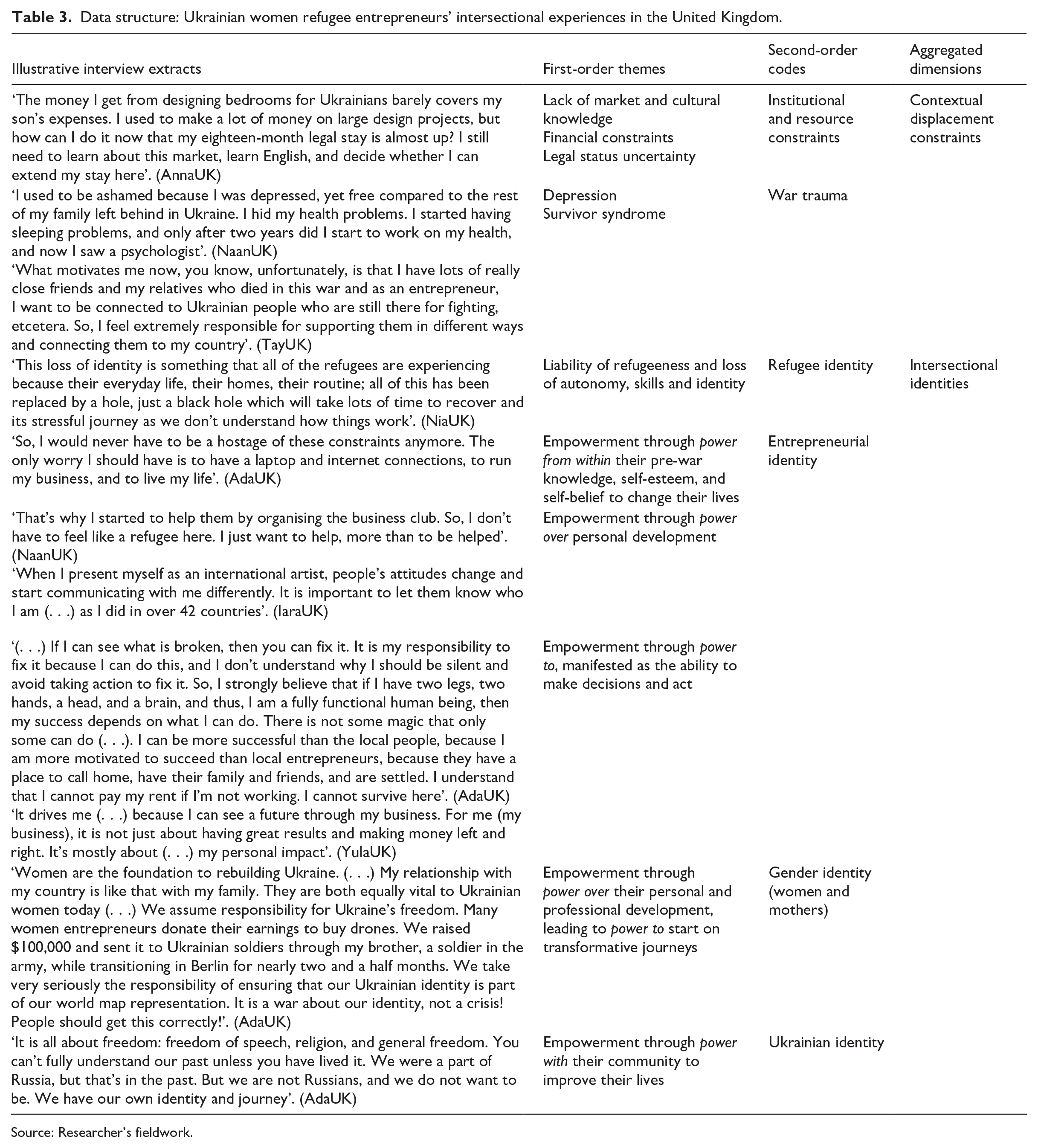
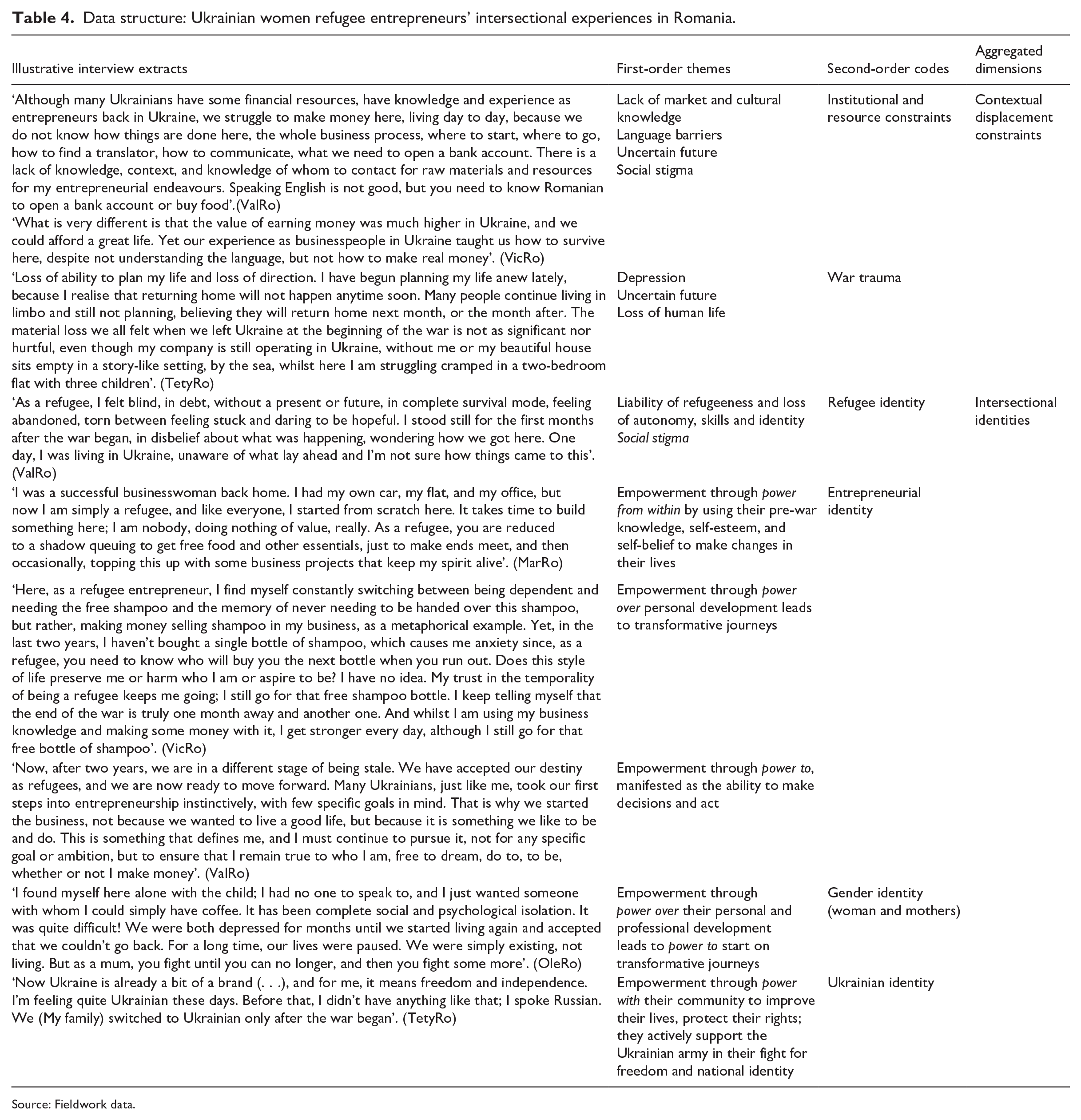
To summarise, we leveraged Gioia et al.’s (2013) approach to identify convergent and divergent patterns within and across interviews (see Tables 3 and 4), which resulted in informant-centred first-order themes (e.g., liability of refugeeness, empowerment through power from within, over, to), theory-centred second-order codes (e.g., intersectional identities: Ukrainian, refugee status, gender and entrepreneurial identities) and aggregated dimensions (e.g., intersectional identities). This approach enabled a qualitatively rigorous illustration of the relationships between data and theory, while ensuring proper inductive analysis and decreasing the risk of misrepresenting participant experiences or introducing interpretative bias (Gioia, 2021). Additionally, to maintain scientific rigour, the researchers adhered to the assessment criteria established by Smith (2011) and placed emphasis on authenticity, context sensitivity, transparency and trustworthiness. The use of semi-structured interviews and direct excerpts from participant narratives effectively maintained the authentic nature of their experiences. The study’s context sensitivity was enhanced by encouraging participants to use their preferred language throughout the interviews. The diligence in disclosing study methodology, evaluation of ethics application and the active involvement of all three researchers at every level of the research process guaranteed transparency and trustworthiness.
Data structure: Ukrainian women refugee entrepreneurs’ intersectional experiences in the United Kingdom.
Source: Researcher’s fieldwork.
Data structure: Ukrainian women refugee entrepreneurs’ intersectional experiences in Romania.
Source: Fieldwork data.
Research findings
Our participant narratives illustrate their complex and dynamic intersectional experiences in a context characterised by institutional and resource constraints and the burden of war trauma they carry with them (Abebe, 2023; Wauter and Lambrecht, 2008). In this section, we reveal participant experiences, constraints, identities and agency illustrated by our study.
Ukrainian women refugee entrepreneurs’ intersectional experiences in the United Kingdom and Romania
The narratives of the 13 Ukrainian women refugee entrepreneurs weave a gallery of tapestries, where each thread, represents contextual constraints and sparkles of agency, from lack of financial resources to lack of host market knowledge, profound loss, post-traumatic syndrome and survivor syndrome triggered by war trauma these women refugees experienced. Each thread has deep personal meanings and motivates them to keep thriving against all odds. The contextual complexities of these women’s stories are captured in Tables 3 and 4.
Contextual constraints and war trauma experienced in the United Kingdom and Romania
This subsection analyses the experiences of Ukrainian refugee entrepreneurs as they navigate the respective economic, social and institutional environments of the United Kingdom and Romania. Despite the UK’s developed economy and Romania’s emerging market, both contexts provide considerable problems, such as financial vulnerability, legal uncertainty and market unfamiliarity. Specifically, in the United Kingdom, systemic impediments and bureaucratic challenges are prevalent, whereas in Romania, language barriers and social constraints intensify many of these difficulties. Furthermore, across both contexts, the trauma of war and displacement exacerbates participant challenges, relegating them to survival mode instead of prioritising economic expansion, all while navigating these complex emotional, cultural and institutional landscapes.
In the United Kingdom, our participants engaged in entrepreneurial ventures with great energy, despite the contextual hardships they faced, such as lack of host market expertise and the attendant financial constraints that spark their entrepreneurial agency. TayUK’s testimonial relative to ‘knowing all the ins and outs of the labour market in the UK that holds us (Ukrainian refugee entrepreneurs) back’ reflects a widespread anxiety about starting over and being forced to navigate an unfamiliar business environment, fearing legal and bureaucratic challenges one cannot afford to face, such as hiring locals: ‘so we don’t get sued by them’ (TayUK). Many participants expressed their dissatisfaction with their inability to obtain financial resources, because ‘as a refugee, you are not credible enough, so we don’t have access to any kind of loans or credits, because the company doesn’t have any kind of history here due to our recent arrival’ (TayUK). The institutional hurdles to banking access highlight how pervasive financial vulnerability is among women refugee entrepreneurs. For many, business risks are exacerbated by the distinctive institutional and resource challenges they face as refugee entrepreneurs, which limit their ability to make informed decisions, leading to a heightened sense of hopelessness, deterring some from expanding their business into the British market, focusing on survival instead of growth. While others proceed cautiously, creating partnerships, just to make ends meet, in business and everyday life, where ‘even after pulling resources from all three partners and business opportunities, we continue to struggle to support our family and business’ (TayUK). Similarly, in Romania, Val Ro’s narrative exposes how women refugee entrepreneurs ‘struggle to make money here, living day to day, because we do not know how things are done here, the whole business process, where to start, where to go, how to find a translator, how to communicate’. Across both countries, participants reported a lack of market and cultural understanding: ‘During the admissions exam at the university, they did not see me as a person, but as a Ukrainian refugee. All their queries were: Is the war in Ukraine real? Will you go back to your country when the war is over? (. . .). These questions made me feel uneasy and unworthy. It’s still extremely difficult for me here, even though I am providing for me and my family, and I am not a dependent refugee anymore’ (OleRo). However, whilst in theUnited Kingdom, refugees mostly face systemic constraints due to universalist policies, in Romania, social and cultural constraints, including language barriers, add to their daily challenges. For example, ‘speaking English is not good enough, for you need to know Romanian to open a bank account or buy food’ (ValRo). This requirement to be proficient in Romanian for basic interactions and administrative business tasks hinders the ability to run one’s business, restricting a refugee’s prospects of reclaiming some level of financial and social autonomy.
Not only are the lives of these women refugees constantly altered by the complex web of institutional and resource constraints, for they also continue to suffer from the war trauma that has caused them to experience depression and survivor syndrome. Their narrative puzzle consists of experiences of apocalyptic losses, as NiaUK related her profound sense of loss: ‘One day, we woke up, and our home was gone. Uh, we lost our jobs, and I lost my business. This emptiness, inside and around me. I lost everything!’. The survivor syndrome, which is reminiscent of AdaUK’s narrative, further exacerbates their depression: ‘I am ashamed that people are living their lives every day in war-torn Kyiv or Ukraine, while I can live in freedom (. . .). During my first three to four months here, I determined to buy only the essential items for survival, and we (myself and my husband) lived only out of our suitcase. Every time I visit a museum or art gallery or go out for a coffee, I cannot stop thinking of how other people are dying while I enjoy this life. And that’s not nice. Everybody’s suffering, and you are not? This duality is what I have in my head. It’s really hurting!’. Similarly, ToryRo recalled: ‘To come here, for example, I had to choose between saving my father’s life and staying here to save my children’s lives. How does someone choose and live normally with such choices? No matter what I would have chosen, I would have been wrong in this situation. Isn’t that true? As a result, I lost loved ones, because, like many other Ukrainians, I had no choice’. The shared tragedy of displacement, along with the ongoing conflict in Ukraine, has a significant impact on their mental health. Their feelings of loss and psychological strain from leaving family and friends behind increase their difficulties in adjusting to new situations, causing ‘many Ukrainians to question the meaning of their lives, as many (of us) have lost our identities as a result of losing control over (our) lives’ (ValRo). Furthermore, ValRo described how the sudden displacement and uncertainty of their stay in Romania contributed to a more severe identity crisis, which ‘began when we got here at the beginning of the war, and we realised that we were powerless, because we failed to figure out how to be entrepreneurs again’. This complex interplay of multiple losses, including loss of social and economic power, and the need to start from scratch in a foreign country creates a sense of displacement and loss of identity and life direction: ‘I (felt) just (. . .) cold, incomprehensible, a strange country, because of the language barrier, which gave me no chance to adapt or to prove myself’ (InaRo). Next, we analyse the intersectional influences upon the experiences of the women in the United Kingdom and Romania as refugees, entrepreneurs, mothers, women and Ukrainians.
Refugee identity: liability of refugeeness
When asked about their experience as a refugee in the United Kingdom or Romania, all participants refuted being labelled refugees. This reflects not only the preferential treatment they received from host countries, by getting immediate access to the labour market (OECD, 2023), but also their determination to stand up for themselves and use their pre-war entrepreneurial experience and their high educational attainment, not to overcome, but to avoid designating oneself as a refugee, which they regard as ‘hopeless victims’ (IaraUK), ‘hostage of these constraints’ (AdaUK) and ‘a black hole’ (NiaUK). This is because, as NiaUK highlighted: ‘we (Ukrainian refugees) are educated, living within society instead of camps, and having rights’. By comparison, ‘normal refugees are uneducated, live in camps, and have no rights as we do’. The belief that ‘not all refugees are created equal’ leads them into creating a refugee hierarchy, where they feel emotionally protected and worthy of the top position, which makes their lives as refugees liveable. The discomfort with being labelled as a refugee is anchored in the belief that accepting that identity would mean giving up their autonomy; their ability to exercise their agency, while ‘being fearful and weak’ (YulaUK), and thus, succumbing to a life of compromise, defined by a vicious cycle of ‘trying, failing, and learning from the failure (. . .) to meet the (host) expectations’ (ValRo), as they wonder if the cost of meeting host country socio-cultural expectations would be greater than the benefits, since ‘having two Master degrees and learning the Romanian language used only here, might not be enough to get a white collar job (. . .) just because you are new, a foreigner’ (ValRo).
However, their experiences as refugees are far more complex, revealing novel aspects of what we might call the liability of refugeeness. Compared to migrant entrepreneurs who experience the liability of smallness and newness, our respondents experience the liability of refugeeness, that is, a loss of autonomy, competencies and identity due to displacement and contextual constraints: ‘Being a dependent person, not knowing the language, my 17 years of expertise being good only for putting tomatoes on shelves in Kaufland. I don’t want to be someone’s pet’ (InaRo). The association of being a refugee with ‘being someone’s pet’ (InaRo) is dehumanising, emphasising a complete loss of control and belonging. While the liability of refugeeness reinforces their emotional and economic burden, it also pushes participants to act as if they believe that they have the ability to overcome difficulties: ‘Well, this does not suit me very much (. . .) but although I can’t find a job and I cannot look after myself and my family, I refuse to be a passive consumer (. . .) getting food here and money there. I couldn’t live like this and that’s why I started doing some business dealings’ (InaRo).
Despite facing similar obstacles and depicting their lives as precarious, our respondent’s life stories reveal two contextual nuances. First, whilst acknowledging the profound loss they have suffered, UK-based refugees are hopeful that their liability of refugeeness is a temporary constraint that they can overcome, because they believe British entrepreneurial culture will allow them to take charge of their future by ‘us(ing) all my energy, power and the meaning of being a public figure, my brain, my communication skills, to change my life from a victim into the artist I am’ (IaraUK). By contrast, in Romania, InaRo hopes to overcome her liability of refugeeness by creating her own emotionally balanced reality and life: ‘I believe we are all creators of our own reality and lives, and I want to have a say in mine’ (InaRo). However, she struggles to find the optimal personal and economic compromise to see through the transformational pain she suffers from reclaiming some degree of autonomy, competencies and relatedness in the future, while continuing her business dealings at the margins of Romanian society. She knows that ‘Romania is a safe, temporary hub’ (InaRo) and that her business dealings will ensure short-term survival for her and her family. Still, they will not secure the life she wants, nor the life she has lost and she tries to reclaim: ‘I see Ukrainians choosing to either return to Odessa/Kyiv, to our cities for opportunities and be willing to take the risk even during the war, or wait here for the wear to end so they can return to Ukraine, or choose a country with a more flexible system for entrepreneurs. I think that the inflexibility of the Romanian system plays a very big role here’ (InaUK).
This uncertainty and unworthiness limit their ability to fully commit to their entrepreneurial ventures, as their primary identity remains that of a transient refugee, and their struggle for a stable and worthy identity is an important barrier to their personal and professional development. The high cost of gaining a more permanent identity underscores the structural constraints preventing access to resources for proper living conditions. Overall, participant stories are filled with references to the uncertainty of their right to remain in host countries and their worthiness as refugees or entrepreneurs, reflecting a profound identity crisis exacerbated by the uncertain legal status and societal perceptions of refugees, as well as a lack of knowledge, which perpetuates their dependence on a legal and economic system that keeps them marginalised. However, despite the distinctive challenges these refugee women face in the United Kingdom and Romania, due to institutional, social and resource constraints and war trauma, their entrepreneurial identity brings them hope in their ability to overcome the liability of refugeeness and find purpose.
Entrepreneurial identity: a constellation of power from within, power over, and power to
The accounts showcase the depth of the women’s emotional struggle and revolt of being forced into a refugee identity and their motivation for embarking upon entrepreneurship, against all odds: ‘Do you understand how devastating this loss is? I, Vic, used to be a fairly successful entrepreneur in Ukraine before the war, and now my entire identity has been turned inside out (. . .); I understand that as a refugee, I could not bring it (entrepreneurship identity) with me here, and most likely, there will be nothing left of it tomorrow (. . .) But, then again, what would convince me to accept further losses by investing significant time, money, and effort in this venture and here? Maybe it is the fact that I hate being a refugee, and I love being my own boss. I cannot ignore that I am one of the people who are natural at solving problems and bringing positive changes in my community (. . .) Being an entrepreneur means taking full responsibility for my business, for my life. It is the least I could still do for me and my family, worth it or not’ (VicRo). Despite living in a legal and institutional limbo, their fear of prolonged displacement due to war motivates them to build war-proof business models, transforming their ‘bricks and mortar’ pre-war businesses into hybrid or online enterprises (see Table 2).
For Ukrainian women refugee entrepreneurs in the United Kingdom and Romania, entrepreneurial identity means more than a mere label; it represents the process of regaining their pre-war knowledge, autonomy and sense of self. This empowers them to discover novel inner resources, refusing the stereotype of being helpless victims, and instead, showcasing their ability to act, a characteristic that is crucial for many refugee entrepreneurs. IaraUK’s story shows this, as she highlighted her entrepreneurial identity as a catalyst for transforming her life from that of a victim to that of an artist: ‘Us(ing) all my energy, power and the meaning of being a public figure, my brain, my communication skills, to change my life from a victim into the artist I am (.. . .) When I present myself as an international artist, people’s attitudes shift, and they start communicating with me differently’ (IaraUK). This power from within nurtures her self-confidence and empowers her to exert control over the constraints she experienced as a refugee. IaraUK placed a strong emphasis on being visible to the public and reinventing oneself professionally.
Entrepreneurial identity seems to symbolically act as the participants connection with a cherished past and a way to reclaim pre-war professional dignity. For instance, OleRo used her pre-war entrepreneurial skills to create value, despite the constant reminder of her refugee status. Her power from within enhanced her self-efficacy regarding her capacity to create and negotiate a new entrepreneurial identity and thus, move away from being seen as a refugee: ‘As an entrepreneur here, I can create value for others, (. . .) I could get a second chance to create my own life here, yet I am always reminded that I am not a citizen; this imbalance is quite concerning. I have sleepless nights wondering how I could become a citizen and what do I need to do to free myself from being just a refugee?’ (OleRo). Our participants portrayed their entrepreneurial identity as a source of autonomy, which should expand to their business: ‘my company must be as free as myself. This means that it doesn’t matter where I am today, in Romania, in England, in Poland, or in Kherson, my business should work and should keep me financially free by bringing me an income. The only thing is that I haven’t fully figured out what legal form it will have?’ (InaRo). However, their identities are fluid and nonlinear, and as researchers we were invited to witness the emergence of a ‘liquid cage’ in which participants enact their transformative entrepreneurial agency (Refai and McElwee, 2023). Moreover, their determination to reject the passive label of refugee and their memories of a previous successful entrepreneurial identity highlights their strong desire for empowerment. As they tell the story of how they have solved problems and fostered positive transformation, participants reframe their identity from an ascribed refugee identity seen as at the mercy of external factors to an entrepreneurial one perceived as a source of agency enabling them to create their own path through life. This change in self-perception is a hallmark of power over, in which personal growth and the restoration of personal power reshape the identity of these women refugees.
Whilst all women refugee entrepreneurs in our sample demonstrate a strong sense of agency and a capacity to make powerful decisions as entrepreneurs, their expressions and motivations of power varied. These ranged from the determination to achieve professional recognition (IaraUK), to economic survival (OleRo, AdaUK), personal fulfilment and impact (YulaUK). This diversity highlights the distinct experiences, and particular personal meanings embedded in the women’s journeys as entrepreneurs. Additionally, this diversity demonstrates how various forms of power influence the ability to act and feel empowered. Collectively, these forms of power enable women refugee entrepreneurs to overcome the liability of refugeeness. Their entrepreneurial identity has encompassed more than just economic survival; it has also involved overcoming the challenges associated with being seen as a refugee and regaining one’s autonomy and business abilities through constructing oneself as an active participant, rather than as a passive victim in the host country.
Gender identity: power to as breadwinners and power over as army supporters
By delving into the stories of the participants, we acquired thorough knowledge of how they balance their multiple roles as single mothers and, to our surprise, as active contributors to Ukrainian independence, underlining the dimensions of power to as breadwinners and power over as army supporters. Their experiences as single mothers are both uplifting and restricting. On the one hand, participants felt empowered since they could defend and provide for themselves and their families: ‘I left for the safety of my son, both physical and mental, a difficult journey with some border crossings, leaving behind a privileged life in Kyiv’ (IaraUK). By controlling their emotions, they become their children’s sole breadwinner and emotional support, transforming their lives. MarRo showed her autonomy and ability to act decisively by fleeing to protect her son: ‘I’m a full-time mum here. I fled to make sure that my son received a solid education and was not drafted into the army. There were still kids who were not prepared to go to war, so we wanted to educate and protect them, rather than send them into combat’ (MarRo). But being single mothers limits their capacity to completely embrace their entrepreneurial identities and attain the same degree of success that they had before the war. Surprisingly, their gender identity transcends their role as mothers and breadwinners for their families, allowing them to become financial supporters of the Ukrainian army, rewriting the grand narratives of masculinised nationhood (Peng et al., 2022). The participant’s power to and power over come to life in TayUK’s story: ‘I am a part of the United Humanitarian Front, thus together with other female businesses, I am raising funds to aid our military personnel and reconstruct Ukraine (. . .). It is something we do to cure ourselves. It helps me heal from the pain of not being there to fight. I’m not on the front lines, but they’re always in my heart, and I’m there with them and for my children. They need a free Ukraine to return to’.
Through power over and power to, these women refugee entrepreneurs navigate displacement with dignity and autonomy, highlighting the significance of supporting their dual roles as mothers and entrepreneurs. Critically, their power over embedded in their gender identity is complemented by the power with embedded in their Ukrainian identity.
Ukrainian identity: power with as army supporters
Participants talked about their path to empowerment as Ukrainians, expressing their solidarity with the Ukrainian army. Their goal was not only to secure a free Ukraine for their children, but also, to exercise their autonomy and provide financial support for the war for national independence. AdaUK shares how her Ukrainian identity is intertwined with their sense of solidarity and collective action: ‘It is all about freedom: freedom of speech, religion, and general freedom. You can’t fully understand our past unless you have lived it. We were a part of Russia, but that’s in the past. But we are not Russians, and we do not want to be. We have our own identity and journey’.
NaanUK’s daily efforts to support the military brigade through her entrepreneurial activities illustrate how participants maintain their connection to their homeland and contribute to the war: ‘Back home, know that my 35-year-old close buddy, who is like my brother, is now a soldier fighting on the front lines. So, every day, I think of him and how many candles I need to sell to help their brigade. Yes, Ukrainian women take on multiple roles, from supporting their families and our health to supporting our country and soldiers. We are like an army outside Ukraine’.
Like Ukrainian women refugees in the UK, being Ukrainian in Romania also involves a dynamic repertoire of empowerment manifested as power with, which includes struggle yet determination to hold one’s family together, and a responsibility to take on active citizenship by donating to Ukrainian army from the little they make with their enterprises: ‘Almost everyone I know who is an entrepreneur, here or in Germany, or anywhere, supports the troops back home with money. Despite their little earnings, they consistently donate to the army. This is the least we can do; it is another way of fighting for our freedom. And so, it’s something like a rule, I guess, maybe our moral obligation to contribute to our army and stay together in good and bad times’ (ValRo).
In contrast with their co-nationals from theUnited Kingdom, in Romania, women refugees also talked about the ethnic and linguistic duality embedded in their Ukrainian identity. For instance, InaRo tried to navigate her national identity crisis by blending one’s native cultures altogether: ‘I have big problems identifying myself only as Ukrainian, because my mother is Belarusian-Polish and my dad is Belarusian-Russian, and I am the first child who was born in Ukraine and who, unfortunately, does not speak Ukrainian well. Because of this, I am going through an identity crisis. Even if I feel Ukrainian, and I feel that I belong. These days, there is a new discourse against those who don’t speak Ukrainian, and who are regarded as not being Ukrainian! And this new system is pushing me out just because I speak Russian. And I ask myself the question: should I now break myself and become what this system wants me to be? But, no, I made the decision to not give in (. . .). And I earn and send part of the money (. . .) not send it to ZSU (Armed Forces of Ukraine), because (. . .) I am against killing people, because Russian soldiers are also people, and my dad is Russian, and I love my dad’ (InaRo). InaRo’s experience reveals the ethnic and linguistic complexities that can hinder a Ukrainian’s sense of national identity due to their shared Russian history during the decades of communism. Like many Ukrainians with a dual identity, InaRo’s mixed heritage and limited proficiency in Ukrainian create a struggle within, which is amplified by societal pressure to conform to a single, monolithic Ukrainian identity. This dichotomy informs her career as a Ukrainian refugee entrepreneur as she navigates personal and social expectations.
The narratives demonstrate how forms of power are interconnected and influence their overall experiences and actions. Together, they enabled the participants to overcome the difficulties associated with being displaced and build a resilient sense of self and purpose. Through the integration of these various forms of power, our Ukrainian women refugee entrepreneurs in the United Kingdom and Romania can regain control over their actions, reframe their identities and redefine their social positions, while asserting their collective power and influence.
Discussion
This IPA study sought to explore how Ukrainian women refugee entrepreneurs navigate their intersectional identities in the context of displacement in the United Kingdom and Romania. Our study findings show that war trauma and precarious life styles are at the heart of our participant stories, providing a contextual view of displacement and its challenges (Abebe, 2023; Wauters and Lambrecht, 2006, 2008). Similar to Syrian women refugees (Alkhaled and Sasaki, 2022) and Ukrainian entrepreneurs in Denmark (Klyver et al., 2022), our participants suffered unimaginable losses of identity, competencies and autonomy, which distinguish them from other migrants (Abebe, 2023). Ukrainian women refugees in the United Kingdom and Romania face institutional and resource challenges, such as a lack of financial resources due to their low credibility as refugees, which hinders their capacity to start stable, long-term businesses. Adeeko and Treanor (2022) found similar issues among UK-based African women refugees. However, the experience of our participants reveals additional cross-cultural complexities, such as facing language barriers as well as social and verbal discrimination. The importance of distinct contextual features emphasises the need for host country-specific assistance structures.
Second, our research demonstrates how women refugee entrepreneurs utilise multiple identities to exercise power in the context of displacement. The gendered identity of our participants, like that of Syrian women refugees (Alkhaled and Sasaki, 2022) and African ones in the United Kingdom (Adeeko and Treanor, 2022), assumes distinctive significance as breadwinners. Their entrepreneurial identity serves as a means of both socio-economic survival and empowerment reminiscent of the experiences of the African refugee entrepreneurs in the UK study of Adeeko and Treanor (2022). The interplay between their vulnerability as single displaced mothers and their empowerment as entrepreneurs demonstrates the intersectional dynamics of these two identities, and further shows that Ukrainian women refugees turn to entrepreneurship to address contextual constraints and precarity. The hope being that entrepreneurship, despite being uncertain and confined to the margins of society (Refai and McElwee, 2023), might enable them to reclaim some degree of autonomy, pre-war entrepreneurial skills and relatedness, not in the host communities, but among themselves (Harima, 2022). Additionally, we present women refugee entrepreneur experiences as dynamic. This phenomenon resembles the emotional rollercoaster experienced by Syrian refugees in Germany (Yeshi et al., 2022) and by Palestinian refugee entrepreneurs in Lebanon (Shepherd et al., 2020) as they enact their entrepreneurial identity to exercise power over their refugeeness. Consequently, at the intersection of their identities as mothers, women and entrepreneurs, these women refugees exert control over their refugeeness and overwrite the rhetoric of victimisation surrounding their identity as displaced women and single mothers by exercising their agency as entrepreneurs. Intriguingly, all our respondents denied any self-identification as a refugee. This assertion demonstrates their awareness of the prevailing stigmatisation and negativity in society’s views of refugees; indeed, their ascribed refugee identity reveals significant cross-cultural complexities. Despite their challenging circumstances, their narratives convey a sense of entitlement and self-confidence derived from their advanced education. The unapologetic resistance to being labelled as refugees and the preferential treatment afforded by host European nations raised concerns regarding potential discrimination against other refugees (De Coninck, 2023).
Whilst other scholars have recently acknowledged the stigma and vulnerabilities associated with the refugee identity (Adeeko and Treanor, 2022; Hack-Polay et al., 2021), our study goes further to reveal a novel experience of refugee entrepreneurs, that of the liability of refugeeness. Compared to migrant entrepreneurs, whose liabilities of newness, smallness (Hannan and Freeman, 1984) and poorness (Morris, 2020) are well documented, the liability of refugeeness experienced by our participants refers to a loss of autonomy, competences and identity, exacerbated by war trauma. They illustrate the refugee paradox, whereby refugees are supported because of these liabilities, while at the same time, they are expected to lead self-determined, agentic lives as soon as possible (Kohlenberger, 2023). Like Palestinian refugees in Lebanon (Shepherd et al., 2020) and Syrian women refugees in the United Kingdom (Alkhaled and Sasaki, 2022), our participants use entrepreneurship and their entrepreneurial identity as a means to navigate contextual constraints and establish a contextually empowering identity (Shepherd et al., 2020), rather than a means towards social mobility (Refai and McElwee, 2023).
This finding supports the idea that refugees make decisions about how they might use entrepreneurship to enact identity goals (Alkhaled and Sasaki, 2022) and hide their refugeeness; perceived as discriminatory and hindering their self- and social empowerment (Shepherd et al., 2020). However, for Ukrainians residing in Romania, a nation with a developing economy, a nascent entrepreneurial mindset and a lack of sociocultural and economic infrastructure to support refugees, the entrepreneurial experience was unlikely to secure a good standard of living or long-term solutions to overcoming precarity. From an intersectional perspective, the identity of our participants as refugee entrepreneurs is not straightforward; rather, it is challenging due to the tension between multiple identities. The entrepreneurial identity was prioritised over all others, thereby underscoring their commitment to entrepreneurship as a socio-economic transformative endeavour that has the potential to address social stigma and precarity, rather than entertaining their liability of refugeeness. The meanings, constraints and forms of power articulated can be understood only if these identities are considered together. The interplay of vulnerabilities and agency experienced in the United Kingdom resonates with that of African women refugees seeking to address constraints through entrepreneurship (Adeeko and Treanor, 2022). In Romania, however, the women’s entrepreneurial identity is mainly centred around reclaiming their dignity, rather than overcoming marginalisation or achieving economic success, as was the case of Syrian refugees in the United Kingdom (Kapasi and Stirzaker, 2023). Such findings confirm that even in constrained environments, entrepreneurial refugees knowingly use entrepreneurship as a means of empowerment to further identity preferences, which might nurture some sense of ownership, even if this might not always translate into successful business ventures (Klyver et al., 2022). It is possible that, for Ukrainian refugees, particularly those living in Romania, socio-cultural and economic constraints might be incomprehensible – as our respondents explained. Thus, there might be limited opportunities for them to alter identities, leading them to engage in small but meaningful acts of resistance (Adeeko and Treanor, 2022; Shepherd et al., 2020). Rowland’s power over (1997), participants overwrite refugee stigma and address some of the socio-economic constraints associated with being a refugee, making them feel worthy even if their entrepreneurial identity remains fragile, at the margins of host societies. Entrepreneurial identity becomes, despite its fragility, a trusted vehicle to exercise power from within, power over and power to. By enacting power from within, our respondents reclaim some of their pre-war entrepreneurial competences; by enacting power to, they shift from hopeless victims to providers for their families and by enacting power over, they restore their pre-war entrepreneurial identity to overcome refugee stigma and socio-economic constraints (Rowlands, 1997).
Despite gender blindness being well documented in entrepreneurship studies and refugee entrepreneurship (Adeeko and Treanor, 2022), comparing the experiences of African refugee entrepreneurs (Adeeko and Treanor, 2022) and Syrian women refugees in the United Kingdom (Alkhaled and Sasaki, 2022), Ukrainian women refugees in the United Kingdom and Romania do not share having to manage gendered assumptions or socio-cultural expectations (Al-Dajani, 2023). Instead, our participants, except for one (MarUK), illustrate synergy among their identities as mothers and entrepreneurs. Our findings indicate a significant, yet often overlooked, role that these women fulfil as active citizens and contributors to the military, influencing both their experiences and the future of their nation (Lönnroth-Olin et al., 2023). This novel finding contests the prevailing narrative of masculinised nationhood (Peng et al., 2022), which positions men as heroes and women as vulnerable victims (Williams, 2016). The empowerment of these women occurs at the intersection of motherhood, as providers for their children, and national identity, as army supporters and financiers, participating alongside their husbands, who are actively engaged in a war to defend Ukrainian nationhood and freedom. However, without undermining their pride and actions as Ukrainian citizens, ready to sacrifice themselves for their country, some of them experience identity crises, duelling between their Russian upbringing and Ukrainian citizenship.
In a context of displacement and precarity, the women’s intersectional identities emerge as non-linear and transformative (Brown, 2021); the result of a dynamic process (Radu-Lefebvre et al., 2021) of navigating contextual constraints and exercising their agency to overcome them (Christensen and Newman, 2024). All the experiences shape their identities, with some participants choosing to reclaim or reinvent some of their pre-war identities, while others chose to silence their refugee identities to avoid further loss and stigma (Adeeko and Treanor, 2022). Overall, as Ukrainian refugees remain marginalised, their hardships embody emotional reflexivity, enacted to reconcile many challenges by mobilising ‘promises and hopes about new selves through offering a feeling of the possibility of agency and capability’ (Muhr et al., 2019: 570) through entrepreneurship. It becomes evident that, when facing constrains, entrepreneurial action may provide a vehicle for identity re-negotiation (Chitac, 2023; Shepherd et al., 2020).
Theoretical contributions
Drawing on a contextual approach of Ukrainian women refugees belonging to the first wave of European refugees since Second World War (OECD, 2023), this study uncovers their phenomenological journeys in their host countries. In so doing, we bring two main theoretical contributions to refugee entrepreneurship. First, we respond to the call of Refai et al. (2024) to better understand entrepreneurial agency in resource-constrained contexts, which we do by taking an IPA approach to reveal the cross-cultural tapestry of constraints and forms of power experienced by Ukrainian women refugee entrepreneurs in the United Kingdom and Romania. This tapestry blends vulnerabilities stemming from the liability of refugeeness with agentic forms of power, which leads to empowerment exercised through refugee women entrepreneur roles as mothers, entrepreneurs and army providers. Second, by taking a power and intersectional lens, we challenge the conceptualisation of women refugees as hopeless victims (Pesch and Ipek, 2024) or invisible players in the grand narrative of the masculinised nationhood (Peng et al., 2022) to reveal their engagement with different forms of power through skilfully leveraging multiple identities, an overlooked, yet critical, dimension for understanding refugee entrepreneurship (Al-Dajani, 2023; Khademi et al., 2024). Indeed, our analysis draws attention to refugee entrepreneurship as a liquid cage (Refai and McElwee, 2023), where refugees, despite facing vulnerabilities, are not silent exiled prisoners, but instead, flexible, agentic and transformative contributors to their own lives and their home country’s future (Lönnroth-Olin et al., 2023). Moreover, our study demonstrates that intersectionality is a useful framework for analysing the multiple identities adopted by women refugees and their impact on entrepreneurial activities and access to resources (Martinez Dy, 2020).
Practical and policy implications
Our study offers several implications for refugee organisations and policymakers in host countries. Women refugees face distinctive challenges, such as war trauma, language barriers, loss of autonomy and competence and socio-economic exclusion. Refugee-based organisations should be aware of these distinctive barriers and mediate the successful transfer of formal qualifications, which are critical in supporting refugees to avoid the life-altering and dispiriting loss of their human capital and socio-economic potential. Additionally, the gendered Ukrainian refugee crisis requires evidence-based policies and gender-sensitive solutions that challenge the ‘one-size-fits-all’ and ‘all entrepreneurs are created equal’ approach to entrepreneurship (Martinez Dy, 2020; Martinez Dy and MacNeil, 2023), and correct the conceptual overlap between migrants and refugees, which has persisted in policy and research for over 20 years. Programmes, strategies and comprehensive measures addressing refugee women’s inequality (Sustainable Development Goal 10) and socio-economic challenges are crucial (Richey et al., 2022) to avoid 1% of the world’s population being condemned to irreversible socio-economic survival at the margins (OECD, 2023).
Limitations and future research
Our study’s major contributions to refugee entrepreneurs, practice and policy should be evaluated considering its methodological limitations. While our study sample size of 13 participants across two host nations is in line with IPA tradition (Alase, 2017) and previous interpretative studies on refugee entrepreneurs (Adeeko and Treanor, 2022), a larger, cross-national study would be useful to determine how institutional frameworks and gendered regimes impact upon subjective experiences. A longitudinal study could also help researchers understand the experience of refugee entrepreneurs with a temporal lens (Saunders et al., 2019). For this study, we interviewed eight respondents in English, their second language, due to their choice and proficiency. Qualitative research in a foreign language may decrease data quality. However, probe questions ensured depth and quality in the data collection process (Harima, 2022). To mitigate the possibility of such biases, future research could aim to use the native language of the participants.
Conclusion
Our phenomenological dive into the experiences of Ukrainian refugees reveals their transformative experiences as they navigate their intersectional identities to claim their agency by recovering some of their autonomy, skills and identity. It is our contention that this study of Ukrainian women refugee entrepreneurs in the United Kingdom and Romania will inspire further investigations and support policy initiatives towards designing venues to support them. To address the unprecedented refugee crisis and the economic and social challenges faced by both refugees and host nations, it is necessary to implement programmes grounded in empirical evidence (OECD, 2023; UNHCR, 2024). Our study provides valuable insights into the experiences of Ukrainian women refugee entrepreneurs, shedding light on their everyday challenges and accomplishments. These findings serve as evidence of their resilient determination to keep standing for what they are and for what they believe. Considering De Coninck’s (2023) perspective, we hope that, despite the uncertainty surrounding the end of the war, host countries will continue to work towards creating a supporting pro-entrepreneurial environment from which the whole society could benefit.
Footnotes
Acknowledgements
We are grateful to the guest editors for this opportunity, as well as the reviewers for their extensive support and commitment to sharing their knowledge and supporting the development of our article.
Data availability statement
The data supporting the findings of this study are available on request from the corresponding author. The data are not publicly available due to containing information that could compromise the privacy of research participants.
Funding
The author(s) disclosed receipt of the following financial support for the research, authorship and/or publication of this article: This research is financed by Research England Research Culture Enhancement. Cross-cultural research on Ukrainian refugees in Romania and the United Kingdom was approved by University Ethics Committee (ETH2122-2570).
