




Abstract
This article examines the role of parental transmission of entrepreneurship in the sales performance of small and micro-enterprises. We posit that while the intergenerational transmission of attitudes may be crucial for the entrepreneurial entry decision (as highlighted by the literature), cognitive elements and transmission of knowledge are more important for actual venture performance. Applying social cognitive theory (SCT), we leverage a large World Bank dataset to understand the drivers of small and micro-enterprise performance in the understudied developing economy context of Sri Lanka. The study illuminates how parental transmission is conditioned by cognitive skills. We also highlight that both the education and business-specific managerial experience of founders, as captured by firm age, may substitute for the parental transmission of business knowledge. The research offers theoretical and practical implications, interpreting the human capital drivers of small and micro-enterprise success through the lens of SCT and considering the complementary and compensatory influences on outcomes.
Introduction
Successful small and micro-enterprises have the potential to support economic development at the individual, national and global levels, especially in resource-constrained developing economies (Bruton et al., 2021; Carlson, 2023; Ribeiro-Soriano, 2017). Such small, often informal firms dominate the economies of developing nations in Asia, South America and sub-Saharan Africa (Medina and Schneider, 2018), with the majority of businesses in low- to middle-income nations employing fewer than 10 workers (McKenzie and Woodruff, 2017). However, small firms and micro-entrepreneurs in such settings often struggle to improve their businesses and vary greatly in performance, fuelling debate regarding their economic efficacy (Carlson, 2023). Thus, scholars and policymakers alike have highlighted the importance of investigating the factors influencing small and micro-enterprise performance (Block et al., 2015; Si et al., 2020; Sutter et al., 2019). Extant studies on this sector tend to focus on access to capital and business training, while less is known about the background and experiences of individual entrepreneurs (Berge et al., 2011; Bischoff et al., 2020; Fafchamps et al., 2011). Surprisingly, and more specifically, while there is a large body of literature on the role of intergenerational transmission of entrepreneurship leading to increased new business formation by offspring (see reviews: Capolupo et al., 2023; Zapkau et al., 2017), research has focused less on the role that such transmission plays in enhancing the performance of the businesses founded by children of parent-entrepreneurs. The effect of this transmission on entrepreneurial performance, rather than on entry, is the gap we aim to address.
We conceptualise the parental transmission of entrepreneurship as including knowledge alongside attitudes (Hoffmann et al., 2015), consistent with nuanced perspectives on entrepreneurial human capital development within families (Jayawarna et al., 2014). The study examines business performance by offspring of entrepreneurs versus those without entrepreneurial parents, viewing this transmission as a social cognitive process, conditioned by human capital such as cognitive ability, education and business experience. Social cognitive theory (SCT) is chosen as a suitable framework because it addresses how individuals develop skills to engage in effective agency through observational learning and vicarious acquisition of behaviours (Bandura, 2023). Here, the South Asian developing economy context is particularly meaningful, given the prevalence of micro-enterprises (Bruton et al., 2021), constrained access to formal sources of business knowledge and market information (CBSL, 2021), and a cultural orientation toward family cohesion (Global Leadership and Organizational Behavior Effectiveness [GLOBE], 2020; Heine, 2020) which may reinforce the process of social learning.
Our research question is: How does parental business ownership influence the performance of the subsequent generation of small and micro-entrepreneurs? We also investigate the conditionalities affecting the performance outcomes; this enables us to consider the alternative paths of knowledge acquisition available for offspring of non-entrepreneurial parents. To address these questions, we hypothesise and test a model using a pooled dataset of 8453 micro- and small enterprises from the World Bank Microdata Library, which included seven rounds of surveys conducted in Sri Lanka between 2008 and 2014. In the context of Sri Lanka, a collectivist cultural orientation featuring strong familial ties, community structures and parental authority (GLOBE, 2020; Hofstede Insights, 2023) enhances the social learning mechanisms posited by SCT (Bandura, 2006; Lanero et al., 2016). Given the disruptions to formal education and business infrastructure due to historical conflicts and crises (Duncan and Cardozo, 2017), informal and embedded social sources of business acumen become critical within a resource-constrained environment (Deyshappriya and Maduwanthi, 2020; Lee et al., 2019).
We apply SCT to examine the human capital conditions influencing the relationship between parental transmission and subsequent performance, with a focus on the cognitive ability, education and business experience of founders (Bacq et al., 2017). Our analysis considers both complementary and compensating effects, with particular emphasis on the latter. Given that entrepreneurs cannot choose their family history, how do those without parental business experience achieve high performance? Moreover, to what extent can human capital, such as education and experience, either enhance the effect of parental business ownership, or, alternatively, compensate for the lack of such parental influence?
The study makes several contributions to the literature. We apply SCT to expand understanding of knowledge transmission related to parental entrepreneurship, considering human capital elements that make this transmission more, or less, important. In so doing, we extend previous research on intergenerational transmission and business formation by examining effects on performance (Capolupo et al., 2023; Criaco et al., 2017; Laspita et al., 2012). Notably, we suggest compensatory effects of founder education and business experience, demonstrating that those without entrepreneurial parents gain more from experiential and formal learning. More broadly, we contribute to a growing body of literature that considers the impact of knowledge on entrepreneurial outcomes, incorporating the social and family context (Jayawarna et al., 2015; Macpherson et al., 2022; Welter, 2011). This article also has relevance for analyses of opportunities for small and micro-enterprise in a developing country setting, consistent with the Sustainable Development Goals, including SDG8.3 (to encourage micro- and small enterprise growth) and SDG10.1 (to foster income growth among the lower 40% of the world’s population) (United Nations, Department of Economic and Social Affairs [UNDESA], 2022).
In the following sections, we review the existing literature and theory motivating our hypotheses, detail the methodological approach, present the results and discuss the implications for theory and practice.
Literature review and hypothesis development
Parental transmission of entrepreneurship
A growing body of literature addresses the transmission of entrepreneurial activity through generations regarding the influence of parents and the broader family (Capolupo et al., 2023; Criaco et al., 2017; Zapkau et al., 2017). However, viewed critically, the literature to date has focused solely upon the impact of parental entrepreneurship on new business formation by offspring, rather than on the actual performance of these businesses. As the transmission mechanisms for both phenomena bear some similarity, we briefly review the literature on entrepreneurial entry below, emphasising, however, that we would expect the relative weight of different mechanisms to differ between business formation and subsequent performance. Several broad channels of the intergenerational transmission of entrepreneurship can be identified (Hoffmann et al., 2015). The first pertains to human capital and relevant experience. Interactions with entrepreneurial parents give offspring a competitive advantage in their own venturing activities (Hoffmann et al. 2015; Jayawarna et al., 2015) and therefore, make the option of starting their own business more attractive. These interactions are often supported by active mentoring and conscious learning from the parents (Clinton et al., 2021).
A second channel relates to financial capital. When insufficient access to external finance prevails, the financial resources accumulated by the family business may be leveraged to enable subsequent business start-ups by the next generation (Harvey and Evans, 1995). A third entails access to the social capital of the parents, including reputation as well as business networks, which are likely to include prospective partners, advisors, suppliers and customers (Laspita et al., 2012). Fourth, beyond a resource perspective, entrepreneurial values, attitudes and preferences can also be inherited alongside knowledge (Dou et al., 2021), as parents serve as role models for their children (Hoffmann et al., 2015; Palmer et al., 2021; Wyrwich, 2015), influencing entrepreneurial decisions (Sørensen, 2007). Parental entrepreneurial values and attitudes carry more weight for the next generation when the parental business is successful (Mungai and Velamuri, 2011). Finally, another transmission channel, related to genetics, is more controversial. Some results support the existence of this channel (Vladasel et al., 2021), while others find no significant entrepreneurial genetic effect (Van der Loos et al., 2013). Overall, even if some genetic effects are real, they appear to play a far smaller role than post-birth factors (Lindquist et al., 2015).
Notably, there is an emerging recognition in the literature that entrepreneurial transmission is contingent to a certain extent on other factors. For example, the effect of such transmission in families with a history of business venturing on the next generation may be moderated by individual traits of the offspring (Chlosta et al., 2012) as well as cultural contexts (Laspita et al., 2012). This raises the issue of potential conditionalities, on which we will focus, while motivating our hypotheses below.
SCT, social learning and parental transmission
We apply SCT to understand the paths and effects of knowledge transmission, comparing offspring of parent-entrepreneurs with those lacking such parents. SCT proposes a view of human cognition and learning in which behaviour derives from a dynamic interplay of cognitive, behavioural and environmental elements, through which individuals develop a range of competencies to achieve desired outcomes (Bandura, 2006). While early work on social learning theorised basic imitation and reinforcement of behaviour (Miller and Dollard, 1941), SCT models a more complex mental process in which individuals can apply or adapt their knowledge in delayed or new situations (Bandura and Walters, 1963). This is relevant to parental transmission because learning that takes place within a social environment such as the family is based on observation and modelling. It leads to acquisition of social, cognitive and physical skills (Zimmerman and Schunk, 2003), which entrepreneurs can utilise later in their own firms. Applying SCT, scholars note that individuals can absorb business behaviours through social exposure to role models 1 who transmit skills, practices and tacit knowledge, with positive effects on subsequent performance (Liu et al., 2015). ‘By observing others, people acquire knowledge, rules, skills, strategies, beliefs and attitudes. Individuals also learn from models the usefulness and appropriateness of behaviors and the consequences of modeled behaviors . . .’ (Schunk, 2012: 119). Vicarious experiences help develop the capability to perform the behaviour, and influence whether a person will engage in relevant actions, based on reinforcement within the external environment, including families and peer groups (Bandura et al., 2001).
Entrepreneurial understanding and behaviours also develop via mastery experiences (Kolb, 1984) – for instance, direct experience of engaging in business actions and tasks. This kind of hands-on learning is especially useful among small and micro-entrepreneurs (Berge et al., 2011; Fang et al., 2010) as both formal and informal business experience increase the practical knowledge of individuals who gain confidence and go on to launch their own ventures (Drnovšek et al., 2010). Children raised by parental entrepreneurs may gain from both experiential learning through direct participation in the family enterprise and observational learning through vicarious exposure to business activities (Cope, 2005; Dimov, 2010). Through these channels, entrepreneurial parents bequeath their own knowledge and practices via role modelling and guidance within a social context (Bandura, 2006).
Parental business ownership and offspring business performance
Familial forces influence not only the intention and perceived ability to launch ventures but also their growth (Bacq et al., 2017) as experience in a parental business enhances the self-efficacy and skills of entrepreneurs for their own subsequent enterprises (Carr and Sequeira, 2007; Dunn and Holtz-Eakin, 2000). Experience facilitates the accumulation of skills, tacit practical knowledge and specific business expertise relevant for subsequent performance (Baum and Bird, 2010), which includes entrepreneurial thinking and acting (Sardeshmukh and Corbett, 2011). Thus, we posit that the parental business influence extends to subsequent performance of new businesses created by their children. Observational learning from parents affects their offspring’s business performance, as children model parental actions, influenced by their perception of parental status, competence and authority (Chlosta et al., 2012; Hoffmann et al., 2015; Mungai and Velamuri, 2011). Observers tend to take greater note of models bearing resemblance to themselves or who have faced similar circumstances (Schunk, 2012) – family members in particular. Emotional engagement and attention are important features of observational learning, which reinforce the effect of modelling (Bandura, 2023). Perceived similarity with the model strengthens motivation because the observer believes that if others do well, they can also do so (Bandura, 1997), with effects on efficacy and subsequent performance.
Individuals are more likely to attend to, acquire and re-enact those behaviours from which they have learned to expect rewarding outcomes (Lanero et al., 2016; Lent et al., 1994), as in the case of parental business success. Those actions perceived as valuable and rewarding for the model tend to attract greater attention amongst observers, who are then motivated to acquire and apply the behaviour themselves (Bandura, 1997; Schunk, 2012). However, offspring may also experience inhibitory effects in which they learn to reduce or eliminate the behaviours that result in punitive consequences amongst their models (Bandura, 2023). That is, observers would expect a similar result when witnessing models experience negative outcomes (Schunk, 2012) such as a business loss. This may reduce those actions on the part of observers, enhancing their own performance.
Considering the upheaval experienced by small businesses in Sri Lanka due to crises (CBSL, 2021; Weligodapola, 2022), it is likely that parental expertise in overcoming business obstacles and difficulties holds significant importance. In regions with scarce business support and infrastructure, knowledge accessed through social relationships is especially vital for small entrepreneurs (Lee et al., 2019). In addition, parental transmission is likely to play a particularly meaningful role in cultures with strong family cohesion, hierarchy and respect for the elders, which cultural measures suggest is true of the Sri Lankan context. Moreover, in this culture, a dedicated focus on the education of children is highly valued, and cultural values are transmitted within the family from an early age (GLOBE, 2020; Sen Nag, 2019). Indeed, based on GLOBE data, Laspita et al. (2012) find that the effect of parental entrepreneurship on students’ entrepreneurial intentions is stronger in countries with higher in-group collectivism.
Based on this discussion, we posit that knowledge transmission via observation as well as hands-on learning result in greater expertise among offspring, applicable for their own ventures, enhancing performance:
H1: Small and micro-entrepreneurs whose parent(s) owned a business achieve better performance in their current ventures.
Human capital and cognitive ability
Cognitive ability 2 – such as problem-solving, decision-making and strategic thinking – play a crucial role in shaping business outcomes. For small and micro-enterprises, where resources are often limited, the cognitive capabilities of the entrepreneur can significantly impact the business performance and entrepreneurial success (Baron, 2004; Baum and Bird, 2010; Davidsson and Honig, 2003; Ramos-Rodriguez et al., 2010). Entrepreneurs with robust cognitive abilities are often better equipped to handle challenges, make informed decisions and leverage opportunities, which can translate into improved business outcomes. Further, observation of models does not automatically result in learning or, if learning does occur, does not guarantee performance (Schunk, 2012). Entrepreneurial learning and subsequent action emerge as the result of a combination of personal cognitive factors and external environmental influences (Bacq et al., 2017). In particular, individuals vary in their ability to absorb and reorganise knowledge acquired from models in the social context (Bandura and Walters, 1963). Notably, those with a longer attention span and stronger ability to process information achieve greater gains from observational learning (Bandura, 2023).
Thus, beyond personality traits such as openness, individual cognitive qualities or strengths are likely to facilitate or complement the absorption and application of entrepreneurial knowledge from parents. In particular, the concept of analytical intelligence relates to the capacity to learn, remember and retrieve complex information (Baum and Bird, 2010), which implies the ability and likelihood to adopt effective behaviours from the contextual environment (Bandura, 2006). Based on the above, we argue that offspring with higher cognitive ability (as measured, for example, by the Raven test) will be more adept at benefitting from the positive effects of parental entrepreneurship due to their greater ability to acquire and utilise the available information for their own business purposes. Thus, we propose a complementary effect:
H2a: Small and micro-entrepreneurs with higher cognitive skills achieve better performance in their current ventures.
H2b: Small and micro-entrepreneurs with higher cognitive skills experience greater performance gains from the positive influence of parental business ownership.
Formal education
Education plays an essential role in determining career pathways, with the potential to enhance entrepreneurial and managerial capabilities (Lanero et al., 2016; Robinson and Sexton, 1994; Van der Sluis et al., 2005). Early educational experiences play a critical role in the development of human capital and entrepreneurial potential (Jayawarna et al., 2014). Competent models such as teachers and classmates provide opportunities for vicarious learning that influence business knowledge and skill development (Bandura, 2023). In this process, observers pay greater attention to models perceived as having high status or superior qualifications (Bandura and Walters, 1963), which is traditionally the case for how students view their teachers (Schunk, 2012). In addition, formal education settings may offer mastery experiences to apply skills relevant to career behaviours (Lent et al., 1994).
Alongside this direct channel of learning, education may also affect business performance indirectly. Individuals with higher levels of formal education may build financial resources that enhance the capital of their ventures, enabling them to scale up more quickly. In addition, education may have a signalling effect facilitating access to external finance and other resources (Van der Sluis et al., 2005). Moreover, education is associated with a more diverse cognitive perspective (Estrin et al., 2016), which enables greater variation in combining knowledge into innovative entrepreneurial behaviour (Bandura, 2023). This aligns with the theoretical tradition that sees successful entrepreneurs as ‘jacks-of-all-trade’ or generalists who exhibit an ability to combine elements of knowledge for their businesses (Lazear, 2004), a theory that has found empirical support (Åstebro and Thompson, 2011).
While the importance of formal education in entrepreneurial success is recognised globally, its role varies depending on historical and structural factors specific to each context. In Sri Lanka, disruptions to formal education caused by periods of conflict, such as the civil war, and natural disasters, including the 2004 tsunami, have led to marked disparities in educational attainment and opportunities (Berger, 2010). These challenges amplify the relative value of formal education as a pathway to unique human capital advantages for those who navigate these systemic hurdles. At the same time, Sri Lanka’s resource-constrained environment, characterised by limited access to business knowledge, technology and finance (CBSL, 2021), implies a crucial role for education in equipping entrepreneurs with tools to overcome these barriers. In such an environment, entrepreneurs with formal educational backgrounds may be particularly well-positioned to innovate, adapt to challenges and engage with market opportunities.
We also postulate the substitution effect of education, vis-à-vis parental transmission. Formal modes of learning are likely to be even more relevant to entrepreneurs without entrepreneurial parents, in contrast to those who have had the opportunity to gain knowledge through exposure and involvement through parental business. When observational or experiential learning opportunities are not available via parental business, then access to formal education is likely to confer knowledge advantages not otherwise available to these individuals. As previously discussed, within the type of cultural framework that Sri Lanka represents, family networks often serve as conduits for business knowledge and resources, facilitating entrepreneurial endeavours (Hofstede Insights, 2023; Sørensen, 2007). These familial networks not only provide industry-specific knowledge but also foster trust and access to resources critical for business success in a collectivist setting (Harper, 2003; Niles, 1998). Entrepreneurs who lack access to transgenerational business knowledge – typically transmitted through family networks – may encounter additional barriers to success compared with offspring of entrepreneurial parents. For them, the compensatory signalling value of formal education (Bandura, 2023; Niles, 1998) is likely to be particularly salient in Sri Lanka’s trust-based society. Formal education serves as a marker of competence and credibility, enhancing an individual’s reputation and facilitating access to external resources such as financing, partnerships and customer networks (Buera et al., 2015; McMullen and Shepherd, 2006).
We therefore, argue that a compensatory effect of education, and especially the threshold effect (Van der Sluis et al., 2005) of an attained level of education (higher, secondary, primary), is likely. With education, the performance advantage of learning from parents, while still valuable, becomes relatively less critical. Therefore, we posit:
H3a: Small and micro-entrepreneurs who have more education achieve better performance in their current ventures.
H3b: Small and micro-entrepreneurs who have no parent(s) who owned a business gain relatively more from education, in terms of better performance in their current ventures.
Business experience
The relationship between firm age and performance has been extensively explored within the field of entrepreneurship. Generally, older firms enjoy advantages stemming from cumulative learning, established customer bases and more refined business processes, which contribute to improved performance (Coad et al., 2018). This learning-by-doing effect implies that as firms mature, they become increasingly effective in their operations, which are likely to result in higher sales performance. As firms age, they achieve higher profits and productivity even as growth decelerates (Coad et al., 2013). This is partly because growing enterprises engage in intensive learning, acquiring a range of business competencies (Autio et al., 2000), with learning-by-doing yielding performance gains (Van Stel et al., 2018), despite the possible tapering-off effect (Agarwal and Gort, 2002), also described as the ‘age trap’ (Liu et al., 2015). Launching and growing a venture requires entrepreneurial skills to implement a range of business practices and to overcome the liability of newness (Cafferata et al., 2009). Routine practices and specific skills acquired through years of venture experience constitute intangible resources that entrepreneurs can deploy to identify and pursue opportunities while solving emergent problems (Yang and Aldrich, 2017). In small and micro-enterprises, where the founder typically plays a central role, experiential knowledge as the firm matures can significantly influence sales performance (Eesley and Roberts, 2012).
From a contextual view, Sri Lankan enterprises frequently operate in an environment of limited formal support and may rely on experiential learning to compensate for restricted access to finance, technology and value chains (CBSL, 2021). The history of crises has necessitated that entrepreneurs develop resilience and adaptability (Weligodapola, 2022), for which experiential knowledge is an essential driver of performance and growth. As discussed above, in a collectivist cultural setting, familial and social networks frequently play a pivotal role in shaping career success (Laspita et al., 2012; Sørensen, 2007). Therefore, for entrepreneurs lacking a background of multigenerational business knowledge, such as those without entrepreneurial parents, accumulating firm-specific experience over time may play an important compensatory role, alongside education. Older enterprises, especially those led by entrepreneurs without familial business background, may generate relatively greater performance improvements as they leverage their accumulated experience to navigate market uncertainties, build relationships and refine their business processes.
More generally, similar to formal education, knowledge gained directly from founding and managing an enterprise as the venture matures is likely to yield relatively greater benefits for individuals without entrepreneurial parents. While the offspring of entrepreneurs often begin their own ventures with greater business knowledge resources, the relative value of this initial resource advantage is likely to decrease over time. That is, we argue that founders without entrepreneurial parents, who lack this initial advantage, will gradually gain experience, skills and knowledge, essentially ‘catching up’ from a comparative perspective. Finally, older firms accumulate valuable reputation (Coad et al., 2018), which for those without parent-entrepreneurs may compensate for their initial inability to rely on family-related business reputation. Therefore, we posit:
H4a: Small and micro-entrepreneurs who founded their business achieve better performance as their firm age grows.
H4b: Small and micro-entrepreneurs who founded their business and have no parent(s) who owned a business gain relatively more in terms of performance as their firm age grows.
Sri Lankan context
Before shifting to the empirical section, we critically summarise ways in which the Sri Lankan context may impose boundary conditions on our hypotheses. The country is considered a ‘Frontier Economy’, at a higher level of development than the least developed nations but lower than emerging markets (Financial Times Stock Exchange, 2022). This suggests a setting in which small and micro-enterprise is prevalent and necessary in terms of realising economic opportunities (Bruton et al., 2021; Medina and Schneider, 2018). Notably, SMEs make up approximately 90% of firms, contributing 52% to Sri Lanka’s GDP and providing 45% of total employment (Deyshappriya and Maduwanthi, 2020). Operating across industries including agriculture, apparel, food, hospitality and household goods, these enterprises are typically characterised by their small size, low capital investment and the involvement of family labour (Deyshappriya and Maduwanthi, 2020). Moreover, the business environment has been marked by turbulence and disruption in accessing resources, markets and market information (Deyshappriya and Maduwanthi, 2020). Ongoing crises, such as the aftermath of the civil war and the 2004 tsunami, have created instability and vulnerability within the business landscape. This has increased challenges to micro- and small enterprises (Weligodapola, 2022), such as limited access to knowledge and finance, low technology adoption and constrained links to global and domestic value chains (CBSL, 2021). In addition, the civil war and subsequent events have disrupted formal educational systems (Berger, 2010) with expenditure for crisis management at times crowding out investments in education and business infrastructure (Duncan and Cardozo, 2017). In light of these contextual factors, transgenerational transmission of knowledge is likely to play a crucial role in micro-enterprise development in Sri Lanka’s environment.
Parallel to this situation, cultural indices indicate a collectivist, in-group orientation in the South Asia cluster, reflecting a social orientation and loyalty towards family and close community groups (GLOBE, 2020; Hofstede Insights, 2023). Likewise, a collectivist culture implies a closer alignment between the self and the in-group, starting with the family (Heine, 2020), with this shared identity acting as a strong influence in the social learning process (Bandura, 1997). Meanwhile, perceptions of parental authority and increased family cohesion (Heine, 2020) are likely to reinforce the effects of parental transmission (Laspita et al., 2012) as authority is a major factor in social learning (Schunk, 2012). In this environment, the parental transmission of knowledge may play a particularly significant role.
Data and methods
Research design
To examine the influence of parental business ownership on the success of entrepreneurial activity by offspring, we utilise data from surveys of micro- and small enterprises conducted in Sri Lanka between 2008 and 2014 by researchers from the World Bank and the University of Warwick. This time frame corresponds to a period of steady development, prior to earlier and subsequent events dampening growth. The dataset is publicly accessible through the World Bank Microdata Library (Woodruff, 2023), and is the source for all the variables used in our analysis. The dataset contains variables harmonised across the several rounds of surveys. All the cross-sectional surveys conducted between 2008 and 2014 incorporate similar survey design, with data on demographic features of the owners of small and micro-enterprises and firm business practices in Sri Lanka. The surveys were usually administered face-to-face, in accordance with traditional research practice in developing countries, and questions were closed-ended. Thus, we examine seven rounds of cross-sectional and non-overlapped observations in Sri Lanka between 2008 and 2014. The next sections provide more detail on the sample, variables of interest, modelling and estimation strategy.
Data
The data combines several samples. The first comes from the Sri Lankan Longitudinal Survey of Enterprises (SLLSE), a survey of small and micro-enterprises collected in 2008 (De Mel et al., 2013; Woodruff, 2023). The Sri Lankan enterprises were then re-sampled in 10 additional follow-up rounds, in April and October 2009, 2010, 2011 and 2012, and in April 2013 and 2014. One sample consists of female business owners, who were interviewed in 2009, in order to boost the number of female entrepreneurs surveyed. Four rounds of follow-up surveys were conducted in 2009, 2010 and 2011 (De Mel et al., 2013; Woodruff, 2023). The final combined sample, harmonised, comprises 8453 enterprises surveyed between 2008 and 2014. It includes firms up to 40 paid employees, and as we verified, the pattern for each subsample is similar, as assessed within the dataset, we can use due to cumulative effects of missingness in various variables. Although survey data were based on self-reported information, they were validated via an auditing exercise in which third-party auditors without knowledge of the initial survey responses conducted follow-up interviews with subsets of the original samples. The results yielded a very high correlation with the self-reports (McKenzie and Woodruff, 2017). The Sri Lankan samples are a part of a wider dataset of seven countries that was used to evaluate the impact of business practices. However, there is a trade-off: the compilation of the cross-country sample was achieved at the cost of utilising much-reduced models, because the number of variables that are common to these surveys across different countries is small. Here, we opted for a richer set of variables that we have available for Sri Lanka, including our key variables of interest, and especially parental business ownership, that we use to test the hypotheses.
Measures
In our baseline models, we adopt an augmented Cobb–Douglas production function approach, where labour and capital are considered as the fundamental resources transformed into output (Varian, 1992). Natural logarithm of sales (Log of sales) is regressed on natural logarithms of labour and capital and on additional variables. We focus on sales revenue rather than on accounting measures such as profit (Khayesi et al., 2014), because many informal firms do not keep profit and loss accounts (Haarman et al., 2022).
The key explanatory variable Parental Business Ownership is a binary variable that takes a value of 1 for entrepreneurs whose parents were business owners, and 0 for those whose parents were not (the benchmark). We use it to test Hypothesis 1. We also present a model with two parental ownership indicators, distinguishing between the mother and the father. Additionally, we include three variables and their interactions with Parental Business Ownership to test Hypotheses 2–4. These variables are Raven test (for Hypothesis 2), which is a psychometric measure of fluid nonverbal analytical ability and abstract problem-solving skills, which proxies cognitive skills 3 ; Education (for Hypothesis 3), based on years of formal education split into three categories; and Firm age and Firm age squared (for Hypothesis 4) to capture business-specific managerial experience (of business founders). The measurement of the last two variables is self-evident, while for education, the split requires further explanation. Primary education in Sri Lanka takes five years, and secondary education an additional eight years. 4 Accordingly, we created three education intervals: ⩽5 years; 6–13 years; ⩾14 years. These intervals correspond to stages of education with a slight measurement error because of those who repeated a year in school; this can create an attenuation bias, against our hypotheses. Nevertheless, as an approximation of the level of education, the categorisation works well. More generally, the dummy approach is based on the assumption that there are threshold effects of education (Van der Sluis et al., 2005). We draw on the literature and add control variables at the environment, firm and individual levels that might be correlated with firm performance. At the environment level, we include Number of firms in the same line of business in the local area (based on the initial survey question), which may be associated both with positive effects of learning opportunities (more generally, with Marshallian agglomeration effect: Marshall, 1920; Rosenthal and Strange, 2004) and negative effects of disincentives for innovation (Glaeser et al., 1992).
At the firm level we use: Log of capital and Log of labour, consistent with the production function approach. Formal business (being registered for tax purposes) is included, because the literature suggests that informality may affect performance negatively (Fajnzylber et al., 2011). To control for the impact of sectoral differences, we include a full set of sectoral dummies at the SIC 2-digit level. At the same time, to highlight effects related to broad sectors, Manufacturing and Services dummies are included, with Trade taken as omitted reference category (and likewise, within each of broad sectors, one SIC-2 category is omitted to avoid perfect multicollinearity). We separated trade from (other) services because it is as large as all other services combined in our sample and has characteristics that are distinctively different from those of other services.
At the individual level, we control for two demographic characteristics: Owner’s age and Owner’s age squared, and Male gender with Female taken as the reference category; this is consistent with the literature that points to their effects on the income of entrepreneurs (Parker, 2018). Age and gender may determine the levels and types of knowledge, skills, experience and other resources individuals possess, which consequently affect performance. For example, older entrepreneurs may be better equipped to achieve higher performance thanks to their savings, social status and networks, but the relationship of performance with age may be non-monotonic because of the shift in attitudes and deterioration of health that may be associated with advanced age (Morris et al., 2012; Ucbasaran et al., 2010). Therefore, we enter age in the form of a linear and a square term.
We include a binary variable that takes a value of 1 if the owner of the business was also the Business founder, as a founder remaining connected to the firm may be associated with higher performance (He et al., 2010). Last, but not least, we include a set of dummies that control for survey waves. In our second set of results (Table 4), we focus only on the sub-sample of business founders, which gives us a sharper test of Hypothesis 4, as for this sub-sample the age of firm and the time spent by the founders managing the firm coincide. Therefore, for this sub-sample we can interpret the age of firm as equivalent to the length of firm-specific learning of the founders. Definitions of all variables used in estimated models, supplemented with descriptive statistics, are provided in Table 1.
Definitions of variables and descriptive statistics.
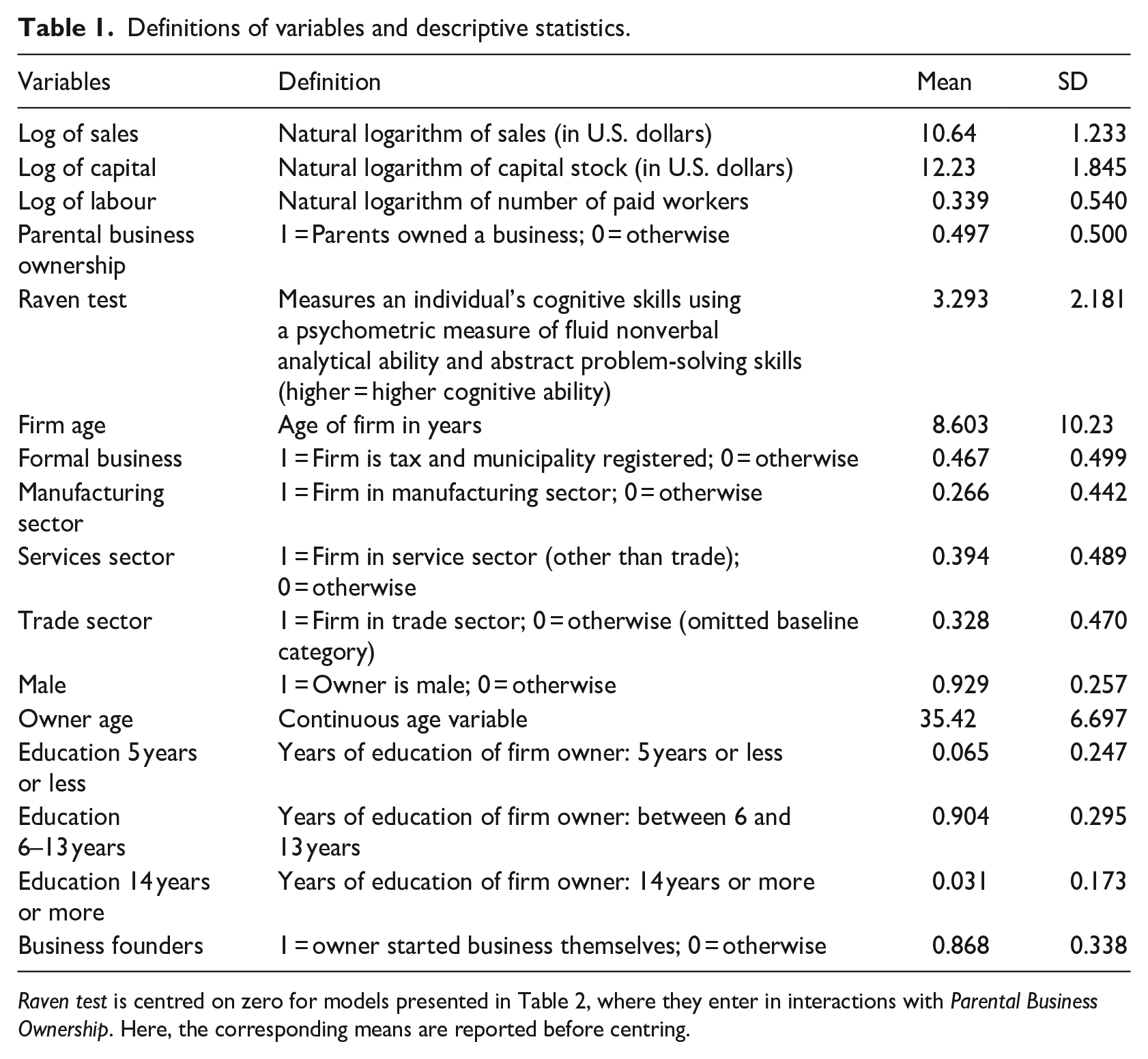
Raven test is centred on zero for models presented in Table 2, where they enter in interactions with Parental Business Ownership. Here, the corresponding means are reported before centring.
Finally, in developing economy firms, the size of capital is strongly influenced by education, as we know from the literature (Van der Sluis et al., 2005). We also confirm it empirically for our data: when log of capital is regressed on educational dummies, the effects are all highly significant (p < 0.001). Thus, because capital intermediates between education and sales, the effect of education is attenuated. Therefore, below we will also consider additional models without log of capital. These models capture indirect effects of education alongside its direct effects.
Model specification
Combining the variables, we use the following reduced-form equation:
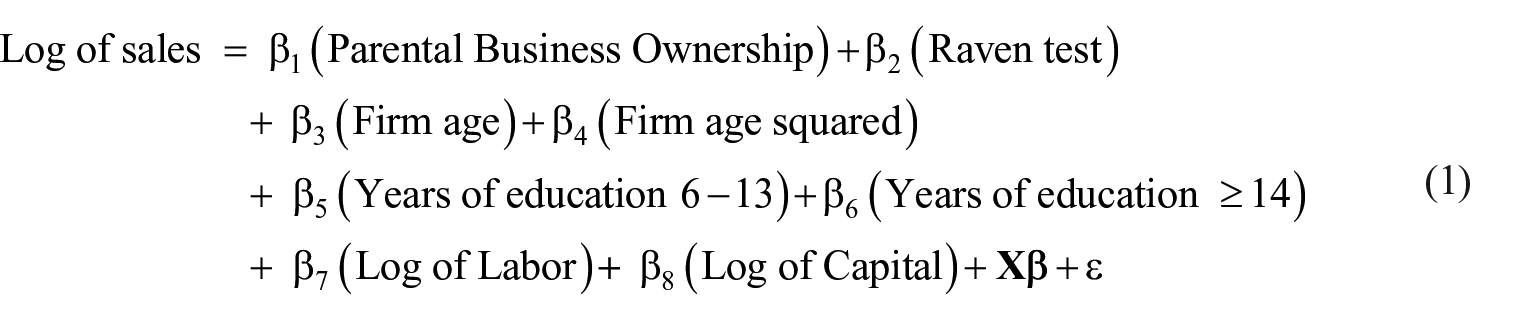
Here,
Given the cross-sectional nature of our data, we apply the ordinary least-squares estimator with robust standard errors (Wooldridge, 2016), utilising Stata software. To investigate any potential issues of multicollinearity, we calculate variance inflation factors (VIF) for all our variables in the Sri Lanka sample in all specifications. We find no indication of multicollinearity problems. The two variables for which we have linear and quadratic terms (age of firm; age of the owner) exhibit, as expected, higher VIF scores. In all models, the mean VIF score is likewise predominantly inflated by the owner age and owner age squared variables and slightly less by the firm age and firm age squared variables because, by construction, these variables are highly correlated within the two pairs. Generally, multicollinearity should be seen as an estimation problem only for small samples (Wooldridge, 2016), which is not applicable in our case.
Results
Descriptive statistics and correlation table
Among those surveyed, 67% of the sample of founders and/or owner-managers of small or micro businesses in Sri Lanka are self-employed sole proprietors. Another 17% have one paid employee, 8% have two paid employees, 3% have three paid employees, 2% have four paid employees and 1% have five employees. This leaves 1% of the sample with more than five employees, and the largest number of employees in the sample is 40.
The average business owner in the sample is 35 years old, with 10 years of education. Approximately 92% of the owners are male, and half of the sample has at least one parent who owned a business in the past. There is an average of 23 firms in the same business line within 1 km of the owner’s firm. The average age of the firm is nine years. Overall, 47% of the sampled firms are registered and taxed with the local municipality. Table 1 provides further detail.
The correlation matrix, shown in Table 2, reveals that the log of sales is strongly correlated with the log of labour, and next with log of capital, consistent with the production function approach. The third strongest correlation for log of sales is for being located in the service sector (other than trade). It has a negative sign as we would expect. Within the set of explanatory variables, we see education as being positively correlated with cognitive capabilities (Raven test). 5 This completes the list of pairwise correlations with absolute value above 0.2.
Correlation matrix.
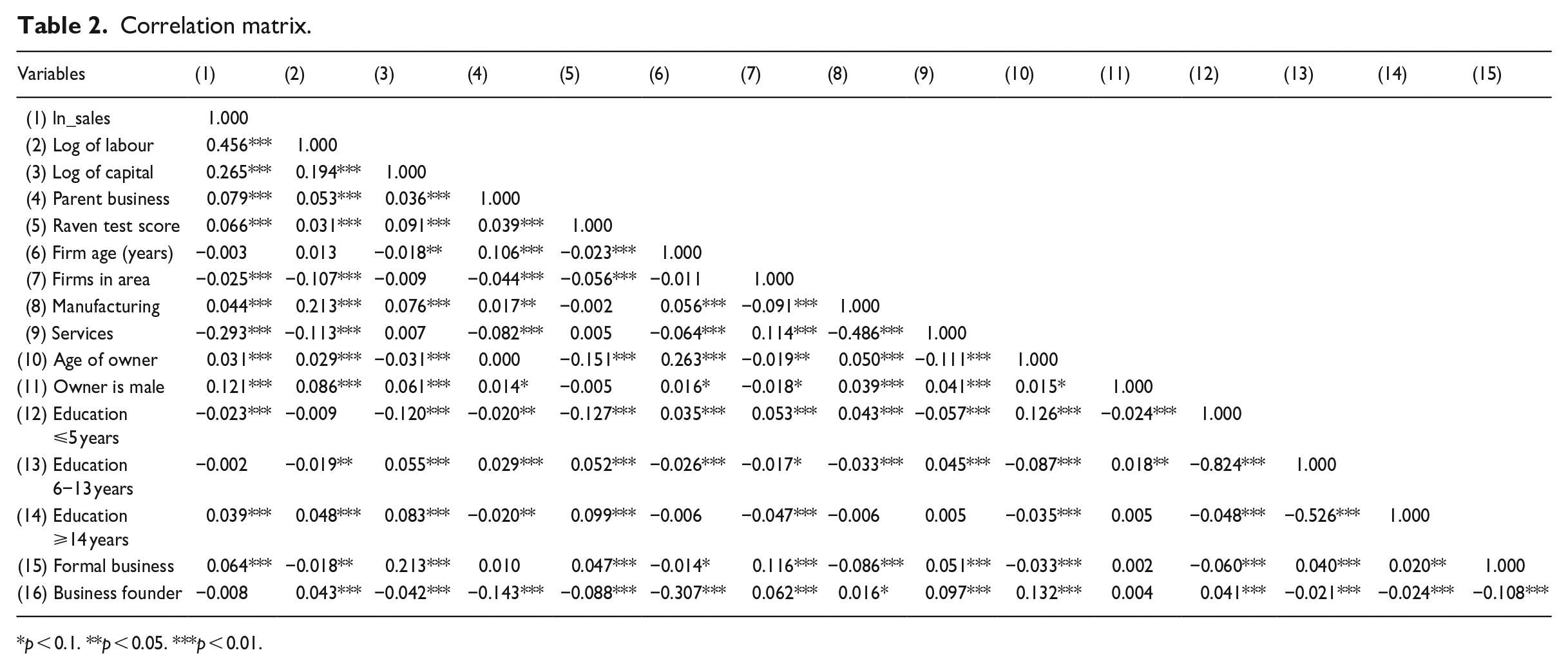
p < 0.1. **p < 0.05. ***p < 0.01.
Effects of parent business ownership, ability, education and founders
Table 3 reports four models. The first and second columns (1) and (2) correspond to our benchmark specifications. Model 1 includes the father- and mother-owned businesses indicator variables separately. Interestingly, the size of the positive mean effects on sales revenue, as represented by the coefficients, is lower for parental business ownership by the father compared with the mother (0.038 vs 0.088). Nevertheless, applying the post-estimation test, we do not detect a significant difference between these gender-specific coefficients (F = 1.46, p = 0.226).
Regression models (dependent variable: logarithm of sales).
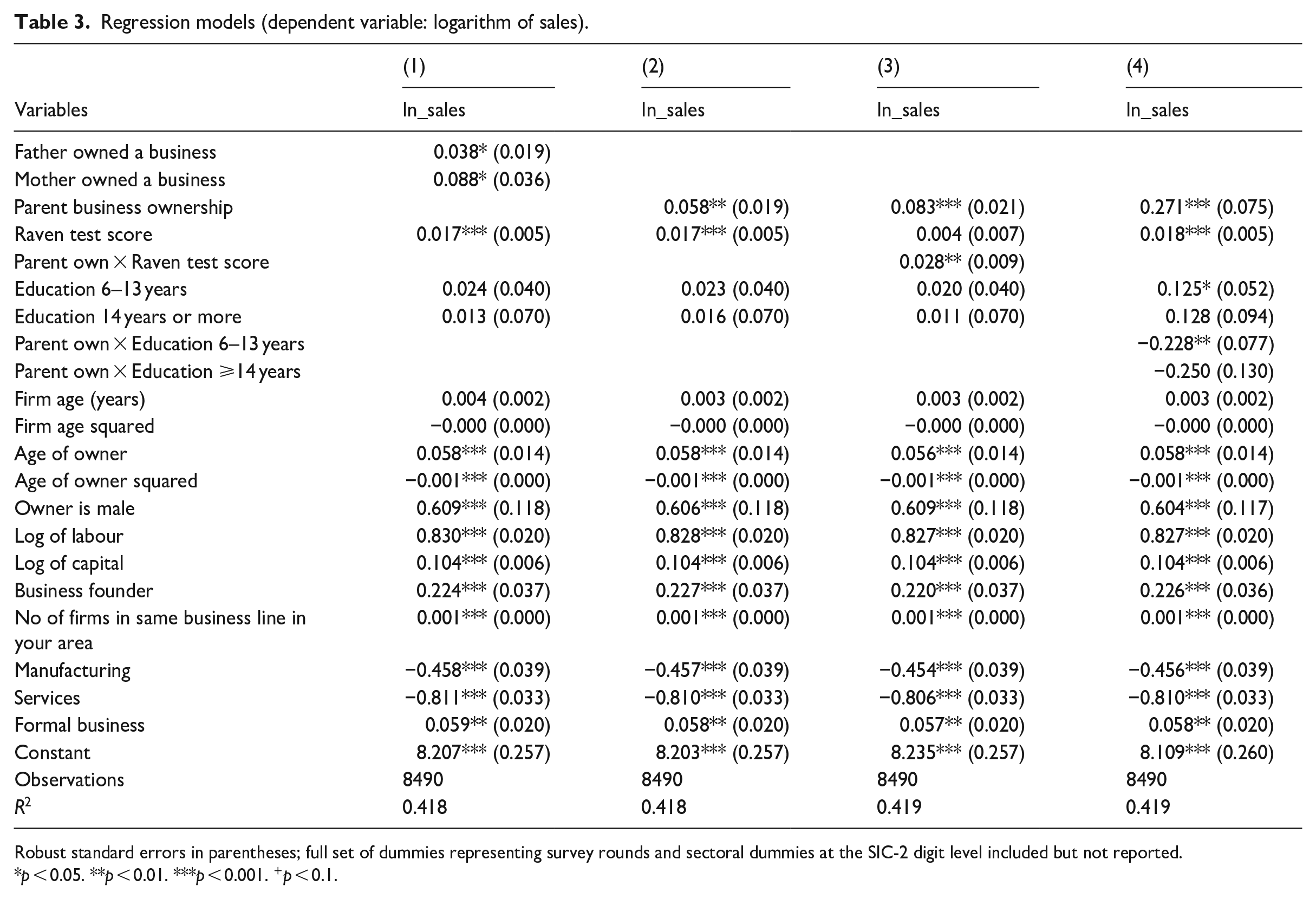
Robust standard errors in parentheses; full set of dummies representing survey rounds and sectoral dummies at the SIC-2 digit level included but not reported.
p < 0.05. **p < 0.01. ***p < 0.001. +p < 0.1.
Based on the test results, we combined the two parent-gender based variables into one, Parent business ownership, and use it in all subsequent models. Table 3 Model 2 tests our baseline hypothesis H1 (Small and micro-entrepreneurs whose parent(s) owned a business achieve better performance in their current ventures). It can also be used to evaluate hypotheses H2a, H3a and H4a. Model 3 includes the interaction between cognitive ability and parental business ownership; Model 4 includes interactions between education categories and parental business ownership, testing the corresponding effects on log of sales, corresponding respectively to Hypotheses H2b and H3b.
The results of our benchmark specification in Table 3 column (2) illustrate that parent-owned businesses have a positive effect on sales. The coefficient’s estimate for the effect on sales is around 0.06, suggesting that parental ownership of a business is associated with 6% higher sales in the offspring’s current venture. 6 This effect is significant at p < 0.01; therefore, we find support for Hypothesis H1. A one-point higher Raven score is associated with 1.7% higher sales (p < 0.001), consistent with H2a. However, coefficients for education while positive are insignificant; therefore, Models 1 and 2 do not support H3a, an issue to which we will return below.
Moderation effects of cognitive skills, education and founder business experience
To explore the moderating impact of cognitive ability on the association between parental business ownership and sales performance, we include the corresponding interaction term in Model 3. The coefficient of the interaction term is significant at p < 0.01 and implies that small and micro-entrepreneurs with higher cognitive skills experience greater performance gains from parental business ownership. This is further confirmed by a joint significance post-estimation test of: parental ownership, Raven test score and their interaction (F = 11.47, p < 0.001). Figure 1 plots the marginal effects of the interaction. As the level of cognitive ability increases (as we move to the right), the differentiating effect of parental business ownership on performance increases as well. For those with parent-entrepreneurs, a one-point higher Raven score is associated with 3.2% higher sales (p < 0.001). For those without parent-entrepreneurs, this coefficient corresponds to 0.4% and is insignificant at conventional levels. Thus, it is for those with entrepreneurial parents that ability has an additional important effect amplifying the knowledge transmission. Cognitive ability makes the learning from parents more effective and amplifies the effect of parental business ownership on entrepreneurship. Thus, there is strong support for Hypothesis 2b.
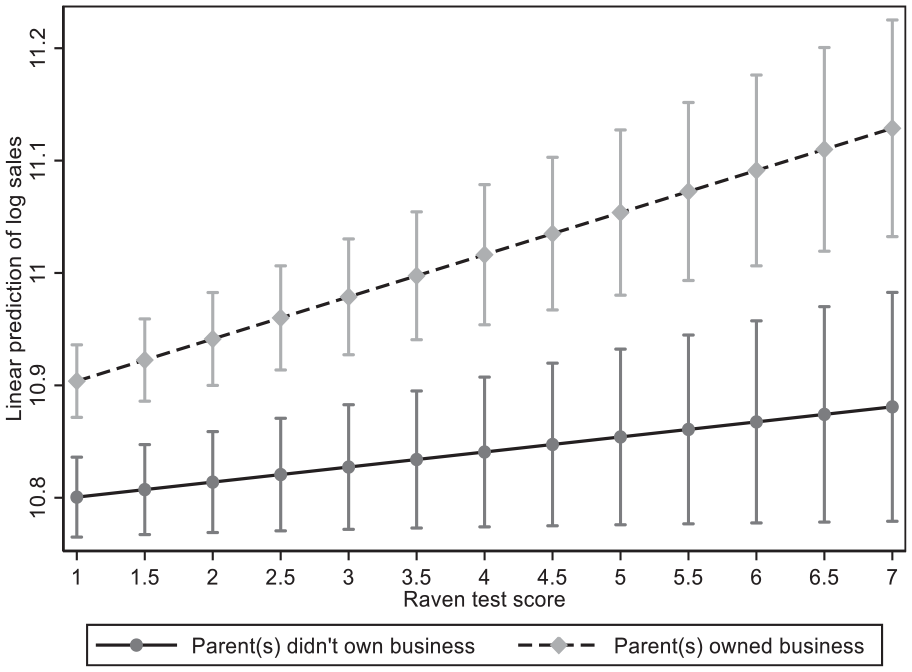
Moderating impact of cognitive ability on the effect of parental business ownership on log sales performance.
Next, we move to the results on the moderating effect of education (as proxied by the corresponding interval of years of education). The corresponding coefficient on interaction with parental business is negative and significant at the probability level p < 0.01 for secondary education. The interaction effect of post-secondary education with parental business ownership is also negative, and the size of the effect is slightly larger, but it is insignificant due to larger standard error. However, running the post-estimation test of joint significance of both interaction terms, education dummies and parental business ownership, we obtain F = 3.71, which is significant at p < 0.01. Figure 2 plots these marginal effects. For those with education beyond the primary level, the difference in performance between having and not having parents who were business owners becomes indistinguishable. In contrast, for those with only primary education, there is a significant premium for having parental business owners, consistent with Hypothesis 3b.
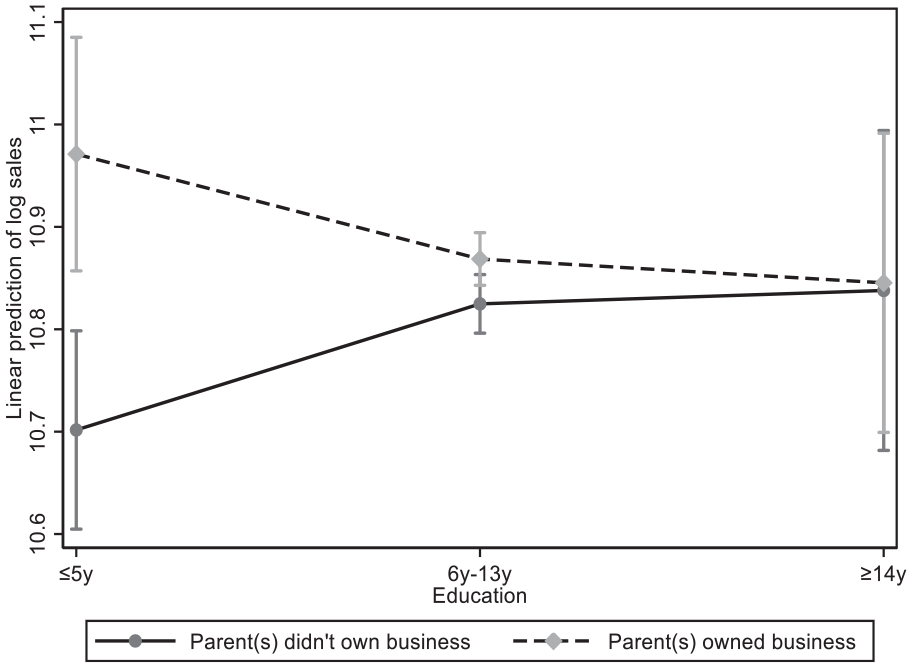
Moderating impact of education on the effect of parental business ownership on log sales performance.
Interpreting Figure 2, we should keep in mind that Model 4 captures only direct effects of education and washes out all its indirect effects. Van der Sluis et al. (2005) emphasise that the higher level of education implies better opportunities for business financing, both because it is associated with accumulation of one’s own wealth and because it facilitates access to external finance. They also observe that choice of business sector may likewise be endogenous to education, because those with higher education may choose sectors that require higher technical competence with higher rewards. Motivated by these observations, we tested alternative models, and the results are illustrated in Figure 3. In the right upper corner, we first present the marginal effects of the model that has only parental business ownership, educational dummies and their interactions. Here, the coefficients of increased education are unambiguously positive both for those with and without parental business ownership. The effects on sales performance converge as the level of education increases. Looking at the confidence intervals, we can also see that these effects are estimated precisely. Next, the right upper panel represents the model with all the control variables except the two-digit sectors (only the distinction between manufacturing, services and trade is retained). The effects of higher education are now attenuated. In the lower panels, we add first two-digit sector of activity (on the left) and finally also capital (on the right, which implies we replicate Figure 3). The indirect effects of education are now absorbed by other variables and the pattern is less clear, except the differences between those with and without parent-entrepreneurs, as already discussed.
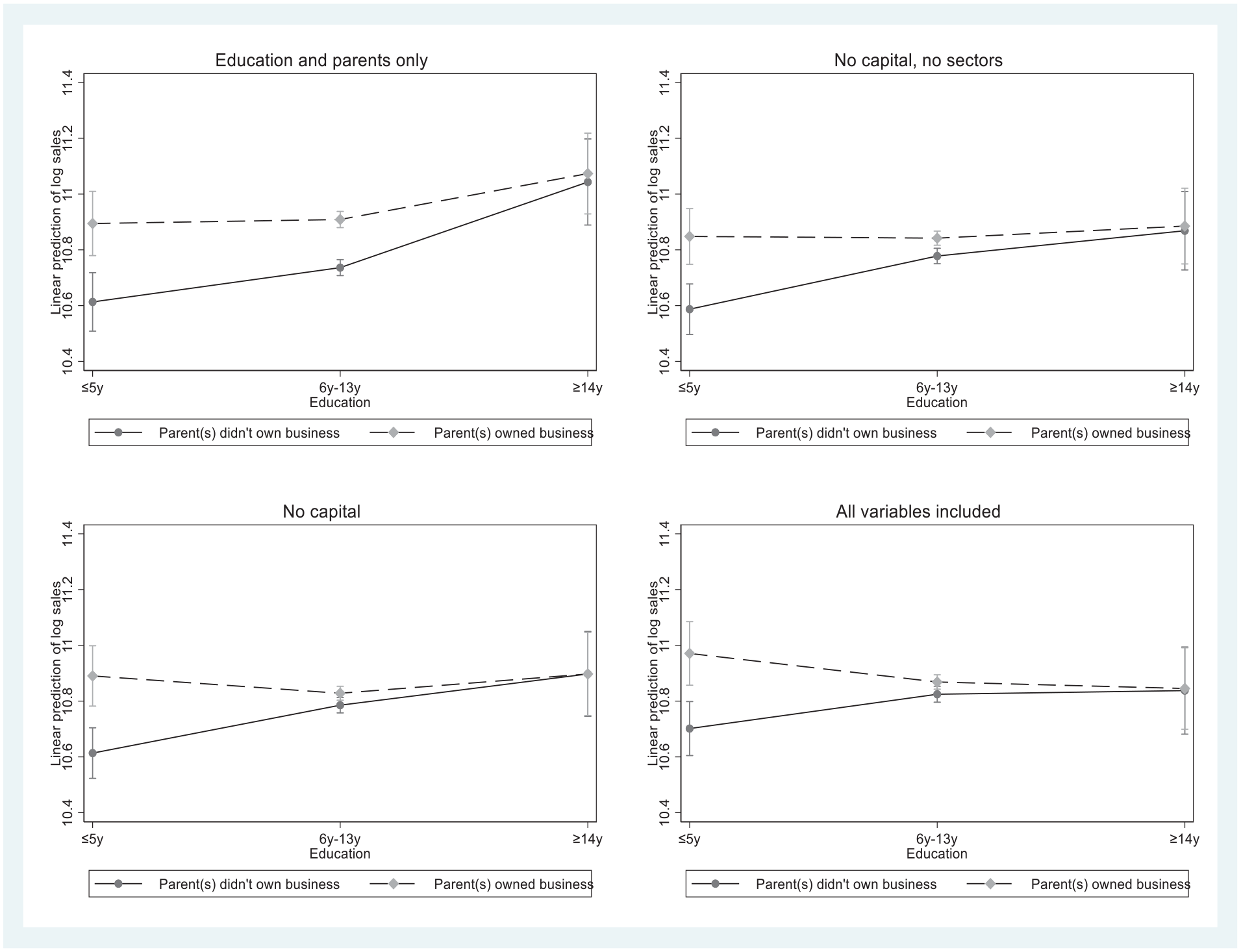
Moderating impact of education on the effect of parental business ownership on log sales performance, under alternative model specifications.
Finally, Hypotheses H4a and H4b, which concern the interaction between firm age (business-specific managerial experience) and parental ownership, are tested on the subsample of those owners-managers who founded their businesses. To investigate performance gains through the lens of experiential learning (learning-by-doing) by the founder, we need to limit the sample to those who started and still manage their own firm. The overwhelming majority of respondents are also founders of their ventures; nevertheless, as can be seen from Table 1 statistics, dropping non-founders shrinks the sample by 13%.
Table 4 presents these results. Model 1 replicates the baseline Model 2 from Table 3, and we see little selection effect resulting from narrowing the sample, when it comes to the effect of parental business ownership. The coefficient is significantly positive and remarkably retains about the same value of 0.06 (6% premium in sales). Model 2 modifies the design so now we control for age of founder at time of start-up, instead of their overall age at time of survey. The effect of age at start-up is significant and negative, suggesting that firms started at a younger age of the founder perform better. The effect of parental business ownership on sales performance is still approximately 6%.
Regression models (dependent variable: logarithm of sales (founders only)).
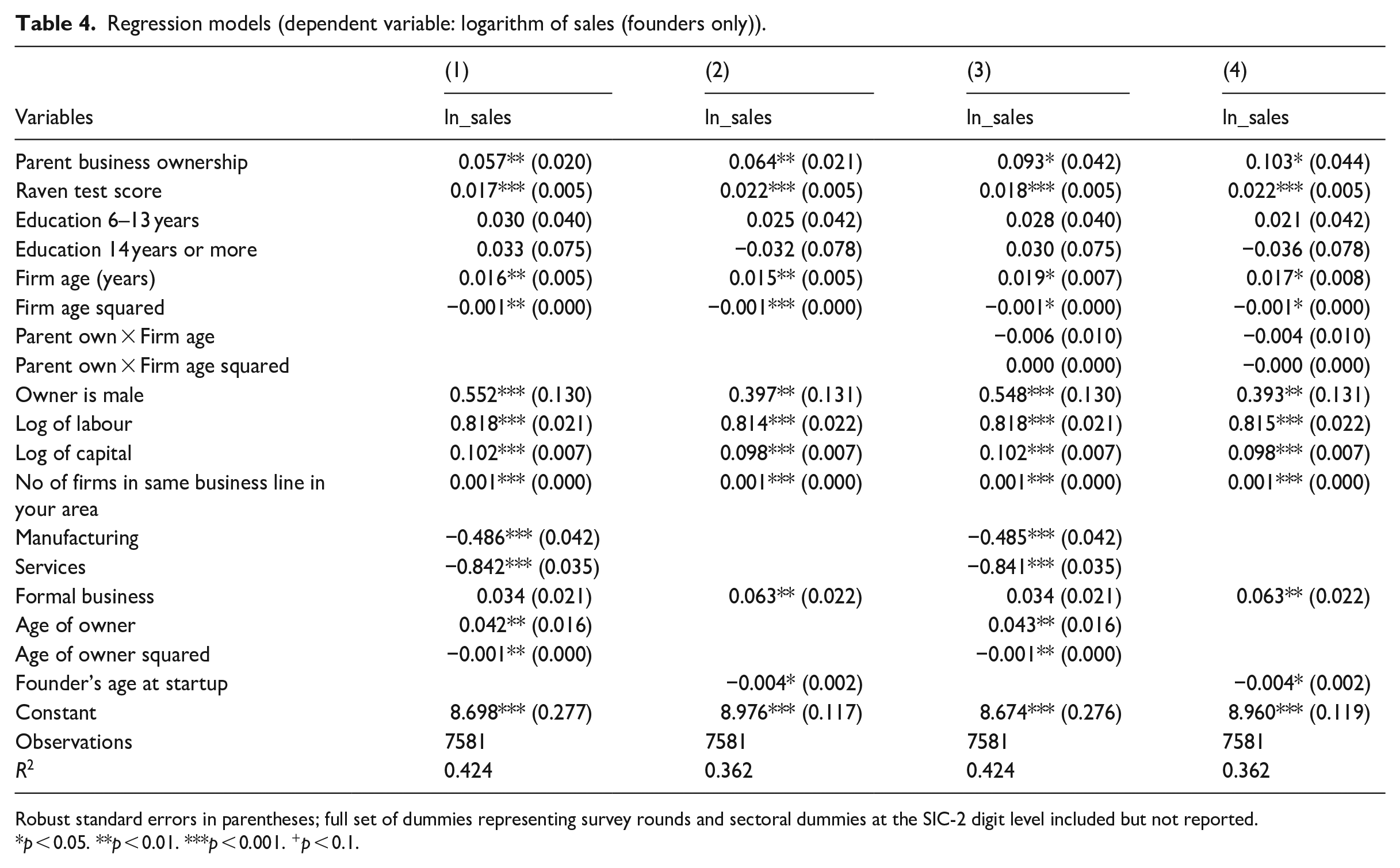
Robust standard errors in parentheses; full set of dummies representing survey rounds and sectoral dummies at the SIC-2 digit level included but not reported.
p < 0.05. **p < 0.01. ***p < 0.001. +p < 0.1.
Models 3 and 4 are analogous to Models 1 and 2 correspondingly, but we now include the interaction effect between length of firm-specific experience (now equivalent to firm age) and parental business ownership, to test Hypothesis 4b.
The results seem slightly weaker than for the other hypotheses. The corresponding interaction terms are insignificant. On the other hand, the joint post-estimation tests of the components and their interactions render F = 3.75 for Model 3 and F = 5.65 for Model 4, significant at p < 0.01 and p < 0.001 respectively. To understand the results, we need to plot the marginal effects, and these are presented in Figure 4. It reveals an interesting nonlinear pattern.
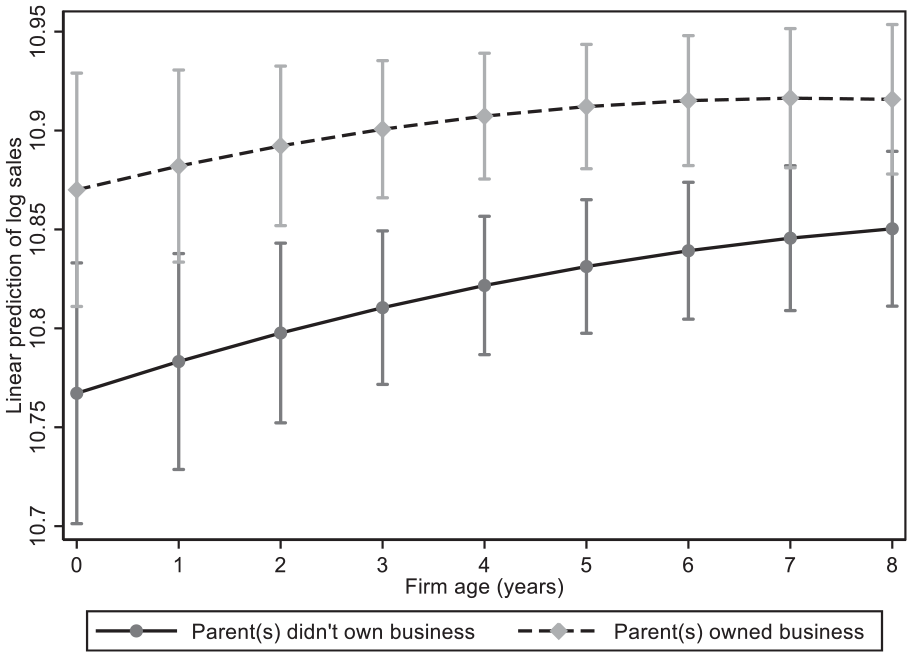
Moderating impact of business-specific managerial experience (firm age) on the effect of parental business ownership on log sales performance.
First, we can observe that for founders, sales correlate positively with age, yet the difference in sales performance decreases with firm age. This suggests that our hypothesis H4a is supported, but with the qualification that it is only for the first 8 years of firm age.
Second, it seems that more learning from firm-specific experience takes place in the case of founders without parental business owners, as represented by the steeper slope of the lower curve on Figure 4. This is consistent with Hypothesis H4b.
Third, the pattern is nonlinear: for very young firms, aged less than 2 years, the dispersion in sales performance effect, as evidenced by the confidence intervals, is high, and therefore, the difference between firms managed by founders with and without parent-entrepreneurs is statistically not significant. However, from the second year of firm existence onward, the difference becomes significant, and the founders with parent-entrepreneurs have an edge. Yet, those without parent-entrepreneurs are catching up, and for firms that are at least 8 years old the difference becomes insignificant again. Thus, the effects suggest that small and micro-entrepreneurs without parental business owners realise greater performance gains as their own ventures age through experiential learning, relative to the initial advantage of those whose parent(s) owned a business. Thus, Hypothesis 4b is partly supported, while it needs a calibration. We cannot say generally that the performance difference between those with and without parent-entrepreneurs diminishes with age, because it is also insignificant in the first year after the firm was created. Further, our evidence suggests that this experiential catching up takes time; only after seven years does the performance of firms started by those without parent-entrepreneurs become statistically indistinguishable from those started by those with parent-entrepreneurs.
Controls
We next discuss results for the control variables. The effect of log capital and log labour on log sales is consistently positive and highly significant, consistent with the Cobb–Douglas production function model, with much higher size of the labour effect. Given that both variables are entered in logs, we can interpret the coefficients as elasticities; these are consistently estimated as being slightly above 80% for labour, and about 10% for capital. Remarkably, the coefficients on log capital closely mirror the findings in McKenzie and Woodruff (2017) who combined Sri Lankan data with samples from other countries (at cost of not including parental business ownership and some controls). While our labour coefficients are slightly higher than theirs, they similarly remain several times greater than those for capital. The coefficients for the manufacturing and services sectors appear consistently negative and highly significant in all models, even as we also include the lower level-2 SIC sectoral dummies, implying that it is the baseline trade sector which is associated with highest sales performance. At the same time, manufacturing appears to be characterised by stronger performance than (other) services.
Moving to individual-level variables, for owner age, we obtain a positive and significant linear effect and a negative and significant quadratic effect across all models, reflecting previous findings on age (Morris et al., 2012; Ucbasaran et al., 2010). Calculating the first derivative and equating with zero (based on Model 1 in Table 3), we find that the owner age associated with the highest performance is 31 years – performance increases with age till then, and subsequently decreases as the age of the owner increases. The positive and significant coefficients for males in all models may indicate social constraints on growth for female business owners (Ashraf et al., 2019; Uzuegbunam and Uzuegbunam, 2018). However, the corresponding coefficient (0.590) is smaller than that obtained in the combined country dataset (McKenzie and Woodruff, 2017), suggesting that gender discrimination may be lower in Sri Lanka compared with other developing countries in the sample (Sen Nag, 2019). In keeping with previous work on informality (Fajnzylber et al., 2011), tax- and municipality registered businesses are associated with higher performance. Finally, for business owners, starting their own businesses rather than inheriting them is also positively associated with performance gains (Table 3).
Discussion
This study critically evaluates how small and micro-entrepreneurs in Sri Lanka acquire knowledge to enhance business performance within resource-constrained settings. We place particular emphasis on the role of parental transmission of business knowledge and the conditioning influence of human capital elements. In contrast to previous research that predominantly focuses on entrepreneurial intention and business formation (Capolupo et al., 2023; Zapkau et al., 2017) and highlights the importance of transmitted attitudes, values and motivations (Hoffmann et al., 2015; Laspita et al., 2012), our study shifts the emphasis to the cognitive aspects that affect post-entry performance (Baron, 2004). We utilise SCT (Bandura, 1997, 2006) to posit that entrepreneurial parents exert an overall positive influence on the performance of ventures launched by offspring. However, those without parent-entrepreneurs are able to compensate either through their own education or experiential learning accrued from managing their own business. We theorise that for offspring of entrepreneurial parents, parental knowledge transmission occurs through social cognitive mechanisms such as observational and vicarious learning, role models and potential mastery experiences within their parent’s business. In contrast, those without parent-entrepreneurs derive greater performance benefits from the positive influence of education and acquire knowledge through experiential learning-by-doing as their own ventures mature. Yet, the empirical findings suggest important nuances. Only for individuals with primary education, we see a strong contrast between those with and without parental business owners: for this group, having parent-entrepreneurs makes a difference to sales performance. Moreover, parental entrepreneurship also confers an advantage only for young (but not nascent) firms, until those founders without parent-entrepreneurs catch up through specific business experience.
Theoretical implications
This study has several theoretical implications that offer useful contributions to the literature. First, we consider knowledge transmission pertaining to parental entrepreneurship through a social cognitive lens, linking SCT with human capital concepts, to better understand different channels of entrepreneurial knowledge acquisition. In so doing, we add to the discussion on social, observational and experiential learning and the cognitive perspective in entrepreneurship (Bacq et al., 2017; Liu et al., 2015), while filling a gap regarding the effect of parental transmission on business performance (Capolupo et al., 2023; Zapkau et al., 2017). This builds on emerging research that expands upon formal education to consider family background and business experience as contributors to the human capital that drives entrepreneurship (Estrin et al., 2016; Jayawarna et al., 2014), especially within cultural contexts oriented towards in-group collectivism and family cohesion (Laspita et al., 2012).
Second, given that entrepreneurs cannot choose their family history, we suggest compensatory opportunities for the positive effects of parental business ownership. This points to alternate learning pathways for those without parent-entrepreneurs to generate sales performance. Previous work has proposed, but not confirmed, a tapering-off effect of vicarious learning among entrepreneurs as ventures age (Liu et al., 2015). Indeed, our results suggest that the relative performance advantage of vicarious learning experienced by offspring of parent-entrepreneurs does fade, while firm age generates a particular experiential learning-by-doing benefit among business founders without parent-entrepreneurs. We further highlight the nuanced effects of human capital. Emphasising that ability plays a critical role amplifying the effects of parental learning adds nuance to the application of SCT. We also extend the empirical analysis of the role of education by demonstrating that the corresponding coefficients are highly sensitive to inclusion/exclusion of other factors. This is because several factors mediate between education and performance outcomes, with enhanced access to external finance and own capital playing an important role (Van der Sluis et al., 2005).
More broadly, this study contributes to the growing literature that addresses micro- and small enterprises in developing countries (Bruton et al., 2021; Medina and Schneider, 2018), a context that has frequently been underrepresented in enterprise datasets (Engelen et al., 2014), particularly with regard to Sri Lanka. Previous research finds that business knowledge and skills may be lacking among small and micro-entrepreneurs (Berge et al., 2011), while human capital endowments can be enhanced by informal sources of information, such as social ties (Boafo et al., 2022; Ramos-Rodriguez et al., 2010). We extend this work by theorising how knowledge sources in the immediate family environment support business performance through social cognitive processes, arguing that these channels hold particular value for the most disadvantaged – especially those with limited education.
Practical implications
This study has several implications for policy and practice. Previous research suggests that understanding the mechanisms by which parents transmit business knowledge to offspring is useful for both entrepreneurial practice and policy design (Hoffmann et al., 2015). At the individual entrepreneur level, the findings not only indicate the effectiveness of parental transmission but also hint at compensatory strategies to access necessary knowledge, such as experiential learning within the firm. At a community or regional level, policymakers can utilise these insights to replicate or support initiatives to foster enterprise performance – beyond the initial entry decision – amongst small and micro-entrepreneurs in constrained or developing contexts. For instance, informal role-modelling and mentorship or exchange programmes would supplement the social cognitive pathways, further enhancing business performance. Local programmes such as business incubators, supported accelerators or entrepreneurial shadowing (Mirindi, 2020) would actively encourage observational learning. Increased opportunities for knowledge transmission, whether through formal or informal means such as networking, training or trade organisations, are likely to improve business outcomes. At the national and global levels, such efforts could contribute to sustainable development, promoting inclusive growth through small and micro-enterprise (SDG8) and increasing income opportunities at the base of the pyramid (SDG10) (UNDESA, 2022). Furthermore, similar approaches may also be relevant in developed countries, particularly in disadvantaged, resource-constrained regions (Lee et al., 2019).
Limitations and future research
This study has certain limitations that could be addressed in future research. Studies on small and micro-entrepreneurs in developing countries face issues around access to quality data (Engelen et al., 2014). While the current study leverages high-quality data from an existing source, going forward, the specific content of knowledge transmitted within the social learning process could be unpacked – for instance via targeted surveys, qualitative interviews or ethnographic research. Similarly, different learning mechanisms that affect performance of small firms could be further explored from the perspective of internal, practice-based acquisition versus external proximal sources such as peers (Battisti et al., 2019). While the current study views parental entrepreneurship as a proxy for transmission, distinct learning pathways should be examined between observation and experience, for those who do not work in parental businesses (Fairlie and Robb, 2009). The large confidence interval around the coefficient representing the years of schooling corresponding to higher education may reflect an opportunity cost for more educated individuals and possible negative selection; that is, those with higher levels of education would tend to have access to a greater array of career opportunities beyond small and micro-enterprise. Holding ability constant, education offers other options so that some high performers select out of small-scale enterprise and into formal employment. It would be worthwhile to investigate those choices directly.
More generally, our study emphasises the importance of knowledge channels beyond or in addition to formal education in building entrepreneurial skills. In that sense, while we stress parental transmission, the acquisition of specific business practices within industries may follow alternate pathways, especially for offspring who found ventures in different business sectors from their parents. In such cases, the role of formal and informal learning channels via trade and industry social networks may be more relevant (Zhang et al., 2023). This is worth exploring further. Variables worthy of further investigation include gender, given the effect of gender role stereotypes on entrepreneurial behaviours as well as role model influences of mothers on daughters regarding self-employment (Greene et al., 2013). In addition, small enterprises in some contexts may be run on a family basis, in which both partners are active entrepreneurs, but only the male partner or parent is formally reported as the owner. Going forward, female ownership of firms and gender effects would be a fruitful area for study (Jayawarna et al., 2014). For instance, the difference between the role model effect of female versus male parental entrepreneurs and gender of offspring merits further exploration (Hoffmann et al., 2015; Mungai and Velamuri, 2011), as does family configuration.
While social learning is a universal capacity, the process through which it occurs varies across cultures and settings (Bandura, 2023), for instance in contexts with a cohesive family orientation and in-group collectivism (GLOBE, 2020; Heine, 2020). However, while we see collectivist cultural orientation in Sri Lanka as an important boundary condition for our research, it is important not to apply overly simplistic interpretations of culture. While it may support family learning, Sri Lankan culture is consistent with affirmation of self-reliance (Niles, 1998) and therefore conducive to entrepreneurship. It has been noted that cultural collectivism may support business and entrepreneurship, in particular in south-east Asia (Harper, 2003; Laspita et al., 2012); what we suggest however, is that parental transmission, supported by the related values, may play a particularly important role in cultural embeddedness of entrepreneurship. Again, this is worth further exploration.
As a single-country study based in Sri Lanka, the findings may not be broadly generalisable to other settings. Comparative analysis was not performed, for instance between high- and low-collectivistic contexts (GLOBE, 2020). Future research could encompass a broader range of countries to assess if parental transmission, as well as alternative pathways, hold not only in different cultural (Stephan et al., 2015) but also (formal) institutional contexts (Mickiewicz et al., 2021) and if differences are seen in a comparative study. In particular, it would be interesting to investigate whether parental transmission has equally strong effects on performance in more individualistic cultures, where the role of family-based identity, parental authority and control differs (Heine, 2020). Building on the existing study, these pathways offer fruitful opportunities for future research.
Conclusion
This study aims to answer the question of how parental business ownership influences the performance of ventures subsequently founded by offspring of entrepreneurs, conditional on individual cognitive ability, formal education and firm-specific business experience. Applying SCT and human capital theory (Bacq et al., 2017; Bandura et al., 2001; Liu et al., 2015), we develop and test our hypotheses based on a pooled survey dataset of 8453 small and micro-entrepreneurs collected over seven years in Sri Lanka, accessed from the World Bank. Our study expands the application of these theories to address a less-explored context relevant to micro- and small businesses that dominate the landscape across developing and emerging economies (Bruton et al., 2021). Opening the ‘black box’ of the experience and background of individual small and micro-entrepreneurs is an important emerging subject area in the literature (Block et al., 2015; Carlson, 2023). While small and micro-enterprises in developing economies have been the subject of studies by economists and development agencies (Bruton et al., 2021; Carlson, 2023; De Mel et al., 2013, 2014; McKenzie and Woodruff, 2017) informing the current study, theorising has only recently begun to address the important niche explored in this article.
Footnotes
Funding
The author(s) received no financial support for the research, authorship and/or publication of this article.
