



Abstract
Research regarding the influence of personality traits, such as narcissism, on entrepreneurial orientation (EO) is burgeoning, yet the role of affective and cognitive mechanisms is under-examined. Drawing from research on conservation of resources (COR) theory, entrepreneurial cognition and emotion, we examine the narcissism-EO relationship nexus. Specifically, we analyse the mediating role of the resource-induced coping heuristic (RICH) and the moderating influence of fear on the relationship between narcissism and EO. Longitudinal data from CEO-entrepreneurs of SMEs in six countries were collected during the COVID-19 disruptions. Results suggest that the RICH fully mediates the relationship between narcissism and EO. Fear of COVID-19 (FC-19) positively influenced EO and strengthened the narcissism-RICH relationship. Further, pandemic-related disruptions negatively influenced EO and attenuated the positive influence of FC-19 on EO. These findings offer insight into the drivers of entrepreneurial behaviour during times of disruption.
Keywords
Introduction
Entrepreneurial orientation (EO) – a firm’s proclivity towards risk-taking, innovativeness, and proactiveness – can aid firms to pivot and grow in a disruptive context (McGee and Terry, 2022). Despite a plethora of research regarding firm performance outcomes of EO, limited scholarly attention has been paid to the individual-level antecedents of EO (Pittino et al., 2017; Wales, 2016). Contemporary research warrants deeper insights into psychological processes, including cognitions and emotions, ‘to broaden the nomological net in studying the antecedents of EO’ (Stewart et al., 2023: 2929). In this study, we focus on the cognitive and affective mechanisms through which the personality trait of narcissism influences EO. Entrepreneurship research has established a relationship between narcissism and EO (Leonelli et al., 2022; Leung et al., 2021; Li et al., 2021). Yet, it has been suggested that the relationship is more complex (Cragun et al., 2020; Wales et al., 2013). For instance, Gerstner et al. (2013) examined the mediating role of managerial cognition in the relationship between CEO narcissism and unconventional innovation strategies. We also recognise that ‘a study of the entrepreneurial mind is incomplete without considering the role of entrepreneur affect, – namely their emotions’ (Delgado García et al., 2015: 191). Top manager emotions play a significant role in directing SME strategic choices, including EO (Bernoster et al., 2020; Miocevic, 2022). Scholars suggest that intervening variables may act as conduits or pathways, influencing the relationship between an entrepreneur’s personality traits and action choices, such as EO (Frese and Gielnik, 2014; Klotz and Neubaum, 2016; Stewart et al., 2023). However, our understanding of the mechanism through which narcissism influences the strategic choices of entrepreneurial firms is limited.
To address the above stated gap, we conducted a longitudinal study to identify the cognitive and affective mechanisms through which CEO narcissism influences EO. We draw from research on entrepreneurial cognition and COR theory (Hobfoll et al., 2018) and analyse the mediating role of the resource-induced coping heuristic (RICH; Lanivich, 2015). We additionally consider research on affect in entrepreneurship and examine fear as a trigger in acquiring, protecting and developing resources, as measured through the RICH for people with narcissistic tendencies. While entrepreneurship theories have addressed uncertainty management by entrepreneurs, Rauch and Hulsink (2023) espouse for a deeper understanding of the impact of life-threatening events on entrepreneurship. We contextualise the discrete emotion of fear in the context of COVID-19. With our longitudinal study, we make several contributions to the narcissism and EO literature. First, we open the black box on the relationship between narcissism and the RICH. By taking an individual-level perspective, we add to the literature on the drivers of differences in EO among firms (Palmié et al., 2018) during disruptions. Specifically, by distinguishing the mediating role of the RICH, we contribute to a better understanding of the relationship between personality and cognitive antecedents of EO (Gorgievski and Stephan, 2016; Klotz and Neubaum, 2016; Stewart et al., 2023). Second, we advance the literature on the role of discrete emotions within entrepreneurship by gauging the emotive reactions of entrepreneurs and their influence within the personality-EO nexus. Third, by including separate variables to capture the role of fear and disruptions, we distinguish between the threat of resource loss and actual resource loss (Halbesleben et al., 2014), enabling deeper insight into how EO may be enhanced in response to different types of threat. This is particularly relevant for firms in times of uncertainty (McGee and Terry, 2022; Wales et al., 2023). We demonstrate that the fate of a small firm during a disruptive event depends largely on the personality (Wales et al., 2023), coping mechanisms and personal circumstances of its leader (Newman et al., 2022).As environmental disruptions or external shocks are likely to reappear in the future, it is important to understand the micro-level processes that help CEOs to manage these events (Batjargal et al., 2023; Newman et al., 2022; Stephan et al., 2023). Although this study focuses on disruptions stemming from COVID-19, knowledge from our findings could be generalisable in the creation of strategies for disruption/loss management.
In the next section, we review the extant literature and develop our hypotheses. Thereafter, we present our methodology, analysis and results. In the concluding sections, we discuss the theoretical and managerial implications and limitations of our research and offer directions for future research.
Literature review and research hypotheses
Entrepreneurial orientation
EO refers to the degree to which a firm ‘engages in product-market innovation, undertakes somewhat risky ventures, and is first to come up with ‘proactive’ innovations, beating competitors to the punch’ (Miller, 1983: 771). Resource-constrained SMEs require a strategic posture such as EO to efficiently utilise their limited resources and attain a competitive advantage (Bernoster et al., 2018; Brouthers et al., 2015; Wiklund and Shepherd, 2003). Importantly, EO is a beneficial strategic stance that enables the firm to navigate the uncertain conditions induced by disruptions (McGee and Terry, 2022). Recognised as one of the most researched constructs in the entrepreneurship literature, EO has been conceptualised and measured at different levels (Wales et al., 2020, 2021). Diverse manifestations of EO include top management style, organisational configuration and new entry initiatives (Wales et al., 2020). Also, researchers have conceptualised EO at the individual (Clark et al., 2023) and team levels (Covin et al., 2020). In the context of SMEs, many scholars agree that CEO characteristics influence strategic elements – such as EO (Palmié et al., 2018; Stewart et al., 2023; Wales, 2016). In small firms, CEOs have a decisive role on the implementation of EO, and it is assumed that their firms mirror their own personas (Palmer et al., 2019). While this does not guarantee that CEOs are the sole decision-makers in their firms, it is ultimately their responsibility to direct the firm and make final decisions regarding firm orientation. Within this tradition, studies typically follow Covin and Selvin’s (1989) uni-dimensional conceptualisation of EO to explain the relationship between the CEO personality, their motivations and firm-level EO (Pittino et al., 2017; Stewart et al., 2023). Covin and Slevin (1989), identified three inter-related dimensions of EO: risk-taking, proactiveness and innovativeness. Risk-taking refers to making risky and large resource commitments on ventures or ideas that have low-probability outcomes. Proactiveness refers to taking the initiative and anticipating opportunities before others. Innovativeness refers to the introduction of products or processes that are novel to a particular market or industry (Miller, 1983; Wales et al., 2021).
A limited body of research explores the influence of individual-level antecedents of EO. For instance, narcissism (Li et al., 2021), self-efficacy and dominance of CEOs (Palmer et al., 2019), effectuation (Palmié et al., 2018), and internal locus of control (for family business successors) are known to foster EO in small firms. Stewart et al. (2023) extend the direct association between personality traits and EO by highlighting the mediating role of decision-maker cognition. Building on this research, and in response to a call to examine the mechanisms through which personality traits influence EO (Klotz and Neubaum, 2016; Stewart et al., 2023), we explore the relationship between narcissism and EO. Specifically, we draw from COR theory (Hobfoll, 1989, 2011) to elucidate the cognitive and affective mechanisms through which CEO narcissism influences EO. Figure 1 illustrates our conceptual model.
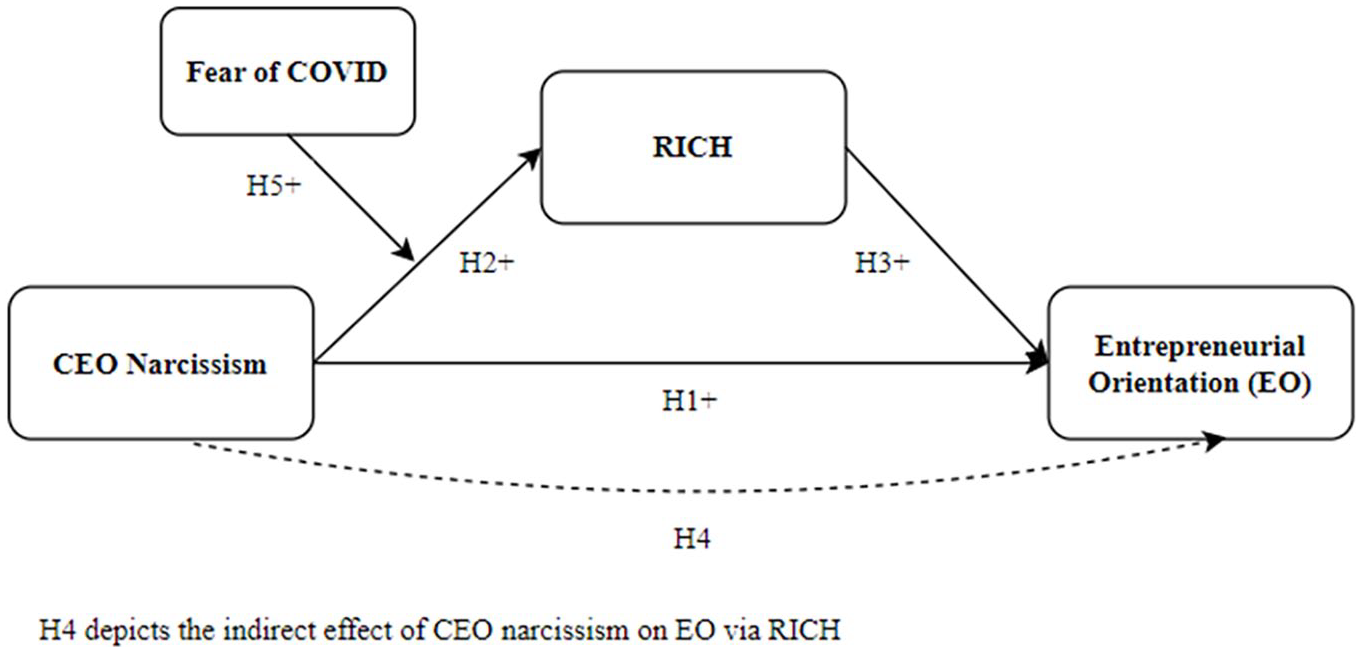
Conceptual model.
Narcissism and EO
Narcissism is a relatively stable individual attribute (Campbell et al., 2011) and is ‘characterised by an inflated sense of self that is reflected in feelings of superiority, arrogant behaviour, and a need for constant attention and admiration’ (Bogart et al., 2004: 36). Narcissists have a strong sense of confidence in their abilities and seek out the next ‘big thing’, even if their present condition is desirable (Navis and Ozbek, 2016). Their need for continued admiration and attention leads them to fantasise about fame (Raskin and Novacek, 1991) and to seek greater power and prestige (Resick et al., 2009). Scholars have linked narcissism with entrepreneurial intentions (Leung et al., 2021), failure of crowd funding campaigns (Bollaert et al., 2020; Butticè and Rovelli, 2020) and venture performance (Wu et al., 2022). Narcissistic CEOs believe that, under their leadership, their firms can manage any challenge (Agnihotri and Bhattacharya, 2019), even in new and unfamiliar contexts (Navis and Ozbek, 2016).They are known to engage in high-risk entrepreneurial initiatives without fully considering the embedded risk and resource requirements (Oesterle et al., 2016; Wales et al., 2013). Prior research has shown that during the global financial crisis (2008–2009), firms led by narcissistic CEOs engaged in high-risk strategies (Buyl et al., 2019). Narcissistic CEOs also engage in opportunity-seeking and forward-looking initiatives (Leonelli et al., 2022; Li et al., 2021).Such proactive behaviours might enable them to take advantage of market opportunities by foreseeing future demand and acting before competitors (Engelen et al., 2016). Pursuing such activities can drive their firms towards recognition as market leaders (Lumpkin and Dess, 1996) and to generate higher levels of net cash flows faster (Srivastava et al., 1998). The tendency of narcissistic CEOs to spend money on research and development programmes pushes their firms to attain greater levels of innovation (Campbell and Campbell, 2009). Gerstner et al. (2013) pointed out that narcissistic CEOs are unafraid to adopt or aggressively invest in unconventional technologies, despite their inherent riskiness. Such bold moves enable narcissistic CEOs to draw attention to themselves and garner the admiration of others (Wallace and Baumeister, 2002). Based on prior research demonstrating the tendency of narcissistic CEOs to behave entrepreneurially (Li et al., 2021; Wales et al., 2013), we expect a positive relationship between CEO narcissism and EO.
COR theory, Narcissism and the RICH
COR theory argues that resources are essential; the inability of individuals to acquire and conserve resources through their own efforts induces stress (Hobfoll, 2001). Individuals do not actively wait for stressful events; rather, in anticipation of future challenges, they amass resources (Hobfoll, 2001). Resources are anything an individual perceives as valuable (Hobfoll et al., 2018) that aid in goal attainment (Halbesleben et al., 2014) and so, also include personal resources such as personality traits and conditions (Hobfoll, 1989). Personal resources are viewed as a primary source to achieve goals; in this context, narcissism may be considered as one such resource. Furthermore, a central tenet of COR theory is that individuals with ‘greater resources are less vulnerable to resource loss and more capable of resource gain’ (c.f., Hobfoll et al., 2018: 106) so for example, Yi-Feng Chen et al. (2021) found that a proactive personality aids in the acquisition and conservation of job resources. Grounded in COR theory, the RICH measures an individual’s cognitive disposition towards resource acquisition and conservation to cope with actual or potential resource loss. The RICH is a useful tool for examining the cognitive mechanism that leads to the acquisition and conservation of resources (COR) without information about the value or specifics of every resource (Lanivich, 2015). The RICH has three dimensions: acquisition, protection and development of resources. Acquisition focuses on the inclination towards acquiring tangible and intangible resources for use, importantly, as noted by Lanivich (2015), it includes recognising the presence of advantageous resources. Protection refers to the tendency to maintain acquired resources and includes the ability to utilise a resource to keep other resources whilst development refers to an individual’s proclivity towards refining or improving acquired resources.
Narcissistic CEOs pursue acclamation and make bold decisions to draw attention to themselves while showing little concern for resource limitations or risk assessment (Engelen et al., 2016; Wales et al., 2013). Although they may follow ambitious strategies irrespective of resource considerations, narcissists have extreme confidence regarding their control over event (Wales et al., 2013). Given their high self-confidence and self-centred behaviours, they are oriented towards hoarding valuable resources (Bernerth, 2022; Nowak et al., 2020). As ‘organisational resource hogs’, narcissists try to gain control over valuable resources (Wales et al., 2013: 1074). Resource acquisition as a concept within the RICH ‘extends from acknowledging the whereabouts of something, to sole control of a tangible asset, and encompasses all operationalisations in between’ (Lanivich, 2015: 867). Narcissistic CEOs might not possess the required resources to execute their ambitious strategies, but they possess the mindset to acquire accessible and useful resources (Campbell and Campbell, 2009) and are also motivated to maintain and protect the resources they consider valuable. Huang et al. (2020) found that individuals high in narcissism are inclined to protect their limited resources, such as time, by engaging with selected colleagues and developing relationships only with those individuals whom they consider advantageous. Protection of resources within the RICH includes expending one thing (e.g. time, capital) to ensure the maintenance of other resources (Lanivich, 2015). Given their obsession with big gains, narcissistic CEOs tend to exploit, manipulate and develop resources to pursue their risky and bold strategic initiatives (Campbell et al., 2011; Engelen et al., 2016; Wales et al., 2013). In accordance with COR theory, it is plausible that narcissistic CEOs, to support their grand visions, exaggerated sense of control and self-centeredness, will acquire and protect valuable resources to stave off and cope with threats to their self-concept. Furthermore, to fulfil their bold and innovative initiatives, they are more likely to develop resources. It follows that a narcissistic CEO will have a higher tendency to display RICH behaviours.
The RICH and EO
COR theory suggests that individuals seek resources to mitigate potential or actual resource loss (Hobfoll, 2011). Building from this premise, Lanivich (2011, 2015) posited that entrepreneurs cope with venture uncertainty through heuristics for acquiring, protecting and developing resources – which can augment entrepreneurship because newly acquired or protected resources can be used to deflect threats or stave off potential losses (Hobfoll, 1989). Displaying RICH behaviours demonstrates competence, which enables entrepreneurs to overcome hurdles in their pursuit of goals (Lanivich et al., 2021). Additionally, developing or re-bundling resources may lead to innovative strategies required for entrepreneurship (Reypens et al., 2021; Williams et al., 2021). Indeed, research on the RICH has been useful in predicting entrepreneurial success (Lanivich, 2015), well-being (Lanivich et al., 2021) and EO (Adomako,2021). Furthermore, resource behaviours stemming from the RICH disposition are attractive to entrepreneurs as resources beget further resources (Hobfoll et al., 2018), and accumulating resources can create potential resource (re)combinations for innovations and entrepreneurial opportunities. Furthermore, resource commitment for experimentation requires both initial resource investment and a resource reservoir to leverage when opportunities arise (Wales et al., 2023), highlighting the importance of acquiring, protecting and developing resources for future use. The critical role played by the cognitive orientation of CEOs in strategic decision-making (Liu et al., 2018; Malhotra et al., 2018) has been noted; cognitive resources, such as the various components of the entrepreneurial mindset, support entrepreneurial decisions and behaviours (Lin et al., 2022; Pidduck et al., 2021).Adomako (2021) recently demonstrated that utilising the RICH as a cognitive strategy leads to proactive, risk-taking and innovative behaviours. However, to enact strategic postures focused on risky, transformative and forward-looking endeavours, firm leaders (e.g. founders, CEOs) must consider the resources and resource combinations required for such exploratory behaviours. In other words, they must be equipped cognitively to make bold decisions regarding which resources to pursue. Thus, this research expands the findings of Adomako (2021) that RICH behaviours are likely to affect EO strategy by exploring how CEO narcissism can motivate use of RICH for firm EO strategy, especially in the context of a major disruption.
Scholars have long considered resource provisions (actual or potential) critical for implementing EO (Barney, 1991; Covin and Slevin, 1991). Wales et al. (2023) emphasise that EO is an exploratory behavioural posture focusing on commitment to new product-market entries, discovery and experimentation. Such efforts require resources (albeit in varying phases) and new resource combinations. Given the emphasis on exploration and experimentation, scholars conceptualise EO as a resource intensive posture to implement innovative, risky and proactive behaviours (Gali et al., 2024). With this in mind, we propose that, as a cognitive heuristic of narcissistic CEOs, the RICH will influence an entrepreneur’s strategic thinking and actions towards entrepreneurialism during a major disruption.
Mediating role of the RICH
A key purpose of this study is to investigate the underlying mechanisms that connect CEO narcissism (a personality attribute) to EO (a strategic posture adopted by the firm). A detailed model linking CEO attributes to firm-level processes was developed by Liu et al. (2018); their causal chain processes convey that CEO attributes influence CEO cognition and emotion, which further influences strategic choices. This model underpins the notion that rather than directly influencing firm-level outcomes, intervening variables (cognition and emotions) link CEO personal attributes to firm-level outcomes. EO as a strategic posture requires implementing proactive, innovative and risky strategic actions to successfully compete with rivals in the industry and gain high returns (Covin and Slevin, 1991). We propose that the RICH is a cognitive mechanism that mediates the effect of CEO narcissism on EO. Relatedly, in their action-characteristics model of entrepreneurship, Frese and Gielnik (2014) proposed several motivational and cognitive factors, including heuristics, as antecedents to strategic choices such as EO. Cognitive factors (e.g. self-efficacy, proactivity) have been demonstrated to positively influence entrepreneurial behaviours such as alertness (Obschonka et al., 2018; Uy et al., 2015). Moreover, in conceptualising COR theory, Hobfoll (2011) and Hobfoll et al. (2018) suggest that resources travel in packs or caravans (i.e. resources beget further resources) and refer to resource passageways to explain the links between caravans of resources. Resource passageways are potential facilitators or inhibitors for building resource pools for goal attainment. Hobfoll et al. (2020) noted that resource caravans, and personal and environmental passageways, are central to protecting oneself from stress in the aftermath of disruptions. Additionally, a resource passageway could attenuate or amplify resource utilisation (Halbesleben et al., 2014). Considering narcissism as a caravan resource, a narcissistic CEOs disposition motivates them to manoeuvre into advantageous positions, searching for resources to support their sense of self. At the same time CEOs, as the figureheads and primary decision-makers of their ventures, are tied to their firm not only through identity but also through duty. This link represents a resource passageway condition that directs resources towards the goals of the firm, like EO. Thus, the caravan of resources that follows narcissistic motivation can also be advantageous to the venture.
Extending this line of reasoning, we argue that the RICH allows narcissistic CEOs to create a pool of resources that can extend to their organisation. Without the proclivity to attain, protect and develop resources that can help cope with threats, the pool of resources needed to combat such threats may not exist, and, especially in times of disruption, may lead to resource shortfalls that curtail or outright halt EO. In this way, narcissism functions through the RICH, allowing narcissistic CEOs to accumulate resources that operationalise their image of grandiosity and protect their ability to develop venture goals during disruptions.
The moderating role of fear
Limited research focuses on how personality traits, cognition and emotion together influence entrepreneurial behaviour. However, Cristofaro and Giannetti (2021) theorise an affective-cognitive approach to highlight that emotions and cognition are intertwined and contribute to entrepreneurship. Utilising the framework of COR theory, wherein resources are a primary bridge between cognition and entrepreneurship (Lanivich et al., 2024), we consider an affective-cognitive approach to suggest that CEO affect, with emphasis on the discrete emotion of fear in the context of COVID-19, will intensify the relationship between narcissism and the RICH to influence EO. The role of fear has been analysed through the lens of COR theory (Reizer et al., 2022; Toker et al., 2015); Reizer et al. (2022) suggested that fear represents a potential threat to personal resources, such as employment, health, life, and this could lead to a decline in cognitive and emotional resources, creating stress. A result is the activation of avoidance behaviours which could manifest in decreased productivity or constrain work outcomes. However, following cognitive neuroscience, Lebel et al. (2023: 1215) suggested that ‘fear’ should be conceptualised in terms of its motivational tendency involving protective effort, which can manifest in a variety of behaviours beyond withdrawal, flight or escape. Indeed, as an adaptive response mechanism, fear encompasses threat appraisal of uncertainty, that could lead to avoidance/escape (flight) or protective/proactive (fight) behaviours 1 (Frijda et al., 1989; Lebel, 2017; Lerner et al., 2015; Ronningstam and Baskin-Sommers, 2013). Thus, the motivation to protect oneself could result in proactive or defensive behaviours with the aim of managing the situation (Lebel et al., 2023), becoming more pronounced in situations where there is no immediate escape route available (Lebel, 2017). This suggests that focusing on the motivational qualities of fear (e.g. protection efforts) can help provide a comprehensive assessment of its influence on action (Cacciotti and Hayton, 2015).
COR theory also emphasises that personality traits can be resources to manage stress, and COR is vital during a major disruption (Hobfoll, 1989). We anticipate that fear, in context, will function as a motivational enhancer intensifying the extent to which narcissism, as an emotional resource caravan, influences RICH behaviours to acquire, protect and develop resources. We focus on the approach-oriented tendencies of narcissists, or their motivation to seek rewards (Foster and Brennan, 2011). This motivation of narcissists intensifies when tasks are challenging and ambiguous because such situations provide an opportunity to demonstrate prowess (Wallace and Baumeister, 2002). Furthermore, narcissists perform better under stressful circumstances (Wallace and Baumeister, 2002), and they are known to utilise fear as a constructive emotion (Ronningstam and Baskin-Sommers, 2013). Therefore, it is plausible that narcissists will harness the protective, yet functional, additional motivation of FC-19.
Extant entrepreneurship research highlights the adverse effect of fear by associating it with avoidance behaviours or the tendency to take flight. For example, the Appraisal Tendency (Lerner et al., 2015) and Feeling as Information (Schwarz and Clore, 2007) frameworks suggest that feelings of fear will predispose entrepreneurs to appraise a situation as highly uncertain, increasing their risk perception (Foo et al., 2009) and decreasing their tendency to exploit opportunities (Grichnik et al., 2010; Welpe et al., 2012). In terms of evidence, Miocevic (2022) found that COVID-19 induced negative emotions, such as nervousness or fear, led SME owners to reduce investment and focus on retrenchment strategies. Furthermore, narcissists have been found to engage in self-protection behaviours, such as hoarding (Nowak et al., 2020), when fearful of the impact of COVID-19 (Blanchard et al., 2023). Hence, we posit that threatening, fear-laden situations will signal an intensified need for the acquisition, protection and development of resources by narcissistic CEOs because their approach-orientation motivates them to utilise fear as a constructive, rather than destructive, emotion (Ronningstam and Baskin-Sommers, 2013).Under conditions of FC-19, narcissists may use their self-centredness and insatiable drive for self-enhancement as additional fuel to protect, acquire and develop valuable resources.
Method
As the context of this study, we understand that uncertainty and volatility from the COVID-19 pandemic such as restrictions on work and travel, isolation requirements etc., have affected individuals in different countries in differing ways. Relatedly, research has shown that disruptions from the COVID-19 pandemic affected individuals differently, depending on their personal circumstances and life stage (Mockaitis et al., 2022); for example, disruptions will have affected the extent that entrepreneurs were able to devote time to their business. We thus, accounted for pandemic-related factors in this study, such as pandemic-related disruptions, and work-related factors. Also, the longitudinal nature of our study accounts for cross-national differences over time.
Sample
We recruited participants via Prolific in September 2021 (T1) and March 2022 (T2). We targeted occupational entrepreneurs (Gorgievski and Stephan, 2016) of SMEs because, in the context of small firms, the CEO has substantial influence on organisational processes and decisions (Weaven et al., 2021). We included only entrepreneurs with firms of 500 or fewer employees, following the US definition of SMEs (U.S. S.B.A., 2023). At T1, 472 entrepreneurs completed the survey. We retained 393 usable responses after accounting for missing data. These participants were asked to complete the follow-up survey at T2; we received 251 responses (64% response rate) and retained 244 usable questionnaires. The demographic composition of our sample was as follows: Most of the respondents (93%) represented firms with 100 or fewer employees (4.7% 101–250 employees; 2.3% 251–500 employees). Respondents resided in Australia and New Zealand (12.8%), Canada (25.9%), Ireland (9.7%), UK (20%) and USA (31.5%). The median respondent age was 35 years, and the gender composition of the sample was male (53%) and female (47%); other gender identities were not accounted for. Most respondents (72%) were university-educated and had an average of 8.27 years of entrepreneurial experience.
Measures and procedure
The questionnaires consisted of items in English repeated across T1 and T2, as well as questions that were time-specific. Time-varying measures were recorded at T1 and T2 on seven-point, Likert-type scales (1 = ‘strongly disagree’ and 7 = ‘strongly agree’) (See Appendix 1). EO (αT1 = 0.91, αT2 = 0.92) was measured using the nine-item scale from Covin and Selvin (1989). We focused on the conceptualisation of EO by Covin and Selvin (1989), treating it as a unidimensional concept that includes innovativeness, risk-taking and proactiveness. To measure the RICH (αT1 = 0.91, αT2 = 0.90), we used the 16-item scale from Lanivich (2015). The scale for FC-19 (αT1 = 0.93, αT2 = 0.92) was adopted from Ahorsu et al. (2022) and consisted of seven items measuring the intensity of emotional feelings regarding FC-19.Narcissism scale was adapted from Paulhus and Williams (2002) and recorded at T1 (time-invariant). Narcissism (αT1 = 0.79) was measured on a seven-point, Likert-type scale (1 = ‘strongly disagree’ to 7 = ‘strongly agree’) and consisted of four items.
Given that the energy expended in coping with disruptions during the COVID-19 pandemic could negatively affect entrepreneurial efforts. Indeed, disruptions to personal lives and routines, as a result of health setbacks, isolation requirements and restrictions on movement and travel reflected the reality (not just a threat) of the pandemic for many operators of SMEs. We measured disruptions at T1. Disruptions included two items (αT1 = 0.81) that measured the extent to which (1 = ‘not at all negatively’ to 7 = ‘extremely negatively’) the pandemic had affected a respondent’s health and personal life (Mockaitis et al., 2022). Additionally, we included other common descriptive variables frequently used in studies exploring individual-level antecedents of EO (Palmer et al., 2019; Stewart et al., 2023). The following demographic variables: gender (0 = female, 1 = male), company type (0 = service, 1 = manufacturing), age in years, education (1 = ‘no formal education’ to 6 = ‘doctoral degree’), number of hours worked in a typical week on the business, length of business ownership in years and CEO entrepreneurial experience (in years) were time-invariant recorded at T1.
Common method variance is unlikely to be a concern in our data given the longitudinal design (Podsakoff et al., 2003) and significant interaction results (Siemsen et al., 2010, see Table 3). We employed the marker variable technique within each time period, adding the blue attitude marker (Simmering et al., 2015). Correlations between the marker variable and key constructs in our conceptual model (Figure 1) were not significant and ranged from −0.02 to 0.04 (T1) and from −0.04 to 0.04 (T2).
Analysis and results
The means, standard deviations and bivariate correlations among the variables in the study are depicted in Table 1. The difference in the time-varying measures over the two periods were marginal; notably, the mean of FC-19 decreased in T2. The relationship between FC-19 and disruptions was positive and significant (r = 0.19, p < 0.01) at T1, but was no longer significant at T2. FC-19 was significantly related to education (r = 0.23, p < 0.01) at T1 and narcissism at T1 (r = 0.30, p < 0.01) and T2 (r = 0.15, p < 0.05). A positive relationship between gender and entrepreneurial experience suggests more experience among females (r = 0.17, p < 0.01). Females also reported higher extent of disruptions due to the pandemic (r = 0.19, p < 0.01) and higher narcissism (r = 0.22, p < 0.01). Also, narcissism and age were negatively correlated (r = −0.16, p < 0.01).
Means, standard deviations and correlations.
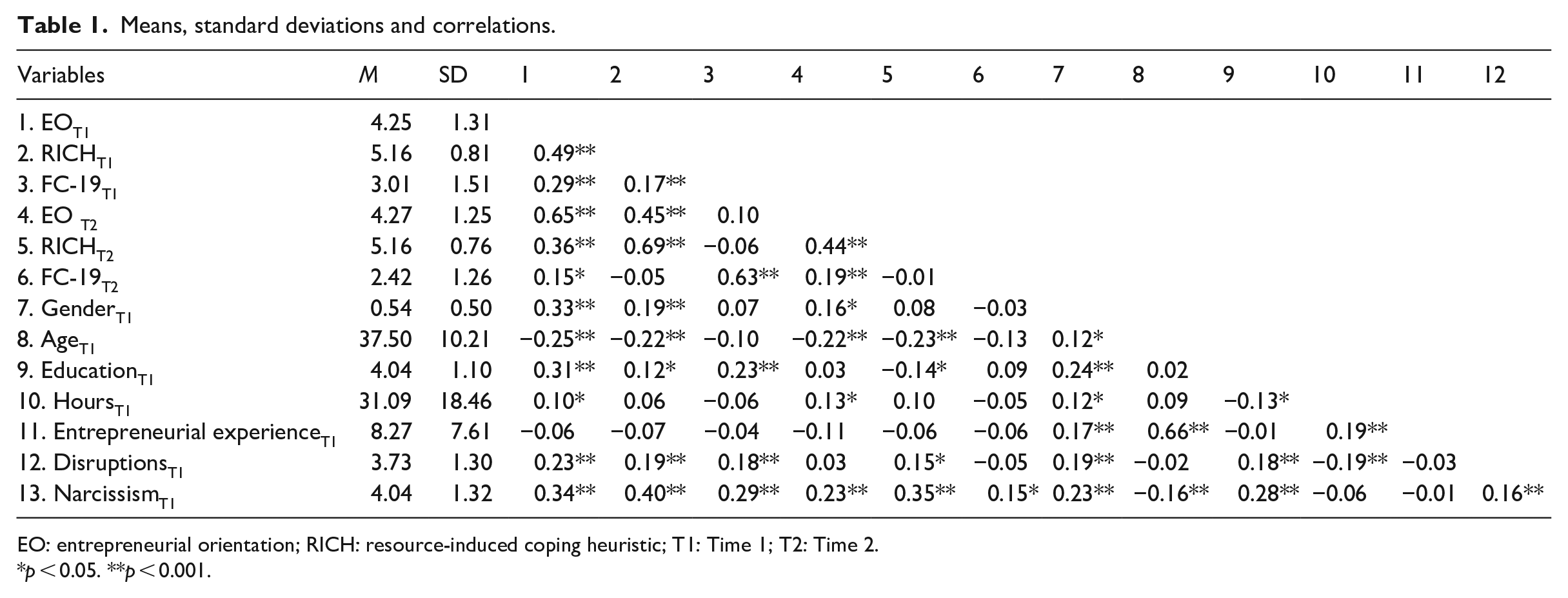
EO: entrepreneurial orientation; RICH: resource-induced coping heuristic; T1: Time 1; T2: Time 2.
p < 0.05. **p < 0.001.
We analysed the data with longitudinal linear mixed models. The multilevel analyses were conducted for each outcome variable using the general linear mixed-model procedure in SPSS v25. The primary Level 1 unit of analysis was time, with individuals at Level 2. Time was dummy coded, and we applied grand-mean centring of all continuous covariates to facilitate interpretation; the intercept is interpreted as the expected value of the outcome variable when each predictor is at the grand mean. The temporal patterns were examined via multilevel models (Tables 2 and 3). We first calculated the intercept-only (unconditional) null models adding the linear effect of time as a fixed effect to assess the variance components and to establish how much of the variation for the dependent variable is explained at the individual and repeated measures levels (Table 2). The full models for each outcome variable are presented in Table 3.
Unconditional (null models) for outcome and mediator variables.
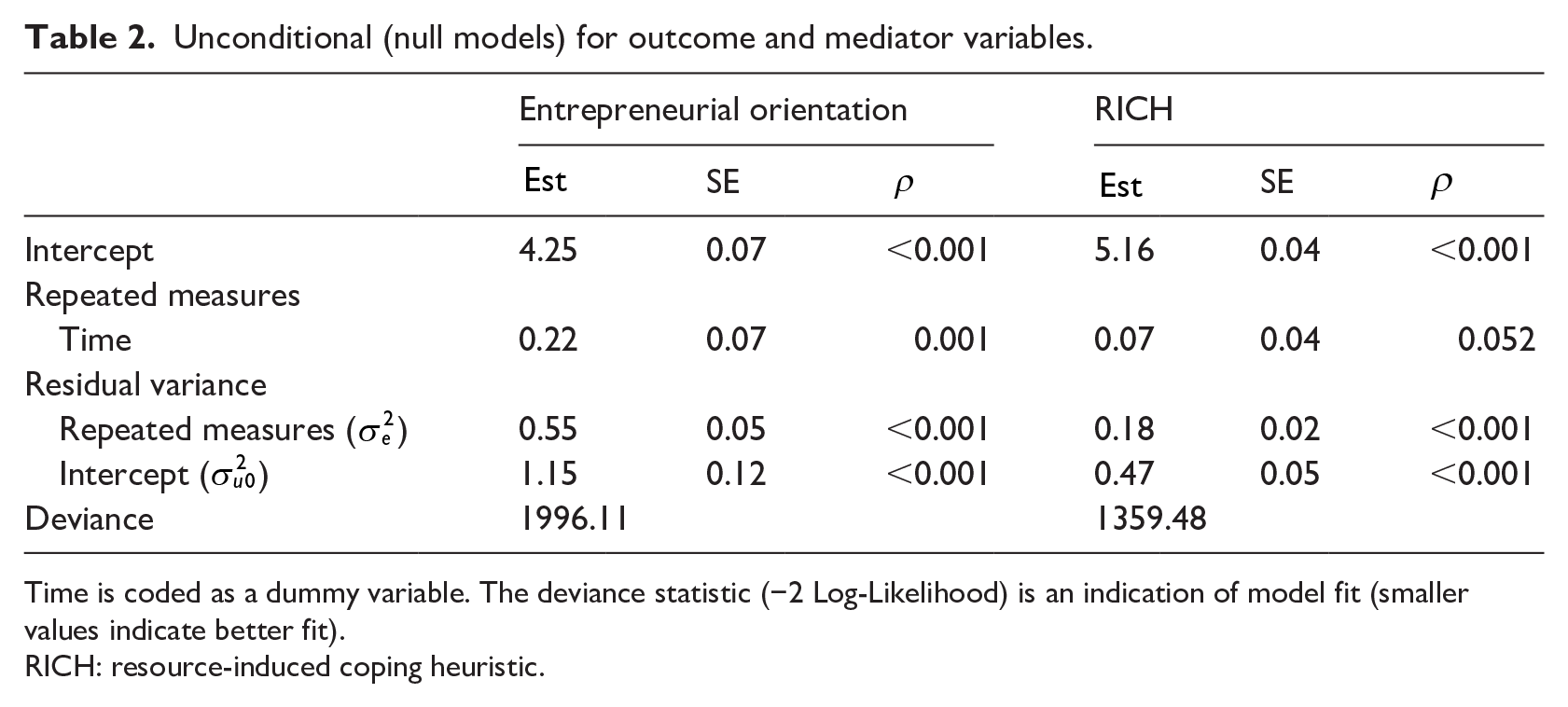
Time is coded as a dummy variable. The deviance statistic (−2 Log-Likelihood) is an indication of model fit (smaller values indicate better fit).
RICH: resource-induced coping heuristic.
Multilevel analysis.
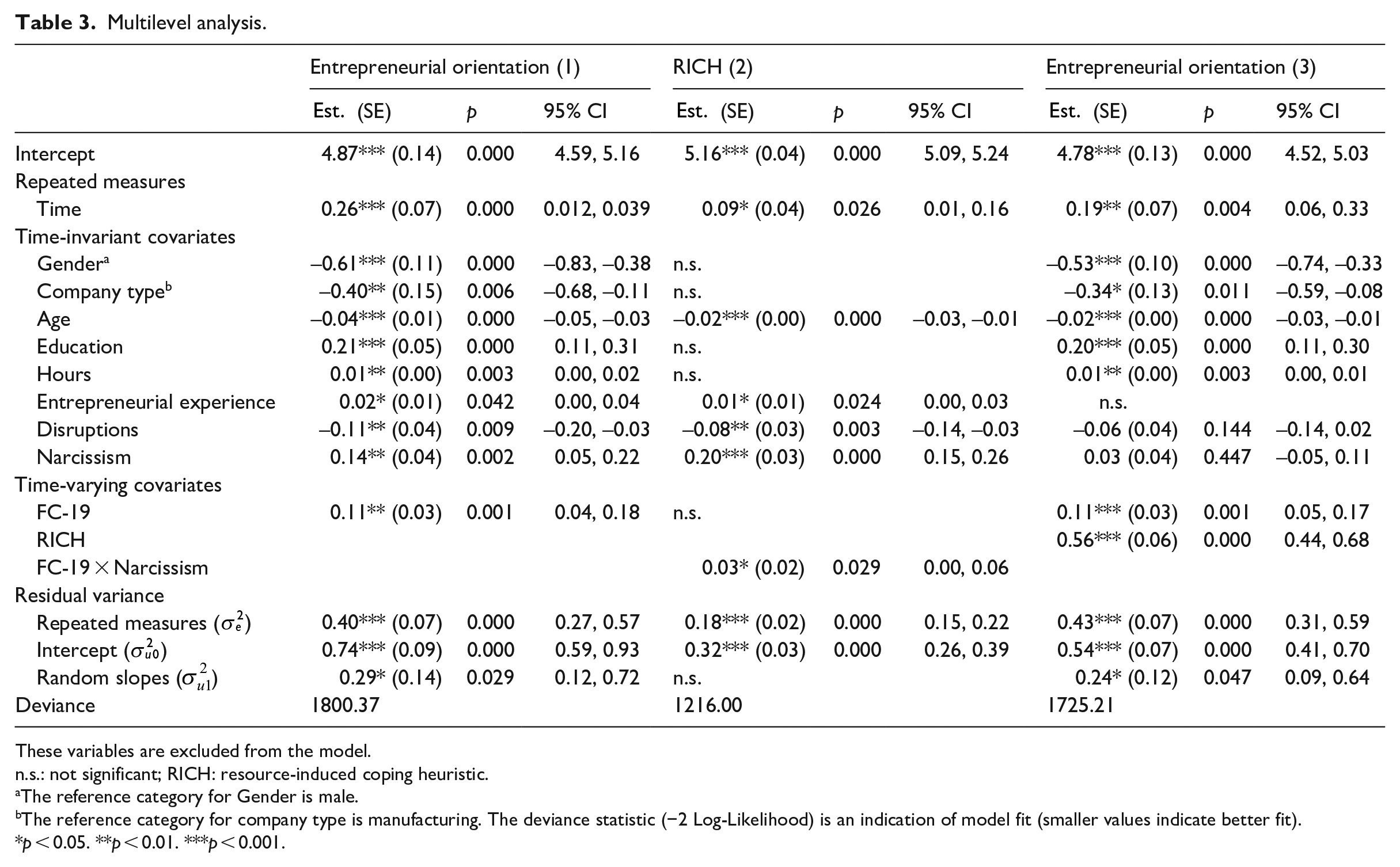
These variables are excluded from the model.
n.s.: not significant; RICH: resource-induced coping heuristic.
The reference category for Gender is male.
The reference category for company type is manufacturing. The deviance statistic (−2 Log-Likelihood) is an indication of model fit (smaller values indicate better fit).
p < 0.05. **p < 0.01. ***p < 0.001.
The null models (Table 2) allowed us to calculate the intraclass correlations. For EO, 67.84% (Level 2) and 32.16% (Level 1) of the variance were at the individual and repeated measures levels, respectively; for the RICH, these were 72.31% (Level 2) and 27.69% (Level 1). These values suggest that multilevel analysis is justified (Aguinis et al., 2013).
We next examined the predictive ability of the time-invariant and time-varying Level 2 variables. Table 3 depicts the models for each outcome variable as follows. Model 1 includes effects of predictors on the outcome EO. Model 2 depicts the predictors of the RICH as mediator and its first stage moderation. Model 3 is the full mediated model. We included random slopes in our models of EO to allow relationships to vary across individuals. To select the best models for our analyses, we compared the Akaike’s Information Criterion of successive models and the Akaike weights of our best fitting models against the next best using the Kullback–Leibler discrepancy formula and obtained results as follows: EO (1) = 0.50, RICH (2) = 0.50, EO (3) = 0.50. Additionally, the −2 Restricted Log Likelihood deviance values (reported in Table 3) showed significant improvement upon the unconditional models as follows: EO (1) Χ2 (10) = 195.74, p < 0.001; RICH (2) Χ2 (6) = 143.48, p < 0.001; EO (3) Χ2 (10) = 270.9, p < 0.001.
The linear effect of time
Our study was conducted during the pandemic, and we are interested in changes to our outcome variables over time. In Table 3, we can see that the effect of time was significant in the model for EO (1) (b = 0.26, p < 0.001) indicating a linear relationship between EO and time. The rate of growth in EO increases by 0.04 over time, after adjusting for the covariates (i.e. compared to the null model in Table 2). Time was also a significant predictor of the RICH (b = 0.09, p < 0.05); the rate of growth increased by 0.02 after adjusting for the covariates in the model. In the final model for EO (3), the linear effect of time is significant (b = 0.19, p < 0.01) and decreased by 0.03 after adjusting for the covariates. As respondents adjusted to the pandemic during the period of our study, EO and the RICH, on average, increased.
Predictors of EO
Model 1 includes the significant predictors of the time-varying outcome variable EO. The coefficient for gender is negative (b = −0.61, p < 0.001) suggesting that the EO among females is lower than for males. This is also true of service firms compared to manufacturing (b = −0.40, p < 0.01). A negative coefficient for age (b = −0.04, p < 0.001) suggests that older respondents had lower EO. The positive coefficient for education (b = 0.21, p < 0.001) suggests increasing EO with higher levels of education. Number of hours devoted to the business per week was positively associated with EO (b = 0.01, p < 0.01). Entrepreneurial experience had a positive effect on EO (b = 0.02, p < 0.05). A negative coefficient for disruptions (b = −0.11, p < 0.01) indicates that more disruptions to respondent lives during the pandemics were associated with lower EO. Perhaps counter intuitively, FC-19 was a positive predictor of EO (b = 0.11, p < 0.01). Upon the inclusion of the RICH, all covariates remained significant predictors of EO in Model 3, except for disruptions and entrepreneurial experience.
Predictors of the RICH
Only a few of the covariates were significant predictors of the RICH. The negative coefficient for age (b = −0.02, p < 0.001) suggests that younger respondents perceive themselves as better at acquiring, protecting and developing resources than older respondents. Respondents with greater entrepreneurial experience responded more positively to the RICH (b = 0.01, p < 0.05). The coefficient for disruptions was negative (b = −0.08, p < 0.01), suggesting that fewer disruptions are conducive to the RICH.
Hypothesis testing
Hypothesis 1 predicted a positive relationship between CEO narcissism and EO; the coefficient for narcissism is positive and significant in model 1 (b = 0.14, p < 0.01). Hypothesis 2 predicted a positive relationship between CEO narcissism and the RICH. Our results show a positive and significant relationship (b = 0.20, p < 0.001) supporting Hypothesis 2. Hypothesis 3 predicted a positive relationship between the RICH and EO. Model 3 shows that the coefficient for the RICH was positive and significant (b = 0.56, p < 0.001), supporting Hypothesis 3.
Hypothesis 4 predicted that the relationship between narcissism and EO will be mediated by the RICH. Our mediation path analysis reveals that narcissism indirectly influenced EO through the acquisition, preservation and development of resources (RICH). Path A (narcissism on RICH) (b = 0.20, p < 0.001) and Path B (RICH on EO) (b = 0.56, p < 0.001) were both significant. As seen in Table 3, the initial total effect of narcissism and EO (b = 0.14, p < 0.01, Model 1) was no longer significant after the introduction of the RICH in Model 3 (b = 0.03, n.s.). Additionally, the Sobel test of the indirect effect confirms mediation (z = 5.42, p < 0.001).
Hypothesis 5 predicted a moderating effect of FC-19 on the RICH. We find a significant first-stage moderation (b = 0.03, p < 0.05). The significant positive coefficient indicates that the positive relationship between narcissism and the RICH is stronger for individuals with higher levels of FC-19. This suggests that the importance of acquiring, preserving and developing resources increases when there is a perceived threat, such as that brought on during the pandemic and associated uncertainties, this is particularly true for respondents with high narcissism. Hypothesis 5 is supported.
Discussion
A noticeable imbalance exists within EO research, with a predominant emphasis on performance outcomes, rather than delving into the drivers of EO. We contribute to closing this gap by integrating insights from research on CEO personality (narcissism), coping (RICH) and emotions (FC-19) to examine their influence on the narcissism–EO relationship. Prior research has established that narcissistic CEOs focus on EO during disruptive times (Buyl et al., 2019). Through our findings, we shift the focus to the mechanisms that enable such strategies. Our results suggest that the RICH can be viewed as a resource caravan facilitator that provides narcissistic CEOs with a mechanism through which they can implement their grandiose entrepreneurial strategies. The RICH provides assurance to narcissistic CEOs that they have access to required resources to defend their self-image and goals. In the wake of disruptions, when resource loss is imminent, COR theory postulates that ‘resource gains become more important’ (Hobfoll et al., 2018: 106). Thus, the protection and enhancement of their self-image and the intrinsically linked venture goals become more laudable. Our findings show that the RICH is fundamental for narcissists to manifest EO in their firms.
We delineate narcissism as a dispositional resource that facilitates the RICH. Reflecting COR theory, and its resource investment principle, individuals invest in resources to protect themselves (Hobfoll et al., 2018). While there is some evidence that personality traits are key resources leading to the acquisition and conservation of other resources (Halbesleben et al., 2014), most research focuses on positive personality traits such as proactive personality (Yi-Feng Chen et al., 2021). Our results suggest that during disruptions, narcissists invest in the RICH to maintain their grandiose self-image and pursue venture goal attainment. Furthermore, the purposeful use of the RICH by narcissistic CEOs also facilitates entrepreneurial behaviours. As such, we provide supportive evidence for the COR theory assertion that resources beget resources. Narcissists are known to acquire and develop the necessary resources and skills to create new ventures (Navis and Ozbek, 2016) and enhance entrepreneurial performance (Brownell et al., 2021). Their obsession with grandiosity inspires them to attach their self-image to their venture, rendering the two inseparable (Brownell et al., 2021, 2023). Thus, as established by prior research, to enhance their self-image, they pursue a venture strategy focused on risk-taking, innovativeness and proactiveness (Cragun et al., 2020).
Our findings also suggest that when FC-19 is high, narcissists demonstrate increased tendencies to use their RICH. Scholars have argued that narcissists are proactive under high ambiguity and uncertainty, including uncertainty associated with COVID-19 (Lang et al., 2021). Adding to this, we found that high FC-19 leads narcissists to engage in coping mechanisms geared towards the acquisition, protection and development of resources. This invokes a fight mode when the threat related to the pandemic is high. Hence, our study moves beyond the restrictive conceptualisation of fear in entrepreneurship that focuses on avoidance/flight behaviours (Cacciotti and Hayton, 2015). We advance the recent discussion on the protective, yet proactive, behavioural consequences of fear (Lebel, 2017) within entrepreneurship. It is important to note that we are not proposing that narcissists do not fear COVID-19; in fact, they reported high FC-19. Rather, we contend that narcissists display fight tendencies by increasing their RICH behaviours when there is a looming threat to resources (as represented by FC-19). This echoes the COR theory assertion that when there is a threat to resources, those with greater resources ‘are more capable of orchestrating resource gain’ (Hobfoll et al., 2018: 105). It has been arguend that fear related to major catastrophes will reduce entrepreneurial activity (Bendell et al., 2020). In contrast to this, our findings suggest that FC-19 increases the RICH among narcissistic CEOs, extending prior research on fear in entrepreneurship (Cacciotti and Hayton, 2015). However, Carver (2003) suggested that negative emotions (including being nervous or stressed) might indicate there is a discrepancy between desired goals and the actual attainment of goals. Foo et al. (2009) asserted that negative emotions signal that progress towards task completion is slow, and, as a result, entrepreneurs increase their efforts to accomplish their goals. Considering this, it is possible that when FC-19 is high, and there is a looming threat to resources, entrepreneurs find it difficult to achieve their goals. As a result, they might be more willing to try innovative, proactive and risky strategies to survive or succeed. The evidence from this study also suggests that disruptions (related to health and personal life) decrease CEO’s RICH and EO. COR theory suggests that the threat of resource loss and actual resource loss can both lead to stress and have motivating potential (Hobfoll, 1989). However, limited research has differentiated between resource loss and threat, and we know little about the comparative impact of those experiences (Halbesleben et al., 2014). Our research clarifies this difference by demonstrating that, for CEOs of SMEs, a threat to resources (FC-19) led to an increase in EO, whereas when individuals experience actual resource loss (indicated by pandemic disruptions), EO decreased. Consequently, we put forth that a threat of resource loss leads to different strategic choices than actual resource loss. These findings have important implications for future research on creating strategies for loss management. Considering narcissistic CEOs, a potential loss could create impetus for competitiveness, whereas an actual loss of resources could dampen the same.
Practical implications
With this study, our hope is to motivate firm leaders to analyse their own cognition and behaviours. Our results highlight that awareness regarding resources and their potential is crucial for building and leading an entrepreneurial firm. Although the disruptions related to COVID-19 have eased, investing in building a mindset prepared for future disruptions could assist in handling future crises. Our findings suggest that disruptions influence coping mechanisms and, subsequently, strategic decision-making. Other studies have shown that coping with adversities is critical for the survival of small firms (Torrès et al., 2022). Thus, it can be useful for CEOs to be aware of how personal disruptions can influence their coping mechanisms and subsequent strategic choices. Following this, CEOs of entrepreneurial ventures could focus on devising strategies to mitigate the negative effects of disruptions on their cognitions. For instance, mindfulness exercises can be beneficial in situations of extreme exhaustion (Murnieks et al., 2020). Additionally, we caution those that monitor CEOs, and those that depend on their leadership or partnership, to consider their narcissistic tendencies, specifically during disruptions that could enhance their fear of loss. In these situations, narcissistic CEOs are likely to be motivated to acquire, protect and develop resources that aid in the EO of the firm because it suits their needs – but at what point can CEO’s narcissism become detrimental? Are they only acquiring their fair share, or does their narcissistic trait foretell a tendency to hoard from their constituents (Bernerth, 2022; Nowak et al., 2020)? Future research considerations are considered below.
Limitations and future research
Our study has limitations that unveil promising directions for future research. Our data indicate that the EO of firms increased as the pandemic progressed. However, we did not examine the pandemic’s influence on firm’s performance. As extant research has highlighted the benefits of EO in hostile environments (Wales et al., 2021), such as the pandemic (McGee and Terry, 2022), we studied EO as a focal construct. In highly dynamic environments, the RICH also exerts a stronger influence on EO (Adomako, 2021). We were not able to explore this in this study; yet, we believe that exploring the boundary conditioning role of other environmental factors in the personality-EO nexus is a promising avenue for future studies. Furthermore, it has been argued that for EO to manifest firm performance, new value creation is a critical mechanism (Wales et al., 2023). Narcissistic CEOs are inclined to innovate and experiment in pursuit of glory (Wales et al., 2013); our framework could be extended to include a measure of new value creation. Additionally, the EO of individuals can influence firm-level EO (Clark et al., 2023). Given that individual-level EO encompasses traits such as risk-taking and competitiveness, a potential correlation with narcissism is evident. One might speculate that narcissists exhibit higher levels of individual EO, though this remains a subject that could be explored in future research. We acknowledge that using self-reported, single-informant data has limitations. However, in the small business context, using self-reported data is a widely accepted practice (McGee and Terry, 2022). Given that narcissists tend to exaggerate their success stories (Lakey et al., 2008), collecting data from other key respondents about their firm’s EO would enable an assessment of EO from various sources.
CEO narcissism is related to selfish, unethical and questionable behaviour, ranging from tax avoidance to financial fraud (Cragun et al., 2020). Our results show that narcissists, when fearful of COVID-19, acquired resources at an increasing rate during the study period. Various governments launched COVID-19 support schemes to assist businesses in staying solvent during the pandemic, and various media investigations have suggested that some of these loans were misused (BBC, 2022). Future research could explore factors that amplify and contribute to wrongdoings by narcissistic business owners when there is a looming threat to resources. Finally, as with narcissism, there is an increasing awareness of the positive and negative implications of other ‘dark’ personality traits, such as Machiavellianism and psychopathy, on entrepreneurial outcomes (Brownell et al., 2023). Researchers are encouraged to evaluate the optimal levels of dark triad personality required for resource acquisition and EO.
Conclusion
While research has advanced our understanding of individual-level antecedents of EO, there is still much to learn about the mechanisms through which narcissism influences EO. In this study, we drew from COR theory to explore the influence of CEO narcissism on EO. We found that the RICH is a key cognitive coping mechanism that creates a passageway for narcissists to build an entrepreneurial firm. Also, we built on COR theory and the research on fear in entrepreneurship and found distinctive impacts regarding how the threat of resource loss (FC-19) and the RICH affect EO. This work contributes to entrepreneurship literature regarding how CEOs affect their firm’s EO.
Footnotes
Appendix
Constructs measurement.
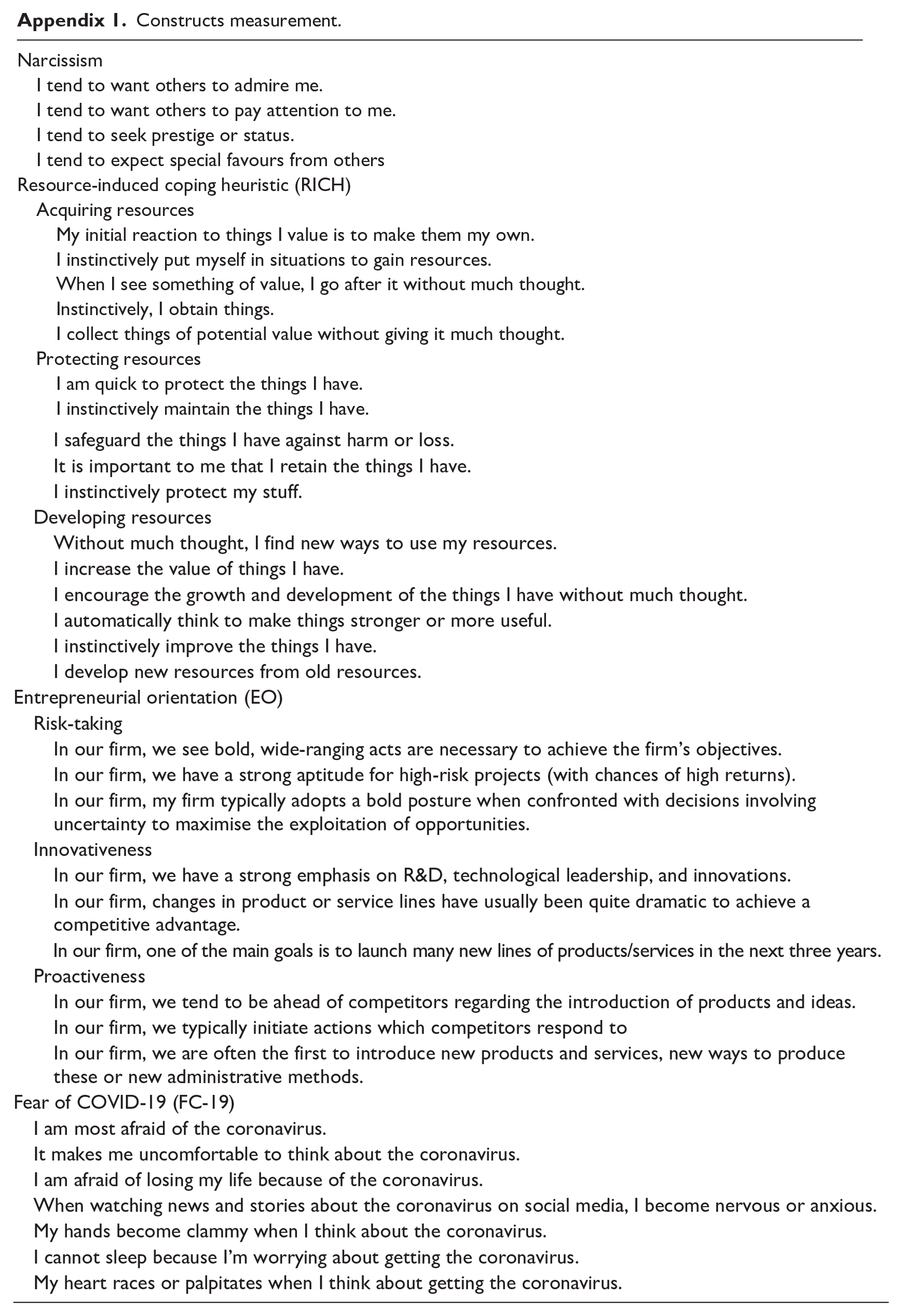
| Narcissism |
| I tend to want others to admire me. |
| I tend to want others to pay attention to me. |
| I tend to seek prestige or status. |
| I tend to expect special favours from others |
| Resource-induced coping heuristic (RICH) |
| Acquiring resources |
| My initial reaction to things I value is to make them my own. |
| I instinctively put myself in situations to gain resources. |
| When I see something of value, I go after it without much thought. |
| Instinctively, I obtain things. |
| I collect things of potential value without giving it much thought. |
| Protecting resources |
| I am quick to protect the things I have. |
| I instinctively maintain the things I have. |
| I safeguard the things I have against harm or loss. |
| It is important to me that I retain the things I have. |
| I instinctively protect my stuff. |
| Developing resources |
| Without much thought, I find new ways to use my resources. |
| I increase the value of things I have. |
| I encourage the growth and development of the things I have without much thought. |
| I automatically think to make things stronger or more useful. |
| I instinctively improve the things I have. |
| I develop new resources from old resources. |
| Entrepreneurial orientation (EO) |
| Risk-taking |
| In our firm, we see bold, wide-ranging acts are necessary to achieve the firm’s objectives. |
| In our firm, we have a strong aptitude for high-risk projects (with chances of high returns). |
| In our firm, my firm typically adopts a bold posture when confronted with decisions involving uncertainty to maximise the exploitation of opportunities. |
| Innovativeness |
| In our firm, we have a strong emphasis on R&D, technological leadership, and innovations. |
| In our firm, changes in product or service lines have usually been quite dramatic to achieve a competitive advantage. |
| In our firm, one of the main goals is to launch many new lines of products/services in the next three years. |
| Proactiveness |
| In our firm, we tend to be ahead of competitors regarding the introduction of products and ideas. |
| In our firm, we typically initiate actions which competitors respond to |
| In our firm, we are often the first to introduce new products and services, new ways to produce these or new administrative methods. |
| Fear of COVID-19 (FC-19) |
| I am most afraid of the coronavirus. |
| It makes me uncomfortable to think about the coronavirus. |
| I am afraid of losing my life because of the coronavirus. |
| When watching news and stories about the coronavirus on social media, I become nervous or anxious. |
| My hands become clammy when I think about the coronavirus. |
| I cannot sleep because I’m worrying about getting the coronavirus. |
| My heart races or palpitates when I think about getting the coronavirus. |
Funding
The author(s) disclosed receipt of the following financial support for the research, authorship, and/or publication of this article: The authors received financial support for their study from the Maynooth University (Donnellan Fund) and Victoria University of Wellington.
