



Abstract
Due to urgent societal challenges, organisations increasingly prioritise principles of hybrid value creation over capitalist efficiency rationales. Bureaucratic governance arrangements are widely regarded as detrimental to these organisations and their capacity to drive social change and innovation. Yet, bureaucratic governance continues to dominate the organisational landscape, while alternative approaches remain largely absent or underdeveloped. In this article, we address this puzzle and explore the re-enchantment of collegiality as a polycratic intra-organisational governance concept. Our research is based on empirical evidence from two social enterprises, of which one failed and one succeeded, with a collegiality governance approach. We find that certain elements of traditional collegiality can be particularly problematic in practice and propose a neo-collegial framework that we regard as particularly suitable for the governance of hybrid organisations.
Keywords
Introduction
Organisations continue to be major contributors to societal inequality (Bapuji et al., 2020; Stainback et al., 2010), especially when their structures and practices are narrowly aligned with the bureaucratic logic of instrumental rationalisation, entrenched hierarchy, and impersonal interaction (Amis et al., 2020; Banerjee et al., 2021; Hayes et al., 2018). This particularly concerns organisational governance systems, which, critics argue, consistently maintain oligarchic, hierarchical, and unequal structures in most organisations on a global scale (Landemore and Ferreras, 2016). However, although bureaucracy has proven itself as a remarkably persistent form of organisation across the business landscape (Monteiro and Adler, 2022), technological developments, mounting globalisation, and grand challenges such as climate change, economic crises, and the COVID-19 pandemic have also put traditional organisational modes of operation under increasing pressure. Arguably, the 21st century is experiencing a radical institutional shift in which alternative organisational forms and governance concepts are on the rise (Alvarez et al., 2020; Muñoz et al., 2020; Sama et al., 2022, while the legitimacy of the capitalist organisation is progressively undermined (Adler, 2001; Davis, 2016).
In response to these dynamics, an increasing number of organisations are following a hybrid or multi-purpose model that integrates a broader set of organisational values and objectives for more sustainable and less capitalistic ways of organising (Dufays and Huybrechts, 2016; Ramus et al., 2017; Skelcher and Smith, 2015). Social enterprises, for example, are regarded as a prime example of hybrid organisations since they combine social and commercial value-creation activities at the very core of their mission (Battilana and Lee, 2014). The multifocal purpose of hybrid organisations reveals new opportunities for social change (Jay, 2013; Lumpkin et al., 2018; Tracey et al., 2011) but also implies the need for alternative governance concepts in which social and commercial logics can co-exist (Battilana et al., 2022a; Ebrahim et al., 2014; Filatotchev et al., 2020; Mair et al., 2015).
Max Weber (1968) explicitly highlighted democracy and collegiality as two major political governance concepts based on a polycratic ideal in which power is theoretically shared equally among all organisational members (Waters, 1993). Research in organisational theory, however, has exhibited a clear imbalance between the two Weberian types. While democracy is extensively discussed as an organisational governance principle (Battilana et al., 2022b; Davis, 2021; Harrison and Freeman, 2004; Hielscher et al., 2014; Johnson, 2006; Kerr, 2004; Lee and Romano, 2013), collegiality has been largely overlooked, with a few exceptions (Denis et al., 2019; Lazega, 2020b). This is surprising, considering the explicit calls of younger generations for alternative organisational regimes with more collegial ways of decision-making (Pfeffer, 2013) that are characterised by a ‘dominant orientation to a consensus achieved between the members of a body of experts who are theoretically equal in their levels of expertise but who are specialised by area of expertise’ (Waters, 1989: 956). Contrary to bureaucratic organisational regimes that are based on hierarchy, routine tasks, and an exclusive focus on economic efficiency, collegiality embraces a participatory collective to innovate and leverage new business opportunities for social change (Lazega, 2020b).
Since bureaucracy has permeated the global organisational landscape, the historically established concept of collegiality has become marginalised in practice. However, due to the demand for effective governance systems that enable organisations to better deal with contemporary societal challenges (Bacq and Aguilera, 2022; Couture et al., 2023), and with the increase in hybrid and multi-purpose organisations, this is an appropriate time to explore new opportunities for a revitalisation of the collegiality concept. In fact, the principles of collegiality can already be seen in several innovative organisational constructs that are emerging as post-bureaucratic counterweights. Covered mainly by the practice literature, popular empirical examples include Holacracy organisations (Robertson, 2015), Teal organisations (Laloux, 2014), and Humanocracy organisations (Hamel and Zanini, 2020), 1 despite there being no explicit mention of collegiality as such. Addressing this embryonic development, recent research in the sociology of organisations has proposed the revival of the theoretical concept of collegiality through a stratigraphic approach that embraces a joint regulation of collegiality and bureaucracy for organisations that seek to drive social change and innovation (Lazega, 2020b). It was criticised, however, for its negligence of engagement with research on hybrid organisations and their governance logics as a particularly promising research context to unearth new insights for theory and practice (Thornton, 2021).
In this study, we address this lacuna by asking the following research question. ‘How can collegiality be effectively re-enchanted as a polycratic organisational governance alternative?’. Based on Max Weber’s remarks on the ‘disenchantment of the world’, in which he refers to an increasing rationalisation and secularisation of society that results in the suppression of traditional ways of organising (Weber, 1989), we use the term ‘re-enchantment’ to refer to the reinvigoration of such previously suppressed and marginalised ways of organising (Suddaby et al., 2017). Our research draws on empirical data from two exemplary hybrid organisations, one from the Global North (Scotland) and one from the Global South (Ecuador), that implicitly adopted a collegiality governance approach. While the Scottish organisation failed, the Ecuadorian organisation continues to thrive with a slightly modified version of the Weberian collegiality ideal. Our findings showcase how collegiality governance can function in the empirical context of hybrid organisations, indicating a promising potential for its adoption in various kinds of multi-purpose organisations. However, we also found that two out of six defining elements of theoretical collegiality (namely formal egalitarianism and decision-making by consensus) can complicate the effectiveness of the concept in practice. These findings are of particular relevance as they also reveal important and novel insights for broader academic and societal debates that focus on the reduction of inequality (Amis et al., 2018; Stainback et al., 2010) and the promotion of deliberative decision-making (Frémeaux and Voegtlin, 2023; Lee and Romano, 2013) in future-oriented organisations.
We make four major contributions to the theory and practice of organisational governance. First, by exploring the theoretical elements of traditional collegiality governance in the empirical context of hybrid organisations, we highlight the opportunities and challenges that are likely to arise from the organisational adoption of traditional collegiality. Second, we develop a revised, improved, and practically applicable theoretical framework for the re-enchantment of traditional collegiality (Waters, 1989; Weber, 1968) in alignment with the contextual embeddedness of an organisation and its members. We refer to this as a neo-collegial governance framework. Third, since little governance theory for hybrid organisations is derived from empirical evidence (Mair et al., 2015), we respond to calls for a closer look at real-life examples to provide more practical insights for the governance of hybrid organisations in different contexts (Mair et al., 2020). In so doing, we particularly advance the emergent literature on hybrid enterprise governance (Battilana et al., 2015; Cornforth, 2020; Ebrahim et al., 2014; Mair et al., 2015; Wolf and Mair, 2019) by theorising on the re-enchantment of collegiality as a previously marginalised polycratic governance concept. Fourth, we extrapolate from our empirical and theoretical contributions to theorise how collegiality might work in contexts beyond hybrid organisations.
Our article is organised as follows. First, we review the literature related to collegiality and hybrid enterprise governance before we outline our research design. We then present our findings from the study of the two-hybrid organisations, of which one failed, and one succeeded with a collegiality approach. This is followed by the development of our theoretical framework and a critical discussion of whether and how collegiality can represent an effective organisational governance approach for different types of organisations. We conclude with the limitations of our study and suggest relevant avenues for future research.
Theoretical background
The re-enchantment of collegiality
Collegiality is a political governance theory that stands in sharp contrast to bureaucracy. While bureaucracy is characterised by steep hierarchies, calculative routines, and impersonal interaction, collegiality is ‘a form of endogenous organisation based on exploratory and innovative tasks, carried out by peers who seek various forms of agreements to coordinate and use personalised relationships to do so’ (Lazega, 2020b: 40). Derived from the foundational work of Max Weber (1968, 1930), Malcolm Waters (1989: 957) distilled the concept of collegiality into six definitional and interdependent elements. These include: (1) Professional career, in which organisational members do not regard their work as a contractual obligation or in terms of self-interest, but rather as a vocational dedication to suprapersonal norms; (2) theoretical knowledge that is differentiated with respect to each organisational member and applied for the benefit of others; (3) formal autonomy, in which certain structured processes and procedures (as little as possible, but as much as necessary) ensure that organisational members have the freedom and trust to independently pursue organisational goals; (4) collective decision-making through collective fora in which organisational members deliberate and strive for consensus; (5) formal egalitarianism, in which the members of the organisation are theoretically regarded as equals while certain explicit mechanisms and established norms (as little as possible, but as much as necessary) are put in place to promote and maintain equality; and (6) scrutiny of product in the form of evaluation and informal control by trusted peers. In practice, collegiality has a long history as a widespread and functioning governance mechanism in different organisational bodies, including governments (Weber, 1968), courts (Siebert et al., 2017), religious institutions (Wilde, 2004), universities (Dearlove, 1997), and law firms (Lazega, 2001). It also existed in various forms across different societies and functional domains (Sciulli, 1986). With the rise of capitalism, however, the prevalence of collegiality experienced a significant decline while bureaucracy became the globally dominant governance regime across the organisational landscape (Lazega, 2020b).
When Max Weber elaborated on a growing disenchantment of the world (Weber, 1989), he took a very pessimistic outlook on the social wellbeing of humanity under the capitalist system that spurred the industrialising world. In Weber’s view, society would imprison itself in an ‘iron cage’ of instrumental rationalisation that alienates people from their work and displaces traditional forms of collective organisation, including collegiality (Weber, 1930). In his seminal work Economy and Society, for example, Weber (1968) demonstrated how the collegial governments in Prussia became displaced by a monocratic authoritarian presidency to achieve faster decision-making. Overall, he saw little potential for collegiality to endure as a widespread form of governance in a capitalist system, for which he regarded bureaucracy as the most effective form of organisation despite its high social costs (Waters, 1989). And Weber’s prophecy came true. In pursuit of the neoliberal paradigm that depicts economic growth as the panacea for human development and prosperity, bureaucracy has been eulogised for its efficiency. Once bureaucracy became isomorphic across organisational fields (DiMaggio and Powell, 1983), collegiality became deinstitutionalised. As a result, the dominance of bureaucracy has led to the disempowerment of workers and thereby eroded the integration of collective interests into the governance of organisations (Battilana et al., 2022b).
In recent years, however, the discussion around the Weberian ambivalence of bureaucracy has revived (Adler, 2012; Courpasson and Reed, 2004; Kallinikos, 2004). There is considerable doubt that capitalist competition can solve the grand challenges of our society, giving rise to post-bureaucratic imaginaries for organisations and economies (Kokkinidis, 2015a; Monteiro and Adler, 2022). Arguably, society is transitioning towards a ‘new normal’ in which the increase of the common good marks the core purpose of many organisations (Muñoz et al., 2020). This has also given rise to the re-enchantment of previously disenchanted ways of organising (Suddaby et al., 2017) that involve the restructuring of organisational regimes in which traditional bureaucracy is diluted and combined with alternative forms of governance (Courpasson and Clegg, 2006). Examples include organisational democracy (Courpasson and Dany, 2003), polyarchy (Courpasson and Clegg, 2012), and collegiality (Lazega, 2001, 2020b). What the resulting hybrid governance concepts have in common is a broader decentralisation of power and control, higher levels of collective and participatory decision-making, as well as an attenuated focus on economic rationalisation, which warrant their consideration as alternative governance concepts for post-bureaucratic organisations. In this sense, hybrid enterprises were highlighted as a particularly promising organisational context (Thornton, 2021) since they often have to deal with tensions between social and commercial logics (Battilana et al., 2022b) and the conflicting expectations of multiple heterogeneous stakeholders (Bunduchi et al., 2023).
The governance arrangements of hybrid organisations
Hybrid organisations are the tangible outcome of a progressively adopted set of principles that deviate from the bureaucratic form of organisation. By following a hybrid organisational ideal, economic rationalisation is balanced, or even superseded, by social value creation (Battilana et al., 2012). Social enterprises, for example, as one of the most emblematic types of hybrid organisations (Bauwens et al., 2020), leverage economic efficiency only as a necessary means to achieve greater social ends (Tracey and Phillips, 2007). This requires that they combine and navigate the conflicting and traditionally incompatible logics of social and commercial value creation in a hybrid format (Battilana and Dorado, 2010; Litrico and Besharov, 2019; Mair et al., 2015; Pache and Santos, 2013). In dealing with this complexity, hybrid organisations are confronted with unique governance challenges (Bruneel et al., 2016; Ebrahim et al., 2014) that demand alternative governance arrangements (Battilana et al., 2018; Filatotchev et al., 2020; Wolf and Mair, 2019). Major fields of inquiry include legal structures, voluntary accreditations, as well as inter-organisational and intra-organisational governance and management systems.
Legal structures that incorporate the value plurality of hybrid organisations remain largely absent in most countries. In response, a common, albeit administratively complex strategy for many hybrid enterprises is to register their multi-purpose organisation under two separate legal entities that include one traditional for-profit and one traditional non-profit under one roof (Battilana et al., 2012). However, a growing number of governments have started to recognise the distinct requirements of hybrid organisations and created dedicated legal frameworks in which bureaucratic rationalisation is legally constrained by instruments such as dividend caps or asset locks. Examples include the community interest company (CIC) in the United Kingdom, the low-profit limited liability company (L3C) in the United States, and the cooperativa de iniciativa social in Spain. These legal frameworks also provide hybrid organisations with a public identity and greater legitimacy to internal and external stakeholders (Cornforth, 2020; Ebrahim et al., 2014).
Voluntary accreditations are another increasingly adopted governance instrument for hybrid organisations to communicate and legitimise their identity, especially in countries where dedicated legal forms are unavailable (Moroz et al., 2018) or where sustainability legislation is weak (Lucas et al., 2022). A popular example is the B Corp certification, issued by the US non-profit enterprise B Lab, which conducts voluntary impact assessments among participating hybrid enterprises that must achieve a minimum impact score to obtain the coveted certification. Under the objective of redefining the capitalist system, assessment criteria not only include the social and environmental impact of the organisation but also its governance (André, 2012). While bureaucratic governance practices negatively affect the impact score, participatory governance practices are beneficial to it.
At the inter-organisational level, numerous management scholars have also advocated the pursuit of multi-stakeholder governance arrangements to collectively resolve grand societal challenges and enhance social welfare (Bacq and Aguilera, 2022; Bridoux and Stoelhorst, 2022; Couture et al., 2023; Dentoni et al., 2018). These approaches are typically underpinned by a polycentric governance logic that rejects a central governing authority and embraces a self-organising system with multiple, semi-autonomous centres of decision-making across organisational boundaries (Polanyi, 1964; Ostrom et al., 1961). However, since polycentric arrangements may cause duplication, overlap, and redundancy, they tend to be less efficient than the bureaucratic Weberian ideal that favours centralisation over decentralisation (Blomquist and Schröder, 2019). Yet, as a polycentric logic places the maximisation of joint value creation over the maximisation of self-interest, it represents an alternative governance approach that matches the pluralistic orientation of many hybrid organisations and their quest for more effective paths to a sustainable future.
For a growing number of scholars, the effective organisation of joint value creation will also require distinct governance arrangements at the intra-organisational level. While some elaborated on a need for stronger worker empowerment and participatory decision-making within organisational boundaries (Battilana et al., 2022b; Tasavori et al., 2018; Zaefarian et al., 2023), others highlighted the potential of worker autonomy and self-management for the organisational pursuit of social change and innovation (Kokkinidis, 2015b; Soetens and Huybrechts, 2023). What unites these approaches is a polycratic governance logic that assumes power and decision-making authority to be dispersed among various individuals or groups within an organisation (Waters, 1993). Within the polycratic realm, however, existing research has predominantly focused on the opportunities of democratic governance (Battilana et al., 2018; Courpasson and Dany, 2003; Davis, 2021; Landemore and Ferreras, 2016) while research on other empirically functioning alternatives of pluralistic organising has been neglected. This particularly concerns the conceptualisation of an empirically grounded and contextually integrated framework of collegiality governance for hybrid enterprises and other types of post-bureaucratic organisations.
Research design
Research philosophy and methodology
Our research design was guided by an interpretivist research philosophy that followed an optimistic scepticism about Max Weber’s (1930) gloomy ontological assumption that our society is doomed to experience aeonian suffering from the unintended consequences of ever-increasing rationalisation processes. Therefore, we were driven by our subjectivist axiological belief that society is capable of reversing the Weberian arrow that travelled from value-driven to calculative means-end forms of organisation and facilitating the enchantment and re-enchantment of alternative, non-bureaucratic organisational regimes, such as collegiality. To unearth new knowledge in this research area, we adopted a reflexive methodology (Alvesson and Sköldberg, 2017) and immersed ourselves in the social realities of two small businesses that were located in different empirical contexts and seemingly operated under a collegial governance logic. In particular, we wanted to understand in depth how their governance approach was socially constructed and maintained in relation to their different contexts. Therefore, we needed to be part of the phenomenon under study and apply a triangulation of qualitative methods to create deeper understandings and reflexive interpretations of the social worlds in which collegiality can be effectively re-enchanted as an organisational governance alternative. This also required that we constantly and critically reflected on our own values in relation to what we were researching, why we were researching it, and for whom, in order to demonstrate the broader social implications of our work (Carter and Spence, 2019; Howard-Grenville, 2021).
Empirical context
Although hybrid organisations with multiple and often competing institutional logics exist in several different forms and manifestations (Smith and Besharov, 2019; Jay, 2013), the empirical setting of social business hybrids is considered particularly apt to advance research on pluralistic organisations in general (Kraatz and Block, 2017) and the theoretical continuum between collegiality and bureaucracy in particular (Thornton, 2021). Therefore, we conducted research on two social enterprises from Ecuador and Scotland that appeared to have developed an individual configuration of collegiality governance. The heterogeneous context was chosen because of the precarious tendency of Western-centric management scholarship to neglect important sources of contextual richness (Gümüsay et al., 2020) and the diversity of alternative governance arrangements (Filatotchev et al., 2022). By using a polar sampling approach with one successful and one unsuccessful organisation (Kellogg, 2012) and by focusing on hybrid organisations from the Global South and the Global North, we seek to reveal new insights on collegiality as an organising principle that exists in both collectivistic and individualistic societies. We have changed the original names of the two case organisations, given some participants preferred to remain anonymous.
The first organisation, ‘ScotOrg’, was a Scottish social enterprise that was jointly established in 2016 and legally registered as a CIC by five Scottish individuals, who also decided to run it collectively. Soon after the inception of the company, another person was integrated into the founding team as an equal member in order to better manage the operational side of the business. The organisation produced and sold innovative premium beverages and distributed 100% of its profits to a charitable organisation that supports socially disadvantaged individuals. ScotOrg’s products were an instant success and quickly became available in more than 200 stores, shops, and bars, as well as in seven of the UK’s leading wholesale distributors. This brought the venture the economic capital necessary to bring its social mission to life. However, despite the venture’s organisational success, underpinned by its highly skilled, experienced, and dedicated members, ScotOrg soon encountered major challenges with its collegiality governance concept. After resulting internal tensions eventually became insurmountable, the firm closed in 2019.
The second organisation, ‘EcuadOrg’, is an Ecuadorian social enterprise that was legally registered as a non-profit organisation in 2018, due to the absence of dedicated legal forms for hybrid organisations in Ecuador. Its members are from Ecuador, South Africa, and the USA. Its mission is to develop and support resilient indigenous community enterprises, enabling them to produce and internationally commercialise value-added products from local resources. At the time of writing, EcuadOrg consists of six core team members and five external board members. Like ScotOrg, it relies on a collective of highly knowledgeable and specialised individual members who underpin its thriving social and commercial performance. Unlike ScotOrg, however, EcuadOrg has demonstrated a better adaptation of the collegiality logic in alignment with the distinct characteristics of the organisation and its members. The firm remains in operation and shows no signs of internal issues related to its governance concept.
Data collection
The data collection for this study was shared between the two authors. After a conversation about collegiality and our independent research on hybrid governance in Scotland and Ecuador, we decided to collaborate on this project, as each of us was able to provide an empirical example of an apparently collegially governed social enterprise. In line with our interpretivist research philosophy, our main sources of data were interviews as well as participant and non-participant observations. To enhance the reliability and validity of our observations and the interview responses, we further triangulated the primary data with secondary data from internal and external documents of the two-hybrid organisations. This comprised news articles, press releases, company reports, legal documents, organograms, and LinkedIn profiles of the members of both organisations. A total of 17 semi-structured interviews were conducted, audio-recorded, and transcribed. These had an average length of 53 minutes per interview. The interviewees comprised the founders, employees, and external board members of the two small business organisations. Table 1 provides an overview of the data sources.
Data overview.
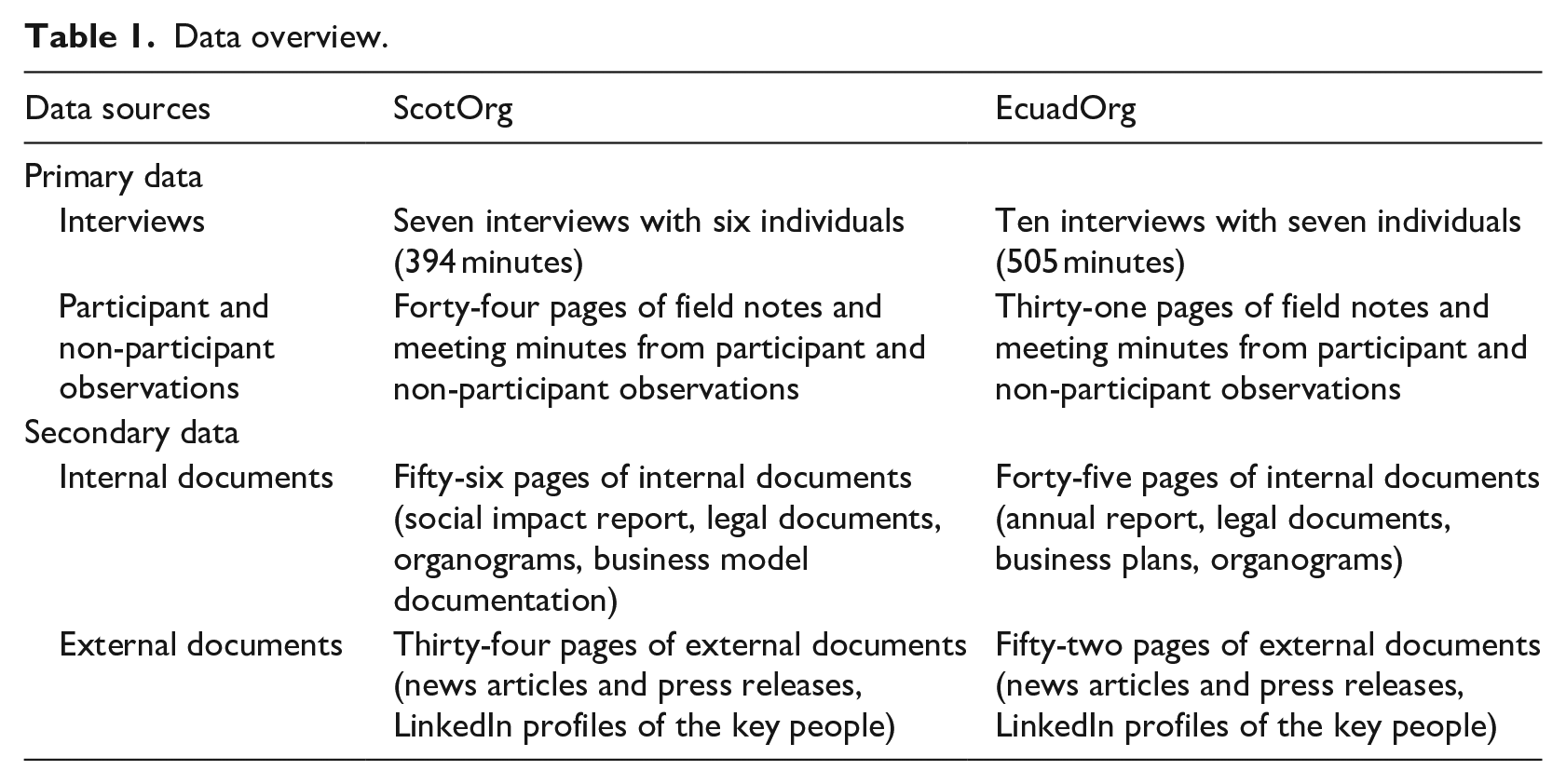
At ScotOrg, the second author accompanied the full organisational journey of the firm from its inception in 2016 until its demise in 2019. During this time, her participant and non-participant observations involved her passive presence in seven important board meetings as well as her active support for the creation of ScotOrg’s annual social impact report. The organisational involvement of the second author was important to get a holistic understanding of the governance dynamics at ScotOrg and to build mutual trust with ScotOrg’s individual members in order to capture in-depth insights from the personal interviews with all decision-makers of the organisation.
At EcuadOrg, data collection was undertaken by the first author. As part of a larger research project, he undertook four visits to the country, covering a total of 20 weeks between 2016 and 2019, of which he volunteered for 6 weeks at EcuadOrg. Throughout this time, he was in constant contact with the members of EcuadOrg and conducted ten personal interviews about the governance concept of the organisation. Additional participant and non-participant observations involved his presence at internal company meetings and workshops, which helped to get a deeper understanding of the governance principles of EcuadOrg.
Data analysis
The data analysis is based on exploitative abductive reasoning. Unlike explorative abductive reasoning, where researchers are unable to find and apply a fitting theory or theoretical perspective that can plausibly explain puzzling facts, exploitative abductive reasoning involves the systematic identification of recurring patterns in the data, followed by an analytic process that matches them with an existing theory or concept that provides the most plausible explanation for the phenomenon under study to facilitate further theorising (Bamberger, 2018). Thus, we abductively exploited the collegiality concept (which we regarded as a cleanly fitting explanation for the empirical phenomenon) to theorise whether and how it can be effectively re-enchanted as a polycratic alternative to bureaucratic organisational governance systems. To do so, we applied a systematic combining approach (Dubois and Gadde, 2002), in which we iteratively moved back and forth between the empirical data from the empirical cases, existing governance frameworks, and our evolving theorisation.
The analysis process had three major stages. In stage one, we categorised and structured the data about the two organisations. This gave us a thorough overview of the data, as well as an initial comparative understanding of the two organisational contexts. In stage two, we juxtaposed the governance concepts of both organisations and compared them with existing frameworks from the organisational governance literature. Subsequently, we aligned the empirical cases with the collegiality concept as the closest theoretical framework to explain the governance approaches of EcuadOrg and ScotOrg. In stage three, we coded the data in relation to the six major collegiality elements, as outlined by Waters (1989). This helped us to systematise the data observations and to identify the critical similarities and differences in the governance approaches of the two organisations.
Findings
Collegiality at ScotOrg
In the case of ScotOrg, the innovative hybrid organisation failed after only 3 years of operation, despite having achieved impressive organisational success with fast growth, a highly dedicated and experienced management team with a common goal, and without committing any organisational misconduct. Instead, the members of ScotOrg attributed the firm’s demise to considerable struggles with their governance approach. These struggles, however, concerned only two of Waters’ (1989) six classical collegiality elements.
In terms of professional careers, all ScotOrg members demonstrated a high vocational commitment to the hybrid mission of their organisation, while none of them saw the work as a contractual obligation or a means to maximise personal self-interest. Instead, all members jointly worked towards the creation of a greater societal good by supporting socially disadvantaged people through the means of the organisation. Although ScotOrg had a clear performance orientation, its profits were either reinvested into the business or distributed to the organisation’s beneficiaries. The members even decided to abstain from any personal income from the business and ran it voluntarily in order to deliver a maximum of financial resources to the charitable partner of the organisation.
ScotOrg Member 1: Our mission is to help people from deprived backgrounds or less fortunate backgrounds to be able to gain a start in life. . . . We’re all relying on a different business to actually pay our wages. ScotOrg Member 2: We did £100,000 worth of work for nothing, you know, which is what it would cost to set up a very small brand like [ScotOrg].
Regarding the theoretical knowledge element of collegiality, all ScotOrg members also had profound and complementary expertise and experience in different professions, which they leveraged and shared for the envisaged prosocial impact of their organisation. While one team member was a marketing executive, one was a legal and regulatory specialist, two were beverage industry experts, and another was a social enterprise specialist.
ScotOrg Member 4: We were all kind of entrepreneurs, I suppose, you would call us. We were quite used to making quick decisions and going with our gut, and not having to research everything.
While a high level of differentiated knowledge was a fundamental principle for the collegiality concept of ScotOrg and essential for the functioning of the organisation, it also facilitated the formal autonomy of its members and allowed them to work independently in their area of expertise. However, strategic business decisions still had to be taken by the whole management committee, for which all members had to come together in personal meetings.
Interviewer: So, who would you say runs [ScotOrg]? ScotOrg Member 1: I would say anyone, individually . . . But as a board, we have all guided and all brought to the table our different facets to where we think and where we feel it should go.
The procedure for collective decision-making in committee meetings at ScotOrg followed the collegial ideal of consensus, requiring all members to agree about the matter in question. It also involved prior deliberation, which is understood as ‘reason-giving discussions in which evidence is weighed, beliefs are shared, and preferences are changed’ (Lee and Romano, 2013: 733). This approach to decision-making, however, turned out to be a very time-consuming process that led to critical internal tensions among the company members, especially since the business in the fast-moving beverage industry often required quick reactions to the dynamics of the organisational environment.
ScotOrg Member 6: In a way, it was maybe pre-briefings to avoid confrontation at the meeting. So, it’s maybe like: ‘OK, here is an idea, here is how it could work, let’s chat it over at the meeting.’ ScotOrg Member 2: And if everybody says yes, then we just did it. ScotOrg Member 1: I think we probably all underestimated the amount of time we would require, . . . how difficult it would be to get a mutually overlapping time. ScotOrg Member 5: And the fact is, all five of us are too time-poor to get after it properly. . . . I’m used to very tight agendas, very tight structure, especially with people who have limited time to get stuff done in time.
In terms of formal egalitarianism, the team at ScotOrg decided to run the hybrid enterprise in the collegial vision of a company of equals (Freidson and Rhea, 1963; Parsons, 1956), in which none of the members is subordinate to another. This equally shared control was a new situation for all the individuals involved and quickly led to internal confusion and further interpersonal tensions.
ScotOrg Member 5: We thought that that separation of powers and responsibilities was kind of a good thing to do, governance-wise. . . . It felt like a coming together of a kind of equals with different skillsets. . . . So, I don’t know why it never really occurred to me early doors, you know. But somebody needs to be the boss here. ScotOrg Member 6: I think it is good to have a flat hierarchy, but you need to have someone in charge.
With reference to the scrutiny of product elements, ScotOrg abstained from the implementation of a formal external supervisory board, as it was also not required by the legal CIC structure of the company. Instead, all members represented both the management body and the supervisory board at the same time, while personal committee meetings were utilised as the major informal control instrument. Although the company had established an external advisory panel, its role was limited to the selection of suitable beneficiaries. In this sense, ScotOrg also abstained from a formal control mechanism. By the time the members of ScotOrg started to recognise and discuss their intra-organisational issues with some elements of their collegiality concept, the interpersonal tensions had already become insurmountable and forced it to shut down operations in the summer of 2019, followed by the official dissolution in 2020.
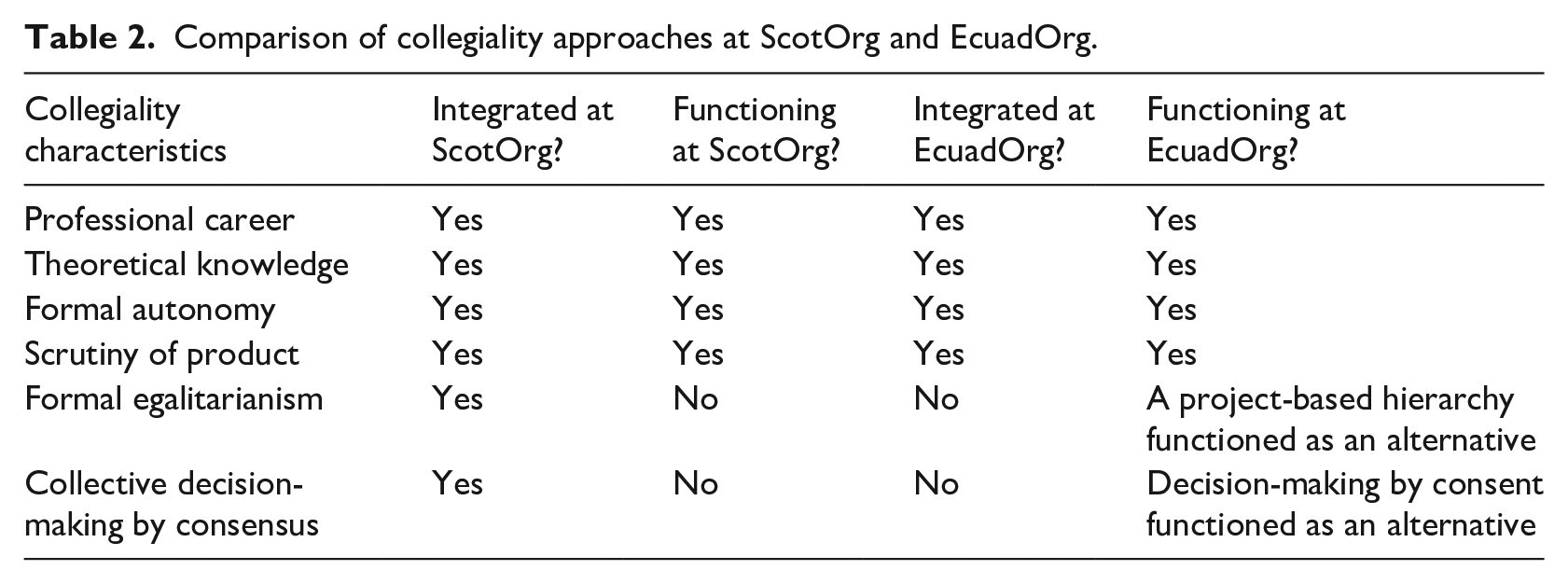
Thus, ScotOrg’s intra-organisational governance approach complied with all six theoretical elements of the concept of collegiality. In practice, however, we found that the two collegial elements of formal egalitarianism and collective decision-making by consensus turned out to be a major source of internal organisational tensions that played a major role in the company’s demise. Moreover, by zooming out from the intra-organisational governance of ScotOrg to its inter-organisational embeddedness, we also observed that the highly competitive nature of its industry also played a significant role. Since ScotOrg was following cooperation-oriented ideals in a competition-oriented industry, the organisation was swimming against a strong tide. In addition, as all its members worked in parallel in other organisations that were governed according to bureaucratic logics, they were in a constant struggle with their structural embeddedness in two considerably different social contexts. As evident in their interview responses above, it was often unavoidable that bureaucratic logics slipped in from one of these contexts and complicated the collegial ambition of the organisation.
Collegiality at EcuadOrg
In comparison to ScotOrg, EcuadOrg implemented a slightly different collegiality concept, which turned out to be highly beneficial. In terms of the professional career element, the members of EcuadOrg also demonstrated a strong sense of personal commitment to their work, just like the people at ScotOrg. In contrast to organisations dominated by a rational-bureaucratic logic, in which individuals tend to alienate themselves from their work, those at EcuadOrg reported a feeling of strong meaningfulness that they gained from their non-routinised operations and strongly identified themselves with the hybrid mission of their organisation and its alternative ways of doing things.
EcuadOrg Member 6: I love what I do, and I love what my organisation does. Obviously, a percentage of me is obligated to work because I have to survive. But in general, it’s a passion. EcuadOrg Member 2: I think we are more open to trying new things. And we know there are other ways to work. EcuadOrg Member 1: Always look for a system that is going to lead to sustainable change.
With regard to the theoretical knowledge element, the members of EcuadOrg also demonstrated a high degree of specialisation in different subject areas such as education, accounting, agriculture, forest management, and social development work, which was applied and shared for the benefit of the beneficiaries of the organisation. The members of EcuadOrg furthermore placed a strong emphasis on the continuous development of their knowledge resources through personal training opportunities. For example, each member can freely choose two training activities per year that they regard as personally valuable for themselves and their work.
EcuadOrg Member 2: I would say each person’s role is pretty specialised. . . . I would definitely give everyone credit for, you know, carrying out their personal responsibilities in their areas of specialisation. EcuadOrg Member 6: We all bring something different to the table. . . . We have a policy at [EcuadOrg] that we can do two trainings a year of our liking. EcuadOrg Member 4: There are many opportunities to train yourself, to implement your idea, and to start some initiatives.
Like ScotOrg, EcuadOrg also places great importance on a polycratic dispersion of power through which high degrees of formal autonomy are enjoyed by all members, depending on their individual expertise and experience in particular subject areas. This is particularly evident in all sorts of projects that the members initiated, created, and implemented independently, ideally after consulting with the group in weekly meetings.
EcuadOrg Member 1: It’s veeery important that everybody needs to feel quite inspired and self-motivated to work hard and to do the best they can. And with a strictly top-down mechanism, that’s very difficult to achieve. EcuadOrg Member 2: Definitely, everybody is responsible for their own work in their own area. EcuadOrg Member 3: We want everybody to be the owners of what they are doing and see their colleagues as people who are going to help them get there.
The weekly team meetings at EcuadOrg were also an ideal space for collective decision-making. Although the members of EcuadOrg, like those at ScotOrg, ideally aimed for consensus in their decision-making procedures, it was sufficient for them to find consent. Contrary to consensus, consent does not require the favourable agreement of all members to a certain proposal, but at least their toleration through the absence of objection, making it a far more time-efficient approach. Finding consent also seemed fairer to them than a democratic voting procedure, from which they abstained completely. However, since the members of EcuadOrg had organised most of their work in autonomously led projects, time-consuming collective deliberations were also less frequent, as opposed to the procedures at ScotOrg.
EcuadOrg Member 3: We never had a thing where we had to vote or something. . . . It is more by the absence of objection. Since it is in spaces where we are analysing together, we come to conclusions together. EcuadOrg Member 6: There are not many decisions that we have to make as a group. There are a lot of decisions that are just very project-specific. . . . So, group decisions are made a lot by consensus, and I would also say lack of objection. . . . I don’t think we have ever voted. We definitively don’t vote.
In terms of formal egalitarianism, EcuadOrg also reduced the elements of hierarchy, status, and formalisation that are inherent in a bureaucratic logic as much as possible. In contrast to ScotOrg, however, EcuadOrg did not envision the organisation as a company of equals either, particularly because of the heterogeneous social and professional backgrounds of its members and their different knowledge levels. Formally, the legal structure of the organisation required EcuadOrg Member 1 to be the legal representative of the company, which gave him formal authority but also demanded high responsibility. Consequently, his remuneration was agreed to be slightly higher than that of his colleagues. Informally, however, EcuadOrg follows a very decentralised and flexible structure in which hierarchy is project-based, knowledge-dependent, and internally negotiated by the project team members instead of being formally imposed onto them.
EcuadOrg Member 1: Not everybody is equal. Not everybody has the same educational background; nobody has the same skills and capacities. I am a little bit hesitant about thinking that everybody is equal. But I think everybody should have the opportunity to grow and develop. That, for me, is vital. EcuadOrg Member 3: There are subjects where there is like a hierarchy that gets in place when it’s about money or hiring. But in day-to-day life, we are all just working together to make things happen.
In terms of scrutiny of product, EcuadOrg is legally required to have a supervisory board. Although the board has the formal authority to actively intervene in EcuadOrg’s management, it is informally used as a passive advisory resource that brings further expertise and knowledge to the table and supports EcuadOrg in critical situations. In addition, EcuadOrg relies on an internal management system that involves frequent peer evaluations and reflective self-evaluations as another informal control mechanism for the organisation’s value-creation activities.
EcuadOrg Member 1: I am not a fan of top-down governance mechanisms. . . . So, it is definitely more consulting with the board. . . . The people who know best about most things are me and my team. The board has more of an advisory capacity. And should things start to go seriously wrong, then the board has the authority to take action. EcuadOrg Member 6: We all have a weekly meeting together. Everybody knows what’s going on with everybody. . . . Three times a year, we do an evaluation session and a self-evaluation. Each of us.
Thus, the intra-organisational governance approach of EcuadOrg does not fully comply with all six theoretical elements of the collegiality concept since the organisation’s application of formal egalitarianism and decision-making by consensus showed a slightly different yet influential deviation. However, the organisation considers its governance concept highly conducive, and it has also experienced no critical drawbacks like ScotOrg. In addition, the inter-organisational embeddedness of EcuadOrg differs from that of ScotOrg as it is imprinted by a polycentric environment in which many prosocial stakeholders cooperate under the common goal of eradicating poverty and inequality for indigenous people in the region. Moreover, there were no signs of identity conflicts among EcuadOrg’s members, as in ScotOrg’s case.
In summary, in our comparison of the governance approaches of EcuadOrg and ScotOrg, we found that the traditional collegiality elements of professional career, theoretical knowledge, formal autonomy, and scrutiny of product were generally conducive for collegiality to function in the two-hybrid organisations. Formal egalitarianism and decision-making by consensus, however, turned out to be two particularly critical elements that suggest the implementation of a neo-collegial approach in which these elements are adapted, replaced, or complemented by elements of other governance principles. Table 2 summarises the differences between the collegiality approaches of ScotOrg and EcuadOrg. Moreover, our findings indicate that the functioning of polycratic intra-organisational governance arrangements is positively influenced by embeddedness of the organisation and its members in a context that is characterised by polycentric governance arrangements in which cooperative stakeholder relations are prioritised over transactional stakeholder relations.
Comparison of collegiality approaches at ScotOrg and EcuadOrg.
Discussion
Based on the findings of our research, we argue that collegiality is a viable concept informing the polycratic governance of hybrid organisations where social logics are either prioritised or balanced with commercial logics. This includes different types of multi-purpose organisations, such as social enterprises, NGOs, cooperatives, network organisations, post-growth organisations, or community enterprises. We regard these organisations as particularly fruitful organisational constructs for effective implementation of collegiality governance because they typically prioritise cooperation, flat hierarchies, and participatory decision-making to achieve their social goals (Pestoff and Hulgård, 2016). Moreover, they are ideally positioned to prefigure the institutional transformation of our economies (Schiller-Merkens, 2022) since they compromise on traditional bureaucratic ideals in favour of more humanistic ways of organisation (Lee and Edmondson, 2017). However, as discussed below, we argue that collegiality governance might also function in organisations with a primarily commercial mission.
In Weberian terms, the findings of our research contribute to the growing evidence of a disenchantment of rational-bureaucratic regimes, an enchantment with novel and innovative governance concepts, as well as a re-enchantment of previously existent but marginalised approaches to organisational governance (Suddaby et al., 2017). Collegiality is part of the latter and might be set to experience a resurgence in a growing number of organisations. However, these organisational constructs come in many different forms, and they are significantly different from those in which collegiality has a long empirical history, such as in universities, courts, and religious institutions. Therefore, we argue that organisational actors will have to make certain adaptations to successfully govern their hybrid enterprises under a collegiality regime. These led us to alter the traditional collegiality conceptualisation of Malcom Waters (Waters, 1989) to form a significant contribution to organisational governance research. In particular, we propose a neo-collegial governance framework (Figure 1) that involves a re-configuration of the six classical collegiality elements (especially formal egalitarianism and collective decision-making by consensus) to function in hybrid organisations, to better reflect the contemporary understanding of traditional terminologies in the management literature, and to make the application of the concept more tangible for practitioners. Furthermore, we discuss the implications of the contextual embeddedness of the concept.
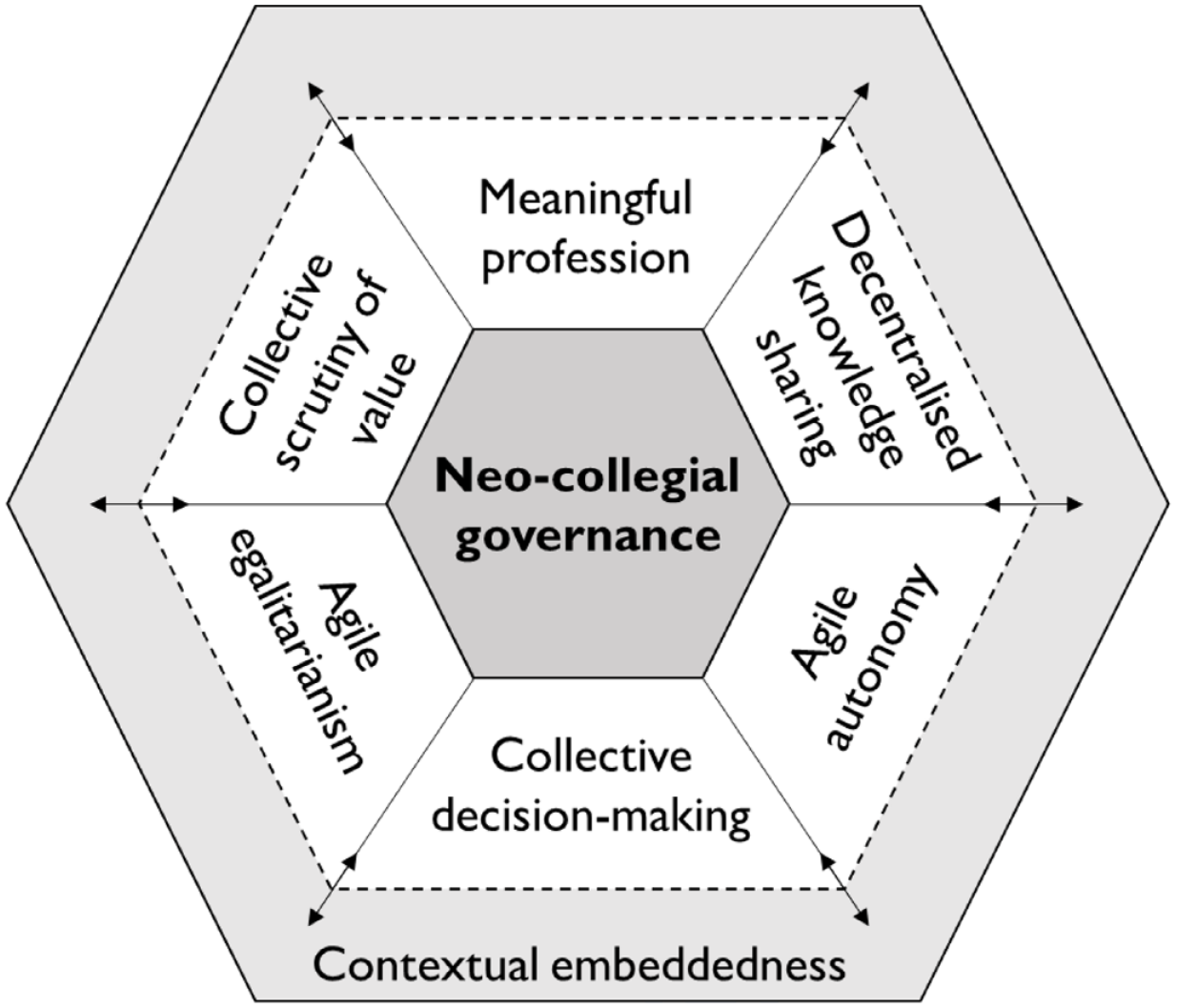
A neo-collegial governance framework.
The intra-organisational configuration of neo-collegial governance
To provide hybrid organisations with an applicable polycratic governance alternative that might help them to better cope with the challenges of the contemporary and the future business environment, our findings prompt us to re-enchant the traditional conceptualisation of collegiality in the following way. In so doing, we advance the emergent literature on hybrid enterprise governance (Battilana et al., 2015; Cornforth, 2020; Ebrahim et al., 2014; Wolf and Mair, 2019) with a neo-collegiality framework that responds to calls for empirically derived theorisations that are applicable for a range of multi-purpose organisations (Battilana et al., 2018; Mair et al., 2015, 2020).
First, we relabelled the professional career element of traditional collegiality into meaningful profession, since it more accurately conveys the personal identification of individuals with a profession to which they purposefully choose to devote a significant amount of their life and continually improve their relevant skills. Contrary to a bureaucratic logic in which individuals alienate themselves from their work since their job or occupation is focused on little more than economic income and personal subsistence (Wrzesniewski et al., 1997), the collegiality logic postulates that workers are driven by a vocational commitment or a calling to suprapersonal norms to also serve others or contribute to society (Waters, 1989). Therefore, we argue that a neo-collegial governance approach must more strongly embrace the sense, purpose, and value of a professional career to represent the growing number of individuals for whom a positive societal impact is particularly important to experience their work as meaningful (Grant, 2007; Michaelson et al., 2014; Morris et al., 2024). These feelings of meaningfulness, zest, and passion are not only positively associated with personal work and life satisfaction (Peterson et al., 2009) but also with social impact (Barkema et al., 2024; Drencheva et al., 2023) and organisational performance (Cardon et al., 2009; Mueller et al., 2017). Accordingly, we assume that this element of neo-collegiality will be of increasing importance for organisational futures.
Second, we also reframe the theoretical knowledge element of traditional collegiality into decentralised knowledge sharing since collegiate organisations are fundamentally driven by knowledge resources (Courpasson and Clegg, 2012) that are differentiated among organisational members and applied for the benefit of less knowledgeable and more vulnerable individuals (Waters, 1989). For hybrid organisations, this strongly resonates with their work for and with less powerful beneficiaries, whose destiny is often significantly influenced by the skilful and context-sensitive application of the knowledge of the members of the hybrid organisation (Koehne et al., 2022). A prominent example relates to work integration social enterprises that employ their beneficiaries directly to empower them within organisational boundaries (Battilana et al., 2015), as is the case at EcuadOrg. Moreover, increasing levels of internal knowledge sharing are positively related to an enhanced entrepreneurial orientation of the venture (De Clercq et al., 2015). Since interpersonal learning and interaction are particularly conducive to the transfer of the tacit knowledge elements that are critical for an organisation’s innovation capability (Tamer Cavusgil et al., 2003), the collaborative nature of collegiality-governed organisations provides a fertile ground in this regard. Therefore, our findings confirm the relevance of fostering specialised knowledge in collegiate organisations (Waters, 1989) but also emphasise the importance of interpersonal knowledge sharing (Hahn and Ince, 2016) for a more effective organisational production of social change and innovation.
Third, we argue that the formal autonomy element of traditional collegiality can be easily misunderstood as a structurally enforced form of autonomy. However, compared to bureaucratic governance systems, collegiate forms of organisation typically rely on as little formalisation as necessary to create a structured environment in which high degrees of independence, flexibility, and self-management are granted to organisational members. Since this is akin to the comparatively young concept of agile management (Grass et al., 2020; Junker et al., 2022), we relabelled this element into agile autonomy in our neo-collegiality framework. High levels of autonomy will help organisational actors break free from bureaucratic authority and disrupt the status quo of an existing social order to create new possibilities for social change and innovation (Haugh and Talwar, 2016; Rindova et al., 2009). To achieve this, our findings suggest that hybrid organisations can benefit from the creation of autonomous spaces by organising their members in self-managed teams and projects (Kokkinidis, 2015b). At EcuadOrg, for example, every member is responsible for their own work and can freely choose their personal training and development activities to enhance both work satisfaction and performance. This further aligns with the classical concept of management by objectives and self-control by Drucker, who already presumed half a century ago ‘that people want to be responsible, want to contribute, want to achieve’ (1974: 348). Yet, the hierarchical structure of many bureaucratic organisations has stifled people’s ability to do so. As such, our findings contribute to the growing evidence for the recent revival of autonomy-giving governance and management concepts that find increasing application in various organisations that seek to flatten their hierarchies. Examples include ‘Holacracy organisations’ (Robertson, 2015), ‘Teal organisations’ (Laloux, 2014), ‘Podularity organisations’ (Gray and Vander Wal, 2012), ‘Beta organisations’ (Hermann and Pflaeging, 2018), ‘Humanocracy organisations’ (Hamel and Zanini, 2020), or different types of cooperatives (Kokkinidis, 2015b; Soetens and Huybrechts, 2023). However, to prevent organisational anarchy, they still rely on a minimum level of formalised rules and routines, just like any kind of agile organisation.
Fourth, our findings prompt us to suggest a re-configuration of the collective decision-making element of traditional collegiality governance. Although we adhere to the original terminology, we particularly caution against the consensus-based deliberation models that traditional collegiality idealises (Waters, 1989). Although several organisational scholars advocate deliberation as a participative decision-making approach (Battilana et al., 2018; Frémeaux and Voegtlin, 2023; Lee and Romano, 2013), emphasising that ‘consensus-based decision-making models encourage the development of more inclusive models of participation and the construction of rule-creating rather than rule-following individuals’ (Kokkinidis, 2015b: 849), our findings demonstrate that the considerably time-consuming and challenging process of consensus-based in deliberation is a significant disadvantage that should not be overlooked. As highlighted by Lazega (2020b: 12), ‘very rarely do committees agree easily – if at all – on the criteria that should have priority’. Moreover, consensus might be difficult to achieve when a high number of stakeholders is involved and the business network becomes more opaque (Reypens et al., 2021). Thus, our research contributes to these insights and suggests that collective decision-making by consensus will be particularly unsuitable for organisations that operate in fast-moving industries and require frequent collective fora. In hybrid enterprises, for example, the pace of decision-making has been highlighted as a critical element in keeping abreast of constant changes and uncertainties in their organisational environment (Dorado and Shaffer, 2011). Thus, neo-collegial hybrids may want to integrate elements from other collective decision-making alternatives, such as democratic voting procedures, agonistic pluralism, or decision-making by the absence of objection. Democratic voting frequently replaces consensus in collegiate organisations (Waters, 1989) since it is useful when quick decisions are needed. On the downside, however, it risks dividing organisational members into ‘winners’ and ‘losers’ (Soetens and Huybrechts, 2023). By contrast, the concept of agonistic pluralism (Mouffe, 1999, 2000) integrates both deliberative democracy and consensus by combining a basic level of agreement among members with the right to defend their own views and ideas (Kokkinidis, 2015b). Similarly, our findings at EcuadOrg point to the concept of collective decision-making by the absence of objection, which substitutes consensus with consent. This approach is also embraced by Teal organisations (Laloux, 2014) and Holacracy organisations (Robertson, 2015). Although an absence-of-objection approach can also involve deliberation, the difference to consensus decision-making is that not all organisational members have to agree to a proposal. Instead, the minimum requirement is that every member can at least tolerate the proposal (Robledo, 2020). This allows for reaching agreements faster compared to consensus procedures. Yet, some members might still be left dissatisfied with decision outcomes and feel aggrieved or rejected by the collective. Under neo-collegial governance, members must therefore carefully evaluate which approach corresponds best to their expectations from a collective forum, as well as the average speed required to reach agreements in line with the pace of the industry in which the organisation operates.
Fifth, our findings also suggest re-configuring the formal egalitarianism element of traditional collegiality governance, which we prefer to call agile egalitarianism in our neo-collegial model since it also requires as little formalisation as possible but as much as necessary. Based on our findings at ScotOrg, we reject the traditional collegial idea of a ‘company of equals’ (Freidson and Rhea, 1963; Parsons, 1956) and confirm that ‘it is extremely unlikely that any group of its members will be exactly equal’ (Waters, 1989: 957). Elements of formal authority are not uncommon in collegiate organisations and might involve at least the designation of a ‘primus inter pares’ as the first among equals (Greenwood et al., 1990; Waters, 1989). As hierarchies are generally knowledge-dependent in collegiate organisations (Courpasson and Clegg, 2012), our findings at EcuadOrg suggest that hierarchies can also be re-negotiated from project to project or from client to client, depending on who exhibits the best available knowledge and experience for the project or the client. Agile egalitarianism must, therefore, be understood as the fostering of a collaborative culture where equality is not enforced by formalisation but where formal structures empower all organisational members to contribute ideas, opinions, and perspectives regardless of their position within the organisation. This particularly contributes to research that addresses the organisational reproduction of inequality within organisational boundaries (Amis et al., 2020; Stainback et al., 2010). Although some post-bureaucratic organisations have already made a radical shift towards striving for maximum workplace equality, for example by formally declaring equal power policies, equal remuneration schemes, and equal decision-making rights (Kokkinidis, 2015b; Laloux, 2014), researchers and practitioners should not forget that collegiate organisations are also performance-oriented systems, even if not in a primarily economic sense. Therefore, our research highlights that organisational members of neo-collegial organisations must carefully evaluate the right balance between the maximum equality possible and the minimum hierarchy necessary to effectively drive social change and innovation.
Sixth, our findings suggest a more encompassing definition of the scrutiny of product element of traditional collegiality that goes beyond making sure that organisational members are held accountable by their peers (Waters, 1989). For a neo-collegial governance model, accordingly, we propose a collective scrutiny of value that informally engages internal and external stakeholders to collectively evaluate and assess the shared outcomes and outputs produced and delivered by organisational members in relation to the organisation’s mission and objectives. Thus, it involves not only to peer-evaluate the work of colleagues but also to co-assess the joint value-creation by and for the members of the organisation in alignment with stakeholder expectations. As demonstrated by EcuadOrg, this is a frequent and inclusive process in which participatory feedback from internal and external stakeholders is used to continuously improve the effectiveness of the organisation and its polycratic governance approach. Moreover, EcuadOrg’s collective scrutiny of value goes beyond the evaluation of pure productivity metrics but considers a broad range of social, environmental, and ethical considerations to ensure the organisation’s long-term sustainability and resilience. In the context of hybrid organisations, previous research has mainly highlighted the board of directors as a critical evaluation instrument (Bruneel et al., 2020) whose official responsibility is to use its given authority to make sure that the managerial body is acting in the best interests of the organisation’s stakeholders. However, EcuadOrg uses the board merely in an advisory capacity. Contrary to traditional organisations, it exemplifies a ‘multiteam system’ in which organisational members and board members work independently and interdependently to enhance organisational performance (Luciano et al., 2020). From this perspective, the board is regarded as a support and empowerment instrument for members to achieve hybrid organisational goals rather than a mere control and surveillance instrument that characterises bureaucratic organisations (Mair et al., 2020). Consequently, our contribution is to offer a novel perspective on the conventional understanding of scrutiny of product and the role of boards in hybrid enterprise governance by advocating for a more inclusive, participatory, and value-driven approach that aligns with the unique characteristics and objectives of hybrid organisations.
Thus, our research suggests a neo-collegial framework that re-configures the traditional collegiality conceptualisation that was developed by Max Weber (Weber, 1930, 1968) and refined by Malcolm Waters (1993, 1989) in order to be applicable to the rapidly growing number of organisations that follow a mission in which commercial logics are hybridised with social and environmental logics (Mair et al., 2015; McMullen and Warnick, 2016; Smith and Besharov, 2019). However, our findings also point to the critical role that the contextual embeddedness of neo-collegially governed organisations plays in the functioning of the concept.
The contextual embeddedness of neo-collegially governed organisations
For collegiality to function as an organisational governance model, our insights from EcuadOrg and ScotOrg urge us to also consider the model’s internal configuration in relation to the contextual embeddedness of the organisation and its members.
At the individual level, our findings at ScotOrg suggest that, even for those individuals who demonstrate an explicit commitment to polycratic governance, its daily practice can easily become challenging when members still carry identity imprints from former or other concurrent occupations that were dominated by a bureaucracy logic. In contrast, the organisational members of EcuadoOrg had former occupations that imprinted them with a predominately social logic (including occupations such as teachers, social entrepreneurs, interns and employees of other social enterprises or NGOs). These findings contribute to research that explores the challenges implied in the transitioning of individuals from one organisational governance system to another (King and Land, 2018; Morris et al., 2024). Accordingly, we argue that younger generations or employees who were socialised into decentralised organisations might be preferred organisational members to establish and maintain polycratic regimes, whereas individuals who were socialised into bureaucratic organisations might find it more challenging to integrate into neo-collegial regimes. Moreover, our findings support prior entrepreneurship research that found a high team homogeneity in terms of participatory governance experience and functional background to be conducive to the performance of decentralised power structures (Xie et al., 2020).
At the organisational level, we observed that EcuadOrg was embedded in an extra-organisational environment that embraced cooperative multi-stakeholder partnerships to spur the socioeconomic development of indigenous communities in the region. In contrast, ScotOrg was embedded in an extra-organisational environment that was characterised by transaction-based partnerships to survive in the highly competitive food and beverage industry. Our findings suggest that an intra-organisational governance approach that builds on a polycratic logic aligns particularly well with an extra-organisational governance approach that builds on a polycentric logic in which inclusive collaboration, participation and shared responsibility is emphasised among stakeholders to balance competing interests and achieve sustainable outcomes (Ostrom, 2010; Poteete et al., 2010).
Although our empirical research focuses on social enterprises characterised by a primarily social mission, we argue that aspects of collegiality can also function in organisations that are commercially driven and embedded in a competitive industry. However, these organisations are likely to find its implementation more challenging since they typically have a higher need for quick decision-making, are more bound to competitive pressures, and put their core focus on financial performance and the maximisation of efficiency. Therefore, they tend to have a stronger alignment with bureaucratic logic. Nonetheless, we argue that aspects of collegiality can still be beneficial in enhancing collaboration and self-organisation in commercially oriented businesses. For example, the Chinese multinational home appliances and consumer electronics company Haier follows an innovative and much-celebrated intra-organisational governance approach that it calls the ‘Rendanheyi’ model (Fischer et al., 2013; Frynas et al., 2018), which shares several similarities with the principles of neo-collegiality. First, Haier embraces the meaningful profession element as the company empowers its employees to take ownership of their work and motivates them to continually seek out opportunities for skill development and professional growth. Second, Haier seizes the agile autonomy element as it takes decentralisation to an extreme level by atomising the organisation into small, self-managed microenterprises where each unit functions as an independent profit centre with its own responsibilities and decision-making authority. Third, Haier promotes the decentralised knowledge-sharing element as its structure and digital collaboration platforms enable knowledge-sharing to occur organically and fluidly across different units within the organisation. Fourth, Haier embraces the collective decision-making element of neo-collegiality, as employees are enabled to cooperate and consult with their colleagues to make informed collective choices that align with the objectives of their unit and the broader organisation. Fifth, Haier fosters a culture of agile egalitarianism that recognises and rewards employees based on their performance and contributions rather than seniority or status, ensuring that everyone has equal and flexible opportunities to succeed and advance within the organisation. Sixth, Haier demonstrates a strong sense of collective scrutiny of value as the company is known for involving a wide range of both internal and external stakeholders in the evaluation and assessment of the value it jointly creates and delivers.
Despite being embedded in an industry that is characterised by fierce competition, the example of Haier shows that the principles of neo-collegiality governance can also work in companies that follow a primarily commercial logic. Although we regard hybrid enterprises as the most promising context for neo-collegiality to spur social change and innovation, its implementation in an increasing number of commercially driven organisations will be an important step to reduce social inequalities within and across organisational boundaries. However, this does not mean that any organisation might benefit from a neo-collegial governance approach. Since neo-collegiality promotes decentralised collaboration, collective decision-making, and a culture of continuous learning and innovation, we argue that especially knowledge-intensive organisations provide a fertile ground for neo-collegiality to flourish. In contrast, organisations in highly regulated contexts that require strict adherence to protocols, organisations in fast-paced industries or crisis contexts that require quick and decisive actions, as well as highly complex organisations with multiple layers of hierarchy might benefit from a stronger emphasis on bureaucratic logics. Nevertheless, we believe that practitioners of both socially and commercially driven organisations can benefit from the insights of our research.
Limitations and suggestions for future research
In this article, we have focused particularly on two-hybrid enterprises that fit into Water’s categorisation of ‘exclusively collegiate organisations’, which are typically small businesses in which collective, interpersonal decision-making tends to be more easily achievable than in larger organisations (1989). Further collegiality research would, therefore, benefit from explorations within medium-sized and large organisations, as well as other types of hybrid and non-hybrid organisations.
As the two organisations of this study had implemented the collegiality concept right from their inception, it would be of further interest to explore whether bureaucratically governed companies can make the successful transition to becoming collegially governed organisations. This might involve patterns in which the entire organisation or only single departments transition to collegiality. Multiteam systems are likely to be a particularly fruitful context in this regard since they consist of interconnected and interdependent teams for which the taken-for-granted assumption of hierarchical governance arrangements was recently called into question (Matusik et al., 2022).
Future research may also make new inroads by integrating the broader micro- and macro-level influences that collegiate organisations must deal with. On the micro level, this particularly points to the social identity of the organisational members who ultimately form organisations into political communities that require governing principles. As most organisations are still governed by bureaucratic regimes, future studies will need to explore how transitioning individuals can successfully integrate into the structures of collegially governed organisations. For example, since previous research has identified that an individual’s psychological effort to achieve a higher social status ordering is conducive to hierarchies but detrimental to collegial organisations (Gruenfeld and Tiedens, 2010; Pfeffer, 2013), future research will need to understand better which social imprints and attitudes are most conducive for collegial regimes. On the macro-level, governance arrangements have also been highlighted as being considerably influenced by the institutional environment and its national governance logics (Aguilera and Jackson, 2003; La Porta et al., 2000), while they can also help to filter institutional influences for a better balancing of financial and social trade-offs in hybrid organisations (Battilana et al., 2022a). Although many organisations align their governance arrangements with their broader institutional environment, others demonstrate an agency that succeeds in implementing non-conforming governance practices despite a hostile institutional context (Aguilera et al., 2018; Bednar et al., 2015). In this regard, future collegiality research will benefit from more investigations in different environments by focusing on the interplay between firm-level collegiality and the institutional context. A promising starting point might be the research of Aguilera et al. (2018: 87), who explored ‘why, when, and how a firm adopts governance practices that do not conform to the dominant governance logic’.
In addition, multilevel research on the relational infrastructures of collegial and bureaucratic actors will be valuable in exploring how collegiality can influence and is influenced by, interdependencies across societal strata. In this regard, Lazega (2020a) suggests an application of social network analysis to study collegiality from a bottom-up, top-down, or inside-out perspective. Alternatively, the polycentricity framework of Elinor Ostrom (2010) might serve as another valuable analytical tool as it refers to a form of governance that favours the autonomy of multiple centres of decision-making by balancing centralised and decentralised governance mechanisms on micro, meso, and macro levels of organisation to achieve greater effectiveness compared to centralised systems (Carlisle and Gruby, 2019).
Considering also the small sample of empirical evidence that our research builds on, we call on future research to create a richer and more diverse empirical foundation for collegiality research in different contexts. There are likely many other types of organisations that govern themselves under a regime that emulates collegiality without explicitly referring to the conceptualisation of Max Weber and Malcolm Waters. In general, the concept of collegiality governance deserves much more empirical and theoretical advancement since it overlaps with other governance ideals, including deliberative democracy and bureaucracy, and has various implications for the creation of alternative governance templates that can help resolve the crisis of the capitalist system.
Conclusion
Given the urgent need for a radical shift of the world’s contemporary economic system away from an exclusive focus on economic efficiency and growth addictions towards alternative ways of organising (Banerjee et al., 2021), hybrid organisations already represent an intermediate step in this direction. However, they require appropriate governance mechanisms that deviate from the dominant market logic of rational-bureaucratic organising and incorporate their multiple organisational purposes. In this article, we have empirically explored the re-enchantment of the polycratic Weberian ideal of collegiality as one potential alternative for the governance of hybrid organisations. As a participatory form of governance that embraces an innovative collective, a neo-collegial model offers a promising opportunity to transform the neoliberal governance system of our society if organisational members are able to adequately adapt its six major elements to their specific requirements. Our article will hopefully inspire future research to make new inroads towards the re-enchantment of traditional collegiality in theory and practice.
Footnotes
Funding
The author(s) received no financial support for the research, authorship, and/or publication of this article.
