



Abstract
Existing research in the entrepreneurial context tends to treat emotions as static phenomena, paying limited attention to the question of how entrepreneurs can actively shape their emotional experiences through emotion management to enhance their well-being and performance. Furthermore, the exploration of how entrepreneurs manage their emotions to sustain their entrepreneurial activities often employs different concepts and terminologies resulting in a fragmented literature that lacks continuity. To extract a common thread from this research field, we conducted a systematic integrative review and integrated research on emotional intelligence, emotion regulation, and emotion-focused coping in the entrepreneurial context using the umbrella term of emotion management. With a comprehensive framework, we organised the emotion management literature around perspectives on an entrepreneur’s individual ability, a trait, and situation-specific strategies. Additionally, we highlighted contextual factors, specifically macro- and meso-level factors, individual factors, antecedents, and consequences. Drawing upon our findings, we reveal existing gaps and propose future directions for emotion management in entrepreneurship research.
Introduction
Entrepreneurship is commonly seen as an emotional ‘rollercoaster ride’ characterised by heightened emotions (Cacciotti and Hayton, 2015; Schindehutte et al., 2006; Shepherd et al., 2011; Waldman et al., 2024). To date, research on emotions in entrepreneurship has predominantly focused on the experience of either positive or negative emotions, their antecedents (e.g. stress, uncertainty, and success), and their consequences on entrepreneurial performance and well-being, which is also reflected by existing systematic reviews on emotions in the entrepreneurial context (for reviews and meta-analyses on emotions in the entrepreneurial context, see Fodor and Pintea, 2017; Delgado-García et al., 2015; Williamson et al., 2022). However, emotions are neither static nor only positive or negative; rather, emotions can be managed to achieve certain goals (Brundin et al., 2021; Frese and Gielnik, 2023), for instance, to attain entrepreneurial behaviour, performance, and learning (Shepherd, 2003; Zampetakis et al., 2017). Extant research in the entrepreneurial context utilises a broad variety of theoretical lenses to describe the phenomenon of emotion management; thereby, encompassing concepts of emotional intelligence (Mayer and Salovey, 1997), emotion regulation (Grandey, 2000; Gross, 1998), as well as emotion-focused coping (Lazarus and Folkman, 1984). Although stemming from different theoretical traditions, these concepts focus on the manageable, modifiable nature of emotions and explore individual efforts to respond to emotional demands and the modification of one’s own or others’ emotions (Gross, 2015; Olson et al., 2019). Surprisingly, these concepts have evolved separately in entrepreneurship research. Thus, our understanding of how entrepreneurs can effectively manage their own and others’ emotions to maintain their entrepreneurial activities, performance, and well-being is still fragmented (De Cock et al., 2020; Engel et al., 2021). Therefore, there is a need for more systematic knowledge about emotion management for both entrepreneurial theory and practice, given that effective emotion management is essential for the well-being and performance of founders and employees, which in turn is crucial for the survival of new and emerging ventures (Shepherd, 2020; Stroe et al., 2020; Waldman et al., 2024).
With a systematic integrative review aimed at uniting and thus, integrating different research strands (Cronin and George, 2020; Radu-Lefebvre et al., 2021), we assimilate existing findings from the different research traditions of emotional intelligence, emotion regulation, and emotion-focused coping and subsume them under the umbrella term emotion management (Peña-Sarrionandia et al., 2015). In keeping with recommendations for integrative reviews (Cronin and George, 2020; Radu-Lefebvre et al., 2021), we conduct a systematic keyword search and construct first-order, second-order, and third-order themes. Based on our findings, we provide a framework for a comprehensive picture of entrepreneurial emotion management, which, in turn, reveals five specific areas for future research. The objective of this systematic integrative review is to enrich the emerging field of entrepreneurial emotion management by summarising current knowledge across various perspectives on emotion management and related contextual factors. Specifically, we aim to draw insights from distinct research traditions to inform the respective academic communities and stimulate new, innovative research by uncovering areas currently hidden due to siloed thinking within these communities (Cronin and George, 2020).
Our contribution to the literature is threefold. First, by reviewing the literature from the different research traditions on emotional intelligence, emotion regulation, and emotion-focused coping, we structure the current state of the literature with a comprehensive integrative framework. This framework provides an overview of different perspectives of entrepreneurial emotion management, as well as contextual factors, including macro- and meso-level factors, individual factors, antecedents, and consequences. We highlight the commonalities and distinctions among the various research traditions in their approaches to entrepreneurial emotion management and in their examination of contextual factors. Through this, we aim to foster the evolution of the entrepreneurial emotion management literature, which is presently marked by scholars employing disparate theoretical lenses in parallel (Cronin and George, 2020). Second, we examine entrepreneurial emotion management along the three perspectives as an individual ability, a trait, or as situation-specific strategies, and we illuminate the differences and connections between these perspectives. By concurrently exploring all three perspectives, we extend prior research that typically focuses on just one perspective at a time. Integrating these perspectives allows for a more nuanced understanding of emotion management and emphasises that it is a multifaceted construct: Effective entrepreneurial emotion management requires developing individual abilities, leveraging personal traits and applying suitable strategies in specific situations. Third, we highlight existing gaps in the reviewed literature and derive five avenues for future research. These directions involve further exploring the connections between the emotion management perspectives, delving deeper into macro- and meso-level factors, such as different organisational predispositions, as well as individual factors, with a particular emphasis on the under-researched interpersonal perspective. Additionally, we suggest a more nuanced examination of the antecedents of emotion management, moving away from a general perspective of managed emotions and a more diversified investigation of consequences, including potential negative effects of entrepreneurial emotion management.
Emotion management research traditions
To date, various research traditions related to emotion management have been studied predominantly independently in separate scholarly communities, particularly in the context of organisations (Peña-Sarrionandia et al., 2015). In this systematic integrative review, we place a particular emphasis on the entrepreneurial domain, where the study of emotion management is still relatively limited (De Cock et al., 2020; Engel et al., 2021; Frese and Gielnik, 2023). By examining the topic in this context and systematically reviewing it in an integrative manner, we hope to provide a theoretical impetus to advance the literature as valuable insights from different communities could be shared and integrated, which would promote the growth and refinement of this field (Cronin and George, 2020). From a practical perspective, further advances in understanding emotion management are of great importance, especially in the entrepreneurial context where emotional experiences prosper (Schindehutte et al., 2006; Waldman et al., 2024). Effective management of emotions is central to maintaining individual well-being and performance amid the uncertainties and stressors that entrepreneurs face (Drnovsek et al., 2010; Nikolaev et al., 2020). In addition, mastering emotion management is critical to maintaining successful relationships with customers, investors, and employees (Batchelor et al., 2018; Burch et al., 2013). The existing literature primarily examines how individuals can deal with negative emotions in order to benefit from the regulating such emotions (Gross, 2015). At the same time, it is certainly possible to manage positive emotions, for instance, to appear more serious during negotiations 1 , and there is also evidence experiencing negative emotions is not always detrimental to attitudes and behaviours (George and Zhou, 2002). However, the majority of the emotion management literature either implicitly, or explicitly, focuses upon the occurrence of unwelcome, stressful, or negative emotions that individuals aim to overcome by regulating them, or applying coping strategies (Gross, 2015). In the entrepreneurial context, this encompasses the exploration of how, why and when entrepreneurs (should) manage negative emotions that occur during extreme situations such as, failure or crisis (Cacciotti and Hayton, 2015).
Three main research traditions have evolved that scholars use to describe the phenomenon of emotion management: emotional intelligence, emotion regulation, and emotion-focused coping. First, emotional intelligence (Goleman, 1998; Mayer and Salovey, 1997), which includes the subdimension ‘to regulate one’s own and others’ emotions’ (Mayer and Salovey, 1997: 11), evolved mainly independently from concepts surrounding emotion regulation in both the psychology and organisational literature (Peña-Sarrionandia et al., 2015). With its other subdimensions (perceive and appraise emotions accurately, access and evoke emotions when they facilitate cognition, comprehend emotional language, and make use of emotional information) (Mayer and Salovey, 1997: 11), emotional intelligence has received significant attention as a driver for various positive outcomes on the individual and firm level (Miao et al., 2017). Emotional intelligence can be seen as a concept that resides at a theoretically higher level above emotion regulation and emotion-focused coping, as emotional intelligence can influence the extent to which individuals are able to manage their own emotions by using different strategies as a trait or in a specific situation (Peña-Sarrionandia et al., 2015). Emotional intelligence is typically measured with different subdimensions, with the regulation of emotions being one (Mayer and Salovey, 1997). In contrast to the emotion regulation and emotion-focused coping traditions, emotional intelligence does not involve the use of specific strategies to manage emotions but rather the general ability to monitor one’s own and the emotions of others, which guides individual behaviour (Mayer and Salovey, 1997).
Second, research on emotion regulation conceptualises the management of emotions as the suppression and reappraisal of emotions for both intrinsic and extrinsic purposes (Gross, 1998) or deep acting and surface acting to manage emotions in front of others (Grandey and Melloy, 2017; Hochschild, 1983). Specifically in the service sector, but increasingly in other organisational domains, emotion regulation is also known as emotional labour, which is the regulation of emotions as part of the job (Grandey and Gabriel, 2015). Furthermore, there have been various approaches to conceptualise specific emotions as being able to regulate the experience of other emotions (i.e. positive emotions regulate negative emotions) (Stroe et al., 2020) that can be subsumed under the emotion regulation tradition.
The third related concept is emotion-focused coping, which stems from research on reactions to stressors (Gross, 2015; Lazarus, 2006). Emotion-focused coping is defined as the regulation of emotional reactions that are evoked by stressors, while the emphasis of problem-focused coping is finding a solution to the stressor itself (Lazarus and Folkman, 1984). Similar to analyses of emotion regulation, research in this field commonly discerns various specific forms of emotion-focused coping (e.g. venting, denial, or disengagement) (Lazarus and Folkman, 1984), representing a notably diversified approach towards examining the emotion management process. This approach contrasts with the emotional intelligence domain, where a majority of studies predominantly adopt a broad conceptual framework for understanding emotion management, lacking specific delineation of distinct techniques. The particularities of the various research traditions in the specific entrepreneurial context will be discussed in the remainder of this review.
Review method
Data collection
As a first step of our systematic integrative review, we determined the keywords for our search process. The flow diagram of the search and screening process, including the search string, is presented in Figure 1 (Page et al., 2021). As entrepreneurial emotion management has been investigated by using a variety of different concepts, we included these varying terms (i.e. emotion management, emotion regulation, emotional labour, emotional intelligence, and emotion-focused coping) into the first part of our search string. To cover all relevant literature, we also included the keywords ‘mood regulation’ and ‘affect regulation’ as related concepts (Gross, 2015). We combined this first part of the search string with a second stack of keywords, determining the entrepreneurial scope of our literature search, such as entrepreneur, venture, or small business. We conducted the systematic keyword search in Web of Science and Business Source Premier and manually searched in reference sections of our identified articles for potential studies within our scope (Tranfield et al., 2003).
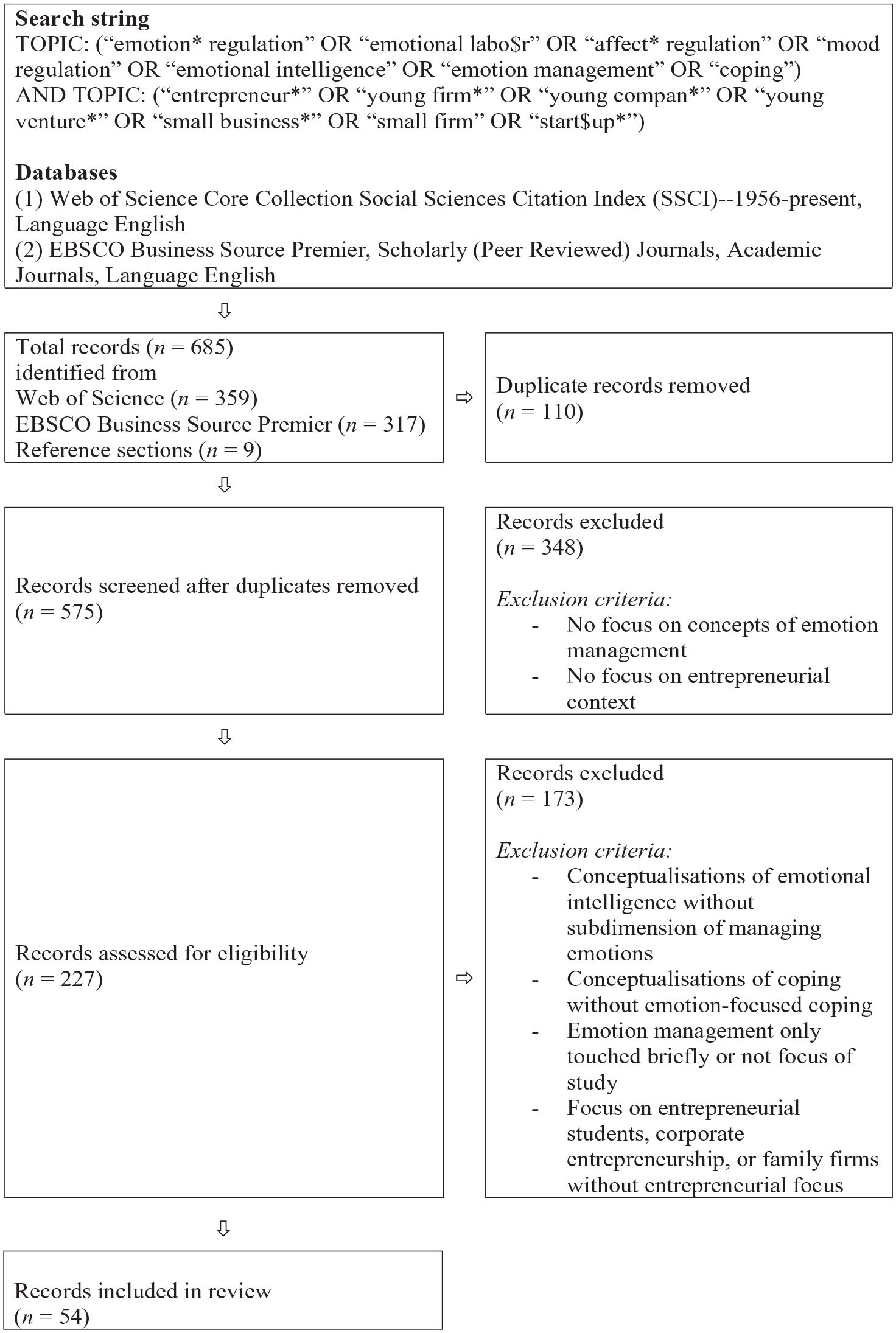
Flow diagram of the search process.
Included articles had to be peer-reviewed and published in academic journals, as well as written in English. Other than these, we did not exclude any journals based on rankings or subject-specific domains, nor did we specify a specific time frame for publication. We conducted the latest search for the current version of this review in December 2022, which yielded 685 independent records, including duplicates.
Screening process and exclusion criteria
In keeping with recommendations from Tranfield et al. (2003), we determined exclusion and inclusion criteria for our screening process – also indicated in Figure 1. After reading the titles and abstracts of our initially identified records first, we excluded all articles that did not refer to the topic of emotions or emotion management (including all targeted sub-concepts) in the entrepreneurial context. For example, the initial sample included articles that dealt with macro-economic or political themes with regard to entrepreneurial firms (e.g. Anton and Onofrei, 2016; Melissanidou and Johnston, 2019), which were not aligned with our defined search and we hence excluded. This screening and exclusion step resulted in 227 studies.
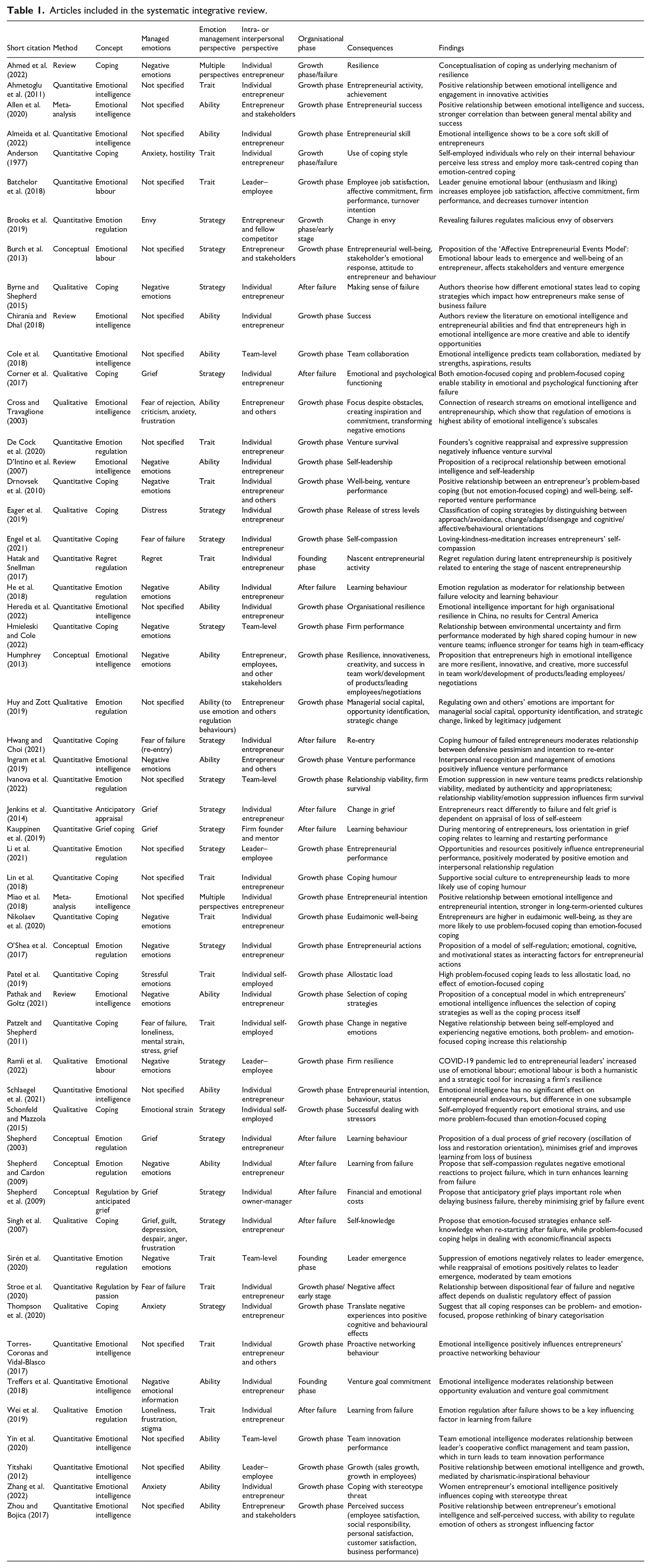
We conducted a second exclusion step in which we screened the full texts of our records and assessed these remaining studies for eligibility (Tranfield et al., 2003). As our inclusion criteria necessitated that articles had to focus on emotion management (i.e. reflected by the regulation or adjustment of emotions) rather than on entrepreneurial emotions in general, we excluded all records that examined emotions without focusing on the regulative, manageable nature of emotions (e.g. Gorgievski et al., 2014). Another inclusion criterion determined that articles had to focus on the entrepreneurial process, including entrepreneurs who were either in the founding or growth phase of their ventures or those who had encountered failure. This criterion meant focusing on entrepreneurs who had taken concrete steps towards establishing their business, which could include evaluating or identifying opportunities. Conversely, we excluded studies that centred solely on individuals with entrepreneurial aspirations but no tangible entrepreneurial activities. As a result, articles examining the emotion management of entrepreneurial students with mere intentions to start a business, such as in a study by Shepherd (2004), were not considered for inclusion in our review. We also excluded articles that focused on employee emotion management in relation to a corporate entrepreneurship project (e.g. Patzelt et al., 2021), as we aimed to focus on entrepreneurial endeavours in the context of a new venture rather than an existing organisation. Additionally, we excluded articles that focused on small businesses or family firms when the firms studied in these particular articles did not include an entrepreneurial focus (e.g. Radu-Lefebvre and Randerson, 2020). Regarding studies on emotional intelligence, we only included studies that explicitly included the subdimension of regulating one’s own and the emotions of others (Mayer and Salovey, 1997) in their definition of emotional intelligence. With regard to studies on emotion-focused coping, only studies that explicitly distinguished between emotion-focused and problem-focused coping were included while not only referring to coping as a broad dimension. After this exclusion step, 54 studies remained that were included as the final sample for this review. Table 1 summarises all articles, employed methods, concepts, and findings reported in the respective articles.
Articles included in the systematic integrative review.
Data coding
As a first step, all studies were coded descriptively. To achieve a first overview of the included studies, we screened the full texts for common subjects, theoretical constructs, and perspectives (Radu-Lefebvre et al., 2021). We also determined whether the respective article was based on a qualitative (n = 10), quantitative (n = 32), or conceptual (n = 5) study or if it was a review article or meta-analysis (n = 7). Journals included in our review stem from the management and organisational behaviour (n = 12), psychology (n = 9), and entrepreneurship (n = 27) domains. Six articles were published in journals from miscellaneous domains. After the descriptive coding, we summarised common subjects and constructed second-order themes. As the core of our coding process, we scrutinised the different definitions of emotion management – hence, we first recorded the different conceptualisations of emotion regulation (e.g. suppression and reappraisal), emotional labour with deep and surface acting, emotional intelligence with its subdimension of regulating one’s own and the emotions of others, as well as emotion-focused coping (e.g. venting or denial). In this coding step, we discovered that the literature on these different concepts examined emotion management from different angles related to the role that it serves for the individual. For instance, when studies took the ability perspective, literature defined emotion management as a personal capability to manage emotions in a certain way (Grandey and Gabriel, 2015; Miao et al., 2017). The trait perspective, however, meant that studies conceptualised emotion management as strategies that individuals use chronically or habitually as a character or personality trait (Miao et al., 2018). Finally, the strategy perspective reflects the use of emotion management in specific situations or contexts (Gross, 2015).
While the different concepts surrounding emotion management typically either distinguish between an ability or a trait (Grandey and Melloy, 2017) or between a trait and a strategy perspective (Maxwell et al., 2019), we coded the articles with all three respective categories, as the simultaneous scrutiny of all three perspectives allows us to gain a more comprehensive view on emotion management. In the next step, we assessed whether the studies in our sample analysed emotion management from an ability, a trait, or a strategy perspective and coded the articles respectively. This mapping studies in our sample led to the second-order themes of individual ability, trait, and situation-specific strategies. Furthermore, we categorised descriptive codes such as culture and perceived uncertainty as environmental conditions, subjects such as firm age as organisational predispositions, and the investigated entrepreneurial stages (e.g. growth and after failure) as organisational phases. As the studies varied in the way they investigated emotion management of individual entrepreneurs or in the context of other stakeholders, we categorised all studies as either reflecting an intra- or interpersonal perspective. Moreover, we summed up variables such as the entrepreneurial experience as individual predispositions and variables such as team-efficacy as relational predispositions. We also summed up events (e.g. venture obstacles) with the second-order theme of entrepreneurial events and studied emotions (e.g. fear or failure) with the theme of managed emotions. As for possible outcomes of emotion management, we summed up individual outcomes (e.g. entrepreneurial performance) and venture outcomes (e.g. venture survival).
During the third abstraction stage, we built five integrative themes (Cronin and George, 2020; Radu-Lefebvre et al., 2021) to encapsulate the underlying conceptual dimensions. We categorised the second-order themes of individual ability, trait, and situation-specific strategies as entrepreneurial emotion management perspectives. In addition, we grouped the second-order themes: environmental conditions, organisational predispositions, and organisational phases, into macro- and meso-level factors. We aggregated individual and relational predispositions as well as intra- or interpersonal perspectives as individual factors, and we consolidated entrepreneurial events and managed emotions as antecedents. Finally, we aggregated individual outcomes as well as venture outcomes as consequences. The full presentation of the coding themes can be found in the Appendix (Figure A1).
Development of the framework
To put the identified themes in a temporal and contextual relationship, we organised all previously described themes in an integrative framework, presented in Figure 2. Below each third-order theme, the related second-order themes are displayed with respective examples of first-order themes. At the core of the framework, we highlight the three corresponding different perspectives on emotion management – as an individual ability, a trait, or as situation-specific strategy. The two outer layers macro- and meso-level factors and individual factors include factors that influence the emotion management process. Furthermore, the core of the framework, that is, entrepreneurial emotion management, is linked to antecedents and consequences of entrepreneurial emotion management (Burch et al., 2013; Weiss and Cropanzano, 1996). However, this should not reflect a linear process: As also noted by Burch et al. (2013), entrepreneurial emotion management and its consequences influence subsequent events because of the new knowledge and experience acquired during past events. This cycle is indicated in the framework by an arrow that links back from the consequences to the antecedents of entrepreneurial emotion management.
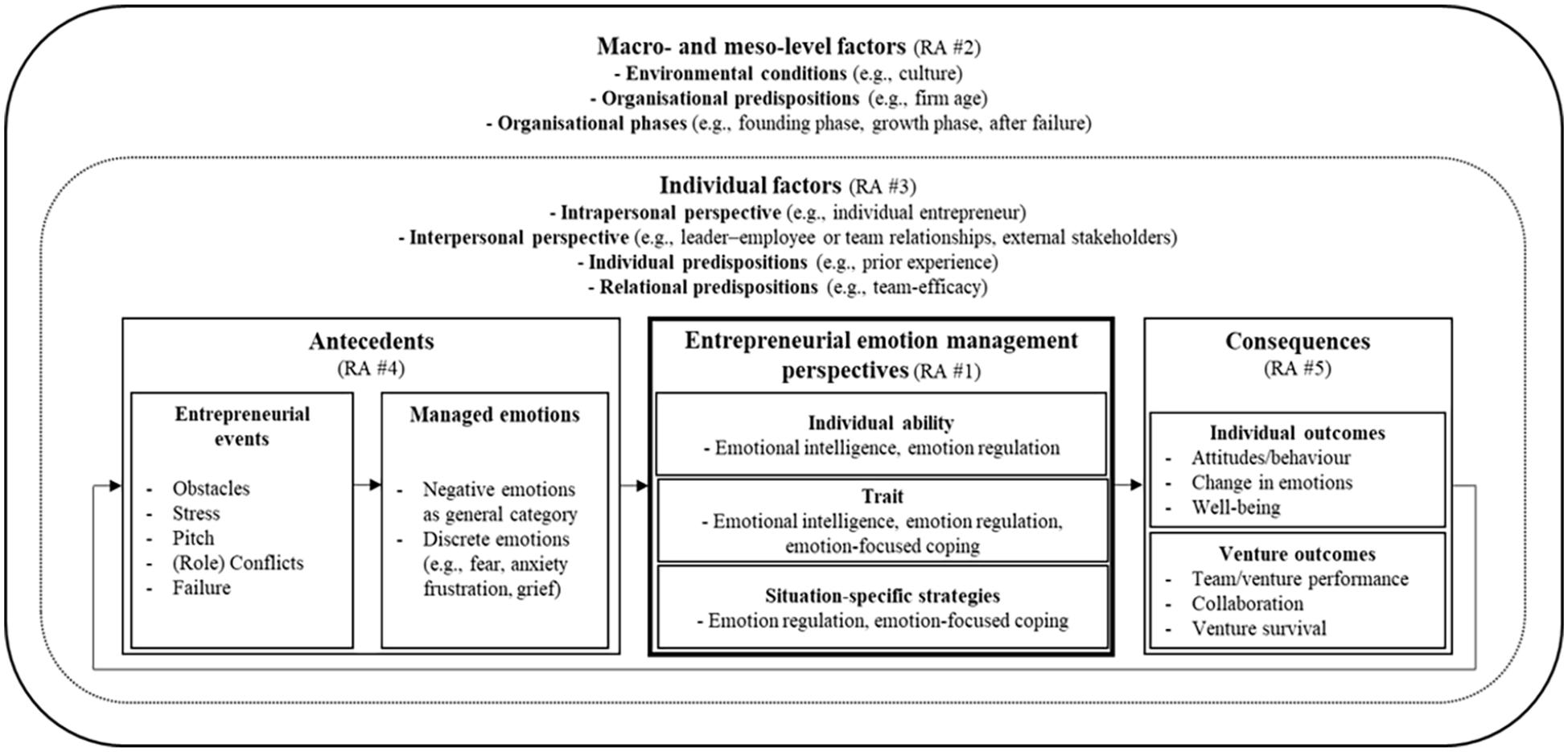
Framework of entrepreneurial emotion management with indication of research avenues (RA).
Entrepreneurial emotion management perspectives and concepts
During the screening process, we mapped the core of our framework, the main research concepts of emotional intelligence, emotion regulation, and emotion-focused coping, as well as three different perspectives on entrepreneurial emotion management, namely the individual ability, the trait, and the situation-specific strategies perspectives. When studies took the ability perspective (n = 20), scholars defined entrepreneurial emotion management as a personal capability to manage emotions in an appropriate and successful way (Mayer and Salovey, 1997). As visualised in Figure 3, the ability perspective has been taken in the emotional intelligence and emotion regulation research traditions.
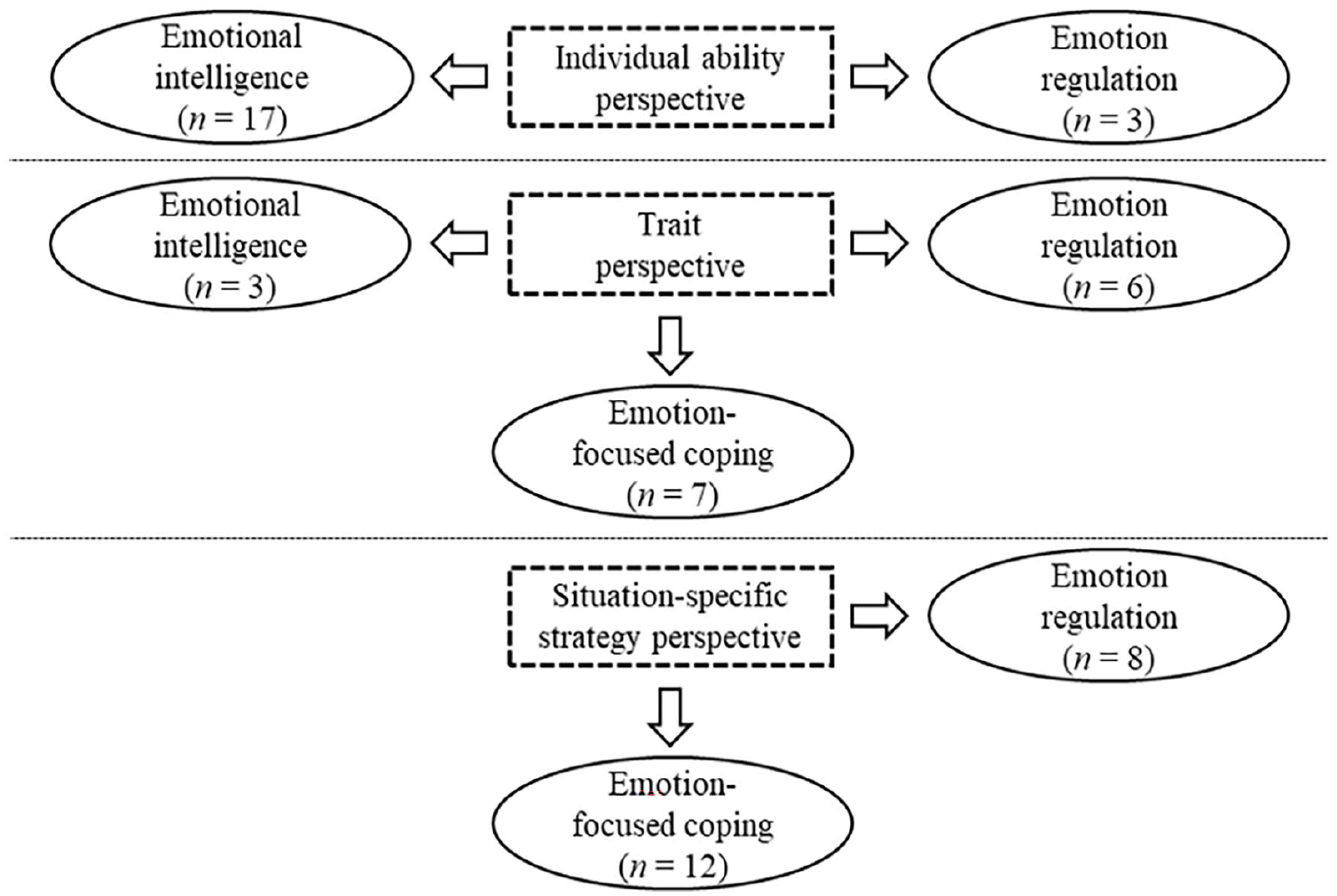
Emotion management concepts and perspectives.
Research has also analysed entrepreneurial emotion management from a trait perspective (n = 16), which means that studies conceptualised entrepreneurial emotion management as a mechanism that individuals use habitually or chronically as a trait (Miao et al., 2018) or as a propensity to use certain strategies (Batchelor et al., 2018). The trait perspective has been examined by all three emotion management traditions: emotional intelligence, emotion regulation, and emotion-focused coping. Finally, entrepreneurial emotion management has also been investigated as a set of situation-specific strategies (Peña-Sarrionandia et al., 2015) (n = 20), which means that individuals use strategies on purpose or in a specific situation (Engel et al., 2021; Ivanova et al., 2022). Scholars from the emotion regulation and emotion-focused coping research traditions have used the situation-specific perspective. Two articles in our review investigated entrepreneurial emotion management from multiple perspectives, namely, Miao et al. (2018) meta-analytically analysed the concept of emotional intelligence from an ability and a trait perspective, and Ahmed et al. (2022) conducted an integrative review on resilience, stress, and coping while examining emotion-focused coping from a trait and a strategy perspective. We will elaborate on the different research concepts and the respective perspectives as an individual ability, a trait, and as situation-specific strategies below.
Entrepreneurial emotional intelligence
In total, 19 studies in this review utilised the emotional intelligence concept. Twelve investigated entrepreneurial emotional intelligence as an ability from a quantitative or meta-analytical perspective. With a meta-analysis, Allen et al. (2020) found that emotional intelligence had a stronger influence on entrepreneurial success than the entrepreneur’s general mental ability. Zhou and Bojica (2017) found that the ability to regulate emotions is more strongly related to perceived entrepreneurial success than the other subdimensions of emotional intelligence, while Ingram et al. (2019) also demonstrated the positive impact of this ability on venture performance. Another study showed the positive impact of team emotional intelligence on team innovation performance (Yin et al., 2020), thereby highlighting that not only an individual’s ability to regulate emotions but also the sum of team member emotional intelligence as crucial for success. In contrast to these findings, Schlaegel et al. (2021) found no significant relationship between emotional intelligence and entrepreneurial intentions.
Five of the identified studies in this review examined emotional intelligence as an ability in the entrepreneurial context from a qualitative or a conceptual perspective. While they all support the assumption of emotional intelligence as a crucial ability for entrepreneurs, their suggested outcomes on entrepreneurial behaviour, well-being, and success vary. Humphrey (2013) pointed out why emotional intelligence relates to entrepreneurship, that is, among other factors, the ability to manage intense emotions when working with employees and stakeholders. D’Intino et al. (2007) defined the ability to regulate emotions as the main characteristic of emotional intelligence; they proposed a positive interaction with self-leadership, that is, the ability of entrepreneurs to regulate their own behaviour. While the ability to regulate emotions is generally attributed to entrepreneurs more than to employees in other professions, D’Intino et al. (2007) also pointed out the fact that this ability is something that can be learned and developed. Similarly, Pathak and Goltz (2021) proposed a conceptual model which highlights that emotional intelligence as an ability will help in selecting and shaping the appropriate coping process with negative emotions.
Emotional intelligence scholars have defined emotional intelligence and its subdimension of regulating emotions not only as an ability but also as a trait (n = 3), reflecting the idea of emotional intelligence as emotional self-perceptions and a part of personal characteristics (Torres-Coronas and Vidal-Blasco, 2017). For example, Ahmetoglu et al. (2011) demonstrated that emotional intelligence as a trait has a positive influence on entrepreneurial activity and entrepreneurial achievement, while Torres-Coronas and Vidal-Blasco (2017) showed that regulating emotions as part of emotional intelligence positively influences entrepreneurs’ proactive networking behaviour.
In summary and across the board, scholars see emotional intelligence as an ability or a trait as positive – or at least not harmful – for entrepreneurs and their endeavours. However, it remains unclear whether there are certain entrepreneurial behavioural strategies that can be characterised as being more or less emotionally intelligent and how entrepreneurial intelligence relates to using certain strategies to manage situations in which negative emotions occur. We will elaborate further on this research void in the future research avenues (RA).
Entrepreneurial emotion regulation
Seventeen studies in this review focused on emotion regulation and conceptualised it as an entrepreneurial ability, a trait, or a strategy. The ability perspective is represented in three studies that stem from the emotion regulation tradition. For instance, Huy and Zott (2019) theorised that regulating both own (e.g. by focusing on long-term success) and the emotions of others (e.g. by showing consideration) is an essential part of an entrepreneur’s dynamic managerial capabilities. Scholars also explored emotion regulation from a trait perspective (n = 6). In contrast to emotional intelligence, those studies typically distinguish between subtypes of regulating emotions based on the terminology introduced by Gross (1998), who differentiated between the suppression or reappraisal of emotions. Several studies showed that the suppression or reappraisal of emotions has distinct outcomes on behavioural outcomes: Team members in entrepreneurial firms who regularly suppress their emotions were perceived less as leaders than individuals who reappraise their emotions (Sirén et al., 2020). At the same time, De Cock et al. (2020) found that both reappraisal and suppression of emotions are negatively related to venture success, implicating that the regulation of emotions should generally be avoided, which contradicts previous research that highlighted the positive role of emotion regulation. Other studies use the emotion regulation terminology initially stemming from research on emotional labour – that is, the distinction between deep and surface acting (Grandey, 2000; Hochschild, 1983). For example, Batchelor et al. (2018) demonstrated that both strategies of regulating and thereby disguising emotions are rather harmful to observers, and they plead for entrepreneurial leaders to show their genuine, natural emotions in order to achieve favourable employee attitudes.
Comparatively, few authors explored specific mechanisms that go beyond the reappraisal–suppression or deep-acting–surface acting differentiation. Two studies conducted their research using concepts that differ from traditional conceptualisations: Stroe et al. (2020) proposed that affect can be regulated by other emotions; in this case, the type and level of passion regulated the fear of failure. Research by Hatak and Snellman (2017) investigated emotion regulation with regard to the specific emotion of regret; their findings showed that the anticipation of regret can serve as a regulation mechanism for nascent entrepreneurial activities. Studies examining emotion regulation as situation-specific strategies (n = 8) employ varying conceptualisations. Using more popular operationalisations of emotional labour and emotion regulation, Burch et al. (2013) conceptually investigated the role of deep acting and surface acting on general entrepreneurial well-being and performance outcomes, while Ramli et al. (2022) showed with interview data that entrepreneurs used more deep and surface acting in a crisis situation. Ivanova et al. (2022) specifically explored the role of inauthentic emotion suppression as part of emotion regulation in new venture teams, which showed to be a negative way of regulating emotions for relationship viability. Similarly, focusing on the interpersonal level, Brooks et al. (2019) conceptualised revealing failure as an interpersonal emotion regulation strategy and showed that it weakens observer envy in an entrepreneurial pitch situation. A quantitative study by Li et al. (2021) defined emotion regulation as an interpersonal strategy of supervisors that was operationalised as ‘positive’ behaviours (e.g. spending time with subordinates), which in turn increased entrepreneurial performance. Two studies examined the role of humour as a strategy: While Hwang and Choi (2021) showed that the use of humour by entrepreneurs who experienced failure motivated re-entry into entrepreneurial endeavours, Hmieleski and Cole (2022) found a positive influence of using humour as a strategy to deal with uncertainty on firm performance. Taking a conceptual view on emotion regulation as a situation-specific strategy after failure, Shepherd (2003) and Shepherd et al. (2009) highlighted the need for the regulation of grief (i.e. by taking a loss and restoration orientation in their grief recovery or by anticipating grief) to enhance learning from failure. Similarly, He et al. (2018) showed that the ability to regulate emotions positively moderates the relationship between learning behaviours after failure and particularly, rapid failure.
Entrepreneurial emotion-focused coping
Articles in this review that focused on entrepreneurial emotion-focused coping encompass 18 studies that either used a trait or a strategy perspective. Those in the emotion-focused coping domain typically differentiate between more specific forms of emotion-focused coping; this is a more diversified approach to analysing the entrepreneurial emotion management process than in the emotional intelligence domain, where most studies just focus on a broad conceptualisation of managing emotions without specifying certain techniques. Also, other than in the emotion regulation domain, scholars typically do not put emphasis on an upregulation focus on emotions but rather propose different mechanisms. For instance, regarding emotion-focused coping strategies that entrepreneurs employ as a trait (n = 7), studies showed that different mechanisms like avoidance, minimisation and distancing oneself from the problem lead to higher well-being (Drnovsek et al., 2010), while emotion-focused coping also proved to be beneficial for decreasing negative affect (Patzelt and Shepherd, 2011). Nikolaev et al. (2020), however, argued that emotion-focused coping is a rather harmful coping technique and empirically demonstrated that entrepreneurs generally use more problem- than emotion-focused coping, which in turn leads to higher well-being than that of traditional employees. This view on the management of emotions is, hence, different from studies on emotional intelligence and emotion regulation that, in contrast, attribute a significant importance to the existence and use of emotion management in the entrepreneurial context. While both views may have their merits, this can be seen as an indication that the pure focus on the management of entrepreneurial emotions, as conceptualised in the emotional intelligence and emotion regulation literature, may have its limitations when it is not interpreted in light of the practical challenges and problems that arise in the entrepreneurial context. While the focus on managing emotions may help in overcoming challenges, the focus on practical problems – that in turn evoke emotions – and the aim to solve them should, at the same time, not be neglected. Twelve studies explored coping as situation-specific strategies. Engel et al. (2021) investigated fear of failure and demonstrated that meditating entrepreneurs enhanced their self-compassion as an emotion-focused coping strategy; this reduced their fear of failure. Focusing on the time after failure, one study showed that appraisals of loss had a positive influence on grief after failure (Jenkins et al., 2014). Another qualitative study revealed that emotion-focused coping strategies (i.e. venting, using emotional support) had a positive influence on the relief of stress levels (Eager et al., 2019), and Singh et al. (2007) found that entrepreneurs using emotion-focused strategies after failure (i.e. reframing and re-examination), experienced psychological learning in terms of their self-knowledge.
These studies demonstrate, contrary to the conceptualisation of emotion-focused coping as a trait by Nikolaev et al. (2020), that emotion-focused coping strategies can have positive outcomes in certain situations. An explanation for the differences could be the operationalisation of emotion-focused coping. While Nikolaev et al. (2020) described the trait of emotion-focused coping as an avoidance strategy (meaning that entrepreneurs do not actively engage in managing emotions), studies that analysed emotion-focused coping from a non-habitual strategy perspective described emotion-focused coping as self-compassion (Engel et al., 2021) or as appraisals (Jenkins et al., 2014). While the latter two strategies imply an active way of managing emotions, the avoidance of emotions is a more passive way of dealing with them, which can, hence, be seen as less beneficial.
Contextual factors of entrepreneurial emotion management
In addition to the different perspectives on entrepreneurial emotion management, the framework in Figure 2 also highlights contextual factors, including macro- and meso-level factors, individual factors, antecedents, and consequences. These contextual factors determine the entrepreneurial emotion management process, as entrepreneur experiences are embedded within a complex web of environmental, organisational, and individual factors that also lead to a variety of potential antecedents and consequences of entrepreneurial emotion management. Within each research tradition of entrepreneurial emotion management, including emotional intelligence, emotion regulation, and emotion-focused coping, scholars have explored contextual factors with varying frequency. Table 2 offers a comprehensive summary, showing the frequency with which these contextual factors were investigated across each entrepreneurial emotion management concept.
Emotion management concepts in relation to contextual factors.
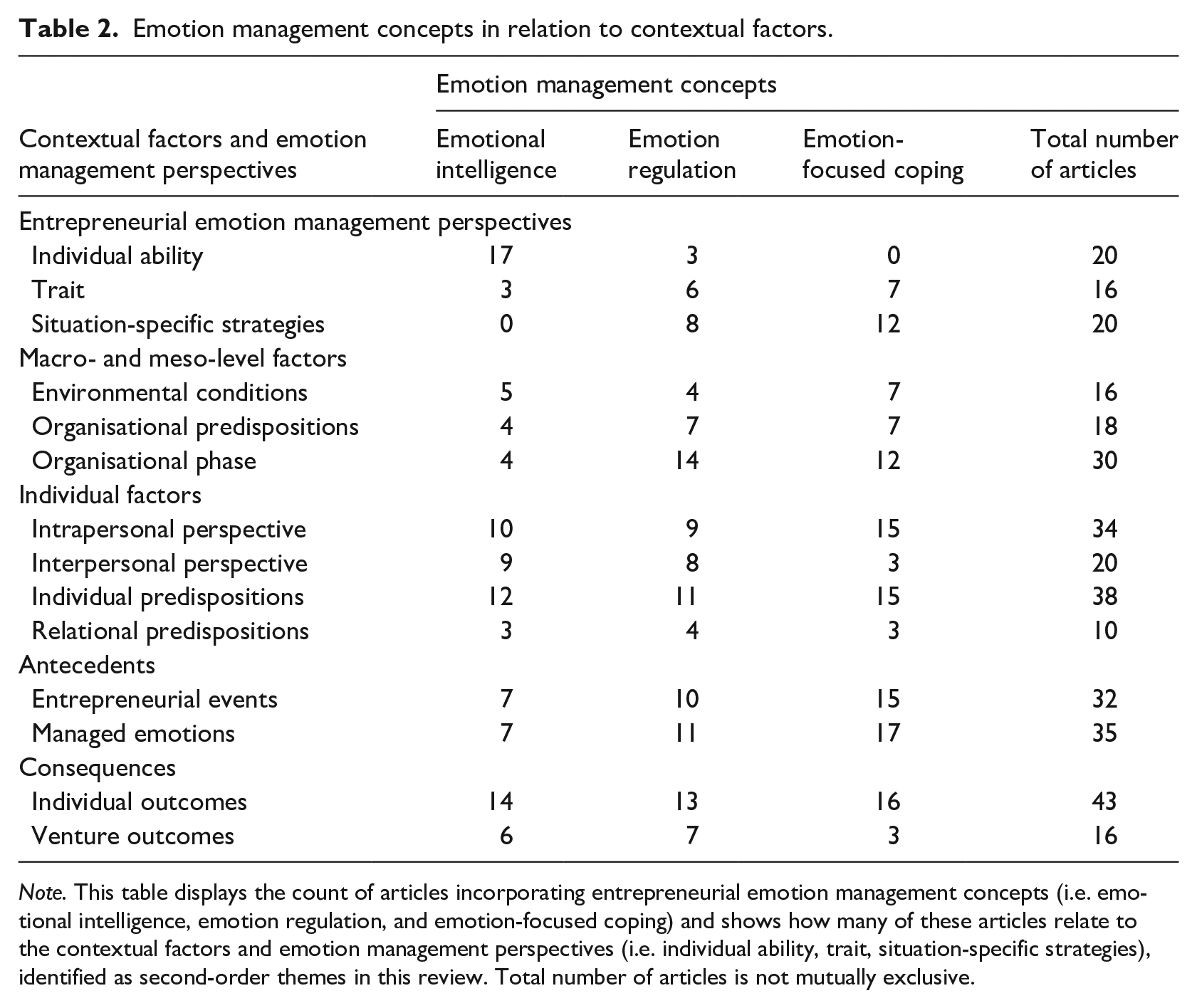
Note. This table displays the count of articles incorporating entrepreneurial emotion management concepts (i.e. emotional intelligence, emotion regulation, and emotion-focused coping) and shows how many of these articles relate to the contextual factors and emotion management perspectives (i.e. individual ability, trait, situation-specific strategies), identified as second-order themes in this review. Total number of articles is not mutually exclusive.
Macro- and meso-level factors
Entrepreneurs operate under diverse circumstances involving macro- and meso-level factors, which influence the emotion management process (see the top of Figure 2 and left column of Table 2). As a macro-level factor, environmental conditions (n = 16) encompass the culture or geographic area in which entrepreneurs operate. For example, Miao et al. (2018) conducted a meta-analysis that revealed a particularly strong positive link between emotional intelligence and entrepreneurial intentions in cultures oriented towards long-term objectives, which is because individuals in such cultures are more inclined to focus on long-term goals, a characteristic often associated with entrepreneurial ventures. Environmental conditions were also investigated by Schlaegel et al. (2021), who explored environmental conditions by comparing the emotional intelligence levels between entrepreneurs and non-entrepreneurs. The evidence from their findings showed significant differences in a German entrepreneurial sample, unlike in the U.S. and Russian samples, indicating the influence of environmental conditions on the capacity to manage emotions within entrepreneurial contexts. Focusing more narrowly on meso-level factors, specifically on organisational predispositions (n = 18), Drnovsek et al. (2010) demonstrated that a venture’s capital positively predicts entrepreneur preferences for emotion-focused coping over problem-focused coping. Conversely, De Cock et al. (2020) found that a venture’s overall performance affects whether an entrepreneur’s use of emotion regulation strategies decreases the likelihood of venture survival.
Meso-level factors also encompass various organisational phases (n = 30), including the initial founding phase, the growth phase, and potentially, the phase of failure. However, 24 studies, notably in the emotional intelligence domain, did not further specify the organisational growth phase under scrutiny. In total, 13 studies examined the impact of entrepreneurial emotion management on categories of entrepreneurial behaviour and performance outcomes, such as success, or health outcomes, such as well-being (Burch et al., 2013; Drnovsek et al., 2010; Nikolaev et al., 2020) in a more specified growth phase. A smaller set of just five studies delved into the nuances of the founding stage, investigating aspects such as the role of regret regulation in nascent entrepreneurial activities (Hatak and Snellman, 2017) and the impact of emotional intelligence on venture goal commitment (Treffers et al., 2018). Furthermore, twelve studies shed light on the significance of entrepreneurial emotion management post-failure, focusing on themes like learning from failure (Shepherd et al., 2009; Wei et al., 2019) and re-starting a new venture (Hwang and Choi, 2021; Kauppinen et al., 2019).
In sum, the analysis, as depicted in Table 2, reveals a common trend among scholars across all three research traditions to treat entrepreneurs and their firms as a relatively homogeneous group, often overlooking the nuances of specific environmental conditions, organisational predispositions, and organisational phases. This approach limits a comprehensive exploration of the varied experiences of entrepreneurs in managing emotions. Our discussion on future research directions aims to bridge this gap by highlighting areas in need of further investigation.
Individual factors
Research on entrepreneurial emotion management divides into intrapersonal and interpersonal perspectives. Overall, as indicated in Table 2, the intrapersonal perspective is more prominent than the interpersonal perspective. This is particularly the case within the emotion-focused coping realm, where scholars mostly adopt an intrapersonal view, focusing on the individual entrepreneur, while only three studies took an interpersonal perspective. In comparison, in the emotion intelligence (n = 9) and emotion regulation (n = 8) domains, the interpersonal perspective is more prominent. The intrapersonal perspective, explored in 34 studies, examines how entrepreneurs internally manage their emotions (Madrid et al., 2019). This includes exploring the impact of emotional intelligence on entrepreneurial success (Ahmetoglu et al., 2011) and how emotion regulation and coping strategies contribute to well-being and learning from failure (He et al., 2018; Nikolaev et al., 2020). Conversely, the interpersonal perspective, covered in 20 studies, investigates how entrepreneurs manage their own, or the emotions of others, during interactions – for instance, in teams (Hmieleski and Cole, 2022; Ivanova et al., 2022), with external stakeholders (Burch et al., 2013), or with subordinates (Sirén et al., 2020; Yin et al., 2020). This perspective acknowledges that entrepreneurship affects not only the founders but also their employees, who share the venture’s inherent uncertainties and emotional challenges (Andersén, 2017) and that entrepreneurs often work together with other stakeholders. However, the literature – especially in the emotional intelligence domain – often lacks specificity regarding whose emotions (e.g. those of team members, subordinates, investors) are being managed, broadly categorising them as ‘others’. This presents a gap in understanding the targeted individuals of emotion management, a topic we will revisit in the future research agenda.
The interpersonal perspective extends to managing emotions in front of others, including suppressing negative emotions during challenges (Ivanova et al., 2022) or influencing the emotions of others in order to motivate them (Cole et al., 2018; Huy and Zott, 2019). The display of emotions can lead to the contagion of emotions, affecting observer attitudes and behaviours (Barsade, 2002). A key consideration here is the authenticity of such emotional displays, as genuine emotion management can foster positive outcomes like trust and engagement, while inauthentic displays may have negative repercussions (Batchelor et al., 2018; Burch et al., 2013). Despite its prominence in organisational behaviour research on inauthentic emotion management strategies, surprisingly, this area remains largely unexplored empirically within entrepreneurial research; this represents a significant opportunity for future investigation.
Distinguishing between intrapersonal and interpersonal perspectives also allows for the examination of individual (n = 38) and relational (n = 10) predispositions. Individual predispositions encompass entrepreneurial abilities (Ahmetoglu et al., 2011), resilience (Corner et al., 2017), optimism (Engel et al., 2021), or general mental ability (Allen et al., 2020), which are related to emotion management ability. Another factor on the individual level is an entrepreneur’s lower perceived role centrality, which has been shown to positively influence the use of emotion-based coping rather than problem-focused coping (Drnovsek et al., 2010). One noteworthy study explicitly highlighted the role of the entrepreneur’s gender and showed that emotional intelligence can help women deal with the stereotype threat they may face when founding (Zhang et al., 2022). Relational predispositions, however, include factors such as team efficacy (Hmieleski and Cole, 2022) and team passion (Yin et al., 2020) that have been shown to positively influence the entrepreneurial emotion management process. However, despite these existing insights, research on relational predispositions remains limited, highlighting a critical gap given the collaborative nature of entrepreneurship.
Antecedents
Entrepreneurs experience multiple events at work – with either short- or long-term implications. These range from everyday situations, such as navigating challenges (Drnovsek et al., 2010) and dealing with stress (Thompson et al., 2020), to managing interpersonal conflicts (Schonfeld and Mazzola, 2015; Yin et al., 2020). Much of the existing research, however, delves into more critical incidents within the entrepreneurial process, including business failures or crises (He et al., 2018; Hwang and Choi, 2021; Jenkins et al., 2014; Ramli et al., 2022; Shepherd et al., 2009). Specifically, the COVID-19 pandemic has brought forth novel work on emotionally laden events in the entrepreneurial context. For example, Ramli et al. (2022) found that entrepreneurs undertook more emotional labour during the pandemic to lead their employees through the crisis. As it can be seen in Table 2, it is striking that scholars from the emotion regulation and emotion-focused coping research traditions, in particular, define which events they focus upon, while emotional intelligence scholars often leave open which situations of the entrepreneurial experience they aim to investigate. As depicted in Figure 2, these events elicit emotional responses that can significantly affect work attitudes and behaviours (Gross, 2015; Weiss and Cropanzano, 1996). As indicated in Table 2, 35 studies in total have specified the discrete emotion they are studying. While 19 studies explored emotions ranging from fear of failure, anxiety, regret, sadness, grief, anger, frustration, and envy, there is a notable gap in the differentiation of these emotions in the literature, as 16 studies only referred to negative or stressful emotions, and 19 studies did not specify whether they were examining negative, positive, or even more nuanced emotional states.
As depicted in Table 2, a general approach to studying emotions is particularly prevalent in research on emotional intelligence and emotion regulation, with only 7 (emotional intelligence) and 11 (emotion regulation) studies focusing on discrete emotions. Other scholars from these traditions state, albeit often only implicitly, that they are interested in the process of managing emotions that are undesirable or disruptive to the entrepreneurial process (Burch et al., 2013; Drnovsek et al., 2010), which implicates that negative emotions are of interest in their studies – however, they do not further differentiate them. An exception lies within the domain of emotion-focused coping, where specific emotions like grief (Corner et al., 2017; Jenkins et al., 2014; Kauppinen et al., 2019; Shepherd, 2003) or fear (Engel et al., 2021; Hwang and Choi, 2021; Stroe et al., 2020) are studied in a total of 17 articles.
With regard to positive emotions, we already know from other work contexts (e.g. police officers) that it is theoretically and practically possible to manage (i.e. to downregulate) positive emotions (Gross, 2015). Although there is no example of positive entrepreneurial emotion management in this systematic integrative review, a potential use case for research in the entrepreneurial context could be that entrepreneurs manage their positive emotions to appear more serious in negotiations – which could be explored from both an ability and a strategy perspective. We will discuss this further in the future RA.
Consequences
Finally, the consequences of entrepreneurial emotion management can be differentiated by individual (n = 43) and venture (n = 16) outcomes. At the individual level, research has explored a broad spectrum of outcomes, ranging from effects on personal attitudes, behaviours, and well-being to intentions for future entrepreneurial engagement. Within the emotional intelligence domain, studies have predominantly focused on its influence on broader aspects such as perceived entrepreneurial success (Allen et al., 2020; Chirania and Dhal, 2018; Zhou and Bojica, 2017) and entrepreneurial performance and achievements (Ahmetoglu et al., 2011). Conversely, research through the lens of emotion-focused coping has mainly delved into psychological effects, including personal well-being (Drnovsek et al., 2010; Nikolaev et al., 2020) and stress reduction (Eager et al., 2019; Schonfeld and Mazzola, 2015). Emotion regulation studies have examined a range of outcomes, from emotional and attitudinal changes to behavioural shifts such as learning from failure (He et al., 2018; Shepherd, 2003; Shepherd and Cardon, 2009; Wei et al., 2019) and improving entrepreneurial performance (Li et al., 2021). Interestingly, only four studies specifically addressed changes in emotions as a result of entrepreneurial emotion management (Brooks et al., 2019; Jenkins et al., 2014; Patzelt and Shepherd, 2011; Stroe et al., 2020), suggesting an opportunity for further research to first, investigate emotional changes and then, assess subsequent attitudinal or behavioural adjustments (Weiss and Cropanzano, 1996). Research on outcomes at the venture level is much more limited. As depicted in Table 2, this is evident across all research traditions. Extant research has explored outcomes such as team collaboration (Cole et al., 2018), venture survival (De Cock et al., 2020), leader emergence (Sirén et al., 2020), and team innovation performance (Yin et al., 2020). These studies highlight the broader impact of entrepreneurial emotion management, suggesting that an entrepreneur’s ability to manage emotions can influence the success of their team and venture. The underlying assumption is that entrepreneurial emotion management directly or indirectly (through mechanisms like interpersonal processes) affects performance and success (Ingram et al., 2019).
Across all research traditions – emotional intelligence, emotion regulation, and emotion-focused coping – scholars place emphasis on the positive impact of effective emotion management. De Cock et al. (2020) provided a notable exception, indicating that habitual emotion regulation strategies, such as suppression and reappraisal, reduce the likelihood of venture survival. This finding introduces a critical perspective on the potential drawbacks of entrepreneurial emotion management, warranting further exploration in this area.
Future research avenues
As the systematic integrative review of current literature on entrepreneurial emotion management has illustrated, there are still unanswered questions both within emotion management perspectives and their interconnections as well as the varied attention given to contextual factors. Notably, the frequency with which these contextual factors are investigated across the different emotion management concepts reveals significant disparities. Based on the insights from Table 2 and the preceding discussion, we have identified areas that are under-researched and in need of further investigation.
Research avenue 1: Entrepreneurial emotion management perspectives
Integrating studies on emotion management, including those focused on emotional intelligence, emotion regulation, and emotion-focused coping, allows us to examine entrepreneurial emotion management from various perspectives: as an entrepreneur’s individual ability, a trait, or situation-specific strategies. We have identified research gaps within each of these perspectives, as well as in their interrelationships.
Regarding the ability perspective, emotion management has been highlighted as particularly crucial and beneficial for entrepreneurs (Cross and Travaglione, 2003; Humphrey, 2013). However, it is important to note that most studies in this review relied on self-report measures to assess entrepreneurial emotion management ability (Miao et al., 2018). However, a more recent study suggested that entrepreneurs may sometimes overestimate their abilities, which can skew their judgements (Singh, 2020). This overestimation could also affect their self-assessment of emotion management ability. Thus, incorporating objective measures, such as evaluations by team members, could provide a clearer understanding of the ability perspective and its relationship to entrepreneurial success. Our review also indicates a lack of empirical evidence on the effectiveness of situation-specific strategies. While the importance of identifying appropriate strategies for entrepreneurs has been recognised in qualitative and conceptual studies, only seven studies have examined specific strategies and their efficacy quantitatively. This gap is significant because the use and impact of entrepreneurial emotion management strategies are likely to vary. Research in the broader organisational context has shown that individuals employ a variety of strategies in specific situations (Scott et al., 2012). This variability is particularly pertinent in the unpredictable entrepreneurial environment, where entrepreneurs must continually adapt to new circumstances without standard procedures (Baron, 2008).
Our review also highlights a significant knowledge gap regarding the interplay between these perspectives, especially the impact of emotion management ability on the choice of specific strategies. This limitation is apparent not only in the entrepreneurial sphere but also in the broader organisational domain (Megías-Robles et al., 2019). Initial efforts in the organisational literature have already started to bridge emotional intelligence and emotion management, conceptualising emotional intelligence as a potential influencing factor in adopting more effective emotion management strategies, such as preferring authentic over inauthentic strategies (Grandey and Melloy, 2017; Gabriel et al., 2023). Therefore, future research should investigate the implications of general emotion management ability for entrepreneurial behaviour, specifically whether it predicts the use of certain trait-level or situation-specific strategies (e.g. on the daily level), and, in turn, which strategies reflect a high emotion management ability. Additionally, it would be beneficial for theoretical advancement to explore whether entrepreneurs learn from employing various strategies and how this learning affects their emotion management ability in the long term (O’Shea et al., 2017).
Research avenue 2: Macro- and meso-level factors
As we have shown in this review, previous research has already revealed that different macro- and meso-level factors influence entrepreneurial emotion management. However, as also displayed in Table 2, only 16 articles shed light on environmental conditions, and 18 articles specified organisational predispositions as contextual factors potentially influencing entrepreneurial emotion management. At the same time, the studied variables remain at a generic level. While environmental conditions predominantly include cultural or geographical variables, organisational predispositions encompass very general variables, such as firm age, capital or performance (De Cock et al., 2020; Drnovsek et al., 2010). Future research could, therefore, focus on influencing factors that are associated more directly with outcomes on emotional experiences. As one crucial influencing factor, the culture or geographic areas entrepreneurs operate in were defined (Lin et al., 2018; Miao et al., 2018; Schlaegel et al., 2021). Culture however, could also be explored at the venture level as an organisational predisposition. For example, an emotion-oriented firm culture could foster the engagement in different emotion management strategies or the ability of venture members to manage their emotions. Burch et al. (2013) assume that, in the entrepreneurial context, display rules of emotions might prescribe the expression of genuine emotions rather than the upregulation of emotions as the ‘cultural’ norm in traditional organisational contexts. This assumption remains underexplored in the entrepreneurial context, and the investigation of appropriate emotional displays would be a fruitful path for future research.
In addition, research could explore more specific organisational phases to identify the significance and the peculiarities of entrepreneurial emotion management in those phases, a void that is particularly evident in the emotional intelligence domain. Extant literature that is part of this review either focused on the growth phase (n = 13), did not define the specific organisational growth phase (n = 24), or focused on the time after failure (n = 12). However, it is an important future research avenue to specifically investigate the time during founding and nascent venture development, which has been studied in only five articles so far. Those periods may be especially challenging or stressful for entrepreneurs with potential events that could evoke negative emotions – for example, project setbacks, which could influence team dynamics in the formation of teams or the initiation of business with new customers, investors, and partners. Research in the context of nascent venture formation could hence examine how entrepreneurs can best deal with these challenges with the support of emotion management and how entrepreneurs can use their emotional knowledge and acquired abilities for later stages of their entrepreneurial endeavours.
Research avenue 3: Individual factors
In this review, and as visualised in Table 2, we show that extant research distinguishes between an intrapersonal (n = 34) and an interpersonal (n = 20) approach to entrepreneurial emotion management and that the latter has received less attention to date (De Cock et al., 2020; Madrid et al., 2019). Such studies, especially those employing quantitative methods, have largely concentrated on the intrapersonal perspective, often under the ‘lone founder’ narrative (Cooney, 2005). Yet, the way entrepreneurs manage emotions not only affects them but also affects the behaviour of venture members, which is crucial for a venture’s performance and survival (De Cock et al., 2020). Scholars in the wider organisational field have already recognised the need to explore the interpersonal aspects of emotion management, noting its significance in fostering positive work relationships (Troth et al., 2018). Within the entrepreneurial sphere, the interpersonal aspect has been mainly examined through the lens of emotional intelligence (n = 9) so far, examining the general ability to manage the emotions of others (Miao et al., 2018). However, it still remains to be determined if emotion management ability yields positive effects for employees and other stakeholders beyond the entrepreneurs themselves, as extant studies mostly did not specify the stakeholders with whom they are interacting and did not focus on how emotion management contributes to these interactions and potential relational outcomes. This gap is pivotal as entrepreneurs interact with a variety of stakeholders, including employees, investors, and customers, and understanding how and when emotion management ability contributes to constructive, lasting relationships is essential (Burch et al., 2013).
The exploration of interpersonal emotion management strategies, whether as a trait or through situation-specific strategies, is also still emerging. It is clear that displayed emotions affect others (Barsade, 2002), such as team members, or external stakeholders, such as investors (Burch et al., 2013). Investigating how managing emotions like passion or anxiety in interactions with team members or investors might influence relational dynamics, potentially fostering trust or causing rejection, presents a compelling research opportunity. This could be especially interesting with regard to leadership behaviour, as entrepreneurial leaders play a key role in setting emotional norms and behaviours for themselves and their teams (Batchelor et al., 2018; Ensley et al., 2006). For example, research could further examine how entrepreneurial leaders can model emotional behaviour to guide their teams. By proactively considering entrepreneurial emotion management as a key resource for success, there is potential to better prepare employees for emotionally charged situations, reducing reliance on detrimental strategies like emotion suppression or inauthentic displays (Burch et al., 2013; Ivanova et al., 2022). Furthermore, a closer examination of the interrelationship between intra- and interpersonal perspectives could lead to a more holistic understanding. For example, dyadic studies could be conducted to examine various stakeholder perspectives (e.g. a venture’s leader and subordinate experiences) to gain more insights into the role of emotion management in relational consequences.
Research avenue 4: Antecedents
The antecedents of entrepreneurial emotion management encompass both triggering events and the resultant emotions. As depicted in Table 2, a significant portion of the literature (n = 32) identified events that necessitate emotion management, with the exception of studies from the emotional intelligence domain (n = 7). The focus on concrete events is crucial since the effectiveness of certain strategies and the importance of emotion management ability may vary based on the emotional intensity or personal relevance of the events and on whether emotions are managed internally or during interactions with others (e.g. managing anger resulting from a project setback might differ when entrepreneurs are alone compared to when they are with others). However, similar to the exploration of macro- and meso-level factors, research on specific events remains nascent, often addressing broadly defined events (e.g. generalised obstacles). Future research could, thus, broaden the range of events examined and include a temporal dimension. Not all emotion management strategies are appropriate in every context. For instance, while suppressing anger might be effective in the short term, like when trying to meet a deadline, it could be harmful to long-term well-being (Gabriel et al., 2023). Communication mode also emerges as another situational factor worth investigating. The growing trend of entrepreneurs communicating with their employees and investors via digital channels opens new avenues for research. This shift towards digital communication, as also recently suggested by Gabriel et al. (2023), introduces fresh queries into emotion management studies, such as the ways interpersonal emotion management can enhance investor relations in a predominantly digital environment and how the dynamics of emotion management might differ in founder teams that collaborate mainly online.
With regard to investigated emotions, 35 studies in this review have identified the emotions being managed, but 16 of them have focused on ‘negative’ emotions without distinguishing among specific emotions. Nineteen studies have not defined the targeted emotions at all. Given that emotions can have different meanings across situations (Ashkanasy and Dorris, 2017; George and Zhou, 2002), future research could delve deeper into the management of distinct emotions like fear, anger, or irritation, which might uncover nuances in the experience and effective management of various negative emotions. Additionally, managing positive emotions, which is theoretically feasible (Gross, 2015), could also be pertinent in the entrepreneurial setting. There may be circumstances where it is advantageous for entrepreneurs to down-regulate positive emotions, especially when a more rational and analytical approach is required. Existing research has indicated that even passionate emotions can be detrimental (de Mol et al., 2020), suggesting an area of exploration into whether entrepreneurs might benefit from moderating their passion in situations that demand a more reasoned response.
Research avenue 5: Consequences
Regarding the consequences of entrepreneurial emotion management, research has predominantly focused on outcomes at the individual rather than the venture level, as illustrated by Table 2. While this is not surprising, given the psychological nature of emotion management, existing studies on outcomes at the venture level have yielded intriguing findings, demonstrating that emotion management is not solely crucial for individuals but also carries significant implications for the long-term economic success of entrepreneurial businesses. Therefore, it is vital for future researchers to incorporate this venture-level perspective into their studies. Given the critical reliance of entrepreneurial ventures on innovation (Williamson et al., 2022), one possible research direction would be to examine how the extent of emotion management ability of leaders or within (founding) teams and the effective use of emotion management strategies can predict the innovativeness of a venture. With regard to the individual level, this review reveals that the majority of existing research on entrepreneurial emotion management has examined very broad individual outcomes consistently across all research traditions, with a focus mainly on cross-sectional and trait-level analyses of potential consequences. Three key points emerge from this observation:
First, many studies overlook the emotional mechanisms at work when assessing consequences. Surprisingly, research has only sporadically considered changes in experienced emotions as a potential consequence of entrepreneurial emotion management (n = 4). This gap in the literature is significant, as changes in emotions can predispose attitudes and behavioural outcomes (Weiss and Cropanzano, 1996). Experimental methods could offer valuable insights into the relationship between emotions, entrepreneurial emotion management and their attitudinal and behavioural effects by examining the changes in emotions as the foundational mechanism linking emotion management and its consequences.
Second, given that emotion management is a daily occurrence, with likely variations in intensity and chosen strategies, an important area for future investigation is the daily consequences of entrepreneur emotion management. Although exploring ‘extreme’ events appears apt for the entrepreneurial setting, entrepreneurs encounter challenging and emotional situations daily. Research into how emotion management by entrepreneurs affects daily behaviours, such as creativity, proactive work behaviour, well-being, or relationships with others (e.g. leader-subordinate relationships), would provide fruitful insights.
Third, the majority of research highlights the positive outcomes for entrepreneurs and their firms. Beyond studies rooted in the coping tradition, which suggest that problem-focused approaches are generally more advantageous than emotion-focused strategies (Nikolaev et al., 2020), the domains of emotion regulation and emotional intelligence predominantly view emotion management as beneficial for entrepreneurs. Nevertheless, research in other organisational contexts has also illuminated the potential drawbacks of emotion management, such as the risk of health impairment due to strenuous emotion management efforts (Grandey and Melloy, 2017), a factor that could be crucial for entrepreneurial success or failure. This aspect has yet to be thoroughly explored in the entrepreneurship domain (O’Shea et al., 2017). Another consideration is the authenticity, or lack thereof, of displayed emotions that do not align with an individual’s genuine feelings (Batchelor et al., 2018) and could lead to mistrust among observers (Grandey and Melloy, 2017). For example, expressing anger during project challenges could elicit negative responses from the team, whereas concealing anger might only be advantageous if done authentically; this, in turn, is dependent on the individual’s emotion management ability. In sum, the entrepreneurial setting offers numerous opportunities to investigate the consequences of emotion management and to offer a more balanced perspective on the advantages and disadvantages of emotion management.
Conclusion
Against the background of the multitude of potential emotional events in the entrepreneurial context, understanding both theoretically and practically how entrepreneurs can respond to unwelcome emotions to attain their entrepreneurial activities is a high research priority (Frese and Gielnik, 2023). At the same time, by applying different concepts, the literature on entrepreneurial emotion management remains fragmented. By integrating the research streams on emotional intelligence, emotion regulation, and emotion-focused coping, we provided a comprehensive picture of existing research on emotion management in the entrepreneurial context. As the examination of the identified themes – entrepreneurial emotion management perspectives, macro- and meso-level factors, individual factors, antecedents, and consequences – has shown, the research traditions share some commonalities in their research approaches but also differ in whether they view the contextual factors of entrepreneurial emotion management as general dimensions or from more specific and diverse perspectives, which in turn calls for further research.
First, the three research streams, emotional intelligence, emotion regulation, and emotion-focused coping, adopt different perspectives when considering entrepreneurial emotion management from an ability, trait, or strategy perspective. While emotional intelligence is conceptualised as an entrepreneurial ability or trait, emotion regulation is examined from all three perspectives, and emotion-focused coping is studied as a trait or a strategy. However, our knowledge is still limited in terms of quantitative evidence regarding beneficial strategies used to manage emotions as well as the interrelationship between the three perspectives.
Second, our systematic integrative review has shown that scholars in all three research traditions treat entrepreneurs, and their firms, mainly as a homogeneous mass in terms of the macro- and meso-level factors studied without delving deeper into the specific environmental conditions, organisational predispositions and organisational phases.
Third, with regard to the individual factors, there are already attempts to examine entrepreneurial emotion management not only from an intrapersonal but also from an interpersonal perspective, particularly in the research areas of emotional intelligence and emotion regulation. However, only a few studies have empirically measured and tested the interpersonal lens from both ability and strategy perspectives while specifying whose emotions are being managed.
Fourth, with respect to the antecedents of entrepreneurial emotion management, research traditions differ in whether they examine specific emotions for example, fear, during particular entrepreneurial events such as failure, or whether they leave the analysis at a more general level. In particular, scholars from the emotional intelligence tradition tend to examine broadly defined emotions and often do not specify situational contexts, whereas both the emotion regulation and emotion-focused coping traditions are more specific about which emotions are examined and during which specific events. However, there is still room for more detailed considerations of various discrete emotions that occur in the entrepreneurial life.
Fifth, our review has shown that all three of the examined research traditions tend to look at broad consequences of entrepreneurial emotion management. We have identified that while individual-level outcomes of emotion management have received considerable attention, venture-level outcomes are less explored, yet they hold significant potential for understanding the broader impact on entrepreneurial success. With regard to individual outcomes, our review emphasised the importance of daily emotion management practices and their influence on key entrepreneurial outcomes such as creativity and highlighted the necessity of balancing the beneficial aspects of emotion management with its potential drawbacks, such as the risks associated with inauthentic emotional displays and the physical and psychological costs of continuous emotion management (Gabriel et al., 2023).
This systematic integrative review has illuminated the multifaceted landscape of entrepreneurial emotion management. In advancing this field, it is imperative that researchers and practitioners alike recognise the pivotal role of emotion management in entrepreneurship and its contextual factors, as it not only influences the well-being and performance of individuals but also shapes the success of entrepreneurial ventures.
Footnotes
Appendix
Acknowledgements
We gratefully acknowledge the helpful feedback provided by participants at the 2022 European Academy of Management Conference and the 2022 Annual Meeting of the Academy of Management.
Funding
The author(s) received no financial support for the research, authorship, and/or publication of this article.
