




Abstract
The personality configuration of mentors and mentees is important in understanding mentoring outcomes. While the best mentors appear to have higher degrees of agreeableness and conscientiousness, entrepreneurs generally score lower on agreeableness and have higher degrees of narcissism, a personality trait that could be detrimental to mentoring. We investigated the interaction of narcissism with two traits from the Big Five Inventory, namely agreeableness and conscientiousness, to see how this interaction influenced learning from the relationship of mentee entrepreneurs. Our findings suggest that mentee narcissism negatively influences learning, and mentor agreeableness mitigates the negative effects on mentee learning. These findings show certain beneficial personality configurations in entrepreneurial mentoring and provide elements to consider in managerial practice when pairing mentors and mentees in this context.
Keywords
Introduction
Mentoring is defined as a dyadic relationship through which a more experienced person helps advance the professional and personal growth of a less experienced person (Mullen, 1994). Entrepreneurial mentoring has been deemed to be an effective practice to support novice entrepreneurs in their professional and personal development, essentially based on learning outcomes: better decision-making, the ability to identify business opportunities (Bisk, 2002; St-Jean, 2012; Sullivan, 2000), improved networking skills (Haneberg and Aaboen, 2020), increased profit for young microenterprises (Brooks et al., 2018) and support for the development of personal identity as an entrepreneur (Rigg and O’Dwyer, 2012). The correct matching of mentors and mentees is an important factor in mentoring effectiveness. In organisational settings, it has been shown that mismatches regarding personality, values and working style were the most common reasons for reporting a negative mentoring relationship (Eby et al., 2000). In any mentoring relationship, personality influences relationship quality and outcomes (Bozionelos, 2004; Kumari et al., 2022; Menges, 2016). Thus, personality is an individual characteristic that can play a substantial role and deserves attention in this sense (Bozionelos et al., 2014). However, when we look at the entrepreneurial personality, the characteristics of individuals who are likely to be attracted to, and remain in, entrepreneurship are well known (Zhao et al., 2010). Entrepreneurs are generally higher in narcissism (Hmieleski and Lerner, 2016; Leung et al., 2021; Mathieu and St-Jean, 2013) and less agreeable (Antoncic et al., 2015; Rauch and Frese, 2007) than non-entrepreneurs. These two personality facets could be harmful in a mentoring relationship (Allen et al., 2009; Waters, 2004). Similarly, previous research has analysed the match of mentor – mentee 1 personality traits (Huggett et al., 2020). There is however, little knowledge about the effect of this matching on learning outcomes if one of the protegees possesses characteristics, such as narcissism, that are usually not conducive to developing a high-quality relationship and learning. Specifically, narcissism is likely to reduce learning.
Narcissism revolves around self-centred behaviour implying a persistent need for admiration and an exaggerated sense of self-importance and grandiosity (LeBreton et al., 2018). In general, highly narcissistic people will rely on ego-defensive strategies and thus, be inattentive to reflection, learning and information scanning. Accordingly, mentee narcissism is likely to reduce the ability to learn from the mentor. Mentees high in narcissism would be less inclined to follow the advice of mentors as they may not recognise their weaknesses or learn from their mistakes despite the guidance from their mentor. Moreover, mentor narcissism would be detrimental to a mentoring relationship. Mentors high in narcissism are likely to focus on themselves and recall their previous success rather than focus on the mentee’s needs; this could lessen mentee learning. Notably, narcissism interacts with other traits (Campbell et al., 2011; Zajenkowski and Szymaniak, 2021) suggesting a nuanced account is needed to distinguish effects in given contexts (Miller et al., 2010). For example, being successful entrepreneurs, mentors probably exhibit a lower degree of agreeableness; thus, they would be less trusting, altruistic, cooperative and modest (Zhao and Seibert, 2006). When paired with a mentee high in narcissism, this is likely to worsen the relationship and hamper learning, if not precipitate the end of the relationship (Allen et al., 2009). Conversely, high agreeableness on the part of a mentor could mitigate the impact of a mentee’s narcissism. Agreeableness is important for mentoring (Bozionelos et al., 2014); mentors may show high degrees of this trait because self-selection in the mentoring programmes could occur and thus, attract/retain them. Moreover, entrepreneurs are more conscientious than the general population and so, are more likely to have a high need for achievement, work motivation, organisation and planning, self-control and acceptance of traditional norms and virtue and responsibility towards others (Zhao and Seibert, 2006). Highly conscientious mentees may feel that they were learning less with highly narcissistic mentors and would therefore, not be reaching their goals. However, mentees with low degrees of conscientiousness could be less affected by their mentor’s narcissism and believe they could learn from them.
The goal of this study is to examine the effect of narcissism among members of the entrepreneurial mentoring dyad, as well as the potential moderating effects of agreeableness and conscientiousness of both mentor and mentee towards the mentee’s learning. To investigate our hypotheses, we collected data from 188 dyads of mentors/mentees, in partnership with the Réseau Mentorat, the largest mentoring network in Québec (Canada). Our study contributes in many ways. First, it adds to the research on narcissism in mentoring by showing how the negative effects of narcissism can be mitigated. A growing number of studies have suggested that narcissism is related to entrepreneurship (Brownell et al., 2021; Leung et al., 2021; Navis and Ozbek, 2016). However, to date, only a handful of academic studies have investigated the negative consequences of this trait on entrepreneurship (Leung et al., 2021; Liu et al., 2019), especially when being supported by a mentor. We provide initial evidence about the role of narcissism on mentee learning. By investigating this role, we examine whether mentors and mentee narcissism matters and whether mentees are less willing to learn because of having high narcissism. Second, our study contributes to research on the role of personality characteristics in mentoring entrepreneurs. In the generic mentoring research, few attempts have succeeded in pinpointing the fruitfulness of the personality-matching approach and its contribution to mentoring research (Huggett et al, 2020). This is even more evident in the context of entrepreneurship. This is surprising as we know that personality characteristics affect relationships and learning – core elements in mentoring processes. This study contributes to that end. Third, our empirical contribution is also noteworthy. Practitioners expend resources developing and supporting mentoring programmes but there remains limited knowledge of how best to identify and match mentors and mentees and a lack of understanding about which personality combinations work best and which can have an extremely detrimental effect on learning. Identification of individual characteristics that increase the likelihood of mentoring effectiveness should help managers of mentoring programmes deal with those exhibiting deficiencies in those features. If practitioners continue to invest time, money and resources in developing such programmes, further understanding of the role of personality characteristics in mentoring relationships seems essential (Huggett et al., 2020).
This article proceeds as follows. First, the literature on mentoring and its associated outcomes is introduced. Second, we highlight the role of personality in mentoring relationships and hypothesise the impact of narcissism and the moderating role of mentor/mentee agreeableness and conscientiousness on mentee learning through the mentoring relationship. Third, we describe the research method, including sampling, measurement and analysis. We then test our hypotheses. Finally, we outline and discuss the results and their implications for scholars and practitioners.
Literature review
Mentoring for entrepreneurs
In Greek Mythology, Odysseus entrusted the care of his son Telemachus to his good friend Mentor when he was away fighting wars. Mentor took over the responsibility for Telemachus’s education and development (Finley, 1978). When Mentor spoke to Telemachus, it was the Goddess Athena who spoke through him. Thus, the Mentor took on divine qualities and wisdom. From this mythology comes the analogy of the mentor as an older and experienced person who takes an active interest in sponsoring the career of a younger person (mentee) (Arthur, 1985). In particular, mentoring suggests a wide range of involvement in the life of the mentee, providing emotional support, advice and knowledge for his/her professional development, among other things (Chao et al., 1992). In organisations, mentors provide young adults with career functions (sponsorship, exposure and visibility, coaching, protection and challenging assignments), as well as psychosocial functions (acceptance and confirmation, counselling, role modelling and friendship (Kram, 1983, 1985) to support promising employees as they move up the hierarchical ladder. Wanberg et al. (2003) summarise previous studies on mentoring using a conceptual model that represents the process of mentoring. They state that the characteristics of each member of the dyad (mentor and mentee) influence the mentoring relationship (trust, perceived similarity, etc.), which, in turn, influences the mentor’s functions (career, psychosocial and role model), all affecting the various proximal (learning) and distal (intention to remain in the organisation) outcomes. This model has been tested globally in the context of organisational mentoring (Kammeyer-Mueller and Judge, 2008) and for entrepreneurs (St-Jean, 2012) with some success, in addition to being partially tested by many other works (St-Jean et al., 2018; Turban et al., 2017).
Mentors and advisers to entrepreneurs play important roles in entrepreneurial ecosystems, particularly in facilitating connections between people and providing the social capital necessary for the emergence of entrepreneurial dynamism (Brown and Mason, 2017). In addition, mentors encourage people to commit to an entrepreneurial career (Eesley and Wang, 2017), or even help university students identify opportunities, enabling them to get involved in entrepreneurship (St-Jean et al., 2017). Several mentoring practices exist and coexist with other types of support (advices, coaching, etc.) to help entrepreneurs, some of them occurring through online platforms (Lall et al., 2023), in incubators/accelerators (Stephens and Miller, 2022), and may involve multiple mentors (Kay and Wallace, 2009). Such a variety of initiatives includes peer mentoring, which provides many benefits such as emotional support, creative ideas, advice or constructive criticism on business management (Kuhn and Galloway, 2015). Naturally, entrepreneurs turn to others for advice and counsel, with those with a large network being the most sought-after (Kuhn et al., 2017). Engaging entrepreneurs in an interaction with the mentor is important to encourage the integration of advice into strategic decisions and thus, produce tangible results for the entrepreneur (Miller et al., 2023).
While these various practices exist and bring different benefits to entrepreneurs, in this research we focus on formal, dyadic mentoring, which aims as much at the professional development of the mentee entrepreneur as at his or her personal development. In entrepreneurship, decades of research suggest that mentoring is an effective practice to support novice entrepreneurs in their career development and one of the main outcomes of mentoring is the learning that novice entrepreneurs experience throughout their discussions with their mentor (Assenova, 2020; Bisk, 2002; St-Jean and Audet, 2012; Sullivan, 2000). This learning helps to support opportunity identification and entrepreneurial self-efficacy and it reduces doubts about the project, thus improving resiliency and motivation (Ozgen and Baron, 2007; Radu Lefebvre and Redien-Collot, 2013; St-Jean and Tremblay, 2020; St-Jean et al., 2018).
Personality characteristics and mentoring
The presence of a mentor alone is not sufficient to lead to positive outcomes; the quality of the mentoring relationship (Ragins et al., 2000) and the mentee’s openness and willingness to actively be involved in mentoring are also important factors (Bozionelos, 2004). Research shows that greater perceived similarity in the dyad is consistently associated with higher perceptions of mentoring support (Eby et al., 2013; Ghosh, 2014). In the context of other interpersonal working relationships, Bernerth et al. (2008) found that personality dissimilarity was related to lower quality relationship. In several ways, personality represents ‘the foundational bedrock of effective mentoring relationships’ (Ragins and Kram, 2007). However, relatively little is known about the role of personality characteristics in mentoring relationships (Turban and Lee, 2007).
Mentoring studies that address personality dimensions generally rely on the Big Five Inventory (BFI), which consists of five major personality traits: extraversion, agreeableness, conscientiousness, neuroticism and openness to experience (Digman, 1990; McCrae and Costa, 1987). The research evidence suggests that a mentor’s openness to experience relates positively to the mentoring provided, just as mentees with broad interests who are receptive to new experiences and ideas are more likely to receive mentoring support (Bozionelos, 2004). Similarly, Waters (2004) found that mentoring dyads in which mentors and mentees both have high levels of extraversion, openness to experience and agreeableness (and those in which mentees have a high level of conscientiousness) tend to have a shared view of the mentorship, in particular regarding the level of psychosocial support. Niehoff (2006) also found that individuals who engaged in mentoring relationships tended to be conscientious, extraverted and open to the experience. Thus, studies on mentoring suggest that personality is related positively to a number of different mentoring processes and outcomes. To a lesser extent, research has looked at personality traits that are likely to damage mentoring relationships as well as their potential outcomes. Specifically, entrepreneurs are more likely to have high narcissism (Hmieleski and Lerner, 2016; Mathieu and St-Jean, 2013) and display aggressiveness, ruthlessness and irresponsibility (Miller and Le Breton-Miller, 2017). Notably, the social exploitative behaviour associated with narcissism suggests that it has a damaging influence on mentoring (Allen et al., 2009); this highlights the importance of investigating the impact of personality traits, especially the interaction between narcissism on one hand and agreeableness and conscientiousness on the other, providing the best personality match in entrepreneurial mentoring dyads.
In our study, we focused mainly on two specific traits that could interact with narcissism to affect the mentoring relationship and mentee learning: conscientiousness and agreeableness. Conscientiousness is particularly important in the context of our study because it is the single best predictor of performance and entrepreneurship (Zhao and Seibert, 2006; Zhao et al., 2010). More importantly, it covers achievement orientation and discipline, duty and trustworthiness. These are the characteristics that are most desired by mentors and mentoring activities. Agreeableness is interesting for two reasons. First, entrepreneurs are low in agreeableness, they are competitive and often need to make tough decisions when running their businesses (Zhao and Seibert, 2006). Second, it should be helpful in mentoring because it is associated with helping and being empathetic towards others. Thus, scoring high on agreeableness can improve the quality of the mentor–mentee relationship and thus increase the potential mentoring outcomes (Waters, 2004).
The relationship between narcissism and mentee learning
Clinically, narcissism has been described by the Diagnostic and Statistical Manual of Mental Disorders as a common pattern of grandiosity, need for admiration (self-focus and self-importance) and lack of empathy (The American Psychiatric Association, 2013, p. 645). In social sciences, narcissism has been identified as a personality dimension that concerns every individual to different degrees (Morf and Rhodewalt, 2001). Paulhus (2001) argues that narcissists are ‘disagreeable extraverts’. Narcissistic individuals display a sense of entitlement, are interpersonally exploitative, expect special treatment from people around them and are full of paradoxes (Morf and Rhodewalt, 2001). It is important to note that in the current study, we follow the social science description of narcissism using the sub-clinical definition.
Narcissism is conceptually related positively to self-esteem (Rose, 2002) and negatively to sadness, depression, neuroticism and social anxiety (Emmons, 1984; Sedikides et al., 2004). However, narcissism has been significantly correlated with dominance and the need for power (Carroll, 1987; Emmons, 1984). Narcissistic individuals make risky decisions due to their greater overconfidence (Campbell et al., 2004), and when they fail, they often blame their colleagues or evaluators (John and Robins, 1994; Kernis and Sun, 1994). More recently, entrepreneurship has become interested in narcissism as well. The evidence indicates that narcissism is positively related to entrepreneurial intentions (Hmieleski and Lerner, 2016; Hoang et al., 2022; Leung et al., 2021; Wu et al., 2019). Moreover, across studies, there seems to be a small and significant relationship between entrepreneur narcissism and firm performance (Brownell et al., 2021). However, this research has not looked at how entrepreneurs are producing these outcomes. There is some evidence that narcissism is related to innovation and entrepreneurial orientation (Leung et al., 2021; Wales et al., 2013) and positively affects entrepreneurial success (Gubik and Vörös, 2023). Since entrepreneurial orientation and innovation are related to performance, they may be one of the mechanisms that explain positive relationships between narcissism and performance. Despite this evidence that narcissism might have many positive effects on entrepreneurship, we assume that it is not conducive to learning in mentoring. Specifically, highly narcissistic individuals tend to believe they are unique (Emmons, 1984), more intelligent (Gabriel et al., 1994) and have superior qualities over others (Morf and Rhodewalt, 2001). Since people high in narcissism are relatively insensitive to social constraints, this disposition has negative consequences in interpersonal interactions (Campbell, 1999), such as a mentoring relationship. In entrepreneurship, a recent study has shown that a narcissistic personality creates cognitive and motivational obstacles to learning (Liu et al., 2019). In a mentoring context, Allen et al. (2009) argue that narcissism has damaging impacts on mentoring. The results of an empirical study with a sample of 132 mentees employed in a variety of settings indicate that mentees with a greater score on narcissism report less career support, less psychological support, low relationship quality and overall, more negative mentoring experiences (Allen et al., 2009). Based on these findings, there are several reasons to expect that in the context of entrepreneurship, narcissism can hinder mentoring outcomes (especially the mentee’s learning).
With regard to mentee narcissism and considering the definition of Campbell et al. (2011) and Morf and Rhodewalt (2001) in the narcissistic personality inventory (NPI), mentees with high NPI scores should have extremely high expectations, which would probably be too difficult to meet. They may also be resistant to changing their behaviours or ways of thinking. Consequently, they may report less learning (Liu et al., 2019). Thus, novice entrepreneur mentees with high NPI scores would find their mentoring relationship less beneficial, especially in terms of the learning they can receive from their mentor. Thus, we propose the following hypothesis:
Regarding mentor narcissism, those with high levels demonstrate their superiority and engage with their personal needs and self-interests (Emmons, 1984; Gabriel et al., 1994; Morf and Rhodewalt, 2001), and take credit for the mentee’s efforts. As such, they spend a considerable amount of time exhibiting their success and achievements without consideration for the needs of their mentees. Consequently, the mentor creates a negative mentoring relationship; this is associated with a loss of trust, emotional and psychological distress which, in turn, affects mentoring outcomes such as learning. Indeed, dysfunctional mentoring has an explanatory power in predicting outcomes for mentees over and above positive mentoring (Eby et al., 2004). Moreover, ‘narcissists look to relationships as a source of power or control not as an arena for experiencing and expressing commitment’ (Campbell et al., 2002). They tend to have difficulty maintaining positive relationships over time and this is likely to extend to work relationships, including mentoring relationships (Campbell and Foster, 2002; Campbell et al., 2002). A longitudinal study revealed that narcissists were initially positively rated as ‘confident, entertaining and intelligent’, but, by the end of the study, they were perceived and described as ‘hostile, arrogant, cold and tend to brag and overestimate their abilities’ (Paulhus, 1998). Finally, mentors high in narcissism are concerned with self-centred behaviour rather than with sharing their experience and helping the professional and personal growth of the less experienced mentee. As a result, the mentee will experience less learning from the mentoring relationship. In summary, we expect that mentees matched with mentors with greater narcissism would attain less learning than those with lower narcissism. Thus, we propose the following hypothesis:
The moderating effect of the conscientiousness trait
The five-factor model of personality, also called the BFI, derives from a seminal lexical study conducted by Allport and Odbert (1936). It is the most often used measure for personality, describing five broad domains of personality using the acronym OCEAN: Openness to experience, Conscientiousness, Extraversion, Agreeableness, and Neuroticism (Digman, 1990; Goldberg, 1990; McCrae and Costa 1990). Openness to experience emphasises creativity, imagination, originality, curiosity and broad-mindedness (Barrick and Mount, 1991; McCrae and Costa, 1987); conscientiousness is associated with hardworking, ambitious, energetic and persevering attitudes (McCrae and Costa, 1987); extraversion characterises people who are enthusiastic, full of energy, with positive emotionality and a tendency to enjoy human interactions (McCrae and Costa 1990); agreeableness is associated with courtesy, trust and tolerance, and also characterises friendly people (Barrick and Mount, 1991); and finally, neuroticism is defined by anxiety, emotional instability and depressive mood (Sullivan, 2000). The Big Five seems to be the most frequently used taxonomy in various studies on the organisational context (Rauch and Frese, 2007; Sullivan, 2000) and entrepreneurship (Brandstätter, 2011; Ciavarella et al., 2004; Rauch and Frese, 2014; Shane and Nicolaou, 2013; Zhao and Seibert, 2006).
The Big Five personality approach (Goldberg, 1981, 1990) has received extensive research attention in entrepreneurship when trying to discover personality differences between entrepreneurs and non-entrepreneurs. In a meta-analytical review, Zhao and Seibert (2006) reported that entrepreneurs scored higher on openness to experience, conscientiousness and emotional stability, and lower on agreeableness than non-entrepreneurs. Additionally, a meta-analysis conducted by Zhao et al. (2010) showed that four of the Big Five personality dimensions are related to entrepreneurial intentions and firm performance (high conscientiousness, openness and extraversion, and low neuroticism). In our study, we focused mainly on two specific traits that could interact with narcissism to affect the mentoring relationship: conscientiousness and agreeableness. The impacts of extraversion and openness to experience seem less useful to test because narcissists are already seen as extraverts (Paulhus, 2001), and people who have chosen to engage in a mentoring experience have a certain openness to the experience and a high level of extraversion (Niehoff, 2006). In addition, extraversion is a recognised trait among entrepreneurs (Brandstätter, 2011). For these reasons, these two traits seem a priori to be present in our sample of mentors/mentees.
When considering high narcissism in one dyad member, conscientiousness in the other partner would appear to increase the potential negative impact upon learning. The conscientiousness trait induces high achievement behaviour and makes people result-oriented. Previous empirical studies indicate that conscientiousness is consistently related to all job performance criteria for many occupational groups (professionals, managers, police, etc.) (Barrick and Mount, 1991). A meta-analysis conducted by Barrick et al. (2001) demonstrated that conscientiousness is a valid predictor of work performance. In entrepreneurship, the entrepreneur’s conscientiousness is positively related to long-term venture survival (Ciavarella et al., 2004). This personality trait on the mentee’s side is also a good predictor of the quality of mentoring received as well as the benefits received from the mentoring relationship (Arora and Rangnekar, 2016). With a self-centred mentor who does not focus on the mentee’s needs, the mentee’s conscientiousness would exacerbate the negative impact on perceived learning from the mentoring relationship because such a situation poses a high risk for people with high conscientiousness (Boyce et al., 2010). Indeed, these mentees would be sensitive to the fact that the relationship is not achieving its full potential and that the mentor could be more effective, thereby reducing the perception of learning from the relationship. A negative relationship with the mentor is more threatening for mentees with high conscientiousness as high achievement is more central to their lives whilst entrepreneurship is central to their identity.
The arguments for conscientiousness seem to apply equally to a highly conscientious mentor paired with a highly narcissistic mentee. Conscientiousness personality encompasses industriousness, reliability, self-discipline, perseverance, a sense of duty, achievement-striving and adherence to moral principles (Bozionelos et al., 2014). Because of these features, mentors will be motivated to make the mentoring relationship more effective, which could enhance the likelihood of the mentee’s learning. However, highly conscientious mentors may focus excessively on task accomplishment such as the performed functions or the mentee’s learning, and this may lead them to disregard social interaction with the narcissistic mentee. They could also see that the mentees only want to shine and put themselves into a position to show their ‘greatness’, even blaming others for their failures. Indeed, conscientiousness is related to perfectionism (Egberink et al., 2010), which, in turn, is related to various psychosocial problems and deficits in social skills (Flett et al., 1996). Given that these types of behaviour are not conducive to developing learning in a mentoring relationship, highly conscientious mentors will feel as if they are wasting their time in the relationship, increasing the mentee’s belief they are not learning. Thus, we suggest the following hypotheses:
The moderating effect of the agreeableness trait
According to Bozionelos et al. (2014), unless they have very high levels of this trait, agreeable people have an advantage over those who are less agreeable in terms of the mentoring received. Agreeable mentors/mentees tend to establish trusting and courteous interpersonal relationships and may be flexible in dealing with a narcissistic dyad partner. Narcissistic mentees may not be willing to disclose their real situation and would probably embellish reality to nurture their ego. They may not be too interested in the advice provided and would be less likely to follow it. This situation may be frustrating for mentors. When facing a narcissistic member of the dyad, agreeableness may allow the other member to pass over this deleterious and detrimental personality trait and provide the kindness required to keep both members bonded and connected (Hurtz and Donovan, 2000); Van Scotter and Motowidlo (1996) have shown that agreeableness is strongly related to interpersonal facilitation. Agreeableness as a trait influences the way a person communicates to others (Palmer et al., 2016). When the mentor needs to get a difficult message across to his or her mentee, agreeableness as a trait could avoid bruising the ego of a narcissistic mentee and keep the relationship functional and therefore likely to generate learning. It is also likely that an agreeable mentee will be less critical of his or her narcissistic mentor and will focus on taking the positive out of the relationship and thus learning, despite this detrimental trait in the mentor. Also, agreeable mentees are those who have more career success following a mentoring relationship (Bozionelos and Bozionelos, 2010). We can imagine that being agreeable with one’s mentor, especially if the latter is highly narcissistic, will facilitate the relationship and consequently enable the entrepreneurial mentee to learn from the mentoring relationship. We can therefore, predict the potential positive moderating effect of agreeableness on the mentoring relationship, thus the mentee’s learning. This leads us to our fourth hypothesis:
Figure 1 shows our empirical model. The model assumes a negative relationship between the narcissism of mentors or mentees on mentee learning. This relationship is altered in two ways: First, agreeableness softens the negative relationship between the narcissism of mentors or mentees on mentee learning. Second, conscientiousness intensifies the negative relationship between the narcissism of mentors or mentees on mentee learning.
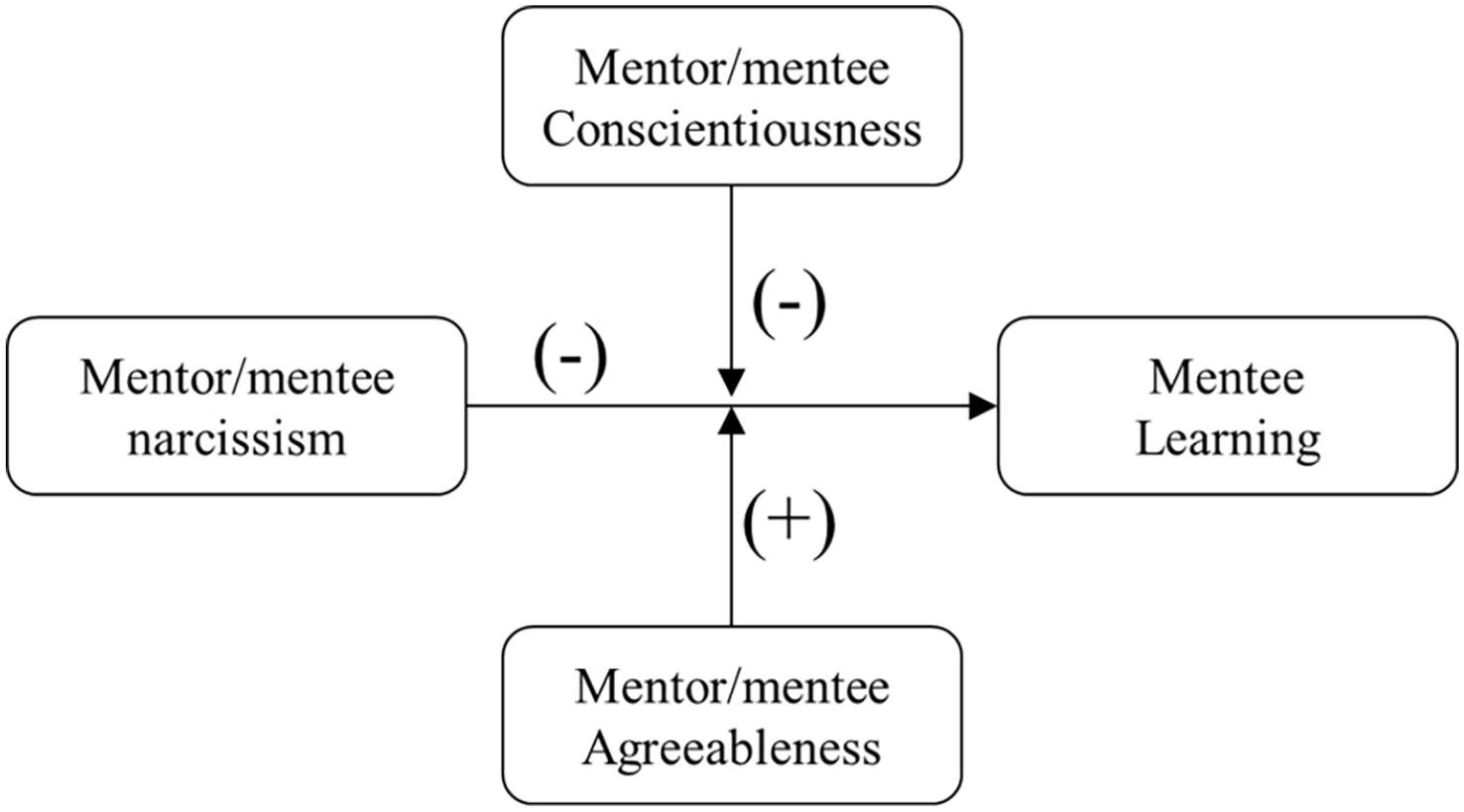
The empirical model.
Methodology
Sampling procedure
The sample consists of 188 dyads of mentors paired with novice entrepreneurs (mentees). In a dyadic design, ‘each person is linked to one, and only one, other person’ (Kenny et al., 2006, p. 4). To recruit participants for our study, we worked in collaboration with Réseau Mentorat, the largest mentoring network in Québec (Canada). Mentors from the Réseau Mentorat identify themselves as experienced entrepreneurs or ‘business owners’ who want to share their experience and provide psychosocial and career-related support to their mentees. They voluntarily support novice entrepreneurs regularly over a period of at least 1 year, but for some dyads, the mentoring relationship is extended over many years. Entrepreneurs can thus benefit from the support of a mentor at a minimal cost: a few hundred Canadian dollars annually, and sometimes even free of charge. The Réseau Mentorat states that the number of entrepreneurs who were paired in a mentoring relationship was 2768 for the year 2021–2022. 2 All data were collected via online questionnaires. A total of 648 mentees answered the online questionnaire for a response rate of 30.7%; 355 mentees agreed to let us contact their mentors to perform a dyadic analysis of their relationship. We identified 260 valid email addresses of mentors who were asked to complete the questionnaire. Only 151 answered at least a part of the questionnaire. As some mentors were involved in more than one active mentoring relationship, this provided a final sample of 188 dyads (37 supported more than one mentee). The response rate for mentors was 58%. Both mentors and mentees fill out a personality profile questionnaire with a few demographic variables. Information about the relationship, and especially outcomes such as learning, were measured only for the mentees. Given that the mentors may have had many mentees to support but each mentee had only one mentor, information about the relationship was only included in the mentee’s questionnaire.
Sample characteristics
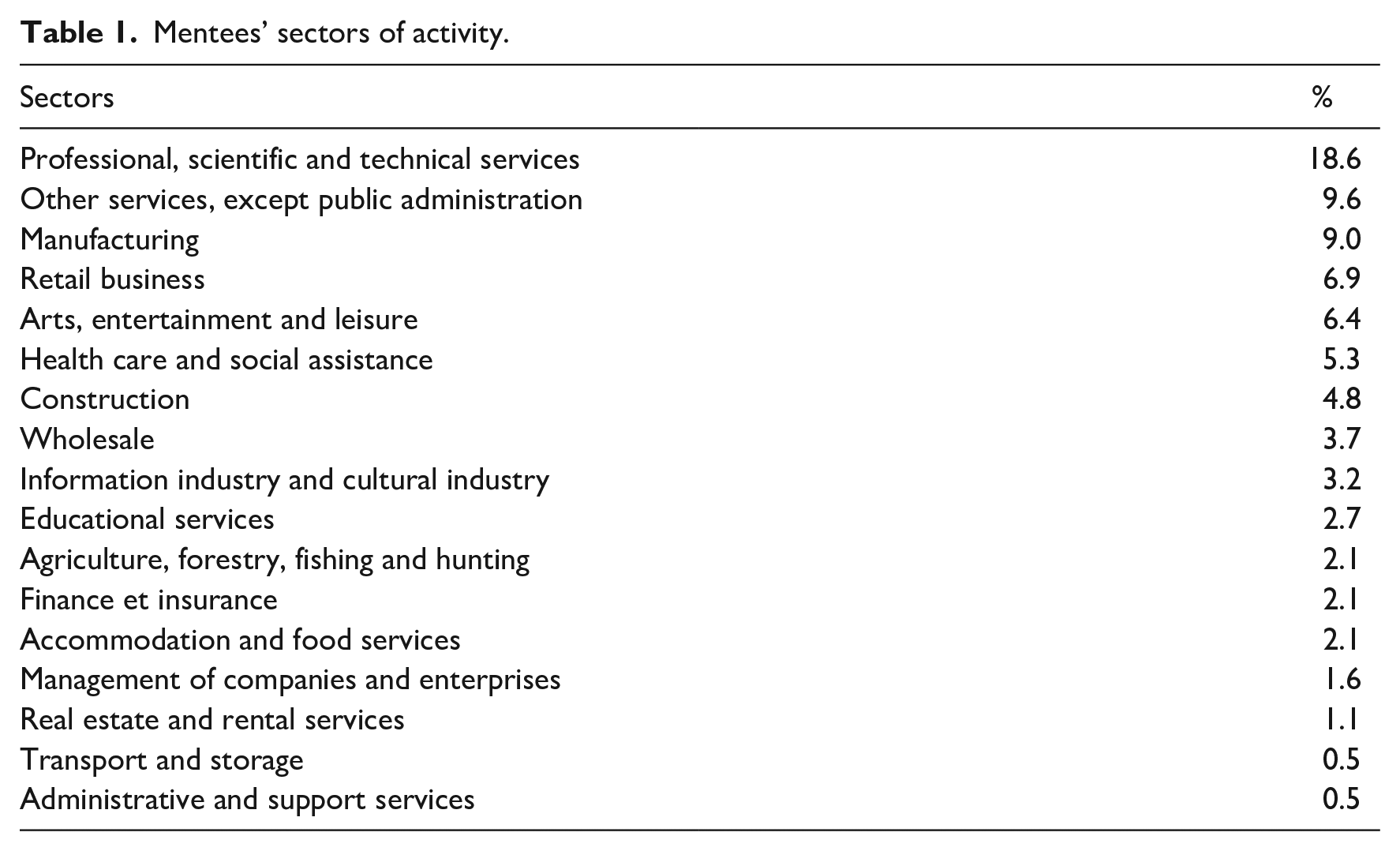
Of the total sample, 51.4% of the mentees were female, 83.7% of the mentors were male, and the mean age of the mentees was 41 and 62 for the mentors. Almost all of the mentors (97.8%) received training from the Réseau Mentorat, which lasted between 1 and 3 hours. In addition, 84% of our sample of mentors were involved in active relationships at the time of data collection and supported between one to six entrepreneurs, and more than half (52%) of them have received formal mentoring in the past. All the supported entrepreneurs in our sample are novices, without previous experience in business, and 58.9% of them have a graduate or postgraduate degree. Also, 56.3% of them are the sole owners of their business (owning 100% of the capital), while 15.4% reported that they own 50% or more of the capital and operate in different industries. Table 1 shows the sectors in which our sample mentees operate.
Mentees’ sectors of activity.
In 60% of cases, the pairing procedure was undertaken based on the intuition of the person in charge of programme coordination in accordance with the expectations of potential mentees, the perceived personalities of the mentors and mentees, and other qualitative criteria. At this stage of the relationship, the coordinator ensured that the mentor did not work in the same business segment as the mentee, and this condition was applied to the majority of dyads (85.6%). The rationale for this choice was to avoid any competition between the businesses of mentors and mentees, as well as to ensure mentors were question-oriented towards their mentees to understand their particular context. Finally, our descriptive analysis shows that the majority of mentees (71.6%) spent between 45 and 90 minutes talking with their mentors during the mentoring meetings, which were held every four to six weeks (67.6%).
Variables and measures
Dependent variable
Mentee learning: This measure was developed for this study based on previous findings related to entrepreneurial learning in mentoring (Barrett, 2006; Deakins et al., 1998; Kunaka and Moos, 2019; Matlay and Barrett, 2006; St-Jean and Audet, 2012; Sullivan, 2000; Warren, 2006). We developed a list of seven possible learning outcomes from mentoring (I want to learn how to. . . (1) identify business opportunities, (2) clarify my project’s vision, (3) better plan, manage my priorities and set specific goals (4) manage finances, (5) have trust in my abilities, (6) manage my stress, and (7) balance work and personal life, and then we asked mentees to what extent they learned these different aspects from their relationship with their mentor (seven-point Likert scale)). The exploratory factorial analysis yielded a one-factor solution representing 59.41% of the explained variance. As we can see in Table 2, the CFA indexes suggest a sufficient fit of the model to the current data (CFI = 0.962, TLI = 0.921 and RMSEA = 0.111). According to Hu and Bentler (1995), the CFI, TLI and NFI values should be equal to or above 0.90 to indicate a satisfactory model fit; for RMSEA, a value of <0.11 indicates a reasonable fit model in relation to the degrees of freedom. We calculated a total score of learning by averaging the seven items for the next analysis. Cronbach’s alpha was 0.882.
Goodness of fit statistics for the CFA model.

Independent variables
The Big Five
We selected the BFI with single items using a bipolar response scale (BFI-10) proposed by Woods and Hampson (2005), namely Extraversion, Agreeableness, Neuroticism, Conscientiousness and Openness to experience. Respondents have to position their personality at the closest on each of the five bipolar statements with a slider ranging from 1 to 18. The personality traits questionnaire was administered to both mentors and mentees. The Single-Item Measures of Personality offers a ‘reasonable alternative to longer scales’ (Woods and Hampson, 2005). Measures of mentor/mentee agreeableness and conscientiousness were drawn from this scale.
Narcissism
The NPI is a self-report inventory designed to measure individual differences in narcissism in non-clinical populations (Raskin and Hall, 1979). Since 1985, it has been used as ‘the main or only measure of narcissistic traits in approximately 77% of social-personality research on narcissism’ (Cain et al., 2008, p. 643). In our study, narcissism was assessed using a short version of the narcissism scale (NPI-16) (Ames et al., 2006). Each item presents two statements and respondents choose the one that suits them the best. The narcissistic responses were coded 1 while the non-narcissistic responses were coded 0, providing a score of narcissism between 0 and 16. Both mentors and mentees were administered this scale. Cronbach’s alpha was 0.623 and 0.579 for mentee and mentor narcissism, respectively. This shows moderate reliability, according to Perry Hinton et al. (2004), and it is very similar to the Cronbach alphas obtained for the development of this scale (ranging from 0.65 to 0.72 in five different studies). As previously demonstrated, low Cronbach alpha can only increase the likelihood of yielding inconclusive results (false negatives, type II errors) (Schmitt, 1996).
Control variables
We controlled for mentor and mentee gender, mentoring relationship length (in months), frequency of meetings, meeting length, the mentor’s prior experience in entrepreneurship, trust towards the mentor (3 items), perceived similarity with the mentor (3 items) and mentor functions (10 items) (St-Jean, 2011). All of these variables were answered by the mentees. Previous studies have shown that trust (Bouquillon et al., 2005), perceived similarity (St-Jean et al., 2018) and mentor functions (Allen and Eby, 2003; St-Jean, 2012) are strongly related to mentee learning and that these aspects can be caused by personality dimensions; therefore, we controlled for these elements to avoid a potential confounding effect in the analysis. The same reasoning applies to the other control variables.
Results
Table 3 displays the descriptive statistics and the inter-correlations of study variables. We used moderated regressions using Process v4.0 macro for SPSS (Hayes, 2017) to test the hypotheses. Before testing the hypotheses, we looked at the distribution of the variables of interest in this study. In particular, we looked at the distribution of personality configurations between mentors and mentees. To do this, we first separated the narcissism variable (NPI-16) into two groups: low NPI and high NPI. We chose to separate the groups from 1 to 5 (low) and from 6 to 18 (high) according to the approximate average obtained from a representative population (Ames et al., 2006). We have also separated the two dimensions of the BFI at the midpoint since these scales are bipolar and the centre perfectly represents the point of separation. Consequently, we have high and low agreeableness and high and low conscientiousness.
Means, standard deviations and correlations between the variables.
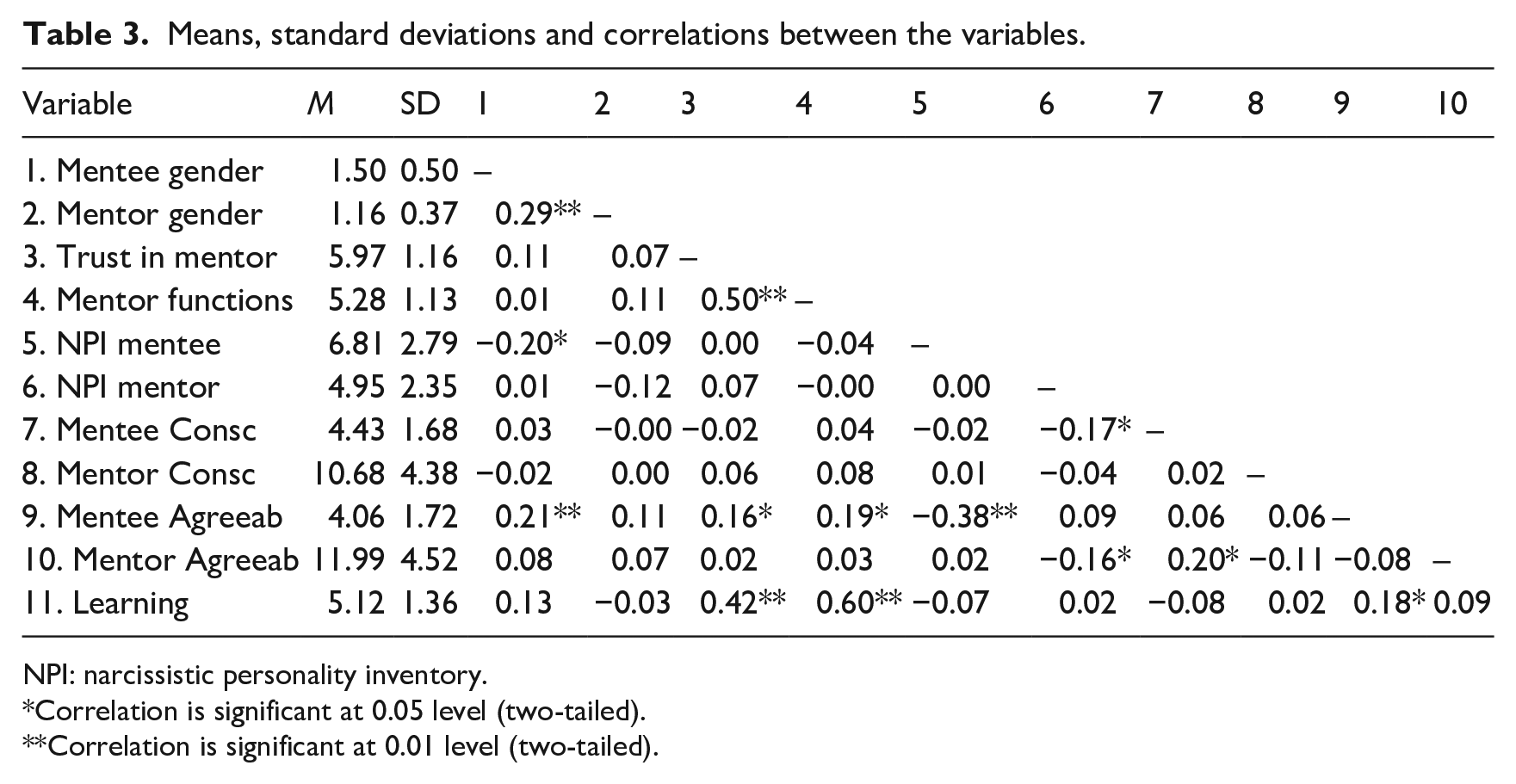
NPI: narcissistic personality inventory.
Correlation is significant at 0.05 level (two-tailed).
Correlation is significant at 0.01 level (two-tailed).
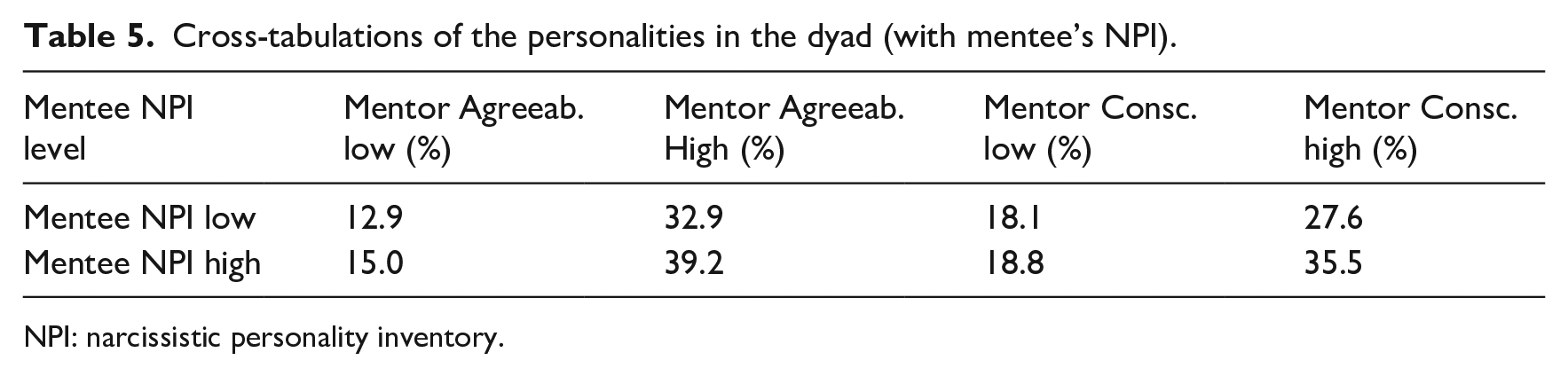
As can be seen in Table 4, the pattern of narcissism in the dyad reveals a greater occurrence (39.5%) of cases where the mentee’s narcissism is high which is combined with a low mentor narcissism, followed by the case where both members of the dyad have a low narcissism (38.0%). Less frequently, there are cases of high narcissism in both members of the dyad (14.8%), followed by the least frequent case where the mentee has low narcissism and is paired with a mentor with high narcissism (7.7%). In terms of configurations according to mentee narcissism levels, we note that the most frequent scenario is to have a mentee high in narcissism paired with a mentor high in agreeableness (39.2%) or high in conscientiousness (35.5%) (the two can be combined), followed by cases where the mentee is narcissistic and paired with a mentor high in agreeableness (32.9%) or high in conscientiousness (27.6%) (Table 5). Less frequent cases are those where mentees are high in narcissism but the mentor’s agreeableness or conscientiousness is low (15.0% and 18.8%, respectively), followed by the least frequent cases where the mentee’s narcissism is low as is the mentor’s agreeableness (12.9%) or conscientiousness (18.1%).
Cross-tabulations of the personalities in the dyad (with mentor’s NPI).
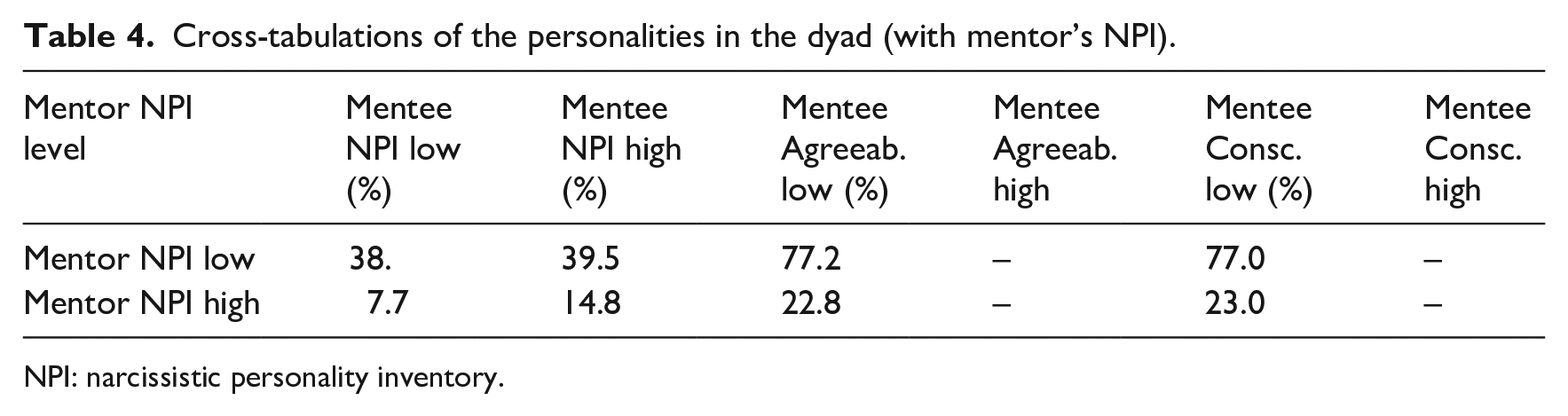
NPI: narcissistic personality inventory.
Cross-tabulations of the personalities in the dyad (with mentee’s NPI).
NPI: narcissistic personality inventory.
We have also produced the distribution of declared genders in the dyads. Since gender dynamics can influence mentoring relationships in different contexts (Kofoed and McGovney, 2019; O’brien et al., 2010), including in mentoring for entrepreneurs (Baluku et al., 2020; Brush et al., 2019; Lall et al., 2023; St-Jean and Jacquemin, 2022), this information can help facilitate subsequent interpretation. We have, of course, controlled for the reported genders of mentors and mentees in the models used to test our hypotheses below. As can be seen in Table 6, the most frequent case is a male mentor paired with a male mentee (48.2%), followed by a male mentor paired with a female mentee (37.2%). This is not so surprising given that 85.4% of mentors are men. Consequently, the least frequent pairings are with female mentors, who are much more likely to be paired with other women (12.4%) than with male mentees (2.2%).
Cross-tabulations of the dyad genders.

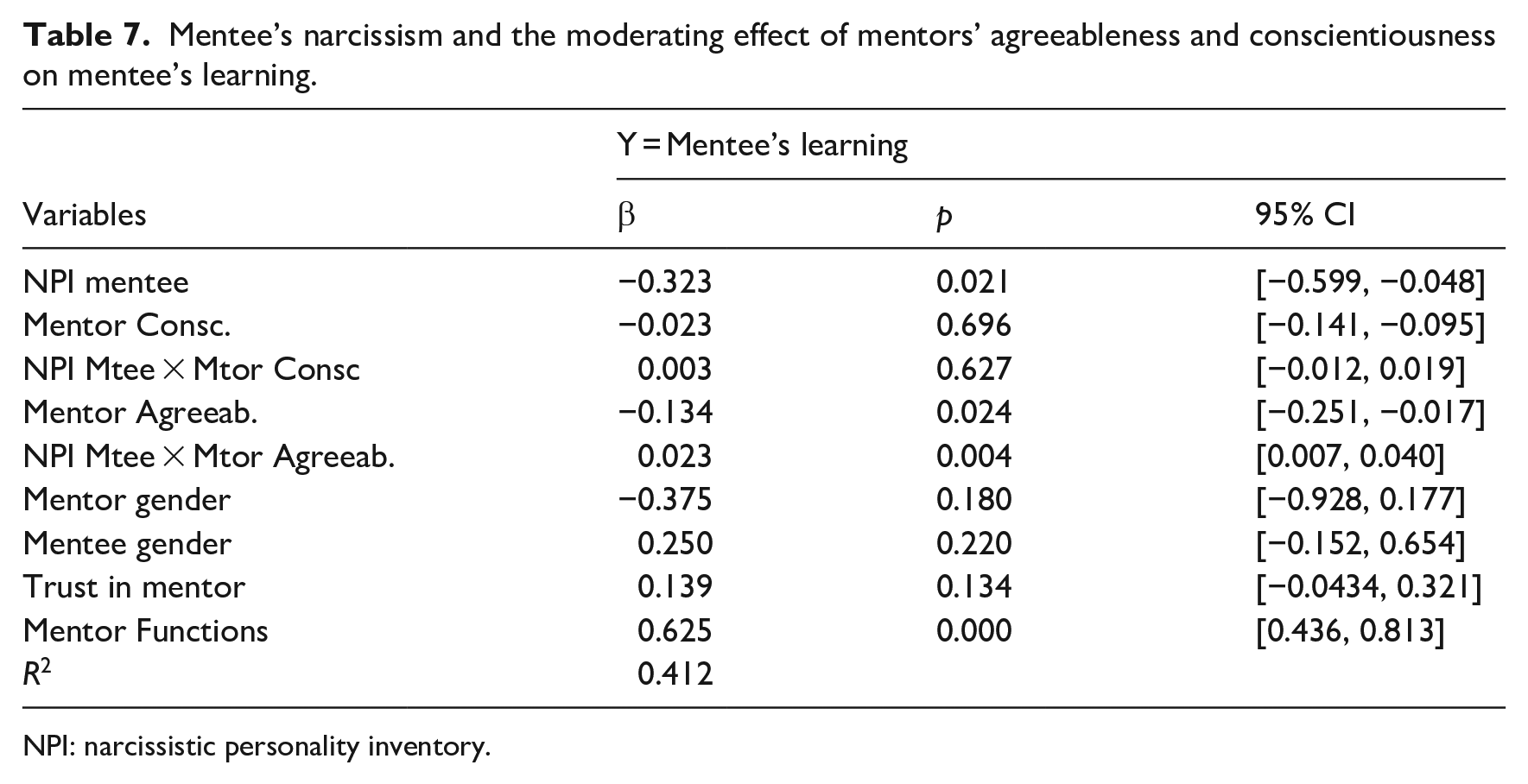
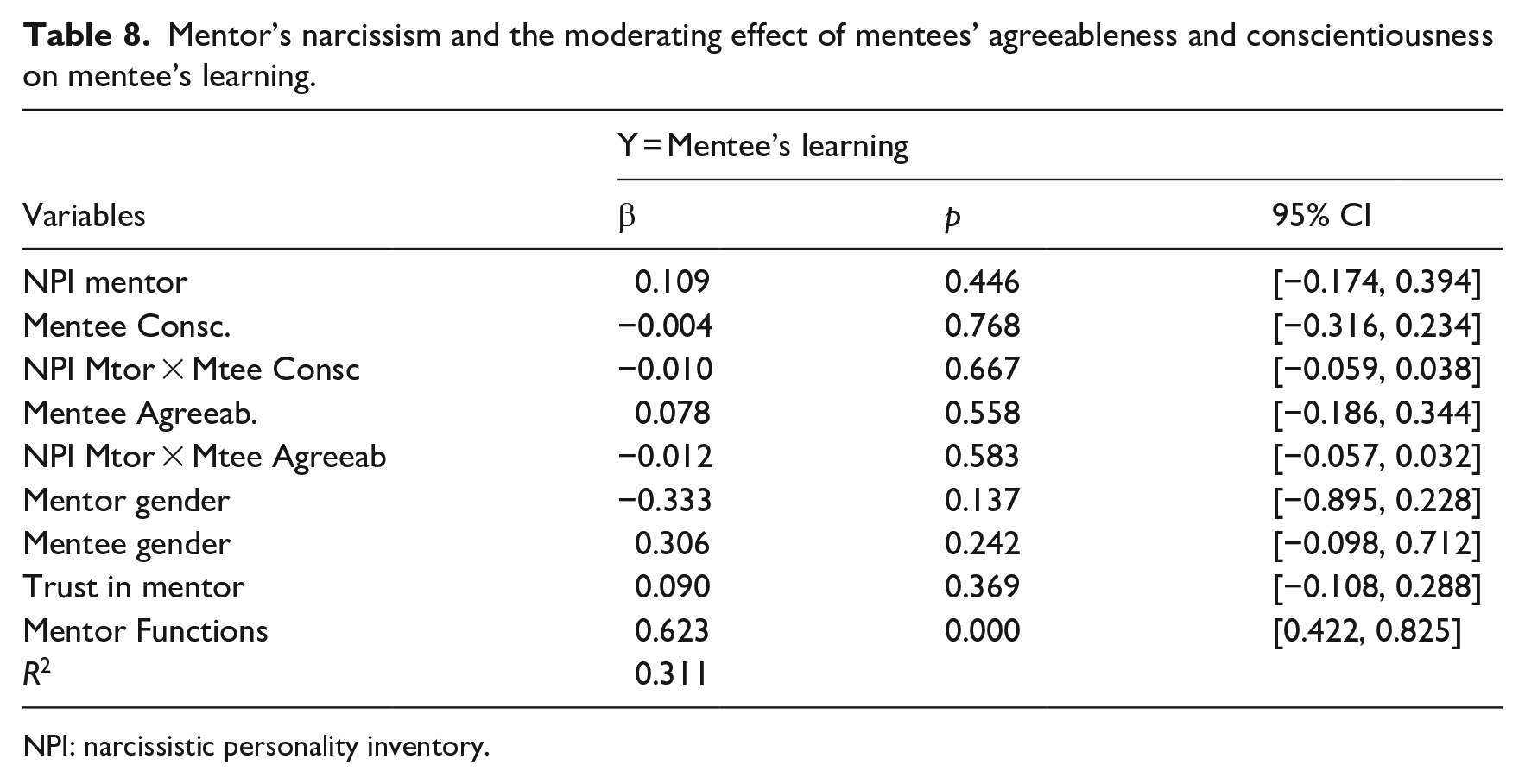
Hypothesis one (H1) suggested that mentees’ narcissism is negatively related to learning. The results of the moderated regression are presented in Table 7 and indicate support for this hypothesis (β = −0.323; p = 0.021). Next, we tested the hypothesis that mentor narcissism has a direct negative effect on mentee learning (Hypothesis 2) (Table 8). Hypothesis 2 was not supported (β = 0.109, p = 0.446). Hypothesis 3a suggested that the mentor’s conscientiousness negatively moderates the relationship between the mentee’s narcissism and learning. As displayed in Table 7, we found no support for this hypothesis (β = 0.003, p = 0.627). Next, we tested whether a mentee’s conscientiousness moderates the relationship between the mentor’s narcissism and the mentee’s learning (Hypothesis 3b). Hypothesis 3b was rejected (β = −0.010, p = 0.667, Table 8). Hypothesis 4a suggests that a mentor’s agreeableness positively moderates the negative relationship between a mentee’s narcissism and learning. This hypothesis was confirmed (β = 0.023; p = 0.004, Table 7). When we plotted the interaction terms (Figure 2), we can observe that highly narcissistic mentees learn more with a mentor who scored high on agreeableness. For mentees who scored low in terms of narcissism, the level of mentor agreeableness does not have any effect on their learning. Finally, we did not find evidence that a mentee’s agreeableness positively moderates the negative relationship between a mentor’s narcissism and mentee’s learning (β = −0.012; p = 0.583, Table 8) and thus reject Hypothesis 4b.
Mentee’s narcissism and the moderating effect of mentors’ agreeableness and conscientiousness on mentee’s learning.
NPI: narcissistic personality inventory.
Mentor’s narcissism and the moderating effect of mentees’ agreeableness and conscientiousness on mentee’s learning.
NPI: narcissistic personality inventory.
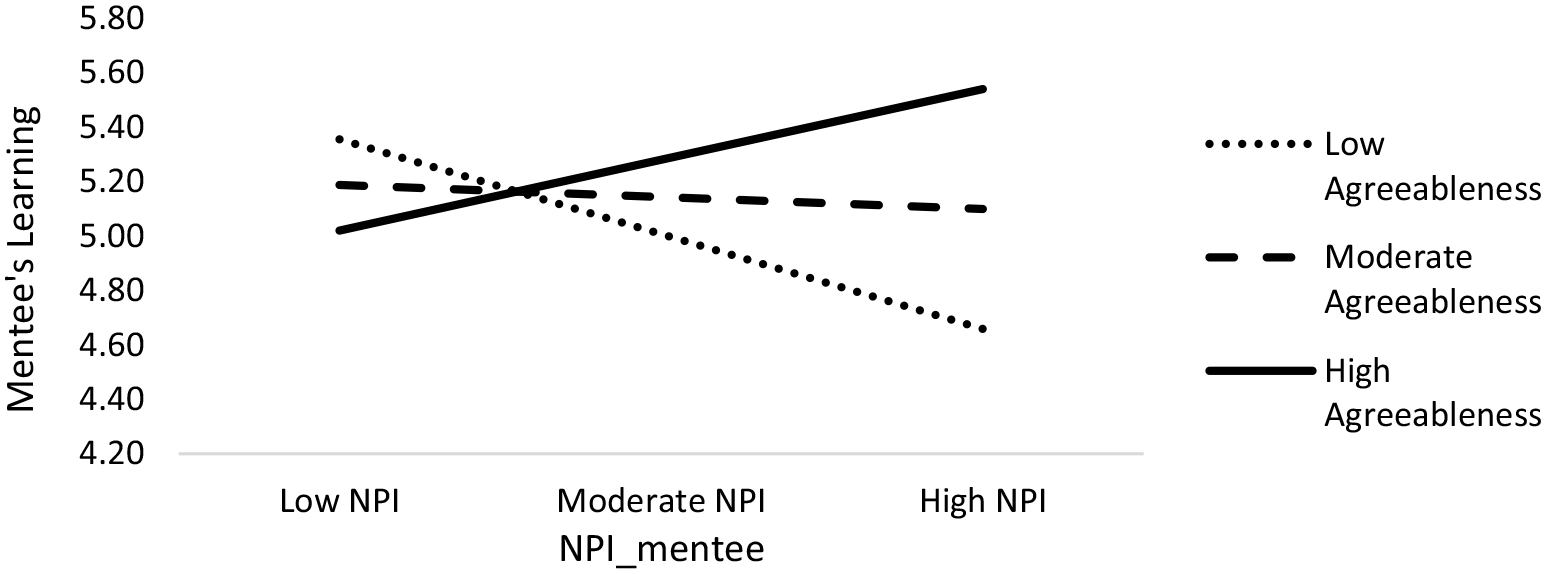
The moderating effect of mentor agreeableness.
Discussion
This research set out to examine the effect of personality traits, especially the interaction of narcissism with conscientiousness and agreeableness on mentee entrepreneurial learning. In doing so, we wanted to evaluate which personality traits could provide the best match in entrepreneurial mentoring dyads. First, the findings demonstrate that mentee narcissism is negatively related to his/her learning outcomes throughout the mentoring relationship. This is perhaps because the expectations and interpersonal needs of mentees high in narcissism are difficult to live up to (Liu et al., 2019). Consequently, narcissistic mentees are more likely to report less satisfaction and less learning through a mentoring relationship (Allen et al., 2009). They will think they have very little to learn, so they will have the impression of learning less with their mentor and will be more likely to blame for failures (Campbell et al., 2000). This finding is consistent with those of Allen et al. (2009) about the damaging impacts of narcissism on mentoring. More specifically, in this study, mentees with a higher narcissism report fewer mentoring functions and more negative mentoring experiences. In an entrepreneurial context where the prevalence of narcissism is higher than in the general population (Mathieu and St-Jean, 2013), this demonstrates that this trait is detrimental to fully benefiting from mentor support, at least in terms of learning outcomes.
Second and contrary to our expectations, the findings indicate that mentor narcissism is not harmful to mentee learning. While this finding is surprising, it is probably due to the relatively low base rate of highly narcissistic mentors in the current study. The average narcissism score for mentors in our sample is 4.95 (σ = 2.35, maximum score = 13, on a scale of 0–16), which is considered low based on representative samples of the population (Ames et al., 2006). Our cross-tabulation of the personality dyad configurations (ref. Table 4) revealed that more than 77% of mentors in the sampling should be considered low in narcissism. These situations can reduce the explanatory power of the analyses, and so, introduce a type II error, that is, the fact that the mentor’s narcissism is really negative but that we were unable to demonstrate this due to a lack of sufficient cases. The training sessions given to prospective mentors emphasise that they will need to avoid talking about themselves, and instead focus on the needs of their mentees. This may lead to a self-selection process wherein the more narcissistic mentors may decide they do not belong in the mentorship programme. Otherwise, they can learn to ‘mask’ their narcissism by developing skills so that they can avoid damaging the mentoring relationship with this trait.
Third, the hypotheses concerning conscientiousness were not supported. It was expected that a moderated effect would exist but the data showed no significant effect. On the one hand, the mentor’s conscientiousness could have moderated the negative effect of the mentee’s narcissism on his learning. We were unable to observe this in our analyses, despite this special case (mentee high in narcissism paired with mentor high in conscientiousness) being the most prevalent type of personality configuration (35.5%, refer to Table 5). This is in line with the fact that conscientiousness is positively related to the frequency of participation as a mentor in formal programmes (Niehoff, 2006). Besides, a highly conscientious mentor may be someone who takes their role seriously and therefore performs as many of the mentor’s functions as possible. Although we did not investigate this, our modelling illustrates the important effect of mentor functions in developing learning outcomes from the relationship for mentees (β = 0.625; p = 0.000, Table 7). The variance explained by this variable could reduce the effect that could potentially have been observed for conscientiousness. On the other hand, the moderating effect of the mentee’s conscientiousness in augmenting the negative effect of the mentor’s narcissism on learning from the relationship has also not been demonstrated. In this case, type II error is probably the most likely explanation for the fact that there is no highly conscientious mentee paired with a highly narcissistic mentor (refer to Table 4). It is accordingly much more difficult to observe such an effect in the absence of marked cases in the higher parts of these personality dimensions.
Fourth, our results reveal that mentor agreeableness moderates the relationship between narcissism and mentee learning, on the one hand. Specifically, highly agreeable mentors tend to establish trusting and courteous interpersonal relationships and may be flexible in dealing with narcissistic mentees. Consequently, they can maintain a quality relationship with their mentees and maximise their learning. This is consistent with the theory that mentors need to develop trust with mentees (Allen, 2003; Ragins and Cotton, 1999), and being altruistic is a predictor of the motivation to mentor others (Allen, 2003; Aryee et al., 1996). On the other hand, our findings indicate that mentee agreeableness does not appear to make a difference in terms of whether they are matched with a mentor high in narcissism. As previously underscored, a type II error is highly probable in that specific case because there are no cases where a mentor is high in narcissism and has been paired with a highly conscientious mentee (refer to Table 4). Although variance exists in these two personality traits in the dyad, the absence of higher cases of these two traits in the dyad reduces the possibility of obtaining significant results. We should add that it could also be caused by the fact that we looked specifically at mentee learning. In fact, agreeableness could lessen the negative effect of the other dyad member’s narcissism on the relationship quality and the level of satisfaction, which would allow the pairing to continue and the mentoring to be delivered. It is highly probable that having a nurturing relationship with a mentor is a necessary but not sufficient condition for learning. Thus, it is reasonable to observe that this personality configuration does not have a direct effect on mentee learning but rather on the relationship quality.
Implications for research
First, our study has implications for research on personality characteristics (narcissism and the Big Five) and learning from mentoring. In light of the dyadic nature of the mentoring relationship (Ragins and Kram, 2007), we examined both parties’ characteristics with a particular focus on personality. We contribute to showing the conditions under which certain personality matches in the dyad foster, or hinder, learning from a mentoring relationship. Our results support previous work in the context of organisational mentoring, which demonstrated the value of looking at the effect of personality configurations in the dyad to understand the impact of mentoring. We show that this approach is particularly relevant in the context of novice entrepreneurs. As many entrepreneurs (mentors or mentees) are more narcissistic (Hmieleski and Lerner, 2016; Mathieu and St-Jean, 2013) and less agreeable (Rauch and Frese, 2007) than the general population, mentors should be carefully paired based on the optimal configuration of personality to improve mentee learning. Previous research has indicated that ‘chemistry’ in the dyad is important in supporting the mentoring received and developing outcomes (Jackson et al., 2003). Our research sheds light on the personality profile combinations that generate more learning outcomes and consequently offers insights into the elements that could support the establishment of this chemistry in the dyad.
Second, our research demonstrates the detrimental effect of narcissism in mentoring, and the importance of paying attention to this aspect of personality, which can bring positive benefits to entrepreneurs in certain contexts, but can sometimes be detrimental, as we observe among mentored entrepreneurs. We were unable to observe the negative effect of narcissism among the mentor-entrepreneurs in our sample but this lack of results should not cause researchers to throw in the towel and abandon this avenue. Having studied a formal programme where the importance of being a mentor who listens and is oriented towards his/her mentee and his/her needs is likely to create a self-selection bias towards the least narcissistic mentors, as we observed. However, this is unlikely to happen in informal mentoring dynamics or even in an incubator or accelerator programmes where mentors have more nested functions to meet specific support needs, rather than being oriented towards a more developmental relationship where learning is the key. It is likely that the narcissism of both mentor and mentee is, on the one hand, a hindrance to mentoring where coachability could be reduced (Kuratko et al., 2021; Marvel et al., 2020). However, it could also steer mentoring dynamics in other programmes towards a more instrumental perspective, where the mentee will see the mentor as a resource to be exploited and not as someone likely to accompany the individual over the long term to generate diverse learning.
Third, we contribute to showing that despite the possible direct and negative effects of certain personality-related characteristics, such as narcissism, the other part of the dyad can soften the effects if it possesses appropriate personality traits. As it ‘takes two to tango’, potential harmful personality traits in a mentoring relationship must be considered in terms of how they will be hindered, or fostered, by the personality of the dyad’s other member. We have shown how the mentor’s agreeableness has a positive effect in reducing the negative effect of the mentee’s narcissism. Although this ‘linear’ approach makes a lot of sense, other approaches could also be used to generate other perspectives. Configurational approaches, for example, address dynamics such as the one observed by identifying the most relevant configurations for generating benefits and are increasingly used in entrepreneurship (Nikou et al., 2022; Raymond and St-Pierre, 2013). It is also possible to envisage a perspective where certain minimum traits are necessary conditions for successful mentoring (e.g. that the mentor has a certain level of agreeableness) (Arenius et al., 2017; Dul et al., 2023; Linder et al., 2022). Our contribution paves the way for future research in these directions.
Managerial implications
Our managerial contribution is also noteworthy. Organisations and practitioners devote considerable resources to developing and supporting mentoring programmes and emphasise the importance of recruiting the right mentors to sustain effective mentoring relationships. They seek ways to improve the quality of their mentor’s interventions and to ensure the achievement of high standards leading to the satisfaction of the mentees (St-Jean and Mitrano-Méda, 2016). However, we had limited knowledge of how best to match mentors and mentees, and a lack of understanding of which personality traits might be detrimental, or helpful, to the mentoring relationship, especially for entrepreneurs. As the Réseau Mentorat matches a significant number of novice entrepreneurs each year (2768 entrepreneurs in 2021–2022), our results should be useful in the mentor/mentee matching process in matching narcissistic entrepreneurs to highly agreeable mentors.
Limitations and future research
One of this study’s limitations is the sample. It may not be a representative sampling of the whole population of supported mentees. Some combinations of mentor and mentee personality could be missing, just as there could be a bias introduced by the coordinators who suggest the pairing of some dyads. The second limitation is that the programme is very specific and not like those found in high-tech start-up incubators or accelerators. In those settings, the term ‘mentor’ is often used but it usually refers to coaches or technical consultants. Sometimes, all three postures will be adopted (coaching, technical consulting and mentoring), depending on the individual’s qualities and interests. In fact, our results may be true in the context of a mentoring programme where mentees have to ask for the support of a benevolent mentor and are not part of a support scheme that comes with funding. Thus, it can be difficult to generalise to other contexts. This study also used a short version of the measure of the Big Five personality factors and narcissism. Researchers may like to consider more detailed measurement scales in future research (e.g. BFI 44 and NPI 40). Finally, relationships with very poor chemistry probably ended the programme quickly and did not participate. Therefore, we probably have a bias towards the least potentially bad relationships. Future research needs to explore other personality characteristics, like emotional intelligence, which ultimately relate to mentoring success.
Conclusion
Our research has shown the negative effect of the entrepreneurial mentee’s narcissism on learning from the mentoring relationship. We also showed that a mentor with high agreeableness could neutralise this negative effect. These results could be different in other entrepreneurial mentoring contexts, for example, in incubators or informal relationships. Thus, the nuances that general traits such as conscientiousness and, in particular here, agreeableness, lend to narcissism help us better understand how personality configurations in the dyad affect the outcomes of the relationship, in particular the learning that results from it. We have also chosen to focus on learning from the mentoring relationship but other benefits may be sought and exist, such as wanting to be connected (networking). We also observed that self-selection of the least narcissistic, most agreeable and conscientious mentors could take place thanks to the training offered by the Réseau Mentorat mentoring programme and the fact that long-term, developmental, learning-oriented benefits are sought. It should be pointed out that we do not have a very equitable gender distribution in the dyad either, where cases of male mentees paired with female mentors are almost non-existent. Knowing the importance of gender in entrepreneurship (Brush et al., 2019; Laguía et al., 2022; Nicholls-Nixon and Maxheimer, 2022) and mentoring (Blake-Beard et al., 2011; Kao et al., 2014; Kay and Wallace, 2009; Ramaswami et al., 2010), this situation sends a signal that too few woman mentors are committed to supporting novice entrepreneurs, although they can serve as role models, especially for woman entrepreneur mentees. It may also be that gender stereotyping in matchmaking exists since male mentees may be more likely to seek the guidance of a man, who represents the archetypal entrepreneur (Balachandra et al., 2019; Gupta et al., 2008; Laguía et al., 2022; Malmström et al., 2017). Although we have controlled for the effect of gender in our analyses, these issues merit further investigation in future work. We hope our results will inspire other researchers to explore these different avenues in the future.
Footnotes
Funding
The author(s) disclosed receipt of the following financial support for the research, authorship, and/or publication of this article: This work was supported by the Social Sciences and Humanities Research Council of Canada (SSHRC), grant # 890-2014-0104.
