




Abstract
By focusing on individualised theories of entrepreneurship, mainstream entrepreneurship literature often marginalises entrepreneurship as a product of collaborative action. Addressing this limitation, our emphasis on collective entrepreneurship is contextualised in the setting of low-income communities and draws out three important components: collective ownership, collective processes and collective goods. Through our qualitative research into two community organisations in the West of Scotland, we demonstrate the important interplay of each component. We provide a deeper understanding of the dynamics at play as collective forms of entrepreneurial behaviour result in community actors empowered to pursue a commercial activity, negotiate with the state and exploit existing and newly emerging social and cultural capital. Our theoretical contribution explains the linkages and connections of the three components to better understand collective entrepreneurship in low-income communities and entrepreneurial processes more generally.
Introduction
Traditional entrepreneurship scholarship has predominantly focused on the entrepreneurial individual (Drakopoulou Dodd and Anderson, 2007; Sarasvathy, 2004). The emphasis has been on how personal and interpersonal characteristics are the basis of successful entrepreneurship, including tolerance of risk, charisma, leadership skills, and an entrepreneurial mindset (Blundel et al., 2017). This tradition does not adequately account for the impact of structural inequalities in determining entrepreneurial success. As there is little evidence to suggest that individual entrepreneurial characteristics are distributed unevenly across society, the individualised tradition is limited in explaining the variance in entrepreneurial outcomes. Despite these shortcomings, the individualised legacy holds sway in policymaking for low-income communities (Bateman, 2010; Danson et al., 2020; Smith et al., 2019).
An increasing number of scholarly publications have begun to deploy the concept of collective entrepreneurship as researchers have sought to improve entrepreneurship theory, better conceptualise intra-firm and inter-firm innovation dynamics, and appreciate the social context of entrepreneurial activity (Burress and Cook, 2010). Yet, collective entrepreneurship has still to be categorised coherently. Collective entrepreneurship can be found in private (Domingo and David, 2010), public (Mazzucato, 2018) and third sectors of the economy (Shaw and de Bruin, 2013) through the development and deployment of social capital (Casson and Della, 2007), entrepreneurial networks (Galkina and Jack, 2021), entrepreneurial eco-systems (Link and Sarala, 2019a) and through the utilisation of open innovation (Wynarczyk et al., 2013). However, to understand collective entrepreneurship and its application within low-income communities, more academic attention is needed.
We seek to contribute to this work by categorising collective entrepreneurship systematically into three main components, namely collective ownership, collective processes and collective goods. These three categories, we contend, remain unconnected both in theory and policy and this restricts our understanding of the potential of collective forms of enterprising behaviour. Collective entrepreneurship provides an alternative way to think about wealth creation in low-income communities, one that reduces our dependency on individualised entrepreneurial strategies. This leads us to consider new concepts that take into account the impact of structural inequalities in determining entrepreneurial success. Our proposition, therefore, is that through understanding the linkages and connections of the three components, we can theorise better and explain collective entrepreneurship in low-income communities and more general entrepreneurial processes.
In this article, we address the following research question: How do we understand and theorise the importance of the interplay of collective ownership, collective processes and collective goods as a way of explaining collective entrepreneurship in low-income communities?
We use the three components to structure the article. In the next section, we examine how other authors have considered collective ownership, collective processes and collective goods. We analyse how these researchers have applied the three concepts in the differing sectors of the economy, for example, the private, the public and the third. We emphasise, for example, how the forms of collective ownership can form the basis for more solidaristic entrepreneurial behaviours and that these stand in contrast to individualised explanations of entrepreneurship. However, we also show how general ideas of entrepreneurship, whether on entrepreneurial capital, on entrepreneurial team working or through the provision of collective public goods, can be enhanced by a better understanding of the three components of collective entrepreneurship.
We then detail the research approach used in this article. We draw on a single case study of a successful partnership of two community-based enterprises in the West of Scotland, which serve low-income communities. The work involved qualitative methods that have included semi-structured interviews and observations of the two organisations: Larbeth Development Trust (LDT) and Brechen Development Trust. (BDT). 1 We present our findings using the same structure that is central to our argument, focused on collective ownership, processes and goods. We identify how the two organisations emerged from different place contexts, developed partnerships with agencies of the state and with each other. Our analysis then centres on the salience of the three components and their interplay and how this helps us to understand collective entrepreneurship. This interplay is complex and often context-dependent. However, if we are to overcome the perception of entrepreneurial deficit and the very real wealth inequality in low-income communities, then we need a basis from which to theorise and strategise collective entrepreneurship.
Background: Literature review
Enterprise and entrepreneurship in low-income communities are often expected to benefit from policy in a similar fashion as more affluent areas with little attention being paid to local context (Parkinson et al., 2017). There is a negation of the local resources that can be drawn on in low-income communities that arise from collectivised entrepreneurial behaviours. Strategising collective forms of entrepreneurship for low-income communities is, however, problematic because there is considerable disparity in the use of the term. We identify three key conceptualisations within the literature.
Some authors equate collective entrepreneurship with a specific mode of governance associated with the collective ownership of a firm, especially cooperative forms (Bataille-Chedotel and Huntzinger, 2004; Bijman and Doorneweert, 2008). Others conceptualise collective entrepreneurship as collective processes and are concerned with the multiple actors involved in the process of identifying, creating and exploiting opportunities (Chang, 2010; Davidsson and Honig, 2003; Davidsson and Wiklund, 2007; Dufays and Huybrechts, 2016; Harper, 2008; Iurchenko et al., 2023; Johannisson and Nilsson, 2006; Lounsbury, 1998; Weik, 2011). A third group of authors highlights the role of collective goods, particularly intangible goods such as social capital or cultural values, in spurring entrepreneurial activity (Burress and Cook, 2010; Chatti et al., 2021; Dana and Dana, 2007; Frederick and Henry, 2004; Kraybill et al., 2010; Nembhard, 2008; Sachs, 2004; Stokes, 1974). In this review, we show how this literature on collective ownership, collective processes and collective goods is increasingly supported by the emerging scholarship on entrepreneurship. We also highlight how these three dimensions offer promise for low-income communities.
Collective ownership
We understand collective ownership to be the ownership of assets by members of a group. This might take the form of cooperative forms of business, although not all social organisations are governed this way. Cooperatives are formally owned by their members through shares and whose members operate on a principle of one member, one vote, and can expect returns on that investment in interest payments or dividends. Other forms include membership organisations where ownership of any assets is formally vested in the organisation while that organisation is managed democratically by its members.
Cooperatives have much to commend them in terms of entrepreneurial capacity, although they face many difficulties in sustaining their social and commercial mission (Bijman and Doorneweert, 2008; Dow, 2003; Rey and Tirole, 2007). They tend to be better at sharing knowledge internally and across organisations (Bartlett et al., 1992) and are often ‘better generators of local innovation than standard capitalist companies’ (Becerra and Thomas, 2017: 10). Evidence referring to worker-owned cooperatives suggest that collective ownership creates organisations which tend to grow as fast or faster (Arando et al., 2012; Burdín and Dean, 2012; Fakhfakh et al., 2011) and have productivity as high or higher than comparable ‘capitalist’ firms (Fakhfakh et al., 2011). The more limited work on membership organisations also demonstrates the entrepreneurial potential of other collectively owned organisational forms. For example, membership vehicles for community development in the Highlands and Islands of Scotland demonstrate increased investment, new economic opportunities, improved infrastructure and the reversal of population decline for the communities involved (Bryan, 2014).
Strategy and policy for entrepreneurship based on collective ownership might be particularly beneficial in low-income communities for two key reasons. First, as opposed to individual entrepreneurs, who typically relocate from a deprived area if they achieve commercial success (Frankish et al., 2011), collectively owned enterprises tend to prioritise local employment and typically display a long-term commitment to remain in a community (Zeuli and Cropp, 2004). Second, collectively owned enterprises tap into existing solidaristic organisations more in keeping with pre-existing organisational forms operating within low-income communities, and may be better placed to mobilise these communities along entrepreneurial paths (North et al., 2020). Collective ownership is captured both formally and informally in the work of collective entrepreneurship.
Collective processes
The role of collective process in driving entrepreneurship is based on a critique of the individualised concept which fails to recognise the practice of entrepreneurship as an amalgam of ‘socially distributed processes involving possibilities for joint action’ (Nordstrom and Jennings, 2015: 1). We can point to two main foci of this work.
First is the internal team working involved in entrepreneurial ventures (Davidsson and Wiklund, 2007; Dufays and Huybrechts, 2016; Harper, 2008; Lounsbury, 1998). This emphasises processes of ‘collective ideation, collective efficacy, collective learning, collective cognition and collective action’ (Burress and Cook, 2010: 9). It calls upon the conceptualisation of ‘the entire employee base as a source of ideas’ (Rigolini, 2007: 43) to better harness human resources to confront increasing market competition across many industries. It draws on insights about the beneficial impacts of worker autonomy and decentralised leadership for the recruitment of talent, stimulating innovation and motivating employees, typically within large corporations (Ancona, 2005; Comeche and Loras, 2010; Dos Santos and Spann, 2011; Hamel, 2007; Mourdoukoutas, 1999; Pink, 2010; Reich, 1987; Rigolini, 2007).
A second focus is how actors external to the firm become involved in the entrepreneurial process. These might be investors, partnering firms, universities and government agencies (Chang, 2010; Davidsson and Honig, 2003; Galkina and Jack, 2021; Johannisson and Nilsson, 2006; Weik, 2011). In this work, a key concern is the source and structure of economic development where at the national level macroeconomic factors and public policy can help or restrict development by shaping entrepreneurial opportunities (Chang, 2013; Wilken, 1979). At a local level, institutional structures are important, involving local government, universities or development agencies, who work together to drive the local economy (Jonsson, 2015). Here we find the literature on entrepreneurial ecosystems that notes the role of entrepreneurs in building and maintaining relationships across organisations (Qian and Acs, 2022; Spigel and Harrison, 2018; Stam and Spigel, 2016) as well as ideas about how co-creation with communities provides social enterprises with competitive advantages (Bloom and Smith, 2010).
Collective processes are important to help understand and advance entrepreneurship in low-income areas for three key reasons. First, the concept provides a more realistic interpretation of entrepreneurial practices particularly, but not limited to, low-income communities. Individualised approaches do not tally with a growing body of research demonstrating that successful entrepreneurship relies on complex, multi-scalar collaboration (Brown and Mason, 2017; Link and Sarala, 2019b; Stam and Spigel, 2016). If individuals from more affluent backgrounds do not in reality create and drive new ventures singlehandedly but instead rely on social networks, skills and privileged access to capital, it is unrealistic to expect individuals in low-income communities to do so. This, as we have alluded to above, is a promissory benefit of enterprise that is expected, in both theory and policy, in low-income communities (Parkinson et al., 2017).
Second, this perspective highlights the important role of the state in leading entrepreneurial processes. Where entrepreneurial activity has the most meaningful positive impact on individuals and society, it is the result of state intervention to provide basic research and to police abuses of economic power by creating public policy to promote inclusive development (Kingma, 2003; Mazzucato, 2018). Here, a case for intervention may not seem so implausible although the context of a place-based approach to drive productivity and wealth creation is usually less forthcoming. Third, regarding ‘team entrepreneurship’ (Cooney, 2005), collective entrepreneurship can provide co-constructed knowledge of group ideation, collective learning and collective intelligence for use in low-income areas when, typically, these processes are most recognised in corporate settings.
Collective goods
Collective goods (also known as public goods) refer to ‘any good that cannot be withheld from any member of a specified group once it is supplied to one member of that group’ (Frohlich and Oppenheimer, 1971: 3). While what exactly constitutes a collective good is a matter of debate (Kaul et al., 2003), examples of collective goods may include road networks, law and order or defence. 2 Importantly, collective goods are not restricted to those who can pay for them and are not allocated purely using the market mechanism. Another example might be basic research which, although it ultimately may be commercialised, is considered too risky by private investors and so is not typically produced without state support (Mazzucato, 2018). While the collective entrepreneurship literature highlights how entrepreneurs often draw upon collective goods such as those above they also utilise social and cultural norms that enhance their ventures (Burress and Cook, 2010; Chatti et al., 2021; Dana and Dana, 2007; Frederick and Henry, 2004; Kraybill et al., 2010; Nembhard, 2008; Sachs, 2004; Stokes, 1974).
There is much in common in this literature with the concept of entrepreneurial capital: the idea that all forms of entrepreneurship are enabled by a range of resources, including financial, cultural, symbolic, and social capital (Pret and Shaw, 2013). Social capital, consisting of interpersonal connections between people, is increasingly recognised as an important factor in entrepreneurship as it enables a wider set of capabilities and strategies, enabling networks and ideas (Casson and Della, 2007; Muringani et al., 2021). Places provide a context-dependent factor in this as it is here that local ties that consist of economic and social relations exist (McKeever et al., 2015). This perspective tends towards recognising both social and cultural capital as collective goods in their non-exclusive forms, such as pre-existing networks (Bhandari and Yasunobu, 2009; Kostova and Roth, 2003).
When entrepreneurs draw on these resources, they are drawing upon collective goods. They may be a ‘stock of inherited traditions, values, beliefs’ (Throsby, 1999: 166) which are available to be drawn upon by all and within low-income communities. Examples of these pre-exiting networks could be associated with a place of work, such as a trade-unions or associated social clubs, or organisations concerned with culture, entertainment and leisure, such as sporting clubs or choirs, many of which are especially strong in older industrial areas that were once prosperous (Kretzmann and McKnight, 1993). Similarly, cultural capital can be conceptualised as a collective good in its non-exclusive forms, such as when the cultural characteristics of a community provide bases for action.
This effect is enhanced where there is stronger cultural cohesion, where a common cultural identity provides the basis of collective action (Elo, 2019). For example, when migrants form teams and groups facilitating entrepreneurial development and growth (Cooney, 2005; Elo, 2019). Or when cultural dimensions stimulate entrepreneurial activity through culturally embedded preferences for collectivism (Dana and Dana, 2007; Murphy et al., 2020).
Social and cultural capital can be considered as collective goods where strong pre-existing networks in a community provide a resource that the community can draw upon. This provides a consistent conceptual base to the literature on social movements, where it is found, for example, that such movements are more common where those populations show strong social networks, not least because these networks provide the basis for coordination, solidarity and trust (Edwards and Crossley, 2009). Similar ideas can be drawn from the literature on social enterprise particularly when demands for collective goods cannot be adequately provided by the state or due to a combination of state and market failure (Heap et al., 2019; Kingma, 2003; Shaw and de Bruin, 2013; Thompson et al., 2022).
Our concern with collective goods offers three key insights into how entrepreneurship in low-income areas might be advanced. First, it raises a point about how conditions conducive to entrepreneurial activity are created. The response implies a role for state intervention. If the provision of collective goods provides the basis upon which enterprises are sustained, there is a need for non-market intervention to make enterprise functional, particularly in areas under-served by appropriate resources (Bates and Robb, 2011; Sass Rubin, 2011). At a minimum, this necessitates a role for the state in providing basic infrastructure, such as lighting, policing and roads. 3 Beyond basic infrastructure, the state might target the provision of a broader range of collective goods for low-income areas as these have an important role to play in new venture creation, for example, financial, cultural, human and social capital (Pret and Shaw, 2013). Collective goods, therefore, is one way in which the state allocates and redistributes resources to low-income areas based on its potential to stimulate entrepreneurship.
Second, a focus on collective goods draws attention to what role third sector organisations can play in low-income communities (Shaw and de Bruin, 2013; Thompson et al., 2022). This is not to state that commercial enterprises do not produce collective goods; any company that brings prosperity to a region might be said to be producing a collective good, or a generalised positive externality. 4 Third sector organisations drive both commercial and social logic in the production of collective goods. Many of these are of benefit in low-income areas, such as programmes to tackle labour market exclusion (Defourny and Nyssens, 2006) and build social capital while contributing to broader strategies for community development and regeneration in deindustrialised areas (Mathie and Cunningham, 2003). Social enterprises in general and community-based enterprises in particular, are well suited to create a virtuous circle of new venture creation (Leadbeater, 1997).
Third, by developing insight into the role of collective goods in entrepreneurship, we can understand better how existing social institutions in low-income areas can support new venture formation. The importance of building on cultural legacies and existing social institutions is recognised as a powerful strategy to drive development in low-income areas (Kretzmann and McKnight, 1993). For this, we should consider social movements as a progressive part of stimulating collective forms of enterprise and not limit our understanding of entrepreneurship to individualised or market-based competition. Social movements are increasingly being recognised as an important source of innovation (Smith et al., 2014). Broadening our conceptualisation of entrepreneurship to include collective goods helps us become open to other potential loci of collective entrepreneurship, such as local or community practices which have often been neglected in the entrepreneurship literature (Parkinson et al., 2017).
Research focus
Our attempt here is to show the interplay of the three components of collective entrepreneurship, of ownership, processes and goods. Much of the literature on collective entrepreneurship considers each conceptualisation in isolation. However, there are some exceptions, with Stryjan (1989) noting that cooperative businesses typically owe their origins to pre-existing cultural norms or social relations within a group. The culture of a region is a contributing factor in the establishment of collaborative processes between entrepreneurial actors according to Spigel and Harrison (2018). This might include how the processes established by regional development policies stimulate growth in collectively owned firms such as cooperatives (Morgan, 2016). Bartlett et al. (1992) and Montgomery et al. (2012) show that collective processes are a strength of collectively owned enterprises; third sector organisations – of both a membership or cooperative variety – are often adept at collaborating to ‘pool’ scarce resources and often share a collective ideal. And firm performance is improved where not only is there employee ownership but also the involvement of employees in processes of company decision-making (Kruse, 2022).
What is absent is any attempt to systematically appraise the interplay of all dimensions of collective entrepreneurship in one case. To address this gap, we turn to a case study of a partnership of community organisations which exhibits all three components of collective entrepreneurship. We deploy the three dimensions as an analytical construct and explore the opportunities and barriers that our case study informants experienced in relation to collective ownership. As far as we are aware, we make the first attempt to explore all three systematically in one case and to attempt to investigate the challenges and opportunities of collective entrepreneurship as experienced in low-income communities.
Methodology
We look specifically at two social enterprises which operate in partnership in the West of Scotland: LDT and BDT. This we define as a single case study with two embedded units of analysis (Yin, 2012). Development trusts are community-led social organisations with a mission to improve the lived environments in localities through creativity and enterprise (DTAS, 2020a). LDT and BDT are collectively owned, deploy a range of collective processes, produce and draw upon collective goods and both seek to improve the prospects of the low-income areas they serve.
The case study was developed using a combination of convenience, purposive and theoretical sampling (Gill, 2020). Larbeth is characterised by middling to low scores in the Scottish Index of Multiple Deprivation (SIMD), indicating low-income, high employment and high crime rates, while Brechen is more varied, with two from nine SIMD geographical data zones of the town in the upper quintile, five receiving a middling rank, and two in the lowest quintile. Engagement with the trusts began in 2013, while one of the authors remains in contact and meets with the trusts’ leadership around six times per year to advise on strategy and provide support for funding applications. Working with the trusts over several years, the authors have gained privileged and trusted access to the informants.
This research involved a participatory form of ethnographic research consisting of approximately 319 hours of observations over 42 days of fieldwork from November 2014 to September 2015 (Appendix A). Observations took place in a range of contexts. While most occurred while working alongside key figures in the trusts in their offices, it also included observations of community consultations, workshops, Annual General Meetings (AGMs) and meetings between the trusts and other important stakeholders, such as local council officials. The data were recorded in detailed field notes, taken contemporaneously or shortly afterwards. The collection of detailed texts not only facilitated analysis (Van Maanen, 2011) but also provided a data trail to ensure the work’s dependability and credibility (Lincoln and Guba, 1986). The notes aided the transferability of the results, for example, allowing judgements about the analysis to be made by other members of the research team. The ethnographic approach built trust in the informants and increases the ecological validity of our work.
For this article, we have also drawn on 10 formal qualitative interviews which were audio-recorded and transcribed (Appendix B). The interviews were selected using a combination of convenience, snowball and purposive sampling. These were conducted with employees and board members of the trusts, as well as representatives of the local authority and Development Trusts Association Scotland (DTAS), the umbrella body for development trusts in Scotland, of which LDT and BDT are members. Interviews were tailored to the interviewee but focused on several key themes including the trusts’ development, internal and external facing practices and key opportunities and challenges. Interviews provided time and space dedicated to allowing informants to consider key phenomena and explain these in their own words.
Apart from drawing on local newspapers and social media, public information was gathered through Companies House, the United Kingdom’s registrar of companies. In addition, we were given privileged access to unpublished material by LDT and BDT’s leadership which without our engagement, would have otherwise remained inaccessible.
These three data collection methods formed part of our data triangulation strategy, with data from each collection method complementing the others. Running interviews at the same time as fieldwork allowed us to crosscheck details which emerged as a result of one mode of data collection using another; our ongoing engagement provided significant opportunity for further probing and clarifications. At the same time, scrutinising documentary evidence both prompted new lines of inquiry and, where it was publicly available, served to shed light on the similarities and differences between the trusts’ public personas and the more private reflections of trust members, accessed through interviews and fieldwork. Our data triangulation approach strengthens our confidence in the credibility of our findings (Lincoln and Guba, 1986).
Analysis was undertaken in an iterative fashion, deploying a modified form of Braun and Clarke’s six-step thematic analysis procedure (Braun and Clarke, 2012). Key steps taken were as follows:
1) Gaining familiarity with the data set: the text was read and re-read, with initial ideas being noted.
2) Generalising initial codes: some preliminary codes were established, which notably captured differing aspects of the trusts collective approach to entrepreneurship. The entire data were reviewed systematically and data collated to each code.
3) Establishing themes: investigator triangulation was applied by discussing the collated codes and the soundness of the developing themes they implied (Archibald, 2016).
4) Defining/naming the themes: through both our growing knowledge of the trusts’ activities and reflection upon theory, the three key themes of our analytical framework were established (i.e. collective ownership, collective processes or collective goods). It was also at this stage that we recognised the interplay between the key themes and we decided to make this the focus of our work.
5) Reviewing themes: the data were reviewed to check the appropriateness of the themes for the entire data set.
6) Producing the report: our overarching themes (e.g. the three dimensions of collective entrepreneurship and their interplay) are deployed in this article to structure our findings section.
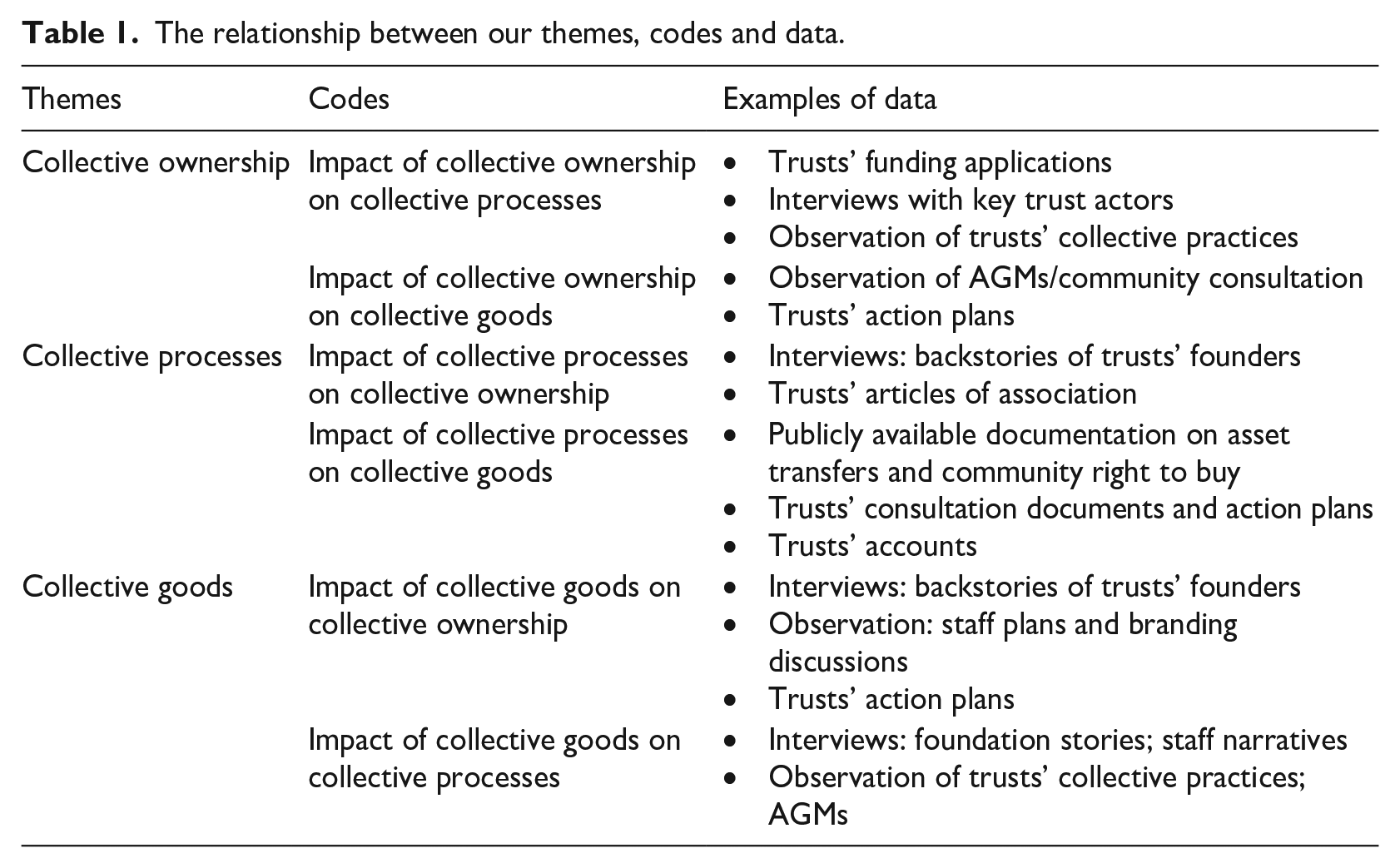
Table 1 shows a logical relationship between our themes, codes and data examples. This structured approach has enabled us to thoroughly analyse the data and present relevant evidence for each theme systematically.
The relationship between our themes, codes and data.
The case units of analysis
Situated within 50 miles of Glasgow, both Brechen and Larbeth have a similar history. Both were a focus of manufacturing activity before the onset of de-industrialisation. From the mid-19th century until the 1980s, Brechen was a key centre for the Scottish pottery industry, with significant brands, particularly Brechenware, enjoying worldwide renown. Larbeth is famed both as the centre of the former train manufacturing base and for the post-industrial decline which followed the closure of its factory in the 1980s. Larbeth’s decline has been severe, with a population collapse from 15,000 in its industrial heyday to 9000 today. Community development trusts (CDTs) have been formed in both towns to attempt to tackle this decline.
BDT was established in 2009 largely by members of the footballing community of the town, to take over the management of football facilities which had been council-owned and earmarked for closure. As well as running these sports facilities, BDT owns a 13-acre campus from the Church of Scotland with a range of accommodations and workshops, a sports hall, chapel, cafe and mansion house and held ideas to run a micro-enterprise hub with workspaces (Table 2).
Key facts and figures on BDT and LDT.
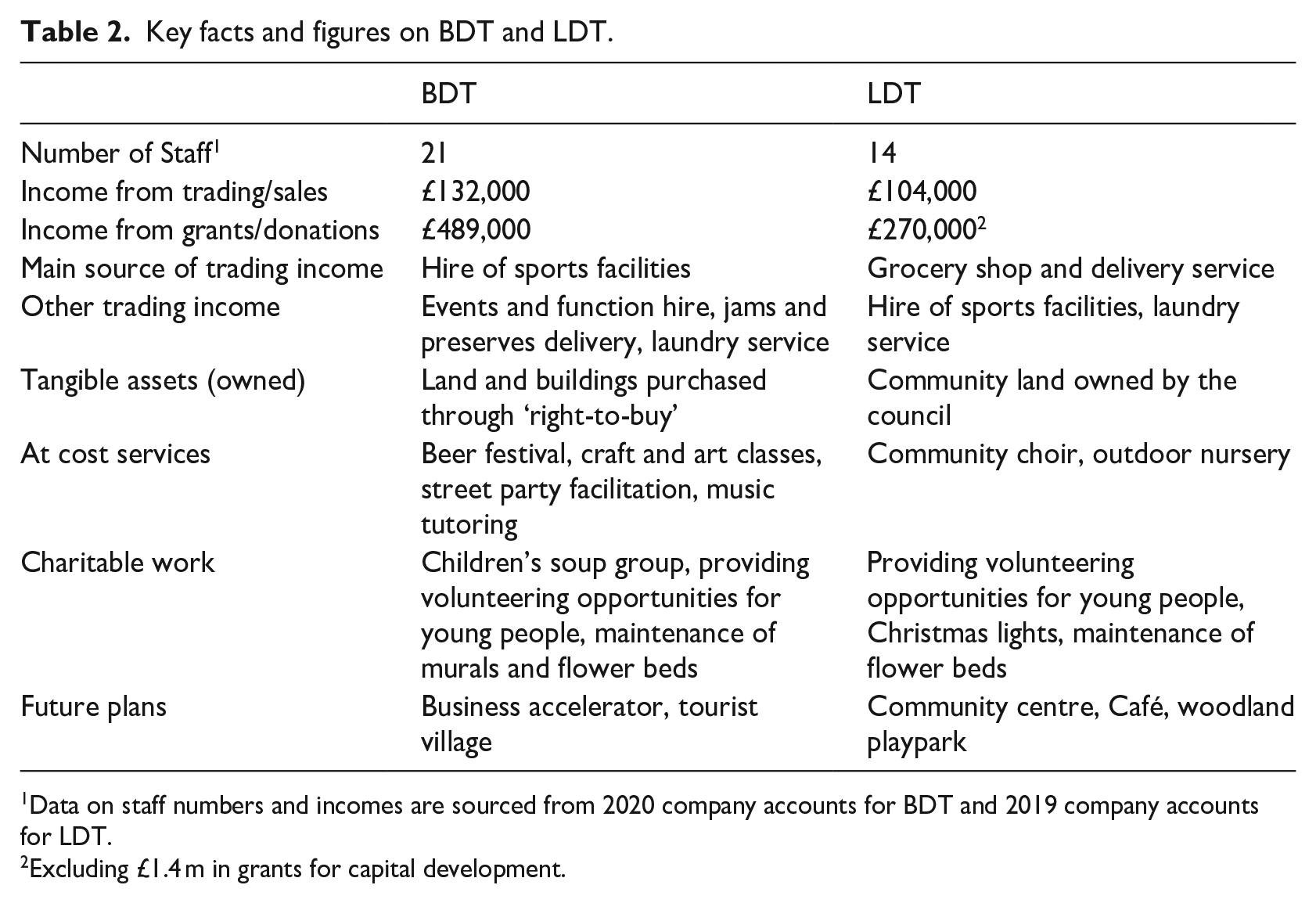
Data on staff numbers and incomes are sourced from 2020 company accounts for BDT and 2019 company accounts for LDT.
Excluding £1.4 m in grants for capital development.
LDT was founded in 2011 by a group of women associated with a community centre which was scheduled to be demolished to make way for an access road to a new sports facility. To sustain its activities, LDT established a laundry service and a fruit and vegetable shop and delivery service. In 2016, LDT attained a 6-acre site in an asset transfer from the local authority at the cost of £1 for the development of sports facilities and a community centre.
Both trusts sustain themselves by a combination of trading activities and grant funding. BDT received £111,000 from trading activities and £211,000 from grants in the financial year ending 2019 while the respective figures for LDT are £150,000 and £270,000. LDT also acquired £1.4 m in grants for capital development of a new sports complex, largely from the local authority and Scottish Government. The two trusts formed a partnership in the early stages of development through a mutual acquaintance who had supported both trusts in his role as an employee of the anti-poverty campaign Oxfam.
Findings
Our findings are separated into two main sections. The first (How collective entrepreneurship manifests itself in our case study) identifies how the case study deploys the different aspects of collective entrepreneurship. The second (Analysis: The interplay between aspects of collective entrepreneurship) analyses the interplay of these different aspects.
How collective entrepreneurship manifests itself in our case study
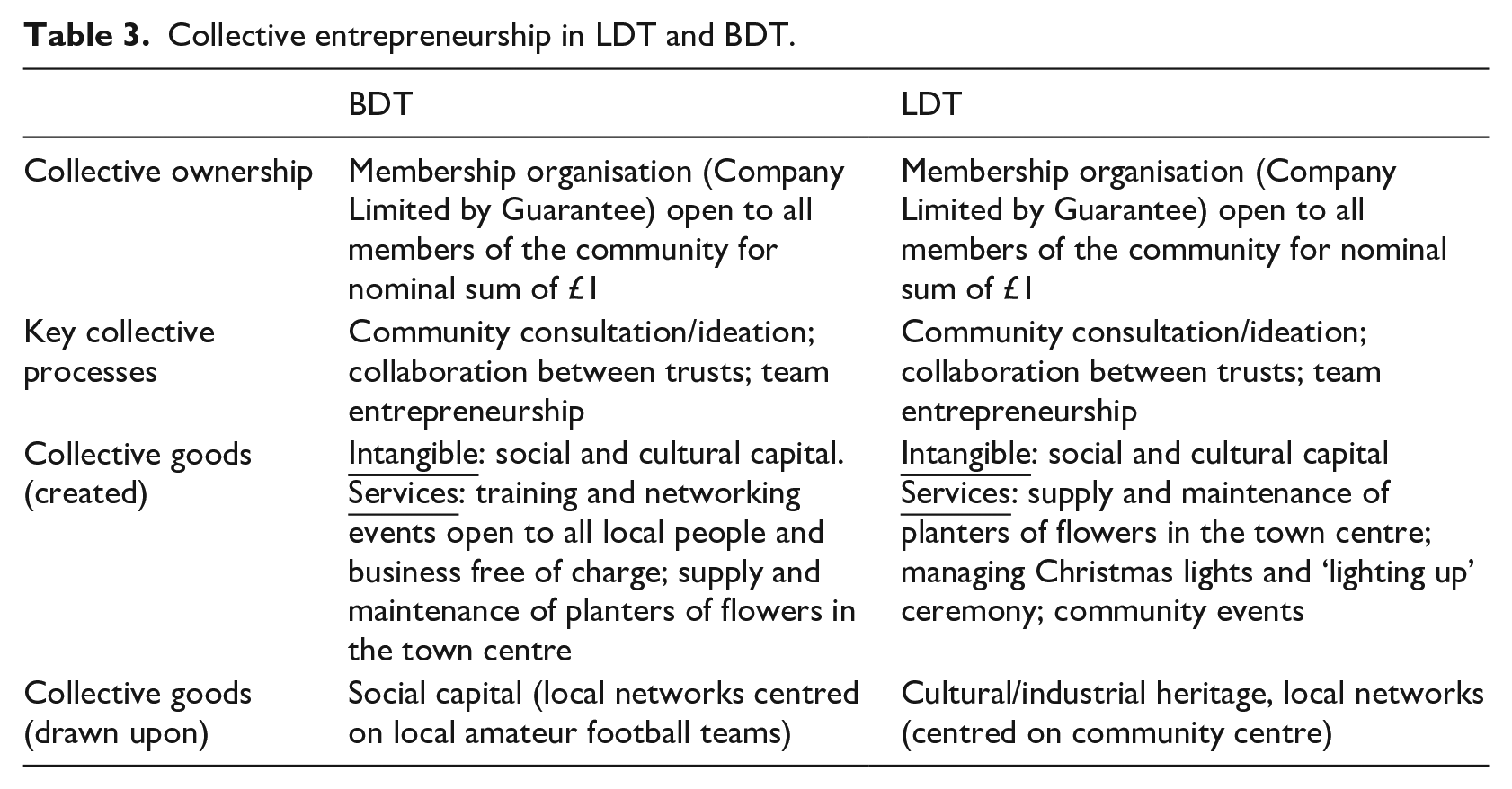
Our findings from the research identify a foundation for collective entrepreneurship. By drawing on the extant literature above, we explore collective entrepreneurship using the categories of collective ownership, collective processes and collective goods, summarised in Table 3.
Collective entrepreneurship in LDT and BDT.
Collective ownership
Collective ownership covers the legal form of the collective enterprises and sets out the way the organisations are governed and operated. Both BDT and LDT are Companies Limited by Guarantee (CLGs), a legal structure that offers the flexibility often seen in social organisations as the governance arrangements allow both commercial and social objectives to be pursued simultaneously (Smith and Teasdale, 2012).
The constitutions of the Larbeth and Brechen CDTs allow anyone living in the areas which the trusts serve – defined by local postcodes – to acquire membership for £1. The trusts’ staff are also provided with membership. Membership entitles members with a vote – equal to that of every other member – at the AGM and any other important company meetings. At the AGM members of the board are elected, who then determine who should hold the various roles required for the board to function: the chairperson, the treasurer, the secretary, etc. The board appoints the staff, including the manager. This constitutional form of ownership has two important outcomes. First, assets are owned by the trust and their ownership and use are democratically accountable to the membership. Second, as the trusts are anchored in the communities, collective ownership is key to determining how any surplus generated is allocated. The democratic process in which the community members participate becomes part of the ownership model. Ensuring equal voting rights requires collective effort in terms of persuasion, deliberation and decision-making.
The ability to access finance and investment into social mission-led organisations is extremely difficult (Daggers et al., 2021; Giacomantonio, 2017). The intensity of this was reflected by one member of the LDT management team who reacted by saying ‘how in the hell is a community like Larbeth going to raise £150,000?’ (FN, February, 2015). Both BDT and Larbeth have achieved success in accessing capital, raising hundreds of thousands of pounds in recent years (see Table 2), and their efforts show two things: the risk associated with underpinning social purpose and the need for subsidy to enable social organisations to function. To access capital, the trusts were driven to engage with grant funding processes managed by government bodies and social sector funders. This can be a frustrating process because ‘it’s so hard to get. There’s such high competition’ (I2). Funding applications and the creation of accountability reports, where the trusts demonstrate social impact and align their work to funders’ priorities is a fundamental collective process and underpins the ownership model.
Collective ownership has also necessitated other forms of collaboration with external parties, specifically through partnership working that has been essential in gaining access to capital. While commercial bank loans are a challenge to attain and angel investors or venture capitalists seek out very specific forms of for-profit enterprise, social finance for organisations like BDT and LDT is also problematic (Daggers et al., 2021; Thompson et al., 2022). The trusts, as CLGs, cannot issue shares and some forms of commercial finance would cede control to outside investors, potentially undermining community autonomy and social purpose. Other options, such as community fundraising, are available but can lead to different problems for social organisations. It means community financing is often limited by the amount of disposable income in communities, by the lack of assets and through an insufficient trading history (Rosenman, 2019). One area where collective ownership is advantageous is in the ability to acquire assets and both LDT and BDT have benefited in this way through their relationship with government.
Community asset acquisition policies are more closely related to the government’s community development agenda as successive Scottish governments’ community asset acquisition policies were consolidated in the Community Empowerment (Scotland) Act 2015. Amongst the Act’s provisions are a strengthening of the rights of community organisations to attain land from public bodies (asset transfer) and buy available local private land (community right to buy), supported with grants by the Scottish Government-supported Scottish Land Fund (SLF) (Scottish Government, 2020). LDT attained six acres of land through an asset transfer from West Lanarkshire council for the nominal sum of £1 and BDT attained 13 acres through the Community Right to Buy mechanism from the Church of Scotland for £512,000, a sum which was provided by the SLF.
Each trust draws upon the knowledge and experience of key members of staff and volunteers to trial and operate new ventures. Teams are small, due to the small scale of the operations. Duties overlap, meaning all staff work closely alongside each other. Board meetings serve as a forum for new ideas and provide oversight of trials of any new service. Several of the trusts initiatives have emerged from ideas brought to the board by staff or volunteers. For example, the chair of Brechen Trust, a Physical Education teacher at a local school, has set up and delivered sports classes (football and badminton) in the trust-owned facilities. In Larbeth, the delivery service has been expanded to local schools, in part due to the contacts of another employee, a retired head schoolteacher.
Collective processes
Collective processes are demonstrated through internal and external activities and between the two trusts. We witnessed how the trusts deployed collective processes to consult and deliberate internally and to collaborate with the state and its agencies externally. Internally, it was an open and collective consultation process that collectively led to the provision of commercially viable collective social goods. Externally, engagement with the state enabled asset transfer but demonstrated a hierarchy in collaboration. The collective purpose between the two trusts enabled new forms of social capital to form.
Building internal collaboration: Community consultation
Internal collaboration meant a consultation process with three main characteristics: (1) no pre-set agenda; (2) actively bringing new voices into the process and (3) creating spaces to consult and deliberate. This consultation included the leafleting of every house in the community, with trust volunteers speaking to every organisation in the area. The use of social media and text messages, public meetings, feedback encouraged by letters, emails and private discussions with trust members, all formed part of the consultations. What we witnessed was a concerted attempt to generate ideas from the community, rather than residents being presented with a list of options which could be accepted or rejected. Ideas were distilled and taken back out to the community in an iterative process, cumulating in the public unveiling of a community action plan. These processes were a significant undertaking and in both cases took almost 2 years to complete with significant numbers of community residents contributing. LDT reported that over 2000 locals participated.
Several of the key ideas which the trusts went on to commercialise were generated by the community. The main source of revenue from trading for LDT is its fruit and vegetable shop and delivery service. For BDT, it is the hire of sports facilities. The ideas emerged in response to community feedback about concerns over local diet and health and the deliberation prompted the creation of collective goods with a focus on social purpose. Consultations revealed local demand for projects to make the towns more attractive and led to both Larbeth and Brechen providing planters of flowers in the town centres. Brechen Trust also manages a project, in collaboration with the Glasgow School of Art, to decorate the town with murals. Larbeth Trust manages the installation of Christmas Lights. Apart from improving the physical appearance of the town, Brechen provides space for workshops, training and networking events for local people and business in the Greeland estate complex.
Building external collaboration: The state and its agencies
LDT and BDT used their partnership with the government and their agencies as part of a set of collective processes. The umbrella body DTAS provided a forum for two-way deliberation between grassroots activism and government-sponsored action. While DTAS is functionally separate from the Scottish Government and lobbies the Scottish Government on behalf of its members (DTAS, 2020b), one DTAS employee we spoke with referred to an excellent relationship with government, saying that DTAS has representation on ‘all the major government policy committees’ including the Environment, Climate Change and Land Reform Committee, which reviews land ownership for all Scotland (I3). DTAS provides the trusts with access to relevant policymaking circles, for example the development manager of Brechen Trust is a board member of DTAS.
The opportunities taken by both trusts were enabled due to the policies of the devolved Scottish Government. The asset transfers required appropriate business plans to demonstrate how the use of the assets would lead to sustainable enterprise. While the trusts worked to create the vision for these new ventures, the resources required were provided largely by the state and the entrepreneurial opportunities which the trusts have developed have been co-created by the state and the trusts working together, juxtaposing professional and activist skills (Kretzmann and McKnight, 1993).
External collaboration was not always harmonious. We heard of complaints about how the ‘processes, requirements and personnel at the local authority were repeatedly changed at the last minute. . . [contrasting] to the support provided to business interests’ (I5). LDT activists experienced a clear bias by the local government which favoured private development and the trust had been refused transfer of land for community facilities for more valuable land in the centre of town because the council preferred to sell the land to private developers. One council employee told us how the council was ‘thinking dollar signs!’ (FN, February, 2016), and this point was elaborated by an LDT employee who explained that the council would ‘gain from selling the land, [and] from housing and the tax that it could charge rather than for a community centre’ (FN, February, 2016). LDT’s manager suggested that the reason that the council had transferred land – as an asset – to the trust was because ‘the land isn’t worth anything’ (I2). The experience of the trusts indicated to us that community organisations were often considered to be of secondary importance by the government in comparison to commercial interests.
In negotiations with state employees LDT activists often felt poorly treated. On occasion, the activists were made to wait and feel that they were not taken seriously and they attributed their poor treatment to class prejudice. For example, at one meeting, it emerged that state agency officials had not even read the business plan the group had sent prior to the meeting. LDT’s manager said that ‘if that had been a group from Bearsden or Milngavie [affluent suburbs of Glasgow] I bet you any money she would have read that business plan from cover to cover’ (I2). By contrast, while there were examples of strained relations between Brechen’s leadership and state officials this was not attributed to class prejudice.
Building social capital between trusts
The partnership between BDT and LDT that helped to shape new social capital was ultimately an informal arrangement. The relationship is close in terms of the personal familiarity of key members of the organisations with, for example, BDT’s manager describing LDT as a ‘sister trust’ (FN, April, 2016). One employee of LDT acted as a go-between for the two trusts. Workshops to assist in the development of the trusts’ work in which the leadership and staff of both trusts took part were arranged by this person. Invitations to the workshops were extended from the wider networks of both trusts, to involve external stakeholders and experts including members of our own research team.
The knowledge sharing between the trusts formed the basis for new ideas, processes of ideation become evident, and social capital is formed. For example, it was through their collaboration that awareness of a Climate Challenge Fund grant became evident and it led to LDT applying and attaining facilities in which to base its enterprises. This initial knowledge came from employees in BDT who had successfully made a similar application. LDT’s management then discussed with BDT how the model of the latter trust worked to generate revenue from the hire of sports facilities. In turn, the manager of BDT sought to understand from the manager of LDT how a sustainable community shop could be started in Brechen. Although often there was overlap between internal, external and joint working, these forms of collaboration were at the heart of the collective processes we see in collective entrepreneurship.
Collective goods
Another foundation of collective entrepreneurship is collective goods. There are goods collectively produced and consumed and there is the collective production and consumption of intangible goods such as social and cultural capital. The collective consumption of resources is typically based on how the trust’s activities depend on the use of public land. In BDT’s case, the land for sports facilities is leased from the council and in the case of LDT land for sports facilities has been transferred from the council to the LDT. In the latter case, this land has changed hands but remains collectively owned.
Collectively produced services often serve a social and commercial purpose. At LDT, a community choir is run with the aim of building up social capital while generating revenue that covers its costs. One LDT board member and attendee of the choir explains the benefits of the service: ‘I got a blether and I got a laugh. And you go away quite happy. And I feel that that passes on’ (I6). BDT’s manager explains how another at-cost service called Street Meet, where the trust provides equipment for running on-street parties, generates community togetherness and again provides the basis for embedding social capital. Street Meet’s purpose is to ‘build up social networks and bring people together and [provide] fun as well. Because I think a lot of [times we] forget that fun . . . is usually where great things happen’ (I5). Thus, the trusts pursue their social purpose, raise revenue and create a positive environment for community members.
This idea of producing new forms of social capital is an important outcome of collective entrepreneurship. The trusts seek to develop community spirit through the production of collective goods and as a byproduct of the services that they provide for a fee. These include those produced in the form of projects to make the towns more attractive and that can generate local activity through organising and hosting events. Frequently mentioned by informants was the need to improve the ‘community spirit’ of the towns. This vague term was often used by the trusts’ activists to describe ways to enhance levels of positivity about the locality and social interconnectedness. LDT’s manager explains: Larbeth . . . always had fantastic community spirit . . . there was a huge hive of activity, and it was all lost, the community spirit slowly but surely was starting to die, so we’re trying to get that back again. (I2)
The leadership of LDT was initially drawn from a core campaign group of about 30 women who were previously connected to the local community centre in various ways. LDT’s current manager taught tap dancing at the centre. Another founder was involved in youth drama classes there. BDT’s formation was based largely on local networks associated with the local amateur football club. As BDT’s Chairperson commented the community saw the trust initially as ‘the football people’ (I4). Relations between the trusts and the community are recognised by the trusts as central to their success. Early campaigning work of the trusts depended on local networks, for example, allowing significant numbers of people to be mobilised in ‘daisy chain’ letter writing campaigns to the local authority. (FN, March, 2016)
The production and distribution of cultural capital are also important in collective entrepreneurship and we have contrasting examples of this to present. The cultural heritage of Larbeth town was used where the trust named its greengrocer delivery service after the train factory which characterised the town; the factory was called Froots and the greengrocers Larbeth Roots and Froots. BDT purchased the rights to the local pottery brand, Brechenware, for which the town became renowned. They began to consider renaming the Greeland estate as Brechenware. BDT is also experimenting with fitting out a building in the estate for pottery manufacture to revive the brand commercially. In both trusts, then, we observe a recognition of the value of cultural capital and an attempt to bring aspects of the towns’ cultural heritage under collective ownership.
LDT activists took the town’s strong working class heritage a stage further to provide meaning and identity for the trust. The LDT action plan states that its programme is based on an approach which favours ‘community ownership’, is ‘culturally appropriate’ and that those ‘involved are proud of their culture and their struggle’. Brechen is more culturally fragmented; Brechen is a dormitory town for wealthier residents who commute to Glasgow as well as having low-income areas where residents rely more heavily on local shops and services.
In Brechen, this fragmentation impacted the ability of the community to mobilise, with the BDT manager informing how ‘community activism is alien in Brechen’ (I5). However, we might expect a greater availability of professional skills associated with the greater wealth of the area and we saw that BDT benefits from a greater range of volunteers. In both trusts school teachers and community workers took board positions. However, BDT’s board also includes highly specialised professionals such as engineers and accountants in much the same way other research has reported on collective enterprise (Amin, 2009; Davies et al., 2019; Medoff and Sklar, 1994). This greater range of expertise benefits BDT with, for example, the accountant who provided scrutiny of company finances and the engineer who offered advice on options for the most appropriate materials to be used in repurposing trust properties.
Analysis: The interplay between aspects of collective entrepreneurship
The categories of collective ownership, collective processes and collective goods interact with each other in a complex interplay (see Figure 1). This interplay is not necessarily commensurate in the sense they equally balance against each other, but nevertheless show important forms of collective behaviour behind collective entrepreneurship.
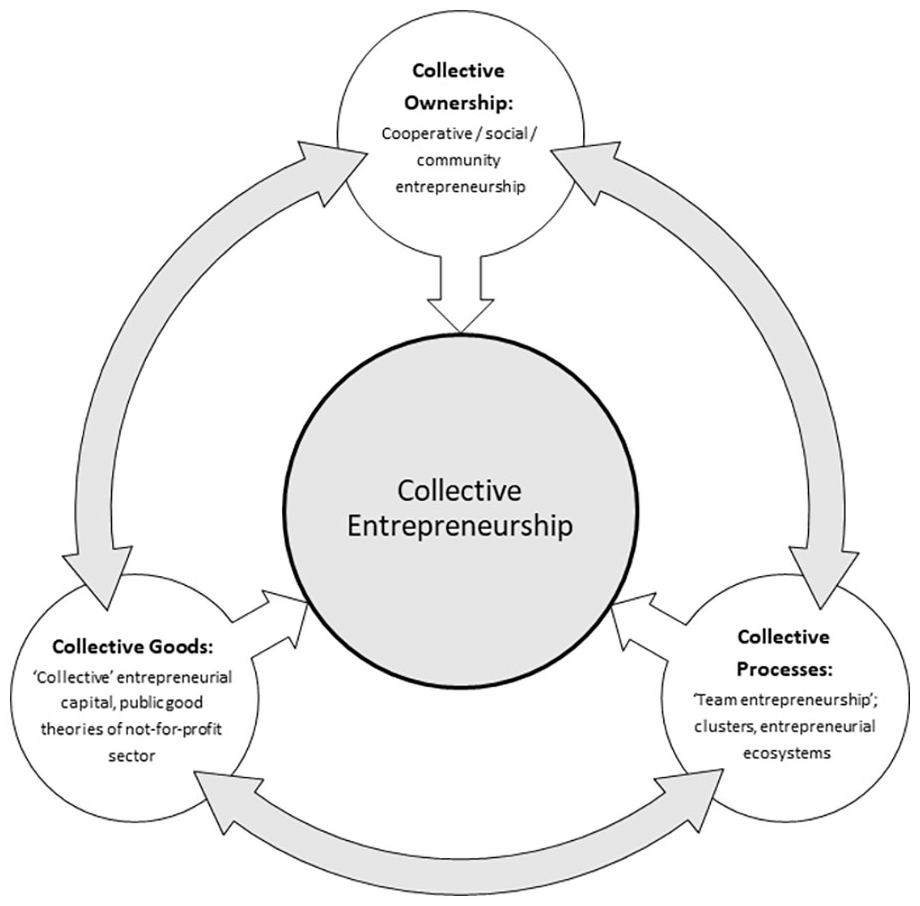
Interplay of collectiveness of entrepreneurship.
The impact of collective processes on collective goods
In this case study state agencies, which co-create opportunities for the trusts, exhibit support mechanisms that encourage community organisations to create collective goods. Funding for both asset transfers (used by LDT) and community right to buy (used by BDT) was contingent upon community groups demonstrating community benefits. For example, the SLF stipulates that it ‘will prioritise applications that can demonstrate significant positive impact for the community as a whole’ (Community Fund, n.d.). By making funding available to organisations which are not profit distributing, policy mechanisms create space for social goods to be prioritised over the financial returns to investors.
In our case, the strongest element of group ideation was undertaken through a process of community engagement. We note that the collective process of community consultation prompted the creation of tangible collective goods; as we have seen, the local demands for projects to make the towns more attractive led, in both Larbeth and Brechen, to the provision and maintenance of planters of flowers in the town centres and murals in Brechan and Christmas Lights in Larbeth. In the Greeland estate complex, Brechen provided space for workshops, training and networking events for local people and businesses. This shows how the social purpose becomes the starting point for collective processes from which generalised benefits, as well as commercial revenue generation, can be explored.
The impact of collective goods on collective processes
Our study presents social capital as a collective good that emerges from the mobilisation of community members and by developing of active networks. In Larbeth, for example, a ‘daisy chain’ letter writing campaign to the local authority was launched where local councillors were ‘bombarded with letters’ (FN, 2016). It can become more sophisticated as the Chair of BDT suggested: ‘all the grants . . . we get is because of the good links we’ve got with the community’ (I4). A collective good, then, has opened up opportunities to engage in the process of partnering with the state and its agencies. Furthermore, a two-way process of trust and accountability between organisation and community, for example, through the iterative processes of community deliberation, demonstrates how the outcome of a collective good can, in turn, become important to the entrepreneurial process.
How cultural capital translates into collective processes is complex. In Larbeth, the collaborative processes of the venture were deemed to be suitable as they aligned well with a culture revering community activism and struggle. However, in Larbeth, class prejudice amongst state officials was seen as hampering the process of partnering with the state. Brechen, owing to a more mixed cultural heritage, may not have been able to draw to the same extent on a culture of solidarity, but benefited greatly from access to the range of skills to which its cultural heritage had bequeathed it.
The impact of collective processes on collective ownership
The legal form of collective ownership is taken by the trusts because it provides an established framework for collective processes, to provide certain formal collective controls which are underpinned by the voting of members at AGMs. Collective processes like these are open to all residents of the community with an equality of decision-making that distinguishes the trust from other types of legal forms, such as companies limited by shares. With equal voting rights, the trusts’ governance is similar to that of a cooperative.
Familiarity with collective processes amongst the founders of our trusts underpinned the choice of collective ownership. As we have seen in the section ‘How collective entrepreneurship manifests itself in our case study’, LDT was founded by a group of local women who had sat on the management committee of the local community centre and BDT was founded by a committee which organised local amateur football. In effect, the collective processes were reimagined for a new setting and set a new entrepreneurial purpose. This inclusiveness was an important social innovation that led to continuous deliberation, decision-making and formal recognition of the work of volunteers. We can acknowledge that external collective processes, when, for example, the trusts partnered with government agencies, helped to channel the organisations along certain collective paths, that is those legal forms of collective ownership readily available for collective processes. But the choice to take the collective ownership route and set up a community organisation in the first place was that of the founders, enabled by the social and cultural context of the areas.
The impact of collective ownership on collective processes
The legal aspect of collective ownership affects internal and external processes. Good examples include the types of processes developed to access finance. Struggling to attain commercial finance, the trusts have been steered towards distinct collective processes for securing finance and gaining other forms of support. Examples include processes of funding applications and accountability reports, which demonstrate how the trusts align their work with funders’ priorities. Collective ownership also entails engagement with specific types of organisation which cater to these types of enterprises; the need for legal and project support prompts the trusts to engage with relevant actors in the sector, such as DTAS.
Besides finance, collective ownership means a certain ethos about how the various processes of business should be conducted. One interviewee explained: I think the very basic thing is that collective participation, contribution, more working together to actually produce better outcomes, the social responsibilities about the individual within that set up . . . how the finances are distributed . . . democratising of the organisation. So the essence of that, the bottom line is to produce wealth in a way which is a bit more ethical, employment which is a bit more ethical, so it’s both economic and social. (I1)
Both collective ownership and collective processes are perceived as a means of behaving ethically and inclusively, not purely in legal or procedural terms. Collective ownership is seen as fundamentally ethical in its own right, as a way to distribute rewards. But it is also considered more ethical because of the attendant processes which promote inclusivity.
The impact of collective ownership on collective goods
We have seen above how the impact of collective ownership on collective goods is often intermediated by collective processes. Our research shows how collective ownership provides residents with the protection of spaces for non-commercial community activity; we saw examples to protect community space such as LDT’s new community centre and football pitches and BDT’s community hub in Greeland. These are spaces that can only be sold if the community allows it, with the trusts’ articles of association stating they can only be sold to other non-profit distributing bodies, such as another community trust or charity.
Conversely, the absence of community ownership led, in some instances, to the destruction of community assets. A lack of community control in Larbeth resulted in buildings important to the community being demolished. One former listed building where community events were held was sold by the local authority to a private developer, who demolished the building before selling the land to housing developers at a price which provided a return in excess of the fine applied for the demolition of the protected building. A locally managed, although council-owned, community centre was demolished to create an access road for a council-run sports facility. Collective ownership produces a firmer commitment to place but also a mechanism for the longer-term maintenance of local and collectively owned goods.
The impact of collective goods on collective ownership
We have seen how collective goods and collective processes are linked; collective ownership has been favoured by the trusts because it provides a framework for more ethical processes around surplus disbursement and inclusive decision-making. We have also seen how social capital, as a collective good, has opened opportunities for processes of community activism and deliberation. As partnership with the broader community provides the basis for the particular form of collective ownership adopted, we can understand social capital as being an important factor in shaping the collective ownership of the trusts, as a means to provide structure to the community processes at work.
Cultural capital has also impacted the collective ownership of the trusts. We have noted how far LDT promote the idea of ‘community ownership’ as ‘culturally appropriate’ for a working-class community who are ‘proud of their culture and their struggle’. We have also seen how in communities, social organisations like the trusts can capitalise on cultural capital in different ways. The examples we have shown above, with Roots and Froots in Larbeth and the Brechenware local pottery brand, show collective goods as cultural capital, a collective ownership of this part of the towns’ cultural heritage.
Discussion and future research
Our novel approach, of appraising systematically the interplay of the three typically disparate dimensions of collective entrepreneurship, sheds light on a host of factors at play in entrepreneurship in low-income areas which are both familiar and unfamiliar in entrepreneurship scholarship.
First, in terms of the relationship between collective processes and goods. Our findings suggest an impact of collective processes on collective goods which echoes literature on the role of public policy to shape entrepreneurial opportunities (Chang, 2013; Wilken, 1979) not least by providing resources in low-income areas to support entrepreneurship (Bates and Robb, 2011; Sass Rubin, 2011). Where previous literature has highlighted a key function of social enterprise as intervening where markets and the state fail (Kingma, 2003), we note a novel and complex process where collective goods are co-produced by the state and social enterprise. The processes around a partnership with the state differ from conventional settings in that they do not take place primarily under the auspices of economic or industrial policy but the ‘softer’ policy area of community development. In these relations, the trusts are very much considered junior partners by state actors, seemingly taken less seriously than commercial actors. Our findings also stand in contrast to much collective entrepreneurship literature which is focused on processes of ideation in corporate teams for commercial gain (Rigolini, 2007). Rather we find the trusts’ collective processes, such as group ideation through community engagement, to be more supportive of the production of collective goods. Such collective goods, notably social capital and cultural capital, are, in turn, important to support enterprise in low-income communities (Elo, 2019; McKeever et al., 2015). By showing how the trusts foster these collective goods through collective processes, then, our findings provide support for the idea of a virtuous circle created by social enterprise, proposed by Leadbeater (1997), but in this case we observe specifically how collective processes beget collective goods which beget more collective processes and so on.
Second, we turn to the interplay between collective processes and ownership. Our findings shed light on how collective processes and ownership are different but have related dimensions. Our findings, therefore, contrast with literature which conflates collective entrepreneurship with the decision-making processes of cooperatives (Manouchehrabadi et al., 2021; Meyer, 2020; Stryjan, 1994). Our analysis shows how collective processes and collective ownership interrelate in enterprise forms that are not cooperatives. We also show how an embrace of collective processes may predate the adoption of the ownership model. Hence, while our findings confirm that various contextual factors are significant in the development of collective ownership (Elo, 2019), we highlight how familiarity with and preference for, certain inclusive processes can be central to establishing collective ownership. The ease with which BDT and LDT cooperate resonates with Bartlett et al. (1992), who show the strengths of collectively owned organisations in processes for sharing information between like-minded organisations. We also find that processes for accessing finance for collectively owned enterprises are inadequate. As such, our work reflects prior research, for example where Davies et al. (2019) and Hörisch (2015) show how commercial investment processes are often incompatible with collective ownership where it means ceding control to a commercial organisation. Likewise, our work chimes with that of Daggers et al. (2021) and Meyer (2020) who show how community finance or community fundraising is also problematic because of the low levels of disposable income in low-income communities. Our findings provide examples of where collective financial processes for collective ownership in low-income areas break down and need to be rethought. Overall, we show how the interplay of collective ownership brings in a host of different actors – for finance (e.g. grant funders) and other enterprise support (e.g. third-sector intermediaries such as DTAS) – into the entrepreneurial process with different expectations of partnerships than we would expect to find in more conventional entrepreneurial settings.
Third, we turn to the relationship between collective ownership and goods. Our findings agree with work in the discipline of community development which demonstrates a potentially powerful role for collectively owned community enterprises in assessing, developing and securing assets under collective ownership, as part of a prosocial entrepreneurial mission (Mathie and Cunningham, 2003). Yet, while Zeuli and Cropp (2004) show how collective ownership produces a firmer commitment to place, we show how this commitment does not only relate to a firm not relocating or favouring local employment; community ownership (and the collective process involved) also drives the trusts towards enhancement of the locality in a more holistic sense, especially through the production of collective goods to promote what our informants describe as ‘community spirit’. At the same time, our findings support previous work which has shown how collective goods in the form of cultural (Throsby, 1999) and social capital (Casson and Della, 2007; Muringani et al., 2021) can translate into collective ownership (Dana and Dana, 2007; Elo, 2019; Lin et al., 2022).
While we are confident that our findings present a picture of collective entrepreneurship which will be familiar to many low-income communities, we are also aware that the balance and extent of collective ownership, processes and goods will vary in degree from place to place. Our findings suggest that challenges for one dimension of collective ownership will feed through to other dimensions. For example, where there is a less supportive policy environment or a shortage of social or cultural capital, it will likely be harder for collective ownership to take root. More research is required to evaluate this variation and its implications. Although our findings relate specifically to collective entrepreneurship in low-income communities, we contend that there are implications of this work beyond such settings. Indeed, we maintain that our analytical approach has promise for a better understanding of many if not all forms of entrepreneurship. This is because, as we have shown in our literature review: (1) all forms of entrepreneurship exhibit some form of collective processes; (2) collective goods invariably form some part of the capital upon which a firm depends and (3) collective ownership, or a lack thereof, is a key characteristic of an enterprise, with implications for how the firm manages its staff, drives innovation, relates to other stakeholders and preferences for prosocial activity. Yet, research into the interplay of these dimensions within more mainstream or commercial entrepreneurial settings is underdeveloped.
Here our research comes full circle. Our approach in this work has been to recognise the growing body of literature that demonstrates that conventional entrepreneurship is a collective endeavour and seeks to apply these learnings to low-income areas. Yet, we propose that the form of entrepreneurship we witnessed in the low-income areas we have studied, where collective entrepreneurship is both valued and embraced, offers considerable promise for mainstream entrepreneurship. Indeed, if benefits can be derived from collective goods, processes and ownership in the more challenging circumstances of low-income areas, there is reason to believe that greater advantage might be gained where circumstances are more favourable.
To offer insight into how one might build on the work of this article and address entrepreneurship more broadly, let us suggest some specific areas which our research implies could merit further study. To develop our approach outside low-income areas, more understanding is needed about how the extent of resources available to an enterprise (collective or otherwise) affects the interplay between the dimensions of collective entrepreneurship. In other words, how would the interplay affect similar enterprises operating in wealthier or, indeed, even poorer areas? Beyond social enterprise, we need to understand more clearly the blockages in the bidirectional flows between the different aspects of collective entrepreneurship which prevent benefit from being derived from more collective approaches in commercial firms. Considering specifically intangible resources, more work is required to better understand how the evolution of cultural capital within a commercial firm impacts processes of employee engagement and collective ideation. Also in such firms, how does an absence of collective ownership hamper efforts to build cultural capital or drive collective processes? Some research would suggest that insufficient collective ownership is not an insignificant issue in terms of firm innovativeness or performance (Garrett, 2010; Kruse, 2022), but there is limited understanding of how such blockages, (for example, resistance to extending ownership), can be successfully overcome. Issues of the interplay between collective goods and other dimensions may be more marked in certain sectors, for example, where reliance on collective goods is more pronounced. To illustrate, the objectified character of cultural heritage is an important feature of place marketing and the stimulus to many start up and independent businesses in the hospitality sector (Gertner, 2019). Our framework, then, prompts us to ask novel questions of such sectors, such as, does the reliance on collective goods have implications for the types of collective process or ownership of these enterprises? Would such firms benefit from a more collective approach? In broad terms, we offer our framework as a means to evaluate the dynamics of the collectiveness of an enterprise, capable of providing greater insights into when and where collective entrepreneurship (and hence entrepreneurship in general) is likely to be more successful.
Conclusion: Making sense of collective entrepreneurship in a low-income community
Our main contention in this article is that theorising entrepreneurship in low-income communities is limited by focusing on the entrepreneurial individual. We must develop new concepts that take into account the impact of structural inequalities in determining entrepreneurial success. Collective entrepreneurship enables this and while evident in private, public and third sectors, we have sought to theorise collective entrepreneurship within low-income communities in two ways. First is how collective entrepreneurship works through the collaborative action of actors in the entrepreneurial process. This is in part a response to those structural inequalities, as we have shown in our case. Second, that this collaboration is demonstrated through the interplay of collective ownership, collective processes and collective goods.
It is the linkages and connections of these three components that add to our understanding of collective entrepreneurship in low-income communities and we would contend, in more general entrepreneurial processes. While our work suggests more investigation into the latter, the theoretical contribution we posit is embedded in understanding the interplay of the three components. We have examined the phenomenon of collective entrepreneurship in detail at the level of the low-income community and interpreted it through the extant literature. This literature aids our understanding of what is happening in our case and while empirically grounded, we can in conclusion draw out four main reflections from the interplay of collective ownership, processes and goods.
First, while the shortage of typical entrepreneurial resources in a low-income community inevitably finds its way through to any entrepreneurial endeavour, clearly the lack of access to finance is critical. While we believe our work may help advocate collective forms of entrepreneurship, it would be naive not to recognise the increased risk associated with less access to finance (Dow, 2003; Rey and Tirole, 2007). Even recent efforts to link social value, for example, through issuing social impact bonds, to social mission have proven to have a limited impact on community entrepreneurship (Giacomantonio, 2017). Quite simply, with too few options to raise money from low-income communities the trusts become over dependent on limited amounts of grant funding and state support. This ultimately inhibits forms of collective entrepreneurship in low-income communities.
Second, state support is contradictory. On the one hand, the state can help while simultaneously can act as a barrier to new collective enterprising ideas in low-income communities. As we have seen in our case, state support has been pivotal in establishing the trusts, providing advice and guidance and, importantly, grant funding. Yet, engagement with the state and state agencies has proved frustrating and time-consuming and this cannot simply be reduced to ideas about red tape and bureaucracy. In both LDT and BDT, there was evidence of how their work was marginalised in favour of commercial developer interests. We have also noted in the case of LDT what we have termed class prejudice from state officials. As long as support for collective entrepreneurship in low-income communities has some dependency on state resources, then it is also about what is strategically valued by the government.
This leads on to the third point in our conclusion and how ideation forms as social capital is built. The collective processes of ‘team entrepreneurship’ appear to be based largely on the small scale of the organisations (Cooney, 2005; Harper, 2008). Without more formal processes for ideation, this likely to be difficult to maintain as the organisation increases in scale. In our cases, clearly the collective character of the organisation lends itself to processes of collaboration, to a shared purpose and shared values about democracy. These, in turn, generate spaces for new ideas, new alliances and networks. As this takes place, the social purpose and mission of the organisation rest in the background, reflecting ideas for collective entrepreneurial development that benefit the wider citizenship of the place over and above the pursuit of profit.
Finally, we found that the low-income of our case communities translated into less well-resourced outcomes, whether tangible or intangible. In Larbeth, cultural capital manifest as a collective sense of class identification and this aided the mobilisation of local people that could be translated into projects cited earlier. The more diverse community of Brechen has been able to benefit from a wider range of social and cultural capital, no doubt based on what they were able to draw from income-rich and so-called ‘professional’ residents. Social and cultural capital are essential ingredients of the components of collective entrepreneurship that we have discussed above (McKeever et al., 2015).
In view of the four points we make, we finish by pointing out how important support and solidarity between organisation and community becomes. This is likely to be a specific social and cultural context that emanates from the three components of collective entrepreneurship and their interplay and iteration thereon. Our attempt to consolidate these three largely isolated strands may begin to indicate why instances of collective entrepreneurship are often evident although remain isolated except of course in internationally renowned examples, such as Mondragon and the Chantier de l'économie sociale (Thompson et al., 2022).
In this regard, we demonstrate that all three dimensions of collective entrepreneurship can be highly developed in one setting. The cases we have used show that benefits can be attained by realising the components of collective ownership, process and goods. Yet, we also evidence how the power dynamics between the trusts and their external partners, especially the state, suggest collectiveness might easily be undermined by the capacity of more powerful parties’ to dictate the terms of cooperation. Ultimately, therefore, one of the theoretical lessons of our research is how these three components are not usually brought together in any meaningful way. In this sense, we fail to strategize entrepreneurship in low-income communities; that is, entrepreneurship policy remains atomised with an emphasis on the individual.
Footnotes
Appendix
List of interviewees.
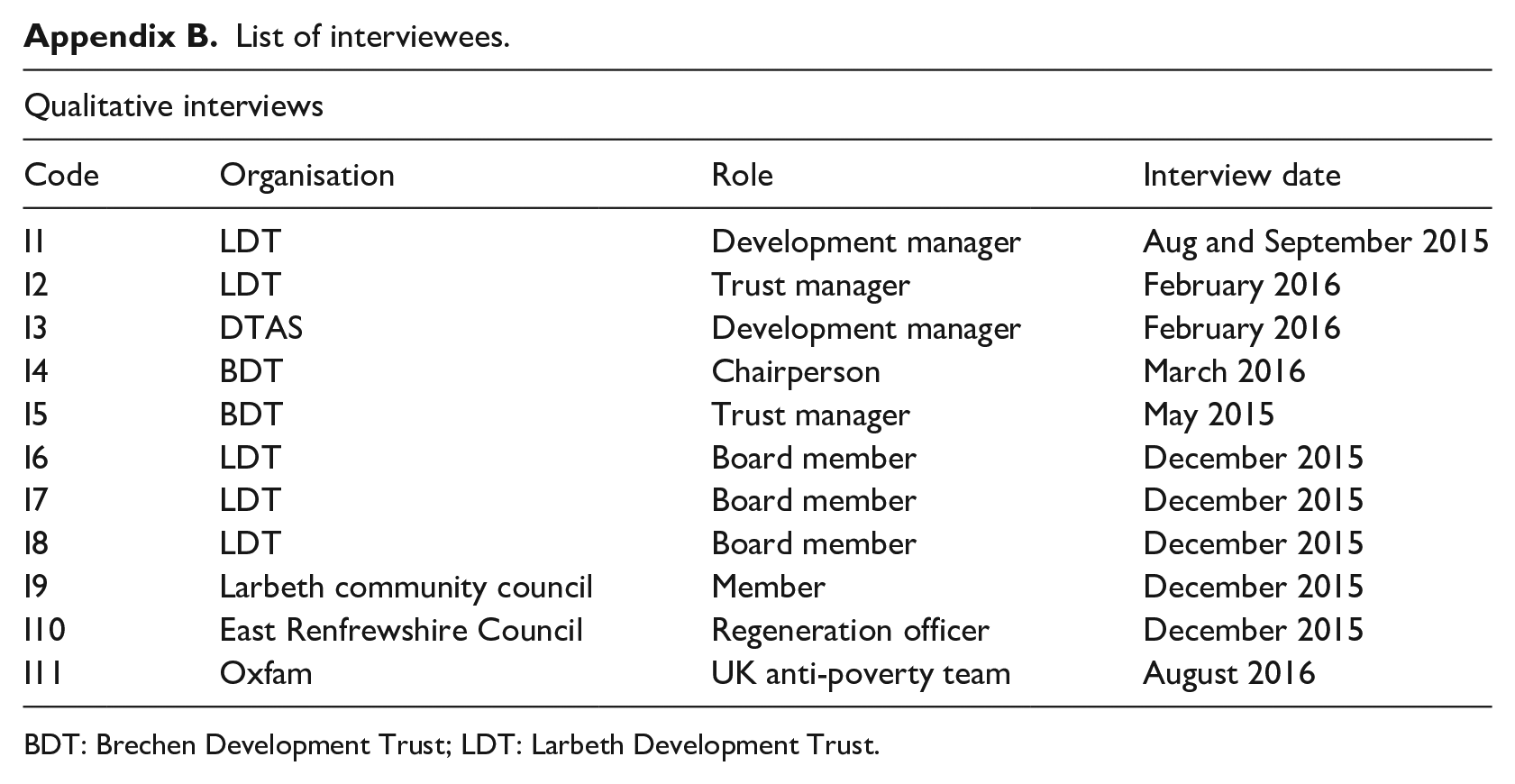
| Qualitative interviews | |||
|---|---|---|---|
| Code | Organisation | Role | Interview date |
| I1 | LDT | Development manager | Aug and September 2015 |
| I2 | LDT | Trust manager | February 2016 |
| I3 | DTAS | Development manager | February 2016 |
| I4 | BDT | Chairperson | March 2016 |
| I5 | BDT | Trust manager | May 2015 |
| I6 | LDT | Board member | December 2015 |
| I7 | LDT | Board member | December 2015 |
| I8 | LDT | Board member | December 2015 |
| I9 | Larbeth community council | Member | December 2015 |
| I10 | East Renfrewshire Council | Regeneration officer | December 2015 |
| I11 | Oxfam | UK anti-poverty team | August 2016 |
BDT: Brechen Development Trust; LDT: Larbeth Development Trust.
Acknowledgements
We would like to thank the participants in all stages of the research outlined in this article for their time and contributions. We would especially like to thank participants from the two trusts for their time and support.
Declaration of conflicting interests
The author(s) declared no potential conflicts of interest with respect to the research, authorship, and/or publication of this article.
Funding
The author(s) received no financial support for the research, authorship, and/or publication of this article.
