



Abstract
Drawing on the cognitive psychology of entrepreneurship, bounded rationality and role congruity perspectives, we investigate the moderating role of the assertiveness of women business owners in the relationship between their business performance and subsequent family-to-business instrumental support. Previous research has generally examined the family support women receive while running their businesses as an antecedent of firm performance. In this article, we reverse the order of these factors and investigate whether the past performance of a woman-led firm is a precursor of family support. Based on results of a longitudinal study of women business owners in Denmark, we found that the higher the assertiveness, the weaker the link between past performance and instrumental family support for businesses.
Keywords
Introduction
Previous studies have emphasised challenges that women business owners face when seeking to combine their family and business responsibilities (De Clercq and Brieger, 2022; Heilbrunn and Davidovitch, 2011). Women tend to face greater barriers than their male counterparts when choosing an entrepreneurial career and attempting to balance it with family life (Bloemen-Bekx et al., 2019; Braches and Elliott, 2017; Harrison et al., 2015). Male entrepreneurs can also find it difficult to achieve work–life balance; however, difficulties regarding family–work interactions tend to be more acute for women given the societal expectations regarding their caring roles (Brush et al., 2019; Gherardi, 2015; Jurik et al., 2019).
Accordingly, as informed by factors that contribute to the gendering of entrepreneurship (Gherardi, 2015), being a wife, mother and/or daughter is an integral part of being a female entrepreneur and, as such, is grounded in the local reality of the work–family life balance. This balance is considered the main responsibility of female adults in the family since their primary loyalty – in prevailing societal views – is considered to be reproduction and home (Gherardi, 2015). Research often describes women in highly gendered ways as in charge of domestic spheres, particularly those with young children (Jurik et al., 2019) whilst the division of labour in households continues to be gendered (Braches and Elliott, 2017). Consequently, women are more likely to prioritise family life over employment and career development (Den Dulk et al., 2015). As a result, women frequently report experiencing stress from having/or trying to simultaneously meet the role demands of being ‘a mother, a housekeeper, a wife, a friend, and a businesswoman’ (Den Dulk et al., 2015: 141). Despite these efforts, they frequently cannot separate their family and work boundaries, which can impede their future success (Busby and James, 2015). Given these challenges, the forms of appropriate support women receive while running their business are of utmost importance (Powell and Eddleston, 2013; Welsh and Kaciak, 2019; Wijewardena et al., 2020). In this article, we focus upon one important type of support: family instrumental support. According to Jennings and Brush (2013), entrepreneurial activity is embedded in families as entrepreneurial decisions, processes and outcomes are influenced by and can influence, family system factors reflected in the family embeddedness perspective (Aldrich and Cliff, 2003).
Typically, family support is viewed as an antecedent to firm performance (Alves et al., 2021; O’Boyle et al., 2012; Welsh et al., 2021). A relevant research question, however, pertains to the possibility of reversing this order: Can the past performance of a woman-led firm play an important role in determining subsequent family support? Furthermore – if so – under what conditions do women typically receive family support? That this question remains under researched in the literature is surprising. However, Welsh and Kaciak’s (2018) model emphasises the need to focus on reciprocal connections stemming from the performance construct back to certain dimensions of family–work interactions. A similar bidirectional approach (“how does what takes place in the family firm affect the family and vice versa?”) was advocated by Powell et al. (2018, p. 101).
Within the domain of the gender role congruity theory of prejudice towards female leaders (Eagly and Karau, 2002), the perceived incongruity between the female gender role and leadership role can trigger prejudices, such as perceiving women less favourably than men in such roles and evaluating the behaviour of women business owners less favourably overall. Negative attitudes such as ‘anti-child anti-woman’, or acceptance of the masculine characteristics and norms underpinning entrepreneurship (the ‘male game’) due to gendered role expectations culturally embedded in societies are frequently reported (Braches and Elliott, 2017). Entrepreneurship has been normatively gender oriented (Bloemen-Bekx et al., 2019) so, considered a male-gendered phenomenon (Ahl, 2006; Henry et al., 2016; Jennings and Brush, 2013) and stereotyped as a male career (Gupta et al., 2009). Research on the impact of gender on entrepreneurial activity has been growing steadily, with women being the gendered subject, often in terms of the gender gap in self-employment rates (Marlow, 2020; Marlow and Martinez Dy, 2018; Weiss et al., 2023). Accordingly, research has afforded greater scrutiny towards women, than men, in leadership roles (Gupta et al., 2018; Ryan and Haslam, 2007). This can also shape strong societal expectations of certain attitudes and behaviours for women in entrepreneurship role distinct from their male counterparts. However, we have insufficient knowledge regarding such socio-psychological dynamics that may affect women entrepreneurs and their enterprises.
To address this research gap, we conducted a longitudinal study that measured the performance of firms run by women, and their subjective perception of various aspects of family-to-business instrumental support. This focuses upon the extent to which women think they can count on help from their family members concerning business matters, in the forms of unpaid voluntary contributions, work and feedback (Eddleston and Powell, 2012). We opted to conduct a longitudinal study, rather than a cross-sectional one, to ensure that conclusions could be drawn to measure the interactions among our studied variables more reliably (Spector et al., 2004). Only longitudinal studies can enable researchers to assess the temporal development of the individual experiences of work–family interactions (Powell et al., 2009).
Specifically, we investigate the relationship between past firm performance, future family instrumental support and the moderating effect of the assertiveness of women business owners upon this relationship. Assertiveness is measured as an aggregate personal cultural orientation associated with acting independently, a strong self-concept, a sense of freedom, autonomy and personal achievement (Sharma, 2010). Our findings illustrate that high assertiveness can weaken the link between firm performance and subsequent instrumental family support for women business owners in Denmark. This may be related to the negative implications of high assertiveness for women entrepreneurs which supports the predictions of the gender role congruity theory of prejudice.
Our theoretical rationale draws upon perspectives from the cognitive psychology of entrepreneurship (Krueger, 2003), bounded rationality (Kahneman, 2003; Kahneman and Anderson, 2003; Simon, 1957) and role congruity (Eagly and Karau, 2002). According to the notion of bounded rationality that lies in the domain of cognitive psychology, individuals cannot be perfectly rational and often make decisions based on their beliefs, knowledge and estimations, thereby forming mental shortcuts (Kahneman, 2003). This phenomenon is relevant to the support of women business owners. Indeed, the entrepreneurial cognition literature has focused on belief structures and knowledge of entrepreneurs, their perceptions, intentions, learning and context, all of which shape entrepreneurial actions and other outcomes (Krueger, 2003; Krueger and Day, 2010). While family-to-business support tends to be particularly influential for women entrepreneurs across different countries (Powell and Eddleston, 2013; Welsh and Kaciak, 2019), cognition and bounded rationality may be underlying factors in family decisions that can affect the availability of support. However, this requires further investigation. We examine these issues among women-led businesses in Denmark, a country with a cultural context of relatively low gender discrimination (Nelson et al., 2017; Plantenga et al., 2009). In gender-supportive environments, the positive emotions women entrepreneurs experience based on their family lives and the potentially beneficial impacts on their business operations (and vice versa) are expected to be particularly relevant (Jayawarna et al., 2020; Jennings and Brush, 2013).
This article makes important contributions to the existing literature. First, we provide empirical evidence that the link between past performance of a woman-led firm and subsequent instrumental support she receives from the family, is moderated by levels of her assertiveness. Second, we discuss potential theoretically informed alternative explanations for this result. Hence, we contribute to the broader literature by exploring possible theoretical rationales for our findings, grounded in cognition, bounded rationality and role congruity perspectives, in the context of women’s entrepreneurship. Given that family support can be vital for women and their enterprises, our discussion of the potential underlying cognitive dynamics and role incongruity perceptions, which may facilitate or limit such support, is uniquely positioned to shed light on the issues surrounding women’s entrepreneurship.
In the following section, we discuss the theoretical background of this study, including its theoretical anchoring and present our hypotheses. We then describe our research methodology and report the results of our analysis. We conclude by discussing theoretical implications, limitations and directions for future research, practical implications and a conclusion.
Theory and hypotheses
Cognitive psychology of entrepreneurship, bounded rationality and perceived role incongruity
Cognitive psychology in entrepreneurship research has highlighted the importance of beliefs, knowledge, perceptions and intentions that precede entrepreneurial behaviours, alongside learning and the corresponding context (Ahmad et al., 2021; Krueger, 2003; Krueger and Day, 2010). This perspective predicts that individuals often start with anchoring, in which the context of their mental starting point is the key (Tversky and Kahneman, 1974), followed by generalisations from examples (representativeness; Tversky and Kahneman, 1974) while referring to stereotypes (stereotype heuristic; Tversky and Kahneman, 1974). Additionally, individuals often make decisions based on the available information, which they assume to be exhaustive and complete. Hence, assessment accuracy tends to rely on the availability of information (Tversky and Kahneman, 1974). However, these approaches can result in cognitive errors (Baron, 2000) and decisions that rely on stereotypes rather than relevant facts (Tversky and Kahneman, 1974). Cognitive biases can also emerge because of limited processing capacity and bounded rationality (Frese and Gielnik, 2014; Tversky and Kahneman, 1974).
Relatedly, the bounded rationality literature emphasises that individuals are not perfectly rational and often make decisions based on their beliefs and expectations (Ahmad et al., 2021; Etzioni, 2010; Kahneman, 2003). Indeed, interpretation and processing of information can be limited by an individual’s nature. Hence, interpreting a specific situation depends on the availability of information from either people’s memories or their surrounding environments (Simon, 1990). In addition, because of their limited processing capacity, individuals often use heuristics and mental shortcuts to manage complex decision-making (Aldrich and Yang, 2014; Baron, 2000; Hammond et al., 1998).
One of the prominent issues that women face in terms of cognitive biases and bounded rationality tends to be the perceived incongruity between the female gender role and the leadership role due to gender stereotypes applied to women and pro-male gender bias within the context of masculinised roles and tasks, such as entrepreneurship (Hoyt and Burnette, 2013). In the case of women entrepreneurs and family members who support their businesses, the level of family-to-business support is expected to vary depending on the aforementioned bounded rationality and cognitions of family members and biases because of perceived role incongruity (Eagly and Karau, 2002). When family members decide whether to support the business of a woman family member/entrepreneur, they are likely to refer to heuristics, such as information regarding the performance of the business in question and the manifested attitudes and behaviours of the woman who runs such a business. Thus, we apply the cognitive psychology of entrepreneurship and bounded rationality perspectives with gender role congruity theory (Eagly and Karau, 2002), which describes attitudes about the appropriate social roles of men and women and captures the related gender stereotypes.
The theoretical framework in Figure 1 highlights our prediction that the assertiveness of women business owners moderates the relationship between firm performance and subsequent family-to-business instrumental support.
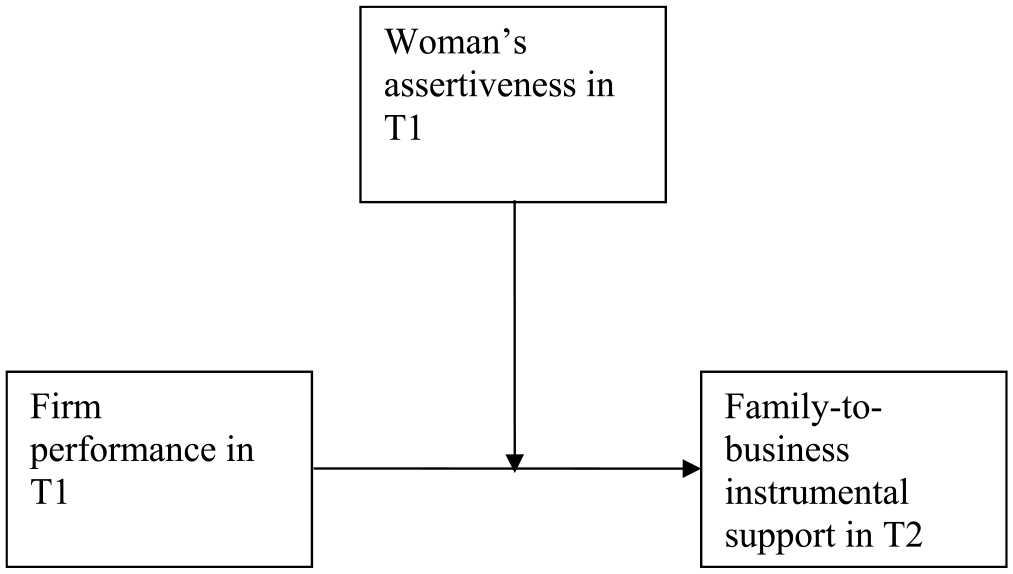
Theoretical model (T2 = T1 + 12 months).
We anticipate that the arguments in this research will apply to both female and male entrepreneurs; however, the forcefulness with which women are affected by various societal perceptions (e.g. assertiveness) may be higher than that of men (De Clercq et al., 2022; Eagly and Chin, 2010; Khattab and Leroy, 2016). Within the framework of gender role congruity theory, expectations of the entrepreneur’s role can be incongruent with gender stereotypes (Ritter and Yoder, 2004). Accordingly, while men tend to be associated with agentic characteristics, that is, achievement-oriented characteristics such as aggressiveness and confidence, women are normatively perceived to be more concerned with the welfare and caring. Furthermore, research illustrates a perception mismatch between female gender roles and leadership roles that can result in negative outcomes such as a gender compensation gap (Wang et al., 2019). Once women overcome and bypass glass ceilings and attain a leadership role, their behaviours are likely to be evaluated differently and less favourably than the same behaviours exhibited by men (Eagly and Chin, 2010). Thus, we explored the context in which women are positioned in relation to other family members with whom they interact (Marlow and Martinez Dy, 2018). Therefore, the following hypotheses refer exclusively to female business owners.
Hypotheses
Firm performance and family-to-business instrumental support
Reflecting the cognitive psychology and bounded rationality perspectives, we expect more family support for a business run by a female family member in the case of proven firm success. This type of pre-existing first-hand information is relatively easy to access or observe. When family members have this type of basic but fundamentally important information, limited information processing capacity and bounded rationality, family support is more likely to be offered to the businesses of their female family members. Moreover, the availability of family support is related to the anticipated future benefits that may be shared with the family in return for support. Family members may consider the economic costs and benefits of their actions; in this context, many of these tradeoffs are particularly salient for women who are business owners (Newman and Alvarez, 2022). As Schlaile et al. (2018) noted, bounded rationality often has an ‘economic connotation’ (p. 573). Such attitudes may also stem from asymmetrical altruism (Verbeke and Kano, 2010; 2012), a phenomenon that colours the performance evaluations of family members and places limits on the enhanced and attentive monitoring and evaluation of their actions (Banalieva and Eddleston, 2011). Thus, the availability of family support is rooted in expectations and desires of family members to maximise individual utility.
Individuals often rely on simplifying heuristics that facilitate approximate inferences (Hallen and Pahnke, 2016). In addition, they can also rely on stereotypes regarding entrepreneurs, even in gender-supportive contexts (Ritter and Yoder, 2004; Wu and Chua, 2012), such as Denmark, as historically, entrepreneurship has been dominated by men. Therefore, family members may perceive or assume that a woman requires help from the family regardless of proven financial success, in addition to other expectations. As such, these two perspectives predict a positive impact of proven high performance on the family subsequent instrumental support for a firm run by a woman. Accordingly, we formulated our first hypothesis:
The moderating role of assertiveness
However, the question remains whether the positive relationship between past performance and subsequent family support, posited by Hypothesis 1 (H1), might be mitigated by other factors. Anchoring, stipulated by the cognitive psychology perspective, is the mental starting point for family members and is based on prior experiences, for example, the economic performance of the firm and other available objective information. Family members are also driven by their subjective perceptions, shaped by their observations and experiences, to inform their decisions about providing support. As noted, we focus on the assertiveness of women entrepreneurs, a personal cultural attitude influencing whether individuals demonstrate a tendency to act independently, display a desire for a strong self-concept, have a sense of freedom and autonomy and strive for personal achievement (Sharma, 2010). We expect that the assertiveness of women business owners, when visibly manifested through such attitudes and behaviours, can influence family perceptions and play an important role regarding the availability of family support.
First, consistent with the role congruity perspective (Eagly and Chin, 2010; Gupta et al., 2018), assertiveness is more closely associated with male entrepreneurs (Bossuyt and Van Kenhove, 2018; Carmona et al., 2018). When women manifest high assertiveness, others may judge this characteristic as contradicting expected gender roles (Capezio et al., 2017). Entrepreneurship is often perceived as a masculinised endeavour incongruent with the role of the female gender (Bloemen-Bekx et al., 2019; Henry et al., 2016; Shinnar et al., 2018). Thus, the perceived incongruity between female gender roles and entrepreneurial roles can generate gender stereotypes and greater scrutiny of women’s actions. This may also lead to a negative bias regarding the personal likeability of women business owners (Farah, 2020; Thompson-Whiteside, 2015) leading to family members reducing the availability of instrumental support for businesses run by women.
Second, these perceptions may shape the beliefs of family members about women’s potential for success in future ventures. For instance, highly assertive women may be perceived as overconfident, even in societies with lower levels of gender bias. Regardless of gender, entrepreneurial overconfidence in the form of over precision, over estimation so, limiting venture preparations, trigger over optimistic forecasts and set the stage for non-optimal outcomes such as firm failure (Cieslik et al., 2018; Invernizzi et al., 2017; Kraft et al., 2022). This leads to scepticism and diminished enthusiasm from the family regarding further support.
Finally, while these two scenarios describe ‘punishing’ behaviours from family members stemming from unfavourable perceptions of high assertiveness by the female family member–entrepreneur, such increased assertiveness can be judged by some family members positively as implying entrepreneurial efficacy and competency (Baciu et al., 2020). In such cases, however, those family members may simply perceive any additional action associated with increasing family-to-business support as less necessary for more assertive women given assumptions they do not require such support (‘withholding help’ behaviour). These three scenarios may also apply to male entrepreneurs; however, the intensity of such family feelings may be stronger in the case of women informed by gender role incongruity.
In summary, we assume that psychological traits associated with high achieving women entrepreneurs who are independent, autonomous, free and competent (overall, assertive) visibly translate into publicly displayed attitudes and behaviours. These, in turn, shape family member perceptions of these women, negatively informed by the processes described above, which then influence the link between firm performance and subsequent offers of family help. These observations give credence to a possible interaction between past firm performance and assertiveness that influences the level of family instrumental support; we formulate this as our second hypothesis.
Method
Procedures and participants
We employed a deductive, quantitative approach to test our hypotheses grounded in our theoretical framework. The empirical tests were based on a survey instrument administered in a two-wave panel design – the first in Summer 2019 (T1) and the second in Summer 2020 (T2) – to investigate women business owners operating in Denmark. Accordingly, all focal variables were measured at T1 and T2. In addition to the conceptual relevance of Denmark, as noted previously, our focus on a single country helped us mitigate the risk of unobserved cultural or institutional influences on the opportunities and challenges that women entrepreneurs may experience in the context of family–work interactions (De Clercq and Brieger, 2022; Haar et al., 2014).
The proposed research project underwent a detailed review process and received clearance from the research ethics board of the university of one of the coauthors. In addition, to conduct the data collection process, we hired a well-established firm (FFIND Beyond Data, ISO 9001:2015; www.ffind.com) with a strong reputation for supporting large-scale survey projects. Our reliance on a third-party intermediary for online data collection is consistent with similar approaches taken in the extant research (Arend, 2014; Ellram et al., 2013).
The framework for the sample was based on FFIND Beyond Data’s database of companies operating in Denmark. We instructed the company to target firms that met three criteria: they (1) were owned by a woman who held more than 50% of the shares, (2) had been established in 2010 or thereafter (i.e. they were younger than 10 years) and (3) employed fewer than 250 people. We sought to survey women business owners with a majority stake in their firms who thus, have significant influence over their firm’s decision-making (in line with a definition used by Marlow and Patton, 2005). Furthermore, we targeted relatively young firms (no more than 10 years old) because tensions in the context of work–family interactions are likely to still be relevant and so, prevail upon their development. Finally, firms with fewer than 250 employees dominate upon a global basis, including Denmark (see https://www.oecd-ilibrary.org) and are thus, representative of the national economic fabric. Overall, these sample criteria improved our ability to obtain responses from informants with genuine decision-making powers.
From the framework for the sample, 1092 randomly selected firms were contacted by the survey company; however, 790 of these firms declined to participate. Of the remaining 302 firms, 102 firms did not meet one or more of the three target criteria based on a screening at the start of the interview, and so they were excluded from the survey. The final sample consisted of 200 firms; a response rate of 18.3%. The women entrepreneurs included in this sample had an average age of 47.3 years, 82.5% of them had earned college degrees, they had been active as businesswomen for an average of 11.2 years, and their businesses operated mainly in the service (81.5%) and trade (12.5%) sectors, with a smaller number in manufacturing (6.0%). Most of the firms were small (2–19 employees, 69.5%; 20–99 employees, 26.5%; 100–249 employees, 4.0%).
To develop the survey, we relied on a conventional translation approach (Brislin, 1986), where the original English-language survey questions were translated into Danish and subsequently back-translated into English by two independent bilingual translators. The two English versions were then compared, and any discrepancies were addressed and corrected through consultations with both translators. A pilot version of the survey was tested by reference to a sample of 10 women entrepreneurs who were not part of the focal data collection; their input helped us ensure the clarity of the instructions and the readability of the survey questions.
At T2, the 200 respondents who participated in the T1 study were contacted once again for a follow-up study. We received responses from 163 businesswomen, a retention rate of 81.5%. In three instances, the telephone number was discontinued; in 15 cases, we could had no answer; in 11 instances, the target person was no longer available and in eight, the target respondent refused to participate further. We thus ‘lost’ a number of respondents between the two time periods – typical for studies featuring a longitudinal design (Ahern and Le Brocque, 2005).
Sample attrition and self-selection bias: The Heckman procedure
We used Heckman’s (1979) two-step residual approach to address the issues of sample attrition and possible self-selection bias mentioned above. In the first step of the Heckman procedure, the selection equation, the probability of participation in the second wave (T2) of a longitudinal study is analysed, usually by reference to a logit or probit model. The second step, the outcome equation, is the original regression of interest as supplemented with the correction factor defined above. A significant inverse Mills ratio in such a model provides evidence of self-selection bias warranting further remedial action (Bascle, 2008). Otherwise, no bias is identified, and the researcher may proceed to test the model by reference to the panel of respondents who provided complete data at both T1 and T2 (Patel and Cooper, 2014; Rudolph and Baltes, 2017).
As an exclusion restriction, we used a four-item scale (Eddleston and Powell, 2008; Powell and Eddleston, 2008, 2013): ‘How satisfied are you with: (a) earning a lot of money; (b) growing a world-class business; (c) leading a large, rapidly growing enterprise; and (d) the success of your business?’ (Cronbach’s alpha = 0.83 at T1). We assumed that the more satisfied a woman entrepreneur was with her business success at T1, that is, the better her socioeconomic status, the more likely it was for her to participate in the second round of the survey. Next, we developed a logit model in which business satisfaction was selected as a predictor of future participation alongside a number of control variables (we used the same controls in all subsequent models).
We found that the variable measuring the respondent’s satisfaction with her business did predict selection, that is, participation at T2. The corresponding binary regression coefficient was B = 0.592 (p < 0.01), indicating that more satisfied (business-like) respondents were more likely to participate in the second round of the survey. Subsequently, we investigated whether this variable was indeed an exclusion restriction, that is, that it was not significantly related to our outcome variable of interest (instrumental family support) at T2. For this purpose, we specified a regression model featuring the control variables and the independent variable of business performance at T1 in addition to the exclusion restriction (satisfaction with business). The regression coefficient for business satisfaction was B = 0.112 (n.s.) satisfying the requirements of exclusion restriction.
To calculate the inverse Mills ratio, we applied the two-step Heckman procedure available in Stata 16.0 software. The value of this ratio was B = −0.903 (n.s.). The statistically non-significant value of this ratio allowed us to comfortably proceed to specify and test the subsequent linear regression model by reference to only the panel of respondents who provided data at both T1 and T2 (N = 163).
We also controlled for attrition bias when comparing respondents who participated in both waves (T1 + T2) with respondents who did not participate at T2. Independent samples t-tests and chi-square cross-tabulation tests revealed no significant differences between individuals included in the final sample and those who dropped out of the sample (Kolvereid and Isaksen, 2006). We conclude that sample selection and response bias are not influential, and the sample used for the final estimation is representative of the women business owners included in our study (Cruz et al., 2010; Patel and Thatcher, 2014).
Measures
The independent variable (firm economic performance) and the moderator (assertiveness) were measured at T1, whereas the dependent variable (family-to-business instrumental support) was observed at time T2, where T2 = T1 + 12 months.
We allowed an open interpretation of the term ‘family’ as all individuals that the respondent considered were family members either currently living in the household, or elsewhere. Thus, we assume all individuals related by birth, adoption or marriage could be considered family (Cogan et al., 2022). The use of the number of family members employed in the firm as a control variable (see below) further confirmed this approach – a condition pertaining to family involvement within the organisation (Powell and Eddleston, 2017).
Dependent variable: Family-to-business instrumental support
We use one of the three dimensions of family-to-business support adapted by Eddleston and Powell (2012) for the entrepreneurial context from King et al.’s (1995) measure of family support for workers. The five-item scale of instrumental family-to-business support scale assessed the extent to which women entrepreneurs think they could count on tangible help from their family members concerning business matters. The other two measures, four-item emotional support and four-item instrumental support at home, were not considered because they did not precisely fit the model theorised in this study. Example items included ‘My family gives me useful feedback on my ideas concerning my business’ and ‘I can count on my family members to fill in for me and/or my employees in times of need’ (Cronbach’s alpha = 0.81 at T2). The anchors ranged from 1 = ‘strongly disagree’ to 7 = ‘strongly agree.’ 1 Accordingly, we measured how the family contributes to business directly rather than indirectly, for example, by releasing women from household duties, care work, etc. Also, we consider perceptions of family support, rather than objectively measuring such support.
Independent variable: Firm performance
To determine how the businesses of women entrepreneurs fare relative to those of their competitors, we used a three-item scale of firm performance (Hatak et al., 2016). In particular, the participants rated growth of their firm compared to that of their competitors in three areas: sales, market share and number of employees (Cronbach’s alpha = 0.87 at T1). The anchors of the seven-point Likert scale varied from ‘much worse’ to ‘much better.’ Our reliance on subjective comparative performance assessments reflects well-established practices (Ling and Kellermanns, 2010; Powell and Eddleston, 2013; Wiklund et al., 2009). Moreover, the women who participated ran small, young, privately held firms; accordingly, secondary data on performance were not readily available. Although we could obtain objective performance data from these participants, this approach tends to reduce response rates drastically (Runyan et al., 2008; Shanine et al., 2019). Previous entrepreneurship research has also found strong positive correlations between objective and self-reported performance data for privately held businesses (Ling and Kellermanns, 2010). Therefore, we consider the potential validity concerns related to subjective performance data to be less problematic than the systematic sampling biases that could have resulted from decreased response rates (Burns and Burns, 2008).
Moderating variable: Level of assertiveness
To measure the assertiveness of our respondents, we used a four-item scale describing a personal cultural orientation towards independence that is associated with a strong self-concept as well as senses of freedom, autonomy, competence, self-direction and personal achievement (Sharma, 2010). Example items included ‘I would rather depend on myself than others’ and ‘It is important than I do my job better than others’ (Cronbach’s alpha = 0.62 in T1). 2
Control variables
The analyses accounted for the influence of several variables to minimise the possibility of omitted variable bias. The amount of instrumental help offered by the family may depend on the personal characteristics of the woman entrepreneur in question as well as pertinent features of the business that she runs. Therefore, we specifically controlled for her level of education (1 = primary, 2 = secondary, 3 = college or higher) and marital status (1 = married, 0 = otherwise) as well as firm size (1 = 2–19 employees, 2 = 20–99 employees, 3 = 100–249 employees), the number of family members/relatives employed in the firm and the number of co-owners of the business.
We also thought to control for the number of children living with the respondent in the same household for at least 3 days per week. However, because this variable was highly correlated with marital status, we excluded it from further analyses to reduce multicollinearity. We also considered controlling for the employment status of the respondent’s spouse/partner, as this might influence the relationships tested in our model. This variable, however, exhibited almost no variation (88.9% of surveyed women indicated that their spouse/partner was employed); therefore, it was dropped from further analyses.
Common method bias
Method or source bias can be a concern in survey-based research (Podsakoff et al., 2003). Although our dependent variable was measured at a different time than the independent variables, which should ‘reduce’ the threat of common method bias to some degree (Antonakis, 2017), the predictors were measured at the same time (T1), thus giving rise to the possibility of such bias (Antonakis et al., 2010). We tested for common method bias by employing the confirmatory factor analysis marker technique (Williams et al., 2010). As a marker variable, that is, a method factor that is theoretically unrelated to the substantive variables (Chadwick and Raver, 2020; Ren et al., 2021) and simultaneously likely to tap into at least one of the potential biases outlined by Podsakoff et al. (2003), we used a three-item social desirability scale (Crowne and Marlowe, 1960; Cronbach’s alpha = 0.77). An example item for this scale is ‘I am sometimes irritated by people who ask favours of me’ (with responses ranging from 1 = strongly disagree to 7 = strongly agree). One item, that is, ‘No matter who I am talking to, I am always a good listener’, which was reverse coded, was omitted from the analyses as a result of its low reliability.
The results (available upon request) indicated no evidence of common method bias in our sample with respect to either equal or unequal method effects. Overall, these results diminish concerns regarding common method bias with regard to our study.
Results
Data analysis
To provide evidence regarding the discriminant validity of the self-reported measures, we conducted a confirmatory factor analysis by using AMOS 28.0 software to test a series of nested models. A three-factor solution exhibited the best fit to the data (χ2(51) = 100.84, confirmatory fit index = 0.93, incremental fit index = 0.93, Tucker–Lewis index = 0.89 and root mean squared error of approximation = 0.07; Kline, 2005). The discriminant validity of these measures was further confirmed because the fit of the constrained construct pair models (χ2(54) = 154.71) in which the correlations among constructs was equal to 1 was poorer (∆χ2(3) = 53.87, p < 0.001) than the fit of their unconstrained counterpart, in which the correlations were allowed to vary freely (Lattin et al., 2003). Finally, each measurement item loaded significantly on its particular construct; this provided evidence to support convergent validity.
Table 1 illustrates the zero-order correlations and descriptive statistics. Although the correlations between the independent and moderator variables were fairly low, we investigated multicollinearity based on variance inflation factors (VIFs). The VIFs for the predictors were all below 10, thus suggesting no evidence of substantial multicollinearity (Cohen et al., 2003).
Correlation table and descriptive statistics.
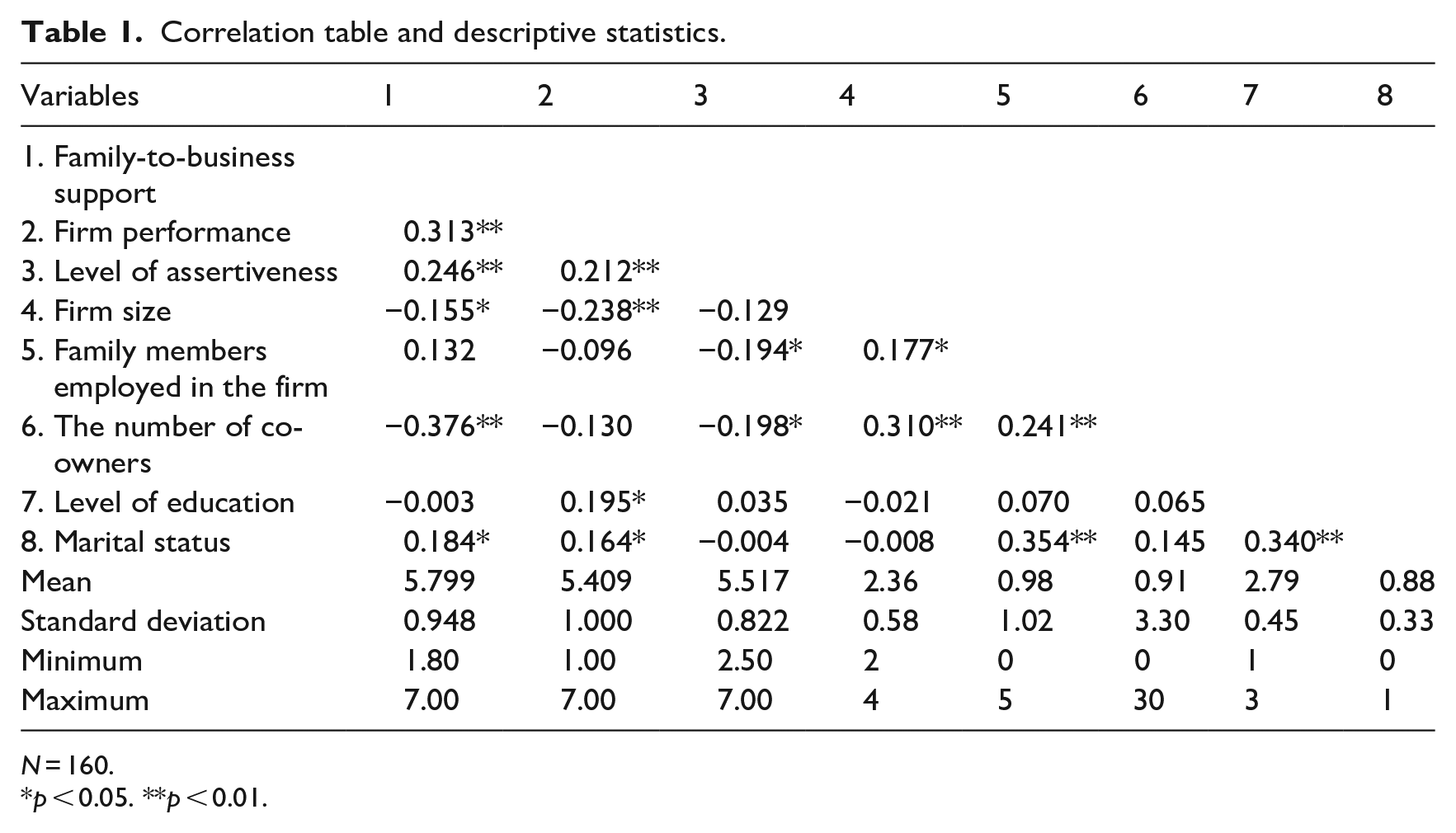
N = 160.
p < 0.05. **p < 0.01.
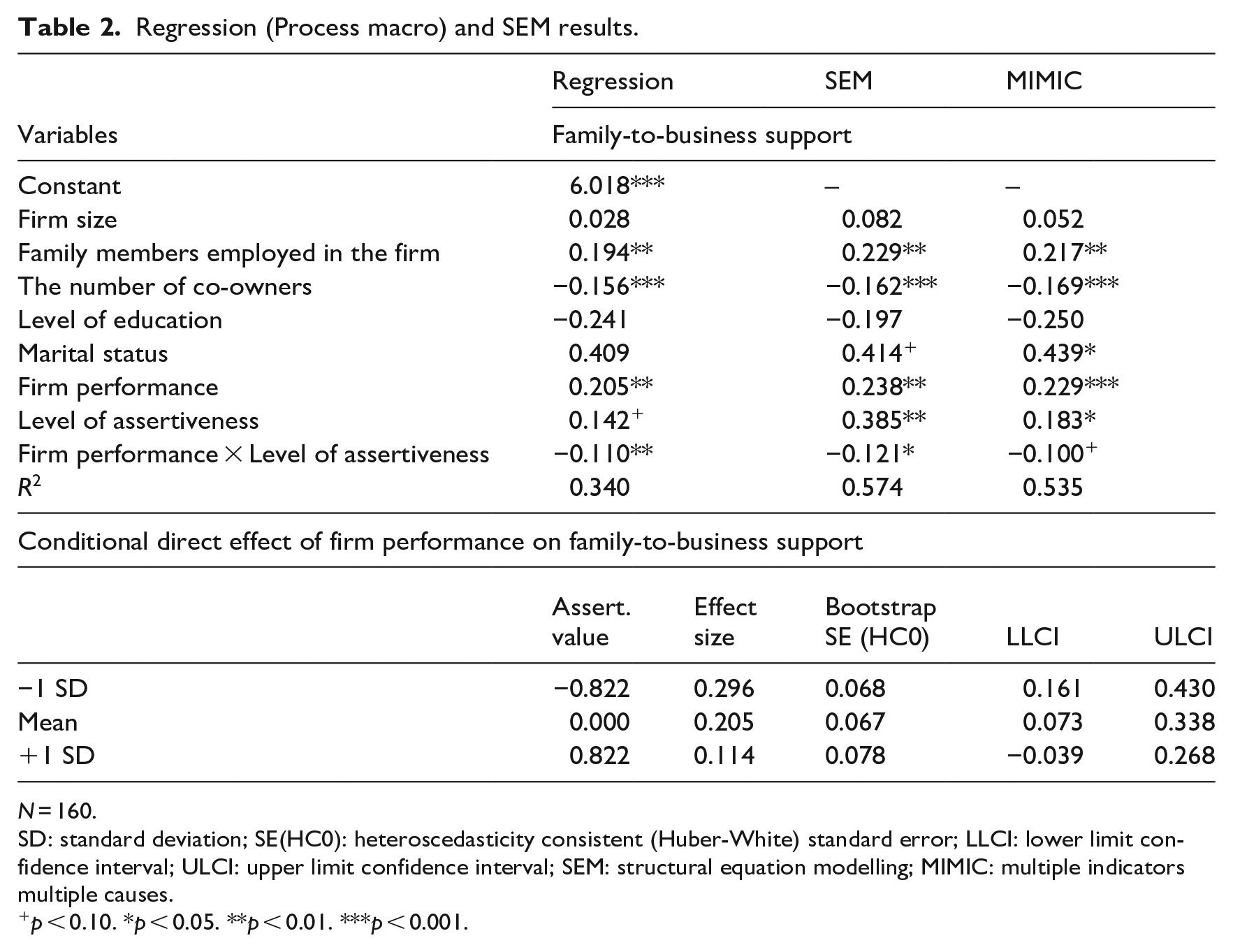
For the hypothesis tests, we relied on the Process macro (Hayes et al., 2017; Preacher et al., 2007), which does not assume normal distributions of the variables involved in the analysis and instead relies on a bootstrapping technique (MacKinnon et al., 2004). Consistent with the proposed conceptual model, we used Model 1 of the Process macro to estimate the moderating effect of assertiveness on the relationship between firm performance and family-to-business instrumental support. We mean centred the independent and moderator variables prior to constructing the interaction term to mitigate multicollinearity (Cohen et al., 2003). Furthermore, we used heteroscedasticity-consistent standard errors. Table 2 shows the moderation findings revealed by the Process macro.
Regression (Process macro) and SEM results.
N = 160.
SD: standard deviation; SE(HC0): heteroscedasticity consistent (Huber-White) standard error; LLCI: lower limit confidence interval; ULCI: upper limit confidence interval; SEM: structural equation modelling; MIMIC: multiple indicators multiple causes.
p < 0.10. *p < 0.05. **p < 0.01. ***p < 0.001.
Findings
We found that firm performance at T1 is positively related to family instrumental support at T2 (β = 0.205, p < 0.01), thus supporting H1. The results shown in Table 2 also indicate a significant negative effect of the firm performance × assertiveness interaction term (β = −0.110, p < 0.01) with regard to predicting family instrumental support. The findings revealed by the Process macro indicate that the relationship between firm performance and family support is stronger at lower levels of assertiveness (0.296 at one SD below the mean, 0.205 at the mean and 0.114 at one SD above the mean). The confidence intervals include 0 at the higher level ((−0.039; 0.268)) but not at the two lower levels ((0.161; 0.430) and (0.073; 0.338)), providing evidence of the presence of moderation in this context. Therefore, low assertiveness strengthens the positive, direct relationship between firm performance and family instrumental support supporting H2 and the overall theoretical model. Our results are also supported by the interaction plot (Figure 2), which demonstrates that the relationship between firm performance and family-to-business instrumental support is positive, as stipulated by H1. This relationship is substantially more positive among women entrepreneurs with lower assertiveness than among those with higher assertiveness further supporting H2. Simple slope tests (Dawson, 2014) gave additional credence to this finding (results available upon request).
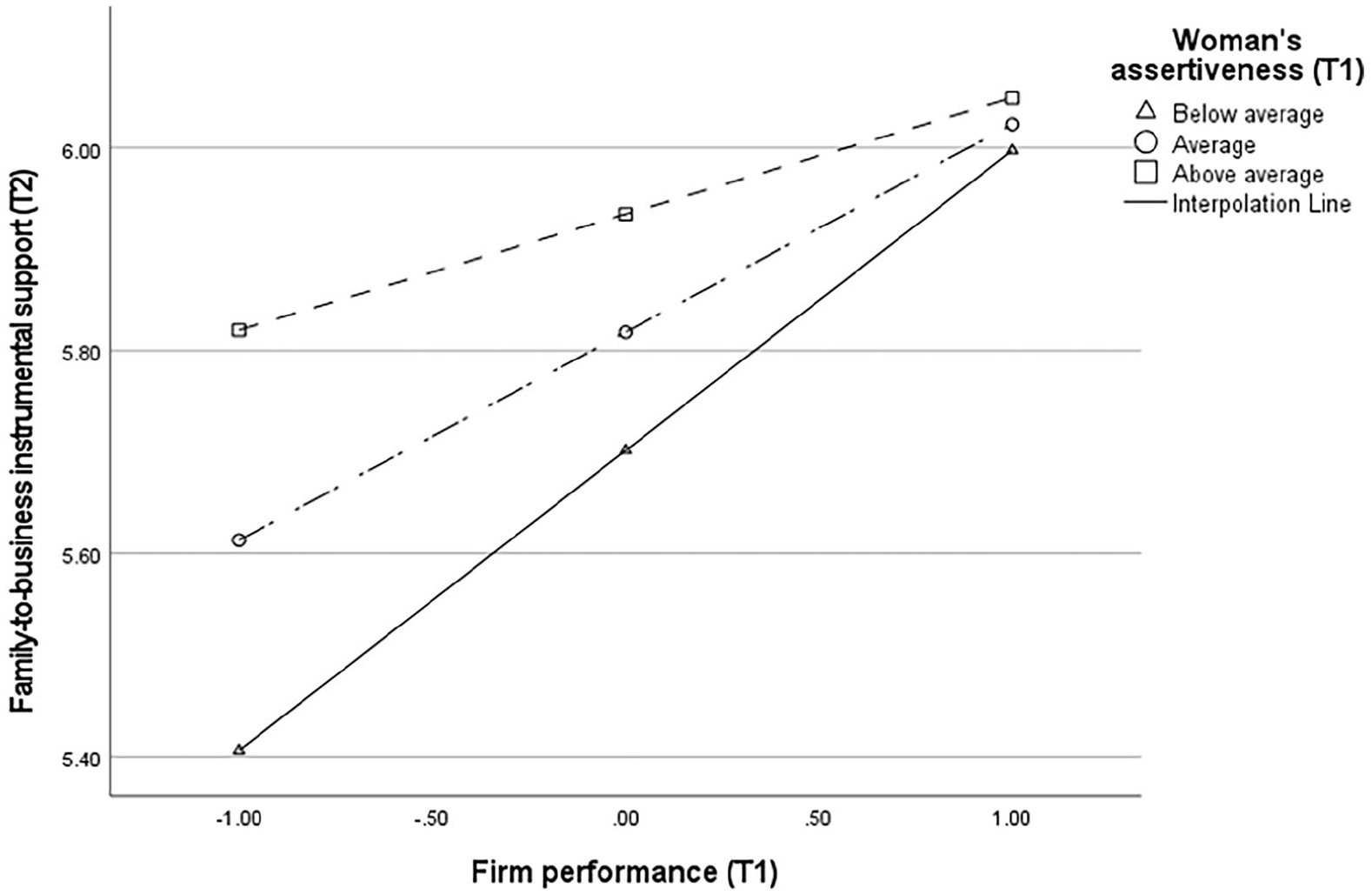
Interactive effect between firm economic performance in T1 and woman’s degree of assertiveness in T1 in predicting family instrumental support for business in T2.
Summarising, women business owners who display high levels of assertiveness do not experience a significant improvement in family support due to performance even when their performance improves, which is consistent with our arguments in support of H2. We conclude that the family may treat a woman differently depending on the ways in which her assertiveness is demonstrated. As a result, in the case of women entrepreneurs who appear highly assertive, further family support diminishes.
Regarding the control variables, the number of family members employed in the firm was, unsurprisingly, positively related to family support. Conversely, the relationship involving the number of co-owners was found to be negative – apparently, the family members would be more likely to assume that their support is unnecessary when a woman has other business partners. The remaining control variables (firm size, level of education and marital status) were not significantly related to the outcome variable. As noted earlier, we also considered the number of children living with the respondent, at least 3 days per week, as a potential control variable. The sample results indicated that more than one in five (21.5%) of the respondents reported having no such children, 50% indicated having one child, 28% indicated having two children and 0.5% indicated having three children (with an average of 1.080 children and a standard deviation of 0.715). Because this variable was highly correlated with marital status (r = 0.383, p < 0.01), we could not use both of them in the same model due to multicollinearity concerns. However, when we replaced marital status with the number of children, the latter was also found to be insignificantly related to the outcome variable, whereas all other tested relationships remained qualitatively unchanged. This unhypothesised finding combined with the aforementioned insignificance of the marital status suggests that neither children, nor marriage, seem to influence family help. Finally, although the level of education was insignificant, we would like to emphasise that its coefficient was consistently negative across all models tested (Table 2). This might suggest that the higher the women’s education level, the less likely the family would be to consider that additional support was needed for her business. Future research is needed to clarify this issue.
Robustness checks
Replication using structural equation modelling
As an alternative to the Process macro, we performed structural equation modelling (SEM) to formally account for the presence of measurement error in the constructs. All structural models included the previously used control variables, which were directly related to the outcome variable and correlated with all other constructs. The independent variables also covaried with each other (Haar et al., 2019). The SEM results, which are displayed in Table 2 as SEM1, are persistently consistent with those generated using the Process macro.
Replication using multiple indicators multiple causes model
Due to the large number of interaction terms that led to potential issues with multicollinearity (Haar et al., 2014, 2019), the fit of the SEM was unsatisfactory. Therefore, we also estimated a model in which only the outcome variable was retained as a latent variable, whereas the two latent independent variables were replaced with their mean-centred composites. This new model is thus, a multiple indicators multiple causes (MIMIC) model (Jöreskog and Goldberger, 1975). The results (displayed as MIMIC in Table 2) were, once again, very similar to those produced using previous approaches.
Discussion
This article investigated the relationship between the performance of firms owned by women and subsequent family-to-business instrumental support, and the moderating role played in this relationship by assertiveness. We based our analyses on data collected in a longitudinal study of women entrepreneurs in Denmark, on two occasions, separated by 1 year. Our subsequent discussion is based on plausible, theoretically informed, explanations of the study findings grounded in insights from the cognitive psychology of entrepreneurship, bounded rationality and gender role congruity perspectives.
Our findings indicate that past firm performance can facilitate the availability of subsequent instrumental support offered by the family, owing to the proven success. Ample research shows that measures of past performance are indicators of business credibility and growing value (Eddleston et al., 2016). Past performance provides legitimacy and assurance that the business may remain economically viable (Jain et al., 2008). However, high assertiveness can weaken the link between firm performance and the family’s additional instrumental support offered to the woman-led business. This may be because of the potential inference of family members that more help is not/should not be necessary. The underlying notions may be either (1) no help should be offered (the ‘punishing behaviour’, as informed by the negative social biases predicted by the gender role congruity theory in conjunction with the cognitive psychology of entrepreneurship and bounded rationality perspectives) or (2) it is simply redundant as the woman entrepreneur appears self-sufficient by displaying high assertiveness (the ‘withholding help behaviour’ prompted by perceptions of high assertiveness and success). While the possible underlying reasons are beyond the scope of our study, the findings are consistent with these perspectives. This suggests that applying these theoretical frameworks in studies on family support for women entrepreneurs may generate important insights. Indeed, in cases where only limited information is available regarding women’s ventures and future success/failure, as well as the expected bounded rationality of family members, the cognitions of those members, which involve mental shortcuts and heuristics, can be an underlying reason for whether they provide or refrain from providing instrumental support to women. These cognitions can generate biased decisions and stereotypes regarding the support of women business owners that can be in the form of punishing, or withholding, behaviour. In high gender equality domains, such as the Danish context, we expect more of the latter than the former.
While high assertiveness can limit the availability of family support, displays of personality traits associated with gender stereotypes, such as gentleness, nurturance and submissiveness, within the business circles in which these women entrepreneurs operate may also be devalued (Capezio et al., 2017; Powell et al. 2002; Ragins and Sundstrom 1989). Both extremes of this spectrum, that is, high assertiveness and lack of confidence, may ultimately be detrimental to women entrepreneurs for reasons rooted in gender bias (Capezio et al., 2017). Indeed, women who exhibit traits opposed to gender stereotypes have been shown to experience social backlash (Bossuyt and Van Kenhove, 2018; Nguyen et al., 2008). Thus, women entrepreneurs face particular challenges as they need to avoid being either too assertive or shy/insecure. To address this issue, they may try to balance these two distinct behaviours, as suggested by Carmona et al. (2018). In the same vein, Swail and Marlow (2018) argue that women entrepreneurs may adopt compensation strategies: ‘. . . to counter the detriment of femininity by embracing specific forms of masculinity’, that is, ‘embrace the masculine while attenuating the feminine’ (p.271). Unfortunately, this finding aligns with the main tenets of gender role incongruity concerning female leaders. For instance, Khattab and Leroy (2016) highlighted that female leaders who strive to balance both agentic (instrumental) and communal (expressive) features are under scrutiny and perceived as the least authentic. In contrast, male leaders do not have boundaries regarding being simultaneously agentic and communal. It is also worth noting that higher levels of assertiveness on the part of women entrepreneurs, particularly in countries such as Denmark, may be judged by the involved actors through the lens of the ‘Law of Jante’ (janteloven) that discourages people in Nordic cultures from broadcasting their achievements (Kirkwood and Warren, 2020). The Law of Jante refers to a pattern of group behaviour towards individuals within Scandinavian communities that negatively portrays and criticises individual success and achievements as unworthy and inappropriate. However, this may not be as crucial and relevant for immediate family members (e.g. the household) as for family members at large. As members of the household can be seen as one economic unit with their self-interests aligned with those of the woman business owner, excessive displays of assertiveness by their mother or wife may not be seen in such a negative light compared to more distant relatives with weaker economic ties to the family. However, even in the case of immediate family members, the prevailing societal and cultural norms informed, among other experiences, by gender role congruity theory, may still generate negative feelings about such manifestations of assertiveness. As we argued, negative feelings towards highly assertive women entrepreneurs are still expected to be less severe in Denmark where greater gender egalitarianism prevails, compared to other country and cultural contexts.
Another phenomenon related to Jante’s law is the tall poppy syndrome (TPS), according to which the success of some results in envy from others (Kirkwood, 2007; Kirkwood and Warren, 2020; Marques et al., 2022). TPS is often considered culturally specific to Australasia, but it has also been observed in Nordic countries (Kirkwood and Warren, 2020). We expect that TPS may not apply to immediate family members. However, it may be a legitimate concern when the attitudes and behaviours of relatives beyond the boundaries of the household are brought into the equation, regardless of the country’s geographical location. As noted, we consider a family as a whole without specifying whether it comprises only immediate household members or a more distant group of relatives. Some immediate family members, such as adult children, often live outside the household in today’s nuclear family setting, especially in European countries such as Denmark. As such, the immediate family can practically involve all children, parents, siblings and grandparents depending on cultural and socioeconomic factors and family member preferences. Family instrumental support may come from either of these family members; therefore, any knowledge of their possible reactions to the levels of assertiveness displayed by a female member and entrepreneur simultaneously is crucial. This is particularly relevant because TPS is more likely to affect successful women (O’Neill et al., 2014), consistent with the role congruity theory, drawing attention to the double standards concerning women and men (Gupta et al., 2018; Khattab and Leroy, 2016).
The attitudes of those who judge others based on TPS have also been found to depend upon how the person being judged presents himself or herself to others (e.g. as boastful and self-centred versus humble and unassuming; Feather, 1989; Marques et al., 2022). Specifically, the targeted individual is judged negatively when they appear to possess fewer positive personality characteristics or are viewed as undeserving of their high position (Feather et al., 1991; Marques et al., 2022). Previous research suggests that quiet achievers are more resistant to the effects of TPS (Feather et al., 1991). Accordingly, we expect that women entrepreneurs exhibiting high assertiveness may send signals for being successful and thereby, be more prone to be affected by the TPS. Research on envy (Van De Ven et al., 2012, 2015) has claimed that even more drastic reactions such as schadenfreude, that is, the experience of pleasure, joy or self-satisfaction due to learning or witnessing the troubles, failures or humiliation of others, are possible when an individual targeted as a tall poppy falls, particularly in cases where the misfortune in question is perceived to be deserved (Dasborough and Harvey, 2017). However, the perceived positive personality characteristics of tall poppies may have mitigated some of these effects. Our analysis, therefore, may be useful to researchers seeking evidence of TPS coming from relatives likely to be outside the household in countries other than those located in the Australasian region (Marques et al., 2022).
With regard to the reported results involving control variables, the non-significant impact of the number of children and marital status on family help warrants some thought. Given that gender roles (and expectations of women fulfilling them) increase significantly when children are born and/or when a woman enters a marital relationship (Eagly and Karau, 2002), the gender role congruity theory would predict that children and/or marriage factors might be relevant in this case, and we find that they are not, at least in terms of their impact on family help. This would suggest that out of the two earlier described scenarios, the ‘withholding help’ behaviour is more suggestive while withholding help as a ‘punishment’ seems less applicable to women who are mothers and/or wives. We continue this discussion below.
This article contributes to the existing literature in several ways. First, it represents one of the few attempts to use the frameworks of cognitive psychology (Krueger, 2003), bounded rationality (Kahneman, 2003) and role congruity (Eagly and Karau, 2002) to explain the determinants of familial instrumental support for women entrepreneurs. In particular, the interaction between past firm performance and assertiveness of women business owners appears to be an important antecedent of instrumental family support. Second, whilst this research adds to our understanding of family support for women entrepreneurs it also provides a more nuanced picture of how the underlying cognitions, bounded rationality and role incongruity perceptions of family members may influence the level of support that they provide as a possible result of biases and stereotypes. This issue can affect motivations of women business owners, their perceptions of fairness and justice, entrepreneurial initiatives and future venture success or failure. As well as contributing to the entrepreneurship literature our findings have important practical implications.
Practical implications
Our findings stimulate thoughts on the interactions between familial and entrepreneurial dynamics. In particular, we find that high assertiveness on the part of women entrepreneurs adversely influences family support for their ventures, perhaps due to mental shortcuts and heuristics that lead to assumptions regarding the women’s entrepreneurial efficacy and competency. These factors may explain why high assertiveness among women business owners is associated with diminishing family-to-business support. Additionally, high assertiveness may limit the personal likeability of women (Farah, 2020) more likely in societies with less gender equality because of greater underlying biases and perceived role incongruity. This may have long-term implications for perceived overconfidence, which may eventually limit venture success (Invernizzi et al., 2017; Kraft et al., 2022; Singh, 2020). Moreover, consistent with the role incongruity perspective (Eagly and Karau, 2002), high assertiveness may be perceived negatively in case of women due to gender stereotypes, as this feature is more associated with male entrepreneurs. In contrast, this characteristic may be perceived in the opposite way for male entrepreneurs (Farah, 2020). Research shows that women who disrupt gender norms by adopting masculine behaviours seldom achieve their aims, lose approval and risk being demoted (García and Welter, 2013). Ultimately, familial decisions rooted in biases and stereotypes may limit the availability of support provided by the family to women entrepreneurs and potentially decrease their morale, who must face these concerns regarding fairness, strategic pursuits and the overall performance of the businesses. For instance, when family support is limited, women may restrict the scale and scope of their businesses. Additionally, women may be forced to downplay successes, or deliberately limit their entrepreneurial risk-taking and innovativeness to avoid unwanted attention (Kirkwood, 2007; Kirkwood and Warren, 2020).
The results of our study are consistent with the findings of Carmona et al. (2018) based on their research on the impact of the management styles adopted by women entrepreneurs regarding their positionalities in social spaces. It was concluded that it is not gender per se that is relevant in those instances, but rather how a woman can manage her business by employing a balanced mix of feminine and masculine approaches that are not limited to any particular gender. This perspective suggests that, rather than developing gender-stereotypic or feminine-oriented characteristics in terms of management style, women should, among many other skills, be able to acquire intimate knowledge of the rules of the game and so, be able to succeed in a business world dominated by men. If she avoids displays of high assertiveness, she can accumulate various kinds of capital: economic, cultural, social and symbolic (Bourdieu, 1986). Symbolic capital is particularly relevant in this case, as it can be translated into any of the other three forms of capital after receiving positive recognition from relevant actors in the social field (Carmona et al., 2018). Therefore, mobilising family support and other capital may require a careful calibration of feminine/masculine behaviours.
A similar conclusion, although stemming from a different setting (‘Do words matter in entrepreneurial pitching?’), was proposed by Balachandra et al. (2021). In this study, women were aware of the crucial role of their language choices when pitching for investment funding, particularly in front of their predominantly male audiences. The results indicate that although most influential pitches would be masculine rather than feminine in their inspirational focus; they should nevertheless, be moderate in stylistic language, that is, gender neutral. Moreover, Hytti et al. (2011) found that daughters who enter family businesses as successors may use similar tactics to balance their feminine and masculine roles. As such, they interact with others by often moving between concealing their leader identity and producing a masculinised identity as a strong leader; and so, switching between different roles in different contexts. They move in and out of leadership visibility by relying on different identities while navigating the straits between being a business leader and preserving their gendered position in the family business environment.
In sum, the various tactics discussed above indicate that women business owners seem to feel the need to manoeuvre between the two important life spheres of family and business owing to the potential cognitive dynamics (e.g. bounded rationality, potential biases and gender stereotypes) among audiences. The societal expectations of certain attitudes and behaviours for women in entrepreneurship role are likely to vary in different country and cultural contexts depending on the gender equality level. Accordingly, the perceptions of role congruity/incongruity between gender and entrepreneur role can vary.
Limitations and directions for future research
This study has certain limitations that require further investigation in future studies. First, the data were collected exclusively in Denmark limiting the possibility of generalising our findings to other countries. Denmark is a developed country with strong economic and democratic institutions. From a cultural perspective, it is classified (Hofstede et al., 2010) as a country that offers equitable opportunities across genders. Replication of this study in countries that have similar levels of economic and democratic development, but feature less gender equity, would be valuable in determining whether this relationship holds. Furthermore, any replication of this study in any country would be relevant for establishing the specific conditions (economy, institutions, laws, culture) of assertiveness displayed by entrepreneurs (females or males for that matter) who impact the model tested in this article. Second, the sample size was relatively small for extensive quantitative analyses. Although the initial size was adequate (N = 200), we lost 37 respondents between the two waves of the longitudinal design, which was unavoidable. Future research may want to mitigate such challenges by starting with a larger initial sample size.
Third, we focused on only one potential moderator of the link between past performance and subsequent family support. Future research should consider other possible moderators, such as the material importance of the business to the household as a whole. This could be addressed by a qualitative study with an attempt to elicit such importance from the respondents in a more relaxed, open-ended atmosphere and setting. Other possible moderators to consider could be an impact of having children, being married and/or running a business jointly with a partner on help and/or assertiveness. For example, the gender role congruity theory would predict that children/marriage might intensify the moderating impact of assertiveness on the link between past performance and family support. Specifically, high assertiveness displayed by mothers/wives might be more highly correlated to diminishing help. This would suggest that out of the two earlier described scenarios, the withholding help behaviour is more suggestive, whereas keeping back help as a punishment seems socially inappropriate to target women business owners who are also mothers and/or wives. In these cases, a moderated moderation analysis or another type involving multiple moderators might be applied.
Fourth, our measures were based on the perceptions and experiences of women business owners, which are inevitably susceptible to subjectivity. Fifth, we measured assertiveness only from the self-assessed perspective of women entrepreneurs and, based on that, inferred the family’s most likely reactions to such displayed attitudes and behaviours in our gendered arguments for hypotheses and discussion of the results. In other words, we investigated only the cognitions of those to whom support was provided and not those who provided such support. Therefore, future research should employ more nuanced approaches and directly measure family reactions to various levels of displayed assertiveness through interview-based qualitative studies, while clearly separating inputs from immediate household family members and other relatives. In general, since we applied the cognitive psychology of entrepreneurship, bounded rationality and role congruity perspectives in our efforts to explain the potential underlying reasons and rationale for the determinants of family instrumental support, we recommend qualitative studies with multiple respondents to delve deeper into the potential underlying factors that shape entrepreneurial behaviours and outcomes.
A qualitative, in-depth and contextualised approach, as advocated by Henry et al. (2016), could help to explore the processes behind our quantitative analysis. This would help discern differences among the various types of family members involved and their roles in supporting women entrepreneurs – members of the family. Different family members and female entrepreneurs could be interviewed separately. Family members can be classified into those who have strong economic ties and other interests with the woman entrepreneur, further separating those living under the same roof from those who live elsewhere and those with no such direct economic ties and interests (typically distant relatives). In such a predefined setting, the three focal constructs from the current research can be investigated, each time separately, from the perspective of the specific actor(s) involved: (1) how (and the amount of) family help is offered and delivered to the woman business owner (whether observed objectively or felt subjectively), (2) her level of assertiveness (acknowledged, displayed, perceived, etc.) and (3) business performance. By giving a voice to all actors involved and employing research methodologies to achieve a greater methodological variance in exploring such family issues, the qualitative interpretive research design would provide additional insights into the explored phenomena (McAdam et al., 2021). Comparative, quantitative and qualitative studies of male entrepreneurs may shed additional light on these processes.
Sixth, we assumed that when women self-describe themselves as assertive, these traits are shaped by their long-term life experiences and personal characteristics and are thus exogenous to family support – the outcome variable in the proposed model. However, it is possible that they felt the need to become more independent simply because of not receiving much support. Alternatively, and equally likely, high family support may indicate that a woman has less need to be assertive. 3 As such, there could be a reverse link between family help and assertiveness, suggesting a possible endogeneity problem. Normally, one would be more concerned with endogeneity threats involving the outcome and the independent variable, which, in our case, is somewhat mitigated by the longitudinal design we used. The dependent variable (family help) is separated from the independent variable (firm performance) by a 1-year span, and assertiveness of women business owners is the moderator in this link. Future research should nevertheless consider a model in which our current moderator is a direct predictor of family help and investigate the issue of endogeneity threat in such a setting.
Seventh, although the use of the advanced confirmatory factor analysis marker technique offered satisfactory grounds to declare that common method bias was not a serious problem in our study, we cannot discount such a threat entirely because such bias is always possible in the context of a dataset that employs self-reported measures. Therefore, we also employed certain ex-ante procedural measures to reduce the potential effect of common method bias, as suggested by Podsakoff et al. (2003) and in line with Richardson et al. (2009), who warned that post hoc tests can never fully compensate for a poor ex-ante research design. Accordingly, our respondents were interviewed via telephone, and each interview was thoroughly conducted to allow respondents sufficient time to provide unprompted answers. Furthermore, to mitigate other possible biases, particularly expectancy bias, the items associated with the family support construct appeared at the beginning of the survey, topics related to assertiveness were located somewhere in the middle and items on firm performance were included closer to the end. This physical separation of questions made it less likely for respondents to remember their answers during the earlier interview stages and adjust their responses accordingly.
In addition to addressing the limitations of this study, several avenues for future research should be considered. Besides the determinants of instrumental support provided by the family to women entrepreneurs highlighted in this article, other factors may affect these decisions, such as the degree of professionalisation (Songini and Gnan, 2009) of women-led ventures. We expect that, as the degree of professionalisation of such ventures increases, the family’s instrumental support may become more available for women, assuming that they expect their ventures to grow and be successful. It would also be interesting to investigate whether there is any difference between the instrumental and emotional support provided by the family. For instance, since emotional support may be easier to provide, such as verbal encouragement and praise, whether a women entrepreneur’s assertiveness would alter the expected strong positive association between proven success and their subsequent emotional support is important to examine and compare with the instrumental support.
Future studies can also examine the impact of the industry (Hasan and Almubarak, 2016) in which women operate on the support provided by their families. For instance, family members may be more or less prone to support ventures in certain industries (e.g. in the service industry versus the technology industry) because of industry characteristics such as life cycle, growth potential and competition. Moreover, role models in the family and social networks can also influence the familial support provided to women entrepreneurs (Austin and Nauta, 2016; Marks, 2021; Nowiński and Haddoud, 2019). Indeed, in settings featuring successful entrepreneurs who serve as role models in the family and/or other social circles, family members may provide more support to women business owners as they may consider their venture to be a family tradition and/or part of their culture. In such cases, family members may be more prone (or feel more obliged or altruistic) to provide support regardless of the characteristics of the venture or the personality or image of the woman in question. There is also scope to investigate whether the instrumental support families provide varies depending on the strategic orientation of ventures. For example, innovative and sustainable ventures established by women who exhibit environmental and social responsibility may receive more instrumental support from family members as impact investors. These family members may be concerned with financial success and broader economic, social and environmental impacts (Bocken, 2015) as they can help enhance a family’s image, reputation and legacy.
Finally, future research could also examine the outcomes of family support for women entrepreneurs, such as their perceptions of justice (Adams, 1965; Colquitt et al., 2001). Indeed, in cases of little, or no, family support women may perceive injustice, which may consequently diminish or eliminate their entrepreneurial inspiration and aspirations. This, in turn, may limit their overall motivation and efforts concerning such ventures. Additionally, more longitudinal studies should be conducted to investigate how women with less familial support can continue pursuing their entrepreneurial ambitions.
Conclusion
This article draws on the cognitive psychology of entrepreneurship, bounded rationality and role congruity frameworks to explore family support in the context of women-led businesses. Given the relevance of this topic to the prosperity and survival of these ventures, we hope that this article will inspire further efforts to inform researchers, women business owners and their families about the factors that can facilitate, or hinder, family support for business. We shed light on the underlying biases and perceptions that can help nurture family and business environments, thereby fostering or limiting such support. As a result of these insights, this analysis might prompt further examination of how women entrepreneurs can leverage their attitudes, behaviours, firm characteristics and performance to promote outcomes that can increase the quality of both their professional and family lives.
Footnotes
Funding
The author(s) disclosed receipt of the following financial support for the research, authorship, and/or publication of this article: This research was funded by research grant no. 2017/27/B/HS4/02075 for Eugene Kaciak, National Science Centre, Poland.
