



Abstract
This article examines how passion affects an entrepreneur’s business failure experiences. Our study explores the link between the type of passion an entrepreneur exhibits and the effect this has on the entrepreneurs’ attitudes and reactions to business failure. We analyse the way in which passion type informs entrepreneurs identification with their business, and the entrepreneurial process. Entrepreneurs who experienced harmonious passion maintained an emotional distance from their business failure. Harmoniously passionate entrepreneurs had a rational perspective and were reflective, self-aware, adaptive and future oriented. Entrepreneurs who experienced obsessive passion, were defensive and reactionary about their business failure. Obsessively passionate entrepreneurs attached contingencies and experienced increased stress and conflict. Our findings suggest promising opportunities for future research on the interplay between heterogeneous passions, adaptive/maladaptive entrepreneurial action and regulated goal pursuit.
Keywords
Introduction
Stereotypical images of entrepreneurs tend to coalesce around an individual’s entrepreneurial passion (EP) for their venture, such EP drives individuals through the early stages of new venture creation. Consequently, if a business fails, it has an impact on the entrepreneur and effects the EP felt towards their business and business ventures. Passion is defined by Vallerand (2012: 1) as ‘a strong inclination toward a self-defining activity that people like (or even love), find important, and in which they invest time and energy on a regular basis’. Passion encourages persistence even amidst obstacles (Cardon and Kirk, 2015), and it is considered one of the most observed phenomena of the entrepreneurial process (Smilor, 1997). While EP has been the subject of increased empirical attention in recent years, Schwarte et al. (2023: 10) posit the need to ‘develop a deeper understanding of EP display by incorporating different entrepreneurial role identities’. Furthermore, despite EP now being a burgeoning field of research, little is known about the influence that EP has on venture outcomes (Adomako et al., 2023). Recent research suggests that passion is determined by personality (Schulte-Holthaus and Kuckertz, 2020); as such, there are greater levels of passion experienced by individuals who hold their entrepreneurial identity as more central and important to themselves (Kakarika et al., 2022; Murnieks et al., 2014). Consequently, EP can influence individual behaviour and is significantly related to entrepreneurial behaviour (Murnieks et al., 2014: 1599) with differing types of passion engendering different entrepreneurial intentions (McSweeney et al., 2022).
Passion in entrepreneurship leads to intense identification (Adomako et al., 2023; Cardon et al., 2005), it is self-reinforcing such that EP is associated with the alignment of the entrepreneurial endeavour to an entrepreneur’s competencies (Stenholm and Nielsen, 2019). EP enhances the scope, intensity and usage of skills applied by during the start-up process (Xiao et al., 2020). Identity and identification are powerful terms – they are the subtext of much organisational behaviour (Albert et al., 2000). According to Pratt (1998), identity is often concerned with the question, ‘Who am I?’ while identification asks, ‘How do I come to know who I am in relation to you?’ In identity theory the self is reflexive, meaning individuals define themselves in relation to other individuals, relationships or groups (Pratt, 1998). Through this process, an identity is formed, and this connection can be referred to as identification (Cooper and Thatcher, 2010; McCall and Simmons, 1978; Stets and Burke, 2000). Organisational identification occurs ‘when an individual’s beliefs about his or her organisation become self-referential or self-defining’ (Pratt, 1998: 172). Entrepreneurs often identify strongly with the firm they create (Adomako et al., 2023; Cardon et al., 2009); so for example, it is not uncommon for entrepreneurs to refer to their venture as their ‘baby’ (Cardon et al., 2005; Dodd, 2002). Such a strong identification by an entrepreneur with the firm indicates more than merely equity ownership, there is strong psychological attachment too (DeTienne, 2010; Newman et al., 2021; Williamson et al., 2022). The extent to which an entrepreneur has their self-efficacy interwoven with the business (i.e. the extent of their identification with the business) influences their perceptions, actions and behaviours towards the firm. Firm failure can lead to a change in role identity and role disruption resulting in feelings of personal inadequacy (Jenkins et al., 2014; Shepherd and Haynie, 2011) and subsequently affect the goals individuals set and pursue (Conger et al., 2012; Newman et al., 2021).
Within the social psychology literature, Vallerand et al. (2003) proposed the Dualistic Model of Passion (DMP) with four elements encompassing the definition of passion: activity valuation; liking the activity; time spent on the activity and the internalisation process. Activity valuation captures the meaningful nature of the activity relative to other interesting yet less important activities for the individual. Liking an activity and the time invested in it influence the level of passion afforded to, as well as the inclination to persist with the activity. Finally, the internalisation process proposes that people value an activity for autonomous reasons (the inherent satisfaction it brings) or controlled reasons (it serves important compensatory functions; Mageau et al., 2009; Smith et al., 2023; Vallerand et al., 2003). It is the final element, the internalisation process, which distinguishes between harmonious and obsessive passion.
Harmonious passion (HP) and obsessive passion (OP) are opposing characterisations of the way an activity (towards which one feels passionate about) is internalised into one’s identity. In cases of obsessive passion, the activity controls the person, while in HP the person controls the activity. Each type of passion results in different affective and behavioural responses/outcomes (Vallerand et al., 2003). When an entrepreneur experiences business failure there is little understanding of the effects of passion particularly for those entrepreneurs who go on to create new ventures. Scholars have called for further research on EP (Cardon et al., 2009; Lee and Herrmann, 2021; Murnieks et al., 2014; Newman et al., 2021). Specifically, Schwarte et al. (2023: 12) call for research exploring ‘the different displays of harmonious and obsessive passion’. Furthermore, while there is a prevailing assumption that passion in entrepreneurship is largely functional, there is emerging evidence that passion in entrepreneurship may in fact be dysfunctional (de Mol et al., 2020). This article examines the instances in which passion may oscillate between functional and dysfunctional.
Our study aims to shed further light on the phenomenon of business failure through the lens of passion, with a specific focus on harmonious and obsessive passion. In so doing, we examine the identity and identification of entrepreneurs towards their businesses and the effects of passion on entrepreneurs who have experienced business failure. In particular, we focus on the identification and the resultant attitudes and responses of entrepreneurs. With this focus, we make two main contributions.
First, acknowledging that others have examined different aspects of EP (Adomako et al., 2023; Cardon et al., 2009; Neneh, 2022) this article extends these analyses by illustrating that an entrepreneur’s identification towards their business influences the passion they experience – harmonious or obsessive. Consequently, when the business fails this affects the entrepreneur’s attitude, reaction and subsequent outcomes from the business failure. According to Lex et al. (2022), greater insights are needed to fully understand the role of self-regulation and emotional cognition where harmonious and OP is concerned. There are different identity mechanisms between harmonious and OP that in turn, affect responses to failure in an entrepreneurial context (Stroe et al., 2020). Those entrepreneurs who experience HP have a generally opportunistic and positive attitude when confronted with failure given, they are likely to have maintained an emotional distance that affords a more rational perspective as the failure unfolds. Entrepreneurs who experience OP tend to be reactionary and defensive as they attach contingencies to the longevity of the firm. Previous research on EP has focused on role identities – inventor, founder and developer – and has highlighted that such identities are threatened by business failure (Cardon et al., 2009). We, however, demonstrate how business failure and the threat it poses subsequently influence the pattern of identification entrepreneurs have with their respective firms and their entrepreneurial experience. Our second contribution centres on entrepreneurial identity through the lens of passion. We delineate between process-focused identification and firm-focused identification for regenerative entrepreneurs (Walsh and Cunningham, 2017). Accordingly, we illustrate how identity and identification influence the display of EP in direct response to recent calls from Schwarte et al. (2023) to explore the expression of EP and the role of identity.
Our article is organised as follows. For our literature consideration, we focus on passion, EP and the role of identity in entrepreneurial pursuit and business venturing. We then detail the methodological approach before presenting our main findings. We conclude our article with a discussion of our findings, outline some future avenues of research as well as acknowledging our study’s limitations.
Literature considerations
Passion
Passion, derived from the Latin word passio, meaning suffering, is not wholly positive. Descartes (1972) defined “passions as strong emotions towards behavioural tendencies that can be positive as long as reason underlies the behaviour” (as cited in Vallerand et al., 2003: 2). The DMP proposed by Vallerand et al., 2003) comprises two types of passion: harmonious and obsessive (see Table 1 for a summary overview of passion types).
Characteristics of harmonious and obsessive passion.
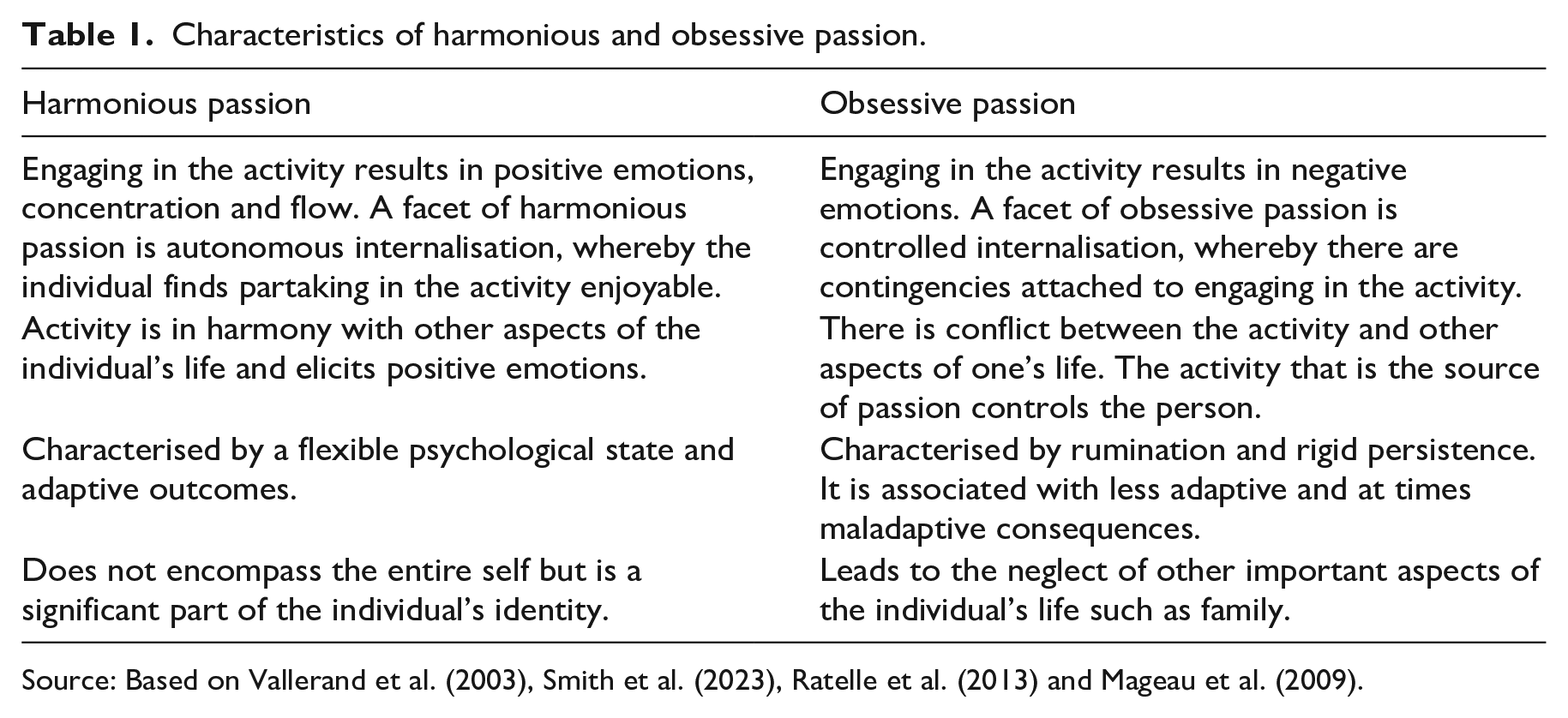
Source: Based on Vallerand et al. (2003), Smith et al. (2023), Ratelle et al. (2013) and Mageau et al. (2009).
HP occurs when an individual freely engages in an activity, which they recognise is important to them, without any contingencies attached. The activity is significant to the person but is not an overpowering aspect of their identity; as such, it is in harmony with other parts of the individual’s life. An individual with HP will feel positive effects before, during and after engaging in the activity (Vallerand et al., 2003). Conversely, OP occurs when an individual feels compelled to engage in an activity due to certain contingencies being attached to the activity, such as a feeling of self-esteem and social acceptance. Although the person enjoys the activity, they are controlled by internal contingencies. The activity occupies a disproportionate amount of the person’s identity and causes conflicts in other areas of their life. OP results in negative feelings when the individual is engaging in the activity (e.g. stress, anxiety) and also conversely, when not engaging with it (e.g. embarrassment, shame, guilt) (Gorgievski et al., 2014; Vallerand et al., 2003). Those with HP are able to terminate their relationship with the activity once it becomes a negative factor in their life. However, this is not the case with OP. Since the activity has taken control of the individual, those experiencing OP persist with it, not only in the absence of positive emotion but also at personal costs to themselves such as damaging relationships and career opportunities (Vallerand et al., 2003). Furthermore, negative affects, like those associated with OP, lead to cognitive tunnelling, narrower response repertoires and a contagion effect leading to spiralling negative consequences. Meanwhile, positive affective states, such as those experienced by individuals with HP, lead to broader cognitive and behavioural responses and resource building (Frederickson, 2001; Frederickson and Branigan, 2005; Gorgievski et al., 2014; Stroe et al., 2020).
Studies specifically focusing on harmonious and OP in the entrepreneurship field are increasing; yet, many recent articles on harmonious and OP are systematic literature reviews (Lee and Herrmann, 2021; Newman et al., 2021) and meta-analyses (Zhao and Liu, 2022) or concentrate on aspects of entrepreneurship other than business failure (Bayraktar and Jiménez, 2022 – entrepreneur well-being; Wilm and Kindermann, 2021 – entrepreneurial risk-taking; Murnieks et al., 2020 – entrepreneurial identity-related social forces such as gender). Helpfully, Thorgren and Wincent (2013) have paved the way for research with an exploration of both types of passion in an entrepreneurial team setting. They warn that the typical expectation that HP is beneficial is not always accurate and contend that ‘the growing theory building on passion would benefit from elaborating more on the positive and negative sides of being passionate’ (Thorgren and Wincent, 2013: 2325). Interestingly, research from the psychology literature by Amiot et al. (2006) found that OP could be more functional than HP in highly competitive environments. This study focused on competitive hockey leagues, where it was found that obsessively passionate athletes displayed greater psychological adjustment in highly competitive leagues, arguing that OP is a positive attribute in highly competitive environments. Given that entrepreneurial environments are generally regarded as highly competitive (Baron, 1998), it is possible that OP may also be preferable to HP for entrepreneurs.
Entrepreneurial passion
For entrepreneurs, passion involves unflagging persistence and adaptation to be successful in an ever-changing environment (Baron, 2008). In an environment with constant change and shifting identities, identification is constructed and reconstructed in the social context rather than being fixed (Somers, 1994). Murnieks et al. (2014: 1585) have called for ‘further examination of the relevance of identity to the experience and effects of passion’. They highlighted the need for research on passion, specifically harmonious and OP, which is cited as a fruitful and important avenue for exploration in the entrepreneurial context (Lee and Herrmann, 2021; Murnieks et al., 2014; Newman et al., 2021). Conversely, scholars such as Cardon et al. (2009), Cardon et al. (2013), Cardon and Kirk (2015) posit that EP is distinct from harmonious and OP. This distinction arises from the emphasis that Cardon’s EP research places on role identities (Cardon et al., 2009). This has led to the development of three distinct role identities based on passion towards entrepreneurial activity: the inventor, founder and developer identities (Adomako et al., 2023; Cardon and Kirk, 2015; Cardon et al., 2009; Gartner et al., 1999; Neneh, 2022).
The inventor identity captures an entrepreneur’s passion for identifying, inventing and exploring new opportunities.
The founder identity refers to those passionate about establishing firms and exploiting opportunities.
The developer identity incorporates those entrepreneurs who are passionate about developing, nurturing and expanding a business once it has been created.
These three identities are not mutually exclusive; individuals may be passionate about all three taxonomies in equal measure (Cardon et al., 2009). The identities are effective for examining EP for the conception, creation or expansion of a firm; however, they fail to provide insight into the manifestation of EP that occurs when the firm fails. When the firm goes through the process of failure the three aforementioned passion-based identities are, at least temporarily disenfranchised.
Identity and identification
There are links between passion, identity and identification but there is little research on the impact of EP on an individual’s actions (Schwarte et al., 2023; Shane et al., 2003) when experiencing business failure. Identity remains a critical component of work on passion (Cardon et al., 2009; Murnieks et al., 2014; Neneh, 2022; Vallerand, 2008). Individuals with a strong entrepreneurial identity experience greater levels of passion (Murnieks et al., 2014). In fact, passions are assumed to emerge from important identity images and as such become an integral part of a person. For example, one with a passion for writing does not simply describe themselves as a person who writes, but as writers, they embody the action (Mageau et al., 2009). Similarly, an entrepreneur may form an identification with the actions and activities of being an entrepreneur, such as identifying and exploiting new opportunities (akin to the inventor and founder identities). Therefore, when one venture fails, the entrepreneur can continue to undertake the activities important to their identity by focusing on creating a subsequent venture. However, entrepreneurs may experience personal connection and even identification (Cardon et al., 2005) with a specific business they created. Since individuals are more hesitant to abandon affect-filled, rather than affect-free goods (Meyer et al., 1993; Zellweger and Astrachan, 2008) a strong level of identification can affect the entrepreneur’s behaviour. Furthermore, excessive identification may result in the loss of one’s individual identity (Michel and Jehn, 2003; Shepherd and Haynie, 2009).
In the case of entrepreneurs who lose their individual identity due to the identification formed with the firm, this may result in contingencies being attached to the success or continuation of the firm, such as self-esteem or social acceptance (Mageau et al., 2009; Vallerand et al., 2003). It is understandable that an entrepreneur may experience personal connection and even identification (Cardon et al., 2005) with a business they created as their ‘blueprint’ is engrained within it (Pitts, 2008). Thus, the venture’s success or failure reflects upon the entrepreneur. As Cardon et al. (2005) points out, identification has both functional and dysfunctional aspects. At times it is positive and motivating, however, it can also be counterintuitive, destructive and blinding. We know that passion inspires individuals to persist through challenges to accomplish difficult tasks (Adomako et al., 2023; Murnieks et al., 2014; Neneh, 2022). But how that passion manifests is dependent on the type of identification formed by the entrepreneur, whether they identify with the entrepreneurial process (i.e. identifying and exploiting new opportunities) or with the specific firm. Our study focus (see Figure 1 below) responds to Schwarte et al’s. (2023) call for research exploring the expression of EP (particularly the expression of harmonious and OP), towards specific activities, and the way in which identity influences the display of EP. Our study explores the manifestation of passion among entrepreneurs following a business failure experience. Particular attention is paid to the attitudes and responses of the entrepreneur. Ultimately, we examine how each passion type affects entrepreneurs’ identification pathways following a business failure experience.
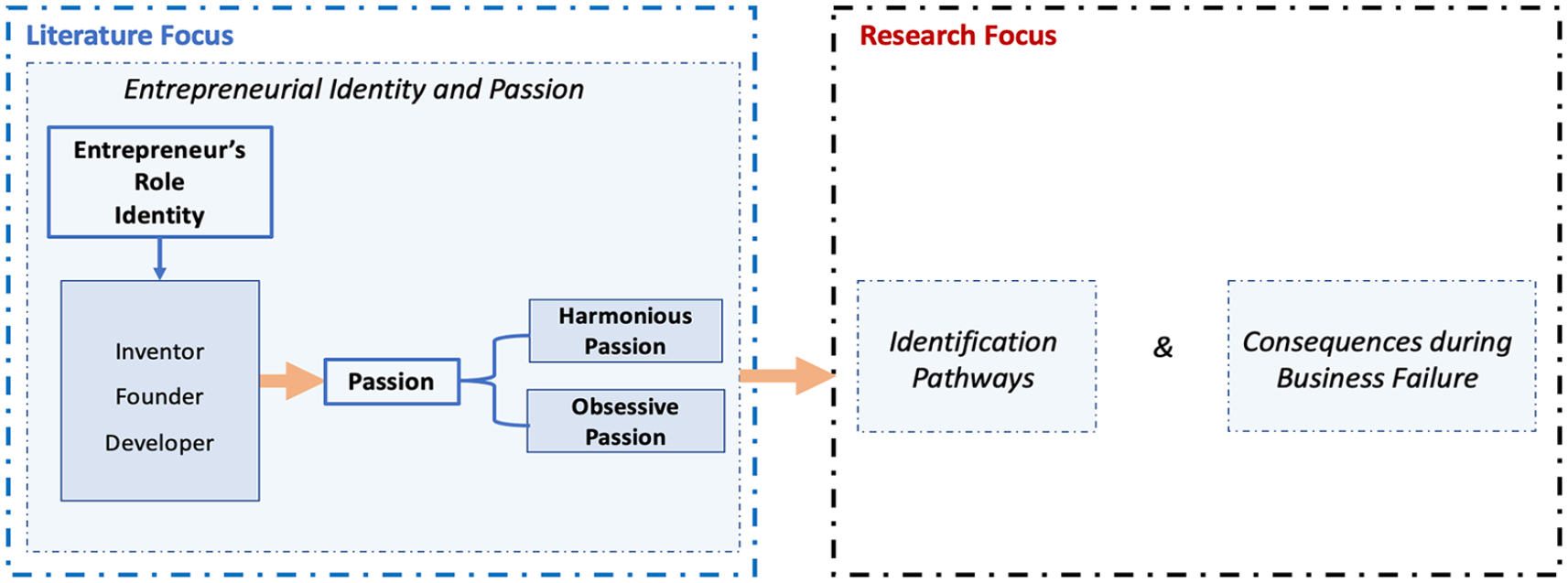
Study focus.
Methodology
This study was designed to examine entrepreneur experiences of business failure. In particular, how failure affects entrepreneurs and why reactions and consequences differed between them. This research objective enables us to examine the interrelationships of the activities of entrepreneurial practice as potential micro-foundations of entrepreneurial action (Shepherd, 2015). We use the lens of passion as it is acknowledged as a powerful instigator and advancer of entrepreneurial action. However, it remains under-investigated in the context of business failure. According to Shepherd (2015), exploring the reciprocal relationships of cognition and emotion and the manner in which emotions facilitate or obstruct the entrepreneurial process, through their effect on entrepreneurial action, is a potential area to offer a contribution.
Qualitative research allows us to inductively build theories taking such an approach, we can explore the contexts, meanings and processes that shape entrepreneurial identification. Entrepreneurial identification is a hard-to-measure entrepreneurship phenomena; yet, through the analysis of common and specific factors within extreme cases we can better understand it (Van Burg et al., 2022). In light of the research objective, we adopted a phenomenological approach as it facilitates an understanding of social and psychological phenomenon from the perspectives of those involved (Welman and Kruger, 1999). Phenomenology emphasises discovery and description rather than testing or proving theories (see Cope, 2005 for a full discussion). The phenomenological paradigm focuses on the experiences of a few individuals to explore deeply held understandings of some facet of their lives (Goulding, 2005; Marshall and Rossman, 1999). Such a design permits an understanding of the themes related to personal responses and experiences rather than face-value answers (Creswell, 1998, 2007).
Selecting entrepreneurs
The Irish Information and Communication Technology (ICT) service-producing sector 1 was selected as the setting for this study for two reasons. First, it provided a unified context within which to examine the failure process, so variances were more likely to be due to individual factors rather than environmental factors. Second, the sector was going through unprecedented growth making it an important and attractive target for entrepreneurs. To identify a suitable set for our study we searched the FAME 2 database using specific search parameters. 3
We selected entrepreneurs whose firms closed down within five calendar years of start-up. We felt it was important to impose a constraint on firm existence, as a large variance would potentially influence the entrepreneur’s identification with their respective firms. Furthermore, to overcome the potential reluctance to discuss failure we ensured those who were selected for the final dataset were currently the directors of a still-trading firm. This combination of parameters resulted in a dataset of 203 entrepreneurs, all of whom were contacted through a letter describing the objectives of the research project. LinkedIn, email and telephone were employed for follow-up contact. Ultimately, 30 entrepreneurs agreed to participate in this study. We conducted semi-structured interviews with the participants averaging 45 minutes per interview; we also gathered secondary source data on the firms from FAME Database (2008–2012), newspaper articles and online archives. The first six interviews were conducted in person allowing us to assess respondent reactions to the interview questions and to ensure they were comprehensible. Once satisfied, the remaining 24 interviews were conducted via telephone and Skype. This mode change enabled easier access to the interviewers and was less of an imposition than face-to-face interviews.
Based on the content of the interviews and the experiences of the entrepreneurs, 14 displayed clear signs of obsessive and HP using Cardon et al.’s (2009) role identities (see Table 3). Therefore, we focus entirely on the failure experiences of those 14 individuals (see Table 2); this enables us to gain a deeper understanding of the connection between EP and identity and subsequent impacts upon entrepreneurial behaviour and action (de Mol et al., 2020; Laskovaia et al., 2022; Schwarte et al., 2023). Given that the phenomena (business failure experiences) are retrospectively examined, every effort was made to eliminate potential retrospective bias. For example, prior to the interviews secondary data was collected and used to create timelines of business evolution, signposting key events and using those events as prompts and triggers in the semi-structured interviews.
Entrepreneurs in the study.
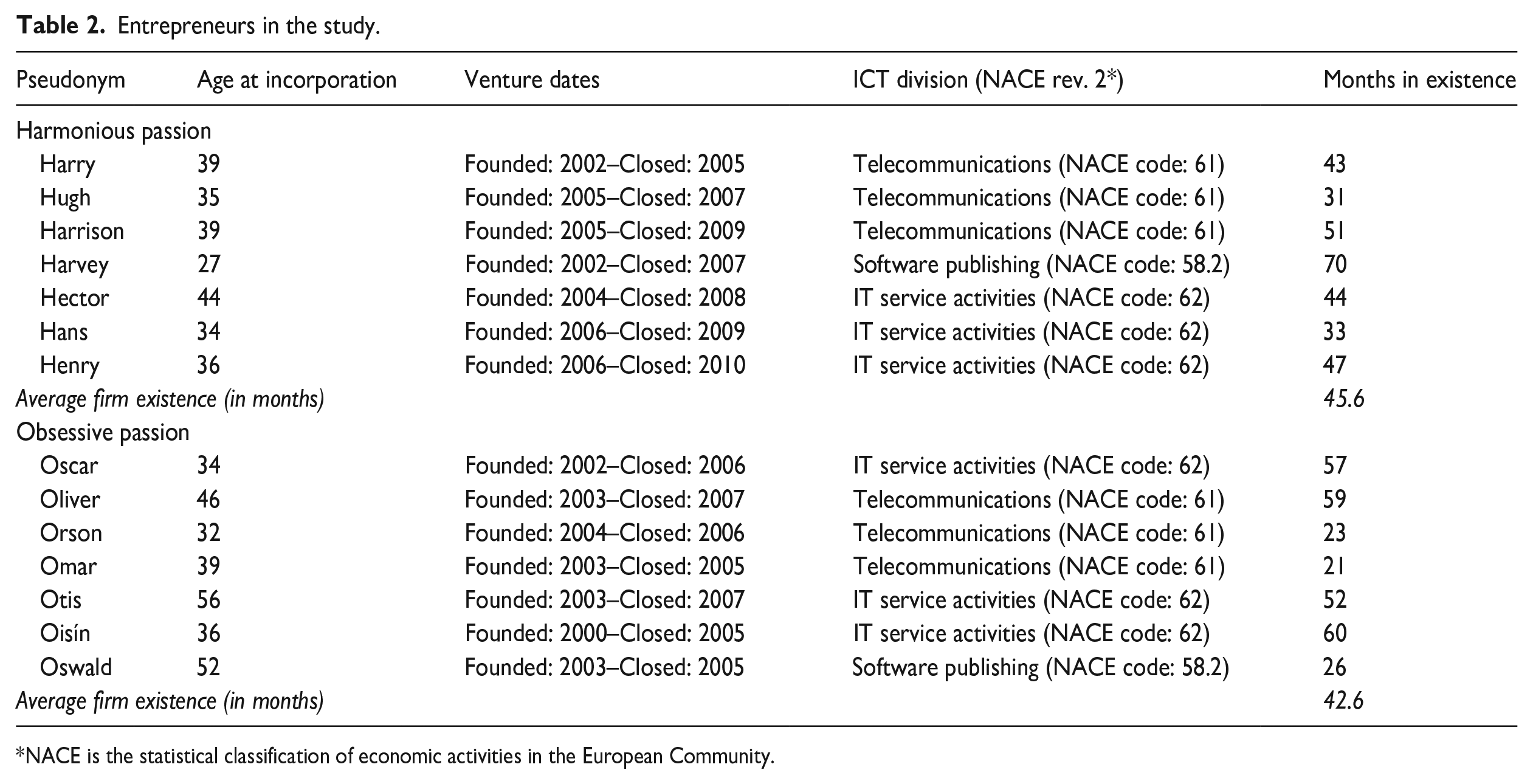
NACE is the statistical classification of economic activities in the European Community.
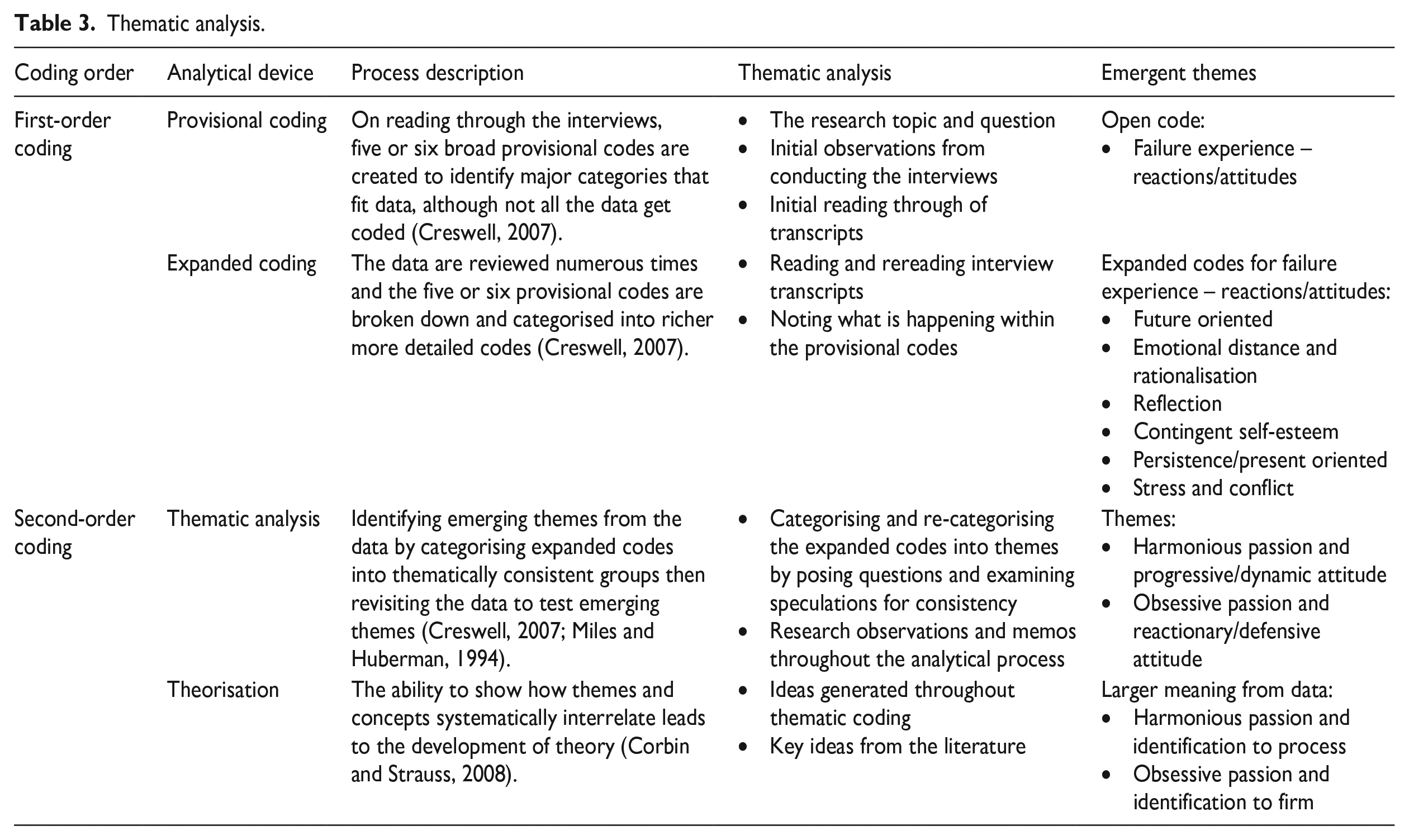
Thematic analysis.
Data analysis
Our study design allowed the entrepreneurs to describe and discuss their business failure experience and the proceeding professional and personal consequences. The interviews focused on their perceptions, reactions, feelings and observations regarding their experiences. Each was asked a set of specific open-ended questions interspersed with follow-up questions to gain a detailed picture. The data were then imported into NVivo, a data management software tool developed solely as a computer-aided qualitative data analysis system developed by QSR International. In analysing the data, the established norms of inductive, theory-building, qualitative research were followed (Creswell, 2007; Miles and Huberman, 1994). The text was engaged as an analytical device. The researchers categorised and re-categorised coded sections into a hierarchy of thematic codes. First-order coding involved reading and rereading the interview transcripts and constantly checking under which category the data in the text can be placed (Alvesson and Sköldberg, 2017). This resulted in data broadly grouped by provisional codes informed by the research topic and the researcher’s initial interview observations.
Provisional codes relate to general entrepreneur reactions, attitudes, experiences and approaches during the failure process. Such codes were then further broken down using expanded coding whereby each expanded code allowed for deeper drilling into the data and dealt with a single relevant issue (see Table 3). The expanded codes distilled the actions of entrepreneurs following failure. It is at this stage that 14 of the 30 entrepreneurs exhibited the distinguishing features of two strongly opposing failure experience reactions/attitudes with clear identification pathways (see Table 4). The remaining 16 entrepreneurs did not have a clear, demarked identification pathway; this is not unusual as entrepreneurial identities are neither singular nor fixed (Clarke and Holt, 2017).
Theme prevalence.
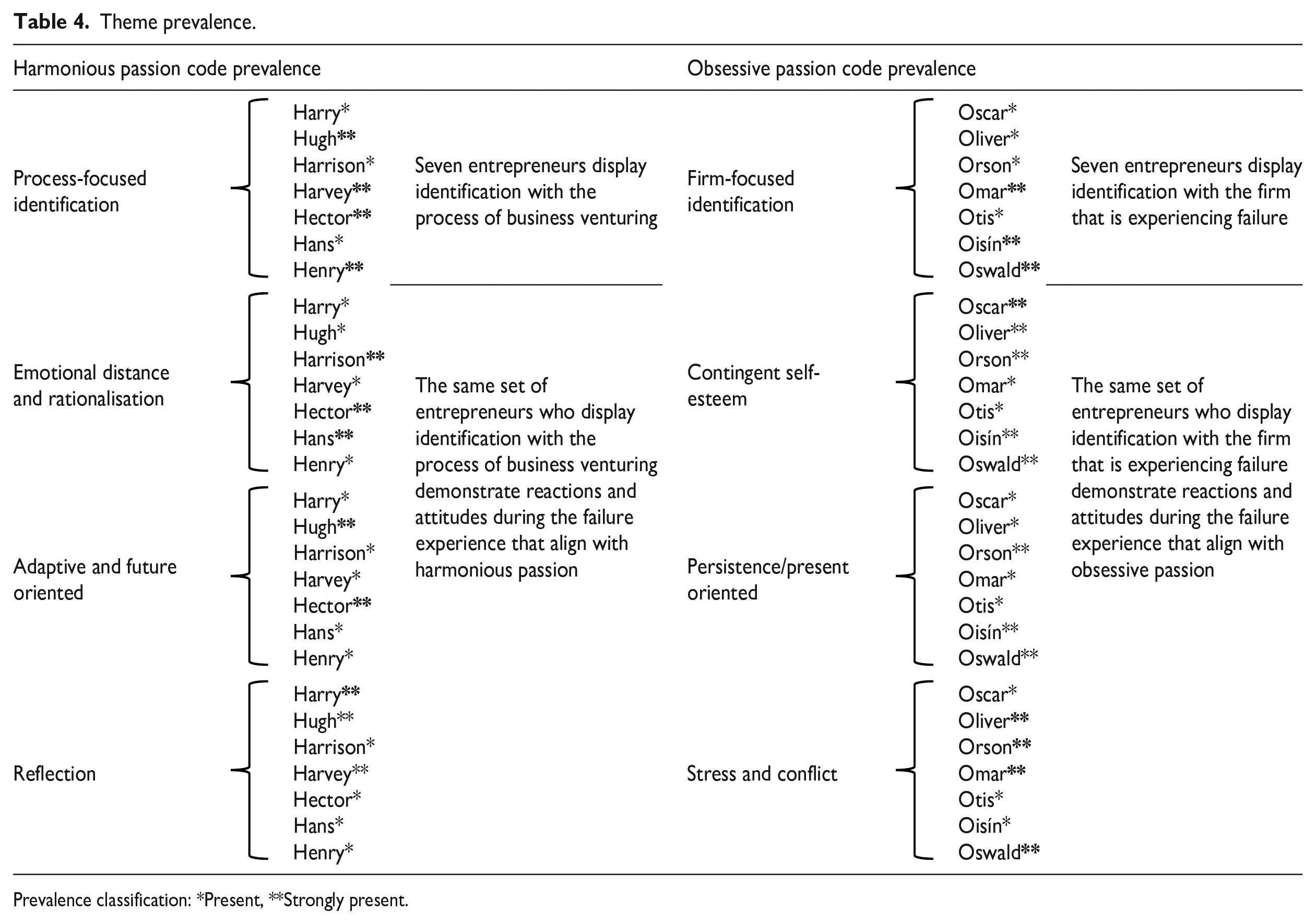
Prevalence classification: *Present, **Strongly present.
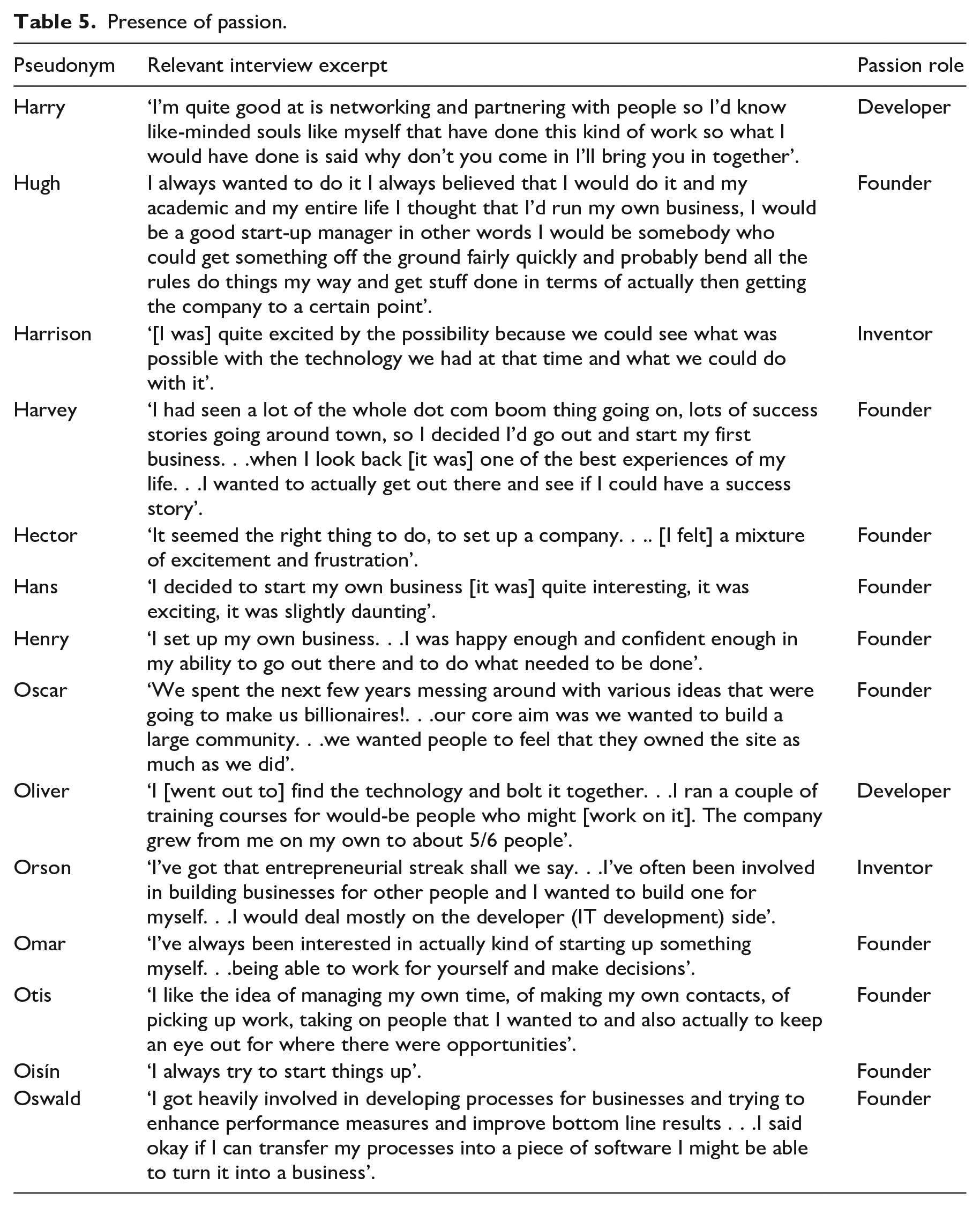
Second-order coding began by establishing emerging themes from the data and categorising expanded codes into thematically consistent groups. The presence of EP was categorised using Cardon et al.’s (2009) role identities – inventor, founder and developer (see Table 5). Those with progressive, dynamic attitudes demonstrated HP and displayed identification with the process of being an entrepreneur, while those with reactionary, defensive attitudes demonstrated OP and identification with the firm. Ultimately a relationship between the effect of identification, the type of passion exhibited by each entrepreneur and the subsequent actions undertaken, emerged. Theorisation was possible by showing how themes and concepts can systematically interrelate and lead to the development of theory. It was at this stage that we identified the relevance of identification and its relationship with passion.
Presence of passion.
Findings
Our findings establish a clear link between passion, identification and entrepreneurial attitudes, reactions and were organised around the core themes that emerged, three of which relate to HP and three to OP.
Harmonious passion
Seven of the entrepreneurs exhibited an opportunistic and progressive attitude when confronted with the failure of their business. The interrelated facets of this attitude emerged as maintaining an emotional distance from the firm and preserving a rational perspective. Also, they were adaptive and future oriented and finally, they were reflective and self-aware in the aftermath of the failure experience.
Emotional distance and rationalization
These respondents began by rationalising their failure experience and considering the future; they were adept at managing their emotions and distancing themselves from the firm. For example, Hector stated, ‘it’s just another phase (. . .) I got it out of my system and there’s the next thing to be done’. Hugh admitted, ‘I wasn’t that emotionally attached to it (. . .) I was very pragmatic about the whole thing’. Similarly, Harrison conceded, ‘I didn’t get depressed or emotionally involved (. . .) I managed to keep it separate from my life outside of here [work]’. Surprisingly, this group of entrepreneurs also discussed positive feelings when they reflected on their failure experience and feelings of relief once the failure had concluded. For instance, Henry recalled, ‘I was glad I didn’t have to do it anymore’. Whilst Harry admitted that now the business was closed ‘the future looked more rosy’. The fact the entrepreneurs focused on that positive emotion rather than negative provides insight into their outlook for the future and understanding of the past. Overall, we found that these entrepreneurs were positive and focused on the benefits that were derived from the business failure. Furthermore, they had the ability to maintain a separation between their personal lives and the business ventures. Thus, they remain emotionally distant and preserve objectivity.
Adaptive/future oriented
Another distinguishing feature is future-oriented outlook. The entrepreneurs were passionate about entrepreneurial opportunities rather than investing their passion solely in one particular venture. The ability to think beyond the confines of the firm was noticeable, as illustrated by Hector’s comment, ‘there’s never been a time in my life when I didn’t have at least three different things going on in my life work-wise so it’s just the creature I am’. An analogous comment was made by Harvey who stated, ‘I like it to appear that I have something in the pipeline to sort the mess that I’m in so [when the failure occurred] I didn’t really say I’m absolutely screwed here’. The entrepreneurs were aware of the importance of pursuing multiple entrepreneurial opportunities, not just to increase success but also to mitigate the downside of failure if/when it occurs. The pursuit of coinciding opportunities was continuous, as Harry said, ‘you can’t sit there and watch for stuff to happen’. The entrepreneurs put effort, focus and emotion into pursuing the best opportunity that presented itself, they did not harbour emotion for any single firm but regarded entrepreneurship as an evolving, dynamic process of continuous change. As such, these entrepreneurs did not invest time focusing on the past, concentrating on other projects and ventures immediately following the initial failure.
Reflection
Finally, in reflection, the entrepreneurs were clear regarding their abilities and the areas where they excelled; they were eager to engage in activities that leveraged their skill set; this related to inventing and founding rather than long-term firm development. Had the firm been a success, there was some likelihood they would have exited to pursue their role as a founder again in a subsequent firm. This sentiment was captured by Hugh, ‘I would be a good start-up manager in other words I would be somebody who could get something off the ground fairly quickly and probably bend all the rules, do things my way and get stuff done in terms of getting the company to a certain point, after a certain point it would be better of being run by a professional manager’. Passion is directed towards the pursuit of entrepreneurial opportunities rather than focused entirely within the confines of the firm. Overall, the entrepreneurs know where their strengths lay and recognised some of their shortcomings. Hans acknowledged that he was ‘clearly more adept at development skills’, whilst Harry admitted, ‘I would suggest that I’m quite good at is networking and partnering with people so I’d know like-minded souls like myself’. These entrepreneurs are outward-looking and keen to identify other pursuits where they can excel. Although their business failed, given their skill set they utilised their abilities to create a new venture.
Process-focused identification
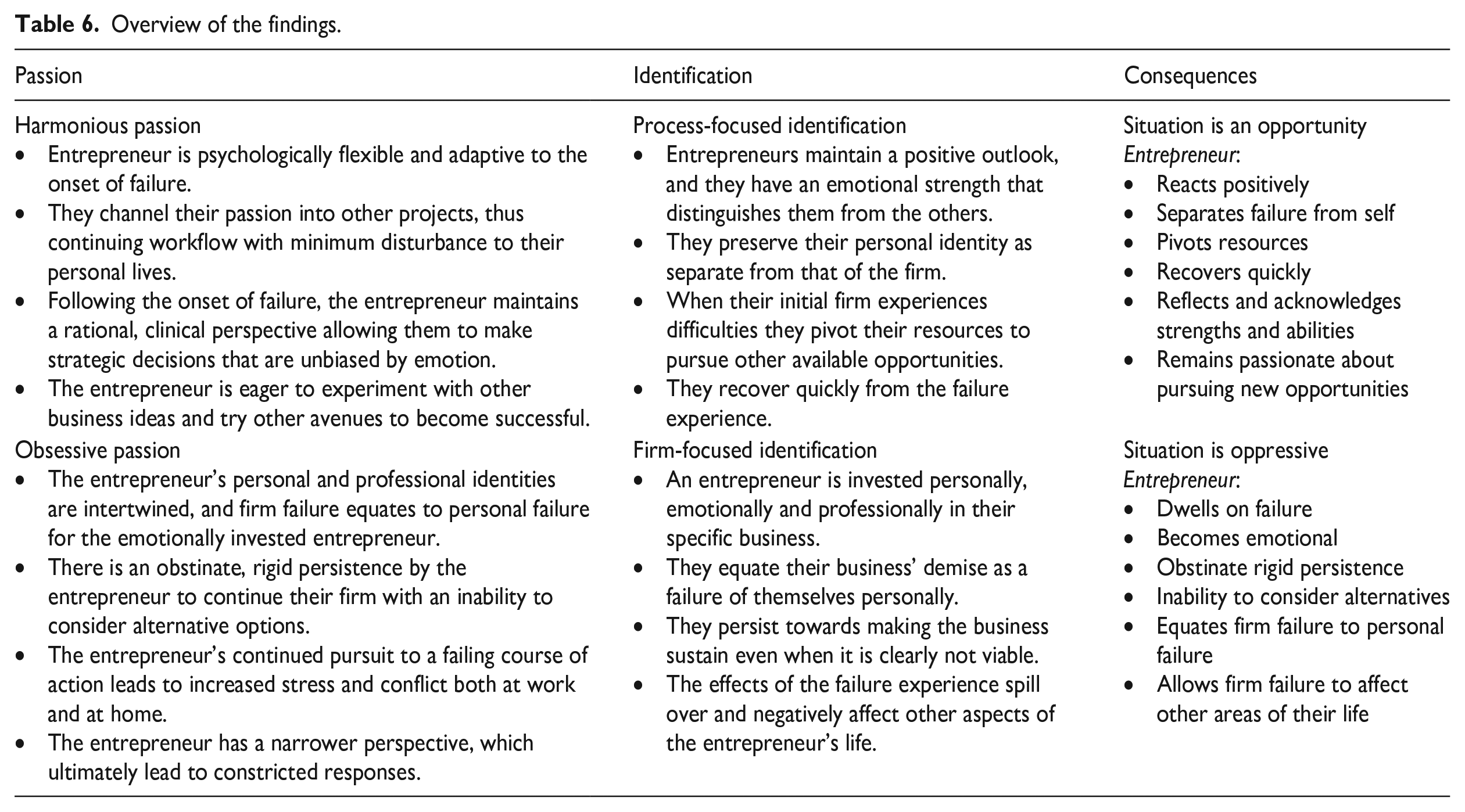
The attitude and reactions addressed above encapsulate HP; during the process of business failure, a positive outlook was maintained. These entrepreneurs were adaptive and displayed self-awareness distinguished by emotional strength; they were passionate, not about the firm specifically, but about the entrepreneurial process. The entrepreneurs experienced process-focused identification; when their initial firm failed, they immediately pivoted their resources to pursue the next opportunity so recovering quickly from this experience. This is illustrated by Hector noting that he ‘transition(ed) into the next thing’ whilst Harvey consoled himself with the reminder that ‘we’ve lost that one but we are doing the next thing and I put all of my efforts into that’ as he decided to keep going until he got the ‘next one off the ground’ (see Table 6 for an overview of the findings).
Overview of the findings.
Obsessive passion
We identified seven entrepreneurs who showed a substantially different attitude from the other respondents. This cohort was reactionary and defensive when their respective firms failed. First, entrepreneurs attach contingencies to the longevity of the firm. Second, they are persistent and present oriented and finally, they experience increased stress and conflict.
Contingent self-esteem
Intense emotions were expressed stemming from the inability to disentangle their individual identity from that of the firm, that is, they identified with the firm to such an extent that their value as individuals was dependent on the persistence of the firm. Oscar admitted ‘vanity, ego’ as the reason they ‘kept it going’; had they exited the market 6 months earlier, time and financial investment could have been saved. These entrepreneurs took business failure personally, as demonstrated by Orson: ‘it’s like someone, like a child, you’re building this business, you’re watching it grow, you’re seeing it develop’. As such, they conflate themselves and the firm and so, the fate of the firm is seen as a reflection of them as individuals.
Persistence/present oriented
In circumstances where the entrepreneurs regarded the firm, and its outcome, as a reflection of themselves, they persisted with the business beyond its natural lifespan in an effort to delay or avoid negative consequences. Oisín described how his business was ‘in trouble from day one’ however, since he was ‘committed to the idea’ the firm was kept ‘going far too long (. . .) probably a year too long’. Similarly, Oswald stated that he ‘was prepared to explore other avenues’ to make the firm a success when it began unravelling as ‘emotions takeover rather than (. . .) business decisions’ and he ‘believed in the idea so much that I felt it was worth sort of pursuing’. The entrepreneurs fixate upon persisting with their firm; however, rather than avoiding negative consequences, these are protracted and exacerbated.
Stress and conflict
It was notable that persistence with a failing business led to a spillover of stress onto other parts of the entrepreneur’s life; as Oliver explained, ‘as the business became tighter, I got involved in another project which meant that I went to Spain. . .for about three weeks of the month’ as a means of earning capital to maintain viability. However, ‘the business [in Ireland] wasn’t managed properly. . .it got to a stage where I had to close down. . .Spain didn’t work either, so I came home’. While he was away, his wife, who was not part of the business had ‘a lot of stress in her life’ as on behalf of the business ‘she was signing all the checks [and]. . .people [employees] were calling up to the house and looking for money. . .they were more focused on getting their money than doing their job’. Furthermore, during the firm’s decline ‘there was more emotion, there was more pressure’, this manifested into an argument with an employee to the point where: ‘I had a big row with him, and I threw him out of the office’. Unsurprisingly, the difficulties related to business seeped into his personal life with a negative effect.
The onset of firm failure also generated controversy for Omar when his relationship with his co-founder became troubled leading to a ‘kind of breakdown, people not talking, getting sour about situations, wanting to go the legal route even you know so the whole thing’, he also acknowledged that ‘when people get stressed really all kinds of crazy things happen and people don’t think straight anymore’. The stress of the failure also affected the entrepreneur’s personal life as he admits ‘family wise it was quite stressful, but I think they were just relieved [when the business was terminated] to be quite honest with you because I could see that it was kind of going down an avenue of no return’. An additional revealing insight came from Otis who spoke not only of his own failure experience, but of those of colleagues and friends; he observed that people ‘see it [business failure] as a source of depression. . .friends of mine have come to me in their darkest hours [to]. . .help them to put a CV together and [they] have left the country when things went sour. . .and I know that part of what they did was they tried utterly and desperately beyond where it was reasonable in order to keep the business going and sometimes in fact you need unceremoniously to say look this is not going to work out’. Not surprisingly, firm failure negatively affects the personal lives of the founders, leading to poor choices such as attempts to prolong the business; as such, these entrepreneurs made choices fuelled by emotion rather than strategy.
Firm-focused identification
Seven entrepreneurs experienced the attitudes and reactions described above indicating OP characterised by the intense emotions felt during and after the failure process. This was illustrated by the efforts to persist with the firm despite clear indicators that it was not viable. Additionally, the negative effects of the failure experience spilled over into other aspects of the entrepreneur’s personal and professional life. These participants exhibited firm-focused identification, meaning they were heavily invested in the business venture both personally and emotionally as well as professionally. In turn, they equated their business’s demise as a personal failure and as such, tried to prolong its existence. For instance, Oisín recognised, ‘we kept it going for far too long. . .a year too long’. However, this exacerbated the initial problems, for as Omar noted, ‘emotions come to the fore and they really shouldn’t and that’s when you really need to think straight’. Overall he said the failure was ‘not a particularly nice experience, it’s very stressful really, you are very much alone’ reflecting on his experience he described how a person can ‘suffer in industry’.
Summary of the key findings
Our analysis uncovered evidence of both HP and OP among 14 of the 30 entrepreneurs and it was clear that each passion type was related to a particular form of identification. The remaining 16 entrepreneurs had various aspects of both passion groups but did not solely align to one passion type. Individuals experiencing HP formed an identification that was focused on the entrepreneurial process whilst those exhibiting OP established identification with the specific firm. Each type of identification affected entrepreneurial responses in different ways, these pathways are illustrated on Figure 2 – Research outcome. Entrepreneurs exhibiting HP identified with the entrepreneurial process rather than the business idea; they were psychologically flexible and adaptive to the onset of failure. Moreover, these participants found it relatively easy to channel their passion and pivot their energy into other projects to continue their flow of work. The failure had minimal impact on their lives outside of the firm as they had the ability to keep their entrepreneurial venture separate from their personal lives. Once the onset of failure occurred the entrepreneurs maintained a rational, clinical perspective; they were able to preserve their own personal identity as separate from that of the firm. This allowed them to make strategic decisions unbiased by emotion. The entrepreneurs were still passionate, eager to experiment with other business ideas and try other avenues to become successful.
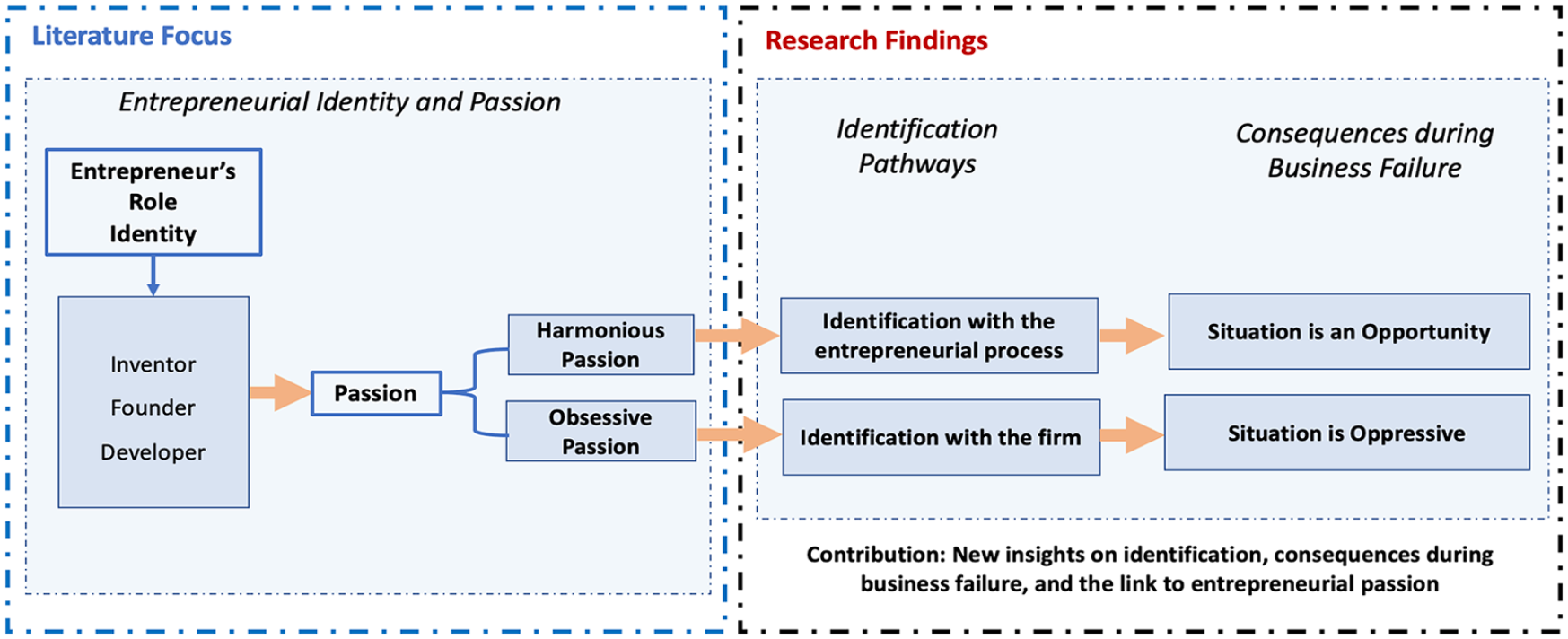
Research outcome.
Conversely, the entrepreneurs who displayed OP identified with the firm itself. They were emotionally and psychologically invested in their business to the extent that their own individual identity was tied to that of the firm. The difficulties that the firm faced were seen as a personal failure and so their energy became invested in ensuring its longevity regardless of its viability. In turn, this resulted in a host of other problems for as the firm’s downward spiral further affects their personal life and inhibits strategic decision-making. We found that amongst obsessively passionate entrepreneurs, personal and professional identities were intertwined. Thus, they were incentivised to keep the firm operating beyond its natural life, as failure would equate to a personal failure for the emotionally invested entrepreneur. This led to an obstinate, rigid persistence to continue the respective firms and an inability to consider alternative options. The continued pursuit of a failing course of action led to increased stress and conflict both at work and in the entrepreneurs’ home lives; they had a narrower perspective which ultimately led to constricted responses. Table 6 provides an overview of the key findings; it elaborates on Figure 2 depicting the distinct pathways linking passion type, to identification focus, and consequences during business failure.
Discussion and implications
Our article examined business failure experiences to shed light on the manifestation of passion, the role of identification and the consequential attitudes and reactions of entrepreneurs. This discussion and contribution section examines the results in light of current literature and explores the practice implications of our findings.
Research on EP has developed and grown in recent years primarily through the work of Melissa Cardon [see Cardon et al. (2005, 2009, 2013); Cardon (2008); and Cardon and Kirk, 2015)]. There is an expanding body of research proposing a link between passion and identity (Cardon et al., 2009; de Mol et al., 2020; Laskovaia et al., 2022; Murnieks et al., 2014, 2020; Schwarte et al., 2023; Vallerand, 2008); yet, the ways in which passion and identity affect entrepreneurial actions remain underexplored (Schwarte et al., 2023). Identity research in the entrepreneurship field largely focuses on role identities – inventor, founder and developer. However, these role identities fail to consider the way passion manifests and how an entrepreneur’s identity is affected when a business fails, as temporarily, all three role identities are disenfranchised. Most identity theories posit that activities, groups or individuals are either internalised or not; however, Bélanger et al. (2013: 191) criticise this absolutist perspective as it fails to take into consideration ‘the way in which the object of interest is regulated and integrated with other life domains’. This study responds to Bélanger et al.’s (2013) criticism and examines the consequences for an entrepreneur when the object they create, build and mould their identities around ceases to exist. It examines the way in which their EP affects the identification formed and their subsequent response to business failure. Essentially, we offer insight into the mechanisms behind identity formation and identification in an entrepreneurial context.
The DMP (Vallerand et al., 2003) highlights the different outcomes that can emerge due to different types of passion. From our findings, in the business failure context, we concur that identification is not binary in that one either identifies with the object or does not. It is the manner in which it is incorporated into individual lives that is important and this is shaped by the passion that one experiences. According to Mageau et al. (2009), OP is hypothesised to result from inadequate fulfilment of intrinsic needs. This leads to contingencies being attached to the activity, such as feelings of social acceptance or self-esteem. Such contingencies result in the internalisation of intra- and/or interpersonal pressures, with Vallerand et al. (2003) suggesting that engaging in the activity becomes a substitute for self-worth. Our study supports and extends this hypothesis in a business failure context for regenerative entrepreneurs by illustrating the contingencies entrepreneurs place on an activity and the impact engaging in such an activity has upon their actions. They were focused on making that particular business a success and were reluctant to abandon it, hindering their opportunity to examine alternatives. Conversely, entrepreneurs who exhibited HP and identified with the entrepreneurial process took a different approach in terms of persistence and identification. Thus, the two opposing types of passion each resulted in opposing patterns of identification being formed when experiencing business failure.
A total of 16 of the 30 entrepreneurs did not fit squarely into the OP or HP groups. Instead, they exhibited either no discernible passion or elements of both passion types, to varying degrees, along a continuum. This highlights the nuances and complexities that persist in understanding passion and the potential to hold elements of both HP and OP either simultaneously and/or within a short period of time. The potential for two forms of passion to coexist within individuals was acknowledged by Vallerand (2015), with newer research discussing the potential of a quadripartite approach including pure HP, pure OP, mixed OP and HP and non-passion (Gillet et al., 2022). However, within our study, the resulting identification emerging from entrepreneurs that exhibited mixed OP and HP, or non-passion, was not clear from our data.
The analysis of competitive sports leagues by Amiot et al. (2006) (noted above), theorised that OP is a positive attribute in highly competitive environments. With respect to business failure, this argument is not supported by our findings in this particular context. Although we examined business failure, it is worth noting that all participants continued their careers as entrepreneurs, creating new ventures, so they remained in a highly competitive environment, albeit through a different enterprise.
Implications for theory
This research contributes to the entrepreneurship literature in three specific ways. First, we add to the literature on EP. Although passion has been recognised as a fundamental entrepreneurial trait, its manifestation has remained unexplored in the business failure context. Whilst studies examining EP are becoming more commonplace, the link between passion, identity and action remains relatively weak and has not been analysed in depth. Thorgren and Wincent (2013) saw benefit in research that could provide understanding into the way ‘passion make(s) people behave as they do’ (p. 2325). A call which was echoed by Schwarte et al. (2023) who recognised this deficiency and called for future research to focus on how the internalisation of entrepreneurial activities into one’s identity could trigger negative feelings and the way HP or OP influences their entrepreneurial behaviour. The business failure context thus, provides an appropriate environment to consider the extremes of passion and the link to identification in addition to the manner in which they affect individual responses. Our study addresses this call and illustrates that the type of passion an entrepreneur experiences influences how they identify with their business. This, in turn, affects the entrepreneur’s attitude and reactions. Our research sheds new light on these linkages finding that those experiencing HP identified with the entrepreneurial process whilst those experiencing OP identified with the specific firm.
Second, our research contributes to the literature on EP by building on Cardon et al’s. (2009, 2013) research and incorporating the DMP from sociology literature. This combination provides a compelling theoretical platform from which to explore business failure and its effects on the entrepreneur. Cardon et al’s. (2009, 2013) research on EP has focused on entrepreneurial role identities (inventor, founder and developer); however, when a firm fails, these identities are threatened. The type of passion they experience influences the manner in which an entrepreneur responds to this threat; this, in turn, affects the pattern of identification they form with the activity. Engaging Cardon et al’s. (2009, 2013) existing research on EP informed our focus on entrepreneurial identities and entrepreneurial identification. The incorporation of the DMP provided an interesting juxtaposition of HP and OP, these opposing types of passion were particularly interesting to examine in the extreme context of business failure. The key contribution to the existing literature on EP arises from the empirical evidence showing that the type of passion exhibited affects the nature of identification that the entrepreneur forms and this, in turn, influences entrepreneurial attitudes and responses. Thorgren and Wincent (2015: 224) have discussed the need for research that examines the pressures that lead to contingencies being attached to entrepreneurship, as they believe that this will ‘explain differences between HP and OP’. Furthermore, Schwarte et al. (2023: 12) discussed the need for research exploring ‘the different displays of harmonious and obsessive passion’ in particular, how displays of EP are fuelled by different entrepreneurial role identities. Until now, the link between passion, identity and resultant behaviour has lacked empirical evidence; this study builds theory on these links using the extremes of EP (HP and OP) in an extreme context (business failure).
Our final contribution to the entrepreneurship literature comes from our in-depth examination of business failure. While business failure has been explored through various lenses (Simmons et al., 2019 – gender; Liu et al., 2019 – narcissism; Castro and Zermeño, 2021 – resilience), there remains a need for more evidence on the consequences of failure at an individual level through the lens of passion (Lee and Herrmann, 2021; Newman et al., 2021; Schwarte et al., 2023; Zhao and Liu, 2022). We demonstrate that how entrepreneurs respond to business failure is dependent on the type of passion they feel. This, in turn, influences how they identify with the experience (identifying either with the firm or the process) and ultimately, their attitudes and reactions. We examine the process by which the failure of the business can be misconstrued by an entrepreneur as an individual failure due to misaligned identification. Consequently, this research advances both understandings of EP and business failure, building on existing studies on passion (Cardon et al., 2013; Mageau et al., 2009; Murnieks et al., 2014; Schwarte et al., 2023; Vallerand et al., 2003) whilst addressing pertinent calls for research from the contemporary entrepreneurship literature.
Implications for practice
This study has some practice-based considerations. For entrepreneurs (bearing in mind our limitations), our findings highlight the importance of awareness and acknowledgement that they can experience different forms of entrepreneurial identification. However, such different experience of passion does not prevent them from going on to set up another new venture. Entrepreneurs need to bear in mind the effect of their failure experience on them as individuals, their families and friends and how this can affect their own individual ability to cope and process their business failure. This may be challenging in the midst of a business failure, but nonetheless, it is important to acknowledge the various effects they experience. Furthermore, our study highlights the need for entrepreneurs to have strong support networks when navigating business failure. Moreover, appreciating the challenges and demands of creating and launching a new business, entrepreneurs should reflect on their entrepreneurial role identity and the passion they experience. Such awareness and understanding might be helpful to them in dealing with and processing the business failure experience. For entrepreneurial educators and other ecosystem actors, our study highlights the need for open discussions about the realities of business failure and the experiences of entrepreneurs. Such discussions and openness normalises business failure. It removes some of the stigma and exposes nascent entrepreneurs to considering business failure as an eventuality they may face. Also, for entrepreneurship educators, this study highlights the need to further elaborate and explore the facets of EP in supporting the development of nascent entrepreneurs or in their engagements with entrepreneurs.
Limitations
Our study is not without some limitations. First, the study used a sample of ICT entrepreneurs from Ireland, so it does not provide a basis for broad theoretical generalisations. Another limitation arises from the fact that our study is retrospective in nature; business failure phenomena are not examined in real time and a longitudinal ethnographic study was not undertaken. However, according to Sheppard and Chowdhury (2005), some longitudinal methods such as a real-time study of events are not appropriate for studying an ex post facto phenomenon, such as failure. Every effort was made to eliminate potential retrospective bias through the use of timelines to explore the evolution of the business that identified key events which were then used as prompts and triggers in the semi-structured interviews.
Future research and conclusion
We provide compelling empirical evidence of the link between identity, passion and actions, and the role of each in the business failure context. Future research might investigate these links further. In particular, it would be interesting to see a large-scale study, with a heterogeneous sample of entrepreneurs who experienced business failure to examine if our evidence could inform a quantitative study. Another possible line of enquiry may include a longitudinal study that tracks serial entrepreneurs through their multiple ventures to explore whether their response to the failure experience changes over time. There are temporal affects to the manifestation of EP (Gielnik et al., 2015). EP stems from ‘multiple, cumulative means of experiences and abilities’ (Stenholm and Nielsen, 2019: 1380). It is also known that identities and therefore, identification are constructed and reconstructed in the social context (Somers, 1994), so it would be interesting to track and understand these reconstructions over the longer term. According to Hsu, Wiklund and Cotton (2017), ‘the way in which prior failure influences the attractiveness of re-entry has received scant attention in the literature’ (p. 1). Future studies examining business failure through the lens of passion have the potential to further our collective understanding of entrepreneurial choices following a failure experience. Finally, recent research has detailed the potential of a quadripartite approach to passion types including pure HP, pure OP, mixed OP and HP and non-passion (Gillet et al., 2022). Within our study, 16 of the 30 entrepreneurs did not fit squarely into the OP or HP groups yet, identification exhibited by these mixed OP and HP or non-passion, was not clear from our data. Perhaps an area for future research could further explore mixed OP and HP and non-passion, following business failure to better understand the affects.
In conclusion, this article serves as an important reminder to entrepreneurs to acknowledge, recognise and process their emotions with regard to their entrepreneurial situation. Alternatively, by focusing on emotion regulation entrepreneurs can become more adaptive and direct their behaviour to positively overcome the failure experience rather than committing to a failing course of action.
Footnotes
Acknowledgements
The authors wish to acknowledge and thank Professor Susan Marlow, the handling editor, and two anonymous reviewers for their patience and constructive feedback, which has further shaped this article. The authors also want to thank those entrepreneurs who participated in this study.
Authors’ note
Grace S Walsh is also affiliated to CONNECT, the Science Foundation Ireland research centre for Future Networks and Communications, Ireland.
Funding
The author(s) received no financial support for the research, authorship, and/or publication of this article.
