



Abstract
Given the anticipated negative impact of Brexit on the U.K. economy, it might be expected that self-employed individuals would have favoured remaining in the European Union. However, the self-employed are also more likely to have certain demographic characteristics that are associated with voting leave in the 2016 referendum. We investigate such potentially offsetting influences using nationally representative survey data and find that self-employed men were more, and women less, likely to be leave voters compared to the paid-employed. The differences were statistically significant for men but a Gelbach decomposition reveals that they can largely be explained by characteristics, specifically age and education. Our findings, especially for self-employed men, are discussed within the context of the important economic consequences that Brexit continues to have on small businesses in the United Kingdom as well as the need for further evidence on the voting behaviour of the self-employed.
Introduction
Understanding the voting behaviour of the self-employed in the 2016 Brexit referendum is a neglected topic of scholarly research. However, understanding what factors underpinned how the self-employed voted is important both in terms of deepening our knowledge of this group and because of how their views and votes affected the overall outcome, given the closeness of the result and the fact that there were almost 4.8 million self-employed workers in the United Kingdom in June 2016. Leaving the European Union (EU) will also have affected both the immediate and future business prospects of entrepreneurs and small businesses in the United Kingdom. Most economists believed that leaving the EU would have an adverse effect on the United Kingdom (Sampson, 2017) and in the lead-up to the referendum a clear campaign message from remain supporters revolved around HM Treasury estimates that Brexit would make households around £4300 worse off on average by 2030. As a result, lower levels of gross domestic product (GDP) would be expected to reduce the revenues of the self-employed.
The self-employed also became numerically more important as a group of voters because of the rapid expansion of self-employment in the United Kingdom – especially in the period leading up to the EU referendum in 2016. 1 For example, Wales and Agyiri (2016) note that the level of self-employment in the United Kingdom increased from 3.2 million at the end of 2000 to 3.8 million in 2008 and to 4.6 million in 2015, with full-time and part-time workers each contributing about a half of the rise in the number of self-employees. This was partly due to an expansion in types of self-employment such as jobs that were the product of increased labour market flexibility including those that could be termed as false self-employment as well as workers involved in the newly created gig economy (Tomlinson and Corlett, 2017), as well as rising levels of freelancers and sub-contractors (Henley, 2021). Therefore, many of the additional jobs that were created in self-employment would not have been classified as ‘good’ jobs (Goos and Manning, 2007) and some might have been perceived as a result of increased globalisation. 2 Fetzer (2019) examines the relationships between austerity, globalisation and the increased support for Brexit/right-wing parties in the United Kingdom and concludes that the referendum offered the opportunity of a protest vote for many workers.
Moreover, incomes also fell in relative terms for the self-employed in the period since the Great Recession, in comparison to the paid-employed. In particular, d’Arcy and Gardiner (2014) report that real earnings from self-employment in 2010–2011 fell to well below 80% of their 2006–2007 level. They recovered a little in 2011–2012 but the inflation-adjusted incomes of the self-employed were still less than 80% of the level five years earlier, compared to 95% for the paid-employed. This is important within the context of the referendum given that the leave vote was concentrated among the low skilled who had seen their incomes eroded by globalisation, austerity and technological change (Goodwin and Heath, 2016). Liberini et al. (2019) examine the effect of income on the propensity to vote leave. They consider three measures of (household) income: total, labour and relative. They find that all three forms of income have a negative impact on the probability that the respondent indicated a pro-Brexit view, with the strongest effect observed for total household income. 3
The self-employed might also have different views towards immigrants. Attitudes to migration are a key predictor of whether an individual voted leave in the referendum (Blackaby et al., 2020; Goodwin and Milazzo, 2017). On the one hand, some self-employed workers may perceive immigrants as competition in the labour market, or in relation to public services, as migrants can be more entrepreneurial (Clark et al., 2017) as well as being prepared to work in jobs for which they are over-qualified (Dustmann et al., 2013). In contrast, those who employ others may view the more restrictive immigration policies that were advocated by Vote Leave as unappealing. Tiwasing (2021) examines the factors influencing the view that Brexit represented a major obstacle to business among a sample of U.K. small- and medium-sized enterprises (SMEs) surveyed in 2016. He finds that those firms that reported a shortage of managerial skills or expertise and that had trouble in recruiting staff were more likely to indicate that Brexit would affect their business. He also reports some industrial variations with firms located in Retail/Wholesale, Transport and Accommodation & Food Services as well as Professional/Scientific, Information/Communication and Administrative Support significantly more likely to report that Brexit would affect their business.
In addition to the considerations discussed above, some of the demographic characteristics of the self-employed could affect their likelihood of voting to leave – especially with regard to age and education. There is a large gap in average ages and somewhat smaller educational differences between the paid- and self-employed (Henley, 2021), although there are variations by gender (Clark et al., 2017). In addition to this, there is also evidence that the self-employed are happier in their lives and with their work (Binder and Coad, 2013) as well as being more optimistic (Dawson et al., 2014) – happier people tend(ed) to vote for the status quo/remain at the EU referendum (Liberini et al., 2019).
Despite the potential importance of Brexit for the self-employed, there is little evidence on how they actually voted, especially in comparison to other groups. 4 One exception is Alabrese et al. (2019) who include a single dummy variable for the self-employed in their regressions and report that they were (slightly) more likely to be supportive of Brexit in comparison to some other groups of workers. We aim to rectify this gap by undertaking a detailed analysis of how the self-employed voted in the referendum, especially in comparison to those in paid-employment. We particularly focus on the role that the characteristics of those in employment played in explaining whether they voted to leave or remain in the EU and differences between men and women.
Related literature
In this section, first we examine potential factors affecting how, in theory, the self-employed might have been expected to have voted in the referendum. This includes a discussion of the expected influence of predictions of the economic impact of Brexit and a summary of the characteristics of leave voters in the EU referendum in conjunction with those of the self-employed to show how demographic and other factors might have affected voting intentions. The section is completed with a brief review of the small number of empirical studies that have included controls for self-employment in their regression models examining the determinants of the leave vote.
Expectations of how the self-employed might have voted
It is well known that the majority of experts and commentators thought that Brexit would have a negative impact on the U.K. economy. In addition to the forecasts produced by the U.K. government, organisations such as the National Institute for Economic and Social Research, Institute for Fiscal Studies, International Monetary Fund, and Organisation for Economic Cooperation and Development predicted lower economic growth should the United Kingdom decide to leave the EU. In addition, the Confederation of British Industry commissioned PricewaterhouseCoopers to provide a detailed quantitative assessment of the potential implications for the U.K. economy of leaving the EU. PwC (2016) concluded that total GDP would be in the range of £55–£100 billion (3–5.5%) lower in the five years following Brexit. Such predictions would have been expected to influence the views of the self-employed when casting their votes in the EU referendum. In particular, Healy et al. (2017) begin their article with the observation that ‘economic performance is one of the best predictors of election outcomes’ (p. 771). They go on to discuss the different transmission mechanisms for economic voting. These include pocketbook voting, where voting is based on personal economic conditions, and sociotropic voting, in which the individual is more concerned with overall economic performance. It has also traditionally been thought that the self-employed vote for centre-right parties given that these are more associated with free enterprise and represent the interests of business and enterprise. Barisione and De Luca (2018) report evidence in support of this view in Italy and Spain but less so for the United Kingdom. They also find that the strength of the relationship has weakened over time, possibly because of the changing composition of self-employed workers and that other parties increasingly support this growing group.
The consequences of Brexit would also be expected to be worse for exporters. Brown et al. (2019) provide evidence on this, with their findings indicating that larger, export- and import-oriented SMEs were most concerned about leaving the EU. They also report that many SMEs with growth-related plans had scaled back on innovation, capital investment and exporting following the referendum. Brown et al. (2020) found that Scottish SMEs who exported and were innovators had most to fear from Brexit, while domestically focused and less innovative firms were far less concerned about the United Kingdom’s departure from the EU. Bloom et al. (2018) report that uncertainty among U.K. businesses increased considerably following the referendum and that it was highest in firms that traded more with the EU and relied more heavily on EU migrant workers. Hart et al. (2021) also comment that Brexit increased uncertainty among firms operating in the United Kingdom. Cumming and Zahra (2016) discuss the possible implications of Brexit for international entrepreneurship suggesting that leaving the EU would have adverse consequences for new venture start-ups and their funding because of the anticipated institutional upheaval. Belghitar et al. (2021) further report that exchange rate fluctuations have a negative impact on the performance of SMEs in the United Kingdom, which could have important implications within the context of Brexit. It has also been argued, more generally, that populism can reduce entrepreneurship if it thrives when there is a belief that society holds values that are beneficial to business and property rights (Bylund and McCaffrey, 2017). Bennett et al. (2023) examine the relationship between entrepreneurship and populism using individual-level data on 33 countries and find that populism does reduce entrepreneurial activity but the effect is moderated if it is underpinned by a centrist ideology.
However, there could be counter-arguments – at least from a theoretical perspective – why the self-employed and entrepreneurs may not vote in the expected way given predictions about the economy following Brexit. These include the arguments of Shane (2010) that people do not always take rational decisions since they ‘make intuitive choices, without gathering and evaluating evidence to justify their selections’ (p. 83). Within the context of the business world, Shane (2010) goes on to suggest that going with your ‘gut’ may be particularly useful when the future is uncertain. Huang and Pearce (2015) investigate reasons why early-stage investors in entrepreneurial activities may act instinctively offering empirical evidence that business investors use both intuition and formal analysis to develop a ‘gut feel’ when making their decisions.
Characteristics of leave voters and the self-employed
Starting with gender, some studies have found that men were significantly more likely to be leave supporters/voters than women. For example, Liberini et al. (2019) who use the Understanding Society dataset report a gender differential in support for Brexit of around eight percentage points in their regression models that control for a range of personal characteristics. 5 Alabrese et al. (2019) also find that gender has a statistically significant influence on the support for Brexit using the same dataset but the magnitude of this effect is smaller than that in the former study once local-level controls have been added. However, some studies using different datasets find that gender has no statistically significant effect on the probability of voting leave at the referendum. These include Goodwin and Milazzo (2017) and Kolpinskaya and Fox (2021) who examine the British Election Survey. 6 In contrast, there is clear evidence that men are much more likely to be self-employed than women. For example, using the 2011 Census, Clark et al. (2017) report that 20% of men in employment were self-employed, compared with less than 10% of women. Saridakis et al. (2014) examine variations in the gender gap in self-employment rates in the United Kingdom between 1973 and 2007 and show that the male rate was considerably higher than that for females over this entire period.
Most studies on the characteristics of leave voters report similar findings with regard to age and education in that those voting to or supporting leave were far more likely to be older people and to have none, or low levels of qualifications. For instance, Liberini et al. (2019) find that the difference in the probability of being a Brexit supporter between graduates and non-graduates was 13 percentage points. While Alabrese et al. (2019) report similar differentials for the over 60s and under 30s in terms of being more and less likely to be in favour of Brexit, respectively. The relationship between age and self-employment has also been clearly established, with numerous studies highlighting the positive association between age and working for oneself. Henley (2017) includes age as a linear variable in his probit regression models and finds that an additional year increases the probability of being self-employed by around 0.2 percentage points. There are also differences in the ages at which the paid- and self-employed retire. For example, Parker and Rougier (2007) report that individuals who have been self-employed for at least 6 years retire later. The impact of education on self-employment is far from conclusive according to Simoes et al. (2016) since highly educated individuals might have better job opportunities in the paid-employment sector or alternatively may be better able to identify entrepreneurial opportunities or have greater managerial ability. In terms of the United Kingdom, several studies have found that highly qualified women are more likely to be self-employed, whereas the opposite is true for men. For example, Clark et al. (2017) find that the difference in the probability of being self-employed between graduates and workers without qualifications was around 2 percentage points higher for women, compared to 6 percentage points lower for men.
With regard to ethnicity and religion, Liberini et al. (2019) find that voters from Black and Mixed ethnic groups were significantly less likely to be leave supporters. Clark et al. (2017) argue that there is significant heterogeneity in self-employment between ethnic groups, with high rates observed for some Asian groups, especially Pakistanis, while groups such as Black Africans and Caribbeans have historically had low rates. Clark and Drinkwater (2010) also show that there has been a fall in self-employment among the Chinese and Indians. Furthermore, people with some non-Christian religions such as Muslims, Hindus and Jews tend to be more pre-disposed towards self-employment (Clark and Drinkwater, 2000) but are less likely to be leave voters (Kolpinskaya and Fox, 2019).
Residential location may also have an influence given the large regional variations in the Brexit vote. In particular, there has been an over-representation of the self-employed in London, where remain supporters were in the majority. Saridakis et al. (2020) report that self-employment rates were highest in London, and lowest in the North East, over the period between 2004 and 2016. It was also shown that the rates of self-employment grew most rapidly in London over the five years leading up to the referendum, with the gap between self-employment rates for men in London and the next two highest regions – the South East and South West being particularly noticeable. The impact of national identity, as well as other variables, on support for Brexit may vary in different parts of the United Kingdom (Henderson et al., 2021).
Previous empirical evidence on how the self-employed voted
Existing studies have only included single dummy variables to identify the self-employed in their regressions. In particular, although the focus of the study by Alabrese et al. (2019) is not on how the self-employed (or any other specific group) voted per se, they report estimates for a dummy variable identifying the self-employed from applying regression models to Understanding Society data using a range of different specifications. In some of these specifications, they also include the self-employment rate at the district level – as do Becker et al. (2017) in their aggregate-level regression models – and the results that are presented show how the estimates are affected when other controls are included. However, the findings with regard to the self-employed (and in terms of the influence of the local self-employment rate) are only discussed very briefly in the text. Specifically, there is only one line indicating that ‘self-employed respondents are also more likely to support Leave, even though this association is insignificant for most specifications in the table’ (p. 142).
Further inspection of their regression results reveals that the positive coefficient attached to the self-employed dummy (relative to the paid-employed) becomes significant at the 5% level when a control for whether the respondent has a permanent job is added to the specification containing four dummies indicating industry of employment. These initial findings therefore, indicate that the self-employed were more likely to be leave voters when controlling for a limited amount of covariates. However, the influence of this dummy variable becomes insignificant once other controls such as gender, age and education are added. Alabrese et al. (2019) do not split their results by gender but also compare the self-employed with a predominantly retired reference group in an earlier table. Here the self-employment dummy has a negative and significant sign. However, the negative coefficient attached to the paid-employment dummy is larger, by around three percentage points – which is consistent with their models that only include those individuals in employment. The size of both coefficients declines when controls for marital status and age are included, with the self-employment dummy becoming insignificant. The self-employment rate at the local level has a positive but generally insignificant impact on support for leaving the EU when considering just employees. Becker et al. (2017) report a similarly minor effect of the self-employment rate on the Brexit vote when just using aggregate data on local authorities in the United Kingdom.
Data and descriptive statistics
The data used in this paper are taken from several years of the British Social Attitudes Survey (BSAS). In particular, the 2016, 2017, 2018 and 2019 surveys contained questions on whether the respondent voted in the EU Referendum and, if so, how they voted – either to remain or leave the EU.
7
These two questions were not asked to all respondents in the latter two surveys, when they were included on only one of the three questionnaires that were administered. The self-employment indicator has been constructed using the following questions. Firstly, to identify the employed:
Which of the following descriptions applied to what you were doing last week, that is the seven days ending last Sunday?
Respondents could select multiple options including ‘In paid work (or away temporarily) for at least 10 hours in the week’. A derived variable was then used to identify the respondent’s main activity last week.
Respondents indicating that they were in employment were then asked a question:
In your main job are you . . .
1 . . . an employee 2 or self-employed? 8 (Don’t know) 9 (Refused)
Respondents indicating that they are ‘self-employed’ and ‘in paid work’ were then identified as self-employed.
In total, just under 7800 individuals answered the question on whether they had voted in the referendum, of whom 3348 were in paid-employment and 645 were self-employed. In our subsequent analysis, we use the unweighted data from the surveys.
Table 1 contains details on how the self-employed voted in the EU referendum relative to other groups. It can be noted that the overall statistics are generally in line with post-referendum polls on the percentage voting leave for different sections of the U.K. electorate such as those undertaken by Ipsos Mori, YouGov and Ashcroft. Moreover, Curtice (2016) notes that the BSAS provides high-quality and representative data on political and other issues because of the (relatively time consuming and expensive) process of random sampling. However, the self-reported turnout rates are higher in the BSAS, which may in part be due to the effects of recall or interviewer bias. The self-employed as a whole were more likely to have voted in the EU referendum than the paid-employed, with a gap of 4%, which was significant at the 5% level using a two-tailed test for the difference between two means. The turnout rate for the self-employed was however very similar to those individuals who were out of employment, a group that is dominated by retired individuals. The differential between the self- and paid-employed was mainly due to males, since over 80% of self-employed males voted in the EU referendum, compared to just under 75% of males in paid-employment. While the difference in the turnout between self- and paid-employed females was around (a statistically insignificant) two percentage points.
Voting in the European Union referendum by economic groups and gender.
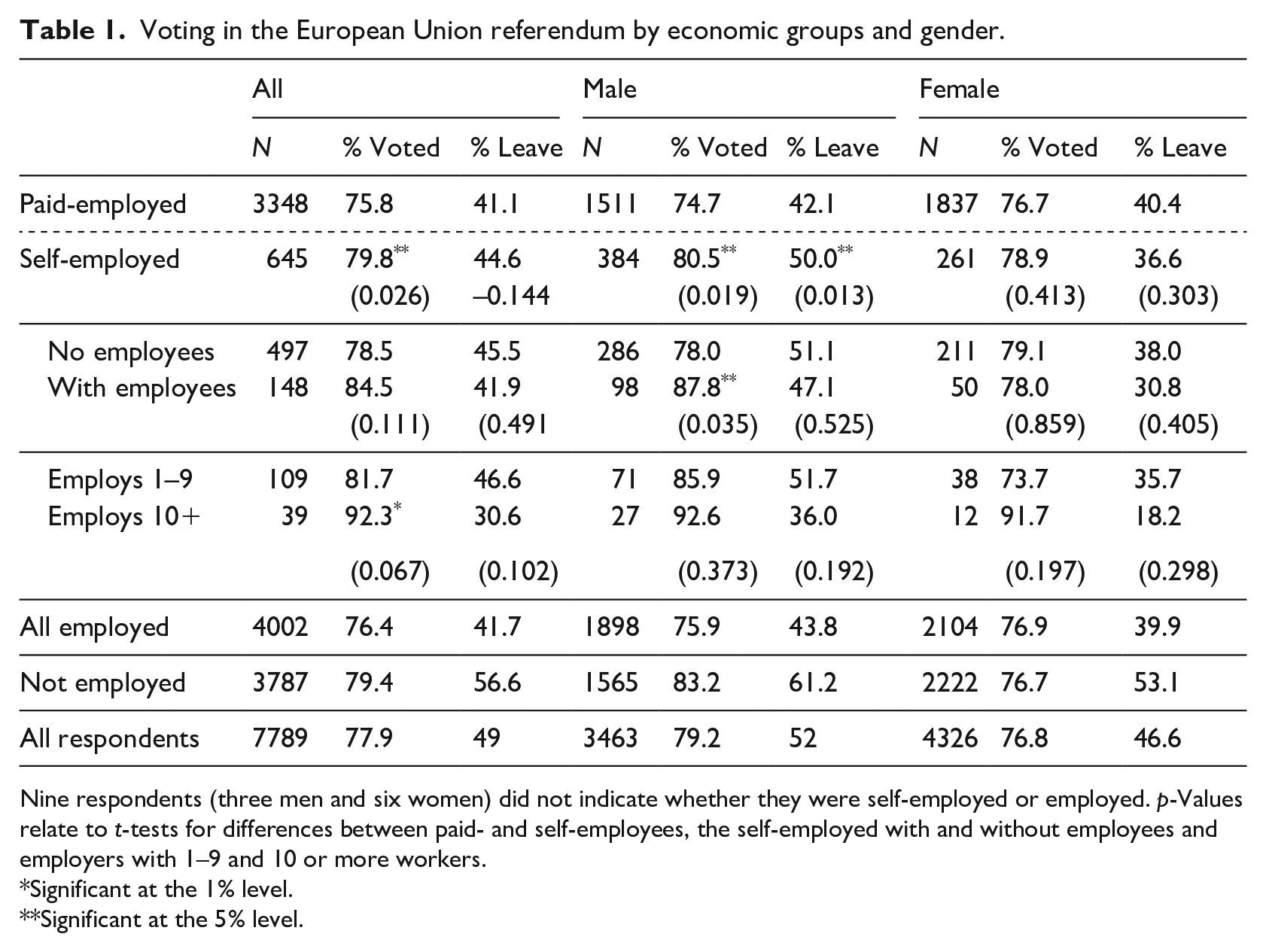
Nine respondents (three men and six women) did not indicate whether they were self-employed or employed. p-Values relate to t-tests for differences between paid- and self-employees, the self-employed with and without employees and employers with 1–9 and 10 or more workers.
Significant at the 1% level.
Significant at the 5% level.
Table 1 also shows that in overall terms the self-employed were over-represented among leave voters compared to the paid-employed, with the difference being around 3.5%. 8 However, there is a very different picture between males and females, with the differential for the former being almost eight percentage points and significant at the 5% level. For females, the self-employed were less likely to have voted to leave the EU than the paid-employed, with the difference being a statistically insignificant 3.8%. The percentage of leave voters was higher among those out of employment, at around 57%, which aligns with the findings of Alabrese et al. (2019).
The BSAS also contains information on whether the self-employed employ others and if so how many are employed. Table 1 reports EU referendum voting statistics for the solo self-employed and for those who employ others. There are no significant differences in the percentage of leave voters between these two groups for either males or females, although leave voting was around 4 and 7 percentage points higher for solo self-employed males and females, respectively. Interestingly, the percentage of self-employed males employing others who voted in the EU referendum was significantly higher than it was for solo self-employed males at the 5% level. Given the relatively small number of self-employed individuals employing others, then it is difficult to ascertain whether those with a relatively large workforce voted differently from the self-employed with only a few workers. Table 1 does report some voting statistics for two groups of the self-employed with staff: those employing 1–9 and 10 or more workers. The voting gaps between the two groups are fairly large but not statistically significant. In particular, the percentage of leave voters is over 15, which is lower for the self-employed with 10 or more employees, both for males and females. Given the relatively small number of the self-employed employing others in the sample, especially those with at least 10 workers, we do not further investigate differences between these groups.
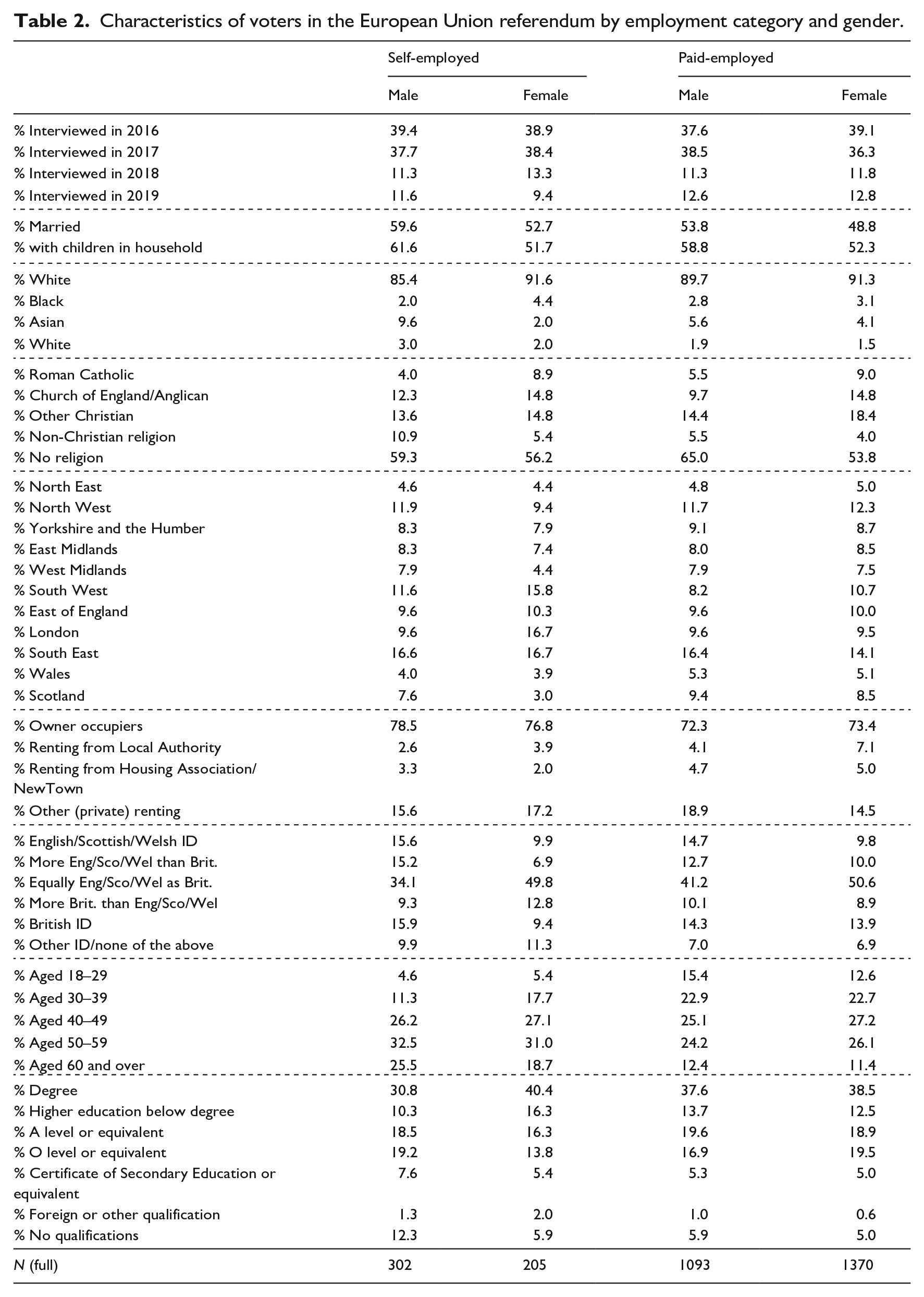
Table 2 presents the characteristics of self- and paid-employed individuals who voted at the EU referendum. A higher percentage of male and female self-employed voters were married compared to their counterparts in paid-employment. To some extent, this reflects the older age profile of the self-employed, as can be seen in the table. This is particularly noticeable for males, with 25% of self-employed male voters at the EU referendum aged 60 and over compared with 16% aged under 40. The equivalent figures for males in paid-employment were 19 and 23%. There were also larger educational differences by gender, with males in paid-employment having a seven-point advantage over the self-employed in terms of the percentage of graduates, whereas the difference was two percentage points in favour of the self-employed for females. There were also some ethnic and gender differences between the groups. These include the higher proportion of self-employed men with an ethnic minority background and a non-Christian religion. A higher proportion of self-employed men and women also indicated that they had no religion in comparison to their equivalents in paid-employment. A higher percentage of self-employed females lived in London, with a percentage that was more than seven points above the paid-employed. However, this was counter-balanced by only 3% of this group living in Scotland, compared to 9% of female voters in the paid-labour market.
Characteristics of voters in the European Union referendum by employment category and gender.
Empirical methodology
The empirical approach involves pooling the self-employed and paid-employed in a regression where a dichotomous dependent variable takes a value of 1 if the respondent was a leave voter and 0 if they voted remain. These models are estimated separately for males and females using a linear probability model and a dummy variable is included as explanatory variable to identify the self-employed. For reasons of comparability, we follow Alabrese et al. (2019) and Liberini et al. (2019) by reporting estimates from a linear probability model. 9 Other explanatory variables include controls for socio-demographic factors (including marital status, children in household, ethnicity, religion and year of interview), variables relating to residence and national identity, age, education, industry and household income. 10
In the regression models, the main parameter of interest is the coefficient on the dummy variable indicating self-employed status. This represents the ceteris paribus effect of self-employment status on the predicted probability of voting leave conditional on other characteristics of the worker. Consider a version of this model with no explanatory variables: here the coefficient on self-employment reflects the mean difference in the raw data between the paid-employed and self-employed in their propensity to vote leave. In typical applications, researchers then often add variables or groups of variables representing specific characteristics (e.g. industry) sequentially to the model to see which characteristic ‘explains’ most of the raw difference. Gelbach (2016) shows that this can be misleading as the inferences made can depend on the order in which the variables are added to the regression model. He proposes an alternative decomposition methodology in which the relative contributions to any reduction in the gap between the paid- and self-employed can be attributed to different worker characteristics in a manner which is order-invariant.
To see how the decomposition works, consider a population regression model:

where X contains the main explanatory variable of interest (self-employment status) and a constant term, W contains all other ‘control’ variables and u is an iid error term with a zero mean. Define
Gelbach’s approach is to note that

where
It can then be shown that for the kth explanatory variable in W the component of interest is:

where
Results
Table 3 contains the results of the Gelbach decomposition procedure. 12 The raw gap is estimated to be 8.3% (the p-value for a test of the null hypothesis of the raw gap being equal to zero is 0.012) for males and −3.1% for women; however, the gap for women is not statistically significant (p = 0.417). For the males, inclusion of the full set of explanatory variables causes the coefficient on self-employment to fall to 1.1% (p = 0.727), suggesting that the bulk of the difference in propensities to vote leave between the self- and paid-employed is explained by the independent variables. 13 Thus, we find no direct effect of self-employment status separate from the fact that self-employment is correlated with these variables.
Components of Gelbach decomposition.
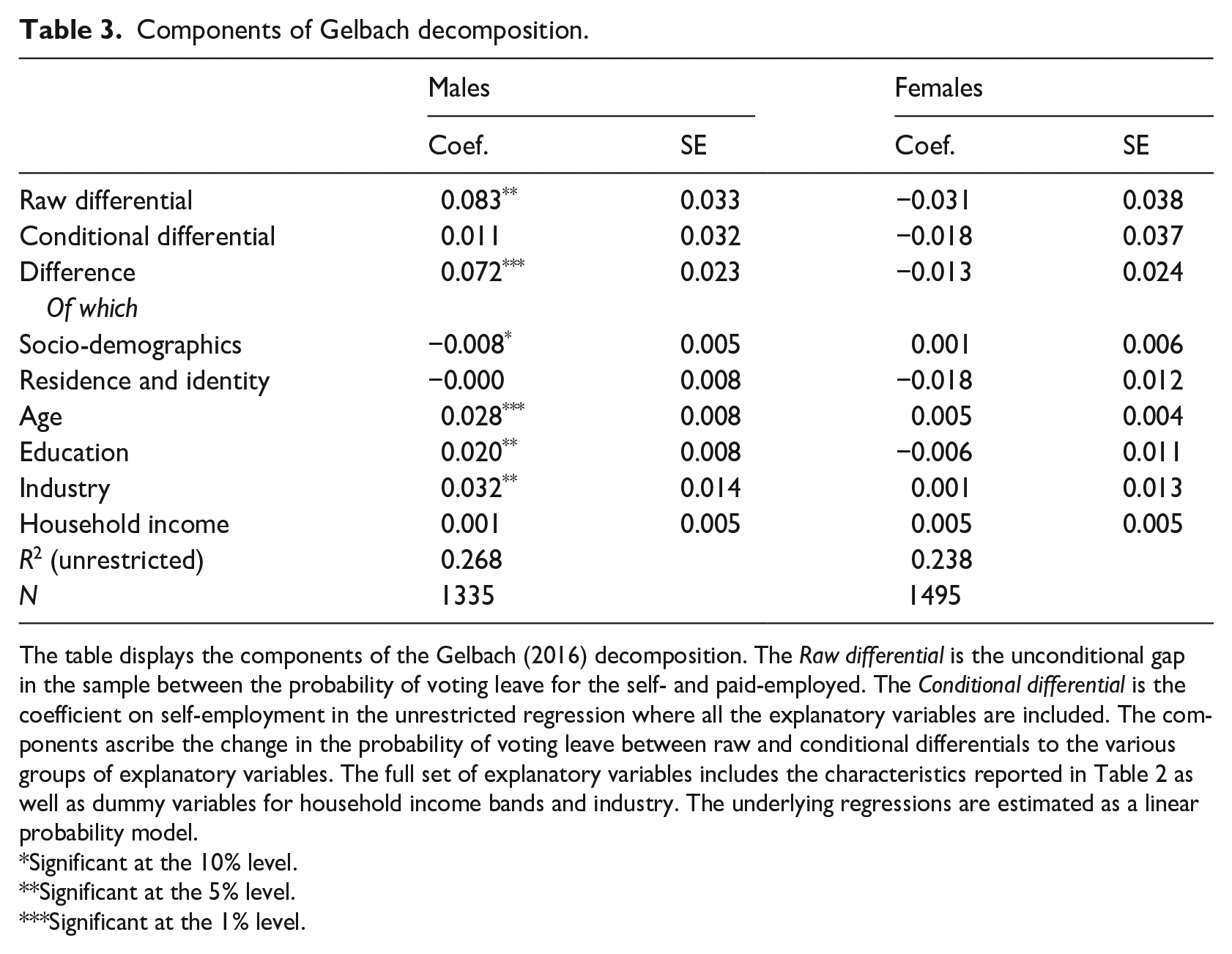
The table displays the components of the Gelbach (2016) decomposition. The Raw differential is the unconditional gap in the sample between the probability of voting leave for the self- and paid-employed. The Conditional differential is the coefficient on self-employment in the unrestricted regression where all the explanatory variables are included. The components ascribe the change in the probability of voting leave between raw and conditional differentials to the various groups of explanatory variables. The full set of explanatory variables includes the characteristics reported in Table 2 as well as dummy variables for household income bands and industry. The underlying regressions are estimated as a linear probability model.
Significant at the 10% level.
Significant at the 5% level.
Significant at the 1% level.
Specifically, age, education and industry are the main sets of factors identified as contributing to the closure of the gap. Age explains around one-third (0.028/0.083) of the raw differential and reflects the well-established finding that older voters were more likely to favour leaving the EU. In our male sample, the self-employed were older than the paid-employed (average age 50 compared to 44). It is also found that the less well educated were more likely to vote leave and we find that this accounts for around a quarter of the gap. Self-employed men in our sample were less likely to have a university degree than their paid-employed counterparts (31% compared to 38%).
The decomposition suggests that just over a third of the gap is due to the industry dummy variables. The role of industry as a contributor to the decomposition derives from the fact that the self-employed were relatively more likely to work in industries which voted to leave such as construction, agriculture and transport and were much less likely to be found in industries such as education, finance, professional services and IT. We should be careful about inferring causality here. Choice of self-employment and choice of industry are likely to be jointly determined and it is not clear whether the preponderance of leave voters in some industries is due to an inherent characteristic of the industry (e.g. the tradable nature of the goods and services in that industry or the importance of migrant labour) or due to the fact that self-employed workers are more likely to be found in that industry and there is something inherent in self-employed status that contributes to anti-EU sentiment. There may be some unobserved heterogeneity between graduate-dominated industries such as finance and education that is not captured by the education dummies. However, there may also be an economic competition argument here where less educated workers feel threatened by migrants (Scheve and Slaughter, 2001).
In addition to the relatively small and insignificant overall difference for females, none of the components of the decomposition are substantively or statistically significant. The largest effect relates to the contribution of the residency and identity variables, with the remainder of the differentials close to zero. As a result, under a half of this lower probability that self-employed females voted to leave the EU could be accounted for by characteristics, with the majority of the differential being unexplained. This is in sharp contrast to the case of males.
Discussion and conclusions
This research note presents new findings with regard to the voting behaviour of the self-employed at the EU referendum. Self-employed men were both more likely to vote in the referendum and more likely to vote leave than their paid-employed counterparts. However, the difference in the propensity to vote leave becomes statistically insignificant once a range of observable characteristics are factored in. The application of a Gelbach (2016) decomposition indicates that the most important variables in ‘explaining’ the raw differential in the likelihood of voting leave are industry, age and education. In contrast, there are no statistically significant differences in the propensity to vote leave between women in paid- and self-employment either in the raw data or in the regression models.
Differences in the age structure and pattern of educational attainment between paid- and self-employed are well established and may be taken to suggest that part of the higher likelihood of voting leave on the part of self-employed men reflects these socio-demographic factors rather than being related more fundamentally to the economic aspects of self-employment and the prospective economic impact of Brexit. The effect of which industry self-employed men work in, which accounts for 39% of the gap in voting leave, does however suggest that ‘business’ factors may have had some role to play possibly through the tradability of output, competition from migrant workers (e.g. in construction) or the impact of EU regulations (such as in relation to agriculture). These factors can affect paid-employed workers as well and it is therefore of interest to further disentangle the interaction between business ownership and attitudes to the EU through the use of quantitative and qualitative approaches.
Assessments of the impact of the United Kingdom’s withdrawal from the customs union appear to confirm that this will have a negative impact on a range of small businesses. For example, Dhingra and Sampson (2022) conclude that Brexit had large negative effects on the U.K. economy. They report that Brexit led to higher import and consumer prices, lower investment and slower GDP growth between 2016 and 2019. Similarly, Dhingra et al. (2022) argue that there was an immediate adverse impact on both household incomes, due to a rise in the cost of living, and business investment because of greater uncertainty following the referendum. It is also suggested that the new post-Brexit trading arrangements will lead to a general loss in competitiveness among U.K. firms and large adjustments in some industrial sectors. Therefore, they conclude that the impact of Brexit will be more severe for those firms that are directly involved in international trade. BCC (2022) undertook a survey on 1168 businesses, over 90% of which were SMEs. It was reported that 77% of firms for which the Brexit deal was relevant indicated that it was not helping them increase sales or grow their businesses and 56% had experienced difficulties in adapting to new rules for trading goods. While 80% found that the cost of importing had increased. However, even for firms that do not import or export, there have also been consequences from Brexit-induced supply chain problems (Hesketh et al., 2021) and from rising prices. Therefore, it will be interesting to observe whether there has been a change in the views of the self-employed compared to how they voted in the referendum, especially with regard to men. In addition, further analysis of more nuanced aspects of the relationship between Brexit and self-employment such as differences among those individuals employing others would be valuable. We leave such considerations for future research. Moreover, from a wider perspective on voting, there is a general paucity of studies that examine the voting behaviour of this important section of the electorate. Barisione and De Luca (2018) show that the political allegiances of the self-employed vary by country and have changed over time. To the extent that self-employment represents a distinctive form of economic activity, and therefore that the self-employed are a distinct interest group in society, their political behaviour is worthy of more detailed study.
Footnotes
Acknowledgements
The British Social Attitudes Survey has been made available by the U.K. Data Service. We are also grateful for comments received from three anonymous reviewers and seminar participants at Nottingham Trent Business School.
Declaration of conflicting interests
The author(s) declared no potential conflicts of interest with respect to the research, authorship and/or publication of this article.
Funding
The author(s) disclosed receipt of the following financial support for the research, authorship and/or publication of this article: The authors would like to thank the Economic and Social Research Council for helping to fund this research via the grants ES/V013475 and ES/S012345/1.
