




Abstract
Prior studies suggest that religion matters in the adoption of corporate social responsibility (CSR) initiatives in SMEs. This study draws on an institutional logics perspective to illuminate a hitherto underexplored interplay of multiple logics that in combination influence family SMEs when pursuing CSR. Based on a qualitative study of family SMEs in Northern Vietnam, this article aims to deepen our understanding of how constellations of institutional logics entwine to influence their CSR initiatives, in particular where these initiatives include commitments to contributing towards the UN Sustainable Development Goals. We find that when a religious logic is present there is a shift away from the dominance of a family logic and a turn towards a community logic. Further, whereas non-religious family SMEs act instrumentally towards CSR initiatives, seeking benefits primarily for the family and the firm, a religious logic introduces a normative character to the market logic, whereby economic benefits are construed as resources to support local communities rather than the family. Implications for theory, practice and further research are offered.
Introduction
There is a growing interest in how family businesses address corporate social responsibility (CSR) initiatives (Smith et al., 2022; Stock et al., 2023), which has motivated family business scholars to explore practices or initiatives that balance environmental integrity, social equity and economic prosperity to secure intergenerational equity (Baden et al., 2011; Bansal and DesJardine, 2014). Family businesses (hereinafter ‘Family SMEs’), broadly defined as firms where family members have influence in the development of a firm over time (Howorth et al., 2010; Howorth and Robinson, 2020), constitute the majority of Small and medium-sized Enterprise (SMEs) worldwide (Howorth et al., 2014; Westhead et al., 2002) and play a pivotal role in our understanding of CSR (Baù et al., 2021; Clauß et al., 2022; Ferreira et al., 2021). Scholars have found that family SMEs tend to adopt more responsible behaviours relative to their non-family counterparts (Laguir et al., 2016) with some adopting formal CSR policies (Discua Cruz, 2020) as well as explicit commitments to contribute to transnational sustainability initiatives, such as the UN Sustainable Development Goals (SDGs) (Patuelli et al., 2022). Yet, it is widely acknowledged that the core influences as to why family SMEs adopt such initiatives differ across countries and sectors (Iatridis et al., 2016; Wang, 2016) and it is also likely that contextual aspects (e.g. legal frameworks, cultural norms) will also affect the choices they make on which initiatives to pursue (Wright et al., 2014) complicating the translation of CSR into operational action (Soundararajan et al., 2018).
As family SMEs are heterogeneous (Howorth et al., 2010), we can expect that they differ from non-family counterparts in terms of underlying motivations, rationales influencing their actions and approaches to adopting CSR initiatives (Borga et al., 2009; Slawinski and Bansal, 2015). Prior studies have relied on varied theoretical perspectives, such as paradox, socioemotional and stewardship, to make sense of how internal and external dilemmas influence the decision to adopt CSR initiatives (Discua Cruz, 2020; Patuelli et al., 2022). Commitments to CSR by family SMEs may be influenced by both external pressures, such as industry groups, consumers and the local community to address issues such as climate change, resource depletion and waste production, as well as internal pressures, such as the influence of values, beliefs, family traditions and normative expectations (Tyler et al., 2020). However, recent studies suggest that family SMEs are also influenced by heterogeneous constellations of logics to make sense of and organise activities over time (Ferreira et al., 2021; Mir and Feitelson, 2007), and which vary substantively around the world (Wang et al., 2016).
We argue that examining the interplay of multiple institutional logics (Besharov and Smith, 2014; Thornton et al., 2012) is a relevant lens to understand CSR initiatives in family SMEs. First, family SMEs often rely on multiple logics, influenced by the participation of family members in the business with shared understandings and values nurtured over time (Miller et al., 2017; Reay et al., 2015). However, in the extant literature the interplay of multiple logics in family SMEs has predominantly focused on the tensions and/or complementarity between market and family logics (Boers and Andersson, 2021). Second, pursuing CSR initiatives may be influenced by market and community logics to create a competitive advantage compared to larger competitor firms, and thus, firms may leverage initiatives to gain a cost advantage or to seek differentiation (Doluca et al., 2018; Mir and Feitelson, 2007; Muller et al., 2022). A community logic may influence decisions by providing a framework of action and direct resources to those who appear to uphold community motivations (Almandoz et al., 2017). Many family SMEs blend the logic of the family with both a market and community logic (Miller et al., 2017). Finally, given that many family SMEs around the world are influenced by religion (Astrachan et al., 2020), there remains a tendency to overlook that a religious logic matters in the adoption of CSR policies (Freston, 2019; Schliesser, 2023; van Aaken and Buchner, 2020). A focus on religion may also explain how, why and which CSR initiatives are adopted by family SMEs (Jamali and Sdiani, 2013; Mazereeuw-van der Duijn Schouten et al., 2014). Moreover, while recent studies suggest that family and community logics may be influenced by a religious logic (Cater III and Alderson, 2022) there is limited theorisation explaining how family, market and other logics such as religion or community interact in family SMEs (Reay et al., 2015) especially in the context of pursuing CSR initiatives. We argue that a religious logic might help elucidate how and why family SME leaders contribute to the SDGs as part of their CSR commitments (Cezarino et al., 2022). Our exploratory research question reflects this motivation: how does religion influence family SMEs in the pursuit of CSR outcomes?
To address our research question, the transitional context of Vietnam was selected for several reasons. First, there is a general assumption that CSR initiatives can be replicated around the world, overlooking crucial differences between competing logics across different countries (Wang et al., 2016). Further examination of CSR initiatives adopted in transitional countries (Jamali and Karam, 2018) may elucidate whether a religious logic influences the tendency to pursue formal CSR policies (including contributing towards the SDGs) in family SMEs (Blindheim, 2015; Gond and Moser, 2019). Second, prior scholarship on religious logics has often been limited to firms influenced by Christian religious beliefs, and by selecting Buddhist family SMEs in Vietnam, our study offers an opportunity to expand the existing understandings of religious logics to Eastern traditions. Third, social orientations are strongly emphasised in Vietnam (Burton et al., 2022) which can enhance our understanding of how multiple logics in family SMEs entwine beyond the extant focus on family and market logics alone. Fourth, transnational initiatives, such as the UN SDGs, offer a way to understand how family SMEs address CSR concerns due to their specific focus, time frames and challenge-led commitments, suggesting that multiple logics may be at play (Smith et al., 2022). Finally, SMEs in Vietnam have been urged to contribute towards the SDGs more effectively to overcome national concerns over greenwashing (Crabtree and Gasper, 2020: 173; Nishitani et al., 2021). Substantial support from the government in terms of a statutory framework, financial support (UNDP, 2018) and ‘green’ initiatives outlined in the national plan places Vietnam as an ideal context to explore our interests.
Through a qualitative study of 11 religious and non-religious family SMEs in Northern Vietnam, who had undertaken formal training to raise awareness of the SDGs, we contribute to the family SME literature in several ways. First, we introduce a complex interplay of different logics relating to the way in which family SMEs engage with CSR through commitments to the SDGs. Both religious and non-religious family SMEs relied primarily on a constellation of professional, community and market logics that guided how they selected which SDGs to focus on (e.g. aligning resources, managerial commitment). Second, our study identifies two distinctive orientations of family SMEs that contribute to the current lack of theory explaining the interactions of multiple logics in family business: (i) non-religious family SMEs use an instrumental interpretation of the market logic to drive social and community impact via short-term initiatives that require little capital/resources to deliver economic outcomes for the family business (Reay et al., 2015) and (ii) religious family SMEs use a normative interpretation of the market logic from a stewardship perspective, guided by Buddhist religious logics, to promote a normative and long-term commitment to social and community impact (Discua Cruz, 2020). Based on the interplay of logics in family SMEs, we show how instrumental orientations in pursuing SDG initiatives in non-religious family SMEs are associated with a deflection of longer-term responsibilities to government institutions, while stewardship orientations in religious family SMEs superordinate their religion for institutions (Miller et al., 2017).
The remainder of this article continues as follows: first, a brief review of family SMEs and sustainability initiatives, followed by a theoretical focus on institutional logics. The context of study, method and analysis of data are then presented. Finally, discussion of findings, implications and avenues for further research are offered.
Theoretical background
Family SMEs and CSR initiatives
Recent studies defining family SMEs argue that a defining characteristic is the control that the family members have over the decisions and resources that affect the firm, the way it operates and differentiates itself from others over time (Discua Cruz, 2020; Gimenez-Fernandez et al., 2021). While family SMEs have been found to engage in CSR initiatives for a long period of time (Fitzgerald et al., 2010), understanding their approach and rationale for pursuing such initiatives is not straightforward (Mir and Feitelson, 2007). CSR, which deals with how companies meet the economic, legal, ethical and philanthropic concerns of those whose lives are affected by their operations (Carroll and Shabana, 2010; Wang et al., 2016), has become increasingly popular and has helped to frame the way some family SMEs approach sustainability concerns (Campopiano et al., 2014; Discua Cruz, 2020). Aguinis and Glavas (2019: 1068), for instance, suggest that family SMEs engage in peripheral activities (e.g. philanthropy and charity closer to home) and embedded activities (aligned with the firm’s strategy as well as its operations) which may embody pursuing new initiatives (SDGs) to frame a CSR approach.
Diverse rationales have been found to influence the decision to adopt new CSR initiatives, such as: long-term revenues associated with being perceived as a socially and environmentally responsible organisation; reduction of operational costs by adopting initiatives that encourage better waste management, energy savings and eco-friendly initiatives; risk minimisation by becoming compliant to governmental regulations; and legitimacy to operate based on the perception of their operations by different actors within their communities (Pedersen, 2009). However, Mir and Feitelson (2007) identified factors or conditions that support or impede CSR initiatives, suggesting that in places experiencing contextual changes, or transitions, in terms of environmental legislation and policies, family SMEs experience dilemmas and tensions because of competing rationales influenced by the marketplace, governmental institutions, professional associations and community.
When trying to explain the adoption of CSR initiatives, recent studies have highlighted theoretical perspectives such as agency and stewardship, commonly used in family business research to explain distinct characteristics likely to affect the motivation of family SME leaders (Discua Cruz, 2020). Based on these theoretical perspectives, family SMEs may engage in CSR initiatives due to a stewardship responsibility to nurture the interests of the organisation (Madison et al., 2016; Spielmann et al., 2022). Such engagement is often criticised as it suggests a concern over the financial well-being of the firm or the reputation of the family, often overlooking competing rationales on what is meaningful for family SME owners. Moreover, a stewardship responsibility may also be a response to fit in with market expectations, policy guidance or codes of conduct of professional bodies, the government, or the expectations of society (Tyler et al., 2020).
Some others may criticise family SMEs for not engaging in CSR initiatives due to holding onto the primacy of a family rationale. Family members may be concerned that market or community pressures may be too dominant in the decision-making process and thus, family SMEs decide on which initiatives to pursue based on family concerns. Recent studies suggest that the rationale and approach to deciding which CSR activities (including which SDGs to contribute to) could be based on aspects that address a family’s socioemotional demands such as family ownership, intentions to leave a legacy and their values and beliefs (Hsueh et al., 2023).
Family SMEs and the SDGs
The United Nations (2020) agreed on a set of 17 SDGs defined to provide ‘a shared blueprint for peace and prosperity for people and the planet, now and into the future’ (United Nations, 2023). These goals provide a comprehensive set of ambitions that incorporates ecological, social and economic perspectives, and are relevant for family SMEs (Clauß et al., 2022; Patuelli et al., 2022). The SDGs attempt to reconcile the often competing goals of environmental protection and social justice for current and future generations as well as responsible care for our environment over the long term. The association of SDGs being integrated as part of CSR research is relevant for this study as it calls for perspectives that can allow examining diverse logics (Bebbington and Unerman, 2018; Cezarino et al., 2022) in the adoption of SDGs within a family SME.
Such an emphasis is important as studies have provided a fragmented explanation in terms of what influences the adoption of SDGs as part of a wider CSR commitment in family SMEs. Patuelli et al. (2022), focusing on a single-family business case, found that SDGs can help a family firm align its existing CSR activities to global challenges. Their study relied on a theoretical perspective that gives primacy to a family logic. Under such a perspective, family values, personal beliefs and governance aspects are crucial drivers of the decision to pursue contributions to the SDGs. Other studies, focusing on rationales that stress a market or community logic, explain why firms would (or not) contribute to the SDGs based on the influence of different actors (e.g. government, family business leaders, religious institutions), which may facilitate but also impede CSR understanding and implementation (Kariyapperuma and Collins, 2021; Smith et al., 2022). Studies have suggested that SMEs need to make SDGs ‘personable’ and ‘relatable’ (Smith et al., 2022: 119) highlighting the importance of the values people hold around diverse contextual elements. Family SME leaders may perceive SDGs as abstract, distant and centralized, often resulting in a distrust for global institutions and scepticism of the sustainability initiatives implemented by larger enterprises, suggesting the reinforcement of logics that relate to family and communities at the local level (Smith et al., 2022).
Institutional logics
The institutional logics perspective serves as a framework to study ‘the interrelationships among institutions, individuals, and organisations in social systems’ (Thornton et al., 2012: 2). This perspective explains cultural elements, such as normative expectations, values and beliefs, that help family SMEs make sense of and organise activities over time (Haveman and Gualtieri, 2017). A core premise of the institutional logics perspective relevant for this study is that it helps examine the interests, identities, values and assumptions of individuals within family SMEs in any context (Aparicio et al., 2017; Thornton et al., 2012).
Institutional logics frame societies as inter-institutional systems; the co-existence of multiple logics creates practices that have a substantial influence on organisational behaviour, where initiatives or policies adopted by firms reflect what is desirable or acceptable in the wider society (Thornton et al., 2012; Westermann-Behaylo et al., 2014). Thornton (2004) identified six core institutions of society that impact all organisations: markets, corporations, professions, states, families and religions. Each of these institutional items (e.g. families and religion) can have their own logics which influence firm action, including the choice to pursue specific activities within a family SME, such as those actions related to CSR. Logics reflect the values people hold relating to these various institutions.
A key principle in institutional logics is that each of the institutional orders in society has both material (e.g. structures and practices) and symbolic elements (e.g. ideation and meaning) which are both intertwined and constitutive of one another (Thornton et al., 2012). For example, a family logic would be evidenced by a strong sense of material elements through family structures, primogeniture, obedience to parents and symbolic elements such as shared values, traditions and beliefs, which will influence a family business (Miller et al., 2017). A market logic, by contrast, is reflected by practices linked to building a competitive position, efficiency, increasing profits and symbolic elements such as legitimacy based on performance, competition and meritocracy, where success in the market and professional management influences the development of the firm (Thornton, 2001). Such distinctions have been particularly noted in the study of management practices of family firms through the contrast between an agency perspective, which focuses on strategic benefits to the firm, and a stewardship rationale, focusing on safeguarding family values and objectives (Discua Cruz, 2020).
Recent studies highlight that a family SME is unique as it embodies at its core multiple logics with family features at its core (Boers and Andersson, 2021). Family business research applying an institutional logics perspective has, however, highlighted the potential conflict between a market and family logic (Jaskiewicz et al., 2016; Miller et al., 2017; Reay et al., 2015). In the market logic, the accepted goal is that the adoption of CSR practices may affect financial performance (Muller et al., 2022). Behaviour would then be influenced by adopting practices fuelled by market demand, where the family firm competes to increase sales, and where decision-making is developed to maximise efficiency and increase profits (Boers and Andersson, 2021). Where such logics dominate within a family firm, motives for family members to participate relate to competency and the syncing of goals that maximise the profitability and success of the business above family concerns.
Family logic diverges from market logic in many ways. A family logic would suggest a focus on multiple goals, where family goals may supersede business goals, and where a long-term orientation for the family in business is emphasised (Basco, 2017; Lumpkin and Brigham, 2011). Within family SMEs, a family logic may entail the unconditional loyalty to family interests and influence, the adoption of initiatives that will enhance family reputation, decisions are influenced by family membership, and the long-term development of the firm geared to benefit future generations (Boers and Andersson, 2021). Where such logics dominate, motives for family members may then relate to family membership (Miller et al., 2017). Family logics, for example, may affect the decision to downsize yet retain family participation and goals (Greenwood et al., 2009), and thus, values idiosyncratic to the family may permeate the organisation and influence the goals and norms over the long term.
Nevertheless, the co-presence of both family and market logics may allow firms to benefit in their co-existence. Miller et al. (2017) highlight that where a balance between both logics is achieved, a family logic may encourage the alignment of objectives looking after the benefit of the family and the firm, while a market logic would help to minimise nepotism and support the incorporation of practices that can benefit the firm and preserve a family legacy. Recent studies suggest that the co-existence of family and market logics varies significantly across geographical locations due to the influence of multiple institutions (Miller et al., 2017; Reay et al., 2015) pinpointing that understanding the adoption of CSR initiatives by family SME leaders needs to consider a common starting point.
Religious logics
Religion, that is, ‘systems of meaning embodied in a pattern of life, a community of faith, and a worldview of the sacred and what ultimately matters’ (Schmidt et al., 1999: 10), is considered influential on the institutional fabric of business life. Recent studies suggest that 84% of the world’s population claims a religious affiliation, with religion being ‘important’ or ‘extremely important’ in shaping how they think and behave (Iyer, 2016; Pew Research Centre, 2017). Since the publication of Max Weber’s The Protestant Ethic and the Spirit of Capitalism in 1904–1905/1958, it has been widely recognised that religion can have an impact on economic and social development. This is because religion plays a significant role in shaping personal values and morals, which can ultimately influence an individual’s behaviour and entrepreneurial activities (Sabah et al., 2014; Zelekha et al., 2013). Moreover, religion has been found to have a significant and positive impact on well-being, encompassing the ability to cope with high levels of stress (Pargament and Raiya, 2007) and promoting human flourishing (Myers, 2008). While such attention has gained traction in entrepreneurship research (Balog et al., 2014; Block et al., 2020; Wiklund et al., 2019), its study has been largely neglected in the analysis of family SMEs (Astrachan et al., 2020).
Religion highlights an association with context as it involves experiences, thoughts, emotions and behaviours affecting everyday occurrences (Benefiel et al., 2014; Smith et al., 2021). According to Dodd and Seaman (1998), religious beliefs can have an impact on management decision-making in family SMEs and even the decision to establish a new firm. For example, family SME owners who are religiously inclined may set goals that extend beyond profit maximisation or self-serving ideals and instead pursue a higher calling related to their religion, as noted by Smith et al. (2021). This can affect the opportunities pursued, the information considered and the decisions made regarding those opportunities. Thus, while religion can serve as a framework for decision-making among entrepreneurs (Fernando and Jackson, 2006) and family SMEs around CSR (Discua Cruz, 2020), it is important to note that being motivated by religion does not always translate to prioritising the adoption of CSR initiatives. For instance, Day and Hudson (2011) found that Christian entrepreneurs who were more motivated by extrinsic religious factors were less likely to prioritise ‘other-directed’ values in their business operations, such as demonstrating concern for employees, customers and suppliers.
Family SMEs are, however, typically renowned for having a heightened sense of responsibility to the communities in which they operate (Birdthistle and Hales, 2022), yet there is still scant attention as to how other institutional logics, such as those associated to religion, influence the approaches of family SMEs to CSR initiatives. Family SMEs are found to approach their CSR goals through community actions differently compared to non-family firms (Nekhili et al., 2017). This argument may be explained by family SMEs having a strong social component (Fitzgerald et al., 2010; Yáñez-Araque et al., 2021) due to the influence of family’s religious values and beliefs.
Religion has long been associated with CSR in certain areas of the world (van Aaken and Buchner, 2020). Prior studies point out a significant direct relationship between religiosity and CSR action (Ramasamy et al., 2010). In the United States, for example, strong local religious norms in the area surrounding the firm’s headquarters appear to attenuate the positive effect of CSR on firm value and protection against stakeholder reactions to negative events (Zolotoy et al., 2019). Recent studies focusing on Buddhism suggest that aspects such as geographical proximity to religious sites may have a positive association between religiosity, CSR and philanthropic giving (Du et al., 2015). However, religious leaders of family SMEs may not necessarily prioritise the responsibilities of the firm differently but may tend to hold broader conceptions of the social responsibilities of businesses than non-religious individuals (Brammer et al., 2007). The level of religiosity may be related to a broader or narrower perspective of CSR related to the scope and breadth of activities within a firm (Jamali and Sdiani, 2013). These studies suggest that the tendency to regard CSR as neutral religion or religion as a private personal matter misses the complexity of competing logics for some family SME owners.
In recent discussions related to family logics, religion has emerged as relevant as an influence in other logics (Fathallah et al., 2020) yet such influences do not occur without tensions (Discua Cruz, 2020). Religion matters in the adoption of SDGs as part of a firm’s CSR initiatives (Schliesser, 2023). As the SDGs involve the participation of diverse actors, the religious factor may involve decisions related to who may benefit from their adoption, and which tenets of a particular religion may be addressed or fulfilled (Tomalin et al., 2019). However, Freston (2019) suggests that some forms of religion can question the presuppositions and forces behind the elaboration of the SDGs and thus, the logics behind their adoption by SMEs. Religion remains important to frame which logics may have a stronger weight in CSR decisions due to the fact that religion calls family businesses to be action-oriented in terms of how and why they integrate their faith (Sorenson and Milbrandt, 2022) with sustainability and responsibility concerns (Hoffman and Sandelands, 2005). More recently, studies suggest that religion may positively affect attitudes towards environmental sustainability for family-owned businesses (Singh et al., 2021).
To develop a more comprehensive understanding of the influence of religious values on business-related activities, Morris and Schindehutte (2005) highlight the significance of analysing their relative importance at various levels of analysis, including cultural, subcultural, institutional and personal. Henley (2017) argues that institutional theory and logics can be a useful lens to explore how religion may provide environmental munificence. Such a depiction suggests that religion becomes part of the symbolic construction of reality in some family SMEs (Friedland and Alford, 1991), and so, a religious logic would help to explain the relevance of religion, its interrelationship with other institutional orders and its impact on how individuals and organisations behave (Gümüsay, 2020).
Buddhist religious logics
Buddhist epistemology posits that all individuals exist within a network of mutual interactions. In Buddhist philosophy, the three components of sustainability – economy, society and environment – are perceived as cyclical and intricately linked systems rather than separate or autonomous entities (Rāhula, 1974). Based on the understanding that institutional logics comprise social principles and values that shape individual perceptions and interpretations of reality (Edgley et al., 2015: 2), Buddhism can be considered a religious logic.
Buddhist principles and teachings can offer valuable insights into Buddhist perspectives on CSR and sustainability. The Four Noble Truths, which address the nature of suffering, its cause, cessation and the path to its cessation (Daniels, 2008; Rāhula, 1974), reveal how suffering is brought about by greed, hatred and erroneous beliefs. These truths can expose the root causes of irresponsible and unsustainable behavior, such as the desire for material possessions that leads to excessive consumption and resource waste, while also presenting opportunities for achieving sustainability, such as moderation in consumption to avoid waste (Daniels, 2008). Additionally, the word Dhamme in Pāli 1 (referring to Buddhist teachings) refers to Buddhist teachings which includes the doctrines of the Middle Way (Pāli: Majjhimāpaṭipadāin), finding a balanced approach between the two extremes of maximising growth and minimising utility or indulgence and asceticism in people’s daily activities and community relations (Avery, 2020; Schumacher, 1974; Vu & Burton, 2023).
The Buddhist Law of Karma explains how an individual’s willful actions can have consequences for themselves and others (Daniels, 2008; James, 2004). This principle emphasises the interdependence of individuals, society and nature, and helps people understand their responsibility in safeguarding the rights of others, animals and the environment (James, 2004). Karma, or cause and effect (Pāli: kamma), is a fundamental concept in Buddhism. It elucidates the causal relationships and interdependence among human and non-human beings, fostering a symbiotic relationship that promotes sustainability (James, 2004). The Buddhist Law of Karma supports systems and theories that advocate sustainable living to reduce present levels of demand, energy consumption and pollution for future generations (Meadows et al., 2004). While the consequences of actions may not manifest themselves immediately, the effects of karma are omnipresent (Rinpoche, 2003). Buddhists believe that people often lack sufficient awareness of the impact of their decisions and therefore need to pay more attention to decision-making to prevent problems that arise from short-termism (Shen and Midgley, 2007).
Based on Buddhist philosophy, Buddhist economists propose that business, society and the ecosystem are closely intertwined and interdependent (Schumacher, 1974; Zadek, 1993). Meanwhile, Buddhist ecologists argue that community sustainability is deeply rooted in the resilience of larger macroeconomic, political and ecological systems that provide resources for the community’s functioning and survival, and vice versa (Darlington, 1998). According to Valliere (2008), specific Buddhist doctrines within the sociocultural context have a significant impact on the assessment and exploitation of entrepreneurial opportunities and the day-to-day operations of new ventures. Buddhist values, such as karma and impermanence (referring to the ever-changing nature of phenomena), can stimulate entrepreneurial risk-taking (Liu et al., 2019). In the context of entrepreneurial businesses, the reflexivity of karma can influence goal setting and the objectives pursued by entrepreneurs (Valliere, 2008). For example, a business established solely to generate personal wealth at the expense of others may accumulate negative karma, while a business aimed at improving the society while generating modest profits will benefit from positive karma.
Although religions, such as Buddhism, are one of the most critical informal institutions that shape contemporary societal systems (Friedland and Alford, 1991), they have received little attention in the institutional literature (Song, 2020), which calls for further exploration. The exploration of CSR initiatives by family SMEs in alternative contexts may help us unveil how religion affects family logics. In many areas around the world, the influence of religious principles may also shape other logics. We explore Vietnam as one of such contexts next.
Context of study
Since the turn of the century, the concept of CSR has been introduced to Vietnam by Western governments, MNCs and international and transnational organisations (Hamm, 2012). For instance, in 2003, the topic was brought to the Vietnamese government through the World Bank when the country was a part of the World Bank’s programme ‘Strengthening developing country governments’ engagement with ‘CSR’. There was also an important international initiative to spread the idea of CSR among Vietnamese enterprises via the United Nations Industrial Development Organisation (UNIDO) project: ‘Helping Vietnamese SMEs Adapt and Adopt CSR for Improved Linkages With Global Supply Chains in Sustainable Production’. Since then, many domestic companies have adopted, promoted and expanded CSR policies to gain a competitive edge and access to global markets (Lee, 2016). However, Vietnam is a one-party communist state that employs various methods to preserve socialist values (e.g. a dominant shareholder right and the ability to appoint to key positions in joint stock companies operating in key industrial sectors or in state-owned enterprises), which may potentially impact the pursuit of CSR initiatives (Kane et al., 2021).
As a member of the United Nations (UN), Vietnam has encouraged CSR initiatives and has been actively participating in the implementation of the UN’s SDGs, following the assent of the National Action Plan to implement the 2030 Agenda enacted in May 2017 (Vietnam Voluntary National Review, 2018). In response to enhancing awareness of the SDGs in Vietnamese SMEs, The Small and Medium Enterprise Development Fund (SMEDF) was established in 2016 focusing on innovative and creative businesses, agricultural and aquatic businesses, supporting industries, management businesses and wastewater treatment businesses (UNDP, 2018). In addition to this, the national plan on green development 2050 was approved by the Prime Minister of Vietnam in September 2012 through Decision No 1393. This plan includes a green financial system that consists of five components: green credit, green bonds, green stocks, green financial funds and green insurance. The main objective of this system is to encourage SMEs to invest in environmentally friendly production and to decrease investments that contribute to environmental pollution.
However, with substantial effort from the government towards the National Action Plan, there have been increased tensions in SMEs’ CSR initiatives and contributions towards the SDGs, and there are widespread criticisms that ‘sustainability’ is a form of greenwashing (Crabtree and Gasper, 2020). There are local discrepancies between what is expected and what actually is done, generating further concerns of greenwashing related to disclosing and reporting sustainability activities as a form of impression management (van der Waal and Thijssens, 2020) to help firms to gain legitimacy (Sundin and Brown, 2017).
In this study, we explore how religious and non-religious family businesses in Vietnam have committed to contributing to the SDGs as part of CSR initiatives, for several reasons. First, family firms are the predominant organisational form in Vietnam and make a significant contribution to economic development, as one third of the top 500 largest businesses are family firms (Thomsen, 2011). Second, in family firms, the business philosophy of multigenerational family firms aligns with CSR and sustainability (Discua Cruz, 2020; Walls and Berrone, 2017). Third, with a strong national identity rooted in collectivism and traditional spiritual philosophies, family and religious values have been emphasised in family businesses (Burton et al., 2022). Lastly, religious beliefs and the enduring values of nationalism can contribute to the reconceptualization of CSR or sustainability practices as a form of philanthropy (Nguyen et al., 2018). The personal moral, ethical and religious beliefs of Vietnamese managers may partly guide an organisation’s CSR decisions, where deeply ingrained traditional values and beliefs influence individual thinking and behaviour, including CSR decision-makers (Kane et al., 2021).
Method
We employed a qualitative approach as constellations of logics are revealed through language, practices and manifested in symbols and materials, and revealing these aspects are suited to qualitative data and methods that demand immersion in the phenomenon (Reay and Jones, 2016).
Our methodology involves two components: (i) to explore how family businesses are influenced by multiple logics, we rely on established groupings of logics (Thornton et al., 2012) and (ii) to unpack how family businesses navigate the tensions of multiple logics in prioritizing and implementing initiatives that contribute to the SDGs, we adopted an inductive research design (Miles et al., 2013).
Data collection
Using purposeful sampling (Reay and Zhang, 2014), we conducted 43 semi-structured interviews with key decision-makers (owners and managers) of 11 family SMEs in Northern Vietnam. Our studied family SMEs are members of Vietnam Association of Small and Medium Enterprises (VINASME) and identify themselves as social impact businesses (SIBs), a profit-driven model with a clear mission to solve social and environmental problems (UNDP, 2018). By 2022, in Vietnam, 22,000 enterprises – approximately 4% of businesses – are classified as SIB. The country has a vibrant and diverse ecosystem for SIBs. Our researched family SMEs took part in several training programmes, organised by the United Nations Development Programme (UNDP) and the United States Agency for International Development (USAID), with the aim of supporting and enhancing the capacity of local enterprises to engage in global value chains and to raise awareness of the SDGs. They are also involved or support the SWITCH-Asia Programme 2 in Vietnam to promote the transformation towards sustainable production and consumption – part of the EU’s co-operation programme on sustainable development in the region (Vietnam Voluntary National Review, 2018). Most family SMEs had long-term family ownership across either two to three generations (Table 1). The religious family SMEs in our sample were influenced by Buddhist principles and practices, and followed the Mahayana tradition.
Profile of respondents.
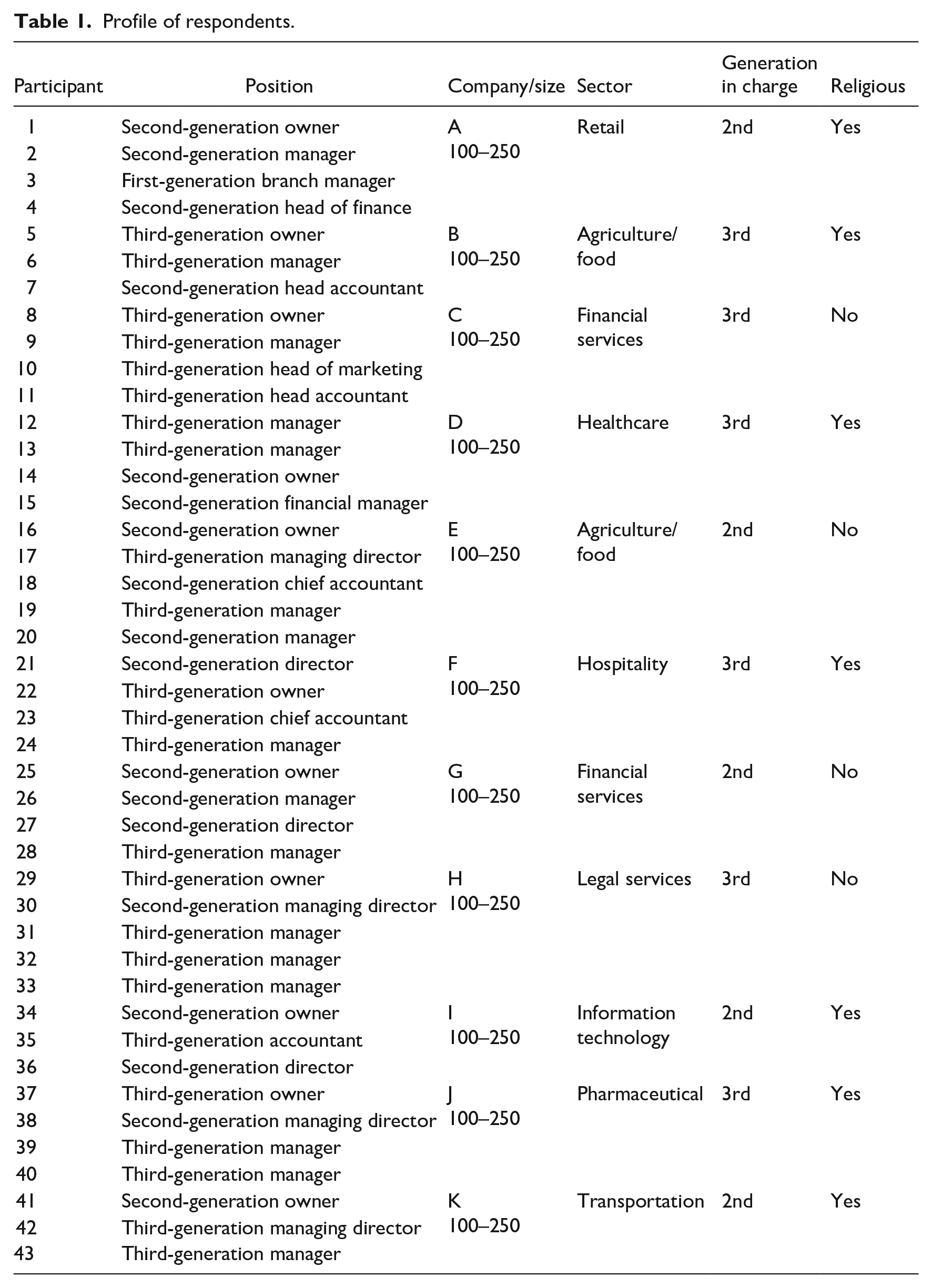
Each interview lasted for about one hour and was designed following Patton’s (2002) framework of questions unpacking knowledge, background and distinguishing questions. We asked interviewees to share their background and what was important to their family firms and how it impacted their choices of prioritising and contributing to specific SDGs. We extended our follow-up questions to check, confirm and unpack dominant logics when they repeatedly referred to a specific logic guiding their family firms. This helped us to identify the dominant logics of firms and their influence on SDG selection and implementation. We then asked about the tensions that they faced in implementation and encouraged them to share the underlying assumptions behind those challenges. As we were interested in how firms with religious logics responded to and dealt with tensions differently than firms that were not religiously dominated, we specifically asked family firms about the religious principles they used, if any.
Data analysis
The first author conducted the initial coding and analysis. All authors then engaged in discussion to revise and sharpen all emerging themes, categories and findings. We relied on Thornton et al’s (2012) seven societal-level logics (market, professional, corporate, family, religion, state and community) to identify the specific logics that guided firm behaviour in our data. We did this by analysing statements made by owners or managers in our interviews and assessed its correspondence to each logic (Goodrick and Reay, 2011).
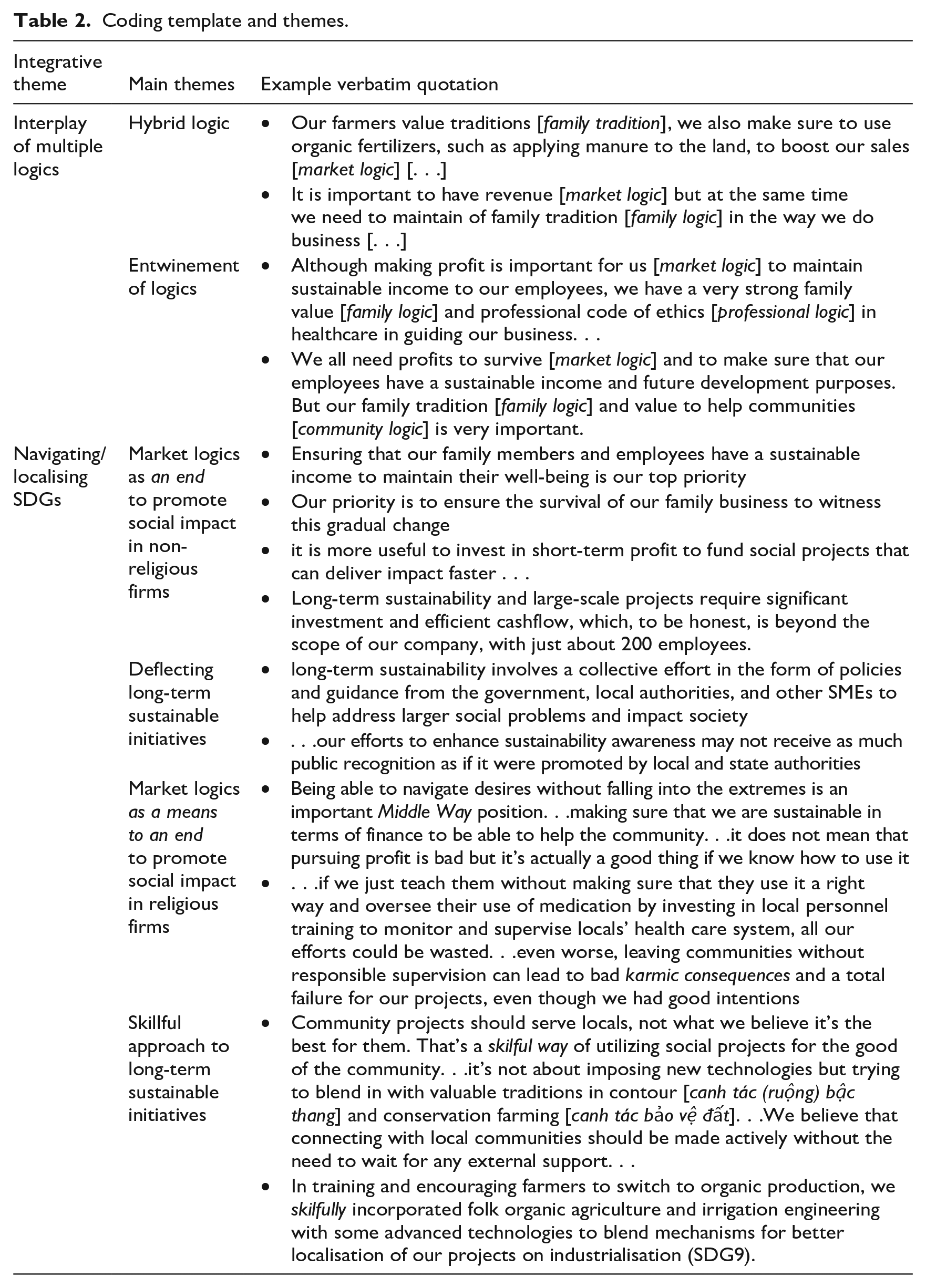
To unpack how the interplay of dominant logics influenced engagement with SDGs, we inductively analysed our data using first- and second-order themes (Miles et al., 2013). We constantly reflected the data back to relevant theory to explain relationships between categories (Golden-Biddle and Locke, 2006) and to make sense of our data and presentation. Our analysis consisted of a number of steps. First, we familiarised ourselves with the entire dataset (Braun and Clarke, 2006) to make sure that the interviewees’ narratives are captured. All authors reviewed the data multiple times and produced a brief summary outlining the key points of the narratives. We started by open coding the statements made by the interviewees to understand how different logics influenced the narratives of religious and non-religious family SMEs in their CSR initiatives, such as family tradition and market logic. Based on the narratives, we formed second-order codes that captured the interplay of different logics, including hybrid and entwinement of logics and localisation of SDGs, in the orientation of family SMEs. After coding all the statements, we reviewed the data set to ensure that our coding was appropriate. We made changes to some initial coding because we found that some statements coded early in the process matched better with first-order codes introduced later. For instance, to capture specific implications of the religious logic, we developed more specific codes based on particular Buddhist philosophical ideas informing various religious logics, such as karma, the middle way and skilful means.
We then integrated the first-order codes into higher order categories. As we built categories from the first-order codes, such as hybrid logic and entwinement of logics, the overall picture became more abstract (Locke et al., 2022). We identified the specific implications of the market logic and examined whether it differed between religious and non-religious family SMEs to enhance theoretical concepts within the dataset, such as market logics as an end in non-religious firms and market logics as a means in religious firms. The second-order codes represented the categories of themes. We combined themes that fit together into aggregate dimensions to form a coherent narrative. To determine how the themes fit together, we brainstormed ideas, went back to the data and first-order codes and sometimes explored the literature. Finally, we revisited our coding frame with discussions on any discrepancies to modify codes with a constant comparative approach to allow aggregate dimensions of the data to emerge. Our coding template shows our detailed analysis (see Table 2).
Coding template and themes.
Findings
The interplay of multiple logics in family businesses’ orientations
In the context of Vietnam, we found multiple institutional logics influencing family business orientations. For instance, bringing together family logics (e.g. family traditions) and market logics (e.g. profitability), some businesses operated on a hybrid logic: While we maintain our family tradition of using local and traditional ways of farming (such as contour [canh tác (ruộng) bậc thang] and conservation farming [canh tác bảo vệ đất]) as our farmers value traditions, we also make sure to use organic fertilizers, such as applying manure to the land, to boost our sales and ensure that we can sustain our business in the long term. (19E)
Apart from the hybrid market and family logics, family businesses also entwined market and community logics in their businesses to guide their operation, which highlights the importance of community logics in the collectivist culture of Vietnam: We prioritise our family values when running our business, which is why we exclusively rely on local manpower for our regional shops. Whenever we establish a new location, we invest in training and hiring local people because they are best equipped to understand the needs of the community. This ensures that our herbal products meet the demands of our local consumers. Also, employing locals helps us understand the preferences of different provinces and enables us to expand and customise our product range. Our approach is not just a reflection of our family’s respect for the community, but also demonstrates our commitment to social responsibility and contributing to the betterment of local communities and society at large. (3A)
Respondents highlighted how community logics can maintain family values and complement market logics since, in the context of a collective culture like Vietnam, local community help is crucial to the deployment of products or services. In hospitality, a family business emphasised the need to involve communities in developing hospitality in some provinces to better promote tourism as well as to enhance job opportunities for local people. The managing director of the firm firmly believed that they were engaged in CSR and contributing to the UN SDG of sustainable cities and communities by supporting underprivileged provinces.
Our family places great importance on our tradition of community service. When we open hotels in provinces, we prioritise providing job opportunities for locals, training them, and collaborating with local services. We also offer franchising opportunities to local individuals and conduct free evening classes on hospitality management that are open to the public. This programme has become immensely popular, prompting us to launch a YouTube channel and host biweekly Zoom classes for free. We are a socially responsible business and I am pretty sure that what we are doing is contributing to the SDGs in making sure communities are better [SDG11]. (24F)
Conversely, professional logics, professional standards and codes of ethics were also underscored in some family firms, particularly in professions like health care and law. Professional ethics were particularly emphasised in our interviews with healthcare business, guiding family businesses not to compromise their codes of ethics: While we recognise the importance of making a profit to sustain our employees’ income, we also strongly adhere to our family values and professional code of ethics in healthcare to guide our business practices. We specialise in spiritual healing and traditional acupuncture treatments. However, some customers mistake our services for superstitious practices, such as energy healing or meditation, and believe they can prescribe acupuncture on their own. We refuse to provide unnecessary acupuncture services as it can be dangerous when not needed. We care for the wellbeing of the community and by refusing to sell medications or medical services when there is not a case to do so is our way of including – even on a small scale, the SDG on health [SDG3] in our family business. (14D)
Other members of the same firm also interpreted their philanthropic activities as initiatives that furthered SDG3 (good health and well-being) through maximising community well-being: I think our family business is already doing things that relate to SDGs. Although we are a small firm, we organise charity tours every month, where our healthcare professionals provide consultations and distribute basic healthcare and emergency kits to locals in need. (13D)
In a family transportation business, providing voluntary vocational training and education to drivers in impoverished provinces is interpreted as a way of promoting education and contributing to SDG4: We don’t just charge for our services, we also offer voluntary vocational training to local people, so they can learn to drive and get jobs as drivers or shippers. I believe this aligns with what we were told at a VINASME-organised seminar on engaging with the UN’s goal of improving education a year ago. We are proud of what we do because our family values have always been about doing business while also contributing to the community. (43K)
Our findings show how multiple logics can guide different organisational behaviours (Besharov and Smith, 2014) beyond the often-emphasised hybridity of family and market logics (Jaskiewicz et al., 2016; Reay et al., 2015). Family SMEs in our study emphasised prioritising particular SDGs based on the profession/sector they are operating in and are particularly influenced by the constellation of community, professional, market and family logics. Family SMEs highlighted that the nature of their business makes it impossible to contribute to all SDGs and prioritisation is needed to maximise the quality of their CSR initiatives: It’s not that we don’t want to engage with UN’s sustainable goals. . .we all know what are they and how SMEs around the world have been promoting these goals as well. . .but it’s unrealistic to fulfil all as family businesses. . .we do not have enough financial and manpower capabilities. . .I think quality matters more than quantity. . .it’s not a matter of being able to engage with all SDGs (which is impossible) but how well we can engage with even just one. . .we have been doing extremely good (I think) in providing decent work for employees [SDG8]. . .maybe even better than larger companies. . .we invest in education and training for freshers, we promote women leadership, equal pay, extended maternity leaves and benefit, and most importantly we promote sustainability in our daily operation like switching 100% paperless, use local products to support local economy, and we use 100% solar energy. I think sustainably needs to start from the most basic things. . .changing the mindset of people before talking about grand impacts. . . (38J)
Navigating and localising SDGs in family businesses
Our data show two main orientations of family businesses in localising and contributing to the SDGs: (1) using market logics as an end to promote community impact in non-religious family businesses and (2) using market logics as means to an end guided by religious logics (Buddhist practice/philosophy) to promote community outcomes in religious family businesses.
Market logics as an end to promote social and community impact in non-religious family firms
Non-religious family businesses tended to localise their interpretation of the goals of the SDGs based primarily on market logics, particularly when there is an interplay between community and market logics.
Ensuring that our family members and employees have a sustainable income to maintain their well-being is our top priority, and I believe this contributes to the SDG of decent work. Although our business primarily focuses on financial services, we also support local communities. We offer free consultations on finance to those who want to start small businesses, encouraging economic growth in the area. Some may argue that we are promoting ourselves, but this is true and not true! We do need to survive first to be able to offer help and services to the communities. We might not be doing substantial changes but we can make changes gradually within the communities. (11C)
Non-religious family firms emphasised that there is a need to do well first. Priority was given to sustaining family and firm interests to contribute to decent work and economic growth based on incremental changes – ‘small’ rather than grand changes. Small changes were interpreted as useful, especially in circumstances where traditional values and techniques (e.g. farming) take time to transform into sustainable orientations.
Undertaking costly projects to promote sustainable industrialization and technologies (SDG9) in traditional agricultural provinces can be a long shot, requiring significant investment that may not be effective. This is because farmers may be sceptical and unwilling to adopt new technologies that need training. Instead, we introduced simple and straightforward technologies that had immediate effects on quality and production. While it may not qualify as sustainable, it is difficult to change farming practices that have been passed down for generations overnight. Our priority is to ensure the survival of our family business and promote our organic approach in agricultural products to witness this gradual change. (20E)
This is a classic example of how tensions arise from firms having to consider and combine more than one institutional logic to pursue ecological, social and economic goals simultaneously (Spieth et al., 2019). In this case, ‘to do good, you have to do well first’ reflects a fundamental tension between market and community logics. Non-religious family firms also highlighted that mobilizing capital (market logic) is needed to maintain the security and well-being of employees to promote family values.
Think of sustainability as an investment. The larger the impact we want to make, the more effort we have to put into mobilising capital for such projects [. . .] providing free financial consulting services to local start-ups in communities can not only help the local young communities but also enhance our reputation in doing CSR. (27G)
Therefore, the engagement of non-religious firms with SDGs that required long-term effort/operation were rejected in favour of actions with a short and immediate impact: We have a family tradition of ‘making an impact now’ because it has been our motto of motivation. It represents our values as sharp and decisive. . .Our sustainability projects reflect that family value. We engage in small sustainability projects that can make immediate impact such as training teachers, locals about sustainability, providing reader-friendly materials and manuals for recycling to households, supporting recycling bins. . .it’s important provide simple guidelines that can lead to immediate actions and impact. (31G)
Participant 5B noted that if their project focused on environmental protection such as investing in and building recycling centres over the next five years, local communities would not support it because they cannot see the immediate impact. They might even resist some of the environmental initiatives as it might affect their earnings from collecting scraps. Instead, it was important to focus on small acts and address more pressing issues in poorer provinces, such as providing sustainable jobs.
We need to acknowledge that some provinces are still struggling to meet their everyday needs, and having a stable job to maintain their livelihood is more important. Talking about long-term sustainable initiatives, such as recycling and environmental protection, may not resonate with some communities. For instance, in X province, some people still rely on collecting all sorts of scrap, such as plastic or aluminum, to sell to businesses. Unless their job can be secured, building recycling centres might actually pose a threat to their livelihood. (5B)
In addition, the need to prioritise short-term goals was emphasised, as it reflects the nature of small businesses and acknowledges their limited capabilities for projects with big impacts: Long-term sustainability and large-scale projects require significant investment and efficient cashflow, which, to be honest, is beyond the scope of our company, with just about 200 employees. Therefore, it is more useful to invest in short-term profit to fund social projects that can deliver impact faster. . .. (28G)
Non-religious family firms also tended to prioritise what they can do as a family business as they believe that to tackle grand challenges is beyond the scope of their individual firm. This also further explains why non-religious family firms are in favour of short-term social and community impacts as these fit their capabilities and resources whereas long-term larger projects should, in their view, rely on governmental guidance and support.
Having worked long enough with local authorities, I know very well that without their keen support and guidance, social initiatives and projects can go to waste, especially in low-educated communities where sustainability remains superficial and people care more about day-to-day and immediate impact. You just can’t expect them to think long-term when they are struggling daily. Therefore, long-term sustainability involves a collective effort in the form of policies and guidance from the government, local authorities, and other SMEs to help address larger social problems and impact society. . .. (33H)
Non-religious family firms emphasised how engaging with long-term SDG projects needs systemic support from relevant state institutions and that fulfilment of these types of goals requires a revision of economic, political, social and cultural systems (Narberhaus and Sheppard, 2015).
We have provided legal consultation to numerous other SMEs within the VINASME community. Alongside this, we run free legal clinics to help marginalised communities in rural areas who are victims of domestic abuse or gender inequality. As a small SME, we understand that our efforts to enhance sustainability awareness may not receive as much public recognition as if it were promoted by local and state authorities. . .while we can support and engage in the sustainability movement, it remains ineffective without a systemic support system from local authorities. (30H)
Non-religious firms were sceptical to invest in long-term sustainable projects because of the uncertainty of the transitional context affecting sustainable practices and orientations such as expectations for lobbying: Getting construction permits in rural areas is a time-consuming and complicated process. Even though the locals and authorities are the beneficiaries, there are implicit and hidden rules that require lobbying in local areas. As a law firm, our family firm values professional ethics. It’s frustrating and tense to see many of our projects get rejected due to a system in the country where lobbying services are normal. I attribute this issue to the transitional economy, which has given local authorities too much room to take advantage of the situation and the spirit of transitioning. (32H)
Market logics as a means to an end to promote social and community impact in religious family firms
Religious family businesses, on the other hand, had a quite different approach, using market logics as means to an end to localise and contribute to SDGs. A market logic was guided by (Buddhist) religious logics to ensure that the market logic served the community to promote social outcomes. For instance, they used the Buddhist principle of the Middle Way
3
to navigate and prioritise community logics. The Middle Way in the Buddhist Madhyamika School of Philosophy highlights how a phenomenon is both conditioning and conditioned by others (Garfield, 1995), thereby implying a balanced view and approach to life. This approach does not reflect a compromise or a midpoint between extremes, but the approach is to overcome extremes of phenomena (Vu and Burton, 2021). Based on this approach, the market logic was a means to foster community project sustainably: There needs to be a balance of how much we can earn and how much we can make use of our asset to contribute to the community. Being able to navigate desires without falling into the extremes is an important Middle Way position. . .making sure that we are sustainable in terms of finance to be able to help the community. . .it does not mean that pursuing profit is bad but it’s actually a good thing if we know how to use it. . .on the other hand, if we just think about giving away blindly, that’s an unsustainable way of running business, which also means that we cannot do community projects for a long and sustainable way. (22F)
Religious family business considered financial sustainability and profit as important means to deliver sustainability projects to help the community as long as the Middle Way is the guiding principle: not being overwhelmed by compassion at any cost and not falling into an extreme desire of profit maximisation. They also used the (Buddhist) religious logic of karmic reasoning
4
to emphasise that without long-term consideration of projects, efforts and good deeds are wasted. This marks a departure from how non-religious family firms prioritise short- over long-term impacts in executing CSR initiatives related to the SDGs: Community involvement is a long-term and exhausting process and we are prepared for it financially in the long run. . .training locals to take care of their health and well-being takes time, especially in rural areas where they just used to folk remedies (bài thuốc dân gian). . .if we just teach them without making sure that they use it a right way and oversee their use of medication by investing in local personnel training to monitor and supervise the local health care system, all our efforts could be wasted. . .even worse, leaving communities without responsible supervision can lead to bad karmic consequences and a total failure for our projects, even though we had good intentions. . .. (38J)
To make sure that positive karma is achieved in CSR projects, market logics were enacted with a normative orientation to highlight long-term outcomes via long-term supervision and oversight of local projects. In this case, SDG3 (good health and well-being) can be sustained with ongoing supervision and education (SDG4) to make sure that responsible consumption is achieved (SDG12). Furthermore, a skilful approach to actively engage with local communities is emphasised: We all value cultural traditions in our firm that is why we respect locals’ cultural customs and we try to #collaborate in our projects as much as we can and support farmers financially to learn new technologies. . .we also try to look for ways to invest in traditional farming methods that farmers are familiar with to improve farming technologies. . . In training and encouraging farmers to switch to organic production, we skilfully incorporated folk organic agriculture and irrigation engineering with some advanced technologies to blend mechanisms for better localisation of our projects on industrialisation (SDG9). (16E)
Religious family businesses defined such approaches as Buddhist skilful means. It is adopted from the doctrine of ‘skill-in-means’ (upāya-kausalya) in the Mahayana Buddhist literature, a technique used by Buddha to benefit different individuals in different contextual situations (Schroeder, 2004). This practice emphasises contextualisation, the ability to constantly deconstruct contexts reflexively to identity relevant approaches to a particular context (Vu, 2021; Vu and Burton, 2022). For example, a second-generation owner contextualised the firm’s financial capability to accommodate local cultural customs and needs. Such contextualisation requires active and close engagement with local authorities and communities to maximise flexibility and localisation of SDGs.
It’s important to listen to locals and develop community projects based on understanding what the local communities want. Community projects should serve locals, not what we believe it’s the best for them. That’s a skilful way of utilizing social projects for the good of the community. . .it’s not about imposing new technologies but trying to blend in with valuable traditions in contour [canh tác (ruộng) bậc thang] and conservation farming [canh tác bảo vệ đất]. . .We believe that connecting with local communities should be made actively without the need to wait for any external support. . . my experience is that if we show that we care about local communities genuinely, not because of any governmental scheme, both implementation and partnership can be built up effectively. (5B)
Overall, non-religious firms rely upon market logics, professional/sectoral consensus on appropriate action and await for guidance from institutions such as the government to join longer and larger projects. Religious family firms, on the other hand, consider market logics as a means to an end, guided by religious logics to maximise social and community outcomes and engagement to operationalise and implement sustainability practices. Religious family firms actively engage with communities in the absence of institutions and institutional support to agree action. Our findings show that the foregrounding of a community logic that guides a more active enactment is closely linked to the Buddhist philosophy embedded in their firm values.
Discussion
This article demonstrates how multiple logics guide different organisational behaviours (Besharov and Smith, 2014). On the basis of the interplay of multiple logics, our study makes a number of important contributions to the family SME and CSR literatures. First, foregrounds the important role of contextual appreciation in family SMEs that pursue CSR initiatives. Prior literature has focused on family and market logics in family SMEs (Miller et al., 2017) but often these studies lack a contextual framework. Our study reveals that in Northern Vietnam, context is crucial, particularly in cultures where religion plays a significant role in the lives and decisions of business leaders. In such contexts, community logic becomes a vital part of the framework. Institutional logics have accentuated the need for contextual appreciation (Aparicio et al., 2017), we contribute to the literature by illuminating how family SMEs address societal concerns in ways strongly influenced by context.
Our findings show both religious and non-religious family firms, as a complement to a family logic, relied on the interplay of professional, market and community logics to guide their CSR work (contributing to SDG initiatives). For instance, our data show how family SMEs blend community, market and family logics to engage with localism in pursuit of SDG11 (sustainable cities and communities) by placing importance on providing local education and training, local job opportunities and collaborating with local suppliers and service providers. For instance, many family SMEs offered free educational opportunities to local communities in poorer provinces with pathways into full-time work or franchising to improve their standard of living and reduce inequalities. In other narratives, business owners spoke of philanthropic activities that furthered SDG3 (good health and well-being) through providing healthcare consultations and distributing basic healthcare and emergency first aid kits to local communities in need. These kinds of community action were widespread across both religious and non-religious family SMEs and are examples of a constellation of family, market and community logics that permeated our data and reflect the context of a collective culture in Vietnam. SDGs. Community logics are an essential part of the collectivist society in Vietnam, which prioritises interpersonal relationships (Kashima et al., 1995) and obligations to the community (Triandis et al., 1988). Because such community narratives are embedded in the way people operate businesses, family SME CSR initiatives rely heavily on local partnerships and networks with local communities.
An emphasis on community logics highlights the importance of culture and context in examining SMEs’ orientation to CSR initiatives. For instance, some local communities were resistant to many environmental initiatives pursued by family SMEs, as these ‘green’ initiatives would impact their income from collecting and selling ‘scrap’: ‘Unless their job can be secured, building recycling centers might actually pose a threat to their livelihood’ (5B). Therefore, firms perceived it as crucial to prioritise social and community aspects of their CSR over environmental action and in ways that address employment opportunities and reduce inequality. Community logics serve as an informal institution of ‘socially shared rules, usually unwritten, that are created, communicated, and enforced outside of officially sanctioned channels’ (Helmke and Levitsky, 2004: 727), to establish the necessary conditions for trust and co-operation (Farrell and Knight 2003) with local communities and beneficiaries.
Our second contribution deepens the existing understandings of the influence of a (Buddhist) religious logic in the CSR decision-making of family SMEs. Prior studies have suggested that while several institutional logics may interplay in the decisions and actions of businesses in CSR, family and market logics occupy a primary role (Aparicio et al., 2017; Miller et al., 2017). In examining differences between religious and non-religious family firms we uncover that, unlike prior research suggesting a strong duality of family and market logics influencing CSR action, a constellation of logics – family, market, community and professional – influence the decisions to contribute to the SDGs.
Our study suggests that in non-religious firms, the family, market, professional and community logic co-exist. Non-religious family firms pursue CSR initiatives influenced by a balance of market and family logics because it benefits the family, firm and community, but it also represents an instrumental approach to CSR. In our study, the market logic for non-religious firms showcases an instrumental rationale and contributing to the SDGs were viewed as an economic end, where improvements in reputation, efficiency, economy, profit and performance drive the rationale behind action (Randerson, 2022). For non-religious family SMEs, CSR initiatives were recognised as a means to further the success of the family and the firm and there was widespread acknowledgement that ‘to do good, you have to do well first’. CSR initiatives were largely confined to ‘small acts’ that were within the capabilities and financial resources of the firm. Non-religious family SMEs spoke of supporting CSR initiatives and contributing to the SDGs through actions that had an immediate and tangible social and community impact such as providing educational resources and foregrounding actions that would also benefit the firm. For example, non-religious family SMEs described an instrumental logic for their CSR initiatives, such as ensuring that their CSR could help them to promote sales (e.g. organic and healthy products) or using their free consulting services to enhance the firm’s reputation. Non-religious family firms also tended to deflect the responsibility to tackle systemic and long-term social and community issues to state and governmental institutions.
Yet, while our findings reveal that whilst market, family and professional logics play a crucial role in all (religious and non-religious) family SMEs, when a (Buddhist) religious logic is present in the firm, the decisions and action are less influenced by a family logic and more by a religious logic. For instance, religious family SMEs repeatedly referred to three philosophical ideas in Buddhism that guide their CSR initiatives: the Middle Way, Karmic Reasoning and Skilful Means. The Middle Way was used by family SMEs to achieve an appropriate balance, over the long run, between the firm’s objectives on the one hand, and the needs of the local community on the other. Religious family SMEs also referred to the Buddhist principle of karmic reasoning (considering the motive, action and outcomes of initiatives) to emphasise social ends and outcomes and a long-term perspective. Religious family SMEs spoke of the need to avoid pursuing CSR initiatives with short-term impacts and to support community projects over the long run, with appropriate commitment, resources, support and oversight. For these family SMEs, good intentions or motives were insufficient to effect lasting change and moreover that short-term impacts were likely to fail and lead to unnecessary resource waste (bad karma). To achieve ‘good karma’, it required both pure motives and the means to execute long-lasting social and community change. Finally, our respondents spoke of the importance of skilful means to effect change. Skilful means was interpreted as a principle of delegating both resources and agency to local communities to decide what is best in the context. For religious family firms, the enactment of these principles enabled the firms to invest in more complex projects with more uncertain outcomes and to delegate both resources and agency to local communities.
In the religious family firms, a market logic is still influential, however, our study suggests that the presence of a (Buddhist) religious logic has two main effects. First, while our study does not claim that the market logic is minimised or disappears when a (Buddhist) religious logic becomes an influential force in the constellation, we unveil how a religious logic appears to change the character of the market logic from an instrumental to a normative interpretation. These religious family SMEs reinterpreted the market logic as normative, whereby economic ends accruing were reinvested to provide further means to widen their support and commitment to local projects over the long run. Religious family SMEs pursued economic ends to remain viable over time, yet such a pursuit focuses on a normative commitment related to how financial goals are in the service of CSR initiatives rather than primarily for the benefit the family or the firm. By drawing upon the three primary tenets of Buddhist philosophy to guide CSR decision-making, this finding suggests a way to balance sustainability and profitability as a tale of two logics (De Clercq and Voronov, 2011). The second effect suggests that the constellation of logics influencing religious family SMEs shifts its primacy from the family and the firm towards community. This suggests not only a constellation of logics influencing decisions to pursue social commitments but also a shift in terms of changing direction or influence from what previous studies have revealed (Miller et al., 2017).
To advance theoretical understandings, we explain the influence of religion in both the shift of primacy in institutional logics and in the instrumental to normative change in the character of a market logic based on a contrast between stewardship and agency perspectives. Agency and stewardship perspectives are relevant as it connects aspects of CSR and institutional logics accordingly (Miller et al., 2017). Agency theory in family firms explains how incumbents rely on others to conduct business according to their family values and desires, where the firm may serve as a vehicle for family utility (Howorth et al., 2010). Agency theory is grounded on the assumptions that family members will be driven by self-serving goals and thus influenced by the interplay between family and market logics. In our study, although non-religious family firms commit to act towards the SDGs, the dominant logics are family and market, reflecting an instrumentality in such initiatives.
Nevertheless, an agency perspective is limited in explaining what occurs when a religious logic is introduced as religion influences a shift away from family logics and towards communities. Such an approach can be theorised through stewardship theory, which assumes a relationship-based system with a focus on non-financial objectives, explaining situations in which individuals serve the organisational good, based on an intrinsic desire to pursue collective goals (Madison et al., 2016). In our study, family SMEs influenced by (Buddhist) religious logics appear to make commitments to the SDGs through aiming to look after communities and other stakeholders, thus suggesting a stewardship behaviour. Such results extend recent studies, which pose that long-term commitments by family SMEs and shared identification with core cultural values explain why family members engage in CSR through stewardship based on a family logic (Discua Cruz, 2020). Through adopting a ‘skilful means’ approach in localising the SDGs, for example, religious family firms were able to facilitate long-term CSR initiatives by strengthening partnership and collaboration with local communities without the need to rely on governmental and institutional support. In addition, from a market perspective, a stewardship perspective focuses on items such as ‘financial assets, physical facilities, products and services, systems, and processes’ to benefit several generations (McCuddy and Pirie, 2007: 962). For religious firms, however, their commitments to the SDGs are not just stewarding the family or business organisation for the long term but stewarding something larger – their society and the planet. Stewardship is then underpinned by a logic constellation, with religion changing the primacy away from family to community. The interplay of logics in religious and non-religious firms is summarised in Figure 1:
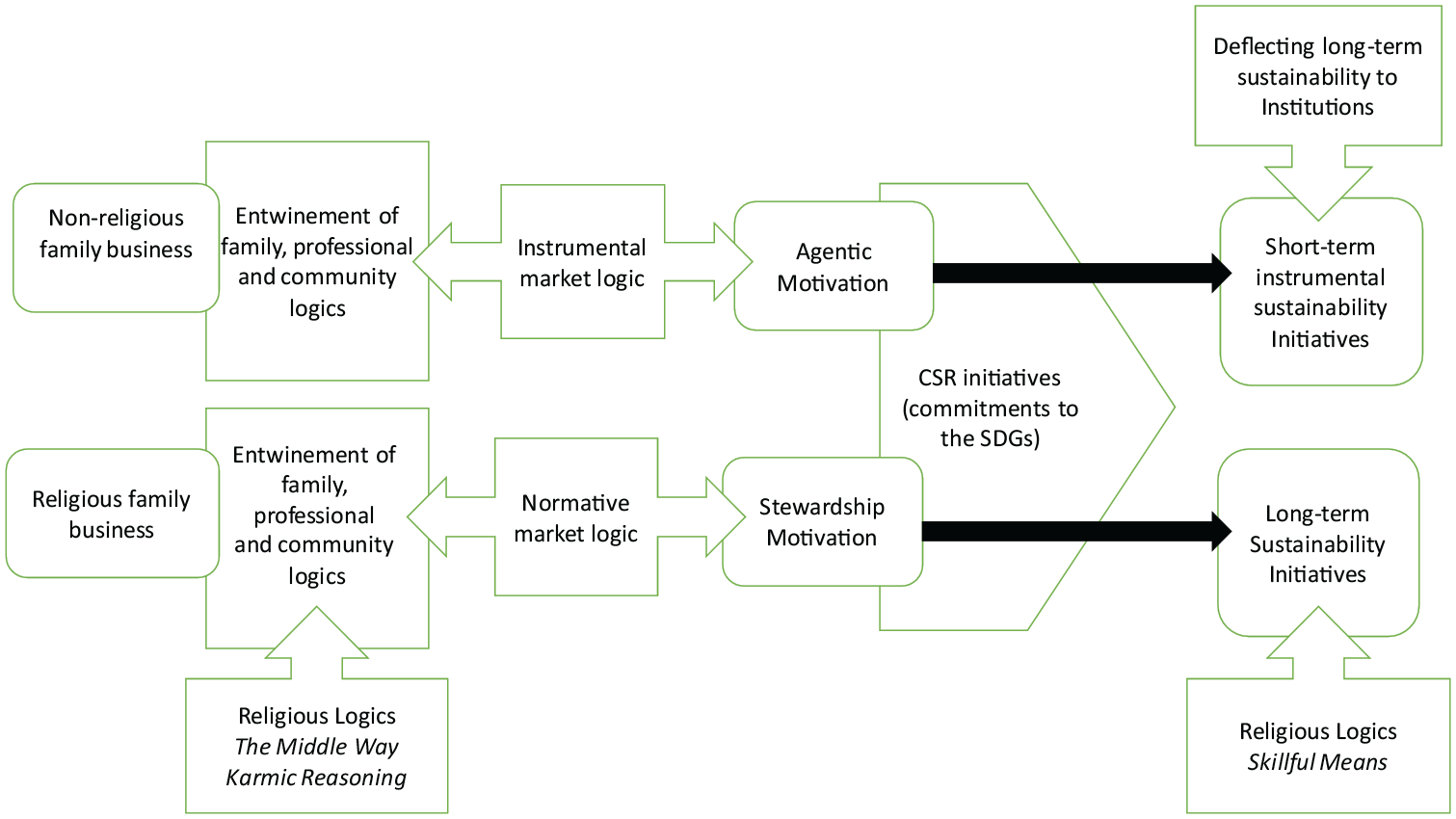
Constellation of logics in religious and non-religious family firms.
This article expands the body of evidence that aspects of CSR in family SMEs may have a stronger relationship to stewardship and religion than previously believed (Burton et al., 2022; Discua Cruz, 2020). By demonstrating how (Buddhist) religious logics have an influence in the character of market logics through a shift underpinned by a stewardship behaviour that goes beyond the family realm, our study underscores the way community becomes a key logic for decisions related to SDGs.
Limitations and future research
While our study provides important implications for the much needed contextual appreciation of commitments to the SDGs (Heras-Saizarbitoria., 2022) and highlights how implementing and localising SDGs in family firms involves the need for an adequate examination of the broader culture and context, including the openness of societies, the institutional context and social interrelationships (Patuelli et al., 2022; Wright et al., 2014), it is important to note that the (Buddhist) religious logic in our study (operated via the Middle Way, karmic reasoning and skilful means) sits within a particular philosophy of a specific tradition that is context specific and may not be applicable to other contexts.
To expand on how different normative commitments affect CSR decisions, further studies are necessary in different contexts (Allen et al., 2016). One potential avenue for further research is exploring the influence of various religions on such decisions, including how religious communities engage with transnational programs such as the SDGs and the tensions that they encounter. This area is particularly noteworthy since the family business landscape is inherently paradoxical (McAdam et al., 2020). Furthermore, to better understand the dynamics of different traditions on religious logics that influence family businesses, future studies may examine different traditions. Additionally, future research could investigate how formal and informal institutions generate trade-offs, tensions and paradoxes (Moratis and Melissen, 2022) that affect the interplay of multiple logics of family businesses.
Conclusion
Our contributions support the view that multiple objectives and diverse forms of engagement (e.g. instrumental, normative) may be showcased by family SMEs in pursuing initiatives to benefit society (Randerson, 2022), and extend our knowledge in terms of the institutional logics that influence each rationale. Examining the religious logic has revealed the constellation of logics involved in commitments to the SDGs and its effects. A religious logic shifts the primacy of rationale from family to community and changes the character of a market logic. Thus, a religious logic has the potential to shift the approach of family SMEs from an instrumental agency behaviour to a normative stewardship-influenced engagement. In other words, a religious logic could change the behaviour of family firms from a self-interest market logic to a stewardship perspective of market logic (i.e. enabling family business leaders to do good for others based on values and beliefs).
By seeking to understand how adding multiple institutional logics to this already complex system of practices, assumptions, values and beliefs, our study provides new insight into what motivates the pursuit of specific CSR practices (Ferreira et al., 2021). While previous studies highlighted how a policy mix encouraging firms to take a voluntary approach is preferable when seeking a balance between responsibilities for the environment and the economy (Arimura et al., 2008), within national contexts suffering from weak institutions such an approach can mask the principles of sustainability in forms of SDG washing. SDG washing (Heras-Saizarbitoria et al., 2022) can take place in contexts like Vietnam where family SMEs can fall into symbolic or impression management approaches (van der Waal and Thijssens, 2020). Future studies exploring issues around SDG commitments by family SMEs in other transitional contexts will expand our understanding of the interplay of competing logics and the influence of religion.
Footnotes
Funding
The author(s) received no financial support for the research, authorship, and/or publication of this article.
