



Abstract
This article draws upon dialogic theory to explore how meaning is co-constructed in dialogue as founding entrepreneurs devise strategies for venture growth. Drawing from a longitudinal study of the impact of a UK University business growth programme upon such strategies, we identify ways in which dialogue influences the meanings attributed to the adoption of, or resistance to, growth strategies. ‘Productive’ dialogue emerging from a diverse range of relevant voices encouraged founders to reflect upon the meanings given to current growth initiatives whilst devising future strategies. Conversely, founders could use ‘degenerative’ dialogue to block the voices of others in order to resist change and protect existing meanings. We contribute to debate by utilising dialogic theory as a conceptual tool to illustrate how business growth programmes shape the meanings founders apply to embrace, or resist strategic change, to effect venture growth.
Introduction
A key challenge for entrepreneurship research is theorising what persists and what changes during venture growth (DeSantola and Gulati, 2017). Strategic entrepreneurship theory provides one solution when explaining how growth is achieved by simultaneously synthesising opportunity-seeking (i.e., entrepreneurship) and advantage-seeking (i.e., strategic management) behaviours (Ireland et al., 2003; Keyhani, 2023). By conceptualising strategic entrepreneurship as a process (Hitt et al., 2011; Wright and Hitt, 2017), scholars have addressed many of the limitations of growth theory. These arose as theory building was predicated upon explaining why firms grow, rather than examining how firms grow (Gilbert et al., 2006). By building upon theories conceptualising growth as a dynamic interactional process (Penrose, 1959), such as resource orchestration (Sirmon et al., 2011), strategic entrepreneurship moved away from identifying antecedents to growth and measuring variations in outcomes (Ireland et al., 2023). By combining concepts from entrepreneurship and strategic management, strategic entrepreneurship theory has provided valuable insights into the process of venture growth (McKelvie and Wiklund, 2010).
Strategic entrepreneurship theory has advanced the conversation about growth by embracing theoretical pluralism to examine how firms create and sustain current advantages while pursuing opportunities that create new advantages (Ireland et al., 2023). As has been argued, analyses of growth can be enhanced by studying heuristics (Bingham et al., 2019), resource configurations (Clarysse et al., 2011), portfolio entrepreneurship (Baert et al., 2016) spatial factors (Spigel and Harrison, 2017) and historical contexts (Wadhwani et al., 2020). However, despite these advances there is much scope for further analyses of diverse aspects of the growth process; for example, we know little about how founding entrepreneurs apply meaning to growth (DeSantola and Gulati, 2017). As the seminal work by Ireland et al. (2003) demonstrated, founding entrepreneurs shape culture, strategies and general advantage-seeking behaviours within the venture. Developing an entrepreneurial culture that is supportive of risk taking, innovation and learning remains a key theme within Strategic Entrepreneurship research (Ireland et al., 2023). However, while current research shows that intra-firm ‘strategic learning’ and learning from collaborative innovation influence Strategic Entrepreneurship (SE) (Ireland et al., 2023), we know less about the processes through which founder’s meaning-making changes in ways that may prove beneficial for developing SE, or persist in ways that may equally prove detrimental particularly if they cannot, or will not, draw upon alternative meanings to identify and enable appropriate changes to enhance growth (DeSantola and Gulati, 2017).
While extant theories explain why a transition in meaning-making is necessary during growth, there is less clarity about how founder meaning-making may change or endure. This is problematic as analysing the precise mechanisms enabling and constraining the transition in meaning-making lack clarity (DeSantola and Gulati, 2017). This raises several related puzzles, such as how exactly founders become more conscious of the need to change during growth (Penrose, 1959) and develop ‘sufficient insight into their own culture to make an intelligent transition process’ (Schein, 1983: 28). Or, at a more general level, how founders draw upon heterogeneous notions of growth; for example, those articulated by advisors, policy makers, academic theorists or expert consultants (Leitch et al., 2010).
To explore how meaning-making informs strategic approaches to growth, we focus upon how founders transpose meaning-making into dialogue and so, we build on research exploring the influence of language upon entrepreneurship (Hjorth and Steyaert, 2004) and strategy (Barry and Elmes, 1997). Analyses of how language shapes the understanding and exploitation of entrepreneurial opportunities is well established (Dimov, 2020) with studies of how entrepreneurs engage in meaning-making during dialogic interactions (Steyaert, 2004), such as intertextual storytelling (Boje and Smith, 2010; O’Connor, 2002), face to face interactions (Fletcher and Watson, 2007) and crowdfunding (Gegenhuber and Naderer, 2019). Yet, analyses of how language use within dialogue shapes meaning-making remains limited to studies of new knowledge (Baralou and Tsoukas, 2015; Tsoukas, 2009), strategic change (Spee and Jarzabkowski, 2017; Thomas et al., 2011) and building dynamic capabilities (Salvato and Vassollo, 2018). To advance debate, we use dialogic theory to conceptualise how founder meaning-making can be ‘opened up’ by engaging in dialogue with others; this subjects their views to challenge or question causing self-reflection or indeed, embeds resistance to change.
Building on a relational ontology, we define dialogue as a fulcrum that encourages co-construction of meaning by connecting utterances. Utterances are defined as nodes connecting a speaker’s intentions and interactions with others (Renfrew, 2014). They are in effect, links in chains connecting a speaker’s prevailing meanings to ‘polyphony’ whereby diverse voices oblige speakers to respond to their utterances (Bakhtin, 1986). Engaging in polyphonic dialogue raises the possibility of challenges to one’s meaning-making but also, can open pathways to generate new meanings (Bakhtin, 1986; Boje, 2008). Consequently, engaging in dialogue can be productive (Tsoukas, 2009) in changing prevailing meaning-making, for instance when making sense of, and assimilating the words of others, into one’s own utterances (Bakhtin, 1986) thereby, extending understanding. However, speakers can resist the utterances of others by ignoring, silencing or dominating their views. At this point, dialogue becomes degenerative as existing meanings are not effectively challenged, evaluated or extended. On this basis, we argue that dialogic theory is an appropriate conceptual lens to analyse how founders engage with venture growth strategies when subject to polyphony as is the case when engaging with University small firm growth programmes. Accordingly, our research objective is to: ‘Critically evaluate how founder meaning-making changes or endures when engaging in dialogue with diverse utterances about venture growth strategies’.
To study how founder meaning-making is influenced by dialogue, we utilise empirical material gathered from an executive education programme devised for founding entrepreneurs seeking to grow their ventures. The evidence consists of data from 6 years of fieldwork arising from a UK University business school small firm growth programme whereby 100 founders participated across three cohorts. During the programme, founders were continuously encouraged to articulate their growth plan and respond to questions and debate from others, while also planning for future outcomes. This generated dialogic interactions in which founders engaged with a diverse range of academics, practitioners, peers and consultants. Using participant observation, interviews and by gathering artefacts such as posters produced to outline growth plans, we assembled a set of real-time and retrospective (Eisenhardt and Graebner, 2007) textual and oral utterances. These were analysed to show how founder meaning-making endured, or changed, as a result of participating in dialogue during the programme. Our analysis revealed that dialogue could, but did not automatically, encourage founders to change their meaning-making – productive dialogue encouraged founders to evaluate prevailing meanings and assimilate new meanings relevant for extending growth plans and activities. In contrast, degenerative dialogue, whereby founders resisted challenges to current thinking, prevented engagement with change and strategic development.
To explore our arguments, our paper commences by outlining a theoretical framework to present the problem under consideration. We then defend our methodology and present empirical material to illustrate our framework; we close by considering the limitations of our study and implications for practice. Thus, the paper contributes to growth theory when analysing how dialogue creates a fulcrum for founders to develop a more entrepreneurial culture enabling growth (Ireland et al., 2003).
Growth and founder meaning-making
As a firm grows and increases in scale and scope (Roberts, 2004), it has to be restructured and adapted to attain and exploit a diverse range of resources (Sirmon et al., 2011); in addition to substantive changes, a greater understanding of how to sustain growth and strategically utilise assets is necessary (Bhide, 2000). Founders therefore, face multiple challenges as they organise their firm, develop teams and change culture (DeSantola and Gulati, 2017). As these challenges emerge, applying existing meanings to growth may be inappropriate, for instance as formal structures evolve as professional managers and functional experts are employed (DeSantola and Gulati, 2017; Flamholtz and Randle, 2016). The extent to which founding entrepreneurs are willing and able to change, for example by adjusting the limits of their personal control, is a key influence on a firm’s ability to grow (Wasserman, 2017). Founder values, beliefs and commitment are highly influential during the creation of a venture in terms of establishing its culture; however, during growth their imprint can impede change if they are unable or unwilling to adapt and change (DeSantola and Gulati, 2017; Zuzul and Tripsas, 2020).
While the influence of founder-based cultural meanings upon the structure, management and growth of the firm has long been recognised (Schein, 1983), there is a paucity of evidence regarding how such meaning-making evolves or endures during growth (DeSantola and Gulati, 2017). There is a plethora of formal consultancy and support services which profess upon what constitutes growth and how to achieve it (Leitch et al., 2010). In addition, founders draw upon personal experience, motivations, families, friends and beliefs to develop their own theories about growth and how it might be achieved (Rindova and Martins, 2018). This diverse range of often conflicting information combines into unevenly distributed ‘blueprints’ regarding how to grow the venture (Aldrich and Yang, 2012). So, there is a rich body of evidence regarding what constitutes growth and how to attain it, but we know far less about how founders apply meaning to growth to make sense of it and build relevant strategies for their ventures (Achtenhagen et al., 2010). To gain greater understanding of meaning-making, we need to analyse the micro-processes founders develop to understand growth and how to achieve it.
Research into cultural change shows shared meanings tend to be configured during negotiations and social interactions occurring in small social networks (Patterson, 2014). We view founder meaning-making as an instance of cultural configuration as shared meanings about growth are interpreted and negotiated. Crucially, as growth puts pressure on founder-based meanings (DeSantola and Gulati, 2017), so personal meanings regarding what constitutes growth and how to grow the venture are likely to be evaluated and shift particularly during dialogic interactions with others. The degree to which founders change their meaning-making depends on a willingness and ability to reflect upon their current actions to become more aware of how their ideas and actions enable or constrain growth (Penrose, 1959). Building upon Patterson (2014), we assume one space where founders might change their meaning-making is when interacting with small-scale networks created to evaluate and develop growth plans, such as University business school firm growth programmes. Such initiatives generate a context for founders to interact with others and so, change prevailing meanings of growth. Dialogue in such contexts is particularly relevant when encouraging a re-weaving of the webs of established beliefs that limit change by reproducing biases and knowledge limitations (Tsoukas and Chia, 2002). We assume ‘dialogic space’, generated when entrepreneurs interact with faculty (Dimov et al., 2021), creates the possibility of changing founder’s meaning-making as they interact with a diverse range of actors who articulate differing experiences, theories and perspectives about growth.
Language, dialogue and the micro-processes of founder meaning-making
We have suggested that founder-based meaning-making is likely to be reconfigured during dialogue in small-scale networks evident in initiatives such as University small firm growth programmes. To conceptually analyse how this occurs, we draw upon dialogic theory given its relevance for exploring the micro-processes of meaning-making and organisational change (Spee and Jarzabkowski, 2017; Tsoukas, 2009; Vaara et al., 2016) Dialogic theory conceptualises meaning-making as relational achievement as during dialogue, language provides a shared cultural tool enabling inter-subjective connections (Cunliffe et al., 2014; Fusaroli and Tylén, 2012). Such interchanges enable individuals to reflect upon their prevailing assumptions and extend meaning-making in ways that would be impossible if alone (Fusaroli et al., 2014). As dialogue creates a fulcrum for evaluating prevailing meaning, so it extends understanding as new meanings are assimilated (Grove, 2015).
Dialogic theory has been applied to extend understanding about the micro-processes of meaning-making informing both strategic and entrepreneurial activities. For example, we know dialogue contributes to creating new knowledge (Tsoukas, 2009), authoring strategy (Barry and Elmes, 1997), achieving joint agreement during change (Spee and Jarzabkowski, 2017), organisational identification during mergers (Vaara and Tienari, 2011), and developing dynamic capabilities (Salvato and Vassolo, 2018). We also know dialogue enables changes to entrepreneurial identities (Boje and Smith, 2010); supports the identification of proto-opportunities (Fletcher and Watson, 2007) storytelling (O’Connor, 2002) and crowdfunding (Gegenhuber and Naderer, 2019). Given the scope of dialogic theory to explain and illustrate the micro-processes of meaning-making, we draw upon the construct to analyse the mechanisms through which founder meaning-making endures, or changes when making sense of growth. First, we build on the relational ontology of dialogic theory to suggest that dialogue provides a space for founders to co-construct meanings about growth when becoming answerable to others (Bakhtin, 1986). Dialogue creates polyphony that draws together multiple voices and views into a shared space (Boje, 2008). For instance, a founder engaging in dialogue about growth strategies will encounter multiple views upon the subject; this can increase reflection upon, and evaluation of, taken-for-granted meanings (Grove, 2015; Tsoukas, 2009). Thus, dialogue encourages founders to evaluate prevailing meanings [either positively or negatively] about strategies for future growth (Vaara et al., 2016).
Second, we assume the effects of dialogue on the fabric of meaning-making can be studied by analysing utterances (Boje, 2008). Utterances are conceptualised as ‘interpersonal accomplishments’ (Baralou and Tsoukas, 2015) as they contain a speaker’s intentions, a speech situation and a speech interaction (Bakhtin, 1981). As utterances connect in dialogue, so a speaker might assimilate the words of others into their own expressions (Bakhtin, 1986). As assimilation extends a speaker’s meaning-making, dialogue can extend [or embed] a founder’s understanding of growth.
Third, we assume dialogue may be productive or degenerative (Spee and Jarzabkowski, 2017; Tsoukas, 2009). Productive dialogue occurs when polyphony generates new meanings through a collision of multiple views, logics and perspectives (Boje, 2008: 65). This is relevant for making ‘bets on the future’ that enable organisational change by constructing alternative future possibilities (Vaara et al., 2016). Degenerative dialogue occurs when speakers silence, or talk past others (Tsoukas, 2009) by, for example, using monologues to silence others and so, inoculate the speaker from polyphony (Bakhtin, 1986). Retelling old ‘war stories’ and exerting authoritative communication are both instances of monologic expression. We apply this distinction when assuming that productive dialogue encourages founders to change prevailing meanings, biases and limitations relating to growth (DeSantola and Gulati, 2017). Conversely, we assume degenerative dialogue reproduces enduring meanings that act as a barrier to developing new meanings to apply to growth.
Summarising, we draw upon concepts from dialogic theory to study the micro-processes of founder meaning-making. We apply the relational ontology of dialogic theory to conceptualise dialogic events as opportunities for founders to participate in a co-construction of meaning-making about growth and in so doing, become more aware of their biases and limitations. We acknowledge that dialogue may change founder meaning-making as they assimilate (or not) the words of others and apply them to evaluate prevailing understandings of growth and devise strategies for future growth. Dialogue may however, be productive or degenerative. The former encourages founders to extend prevailing meanings whereas the latter is the basis of resistance to change ensuring existing strategies endure.
Methodology
An interpretative qualitative process methodology was used as this is appropriate for studying the mechanisms informing organisational and managerial phenomena (Bansal et al., 2018). The focus here is upon the influence of language, which is central to contemporary analysis of strategy (Vaara and Langley, 2021) and entrepreneurship (Dimov, 2020). We adopt a process approach to theory building which is consistent with the relational ontology of dialogic theory, as both conceptualise meaning-making as an ongoing relational achievement (Langley et al., 2013; Tsoukas, 2009). They both seek to integrate context into theory-building using observational data to explore meaning-making (Spee and Jarzabkowski, 2017). Theorising in this way involves elaborating the underlying ‘motors of change’ (Bansal et al., 2018: 35). We define these as mechanisms generated within dialogic interactions, so as to elaborate how dialogue informs the micro-processes of meaning-making (Spee and Jarzabkowski, 2017).
Research setting
We collected data over 6 years (2012–2018) during and following a UK University business school small firm growth programme. The timing is significant as it followed UK policy calling on business schools to create programmes for small firm founders (Young, 2013). The expectation being that such initiatives would generate growth by providing leadership and management training (Hayton, 2015). The programme was designed and delivered by an executive education team for a local city authority and so, independent of national and international provision. The executive education team controlled the content and selection of faculty and participants ensuring separation between the researcher’s interests and the executive education team.
The executive education team and researchers both comprised of three members; in addition, various subject expert academics, professors of practice, practitioners and guest entrepreneurs contributed with an overall faculty of 27. Their collective knowledge generated polyphonic meanings about growth including practical insights from senior executives and entrepreneurs with experience of founding, raising investment, growing and exiting via IPO, Management Buy Out and Trade Sale. The team also provided access to professional and theoretical knowledge through the presence of faculty with PhD and MBA qualifications.
Delivery was undertaken over three 12 month periods from 2012 to 2015, with an average cohort size of 35 who partook in 96 hours of workshops (12 × 8 hour workshops). To join, each founder made a formal application (147 in total) summarising their growth aims and a personal statement about what they hoped to gain; each was checked for eligibility and interviewed by the executive education team. The workshops were themed around growth topics including finance, strategy, leadership and sales, culminating in an oral and poster presentation summarising their growth plan in the final session. Three advanced workshops were held, extending the research into a 4th year (2015–2016), for those completing the programme (77). A smaller number of participants (14) remained connected to the business school by renting office space on the University campus; becoming ‘entrepreneurs in residence’, sponsoring MSc and MBA student projects or undertaking knowledge exchange activities. As the programme unfolded, the researcher team observed three cohorts of founders as they engaged with the business school. This included physically visiting the University campus, sitting in a classroom and engaging in learning activities encouraging founders to evaluate their understanding of growth by interacting with other founders and faculty. The participants were all founders of small businesses located in the same city location with an average firm age of just over four years and 13 employees. As the participants self-selected to join the programme, it is important to note that the sample was not random.
Data gathering
We used multiple methods to gather data (see Table 1). Participant observation was undertaken in two ways. First, one member of the research team joined the executive education team as academic adviser (Cohort 1) and later took on a programme management role (Cohorts 2 and 3). This enabled 360 hours of participant observation helping recruit participants and faculty; facilitating workshops and meeting the client to feedback. Second, each member of the research team participated in programme delivery, two became mentors attending all (39 × 8 hour) workshops (624 hours) and all three gave academic presentations. The potential for introducing bias was minimised as the content was largely designed prior to their direct involvement. The researchers did however, design content, based on their subject expertise; this amounted to 15 hours across all cohorts, or five percent of the total programme content. These roles enabled the research team to capture field notes while observing founders before, during and after the programme. Being in the workshops and spending time with the executive education team enabled observation of founders engaging in meaning-making. This occurred as participants listened and responded to guest speakers; interacted with other participants in formal learning activities and informally during breaks or after workshops. One researcher was also invited to attend multiple events organised by participants outside the programme including meals, workplace tours, award events, product launches and office openings. This made it possible to observe founders discussing growth ‘in the moment’ (Vaara and Langley, 2021).
Data sources and use in analysis.
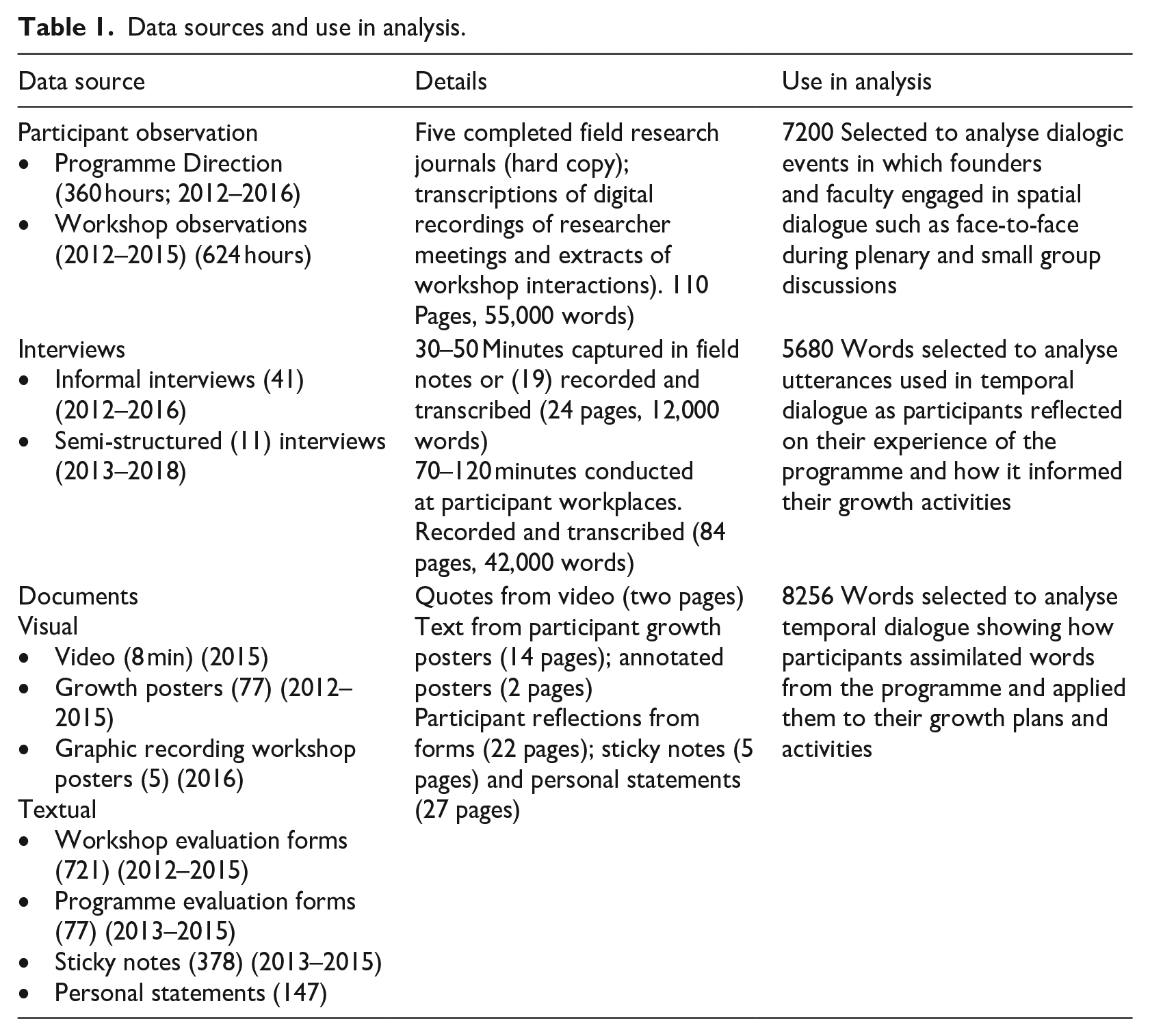
The real-time materials (Eisenhardt and Graebner, 2007) gathered from observations were supplemented with audio recordings (38 hours) made when speakers gave permission; these included Q&A sessions and plenary discussions. Extracts of dialogic events were captured from field notes and recordings. The research team then added their own reflections on dialogic events in which participants, guests and faculty discussed growth, revealing points of difference and agreement. These were transformed into meaningful text (Jarzabkowski et al., 2014) throughout the research period as five completed field journals were exchanged and discussed – typically once a month. Multiple theories were applied to conduct an initial analysis of how the programme was influencing founder meaning-making. Appendix A1 shows the outcome of one meeting in which extracts of dialogue from a workshop on strategy were discussed. The image shows how initial ideas, such as pausing and breakdown, were used to analyse whether participants’ ‘untested and intuitive entrepreneurial practices’ were potentially being changed by the programme.
Interviews were conducted to gather retrospective accounts (Eisenhardt and Graebner, 2007) about how the programme informed growth plans and activities. Informal interviews (41) were conducted during the programme. These lasted 30–50 minutes and were initiated by participants. Sometimes, participants asked specific questions related to the researcher’s expertise, at other times, they asked if they could ‘talk through’ growth challenges. Permission was sought to include these interactions upon an anonymous basis for research purposes with half (19) of the informal interviews recorded. Semi-structured interviews (11 in total) were conducted using a standard interview protocol to elicit participant accounts of how the programme influenced their growth activities; they were undertaken at participant workplaces lasting between 70 and 120 minutes.
We also gathered visual and textual documents. The visual materials included an 8 minutes promotional video created by the executive education team, who interviewed participants independently of the researchers. Photographs were taken of all the growth posters (77) created to accompany a 10 minutes oral presentation in the final session. Each poster summarised future growth plans (see example in Appendix A2) and provided a useful textual record of how participants had assimilated meanings from the programme. We also kept five large posters used in a graphic recording exercise in an advanced workshop (see Appendix A3). These were annotated by 18 participants and provided additional insights into participant experiences of the programme.
Textual documents included evaluation forms completed during each workshop (721 forms in total) and an extended form completed in the final session of each cohort (77 forms in total). The former asked participants to rate each workshop topic/speaker and included one to two pages for reflections upon what they would take away from the workshop and apply before the next meeting. The programme evaluation forms were longer and completed once only during a two-hour ‘reflective wall’ exercise. Participants were asked to summarise how the programme had informed their understanding of growth (300–500 words). Then, working in small groups, they created a wall of large sticky notes (378) capturing their collective insights. We also gathered personal statements (147) submitted during the application process; these provided 200 word accounts summarising what they hoped to gain from attending the programme. From the above we assembled a data set comprising 290 pages (145,000 words) of field notes, participant accounts, transcripts as well as images, audio recordings, video and documents. This was useful for analysing how different meanings about growth circulating dialogue influenced founder meaning-making. By being embedded in the programme as a research setting, it was possible for us to collate the data set while feeding back initial analysis. We could then test initial findings while interacting with founders as they were engaged in growth activities.
Data analysis
As the programme spanned a period of 4 years analysis was conducted throughout the programme; multiple data sources informed our decision to focus our analysis on dialogic events. Programme evaluation forms provided a valuable indicator of the value participants placed on interacting with others. Across all three cohorts the forms (N = 77) consistently showed how participants valued ‘time for individual reflection’ (4.72/5) and ‘interacting with other business owners’ (4.58/5) as the most valuable aspects of the programme. This resonated with our initial analysis of interview accounts and field notes. We used a qualitative process approach (Jarzabkowski et al., 2017) to extend our initial analysis by applying concepts from dialogic theory. As we show below, these were useful for decomposing the data so we could analyse how dialogue influenced, or indeed did not, the micro-processes of founder meaning-making.
In the first stage of analysis, we focused on face-to-face dialogue in which participants discussed their growth plans. This showed the range of voices and multiple meanings introduced which typically ranged from 31 to 44 voices per workshop. This enabled us to analyse which meanings about growth for example, participant-based, investor-driven, guest entrepreneur academic theories, etc. were discussed. In this first phase, we also analysed post-programme materials, such as evaluation surveys managed by the executive education team. These were used to capture participant reflections on the impact of the programme at the end of each cohort (N = 77). The aggregated results provided a key insight. When asked to rank the most important aspect of the programme (#1) ‘time for individual reflection’ (4.72/5) and (#2) ‘interacting with other business owners’ (4.58/5) were prioritised. This reinforced fieldwork observations in which participants repeatedly emphasised the value of having time to ‘work on the business, not in the business’. In the second stage of analysis we applied concepts from dialogic theory to analyse how participants responded to provocation in the shape of challenges to their views and how they incorporated the views of others. During this stage, we used retrospective accounts from interviews, as well as growth posters and evaluation forms which provided additional insights into participant responses to dialogue. This was relevant for identifying instances when language from the programme was assimilated or when it was rejected.
Third, we analysed the degree to which dialogue emerging during the programme encouraged change or persistence in how a founder understands venture growth. Growth posters, evaluation forms and interview data provided valuable insights into how dialogue in the programme informed founder’s meaning-making. To complete the analysis, we coded extracts as productive dialogue if they demonstrated that participants extended their understanding of growth. This trajectory showed how dialogue, when encouraging evaluation and awareness of prevailing meanings, could generate new insights about growth. Evidence illustrating how participants resisted dialogue was coded as degenerative dialogue; this enabled us to observe how prevailing meanings could endure and so, was aggregated into a second trajectory. The two trajectories are used in the following section to frame our findings.
Findings
The findings summarise two trajectories: trajectory A outlines how productive dialogue could encourage change in founder meaning-making whilst trajectory B illustrates how degenerative dialogue reproduced enduring meanings.
Trajectory A: productive dialogue
Becoming answerable
Most participants reported initial unease during early sessions. This response was encapsulated by Nina who stated:
When you first enter the room you’re like ‘I bet I’m the only one who doesn’t understand this, that or the other?’ You expect everyone else will be more successful and experienced. But then you relax and realise we’re all facing pretty similar growth challenges. (Semi-structured Interview)
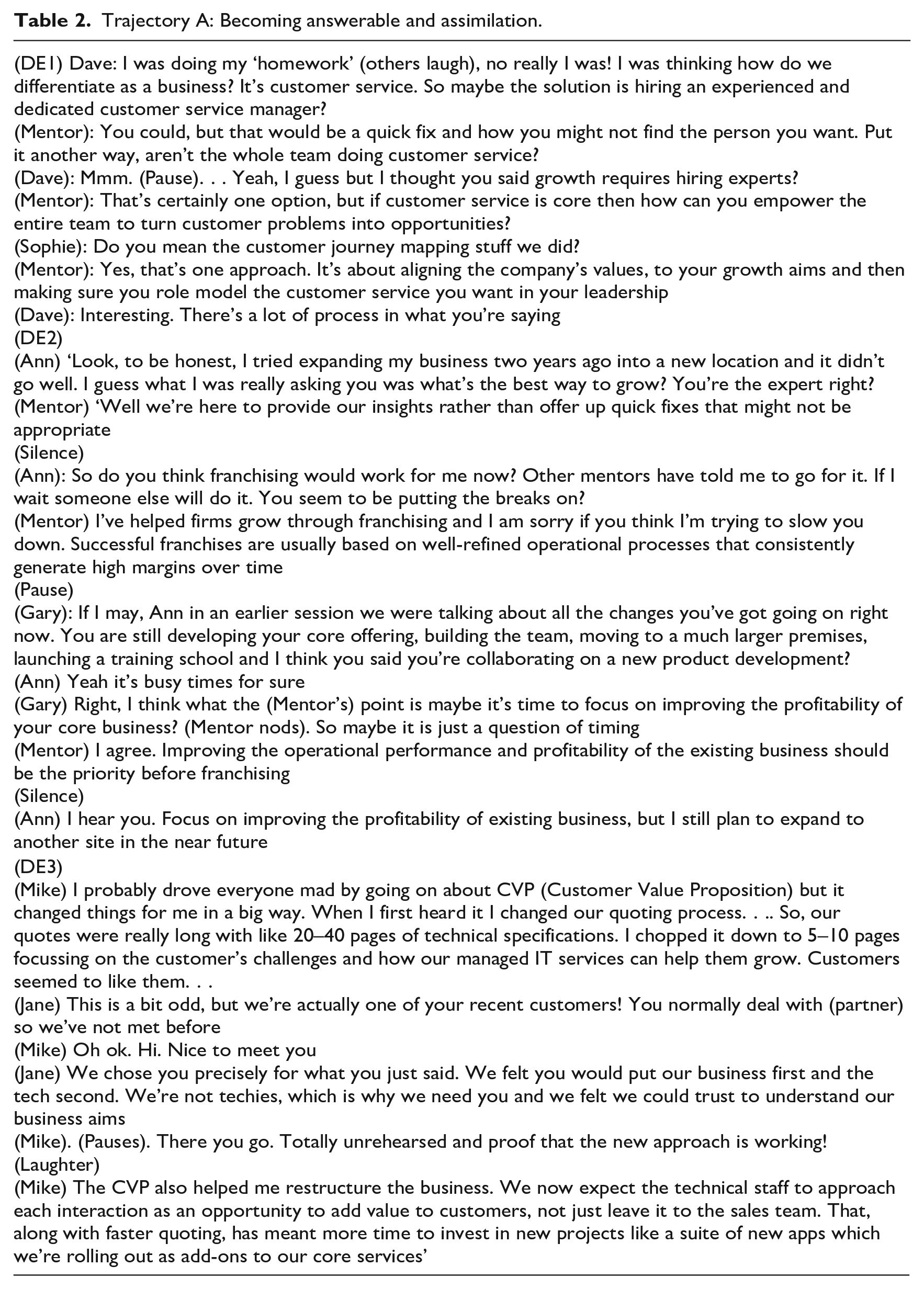
Nina’s reflection was typical of how dialogue in the programme connected a participant’s internal conversations with those of others. Such connection was encouraged as programme activities encouraged participants to pitch their growth plans to others. Extracts DE1 and 2 (Table 2) illustrate how interacting with mentors and other participants created opportunities to become answerable to others. Such responses which participants discussed as being ‘put on the spot’ by multiple views. For example, DE1 shows how Dave’s utterance about differentiating his firm was challenged by a mentor and another participant (Sophie interjects). Similarly, in DE2, Ann receives a challenge from a mentor as they discuss the merits of franchising, before another participant (Gary) adds his view on Ann’s growth activities. Such interactions required considerable effort to ‘stick with the process’ as Sarah described it. For those who did ‘stick with the process’, dialogue opened up new possibilities for constructing alternative futures about what growth is and how to achieve it. Three years after completing the programme, Tina reflected on her experience of how dialogic events encouraged her to evaluate her understanding of growth by interacting in dialogue with others:
A pivotal moment was the realisation early in the programme that I was focussing on the wrong part of my business. When we initially pitched our growth plans I switched to focus on my core business rather than new projects. I distinctly remember as the words were coming out of my mouth people had this look of like ‘really?’ on their faces. I can now see my plans sounded nuts. When I switched to discussing my (core business) I got more relevant feedback. Those initial outside conversations accelerated my decision to quickly quit offshoots, a shift that put my business on an upward trajectory it’s still following four years later. (Informal interview).
Tina’s reflection captures what some participants described as having ‘wake up moments’ as they were asked, sometimes for the first time, to verbally outline their growth plans. As such challenges and affirmations encouraged participants to become more responsive and answerable to others; it was noted how this encouraged a willingness to reflect upon and evaluate growth plans. As one stated, interacting with others was ‘like presenting to a quasi-board each workshop’.
Trajectory A: Becoming answerable and assimilation.
Assimilation
By becoming answerable to others during dialogue, participants reported becoming more aware of prevailing meanings and open to assimilating the words of others into their own. In DE3 (Table 2) Mike explained how hearing the term CVP (Customer Value Proposition), helped him rework his business. The extract was taken as Mike presented to a later cohort outlining his growth experiences; he described how he applied the term CVP to address the loss of competitiveness in his firm that he attributed to changes in the external environment (Hosted IT services) and inefficient internal processes. The extract details Mike’s account of how assimilating the term CVP enabled him to improve his quoting process and staff engagement. During his presentation, and entirely by chance, another participant (Jane) disclosed that her business had recently contracted to Mike’s firm with part of the rationale for this decision echoing Mike’s claim that using CVP had made the business less technical and more customer centric. Such changes had also created new sales upon which Mike could place an exact monetary value whilst this growth strategy had provided time, and retained earnings, to explore new opportunities such as novel app development.
Assimilation was also captured in growth posters which provided insights into the concepts participants had taken and applied from the programme. This included new words and graphics (e.g., 2 × 2 matrices) showing how language from the programme was used to inform growth plans; Appendix A2 illustrates a poster that included concepts and models being assimilated into a plan for succession. In particular, Andrew’s poster caught the attention of the faculty as it revealed that he had closed his existing business in order to open a new venture during the 12 month programme. The poster showed how declining margins convinced him to ‘reboot the company using the lean approach, blue oceans and MVPs’. In his oral presentation Andrew explained how a series of interactions with one of the mentors had helped him develop ‘a mindset where everything is open’. By assimilating the lean start-up approach, the poster revealed how this new ‘born global’ had, in 3 months, generated 50% of the annual turnover of the previous firm and achieved a successful crowdfunding campaign (530% funded).
Changing meaning-making
Evidence of ‘productive dialogue’ was demonstrated when participants assimilated and applied new meanings to inform future growth plans and activities; the range of such changes are summarised in Table 3. Productive dialogue could provide an impetus to change aspects of the business participants claimed they were already aware of, but had not yet taken steps to implement new activities. In DE4, Fasil referred to this as being encouraged to ‘grasp at nettles’ as such changes had previously been considered too daunting; but, applying new meanings assimilated during the programme reconstituted them as attainable. Reference was also made to how regular monthly meetings with other participants encouraged a greater sense of ‘accountability’ to make changes given the need to report back at the next workshop. These were typically related to adopting more competitive approaches in areas such as employment issues, sales targeting and operational performance. In DE4, Nadim and Fasil (co-founders in the same business) described how the programme had encouraged them to formalise the practice of taking time away from the business; this had enabled evaluation of appropriate decisions to increase competitiveness, such as investing in new ICT. In an informal interview, Nadim reflected that he entered the programme being ‘100% focused on getting cash in’ but realised ‘taking his foot off the accelerator’ was necessary to make adjustments that could sustain longer term growth. DE4 illustrates how productive dialogue enabled participants to, as Will described it, undertake ‘a multitude of refinements’.
Trajectory A: Changing founder meaning-making.
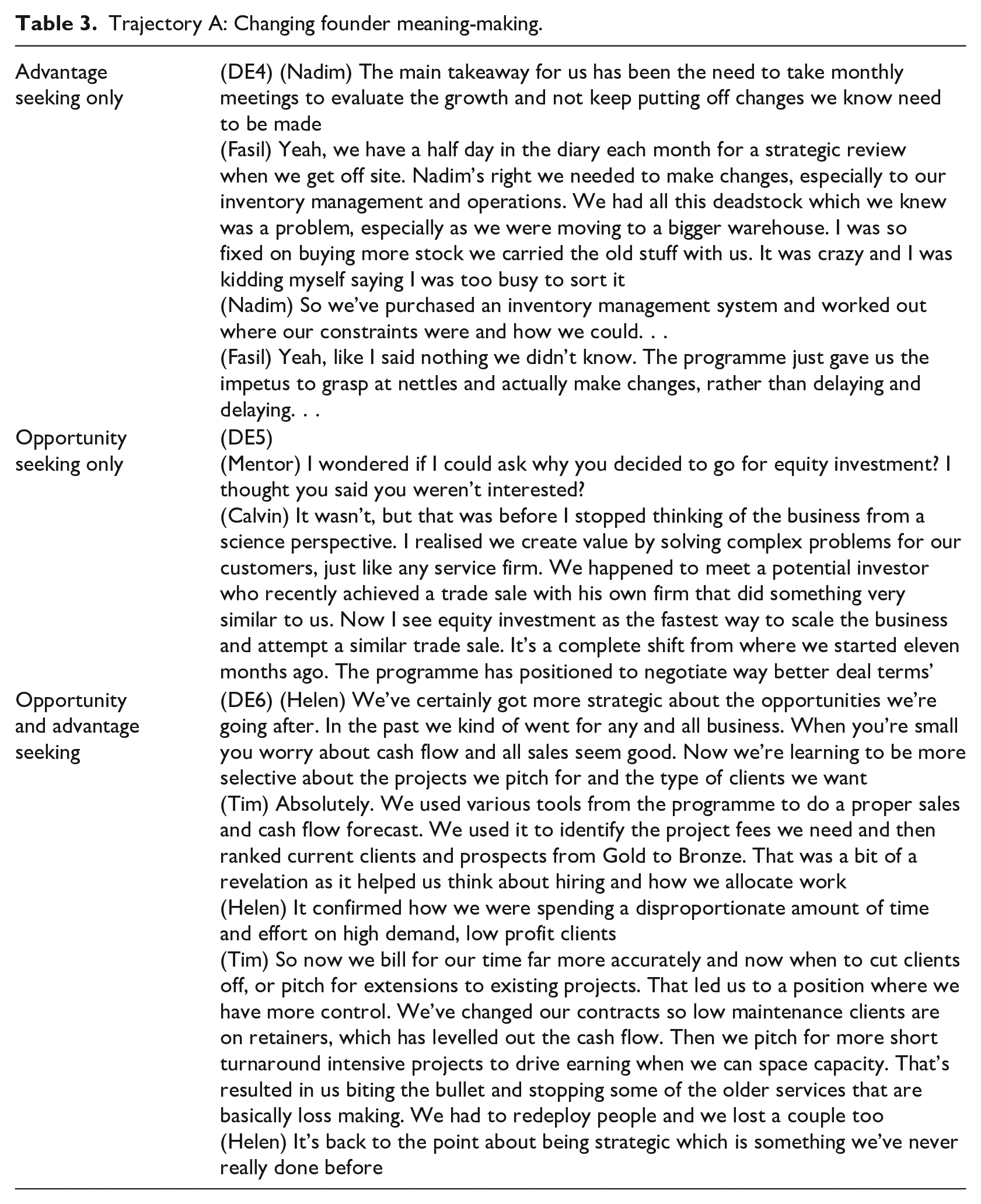
For others, productive dialogue encouraged changes in opportunity-seeking behaviour. In DE5, Calvin explained how his understanding of the potential growth opportunities for his firm had changed; he had been opposed to external equity investment, but his engagement with the programme had caused him to re-evaluate this stance. Consequently, he had pursued business angel investment as dialogue with mentors and guest entrepreneurs, with experience of equity-backed growth, had changed his perspective. As such, Calvin felt his approach to managing the firm had shifted from a ‘steady state organic approach’ to an ‘accelerated exit-oriented approach’.
The third category illustrates how productive dialogue could encourage changes in both opportunity and advantage seeking, often simultaneously. DE6 is an exchange between Tim who completed the programme and his business partner. The co-founders outlined how they applied various ‘tools’ from the programme to develop a more strategic approach to growth of their firm. Neither had received training, nor had management experience, so productive dialogue was invaluable to inform a more strategic approach to pursue opportunities and manage resources. Similarly, Simon explained how his firm had achieved growth by making changes to the opportunities they were pursuing, for example, geographical targeting and strategies to promote competitiveness in terms of pricing, sales strategy, targeting, hiring and investment. As he stated:
We applied the advice about experimenting with pricing to new enquiries from London. We doubled our fees within the M25 (London area) and won business. Clients who previously rejected our pitches explained how they assumed our work would be substandard because our prices were low. . .. So with the increased income we commissioned a lead generation company and hired an in-house business development manager. That provided access to larger organisations. . .. As we start to convert them we’re seeing bigger project budgets and are attracting super experienced (video) producers. We’ve also made investments into our studio which has nudged our production quality to a new level (Semi-structured interview).
This evidence demonstrates how productive dialogue could, through assimilation and application of new meanings, encourage participants to change their meaning-making. Change emerged as participants became more aware of, and willing to address, limitations and biases in their prevailing meaning-making. However, not all participants engaged with reflective meaning-making but rather, illustrated the effects of degenerative dialogue upon meaning-making.
Trajectory B: Degenerative dialogue
Unresponsiveness
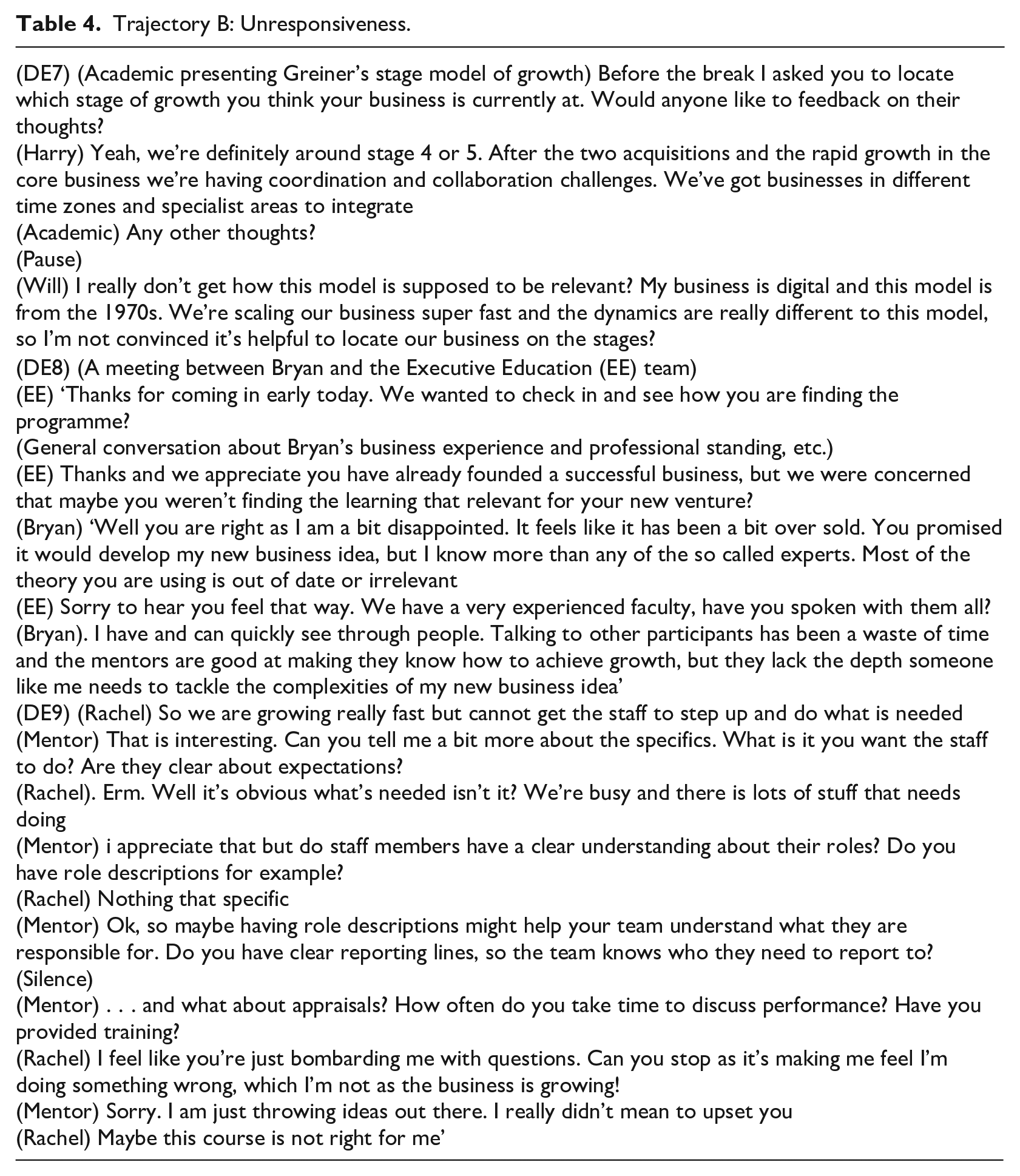
Although many participants had initially found dialogue with others challenging, this became easier as they became more comfortable with participating in dialogic events and engaged in co-construction of meaning, as outlined in trajectory A. So for example, Will’s reaction in DE7 (Table 4) outlines how he was unresponsive and dismissive of the input of others when discussing stage models of growth, claiming they were outdated. Eventually however, he became a highly engaged participant. During a presentation after completing the programme, Will explained how it helped ‘take his blinkers off’. After experiencing rapid growth (from 1 to 42 employees in 2 years), Will explained how the programme ‘made him question whether he really did know everything about growth’ as he reconsidered the need for HR expertise to create formal policies, something he had initially rejected illustrating a shift in attitudes or ‘shifting tracks’ as Wendy described it. However, for others this transition was either very slow, or just did not transpire.
Trajectory B: Unresponsiveness.
Being unresponsive to dialogic events could be prompted by disassociation from the content or theme being addressed and the particular speaker. This was captured in evaluation forms (see below) with references to the lack of relevance of corporate executives as speakers, the value of debates around equity finance for family firm founders or the abstract nature of academic theories.
Today’s session felt like the type of corporate training events. Exactly the type of thing I started my business to get away from. Very unhelpful. (Form, Cohort 1) Today was way too abstract. I can’t apply anything I heard today to my business. (Form, Cohort2) Some excellent presentations today, but as a family business we’re not looking for investment, so I’d like to have heard from others looking to grow from existing family owned assets (Form, Cohort 3).
Extracts DE8 and DE9 (Table 4) illustrate how some participants went further in rejecting the ideas and dialogue of other programme members. In DE8 we illustrate the defensiveness of Brian in the four workshops he attended where he interrupted and dismissed the views of other participants and eventually, such disruption led to him being the only participant asked to leave the programme. While an anomaly, his reasons for being unresponsive were raised by others. Overall, only seven participants left the programme; reasons included: ‘growth doesn’t work the same in my sector’; ‘I don’t have endless time to make the changes you are proposing’ and ‘what gives you the right to tell me what to do’. It later transpired that some of these participants were experiencing financial pressures and/or the founder was transitioning out of the role as founder-CEO.
Impermeability
In addition to unresponsiveness, participants also used language in more subtle ways to avoid assimilating the words of others by using ‘monologic intention’ (Bakhtin, 1986). Table 5 summarises three instances where monologue was used to inoculate a speaker from dialogue. ‘War stories’ (DE10/11) included instances where participants repeated previous experiences to indicate how they had successfully overcome problems in the past and as such, restating their achievements in order to prevent dialogue regarding alternative strategies and critical reflections. Retelling such stories protected participants from evaluating their previous actions and considering how things could have been done differently in light of challenges and suggestions from other participants. In DE10, Ashley retells a story he had told many times, in so doing and when refuting inputs from others, he just reaffirmed his actions rather than critically reflecting what he might have done differently. This revealed how stories could be used to prevent evaluation and address limitations and biases. Talking past and silencing others could also damage dialogue – illustrated in DE12 as Dave attempted to use monologue to dominate a small group activity. In this instance, he initially silenced others and so, prevented them from raising their concerns and questions. This was addressed by mentors and some other participants who, by interrupting and challenging, managed to disrupt the domination and so stifle the monologue.
Trajectory B: Impermeability.
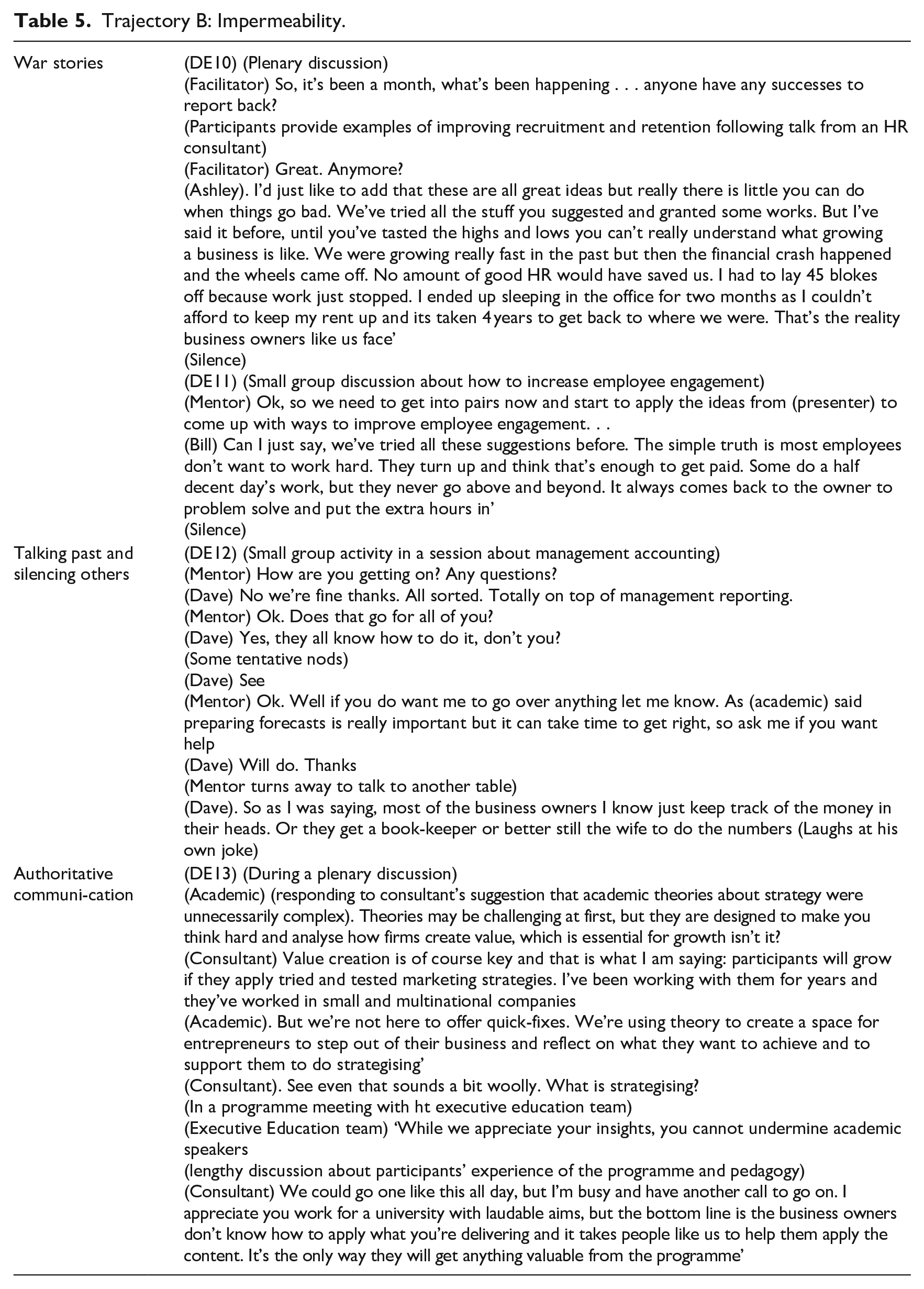
The third type of monologic intent arose when faculty overused authoritative communication. DE13 illustrates how two consultants acting as mentors used monologue, over a six month period, in an attempt to encourage participants to use their services. During this time, as indicated in DE13, they undermined the arguments and evidence presented by academic tutors redirecting authority to their voices as the route to attaining greater value from the programme. The second extract outlined in DE13 occurred in a programme meeting during which this behaviour was challenged prompting the justification that the expertise of the consultants was essential to make sense of the programme material. Such an approach was not only inappropriate but also created a monologue stifling participant dialogue; given such actions, they were asked to leave the programme team.
Academic faculty, particularly those without small business or executive education experience, were deemed to overuse authoritative utterances when, for example, seeking to persuade participants of the value of theoretical analyses. Such arguments could be described as ‘ground breaking’ or ‘significant contributions’ as they were published in ‘top tier journals’ but such claims did not resonate with participants as this meant little to them. This generated resistance as some faculty drew upon their professional authority to ‘lecture’ participants which stifled dialogue and prompted negative feedback:
(Gill) ‘Some sessions were too removed from the practical challenges I’m facing. The speaker’s ideas were interesting but not useful right now.’ (Informal interview) (Robert) ‘I don’t want to sound ungrateful, but that session was dry. I love hearing from other participants and the guest speakers provide some amazing insights, but I’m here to understand how to grow my business not to learn theory. I know others can find the academic speakers hard going for too little payback.’ (Informal interview) (Tim) ‘Being lectured to in workshop 2 was a big turn off. It took me five sessions to re-engage. I’d recommend you take another look at the sequencing and maybe reduce the time some academics have.’ (Programme evaluation form).
To be effective, and to be assimilated, it was necessary for academic faculty and consultants to ‘repurpose’ their arguments to ensure they were accessible and also represented a diversity of perspectives related to growth. As one consultant, who also became a mentor, reflected:
Business school faculty are always very nice, but their advice is often useless. It is not that they are ill informed, often they are very experienced and impeccably qualified, but they don’t recognise there is a lack of common understanding between business owners and faculty. Sometimes this can result in people not talking about the same thing. What’s made this programme different is that we’ve used the science of business knowledge to develop a common language about growth. (Informal interview)
Thus, when monologic intent was adopted, dialogic events were compressed. This prevented new meanings being assimilated to encourage evaluation of prevailing limitations and biases. When utterance boundaries remained impermeable, participants failed to benefit from provocation and juxtapositioning. Instead, monologic intent focused attention back to the speaker’s own meanings. Whether this was caused by participants or faculty, the effect was that monologue served to reproduce existing meanings.
Enduring meaning-making
The longitudinal effect of unresponsiveness and monologic intent meant that participants were prevented from co-constructing meaning. The evidence outlined above describes how degenerative dialogue could reproduce prevailing meanings. One manner in which to analyse the longitudinal effect of the programme was to identify those who had completed it but who still adhered to meanings they held at the point of entry. This was achieved by triangulating personal statements in the original application process with growth posters presented at completion and in addition, follow-up interviews with those for whom the dialogic events seemed to have little, or very minimal impact:
(Karen) My business is really specialised and I’ve not heard anyone who really understands what I’m trying to achieve. I appreciate there is some value in having general insights, but I cannot apply what I’ve heard. I kinda feel a bit cheated. Maybe there were too many ‘suits’ in your programme team?’ (Semi-structured interview) (Luke) ‘Would I recommend the programme to other business owners? Yes, but it wasn’t valuable for me. I’ve heard most of the material before. I’ve got an MBA already and there were very few surprises or new angles for me to try.’ (Programme evaluation form). (Jo) ‘My co-founders are very experienced entrepreneurs and I’m the techie one with the PhD. I don’t really have the opportunity to implement my views on the commercial direction, as they make the strategic decisions. I thought the programme would help me gain new insights into business, but it’s just reinforced my view that it is 99% instinct and 1% rigour.’(Informal interview)
Karen echoed other participants who claimed the programme lacked presenters and contributors who understood their particular sectors. Typically this view was expressed by those in the cultural sector who felt the programme was too ‘corporate’ or ‘full of suits’. For those who had a formal qualification in business studies such as an MBA or Masters degree, elements of the programme revisited familiar ideas and topics and so, the dialogue was less relevant as it was for the small group who held technical degrees, but had limited experience in business. Such responses illustrate how prevailing meanings could endure when participants remained resistant to the meanings circulating within the programme’s language collective and so, hindering the ability to engage in dialogic events to support growth activities.
Thus, degenerative dialogue emerged when participants were unresponsive to the input of others; used monologic intent generating impermeable utterance boundaries and dismissed business education. Over time this promoted degenerative dialogue whereby prevailing meanings endured. We found no examples of new opportunity or advantage-seeking behaviours related to growth where degenerative dialogue was repeatedly used. Trajectory B therefore, demonstrates how access to dialogic events did not automatically generate change in meaning-making. Instead, the mechanisms outlined above were used to ensure prevailing meanings endured, limiting the degree to which participants developed the awareness and insight required to pursue venture growth.
Discussion
Our analysis illustrates how founder meaning could change or endure during dialogue in a University small firm growth programme. By adopting a dialogic approach, we extend understanding about the micro-processes of founder meaning-making. This is captured in our conceptual model (Figure 1), illustrating how participating in dialogic events in the programme influenced, or conversely did not influence, founder meaning-making. Our conceptual model commences when participants joined the programme at which point they brought their prevailing meanings about what growth is, and how to achieve it (left side, Figure 1). The application process revealed that founders developed their understanding of growth from personal experiences and public cultural meanings such as media representations of growth, theories and policies. Joining the programme gave access to a dialogic space (Dimov et al., 2021) composed of other founders and a diverse range of presenters (Figure 1, solid line box illustrating how dialogic events emerge within a specific setting) and who shared their expertise and understanding about venture growth and related processes.
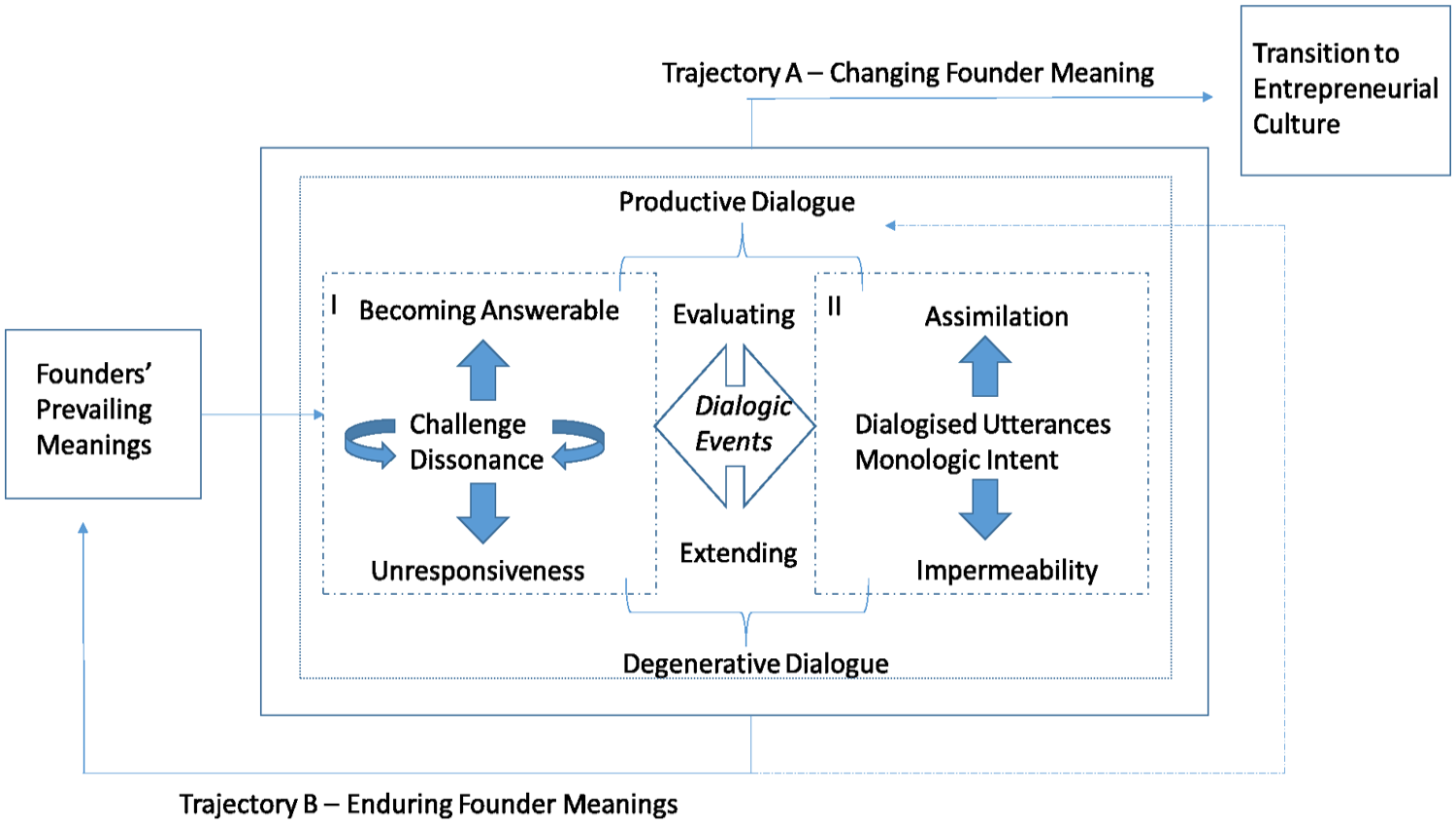
Micro-processes of founder meaning-making within dialogic events.
The two dashed boxes in Figure 1 (I and II) illustrate how dialogic events created a fulcrum for inter-subjective relational co-construction of meaning-making (Cunliffe et al., 2014). Box I illustrates how dialogue generated challenges and dissonance as participants engaged with polyphony. Box II illustrates how dialogue could encourage new meanings to be assimilated. When in the mechanisms in Boxes I and II were activated, dialogue generated change in founder meaning-making by encouraging evaluation and extension to prevailing meaning. When the mechanisms in Boxes I and II were disabled, for instance by monologic intent, founder meaning-making remained unchanged. These differences are illustrated in Trajectory A and B.
Trajectory A shows how participants could, after initial resistance, respond to challenges and resolve dissonance (Box I), this shift encouraged participants to become answerable to others and open to the possibilities of inter-subjective co-construction of meaning. It also illustrates how assimilation (Box II), encouraged new meaning-making. This shapes how dialogue could 1. encourage founders to become more aware of limitations and biases, and 2. encourage new alternative future growth plans and activities relevant for changing their organisation (Vaara et al., 2016). Accordingly, Trajectory A illustrates how dialogue could encourage change in founder meaning-making (Top arrow).
Trajectory B illustrates the effects of degenerative dialogue. This occurred when participants remained resistant so, continued to avoid and so, silence dialogic events. This is represented in Box I as unresponsiveness which minimised the possibility of dialogic events that could facilitate the co-construction of meaning. Trajectory B also illustrates how monologic intent, from both faculty and participants, could reinforce prevailing meanings when preventing assimilation. When degenerative dialogue was used repeatedly, the founders reproduced biases and limitations and did not assimilate new meanings. As such, degenerative dialogue did not increase awareness or encourage new meanings relevant for constructing alternative future growth plans (trajectory B is illustrated in Figure 1 – the line connecting dialogic events back to prevailing founder meanings). This reveals how language could be used, for example in monologic intent, to close down the possibilities of dialogue to generate changes such as those represented in Trajectory A. Finally, we note that monologic intent was often a temporary response, for example to a specific speaker or topic. This was resolved when participants re-engaged in dialogue in ways that were generative of new meanings relevant for extending their growth strategy. This is illustrated in Figure 1 by the dashed line connecting Trajectory B back to Trajectory A.
By adopting a qualitative processual approach (Jarzabkowski et al., 2017), our analysis provides insights into how dialogue influences the micro-processes of founder meaning-making. Figure 1 illustrates how dialogic events could, but did not always, influence such meaning-making with relation to venture growth. As such, it describes how founder meaning-making changes or endures during dialogue. The evidence gathered from the programme reinforces the notion that meaning-making is more likely to change in small-scale networks (Patterson, 2014). We contribute to such arguments by revealing the mechanisms whereby dialogue encourages reconfiguration, or indeed does not, in founder meaning-making.
Limitations and future research
We acknowledge a number of limitations of this study. First, we applied an interpretive qualitative approach to reveal the motors or change and mechanisms used to constitute meaning-making (Bansal et al., 2018). Our analysis therefore, focuses upon the communicative episodes shaping the micro-processes of meaning-making (Spee and Jarzabkowski, 2017). Another possibility is to use dialogic theory built more upon theories of cognition to explore how dialogue influences the micro-processes of entrepreneurial cognition and growth (Wright and Stigliani, 2012). This study was undertaken in the UK, within a university business school and so, is limited to a single cultural context. The participants were founders who had expressed an interest in growing their ventures and therefore were, to some extent, open to interacting with others and developing their understanding of growth. There is now scope to explore how such programmes in other settings may, or may not change founder meaning-making. Future research could also adopt a more critical approach, for instance to analyse how intersectionality (e.g., age, ethnicity, gender, occupation, etc.) influences dialogue in University growth programmes. Our analysis suggests that some voices may be afforded a more dominant role in specific contexts; for instance, the masculinised voices of investors and corporate executives. There is clearly a gap in exploring how, for example, gender and other social positions influence the way language is used to constitute and perform stories of integration. Such critical research is relevant for elaborating how the generative possibilities of dialogue in business schools may legitimise dominant views about growth, while excluding and delegitimising alternative ideas, such as those questioning the impact of economic activity upon natural systems and widening social inequalities. Finally, we note there is much scope to examine how dialogic space in business school growth programmes contributes to entrepreneurial learning (Holcomb et al., 2009; Wang and Chugh, 2014), especially learning that contributes to effective integration of opportunity and advantage-seeking behaviours (Ireland et al., 2023).
Conclusion
Within this paper, we advance understanding about the process through which founder meaning-making endures, or changes, in relation to venture growth (DeSantola and Gulati, 2017). We show how dialogue informs the micro-processes underpinning founder meaning-making. We identify two key mechanisms, ‘becoming answerable’ and ‘assimilation’, that inform founder meaning-making. When activated these mechanisms create a trajectory we term ‘productive’ as prevailing meaning (including any unhelpful biases) was evaluated and extended as new meanings about how to create value and growth were assimilated and applied. The second trajectory we term ‘degenerative’ in which prevailing meaning was not evaluated and monologue was used to prevent extended meaning-making. Here, we address the empirical and theoretical gap in understanding through which founder meanings endure and change is seen as a limitation in growth theory (De Santola and Gulati, 2017). This has implications for developing theories of venture growth by highlighting how productive dialogue has the potential to influence founder meaning-making by encouraging an entrepreneurial stance capable of sustaining opportunity and advantage seeking (Ireland et al., 2003). However, as noted, degenerative dialogue preventing new meanings from emerging may reproduce enduring meanings and not result in changes that may encourage strategic entrepreneurship. In other words, we explain how dialogue is constitutive of founders changing their meaning-making and how this is not necessarily automatic.
We contribute to extant research analysing how language use within dialogue shapes entrepreneurship (Dimov, 2020; Steyaert, 2004) and strategy (Vaara and Langley, 2021). Specifically, we show how dialogic theory is relevant for analysing how polyphony generated in small networks encourages reconfiguration of founder meaning-making. Our analysis adds to research emphasising how meaning is generated in dialogue as a relational achievement through inter-subjective communication (Cunliffe et al., 2014; Fusaroli et al., 2014; Renfrew, 2014). Accordingly, our study advances existing research exploring how dialogue contributes to the creation of new knowledge (Baralou and Tsoukas, 2015; Tsoukas, 2009), proto-opportunities (Fletcher and Watson, 2007), entrepreneurial storytelling (O’Connor, 2002) dynamic capabilities (Salvato and Vassolo, 2018) and strategic change (Spee and Jarzabkowski, 2017). In effect, we demonstrate how dialogue can encourage change through a co-construction of meaning-making with others. In addition, we demonstrate how dialogue in small networks is vital for cultural configuration (Patterson, 2014), as it provides founders with a rare opportunity to encounter and interpret multiple meanings about growth (Leitch et al., 2010). This has implications for developing theory analysing how cultural processes, such as those activated in dialogue, enable founders to develop insight (Schein, 1983) and consciousness (Penrose, 1959) necessary for making a transition to an entrepreneurial culture capable of sustaining opportunity and advantage seeking (Ireland et al., 2003).
We reveal that dialogue may, but not in every case, encourage change in founder meaning-making. This argument informs understanding how cultural meanings persist or change during the transition from founder-based meaning systems to a more professionally managed organisation (DeSantola and Gulati, 2017). Moreover, demonstrating how dialogue can encourage founders to change their understanding of growth adds to knowledge about how founders can address limits to their personal values and beliefs as they come under pressure during growth (Achtenhagen et al., 2010; Schein, 1983). By conceptualising founder meaning-making as an example of cultural configuration, we show how dialogue can reduce the effects of personal liabilities that limit venture growth and encourage founders to develop new ‘theories’ about growth and appreciation of blueprints required to build an effective organisation (Aldrich and Yang, 2012; Wasserman, 2017).
On a practical basis, our arguments reveal how dialogue within University business school programmes can contribute to growth. The value of dialogic events may easily be overlooked as a ‘soft measure’ if programmes are evaluated by ‘hard metrics’ such as increased employment, turnover, profits and investment raised. We argue that dialogic events provide founders with a valuable, inimitable and rare opportunity to evaluate their meaning-making with others. Accordingly, dialogue is an under-appreciated means through which University programmes may contribute to broader economic growth.
Footnotes
Appendix
Acknowledgements
The authors are grateful to Susan Marlow for her generous insights and thoughtful suggestions on earlier versions of this article.
Funding
The author(s) received no financial support for the research, authorship, and/or publication of this article.
